ABG Analysis
Dr. Gaurav Jain
Indications
Assess the adequacy of ventilation and oxygenation
Diagnosis of severity of respiratory failure
Assess prognosis in critically ill
Cardiopulmonary surgery
Sleep studies
Exercise testing
CONTRAINDICATIONS
Negative results of a modified Allen test
Arterial puncture should not be performed through a lesion or
through or distal to a surgical
femoral punctures should not be performed outside the
hospital
A coagulopathy or medium-to-high-dose anticoagulation (eg,
heparin or coumadin, streptokinase, and TPA but not aspirin)
a relative contraindication for arterial puncture
Distal to AV fistula
Sampling
Steady state of oxygenation
10 min (healthy)
20 min (COPD)
Site (order of choice) (Don’t forget to apply LA)
Radial (check for collateral)
Dorsalis pedis
Bracheal
Femoral
Arterialized ear lobe samples: in neonate/small children
AARC Clinical Practice Guideline. RESPIRATORY CARE [Respir Care 1992(8);37:891–897]
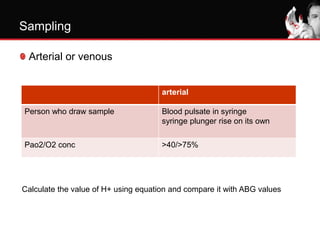
Arterial or venous
Sampling
arterial
Person who draw sample Blood pulsate in syringe
syringe plunger rise on its own
Pao2/O2 conc >40/>75%
Calculate the value of H+ using equation and compare it with ABG values
Sampling
Excess heparin cause (keep <8 units) (Rinse)
a drop in PaCO2 (dilutional)
Rise in PaO2 (dilutional)
No change in PH
.
Arterial blood gas syringe including filter member United States Patent 5807344
Sampling
The pH, remains unchanged because of the vast buffering
potential of oxyhemoglobin and plasma proteins;
for a hemoglobin concentration of 15 grams per dl, 1.62
X107 nm of hydrogen are required to lower the pH from
7.40 to 7.15.
Arterial blood gas syringe including filter member United States Patent 5807344
Air bubble
If sample PaO2<160 – rise
If sample PaO2>160 – fall
Delay in running the sample
Decrease in PaO2
At 0 deg C- stable for 1 hr
Acceptable- 10-15 min at room temp
The PaO2 from subjects with elevated WBC dec
very rapidly. Immediate chilling is necessary
Arterial Blood Gas Analysis by Susan Blonshine, BS, RRT, RPFT. AARC Tımes February 1999
Sampling
Volume of blood requirement: a
blood sample of 2-4 mL be drawn
After drawing the sample firm
pressure must be applied for at
least 2 min
Sampling
AARC Clinical Practice Guideline. RESPIRATORY CARE [Respir Care 1992(8);37:891–897]
FREQUENCY:
depend on the clinical status of the
patient and the indication for
performing the procedure
Arterial line placed if>4 sample
drawn/day
not on an arbitrarily designated time
or frequency.
Sampling
AARC Clinical Practice Guideline. RESPIRATORY CARE [Respir Care 1992(8);37:891–897]
Browning JA, Kaiser DL, Durbin CG. The effect of guidelines on the appropriate use of arterial blood gas analysis in the intensive
care unit. Respir Care 1989; 34:269-276.
HAZARDS/COMPLICATION
Hematoma
Arteriospasm
Air or clotted-blood emboli
Anaphylaxis from local anesthestic
Introduction of contagion
Hemorrhage
Trauma to the vessel
Arterial occlusion
vasovagal response
Pain
Documentation in record
When a sample is obtained,
date,
time,
patient's body temperature,
position,
activity level,
respiratory rate,
sample site,
results of Allen test,
inspired oxygen concentration
mode of supported ventilation.
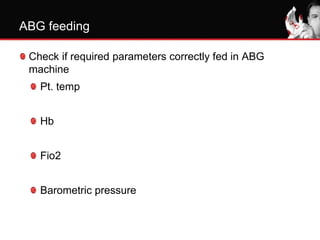
ABG feeding
Check if required parameters correctly fed in ABG
machine
Pt. temp
Hb
Fio2
Barometric pressure
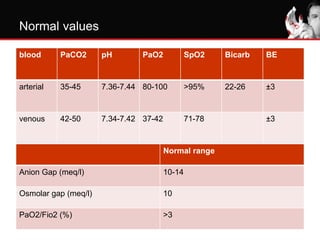
Normal values
blood PaCO2 pH PaO2 SpO2 Bicarb BE
arterial 35-45 7.36-7.44 80-100 >95% 22-26 ±3
venous 42-50 7.34-7.42 37-42 71-78 ±3
Normal range
Anion Gap (meq/l) 10-14
Osmolar gap (meq/l) 10
PaO2/Fio2 (%) >3
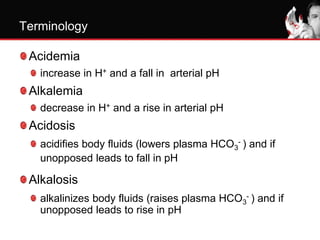
Terminology
Acidemia
increase in H+ and a fall in arterial pH
Alkalemia
decrease in H+ and a rise in arterial pH
Acidosis
acidifies body fluids (lowers plasma HCO3
- ) and if
unopposed leads to fall in pH
Alkalosis
alkalinizes body fluids (raises plasma HCO3
- ) and if
unopposed leads to rise in pH
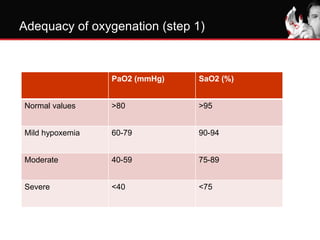
Adequacy of oxygenation (step 1)
PaO2 (mmHg) SaO2 (%)
Normal values >80 >95
Mild hypoxemia 60-79 90-94
Moderate 40-59 75-89
Severe <40 <75
Adequacy of oxygenation (step 1)
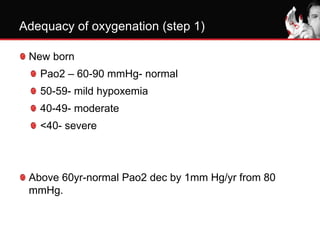
New born
Pao2 – 60-90 mmHg- normal
50-59- mild hypoxemia
40-49- moderate
<40- severe
Above 60yr-normal Pao2 dec by 1mm Hg/yr from 80
mmHg.
Adequacy of oxygenation (step 1)
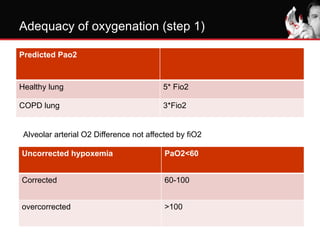
Predicted Pao2
Healthy lung 5* Fio2
COPD lung 3*Fio2
Uncorrected hypoxemia PaO2<60
Corrected 60-100
overcorrected >100
Alveolar arterial O2 Difference not affected by fiO2
Acidemia/alkalosis (step 2)
Classify pH: 7.4 correspond to H conc. of 40
Mild 7.3-7.34 7.46-7.5
Moderate 7.20-7.29 7.51-7.54
Severe <7.2 7.55-7.8
Incompatible with life <6.8 >7.8
Metabolic/respiratory (step 3)
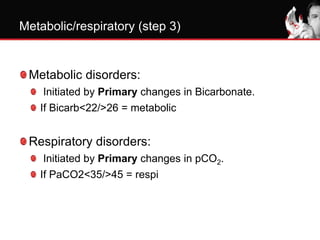
Metabolic disorders:
Initiated by Primary changes in Bicarbonate.
If Bicarb<22/>26 = metabolic
Respiratory disorders:
Initiated by Primary changes in pCO2.
If PaCO2<35/>45 = respi
If Respiratory (acute or chronic) (step 4)
Acute respiratory acidosis/alkalosis (pH~7.4)
∆pH = 0.008* ∆paCO2
Chronic respiratory acidosis/alkalosis (pH~7.4)
∆pH = 0.003* ∆paCO2
Compensation (step 5)
Respi acidosis High paco2 High bicarb
Respi alkalosis low paco2 low bicarb
Meta acidosis low bicarb low paco2
Meta alkalosis High bicarb High paco2
Compensation (step 5)
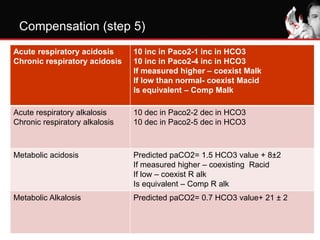
Acute respiratory acidosis
Chronic respiratory acidosis
10 inc in Paco2-1 inc in HCO3
10 inc in Paco2-4 inc in HCO3
If measured higher – coexist Malk
If low than normal- coexist Macid
Is equivalent – Comp Malk
Acute respiratory alkalosis
Chronic respiratory alkalosis
10 dec in Paco2-2 dec in HCO3
10 dec in Paco2-5 dec in HCO3
Metabolic acidosis Predicted paCO2= 1.5 HCO3 value + 8±2
If measured higher – coexisting Racid
If low – coexist R alk
Is equivalent – Comp R alk
Metabolic Alkalosis Predicted paCO2= 0.7 HCO3 value+ 21 ± 2
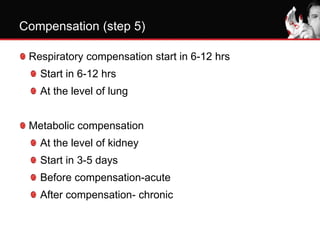
Compensation (step 5)
Respiratory compensation start in 6-12 hrs
Start in 6-12 hrs
At the level of lung
Metabolic compensation
At the level of kidney
Start in 3-5 days
Before compensation-acute
After compensation- chronic
Metabolic acidosis (high/normal AG)(step 6)
Anion gap or UA-UC = Na- Cl + HCO3
Normal range= 12±2 meq/l
Influence of albumin= for each gm decrease in albumin
AG decreases by 2.5
Adjusted AG= observed AG+2.5[4.5-albumin]
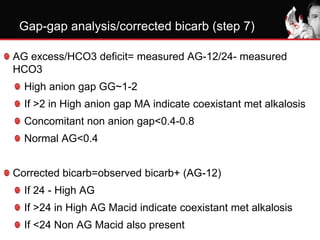
Gap-gap analysis/corrected bicarb (step 7)
AG excess/HCO3 deficit= measured AG-12/24- measured
HCO3
High anion gap GG~1-2
If >2 in High anion gap MA indicate coexistant met alkalosis
Concomitant non anion gap<0.4-0.8
Normal AG<0.4
Corrected bicarb=observed bicarb+ (AG-12)
If 24 - High AG
If >24 in High AG Macid indicate coexistant met alkalosis
If <24 Non AG Macid also present
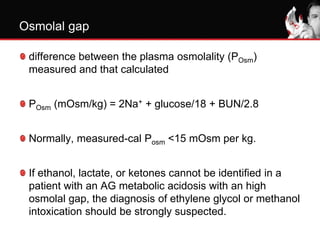
Osmolal gap
difference between the plasma osmolality (POsm)
measured and that calculated
POsm (mOsm/kg) = 2Na+ + glucose/18 + BUN/2.8
Normally, measured-cal Posm <15 mOsm per kg.
If ethanol, lactate, or ketones cannot be identified in a
patient with an AG metabolic acidosis with an high
osmolal gap, the diagnosis of ethylene glycol or methanol
intoxication should be strongly suspected.
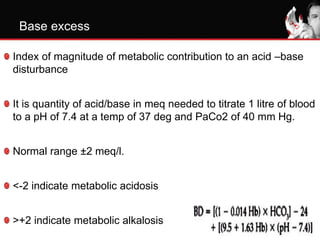
Base excess
Index of magnitude of metabolic contribution to an acid –base
disturbance
It is quantity of acid/base in meq needed to titrate 1 litre of blood
to a pH of 7.4 at a temp of 37 deg and PaCo2 of 40 mm Hg.
Normal range ±2 meq/l.
<-2 indicate metabolic acidosis
>+2 indicate metabolic alkalosis
Thank you

ABG Analysis (3).pptx

  • 1.
  • 2.
    Indications Assess the adequacyof ventilation and oxygenation Diagnosis of severity of respiratory failure Assess prognosis in critically ill Cardiopulmonary surgery Sleep studies Exercise testing
  • 3.
    CONTRAINDICATIONS Negative results ofa modified Allen test Arterial puncture should not be performed through a lesion or through or distal to a surgical femoral punctures should not be performed outside the hospital A coagulopathy or medium-to-high-dose anticoagulation (eg, heparin or coumadin, streptokinase, and TPA but not aspirin) a relative contraindication for arterial puncture Distal to AV fistula
  • 4.
    Sampling Steady state ofoxygenation 10 min (healthy) 20 min (COPD) Site (order of choice) (Don’t forget to apply LA) Radial (check for collateral) Dorsalis pedis Bracheal Femoral Arterialized ear lobe samples: in neonate/small children AARC Clinical Practice Guideline. RESPIRATORY CARE [Respir Care 1992(8);37:891–897]
  • 5.
    Arterial or venous Sampling arterial Personwho draw sample Blood pulsate in syringe syringe plunger rise on its own Pao2/O2 conc >40/>75% Calculate the value of H+ using equation and compare it with ABG values
  • 6.
    Sampling Excess heparin cause(keep <8 units) (Rinse) a drop in PaCO2 (dilutional) Rise in PaO2 (dilutional) No change in PH . Arterial blood gas syringe including filter member United States Patent 5807344
  • 7.
    Sampling The pH, remainsunchanged because of the vast buffering potential of oxyhemoglobin and plasma proteins; for a hemoglobin concentration of 15 grams per dl, 1.62 X10⁷ nm of hydrogen are required to lower the pH from 7.40 to 7.15. Arterial blood gas syringe including filter member United States Patent 5807344
  • 8.
    Air bubble If samplePaO2<160 – rise If sample PaO2>160 – fall Delay in running the sample Decrease in PaO2 At 0 deg C- stable for 1 hr Acceptable- 10-15 min at room temp The PaO2 from subjects with elevated WBC dec very rapidly. Immediate chilling is necessary Arterial Blood Gas Analysis by Susan Blonshine, BS, RRT, RPFT. AARC Tımes February 1999 Sampling
  • 9.
    Volume of bloodrequirement: a blood sample of 2-4 mL be drawn After drawing the sample firm pressure must be applied for at least 2 min Sampling AARC Clinical Practice Guideline. RESPIRATORY CARE [Respir Care 1992(8);37:891–897]
  • 10.
    FREQUENCY: depend on theclinical status of the patient and the indication for performing the procedure Arterial line placed if>4 sample drawn/day not on an arbitrarily designated time or frequency. Sampling AARC Clinical Practice Guideline. RESPIRATORY CARE [Respir Care 1992(8);37:891–897] Browning JA, Kaiser DL, Durbin CG. The effect of guidelines on the appropriate use of arterial blood gas analysis in the intensive care unit. Respir Care 1989; 34:269-276.
  • 11.
    HAZARDS/COMPLICATION Hematoma Arteriospasm Air or clotted-bloodemboli Anaphylaxis from local anesthestic Introduction of contagion Hemorrhage Trauma to the vessel Arterial occlusion vasovagal response Pain
  • 12.
    Documentation in record Whena sample is obtained, date, time, patient's body temperature, position, activity level, respiratory rate, sample site, results of Allen test, inspired oxygen concentration mode of supported ventilation.
  • 13.
    ABG feeding Check ifrequired parameters correctly fed in ABG machine Pt. temp Hb Fio2 Barometric pressure
  • 14.
    Normal values blood PaCO2pH PaO2 SpO2 Bicarb BE arterial 35-45 7.36-7.44 80-100 >95% 22-26 ±3 venous 42-50 7.34-7.42 37-42 71-78 ±3 Normal range Anion Gap (meq/l) 10-14 Osmolar gap (meq/l) 10 PaO2/Fio2 (%) >3
  • 15.
    Terminology Acidemia increase in H+and a fall in arterial pH Alkalemia decrease in H+ and a rise in arterial pH Acidosis acidifies body fluids (lowers plasma HCO3 - ) and if unopposed leads to fall in pH Alkalosis alkalinizes body fluids (raises plasma HCO3 - ) and if unopposed leads to rise in pH
  • 16.
    Adequacy of oxygenation(step 1) PaO2 (mmHg) SaO2 (%) Normal values >80 >95 Mild hypoxemia 60-79 90-94 Moderate 40-59 75-89 Severe <40 <75
  • 17.
    Adequacy of oxygenation(step 1) New born Pao2 – 60-90 mmHg- normal 50-59- mild hypoxemia 40-49- moderate <40- severe Above 60yr-normal Pao2 dec by 1mm Hg/yr from 80 mmHg.
  • 18.
    Adequacy of oxygenation(step 1) Predicted Pao2 Healthy lung 5* Fio2 COPD lung 3*Fio2 Uncorrected hypoxemia PaO2<60 Corrected 60-100 overcorrected >100 Alveolar arterial O2 Difference not affected by fiO2
  • 19.
    Acidemia/alkalosis (step 2) ClassifypH: 7.4 correspond to H conc. of 40 Mild 7.3-7.34 7.46-7.5 Moderate 7.20-7.29 7.51-7.54 Severe <7.2 7.55-7.8 Incompatible with life <6.8 >7.8
  • 20.
    Metabolic/respiratory (step 3) Metabolicdisorders: Initiated by Primary changes in Bicarbonate. If Bicarb<22/>26 = metabolic Respiratory disorders: Initiated by Primary changes in pCO2. If PaCO2<35/>45 = respi
  • 21.
    If Respiratory (acuteor chronic) (step 4) Acute respiratory acidosis/alkalosis (pH~7.4) ∆pH = 0.008* ∆paCO2 Chronic respiratory acidosis/alkalosis (pH~7.4) ∆pH = 0.003* ∆paCO2
  • 22.
    Compensation (step 5) Respiacidosis High paco2 High bicarb Respi alkalosis low paco2 low bicarb Meta acidosis low bicarb low paco2 Meta alkalosis High bicarb High paco2
  • 23.
    Compensation (step 5) Acuterespiratory acidosis Chronic respiratory acidosis 10 inc in Paco2-1 inc in HCO3 10 inc in Paco2-4 inc in HCO3 If measured higher – coexist Malk If low than normal- coexist Macid Is equivalent – Comp Malk Acute respiratory alkalosis Chronic respiratory alkalosis 10 dec in Paco2-2 dec in HCO3 10 dec in Paco2-5 dec in HCO3 Metabolic acidosis Predicted paCO2= 1.5 HCO3 value + 8±2 If measured higher – coexisting Racid If low – coexist R alk Is equivalent – Comp R alk Metabolic Alkalosis Predicted paCO2= 0.7 HCO3 value+ 21 ± 2
  • 24.
    Compensation (step 5) Respiratorycompensation start in 6-12 hrs Start in 6-12 hrs At the level of lung Metabolic compensation At the level of kidney Start in 3-5 days Before compensation-acute After compensation- chronic
  • 25.
    Metabolic acidosis (high/normalAG)(step 6) Anion gap or UA-UC = Na- Cl + HCO3 Normal range= 12±2 meq/l Influence of albumin= for each gm decrease in albumin AG decreases by 2.5 Adjusted AG= observed AG+2.5[4.5-albumin]
  • 26.
    Gap-gap analysis/corrected bicarb(step 7) AG excess/HCO3 deficit= measured AG-12/24- measured HCO3 High anion gap GG~1-2 If >2 in High anion gap MA indicate coexistant met alkalosis Concomitant non anion gap<0.4-0.8 Normal AG<0.4 Corrected bicarb=observed bicarb+ (AG-12) If 24 - High AG If >24 in High AG Macid indicate coexistant met alkalosis If <24 Non AG Macid also present
  • 27.
    Osmolal gap difference betweenthe plasma osmolality (POsm) measured and that calculated POsm (mOsm/kg) = 2Na+ + glucose/18 + BUN/2.8 Normally, measured-cal Posm <15 mOsm per kg. If ethanol, lactate, or ketones cannot be identified in a patient with an AG metabolic acidosis with an high osmolal gap, the diagnosis of ethylene glycol or methanol intoxication should be strongly suspected.
  • 28.
    Base excess Index ofmagnitude of metabolic contribution to an acid –base disturbance It is quantity of acid/base in meq needed to titrate 1 litre of blood to a pH of 7.4 at a temp of 37 deg and PaCo2 of 40 mm Hg. Normal range ±2 meq/l. <-2 indicate metabolic acidosis >+2 indicate metabolic alkalosis
  • 29.