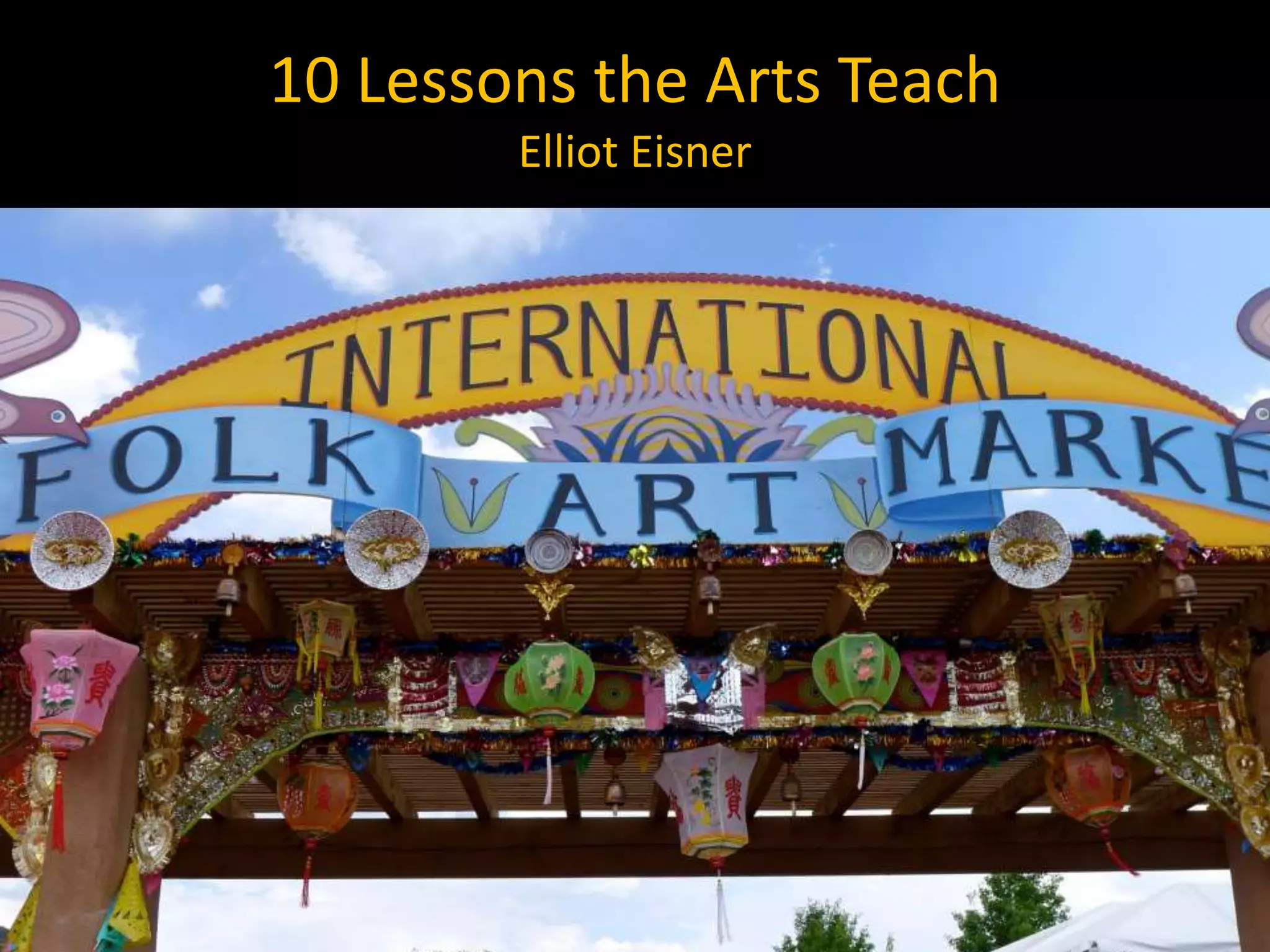
10 Lessons the Arts Teach
Elliot Eisner
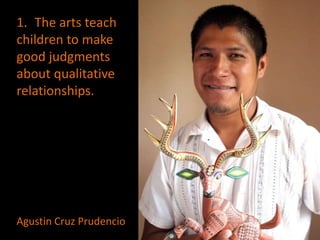
1. The arts teach
children to make
good judgments
about qualitative
relationships.
Agustin Cruz Prudencio
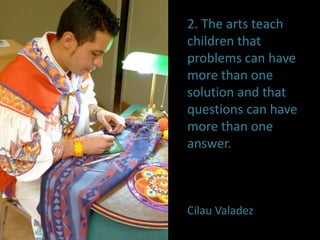
2. The arts teach
children that
problems can have
more than one
solution and that
questions can have
more than one
answer.
Cilau Valadez
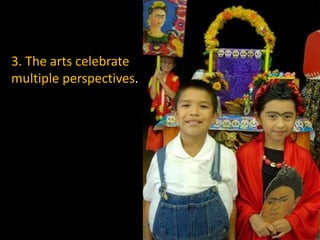
3. The arts celebrate
multiple perspectives.
The arts teach children that in complex forms of problem solving purposes are
ldom fixed, but change with circumstance and opportunity.
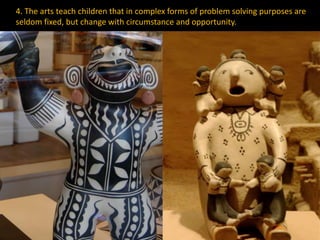
4. The arts teach children that in complex forms of problem solving purposes are
seldom fixed, but change with circumstance and opportunity.
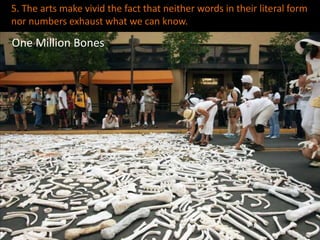
5. The arts make vivid the fact that neither words in their literal form
nor numbers exhaust what we can know.
One Million Bones
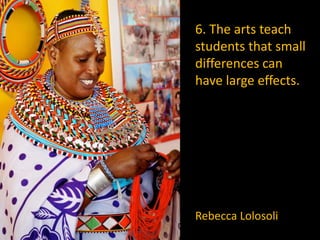
6. The arts teach
students that small
differences can
have large effects.
Rebecca Lolosoli
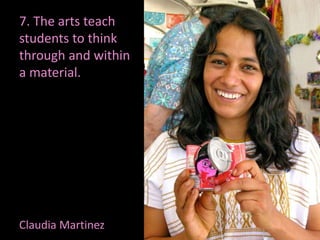
7. The arts teach
students to think
through and within
a material.
Claudia Martinez
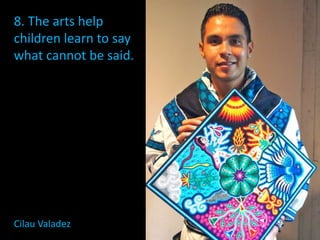
8. The arts help
children learn to say
what cannot be said.
Cilau Valadez
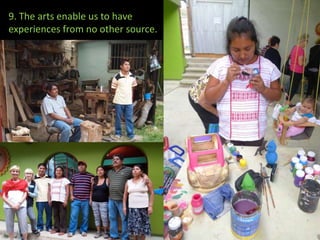
9. The arts enable us to have
experiences from no other source.
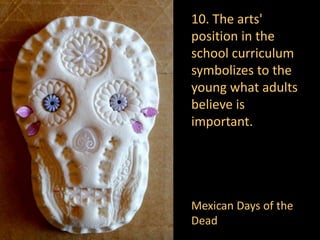
10. The arts'
position in the
school curriculum
symbolizes to the
young what adults
believe is
important.
Mexican Days of the
Dead
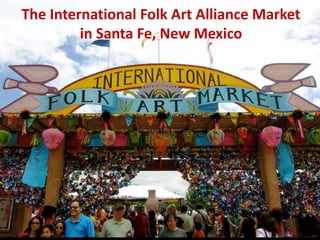
The International Folk Art Alliance Market
in Santa Fe, New Mexico
www.SchoolArtsMagazine.com/travel

Ten Lessons the Arts Teach

  • 1.
    10 Lessons theArts Teach Elliot Eisner
  • 2.
    1. The artsteach children to make good judgments about qualitative relationships. Agustin Cruz Prudencio
  • 3.
    2. The artsteach children that problems can have more than one solution and that questions can have more than one answer. Cilau Valadez
  • 4.
    3. The artscelebrate multiple perspectives.
  • 5.
    The arts teachchildren that in complex forms of problem solving purposes are ldom fixed, but change with circumstance and opportunity. 4. The arts teach children that in complex forms of problem solving purposes are seldom fixed, but change with circumstance and opportunity.
  • 6.
    5. The artsmake vivid the fact that neither words in their literal form nor numbers exhaust what we can know. One Million Bones
  • 7.
    6. The artsteach students that small differences can have large effects. Rebecca Lolosoli
  • 8.
    7. The artsteach students to think through and within a material. Claudia Martinez
  • 9.
    8. The artshelp children learn to say what cannot be said. Cilau Valadez
  • 10.
    9. The artsenable us to have experiences from no other source.
  • 11.
    10. The arts' positionin the school curriculum symbolizes to the young what adults believe is important. Mexican Days of the Dead
  • 12.
    The International FolkArt Alliance Market in Santa Fe, New Mexico
  • 13.

Editor's Notes

  • #2 Elliot Eisner’s Ten Lessons the Arts Teach is one of the documents most downloaded from the National Art Education Association website. This presentation presents these ten lessons through issues of cultural diversity. SOURCE: Eisner, E. (2002). The Arts and the Creation of Mind, In Chapter 4, What the Arts Teach and How It Shows. (pp. 70-92). Yale University Press. Available from NAEA Publications. NAEA grants reprint permission for this excerpt from Ten Lessons with proper acknowledgment of its source and NAEA. See more at: http://www.arteducators.org/advocacy/10-lessons-the-arts-teach#sthash.NJJde2p4.dpuf.
  • #3 Unlike much of the curriculum in which correct answers and rules prevail, in the arts, it is judgment rather than rules that prevail. Agustin Cruz Prudencio’s family’s elaborately carved and hand painted wooden figures reflect the highest quality of Mexican folk art.
  • #4 Cilau Valadez is continuing the traditions of his Huichol people in Mexico, spreading knowledge around the world about the endangered Huichol culture and training apprentices.
  • #5 There are many ways to see and interpret the world. A Mexican Days of the Dead presentation gives and shares multiple perspectives in an engaging school program devoted to Diego Rivera and Frida Kahlo.
  • #6 Learning in the arts requires the ability and a willingness to surrender to the unanticipated possibilities of the work as it unfolds. Virgil Ortiz and Helen Cordero, both from Cochiti Pueblo, have adapted historic figurative traditions for different audiences and times. Folk art often changes from traditional to transitional to transformational forms. The work on the right is the first storyteller figure Cordero created. By contrast, Virgil Ortiz’ work has transformed into work that is reflective of tattoos and scarification found in popular culture. Ortiz now has expanded into photography and fashion design.
  • #7 The limits of our language do not define the limits of our cognition. The One Million Bones Project symbolized victims of genocide around the world in ways only a image can accomplish. People of all ages from the US and around the world made bones from clay, plaster, or papier mache. One million bones were laid on the Mall in Washington, D. C. at the culmination of this project.
  • #8 The arts traffic in subtleties. Rebecca Lolosoli from South Africa, featured in PBS’ “Half the Sky,” started a village for women who had no place else to go, a village that did not allow men to live there. They support themselves and their children by the beaded jewelry they make. One person’s idea and passion can definitely have a large effect.
  • #9 All art forms employ some means through which images become real. Claudia Martinez, shown here, is a Mexican artist who makes art from recycled and repurposed materials. Art can be made from any kind of material.
  • #10 When children are invited to disclose what a work of art helps them feel, they must reach into their poetic capacities to find the words that will do the job. Cilau’s yarn paintings tell the stories of his culture. Each work is completely unique. An understanding of a written language is often not needed to respond to an artwork.
  • #11 The arts enable us to have experiences from no other source to discover the range and variety of what we are capable of feeling. The family of Agustin Cruz Prudencio in Oaxaca works together to produce their fine art and they all live together in a family compound. Each generation learns from the previous one, a situation found in many traditional folk art forms.
  • #12 If many different forms of art are taught in school, their importance is recognized and respected. For example, teaching about the full meaning of the Mexican Days of the Dead helps promote cross-cultural understanding and respect. The Days of the Dead are a time when people remember and honor the memories of people they love who have died.
  • #13 All the artists depicted in this presentation were initially met at the International Folk Art Alliance Market in Santa Fe, always the second weekend in July. The best way to learn about a culture is to immerse yourself in it. The Folk Art Market is a great place to get started.
  • #14 Learn how you can share such experiences pictured here at schoolarts.com/travel. This summer we are offering seminars in Oaxaca, Mexico, and Santa Fe, New Mexico. These are open to anyone with an interest in folk art or Pueblo Indian art and culture. A digital version of the source of Eisner’s Ten Lessons the Arts Teach may be downloaded at http://www.arteducators.org/advocacy/Eisner_10_Lessons_2013.pdf.