BALTIC
SCENE
REPORT 2017-2018
FIND
OUT:
The Biggest
Funding Deals
LONGER
READS ON:
How tech runs
deep in Latvia
How Lithuanians have managed
to raise 500M in ICOs
How digital nomads praise
e-residency in Estonia
The Most Active VCs
in the Baltics
Hand-picked Startups
to Watch
Inspiring Corporate
Innovation Cases
And more...
2
T
he Baltic startup ecosystem is often lauded as a
booming space, filled with perspective and tech
talent. While each country of the Baltics - Estonia,
Latvia, Lithuania - has conducted its own research
into its startup ecosystem, it is rarely analyzed as
a whole, and benchmarked against surrounding regions.
By understanding where the Baltics stand compared to
neighbouring regions, such as the Nordics and Central and
Eastern Europe, we’re able to provide more precise insight
to the state of the region, its progress, its potential, and
ultimately, it’s status in the world of startups.
This report, created by EIT Digital in collaboration with
Startup Wise Guys, aims to provide of the state of the Baltics
in startups to any onlookers, as well as participants of that
ecosystem themselves. This will let us make better jud-
gments about investments and possible growth channels for
Baltic startups and scale ups.
"TheBalticsisoneofthemostactivelydevelopingregionswe’veseen
inrecentyears,andthat’sbecausetheecosystemisquiteadvanced
andinastagewherealltheactorsneededarethere-you’vegotthe
VCs,thebanks,thefounders,theuniversities,andyou’vegotmarkets
whereyoucantest-trialanyviableproducts."
FabioPianesi
ResearchDirectoratEITDigital"
3
4
BAL­
TICS
IN A
NUT­
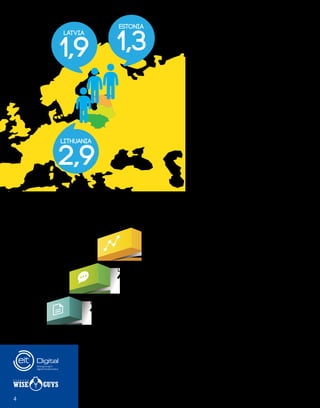
SHELLPOPULATION (IN MILLIONS)
TOTAL BALTIC POPULATION - 6.1 MILLION
1,31,9
2,9
ESTONIA
LATVIA
LITHUANIA
673
ESTONIA
352
LATVIA
424
LITHUANIA
5.2
ESTONIA
1.8
LATVIA
1.4
LITHUANIA
Interesting fact:
Estonia is an outlier in terms of raised investment per capita in 2017 - 208, performing and raising
incredible amounts, when compared to other regions. As a whole it brings up Baltic performance to
57,56 eur per capita, not far off from the Nordics' 80,71 per capita. CEE (Central and Eastern Europe),
with a significantly larger population, is left in the dust with 8,31.
Source: Crowdsourced data, thenordicweb.com, 150sec.com
NUMBER OF STARTUPS
INVESTMENT PER CAPITA (2017)
STARTUPS PER 10,000 INHABITANTS
TOTAL (EUR IN MILLIONS)
POPULATION (MILLIONS)
PER CAPITA (EUR)
Estonia 271,4
1,3
208
62,2
1,9
32
18,5
2,9
6
Estonia
Estonia
Lithuania
Lithuania
Lithuania
Latvia
Latvia
Latvia
5
Source: Crowdfunded data
(Baltics), InVenture (Ukraine),
Nordics (The Nordic Web)
Source: Crowdfunded data
(Baltics), InVenture (Ukraine),
Nordics (The Nordic Web)
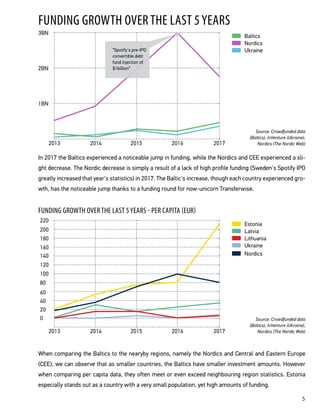
FUNDING GROWTH OVER THE LAST 5YEARS
FUNDING GROWTH OVER THE LAST 5YEARS - PER CAPITA (EUR)
2013 2014 2015 2016 2017
Baltics
Nordics
Ukraine
1BN
2BN
3BN
“Spotify's pre-IPO
convertible debt
fund injection of
$1billion”
In 2017 the Baltics experienced a noticeable jump in funding, while the Nordics and CEE experienced a sli-
ght decrease. The Nordic decrease is simply a result of a lack of high profile funding (Sweden's Spotify IPO
greatly increased that year's statistics) in 2017. The Baltic's increase, though each country experienced gro-
wth, has the noticeable jump thanks to a funding round for now-unicorn Transferwise.
When comparing the Baltics to the nearyby regions, namely the Nordics and Central and Eastern Europe
(CEE), we can observe that as smaller countries, the Baltics have smaller investment amounts. However
when comparing per capita data, they often meet or even exceed neighbouring region statistics. Estonia
especially stands out as a country with a very small population, yet high amounts of funding.
2013 2014 2015 2016 2017
Estonia
Latvia
Lithuania
Ukraine
Nordics
0
20
40
60
80
100
120
140
160
180
200
220
6
BIGGEST
DEALS
Latvia
BitFury - 106,164,030
CreamFinance - 27,200,000
Lithuania
Vinted - 49,756,329
GetJar - 31,500,000
yPlan - 31,400,000
Estonia
Transferwise - 237,800,000
Taxify - 151,970,000
Pipedrive - 70,031,000
Monese - 66,224,449
Skeletontech - 40,000,000
Starship - 39,900,000
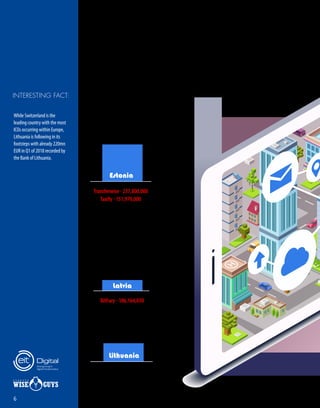
While Switzerland is the
leading country with the most
ICOs occurring within Europe,
Lithuania is following in its
footsteps with already 220mn
EUR in Q1 of 2018 recorded by
the Bank of Lithuania.
INTERESTING FACT:
7
INITIAL COIN
OFFERINGS
(ICO)
Source: ICO Bench, Crowdsourced data, Tech.eu, E&Y
The Baltics as a whole are evidently more active in raising funding via ICOs than the
surrounding regions, particularly in Lithuanian and Estonia. This heightened success
can be partially attributed to Estonia's already existing blockchain-based e-residen-
cy system, and Lithuania's crypto-friendly fintech regulations.
Estonia
Latvia
Lithuania
Baltic countries
Poland
Nordic countries
350M
28,65M
500M
878.65M
59.5M
33 M
FUNDS RAISED THROUGH ICOS IN EUR
(UP TO MAY, 2018)
8
STARTUP
FUNDING IN
THE BALTICS
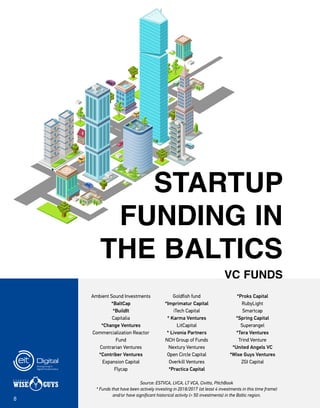
VC FUNDS
Ambient Sound Investments
*BaltCap
*BuildIt
Capitalia
*Change Ventures
Commercialization Reactor
Fund
Contrarian Ventures
*Contriber Ventures
Expansion Capital
Flycap
Goldfish fund
*Imprimatur Capital
iTech Capital
* Karma Ventures
LitCapital
* Livonia Partners
NCH Group of Funds
Nextury Ventures
Open Circle Capital
Overkill Ventures
*Practica Capital
*Proks Capital
RubyLight
Smartcap
*Spring Capital
Superangel
*Tera Ventures
Trind Venture
*United Angels VC
*Wise Guys Ventures
ZGI Capital
Source: ESTVCA, LVCA, LT VCA, Civitta, PitchBook
* Funds that have been actively investing in 2018/2017 (at least 4 investments in this time frame)
and/or have significant historical activity (> 50 investments) in the Baltic region.
9
BUSINESS
ANGELS
Average investment size from
Baltic Business Angels in 2016
was 2.01 EUR per capita.This is
higher than both Poland
(0.33 EUR per capita) and the
CEE region (0.62 EUR per capita).
Estonia ranges at 6.73 EUR per
capita, while Latvia follows at
1.24 EUR and Lithuania -
0.38 EUR.
Source:EWDNCEEReport
INTERESTING
FACT:
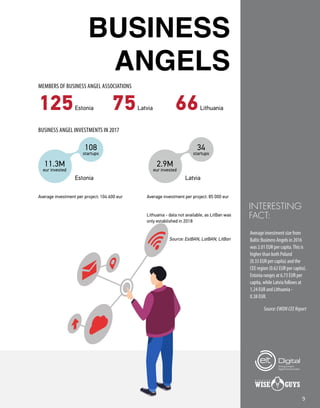
MEMBERS OF BUSINESS ANGEL ASSOCIATIONS
BUSINESS ANGEL INVESTMENTS IN 2017
125 75 66Estonia
Estonia Latvia
Latvia Lithuania
11.3M
eur invested
2.9M
eur invested
108
startups
34
startups
Average investment per project: 104 600 eur Average investment per project: 85 000 eur
Lithuania - data not available, as LitBan was
only established in 2018
Source: EstBAN, LatBAN, LitBan
10
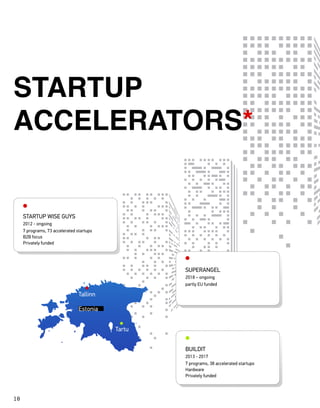
STARTUP
ACCELERATORS*
Estonia
Tallinn
Tartu
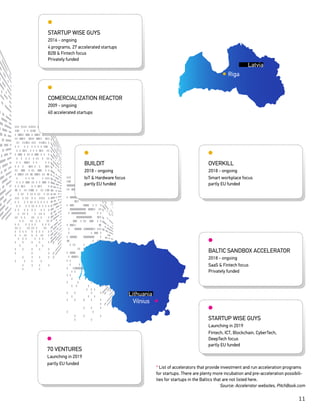
STARTUP WISE GUYS
SUPERANGEL
BUILDIT
2012 - ongoing
2018 – ongoing
2013 - 2017
7 programs, 73 accelerated startups
B2B focus
Privately funded
partly EU funded
7 programs, 38 accelerated startups
Hardware
Privately funded
11
STARTUP WISE GUYS
COMERCIALIZATION REACTOR
BUILDIT
BALTIC SANDBOX ACCELERATOR
70 VENTURES
STARTUP WISE GUYS
OVERKILL
2016 - ongoing
2009 - ongoing
2018 - ongoing
2018 - ongoing
Launching in 2019
Launching in 2019
2018 - ongoing
4 programs, 27 accelerated startups
B2B & Fintech focus
Privately funded
40 accelerated startups
IoT & Hardware focus
partly EU funded
SaaS & Fintech focus
Privately funded
partly EU funded
Fintech, ICT, Blockchain, CyberTech,
DeepTech focus
partly EU funded
Smart workplace focus
partly EU funded
Riga
Latvia
Vilnius
Lithuania
* List of accelerators that provide investment and run acceleration programs
for startups. There are plenty more incubation and pre-acceleration possibili-
ties for startups in the Baltics that are not listed here.
Source: Accelerator websites, PitchBook.com
12
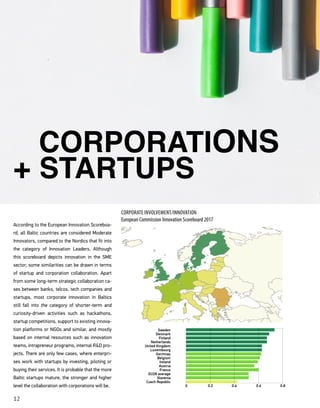
According to the European Innovation Scoreboa-
rd, all Baltic countries are considered Moderate
Innovators, compared to the Nordics that fit into
the category of Innovation Leaders. Although
this scoreboard depicts innovation in the SME
sector, some similarities can be drawn in terms
of startup and corporation collaboration. Apart
from some long-term strategic collaboration ca-
ses between banks, telcos, tech companies and
startups, most corporate innovation in Baltics
still fall into the category of shorter-term and
curiosity-driven activities such as hackathons,
startup competitions, support to existing innova-
tion platforms or NGOs and similar, and mostly
based on internal resources such as innovation
teams, intrapreneur programs, internal R&D pro-
jects. There are only few cases, where enterpri-
ses work with startups by investing, piloting or
buying their services. It is probable that the more
Baltic startups mature, the stronger and higher
level the collaboration with corporations will be.
CORPORATIONS
+ STARTUPS
CORPORATE INVOLVEMENT/INNOVATION
European Commission Innovation Scoreboard 2017
Sweden
0 0.2 0.4 0.6 0.8
Netherlands
Germnay
Austria
Denmark
United Kingdom
Belgium
France
Slovenia
Finland
Luxembourg
Ireland
EU28 average
Czech Republic
13
COLLABORATION PLATFORMS:
CORPORATE VC FUNDS:
This corporate startup program has evolved
from a hackathon and classic accelerator
bootcamp to a case-by-case piloting with
more mature startups disrupting smart cities,
e-commerce and wellness industries. Program
offers market access, integration with Telia
APIs, incubation, office space, and mentoring.
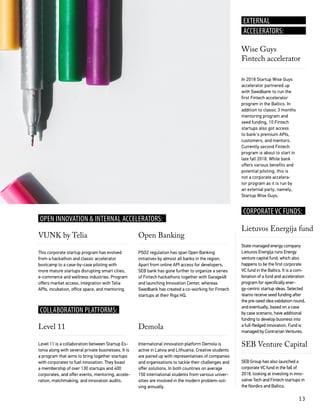
In 2018 Startup Wise Guys
accelerator partnered up
with Swedbank to run the
first Fintech accelerator
program in the Baltics. In
addition to classic 3 months
mentoring program and
seed funding, 10 Fintech
startups also got access
to bank's premium APIs,
customers, and mentors.
Currently second Fintech
program is about to start in
late fall 2018. While bank
offers various benefits and
potential piloting, this is
not a corporate accelera-
tor program as it is run by
an external party, namely,
Startup Wise Guys.
Level 11 is a collaboration between Startup Es-
tonia along with several private businesses. It is
a program that aims to bring together startups
with corporates to fuel innovation. They boast
a membership of over 130 startups and 400
corporates, and offer events, mentoring, accele-
ration, matchmaking, and innovation audits.
PSD2 regulation has span Open Banking
initiatives by almost all banks in the region.
Apart from online API access for developers,
SEB bank has gone further to organize a series
of Fintech hackathons together with Garage48
and launching Innovation Center, whereas
Swedbank has created a co-working for Fintech
startups at their Riga HQ.
State managed energy company
Lietuvos Energija runs Energy
venture capital fund, which also
happens to be the first corporate
VC fund in the Baltics. It is a com-
bination of a fund and acceleration
program for specifically ener-
gy-centric startup ideas. Selected
teams receive seed funding after
the pre-seed idea validation round,
and eventually, based on a case
by case scenario, have additional
funding to develop business into
a full-fledged innovation. Fund is
managed by Contrarian Ventures.
SEB Group has also launched a
corporate VC fund in the fall of
2018, looking at investing in inno-
vative Tech and Fintech startups in
the Nordics and Baltics.
International innovation platform Demola is
active in Latvia and Lithuania. Creative students
are paired up with representatives of companies
and organisations to tackle their challenges and
offer solutions. In both countries on average
150 international students from various univer-
sities are involved in the modern problem-sol-
ving annually.
VUNK by Telia
Wise Guys
Fintech accelerator
Level 11
Open Banking
Lietuvos Energija fund
SEB Venture Capital
Demola
OPEN INNOVATION & INTERNAL ACCELERATORS:
EXTERNAL
ACCELERATORS:
14
LIVING & WORKING
IN THE BALTICS
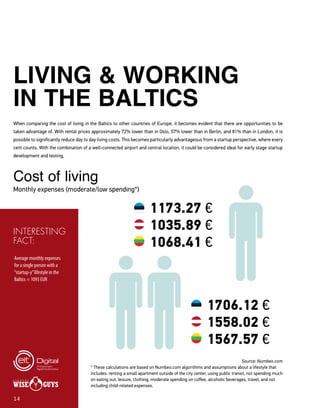
When comparing the cost of living in the Baltics to other countries of Europe, it becomes evident that there are opportunities to be
taken advantage of. With rental prices approximately 72% lower than in Oslo, 57% lower than in Berlin, and 81% than in London, it is
possible to significantly reduce day to day living costs. This becomes particularly advantageous from a startup perspective, where every
cent counts. With the combination of a well-connected airport and central location, it could be considered ideal for early stage startup
development and testing.
Cost of living
Monthly expenses (moderate/low spending*)
Source: Numbeo.com
* These calculations are based on Numbeo.com algorithms and assumptions about a lifestyle that
includes: renting a small apartment outside of the city center, using public transit, not spending much
on eating out, leisure, clothing, moderate spending on coffee, alcoholic beverages, travel, and not
including child-related expenses.
1173.27 
1035.89 
1068.41 
1706.12 
1558.02 
1567.57 
14
Average monthly expenses
for a single person with a
“startup-y”lifestyle in the
Baltics = 1093 EUR
INTERESTING
FACT:
15
Tallinn ranks 23rd in Europe in terms of quality of life, that is the highest ranking among cities analyzed here, followed by Berlin (27th)
and Stockholm (28th). London, on the other hand, ranks below all 3 Baltic capitals. Not only you would burn less cash living in the
Baltics, you'd also probably enjoy it more.
Quality of Life Index
1093 EUR lasts* Source: Numbeo.com
* This comparison is based on
Numbeo.com algorithms, calculating
monthly spending for each city using
the same lifestyle indicators.
Baltics: 31 days London: 11 days
Berlin: 19 days
Stockholm: 17 days
Warsaw: 31 days Kiev: 52 days
Source: Numbeo.com
AVERAGE GROSS
MONTHLY SALARY
AVERAGE GROSS MONTHLY
DEVELOPER SALARY
TAX WEDGE ON
LABOUR COSTS
Latvia* 1,013 2013 41,9%
Lithuania 885 1846 39,2%
Estonia 1,221 2286 38%
Baltic countries 1,039 2048 39,7%
Poland 1,102 2280 33,7%
Nordic countries 3,970 4095 36,75%
CEE 1,358 1893 38,54 %
AVERAGE SALARIES (EUR)
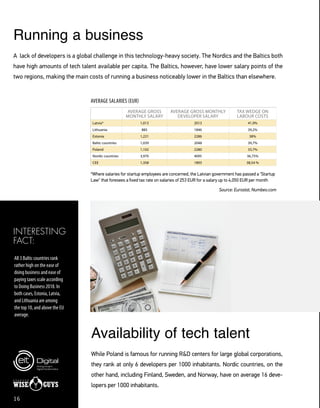
Running a business
Availability of tech talent
A lack of developers is a global challenge in this technology-heavy society. The Nordics and the Baltics both
have high amounts of tech talent available per capita. The Baltics, however, have lower salary points of the
two regions, making the main costs of running a business noticeably lower in the Baltics than elsewhere.
While Poland is famous for running R&D centers for large global corporations,
they rank at only 6 developers per 1000 inhabitants. Nordic countries, on the
other hand, including Finland, Sweden, and Norway, have on average 16 deve-
lopers per 1000 inhabitants.
*Where salaries for startup employees are concerned, the Latvian government has passed a "Startup
Law" that foresees a fixed tax rate on salaries of 253 EUR for a salary up to 4,050 EUR per month
Source: Eurostat, Numbeo.com
All 3 Baltic countries rank
rather high on the ease of
doing business and ease of
paying taxes scale according
to Doing Business 2018. In
both cases, Estonia, Latvia,
and Lithuania are among
the top 10, and above the EU
average.
INTERESTING
FACT:
16
17
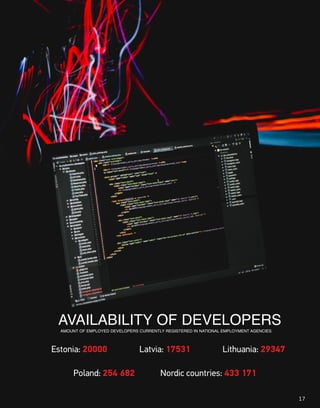
AVAILABILITY OF DEVELOPERS
AMOUNT OF EMPLOYED DEVELOPERS CURRENTLY REGISTERED IN NATIONAL EMPLOYMENT AGENCIES
Estonia: 20000 Latvia: 17531 Lithuania: 29347
Poland: 254 682 Nordic countries: 433 171
1818
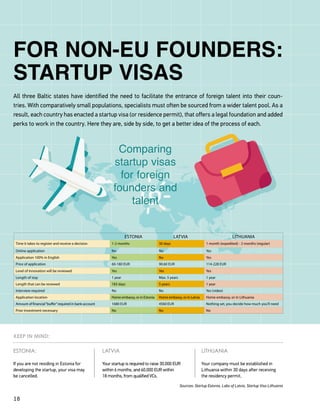
All three Baltic states have identified the need to facilitate the entrance of foreign talent into their coun-
tries. With comparatively small populations, specialists must often be sourced from a wider talent pool. As a
result, each country has enacted a startup visa (or residence permit), that offers a legal foundation and added
perks to work in the country. Here they are, side by side, to get a better idea of the process of each.
Sources: Startup Estonia, Labs of Latvia, Startup Visa Lithuania
LITHUANIA
KEEP IN MIND:
LATVIAESTONIA:
Your company must be established in
Lithuania within 30 days after receiving
the residency permit.
Your startup is required to raise 30.000 EUR
within 6 months, and 60.000 EUR within
18 months, from qualified VCs.
If you are not residing in Estonia for
developing the startup, your visa may
be cancelled.
FOR NON-EU FOUNDERS:
STARTUP VISAS
CARD
Comparing
startup visas
for foreign
founders and
talent
ESTONIA LATVIA LITHUANIA
Time it takes to register and receive a decision 1-2 months 30 days 1 month (expedited) - 2 months (regular)
Online application No No Yes
Application 100% in English Yes No Yes
Price of application 60-180 EUR 90.60 EUR 114-228 EUR
Level of innovation will be reviewed Yes Yes Yes
Length of stay 1 year Max. 5 years 1 year
Length that can be renewed 183 days 5 years 1 year
Interview required No No Yes (video)
Application location Home embassy, or in Estonia Home embassy, or in Latvia Home embassy, or in Lithuania
Amount of financial“buffer”required in bank account 1680 EUR 4560 EUR Nothing set, you decide how much you'll need
Prior investment necessary No No No
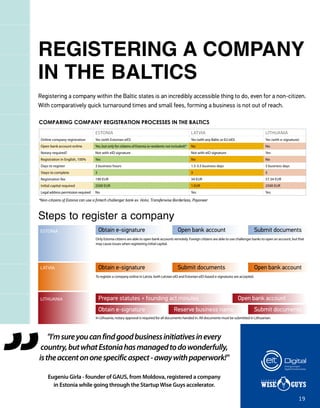
Registering a company within the Baltic states is an incredibly accessible thing to do, even for a non-citizen.
With comparatively quick turnaround times and small fees, forming a business is not out of reach.
Obtain e-signature
Obtain e-signature
Prepare statutes + founding act minutes
Obtain e-signature
Open bank account
Submit documents
Open bank account
Reserve business name
REGISTERING A COMPANY
IN THE BALTICS
"I’msureyoucanfindgoodbusinessinitiativesinevery
country,butwhatEstoniahasmanagedtodowonderfully,
istheaccentononespecificaspect-awaywithpaperwork!"
Eugeniu Girla - founder of GAUS, from Moldova, registered a company
in Estonia while going through the StartupWise Guys accelerator.
Steps to register a company
ESTONIA LATVIA LITHUANIA
Online company registration Yes (with Estonian eID) Yes (with any Baltic or EU eID) Yes (with e-signature)
Open bank account online Yes, but only for citizens of Estonia (e-residents not included)* No No
Notary required? Not with eID signature Not with eID signature Yes
Registration in English, 100% Yes No No
Days to register 3 business hours 1.5-3.5 business days 3 business days
Steps to complete 3 3 5
Registration fee 190 EUR 34 EUR 57.34 EUR
Initial capital required 2500 EUR 1 EUR 2500 EUR
Legal address permission required No Yes Yes
COMPARING COMPANY REGISTRATION PROCESSES IN THE BALTICS
*Non-citizens of Estonia can use a fintech challenger bank ex. Holvi, Transferwise Borderless, Payoneer
ESTONIA
LATVIA
LITHUANIA
Submit documents
Open bank account
Submit documents
Only Estonia citizens are able to open bank accounts remotely. Foreign citizens are able to use challenger banks to open an account, but that
may cause issues when registering initial capital.
To register a company online in Latvia, both Latvian eID and Estonian eID-based e-signatures are accepted.
In Lithuania, notary approval is required for all documents handed in. All documents must be submitted in Lithuanian.
19
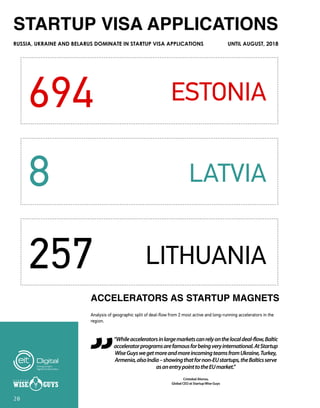
257
8
694
LITHUANIA
ESTONIA
LATVIA
STARTUP VISA APPLICATIONS
ACCELERATORS AS STARTUP MAGNETS
RUSSIA, UKRAINE AND BELARUS DOMINATE IN STARTUP VISA APPLICATIONS UNTIL AUGUST, 2018
Analysis of geographic split of deal-flow from 2 most active and long-running accelerators in the
region.
“Whileacceleratorsinlargemarketscanrelyonthelocaldeal-flow,Baltic
acceleratorprogramsarefamousforbeingveryinternational.AtStartup
WiseGuyswegetmoreandmoreincomingteamsfromUkraine,Turkey,
Armenia,alsoIndia–showingthatfornon-EUstartups,theBalticsserve
asanentrypointtotheEUmarket.”
Cristobal Alonso,
Global CEO at StartupWise Guys
20
21
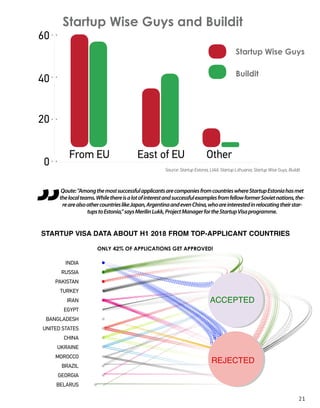
STARTUP VISA DATA ABOUT H1 2018 FROM TOP-APPLICANT COUNTRIES
Source: Startup Estonia, LIAA, Startup Lithuania, Startup Wise Guys, Buildit
Startup Wise Guys and Buildit
From EU East of EU
60
40
20
0
Other
Startup Wise Guys
Buildit
ONLY 42% OF APPLICATIONS GET APPROVED!
INDIA
RUSSIA
PAKISTAN
TURKEY
IRAN
EGYPT
BANGLADESH
UNITED STATES
CHINA
UKRAINE
MOROCCO
BRAZIL
GEORGIA
BELARUS
REJECTED
ACCEPTED
Qoute:"AmongthemostsuccessfulapplicantsarecompaniesfromcountrieswhereStartupEstoniahasmet
thelocalteams.WhilethereisalotofinterestandsuccessfulexamplesfromfellowformerSovietnations,the-
rearealsoothercountrieslikeJapan,ArgentinaandevenChina,whoareinterestedinrelocatingtheirstar-
tupstoEstonia,”saysMerilinLukk,ProjectManagerfortheStartupVisaprogramme.
Air transit connects the Baltic region to every corner of the earth, as well as
ground transit, which connects it to closer destinations in the regions. Here are
some of the most important features of accessibility to consider.
Infrastructure plays a major role in the Baltics as a key destina-
tion. Conveniently located in the crossroads between the East,
West and North, the Baltic States offer easy and affordabe access
to meetings, conferences, and other important events.
ACCESSIBILITY
to EUROPE
22
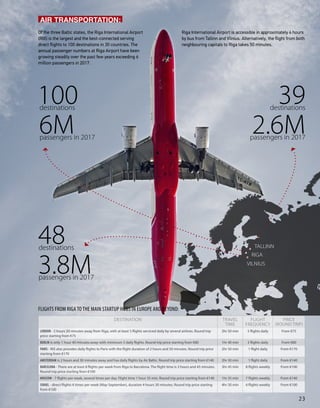
Of the three Baltic states, the Riga International Airport
(RIX) is the largest and the best-connected serving
direct flights to 100 destinations in 30 countries. The
annual passenger numbers at Riga Airport have been
growing steadily over the past few years exceeding 6
million passengers in 2017.
AIR TRANSPORTATION:
VILNIUS
RIGA
TALLINNdestinations
destinations destinations
passengers in 2017
passengers in 2017 passengers in 2017
48
100 39
3.8M
6M 2.6M
FLIGHTS FROM RIGA TO THE MAIN STARTUP HUBS IN EUROPE AND BEYOND:
DESTINATION TRAVEL
TIME
FLIGHT
FREQUENCY
PRICE
(ROUND TRIP)
LONDON - 2 hours 50 minutes away from Riga, with at least 5 flights serviced daily by several airlines. Round trip
price starting from €75
2hr 50 min 5 flights daily From €75
BERLIN is only 1 hour 40 minutes away with minimum 3 daily flights. Round trip price starting from €80 1hr 40 min 3 flights daily From €80
PARIS - RIX also provides daily flights to Paris with the flight duration of 2 hours and 50 minutes. Round trip price
starting from €170
2hr 50 min 1 flight daily From €170
AMSTERDAM is 2 hours and 30 minutes away and has daily flights by Air Baltic. Round trip price starting from €140 2hr 30 min 1 flight daily From €140
BARCELONA - There are at least 8 flights per week from Riga to Barcelona. The flight time is 3 hours and 45 minutes.
Round trip price starting from €100
3hr 45 min 8 flights weekly From €100
MOSCOW - 7 flights per week, several times per day. Flight time 1 hour 35 min. Round trip price starting from €140 1hr 35 min 7 flights weekly From €140
ISRAEL - direct flights 6 times per week (May-September), duration 4 hours 30 minutes. Round trip price starting
from €100
4hr 30 min 6 flights weekly From €100
Riga International Airport is accessible in approximately 4 hours
by bus from Tallinn and Vilnius. Alternatively, the flight from both
neighbouring capitals to Riga takes 50 minutes.
23
REGULATION IN THE BALTICS
FINTECH
The fintech sector is known for its fast-moving
development, and its tendency to challenge
older, stagnated financial industries. It is no
surprise that fintech initiatives develop faster
than the typically slow-moving government
can pass legislation to regulate it.
Each Baltic country has made efforts to develop ini-
tiatives to support and regulate the fintech industry,
and thereby creating trust, transarency and safety
through providing a regulartory body. Here are what
each country have come up with.
It should be noted that the Ministries of Finance of all
three countries have even come together to sign a
joint MoU to announce their commitment to support
blockchain initiatives. This is a takeoff from other
countries, which have made a point of denouncing
it and even banning crypto currencies. Here is what
each country has come up with.
24
As a result, the institution is quick to pass laws relevant to fintech startups that support, regulate
and legitimize their industry, without stifling their progress. This includes the P2P lending industry,
which is covered by the Creditors and Credit Intermediaries act, which came into force January, 2018,
as well as creating a framework for ICOs, depending on their specification.
As ICOs are unique, each is advised to consult the EFSA. Most are covered under the Securities Mar-
ket Act, as well as the Law of Obligations Act. However if tokens are used as a means of providing a
loan, then the Credit Institutions Act may be invoked.
Source: EFSA
The competent authority on
fintech: EFSA (Estonian Finan-
cial Supervision Authority)
Initiatives to support fintech:
Specialized P2P lending policy,
ICO frameworks
ESTONIA:
Weareconstantlymonito-
ringtheareaoffinancial
innovation,reactingtothe
distortionsoftheproducts,
assessingrisksandtaking
proportionatemeasures
withouthindering
theinnovation.
-EFSA-
25
The Latvian financial regulatory body has established a financial innovation support program, which
is currently named the Innovation Sandbox. They invite all fintech initiatives - either existing or simply
conceptual - to visit the innovation center to be consulted for the best way to implement their idea,
and help them with any licences they might need to obtain to be compliant with local laws.
They are currently developing legislation suggestions to regulate the P2P lending industry, noting
that current legislation is not enough to ensure transparency and safety between lenders and borro-
wers. Current P2P projects are forced to paste together different ill-fitting licences to continue work.
This supports the activities of P2P lenders, such as Twino, Mintos, and CreamFinance, which has
been recognized as one of the fastest growing startups in Europe for 2 years in a row.
FKTK have an open doors policy and invite any fintech initiatives, including ICOs, to make use of the
Innovation Sandbox, and be consulted as to the necessary licences that may be needed.
Source: FKTK
The competent authority on
fintech: FKTK (The Financial
and Capital Market Commis-
sion)
Initiatives to support fintech:
Diminished licencsing fee for
innovative payment services.
Originally 5000 EUR,
now cut to 450 EUR
LATVIA:
TheFKTKinnovationsandboxallowsforefficientaccesstoexpert
consultationsofavarietyofindustries.Theexpertsimmerse
themselvesintherelevantfinanceandcapitalmarkettopicsfrom
differentperspectives(legal,financial,conformity,etc.).Wehelp
andconsultavarietyofprojects,inavarietyofdevelopmentstages.
-GunaJanelsiņa,FKTK-
26
Lithuanian authorities have made a concerted effort to embrace financial innovation. As a unique
case with such a small country with the most funds raised through ICOs per capita, (and in total
surpassed only by the US and China), the government has been quick to appreciate the opportunities
provided by blockchain.
Lithuania is the only jurisdiction in the EU to have a special-purpose banking license, allowing the
foundation of a bank with registered capital of just €1M EUR. Additionally, they've created a "new-
commer banking licence package" for alternative tech banks, passed a P2P lending law to regulated
the industry, and have announced the launch of a blockchain sandbox, set to go live in 2019.
The Bank of Lithuania has stated that they intend to make Lithuania the preferred gateway to EU
payment market.
Source: Bank of Lithuania
The competent authority on
fintech: Bank of Lithuania
Initiatives supporting fintech:
Diminished required registered
capital for bank foundation of
specialized banks (to 1M EUR,
down from 5M for standard
banks), blockchain sandbox,
newcomer banking licence
package - P2P lending regu-
lation
LITHUANIA:
-EFSAwebsite-
27
STARTUPS
to WATCH
Rather than bombard you with the typical startup suc-
cess stories, we've curated a list of startups that are in
some ways under the radar, promising, or interesting.
The list is curated by startup organisations, selected Bu-
siness Angels and VCs, accelerators and other players
over the entire Baltic region.
28
29
30
FINTE
TRANSFERGO (LT)
NORDIGEN (LV)
INSLY (EE)
INVESTLY (EE)
ESTATE GURU (EE)
MONETHA (LT)
VERIFF (EE)
MINTOS (LV)
PAYTIPTOP (EE)
31
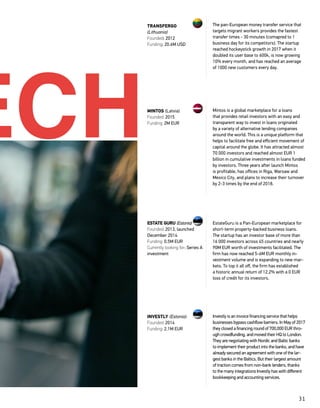
The pan-European money transfer service that
targets migrant workers provides the fastest
transfer times - 30 minutes (comapred to 1
business day for its competitors). The startup
reached hockeystick growth in 2017 when it
doubled its user base to 600k, is now growing
10% every month, and has reached an average
of 1000 new customers every day.
Mintos is a global marketplace for a loans
that provides retail investors with an easy and
transparent way to invest in loans originated
by a variety of alternative lending companies
around the world. This is a unique platform that
helps to facilitate free and efficient movement of
capital around the globe. It has attracted almost
70 000 investors and reached almost EUR 1
billion in cumulative investments in loans funded
by investors. Three years after launch Mintos
is profitable, has offices in Riga, Warsaw and
Mexico City, and plans to increase their turnover
by 2-3 times by the end of 2018.
Investly is an invoice financing service that helps
businesses bypass cashflow barriers. In May of 2017
they closed a financing round of 700,000 EUR thro-
ugh crowdfunding, and moved their HQ to London.
They are negotiating with Nordic and Baltic banks
to implement their product into the banks, and have
already secured an agreement with one of the lar-
gest banks in the Baltics. But their largest amount
of traction comes from non-bank lenders, thanks
to the many integrations Investly has with different
bookkeeping and accounting services.
TRANSFERGO
(Lithuania)
Founded: 2012
Funding: 20.6M USD
MINTOS (Latvia)
Founded: 2015
Funding: 2M EUR
INVESTLY (Estonia):
Founded: 2014
Funding: 2.1M EUR
EstateGuru is a Pan-European marketplace for
short-term property-backed business loans.
The startup has an investor base of more than
16 000 investors across 45 countries and nearly
90M EUR worth of investments facilitated. The
firm has now reached 5-6M EUR monthly in-
vestment volume and is expanding to new mar-
kets. To top it all off, the firm has established
a historic annual return of 12.2% with a 0 EUR
loss of credit for its investors.
ESTATE GURU (Estonia)
Founded: 2013, launched
December 2014
Funding: 0.5M EUR
Currently looking for: Series A
investment
ECH
SOFTWA
DASHBIRD (EE)
PRINTIFY (LV)
WELLPARKO (LT)
ALPHABLUES (EE)
SAYAT (EE)
REBELROAM (EE)
FRACTORY (EE)
CENOS (LV)
HALA (LV)
PLAYGINEERING (LV)
PRINTFUL (LV)
AS A SERVICE
32
33
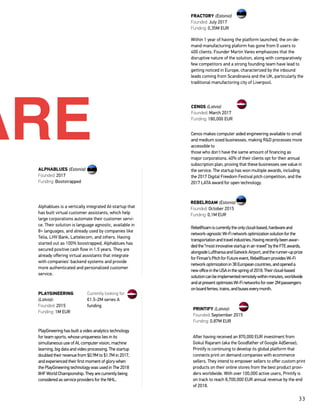
Within 1 year of having the platform launched, the on-de-
mand manufacturing plaform has gone from 0 users to
400 clients. Founder Martin Vares emphasizes that the
disruptive nature of the solution, along with comparatively
few competitors and a strong founding team have lead to
getting noticed in Europe, characterized by the inbound
leads coming from Scandinavia and the UK, particularly the
traditional manufactoring city of Liverpool.
Cenos makes computer aided engineering available to small
and medium sized businesses, making R&D processes more
accessible to
those who don't have the same amount of financing as
major corporations. 40% of their clients opt for their annual
subscription plan, proving that these businesses see value in
the service. The startup has won multiple awards, including
the 2017 Digital Freedom Festival pitch competition, and the
2017 LATA award for open technology.
After having received an 870,000 EUR investment from
Gokul Rajaram (aka the Goodfather of Google AdSense),
Printify is continuing to develop its global platform that
connects print on demand companies with ecommerce
sellers. They intend to empower sellers to offer custom print
products on their online stores from the best product provi-
ders worldwide. With over 100,000 active users, Printify is
on track to reach 8,700,000 EUR annual revenue by the end
of 2018.
FRACTORY (Estonia)
Founded: July 2017
Funding: 0,35M EUR
CENOS (Latvia)
Founded: March 2017
Funding: 180,000 EUR
PRINTIFY (Latvia):
Founded: September 2015
Funding: 0.87M EUR
RebelRoamiscurrentlytheonlycloud-based,hardwareand
network-agnosticWi-Finetworkoptimizationsolutionforthe
transportationandtravelindustries.Havingrecentlybeenawar-
dedthe“mostinnovativestartupinair-travel”bytheFTEawards,
alongsideLufthansaandGatwickAirport,andtherunner-upprize
forFinnair’sPitchforFutureevent,RebelRoamprovidesWi-Fi
networkoptimizationin38Europeancountries,andopeneda
newofficeintheUSAinthespringof2018.Theircloud-based
solutioncanbeimplementedremotelywithinminutes,worldwide
andatpresentoptimizesWi-Finetworksforover2Mpassengers
onboardferries,trains,andbuseseverymonth.
Alphablues is a vertically integrated AI-startup that
has built virtual customer assistants, which help
large corporations automate their customer servi-
ce. Their solution is language agnostic, available in
8+ languages, and already used by companies like
Telia, LHV Bank, Lattelecom, and others. Having
started out as 100% boostrapped, Alphablues has
secured positive cash flow in 1.5 years. They are
already offering virtual assistants that integrate
with companies' backend systems and provide
more authenticated and personalized customer
service.
PlayGineering has built a video analytics technology
for team sports, whose uniqueness lies in its
simultaneous use of AI, computer vision, machine
learning, big data and video processing. The startup
doubled their revenue from $0.9M to $1.7M in 2017,
and experienced their first moment of glory when
the PlayGineering technology was used in The 2018
IIHF World Championship. They are currently being
considered as service providers for the NHL.
REBELROAM (Estonia):
Founded: October 2015
Funding: 0,1M EUR
ALPHABLUES (Estonia)
Founded: 2017
Funding: Bootstrapped
PLAYGINEERING
(Latvia):
Founded: 2015
Funding: 1M EUR
Currently looking for:
€1.5-2M series A
funding
ARE
HARDWARE
SONARWORKS (LV)
AERONES (LV)
3DSOLAR PANEL (LT)
SMARTVENT (EE)
CASTPRINT (LV)
TRIUMPH HEALTH (LT)
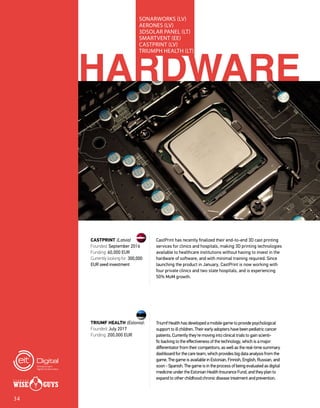
CastPrint has recently finalized their end-to-end 3D cast printing
services for clinics and hospitals, making 3D printing technologies
available to healthcare institutions without having to invest in the
hardware of software, and with minimal training required. Since
launching the product in January, CastPrint is now working with
four private clinics and two state hospitals, and is experiencing
50% MoM growth.
Triumf Health has developed a mobile game to provide psychological
support to ill children. Their early adopters have been pediatric cancer
patients. Currently they're moving into clinical trials to gain scienti-
fic backing to the effectiveness of the technology, which is a major
differentiator from their competitors, as well as the real-time summary
dashboard for the care team, which provides big data analysis from the
game. The game is available in Estonian, Finnish, English, Russian, and
soon - Spanish. The game is in the process of being evaluated as digital
medicine under the Estonian Health Insurance Fund, and they plan to
expand to other childhood chronic disease treatment and prevention.
CASTPRINT (Latvia)
Founded: September 2016
Funding: 60,000 EUR
Currently looking for: 300,000
EUR seed investment
TRIUMF HEALTH (Estonia):
Founded: July 2017
Funding: 200,000 EUR
34
ICO
BITDEGREE (LT)
CHANGE BANK (EE)
WEPOWER (LT)
NOIA NETWORK (LT)
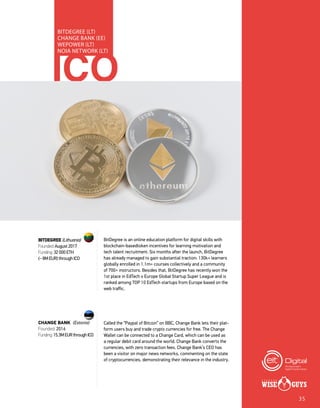
BitDegree is an online education platform for digital skills with
blockchain-basedtoken incentives for learning motivation and
tech talent recruitment. Six months after the launch, BitDegree
has already managed to gain substantial traction: 130k+ learners
globally enrolled in 1.1m+ courses collectively and a community
of 700+ instructors. Besides that, BitDegree has recently won the
1st place in EdTech x Europe Global Startup Super League and is
ranked among TOP 10 EdTech startups from Europe based on the
web traffic.
Called the “Paypal of Bitcoin” on BBC, Change Bank lets their plat-
form users buy and trade crypto currencies for free. The Change
Wallet can be connected to a Change Card, which can be used as
a regular debit card around the world. Change Bank converts the
currencies, with zero transaction fees. Change Bank’s CEO has
been a visitor on major news networks, commenting on the state
of cryptocurrencies, demonstrating their relevance in the industry.
BITDEGREE (Lithuania)
Founded: August 2017
Funding: 32 000 ETH
(~ 8M EUR) through ICO
CHANGE BANK (Estonia)
Founded: 2016
Funding:15.3MEURthroughICO
35
36
AND THE WORLD’S
FIRST e-RESIDENCY
When the country who brought us Skype is also the first nation in the world
to introduce e-Residency - a digital nation for global citizens, powered by the
world-changing blockchain technology - you know you’ve got a force to be
reckoned with.
What is e-Residency?
Named one of the most important governmental experiments of the 21st century, e-Re-
sidency is a government-issued digital identity available to anyone in the world. It empowers
entrepreneurs to set up and run a location-independent business. This means - you can start
a company 100% online from anywhere in the world.
And yes - this idea was first launched in the tiny, yet IT-savvy Baltic state, the Republic of Esto-
nia.
When the program was introduced in 2014, Edward Lucas, the Senior Editor of The Economist,
made history by becoming the first-ever e-Resident. The program has come a long way since
then, boasting nearly 40 thousand e-Residents from 156 countries. More than 10% of all
e-Residency applicants come from Finland, which is not surprising considering the cultural si-
milarities between these neighboring countries. But it is not just the historical background that
plays a role here.
Since 2002, Estonians have been able to run their companies entirely online from anywhere
in the world. By offering e-Residency, Estonians are sharing those benefits with more people
around the world - particularly those who value access to the EU market.
The Estonian e-Residency program has declared war to the twists and turns of bureaucracy. All
paper management - even your taxes and opening your bank account - can be done online. No more
posting and scanning, everything’s now securely encrypted online. You can be the full owner of the
company with much less hassle, no local administrator needed. It is clear that for Estonians it’s the
passion for business that matters, not paperwork.
As with everything else in life, it’s not all rainbows and unicorns. The e-Residency program does
have its limitations. The program does not offer citizenship, a residence permit, or rights to reside
either in Estonia or in the EU. So if you’re looking for a more traditional residency or a ci-
tizenship deal, the program might not be the ideal choice for your needs.
Furthermore, after the recent Latvian banking scandal, there have been issues with Estonian
banks refusing to open accounts for non-resident entrepreneurs and closing accounts that
have already been opened.
Estonian banks are not, however, the only banking options for e-residents. As Adam Rang, the spo-
kesperson for the e-Residency program explains, approximately half of e-Resident companies have
obtained online business banking from the fintech industry. This number is expected to increase,
as fintech companies provide more options and lower prices.
All things considered, if you’re looking for better business mobility in a continuously developing
digital environment, e-Residency is definitely worth giving a try.
But here’s the main question: why did this happen in Estonia among other pla-
ces?
Ever since restoring their independence in 1991, Estonians have been working towards building
a strong tech culture.
The foundation was laid when Mart Laar became Prime Minister of Estonia in 1992. His young
radical government (average age - 35; average EU government leader age - 52) gave the co-
untry a flat income-tax, free trade, and privatization. Many new businesses could be registered
smoothly and without delays.
• In 1998, Estonia equipped all
schools with internet
• In 2000, Estonia declared inter-
net access to be a human right
• The e-Residency programs is
named one of the most impor-
tant governmental experiments
of the 21st century
• The program hosts 50,000
e-Residents from 157 countries
• e-Residents have brought 14.4
million EUR ($17 million) back
to Estonia in net financial proce-
eds and indirect socio-economic
net benefits
• The financial benefits are
predicted to rise to 1.84 billion
euros ($2.17 billion) by 2025
• There are ~3700 IT companies
in Estonia that generate 7% of
GDP
FACTS:
37
38
Then, when Finland offered its old 1970s
analogue telephone-exchange for free, Es-
tonians declined and instead built a digital
system of their own.
In 1998, Estonia equipped all schools with
an internet connection and two years later
declared internet access to be a human
right.
Fast-forward to today, Estonians have
established their own digital ecosys-
tem called e-Estonia - a ground-brea-
king movement that introduces electronic
solutions to facilitate citizen interactions
with the state. By incorporating blockchain
technology, almost all public services in
Estonia are digitised and accessed throu-
gh secure digital identities. This includes
e-services such as e-Tax, i-Voting, Digital
ID, e-Health, and the latest brick in the
sturdy digital wall - the e-Residency pro-
gram.
“The decision to launch e-Residency was
unanimously approved by the Estonian
Parliament with no votes against it. We can
now see clearly that the program is helping
people around the world overcome the bar-
riers to entrepreneurship,” says Rang.
What’s in the future?
As a part of the e-Estonia ecosystem,
e-Residency has increased the attractive-
ness of Estonia not only as a place of re-
sidence, but as a great destination for
profitable business.
Since the launch of e-Residency three ye-
ars ago, approximately 3000 companies
have been created, paying 2.8 million eu-
ros in labor taxes.
According to a cost-benefit analysis, e-Re-
sidents have brought 14.4 million eu-
ros ($17 million) back to Estonia in
net financial proceeds and indirect so-
cio-economic net benefits. This num-
ber is predicted to rise to a whopping
1.84 billion euros ($2.17 billion) by
2025.
But the ingenious Estonians have
many other tricks up their sleeve.
They’ve increased the investment in
the e-Residency programme signi-
ficantly and the President of Estonia
KerstiKaljulaidisleadinganinitiativecalled
e-Residency 2.0, aiming to radically impro-
ve what Estonia offers to its e-residents.
While the main focus of the programme so
far was to help e-residents establish and
manage their companies, the next stage is
expected to focus more on the growth of
their businesses. To support this, a range
of business tools and community features
are already under development. Watch this
space.”
More importantly though, Estonia’s exam-
ple of how government services can be di-
gitizedisacompetitiveproductinitself,and
other countries are taking notice. Estonia
is already working with around 40 other
governments around the world, recently
signing an e-government agreement with
France. Or take the United Nations, for
example. They partnered with e-Residency
to launch a groundbreaking initiative called
e-Trade For All. It’s got such potential that
G20 recommended all its member to acti-
vely support the initiative’s policies.
Nowadays, approximately 3700 IT compa-
nies generate 7% of Estonia’s GDP. It’s no
wonder the smallest Baltic state of only 1.3
million people runs with the big dogs of the
information technology field, if not leading
the pack.
As Adam Rang says, “more of our lives
move online, and it is inevitable that more
countries will find more ways to serve pe-
ople there. And we think e-Residency will
become the new normal.”
So if you’re planning to unleash the poten-
tial of future technology within your busi-
ness, look no further. Here’s Estonia, the
Little Baltic Engine that Could.
39
Estonia is already
working with around
40 other governments
around the world
4040
A FLAT COUNTRY WHERE
TECH RUNS DEEP
‘Still waters run deep’ - this could be said both about the Deep Tech field in
Latvia and the country itself.
It’s not a coincidence that the World Economic Forum marked Latvia among
the top three Europe’s most entrepreneurial countries. A set of qualities,
like intelligence, resilience and hard work has helped the small nation with a
turbulent history produce a number of innovative startups.
As Latvian FinTech startups are taking the spotlight with two-thirds of total funding attracted,
Deep Tech might not appear to be Latvia’s strength from the first glance.
But those who dive deeper into Latvia’s tech scene will discover ingenious startups that have
impacted industries like medicine, climate, agriculture and are literally changing people’s
lives. Startups like Naco Technologies and Anatomy Next are the flag-bearers that have attrac-
ted the attention of global industry giants and made the tiny nation proud.
But they are by far not the only ones.
So what’s unique about the Latvian Deep Tech scene and what’s their secret to success? Ex-
cellent science education, renowned engineering skills or... enthusiastic people? To find the
answers, let’s take a trip into the depths of tech.
What is Deep Tech?
Deep Tech is just as mysterious as it sounds. A hidden corner of tech accessible only to those
with special knowledge, education or skills. Often developed from years of research and lab
testing, Deep Tech refers to fundamental discoveries in science, technology, and enginee-
ring that impact industries and people’s lives.
Deep Tech spans across many technological areas and often solves previously-intractable
41
real-world issues. Currently, industries most disrupted by Deep Tech include medicine, natural
sciences, aerospace, smart home/cities, energy efficiency, robotics, agtech, etc.
As opposed to regular tech startups, Deep Tech ventures are built around unique, often protec-
ted or hard to reproduce, technological or scientific advances.
The distinction between a “regular” technology startup and a Deep Tech startup makes a great
difference to investors as the business potential of a Deep Tech startup can only be evaluated
through an in-depth investigation of the intrinsic technology. But then, if the startup proves to
be successful, the return would typically be significantly higher than with a regular techno-
logy venture.
CEO of Startup Wise Guys accelerator Cristobal Alonso believes that the complexity of the code
and the product itself is what indicates if a particular software startup represents Deep Tech:
“Basically - if the MVP of a startup cannot be replicated by a large team of developers within 6
months, we internally consider that a Deep Tech startup.”
C. Alonso has noticed that Latvia has significantly more Industry 4.0 and Science Tech compa-
nies compared to other countries in the region: “When scouting for startups for our accelerator
in the Baltics and CEE, we see a clear trend in Latvia for ventures that combine software with
deep knowledge in specific industries, machinery, manufacturing.”
Latvian Deep Tech success stories
Latvia, which is celebrating its centenary this year, has been heavily promoting and investing in
its startup ecosystem. Some important support initiatives include:
•	 The Startup law - Latvia is the first country in the region to have a special law for
budding entrepreneurs.
•	 Startup visa for foreign founders allowing non-EU entrepreneurs to receive a resi-
dence permit if they set up a company in Latvia.
•	 A special tax regime for startups that lightens the burden of employee wages.
•	 The government has provided €60 million for seed and growth stage companies and
offers a €50,000 soft loan to early-stage startups who have difficulty accessing capital.
These efforts have not been in vain. Together with other Latvian strengths - a multilingual po-
pulation, one of the highest university attendance rates in the world, and an innovation-friendly
environment - the small country has hatched many successful Deep Tech startups.
• Minox, the sub-microscopic
camera built in Riga, was used
by spies from both sides during
the SecondWorldWar
• The world’s first skydive from
a drone was performed from a
28-propellor Aerones drone
• Sonarworks headphone
calibration technology is used
by producers who work with
Beyonce, Pink,Taylor Swift,
Maroon 5 and more
INTERESTING
FACTS:
The founders of Atlas Dynamics drone startup also created Atlas Aerospace - a company that
manufactures carbon components and aims at creating a European drone building center in
Riga. Indeed, Latvia seems to be a hotbed of drone-related startups. Airdog is another notable
example producing autonomous drones for the extreme sports market and, more recently,
‘Aerones’ which can transport heavy cargo and combat fire-related incidents.
As Latvia’s Deep Tech startups grow in number and strength, the Latvian government, uni-
versities, investors and other stakeholders do their part by initiating support programs, ne-
tworks and learning events for startups. 2018 has been exceptionally dynamic for present and
emerging Deep Tech startups with the international conference Deep Tech Atelier, Garage48
SpaceTech Hackathon and Deep Science Hackathon all taking place this spring.
It all starts at the university
Already during the industrial revolution at the end of the 19th century, Riga became the regi-
onal centre for producing high technology - electronics (VEF - State Electrotechnical Facto-
ry), mechanical engineering (trains, planes, cars). An internationally recognized engineering
school was established, and its tradition continues today. In addition, a number of scientific
institutes have been working on groundbreaking inventions for decades.
Solvita Kostjukova from startup ALINA believes that the Soviet industrial heritage has also
been beneficial for the creation of many Deep Tech and science based startups in La-
tvia. ALINA is also a good example of generations working together - the underlying chemical
technology was invented by Solvita’s father and is now being successfully commercialized by
Solvita and her business developers team.
For most Deep Tech startup founders, their Alma Mater is still the main springboard for pro-
totyping their ideas and helping them see daylight. Several successful startups thank uni-
versities for nursing their ideas and helping them reach adulthood. Sandis Kondrats, CEO
of Anatomy Next, stresses the invaluable support his startup received from professors and
students of Riga Stradins University and the University of Latvia. Conelum is the first techno-
logy startup developed under the wing of Riga Technical University (RTU) and uses methods
researched within the university.
RTU Vice-Rector for Research, Professor Tālis Juhna believes that Latvian universities offer a
strong education in STEM areas making Latvia the region’s leader in several niche segments
- robotics, smart materials, and biomedicine. He points out that “as a country still in the
process of economic transit, Latvia offers a good price-quality balance and this fosters in-
ternational recognition. Latvian scientists that work for Airbus, Daimler, Volvo, and CERN are
a good example to this.”
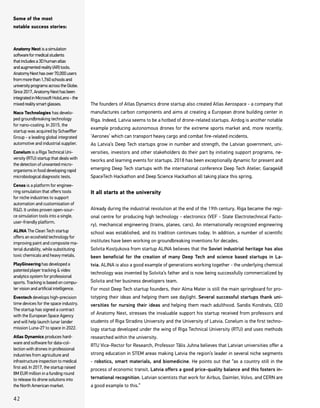
Anatomy Next isasimulation
softwareformedicalstudents
thatincludesa3Dhumanatlas
andaugmentedreality(AR)tools.
AnatomyNexthasover70,000users
frommorethan1,760schoolsand
universityprogramsacrosstheGlobe.
Since2017,AnatomyNexthasbeen
integratedinMicrosoftHoloLens-the
mixedrealitysmartglasses.
Naco Technologies has develo-
ped groundbreaking technology
for nano-coating. In 2015, the
startup was acquired by Schaeffler
Group - a leading global integrated
automotive and industrial supplier.
Conelum is a Riga Technical Uni-
versity (RTU) startup that deals with
the detection of unwanted micro-
organisms in food developing rapid
microbiological diagnostic tests.
Cenos is a platform for enginee-
ring simulation that offers tools
for niche industries to support
automation and customisation of
R&D. It unites proven open-sour-
ce simulation tools into a single,
user-friendly platform.
ALINA The Clean Tech startup
offers an ecoshield technology for
improving paint and composite ma-
terial durability, while substituting
toxic chemicals and heavy metals.
PlayGineering has developed a
patented player tracking & video
analytics system for professional
sports. Tracking is based on compu-
ter vision and artificial intelligence.
Eventech develops high-precision
time devices for the space industry.
The startup has signed a contract
with the European Space Agency
and will help launch lunar lander
mission Luna-27 to space in 2022.
Atlas Dynamics produces hard-
ware and software for data-col-
lection with drones in professional
industries from agriculture and
infrastructure inspection to medical
first aid. In 2017, the startup raised
8M EUR million in a funding round
to release its drone solutions into
the North American market.
Some of the most
notable success stories:
42
For most Deep Tech
startup founders, their
Alma Mater is still the
main springboard for
prototyping their ideas
and helping them
see daylight.
43
44
T.Juhna’s represented RTU is
also doing its share in prepa-
ring future engineers for CTO
positions in startups and in-
cludes business as a compul-
sory subject for all engineering
students. Among other initia-
tives, RTU also offers Design
Factory - a student incubator
that organizes various support
programmes and teaches idea
prototyping using technologies
such as laser cutting and engra-
ving, 3D printing and scanning,
and high-speed CNC machining
and post-processing.
Meanwhile,theUniversityofLa-
tvia (LU) has also made efforts
to promote science-based star-
tups, organizing events like the
first Deep Science Hackathon
and Blockchain Pre-accelera-
tor. The LU Institute of Solid
State Physics has also develo-
ped Materize - a new platform
for exporting science services
and cooperating with industry
in the field of high technologies.
Science working together
with business
As a relatively young Post-So-
viet country, Latvia is strug-
gling with keeping its talents
and paying competitive sala-
ries. This gap is especially wide
when it comes to science, and
now many scientists see the
business world and startups as
an opportunity to earn a living.
Sigvards Krongorns, co-foun-
der of CastPrint, believes that
it’s more difficult for Science
Tech startups to attract fun-
ding than, for example, Fin-
Tech startups. “That’s why many of these startups don’t last long, even if the underlying idea
is a good one.”
Commercialization Reactor is a notable initiative that aims to help science-based startups with
making their inventions saleable. This international platform unites scientists, entrepreneurs,
mentors and, finally, investors.
Innovation and Technology Transfer Centre of Riga Technical University is another successful
program backed by the Riga Technical University and focusing on long-term development of
the tech scene. This structural fund has been allocated €40,5 million by the Ministry of Econo-
mics of Latvia.
Rūdolfs Krese, board member of the Latvian private equity and venture capital association
(LVCA) points out: “Science has to go hand in hand and team up with business because inves-
tors rarely invest in a purely scientific invention or patent. They look for solutions for actual
problems - something that people would be willing to pay for.”
At present, the Latvian
Deep Tech scene is
like a diamond in the
rough - brimming with
potential but still not
properly commercialized.
45
The main investors in Latvian startups are business angels, early-stage VC funds,
as well as foreign investors. Additionally, ALTUM - a state-owned development
finance institution - helps to co-finance investment in startups by business an-
gels. Startup Wise Guys accelerator has already been running 3 programs in
Riga, investing in early stage B2B and Fintech startups. Several other startup
accelerators are powered by European funds.
What the future holds
Advances in Deep Tech take time - and scientists, engineers, developers, and
founders as well as investors have to take this reality into consideration. To cre-
ate a more mature Deep Tech ecosystem, Latvia still needs years of work, stable
seed funding, and initiatives on various levels that work together effectively.
At present, the Latvian Deep Tech sce-
ne is like a diamond in the rough - brim-
ming with potential but still not properly
commercialized. And when it comes to
realizing that potential, the young country
has to act smartly and make sure its eco-
nomy is the one reaping the fruits.
4646
AND ICOs -
THE PERFECT MATCH
Lithuania may be a small country in the map, but when it comes to the world
of cryptocurrencies, it's a giant.
In 2017, the country had 35 Initial Coin Offerings (ICOs) that raised a total of $500 million in value. The
country of just 3 million inhabitants suddenly stood out in the global map and ranked third in terms
of funds raised through ICOs. The only two countries that ranked ahead of Lithuania were the US and
China.
If you think that's impressive, there's more:
In the first three months of 2018, Lithuanian startups had already managed to raise $250 million
through ICOs. That's half of the total funds raised through ICOs in 2017.
Though the volume of ICOs in Lithuania has diminished over the course of 2018, it seems that Lithu-
anian startups had found the recipe to ICO success.
ICO-friendly environment
Lithuania's success story is not a coincidence. The country has committed to supporting the deve-
lopment of blockchain technologies, which, consciously, has created a favorable environment for
ICOs.
SeveralinitiativesatthenationallevelhavetakenLithuaniathisfar.Forexample,by2019theBankof
Lithuania is planning to launch their sandbox platform LBChain to help fintech companies test their
blockchain-based products. The local authorities are also supporting the initiative of the world's first
ICO crowdfunding platform DESICO to make it easier for startups raise money through ICOs.
Such support from the local authorities has not only played a significant role in the adoption of the
technologies, but has also given investors confidence when it comes to ICO funding.
47
A blockchain-enthusiastic
community
By becoming one of the first countries in the
world to provide legal guidelines for ICOs, Li-
thuania has increased society's trust in ICOs
and cryptocurrencies in general. As a result,
the country is experiencing widespread cryp-
tocurrency adoption and blockchain-enthu-
siasm.
Locals are actively setting up Bitcoin nodes,
and Lithuania takes the lead within the Baltic
States in numbers of full nodes - programs
that fully validate Bitcoin transactions. With 66
full nodes Lithuania has earned the 17th spot
in the Global Node Distribution country list.
Large companies are also picking up the cryp-
to-craze. For example, the Lithuanian elec-
tronics and home appliances retailer Elektro-
markt has announced that they're planning to
invest €1.5 million in crypto mining to build the
most powerful cryptocurrency mining system
in the Baltic States.
Atop of all that, various initiatives are born
from within the active community, including
the first Blockchain Center in Europe - the
crypto-focused co-working space based in
Vilnius. It's a great support for startups, as the
center that not only provides consultancies,
but also organises educational and networ-
king events with investors.
• Lithuanian startups raised
$0.25 billion through ICO in the
first 3 months of 2018
• Lithuania was one of the first
countries in the world to legally
regulate ICOs
• Monetha raised 31,5M EUR in
just 18 minutes after launching
their ICO
FACTS:
Localsareactivelysettingup
Bitcoinnodes,andLithuania
takestheleadwithinthe
BalticStatesinnumbersoffull
nodes-programsthatfully
validateBitcointransactions.
The right people in the right place
The crypto-friendly environment, nation's blockchain literacy and receptive attitude towards innova-
tions has created the right mindset that's needed to launch successful ICOs. In addition to all that,
Lithuania's got the talent - their true secret ingredient.
According to Zygimantas Zabieta, the social media and event coordinator at Blockchain Centre,
Lithuania has lots of talented young people with an IT and engineering background. These people
have been trained and gained experience in international data centres - mostly from the Scandina-
vian fintech sector - since 2008-2009.
HealsonotesthatLithuaniaisfinallybenefitingfromtheemigrationofyoungpeopletocountrieslike
UK, Ireland and Scandinavian countries for work and study. Many of these people have returned to
Lithuania and brought back the knowledge gained in Western Europe.
Besides, there's this opportunistic gene that Lithuanians have and that differs them from other Baltic
nations.
Lithuanians are life-hackers, and they seem to have found a way to successfully hack ICOs. That has
led them to grand success stories, like Monetha - the mobile processing company that collected $36
million in just 18 minutes after launching their ICO.
In the meantime, the life-hacking attitude and willingness to take opportunities may have also
paved the way to mistrustful ICOs. The largest ICO in Lithuania's history in terms of funds collected
and contributors attracted - Bankera - is now under investigation because of violating the country's
security laws.
The point is, even though the Lithuanian authorities are cultivating ICOs, it's still worth keeping in
mind that cryptocurrencies are ''high risk'' instruments…where the risk can lead to champagne
drinking in the end.
Lithuaniansare
life-hackers,and
theyseemtohave
foundawayto
successfullyhack
ICOs.Thathasled
themtogrand
successstories,like
Monetha
48
This report is created as a collection, comparison, and analysis of
publicly available information, combined with data and insights
from 25+ stakeholders from the Baltic startup ecosystem (startup
organisations, VC funds, Business Angel associations and individu-
al investors, accelerators, startups, support organisations, govern-
mental entities and opinion leaders). Data about Baltic countries
has been benchmarked against other regions, cities and countries
to give a different and more comprehensive angle.			
		
Both quantitative and qualitative methods have been used in the
research process. In some cases, data has been interpreted and
analysis offered through the lense of the joint EIT Digital and Star-
tup Wise Guys perspective.			
			
A lack of publicly available, comprehensive registered data on the
current state of startups within the Baltics has caused us to turn to
the next best thing - crowdsourced data - which has been compiled
by each of the Baltic States since 2008. This data has not only been
trusted by us, but has also been used as the foundation for reports
by the Ministry of Economics of Latvia, Karma VC, and more.		
	
			
As the data used mostly relies on publicly available information, a
possibility exists that the data does not reflect a comprehensive and
definitive status of the topic at hand. With these limitations in mind,
analysis has been made to the best of report authors' ability and
taking the most trustworthy raw data available. Though the data
may contain gaps in information, it does not diminish the report's
ability to point to tendencies. Since the startup scene develops rapi-
dly, we must note that the data and calculations were made based
on publicly available information by August of 2018.
METHODOLOGY
49
50
This report has been a result of the joint effort between EIT Digital and Startup Wise Guys. It could not
have been completed without the help of various organizations and invidividuals who have participated
by providing their insight, knowledge and perspectives that shaped this report. It is also made possible
by the various previously published research that this report was abe to use as a foundation to build on.
Special thanks to contributors: Data sources:
EIT Digital is a leading European digital innovation and entrepreneurial education organisation driving
Europe’s digital transformation. It delivers breakthrough digital innovations to the market and breeds
entrepreneurial talent for economic growth and improved quality of life in Europe. It does this by
mobilising a pan-European ecosystem of almost 200 top European corporations, SMEs, start-ups,
universities and research institutes.	
Startup Wise Guys is Europe's leading B2B startup accelerator, present in all three Baltic states with
participants from around the world. SWG displays a 77% survival rate, and is one of the most active
early stage investors in Nordics & CEE.
Latvian Startup Association Startin.lv			
Enterprise Lithuania			
Startup Lithuania			
Startup Estonia			
Donatas Keras, Practica VC			
Andris Bērziņš, Change Ventures			
Riivo Anton, United Angels VC			
Jana Pavlenkova, Prototron.ee			
Martins Sulte, Mintos			
Gytenis Galkis, LitBAN			
Aiga Kalbjonoka, LatBAN			
EstBAN			
Guna Janelsniņa, Financial and Capital Market Commission of Latvia	
Povilas Goberis, Blockchain enthusiast			
Zygimantas Zabieta, Blockchain Center Vilnius		
Sven Illing, Buildit.ee			
Livia Vosman, Estonian Financial Supervision Authority	
Arūnas Raišutis, Lietuvos Bankas			
Dāvis Suneps, Register a Company in Latvia			
Adam Rang, e-Residency programme			
Talis Juhna, RTU vice-rector			
Rudolfs Krese, Anita Matisone, LVCA			
Antons Adamovičs, Commercialization Reactor
Jone Vaituleviciute, Civitta.lt
Rūta Merkevičiūtė, Ministry of Finance of Lithuania		
	
Global State of Fintech Report 2018		
Estonian, Latvian and Lithuanian open-source investment data sheets	
Tech.eu Baltic Startup Report		
Earnst & Young research: Initial Coin Offerings (ICOs) 		
Start in Poland, Polish Ministry of Economics		
World Bank Group, Doing Buisness in 2018		
Handbook of Nordic startup investor market		
EWDN Startup Investment & Innovation in Emerging Europe	
Lithuanian Fintech Report		
Sweden Tech Funding Report		
Venture Capital in Europe and Israel		
EBAN 2016 statistics report		
Business Angels Funding 2016 Final Report		
crozdesk SaaS and Cloud Startup Report 2018		
Atomico - State of European Tech 2017		
Deloitte - European Salary Survey 2017		
Funderbeam		
The Nordic Web 2017 Funding Analysis		
Invest Europe		
ZDNet		
ICO Bench		
Statista.com		
Crunchbase		
European Commission Innovation Scoreboard 2017		
Startup Visa Lithuania		
Labs of Latvia		
Invest Lithuania		
PitchBook		
Mercer Quality of Living survey 2018		
Numbeo.com
Design by Instagram: @elas_ram / © EIT Digital, Startup Wise Guys 2018
Research & writing partners: Truesix.co

Baltic Startup Scene Report 2017-2018

  • 1.
    BALTIC SCENE REPORT 2017-2018 FIND OUT: The Biggest FundingDeals LONGER READS ON: How tech runs deep in Latvia How Lithuanians have managed to raise 500M in ICOs How digital nomads praise e-residency in Estonia The Most Active VCs in the Baltics Hand-picked Startups to Watch Inspiring Corporate Innovation Cases And more...
  • 2.
  • 3.
    T he Baltic startupecosystem is often lauded as a booming space, filled with perspective and tech talent. While each country of the Baltics - Estonia, Latvia, Lithuania - has conducted its own research into its startup ecosystem, it is rarely analyzed as a whole, and benchmarked against surrounding regions. By understanding where the Baltics stand compared to neighbouring regions, such as the Nordics and Central and Eastern Europe, we’re able to provide more precise insight to the state of the region, its progress, its potential, and ultimately, it’s status in the world of startups. This report, created by EIT Digital in collaboration with Startup Wise Guys, aims to provide of the state of the Baltics in startups to any onlookers, as well as participants of that ecosystem themselves. This will let us make better jud- gments about investments and possible growth channels for Baltic startups and scale ups. "TheBalticsisoneofthemostactivelydevelopingregionswe’veseen inrecentyears,andthat’sbecausetheecosystemisquiteadvanced andinastagewherealltheactorsneededarethere-you’vegotthe VCs,thebanks,thefounders,theuniversities,andyou’vegotmarkets whereyoucantest-trialanyviableproducts." FabioPianesi ResearchDirectoratEITDigital" 3
  • 4.
    4 BAL­ TICS IN A NUT­ SHELLPOPULATION (INMILLIONS) TOTAL BALTIC POPULATION - 6.1 MILLION 1,31,9 2,9 ESTONIA LATVIA LITHUANIA 673 ESTONIA 352 LATVIA 424 LITHUANIA 5.2 ESTONIA 1.8 LATVIA 1.4 LITHUANIA Interesting fact: Estonia is an outlier in terms of raised investment per capita in 2017 - 208, performing and raising incredible amounts, when compared to other regions. As a whole it brings up Baltic performance to 57,56 eur per capita, not far off from the Nordics' 80,71 per capita. CEE (Central and Eastern Europe), with a significantly larger population, is left in the dust with 8,31. Source: Crowdsourced data, thenordicweb.com, 150sec.com NUMBER OF STARTUPS INVESTMENT PER CAPITA (2017) STARTUPS PER 10,000 INHABITANTS TOTAL (EUR IN MILLIONS) POPULATION (MILLIONS) PER CAPITA (EUR) Estonia 271,4 1,3 208 62,2 1,9 32 18,5 2,9 6 Estonia Estonia Lithuania Lithuania Lithuania Latvia Latvia Latvia
  • 5.
    5 Source: Crowdfunded data (Baltics),InVenture (Ukraine), Nordics (The Nordic Web) Source: Crowdfunded data (Baltics), InVenture (Ukraine), Nordics (The Nordic Web) FUNDING GROWTH OVER THE LAST 5YEARS FUNDING GROWTH OVER THE LAST 5YEARS - PER CAPITA (EUR) 2013 2014 2015 2016 2017 Baltics Nordics Ukraine 1BN 2BN 3BN “Spotify's pre-IPO convertible debt fund injection of $1billion” In 2017 the Baltics experienced a noticeable jump in funding, while the Nordics and CEE experienced a sli- ght decrease. The Nordic decrease is simply a result of a lack of high profile funding (Sweden's Spotify IPO greatly increased that year's statistics) in 2017. The Baltic's increase, though each country experienced gro- wth, has the noticeable jump thanks to a funding round for now-unicorn Transferwise. When comparing the Baltics to the nearyby regions, namely the Nordics and Central and Eastern Europe (CEE), we can observe that as smaller countries, the Baltics have smaller investment amounts. However when comparing per capita data, they often meet or even exceed neighbouring region statistics. Estonia especially stands out as a country with a very small population, yet high amounts of funding. 2013 2014 2015 2016 2017 Estonia Latvia Lithuania Ukraine Nordics 0 20 40 60 80 100 120 140 160 180 200 220
  • 6.
    6 BIGGEST DEALS Latvia BitFury - 106,164,030 CreamFinance- 27,200,000 Lithuania Vinted - 49,756,329 GetJar - 31,500,000 yPlan - 31,400,000 Estonia Transferwise - 237,800,000 Taxify - 151,970,000 Pipedrive - 70,031,000 Monese - 66,224,449 Skeletontech - 40,000,000 Starship - 39,900,000 While Switzerland is the leading country with the most ICOs occurring within Europe, Lithuania is following in its footsteps with already 220mn EUR in Q1 of 2018 recorded by the Bank of Lithuania. INTERESTING FACT:
  • 7.
    7 INITIAL COIN OFFERINGS (ICO) Source: ICOBench, Crowdsourced data, Tech.eu, E&Y The Baltics as a whole are evidently more active in raising funding via ICOs than the surrounding regions, particularly in Lithuanian and Estonia. This heightened success can be partially attributed to Estonia's already existing blockchain-based e-residen- cy system, and Lithuania's crypto-friendly fintech regulations. Estonia Latvia Lithuania Baltic countries Poland Nordic countries 350M 28,65M 500M 878.65M 59.5M 33 M FUNDS RAISED THROUGH ICOS IN EUR (UP TO MAY, 2018)
  • 8.
    8 STARTUP FUNDING IN THE BALTICS VCFUNDS Ambient Sound Investments *BaltCap *BuildIt Capitalia *Change Ventures Commercialization Reactor Fund Contrarian Ventures *Contriber Ventures Expansion Capital Flycap Goldfish fund *Imprimatur Capital iTech Capital * Karma Ventures LitCapital * Livonia Partners NCH Group of Funds Nextury Ventures Open Circle Capital Overkill Ventures *Practica Capital *Proks Capital RubyLight Smartcap *Spring Capital Superangel *Tera Ventures Trind Venture *United Angels VC *Wise Guys Ventures ZGI Capital Source: ESTVCA, LVCA, LT VCA, Civitta, PitchBook * Funds that have been actively investing in 2018/2017 (at least 4 investments in this time frame) and/or have significant historical activity (> 50 investments) in the Baltic region.
  • 9.
    9 BUSINESS ANGELS Average investment sizefrom Baltic Business Angels in 2016 was 2.01 EUR per capita.This is higher than both Poland (0.33 EUR per capita) and the CEE region (0.62 EUR per capita). Estonia ranges at 6.73 EUR per capita, while Latvia follows at 1.24 EUR and Lithuania - 0.38 EUR. Source:EWDNCEEReport INTERESTING FACT: MEMBERS OF BUSINESS ANGEL ASSOCIATIONS BUSINESS ANGEL INVESTMENTS IN 2017 125 75 66Estonia Estonia Latvia Latvia Lithuania 11.3M eur invested 2.9M eur invested 108 startups 34 startups Average investment per project: 104 600 eur Average investment per project: 85 000 eur Lithuania - data not available, as LitBan was only established in 2018 Source: EstBAN, LatBAN, LitBan
  • 10.
    10 STARTUP ACCELERATORS* Estonia Tallinn Tartu STARTUP WISE GUYS SUPERANGEL BUILDIT 2012- ongoing 2018 – ongoing 2013 - 2017 7 programs, 73 accelerated startups B2B focus Privately funded partly EU funded 7 programs, 38 accelerated startups Hardware Privately funded
  • 11.
    11 STARTUP WISE GUYS COMERCIALIZATIONREACTOR BUILDIT BALTIC SANDBOX ACCELERATOR 70 VENTURES STARTUP WISE GUYS OVERKILL 2016 - ongoing 2009 - ongoing 2018 - ongoing 2018 - ongoing Launching in 2019 Launching in 2019 2018 - ongoing 4 programs, 27 accelerated startups B2B & Fintech focus Privately funded 40 accelerated startups IoT & Hardware focus partly EU funded SaaS & Fintech focus Privately funded partly EU funded Fintech, ICT, Blockchain, CyberTech, DeepTech focus partly EU funded Smart workplace focus partly EU funded Riga Latvia Vilnius Lithuania * List of accelerators that provide investment and run acceleration programs for startups. There are plenty more incubation and pre-acceleration possibili- ties for startups in the Baltics that are not listed here. Source: Accelerator websites, PitchBook.com
  • 12.
    12 According to theEuropean Innovation Scoreboa- rd, all Baltic countries are considered Moderate Innovators, compared to the Nordics that fit into the category of Innovation Leaders. Although this scoreboard depicts innovation in the SME sector, some similarities can be drawn in terms of startup and corporation collaboration. Apart from some long-term strategic collaboration ca- ses between banks, telcos, tech companies and startups, most corporate innovation in Baltics still fall into the category of shorter-term and curiosity-driven activities such as hackathons, startup competitions, support to existing innova- tion platforms or NGOs and similar, and mostly based on internal resources such as innovation teams, intrapreneur programs, internal R&D pro- jects. There are only few cases, where enterpri- ses work with startups by investing, piloting or buying their services. It is probable that the more Baltic startups mature, the stronger and higher level the collaboration with corporations will be. CORPORATIONS + STARTUPS CORPORATE INVOLVEMENT/INNOVATION European Commission Innovation Scoreboard 2017 Sweden 0 0.2 0.4 0.6 0.8 Netherlands Germnay Austria Denmark United Kingdom Belgium France Slovenia Finland Luxembourg Ireland EU28 average Czech Republic
  • 13.
    13 COLLABORATION PLATFORMS: CORPORATE VCFUNDS: This corporate startup program has evolved from a hackathon and classic accelerator bootcamp to a case-by-case piloting with more mature startups disrupting smart cities, e-commerce and wellness industries. Program offers market access, integration with Telia APIs, incubation, office space, and mentoring. In 2018 Startup Wise Guys accelerator partnered up with Swedbank to run the first Fintech accelerator program in the Baltics. In addition to classic 3 months mentoring program and seed funding, 10 Fintech startups also got access to bank's premium APIs, customers, and mentors. Currently second Fintech program is about to start in late fall 2018. While bank offers various benefits and potential piloting, this is not a corporate accelera- tor program as it is run by an external party, namely, Startup Wise Guys. Level 11 is a collaboration between Startup Es- tonia along with several private businesses. It is a program that aims to bring together startups with corporates to fuel innovation. They boast a membership of over 130 startups and 400 corporates, and offer events, mentoring, accele- ration, matchmaking, and innovation audits. PSD2 regulation has span Open Banking initiatives by almost all banks in the region. Apart from online API access for developers, SEB bank has gone further to organize a series of Fintech hackathons together with Garage48 and launching Innovation Center, whereas Swedbank has created a co-working for Fintech startups at their Riga HQ. State managed energy company Lietuvos Energija runs Energy venture capital fund, which also happens to be the first corporate VC fund in the Baltics. It is a com- bination of a fund and acceleration program for specifically ener- gy-centric startup ideas. Selected teams receive seed funding after the pre-seed idea validation round, and eventually, based on a case by case scenario, have additional funding to develop business into a full-fledged innovation. Fund is managed by Contrarian Ventures. SEB Group has also launched a corporate VC fund in the fall of 2018, looking at investing in inno- vative Tech and Fintech startups in the Nordics and Baltics. International innovation platform Demola is active in Latvia and Lithuania. Creative students are paired up with representatives of companies and organisations to tackle their challenges and offer solutions. In both countries on average 150 international students from various univer- sities are involved in the modern problem-sol- ving annually. VUNK by Telia Wise Guys Fintech accelerator Level 11 Open Banking Lietuvos Energija fund SEB Venture Capital Demola OPEN INNOVATION & INTERNAL ACCELERATORS: EXTERNAL ACCELERATORS:
  • 14.
    14 LIVING & WORKING INTHE BALTICS When comparing the cost of living in the Baltics to other countries of Europe, it becomes evident that there are opportunities to be taken advantage of. With rental prices approximately 72% lower than in Oslo, 57% lower than in Berlin, and 81% than in London, it is possible to significantly reduce day to day living costs. This becomes particularly advantageous from a startup perspective, where every cent counts. With the combination of a well-connected airport and central location, it could be considered ideal for early stage startup development and testing. Cost of living Monthly expenses (moderate/low spending*) Source: Numbeo.com * These calculations are based on Numbeo.com algorithms and assumptions about a lifestyle that includes: renting a small apartment outside of the city center, using public transit, not spending much on eating out, leisure, clothing, moderate spending on coffee, alcoholic beverages, travel, and not including child-related expenses. 1173.27  1035.89  1068.41  1706.12  1558.02  1567.57  14 Average monthly expenses for a single person with a “startup-y”lifestyle in the Baltics = 1093 EUR INTERESTING FACT:
  • 15.
    15 Tallinn ranks 23rdin Europe in terms of quality of life, that is the highest ranking among cities analyzed here, followed by Berlin (27th) and Stockholm (28th). London, on the other hand, ranks below all 3 Baltic capitals. Not only you would burn less cash living in the Baltics, you'd also probably enjoy it more. Quality of Life Index 1093 EUR lasts* Source: Numbeo.com * This comparison is based on Numbeo.com algorithms, calculating monthly spending for each city using the same lifestyle indicators. Baltics: 31 days London: 11 days Berlin: 19 days Stockholm: 17 days Warsaw: 31 days Kiev: 52 days Source: Numbeo.com
  • 16.
    AVERAGE GROSS MONTHLY SALARY AVERAGEGROSS MONTHLY DEVELOPER SALARY TAX WEDGE ON LABOUR COSTS Latvia* 1,013 2013 41,9% Lithuania 885 1846 39,2% Estonia 1,221 2286 38% Baltic countries 1,039 2048 39,7% Poland 1,102 2280 33,7% Nordic countries 3,970 4095 36,75% CEE 1,358 1893 38,54 % AVERAGE SALARIES (EUR) Running a business Availability of tech talent A lack of developers is a global challenge in this technology-heavy society. The Nordics and the Baltics both have high amounts of tech talent available per capita. The Baltics, however, have lower salary points of the two regions, making the main costs of running a business noticeably lower in the Baltics than elsewhere. While Poland is famous for running R&D centers for large global corporations, they rank at only 6 developers per 1000 inhabitants. Nordic countries, on the other hand, including Finland, Sweden, and Norway, have on average 16 deve- lopers per 1000 inhabitants. *Where salaries for startup employees are concerned, the Latvian government has passed a "Startup Law" that foresees a fixed tax rate on salaries of 253 EUR for a salary up to 4,050 EUR per month Source: Eurostat, Numbeo.com All 3 Baltic countries rank rather high on the ease of doing business and ease of paying taxes scale according to Doing Business 2018. In both cases, Estonia, Latvia, and Lithuania are among the top 10, and above the EU average. INTERESTING FACT: 16
  • 17.
    17 AVAILABILITY OF DEVELOPERS AMOUNTOF EMPLOYED DEVELOPERS CURRENTLY REGISTERED IN NATIONAL EMPLOYMENT AGENCIES Estonia: 20000 Latvia: 17531 Lithuania: 29347 Poland: 254 682 Nordic countries: 433 171
  • 18.
    1818 All three Balticstates have identified the need to facilitate the entrance of foreign talent into their coun- tries. With comparatively small populations, specialists must often be sourced from a wider talent pool. As a result, each country has enacted a startup visa (or residence permit), that offers a legal foundation and added perks to work in the country. Here they are, side by side, to get a better idea of the process of each. Sources: Startup Estonia, Labs of Latvia, Startup Visa Lithuania LITHUANIA KEEP IN MIND: LATVIAESTONIA: Your company must be established in Lithuania within 30 days after receiving the residency permit. Your startup is required to raise 30.000 EUR within 6 months, and 60.000 EUR within 18 months, from qualified VCs. If you are not residing in Estonia for developing the startup, your visa may be cancelled. FOR NON-EU FOUNDERS: STARTUP VISAS CARD Comparing startup visas for foreign founders and talent ESTONIA LATVIA LITHUANIA Time it takes to register and receive a decision 1-2 months 30 days 1 month (expedited) - 2 months (regular) Online application No No Yes Application 100% in English Yes No Yes Price of application 60-180 EUR 90.60 EUR 114-228 EUR Level of innovation will be reviewed Yes Yes Yes Length of stay 1 year Max. 5 years 1 year Length that can be renewed 183 days 5 years 1 year Interview required No No Yes (video) Application location Home embassy, or in Estonia Home embassy, or in Latvia Home embassy, or in Lithuania Amount of financial“buffer”required in bank account 1680 EUR 4560 EUR Nothing set, you decide how much you'll need Prior investment necessary No No No
  • 19.
    Registering a companywithin the Baltic states is an incredibly accessible thing to do, even for a non-citizen. With comparatively quick turnaround times and small fees, forming a business is not out of reach. Obtain e-signature Obtain e-signature Prepare statutes + founding act minutes Obtain e-signature Open bank account Submit documents Open bank account Reserve business name REGISTERING A COMPANY IN THE BALTICS "I’msureyoucanfindgoodbusinessinitiativesinevery country,butwhatEstoniahasmanagedtodowonderfully, istheaccentononespecificaspect-awaywithpaperwork!" Eugeniu Girla - founder of GAUS, from Moldova, registered a company in Estonia while going through the StartupWise Guys accelerator. Steps to register a company ESTONIA LATVIA LITHUANIA Online company registration Yes (with Estonian eID) Yes (with any Baltic or EU eID) Yes (with e-signature) Open bank account online Yes, but only for citizens of Estonia (e-residents not included)* No No Notary required? Not with eID signature Not with eID signature Yes Registration in English, 100% Yes No No Days to register 3 business hours 1.5-3.5 business days 3 business days Steps to complete 3 3 5 Registration fee 190 EUR 34 EUR 57.34 EUR Initial capital required 2500 EUR 1 EUR 2500 EUR Legal address permission required No Yes Yes COMPARING COMPANY REGISTRATION PROCESSES IN THE BALTICS *Non-citizens of Estonia can use a fintech challenger bank ex. Holvi, Transferwise Borderless, Payoneer ESTONIA LATVIA LITHUANIA Submit documents Open bank account Submit documents Only Estonia citizens are able to open bank accounts remotely. Foreign citizens are able to use challenger banks to open an account, but that may cause issues when registering initial capital. To register a company online in Latvia, both Latvian eID and Estonian eID-based e-signatures are accepted. In Lithuania, notary approval is required for all documents handed in. All documents must be submitted in Lithuanian. 19
  • 20.
    257 8 694 LITHUANIA ESTONIA LATVIA STARTUP VISA APPLICATIONS ACCELERATORSAS STARTUP MAGNETS RUSSIA, UKRAINE AND BELARUS DOMINATE IN STARTUP VISA APPLICATIONS UNTIL AUGUST, 2018 Analysis of geographic split of deal-flow from 2 most active and long-running accelerators in the region. “Whileacceleratorsinlargemarketscanrelyonthelocaldeal-flow,Baltic acceleratorprogramsarefamousforbeingveryinternational.AtStartup WiseGuyswegetmoreandmoreincomingteamsfromUkraine,Turkey, Armenia,alsoIndia–showingthatfornon-EUstartups,theBalticsserve asanentrypointtotheEUmarket.” Cristobal Alonso, Global CEO at StartupWise Guys 20
  • 21.
    21 STARTUP VISA DATAABOUT H1 2018 FROM TOP-APPLICANT COUNTRIES Source: Startup Estonia, LIAA, Startup Lithuania, Startup Wise Guys, Buildit Startup Wise Guys and Buildit From EU East of EU 60 40 20 0 Other Startup Wise Guys Buildit ONLY 42% OF APPLICATIONS GET APPROVED! INDIA RUSSIA PAKISTAN TURKEY IRAN EGYPT BANGLADESH UNITED STATES CHINA UKRAINE MOROCCO BRAZIL GEORGIA BELARUS REJECTED ACCEPTED Qoute:"AmongthemostsuccessfulapplicantsarecompaniesfromcountrieswhereStartupEstoniahasmet thelocalteams.WhilethereisalotofinterestandsuccessfulexamplesfromfellowformerSovietnations,the- rearealsoothercountrieslikeJapan,ArgentinaandevenChina,whoareinterestedinrelocatingtheirstar- tupstoEstonia,”saysMerilinLukk,ProjectManagerfortheStartupVisaprogramme.
  • 22.
    Air transit connectsthe Baltic region to every corner of the earth, as well as ground transit, which connects it to closer destinations in the regions. Here are some of the most important features of accessibility to consider. Infrastructure plays a major role in the Baltics as a key destina- tion. Conveniently located in the crossroads between the East, West and North, the Baltic States offer easy and affordabe access to meetings, conferences, and other important events. ACCESSIBILITY to EUROPE 22
  • 23.
    Of the threeBaltic states, the Riga International Airport (RIX) is the largest and the best-connected serving direct flights to 100 destinations in 30 countries. The annual passenger numbers at Riga Airport have been growing steadily over the past few years exceeding 6 million passengers in 2017. AIR TRANSPORTATION: VILNIUS RIGA TALLINNdestinations destinations destinations passengers in 2017 passengers in 2017 passengers in 2017 48 100 39 3.8M 6M 2.6M FLIGHTS FROM RIGA TO THE MAIN STARTUP HUBS IN EUROPE AND BEYOND: DESTINATION TRAVEL TIME FLIGHT FREQUENCY PRICE (ROUND TRIP) LONDON - 2 hours 50 minutes away from Riga, with at least 5 flights serviced daily by several airlines. Round trip price starting from €75 2hr 50 min 5 flights daily From €75 BERLIN is only 1 hour 40 minutes away with minimum 3 daily flights. Round trip price starting from €80 1hr 40 min 3 flights daily From €80 PARIS - RIX also provides daily flights to Paris with the flight duration of 2 hours and 50 minutes. Round trip price starting from €170 2hr 50 min 1 flight daily From €170 AMSTERDAM is 2 hours and 30 minutes away and has daily flights by Air Baltic. Round trip price starting from €140 2hr 30 min 1 flight daily From €140 BARCELONA - There are at least 8 flights per week from Riga to Barcelona. The flight time is 3 hours and 45 minutes. Round trip price starting from €100 3hr 45 min 8 flights weekly From €100 MOSCOW - 7 flights per week, several times per day. Flight time 1 hour 35 min. Round trip price starting from €140 1hr 35 min 7 flights weekly From €140 ISRAEL - direct flights 6 times per week (May-September), duration 4 hours 30 minutes. Round trip price starting from €100 4hr 30 min 6 flights weekly From €100 Riga International Airport is accessible in approximately 4 hours by bus from Tallinn and Vilnius. Alternatively, the flight from both neighbouring capitals to Riga takes 50 minutes. 23
  • 24.
    REGULATION IN THEBALTICS FINTECH The fintech sector is known for its fast-moving development, and its tendency to challenge older, stagnated financial industries. It is no surprise that fintech initiatives develop faster than the typically slow-moving government can pass legislation to regulate it. Each Baltic country has made efforts to develop ini- tiatives to support and regulate the fintech industry, and thereby creating trust, transarency and safety through providing a regulartory body. Here are what each country have come up with. It should be noted that the Ministries of Finance of all three countries have even come together to sign a joint MoU to announce their commitment to support blockchain initiatives. This is a takeoff from other countries, which have made a point of denouncing it and even banning crypto currencies. Here is what each country has come up with. 24
  • 25.
    As a result,the institution is quick to pass laws relevant to fintech startups that support, regulate and legitimize their industry, without stifling their progress. This includes the P2P lending industry, which is covered by the Creditors and Credit Intermediaries act, which came into force January, 2018, as well as creating a framework for ICOs, depending on their specification. As ICOs are unique, each is advised to consult the EFSA. Most are covered under the Securities Mar- ket Act, as well as the Law of Obligations Act. However if tokens are used as a means of providing a loan, then the Credit Institutions Act may be invoked. Source: EFSA The competent authority on fintech: EFSA (Estonian Finan- cial Supervision Authority) Initiatives to support fintech: Specialized P2P lending policy, ICO frameworks ESTONIA: Weareconstantlymonito- ringtheareaoffinancial innovation,reactingtothe distortionsoftheproducts, assessingrisksandtaking proportionatemeasures withouthindering theinnovation. -EFSA- 25
  • 26.
    The Latvian financialregulatory body has established a financial innovation support program, which is currently named the Innovation Sandbox. They invite all fintech initiatives - either existing or simply conceptual - to visit the innovation center to be consulted for the best way to implement their idea, and help them with any licences they might need to obtain to be compliant with local laws. They are currently developing legislation suggestions to regulate the P2P lending industry, noting that current legislation is not enough to ensure transparency and safety between lenders and borro- wers. Current P2P projects are forced to paste together different ill-fitting licences to continue work. This supports the activities of P2P lenders, such as Twino, Mintos, and CreamFinance, which has been recognized as one of the fastest growing startups in Europe for 2 years in a row. FKTK have an open doors policy and invite any fintech initiatives, including ICOs, to make use of the Innovation Sandbox, and be consulted as to the necessary licences that may be needed. Source: FKTK The competent authority on fintech: FKTK (The Financial and Capital Market Commis- sion) Initiatives to support fintech: Diminished licencsing fee for innovative payment services. Originally 5000 EUR, now cut to 450 EUR LATVIA: TheFKTKinnovationsandboxallowsforefficientaccesstoexpert consultationsofavarietyofindustries.Theexpertsimmerse themselvesintherelevantfinanceandcapitalmarkettopicsfrom differentperspectives(legal,financial,conformity,etc.).Wehelp andconsultavarietyofprojects,inavarietyofdevelopmentstages. -GunaJanelsiņa,FKTK- 26
  • 27.
    Lithuanian authorities havemade a concerted effort to embrace financial innovation. As a unique case with such a small country with the most funds raised through ICOs per capita, (and in total surpassed only by the US and China), the government has been quick to appreciate the opportunities provided by blockchain. Lithuania is the only jurisdiction in the EU to have a special-purpose banking license, allowing the foundation of a bank with registered capital of just €1M EUR. Additionally, they've created a "new- commer banking licence package" for alternative tech banks, passed a P2P lending law to regulated the industry, and have announced the launch of a blockchain sandbox, set to go live in 2019. The Bank of Lithuania has stated that they intend to make Lithuania the preferred gateway to EU payment market. Source: Bank of Lithuania The competent authority on fintech: Bank of Lithuania Initiatives supporting fintech: Diminished required registered capital for bank foundation of specialized banks (to 1M EUR, down from 5M for standard banks), blockchain sandbox, newcomer banking licence package - P2P lending regu- lation LITHUANIA: -EFSAwebsite- 27
  • 28.
    STARTUPS to WATCH Rather thanbombard you with the typical startup suc- cess stories, we've curated a list of startups that are in some ways under the radar, promising, or interesting. The list is curated by startup organisations, selected Bu- siness Angels and VCs, accelerators and other players over the entire Baltic region. 28
  • 29.
  • 30.
    30 FINTE TRANSFERGO (LT) NORDIGEN (LV) INSLY(EE) INVESTLY (EE) ESTATE GURU (EE) MONETHA (LT) VERIFF (EE) MINTOS (LV) PAYTIPTOP (EE)
  • 31.
    31 The pan-European moneytransfer service that targets migrant workers provides the fastest transfer times - 30 minutes (comapred to 1 business day for its competitors). The startup reached hockeystick growth in 2017 when it doubled its user base to 600k, is now growing 10% every month, and has reached an average of 1000 new customers every day. Mintos is a global marketplace for a loans that provides retail investors with an easy and transparent way to invest in loans originated by a variety of alternative lending companies around the world. This is a unique platform that helps to facilitate free and efficient movement of capital around the globe. It has attracted almost 70 000 investors and reached almost EUR 1 billion in cumulative investments in loans funded by investors. Three years after launch Mintos is profitable, has offices in Riga, Warsaw and Mexico City, and plans to increase their turnover by 2-3 times by the end of 2018. Investly is an invoice financing service that helps businesses bypass cashflow barriers. In May of 2017 they closed a financing round of 700,000 EUR thro- ugh crowdfunding, and moved their HQ to London. They are negotiating with Nordic and Baltic banks to implement their product into the banks, and have already secured an agreement with one of the lar- gest banks in the Baltics. But their largest amount of traction comes from non-bank lenders, thanks to the many integrations Investly has with different bookkeeping and accounting services. TRANSFERGO (Lithuania) Founded: 2012 Funding: 20.6M USD MINTOS (Latvia) Founded: 2015 Funding: 2M EUR INVESTLY (Estonia): Founded: 2014 Funding: 2.1M EUR EstateGuru is a Pan-European marketplace for short-term property-backed business loans. The startup has an investor base of more than 16 000 investors across 45 countries and nearly 90M EUR worth of investments facilitated. The firm has now reached 5-6M EUR monthly in- vestment volume and is expanding to new mar- kets. To top it all off, the firm has established a historic annual return of 12.2% with a 0 EUR loss of credit for its investors. ESTATE GURU (Estonia) Founded: 2013, launched December 2014 Funding: 0.5M EUR Currently looking for: Series A investment ECH
  • 32.
    SOFTWA DASHBIRD (EE) PRINTIFY (LV) WELLPARKO(LT) ALPHABLUES (EE) SAYAT (EE) REBELROAM (EE) FRACTORY (EE) CENOS (LV) HALA (LV) PLAYGINEERING (LV) PRINTFUL (LV) AS A SERVICE 32
  • 33.
    33 Within 1 yearof having the platform launched, the on-de- mand manufacturing plaform has gone from 0 users to 400 clients. Founder Martin Vares emphasizes that the disruptive nature of the solution, along with comparatively few competitors and a strong founding team have lead to getting noticed in Europe, characterized by the inbound leads coming from Scandinavia and the UK, particularly the traditional manufactoring city of Liverpool. Cenos makes computer aided engineering available to small and medium sized businesses, making R&D processes more accessible to those who don't have the same amount of financing as major corporations. 40% of their clients opt for their annual subscription plan, proving that these businesses see value in the service. The startup has won multiple awards, including the 2017 Digital Freedom Festival pitch competition, and the 2017 LATA award for open technology. After having received an 870,000 EUR investment from Gokul Rajaram (aka the Goodfather of Google AdSense), Printify is continuing to develop its global platform that connects print on demand companies with ecommerce sellers. They intend to empower sellers to offer custom print products on their online stores from the best product provi- ders worldwide. With over 100,000 active users, Printify is on track to reach 8,700,000 EUR annual revenue by the end of 2018. FRACTORY (Estonia) Founded: July 2017 Funding: 0,35M EUR CENOS (Latvia) Founded: March 2017 Funding: 180,000 EUR PRINTIFY (Latvia): Founded: September 2015 Funding: 0.87M EUR RebelRoamiscurrentlytheonlycloud-based,hardwareand network-agnosticWi-Finetworkoptimizationsolutionforthe transportationandtravelindustries.Havingrecentlybeenawar- dedthe“mostinnovativestartupinair-travel”bytheFTEawards, alongsideLufthansaandGatwickAirport,andtherunner-upprize forFinnair’sPitchforFutureevent,RebelRoamprovidesWi-Fi networkoptimizationin38Europeancountries,andopeneda newofficeintheUSAinthespringof2018.Theircloud-based solutioncanbeimplementedremotelywithinminutes,worldwide andatpresentoptimizesWi-Finetworksforover2Mpassengers onboardferries,trains,andbuseseverymonth. Alphablues is a vertically integrated AI-startup that has built virtual customer assistants, which help large corporations automate their customer servi- ce. Their solution is language agnostic, available in 8+ languages, and already used by companies like Telia, LHV Bank, Lattelecom, and others. Having started out as 100% boostrapped, Alphablues has secured positive cash flow in 1.5 years. They are already offering virtual assistants that integrate with companies' backend systems and provide more authenticated and personalized customer service. PlayGineering has built a video analytics technology for team sports, whose uniqueness lies in its simultaneous use of AI, computer vision, machine learning, big data and video processing. The startup doubled their revenue from $0.9M to $1.7M in 2017, and experienced their first moment of glory when the PlayGineering technology was used in The 2018 IIHF World Championship. They are currently being considered as service providers for the NHL. REBELROAM (Estonia): Founded: October 2015 Funding: 0,1M EUR ALPHABLUES (Estonia) Founded: 2017 Funding: Bootstrapped PLAYGINEERING (Latvia): Founded: 2015 Funding: 1M EUR Currently looking for: €1.5-2M series A funding ARE
  • 34.
    HARDWARE SONARWORKS (LV) AERONES (LV) 3DSOLARPANEL (LT) SMARTVENT (EE) CASTPRINT (LV) TRIUMPH HEALTH (LT) CastPrint has recently finalized their end-to-end 3D cast printing services for clinics and hospitals, making 3D printing technologies available to healthcare institutions without having to invest in the hardware of software, and with minimal training required. Since launching the product in January, CastPrint is now working with four private clinics and two state hospitals, and is experiencing 50% MoM growth. Triumf Health has developed a mobile game to provide psychological support to ill children. Their early adopters have been pediatric cancer patients. Currently they're moving into clinical trials to gain scienti- fic backing to the effectiveness of the technology, which is a major differentiator from their competitors, as well as the real-time summary dashboard for the care team, which provides big data analysis from the game. The game is available in Estonian, Finnish, English, Russian, and soon - Spanish. The game is in the process of being evaluated as digital medicine under the Estonian Health Insurance Fund, and they plan to expand to other childhood chronic disease treatment and prevention. CASTPRINT (Latvia) Founded: September 2016 Funding: 60,000 EUR Currently looking for: 300,000 EUR seed investment TRIUMF HEALTH (Estonia): Founded: July 2017 Funding: 200,000 EUR 34
  • 35.
    ICO BITDEGREE (LT) CHANGE BANK(EE) WEPOWER (LT) NOIA NETWORK (LT) BitDegree is an online education platform for digital skills with blockchain-basedtoken incentives for learning motivation and tech talent recruitment. Six months after the launch, BitDegree has already managed to gain substantial traction: 130k+ learners globally enrolled in 1.1m+ courses collectively and a community of 700+ instructors. Besides that, BitDegree has recently won the 1st place in EdTech x Europe Global Startup Super League and is ranked among TOP 10 EdTech startups from Europe based on the web traffic. Called the “Paypal of Bitcoin” on BBC, Change Bank lets their plat- form users buy and trade crypto currencies for free. The Change Wallet can be connected to a Change Card, which can be used as a regular debit card around the world. Change Bank converts the currencies, with zero transaction fees. Change Bank’s CEO has been a visitor on major news networks, commenting on the state of cryptocurrencies, demonstrating their relevance in the industry. BITDEGREE (Lithuania) Founded: August 2017 Funding: 32 000 ETH (~ 8M EUR) through ICO CHANGE BANK (Estonia) Founded: 2016 Funding:15.3MEURthroughICO 35
  • 36.
    36 AND THE WORLD’S FIRSTe-RESIDENCY When the country who brought us Skype is also the first nation in the world to introduce e-Residency - a digital nation for global citizens, powered by the world-changing blockchain technology - you know you’ve got a force to be reckoned with. What is e-Residency? Named one of the most important governmental experiments of the 21st century, e-Re- sidency is a government-issued digital identity available to anyone in the world. It empowers entrepreneurs to set up and run a location-independent business. This means - you can start a company 100% online from anywhere in the world. And yes - this idea was first launched in the tiny, yet IT-savvy Baltic state, the Republic of Esto- nia. When the program was introduced in 2014, Edward Lucas, the Senior Editor of The Economist, made history by becoming the first-ever e-Resident. The program has come a long way since then, boasting nearly 40 thousand e-Residents from 156 countries. More than 10% of all e-Residency applicants come from Finland, which is not surprising considering the cultural si- milarities between these neighboring countries. But it is not just the historical background that plays a role here. Since 2002, Estonians have been able to run their companies entirely online from anywhere in the world. By offering e-Residency, Estonians are sharing those benefits with more people around the world - particularly those who value access to the EU market.
  • 37.
    The Estonian e-Residencyprogram has declared war to the twists and turns of bureaucracy. All paper management - even your taxes and opening your bank account - can be done online. No more posting and scanning, everything’s now securely encrypted online. You can be the full owner of the company with much less hassle, no local administrator needed. It is clear that for Estonians it’s the passion for business that matters, not paperwork. As with everything else in life, it’s not all rainbows and unicorns. The e-Residency program does have its limitations. The program does not offer citizenship, a residence permit, or rights to reside either in Estonia or in the EU. So if you’re looking for a more traditional residency or a ci- tizenship deal, the program might not be the ideal choice for your needs. Furthermore, after the recent Latvian banking scandal, there have been issues with Estonian banks refusing to open accounts for non-resident entrepreneurs and closing accounts that have already been opened. Estonian banks are not, however, the only banking options for e-residents. As Adam Rang, the spo- kesperson for the e-Residency program explains, approximately half of e-Resident companies have obtained online business banking from the fintech industry. This number is expected to increase, as fintech companies provide more options and lower prices. All things considered, if you’re looking for better business mobility in a continuously developing digital environment, e-Residency is definitely worth giving a try. But here’s the main question: why did this happen in Estonia among other pla- ces? Ever since restoring their independence in 1991, Estonians have been working towards building a strong tech culture. The foundation was laid when Mart Laar became Prime Minister of Estonia in 1992. His young radical government (average age - 35; average EU government leader age - 52) gave the co- untry a flat income-tax, free trade, and privatization. Many new businesses could be registered smoothly and without delays. • In 1998, Estonia equipped all schools with internet • In 2000, Estonia declared inter- net access to be a human right • The e-Residency programs is named one of the most impor- tant governmental experiments of the 21st century • The program hosts 50,000 e-Residents from 157 countries • e-Residents have brought 14.4 million EUR ($17 million) back to Estonia in net financial proce- eds and indirect socio-economic net benefits • The financial benefits are predicted to rise to 1.84 billion euros ($2.17 billion) by 2025 • There are ~3700 IT companies in Estonia that generate 7% of GDP FACTS: 37
  • 38.
    38 Then, when Finlandoffered its old 1970s analogue telephone-exchange for free, Es- tonians declined and instead built a digital system of their own. In 1998, Estonia equipped all schools with an internet connection and two years later declared internet access to be a human right. Fast-forward to today, Estonians have established their own digital ecosys- tem called e-Estonia - a ground-brea- king movement that introduces electronic solutions to facilitate citizen interactions with the state. By incorporating blockchain technology, almost all public services in Estonia are digitised and accessed throu- gh secure digital identities. This includes e-services such as e-Tax, i-Voting, Digital ID, e-Health, and the latest brick in the sturdy digital wall - the e-Residency pro- gram. “The decision to launch e-Residency was unanimously approved by the Estonian Parliament with no votes against it. We can now see clearly that the program is helping people around the world overcome the bar- riers to entrepreneurship,” says Rang. What’s in the future? As a part of the e-Estonia ecosystem, e-Residency has increased the attractive- ness of Estonia not only as a place of re- sidence, but as a great destination for profitable business. Since the launch of e-Residency three ye- ars ago, approximately 3000 companies have been created, paying 2.8 million eu- ros in labor taxes. According to a cost-benefit analysis, e-Re- sidents have brought 14.4 million eu- ros ($17 million) back to Estonia in net financial proceeds and indirect so- cio-economic net benefits. This num- ber is predicted to rise to a whopping 1.84 billion euros ($2.17 billion) by 2025. But the ingenious Estonians have many other tricks up their sleeve. They’ve increased the investment in the e-Residency programme signi- ficantly and the President of Estonia KerstiKaljulaidisleadinganinitiativecalled e-Residency 2.0, aiming to radically impro- ve what Estonia offers to its e-residents. While the main focus of the programme so far was to help e-residents establish and manage their companies, the next stage is expected to focus more on the growth of their businesses. To support this, a range of business tools and community features are already under development. Watch this space.” More importantly though, Estonia’s exam- ple of how government services can be di- gitizedisacompetitiveproductinitself,and other countries are taking notice. Estonia is already working with around 40 other governments around the world, recently signing an e-government agreement with France. Or take the United Nations, for example. They partnered with e-Residency to launch a groundbreaking initiative called e-Trade For All. It’s got such potential that G20 recommended all its member to acti- vely support the initiative’s policies. Nowadays, approximately 3700 IT compa- nies generate 7% of Estonia’s GDP. It’s no wonder the smallest Baltic state of only 1.3 million people runs with the big dogs of the information technology field, if not leading the pack. As Adam Rang says, “more of our lives move online, and it is inevitable that more countries will find more ways to serve pe- ople there. And we think e-Residency will become the new normal.” So if you’re planning to unleash the poten- tial of future technology within your busi- ness, look no further. Here’s Estonia, the Little Baltic Engine that Could.
  • 39.
    39 Estonia is already workingwith around 40 other governments around the world
  • 40.
    4040 A FLAT COUNTRYWHERE TECH RUNS DEEP ‘Still waters run deep’ - this could be said both about the Deep Tech field in Latvia and the country itself. It’s not a coincidence that the World Economic Forum marked Latvia among the top three Europe’s most entrepreneurial countries. A set of qualities, like intelligence, resilience and hard work has helped the small nation with a turbulent history produce a number of innovative startups. As Latvian FinTech startups are taking the spotlight with two-thirds of total funding attracted, Deep Tech might not appear to be Latvia’s strength from the first glance. But those who dive deeper into Latvia’s tech scene will discover ingenious startups that have impacted industries like medicine, climate, agriculture and are literally changing people’s lives. Startups like Naco Technologies and Anatomy Next are the flag-bearers that have attrac- ted the attention of global industry giants and made the tiny nation proud. But they are by far not the only ones. So what’s unique about the Latvian Deep Tech scene and what’s their secret to success? Ex- cellent science education, renowned engineering skills or... enthusiastic people? To find the answers, let’s take a trip into the depths of tech. What is Deep Tech? Deep Tech is just as mysterious as it sounds. A hidden corner of tech accessible only to those with special knowledge, education or skills. Often developed from years of research and lab testing, Deep Tech refers to fundamental discoveries in science, technology, and enginee- ring that impact industries and people’s lives. Deep Tech spans across many technological areas and often solves previously-intractable
  • 41.
    41 real-world issues. Currently,industries most disrupted by Deep Tech include medicine, natural sciences, aerospace, smart home/cities, energy efficiency, robotics, agtech, etc. As opposed to regular tech startups, Deep Tech ventures are built around unique, often protec- ted or hard to reproduce, technological or scientific advances. The distinction between a “regular” technology startup and a Deep Tech startup makes a great difference to investors as the business potential of a Deep Tech startup can only be evaluated through an in-depth investigation of the intrinsic technology. But then, if the startup proves to be successful, the return would typically be significantly higher than with a regular techno- logy venture. CEO of Startup Wise Guys accelerator Cristobal Alonso believes that the complexity of the code and the product itself is what indicates if a particular software startup represents Deep Tech: “Basically - if the MVP of a startup cannot be replicated by a large team of developers within 6 months, we internally consider that a Deep Tech startup.” C. Alonso has noticed that Latvia has significantly more Industry 4.0 and Science Tech compa- nies compared to other countries in the region: “When scouting for startups for our accelerator in the Baltics and CEE, we see a clear trend in Latvia for ventures that combine software with deep knowledge in specific industries, machinery, manufacturing.” Latvian Deep Tech success stories Latvia, which is celebrating its centenary this year, has been heavily promoting and investing in its startup ecosystem. Some important support initiatives include: • The Startup law - Latvia is the first country in the region to have a special law for budding entrepreneurs. • Startup visa for foreign founders allowing non-EU entrepreneurs to receive a resi- dence permit if they set up a company in Latvia. • A special tax regime for startups that lightens the burden of employee wages. • The government has provided €60 million for seed and growth stage companies and offers a €50,000 soft loan to early-stage startups who have difficulty accessing capital. These efforts have not been in vain. Together with other Latvian strengths - a multilingual po- pulation, one of the highest university attendance rates in the world, and an innovation-friendly environment - the small country has hatched many successful Deep Tech startups. • Minox, the sub-microscopic camera built in Riga, was used by spies from both sides during the SecondWorldWar • The world’s first skydive from a drone was performed from a 28-propellor Aerones drone • Sonarworks headphone calibration technology is used by producers who work with Beyonce, Pink,Taylor Swift, Maroon 5 and more INTERESTING FACTS:
  • 42.
    The founders ofAtlas Dynamics drone startup also created Atlas Aerospace - a company that manufactures carbon components and aims at creating a European drone building center in Riga. Indeed, Latvia seems to be a hotbed of drone-related startups. Airdog is another notable example producing autonomous drones for the extreme sports market and, more recently, ‘Aerones’ which can transport heavy cargo and combat fire-related incidents. As Latvia’s Deep Tech startups grow in number and strength, the Latvian government, uni- versities, investors and other stakeholders do their part by initiating support programs, ne- tworks and learning events for startups. 2018 has been exceptionally dynamic for present and emerging Deep Tech startups with the international conference Deep Tech Atelier, Garage48 SpaceTech Hackathon and Deep Science Hackathon all taking place this spring. It all starts at the university Already during the industrial revolution at the end of the 19th century, Riga became the regi- onal centre for producing high technology - electronics (VEF - State Electrotechnical Facto- ry), mechanical engineering (trains, planes, cars). An internationally recognized engineering school was established, and its tradition continues today. In addition, a number of scientific institutes have been working on groundbreaking inventions for decades. Solvita Kostjukova from startup ALINA believes that the Soviet industrial heritage has also been beneficial for the creation of many Deep Tech and science based startups in La- tvia. ALINA is also a good example of generations working together - the underlying chemical technology was invented by Solvita’s father and is now being successfully commercialized by Solvita and her business developers team. For most Deep Tech startup founders, their Alma Mater is still the main springboard for pro- totyping their ideas and helping them see daylight. Several successful startups thank uni- versities for nursing their ideas and helping them reach adulthood. Sandis Kondrats, CEO of Anatomy Next, stresses the invaluable support his startup received from professors and students of Riga Stradins University and the University of Latvia. Conelum is the first techno- logy startup developed under the wing of Riga Technical University (RTU) and uses methods researched within the university. RTU Vice-Rector for Research, Professor Tālis Juhna believes that Latvian universities offer a strong education in STEM areas making Latvia the region’s leader in several niche segments - robotics, smart materials, and biomedicine. He points out that “as a country still in the process of economic transit, Latvia offers a good price-quality balance and this fosters in- ternational recognition. Latvian scientists that work for Airbus, Daimler, Volvo, and CERN are a good example to this.” Anatomy Next isasimulation softwareformedicalstudents thatincludesa3Dhumanatlas andaugmentedreality(AR)tools. AnatomyNexthasover70,000users frommorethan1,760schoolsand universityprogramsacrosstheGlobe. Since2017,AnatomyNexthasbeen integratedinMicrosoftHoloLens-the mixedrealitysmartglasses. Naco Technologies has develo- ped groundbreaking technology for nano-coating. In 2015, the startup was acquired by Schaeffler Group - a leading global integrated automotive and industrial supplier. Conelum is a Riga Technical Uni- versity (RTU) startup that deals with the detection of unwanted micro- organisms in food developing rapid microbiological diagnostic tests. Cenos is a platform for enginee- ring simulation that offers tools for niche industries to support automation and customisation of R&D. It unites proven open-sour- ce simulation tools into a single, user-friendly platform. ALINA The Clean Tech startup offers an ecoshield technology for improving paint and composite ma- terial durability, while substituting toxic chemicals and heavy metals. PlayGineering has developed a patented player tracking & video analytics system for professional sports. Tracking is based on compu- ter vision and artificial intelligence. Eventech develops high-precision time devices for the space industry. The startup has signed a contract with the European Space Agency and will help launch lunar lander mission Luna-27 to space in 2022. Atlas Dynamics produces hard- ware and software for data-col- lection with drones in professional industries from agriculture and infrastructure inspection to medical first aid. In 2017, the startup raised 8M EUR million in a funding round to release its drone solutions into the North American market. Some of the most notable success stories: 42
  • 43.
    For most DeepTech startup founders, their Alma Mater is still the main springboard for prototyping their ideas and helping them see daylight. 43
  • 44.
    44 T.Juhna’s represented RTUis also doing its share in prepa- ring future engineers for CTO positions in startups and in- cludes business as a compul- sory subject for all engineering students. Among other initia- tives, RTU also offers Design Factory - a student incubator that organizes various support programmes and teaches idea prototyping using technologies such as laser cutting and engra- ving, 3D printing and scanning, and high-speed CNC machining and post-processing. Meanwhile,theUniversityofLa- tvia (LU) has also made efforts to promote science-based star- tups, organizing events like the first Deep Science Hackathon and Blockchain Pre-accelera- tor. The LU Institute of Solid State Physics has also develo- ped Materize - a new platform for exporting science services and cooperating with industry in the field of high technologies. Science working together with business As a relatively young Post-So- viet country, Latvia is strug- gling with keeping its talents and paying competitive sala- ries. This gap is especially wide when it comes to science, and now many scientists see the business world and startups as an opportunity to earn a living. Sigvards Krongorns, co-foun- der of CastPrint, believes that it’s more difficult for Science Tech startups to attract fun- ding than, for example, Fin- Tech startups. “That’s why many of these startups don’t last long, even if the underlying idea is a good one.” Commercialization Reactor is a notable initiative that aims to help science-based startups with making their inventions saleable. This international platform unites scientists, entrepreneurs, mentors and, finally, investors. Innovation and Technology Transfer Centre of Riga Technical University is another successful program backed by the Riga Technical University and focusing on long-term development of the tech scene. This structural fund has been allocated €40,5 million by the Ministry of Econo- mics of Latvia. Rūdolfs Krese, board member of the Latvian private equity and venture capital association (LVCA) points out: “Science has to go hand in hand and team up with business because inves- tors rarely invest in a purely scientific invention or patent. They look for solutions for actual problems - something that people would be willing to pay for.” At present, the Latvian Deep Tech scene is like a diamond in the rough - brimming with potential but still not properly commercialized.
  • 45.
    45 The main investorsin Latvian startups are business angels, early-stage VC funds, as well as foreign investors. Additionally, ALTUM - a state-owned development finance institution - helps to co-finance investment in startups by business an- gels. Startup Wise Guys accelerator has already been running 3 programs in Riga, investing in early stage B2B and Fintech startups. Several other startup accelerators are powered by European funds. What the future holds Advances in Deep Tech take time - and scientists, engineers, developers, and founders as well as investors have to take this reality into consideration. To cre- ate a more mature Deep Tech ecosystem, Latvia still needs years of work, stable seed funding, and initiatives on various levels that work together effectively. At present, the Latvian Deep Tech sce- ne is like a diamond in the rough - brim- ming with potential but still not properly commercialized. And when it comes to realizing that potential, the young country has to act smartly and make sure its eco- nomy is the one reaping the fruits.
  • 46.
    4646 AND ICOs - THEPERFECT MATCH Lithuania may be a small country in the map, but when it comes to the world of cryptocurrencies, it's a giant. In 2017, the country had 35 Initial Coin Offerings (ICOs) that raised a total of $500 million in value. The country of just 3 million inhabitants suddenly stood out in the global map and ranked third in terms of funds raised through ICOs. The only two countries that ranked ahead of Lithuania were the US and China. If you think that's impressive, there's more: In the first three months of 2018, Lithuanian startups had already managed to raise $250 million through ICOs. That's half of the total funds raised through ICOs in 2017. Though the volume of ICOs in Lithuania has diminished over the course of 2018, it seems that Lithu- anian startups had found the recipe to ICO success. ICO-friendly environment Lithuania's success story is not a coincidence. The country has committed to supporting the deve- lopment of blockchain technologies, which, consciously, has created a favorable environment for ICOs. SeveralinitiativesatthenationallevelhavetakenLithuaniathisfar.Forexample,by2019theBankof Lithuania is planning to launch their sandbox platform LBChain to help fintech companies test their blockchain-based products. The local authorities are also supporting the initiative of the world's first ICO crowdfunding platform DESICO to make it easier for startups raise money through ICOs. Such support from the local authorities has not only played a significant role in the adoption of the technologies, but has also given investors confidence when it comes to ICO funding.
  • 47.
    47 A blockchain-enthusiastic community By becomingone of the first countries in the world to provide legal guidelines for ICOs, Li- thuania has increased society's trust in ICOs and cryptocurrencies in general. As a result, the country is experiencing widespread cryp- tocurrency adoption and blockchain-enthu- siasm. Locals are actively setting up Bitcoin nodes, and Lithuania takes the lead within the Baltic States in numbers of full nodes - programs that fully validate Bitcoin transactions. With 66 full nodes Lithuania has earned the 17th spot in the Global Node Distribution country list. Large companies are also picking up the cryp- to-craze. For example, the Lithuanian elec- tronics and home appliances retailer Elektro- markt has announced that they're planning to invest €1.5 million in crypto mining to build the most powerful cryptocurrency mining system in the Baltic States. Atop of all that, various initiatives are born from within the active community, including the first Blockchain Center in Europe - the crypto-focused co-working space based in Vilnius. It's a great support for startups, as the center that not only provides consultancies, but also organises educational and networ- king events with investors. • Lithuanian startups raised $0.25 billion through ICO in the first 3 months of 2018 • Lithuania was one of the first countries in the world to legally regulate ICOs • Monetha raised 31,5M EUR in just 18 minutes after launching their ICO FACTS: Localsareactivelysettingup Bitcoinnodes,andLithuania takestheleadwithinthe BalticStatesinnumbersoffull nodes-programsthatfully validateBitcointransactions.
  • 48.
    The right peoplein the right place The crypto-friendly environment, nation's blockchain literacy and receptive attitude towards innova- tions has created the right mindset that's needed to launch successful ICOs. In addition to all that, Lithuania's got the talent - their true secret ingredient. According to Zygimantas Zabieta, the social media and event coordinator at Blockchain Centre, Lithuania has lots of talented young people with an IT and engineering background. These people have been trained and gained experience in international data centres - mostly from the Scandina- vian fintech sector - since 2008-2009. HealsonotesthatLithuaniaisfinallybenefitingfromtheemigrationofyoungpeopletocountrieslike UK, Ireland and Scandinavian countries for work and study. Many of these people have returned to Lithuania and brought back the knowledge gained in Western Europe. Besides, there's this opportunistic gene that Lithuanians have and that differs them from other Baltic nations. Lithuanians are life-hackers, and they seem to have found a way to successfully hack ICOs. That has led them to grand success stories, like Monetha - the mobile processing company that collected $36 million in just 18 minutes after launching their ICO. In the meantime, the life-hacking attitude and willingness to take opportunities may have also paved the way to mistrustful ICOs. The largest ICO in Lithuania's history in terms of funds collected and contributors attracted - Bankera - is now under investigation because of violating the country's security laws. The point is, even though the Lithuanian authorities are cultivating ICOs, it's still worth keeping in mind that cryptocurrencies are ''high risk'' instruments…where the risk can lead to champagne drinking in the end. Lithuaniansare life-hackers,and theyseemtohave foundawayto successfullyhack ICOs.Thathasled themtogrand successstories,like Monetha 48
  • 49.
    This report iscreated as a collection, comparison, and analysis of publicly available information, combined with data and insights from 25+ stakeholders from the Baltic startup ecosystem (startup organisations, VC funds, Business Angel associations and individu- al investors, accelerators, startups, support organisations, govern- mental entities and opinion leaders). Data about Baltic countries has been benchmarked against other regions, cities and countries to give a different and more comprehensive angle. Both quantitative and qualitative methods have been used in the research process. In some cases, data has been interpreted and analysis offered through the lense of the joint EIT Digital and Star- tup Wise Guys perspective. A lack of publicly available, comprehensive registered data on the current state of startups within the Baltics has caused us to turn to the next best thing - crowdsourced data - which has been compiled by each of the Baltic States since 2008. This data has not only been trusted by us, but has also been used as the foundation for reports by the Ministry of Economics of Latvia, Karma VC, and more. As the data used mostly relies on publicly available information, a possibility exists that the data does not reflect a comprehensive and definitive status of the topic at hand. With these limitations in mind, analysis has been made to the best of report authors' ability and taking the most trustworthy raw data available. Though the data may contain gaps in information, it does not diminish the report's ability to point to tendencies. Since the startup scene develops rapi- dly, we must note that the data and calculations were made based on publicly available information by August of 2018. METHODOLOGY 49
  • 50.
    50 This report hasbeen a result of the joint effort between EIT Digital and Startup Wise Guys. It could not have been completed without the help of various organizations and invidividuals who have participated by providing their insight, knowledge and perspectives that shaped this report. It is also made possible by the various previously published research that this report was abe to use as a foundation to build on. Special thanks to contributors: Data sources: EIT Digital is a leading European digital innovation and entrepreneurial education organisation driving Europe’s digital transformation. It delivers breakthrough digital innovations to the market and breeds entrepreneurial talent for economic growth and improved quality of life in Europe. It does this by mobilising a pan-European ecosystem of almost 200 top European corporations, SMEs, start-ups, universities and research institutes. Startup Wise Guys is Europe's leading B2B startup accelerator, present in all three Baltic states with participants from around the world. SWG displays a 77% survival rate, and is one of the most active early stage investors in Nordics & CEE. Latvian Startup Association Startin.lv Enterprise Lithuania Startup Lithuania Startup Estonia Donatas Keras, Practica VC Andris Bērziņš, Change Ventures Riivo Anton, United Angels VC Jana Pavlenkova, Prototron.ee Martins Sulte, Mintos Gytenis Galkis, LitBAN Aiga Kalbjonoka, LatBAN EstBAN Guna Janelsniņa, Financial and Capital Market Commission of Latvia Povilas Goberis, Blockchain enthusiast Zygimantas Zabieta, Blockchain Center Vilnius Sven Illing, Buildit.ee Livia Vosman, Estonian Financial Supervision Authority Arūnas Raišutis, Lietuvos Bankas Dāvis Suneps, Register a Company in Latvia Adam Rang, e-Residency programme Talis Juhna, RTU vice-rector Rudolfs Krese, Anita Matisone, LVCA Antons Adamovičs, Commercialization Reactor Jone Vaituleviciute, Civitta.lt Rūta Merkevičiūtė, Ministry of Finance of Lithuania Global State of Fintech Report 2018 Estonian, Latvian and Lithuanian open-source investment data sheets Tech.eu Baltic Startup Report Earnst & Young research: Initial Coin Offerings (ICOs) Start in Poland, Polish Ministry of Economics World Bank Group, Doing Buisness in 2018 Handbook of Nordic startup investor market EWDN Startup Investment & Innovation in Emerging Europe Lithuanian Fintech Report Sweden Tech Funding Report Venture Capital in Europe and Israel EBAN 2016 statistics report Business Angels Funding 2016 Final Report crozdesk SaaS and Cloud Startup Report 2018 Atomico - State of European Tech 2017 Deloitte - European Salary Survey 2017 Funderbeam The Nordic Web 2017 Funding Analysis Invest Europe ZDNet ICO Bench Statista.com Crunchbase European Commission Innovation Scoreboard 2017 Startup Visa Lithuania Labs of Latvia Invest Lithuania PitchBook Mercer Quality of Living survey 2018 Numbeo.com Design by Instagram: @elas_ram / © EIT Digital, Startup Wise Guys 2018 Research & writing partners: Truesix.co