I.	 INTRODUCTION AND FOCUS QUESTIONS
SPECIAL PRODUCTS
AND FACTORS
	 Have you at a certain time asked yourself how a basketball court was painted
using the least number of paint? Or how the architect was able to maximize the space
of a building and was able to place all amenities the owners want? Or how a carpenter
was able to create a utility box using minimal materials? Or how some students were
able to multiply polynomial expressions in a least number of time?
	 This module will help you recognize patterns and techniques in finding products,
and factors, and mathematical as well as real-life problems.
	 After finishing the module, you should be able to answer the following questions:
	 a.	 How can polynomials be used to solve geometric problems?
	 b.	 How are products obtained through patterns?
	 c.	 How are factors related to products?
II.	 LESSONS AND COVERAGE
	 In this module, you will examine the aforementioned questions when you study
the following lessons:
	 Lesson 1 – Special Products
	 Lesson 2 – Factoring
http://dmciresidences.com/home/2011/01/
cedar-crest-condominiums/
http://frontiernerds.com/metal-box
http://mazharalticonstruction.blogspot.
com/2010/04/architectural-drawing.html
1
2
	 In these lessons, you will learn to:
Lesson 1
Special
Products
•	 identify polynomials which are special products through pattern
recognition
•	 find special products of certain polynomials
•	 apply special products in solving geometric problems
•	 solve problems involving polynomials and their products
Lesson 2
Factoring
•	 factor completely different types of polynomials
•	 find factors of products of polynomials
•	 solve problems involving polynomials and their factors.
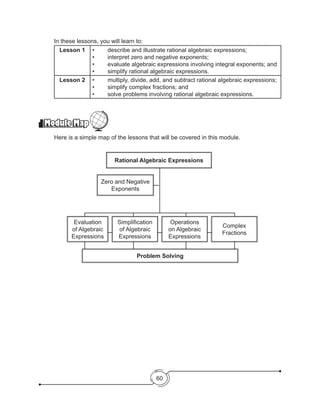
Module MapModule Map
	 Here is a simple map of the lessons that will be covered in this module:
Special Products
Applications
Factoring
Square of a Binomial
Sum and Difference of Two
Terms
Cube of a Binomial
Common Monomial Factor
Difference of Two Squares
Perfect Square Trinomial
General Trinomial
Sum and Difference of Two
Cubes
Grouping
Square of a Trinomial
	 Find out how much you already know about this module. Write the letter that
corresponds to the best answer on your answer sheet.
3
III.	PRE-ASSESSMENT
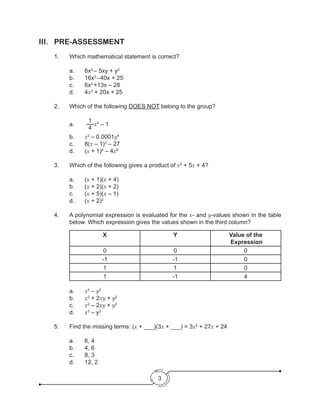
1.	 Which mathematical statement is correct?
	 	 a.	 6x2
– 5xy + y2
	 	 b. 	 16x2
–40x + 25
	 	 c. 	 6x2
+13x – 28
	 	 d. 	 4x2
+ 20x + 25
	 2.	 Which of the following DOES NOT belong to the group?
		a. 	
1
4
x4
– 1
		
	 	 b. 	 x2
– 0.0001y4
				
	 	 c. 	 8(x – 1)3
– 27                	 	
	 	 d. 	 (x + 1)4
– 4x6
	 3.	 Which of the following gives a product of x2
+ 5x + 4?
	 	 a. 	 (x + 1)(x + 4)	 	 	 	
	 	 b. 	 (x + 2)(x + 2)
	 	 c. 	 (x + 5)(x – 1)	 	 	
	 	 d. 	 (x + 2)2
4.	 A polynomial expression is evaluated for the x- and y-values shown in the table
below. Which expression gives the values shown in the third column?
X Y Value of the
Expression
0 0 0
-1 -1 0
1 1 0
1 -1 4
	
	 a. 	 x2
– y2
		
	 b. 	 x2
+ 2xy + y2
		
	 c. 	 x2
– 2xy + y2
		
	 d.	 x3
– y3
5.	 Find the missing terms: (x + ___)(3x + ___) = 3x2
+ 27x + 24
	 a. 	 6, 4	 	 	 	 	 	
	 b. 	 4, 6	 	 	 	
	 c. 	 8, 3
	 d. 	 12, 2
4
6.	 The length of a box is five meters less than twice the width. The height is 4 meters
more than three times the width. The box has a volume of 520 cubic meters.
Which of the following equations can be used to find the height of the box?
	 a. 	 W(2L – 5) (3H + 4) = 520	 	 	
	 b. 	 W(2W + 5) (3W – 4) = 520
	 c. 	 W(2W – 5) (3W – 4) = 520
	 d. 	 W(2W – 5) (3W + 4) = 520	
7.	 One of the factors of 2a2
+ 5a – 12 is a + 4. What is the other factor?
	 a. 	 2a – 3	 	 	 	 c. 	 2a – 8
	 b. 	 2a + 3	 	 	 	 d. 	 2a + 8
8.	 The area of a square is 4x2
+12x + 9 square units. Which expression represents
the length of the side?
	 a. 	 (3x + 2) units	 	 	 c. 	 (4x + 9) units	 	 	
	 b. 	 (2x + 3) units	 	 	 d. 	 (4x + 3) units
9.	 The side of a square is x cm long. The length of a rectangle is 5 cm longer than
the side of the square and the width is 5 cm shorter. Which statement is true?
	 a. 	 The area of the square is greater than the area of the rectangle.
	 b. 	 The area of the square is less than the area of the rectangle.
	 c. 	 The area of the square is equal to the area of the rectangle.
	 d.	 The      relationship cannot be determined from the given information.
10.	 A square piece of land was rewarded by a landlord to his tenant. They agreed that
a portion of it represented by the rectangle inside should be used to construct a
grotto. How large is the area of the land that is available for the other purposes?
	 	 	 	 	 	 	 a. 	 4x2
– 9 		
	 	 	 	 	 	 	 b. 	 4x2
+ x + 9 		
	 	 	 	 	 	 	 c. 	 4x2
– 8x – 9 		
	 	 	 	 	 	 	 d. 	 4x2
+ 9	
11.	 Which value for x will make the largest area of the square with a side of 3x + 2?
	 a. 	
3
4 					c. 	
1
3
			
				
	 b. 	 0.4	 	 	 	 	 d. 	 0.15
2
5 – 2x
2x – 1
2x – 1
5
12.	 Which procedure could not be used to solve for the area of the figure below?
	 a.	 A = 2x (2x + 6) +
1
2
(2x)(x + 8)	 	 	
	 	 A = 4x2
+ 12x + x2
+ 8x					
	 	 A = 5x2
+ 20x							
	 b.	 A = 2x(3x + 14) – 2(
1
2
)(x)(x + 8)
	 	 A = 6x2
+ 28x – x2
– 8x
	 	 A = 5x2
+ 20x
	 c.	 A = [2x(2x + 6) + (x + 8)(2x)] – 2(
1
2
)(x)(x + 8)
	 	 A = [4x2
+ 12x) + (2x2
+ 16x) – (x2
+ 8x)
	 	 A = 6x2
+ 28x – x2
– 8x
	 	 A = 5x2
+ 20x
	 d.	 A = 2x(2x + 6) + (
1
2
)(2 + x)(x + 8)
	 	 A = 4x2
+ 12x + x2
+ 8x
	 	 A = 5x2
+ 20x
13.	 Your classmate was asked to square (2x – 3), he answered 4x2
– 9. Is his answer
correct?
	 a. 	 Yes, because squaring a binomial always produces a binomial product.
	 b. 	 Yes, because the product rule is correctly applied.
	 c. 	 No, because squaring a binomial always produces a trinomial product.
	 d. 	 No, because the answer must be 4x2
+ 9
.
14.	 Let A: 4x2
– 81, and let B: (2x – 9)(2x + 9).  If x = 2, which statement is true about
A and B?
	 a. 	 A > B		 b. 	 A < B		 c. 	 A = B		 d. 	 A ≠ B
	 2x + 6 	 	 x + 8 		 	
	
2x
6
15.	 Your sister plans to remodel her closet. She hired a carpenter to do the task. What
should your sister do so that the carpenter can accomplish the task according to
what she wants?
	 a. 	 Show a replica of a closet.
	 b. 	 Download a picture from the internet.
	 c. 	 Leave everything to the carpenter.
	 d. 	 Provide the layout drawn to scale.
16.	 Which of the following standards would best apply in checking the carpenter’s
work in item number 15?
	 a. 	 accuracy of measurements and wise utilization of materials
	 b. 	 accuracy of measurements and workmanship 	
	 c. 	 workmanship and artistic design
	 d. 	 workmanship and wise utilization of materials
17.	 The city mayor asked you to prepare a floor plan of the proposed day care center
in your barangay. The center must have a small recreational corner. As head of
the city engineering office, what will you consider in preparing the plan?
	 a.	 Feasibility and budget
	 b.	 Design and budget
	 c.	 Design and Feasibility
	 d.	 Budget and lot area
18.	 Suppose there is a harvest shortage in your farm because of malnourished soil.
What will you do to ensure a bountiful harvest in your farmland?
	 a.	 Hire number of workers to spread fertilizers in the farmland.
	 b.	 Buy several sacks of fertilizers and use them in your farmland.
	 c.	 Find the area of the farmland and buy proportionate number of sacks of
fertilizers.
	 d.	 Solve for the number of sacks of fertilizers proportionate to the number of
workers.
19.	 The Punong Barangay in your place noticed that garbage is not properly disposed
because the garbage bins available are too small. As the chairman of the health
committee, you were tasked to prepare garbage bins which can hold 24 ft3
of
garbage.  However,  the location where the garbage bins will be placed is limited.
H ow will you maximize the area?
	 a.	 Find the dimensions of the planned bin according to the capacity given.
	 b.	 Make trial and error bins until the desired volume is achieved.
	 c.	 Solve for the volume and use it in creating bins.
	 d.	 Find the area of the location of the bins.
7
20.	 As head of the marketing department of a certain construction firm, you are
tasked to create a new packaging box for the soap products. What criteria will you
consider in creating the box?
	 a.	 Appropriateness and the resources used
	 b.	 Resources used and uniqueness
	 c.	 Appropriateness and uniqueness
	 d.	 Appropriateness and capacity
	 How was your performance in the pre–test? Were you able to answer all the
problems? Did you find difficulties in answering them? Are there questions familiar to you?
IV.	 LEARNING GOALS AND TARGETS
	 In this module, you will have the following targets:
•	 Demonstrate understanding of the key concepts of special products and factors of
polynomials.
•	 Formulate real-life problems involving special products and factors and solve
these with utmost accuracy using a variety of strategies.
8
11 Special
Products
What to KnowWhat to Know
	 Let us start our study of this module by reviewing first the concepts on multiplying
polynomials, which is one of the skills needed in the study of this module. Discuss the
questions below with a partner.
PATTERNS WHERE ARE YOU?
	 Have you ever looked around and recognized different patterns? Have you asked
yourself what the world’s environment would look like if there were no patterns? Why do you
think there are patterns around us?
	 Identify the different patterns in each picture. Discuss your observations with a partner.
	 Have you ever used patterns in simplifying mathematical expressions? What advantages
have you gained in doing such? Let us see how patterns are used to simplify mathematical
expressions by doing the activity below. Try to multiply the following numerical expressions.
Can you solve the following numerical expressions mentally?
	 Now, answer the following questions:
	 1.	 What do you notice about the given expressions?
	 2.	 Did you solve them easily? Did you notice some patterns in finding their answers?
	 3.	 What technique/s did you use? What difficulties did you encounter?
	 The indicated products can be solved easily using different patterns.
Lesson
97 × 103 =
25 × 25 =
99 × 99 × 99 =
http://gointothestory.blcklst.com/2012/02/
doodling-in-math-spirals-fibonacci-and-being-a-
plant-1-of-3.html
h t t p : / / m e g a n v a n d e r p o e l . b l o g s p o t .
com/2012/09/pattern-precedents.html
9
	 Are your solutions different from your classmates? What did you use in order to find the
products easily?
	 The problems you have answered are examples of the many situations where we can
apply knowledge of special products. In this lesson, you will do varied activities which will
help you answer the question, “How can unknown quantities in geometric problems
be solved?”
	 Let’s begin by answering the “I” portion of the IRF Worksheet shown below. Fill it up by
writing your initial answer to the topical focus question:
IRF WORKSHEETActivity 1
Description: 	 Below is the IRF worksheet which will determine your prior knowledge about
the topical question.
Direction: 		 Answer the topical questions: (1) What makes a product special? and (2)
What patterns are involved in multiplying algebraic expressions? Write
your answer in the initial part of the IRF worksheet.
IRF Worksheet
Initial Answer
Revised Answer
Final Answer
COMPLETE ME!
Activity 2
Description: 	 This activity will help you review multiplication of polynomials, the pre-requisite
skill to complete this module.
Directions: 	 Complete the crossword polynomial by finding the indicated products below.  
After completing the puzzle, discuss with a partner the questions that follow.
Across				Down
1.	 (a + 3)(a + 3)	 	 	 1.	 (a + 9)(a – 9)
  4.	 (b + 4a)2
	 	 	 2.	 (3 + a + b)2
  5.	 2a(-8a + 3a)	 	 	 3.	 (3b – 4a)(3b – 4a)
  6.	 (b – 2)(b – 4)	 	 	 5.	 (-4a + b)(4a + b)
  9.	 -2a(b + 3 – 2a)	 	 	 7.	 (2 – a)(4 – a)
11.	 (5b2
+ 7a2
)(-5b2
+ 7a2
)  	 	 8.	 (4a3
– 5b2
)(4a3
+ 5b2
)
12.	 (a – 6b)(a + 6b)	        	 	 10.	 (2a + 6b)(2a – 6b)
1 2 3
4
5
6 7
8 9 10
11 12
10
QU
ESTIO
NS?
1.	 How did you find each indicated product?
2.	 Did you encounter any difficulty in finding the products? Why?
3.	 What concept did you apply in finding the product?
GALLERY WALK
Activity 3
Description: 	 This activity will enable you to review multiplication of polynomials.
Direction: 		 Find the indicated product of the expressions that will be handed to your
group. Post your answers on your group station. Your teacher will give you
time to walk around the classroom and observe the answers of the other
groups. Answer the questions that follow.
CASE 1:
(x + 5)(x – 5) =
(a – b)(a + b) =
(x + y)(x – y) =
(x – 8)(x + 8) =
(2x + 5)(2x – 5) =
CASE 3:
(x + 5)3
=
(a – b)(a – b)(a – b) =
(x + y)3
=
(x + 4)(x + 4)(x + 4) =
(x + 2y)3
=
CASE 2:
(x + 5)(x + 5) =
(a – b)2
=
(x + y)(x + y) =
(x – 8)2
=
(2x + 5)(2x + 5) =
CASE 4:
(a + b + c)(a + b + c) =
(x + y + z)(x + y + z) =
(m + 2n – 3f)2
=
QU
ESTIO
NS
?
1.	 How many terms do the products contain?	
2.	 Compare the product with its factors. What is the relationship
between the factors and the terms of their product?	
3.	 Do you see any pattern in the product?
4.	 How did this pattern help you in finding the product?	
Remember:
To multiply polynomials:
•  a(b + c)
   = ab + ac
•  (a + b)(c + d)
   = ac + ad + bc + bd
11
	 You just tried finding the indicated products through the use of patterns. Are the
techniques applicable to all multiplication problems? When is it applicable and when is it not?
	 Let us now find the answers by going over the following section. What you will learn in
the next sections will enable you to do the final project. This involves making a packaging box
using the concepts of special products and factoring.
	 Let us start by doing the next activity.
What to ProcessWhat to Process
	 Your goal in this section is to learn and understand key concepts related to finding
special products. There are special forms of algebraic expressions whose products are
readily seen. These are called special products. There are certain conditions which
would make a polynomial special. Discovering these conditions will help you find the
product of algebraic expressions easily. Let us start in squaring a binomial
	 The square of a binomial is expressed as (x + y)2
or (x + y)(x + y) and (x – y)2
or
(x – y)(x – y). In your previous grade, you did this by applying the FOIL method, which is
sometimes tedious to do. There is an easier way in finding the desired product and that is what
we will consider here.
FOLD TO SQUARE
Activity 4
Description: 	 In this activity, you will model the square of a binomial through paper folding.
Investigate the pattern that can be produced in this activity. This pattern will
help you find the square of a binomial easily. You can do this individually or
with a partner.
Directions: 	 Get a square paper measuring 8” × 8”.
1.	 Fold the square paper 1” with from an edge and make a crease.
2.	 Fold the upper right corner by 1” and make a crease.
3.	 Unfold the paper.
	 4.	 Continue the activity by creating another model for squaring a binomial
by changing the measures of the folds to 2 in. and 3 in. Then answer
the questions below.
x
x
y
y
7
7
1
1
Remember:
   •   Area of square = s2
   •   Area of rectangle = lw
12
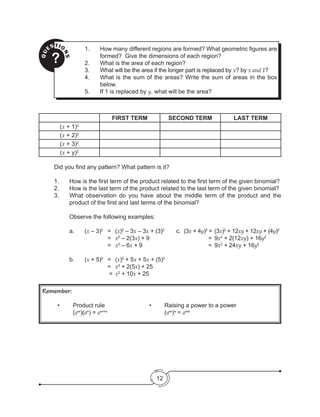
1.	 How many different regions are formed? What geometric figures are
formed? Give the dimensions of each region?
2.	 What is the area of each region?
3.	 What will be the area if the longer part is replaced by x? by x and 1?
4.	 What is the sum of the areas? Write the sum of areas in the box
below.
5.	 If 1 is replaced by y, what will be the area?
QU
ESTIO
NS?
FIRST TERM SECOND TERM LAST TERM
(x + 1)2
(x + 2)2
(x + 3)2
(x + y)2
Did you find any pattern? What pattern is it?
1.	 How is the first term of the product related to the first term of the given binomial?
2.	 How is the last term of the product related to the last term of the given binomial?
3.	 What observation do you have about the middle term of the product and the
product of the first and last terms of the binomial?
	 Observe the following examples:
	 a.	 	 (x – 3)2
	 = 	 (x)2
– 3x – 3x + (3)2
	 	 c. 	(3x + 4y)2
=	(3x)2
+ 12xy + 12xy + (4y)2
	
	 	 	 	 	 =	 x2
– 2(3x) + 9	 	 	 	 	 	 	 	 = 	9x2
+ 2(12xy) + 16y2
	 	 	 	 	 	 =	 x2
– 6x + 9	 	 	 	 	 	 	 	 	 =	9x2
+ 24xy + 16y2
	 b.	 	 (x + 5)2
	 = 	 (x)2
+ 5x + 5x + (5)2
	 	 	 	 	 	 =	 x2
+ 2(5x) + 25
	 	 	 	 	 	 =	x2
+ 10x + 25
Remember:
	 •	 Product rule	 	 	 •	 Raising a power to a power
	 	 (am
)(an
) = am+n
	 	 	 	 (am
)n
= amn
13
	 The square of a binomial consists of:
		 a.	 the square of the first term;
		 b.	 twice the product of the first and last terms; and
		 c.	 the square of the last term.
	 Remember that the square of a binomial is called a perfect square trinomial.
					 							
LET’S PRACTICE!
	 Square the following binomials using the pattern you have just learned.
	 1.	 (s + 4)2
	 	 5.	 (3z + 2k)2
	 	 	 9. 	 (
4
5
kj – 6)2
	
	 2.	 (w – 5)2
	 	 6. 	 (5d – 7d2
t)2
		 	 10. 	 [(x + 3) – 5]2
	
	 3.	 (e – 7)2
	 	 7. 	 (7q2
w2
– 4w2
)2
	 4.	 (2q – 4)2
	 	 8. 	 (
2
2
e – 6)2
									
	 The square of a binomial is just one example of special products. Do the next activity to
discover another type of special product, that is squaring a trinomial.
DISCOVER ME AFTER!
(PAPER FOLDING AND CUTTING)
Activity 5
Description: 	 In this activity you will model and discover the pattern on how a trinomial is
squared, that is (a + b + c)2
. Investigate and observe the figure that will be
formed.
Directions: 	 Get a 10” × 10” square paper. Fold the sides 7”, 3” and 1” vertically and make
creases. Using the same measures, fold horizontally and make creases.
The resulting figure should be the same as the figure below.
7
3
1
a b c
14
1.	 How many regions are formed? What are the dimensions of each
region in the figure?
2.	 What are the areas of each region?
3.	 If the side of the biggest square is replaced by a, how will you
represent its area?
4.	 If one of the dimensions of the biggest rectangle is replaced by b,
how will you represent its area?
5.	 If the side of the smaller square is replaced by c, how will you
represent its area?
6.	 What is the sum of the areas of all regions? Do you observe any
pattern in the sum of their areas?
QU
ESTIO
NS?
Observe the following examples and take note of your observation.
	 a.	 (x + y + z)2
= x2
+ y2
+ z2
+ 2xy + 2yz + 2xz
	 b.	 (m + n – d)2
= m2
+ n2
+ d2
+ 2mn – 2md – 2nd
	 c.	 (3d + 2e + f)2
= 9d2
+ 4e2
+ f2
+ 12de + 6df + 4ef
	 The square of a trinomial consists of:
	 a.	 the sum of the squares of the first, second and last terms;
	 b.	 twice the product of the first and the second terms;
	 c.	 twice the product of the first and the last terms; and
	 d.	 twice the product of the second and the last terms.
LET’S PRACTICE!
	 Square the following trinomials using the pattern you have learned.
1.	 (r – t + n)2
	 	 	 	 	 6. 	 (15a – 4n – 6)2
	
2.	 (e + 2a + q)2
		 	 	 	 7. 	 (4a + 4b + 4c)2
3.	 (m + a – y) (m + a – y)	 	 	 8. 	 (9a2
+ 4b2
– 3c2
)2
4.	 (2s + o – 4n)2
	 	 	 	 9. 	 (1.5a2
– 2.3b + 1)2
5.	 (2i2
+ 3a – 5n)2
	 	 	 	 10. 	 (
3x
4
+
4y
3
- 6)2
15
TRANSFORMERS
Activity 6
Description: 	 This activity will help us model the product of the sum and difference of two
terms (x – y) (x + y) and observe patterns to solve it easily.
Directions: 	 Prepare a square of any measure; label its side as x. Cut a small square of
side y from  any of its corner (as shown below). Answer the questions that
follow.
x
A
D
G
E y C
F
B
In terms of x and y, answer the following:
1.	 What is the area of the original big square (ABCD)?
2.	 What is the area of the small square (GFCE)?
3.	 How are you going to represent the area of the new figure?
Cut along the broken line as shown and rearrange the pieces to form a
rectangle.
1.	 What are the dimensions of the rectangle formed?
2.	 How will you get the area of the rectangle?
3.	 Represent the area of the rectangle that was formed. Do you see any
pattern in the product of the sum and difference of two terms?
Study the relationship that exists between the product of the sum and
difference of two terms and the factors. Take note of the pattern formed.
a.	 (x + y)(x – y) = x2
– y2	 	 	
d.	 (w – 5)(w + 5) = w2
– 25
b.	 (a – b)(a + b) = a2
– b2	 	 	
e.	 (2x – 5)(2x +5) = 4x2
– 25
c.	 (m + 3)(m – 3) = m2
– 9
	 The product of the sum and difference of two terms is the difference of the squares
of the terms. In symbols, (x + y)(x – y) = x2
– y2
. Notice that the product is always a
binomial.
LET’S PRACTICE!
	 Multiply the following binomials using the patterns you have learned.
	 1.	 (w – 6)(w + 6)	 	 	 3.	 (4y – 5d)(4y + 5d)	
	 2.	 (a + 4c)(a – 4c)	 	 	 4.	 (3sd + 4f)(4f – 3sd)
16
CUBRA CUBE
Activity 7
Description: 	 A cubra cube is a set of cubes and prisms connected by nylon. The task is
to form a bigger cube using all the figures provided. Your teacher will help
you how to form a cubra cube. After performing the activity, answer the
questions that follow.
a
b
a
a
b
b
a
b
1.	 How many big cubes did you use? Small cubes?
2.	 How many different prisms do you have?
3.	 How many prisms are contained in the new cube?
4.	 What is the total volume of the new cube formed?
5.	 If the side of the big cube is marked as a and the smaller cube is
marked as b, what is the volume of each figure?
6.	 What will be the total volume of the new cube?
7.	 What are the dimensions of the new cube?
QU
ESTIO
NS
?
Remember:
•   Volume of a cube = s3
•   Volume of a rectangular
    prism = lwh
	 5.	 (12x – 3)(12x + 3)	 	 8.  (
5
6
g2
a2
–
2
3
d2
)(
5
6
g2
a2
+
2
3
d2
)
	 6.  	 (3s2
r2
+ 7q)(3s2
r2
– 7q)	 	 9.  (2sn
qm
+ 3d3k
) (2sn
qm
– 3d3k
)
	 7. 	 (l3
o4
v5
– 6e3
)(l3
o4
v5
+ 6e3
)	 10. [(s + 2)– 4][(s + 2) + 4]
	 The previous activity taught you how to find the product of the sum and difference of
two terms using patterns. Perform the next activity to discover another pattern in simplifying
expressions of polynomials.
17
To find the cube of a binomial of the form (x + y)3
:
a.	 Find the cube of each term to get the first and the last terms.
					(x)3
, (y)3
b.	 The second term is three times the product of the square of the first term and
the second term. 	 3(x)2
(y)
c.	 The third term is three times the product of the first term and the square of the
second term. 	 	 3(x)(y)2
	 Hence, (x + y)3
= x3
+ 3x2
y + 3xy2
+ y3
To find the cube of a binomial of the form (x – y)3
:
a.	 Find the cube of each term to get the first and the last terms.
					(x)3
, (-y)3
b.	 The second term is three times the product of the square of the first term and
the second term. 	 3(x)2
(-y)
c.	 The third term is three times the product of the first term and the square of the
second term. 	 	 3(x)(-y)2
Hence, (x – y)3
= x3
– 3x2
y + 3xy2
– y3
IRF WORKSHEET
Activity 8
Description: 	 Using the “R” portion of the IRF Worksheet, answer the following topical
focus questions: What makes a product special? What patterns are
involved in multiplying algebraic expression?
IRF Worksheet
Initial Answer
Revised Answer
Final Answer
	 This time let us go back to the Gallery Walk activity and focus on case 3, which is an
example of a cube of binomial (x + y)3
or (x + y)(x + y)(x + y) and (x – y)3
or (x – y)(x – y)
(x – y).
18
WEB – BASED ACTIVITY: DRAG AND DROP
Description: 	 Now that you have learned the various special
products, you will now do an interactive activity
which will allow you to drag sets of factors and
drop them beside special products. The activity
is available in this website:
	 	 	 http://www.media.pearson.com.au/schools/cw/
au_sch_bull_gm12_1/dnd/2_spec.html.
QUESTIONS:
1.	 What special products did you use in the activity?
2.	 Name some techniques which you used to make the work
easier.
3.	 What generalizations can you draw from the examples
shown?
4.	 Given the time constraint, how could you do the task quickly
and accurately?
3-2-1 CHART
Activity 9
Description: 	 In this activity, you will be asked to complete the 3-2-1 Chart regarding the
special products that you have discovered.
	 	
3-2-1 Chart
Three things I found out:
1. ________________________________________________________
2. ________________________________________________________
3. ________________________________________________________
Two interesting things:
1. ________________________________________________________
2. ________________________________________________________
One question I still have:
1. ________________________________________________________
You can visit these websites
for more games.
http://math123xyz.com/
Nav/Algebra/Polynomials_
Products_Practice.php
http://worksheets.tutorvista.
com/special-products-of-
polynomials-worksheet.html#
19
WHAT’S THE WAY? THAT’S THE WAY!
Activity 10
Description:	 This activity will test if you have understood the lesson by giving the steps in
simplifying expressions containing special products in your own words.
Directions: 	 Give the different types of special products and write the steps/process of
simplifying them. You may add boxes if necessary.
SPECIAL
PRODUCTS
SPECIAL
PRODUCTS
______________ ______________
______________ ______________
Video Watching:
You can visit the following
websites to watch different
discussions and activities on
special products.
1.	 http://www.youtube.com/
watch?v=bFtjG45-Udk
(Square of binomial)
2.	 http://www.youtube.com/
watch?v=
	 OWu0tH5RC2M
	 (Sum and difference of
binomials)
3.	 http://www.youtube.com/
watch?v=PcwXR
	 HHnV8Y (Cube of a
binomial)
	 Now that you know the important ideas about how patterns on special products
were used to find the product of a algebraic expressions, let’s go deeper by moving on to
the next section.
20
What I have learned so far...________________________
_________________________________________________
_________________________________________________
_________________________________________________
_________________________________________________
_________________________________________________
_________________________________________________
_________________________________________________
_________________________________________________
_________________________________________________
_________________________________________________
_________________________________________________
_________________________________________.
REFLECTIONREFLECTION
21
	 2.	 Emmanuel wants to tile his rectangular floor.  He has two kinds of tiles
to choose from, one of which is larger than the other.  Emmanuel hired
your services to help him decide which tile to use.
a.	 What area will be covered by the 8” x 8” tile? 16” x 16” tile?
b.	 If the rectangular floor has dimensions of 74” x 128”, how many
small square tiles are needed to cover it?
c.	 How many big square tiles are needed to cover the rectangular
floor?
d.	 If each small tile costs Php 15.00 and each big tile costs  Php 60.00,
which tile should Emmanuel use to economize in tiling his floor?  
Explain why.
What to UnderstandWhat to Understand
	 You have already learned and identified the different polynomials and their spe-
cial products. You will now take a closer look at some aspects of the topic and check if
you still have misconceptions about special products.
DECISION, DECISION, DECISION!
Activity 11
Directions:	 Help each person decide what to do by applying your knowledge on special
products on each situation.
	 1.	 Jem Boy wants to make his 8-meter square pool into a rectangular one
by increasing its length by 2 m and decreasing its width by 2 m. Jem
Boy asked your expertise to help him decide on certain matters.
a.	 What will be the new dimensions of Jem Boy’s pool?
b.	 What will be the new area of Jem Boy’s pool? What special
product will be used?
c.	 If the sides of the square pool is unknown, how will you represent
its area?
d.	 If Jem Boy does not want the area of his pool to decrease, will
he pursue his plan? Explain your answer.
22
BEAUTY IN MY TILE!
Activity 13
Description: 	 See different tile patterns on the flooring of a building and calculate the area
of the region bounded by the broken lines, then answer the questions below.
	 	 1.
http://www.apartmenttherapy.com/tile-vault-midcentury-rec-
room-39808
a.	 What is the area represented by the big square? small square?
rectangles?
b.	 What is the total area bounded by the region?
c.	 What special product is present in this tile design?
d.	 Why do you think the designer of this room designed it as such?
AM I STILL IN DISTRESS?
Activity 12
Description: 	 This activity will help you reflect about things that may still confuse you in
this lesson.
Directions: 	 Complete the phrase below and write it on your journal.
		
The part of the lesson that I still find confusing is __________________
because _________________________________________________.
			Let us see if your problem will be solved doing the next activity.
23
1.	 What difficulties did you experience in doing the activity?
2.	 How did you use special products in this activity?
3.	 What new insights did you gain?
4.	 How can unknown quantities in geometric problems be solved?
QU
ESTIO
NS
?
1.	 Did you find difficulty in looking for patterns where the concept of
special products was applied?
	 2.	 What special products were applied in your illustration?
	 3.	 What realization do you have in this activity?
QU
ESTIO
NS
?
WHERE IS THE PATTERN?
Activity 14
Descriptions: 	 Take a picture/sketch of a figure that makes use of special products. Paste
it on a piece of paper.
a.	 What is the area represented by the big square? Small square?
b.	 What is the sum of all areas of small squares?
c.	 If the small squares were to be removed, how are you going to
represent the area that will be left?
2.
24
LET’S DEBATE!
Activity 15
Description: 	 Form a team of four members and debate on the two questions below. The
team that can convince the other teams wins the game.
•	 “Which is better to use in finding products, patterns or long
multiplication?”
	 •	 “Which will give us more benefit in life, taking the shortcuts or going
the long way?
IRF WORKSHEET
Activity 16
Description: 	 Now that you have learned the different special products, using the “F”
portion of the IRF Worksheet, answer the topical focus question: What
makes a product special? What patterns are involved in multiplying
algebraic expressions?
			
Initial Answer
Revised Answer
Final Answer
	 Now that you have a deeper understanding of the topic, you are ready to do the
tasks in the next section.
What to TransferWhat to Transfer
	 Let us now apply your learning to real–life situations. You will be given a practical
task which will demonstrate your understanding.
25
MAKE A WISH
Activity 17
Description: 	 The concept of squaring binomials is used in the field of Genetics through
PUNNETT squares. PUNNETT SQUARES are used in genetics to model
the possible combinations of parents’ genes in offspring. In this activity you
will discover how it will be used.
Direction: 		 Investigate how squaring trinomials are applied in PUNNETT squares and
answer the following questions.
		
	 	 	 One cat carries heterozygous, long-haired
traits (Ss), and its mate carries heterozygous,
long-haired traits (Ss). To determine the chances
of one of their offsprings having short hair, we
can use PUNNETT squares.
SS
Ss
Ss
ss
S
S
s
s
1.	 What are the chances that the offspring is a long–haired cat?            
A short–haired cat?
2.	 What are the different possible offsprings of the mates?
3.	 How many homozygous offsprings will they have? Heterozygous?
4.	 How is the concept of squaring binomials used in this process?
5.	 Do you think it is possible to use the process of squaring trinomials
in the field of genetics?
6.	 Create another model of PUNNET square using a human genetic
component. Explain the possible distribution of offsprings and how
squaring trinomials help you in looking for its solution.
7.	 Create your own PUNNET square using the concept of squaring
trinomials, using your dream genes.
QU
ESTIO
NS
?
Punnett square is named after
Reginald C. Punnett, who
devised the approach. It is used
by biologists to determine the
chances of an offspring having a
particular genotype. The Punnett
square is a tabular summary of
every possible combination of one
maternal allele with one paternal
allele for each gene being studied
in the cross.
	 Now that you have seen the different
patterns that can be used in simplifying polynomial
expressions, you are now ready to move to the next
lesson which is factoring. Observe the different
patterns in factoring that are related to special
products so that you can do your final project, the
making of a packaging box.
26
In this lesson, I have understood that ______________
________________________________________________
________________________________________________
_________________________________________________
________________________________________________
________________________________________________
________________________________________________
________________________________________________
________________________________________________
_________________________________________________
________________________________________________
_________________________________________________
________________________________________________
___________.
REFLECTIONREFLECTION
27
What to KnowWhat to Know
	 Your goal in this section is to see the association of products to factors by doing the
activities that follow.	
	
	 Before you start doing the activities in this lesson, do this challenge first.
	 The figure below is a square made up of 36 tiles. Rearrange the tiles to create a rectangle,
having the same area as the original square. How many such rectangles can you create? What
do you consider in looking for the other dimensions? What mathematical concepts would you
consider in forming different dimensions? Why? Suppose the length of one side is increased
by unknown quantities (e.g. x) how could you possibly represent the dimensions?
	 This module will help you break an expression into different factors and answer the
topical questions, “What algebraic expressions can be factored? How are patterns
used in finding the factors of algebraic expressions? How can unknown quantities in
geometric problems be solved?”
	
	 To start with this lesson, perform the activities that follow:
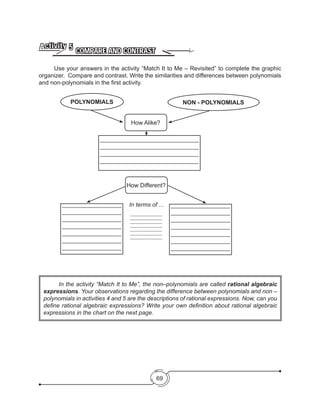
LIKE! UNLIKE!
Activity 1
Description: 	 This activity will help gauge how ready you are for this lesson through your
responses.
Directions: 	 Answer all the questions below honestly by pasting the like or unlike thumb
that your teacher will provide you. Like means that you are the one being
referred to and unlike thumb means that you have no or little idea about
what is being asked.
Lesson 22 Factoring
28
SKILLS ACQUIRED RESPONSES
1. Can factor numerical expressions easily
2. Can divide polynomials
3. Can apply the quotient rule of exponents
4. Can add and subtract polynomials
5. Can work with special products
6. Can multiply polynomials
	 Before you proceed to the next topic, answer first the IRF form to
determine how much you know in this topic and see your progress.
IRF WORKSHEETS
Activity 2
Description: 	 Complete the table by filling up first the initial column of the chart with your
answer to each item. This activity will determine how much you know about
this topic and your progress.
Initial Revise Final
Express the following as
product of factors.
1. 4x2
– 12x =
_________________
2. 9m2
– 16n2
=
_________________
3. 4a2
+ 12a + 9 =
_________________
4. 2x2
+ 9x – 5 =
_________________
5. 27x3
– 8y3
=
_________________
6. a3
+ 125b3
=
_________________
7. xm + hm – xn – hn =
_________________
29
MESSAGE FROM THE KING
(Product – Factor Association)
Activity 3
Description: 	 This activity will give you an idea on how factors are associated with
products. You will match the factors in column A with the products in column
B to decode the secret message.
COLUMN A			 		 COLUMN B
1.	 4x (3x – 5)	 	 	 	 	 A. 	 6x2
y2
+ 3xy3
– 3xy2
	
2.	 3xy2
(2x + y – 1)	 	 	 	 F. 	 x3
– 27
3.	 (x + y)(x – y)	 	 	 	 G. 	 4x2
– 9
4.	 (2x + 3)(2x – 3)	 	 	 	 R. 	 4x2
+ 12x + 9
5.	 (x – 5y)(x + 5y)	 	 	 	 U. 	 12x2
– 20x
6.	 (x + y)2
	 	 	 	 	 E. 	 6x2
+ x – 2
7.	 (2x + 3)2
	 	 	 	 	 T. 	 ac – ad + bc – bd
8.	 (x – 5y)2
	 	 	 	 	 S. 	 mr – nr + ms – ns
9.	 (x + 4)(x – 3)	 	 	 	 C. 	 x2
– y2
10.	 (2x – 1)(3x +2)	 	 	 	 I. 	 2x2
– x – 10
11.	 (x + 2)(2x – 5)	 	 	 	 O. 	 x2
– 10xy + 25y2
12.	 (x – 3)(x2
+ 3x + 9)	 	 	 N. 	 x2
+ x – 12
13.	 (x + 3)(x2
– 3x + 9)	 	 	 H. 	 x3
– 27
14.	 (a + b)(c – d)	 	 	 	 M. 	 x2
+ 2xy + y2
15.	 (m – n)(r + s)	 	 	 	 L. 	 x2
– 25y2
16.	 (3x + 4)(3x – 4)	 	 	 	 P. 	 9x2
– 16
17.	 (3x – 4)2
	 	 	 	 	 V. 	 9x2
– 24x + 16
12 2 3 14 8 7 11 9 4 11 15 14 13 10
7 10 17 10 7 15 10 8 12
6 1 5 14 11 16 5 11 3 2 14 11 8 9
1.	 What are your observations on the expressions in column A?
Compare them with those in column B.
2.	 Do you see any pattern?
3.	 Are the two expressions related?
4.	 Why is it important to know the reverse process of multiplication?
QU
ESTIO
NS
?
30
1.	 What are the things common to these pictures?
2.	 Are there things that make them different?
3.	 Can you spot things that are found on one picture but not on the
other two?
4.	 What are the things common to two pictures but are not found on the
other?
QU
ESTIO
NS
?
	 What did you discover between the relationship of products and its factors? You
have just tried finding out the relationship between factors and their product. You can use
this idea to do the next activities.
	 What you will learn in the next session will also enable you to do the final
project which involves model and lay–out making of a packaging box.
What to ProcessWhat to Process
	 The activity that you did in the previous section will help you understand the differ-
ent lessons and activities you will encounter here.
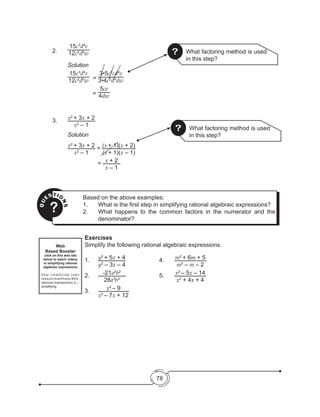
	 The process of finding the factors of an expression is called factoring, which is
the reverse process of multiplication. A prime number is a number greater than 1 which
has only two positive factors: 1 and itself. Can you give examples of prime numbers? Is
it possible to have a prime that is a polynomial? If so, give examples.
	 The first type of factoring that you will encounter is Factoring the Greatest Com-
mon Monomial Factor. To understand this let us do some picture analysis.
FINDING COMMON
Activity 4
Description: 	 Your task in this activity is to identify common things that are present in the
three pictures.
http://blog.ningin.com/2011/09/04/10-idols-and-groups-pigging-out/ http://k-pop-love.tumblr.com/post/31067024715/
eating-sushi
31
	 The previous activity gave us the idea about the Greatest Common Monomial Factor
that appears in every term of the polynomial. Study the illustrative examples on how factoring
the Greatest Common Monomial Factor is being done.
	 Factor 12x3
y5
– 20x5
y2
z
a.	 Find the greatest common factor of the numerical coefficients.
		The GCF of 12 and 20 is 4.
b.	 Find the variable with the least exponent that appears in each term of the
polynomial.
x and y are both common to all terms and 3 is the smallest exponent for x
and 2 is the smallest exponent of y, thus, x3
y2
is the GCF of the variables.
c.	 The product of the greatest common factor in (a) and (b) is the GCF of the
polynomial.
		Hence, 4x3
y2
is the GCF of 12x3
y5
– 20x5
y2
z.
	 d.	 To completely factor the given polynomial, divide the polynomial by its GCF, the
resulting quotient is the other factor.
		 Thus, the factored form of 12x3
y5
– 20x5
y2
z is 4x3
y2
(3y3
– 5x2
z)
	 Below are other examples of Factoring the Greatest Monomial Factor.
	 a.	 8x2
+ 16x  8x is the greatest monomial factor. Divide the polynomial by 8x to
get the other factor.
		8x(x + 2) is the factored form of 8x2
+ 16x.
	 b.	 12x5
y4
– 16x3
y4
+ 28x6
 4x3
is the greatest monomial factor. Divide the given
expression by the greatest monomial factor to get the other factor.
		Thus, 4x3
(3x2
y4
– 4y4
+ 7x3
) is the factored form of the given expression.
Complete the table to practice this type of factoring.
Polynomial Greatest Common
Monomial Factor
(CMF)
Quotient of
Polynomial and
CMF
Factored
Form
6m + 8 2 3m + 4 2 (3m + 4)
4mo2
4mo2
(3m + o)
27d4
o5
t3
a6
– 18d2
o3
t6
– 15d6
o4
9d2
o2
t3
a6
– 6t6
– 5d4
4(12) + 4(8) 4
12WI3
N5
– 16WIN + 20WINNER
32
	 Now that you have learned how to factor polynomials using their greatest common
factor we can move to the next type of factoring, which is the difference of two squares.
Why do you think it was given such name? To model it, let’s try doing the activity that
follows.
INVESTIGATION IN THE CLASSROOM
Activity 5
Description: 	 This activity will help you understand the concepts of difference of two
squares and how this pattern is used to solve numerical expressions.
Investigate the number pattern by comparing the products, then write your
generalizations afterwards.
NUMBER PATTERN:
a.	 (11)(9) = (10 + 1)(10 – 1) = 100 – 1 =
b.	 (5)(3) = (4 + 1)(4 – 1) = 16 – 1 =
c.	 (101)(99) = (100 + 1)(100 – 1) = 10000 – 1 =
d.	 (95)(85) = (90 + 5)(90 – 5) = 8100 – 25 =
e.	 (n – 5)(n + 5) =
	 How do you think the products are obtained? What are the different techniques used to
solve for the products?
	 What is the relationship of the product to its factor? Have you seen any pattern in this
activity?
	 For you to have a clearer view of this type of factoring, let us have a paper folding
activity again.
INVESTIGATION IN PAPER FOLDING
Activity 6
Description: 	 This activity will help you visualize the pattern of difference of two
squares.
Directions:
1.	 Get a square paper and label the sides as a.
	 2.	 Cut – out a small square in any of its corner
and label the side of the small square as b.
3.	 Cut the remaining figure in half.
4.	 Form a rectangle
A
C
G
E D
F
B
33
	 1.	 What is the area of square ABDC?
	 2.	 What is the area of the cutout square GFDE?
	 3.	 What is the area of the new figure formed?
	 4.	 What is the dimension of the new figure formed?
	 5.	 What pattern can you create in the given activity?
QU
ESTIO
NS?
1.	 What is the first term of each polynomial?
2.	 What is the last term of each polynomial?
3.	 What is the middle sign of the polynomial?
4.	 How was the polynomial factored?
5.	 What pattern is seen in the factors of the difference of two terms?
6.	 Can all expressions be factored using difference of two squares?
Why or why not?
7.	 When can you factor expressions using difference of two squares?
QU
ESTIO
NS
?
	 For you to have a better understanding about this lesson, observe how the expressions
below are factored. Observe how each term relates with each other.
a.	 x2
– y2
= (x + y)(x – y)	 	 	 d.	 16a6
– 25b2
= (4a3
– 5b)(4a3
+ 5b)
b.	 4x2
– 36 = (2x + 6)(2x – 6)	 	 e.	 (
9
16
r4
–
1
25
t2
n6
) = (
3
4
r2
+
1
5
tn3
)(
3
4
r2
–
1
5
tn3
)
c.	 a2
b4
– 81 = (ab2
– 9)(ab2
+ 9)
	 Remember the factored form of a polynomial that is a difference of two squares
is the sum and difference of the square roots of the first and last terms.
•	 4x2
– 36y2
 the square root of 4x2
is 2x and the square root of 36y2
is 6y. To
write their factors, write the product of the sum and difference of the square roots
of 4x2
– 36y2
, that is (2x + 6y)(2x – 6y).
34
PAIR MO KO NYAN!
Activity 7
Description: 	 This game will help you develop your factoring skills by formulating your
problem based on the given expressions. You can integrate other factoring
techniques in creating expressions. Create as many factors as you can.
Directions: 	 Form difference of two squares problems by pairing two squared quantities,
then find their factors. (Hint: You can create expressions that may require
the use of the greatest common monomial factor.)
	 You have learned from the previous activity how factoring the difference of two
squares is done and what expression is considered as the difference of two squares. You
are now ready to find the factors of the sum or difference of two cubes. To answer this
question, find the indicated product and observe what pattern is evident.
	 a.	(a + b)(a2
– ab + b2
)
	 b.	(a – b)(a2
+ ab + b2
)
	 What are the resulting products? How are the terms of the products related to the terms
of the factors? What if the process was reversed and you were asked to find the factors of the
products? How are you going to get the factor? Do you see any common pattern?
35
ROAD MAP TO FACTOR
Activity 8
	 Answer the following problems by using the map as your guide.
Is the given
expression a sum
or a difference of
two cubes?
If
Yes
If
Sum
If No
If DifferenceAre the binomials sums or
differences of two cubes?
Use other factoring technique/method
1.	 What are the cube roots of the first and
last terms?
2.	 Write their difference as the first factor.
(x – y).
3.	 For the second factor, get the trinomial
factor by:
a.	 Squaring the first term of the first
factor;
b.	 Adding the product of the first and
second terms of the first factor;
c.	 Squaring the last term of the first
factor.
4.	 Write them in factored form.
	 (x – y)(x2
+ xy + y2
)
1.	 What are the cube roots of the first and last
terms?
2.	 Write their sum as the first factor. (x + y).
3.	 For the second factor, get the trinomial
factor by:
a.	 Squaring the first term of the first
factor;
b.	 Subtracting the product of the first
and second terms of the first factor;
c.	 Squaring the last term of the first
factor.
4.	 Write them in factored form.
	 (x + y)(x2
– xy + y2
)
x
y
1.	 Represent the volume of this figure. What is
the factored form of the volume of a given
figure?
2.	 What are the volumes of the cubes? If the
cubes are to be joined to create a platform
for a statue, what will be the volume of the
platform? What are the factors of the volume
of the platform?
36
Let’s tile it up!
Activity 9
Directions:  	 Prepare the following:
	 	 1.	 4 big squares measuring 4” × 4” represent each square...
	 	 2.	 8 rectangular tiles measuring 4” × 1” represent each square...
	 	 3.	 16 small squares measuring is 1” × 1” represent each square...
	
	 	 Form squares using:
	 	 •	 1 big square tile, 2 rectangular tiles, and 1 small square.
	 	 •	 1 big square tile, 4 rectangular tiles, and 4 small squares.
	 	 •	 1 big square tile, 6 rectangular tiles, and 9 small squares.
	 	 •	 4 big square tiles, 4 rectangular tiles, and 1 small square.
	 	 •	 4 big square tiles, 8 rectangular tiles, and 4 small squares.
1.	 How will you represent the total area of each figure?
2.	 Using the sides of the tiles, write all the dimensions of the squares.
3.	 What did you notice about the dimensions of the squares?
4.	 Did you find any pattern in their dimensions? If yes, what are those?
5.	 How can unknown quantities in geometric problems be solved?
QU
ESTIO
NS
?
	 The polynomials formed are called perfect square trinomials.
	 A perfect square trinomial is the result of squaring a binomial. A perfect
square trinomial has first and last terms which are perfect squares and a middle
term which is twice the product of the square root of the first and last terms.
37
PERFECT HUNT
Activity 10
Directions: 	 Look for the different perfect square trinomials found in the box. Answers
might be written diagonally, horizontally, or vertically.
25x2
10x 81 18x x2
4
15x 16x2
-24x 9 10x 28x
4x2
-16x 16 15x 25 49x2
16x2
49 8x 16 24x2
9
25 14x 8x 40x 30x 10x
7x x2
12x 25x2
40 12x2
	 To factor perfect square trinomials:
	 	 1.	 Get the square root of the first and last terms.
	 2.	 List down the square root as sum/difference of two terms as the case
may be.
	 You can use the following relationships to factor perfect square trinomials:
	 (First term)2
+ 2(First term)(Last term) + (Last term)2
= (First term + Last term)2
	 (First term)2
– 2(First term)(Last term) + (Last term)2
= (First term – Last term)2
	 Remember to factor out first the greatest common monomial factor before
factoring the perfect square trinomial.
	 Ex.	 1. 	 Factor n2
+ 16n + 64
	 Solution:	
	 a. 	 Since n2
= (n)2
and 64 = (8)2
, then both the first and last terms are
perfect squares. And 2(n)(8) = 16n, then the given expression is a
perfect square polynomial.
	 b. 	 The square root of the first term is n and the square root of the last
term is 8. The polynomial is factored as (n + 8)2
.
38
	 Ex.	 2. 	 Factor 4r2
– 12r + 9 	
	 	 	 Solution:	
	 a. 	 Since 4r2
= (2r)2
and 9 = (3)2
, and since (–12r) = (-2)(2r)(3) then it
follows the given expression is a perfect square trinomial.
	 b. 	 The square root of the first term is 2r and the square root of the last
term is 3 so that its factored form is (2r – 3)2
.
	 Ex. 	 3.	 Factor 75t3
+ 30t2
+ 3t
	 	 	 Solution:	
	 a. 	 Notice that 3t is common to all terms, thus, factoring it out first we
have:
		3t (25t2
+ 10t + 1)
	 b. 	 Notice that 25t2
= (5t)2
and 1 = (1)2
, and 10t = 2(5t)(1), then 25t2
+ 10t + 1
is a perfect square trinomial.
	 c. 	 Factoring 25t2
+ 10t + 1 is (5t + 1)2
, thus, the factors of the given
expression are 3t (5t + 1)2
.
		 Explain why in Example 3, (5t + 1)2
is not the only factor. What is the effect
of removing 3t?
Exercises	
	 Supply the missing term to make a true statement.
	 a.	 m2
+ 12m + 36 	 	 =	 (m + ___ )2
	 b.	 16d2
– 24d + 9 	 	 =	 ( 4d – ___)2
	 c.	 a4
b2
– 6abc + 9c2
		 =	 (a2
b ___ ___)2
	 d.	 9n2
+ 30nd + 25d2
	 =	 (___ __ 5d)2
	 e.	 49g2
– 84g + 36	 	 =	 (___ __ ___)2
	 f.	 121c4
+ 66c2
+ 9	 	 =	 (___ __ ___)2
	 g.	 25r2
+ 40rn + 16n2
	 =	 (___ __ ___)2
	 h.	
1
16
x2
+
1
3
x +
4
9
		 =	 (__ __ __)2
	 i.	 18h2
+ 12h + 2	 	 =	 2 (___ __ ___)2
	 j.	 20f4
– 60f3
+ 45f2
	 =	 ___ (2f __ ___)2
	Is q2
+ q – 12 a perfect square trinomial? Why?
	 Are all trinomials perfect squares? How do we factor trinomials that are not perfect
squares?
	 In the next activity, you will see how trinomials that are not perfect squares are factored.
39
TILE ONCE MORE!!
Activity 11
Description: 	 You will arrange the tiles according to the instructions given to form a polygon
and find its dimensions afterwards.
Directions: 	
	 Form rectangles using the algebra tiles that you prepared. Use only
tiles that are required in each item below.
a.	 1 big square tile, 5 rectangular tiles, and 6 small square tiles
b.	 1 big square tile, 6 rectangular tiles, and 8 small square tiles
c.	 2 big square tiles, 7 rectangular tiles, and 5 small square tiles
d.	 3 big square tiles, 7 rectangular tiles, and 4 small square tiles
e.	 4 big square tiles, 7 rectangular tiles, and 3 small square tiles
1.  	 Cutout 4 pieces of 3 in by 3 in card board and label each as x2
representing its area.
2.  	 Cutout 8 pieces of rectangular cardboard with dimensions of 3 in by 1
in and label each as x representing its area.
3.  	 Cutout another square measuring 1 in by 1 in and label each as 1 to
represent its area.
1. 	 What is the total area of each figure?
2.	 Using the sides of the tiles, write all the dimensions of the rectangles.
3.	 How did you get the dimensions of the rectangles?
4.	 Did you find difficulty in getting the dimensions?
QU
ESTIO
NS
?
	 Based on the previous activity, how can the unknown quantities in geometric
problems be solved?
	 If you have noticed, there were two trinomials  formed in the preceding activity. The
term with the highest degree has a numerical coefficient greater than 1 or equal to 1 in these
trinomials.
	 Let us study first how trinomials whose leading coefficient is 1 are being factored.
	 Ex. 	 Factor p2
+ 5p + 6
	 	 Solution:	 a. 	 List all the possible factors of 6.
Factors of 6
2 3
6 1
-2 -3
-6 -1
40
	 	 	 	 b. 	 Find factors of 6 whose sum is 5.
•	 2 + 3 = 5
•	 6 + 1 = 7
•	 (-2) + (-3) = -5
•	 (-6) + (-1) = -7
	 	 	 	 c. 	 Thus, the factor of p2
+ 5p + 6 = (p + 2)(p + 3). 			
	
	 Ex.	 Factor v2
+ 4v – 21
	 	 Solution: 	 a. 	 List all the factors of – 21
Factors of - 21
-3 7
-7 3
-21 1
-1 21
	
	 	 	 	 b. 	 Find factors of -21 whose sum is 4.
	 	 	 	 	 •	 -3 + 7 = 4
	 	 	 	 	 •	 -7 + 3 = -4
	 	 	 	 	 •	 -21 + 1 = -20
	 	 	 	 	 •	 -1 + 20 = 19
	 	 	 	 c. 	 Hence, the factors of v2
+ 4v – 21 = (v – 3)( v + 7).
	Factor2q3
–6q2
–36q.Sincethereisacommonmonomialfactor,beginbyfactoringout2qfirst.  
Rewriting it, you have 2q (q2
– 3q – 18).
	 a.	 Listing all the factors of – 18.
Factors of -18
-1 18
-2 9
-3 6
-18 1
-9 2
-6 3
b.	 Since – 6 and 3 are the factors of 18 whose sum is –3, then the binomial factors
of q2
– 3q – 18 are (q – 6)(q + 3).
c.	 Therefore, the factors of 2q3
– 6q – 36q are 2q(q – 6)(q + 3).
41
Remember:
	 To factor trinomials with 1 as the numerical coefficient of the leading term:
a.	 factor the leading term of the trinomial and write these factors as the leading
terms of the factors;
b.	 list down all the factors of the last term;
c.	 identify which factor pair sums up to the middle term; then
d.	 write each factor in the pairs as the last term of the binomial factors.
NOTE: 	 Always perform factoring using greatest common monomial factor first
before applying any type of factoring.
FACTOR BINGO GAME!
Activity 12
Description: 	 Bingo game is an activity to practice your factoring skills with speed and
accuracy.
Instruction:	 On a clean sheet of paper, draw a 3 by 3 square grid and mark the center as
FACTOR. Pick 8 different factors from the table below and write them in the
grid. As your teacher reads the trinomial, you will locate its factors and mark
them x. The first one who makes the x pattern wins. 	
(n + 4)(n – 5)	 	 (n + 2)(n + 9)	 	 (n – 8)(n – 9)	
	
(n + 2)(n + 3)	 	 (n + 9)(n + 8)	 	 (n + 1)(n + 8)
(n – 8)(n + 4)	 	 (n – 7)(n – 5)	 	 (n + 6)(n + 4)
(n + 3)(n + 6)	 	 (n – 2)(n + 16)	 	 (n + 3)(n + 8)
(n + 4)(n – 5)	 (n + 2)(n + 9)	 (n – 8)(n – 9)	 (n + 2)(n + 3)
(n + 9)(n + 8)	 (n + 1)(n + 8)	 (n – 8)(n + 4)	 (n – 7)(n – 5)
(n + 6)(n + 4)	 (n – 7)(n + 6)	 (n – 12)(n + 4)	 (n – 8)(n + 6)
(n + 3)(n + 6)	 (n – 2)(n + 16)	 (n + 3)(n + 8)
1.	 How did you factor the trinomials?
2.	 What did you do to factor the trinomials easily?
3.	 Did you find any difficulty in factoring the trinomials? Why?
4.	 What are your difficulties? How will you address those difficulties?
QU
ESTIO
NS
?
42
	 What if the numerical coefficient of the leading term of the trinomial is not 1, can you still
factor it? Are trinomials of that form factorable? Why?
	 Trinomials of this form are written on the form ax2
+ bx + c, where a and b are the nu-
merical coefficients of the variables and c is the constant term. There are many ways of factor-
ing these types of polynomials, one of which is by inspection.
	 Trial and error being utilized in factoring this type of trinomials. Here is an example:
	Factor 6z2
– 5z – 6 through trial and error:
	 Give all the factors of 6z2
and – 6
	
	 Write all possible factors using the values above and determine the middle term by
multiplying the factors.
Possible Factors Sum of the product of the outer
terms and the product of the inner
terms
(3z – 2)(2z + 3) 9z – 4z = 5z
(3z + 3)(2z – 2) -6z + 6z = 0
(3z – 3)(2z + 2) 6z – 6z = 0
(3z + 2)(2z – 3) -9z + 4z = -5z
(3z + 1)(2z – 6) -18z + 2z = -16z
(3z – 6)(2z + 1) 3z – 12z = -9z
(6z + 3)(z – 2) -12z + 3z = -9z
(6z – 2)(z +3) 18z – 2z = 16z
(6z – 3)(z + 2) 12z – 3z = 9z
(6z + 2)(z – 3)                                         -18z + 2z = -16z
(6z + 1)(z – 6) -36z + z = -35z
(6z – 6)(z + 1) 6z – 6z = 0
	 In the given factors, (3z + 2)(2z – 3) gives the sum of -5z, thus, making it as the factors
of the trinomial 6z2
– 5z – 36.
	 How was inspection used in factoring? What do you think is the disadvantage of using
it?
Factors of:
6z2
-6
(3z)(2z) (3)(-2)
(6z)(z) (-3)(2)
(1)(-6)
( -1)(6)
43
	 Factoring through inspection is a tedious and long process; thus, knowing another way
of factoring trinomials would be very beneficial in studying this module.
	 Another way of factoring is through grouping or AC method. Closely look at the given
steps and compare them with trial and error.
	 Factor 6z2
– 5z – 6
	 1.	 Find the product of the leading term and the last term.
		6z2
– 5z – 6
	 	 (6z2
)(-6) = -36z2
	 2.	 Find the factors of – 36z2
whose sum is – 5z.
		-9z + 4z = -5z
3.	 Rewrite the trinomial as a four-term expression by replacing the middle term
with the sum of the factors.
		6z2
– 9z + 4z – 6
	 4.	 Group terms with common factors.
		(6z2
– 9z) + (4z – 6)
	 5.	 Factor the groups using greatest common monomial factor.
		3z (2z – 3) + 2(2z – 3)
6.	 Factor out the common binomial factor and write the remaining factor as a
sum or difference of the common monomial factors.
		(2z – 3)(3z + 2)
	 Factor 2k2
– 11k + 12
1.	 Multiply the first and last terms.
	 (2k2
)(12) = 24k2
2.	 Find the factors of 24k2
whose sum is -11k.
	 (-3k) + ( -8k) = -11k
3.	 Rewrite the trinomial as four–term expressions by replacing the middle term
by the sum factor.
	 2k2
– 3k – 8k + 12
4.	 Group the terms with a common factor.
	 (2k2
– 8k) + (-3k + 12)
5.	 Factor the groups using greatest common monomial factor.
	 2k(k – 4) – 3(k – 4)
6.	 Factor out the common binomial and write the remaining factor as sum or
difference of binomial.
	 (k – 4)(2k – 3)
44
	 Factor 6h2
– h – 2
1.	 Multiply the first and last terms.
	 (6h2
)(-2) = -12h2
2.	 Find the factors of 12h2
whose sum is h.
	 (-4h) + ( 3h) = -h
3.	 Rewrite the trinomial as a four–term expression by replacing the middle
term with the sum of the factors.
	 6h2
– 4h – 3h – 2
4.	 Group the terms with a common factor.
	 (6h2
– 3h) + (-4h – 2)
5.	 Factor the groups using greatest common monomial factor.
	 3h(2h – 1) – 2(2h – 1)
6.	 Factor out the common binomial factor and write the remaining factor as a
sum or difference of the common monomial factors.
			(3h – 2)(2h – 1)
WE HAVE!
Activity 13
Description: 	 This game will help you practice your factoring skills through a game.
Instruction: 	 Form a group with 5 members. Your task as a group is to factor the trinomial
that the other group will give. Raise a flaglet and shout “We have it!” If you
have already factored the trinomial. The first group to get 10 correct answers
wins the game.
	
Let’s extend!!
	 We can use factoring by grouping technique in finding the factors of a polynomial with
more than three terms.
Let’s try factoring 8mt – 12at – 10mh – 15ah
	 Solution: 	 1.	 Group the terms with a common factor.
			 	(8mt – 12at) + ( -10mh – 15ah)	
	 	 	 2.	 Factor out the greatest common monomial factor in each group.
				4t(2m – 3a) – 5h(2m – 3a)  Why?
3. 	 Factor out the common binomial factor and write the remaining factor
as a sum or difference of the common monomial factors.
	 (2m – 3a)(4t – 5h)
1.	 Do you find difficulty in playing the game? Why?
2.	 What hindered you from finding the factors of the trinomial?
3.	 What plan do you have to address these difficulties?
QU
ESTIO
NS
?
45
Factor 18lv + 6le + 24ov + 8oe
	 Solution:	 1. 	 Group the terms with a common factor.
			(18lv + 6le) + (24ov + 8oe)  Why?
	
	 	 2. 	 Factor out the greatest common monomial factor in each group.
			6l(3v + e) + 8o(3v + 3)  Why?
3. 	 Factor out the common binomial factor and write the remaining factor
as a sum or difference of the common monomial factors.
			(3v + e)(6l + 8o)
FAMOUS FOUR WORDS
Activity 14
Description: 	 This activity will reveal the most frequently used four-letter word (no letter is
repeated) according to world-English.org through the use of factoring.
Instruction: 	 With your groupmates, factor the following expressions by grouping and
writing a four-letter word using the variable of the factors to reveal the 10
most frequently used four-letter words.
1.	 4wt + 2wh + 6it + 3ih
2.	 15te – 12he + 10ty – 8hy
3.	 hv + av + he + ae
4.	 10ti – 8ts – 15hi + 12hs
5.	 88fo + 16ro – 99fm – 18rm
6.	 7s + 35om + 9se + 45oe
7.	 42wa + 54wt + 56ha + 72ht
8.	 36yu – 24ro + 12ou – 72yr
9.	 72he + 16we + 27hn + 6wh
10.	 26wr – 91or + 35od – 10wd
TEACH ME HOW TO FACTOR
(GROUP DISCUSSION /PEER MENTORING)
Activity 15
Description: 	 This activity is intended to clear your queries about factoring with the help of
your groupmates.
Direction: 		 Together with your groupmates, discuss your thoughts and queries regarding
factoring. Figure out the solution to each others’ questions. You may ask
other groups or your teacher for help.
46
1.	 What different types of factoring have you encountered?
2.	 What are your difficulties in each factoring technique?
3.	 Why did you face such difficulties?
4.	 How are you going to address these difficulties?
QU
ESTIO
NS?
1.	 What techniques did you use to answer the questions?
2.	 What things did you consider in factoring?
3.	 Did you find difficulty in the factoring the polynomials? Why?
QU
ESTIO
NS
?
WITH A BLINK!
Activity 16
Description: 	 This is a flash card drill activity to help you practice your factoring technique
with speed and accuracy.
Instruction: 	 As a group, you will factor the expressions that your teacher will show you.
Each correct answer is given a point. The group with the most number of
points wins the game.
Web – based learning (Video Watching)
Instruction: The following video clips contain the
complete discussion of different types of factoring
polynomials.
A.	 http://www.onlinemathlearning.com/algebra-
factoring-2.html
B.	 http://www.youtube.com/watch?v=3RJlPvX-
3vg
C.	 http://www.youtube.com/watch?v=8c7B-
UaKl0U
D.	 http://www.youtube.com/watch?v=-
hiGJwMNNsM
WEB – BASED LEARNING: LET’S PLAY!
Description: The links are interactive activities which
will enhance your mastery on factoring polynomials.
Perform all the exercises on the different types of
factoring provided in these web sites.
Click the link below.
A.	 http://www.khanacademy.org/math/algebra/
polynomials/e/factoring_polynomials_1
B.	 http://www.xpmath.com/forums/arcade.
php?do=play&gameid=93
C.	 http://www.quia.com/rr/36611.html
D.	 http://www.coolmath.com/algebra/algebra-
practice-polynomials.html (click only games
for factoring)

______
example
______
example
______
example
______
example
______
example
______
example
______
example
FACTORING
TECHNIQUES
	 Now that we have already discussed the different
types of factoring, let us summarize our learning by
completing the graphic organizer below.
GRAPHIC ORGANIZER
Activity 17
Description: 	 To summarize the things you have
learned, as a group, complete the chart
below. You may add boxes if necessary.
47
IRF REVISIT
Activity 18
	 Revisit your IRF sheet and revise your answer by filling in column 2.
Initial Revised Final
Express the following as products
of factors.
1.	 4x2
– 12x = ______
2.	 9m2
– 16n2
= ______
3.	 4a2
+ 12a + 9 = ______
4.	 2x2
+ 9x – 5 = ______
5.	 27x3
– 8y3
= ______
6.	 a3
+ 125b3
= ______
7.	 xm + hm – xn – hn = ______
	 Now that you know the important ideas about this topic, let’s go deeper by moving on to
the next section.
SPOTTING ERRORS
Activity 19
Description: 	 This activity will check how well you can associate between product and its
factors.
Instructions: 	 Do as directed.
			
	 1.	 Your classmate asserted that x2
– 4x – 12 and 12 – 4x – x2
has the same
factors. Is your classmate correct? Prove by showing your solution.
	 2.	 Can the difference of two squares be applicable to 3x3
– 12x? If yes, how?
If no, why?
	 3.	 Your classmate factored x2
+ 36 using the difference of two squares. How
will you make him realize that his answer is not correct?
	 4.	 Make a generalization for the errors found in the following polynomials.
	 	 a.	 x2
+ 4 = (x + 2)(x + 2)
	 	 b.	 1.6x2
– 9 = (0.4x – 3)(0.4x + 3)
48
What I have learned so far... ________________________
_________________________________________________
_________________________________________________
_________________________________________________
_________________________________________________
_________________________________________________
_________________________________________________
_________________________________________________
_________________________________________________
_________________________________________________
_________________________________________________
_________________________________________________
_________________________________________.
REFLECTIONREFLECTION
49
What to UnderstandWhat to Understand
	 Your goal in this section is to take a closer look at some aspects of the topic and
to correct some misconceptions that might have developed.
	 The following activities will check your mastery in factoring polynomials.
SPOTTING ERRORS
Activity 19
Description: 	 This activity will check how well you can associate the product and with its
factors.
Instructions: 	 Do as directed.
			
	 1.	 Your classmate asserted that x2
– 4x – 12 and 12 – 4x – x2
has the same
factors. Is your classmate correct? Prove by showing your solution.
	 2.	 Can the difference of two squares be applicable to 3x3
– 12x? If yes, how?
If no, why?
	 3.	 Your classmate factored x2
+ 36 using the difference of two squares. How
will you make him realize that his answer is not correct?
	 4.	 Make a generalization for the errors found in the following polynomials.
	 	 a.	 x2
+ 4 = (x + 2)(x + 2)
	 	 b.	 1.6x2
– 9 = (0.4x – 3)(0.4x + 3)
	 	 c.	 4x2
y5
– 12x3
y6
+ 2y2
= 2y2
(2x2
y3
– 6x3
y4
)
	 	 d.	 3x2
– 27 is not factorable or prime
	 5.	 Are all polynomial expressions factorable? Cite examples to defend your
answer.
50
IRF REVISIT
Activity 20
	 Revisit your IRF sheet and revise your answer by filling in column 3 under FINAL column.
Initial Revised Final
Express the following as
products of factors.
1.	 4x2
– 12x = ___
2.	 9m2
– 16n2
= ___
3.	 4a2
+ 12a + 9 = ___
4.	 2x2
+ 9x – 5 = ___
5.	 27x3
– 8y3
= ___
6.	 a3
+ 125b3
= ___
7.	 xm + hm – xn – hn = ___
1.	 What have you observed from your answers in the first column? Is
there a big difference?
2.	 What realization have you made with regard to the relationship
between special products and factors?
QU
ESTIO
NS
?
MATHEMAGIC! 2 = 1 POSSIBLE TO ME
Activity 21
Description: 	 This activity will enable you to apply factoring to prove whether 2 = 1.
Instruction: 	 Prove that 2 = 1 by applying your knowledge of factoring. You will need the
guidance of your teacher in doing such.
		If a = b, is 2 = 1?
		a.	 Were you able to prove that 2 = 1?
	 b.	 What different factoring techniques did you use to arrive at the
solution?
	 	 c.	 What error can you pinpoint to disprove that 2 = 1?
	 	 d.	 What was your realization in this activity?
51
JOURNAL WRITING
Activity 22
Description: 	 This activity will enable you to reflect about the topic and activities you
underwent.
Instruction: 	 Reflect on the activities you have done in this lesson by completing the
following statements. Write your answers on your journal notebook.
Reflect on your participation in doing all the activities in this lesson and
complete the following statements:
•	 I learned that I...
•	 I was surprised that I...
•	 I noticed that I...
•	 I discovered that I...
•	 I was pleased that I...
LET’S SCALE TO DRAW!
Activity 23
Description: 	 In this activity you will draw plane figures to help you do the final project after
this module.
Directions: 	 Using the skills you have acquired in the previous activity, follow your
teacher’s instruction.
	 1. 	 Draw the following plane figures:
	 	 a.	 a square with a side which measures 10 cm.
	 	 b.	 a rectangle with a length 3 cm more than its width.
	 	 c.	 anygeometricfigurewhosedimensionsarelabelledalgebraically.
	 2. 	 A discussion on scale drawing will follow. After the discussion, the
teacher will demonstrate the steps on how to do the following:
a.	 A tree is five meters tall. Using a scale of 1m:2cm, draw the tree
on paper.
b.	 The school’s flag pole is 10 m high. Using a scale of 2.5m:1dm,
draw a smaller version of the flag pole. Give its height.
	
	 3. 	 The teacher will demonstrate how a cube can be made using a square
paper. Follow what your teacher did.
52
Model Making
Activity 24
Description: 	 This activity involves the creation of a solid figure out of a given plane figure
and expressing it in terms of factors of a polynomial.
Directions:	 Create a solid figure from the rectangular figure that was provided by
following the steps given.
1.	 Cutout 2-in by 2-in squares in all edges of a 12 in by 6 in rectangle.
2.	 Fold all the sides upward.
3.	 Paste/tape the edges of the new figure.
a.	 What is the area of the original rectangle if its side is x units?
b.	 If the sides of the small squares is y, what expression represents its
area?
c.	 How will you express the area of the new figure in terms of the
variables stated in letters a and b?
d.	 What is the dimension of the new figure formed? How about the
volume of the solid?
e.	 If the value of x = 4 cm and the value of y = 1 cm, what will be the
dimension of the new figure? Its area? Its volume?
f.	 How did factoring help you find the dimensions of the new figure
formed? The area? The volume?
g.	 What did you learn from this activity?
QU
ESTIO
NS
?
			 How can unknown quantities in geometric problems be solved?
	 What new realizations do you have about the topic? What new connections have you
made for yourself?
	 Now that you have a deeper understanding of the topic, you are ready to do the tasks in
the next section.
What to TransferWhat to Transfer
	 Your goal in this section is to apply your learning to real-life situations. You will be
given a practical task which will demonstrate your understanding in special products and
factoring.
53
I BRING MY TRASH HOME
Activity 25
Directions: 	 Perform the activity in preparation for your final output in this module.
			 In response to the school’s environmental advocacy, you are required
to make cylindrical containers for your trash. This is in support of the “I
BRING MY TRASH HOME!” project of your school. You will present your
output to your teacher and it will be graded according to the following
criteria: explanation of the proposal, accuracy of computations, utilization of
the resources, and appropriateness of the models.
PACKAGING ACTIVITY
Activity 26
Directions: 	 This activity will showcase your learning in this module. You will assume the
role of a member of a designing team that will present your proposal to a
packaging company.
	 The RER packaging company is in search for the
best packaging for a new dairy product that they will
introduce to the market. You are a member of the design
department of RER Packaging Company. Your company is
tapped to create the best packaging box that will contain
two identical cylindrical containers with the box’s volume
set at 100 in3
. The box has an open top. The cover will just
be designed in reference to the box’s dimensions. You are
to present the design proposal for the box and cylinder to
the Chief Executive Officer of the dairy company and head
of the RER Packaging department. The design proposal
is evaluated according to the following: explanation of
the proposal, accuracy of computations, utilization of the
resources, and appropriateness of the models.
The first
commercial
paperboard
(not
corrugated)
box was
produced in
England in
1817
54
	 How did you find the performance task? How did the task help you see the real
world application of the topic?
CRITERIA Outstanding
4
Satisfactory
3
Developing
2
Beginning
1
RATING
Explanation of
the Proposal
(20%)
Explanations
and presentation
of the layout is
detailed and clear.
Explanations
and
presentation
of the layout is
clear.
Explanations
and
presentation
of the layout is
a little difficult
to understand
but includes
critical
components.
Explanations
and presentation
of the layout
is difficult to
understand and
is missing several
components.
Accuracy of
Computations
(30%)
The computations
done are accurate
and show
understanding of
the concepts of
special products
and factoring.
There is an
explanation for
every computation
made.
The
computations
done are
accurate
and show a
wise use of
the concepts
of special
products and
factoring.
The
computations
done are
erroneous
and show
some use of
the concepts
of special
products and
factoring.
The
computations
done are
erroneous and
do not show
wise use of the
concepts of
special products
and factoring.
Utilization of
Resources
(20%)
Resources are
efficiently utilized
with less than
10% excess.
Resources are
fully utilized
with less than
10%-25%
excess.
Resources are
utilized but
with a lot of
excess.
Resources
are not utilized
properly.
Appropriateness
of the Model
(30%)
The models
are well-crafted
and useful for
understanding the
design proposal.
They showcase
the desired
product and are
artistically done.
The models
are well-
crafted and
useful for
understanding
the design
proposal. They
showcase
the desired
product.
The diagrams
and models
are less
useful in
understanding
the design
proposal
The diagrams
and models are
not useful in
understanding
the design
proposal.
OVERALL
RATING
55
In this lesson, I have understood that ______________
________________________________________________
________________________________________________
_________________________________________________
________________________________________________
________________________________________________
________________________________________________
________________________________________________
________________________________________________
_________________________________________________
________________________________________________
_________________________________________________
________________________________________________
___________.
REFLECTIONREFLECTION
56
SUMMARY/SYNTHESIS/GENERALIZATION:
	 Now you have already completed this module, let’s summarize what you have just
learned. You have learned that product of some polynomials can be obtained using the
different patterns, and these products are called special products. You also learned the
different examples of special products, such as, perfect square trinomials, the difference of
two squares, and the product when you raise a binomial to the third power.
	 This module also taught you to factor different products through the use of different
patterns and rules. Factoring that you have learned are: (1) Factoring by greatest common
monomial factor, (2) Factoring difference of two squares, (3) Factoring perfect square
trinomials, (4) Factoring general trinomials, (5) Factoring the sum or difference of two cubes,
and (6) Factoring by grouping.
	 You have learned that the special products and factoring can be applied to solve some
real – life problems, as in the case of Punnet squares, packaging box-making, and even on
tiles that can be found around us.
GLOSSARY OF TERMS:
AREA – the amount of surface contained in a figure expressed in square units
COMPOSITE FIGURE – a figure that is made from two or more geometric figures
FACTOR – an exact divisor of a number
GENETICS – the area of biological study concerned with heredity and with the variations
between organisms that result from it
GEOMETRY – the branch of mathematics that deals with the nature of space and the size,
shape, and other properties of figures as well as the transformations that preserve these
properties
GREATEST COMMON MONOMIAL FACTOR – the greatest factor contained in every term
of an algebraic expression
HETEROZYGOUS – refers to having two different alleles (group of genes) for a single trait
HOMOZYGOUS – refers to having identical alleles (group of genes) for a single trait
PATTERN – constitutes a set of numbers or objects in which all the members are related with
each other by a specific rule
PERFECT SQUARE TRINOMIAL – result of squaring a binomial
57
PERIMETER – the distance around a polygon
POLYNOMIAL – a finite sum of terms each of which is a real number or the product of a
numerical factor and one or more variable factors raised to a whole number power.
PRODUCT – the answer of multiplication
PUNNETT SQUARE - a diagram that is used to predict an outcome of a particular cross or
breeding experiment used by biologists to determine the chance of an offspring’s having a
particular genotype.
SCALE DRAWING – a reduced or enlarged drawing whose shape is the same as the actual
object that it represents
VOLUME – the measure of space occupied by a solid body
REFERENCES AND WEBSITE LINKS USED IN THIS MODULE:
Oronce, O. & Mendoza, M. (2003).   Exploring Mathematics.   Rex Book Store.   Manila,
Philippines.
Oronce, O. & Mendoza, M. (2007).   E – Math:   Worktext in Mathematics First Year High
School.  Rex Book Store.  Manila, Philippines.
Gamboa, Job D. (2010).  Elementary Algebra.  United Eferza Academic Publications.  Bagong
Lipa, Batangas City.
Ho, Ju Se T., et al. 21st Century Mathematics: First Year (1996). Quezon City: Phoenix
Publishing House, Inc.,
2010 Secondary Education Curriculum:   Teaching Guide for Mathematics II.   Bureau of
Secondary Education.  Deped Central Office
http://en.wikipedia.org/wiki/Punnett_square
http://www.youtube.com/watch?v=u5LaVILWzx8
http://www.khanacademy.org/math/algebra/polynomials/e/factoring_polynomials_1
http://www.xpmath.com/forums/arcade.php?do=play&gameid=93
http://www.quia.com/rr/36611.html
http://www.coolmath.com/algebra/algebra-practice-polynomials.html
http://www.onlinemathlearning.com/algebra-factoring-2.html
http://www.youtube.com/watch?v=3RJlPvX-3vg
http://www.youtube.com/watch?v=8c7B-UaKl0U
http://www.youtube.com/watch?v=-hiGJwMNNsM
www.world–english.org
http://www.smashingmagazine.com/2009/12/10/how-to-explain-to-clients-that-they-are-
wrong/
58
http://www.mathman.biz/html/sheripyrtocb.html
http://blog.ningin.com/2011/09/04/10-idols-and-groups-pigging-out/
http://k-pop-love.tumblr.com/post/31067024715/eating-sushi
http://www.apartmenttherapy.com/tile-vault-midcentury-rec-room-39808
http://onehouseonecouple.blogzam.com/2012/03/ master-shower-tile-progress/
http://www.oyster.com/las-vegas/hotels/luxor-hotel-and-casino/photos/square-pool-north-
luxor-hotel-casino-v169561/#
http://www.youtube.com/watch?v=PcwXRHHnV8Y
http://www.youtube.com/watch?v=bFtjG45-Udk
http://www.youtube.com/watch?v=OWu0tH5RC2M
http://math123xyz.com/Nav/Algebra/Polynomials_Products_Practice.php
http://worksheets.tutorvista.com/special-products-of-polynomials-worksheet.html#
http://www.media.pearson.com.au/schools/cw/au_sch_bull_gm12_1/dnd/2_spec.html.
http://www.wikisori.org/index.php/Binomial_cube
http://www.kickgasclub.org/?attachment_id949
http://dmciresidences.com/home/2011/01/cedar-crest-condominiums/
http://frontiernerds.com/metal-box
http://mazharalticonstruction.blogspot.com/2010/04/architectural-drawing.html
http://en.wikipedia.org/wiki/Cardboard_box
59
I.	 INTRODUCTION AND FOCUS QUESTIONS
RATIONALALGEBRAIC
EXPRESSIONSAND
ALGEBRAICEXPRESSIONS
WITHINTEGRAL
EXPONENTS
	 You have learned special products and factoring polynomials in Module 1. Your
knowledge on these will help you better understand the lessons in this module.
		 Have your ever asked yourself how many people are needed to complete a job?
What are the bases for their wages? And how long can they finish the job? These
questions may be answered using rational algebraic expressions which you will learn in
this module.
	 After you finished the module, you should be able to answer the following questions:
	 a.	 What is a rational algebraic expression?
	 b.	 How will you simplify rational algebraic expressions?
	 c.	 How will you perform operations on rational algebraic expressions?
	d.	How will you model rate–related problems?
II.	 LESSONS AND COVERAGE
In this module, you will examine the above mentioned questions when you take the
following lessons:
Lesson 1 – Rational Algebraic Expressions
Lesson 2 – Operations on Rational Algebraic Expressions
http://www.newroadcontractors.co.uk/wp-content/gal-
lery/road-construction/dscf1702.jpg
http://planetforward.ca/blog/top-10-green-building-
trends-part-one/
http://www.waagner-biro.com/images_dynam/
image_zoomed/korea_small103_01.jpg
60
	 In these lessons, you will learn to:
Lesson 1 •	 describe and illustrate rational algebraic expressions;
•	 interpret zero and negative exponents;
•	 evaluate algebraic expressions involving integral exponents; and
•	 simplify rational algebraic expressions.
Lesson 2 •	 multiply, divide, add, and subtract rational algebraic expressions;
•	 simplify complex fractions; and
•	 solve problems involving rational algebraic expressions.
Module MapModule Map
	 Here is a simple map of the lessons that will be covered in this module.
Rational Algebraic Expressions
Zero and Negative
Exponents
Evaluation
of Algebraic
Expressions
Simplification
of Algebraic
Expressions
Operations
on Algebraic
Expressions
Problem Solving
Complex
Fractions
61
III.	PRE-ASSESSMENT
Find out how much you already know about this module. Write the letter that you think is
the best answer to each question on a sheet of paper. Answer all items. After taking and
checking this short test, take note of the items that you were not able to answer correctly
and look for the right answer as you go through in this module.
	 1.	 Which of the following expressions is a rational algebraic expression?
	 	 a.	
x
√3y						c. 	4y-2
+ z-3
		b.	 3c-3
√(a + 1)
				d. 	
a – b
b + a
	 2.	 What is the value of a non–zero polynomial raised to 0?
		 a.	 constant				 c.	 undefined
		 b.	 zero					 d. 	 cannot be determined
	 3.	 What will be the result when a and b are replaced by 2 and -1, respectively, in the
expression (-5a-2
b)(-2a-3
b2
)?
	 	 a. 	
27
16
					c.	
3
7
		
		 b. 	 - 5
16
					 d.	 -
2
7
	
4.	 What rational algebraic expression is the same as
x-2
– 1
x – 1
?
	a.	x + 1					c. 	1
	b.	x – 1					 d. 	 -1
5.	When
3
x – 5 is subtracted from a rational algebraic expression, the result is
-x – 10
x2
– 5x
. What is the other rational algebraic expression?
	 	 a. 	
x
4
					c.	
2
x
				
		b. 	
x
x – 5
				d.	
-2
x – 5
62
6.	 Find the product of
a2
– 9
a2
+ a – 20 and
a2
– 8a + 16
3a – 9 .
		a. 	
a
a – 1 				c.	
a2
– a – 12
3a + 15 	
		b. 	
a2
– 1
1 – a
				d. 	
a2
– 1
a2
– a + 1
	
7.	 What is the simplest form of
2
b – 3
2
b – 3
– 1
?
		a. 	
2
5 – b
				c. 	
1
b – 1
		b. 	b + 5
4
				d. 	
1 – b
3
8.	 Perform the indicated operation:
x – 2
3
–
x + 2
2
.
		a. 	
x+5
6
			 c. 	
x-6
6
			
		
		b. 	
x+1
6 			 d. 	
-x-10
6
9. 	 The volume of a certain gas will increase as the pressure applied to it decreases.
This relationship can be modelled using the formula:
				V2
=
V1P1
P2
		where V1
is the initial volume of the gas, P1 is the initial pressure, P2 is the final
pressure, and the V2
is the final volume of the gas. If the initial volume of the gas
is 500 ml and the initial pressure is
1
2
atm, what is the final volume of the gas if
the final pressure is 5 atm?
	
		 a.	 10ml 	 b. 	 50ml 	 c. 	 90ml 		 d. 	 130ml
10.	 Angelo can complete his school project in x hours. What part of the job can be
completed by Angelo after 3 hours?
	 a. 	 x + 3	 	 b. 	 x – 3	 	 c. 	
x
3
			d. 	
3
x
											
11. 	 If Maribel (Angelo's groupmate in number 10), can do the project in three hours,
which expression below represents the rate of Angelo and Maribel working
together?
63
12. 	 Aaron was asked by his teacher to simplify
a2
– 1
a2
– a
on the board. He wrote his
solution on the board this way:
			
a2
– 1
a2
– a
=
(a + 1) (a – 1)
a(a – 1)
= 1
	 Did he arrive at the correct answer?
	 a. 	 Yes. The expressions that he crossed out are all common factors.
	 b. 	 Yes. The LCD must be eliminated to simplify the expression.
	 c. 	 No. a2
must be cancelled out so that the answer is
1
a
.
	 d. 	 No. a is not a common factor of the numerator.
13.	 Your friend multiplied
x – 1
2 – x
and
1 + x
1 – x
. His solution is presented below:
			
x – 1
2 – x
•
x + 1
1 – x
=
(x – 1) (x + 1)
(2 – x) (1 – x)
=
x + 1
2 – x
		 Is his solution correct?
		 a.	 No. There is no common factor to both numerator and denominator.
	 b.	 No. The multiplier must be reciprocated first before multiplying the expres-
sions .
		 c.	 No. Common variables must be eliminated.
		 d.	 No. Dividing an expression by its multiplicative inverse is not equal to one.
	 14. 	 Laiza added two rational algebraic expressions and her solution is presented
below.
			
4x + 3
2
+
3x – 4
3
=
4x + 3 + 3x – 4
2 + 3
=
7x + 1
5
	 Is there something wrong in her solution?
	 a. 	 Yes. Solve first the GCF before adding the rational algebraic expressions.
	 b. 	 Yes. Cross multiply the numerator of the first expression to the denominator
of the second expression.
	 c.	 Yes. She may express first the expressions as similar fractions.
	 d.	 Yes. 4x – 4 is equal to x
64
	 15. 	 Your father, a tricycle driver, asked you regarding the best motorcycle to buy. What
will you do to help your father?
		 a. 	 Look for the fastest motorcycle.
		 b. 	 Canvass for the cheapest motorcycle.
		 c. 	 Find an imitated brand of motorcycle.
		 d. 	 Search for fuel – efficient type of motorcycle.
	 16. 	 The manager of So – In Clothesline Corp. asked you, as the Human Resource
Officer, to hire more tailors to meet the production target of the year. What will you
consider in hiring a tailor?
		 a.	 Speed and efficiency
		 b.	 Speed and accuracy
		 c.	 Time consciousness and personality
		 d.	 Experience and personality
17. 	 You own 3 hectares of land and you want to mow it for farming. What will you do
to finish it at the very least time?
	 a.	 Rent a small mower.			 c.	 Do kaingin.
	 b.	 Hire 3 efficient laborers.		 d.	 Use germicide.
18. 	 Your friend asked you to make a floor plan. As an engineer, what aspects should
you consider in doing the plan?
	 a. 	 Precision
	 b. 	 Layout and cost
	 c. 	 Appropriateness
	 d. 	 Feasibility
19. 	 Your SK Chairman planned to construct a basketball court. As a contractor, what
will you do to realize the project?
	 a. 	 Show a budget proposal.
	 b. 	 Make a budget plan.
	 c. 	 Present a feasibility study.
	 d. 	 Give a financial statement.
20. 	 As a contractor in number 19, what is the best action to do in order to complete the
project on or before the deadline but still on the budget plan?
	 a.	 All laborers must be trained workers.
	 b.	 Rent more equipment and machines.
	 c.	 Add more equipment and machines that are cheap.
d.	 There must be equal number of trained and amateur workers.
65
IV.	 LEARNING GOALS AND TARGETS
	 	 As you finish this module, you will be able to demonstrate understanding of the
key concepts of rational algebraic expressions and algebraic expressions with integral
exponents. You must be able to present evidences of understanding and mastery of the
competencies of this module. Activities must be accomplished before moving to the next
topic and you must answer the questions and exercises correctly. Review the topic and
ensure that answers are correct before moving to a new topic.
		 Your target in this module is to formulate real-life problems involving rational
algebraic expressions with integral exponents and solve these problems with
utmost accuracy using variety of strategies. You must present how you perform,
apply, and transfer these concepts to real-life situations.
66
11 Rational Algebraic
Expressions
What to KnowWhat to Know
	 Let’s begin the lesson by reviewing some of the previous lessons and focusing your
thoughts on the lesson.
MATCH IT TO ME
Activity 1
	 There are verbal phrases below. Look for the mathematical expression in the figures
that corresponds to each verbal phrase.
1.	 The ratio of a number x and four added to two
2.	 The product of the square root of three and the number y
3.	 The square of a added to twice the a
4.	 The sum of b and two less than the square of b
5.	 The product of p and q divided by three
6.	 One–third of the square of c
7.	 Ten times a number y increased by six
8.	 The cube of the number z decreased by nine
9.	 The cube root of nine less than a number w
10.	 A number h raised to the fourth power
		
Lesson
x
4
pq
3
2
x
–
2
x2
3
c2
x2
– 1
x2
– 2x + 1
10x + 6
b2
– (b + 2) a2
+ 2a
+ 4
10
y
b2
(b + 2) √3y √3y
y
+ 2
1
w29 –
w – ∛9
1
n3
2
z3
c2
3z3
– 9 h4
67
QU
ESTIO
NS?
1.	 What did you feel while translating verbal phrases to mathematical
expressions?
2.	 What must be considered in translating verbal phrases to
mathematical phrases?
3.	 Will you consider these mathematical phrases as polynomial? Why
or why not?
4.	 How will you describe a polynomial?
	 The previous activity deals with translating verbal phrases to polynomials. You also
encountered some examples of non-polynomials. Such activity in translating verbal phrases
to polynomials is one of the key concepts in answering word problems.
	 All polynomials are expressions but not all expressions are polynomials. In this lesson
you will encounter some of these expressions that are not polynomials.
HOW FAST
Activity 2
	 Suppose you are to print a 40-page research paper. You observed that printer A in the
internet shop finished printing it in two minutes.
	 a.	 How long do you think can printer A finish 100 pages?
	 b.	 How long will it take printer A to finish printing p pages?
	 c.	 If printer B can print x pages per minute, how long will printer B take to print p
pages?
QU
ESTIO
NS
?
1.	 Can you answer the first question? If yes, how will you answer it? If
no, what must you do to answer the question?
2.	 How will you describe the second and third questions?
3.	 How will you model the above problem?
	 Before moving to the lesson, you have to fill in the table on the next page regarding your
ideas on rational algebraic expressions and algebraic expressions with integral exponents.
68
KWLHActivity 3
	 Write your ideas on the rational algebraic expressions and algebraic expressions with
integral exponents. Answer the unshaded portion of the table and submit it to your teacher.
What I Know What I Want to Find
Out
What I Learned How I Can Learn
More
	 You were engaged in some of the concepts in the lesson but there are questions in
your mind. The next section will answer your queries and clarify your thoughts regarding
the lesson.
What to ProcessWhat to Process
	 Your goal in this section is to learn and understand the key concepts on rational
algebraic expressions and algebraic expressions with integral exponents.
	 As the concepts on rational algebraic expressions and algebraic expressions with
integral exponents become clear to you through the succeeding activities, do not forget
to apply these concepts in real-life problems especially to rate-related problems.
MATCH IT TO ME – REVISITED
(REFER TO ACTIVITY 1)Activity 4
1.	 What are the polynomials in the activity “Match It to Me”? List these polynomials under
set P.
2.	 Describe these polynomials.
3.	 In the activity, which are not polynomials? List these non-polynomials under set R.
4.	 How do these non-polynomials differ from the polynomials?
5.	 Describe these non-polynomials.
69
COMPARE AND CONTRASTActivity 5
	 Use your answers in the activity “Match It to Me – Revisited” to complete the graphic
organizer. Compare and contrast. Write the similarities and differences between polynomials
and non-polynomials in the first activity.
POLYNOMIALS NON - POLYNOMIALS
How Alike?
How Different?
In terms of ...
______________________________
______________________________
______________________________
______________________________
__________________
__________________
__________________
__________________
__________________
__________________
__________________
__________________
__________________
__________________
__________________
__________________
__________________
__________________
__________________
__________________
__________________
__________________
__________________
__________________
__________________
	 In the activity “Match It to Me”, the non–polynomials are called rational algebraic
expressions. Your observations regarding the difference between polynomials and non –
polynomials in activities 4 and 5 are the descriptions of rational expressions. Now, can you
define rational algebraic expressions? Write your own definition about rational algebraic
expressions in the chart on the next page.
70
MY DEFINITION CHART
Activity 6
	 Write your initial definition of rational algebraic expressions in the appropriate box. Your
final definition will be written after some activities.
	 Try to firm up your own definition regarding the rational algebraic expressions by doing
the next activity.
CLASSIFY ME
Activity 7
`
m + 2
0	
c4
m – m	
k
3k2 – 6k
y + 2
y – 2
a
y2
– x9
c
a – 2
1 – m
m3
1
a6
Rational Algebraic
Expressions
Not Rational
Algebraic
Expressions
___________________________
______________________________
_______________________________
______________________________
My Initial
Definition
___________________________
______________________________
______________________________
______________________________
My Final
Definition
QU
ESTIO
NS
?
1.	 How many expressions did you place in the column of rational
algebraic expressions?
2.	 How many expressions did you place under the column of not rational
algebraic expression column?
3.	 How did you differentiate a rational algebraic expression from a not
rational algebraic expression?
4.	 Were you able to place each expression in its appropriate column?
5.	 What difficulty did you encounter in classifying the expressions?
71
	 In the first few activities, you might have some confusions regarding rational algebraic
expressions. However, this section firmed up your idea regarding rational algebraic
expressions. Now, put into words your final definition of a rational algebraic expression.
MY DEFINITION CHART
Activity 8
Write your final definition of rational algebraic expressions in the appropriate box.
_____________________________
______________________________
_______________________________
_______________________________
My Initial
Definition
_____________________________
______________________________
______________________________
______________________________
My Final
Definition
	 Compare your initial definition with your final definition of rational algebraic
expressions. Are you clarified with your conclusion by the final definition. How? Give at
least three rational algebraic expressions different from those given by your classmate.
Remember:
	A rational algebraic expression is a ratio of two polynomials
provided that the denominator is not equal to zero. In symbols:
P
Q
,
where P and Q are polynomials and Q ≠ 0.
	 In the activities above, you had encountered rational algebraic expressions. You might
encounter some algebraic expressions with negative or zero exponents. In the next activities,
you will define the meaning of algebraic expressions with integral exponents including negative
and zero exponents .
MATH DETECTIVE
Rational algebraic ex-
pression is a ratio of two
polynomials where the
denominator is not equal
to zero. What will happen
when the denominator of
a fraction becomes zero?
Clue: Start investigating in
4
2
= 2 ≫≫ 4 = (2)(2)
4
1
= 4
≫≫ 4 = (1)(4)
72
LET THE PATTERN ANSWER IT
Activity 9
	 Complete the table below and observe the pattern.
A B C A B C A B C A B
2•2•2•2•2 25
32 3•3•3•3•3 35
243 4•4•4•4•4 45
1,024 x•x•x•x•x x5
2•2•2•2 3•3•3•3 4•4•4•4 x•x•x•x
2•2•2 3•3•3 4•4•4 x•x•x
2•2 3•3 4•4 x•x
2 3 4 x
RECALL
LAWS OF
EXPONENTS
I – Product of Powers
	 If the expressions multiplied
have the same base, add the
exponents.
		xa
•xb
= xa+b
II – Power of a Power
	 If the expression raised to
a number is raised by another
number, multiply the exponents.
		(xa
)b
= xab
III – Power of a Product
	 If the multiplied expressions
is raised by a number, multiply
the exponents then multiply the
expressions.
	(xa
yb
)c
= xac
ybc
	 (xy)a
= xa
ya
IV – Quotient of Power
	 If the ratio of two
expressions is raised to a
number, then
Case I.	
xa
xb = xa-b
, where a > b
Case II.	
xa
xb =
1
xb-a, where a < b
QU
ESTIO
NS
?
1.	 What do you observe as you answer column B?
2.	 What do you observe as you answer column C?
3.	 What happens to its value when the exponent decreases?
4.	 In the column B, how is the value in the each cell/box related to its
upper or lower cell/box?
	 Use your observations in the activity above to complete the table below.
A B A B A B A B
25
32 35
243 45
1,024 x5
x•x•x•x•x
24
34
44
x4
23
33
43
x3
22
32
42
x2
2 3 4 x
20
30
40
x0
2-1
3-1
4-1
x-1
2-2
3-2
4-2
x-2
2-3
3-3
4-3
x-3
73
QU
ESTIO
NS?
1.	 What did you observe as you answered column A? column B?
2.	 What happens to the value of the numerical expression when the
exponent decreases?
3.	 In column A, how is the value in the each cell/box related to its upper
or lower cell/box?
4.	 What do you observe when the number has zero exponent?
5.	 When a number is raised to a zero exponent, does it have the same
value as another number raised to zero? Justify your answer.
6.	 What do you observe about the value of the number raised to a
negative integral exponent?
7.	 What can you say about an expression with negative integral
exponent?
8.	 Do you think it is true to all numbers? Cite some examples?
Exercises
	 Rewrite each item to expressions with positive exponents.
	1.	b-4
				5.	de-5
f				9.	
l0
p0 	
	 2.	
c-3
d-8				6. 	
x + y
(x – y)0 			 10. 	
2
(a – b+c)0 		
	 3.	 w-3
z-2
				 7.	
( (a6
b8
c10
a5
b2
e8
0
	
	4.	n2
m-2
o			8. 	14t0
3 – 2 – 1 CHART
Activity 10
	 Complete the chart below.
____________________________________________________________________________________
________________________________________________________________________________
____________________________________________________________________________
_________________________________________________________________________
_____________________________________________________________________
_____________________________________________________
______________________________________________________
___________________________________________________
_______________________________________________
___________________________________________
_______________________________________
____________________________________
_________________________
________________________
____________________
________________
_____________
_________
_____
__
3 things
you found
out
1 question
you still
have
2 interesting
things
74
WHO IS RIGHT?
Activity 11
	 Allan and Gina were asked to simplify
n3
n-4. Their solutions are shown below together with
their explanation.
Allan’s Solution Gina’s Solution
n3
n-4 = n3–(-4)
= n3+4
= n7
Quotient law was used in
my solution.
n3
n-4 =
n3
1
n-4
= n3
n4
1
= n7
I expressed the exponent of the
denominator as positive integer,
then followed the rules in dividing
polynomials.
	 Who do you think is right? Write your explanation on a sheet of paper.
	 You have learned some concepts of rational algebraic expressions as you performed
the previous activities. Now, let us try to use these concepts in a different context.
SPEEDY MARS
Activity 12
	 Mars finished the 15-meter dash within three seconds. Answer the questions below.
1.	 How fast did Mars run?
2.	 At this rate, how far can Mars run after four seconds? five
seconds? six seconds?
3.	 How many minutes can Mars run for 50 meters? 55 meters? 60
meters?
QU
ESTIO
NS
? 	 How did you come up with your answer? Justify your answer.
	 What you just did was evaluating the speed that Mars run. Substituting the value of
the time to your speed, you come up with distance. When you substitute your distance to the
formula of the speed, you get the time. This concept of evaluation is the same with evaluating
algebraic expressions. Try to evaluate the following algebraic expressions in the next activity.
RECALL
Speed is the rate of
moving object as it
transfers from one point to
another. The speed is the
ratio between the distance
and time travelled by the
object.
75
MY VALUE
Activity 13
	 Find the value of each expression below by evaluation.
My
Expression
Value of a Value of b My solution My
Value
a2
+ b3
	
2
3
Example:
a2
+ b3
	= 22
+ 33
		 = 4 + 27
		 = 31
31
3 4
2 4
a-2
b-3
-2 3
Example:
a-2
b-3 =
(-2)-2
3-3
	=
33
(-2)2 	
	=
27
4
27
4
a-2
b-3 3 2
a-1
b0
2
3
QU
ESTIO
NS
? 1.	 What have you observed in the solution of the examples?
2.	 How did these examples help you find the value of the expression?
3.	 How did you find the value of the expression?
76
Exercises	
	 Evaluate the following algebraic expressions.
	 1.	 40y-1
, y = 5
	 2.	
1
m-2
(m + 4) , m = -8
	 3.	 (p2
– 3)-2
, p = 1
	4.	
(x – 1)-2
(x + 1)-2 , x = 2
	 5.	y-3
– y-2
, y =2
BIN - GO
Activity 14
	 Make a 3 by 3 bingo card. Choose numbers to be placed in your bingo card from the
numbers below. Your teacher will give an algebraic expression with integral exponents and
the value of its variable. The first student who forms a frame wins the game.
		
1
17
4 2 -
31
8
1
15
1
2
9
3
4
37
4
25
1
11
1
3
3
2
32 2
1
5 5 0 23
4
4
3
1
4 9 0 126
5
6
QUIZ CONSTRUCTORActivity 15
	 Be like a quiz constructor. Write on a one-half crosswise piece of paper three algebraic
expressions with integral exponents in at least two variables and decide what values to be
assigned to the variables. Show how to evaluate your algebraic expressions. Your algebraic
expressions must be different from your classmates'.
The frame card must be like
this:
77
CONNECT TO MY EQUIVALENT
Activity 16
	 Match column A to its equivalent simplest fraction in column B.
A B
5
20
8
12
4
8
5
15
6
8
1
3
1
4
3
4
1
2
2
3
QU
ESTIO
NS
?
1.	 How did you find the equivalent fractions in column A?
2.	 Do you think you can apply the same concept in simplifying a rational
algebraic expression?
	
	 You might wonder how to answer the last question but the key concept of simplifying
rational algebraic expressions is the concept of reducing a fraction to its simplest form. 		
	 Examine and analyze the following examples.
Illustrative example:	 Simplify the following rational algebraic expressions.
	1.	
4a + 8b
12
		Solution
		
4a + 8b
12 =
4(a + 2b)
4 • 3
			 =
a + 2b
3
? What factoring method is used
in this step?
78
	 2.	
15c3
d4
e
12c2
d5
w
		Solution
		
15c3
d4
e
12c2
d5
w =
3•5c2
cd4
e
3•4c2
d4
dw
			 =
5ce
4dw
	 3.	 x2
+ 3x + 2
x2
– 1
		Solution
		x2
+ 3x + 2
x2
– 1
= (x + 1)(x + 2)
(x + 1)(x – 1)
			 = x + 2
x – 1
QU
ESTIO
NS
?
Based on the above examples:
1.	 What is the first step in simplifying rational algebraic expressions?
2.	 What happens to the common factors in the numerator and the
denominator?
Exercises	
	 Simplify the following rational algebraic expressions.
	 1.	 y2
+ 5x + 4
y2
– 3x – 4
			 4. 	 m2
+ 6m + 5
m2
– m – 2
	 2.	 -21a2
b2
28a3
b3
			5. 	x2
– 5x – 14
x2
+ 4x + 4
	 3.	 x2
– 9
x2
– 7x + 12
? What factoring method is used
in this step?
? What factoring method is used
in this step?
Web
Based Booster
click on this web site
below to watch videos
in simplifying rational
algebraic expressions
http://mathvids.com/
lesson/mathhelp/845-
rational-expressions-2---
simplifying
79
MATCH IT DOWN
Activity 17
	 Match each rational algebraic expression to its equivalent simplified expression from
choices A to E. Write the rational expression in the appropriate column. If the equivalent is
not among the choices, write it in column F.
	 A.	 -1		 B. 1		 C. 	 a + 5		 D. 	 3a		 D. 	
a
3
a2
+ 6a + 5
a + 1
a3
+ 2a2
+ a
3a2
+ 6a + 3
3a2
– 6a
a – 2
a – 1
1 – a
(3a + 2)(a + 1)
3a2
+ 5a + 2
3a3
– 27a
(a + 3)(a – 3)
a3
+ 125
a2
– 25
a – 8
-a + 8
18a2
– 3a
-1+ 6a
3a – 1
1 – 3a
3a + 1
1 + 3a
a2
+ 10a + 25
a + 5
A B C D E F
CIRCLE PROCESS
Activity 18
	 In each circle write the steps in simplifying rational algebraic expressions. You can add
or delete circles if necessary.
	 In this section, the discussions are introduction to rational algebraic expressions.
How much of your initial ideas are found in the discussion? Which ideas are different and
need revision? Try to move a little further in this topic through the next activities.
80
What I have learned so far...________________________
_________________________________________________
_________________________________________________
_________________________________________________
_________________________________________________
_________________________________________________
_________________________________________________
_________________________________________________
_________________________________________________
_________________________________________________
_________________________________________________
_________________________________________________
_________________________________________.
REFLECTIONREFLECTION
81
What to UnderstandWhat to Understand
	 Your goal in this section is to relate the operations of rational expressions to
real-life problems, especially rate problems.
	 Work problems are one of the rate-related problems and usually deal with persons or
machines working at different rates or speed. The first step in solving these problems involves
determining how much of the work an individual or machine can do in a given unit of time
called the rate.
Illustrative example:
A.	 Nimfa can paint the wall in five hours. What part of the wall is painted in three hours?
	 Solution:
	 Since Nimfa can paint in five hours, then in one hour, she can paint
1
5
of the wall.
Her rate of work is
1
5
of the wall each hour. The rate of work is the part of a task that is
completed in 1 unit of time.
	 Therefore, in three hours, she will be able to paint 3 •
1
5
=
3
5
of the wall.
You can also solve the problem by using a table. Examine the table below.
Rate of work
(wall painted per hour)
Time worked
Work done
(Wall painted)
1
5
1 hour
1
5
1
5
next 1 hour
2
5
1
5
another next 1 hour
3
5
82
	 You can also illustrate the problem.
			 			
B.	 Pipe A can fill a tank in 40 minutes. Pipe B can fill the tank in x minutes. What part of the
tank is filled if either of the pipes is opened in ten minutes?
	 Solution:
		 Pipe A fills
1
40
of the tank in 1 minute. Therefore, the rate is
1
40
of the tank per
minute. So after 10 minutes,
		 10 •
1
40
=
1
4
of the tank is full.
		 Pipe B fills
1
x
of the tank in x minutes. Therefore, the rate is
1
x
of the tank per
minute. So after x minutes,
		 10 •
1
x
=
10
x
of the tank is full.
		 In summary, the basic equation that is used to solve work problem is:
	 Rate of work • time worked = work done. [r • t = w]
HOWS FAST 2
Activity 19
	 Complete the table on the next page and answer questions that follow.
	
	 You printed your 40–page reaction paper. You observed that printer A in the
internet shop finished printing in two minutes. How long will it take printer A to print 150
pages? How long will it take printer A to print p pages? If printer B can print x pages per
minute, how long will it take to print p pages? The rate of each printer is constant.
1
5
1
5
1
5
1
5
1
5
So after three hours, Nimfa
only finished painting 3
5
of
the wall.
1st
hour 2nd
hour 3rd
hour 4th
hour 5th
hour
83
Printer Pages Time Rate
Printer A
40 pages 2 minutes
45 pages
150 pages
p pages
Printer B
p pages x ppm
30 pages
35 pages
40 pages
QU
ESTIO
NS
?
1.	 How did you solve the rate of each printer?
2.	 How did you compute the time of each printer?
3.	 What will happen if the rate of the printer increases?
4.	 How do time and number of pages affect the rate of the printer?
	 The concepts on rational algebraic expressions were used to answer the situation
above. The situation above gives you a picture how these were used in solving rate-related
problems.
	 What new realizations do you have about the topic? What new connections have
you made for yourself? What questions do you still have? Fill-in the Learned, Affirmed,
and Challenged cards given below.
Learned
What new realizations and
learnings do you have
about the topic?
Affirmed
What new connections
have you made?
Which of your old ideas
have been confirmed or
affirmed?
Challenged
What questions do you
still have? Which areas
seem difficult for you?
Which do you want to
explore?
84
What to TransferWhat to Transfer
	 Your goal in this section is to apply your learning in real-life situations. You will be
given a practical task which will demonstrate your understanding.
HOURS AND PRINTS
Activity 20
	 The JOB Printing Press has two photocopying machines. P1 can print a box of
bookpaper in three hours while P2 can print a box of bookpaper in 3x + 20 hours.
a.	 How many boxes of bookpaper are printed by P1 in 10 hours? In 25 hours? in 65
hours?
b.	 How many boxes of bookpaper can P2 print in 10 hours? in 120x + 160 hours?
in 30x2
+ 40x hours?
	 You will show your output to your teacher. Your work will be graded according to
mathematical reasoning and accuracy.
Rubrics for your output
CRITERIA
Outstanding
4
Satisfactory
3
Developing
2
Beginning
1
RATING
Mathematical
reasoning
Explanation
shows
thorough
reasoning
and insightful
justifications.
Explanation
shows
substantial
reasoning.
Explanation
shows gaps
in reasoning.
Explanation
shows
illogical
reasoning.
Accuracy All
computations
are correct
and shown in
detail.
All
computations
are correct.
Most of the
computations
are correct.
Some the
computations
are correct.
OVERALL
RATING
85
In this lesson, I have understood that ______________
________________________________________________
________________________________________________
_________________________________________________
________________________________________________
________________________________________________
________________________________________________
________________________________________________
________________________________________________
_________________________________________________
________________________________________________
_________________________________________________
________________________________________________
___________.
REFLECTIONREFLECTION
86
What to KnowWhat to Know
	 In the first lesson, you learned that a rational algebraic expression is a ratio of two
polynomials where the denominator is not equal to zero. In this lesson, you will be able to
perform operations on rational algebraic expressions. Before moving to the new lesson,
let’s review the concepts that you have learned that are essential to this lesson.
	 In the previous mathematics lesson, your teacher taught you how to add and subtract
fractions. What mathematical concept plays a vital role in adding and subtracting fractions?
You may think of LCD or least common denominator. Now, let us take another perspective in
adding or subtracting fractions. Ancient Egyptians had special rules on fractions. If they have
five loaves for eight persons, they would not divide them immediately by eight instead, they
would use the concept of unit fraction. A unit fraction is a fraction with one as numerator.
Egyptian fractions used unit fractions without repetition except
2
3
. To be able to divide five
loaves among eight persons, they had to cut the four loaves into two and the last one would
be cut into eight parts. In short:
5
8
=
1
2
+
1
8
EGYPTIAN FRACTION
Activity 1
	 Now, be like an Ancient Egyptian. Give the unit fractions in Ancient Egyptian way.
	1.	
7
10
using two unit fractions.		 6. 	
13
12
using three unit fractions.
	 2.	
8
15
using two unit fractions.		 7. 	
11
12
using three unit fractions.
	 3.	
3
4
using two unit fractions.		 8. 	
31
30
using three unit fractions.
	4.	
11
30
using two unit fractions.		 9. 	
19
20
using three unit fractions.	
	5.	
7
12
using two unit fractions. 		 10. 	
25
28
using three unit fractions.
Lesson 22
Operations on
Rational Algebraic
Expressions
87
1.	 What did you do in getting the unit fraction?
2.	 How did you feel while getting the unit fractions?
3.	 What difficulties did you encounter in giving the unit fraction?
4.	 What would you do to overcome these difficulties?
QU
ESTIO
NS?
ANTICIPATION GUIDE
Activity 2
	 There are sets of rational algebraic expressions in the table below. Check the column
Agree if the entry in column I is equivalent to the entry in column II and check the column
Disagree if the entries in the two columns are not equivalent.
I II Agree Disagree
x2
– xy
x2
– y2 •
x + y
x2
– xy x-1
– y -1
6y – 30
y2
+ 2y + 1
÷
3y – 15
y2
+ y
2y
y + 1
5
4x2 +
7
6x
15 + 14x
12x2
a
b – a
–
b
a – b
a + b
b – a
a + b
b
–
b
a + b
1
b
+
2
a
a2
a + b
PICTURE ANALYSIS
Activity 3
	 Take a closer look at this picture. Describe what you see.
http://www.portlandground.com/archives/2004/05/volun-
teers_buil_1.php
88
1.	 What would happen if one of the men in the picture would not do his
job?
2.	 What will happen when there are more people working together?
3.	 How does the rate of each worker affect the entire work?
4.	 How will you model the rate-related problem?
QU
ESTIO
NS?
	 The picture shows how the operations on rational algebraic expressions can be
applied to real-life scenario. You’ll get to learn more rate-related problems and how
operations on rational algebraic expressions relate to them.
What to ProcessWhat to Process
	 Your goal in this section is to learn and understand key concepts on the operations
on rational algebraic expressions.
	 As these become clear to you through the succeeding activities, do not forget to
think about how to apply these concepts in solving real-life problems especially rate-
related problems.
MULTIPLYING RATIONAL
ALGEBRAIC EXPRESSIONS
Activity 4
		 Examine and analyze the illustrative examples below. Pause once
in a while to answer the checkup questions.
	 The product of two rational expressions is the product of the numerators divided by
the product of the denominators. In symbols,
a
b
•
c
d
=
ac
bd
, bd ≠ 0
Illustrative example 1: Find the product of
5t
8
and
4
3t2 .
		
5t
8
•
4
3t2 	 =
5t
23 •
22
3t2
						=
(5)(t)(22
)
(22
)(2)(3t)t
				
				
REVIEW
Perform the operation on the
following fractions.
1.
1
2
•
4
3
		 4.
1
4
•
3
2
2.
3
4
•
2
3
	 5.
1
6
•
2
9
3.
8
11
•
33
40
Express the numerators and
denominators into prime
factors if possible.
89
						=
5
(2)(3t)
						=
5
6t
Illustrative example 2: Multiply
4x
3y
and
3x2
y2
10
.
	
4x
3y
•
3x2
y2
10
=
(22
)x
3y
•
3x2
y2
(2)(5)
					 =	
(2)(2)(x)(3)(x2
)(y)(y)
(3)(y)(2)(5)
					 =	
(2)(x3
)(y)
(5)
					 =	
2x3
y
5
Illustrative example 3: What is the product of
x – 5
4x2
– 9
and
4x2
+ 12x + 9
2x2
– 11x + 5
?
	
x – 5
4x2
– 9
•
4x2
+ 12x + 9
2x2
– 11x + 5
=
x – 5
(2x – 3)(2x + 3)
•
(2x + 3)2
(2x – 1)(x – 5)
									 =
(x – 5)(2x + 3)(2x + 3)
(2x – 3)(2x + 3) (2x – 1)(x – 5)
									 =
2x + 3
(2x – 3)(2x – 1)
									 =
2x + 3
4x2
– 8x + 4
1.	 What are the steps in multiplying rational algebraic expressions?
2.	 What do you observe from each step in multiplying rational algebraic
expressions?
QU
ESTIO
NS
?
Exercises
	 Find the product of the following rational algebraic expressions.
1.	
10uv2
3xy2 •
6x2
y2
5u2
v2 			4.	
x2
+ 2x + 1
y2
– 2y + 1 •
y2
– 1
x2
– 1 	
2.	
a2
– b2
2ab •
a2
a – b 			5.	
a2
– 2ab + b2
a2
– 1 •
a – 1
a – b 	
3.	
x2
– 3x
x2
+ 3x – 10 •
x2
– 4
x2
– x – 6 	
Simplify rational expressions
using laws of exponents.
? What laws of exponents were
used in these steps?
? What factoring
methods were
used in this
step?
? What are the rational algebraic
expressions equivalent to 1 in
this step?
90
WHAT’S MY AREA?
Activity 5
	 Find the area of the plane figures below.
	a.					b.					 c.	
1.	 How did you find the area of the figures?
2.	 What are your steps in finding the area of the figures?
QU
ESTIO
NS
?
THE CIRCLE ARROW PROCESS
Activity 6
	 Based on the steps that you made in the previous activity, make a conceptual map on the
steps in multiplying rational algebraic expressions. Write the procedure and other important
concepts in every step inside the circle. If necessary, add a new circle.
1.	 Does every step have a mathematical concept involved?
2.	 What makes that mathematical concept important to every step?
3.	 Can the mathematical concepts used in every step be interchanged?
How?
4.	 Can you give another method in multiplying rational algebraic
expressions?
QU
ESTIO
NS
?
Step 1
Step 2
Step 3
Step 4
Final Step
Web – based
Booster:
Watch the videos in this
websites for more ex-
amples. http://www.on-
linemathlearning.com/
multiplying-rational-ex-
pressions-help.html
91
DIVIDING RATIONAL ALGEBRAIC EXPRESSIONS
Activity 7
	 Examine and analyze the illustrative examples below. Pause once in
a while to answer the checkup questions.
	 The quotient of two rational algebraic expressions is the product of the dividend and
the reciprocal of the divisor. In symbols,
a
b
÷
c
d
=
a
b
•
d
c
=
ad
bc
, b, c, d ≠ 0
Illustrative example 4: Find the quotient of
6ab2
4cd
and
9a2
b2
8dc2
.
	 6ab2
4cd
÷
9a2
b2
8dc2 =
6ab2
4cd
÷
8dc2
9a2
b2
			 =
(2)(3)ab2
(2)2
cd
÷
(23
)dc2
(32
)a2
b2
			 =
(22
)(22
)(3)ab2
dcc
(22
)(3)(3)cdaab2
			 =
(2)2
c
(3)a
			 =
4c
3a
Illustrative example 5: Divide
2x2
+ x – 6
2x2
+ 7x + 5
by
x2
– 2x – 8
2x2
– 3x – 20
.
	
2x2
+ x – 6
2x2
+ 7x + 5
÷
x2
– 2x – 8
2x2
– 3x – 20
			=
2x2
+ x – 6
2x2
+ 7x + 5
•
2x2
– 3x – 20
x2
– 2x – 8
			=
(2x – 3)(x + 2)
(2x + 5)(x + 1)
•
(x – 4)(2x + 5)
(x + 2)(x – 4)
			=
(2x – 3)(x + 2)(x – 4)(2x + 5)
(2x­
+ 5)(x + 1)(x + 2) (x – 4)
			=
(2x – 3)
(x + 1)
			=
2x – 3
x + 1
REVIEW
Perform the operation of
the following fractions.
1.
1
2
÷
3
4
4.
10
16
÷
5
4
2.
5
2
÷
9
4
5.
1
2
÷
1
4
3.
9
2
÷
3
4
Multiply the dividend by the
reciprocal of the divisor.
Perform the steps in multiplying
rational algebraic expressions.
? Why do we need to factor
out the numerators and
denominators?
? What happens to the common
factors between numerator
and denominator?
92
Exercises
	 Find the quotient of the following rational algebraic expressions.
	1.	
81xz3
36y ÷
27x2
z2
12xy 				4.	
x2
+ 2x + 1
x2
+ 4x + 3 ÷
x2
– 1
x2
+ 2x + 1
	 2.	
2a + 2b
a2
+ ab ÷
4
a					5.	
x – 1
x + 1 ÷
1 – x
x2
+ 2x + 1	
	 3.	
16x2
– 9
6 – 5x – 4x2 ÷
16x2
+ 24x + 9
4x2
+ 11x + 6 	
MISSING DIMENSION
Activity 8
	 Find the missing length of the figures.
1.	 The area of the rectangle is x2
– 100
8
while the length is
2x + 20
20
. Find the height
of the rectangle.
2.	 The base of the triangle is
21
3x – 21
and the area is
x2
35
. Find the height of the
triangle.
1.	 How did you find the missing dimension of the figures?
2.	 Enumerate the steps in solving the problems.
QU
ESTIO
NS
?
93
1.	 Does every step have a mathematical concept involved?
2.	 What makes that mathematical concept important to every step?
3.	 Can mathematical concept in every step be interchanged? How?
4.	 Can you make another method in dividing rational algebraic
expressions? How?
QU
ESTIO
NS
?
CHAIN REACTION
Activity 9
	 Use the Chain Reaction Chart to sequence your steps in dividing
rational algebraic expressions. Write the process or mathematical concepts
used in each step in the chamber. Add another chamber, if necessary.
Web
Based Booster
Click on this website
below to watch videos
in dividing rational
algebraic expressions
h t t p : / / w w w .
o n l i n e m a t h l e a r n i n g .
com/dividing-rational-
expressions-help.html
Chamber
1
_______________
_______________
_______________
_______________
_______________
_______________
Chamber
3
_______________
_______________
_______________
_______________
_______________
_______________
Chamber
2
_______________
_______________
_______________
_______________
_______________
_______________
Chamber
4
_______________
_______________
_______________
_______________
_______________
_______________
ADDING AND SUBTRACTING SIMILAR
RATIONAL ALGEBRAIC EXPRESSIONS
Activity 10
	 Examine and analyze the following illustrative examples on the
next page. Answer the check-up questions.
REVIEW
Perform the operation on the
following fractions.
1.
1
2
+
3
2
	 4.
10
13
– 5
13
2.
5
4
+
9
4
	 5.
5
4
– 1
4
3.
9
5
+
3
5
	 In adding or subtracting similar rational expressions, add or
subtract the numerators and write the answer in the numerator of the
result over the common denominator. In symbols,
a
b
+
c
b
=
a + c
b
, b ≠ 0
94
Illustrative example 6: Add
x2
– 2x – 7
x2
– 9
and
3x + 1
x2
– 9
.
	
x2
– 2x – 7
x2
– 9
+
3x + 1
x2
– 9
=
x2
– 2x + 3x – 7 + 1
x2
– 9
				=
x2
+ x – 6
x2
– 9
				=
(x + 3)(x – 2)
(x – 3)(x + 3)
				
				=
(x – 2)
(x + 3)
				=
x – 2
x + 3
Illustrative example 7: Subtract
-10 – 6x – 5x2
3x2
+ x – 2 from
x2
+ 5x – 20
3x2
+ x – 2 .
	
x2
+ 5x2
– 20
3x2
+ x – 2 –
-10 – 6x – 5x2
3x2
+ x – 3 =
x2
+ 5x2
– 20 – (-10 – 6x – 5x2
)
3x2
+ x – 2
				=
x2
+ 5x – 20 + 10 + 6x + 5x2
3x2
+ x – 2
				=
x2
+ 5x2
+ 5x + 6x – 20 + 10
3x2
+ x – 2
				=
6x2
+ 11x – 10
3x2
+ x – 2
				=
(3x – 2)(2x + 5)
(3x – 2)(x + 1)
				=
2x + 5
x + 1
Exercises
	 Perform the indicated operation. Express your answer in simplest form.
	1.	
6
a – 5
+
4
a – 5
					4. 	
x2
+ 3x + 2
x2
– 2x + 1
–
3x + 3
x2
– 2x + 1
	
	 2.	
x2
+ 3x – 2
x2
– 4
+
x2
– 2x + 4
x2
– 4
			5.	
x – 2
x – 1
+
x – 2
x – 1
	 3.	
7
4x – 1
–
5
4x – 1
Combine like terms in the
numerator.
Factor out the numerator
and denominator.
? Do we always factor out the
numerator and denominator?
Explain your answer.
? Why do we need to
multiply the subtrahend
by – 1 in the numerator?
Factor out the numerator
and denominator.
95
REVIEW
Perform the operation on the
following fractions.
1.
1
2
+
4
3
		 4.
1
4
–
3
2
2.
3
4
+
2
3
		 5.
1
6
–
2
9
3.
3
4
+
1
8
ADDING AND SUBTRACTING DISSIMILAR
RATIONAL ALGEBRAIC EXPRESSIONS
Activity 11
	 Examine and analyze the following illustrative examples below.
	 Answer the checkup questions.
	 In adding or subtracting dissimilar rational expressions, change
the rational algebraic expressions into similar rational algebraic
expressions using the least common denominator or LCD and
proceed as in adding similar fractions.
	
Illustrative example 8: Find the sum of
5
18a4
b
and
2
27a3
b2
c
.
	
5
18a4
b
+
2
27a3
b2
c
=
5
(32
)(2)a4
b
+
2
(33
)a3
b2
c
			
			=
5
(32
)(2)a4
b
•
3bc
3bc
+
2
(33
)a3
b2
c
•
2a
2a
			=
(5)(3)bc
(33
)(2)a4
b2
c
+
(22
)a
(33
)(2)a4
b2
c
			=
15bc
54a4
b2
c
+
4a
54a4
b2
c
			=
15bc + 4a
54a4
b2
c
LCD of
5
(32
)(2)a4
b
and
2
(33
)a3
b2
c
	 (32
)(2)a4
b and (33
)a3
b2
c
The LCD is (33
)(2)(a4
)(b2
)(c)
Express the denominators
as prime factors.	
Denominators of the rational
algebraic expressions
Take the factors of the denominators. When
the same factor is present in more than one
denominator, take the factor with the highest
exponent. The product of these factors is the
LCD.
Find a number equivalent to 1 that should
be multiplied to the rational algebraic
expressions so that the denominators
are the same with the LCD.
96
Illustrative example 9: Subtract
t + 3
t2
– 6t + 9
and
8t – 24
t2
– 9
.
	
t + 3
t2
– 6t + 9
–
8t – 24
t2
– 9
=
t + 3
(t – 3)2 –
8t – 24
(t – 3)(t + 3)
			=
t + 3
(t – 3)2 •
t + 3
t + 3
–
(8t – 24)
(t – 3)2
(t + 3)
•
t – 3
t – 3
			=
(t + 3)(t + 3)
(t – 3)2
(t + 3)
–
(8t – 24)
(t – 3)(t + 3)
			=
t2
+ 6t + 9
t3
– 9t2
+ 27t – 27
–
8t – 48t + 72
t3
– 9t2
+ 27t – 27
			=
t2
+ 6t + 9 – (8t2
– 48t + 72)
t3
– 9t2
+ 27t – 27
			=
t2
+ 6t + 9 – 8t2
+ 48t – 72
t3
– 9t2
+ 27t – 27
			=
–7t2
+ 54t – 63
t3
– 9t2
+ 27t – 27
Illustrative example 10: Find the sum of
2x
x2
+ 4x + 3
and
3x – 6
x2
+ 5x + 6
.
	
2x
x2
+ 4x + 3
+
3x – 6
x2
+ 5x + 6
=
2x
(x + 3)(x + 1)
+
3x – 6
(x + 3)(x + 2)
			=
2x
(x + 3)(x + 1)
•
(x + 2)
(x + 2)
+
(3x − 6)
(x + 3)(x + 2)
•
(x + 1)
(x + 1)
			=
(2x)(x + 2)
(x + 3)(x + 1)(x + 2)
+
(3x − 6)(x + 1)
(x + 3)(x + 2)(x + 1)
			=
2x2
+ 4x
x3
+ 6x2
+ 11x + 6
+
3x2
− 3x − 6
x3
+ 6x2
+ 11x + 6
LCDof
t + 3
(t – 3t)2 and
8t – 24
(t – 3)(t + 3)
(t – 3)2
and (t – 3)(t + 3)
The LCD is (t – 3)2
(t + 3)
LCD of
2x
(x + 3)(x + 1)
and
3x – 6
(x + 3)(x + 2)
(x + 3)(x + 1) and (x + 3)(x + 2)
The LCD is (x + 3) (x + 1) (x + 2).
Express the denominators
as prime factors.
? What property of
equality is illustrated
in this step?
? What special products
are illustrated in this
step?
? What special products
are illustrated in this
step?
? What property of equality
was used in this step?
97
			=
2x2
+ 3x2
+ 4x − 3x − 6
x3
+ 6x2
+ 11x + 6
			=
5x2
+ x − 6
x3
+ 6x2
+ 11x + 6
Exercises:
	 Perform the indicated operation. Express your answers in simplest form.
	1.	
3
x + 1
+
4
x
					4. 	
3
x2
– x – 2
–
2
x2
– 5x + 6
	
	 2.	
x + 8
x2
− 4x + 4
+
3x − 2
x2
− 4
			5.	
x + 2
x
–
x + 2
2
	 3.	
2x
x2
− 9
–
3
x – 3
FLOW CHART
Activity 12
	 Now that you have learned adding and subtracting rational algebraic expressions, you
are now able to fill in the graphic organizer below. Write each step in adding or subtracting
rational algebraic expressions in each box below.
Adding or
Subtracting Rational
Algebraic
Expressions
STEPS STEPS
If similar rational
algebraic expressions
If dissimilar rational
algebraic expressions
1.	 Does every step have a
mathematical concept involved?
2.	 What makes that mathematical
concept important to every step?
3.	 Can mathematical concept in
every step be interchanged?
How?
4.	 Can you make another method
in adding or subtracting rational
algebraic expressions? How?
QU
ESTIO
NS
?
98
WHAT IS WRONG WITH ME?
Activity 13
	 		 Rewrite the solution in the first box. Write your solution in the second
box. In the third box, write your explanation on how your solution corrects
the original one .
Original My Solution
My
Explanation
2
36 − x2
−
1
x2
− 6x
= 2
(6 − x) (6 − x)
−
1
x(x + 6)
= 2
(x − 6) (x + 6)
−
1
x(x + 6)
= 2
(x − 6) (x + 6)
• x
x
−
1
x(x + 6)
• x − 6
x − 6
= 2x
x(x − 6) (x + 6)
−
1(x − 6)
x(x + 6)(x − 6)
= 2x − (x − 6)
x(x − 6) (x + 6)
= 2x − x + 6
x(x − 6) (x + 6)
= x + 6
x(x − 6) (x + 6)
= 1
x(x − 6)
= 1
x2
− 6x
2
a − 5
−
3
a
= 2
a − 5
• a
a
−
3
a
• a − 5
a − 5
= 2a
a − 5(a)
−
3(a − 5)
a(a − 5)
= 2a
a − 5(a)
−
3a − 15
a(a − 5)
= 2a − 3a − 15
a(a − 5)
= -a − 15
a2
− 5a
Web – based
Booster:
Watch the videos in these
websites for more exam-
ples.
http://www.onlinemathle-
arning.com/adding-ration-
al-expressions-help.html
http://www.onlinemathle-
arning.com/subtracting-
rational-expressions-help.
html
99
3x
2x − 3
+
9
3 − 2x
= 3x
2x − 3
+ 9
(-1)(2x − 3)
= 3x
2x − 3
−
9
2x − 3
= 3x − 9
2x − 3
= 3(x − 3)
2x − 3
= x − 3
2x
4
b − 2
+
b2
− 4b
b − 2
= b2
− 4b + 4
b − 2
= (b − 2)(b + 2)
b − 2
= b + 2
1.	 What did you feel while answering the activity?
2.	 Did you encounter difficulties in answering the activity?
3.	 How did you overcome these difficulties?
QU
ESTIO
NS
?
	 The previous activities deal with the fundamental operations on rational expressions.
Let us try these concepts in a different context.
COMPLEX RATIONAL ALGEBRAIC EXPRESSIONS
Activity 14
	 Examine and analyze the following illustrative examples on the next page. Answer the
checkup questions.
REVIEW
Perform the operation on the
following fractions.
1.
1
2
+
4
3
		 4.
1
2
+
5
4
2.
1
2
–
4
3
		 5.
5
9
+
4
3
3.
5
2
–
4
3
1 – 2
3
4
3
– 2
3
3
4
– 2
3
2
3
+ 2
1 + 2
3
	 A rational algebraic expression is said to be in its simplest
form when the numerator and denominator are polynomials with no
common factors other than 1. If the numerator or denominator, or
both numerator and denominator of a rational algebraic expression
is also a rational algebraic expression, it is called a complex
rational algebraic expression. Simplifying complex rational
expressions is transforming it into a simple rational expression. You
need all the concepts learned previously to simplify complex rational
expressions.
100
Illustrative example 11: Simplify
2
a
−
3
b
5
b
+
6
a2
.
	
2
a
−
3
b
5
b
+
6
a2
	=
2
a
−
3
b
5
b
+
6
a2
=
2b − 3a
ab
÷
5a2
+ 6b
a2
b
= 2b − 3a
ab
• a2
b
5a2
+ 6b
=
(2b − 3a)aab
(5a2
+ 6b)ab
=
(2b − 3a)a
5a2
+ 6b
=
2ab − 3a2
5a2
+ 6b
Illustrative example 12: Simplify
c
c2
− 4
−
c
c − 2
1 +
1
c + 2
.
	
c
c2
− 4
−
c
c − 2
1 +
1
c + 2
=
c
(c − 2)(c + 2)
−
c
c − 2
1 +
1
c + 2
	
	=
c
(c − 2)(c + 2)
−
c
c − 2
•
(c + 2)
(c + 2)
1 •
c + 2
c + 2 +
1
c + 2
Main fraction bar ( ) is a line
that separates the main numerator
and the main denominator.
? Where did
b
b
and
a
a
in the main numerator
and the
a2
a2 and
b
b
in the main denominator
come from?
? What happens to the main numerator and
the main denominator?
? What principle is used in this step?
? What laws of exponents are used
in this step?
Simplify the rational algebraic
expression.
101
	=
c
(c − 2)(c + 2)
−
c(c + 2)
(c − 2) (c + 2)
c + 2
c + 2 +
1
(c + 2)
	=
c
(c − 2)(c + 2)
−
c2
+ 2c
(c − 2) (c + 2)
c + 2
c + 2 +
1
(c + 2)
	=
c − (c2
+ 2c)
(c − 2)(c + 2)
c + 2 + 1
c + 2
	=
-c2
− 2c + c
(c − 2)(c + 2)
c + 2 + 1
c + 2
	=
-c2
− c
(c − 2)(c + 2)
c + 3
c + 2
	= -c2
− c
(c − 2)(c + 2)
÷ c + 3
c + 2
	= -c2
− c
(c − 2)(c + 2)
• c + 2
c + 3
	=
(-c2
− c)(c + 2)
(c − 2)(c + 2) (c + 3)
	=
-c2
− c
(c − 2)(c + 3)
	=
-c2
− c
c2
+ c − 6
Exercises
	 Simplify the following complex rational expressions.
	1.	
1
x
−
1
y
1
x2 +
1
y2
			 3.	
b
b − 1
−
2b
b − 2
2b
b − 2
−
3b
b − 3
		 5.	
4 −
4
y2
2 +
2
y
	
	 2.	
x − y
x + y −
y
x
x
y
+
x − y
x + y
		 4.	
1
a − 2
−
3
a − 1
5
a − 2
+
2
a − 1
102
TREASURE HUNTING
Activity 15
Directions:	 Find the box that contains the treasure by simplifying the rational
expressions below. Find the answer of each expression in the hub.
Each answer contains a direction. The correct direction will lead you
to the treasure. Go hunting now.
	
			 1.	
x2
−
4
x2
x +
2
x
		 2.	
x
2 +
x
3
1
2
		 3.	
3
x2
+ 3x +2
x
x + 2
THE HUB
5x
3
x2
− 2
x
1
x − 1
x2
+ 2
x2
+ x − 6
3
x2
+ x
2 steps to the
right
Down 4 steps
3 steps to the
left
4 steps to the
right
Up 3 steps
Based on the above activity, what are your steps in simplifying complex
rational algebraic expressions?
QU
ESTIO
NS
?
START HERE
103
VERTICAL CHEVRON LIST
Activity 16
Directions:	 Make a conceptual map in simplifying complex
rational expressions using a vertical chevron list.
Write the procedure or important concepts in every
step inside the box. If necessary, add another chevron
to complete your conceptual map.
REACTION GUIDE
Activity 17
Directions:	 Revisit the second activity. There are sets of rational algebraic
expressions in the following table. Check agree if column I is the same
as column II and check disagree if the two columns are not the same.
I II Agree Disagree
x2
− xy
x2
− y2 •
x + y
x2
− xy
x-1
− y-1
6y − 30
y2
+ 2y + 1
÷
3y − 15
y2
+ y
2y
y + 1
Web – based
Booster:
Watch the videos in these
websites for more exam-
ples
http://www.wtamu.edu/
academic/anns/mps/math/
mathlab/col_algebra/col_
alg_tut11_complexrat.htm
http://www.youtube.com/
watch?v=-jli9PP_4HA
h t t p : / / s p o t . p c c .
e d u / ~ k k l i n g / M t h _ 9 5 /
SectionIII_Rational_Ex-
pressions_Equations_
and_Functions/Module4/
Module4_Complex_Ra-
tional_Expressions.pdf
STEP 1
STEP 3
STEP 2
STEP 4
104
5
4x2 +
7
6x
15 + 14x
12x2
a
b − a
–
b
a − b
a + b
b − a
a + b
b
−
b
a + b
1
b +
2
a
a2
a + b
Compare your answer in the anticipation guide to your answer in the reaction
guide. Do they differ from each other? Why?
QU
ESTIO
NS
?
	 In this section, the discussion is all about operations on rational algebraic expressions.
How much of your initial ideas were discussed? Which ideas are different and need
revision? The skills in performing the operations on rational algebraic expressions is one
of the key concepts in solving rate-related problems.
105
What I have learned so far...________________________
_________________________________________________
_________________________________________________
_________________________________________________
_________________________________________________
_________________________________________________
_________________________________________________
_________________________________________________
_________________________________________________
_________________________________________________
_________________________________________________
_________________________________________________
_________________________________________.
REFLECTIONREFLECTION
106
What to UnderstandWhat to Understand
	 Your goal in this section is to relate the operations on rational expressions to
real-life problems, especially the rate problems.
WORD PROBLEM
Activity 18
	 Read the problems below and answer the questions that follow.
	 1.	 Two vehicles travelled (x + 4) kilometers. The first vehicle travelled for (x2
– 16) hours
while the second travelled for
2
x – 4
hours.
	 a.	 Complete the table below.
Vehicles Distance Time Speed
Vehicle A
Vehicle B
b.	 How did you compute the speed of the two vehicles?
	 2.	 Pancho and Bruce were asked to fill the tank with water. Pancho can fill the tank
in x minutes alone, while Bruce is slower by two minutes compared to Pancho.
		 a.	 What part of the job can Pancho finish in one minute?
b.	 What part of the job can Bruce finish in one minute?
c.	 Pancho and Bruce can finish filling the tank together within y minutes. How
will you represent algebraically, in simplest form, the job done by the two if
they worked together?
ACCENT PROCESS
Activity 19
	 List down the concepts and principles in solving problems involving operations on
rational algebraic expressions in every step. You can add a box if necessary.
__________________
_________________
_________________
_________________
__________________
Step 1
__________________
_________________
_________________
_________________
__________________
_
Step 2
__________________
_________________
_________________
_________________
__________________
_
Step 3
107
Rubrics for your output
CRITERIA
Outstanding
4
Satisfactory
3
Developing
2
Beginning
1
Mathematical
reasoning
Explanation shows
thorough reasoning
and insightful
justifications.
Explanation
shows
substantial
reasoning
Explanation
shows gaps in
reasoning.
Explanation
shows illogical
reasoning.
Accuracy
All computations are
correct and shown
in detail.
All computations
are correct.
Most of the
computations
are correct.
Some of the
computations
are correct.
Presentation
The presentation
is delivered in a
very convincing
manner. Appropriate
and creative visual
materials used.
The
presentation is
delivered in a
clear manner.
Appropriate
visual materials
used.
The
presentation is
delivered in a
disorganized
manner. Some
visual materials
used.
The pres-
entation is
delivered in a
clear manner.
It does not
use any visual
materials.
PRESENTATION
Activity 20
Present and discuss to the class the process of answering the questions below. Your output
will be graded according to reasoning, accuracy, and presentation.
Alex can pour concrete on a walkway in x hours alone while Andy can pour concrete on the
same walkway in two more hours than Alex.
	 a.	 How fast can they pour concrete on the walkway if they work together?
	 b.	 If Emman can pour concrete on the same walkway in one more hour than Alex,
and Roger can pour the same walkway in one hour less than Andy, who must
work together to finish the job with the least time?
	 In this section, the discussion is about application of operations on rational algebraic
expressions. It gives you a general picture of relation between operations on rational
algebraic expressions and rate–related problems.
What new realizations do you have about the topic? What new connections have you
made for yourself? What questions do you still have? Copy the Learned, Affirmed, and
Challenged cards in your journal notebook and complete each.
Learned
What new realizations
and learning do you have
about the topic?
Affirmed
What new connections
have you made? Which of
your old ideas have been
confirmed/affirmed
Challenge
What questions do you
still have? Which areas
seem difficult for you?
Which do you want to
explore
108
What to TransferWhat to Transfer
	 Your goal in this section is to apply your learning in real-life situations. You will be
given a practical task which will demonstrate your understanding.
PRESENTATION
Activity 21
		 A newly-wed couple plans to construct a house. The couple has al-
ready a house plan made by their engineer friend. The plan of the house is
illustrated below:
	 	
Bedroom
Comfort
Room
Master
Bedroom
Living Room
Dining Room
Laboratory
	 As a foreman of the project, you are tasked to prepare a manpower plan to be presented
to the couple. The plan includes the number of workers needed to complete the project, their
daily wage, the duration of the project, and the budget. The manpower plan will be evaluated
based on reasoning, accuracy, presentation, practicality, and efficiency.
1 m
2 m
3 m
2 m
1.5 m
2.5 m
3 m
3 m
109
Rubrics for your output
CRITERIA
Outstanding
4
Satisfactory
3
Developing
2
Beginning
1
Reasoning
Explanation
shows thorough
reasoning
and insightful
justifications.
Explanation
shows
substantial
reasoning.
Explanation
shows gaps in
reasoning.
Explanation
shows illogical
reasoning.
Accuracy
All computations
are correct and
shown in detail.
All computations
are correct.
Most of the
computations
are correct.
Some of the
computations
are correct.
Presentation
The
presentation is
delivered in a
very convincing
manner.
Appropriate and
creative visual
materials are
used.
The
presentation is
delivered in a
clear manner.
Appropriate
visual materials
are used.
The
presentation is
delivered in a
disorganized
manner. Some
visual materials
are used.
The presenta-
tion is delivered
in a clear man-
ner. It does not
use any visual
materials.
Practicality
The proposed
plan will be
completed at the
least time.
The proposed
plan will be
completed in
lesser time.
The proposed
project will be
completed with
greater number
of days.
The proposed
plan will be
completed
with the most
number of days.
Efficiency
The cost of the
plan is minimal.
The cost of
the plan is
reasonable.
The cost of
the plan is
expensive.
The cost of the
plan is very
expensive.
110
In this lesson, I have understood that ______________
________________________________________________
________________________________________________
_________________________________________________
________________________________________________
________________________________________________
________________________________________________
________________________________________________
________________________________________________
_________________________________________________
________________________________________________
_________________________________________________
________________________________________________
___________.
REFLECTIONREFLECTION
111
SUMMARY/SYNTHESIS/GENERALIZATION:
	 Now that you have completed this module, let us summarize what have you learned:
	 1.	 Rate–related problems can be modelled using rational algebraic expressions.
	 2.	 Arational algebraic expression is a ratio of two polynomials where the denominator
is not equal to one.
	 3.	 Any expression not equal to zero raised to a zero exponent is always equal to one.
	 4.	 When an expression is raised to a negative integeral exponent, it is the same as
the multiplicative inverse of the expression.
	 5.	 A rational algebraic expression is in its simplest form if there is no common prime
factor in the numerator and the denominator except 1.
	 6.	 To multiply rational algebraic expressions, multiply the numerator and the
denominator, then simplify.
	 7.	 To divide rational algebraic expressions, multiply the dividend by the reciprocal of
the divisor, then multiply.
	 8.	 Toadd/subtractsimilarrationalalgebraicexpressions,add/subtractthenumerators,
and copy the common denominator.
	 9.	 To add/subtract dissimilar rational algebraic expressions, express each with
similar denominator, then add/subtract the numerators and copy the common
denominator.
	 10.	 A complex rational algebraic expression is an expression where the numerator or
denominator, or both the numerator and the denominator, are rational algebraic
expressions.
GLOSSARY OF TERMS:
Complex rational algebraic expression – an expression where the numerator or denomina-
tor or both the numerator and the denominator are rational algebraic expressions.
LCD – also known as least common denominator is the least common multiple of the denomi-
nators.
Manpower plan – a plan where the number of workers needed to complete the project,
wages of each worker in a day, how many days can workers finish the job and how much can
be spend on the workers for the entire project.
Rate-related problems – problems involving rates (e.g., speed, percentage, ratio, work)
Rational algebraic expression – a ratio of two polynomials where the denominator is not
equal to one.
112
REFERENCES AND WEBSITE LINKS USED IN THIS MODULE:
Learning Package no. 8, 9, 10, 11, 12, 13. Mathematics Teacher’s Guide, Funds for
Assistance to Private Education, 2007
Malaborbor, P., Sabangan, L., Carreon, E., Lorenzo, J., Intermediate Algebra. Educational
Resources Corporation, Cubao, Quezon City, Philippines, 2005
Orines, F., Diaz, Z., Mojica, M., Next Century Mathematics Intermediate Algebra, Phoenix
Publishing House, Quezon Ave., Quezon City 2007
Oronce, O., and Mendoza, M., e–Math Intermediate Algebra, Rex Book Store, Manila,
Philippines, 2010
Padua, A. L, Crisostomo, R. M., Painless Math, Intermediate Algebra. Anvil Publishing Inc.
Pasig City Philippines, 2008
Worktext in Intermediate Algebra. United Eferza Academic Publication Co. Lipa City,
Batangas, Philippines. 2011
http://www.wtamu.edu/academic/anns/mps/math/mathlab/col_algebra/col_alg_tut11_com-
plexrat.htm
http://www.youtube.com/watch?v=-jli9PP_4HA
http://www.onlinemathlearning.com/adding-rational-expressions-help.html
http://www.onlinemathlearning.com/subtracting-rational-expressions-help.html
http://www.onlinemathlearning.com/dividing-rational-expressions-help.html
http://www.onlinemathlearning.com/multiplying-rational-expressions-help.html
http://spot.pcc.edu/~kkling/Mth_95/SectionIII_Rational_Expressions_Equations_and_Func-
tions/Module4/Module4_Complex_Rational_Expressions.pdf
Images credit:
http://www.portlandground.com/archives/2004/05/volunteers_buil_1.php

K to 12 - Grade 8 Math Learner Module

  • 1.
    I. INTRODUCTION ANDFOCUS QUESTIONS SPECIAL PRODUCTS AND FACTORS Have you at a certain time asked yourself how a basketball court was painted using the least number of paint? Or how the architect was able to maximize the space of a building and was able to place all amenities the owners want? Or how a carpenter was able to create a utility box using minimal materials? Or how some students were able to multiply polynomial expressions in a least number of time? This module will help you recognize patterns and techniques in finding products, and factors, and mathematical as well as real-life problems. After finishing the module, you should be able to answer the following questions: a. How can polynomials be used to solve geometric problems? b. How are products obtained through patterns? c. How are factors related to products? II. LESSONS AND COVERAGE In this module, you will examine the aforementioned questions when you study the following lessons: Lesson 1 – Special Products Lesson 2 – Factoring http://dmciresidences.com/home/2011/01/ cedar-crest-condominiums/ http://frontiernerds.com/metal-box http://mazharalticonstruction.blogspot. com/2010/04/architectural-drawing.html 1
  • 2.
    2 In theselessons, you will learn to: Lesson 1 Special Products • identify polynomials which are special products through pattern recognition • find special products of certain polynomials • apply special products in solving geometric problems • solve problems involving polynomials and their products Lesson 2 Factoring • factor completely different types of polynomials • find factors of products of polynomials • solve problems involving polynomials and their factors. Module MapModule Map Here is a simple map of the lessons that will be covered in this module: Special Products Applications Factoring Square of a Binomial Sum and Difference of Two Terms Cube of a Binomial Common Monomial Factor Difference of Two Squares Perfect Square Trinomial General Trinomial Sum and Difference of Two Cubes Grouping Square of a Trinomial Find out how much you already know about this module. Write the letter that corresponds to the best answer on your answer sheet.
  • 3.
    3 III. PRE-ASSESSMENT 1. Which mathematicalstatement is correct? a. 6x2 – 5xy + y2 b. 16x2 –40x + 25 c. 6x2 +13x – 28 d. 4x2 + 20x + 25 2. Which of the following DOES NOT belong to the group? a. 1 4 x4 – 1 b. x2 – 0.0001y4 c. 8(x – 1)3 – 27 d. (x + 1)4 – 4x6 3. Which of the following gives a product of x2 + 5x + 4? a. (x + 1)(x + 4) b. (x + 2)(x + 2) c. (x + 5)(x – 1) d. (x + 2)2 4. A polynomial expression is evaluated for the x- and y-values shown in the table below. Which expression gives the values shown in the third column? X Y Value of the Expression 0 0 0 -1 -1 0 1 1 0 1 -1 4 a. x2 – y2 b. x2 + 2xy + y2 c. x2 – 2xy + y2 d. x3 – y3 5. Find the missing terms: (x + ___)(3x + ___) = 3x2 + 27x + 24 a. 6, 4 b. 4, 6 c. 8, 3 d. 12, 2
  • 4.
    4 6. The lengthof a box is five meters less than twice the width. The height is 4 meters more than three times the width. The box has a volume of 520 cubic meters. Which of the following equations can be used to find the height of the box? a. W(2L – 5) (3H + 4) = 520 b. W(2W + 5) (3W – 4) = 520 c. W(2W – 5) (3W – 4) = 520 d. W(2W – 5) (3W + 4) = 520 7. One of the factors of 2a2 + 5a – 12 is a + 4. What is the other factor? a. 2a – 3 c. 2a – 8 b. 2a + 3 d. 2a + 8 8. The area of a square is 4x2 +12x + 9 square units. Which expression represents the length of the side? a. (3x + 2) units c. (4x + 9) units b. (2x + 3) units d. (4x + 3) units 9. The side of a square is x cm long. The length of a rectangle is 5 cm longer than the side of the square and the width is 5 cm shorter. Which statement is true? a. The area of the square is greater than the area of the rectangle. b. The area of the square is less than the area of the rectangle. c. The area of the square is equal to the area of the rectangle. d. The relationship cannot be determined from the given information. 10. A square piece of land was rewarded by a landlord to his tenant. They agreed that a portion of it represented by the rectangle inside should be used to construct a grotto. How large is the area of the land that is available for the other purposes? a. 4x2 – 9 b. 4x2 + x + 9 c. 4x2 – 8x – 9 d. 4x2 + 9 11. Which value for x will make the largest area of the square with a side of 3x + 2? a. 3 4 c. 1 3 b. 0.4 d. 0.15 2 5 – 2x 2x – 1 2x – 1
  • 5.
    5 12. Which procedurecould not be used to solve for the area of the figure below? a. A = 2x (2x + 6) + 1 2 (2x)(x + 8) A = 4x2 + 12x + x2 + 8x A = 5x2 + 20x b. A = 2x(3x + 14) – 2( 1 2 )(x)(x + 8) A = 6x2 + 28x – x2 – 8x A = 5x2 + 20x c. A = [2x(2x + 6) + (x + 8)(2x)] – 2( 1 2 )(x)(x + 8) A = [4x2 + 12x) + (2x2 + 16x) – (x2 + 8x) A = 6x2 + 28x – x2 – 8x A = 5x2 + 20x d. A = 2x(2x + 6) + ( 1 2 )(2 + x)(x + 8) A = 4x2 + 12x + x2 + 8x A = 5x2 + 20x 13. Your classmate was asked to square (2x – 3), he answered 4x2 – 9. Is his answer correct? a. Yes, because squaring a binomial always produces a binomial product. b. Yes, because the product rule is correctly applied. c. No, because squaring a binomial always produces a trinomial product. d. No, because the answer must be 4x2 + 9 . 14. Let A: 4x2 – 81, and let B: (2x – 9)(2x + 9). If x = 2, which statement is true about A and B? a. A > B b. A < B c. A = B d. A ≠ B 2x + 6 x + 8 2x
  • 6.
    6 15. Your sisterplans to remodel her closet. She hired a carpenter to do the task. What should your sister do so that the carpenter can accomplish the task according to what she wants? a. Show a replica of a closet. b. Download a picture from the internet. c. Leave everything to the carpenter. d. Provide the layout drawn to scale. 16. Which of the following standards would best apply in checking the carpenter’s work in item number 15? a. accuracy of measurements and wise utilization of materials b. accuracy of measurements and workmanship c. workmanship and artistic design d. workmanship and wise utilization of materials 17. The city mayor asked you to prepare a floor plan of the proposed day care center in your barangay. The center must have a small recreational corner. As head of the city engineering office, what will you consider in preparing the plan? a. Feasibility and budget b. Design and budget c. Design and Feasibility d. Budget and lot area 18. Suppose there is a harvest shortage in your farm because of malnourished soil. What will you do to ensure a bountiful harvest in your farmland? a. Hire number of workers to spread fertilizers in the farmland. b. Buy several sacks of fertilizers and use them in your farmland. c. Find the area of the farmland and buy proportionate number of sacks of fertilizers. d. Solve for the number of sacks of fertilizers proportionate to the number of workers. 19. The Punong Barangay in your place noticed that garbage is not properly disposed because the garbage bins available are too small. As the chairman of the health committee, you were tasked to prepare garbage bins which can hold 24 ft3 of garbage. However, the location where the garbage bins will be placed is limited. H ow will you maximize the area? a. Find the dimensions of the planned bin according to the capacity given. b. Make trial and error bins until the desired volume is achieved. c. Solve for the volume and use it in creating bins. d. Find the area of the location of the bins.
  • 7.
    7 20. As headof the marketing department of a certain construction firm, you are tasked to create a new packaging box for the soap products. What criteria will you consider in creating the box? a. Appropriateness and the resources used b. Resources used and uniqueness c. Appropriateness and uniqueness d. Appropriateness and capacity How was your performance in the pre–test? Were you able to answer all the problems? Did you find difficulties in answering them? Are there questions familiar to you? IV. LEARNING GOALS AND TARGETS In this module, you will have the following targets: • Demonstrate understanding of the key concepts of special products and factors of polynomials. • Formulate real-life problems involving special products and factors and solve these with utmost accuracy using a variety of strategies.
  • 8.
    8 11 Special Products What toKnowWhat to Know Let us start our study of this module by reviewing first the concepts on multiplying polynomials, which is one of the skills needed in the study of this module. Discuss the questions below with a partner. PATTERNS WHERE ARE YOU? Have you ever looked around and recognized different patterns? Have you asked yourself what the world’s environment would look like if there were no patterns? Why do you think there are patterns around us? Identify the different patterns in each picture. Discuss your observations with a partner. Have you ever used patterns in simplifying mathematical expressions? What advantages have you gained in doing such? Let us see how patterns are used to simplify mathematical expressions by doing the activity below. Try to multiply the following numerical expressions. Can you solve the following numerical expressions mentally? Now, answer the following questions: 1. What do you notice about the given expressions? 2. Did you solve them easily? Did you notice some patterns in finding their answers? 3. What technique/s did you use? What difficulties did you encounter? The indicated products can be solved easily using different patterns. Lesson 97 × 103 = 25 × 25 = 99 × 99 × 99 = http://gointothestory.blcklst.com/2012/02/ doodling-in-math-spirals-fibonacci-and-being-a- plant-1-of-3.html h t t p : / / m e g a n v a n d e r p o e l . b l o g s p o t . com/2012/09/pattern-precedents.html
  • 9.
    9 Are yoursolutions different from your classmates? What did you use in order to find the products easily? The problems you have answered are examples of the many situations where we can apply knowledge of special products. In this lesson, you will do varied activities which will help you answer the question, “How can unknown quantities in geometric problems be solved?” Let’s begin by answering the “I” portion of the IRF Worksheet shown below. Fill it up by writing your initial answer to the topical focus question: IRF WORKSHEETActivity 1 Description: Below is the IRF worksheet which will determine your prior knowledge about the topical question. Direction: Answer the topical questions: (1) What makes a product special? and (2) What patterns are involved in multiplying algebraic expressions? Write your answer in the initial part of the IRF worksheet. IRF Worksheet Initial Answer Revised Answer Final Answer COMPLETE ME! Activity 2 Description: This activity will help you review multiplication of polynomials, the pre-requisite skill to complete this module. Directions: Complete the crossword polynomial by finding the indicated products below. After completing the puzzle, discuss with a partner the questions that follow. Across Down 1. (a + 3)(a + 3) 1. (a + 9)(a – 9) 4. (b + 4a)2 2. (3 + a + b)2 5. 2a(-8a + 3a) 3. (3b – 4a)(3b – 4a) 6. (b – 2)(b – 4) 5. (-4a + b)(4a + b) 9. -2a(b + 3 – 2a) 7. (2 – a)(4 – a) 11. (5b2 + 7a2 )(-5b2 + 7a2 ) 8. (4a3 – 5b2 )(4a3 + 5b2 ) 12. (a – 6b)(a + 6b) 10. (2a + 6b)(2a – 6b) 1 2 3 4 5 6 7 8 9 10 11 12
  • 10.
    10 QU ESTIO NS? 1. How didyou find each indicated product? 2. Did you encounter any difficulty in finding the products? Why? 3. What concept did you apply in finding the product? GALLERY WALK Activity 3 Description: This activity will enable you to review multiplication of polynomials. Direction: Find the indicated product of the expressions that will be handed to your group. Post your answers on your group station. Your teacher will give you time to walk around the classroom and observe the answers of the other groups. Answer the questions that follow. CASE 1: (x + 5)(x – 5) = (a – b)(a + b) = (x + y)(x – y) = (x – 8)(x + 8) = (2x + 5)(2x – 5) = CASE 3: (x + 5)3 = (a – b)(a – b)(a – b) = (x + y)3 = (x + 4)(x + 4)(x + 4) = (x + 2y)3 = CASE 2: (x + 5)(x + 5) = (a – b)2 = (x + y)(x + y) = (x – 8)2 = (2x + 5)(2x + 5) = CASE 4: (a + b + c)(a + b + c) = (x + y + z)(x + y + z) = (m + 2n – 3f)2 = QU ESTIO NS ? 1. How many terms do the products contain? 2. Compare the product with its factors. What is the relationship between the factors and the terms of their product? 3. Do you see any pattern in the product? 4. How did this pattern help you in finding the product? Remember: To multiply polynomials: • a(b + c) = ab + ac • (a + b)(c + d) = ac + ad + bc + bd
  • 11.
    11 You justtried finding the indicated products through the use of patterns. Are the techniques applicable to all multiplication problems? When is it applicable and when is it not? Let us now find the answers by going over the following section. What you will learn in the next sections will enable you to do the final project. This involves making a packaging box using the concepts of special products and factoring. Let us start by doing the next activity. What to ProcessWhat to Process Your goal in this section is to learn and understand key concepts related to finding special products. There are special forms of algebraic expressions whose products are readily seen. These are called special products. There are certain conditions which would make a polynomial special. Discovering these conditions will help you find the product of algebraic expressions easily. Let us start in squaring a binomial The square of a binomial is expressed as (x + y)2 or (x + y)(x + y) and (x – y)2 or (x – y)(x – y). In your previous grade, you did this by applying the FOIL method, which is sometimes tedious to do. There is an easier way in finding the desired product and that is what we will consider here. FOLD TO SQUARE Activity 4 Description: In this activity, you will model the square of a binomial through paper folding. Investigate the pattern that can be produced in this activity. This pattern will help you find the square of a binomial easily. You can do this individually or with a partner. Directions: Get a square paper measuring 8” × 8”. 1. Fold the square paper 1” with from an edge and make a crease. 2. Fold the upper right corner by 1” and make a crease. 3. Unfold the paper. 4. Continue the activity by creating another model for squaring a binomial by changing the measures of the folds to 2 in. and 3 in. Then answer the questions below. x x y y 7 7 1 1 Remember: • Area of square = s2 • Area of rectangle = lw
  • 12.
    12 1. How manydifferent regions are formed? What geometric figures are formed? Give the dimensions of each region? 2. What is the area of each region? 3. What will be the area if the longer part is replaced by x? by x and 1? 4. What is the sum of the areas? Write the sum of areas in the box below. 5. If 1 is replaced by y, what will be the area? QU ESTIO NS? FIRST TERM SECOND TERM LAST TERM (x + 1)2 (x + 2)2 (x + 3)2 (x + y)2 Did you find any pattern? What pattern is it? 1. How is the first term of the product related to the first term of the given binomial? 2. How is the last term of the product related to the last term of the given binomial? 3. What observation do you have about the middle term of the product and the product of the first and last terms of the binomial? Observe the following examples: a. (x – 3)2 = (x)2 – 3x – 3x + (3)2 c. (3x + 4y)2 = (3x)2 + 12xy + 12xy + (4y)2 = x2 – 2(3x) + 9 = 9x2 + 2(12xy) + 16y2 = x2 – 6x + 9 = 9x2 + 24xy + 16y2 b. (x + 5)2 = (x)2 + 5x + 5x + (5)2 = x2 + 2(5x) + 25 = x2 + 10x + 25 Remember: • Product rule • Raising a power to a power (am )(an ) = am+n (am )n = amn
  • 13.
    13 The squareof a binomial consists of: a. the square of the first term; b. twice the product of the first and last terms; and c. the square of the last term. Remember that the square of a binomial is called a perfect square trinomial. LET’S PRACTICE! Square the following binomials using the pattern you have just learned. 1. (s + 4)2 5. (3z + 2k)2 9. ( 4 5 kj – 6)2 2. (w – 5)2 6. (5d – 7d2 t)2 10. [(x + 3) – 5]2 3. (e – 7)2 7. (7q2 w2 – 4w2 )2 4. (2q – 4)2 8. ( 2 2 e – 6)2 The square of a binomial is just one example of special products. Do the next activity to discover another type of special product, that is squaring a trinomial. DISCOVER ME AFTER! (PAPER FOLDING AND CUTTING) Activity 5 Description: In this activity you will model and discover the pattern on how a trinomial is squared, that is (a + b + c)2 . Investigate and observe the figure that will be formed. Directions: Get a 10” × 10” square paper. Fold the sides 7”, 3” and 1” vertically and make creases. Using the same measures, fold horizontally and make creases. The resulting figure should be the same as the figure below. 7 3 1 a b c
  • 14.
    14 1. How manyregions are formed? What are the dimensions of each region in the figure? 2. What are the areas of each region? 3. If the side of the biggest square is replaced by a, how will you represent its area? 4. If one of the dimensions of the biggest rectangle is replaced by b, how will you represent its area? 5. If the side of the smaller square is replaced by c, how will you represent its area? 6. What is the sum of the areas of all regions? Do you observe any pattern in the sum of their areas? QU ESTIO NS? Observe the following examples and take note of your observation. a. (x + y + z)2 = x2 + y2 + z2 + 2xy + 2yz + 2xz b. (m + n – d)2 = m2 + n2 + d2 + 2mn – 2md – 2nd c. (3d + 2e + f)2 = 9d2 + 4e2 + f2 + 12de + 6df + 4ef The square of a trinomial consists of: a. the sum of the squares of the first, second and last terms; b. twice the product of the first and the second terms; c. twice the product of the first and the last terms; and d. twice the product of the second and the last terms. LET’S PRACTICE! Square the following trinomials using the pattern you have learned. 1. (r – t + n)2 6. (15a – 4n – 6)2 2. (e + 2a + q)2 7. (4a + 4b + 4c)2 3. (m + a – y) (m + a – y) 8. (9a2 + 4b2 – 3c2 )2 4. (2s + o – 4n)2 9. (1.5a2 – 2.3b + 1)2 5. (2i2 + 3a – 5n)2 10. ( 3x 4 + 4y 3 - 6)2
  • 15.
    15 TRANSFORMERS Activity 6 Description: This activity will help us model the product of the sum and difference of two terms (x – y) (x + y) and observe patterns to solve it easily. Directions: Prepare a square of any measure; label its side as x. Cut a small square of side y from any of its corner (as shown below). Answer the questions that follow. x A D G E y C F B In terms of x and y, answer the following: 1. What is the area of the original big square (ABCD)? 2. What is the area of the small square (GFCE)? 3. How are you going to represent the area of the new figure? Cut along the broken line as shown and rearrange the pieces to form a rectangle. 1. What are the dimensions of the rectangle formed? 2. How will you get the area of the rectangle? 3. Represent the area of the rectangle that was formed. Do you see any pattern in the product of the sum and difference of two terms? Study the relationship that exists between the product of the sum and difference of two terms and the factors. Take note of the pattern formed. a. (x + y)(x – y) = x2 – y2 d. (w – 5)(w + 5) = w2 – 25 b. (a – b)(a + b) = a2 – b2 e. (2x – 5)(2x +5) = 4x2 – 25 c. (m + 3)(m – 3) = m2 – 9 The product of the sum and difference of two terms is the difference of the squares of the terms. In symbols, (x + y)(x – y) = x2 – y2 . Notice that the product is always a binomial. LET’S PRACTICE! Multiply the following binomials using the patterns you have learned. 1. (w – 6)(w + 6) 3. (4y – 5d)(4y + 5d) 2. (a + 4c)(a – 4c) 4. (3sd + 4f)(4f – 3sd)
  • 16.
    16 CUBRA CUBE Activity 7 Description: A cubra cube is a set of cubes and prisms connected by nylon. The task is to form a bigger cube using all the figures provided. Your teacher will help you how to form a cubra cube. After performing the activity, answer the questions that follow. a b a a b b a b 1. How many big cubes did you use? Small cubes? 2. How many different prisms do you have? 3. How many prisms are contained in the new cube? 4. What is the total volume of the new cube formed? 5. If the side of the big cube is marked as a and the smaller cube is marked as b, what is the volume of each figure? 6. What will be the total volume of the new cube? 7. What are the dimensions of the new cube? QU ESTIO NS ? Remember: • Volume of a cube = s3 • Volume of a rectangular prism = lwh 5. (12x – 3)(12x + 3) 8. ( 5 6 g2 a2 – 2 3 d2 )( 5 6 g2 a2 + 2 3 d2 ) 6. (3s2 r2 + 7q)(3s2 r2 – 7q) 9. (2sn qm + 3d3k ) (2sn qm – 3d3k ) 7. (l3 o4 v5 – 6e3 )(l3 o4 v5 + 6e3 ) 10. [(s + 2)– 4][(s + 2) + 4] The previous activity taught you how to find the product of the sum and difference of two terms using patterns. Perform the next activity to discover another pattern in simplifying expressions of polynomials.
  • 17.
    17 To find thecube of a binomial of the form (x + y)3 : a. Find the cube of each term to get the first and the last terms. (x)3 , (y)3 b. The second term is three times the product of the square of the first term and the second term. 3(x)2 (y) c. The third term is three times the product of the first term and the square of the second term. 3(x)(y)2 Hence, (x + y)3 = x3 + 3x2 y + 3xy2 + y3 To find the cube of a binomial of the form (x – y)3 : a. Find the cube of each term to get the first and the last terms. (x)3 , (-y)3 b. The second term is three times the product of the square of the first term and the second term. 3(x)2 (-y) c. The third term is three times the product of the first term and the square of the second term. 3(x)(-y)2 Hence, (x – y)3 = x3 – 3x2 y + 3xy2 – y3 IRF WORKSHEET Activity 8 Description: Using the “R” portion of the IRF Worksheet, answer the following topical focus questions: What makes a product special? What patterns are involved in multiplying algebraic expression? IRF Worksheet Initial Answer Revised Answer Final Answer This time let us go back to the Gallery Walk activity and focus on case 3, which is an example of a cube of binomial (x + y)3 or (x + y)(x + y)(x + y) and (x – y)3 or (x – y)(x – y) (x – y).
  • 18.
    18 WEB – BASEDACTIVITY: DRAG AND DROP Description: Now that you have learned the various special products, you will now do an interactive activity which will allow you to drag sets of factors and drop them beside special products. The activity is available in this website: http://www.media.pearson.com.au/schools/cw/ au_sch_bull_gm12_1/dnd/2_spec.html. QUESTIONS: 1. What special products did you use in the activity? 2. Name some techniques which you used to make the work easier. 3. What generalizations can you draw from the examples shown? 4. Given the time constraint, how could you do the task quickly and accurately? 3-2-1 CHART Activity 9 Description: In this activity, you will be asked to complete the 3-2-1 Chart regarding the special products that you have discovered. 3-2-1 Chart Three things I found out: 1. ________________________________________________________ 2. ________________________________________________________ 3. ________________________________________________________ Two interesting things: 1. ________________________________________________________ 2. ________________________________________________________ One question I still have: 1. ________________________________________________________ You can visit these websites for more games. http://math123xyz.com/ Nav/Algebra/Polynomials_ Products_Practice.php http://worksheets.tutorvista. com/special-products-of- polynomials-worksheet.html#
  • 19.
    19 WHAT’S THE WAY?THAT’S THE WAY! Activity 10 Description: This activity will test if you have understood the lesson by giving the steps in simplifying expressions containing special products in your own words. Directions: Give the different types of special products and write the steps/process of simplifying them. You may add boxes if necessary. SPECIAL PRODUCTS SPECIAL PRODUCTS ______________ ______________ ______________ ______________ Video Watching: You can visit the following websites to watch different discussions and activities on special products. 1. http://www.youtube.com/ watch?v=bFtjG45-Udk (Square of binomial) 2. http://www.youtube.com/ watch?v= OWu0tH5RC2M (Sum and difference of binomials) 3. http://www.youtube.com/ watch?v=PcwXR HHnV8Y (Cube of a binomial) Now that you know the important ideas about how patterns on special products were used to find the product of a algebraic expressions, let’s go deeper by moving on to the next section.
  • 20.
    20 What I havelearned so far...________________________ _________________________________________________ _________________________________________________ _________________________________________________ _________________________________________________ _________________________________________________ _________________________________________________ _________________________________________________ _________________________________________________ _________________________________________________ _________________________________________________ _________________________________________________ _________________________________________. REFLECTIONREFLECTION
  • 21.
    21 2. Emmanuelwants to tile his rectangular floor. He has two kinds of tiles to choose from, one of which is larger than the other. Emmanuel hired your services to help him decide which tile to use. a. What area will be covered by the 8” x 8” tile? 16” x 16” tile? b. If the rectangular floor has dimensions of 74” x 128”, how many small square tiles are needed to cover it? c. How many big square tiles are needed to cover the rectangular floor? d. If each small tile costs Php 15.00 and each big tile costs Php 60.00, which tile should Emmanuel use to economize in tiling his floor? Explain why. What to UnderstandWhat to Understand You have already learned and identified the different polynomials and their spe- cial products. You will now take a closer look at some aspects of the topic and check if you still have misconceptions about special products. DECISION, DECISION, DECISION! Activity 11 Directions: Help each person decide what to do by applying your knowledge on special products on each situation. 1. Jem Boy wants to make his 8-meter square pool into a rectangular one by increasing its length by 2 m and decreasing its width by 2 m. Jem Boy asked your expertise to help him decide on certain matters. a. What will be the new dimensions of Jem Boy’s pool? b. What will be the new area of Jem Boy’s pool? What special product will be used? c. If the sides of the square pool is unknown, how will you represent its area? d. If Jem Boy does not want the area of his pool to decrease, will he pursue his plan? Explain your answer.
  • 22.
    22 BEAUTY IN MYTILE! Activity 13 Description: See different tile patterns on the flooring of a building and calculate the area of the region bounded by the broken lines, then answer the questions below. 1. http://www.apartmenttherapy.com/tile-vault-midcentury-rec- room-39808 a. What is the area represented by the big square? small square? rectangles? b. What is the total area bounded by the region? c. What special product is present in this tile design? d. Why do you think the designer of this room designed it as such? AM I STILL IN DISTRESS? Activity 12 Description: This activity will help you reflect about things that may still confuse you in this lesson. Directions: Complete the phrase below and write it on your journal. The part of the lesson that I still find confusing is __________________ because _________________________________________________. Let us see if your problem will be solved doing the next activity.
  • 23.
    23 1. What difficultiesdid you experience in doing the activity? 2. How did you use special products in this activity? 3. What new insights did you gain? 4. How can unknown quantities in geometric problems be solved? QU ESTIO NS ? 1. Did you find difficulty in looking for patterns where the concept of special products was applied? 2. What special products were applied in your illustration? 3. What realization do you have in this activity? QU ESTIO NS ? WHERE IS THE PATTERN? Activity 14 Descriptions: Take a picture/sketch of a figure that makes use of special products. Paste it on a piece of paper. a. What is the area represented by the big square? Small square? b. What is the sum of all areas of small squares? c. If the small squares were to be removed, how are you going to represent the area that will be left? 2.
  • 24.
    24 LET’S DEBATE! Activity 15 Description: Form a team of four members and debate on the two questions below. The team that can convince the other teams wins the game. • “Which is better to use in finding products, patterns or long multiplication?” • “Which will give us more benefit in life, taking the shortcuts or going the long way? IRF WORKSHEET Activity 16 Description: Now that you have learned the different special products, using the “F” portion of the IRF Worksheet, answer the topical focus question: What makes a product special? What patterns are involved in multiplying algebraic expressions? Initial Answer Revised Answer Final Answer Now that you have a deeper understanding of the topic, you are ready to do the tasks in the next section. What to TransferWhat to Transfer Let us now apply your learning to real–life situations. You will be given a practical task which will demonstrate your understanding.
  • 25.
    25 MAKE A WISH Activity17 Description: The concept of squaring binomials is used in the field of Genetics through PUNNETT squares. PUNNETT SQUARES are used in genetics to model the possible combinations of parents’ genes in offspring. In this activity you will discover how it will be used. Direction: Investigate how squaring trinomials are applied in PUNNETT squares and answer the following questions. One cat carries heterozygous, long-haired traits (Ss), and its mate carries heterozygous, long-haired traits (Ss). To determine the chances of one of their offsprings having short hair, we can use PUNNETT squares. SS Ss Ss ss S S s s 1. What are the chances that the offspring is a long–haired cat? A short–haired cat? 2. What are the different possible offsprings of the mates? 3. How many homozygous offsprings will they have? Heterozygous? 4. How is the concept of squaring binomials used in this process? 5. Do you think it is possible to use the process of squaring trinomials in the field of genetics? 6. Create another model of PUNNET square using a human genetic component. Explain the possible distribution of offsprings and how squaring trinomials help you in looking for its solution. 7. Create your own PUNNET square using the concept of squaring trinomials, using your dream genes. QU ESTIO NS ? Punnett square is named after Reginald C. Punnett, who devised the approach. It is used by biologists to determine the chances of an offspring having a particular genotype. The Punnett square is a tabular summary of every possible combination of one maternal allele with one paternal allele for each gene being studied in the cross. Now that you have seen the different patterns that can be used in simplifying polynomial expressions, you are now ready to move to the next lesson which is factoring. Observe the different patterns in factoring that are related to special products so that you can do your final project, the making of a packaging box.
  • 26.
    26 In this lesson,I have understood that ______________ ________________________________________________ ________________________________________________ _________________________________________________ ________________________________________________ ________________________________________________ ________________________________________________ ________________________________________________ ________________________________________________ _________________________________________________ ________________________________________________ _________________________________________________ ________________________________________________ ___________. REFLECTIONREFLECTION
  • 27.
    27 What to KnowWhatto Know Your goal in this section is to see the association of products to factors by doing the activities that follow. Before you start doing the activities in this lesson, do this challenge first. The figure below is a square made up of 36 tiles. Rearrange the tiles to create a rectangle, having the same area as the original square. How many such rectangles can you create? What do you consider in looking for the other dimensions? What mathematical concepts would you consider in forming different dimensions? Why? Suppose the length of one side is increased by unknown quantities (e.g. x) how could you possibly represent the dimensions? This module will help you break an expression into different factors and answer the topical questions, “What algebraic expressions can be factored? How are patterns used in finding the factors of algebraic expressions? How can unknown quantities in geometric problems be solved?” To start with this lesson, perform the activities that follow: LIKE! UNLIKE! Activity 1 Description: This activity will help gauge how ready you are for this lesson through your responses. Directions: Answer all the questions below honestly by pasting the like or unlike thumb that your teacher will provide you. Like means that you are the one being referred to and unlike thumb means that you have no or little idea about what is being asked. Lesson 22 Factoring
  • 28.
    28 SKILLS ACQUIRED RESPONSES 1.Can factor numerical expressions easily 2. Can divide polynomials 3. Can apply the quotient rule of exponents 4. Can add and subtract polynomials 5. Can work with special products 6. Can multiply polynomials Before you proceed to the next topic, answer first the IRF form to determine how much you know in this topic and see your progress. IRF WORKSHEETS Activity 2 Description: Complete the table by filling up first the initial column of the chart with your answer to each item. This activity will determine how much you know about this topic and your progress. Initial Revise Final Express the following as product of factors. 1. 4x2 – 12x = _________________ 2. 9m2 – 16n2 = _________________ 3. 4a2 + 12a + 9 = _________________ 4. 2x2 + 9x – 5 = _________________ 5. 27x3 – 8y3 = _________________ 6. a3 + 125b3 = _________________ 7. xm + hm – xn – hn = _________________
  • 29.
    29 MESSAGE FROM THEKING (Product – Factor Association) Activity 3 Description: This activity will give you an idea on how factors are associated with products. You will match the factors in column A with the products in column B to decode the secret message. COLUMN A COLUMN B 1. 4x (3x – 5) A. 6x2 y2 + 3xy3 – 3xy2 2. 3xy2 (2x + y – 1) F. x3 – 27 3. (x + y)(x – y) G. 4x2 – 9 4. (2x + 3)(2x – 3) R. 4x2 + 12x + 9 5. (x – 5y)(x + 5y) U. 12x2 – 20x 6. (x + y)2 E. 6x2 + x – 2 7. (2x + 3)2 T. ac – ad + bc – bd 8. (x – 5y)2 S. mr – nr + ms – ns 9. (x + 4)(x – 3) C. x2 – y2 10. (2x – 1)(3x +2) I. 2x2 – x – 10 11. (x + 2)(2x – 5) O. x2 – 10xy + 25y2 12. (x – 3)(x2 + 3x + 9) N. x2 + x – 12 13. (x + 3)(x2 – 3x + 9) H. x3 – 27 14. (a + b)(c – d) M. x2 + 2xy + y2 15. (m – n)(r + s) L. x2 – 25y2 16. (3x + 4)(3x – 4) P. 9x2 – 16 17. (3x – 4)2 V. 9x2 – 24x + 16 12 2 3 14 8 7 11 9 4 11 15 14 13 10 7 10 17 10 7 15 10 8 12 6 1 5 14 11 16 5 11 3 2 14 11 8 9 1. What are your observations on the expressions in column A? Compare them with those in column B. 2. Do you see any pattern? 3. Are the two expressions related? 4. Why is it important to know the reverse process of multiplication? QU ESTIO NS ?
  • 30.
    30 1. What arethe things common to these pictures? 2. Are there things that make them different? 3. Can you spot things that are found on one picture but not on the other two? 4. What are the things common to two pictures but are not found on the other? QU ESTIO NS ? What did you discover between the relationship of products and its factors? You have just tried finding out the relationship between factors and their product. You can use this idea to do the next activities. What you will learn in the next session will also enable you to do the final project which involves model and lay–out making of a packaging box. What to ProcessWhat to Process The activity that you did in the previous section will help you understand the differ- ent lessons and activities you will encounter here. The process of finding the factors of an expression is called factoring, which is the reverse process of multiplication. A prime number is a number greater than 1 which has only two positive factors: 1 and itself. Can you give examples of prime numbers? Is it possible to have a prime that is a polynomial? If so, give examples. The first type of factoring that you will encounter is Factoring the Greatest Com- mon Monomial Factor. To understand this let us do some picture analysis. FINDING COMMON Activity 4 Description: Your task in this activity is to identify common things that are present in the three pictures. http://blog.ningin.com/2011/09/04/10-idols-and-groups-pigging-out/ http://k-pop-love.tumblr.com/post/31067024715/ eating-sushi
  • 31.
    31 The previousactivity gave us the idea about the Greatest Common Monomial Factor that appears in every term of the polynomial. Study the illustrative examples on how factoring the Greatest Common Monomial Factor is being done. Factor 12x3 y5 – 20x5 y2 z a. Find the greatest common factor of the numerical coefficients. The GCF of 12 and 20 is 4. b. Find the variable with the least exponent that appears in each term of the polynomial. x and y are both common to all terms and 3 is the smallest exponent for x and 2 is the smallest exponent of y, thus, x3 y2 is the GCF of the variables. c. The product of the greatest common factor in (a) and (b) is the GCF of the polynomial. Hence, 4x3 y2 is the GCF of 12x3 y5 – 20x5 y2 z. d. To completely factor the given polynomial, divide the polynomial by its GCF, the resulting quotient is the other factor. Thus, the factored form of 12x3 y5 – 20x5 y2 z is 4x3 y2 (3y3 – 5x2 z) Below are other examples of Factoring the Greatest Monomial Factor. a. 8x2 + 16x  8x is the greatest monomial factor. Divide the polynomial by 8x to get the other factor. 8x(x + 2) is the factored form of 8x2 + 16x. b. 12x5 y4 – 16x3 y4 + 28x6  4x3 is the greatest monomial factor. Divide the given expression by the greatest monomial factor to get the other factor. Thus, 4x3 (3x2 y4 – 4y4 + 7x3 ) is the factored form of the given expression. Complete the table to practice this type of factoring. Polynomial Greatest Common Monomial Factor (CMF) Quotient of Polynomial and CMF Factored Form 6m + 8 2 3m + 4 2 (3m + 4) 4mo2 4mo2 (3m + o) 27d4 o5 t3 a6 – 18d2 o3 t6 – 15d6 o4 9d2 o2 t3 a6 – 6t6 – 5d4 4(12) + 4(8) 4 12WI3 N5 – 16WIN + 20WINNER
  • 32.
    32 Now thatyou have learned how to factor polynomials using their greatest common factor we can move to the next type of factoring, which is the difference of two squares. Why do you think it was given such name? To model it, let’s try doing the activity that follows. INVESTIGATION IN THE CLASSROOM Activity 5 Description: This activity will help you understand the concepts of difference of two squares and how this pattern is used to solve numerical expressions. Investigate the number pattern by comparing the products, then write your generalizations afterwards. NUMBER PATTERN: a. (11)(9) = (10 + 1)(10 – 1) = 100 – 1 = b. (5)(3) = (4 + 1)(4 – 1) = 16 – 1 = c. (101)(99) = (100 + 1)(100 – 1) = 10000 – 1 = d. (95)(85) = (90 + 5)(90 – 5) = 8100 – 25 = e. (n – 5)(n + 5) = How do you think the products are obtained? What are the different techniques used to solve for the products? What is the relationship of the product to its factor? Have you seen any pattern in this activity? For you to have a clearer view of this type of factoring, let us have a paper folding activity again. INVESTIGATION IN PAPER FOLDING Activity 6 Description: This activity will help you visualize the pattern of difference of two squares. Directions: 1. Get a square paper and label the sides as a. 2. Cut – out a small square in any of its corner and label the side of the small square as b. 3. Cut the remaining figure in half. 4. Form a rectangle A C G E D F B
  • 33.
    33 1. Whatis the area of square ABDC? 2. What is the area of the cutout square GFDE? 3. What is the area of the new figure formed? 4. What is the dimension of the new figure formed? 5. What pattern can you create in the given activity? QU ESTIO NS? 1. What is the first term of each polynomial? 2. What is the last term of each polynomial? 3. What is the middle sign of the polynomial? 4. How was the polynomial factored? 5. What pattern is seen in the factors of the difference of two terms? 6. Can all expressions be factored using difference of two squares? Why or why not? 7. When can you factor expressions using difference of two squares? QU ESTIO NS ? For you to have a better understanding about this lesson, observe how the expressions below are factored. Observe how each term relates with each other. a. x2 – y2 = (x + y)(x – y) d. 16a6 – 25b2 = (4a3 – 5b)(4a3 + 5b) b. 4x2 – 36 = (2x + 6)(2x – 6) e. ( 9 16 r4 – 1 25 t2 n6 ) = ( 3 4 r2 + 1 5 tn3 )( 3 4 r2 – 1 5 tn3 ) c. a2 b4 – 81 = (ab2 – 9)(ab2 + 9) Remember the factored form of a polynomial that is a difference of two squares is the sum and difference of the square roots of the first and last terms. • 4x2 – 36y2  the square root of 4x2 is 2x and the square root of 36y2 is 6y. To write their factors, write the product of the sum and difference of the square roots of 4x2 – 36y2 , that is (2x + 6y)(2x – 6y).
  • 34.
    34 PAIR MO KONYAN! Activity 7 Description: This game will help you develop your factoring skills by formulating your problem based on the given expressions. You can integrate other factoring techniques in creating expressions. Create as many factors as you can. Directions: Form difference of two squares problems by pairing two squared quantities, then find their factors. (Hint: You can create expressions that may require the use of the greatest common monomial factor.) You have learned from the previous activity how factoring the difference of two squares is done and what expression is considered as the difference of two squares. You are now ready to find the factors of the sum or difference of two cubes. To answer this question, find the indicated product and observe what pattern is evident. a. (a + b)(a2 – ab + b2 ) b. (a – b)(a2 + ab + b2 ) What are the resulting products? How are the terms of the products related to the terms of the factors? What if the process was reversed and you were asked to find the factors of the products? How are you going to get the factor? Do you see any common pattern?
  • 35.
    35 ROAD MAP TOFACTOR Activity 8 Answer the following problems by using the map as your guide. Is the given expression a sum or a difference of two cubes? If Yes If Sum If No If DifferenceAre the binomials sums or differences of two cubes? Use other factoring technique/method 1. What are the cube roots of the first and last terms? 2. Write their difference as the first factor. (x – y). 3. For the second factor, get the trinomial factor by: a. Squaring the first term of the first factor; b. Adding the product of the first and second terms of the first factor; c. Squaring the last term of the first factor. 4. Write them in factored form. (x – y)(x2 + xy + y2 ) 1. What are the cube roots of the first and last terms? 2. Write their sum as the first factor. (x + y). 3. For the second factor, get the trinomial factor by: a. Squaring the first term of the first factor; b. Subtracting the product of the first and second terms of the first factor; c. Squaring the last term of the first factor. 4. Write them in factored form. (x + y)(x2 – xy + y2 ) x y 1. Represent the volume of this figure. What is the factored form of the volume of a given figure? 2. What are the volumes of the cubes? If the cubes are to be joined to create a platform for a statue, what will be the volume of the platform? What are the factors of the volume of the platform?
  • 36.
    36 Let’s tile itup! Activity 9 Directions: Prepare the following: 1. 4 big squares measuring 4” × 4” represent each square... 2. 8 rectangular tiles measuring 4” × 1” represent each square... 3. 16 small squares measuring is 1” × 1” represent each square... Form squares using: • 1 big square tile, 2 rectangular tiles, and 1 small square. • 1 big square tile, 4 rectangular tiles, and 4 small squares. • 1 big square tile, 6 rectangular tiles, and 9 small squares. • 4 big square tiles, 4 rectangular tiles, and 1 small square. • 4 big square tiles, 8 rectangular tiles, and 4 small squares. 1. How will you represent the total area of each figure? 2. Using the sides of the tiles, write all the dimensions of the squares. 3. What did you notice about the dimensions of the squares? 4. Did you find any pattern in their dimensions? If yes, what are those? 5. How can unknown quantities in geometric problems be solved? QU ESTIO NS ? The polynomials formed are called perfect square trinomials. A perfect square trinomial is the result of squaring a binomial. A perfect square trinomial has first and last terms which are perfect squares and a middle term which is twice the product of the square root of the first and last terms.
  • 37.
    37 PERFECT HUNT Activity 10 Directions: Look for the different perfect square trinomials found in the box. Answers might be written diagonally, horizontally, or vertically. 25x2 10x 81 18x x2 4 15x 16x2 -24x 9 10x 28x 4x2 -16x 16 15x 25 49x2 16x2 49 8x 16 24x2 9 25 14x 8x 40x 30x 10x 7x x2 12x 25x2 40 12x2 To factor perfect square trinomials: 1. Get the square root of the first and last terms. 2. List down the square root as sum/difference of two terms as the case may be. You can use the following relationships to factor perfect square trinomials: (First term)2 + 2(First term)(Last term) + (Last term)2 = (First term + Last term)2 (First term)2 – 2(First term)(Last term) + (Last term)2 = (First term – Last term)2 Remember to factor out first the greatest common monomial factor before factoring the perfect square trinomial. Ex. 1. Factor n2 + 16n + 64 Solution: a. Since n2 = (n)2 and 64 = (8)2 , then both the first and last terms are perfect squares. And 2(n)(8) = 16n, then the given expression is a perfect square polynomial. b. The square root of the first term is n and the square root of the last term is 8. The polynomial is factored as (n + 8)2 .
  • 38.
    38 Ex. 2. Factor 4r2 – 12r + 9 Solution: a. Since 4r2 = (2r)2 and 9 = (3)2 , and since (–12r) = (-2)(2r)(3) then it follows the given expression is a perfect square trinomial. b. The square root of the first term is 2r and the square root of the last term is 3 so that its factored form is (2r – 3)2 . Ex. 3. Factor 75t3 + 30t2 + 3t Solution: a. Notice that 3t is common to all terms, thus, factoring it out first we have: 3t (25t2 + 10t + 1) b. Notice that 25t2 = (5t)2 and 1 = (1)2 , and 10t = 2(5t)(1), then 25t2 + 10t + 1 is a perfect square trinomial. c. Factoring 25t2 + 10t + 1 is (5t + 1)2 , thus, the factors of the given expression are 3t (5t + 1)2 . Explain why in Example 3, (5t + 1)2 is not the only factor. What is the effect of removing 3t? Exercises Supply the missing term to make a true statement. a. m2 + 12m + 36 = (m + ___ )2 b. 16d2 – 24d + 9 = ( 4d – ___)2 c. a4 b2 – 6abc + 9c2 = (a2 b ___ ___)2 d. 9n2 + 30nd + 25d2 = (___ __ 5d)2 e. 49g2 – 84g + 36 = (___ __ ___)2 f. 121c4 + 66c2 + 9 = (___ __ ___)2 g. 25r2 + 40rn + 16n2 = (___ __ ___)2 h. 1 16 x2 + 1 3 x + 4 9 = (__ __ __)2 i. 18h2 + 12h + 2 = 2 (___ __ ___)2 j. 20f4 – 60f3 + 45f2 = ___ (2f __ ___)2 Is q2 + q – 12 a perfect square trinomial? Why? Are all trinomials perfect squares? How do we factor trinomials that are not perfect squares? In the next activity, you will see how trinomials that are not perfect squares are factored.
  • 39.
    39 TILE ONCE MORE!! Activity11 Description: You will arrange the tiles according to the instructions given to form a polygon and find its dimensions afterwards. Directions: Form rectangles using the algebra tiles that you prepared. Use only tiles that are required in each item below. a. 1 big square tile, 5 rectangular tiles, and 6 small square tiles b. 1 big square tile, 6 rectangular tiles, and 8 small square tiles c. 2 big square tiles, 7 rectangular tiles, and 5 small square tiles d. 3 big square tiles, 7 rectangular tiles, and 4 small square tiles e. 4 big square tiles, 7 rectangular tiles, and 3 small square tiles 1. Cutout 4 pieces of 3 in by 3 in card board and label each as x2 representing its area. 2. Cutout 8 pieces of rectangular cardboard with dimensions of 3 in by 1 in and label each as x representing its area. 3. Cutout another square measuring 1 in by 1 in and label each as 1 to represent its area. 1. What is the total area of each figure? 2. Using the sides of the tiles, write all the dimensions of the rectangles. 3. How did you get the dimensions of the rectangles? 4. Did you find difficulty in getting the dimensions? QU ESTIO NS ? Based on the previous activity, how can the unknown quantities in geometric problems be solved? If you have noticed, there were two trinomials formed in the preceding activity. The term with the highest degree has a numerical coefficient greater than 1 or equal to 1 in these trinomials. Let us study first how trinomials whose leading coefficient is 1 are being factored. Ex. Factor p2 + 5p + 6 Solution: a. List all the possible factors of 6. Factors of 6 2 3 6 1 -2 -3 -6 -1
  • 40.
    40 b. Find factors of 6 whose sum is 5. • 2 + 3 = 5 • 6 + 1 = 7 • (-2) + (-3) = -5 • (-6) + (-1) = -7 c. Thus, the factor of p2 + 5p + 6 = (p + 2)(p + 3). Ex. Factor v2 + 4v – 21 Solution: a. List all the factors of – 21 Factors of - 21 -3 7 -7 3 -21 1 -1 21 b. Find factors of -21 whose sum is 4. • -3 + 7 = 4 • -7 + 3 = -4 • -21 + 1 = -20 • -1 + 20 = 19 c. Hence, the factors of v2 + 4v – 21 = (v – 3)( v + 7). Factor2q3 –6q2 –36q.Sincethereisacommonmonomialfactor,beginbyfactoringout2qfirst. Rewriting it, you have 2q (q2 – 3q – 18). a. Listing all the factors of – 18. Factors of -18 -1 18 -2 9 -3 6 -18 1 -9 2 -6 3 b. Since – 6 and 3 are the factors of 18 whose sum is –3, then the binomial factors of q2 – 3q – 18 are (q – 6)(q + 3). c. Therefore, the factors of 2q3 – 6q – 36q are 2q(q – 6)(q + 3).
  • 41.
    41 Remember: To factortrinomials with 1 as the numerical coefficient of the leading term: a. factor the leading term of the trinomial and write these factors as the leading terms of the factors; b. list down all the factors of the last term; c. identify which factor pair sums up to the middle term; then d. write each factor in the pairs as the last term of the binomial factors. NOTE: Always perform factoring using greatest common monomial factor first before applying any type of factoring. FACTOR BINGO GAME! Activity 12 Description: Bingo game is an activity to practice your factoring skills with speed and accuracy. Instruction: On a clean sheet of paper, draw a 3 by 3 square grid and mark the center as FACTOR. Pick 8 different factors from the table below and write them in the grid. As your teacher reads the trinomial, you will locate its factors and mark them x. The first one who makes the x pattern wins. (n + 4)(n – 5) (n + 2)(n + 9) (n – 8)(n – 9) (n + 2)(n + 3) (n + 9)(n + 8) (n + 1)(n + 8) (n – 8)(n + 4) (n – 7)(n – 5) (n + 6)(n + 4) (n + 3)(n + 6) (n – 2)(n + 16) (n + 3)(n + 8) (n + 4)(n – 5) (n + 2)(n + 9) (n – 8)(n – 9) (n + 2)(n + 3) (n + 9)(n + 8) (n + 1)(n + 8) (n – 8)(n + 4) (n – 7)(n – 5) (n + 6)(n + 4) (n – 7)(n + 6) (n – 12)(n + 4) (n – 8)(n + 6) (n + 3)(n + 6) (n – 2)(n + 16) (n + 3)(n + 8) 1. How did you factor the trinomials? 2. What did you do to factor the trinomials easily? 3. Did you find any difficulty in factoring the trinomials? Why? 4. What are your difficulties? How will you address those difficulties? QU ESTIO NS ?
  • 42.
    42 What ifthe numerical coefficient of the leading term of the trinomial is not 1, can you still factor it? Are trinomials of that form factorable? Why? Trinomials of this form are written on the form ax2 + bx + c, where a and b are the nu- merical coefficients of the variables and c is the constant term. There are many ways of factor- ing these types of polynomials, one of which is by inspection. Trial and error being utilized in factoring this type of trinomials. Here is an example: Factor 6z2 – 5z – 6 through trial and error: Give all the factors of 6z2 and – 6 Write all possible factors using the values above and determine the middle term by multiplying the factors. Possible Factors Sum of the product of the outer terms and the product of the inner terms (3z – 2)(2z + 3) 9z – 4z = 5z (3z + 3)(2z – 2) -6z + 6z = 0 (3z – 3)(2z + 2) 6z – 6z = 0 (3z + 2)(2z – 3) -9z + 4z = -5z (3z + 1)(2z – 6) -18z + 2z = -16z (3z – 6)(2z + 1) 3z – 12z = -9z (6z + 3)(z – 2) -12z + 3z = -9z (6z – 2)(z +3) 18z – 2z = 16z (6z – 3)(z + 2) 12z – 3z = 9z (6z + 2)(z – 3) -18z + 2z = -16z (6z + 1)(z – 6) -36z + z = -35z (6z – 6)(z + 1) 6z – 6z = 0 In the given factors, (3z + 2)(2z – 3) gives the sum of -5z, thus, making it as the factors of the trinomial 6z2 – 5z – 36. How was inspection used in factoring? What do you think is the disadvantage of using it? Factors of: 6z2 -6 (3z)(2z) (3)(-2) (6z)(z) (-3)(2) (1)(-6) ( -1)(6)
  • 43.
    43 Factoring throughinspection is a tedious and long process; thus, knowing another way of factoring trinomials would be very beneficial in studying this module. Another way of factoring is through grouping or AC method. Closely look at the given steps and compare them with trial and error. Factor 6z2 – 5z – 6 1. Find the product of the leading term and the last term. 6z2 – 5z – 6 (6z2 )(-6) = -36z2 2. Find the factors of – 36z2 whose sum is – 5z. -9z + 4z = -5z 3. Rewrite the trinomial as a four-term expression by replacing the middle term with the sum of the factors. 6z2 – 9z + 4z – 6 4. Group terms with common factors. (6z2 – 9z) + (4z – 6) 5. Factor the groups using greatest common monomial factor. 3z (2z – 3) + 2(2z – 3) 6. Factor out the common binomial factor and write the remaining factor as a sum or difference of the common monomial factors. (2z – 3)(3z + 2) Factor 2k2 – 11k + 12 1. Multiply the first and last terms. (2k2 )(12) = 24k2 2. Find the factors of 24k2 whose sum is -11k. (-3k) + ( -8k) = -11k 3. Rewrite the trinomial as four–term expressions by replacing the middle term by the sum factor. 2k2 – 3k – 8k + 12 4. Group the terms with a common factor. (2k2 – 8k) + (-3k + 12) 5. Factor the groups using greatest common monomial factor. 2k(k – 4) – 3(k – 4) 6. Factor out the common binomial and write the remaining factor as sum or difference of binomial. (k – 4)(2k – 3)
  • 44.
    44 Factor 6h2 –h – 2 1. Multiply the first and last terms. (6h2 )(-2) = -12h2 2. Find the factors of 12h2 whose sum is h. (-4h) + ( 3h) = -h 3. Rewrite the trinomial as a four–term expression by replacing the middle term with the sum of the factors. 6h2 – 4h – 3h – 2 4. Group the terms with a common factor. (6h2 – 3h) + (-4h – 2) 5. Factor the groups using greatest common monomial factor. 3h(2h – 1) – 2(2h – 1) 6. Factor out the common binomial factor and write the remaining factor as a sum or difference of the common monomial factors. (3h – 2)(2h – 1) WE HAVE! Activity 13 Description: This game will help you practice your factoring skills through a game. Instruction: Form a group with 5 members. Your task as a group is to factor the trinomial that the other group will give. Raise a flaglet and shout “We have it!” If you have already factored the trinomial. The first group to get 10 correct answers wins the game. Let’s extend!! We can use factoring by grouping technique in finding the factors of a polynomial with more than three terms. Let’s try factoring 8mt – 12at – 10mh – 15ah Solution: 1. Group the terms with a common factor. (8mt – 12at) + ( -10mh – 15ah) 2. Factor out the greatest common monomial factor in each group. 4t(2m – 3a) – 5h(2m – 3a)  Why? 3. Factor out the common binomial factor and write the remaining factor as a sum or difference of the common monomial factors. (2m – 3a)(4t – 5h) 1. Do you find difficulty in playing the game? Why? 2. What hindered you from finding the factors of the trinomial? 3. What plan do you have to address these difficulties? QU ESTIO NS ?
  • 45.
    45 Factor 18lv +6le + 24ov + 8oe Solution: 1. Group the terms with a common factor. (18lv + 6le) + (24ov + 8oe)  Why? 2. Factor out the greatest common monomial factor in each group. 6l(3v + e) + 8o(3v + 3)  Why? 3. Factor out the common binomial factor and write the remaining factor as a sum or difference of the common monomial factors. (3v + e)(6l + 8o) FAMOUS FOUR WORDS Activity 14 Description: This activity will reveal the most frequently used four-letter word (no letter is repeated) according to world-English.org through the use of factoring. Instruction: With your groupmates, factor the following expressions by grouping and writing a four-letter word using the variable of the factors to reveal the 10 most frequently used four-letter words. 1. 4wt + 2wh + 6it + 3ih 2. 15te – 12he + 10ty – 8hy 3. hv + av + he + ae 4. 10ti – 8ts – 15hi + 12hs 5. 88fo + 16ro – 99fm – 18rm 6. 7s + 35om + 9se + 45oe 7. 42wa + 54wt + 56ha + 72ht 8. 36yu – 24ro + 12ou – 72yr 9. 72he + 16we + 27hn + 6wh 10. 26wr – 91or + 35od – 10wd TEACH ME HOW TO FACTOR (GROUP DISCUSSION /PEER MENTORING) Activity 15 Description: This activity is intended to clear your queries about factoring with the help of your groupmates. Direction: Together with your groupmates, discuss your thoughts and queries regarding factoring. Figure out the solution to each others’ questions. You may ask other groups or your teacher for help.
  • 46.
    46 1. What differenttypes of factoring have you encountered? 2. What are your difficulties in each factoring technique? 3. Why did you face such difficulties? 4. How are you going to address these difficulties? QU ESTIO NS? 1. What techniques did you use to answer the questions? 2. What things did you consider in factoring? 3. Did you find difficulty in the factoring the polynomials? Why? QU ESTIO NS ? WITH A BLINK! Activity 16 Description: This is a flash card drill activity to help you practice your factoring technique with speed and accuracy. Instruction: As a group, you will factor the expressions that your teacher will show you. Each correct answer is given a point. The group with the most number of points wins the game. Web – based learning (Video Watching) Instruction: The following video clips contain the complete discussion of different types of factoring polynomials. A. http://www.onlinemathlearning.com/algebra- factoring-2.html B. http://www.youtube.com/watch?v=3RJlPvX- 3vg C. http://www.youtube.com/watch?v=8c7B- UaKl0U D. http://www.youtube.com/watch?v=- hiGJwMNNsM WEB – BASED LEARNING: LET’S PLAY! Description: The links are interactive activities which will enhance your mastery on factoring polynomials. Perform all the exercises on the different types of factoring provided in these web sites. Click the link below. A. http://www.khanacademy.org/math/algebra/ polynomials/e/factoring_polynomials_1 B. http://www.xpmath.com/forums/arcade. php?do=play&gameid=93 C. http://www.quia.com/rr/36611.html D. http://www.coolmath.com/algebra/algebra- practice-polynomials.html (click only games for factoring) ______ example ______ example ______ example ______ example ______ example ______ example ______ example FACTORING TECHNIQUES Now that we have already discussed the different types of factoring, let us summarize our learning by completing the graphic organizer below. GRAPHIC ORGANIZER Activity 17 Description: To summarize the things you have learned, as a group, complete the chart below. You may add boxes if necessary.
  • 47.
    47 IRF REVISIT Activity 18 Revisit your IRF sheet and revise your answer by filling in column 2. Initial Revised Final Express the following as products of factors. 1. 4x2 – 12x = ______ 2. 9m2 – 16n2 = ______ 3. 4a2 + 12a + 9 = ______ 4. 2x2 + 9x – 5 = ______ 5. 27x3 – 8y3 = ______ 6. a3 + 125b3 = ______ 7. xm + hm – xn – hn = ______ Now that you know the important ideas about this topic, let’s go deeper by moving on to the next section. SPOTTING ERRORS Activity 19 Description: This activity will check how well you can associate between product and its factors. Instructions: Do as directed. 1. Your classmate asserted that x2 – 4x – 12 and 12 – 4x – x2 has the same factors. Is your classmate correct? Prove by showing your solution. 2. Can the difference of two squares be applicable to 3x3 – 12x? If yes, how? If no, why? 3. Your classmate factored x2 + 36 using the difference of two squares. How will you make him realize that his answer is not correct? 4. Make a generalization for the errors found in the following polynomials. a. x2 + 4 = (x + 2)(x + 2) b. 1.6x2 – 9 = (0.4x – 3)(0.4x + 3)
  • 48.
    48 What I havelearned so far... ________________________ _________________________________________________ _________________________________________________ _________________________________________________ _________________________________________________ _________________________________________________ _________________________________________________ _________________________________________________ _________________________________________________ _________________________________________________ _________________________________________________ _________________________________________________ _________________________________________. REFLECTIONREFLECTION
  • 49.
    49 What to UnderstandWhatto Understand Your goal in this section is to take a closer look at some aspects of the topic and to correct some misconceptions that might have developed. The following activities will check your mastery in factoring polynomials. SPOTTING ERRORS Activity 19 Description: This activity will check how well you can associate the product and with its factors. Instructions: Do as directed. 1. Your classmate asserted that x2 – 4x – 12 and 12 – 4x – x2 has the same factors. Is your classmate correct? Prove by showing your solution. 2. Can the difference of two squares be applicable to 3x3 – 12x? If yes, how? If no, why? 3. Your classmate factored x2 + 36 using the difference of two squares. How will you make him realize that his answer is not correct? 4. Make a generalization for the errors found in the following polynomials. a. x2 + 4 = (x + 2)(x + 2) b. 1.6x2 – 9 = (0.4x – 3)(0.4x + 3) c. 4x2 y5 – 12x3 y6 + 2y2 = 2y2 (2x2 y3 – 6x3 y4 ) d. 3x2 – 27 is not factorable or prime 5. Are all polynomial expressions factorable? Cite examples to defend your answer.
  • 50.
    50 IRF REVISIT Activity 20 Revisit your IRF sheet and revise your answer by filling in column 3 under FINAL column. Initial Revised Final Express the following as products of factors. 1. 4x2 – 12x = ___ 2. 9m2 – 16n2 = ___ 3. 4a2 + 12a + 9 = ___ 4. 2x2 + 9x – 5 = ___ 5. 27x3 – 8y3 = ___ 6. a3 + 125b3 = ___ 7. xm + hm – xn – hn = ___ 1. What have you observed from your answers in the first column? Is there a big difference? 2. What realization have you made with regard to the relationship between special products and factors? QU ESTIO NS ? MATHEMAGIC! 2 = 1 POSSIBLE TO ME Activity 21 Description: This activity will enable you to apply factoring to prove whether 2 = 1. Instruction: Prove that 2 = 1 by applying your knowledge of factoring. You will need the guidance of your teacher in doing such. If a = b, is 2 = 1? a. Were you able to prove that 2 = 1? b. What different factoring techniques did you use to arrive at the solution? c. What error can you pinpoint to disprove that 2 = 1? d. What was your realization in this activity?
  • 51.
    51 JOURNAL WRITING Activity 22 Description: This activity will enable you to reflect about the topic and activities you underwent. Instruction: Reflect on the activities you have done in this lesson by completing the following statements. Write your answers on your journal notebook. Reflect on your participation in doing all the activities in this lesson and complete the following statements: • I learned that I... • I was surprised that I... • I noticed that I... • I discovered that I... • I was pleased that I... LET’S SCALE TO DRAW! Activity 23 Description: In this activity you will draw plane figures to help you do the final project after this module. Directions: Using the skills you have acquired in the previous activity, follow your teacher’s instruction. 1. Draw the following plane figures: a. a square with a side which measures 10 cm. b. a rectangle with a length 3 cm more than its width. c. anygeometricfigurewhosedimensionsarelabelledalgebraically. 2. A discussion on scale drawing will follow. After the discussion, the teacher will demonstrate the steps on how to do the following: a. A tree is five meters tall. Using a scale of 1m:2cm, draw the tree on paper. b. The school’s flag pole is 10 m high. Using a scale of 2.5m:1dm, draw a smaller version of the flag pole. Give its height. 3. The teacher will demonstrate how a cube can be made using a square paper. Follow what your teacher did.
  • 52.
    52 Model Making Activity 24 Description: This activity involves the creation of a solid figure out of a given plane figure and expressing it in terms of factors of a polynomial. Directions: Create a solid figure from the rectangular figure that was provided by following the steps given. 1. Cutout 2-in by 2-in squares in all edges of a 12 in by 6 in rectangle. 2. Fold all the sides upward. 3. Paste/tape the edges of the new figure. a. What is the area of the original rectangle if its side is x units? b. If the sides of the small squares is y, what expression represents its area? c. How will you express the area of the new figure in terms of the variables stated in letters a and b? d. What is the dimension of the new figure formed? How about the volume of the solid? e. If the value of x = 4 cm and the value of y = 1 cm, what will be the dimension of the new figure? Its area? Its volume? f. How did factoring help you find the dimensions of the new figure formed? The area? The volume? g. What did you learn from this activity? QU ESTIO NS ? How can unknown quantities in geometric problems be solved? What new realizations do you have about the topic? What new connections have you made for yourself? Now that you have a deeper understanding of the topic, you are ready to do the tasks in the next section. What to TransferWhat to Transfer Your goal in this section is to apply your learning to real-life situations. You will be given a practical task which will demonstrate your understanding in special products and factoring.
  • 53.
    53 I BRING MYTRASH HOME Activity 25 Directions: Perform the activity in preparation for your final output in this module. In response to the school’s environmental advocacy, you are required to make cylindrical containers for your trash. This is in support of the “I BRING MY TRASH HOME!” project of your school. You will present your output to your teacher and it will be graded according to the following criteria: explanation of the proposal, accuracy of computations, utilization of the resources, and appropriateness of the models. PACKAGING ACTIVITY Activity 26 Directions: This activity will showcase your learning in this module. You will assume the role of a member of a designing team that will present your proposal to a packaging company. The RER packaging company is in search for the best packaging for a new dairy product that they will introduce to the market. You are a member of the design department of RER Packaging Company. Your company is tapped to create the best packaging box that will contain two identical cylindrical containers with the box’s volume set at 100 in3 . The box has an open top. The cover will just be designed in reference to the box’s dimensions. You are to present the design proposal for the box and cylinder to the Chief Executive Officer of the dairy company and head of the RER Packaging department. The design proposal is evaluated according to the following: explanation of the proposal, accuracy of computations, utilization of the resources, and appropriateness of the models. The first commercial paperboard (not corrugated) box was produced in England in 1817
  • 54.
    54 How didyou find the performance task? How did the task help you see the real world application of the topic? CRITERIA Outstanding 4 Satisfactory 3 Developing 2 Beginning 1 RATING Explanation of the Proposal (20%) Explanations and presentation of the layout is detailed and clear. Explanations and presentation of the layout is clear. Explanations and presentation of the layout is a little difficult to understand but includes critical components. Explanations and presentation of the layout is difficult to understand and is missing several components. Accuracy of Computations (30%) The computations done are accurate and show understanding of the concepts of special products and factoring. There is an explanation for every computation made. The computations done are accurate and show a wise use of the concepts of special products and factoring. The computations done are erroneous and show some use of the concepts of special products and factoring. The computations done are erroneous and do not show wise use of the concepts of special products and factoring. Utilization of Resources (20%) Resources are efficiently utilized with less than 10% excess. Resources are fully utilized with less than 10%-25% excess. Resources are utilized but with a lot of excess. Resources are not utilized properly. Appropriateness of the Model (30%) The models are well-crafted and useful for understanding the design proposal. They showcase the desired product and are artistically done. The models are well- crafted and useful for understanding the design proposal. They showcase the desired product. The diagrams and models are less useful in understanding the design proposal The diagrams and models are not useful in understanding the design proposal. OVERALL RATING
  • 55.
    55 In this lesson,I have understood that ______________ ________________________________________________ ________________________________________________ _________________________________________________ ________________________________________________ ________________________________________________ ________________________________________________ ________________________________________________ ________________________________________________ _________________________________________________ ________________________________________________ _________________________________________________ ________________________________________________ ___________. REFLECTIONREFLECTION
  • 56.
    56 SUMMARY/SYNTHESIS/GENERALIZATION: Now youhave already completed this module, let’s summarize what you have just learned. You have learned that product of some polynomials can be obtained using the different patterns, and these products are called special products. You also learned the different examples of special products, such as, perfect square trinomials, the difference of two squares, and the product when you raise a binomial to the third power. This module also taught you to factor different products through the use of different patterns and rules. Factoring that you have learned are: (1) Factoring by greatest common monomial factor, (2) Factoring difference of two squares, (3) Factoring perfect square trinomials, (4) Factoring general trinomials, (5) Factoring the sum or difference of two cubes, and (6) Factoring by grouping. You have learned that the special products and factoring can be applied to solve some real – life problems, as in the case of Punnet squares, packaging box-making, and even on tiles that can be found around us. GLOSSARY OF TERMS: AREA – the amount of surface contained in a figure expressed in square units COMPOSITE FIGURE – a figure that is made from two or more geometric figures FACTOR – an exact divisor of a number GENETICS – the area of biological study concerned with heredity and with the variations between organisms that result from it GEOMETRY – the branch of mathematics that deals with the nature of space and the size, shape, and other properties of figures as well as the transformations that preserve these properties GREATEST COMMON MONOMIAL FACTOR – the greatest factor contained in every term of an algebraic expression HETEROZYGOUS – refers to having two different alleles (group of genes) for a single trait HOMOZYGOUS – refers to having identical alleles (group of genes) for a single trait PATTERN – constitutes a set of numbers or objects in which all the members are related with each other by a specific rule PERFECT SQUARE TRINOMIAL – result of squaring a binomial
  • 57.
    57 PERIMETER – thedistance around a polygon POLYNOMIAL – a finite sum of terms each of which is a real number or the product of a numerical factor and one or more variable factors raised to a whole number power. PRODUCT – the answer of multiplication PUNNETT SQUARE - a diagram that is used to predict an outcome of a particular cross or breeding experiment used by biologists to determine the chance of an offspring’s having a particular genotype. SCALE DRAWING – a reduced or enlarged drawing whose shape is the same as the actual object that it represents VOLUME – the measure of space occupied by a solid body REFERENCES AND WEBSITE LINKS USED IN THIS MODULE: Oronce, O. & Mendoza, M. (2003). Exploring Mathematics. Rex Book Store. Manila, Philippines. Oronce, O. & Mendoza, M. (2007). E – Math: Worktext in Mathematics First Year High School. Rex Book Store. Manila, Philippines. Gamboa, Job D. (2010). Elementary Algebra. United Eferza Academic Publications. Bagong Lipa, Batangas City. Ho, Ju Se T., et al. 21st Century Mathematics: First Year (1996). Quezon City: Phoenix Publishing House, Inc., 2010 Secondary Education Curriculum: Teaching Guide for Mathematics II. Bureau of Secondary Education. Deped Central Office http://en.wikipedia.org/wiki/Punnett_square http://www.youtube.com/watch?v=u5LaVILWzx8 http://www.khanacademy.org/math/algebra/polynomials/e/factoring_polynomials_1 http://www.xpmath.com/forums/arcade.php?do=play&gameid=93 http://www.quia.com/rr/36611.html http://www.coolmath.com/algebra/algebra-practice-polynomials.html http://www.onlinemathlearning.com/algebra-factoring-2.html http://www.youtube.com/watch?v=3RJlPvX-3vg http://www.youtube.com/watch?v=8c7B-UaKl0U http://www.youtube.com/watch?v=-hiGJwMNNsM www.world–english.org http://www.smashingmagazine.com/2009/12/10/how-to-explain-to-clients-that-they-are- wrong/
  • 58.
    58 http://www.mathman.biz/html/sheripyrtocb.html http://blog.ningin.com/2011/09/04/10-idols-and-groups-pigging-out/ http://k-pop-love.tumblr.com/post/31067024715/eating-sushi http://www.apartmenttherapy.com/tile-vault-midcentury-rec-room-39808 http://onehouseonecouple.blogzam.com/2012/03/ master-shower-tile-progress/ http://www.oyster.com/las-vegas/hotels/luxor-hotel-and-casino/photos/square-pool-north- luxor-hotel-casino-v169561/# http://www.youtube.com/watch?v=PcwXRHHnV8Y http://www.youtube.com/watch?v=bFtjG45-Udk http://www.youtube.com/watch?v=OWu0tH5RC2M http://math123xyz.com/Nav/Algebra/Polynomials_Products_Practice.php http://worksheets.tutorvista.com/special-products-of-polynomials-worksheet.html# http://www.media.pearson.com.au/schools/cw/au_sch_bull_gm12_1/dnd/2_spec.html. http://www.wikisori.org/index.php/Binomial_cube http://www.kickgasclub.org/?attachment_id949 http://dmciresidences.com/home/2011/01/cedar-crest-condominiums/ http://frontiernerds.com/metal-box http://mazharalticonstruction.blogspot.com/2010/04/architectural-drawing.html http://en.wikipedia.org/wiki/Cardboard_box
  • 59.
    59 I. INTRODUCTION ANDFOCUS QUESTIONS RATIONALALGEBRAIC EXPRESSIONSAND ALGEBRAICEXPRESSIONS WITHINTEGRAL EXPONENTS You have learned special products and factoring polynomials in Module 1. Your knowledge on these will help you better understand the lessons in this module. Have your ever asked yourself how many people are needed to complete a job? What are the bases for their wages? And how long can they finish the job? These questions may be answered using rational algebraic expressions which you will learn in this module. After you finished the module, you should be able to answer the following questions: a. What is a rational algebraic expression? b. How will you simplify rational algebraic expressions? c. How will you perform operations on rational algebraic expressions? d. How will you model rate–related problems? II. LESSONS AND COVERAGE In this module, you will examine the above mentioned questions when you take the following lessons: Lesson 1 – Rational Algebraic Expressions Lesson 2 – Operations on Rational Algebraic Expressions http://www.newroadcontractors.co.uk/wp-content/gal- lery/road-construction/dscf1702.jpg http://planetforward.ca/blog/top-10-green-building- trends-part-one/ http://www.waagner-biro.com/images_dynam/ image_zoomed/korea_small103_01.jpg
  • 60.
    60 In theselessons, you will learn to: Lesson 1 • describe and illustrate rational algebraic expressions; • interpret zero and negative exponents; • evaluate algebraic expressions involving integral exponents; and • simplify rational algebraic expressions. Lesson 2 • multiply, divide, add, and subtract rational algebraic expressions; • simplify complex fractions; and • solve problems involving rational algebraic expressions. Module MapModule Map Here is a simple map of the lessons that will be covered in this module. Rational Algebraic Expressions Zero and Negative Exponents Evaluation of Algebraic Expressions Simplification of Algebraic Expressions Operations on Algebraic Expressions Problem Solving Complex Fractions
  • 61.
    61 III. PRE-ASSESSMENT Find out howmuch you already know about this module. Write the letter that you think is the best answer to each question on a sheet of paper. Answer all items. After taking and checking this short test, take note of the items that you were not able to answer correctly and look for the right answer as you go through in this module. 1. Which of the following expressions is a rational algebraic expression? a. x √3y c. 4y-2 + z-3 b. 3c-3 √(a + 1) d. a – b b + a 2. What is the value of a non–zero polynomial raised to 0? a. constant c. undefined b. zero d. cannot be determined 3. What will be the result when a and b are replaced by 2 and -1, respectively, in the expression (-5a-2 b)(-2a-3 b2 )? a. 27 16 c. 3 7 b. - 5 16 d. - 2 7 4. What rational algebraic expression is the same as x-2 – 1 x – 1 ? a. x + 1 c. 1 b. x – 1 d. -1 5. When 3 x – 5 is subtracted from a rational algebraic expression, the result is -x – 10 x2 – 5x . What is the other rational algebraic expression? a. x 4 c. 2 x b. x x – 5 d. -2 x – 5
  • 62.
    62 6. Find theproduct of a2 – 9 a2 + a – 20 and a2 – 8a + 16 3a – 9 . a. a a – 1 c. a2 – a – 12 3a + 15 b. a2 – 1 1 – a d. a2 – 1 a2 – a + 1 7. What is the simplest form of 2 b – 3 2 b – 3 – 1 ? a. 2 5 – b c. 1 b – 1 b. b + 5 4 d. 1 – b 3 8. Perform the indicated operation: x – 2 3 – x + 2 2 . a. x+5 6 c. x-6 6 b. x+1 6 d. -x-10 6 9. The volume of a certain gas will increase as the pressure applied to it decreases. This relationship can be modelled using the formula: V2 = V1P1 P2 where V1 is the initial volume of the gas, P1 is the initial pressure, P2 is the final pressure, and the V2 is the final volume of the gas. If the initial volume of the gas is 500 ml and the initial pressure is 1 2 atm, what is the final volume of the gas if the final pressure is 5 atm? a. 10ml b. 50ml c. 90ml d. 130ml 10. Angelo can complete his school project in x hours. What part of the job can be completed by Angelo after 3 hours? a. x + 3 b. x – 3 c. x 3 d. 3 x 11. If Maribel (Angelo's groupmate in number 10), can do the project in three hours, which expression below represents the rate of Angelo and Maribel working together?
  • 63.
    63 12. Aaronwas asked by his teacher to simplify a2 – 1 a2 – a on the board. He wrote his solution on the board this way: a2 – 1 a2 – a = (a + 1) (a – 1) a(a – 1) = 1 Did he arrive at the correct answer? a. Yes. The expressions that he crossed out are all common factors. b. Yes. The LCD must be eliminated to simplify the expression. c. No. a2 must be cancelled out so that the answer is 1 a . d. No. a is not a common factor of the numerator. 13. Your friend multiplied x – 1 2 – x and 1 + x 1 – x . His solution is presented below: x – 1 2 – x • x + 1 1 – x = (x – 1) (x + 1) (2 – x) (1 – x) = x + 1 2 – x Is his solution correct? a. No. There is no common factor to both numerator and denominator. b. No. The multiplier must be reciprocated first before multiplying the expres- sions . c. No. Common variables must be eliminated. d. No. Dividing an expression by its multiplicative inverse is not equal to one. 14. Laiza added two rational algebraic expressions and her solution is presented below. 4x + 3 2 + 3x – 4 3 = 4x + 3 + 3x – 4 2 + 3 = 7x + 1 5 Is there something wrong in her solution? a. Yes. Solve first the GCF before adding the rational algebraic expressions. b. Yes. Cross multiply the numerator of the first expression to the denominator of the second expression. c. Yes. She may express first the expressions as similar fractions. d. Yes. 4x – 4 is equal to x
  • 64.
    64 15. Your father, a tricycle driver, asked you regarding the best motorcycle to buy. What will you do to help your father? a. Look for the fastest motorcycle. b. Canvass for the cheapest motorcycle. c. Find an imitated brand of motorcycle. d. Search for fuel – efficient type of motorcycle. 16. The manager of So – In Clothesline Corp. asked you, as the Human Resource Officer, to hire more tailors to meet the production target of the year. What will you consider in hiring a tailor? a. Speed and efficiency b. Speed and accuracy c. Time consciousness and personality d. Experience and personality 17. You own 3 hectares of land and you want to mow it for farming. What will you do to finish it at the very least time? a. Rent a small mower. c. Do kaingin. b. Hire 3 efficient laborers. d. Use germicide. 18. Your friend asked you to make a floor plan. As an engineer, what aspects should you consider in doing the plan? a. Precision b. Layout and cost c. Appropriateness d. Feasibility 19. Your SK Chairman planned to construct a basketball court. As a contractor, what will you do to realize the project? a. Show a budget proposal. b. Make a budget plan. c. Present a feasibility study. d. Give a financial statement. 20. As a contractor in number 19, what is the best action to do in order to complete the project on or before the deadline but still on the budget plan? a. All laborers must be trained workers. b. Rent more equipment and machines. c. Add more equipment and machines that are cheap. d. There must be equal number of trained and amateur workers.
  • 65.
    65 IV. LEARNING GOALSAND TARGETS As you finish this module, you will be able to demonstrate understanding of the key concepts of rational algebraic expressions and algebraic expressions with integral exponents. You must be able to present evidences of understanding and mastery of the competencies of this module. Activities must be accomplished before moving to the next topic and you must answer the questions and exercises correctly. Review the topic and ensure that answers are correct before moving to a new topic. Your target in this module is to formulate real-life problems involving rational algebraic expressions with integral exponents and solve these problems with utmost accuracy using variety of strategies. You must present how you perform, apply, and transfer these concepts to real-life situations.
  • 66.
    66 11 Rational Algebraic Expressions Whatto KnowWhat to Know Let’s begin the lesson by reviewing some of the previous lessons and focusing your thoughts on the lesson. MATCH IT TO ME Activity 1 There are verbal phrases below. Look for the mathematical expression in the figures that corresponds to each verbal phrase. 1. The ratio of a number x and four added to two 2. The product of the square root of three and the number y 3. The square of a added to twice the a 4. The sum of b and two less than the square of b 5. The product of p and q divided by three 6. One–third of the square of c 7. Ten times a number y increased by six 8. The cube of the number z decreased by nine 9. The cube root of nine less than a number w 10. A number h raised to the fourth power Lesson x 4 pq 3 2 x – 2 x2 3 c2 x2 – 1 x2 – 2x + 1 10x + 6 b2 – (b + 2) a2 + 2a + 4 10 y b2 (b + 2) √3y √3y y + 2 1 w29 – w – ∛9 1 n3 2 z3 c2 3z3 – 9 h4
  • 67.
    67 QU ESTIO NS? 1. What didyou feel while translating verbal phrases to mathematical expressions? 2. What must be considered in translating verbal phrases to mathematical phrases? 3. Will you consider these mathematical phrases as polynomial? Why or why not? 4. How will you describe a polynomial? The previous activity deals with translating verbal phrases to polynomials. You also encountered some examples of non-polynomials. Such activity in translating verbal phrases to polynomials is one of the key concepts in answering word problems. All polynomials are expressions but not all expressions are polynomials. In this lesson you will encounter some of these expressions that are not polynomials. HOW FAST Activity 2 Suppose you are to print a 40-page research paper. You observed that printer A in the internet shop finished printing it in two minutes. a. How long do you think can printer A finish 100 pages? b. How long will it take printer A to finish printing p pages? c. If printer B can print x pages per minute, how long will printer B take to print p pages? QU ESTIO NS ? 1. Can you answer the first question? If yes, how will you answer it? If no, what must you do to answer the question? 2. How will you describe the second and third questions? 3. How will you model the above problem? Before moving to the lesson, you have to fill in the table on the next page regarding your ideas on rational algebraic expressions and algebraic expressions with integral exponents.
  • 68.
    68 KWLHActivity 3 Writeyour ideas on the rational algebraic expressions and algebraic expressions with integral exponents. Answer the unshaded portion of the table and submit it to your teacher. What I Know What I Want to Find Out What I Learned How I Can Learn More You were engaged in some of the concepts in the lesson but there are questions in your mind. The next section will answer your queries and clarify your thoughts regarding the lesson. What to ProcessWhat to Process Your goal in this section is to learn and understand the key concepts on rational algebraic expressions and algebraic expressions with integral exponents. As the concepts on rational algebraic expressions and algebraic expressions with integral exponents become clear to you through the succeeding activities, do not forget to apply these concepts in real-life problems especially to rate-related problems. MATCH IT TO ME – REVISITED (REFER TO ACTIVITY 1)Activity 4 1. What are the polynomials in the activity “Match It to Me”? List these polynomials under set P. 2. Describe these polynomials. 3. In the activity, which are not polynomials? List these non-polynomials under set R. 4. How do these non-polynomials differ from the polynomials? 5. Describe these non-polynomials.
  • 69.
    69 COMPARE AND CONTRASTActivity5 Use your answers in the activity “Match It to Me – Revisited” to complete the graphic organizer. Compare and contrast. Write the similarities and differences between polynomials and non-polynomials in the first activity. POLYNOMIALS NON - POLYNOMIALS How Alike? How Different? In terms of ... ______________________________ ______________________________ ______________________________ ______________________________ __________________ __________________ __________________ __________________ __________________ __________________ __________________ __________________ __________________ __________________ __________________ __________________ __________________ __________________ __________________ __________________ __________________ __________________ __________________ __________________ __________________ In the activity “Match It to Me”, the non–polynomials are called rational algebraic expressions. Your observations regarding the difference between polynomials and non – polynomials in activities 4 and 5 are the descriptions of rational expressions. Now, can you define rational algebraic expressions? Write your own definition about rational algebraic expressions in the chart on the next page.
  • 70.
    70 MY DEFINITION CHART Activity6 Write your initial definition of rational algebraic expressions in the appropriate box. Your final definition will be written after some activities. Try to firm up your own definition regarding the rational algebraic expressions by doing the next activity. CLASSIFY ME Activity 7 ` m + 2 0 c4 m – m k 3k2 – 6k y + 2 y – 2 a y2 – x9 c a – 2 1 – m m3 1 a6 Rational Algebraic Expressions Not Rational Algebraic Expressions ___________________________ ______________________________ _______________________________ ______________________________ My Initial Definition ___________________________ ______________________________ ______________________________ ______________________________ My Final Definition QU ESTIO NS ? 1. How many expressions did you place in the column of rational algebraic expressions? 2. How many expressions did you place under the column of not rational algebraic expression column? 3. How did you differentiate a rational algebraic expression from a not rational algebraic expression? 4. Were you able to place each expression in its appropriate column? 5. What difficulty did you encounter in classifying the expressions?
  • 71.
    71 In thefirst few activities, you might have some confusions regarding rational algebraic expressions. However, this section firmed up your idea regarding rational algebraic expressions. Now, put into words your final definition of a rational algebraic expression. MY DEFINITION CHART Activity 8 Write your final definition of rational algebraic expressions in the appropriate box. _____________________________ ______________________________ _______________________________ _______________________________ My Initial Definition _____________________________ ______________________________ ______________________________ ______________________________ My Final Definition Compare your initial definition with your final definition of rational algebraic expressions. Are you clarified with your conclusion by the final definition. How? Give at least three rational algebraic expressions different from those given by your classmate. Remember: A rational algebraic expression is a ratio of two polynomials provided that the denominator is not equal to zero. In symbols: P Q , where P and Q are polynomials and Q ≠ 0. In the activities above, you had encountered rational algebraic expressions. You might encounter some algebraic expressions with negative or zero exponents. In the next activities, you will define the meaning of algebraic expressions with integral exponents including negative and zero exponents . MATH DETECTIVE Rational algebraic ex- pression is a ratio of two polynomials where the denominator is not equal to zero. What will happen when the denominator of a fraction becomes zero? Clue: Start investigating in 4 2 = 2 ≫≫ 4 = (2)(2) 4 1 = 4 ≫≫ 4 = (1)(4)
  • 72.
    72 LET THE PATTERNANSWER IT Activity 9 Complete the table below and observe the pattern. A B C A B C A B C A B 2•2•2•2•2 25 32 3•3•3•3•3 35 243 4•4•4•4•4 45 1,024 x•x•x•x•x x5 2•2•2•2 3•3•3•3 4•4•4•4 x•x•x•x 2•2•2 3•3•3 4•4•4 x•x•x 2•2 3•3 4•4 x•x 2 3 4 x RECALL LAWS OF EXPONENTS I – Product of Powers If the expressions multiplied have the same base, add the exponents. xa •xb = xa+b II – Power of a Power If the expression raised to a number is raised by another number, multiply the exponents. (xa )b = xab III – Power of a Product If the multiplied expressions is raised by a number, multiply the exponents then multiply the expressions. (xa yb )c = xac ybc (xy)a = xa ya IV – Quotient of Power If the ratio of two expressions is raised to a number, then Case I. xa xb = xa-b , where a > b Case II. xa xb = 1 xb-a, where a < b QU ESTIO NS ? 1. What do you observe as you answer column B? 2. What do you observe as you answer column C? 3. What happens to its value when the exponent decreases? 4. In the column B, how is the value in the each cell/box related to its upper or lower cell/box? Use your observations in the activity above to complete the table below. A B A B A B A B 25 32 35 243 45 1,024 x5 x•x•x•x•x 24 34 44 x4 23 33 43 x3 22 32 42 x2 2 3 4 x 20 30 40 x0 2-1 3-1 4-1 x-1 2-2 3-2 4-2 x-2 2-3 3-3 4-3 x-3
  • 73.
    73 QU ESTIO NS? 1. What didyou observe as you answered column A? column B? 2. What happens to the value of the numerical expression when the exponent decreases? 3. In column A, how is the value in the each cell/box related to its upper or lower cell/box? 4. What do you observe when the number has zero exponent? 5. When a number is raised to a zero exponent, does it have the same value as another number raised to zero? Justify your answer. 6. What do you observe about the value of the number raised to a negative integral exponent? 7. What can you say about an expression with negative integral exponent? 8. Do you think it is true to all numbers? Cite some examples? Exercises Rewrite each item to expressions with positive exponents. 1. b-4 5. de-5 f 9. l0 p0 2. c-3 d-8 6. x + y (x – y)0 10. 2 (a – b+c)0 3. w-3 z-2 7. ( (a6 b8 c10 a5 b2 e8 0 4. n2 m-2 o 8. 14t0 3 – 2 – 1 CHART Activity 10 Complete the chart below. ____________________________________________________________________________________ ________________________________________________________________________________ ____________________________________________________________________________ _________________________________________________________________________ _____________________________________________________________________ _____________________________________________________ ______________________________________________________ ___________________________________________________ _______________________________________________ ___________________________________________ _______________________________________ ____________________________________ _________________________ ________________________ ____________________ ________________ _____________ _________ _____ __ 3 things you found out 1 question you still have 2 interesting things
  • 74.
    74 WHO IS RIGHT? Activity11 Allan and Gina were asked to simplify n3 n-4. Their solutions are shown below together with their explanation. Allan’s Solution Gina’s Solution n3 n-4 = n3–(-4) = n3+4 = n7 Quotient law was used in my solution. n3 n-4 = n3 1 n-4 = n3 n4 1 = n7 I expressed the exponent of the denominator as positive integer, then followed the rules in dividing polynomials. Who do you think is right? Write your explanation on a sheet of paper. You have learned some concepts of rational algebraic expressions as you performed the previous activities. Now, let us try to use these concepts in a different context. SPEEDY MARS Activity 12 Mars finished the 15-meter dash within three seconds. Answer the questions below. 1. How fast did Mars run? 2. At this rate, how far can Mars run after four seconds? five seconds? six seconds? 3. How many minutes can Mars run for 50 meters? 55 meters? 60 meters? QU ESTIO NS ? How did you come up with your answer? Justify your answer. What you just did was evaluating the speed that Mars run. Substituting the value of the time to your speed, you come up with distance. When you substitute your distance to the formula of the speed, you get the time. This concept of evaluation is the same with evaluating algebraic expressions. Try to evaluate the following algebraic expressions in the next activity. RECALL Speed is the rate of moving object as it transfers from one point to another. The speed is the ratio between the distance and time travelled by the object.
  • 75.
    75 MY VALUE Activity 13 Find the value of each expression below by evaluation. My Expression Value of a Value of b My solution My Value a2 + b3 2 3 Example: a2 + b3 = 22 + 33 = 4 + 27 = 31 31 3 4 2 4 a-2 b-3 -2 3 Example: a-2 b-3 = (-2)-2 3-3 = 33 (-2)2 = 27 4 27 4 a-2 b-3 3 2 a-1 b0 2 3 QU ESTIO NS ? 1. What have you observed in the solution of the examples? 2. How did these examples help you find the value of the expression? 3. How did you find the value of the expression?
  • 76.
    76 Exercises Evaluate thefollowing algebraic expressions. 1. 40y-1 , y = 5 2. 1 m-2 (m + 4) , m = -8 3. (p2 – 3)-2 , p = 1 4. (x – 1)-2 (x + 1)-2 , x = 2 5. y-3 – y-2 , y =2 BIN - GO Activity 14 Make a 3 by 3 bingo card. Choose numbers to be placed in your bingo card from the numbers below. Your teacher will give an algebraic expression with integral exponents and the value of its variable. The first student who forms a frame wins the game. 1 17 4 2 - 31 8 1 15 1 2 9 3 4 37 4 25 1 11 1 3 3 2 32 2 1 5 5 0 23 4 4 3 1 4 9 0 126 5 6 QUIZ CONSTRUCTORActivity 15 Be like a quiz constructor. Write on a one-half crosswise piece of paper three algebraic expressions with integral exponents in at least two variables and decide what values to be assigned to the variables. Show how to evaluate your algebraic expressions. Your algebraic expressions must be different from your classmates'. The frame card must be like this:
  • 77.
    77 CONNECT TO MYEQUIVALENT Activity 16 Match column A to its equivalent simplest fraction in column B. A B 5 20 8 12 4 8 5 15 6 8 1 3 1 4 3 4 1 2 2 3 QU ESTIO NS ? 1. How did you find the equivalent fractions in column A? 2. Do you think you can apply the same concept in simplifying a rational algebraic expression? You might wonder how to answer the last question but the key concept of simplifying rational algebraic expressions is the concept of reducing a fraction to its simplest form. Examine and analyze the following examples. Illustrative example: Simplify the following rational algebraic expressions. 1. 4a + 8b 12 Solution 4a + 8b 12 = 4(a + 2b) 4 • 3 = a + 2b 3 ? What factoring method is used in this step?
  • 78.
    78 2. 15c3 d4 e 12c2 d5 w Solution 15c3 d4 e 12c2 d5 w = 3•5c2 cd4 e 3•4c2 d4 dw = 5ce 4dw 3. x2 + 3x + 2 x2 – 1 Solution x2 + 3x + 2 x2 – 1 = (x + 1)(x + 2) (x + 1)(x – 1) = x + 2 x – 1 QU ESTIO NS ? Based on the above examples: 1. What is the first step in simplifying rational algebraic expressions? 2. What happens to the common factors in the numerator and the denominator? Exercises Simplify the following rational algebraic expressions. 1. y2 + 5x + 4 y2 – 3x – 4 4. m2 + 6m + 5 m2 – m – 2 2. -21a2 b2 28a3 b3 5. x2 – 5x – 14 x2 + 4x + 4 3. x2 – 9 x2 – 7x + 12 ? What factoring method is used in this step? ? What factoring method is used in this step? Web Based Booster click on this web site below to watch videos in simplifying rational algebraic expressions http://mathvids.com/ lesson/mathhelp/845- rational-expressions-2--- simplifying
  • 79.
    79 MATCH IT DOWN Activity17 Match each rational algebraic expression to its equivalent simplified expression from choices A to E. Write the rational expression in the appropriate column. If the equivalent is not among the choices, write it in column F. A. -1 B. 1 C. a + 5 D. 3a D. a 3 a2 + 6a + 5 a + 1 a3 + 2a2 + a 3a2 + 6a + 3 3a2 – 6a a – 2 a – 1 1 – a (3a + 2)(a + 1) 3a2 + 5a + 2 3a3 – 27a (a + 3)(a – 3) a3 + 125 a2 – 25 a – 8 -a + 8 18a2 – 3a -1+ 6a 3a – 1 1 – 3a 3a + 1 1 + 3a a2 + 10a + 25 a + 5 A B C D E F CIRCLE PROCESS Activity 18 In each circle write the steps in simplifying rational algebraic expressions. You can add or delete circles if necessary. In this section, the discussions are introduction to rational algebraic expressions. How much of your initial ideas are found in the discussion? Which ideas are different and need revision? Try to move a little further in this topic through the next activities.
  • 80.
    80 What I havelearned so far...________________________ _________________________________________________ _________________________________________________ _________________________________________________ _________________________________________________ _________________________________________________ _________________________________________________ _________________________________________________ _________________________________________________ _________________________________________________ _________________________________________________ _________________________________________________ _________________________________________. REFLECTIONREFLECTION
  • 81.
    81 What to UnderstandWhatto Understand Your goal in this section is to relate the operations of rational expressions to real-life problems, especially rate problems. Work problems are one of the rate-related problems and usually deal with persons or machines working at different rates or speed. The first step in solving these problems involves determining how much of the work an individual or machine can do in a given unit of time called the rate. Illustrative example: A. Nimfa can paint the wall in five hours. What part of the wall is painted in three hours? Solution: Since Nimfa can paint in five hours, then in one hour, she can paint 1 5 of the wall. Her rate of work is 1 5 of the wall each hour. The rate of work is the part of a task that is completed in 1 unit of time. Therefore, in three hours, she will be able to paint 3 • 1 5 = 3 5 of the wall. You can also solve the problem by using a table. Examine the table below. Rate of work (wall painted per hour) Time worked Work done (Wall painted) 1 5 1 hour 1 5 1 5 next 1 hour 2 5 1 5 another next 1 hour 3 5
  • 82.
    82 You canalso illustrate the problem. B. Pipe A can fill a tank in 40 minutes. Pipe B can fill the tank in x minutes. What part of the tank is filled if either of the pipes is opened in ten minutes? Solution: Pipe A fills 1 40 of the tank in 1 minute. Therefore, the rate is 1 40 of the tank per minute. So after 10 minutes, 10 • 1 40 = 1 4 of the tank is full. Pipe B fills 1 x of the tank in x minutes. Therefore, the rate is 1 x of the tank per minute. So after x minutes, 10 • 1 x = 10 x of the tank is full. In summary, the basic equation that is used to solve work problem is: Rate of work • time worked = work done. [r • t = w] HOWS FAST 2 Activity 19 Complete the table on the next page and answer questions that follow. You printed your 40–page reaction paper. You observed that printer A in the internet shop finished printing in two minutes. How long will it take printer A to print 150 pages? How long will it take printer A to print p pages? If printer B can print x pages per minute, how long will it take to print p pages? The rate of each printer is constant. 1 5 1 5 1 5 1 5 1 5 So after three hours, Nimfa only finished painting 3 5 of the wall. 1st hour 2nd hour 3rd hour 4th hour 5th hour
  • 83.
    83 Printer Pages TimeRate Printer A 40 pages 2 minutes 45 pages 150 pages p pages Printer B p pages x ppm 30 pages 35 pages 40 pages QU ESTIO NS ? 1. How did you solve the rate of each printer? 2. How did you compute the time of each printer? 3. What will happen if the rate of the printer increases? 4. How do time and number of pages affect the rate of the printer? The concepts on rational algebraic expressions were used to answer the situation above. The situation above gives you a picture how these were used in solving rate-related problems. What new realizations do you have about the topic? What new connections have you made for yourself? What questions do you still have? Fill-in the Learned, Affirmed, and Challenged cards given below. Learned What new realizations and learnings do you have about the topic? Affirmed What new connections have you made? Which of your old ideas have been confirmed or affirmed? Challenged What questions do you still have? Which areas seem difficult for you? Which do you want to explore?
  • 84.
    84 What to TransferWhatto Transfer Your goal in this section is to apply your learning in real-life situations. You will be given a practical task which will demonstrate your understanding. HOURS AND PRINTS Activity 20 The JOB Printing Press has two photocopying machines. P1 can print a box of bookpaper in three hours while P2 can print a box of bookpaper in 3x + 20 hours. a. How many boxes of bookpaper are printed by P1 in 10 hours? In 25 hours? in 65 hours? b. How many boxes of bookpaper can P2 print in 10 hours? in 120x + 160 hours? in 30x2 + 40x hours? You will show your output to your teacher. Your work will be graded according to mathematical reasoning and accuracy. Rubrics for your output CRITERIA Outstanding 4 Satisfactory 3 Developing 2 Beginning 1 RATING Mathematical reasoning Explanation shows thorough reasoning and insightful justifications. Explanation shows substantial reasoning. Explanation shows gaps in reasoning. Explanation shows illogical reasoning. Accuracy All computations are correct and shown in detail. All computations are correct. Most of the computations are correct. Some the computations are correct. OVERALL RATING
  • 85.
    85 In this lesson,I have understood that ______________ ________________________________________________ ________________________________________________ _________________________________________________ ________________________________________________ ________________________________________________ ________________________________________________ ________________________________________________ ________________________________________________ _________________________________________________ ________________________________________________ _________________________________________________ ________________________________________________ ___________. REFLECTIONREFLECTION
  • 86.
    86 What to KnowWhatto Know In the first lesson, you learned that a rational algebraic expression is a ratio of two polynomials where the denominator is not equal to zero. In this lesson, you will be able to perform operations on rational algebraic expressions. Before moving to the new lesson, let’s review the concepts that you have learned that are essential to this lesson. In the previous mathematics lesson, your teacher taught you how to add and subtract fractions. What mathematical concept plays a vital role in adding and subtracting fractions? You may think of LCD or least common denominator. Now, let us take another perspective in adding or subtracting fractions. Ancient Egyptians had special rules on fractions. If they have five loaves for eight persons, they would not divide them immediately by eight instead, they would use the concept of unit fraction. A unit fraction is a fraction with one as numerator. Egyptian fractions used unit fractions without repetition except 2 3 . To be able to divide five loaves among eight persons, they had to cut the four loaves into two and the last one would be cut into eight parts. In short: 5 8 = 1 2 + 1 8 EGYPTIAN FRACTION Activity 1 Now, be like an Ancient Egyptian. Give the unit fractions in Ancient Egyptian way. 1. 7 10 using two unit fractions. 6. 13 12 using three unit fractions. 2. 8 15 using two unit fractions. 7. 11 12 using three unit fractions. 3. 3 4 using two unit fractions. 8. 31 30 using three unit fractions. 4. 11 30 using two unit fractions. 9. 19 20 using three unit fractions. 5. 7 12 using two unit fractions. 10. 25 28 using three unit fractions. Lesson 22 Operations on Rational Algebraic Expressions
  • 87.
    87 1. What didyou do in getting the unit fraction? 2. How did you feel while getting the unit fractions? 3. What difficulties did you encounter in giving the unit fraction? 4. What would you do to overcome these difficulties? QU ESTIO NS? ANTICIPATION GUIDE Activity 2 There are sets of rational algebraic expressions in the table below. Check the column Agree if the entry in column I is equivalent to the entry in column II and check the column Disagree if the entries in the two columns are not equivalent. I II Agree Disagree x2 – xy x2 – y2 • x + y x2 – xy x-1 – y -1 6y – 30 y2 + 2y + 1 ÷ 3y – 15 y2 + y 2y y + 1 5 4x2 + 7 6x 15 + 14x 12x2 a b – a – b a – b a + b b – a a + b b – b a + b 1 b + 2 a a2 a + b PICTURE ANALYSIS Activity 3 Take a closer look at this picture. Describe what you see. http://www.portlandground.com/archives/2004/05/volun- teers_buil_1.php
  • 88.
    88 1. What wouldhappen if one of the men in the picture would not do his job? 2. What will happen when there are more people working together? 3. How does the rate of each worker affect the entire work? 4. How will you model the rate-related problem? QU ESTIO NS? The picture shows how the operations on rational algebraic expressions can be applied to real-life scenario. You’ll get to learn more rate-related problems and how operations on rational algebraic expressions relate to them. What to ProcessWhat to Process Your goal in this section is to learn and understand key concepts on the operations on rational algebraic expressions. As these become clear to you through the succeeding activities, do not forget to think about how to apply these concepts in solving real-life problems especially rate- related problems. MULTIPLYING RATIONAL ALGEBRAIC EXPRESSIONS Activity 4 Examine and analyze the illustrative examples below. Pause once in a while to answer the checkup questions. The product of two rational expressions is the product of the numerators divided by the product of the denominators. In symbols, a b • c d = ac bd , bd ≠ 0 Illustrative example 1: Find the product of 5t 8 and 4 3t2 . 5t 8 • 4 3t2 = 5t 23 • 22 3t2 = (5)(t)(22 ) (22 )(2)(3t)t REVIEW Perform the operation on the following fractions. 1. 1 2 • 4 3 4. 1 4 • 3 2 2. 3 4 • 2 3 5. 1 6 • 2 9 3. 8 11 • 33 40 Express the numerators and denominators into prime factors if possible.
  • 89.
    89 = 5 (2)(3t) = 5 6t Illustrative example 2:Multiply 4x 3y and 3x2 y2 10 . 4x 3y • 3x2 y2 10 = (22 )x 3y • 3x2 y2 (2)(5) = (2)(2)(x)(3)(x2 )(y)(y) (3)(y)(2)(5) = (2)(x3 )(y) (5) = 2x3 y 5 Illustrative example 3: What is the product of x – 5 4x2 – 9 and 4x2 + 12x + 9 2x2 – 11x + 5 ? x – 5 4x2 – 9 • 4x2 + 12x + 9 2x2 – 11x + 5 = x – 5 (2x – 3)(2x + 3) • (2x + 3)2 (2x – 1)(x – 5) = (x – 5)(2x + 3)(2x + 3) (2x – 3)(2x + 3) (2x – 1)(x – 5) = 2x + 3 (2x – 3)(2x – 1) = 2x + 3 4x2 – 8x + 4 1. What are the steps in multiplying rational algebraic expressions? 2. What do you observe from each step in multiplying rational algebraic expressions? QU ESTIO NS ? Exercises Find the product of the following rational algebraic expressions. 1. 10uv2 3xy2 • 6x2 y2 5u2 v2 4. x2 + 2x + 1 y2 – 2y + 1 • y2 – 1 x2 – 1 2. a2 – b2 2ab • a2 a – b 5. a2 – 2ab + b2 a2 – 1 • a – 1 a – b 3. x2 – 3x x2 + 3x – 10 • x2 – 4 x2 – x – 6 Simplify rational expressions using laws of exponents. ? What laws of exponents were used in these steps? ? What factoring methods were used in this step? ? What are the rational algebraic expressions equivalent to 1 in this step?
  • 90.
    90 WHAT’S MY AREA? Activity5 Find the area of the plane figures below. a. b. c. 1. How did you find the area of the figures? 2. What are your steps in finding the area of the figures? QU ESTIO NS ? THE CIRCLE ARROW PROCESS Activity 6 Based on the steps that you made in the previous activity, make a conceptual map on the steps in multiplying rational algebraic expressions. Write the procedure and other important concepts in every step inside the circle. If necessary, add a new circle. 1. Does every step have a mathematical concept involved? 2. What makes that mathematical concept important to every step? 3. Can the mathematical concepts used in every step be interchanged? How? 4. Can you give another method in multiplying rational algebraic expressions? QU ESTIO NS ? Step 1 Step 2 Step 3 Step 4 Final Step Web – based Booster: Watch the videos in this websites for more ex- amples. http://www.on- linemathlearning.com/ multiplying-rational-ex- pressions-help.html
  • 91.
    91 DIVIDING RATIONAL ALGEBRAICEXPRESSIONS Activity 7 Examine and analyze the illustrative examples below. Pause once in a while to answer the checkup questions. The quotient of two rational algebraic expressions is the product of the dividend and the reciprocal of the divisor. In symbols, a b ÷ c d = a b • d c = ad bc , b, c, d ≠ 0 Illustrative example 4: Find the quotient of 6ab2 4cd and 9a2 b2 8dc2 . 6ab2 4cd ÷ 9a2 b2 8dc2 = 6ab2 4cd ÷ 8dc2 9a2 b2 = (2)(3)ab2 (2)2 cd ÷ (23 )dc2 (32 )a2 b2 = (22 )(22 )(3)ab2 dcc (22 )(3)(3)cdaab2 = (2)2 c (3)a = 4c 3a Illustrative example 5: Divide 2x2 + x – 6 2x2 + 7x + 5 by x2 – 2x – 8 2x2 – 3x – 20 . 2x2 + x – 6 2x2 + 7x + 5 ÷ x2 – 2x – 8 2x2 – 3x – 20 = 2x2 + x – 6 2x2 + 7x + 5 • 2x2 – 3x – 20 x2 – 2x – 8 = (2x – 3)(x + 2) (2x + 5)(x + 1) • (x – 4)(2x + 5) (x + 2)(x – 4) = (2x – 3)(x + 2)(x – 4)(2x + 5) (2x­ + 5)(x + 1)(x + 2) (x – 4) = (2x – 3) (x + 1) = 2x – 3 x + 1 REVIEW Perform the operation of the following fractions. 1. 1 2 ÷ 3 4 4. 10 16 ÷ 5 4 2. 5 2 ÷ 9 4 5. 1 2 ÷ 1 4 3. 9 2 ÷ 3 4 Multiply the dividend by the reciprocal of the divisor. Perform the steps in multiplying rational algebraic expressions. ? Why do we need to factor out the numerators and denominators? ? What happens to the common factors between numerator and denominator?
  • 92.
    92 Exercises Find thequotient of the following rational algebraic expressions. 1. 81xz3 36y ÷ 27x2 z2 12xy 4. x2 + 2x + 1 x2 + 4x + 3 ÷ x2 – 1 x2 + 2x + 1 2. 2a + 2b a2 + ab ÷ 4 a 5. x – 1 x + 1 ÷ 1 – x x2 + 2x + 1 3. 16x2 – 9 6 – 5x – 4x2 ÷ 16x2 + 24x + 9 4x2 + 11x + 6 MISSING DIMENSION Activity 8 Find the missing length of the figures. 1. The area of the rectangle is x2 – 100 8 while the length is 2x + 20 20 . Find the height of the rectangle. 2. The base of the triangle is 21 3x – 21 and the area is x2 35 . Find the height of the triangle. 1. How did you find the missing dimension of the figures? 2. Enumerate the steps in solving the problems. QU ESTIO NS ?
  • 93.
    93 1. Does everystep have a mathematical concept involved? 2. What makes that mathematical concept important to every step? 3. Can mathematical concept in every step be interchanged? How? 4. Can you make another method in dividing rational algebraic expressions? How? QU ESTIO NS ? CHAIN REACTION Activity 9 Use the Chain Reaction Chart to sequence your steps in dividing rational algebraic expressions. Write the process or mathematical concepts used in each step in the chamber. Add another chamber, if necessary. Web Based Booster Click on this website below to watch videos in dividing rational algebraic expressions h t t p : / / w w w . o n l i n e m a t h l e a r n i n g . com/dividing-rational- expressions-help.html Chamber 1 _______________ _______________ _______________ _______________ _______________ _______________ Chamber 3 _______________ _______________ _______________ _______________ _______________ _______________ Chamber 2 _______________ _______________ _______________ _______________ _______________ _______________ Chamber 4 _______________ _______________ _______________ _______________ _______________ _______________ ADDING AND SUBTRACTING SIMILAR RATIONAL ALGEBRAIC EXPRESSIONS Activity 10 Examine and analyze the following illustrative examples on the next page. Answer the check-up questions. REVIEW Perform the operation on the following fractions. 1. 1 2 + 3 2 4. 10 13 – 5 13 2. 5 4 + 9 4 5. 5 4 – 1 4 3. 9 5 + 3 5 In adding or subtracting similar rational expressions, add or subtract the numerators and write the answer in the numerator of the result over the common denominator. In symbols, a b + c b = a + c b , b ≠ 0
  • 94.
    94 Illustrative example 6:Add x2 – 2x – 7 x2 – 9 and 3x + 1 x2 – 9 . x2 – 2x – 7 x2 – 9 + 3x + 1 x2 – 9 = x2 – 2x + 3x – 7 + 1 x2 – 9 = x2 + x – 6 x2 – 9 = (x + 3)(x – 2) (x – 3)(x + 3) = (x – 2) (x + 3) = x – 2 x + 3 Illustrative example 7: Subtract -10 – 6x – 5x2 3x2 + x – 2 from x2 + 5x – 20 3x2 + x – 2 . x2 + 5x2 – 20 3x2 + x – 2 – -10 – 6x – 5x2 3x2 + x – 3 = x2 + 5x2 – 20 – (-10 – 6x – 5x2 ) 3x2 + x – 2 = x2 + 5x – 20 + 10 + 6x + 5x2 3x2 + x – 2 = x2 + 5x2 + 5x + 6x – 20 + 10 3x2 + x – 2 = 6x2 + 11x – 10 3x2 + x – 2 = (3x – 2)(2x + 5) (3x – 2)(x + 1) = 2x + 5 x + 1 Exercises Perform the indicated operation. Express your answer in simplest form. 1. 6 a – 5 + 4 a – 5 4. x2 + 3x + 2 x2 – 2x + 1 – 3x + 3 x2 – 2x + 1 2. x2 + 3x – 2 x2 – 4 + x2 – 2x + 4 x2 – 4 5. x – 2 x – 1 + x – 2 x – 1 3. 7 4x – 1 – 5 4x – 1 Combine like terms in the numerator. Factor out the numerator and denominator. ? Do we always factor out the numerator and denominator? Explain your answer. ? Why do we need to multiply the subtrahend by – 1 in the numerator? Factor out the numerator and denominator.
  • 95.
    95 REVIEW Perform the operationon the following fractions. 1. 1 2 + 4 3 4. 1 4 – 3 2 2. 3 4 + 2 3 5. 1 6 – 2 9 3. 3 4 + 1 8 ADDING AND SUBTRACTING DISSIMILAR RATIONAL ALGEBRAIC EXPRESSIONS Activity 11 Examine and analyze the following illustrative examples below. Answer the checkup questions. In adding or subtracting dissimilar rational expressions, change the rational algebraic expressions into similar rational algebraic expressions using the least common denominator or LCD and proceed as in adding similar fractions. Illustrative example 8: Find the sum of 5 18a4 b and 2 27a3 b2 c . 5 18a4 b + 2 27a3 b2 c = 5 (32 )(2)a4 b + 2 (33 )a3 b2 c = 5 (32 )(2)a4 b • 3bc 3bc + 2 (33 )a3 b2 c • 2a 2a = (5)(3)bc (33 )(2)a4 b2 c + (22 )a (33 )(2)a4 b2 c = 15bc 54a4 b2 c + 4a 54a4 b2 c = 15bc + 4a 54a4 b2 c LCD of 5 (32 )(2)a4 b and 2 (33 )a3 b2 c (32 )(2)a4 b and (33 )a3 b2 c The LCD is (33 )(2)(a4 )(b2 )(c) Express the denominators as prime factors. Denominators of the rational algebraic expressions Take the factors of the denominators. When the same factor is present in more than one denominator, take the factor with the highest exponent. The product of these factors is the LCD. Find a number equivalent to 1 that should be multiplied to the rational algebraic expressions so that the denominators are the same with the LCD.
  • 96.
    96 Illustrative example 9:Subtract t + 3 t2 – 6t + 9 and 8t – 24 t2 – 9 . t + 3 t2 – 6t + 9 – 8t – 24 t2 – 9 = t + 3 (t – 3)2 – 8t – 24 (t – 3)(t + 3) = t + 3 (t – 3)2 • t + 3 t + 3 – (8t – 24) (t – 3)2 (t + 3) • t – 3 t – 3 = (t + 3)(t + 3) (t – 3)2 (t + 3) – (8t – 24) (t – 3)(t + 3) = t2 + 6t + 9 t3 – 9t2 + 27t – 27 – 8t – 48t + 72 t3 – 9t2 + 27t – 27 = t2 + 6t + 9 – (8t2 – 48t + 72) t3 – 9t2 + 27t – 27 = t2 + 6t + 9 – 8t2 + 48t – 72 t3 – 9t2 + 27t – 27 = –7t2 + 54t – 63 t3 – 9t2 + 27t – 27 Illustrative example 10: Find the sum of 2x x2 + 4x + 3 and 3x – 6 x2 + 5x + 6 . 2x x2 + 4x + 3 + 3x – 6 x2 + 5x + 6 = 2x (x + 3)(x + 1) + 3x – 6 (x + 3)(x + 2) = 2x (x + 3)(x + 1) • (x + 2) (x + 2) + (3x − 6) (x + 3)(x + 2) • (x + 1) (x + 1) = (2x)(x + 2) (x + 3)(x + 1)(x + 2) + (3x − 6)(x + 1) (x + 3)(x + 2)(x + 1) = 2x2 + 4x x3 + 6x2 + 11x + 6 + 3x2 − 3x − 6 x3 + 6x2 + 11x + 6 LCDof t + 3 (t – 3t)2 and 8t – 24 (t – 3)(t + 3) (t – 3)2 and (t – 3)(t + 3) The LCD is (t – 3)2 (t + 3) LCD of 2x (x + 3)(x + 1) and 3x – 6 (x + 3)(x + 2) (x + 3)(x + 1) and (x + 3)(x + 2) The LCD is (x + 3) (x + 1) (x + 2). Express the denominators as prime factors. ? What property of equality is illustrated in this step? ? What special products are illustrated in this step? ? What special products are illustrated in this step? ? What property of equality was used in this step?
  • 97.
    97 = 2x2 + 3x2 + 4x− 3x − 6 x3 + 6x2 + 11x + 6 = 5x2 + x − 6 x3 + 6x2 + 11x + 6 Exercises: Perform the indicated operation. Express your answers in simplest form. 1. 3 x + 1 + 4 x 4. 3 x2 – x – 2 – 2 x2 – 5x + 6 2. x + 8 x2 − 4x + 4 + 3x − 2 x2 − 4 5. x + 2 x – x + 2 2 3. 2x x2 − 9 – 3 x – 3 FLOW CHART Activity 12 Now that you have learned adding and subtracting rational algebraic expressions, you are now able to fill in the graphic organizer below. Write each step in adding or subtracting rational algebraic expressions in each box below. Adding or Subtracting Rational Algebraic Expressions STEPS STEPS If similar rational algebraic expressions If dissimilar rational algebraic expressions 1. Does every step have a mathematical concept involved? 2. What makes that mathematical concept important to every step? 3. Can mathematical concept in every step be interchanged? How? 4. Can you make another method in adding or subtracting rational algebraic expressions? How? QU ESTIO NS ?
  • 98.
    98 WHAT IS WRONGWITH ME? Activity 13 Rewrite the solution in the first box. Write your solution in the second box. In the third box, write your explanation on how your solution corrects the original one . Original My Solution My Explanation 2 36 − x2 − 1 x2 − 6x = 2 (6 − x) (6 − x) − 1 x(x + 6) = 2 (x − 6) (x + 6) − 1 x(x + 6) = 2 (x − 6) (x + 6) • x x − 1 x(x + 6) • x − 6 x − 6 = 2x x(x − 6) (x + 6) − 1(x − 6) x(x + 6)(x − 6) = 2x − (x − 6) x(x − 6) (x + 6) = 2x − x + 6 x(x − 6) (x + 6) = x + 6 x(x − 6) (x + 6) = 1 x(x − 6) = 1 x2 − 6x 2 a − 5 − 3 a = 2 a − 5 • a a − 3 a • a − 5 a − 5 = 2a a − 5(a) − 3(a − 5) a(a − 5) = 2a a − 5(a) − 3a − 15 a(a − 5) = 2a − 3a − 15 a(a − 5) = -a − 15 a2 − 5a Web – based Booster: Watch the videos in these websites for more exam- ples. http://www.onlinemathle- arning.com/adding-ration- al-expressions-help.html http://www.onlinemathle- arning.com/subtracting- rational-expressions-help. html
  • 99.
    99 3x 2x − 3 + 9 3− 2x = 3x 2x − 3 + 9 (-1)(2x − 3) = 3x 2x − 3 − 9 2x − 3 = 3x − 9 2x − 3 = 3(x − 3) 2x − 3 = x − 3 2x 4 b − 2 + b2 − 4b b − 2 = b2 − 4b + 4 b − 2 = (b − 2)(b + 2) b − 2 = b + 2 1. What did you feel while answering the activity? 2. Did you encounter difficulties in answering the activity? 3. How did you overcome these difficulties? QU ESTIO NS ? The previous activities deal with the fundamental operations on rational expressions. Let us try these concepts in a different context. COMPLEX RATIONAL ALGEBRAIC EXPRESSIONS Activity 14 Examine and analyze the following illustrative examples on the next page. Answer the checkup questions. REVIEW Perform the operation on the following fractions. 1. 1 2 + 4 3 4. 1 2 + 5 4 2. 1 2 – 4 3 5. 5 9 + 4 3 3. 5 2 – 4 3 1 – 2 3 4 3 – 2 3 3 4 – 2 3 2 3 + 2 1 + 2 3 A rational algebraic expression is said to be in its simplest form when the numerator and denominator are polynomials with no common factors other than 1. If the numerator or denominator, or both numerator and denominator of a rational algebraic expression is also a rational algebraic expression, it is called a complex rational algebraic expression. Simplifying complex rational expressions is transforming it into a simple rational expression. You need all the concepts learned previously to simplify complex rational expressions.
  • 100.
    100 Illustrative example 11:Simplify 2 a − 3 b 5 b + 6 a2 . 2 a − 3 b 5 b + 6 a2 = 2 a − 3 b 5 b + 6 a2 = 2b − 3a ab ÷ 5a2 + 6b a2 b = 2b − 3a ab • a2 b 5a2 + 6b = (2b − 3a)aab (5a2 + 6b)ab = (2b − 3a)a 5a2 + 6b = 2ab − 3a2 5a2 + 6b Illustrative example 12: Simplify c c2 − 4 − c c − 2 1 + 1 c + 2 . c c2 − 4 − c c − 2 1 + 1 c + 2 = c (c − 2)(c + 2) − c c − 2 1 + 1 c + 2 = c (c − 2)(c + 2) − c c − 2 • (c + 2) (c + 2) 1 • c + 2 c + 2 + 1 c + 2 Main fraction bar ( ) is a line that separates the main numerator and the main denominator. ? Where did b b and a a in the main numerator and the a2 a2 and b b in the main denominator come from? ? What happens to the main numerator and the main denominator? ? What principle is used in this step? ? What laws of exponents are used in this step? Simplify the rational algebraic expression.
  • 101.
    101 = c (c − 2)(c+ 2) − c(c + 2) (c − 2) (c + 2) c + 2 c + 2 + 1 (c + 2) = c (c − 2)(c + 2) − c2 + 2c (c − 2) (c + 2) c + 2 c + 2 + 1 (c + 2) = c − (c2 + 2c) (c − 2)(c + 2) c + 2 + 1 c + 2 = -c2 − 2c + c (c − 2)(c + 2) c + 2 + 1 c + 2 = -c2 − c (c − 2)(c + 2) c + 3 c + 2 = -c2 − c (c − 2)(c + 2) ÷ c + 3 c + 2 = -c2 − c (c − 2)(c + 2) • c + 2 c + 3 = (-c2 − c)(c + 2) (c − 2)(c + 2) (c + 3) = -c2 − c (c − 2)(c + 3) = -c2 − c c2 + c − 6 Exercises Simplify the following complex rational expressions. 1. 1 x − 1 y 1 x2 + 1 y2 3. b b − 1 − 2b b − 2 2b b − 2 − 3b b − 3 5. 4 − 4 y2 2 + 2 y 2. x − y x + y − y x x y + x − y x + y 4. 1 a − 2 − 3 a − 1 5 a − 2 + 2 a − 1
  • 102.
    102 TREASURE HUNTING Activity 15 Directions: Find the box that contains the treasure by simplifying the rational expressions below. Find the answer of each expression in the hub. Each answer contains a direction. The correct direction will lead you to the treasure. Go hunting now. 1. x2 − 4 x2 x + 2 x 2. x 2 + x 3 1 2 3. 3 x2 + 3x +2 x x + 2 THE HUB 5x 3 x2 − 2 x 1 x − 1 x2 + 2 x2 + x − 6 3 x2 + x 2 steps to the right Down 4 steps 3 steps to the left 4 steps to the right Up 3 steps Based on the above activity, what are your steps in simplifying complex rational algebraic expressions? QU ESTIO NS ? START HERE
  • 103.
    103 VERTICAL CHEVRON LIST Activity16 Directions: Make a conceptual map in simplifying complex rational expressions using a vertical chevron list. Write the procedure or important concepts in every step inside the box. If necessary, add another chevron to complete your conceptual map. REACTION GUIDE Activity 17 Directions: Revisit the second activity. There are sets of rational algebraic expressions in the following table. Check agree if column I is the same as column II and check disagree if the two columns are not the same. I II Agree Disagree x2 − xy x2 − y2 • x + y x2 − xy x-1 − y-1 6y − 30 y2 + 2y + 1 ÷ 3y − 15 y2 + y 2y y + 1 Web – based Booster: Watch the videos in these websites for more exam- ples http://www.wtamu.edu/ academic/anns/mps/math/ mathlab/col_algebra/col_ alg_tut11_complexrat.htm http://www.youtube.com/ watch?v=-jli9PP_4HA h t t p : / / s p o t . p c c . e d u / ~ k k l i n g / M t h _ 9 5 / SectionIII_Rational_Ex- pressions_Equations_ and_Functions/Module4/ Module4_Complex_Ra- tional_Expressions.pdf STEP 1 STEP 3 STEP 2 STEP 4
  • 104.
    104 5 4x2 + 7 6x 15 +14x 12x2 a b − a – b a − b a + b b − a a + b b − b a + b 1 b + 2 a a2 a + b Compare your answer in the anticipation guide to your answer in the reaction guide. Do they differ from each other? Why? QU ESTIO NS ? In this section, the discussion is all about operations on rational algebraic expressions. How much of your initial ideas were discussed? Which ideas are different and need revision? The skills in performing the operations on rational algebraic expressions is one of the key concepts in solving rate-related problems.
  • 105.
    105 What I havelearned so far...________________________ _________________________________________________ _________________________________________________ _________________________________________________ _________________________________________________ _________________________________________________ _________________________________________________ _________________________________________________ _________________________________________________ _________________________________________________ _________________________________________________ _________________________________________________ _________________________________________. REFLECTIONREFLECTION
  • 106.
    106 What to UnderstandWhatto Understand Your goal in this section is to relate the operations on rational expressions to real-life problems, especially the rate problems. WORD PROBLEM Activity 18 Read the problems below and answer the questions that follow. 1. Two vehicles travelled (x + 4) kilometers. The first vehicle travelled for (x2 – 16) hours while the second travelled for 2 x – 4 hours. a. Complete the table below. Vehicles Distance Time Speed Vehicle A Vehicle B b. How did you compute the speed of the two vehicles? 2. Pancho and Bruce were asked to fill the tank with water. Pancho can fill the tank in x minutes alone, while Bruce is slower by two minutes compared to Pancho. a. What part of the job can Pancho finish in one minute? b. What part of the job can Bruce finish in one minute? c. Pancho and Bruce can finish filling the tank together within y minutes. How will you represent algebraically, in simplest form, the job done by the two if they worked together? ACCENT PROCESS Activity 19 List down the concepts and principles in solving problems involving operations on rational algebraic expressions in every step. You can add a box if necessary. __________________ _________________ _________________ _________________ __________________ Step 1 __________________ _________________ _________________ _________________ __________________ _ Step 2 __________________ _________________ _________________ _________________ __________________ _ Step 3
  • 107.
    107 Rubrics for youroutput CRITERIA Outstanding 4 Satisfactory 3 Developing 2 Beginning 1 Mathematical reasoning Explanation shows thorough reasoning and insightful justifications. Explanation shows substantial reasoning Explanation shows gaps in reasoning. Explanation shows illogical reasoning. Accuracy All computations are correct and shown in detail. All computations are correct. Most of the computations are correct. Some of the computations are correct. Presentation The presentation is delivered in a very convincing manner. Appropriate and creative visual materials used. The presentation is delivered in a clear manner. Appropriate visual materials used. The presentation is delivered in a disorganized manner. Some visual materials used. The pres- entation is delivered in a clear manner. It does not use any visual materials. PRESENTATION Activity 20 Present and discuss to the class the process of answering the questions below. Your output will be graded according to reasoning, accuracy, and presentation. Alex can pour concrete on a walkway in x hours alone while Andy can pour concrete on the same walkway in two more hours than Alex. a. How fast can they pour concrete on the walkway if they work together? b. If Emman can pour concrete on the same walkway in one more hour than Alex, and Roger can pour the same walkway in one hour less than Andy, who must work together to finish the job with the least time? In this section, the discussion is about application of operations on rational algebraic expressions. It gives you a general picture of relation between operations on rational algebraic expressions and rate–related problems. What new realizations do you have about the topic? What new connections have you made for yourself? What questions do you still have? Copy the Learned, Affirmed, and Challenged cards in your journal notebook and complete each. Learned What new realizations and learning do you have about the topic? Affirmed What new connections have you made? Which of your old ideas have been confirmed/affirmed Challenge What questions do you still have? Which areas seem difficult for you? Which do you want to explore
  • 108.
    108 What to TransferWhatto Transfer Your goal in this section is to apply your learning in real-life situations. You will be given a practical task which will demonstrate your understanding. PRESENTATION Activity 21 A newly-wed couple plans to construct a house. The couple has al- ready a house plan made by their engineer friend. The plan of the house is illustrated below: Bedroom Comfort Room Master Bedroom Living Room Dining Room Laboratory As a foreman of the project, you are tasked to prepare a manpower plan to be presented to the couple. The plan includes the number of workers needed to complete the project, their daily wage, the duration of the project, and the budget. The manpower plan will be evaluated based on reasoning, accuracy, presentation, practicality, and efficiency. 1 m 2 m 3 m 2 m 1.5 m 2.5 m 3 m 3 m
  • 109.
    109 Rubrics for youroutput CRITERIA Outstanding 4 Satisfactory 3 Developing 2 Beginning 1 Reasoning Explanation shows thorough reasoning and insightful justifications. Explanation shows substantial reasoning. Explanation shows gaps in reasoning. Explanation shows illogical reasoning. Accuracy All computations are correct and shown in detail. All computations are correct. Most of the computations are correct. Some of the computations are correct. Presentation The presentation is delivered in a very convincing manner. Appropriate and creative visual materials are used. The presentation is delivered in a clear manner. Appropriate visual materials are used. The presentation is delivered in a disorganized manner. Some visual materials are used. The presenta- tion is delivered in a clear man- ner. It does not use any visual materials. Practicality The proposed plan will be completed at the least time. The proposed plan will be completed in lesser time. The proposed project will be completed with greater number of days. The proposed plan will be completed with the most number of days. Efficiency The cost of the plan is minimal. The cost of the plan is reasonable. The cost of the plan is expensive. The cost of the plan is very expensive.
  • 110.
    110 In this lesson,I have understood that ______________ ________________________________________________ ________________________________________________ _________________________________________________ ________________________________________________ ________________________________________________ ________________________________________________ ________________________________________________ ________________________________________________ _________________________________________________ ________________________________________________ _________________________________________________ ________________________________________________ ___________. REFLECTIONREFLECTION
  • 111.
    111 SUMMARY/SYNTHESIS/GENERALIZATION: Now thatyou have completed this module, let us summarize what have you learned: 1. Rate–related problems can be modelled using rational algebraic expressions. 2. Arational algebraic expression is a ratio of two polynomials where the denominator is not equal to one. 3. Any expression not equal to zero raised to a zero exponent is always equal to one. 4. When an expression is raised to a negative integeral exponent, it is the same as the multiplicative inverse of the expression. 5. A rational algebraic expression is in its simplest form if there is no common prime factor in the numerator and the denominator except 1. 6. To multiply rational algebraic expressions, multiply the numerator and the denominator, then simplify. 7. To divide rational algebraic expressions, multiply the dividend by the reciprocal of the divisor, then multiply. 8. Toadd/subtractsimilarrationalalgebraicexpressions,add/subtractthenumerators, and copy the common denominator. 9. To add/subtract dissimilar rational algebraic expressions, express each with similar denominator, then add/subtract the numerators and copy the common denominator. 10. A complex rational algebraic expression is an expression where the numerator or denominator, or both the numerator and the denominator, are rational algebraic expressions. GLOSSARY OF TERMS: Complex rational algebraic expression – an expression where the numerator or denomina- tor or both the numerator and the denominator are rational algebraic expressions. LCD – also known as least common denominator is the least common multiple of the denomi- nators. Manpower plan – a plan where the number of workers needed to complete the project, wages of each worker in a day, how many days can workers finish the job and how much can be spend on the workers for the entire project. Rate-related problems – problems involving rates (e.g., speed, percentage, ratio, work) Rational algebraic expression – a ratio of two polynomials where the denominator is not equal to one.
  • 112.
    112 REFERENCES AND WEBSITELINKS USED IN THIS MODULE: Learning Package no. 8, 9, 10, 11, 12, 13. Mathematics Teacher’s Guide, Funds for Assistance to Private Education, 2007 Malaborbor, P., Sabangan, L., Carreon, E., Lorenzo, J., Intermediate Algebra. Educational Resources Corporation, Cubao, Quezon City, Philippines, 2005 Orines, F., Diaz, Z., Mojica, M., Next Century Mathematics Intermediate Algebra, Phoenix Publishing House, Quezon Ave., Quezon City 2007 Oronce, O., and Mendoza, M., e–Math Intermediate Algebra, Rex Book Store, Manila, Philippines, 2010 Padua, A. L, Crisostomo, R. M., Painless Math, Intermediate Algebra. Anvil Publishing Inc. Pasig City Philippines, 2008 Worktext in Intermediate Algebra. United Eferza Academic Publication Co. Lipa City, Batangas, Philippines. 2011 http://www.wtamu.edu/academic/anns/mps/math/mathlab/col_algebra/col_alg_tut11_com- plexrat.htm http://www.youtube.com/watch?v=-jli9PP_4HA http://www.onlinemathlearning.com/adding-rational-expressions-help.html http://www.onlinemathlearning.com/subtracting-rational-expressions-help.html http://www.onlinemathlearning.com/dividing-rational-expressions-help.html http://www.onlinemathlearning.com/multiplying-rational-expressions-help.html http://spot.pcc.edu/~kkling/Mth_95/SectionIII_Rational_Expressions_Equations_and_Func- tions/Module4/Module4_Complex_Rational_Expressions.pdf Images credit: http://www.portlandground.com/archives/2004/05/volunteers_buil_1.php