Mathematics Towards Elliptic Curve Cryptography by Dr. R. Srinivasan Dean R & D and Post Graduate Studies RNS Institute of Technology, Bangalore Comp Sc. Dept, Mysore  10.9..2011
Cryptography Definitions 1 .  Cryptography  (or  cryptology ; from Greek κρυπτός,  kryptos ,  "hidden, secret "; and  γράφειν ,  graphein ,  "writing",  or  -λογία ,  -logia , "study", respectively) [1]  is the  practice  and study of  hiding information . Modern cryptography  intersects  the disciplines of  mathematics, computer science , and  electrical engineering .  2 .  Cryptography  is the  science of information security . The word is derived from the Greek  kryptos , meaning hidden. Cryptography is closely related to the disciplines of cryptology and cryptanalysis      3.  Discipline or techniques  employed in  protecting integrity or secrecy  of electronic messages by  converting  them into  unreadable  (cipher text) form. Only the use of a  secret key  can convert the cipher text back into human readable (clear text) form.  Cryptography software and/or hardware devices use  mathematical formulas  (algorithms) to change text from one form to another. Source: Internet
Evolution of Cryptography The  origin of cryptography  is usually  dated from about 2000 BC , with the  Egyptian practice  of  hieroglyphics . These consisted of  complex pictograms , the full  meaning  of which was only  known to an elite few .  The  earliest known  use of  cryptography  is found in  non-standard hieroglyphs  carved into  monuments  from the Old Kingdom of Egypt circa  1900 BC .  Some  clay tablets  from  Mesopotamia  somewhat later are clearly meant to  protect information  — one dated near  1500 BC  was  found to encrypt a   craftsman's recipe for pottery glaze , presumably commercially valuable. Hebrew scholars  made use of  simple monoalphabetic   substitution ciphers such  as the  Atbash cipher  beginning perhaps around  500 to 600 BC Then Romans, Julius Caesar  (110BC to 44BC ),….. It was probably religiously motivated  textual analysis of the Qur’an  which led to the invention of the  frequency analysis technique  for breaking monoalphabetic substitution ciphers, possibly by  Al-Kindi , an  Arab mathematician  sometime around  AD 800
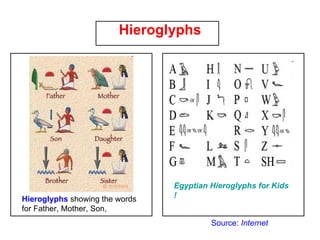
Hieroglyphs Hieroglyphs  showing the words for Father, Mother, Son,  Egyptian Hieroglyphs for Kids ! Source:  Internet
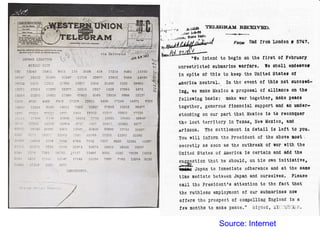
Zimmermann’s Telegram – January 16, 1917 The message came as a  coded telegram  dispatched by the  Foreign Secretary of the German Empire,  ARTHUR ZIMMERMANN, on January 16, 1917, to the German ambassador in Washington D.C., Johann von Bernstorff, at the height ofWorld War I. On January 19, Bernstorff, per Zimmermann's request, forwarded the telegram to the German ambassador in Mexico, Heinrich von Eckardt.  Source: Internet
Source: Internet
Hopes and Assumptions Modern  cryptographic algorithms  –  computational  hardness   assumptions -  hoping  such  algorithms are   hard to break by  a HACKER - but  only  computationally secure !! Information theoretically secure algorithms –  probably  cannot be broken  – like one time pad algorithm - but  more difficult to implement  compared to the former one But if you do  something good , there are  others to use  it for  criminal  and  bad purposes –  Our example : Internet – it was not built with security in  mind – leads to hacking – hence we go to cryptography
Examples – bad and terrifying Sony’s Play Station & Entertainment Networks : Repeatedly attacked - More than  100 million user’s accounts  compromised and the on-line gaming halted for several weeks!! 2.   Internet marketing co.:  Millions of customer’s e-mail addresses taken from  100 major corporations 3. South Korea’s agricultural co-operative:  banking systems crashed for a week –  kept 30 million customers  from accessing their accounts 4 .  Hundai Capital:  balckmailers broke into the financial systems – accessed personal details of  1.75 million customers  and  demanded US $460 000  – not to make the information public  5. Targetted attacks on security vendors also :  a hacker fooled with SSL certificates to large websites like  Google, Yahoo, Mozilla, and Skype 6. Cyber intrusions : government computer systems in  Australia, Canada, France and United States British Government:  saw more than  650 attempted intrusions per day !! US Government :  received 15,000 hits per day –  about one every 6 seconds!! Source: IEEE Spectrum - July 2011
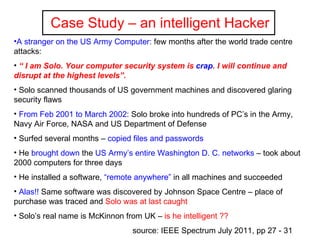
Case Study – an intelligent Hacker A stranger on the US Army Computer:  few months after the world trade centre attacks:  “  I am Solo. Your computer security system is  crap . I will continue and disrupt at the highest levels”. Solo scanned thousands of US   government machines and discovered glaring security flaws From Feb 2001 to March 2002 : Solo broke into hundreds of PC’s in the Army, Navy Air Force, NASA and US Department of Defense Surfed several months –  copied files and passwords He  brought down  the  US Army’s entire Washington D. C. networks  – took about 2000 computers for three days  He installed a software,  “remote anywhere”  in all machines and succeeded Alas!!  Same software was discovered by Johnson Space Centre – place of purchase was traced and  Solo was at last caught Solo’s real name is McKinnon from UK –  is he intelligent ?? source: IEEE Spectrum July 2011, pp 27 - 31
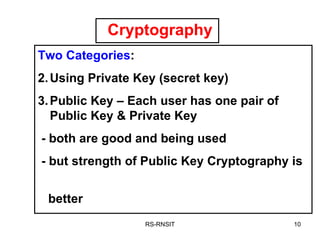
Cryptography RS-RNSIT Two Categories : Using Private Key (secret key) Public Key – Each user has one pair of Public Key & Private Key - both are good and being used - but strength of Public Key Cryptography is  better
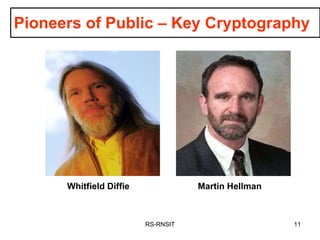
RS-RNSIT Whitfield Diffie Martin Hellman Pioneers of Public – Key Cryptography
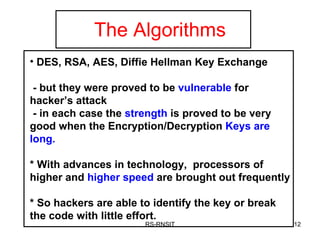
The Algorithms RS-RNSIT DES, RSA, AES, Diffie Hellman Key Exchange  - but they were proved to be  vulnerable  for hacker’s attack - in each case the  strength  is proved to be very good when the Encryption/Decryption  Keys are long. * With advances in technology,  processors of higher and  higher speed  are brought out frequently * So hackers are able to identify the key or break the code with little effort.
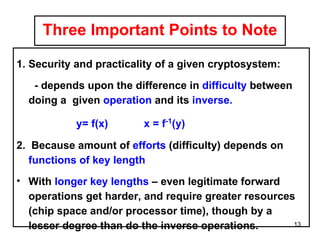
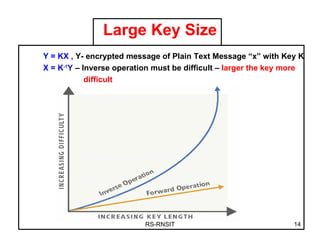
Three Important Points to Note Security and practicality of a given cryptosystem:  - depends upon the difference in  difficulty  between doing a  given  operation  and its  inverse. y= f(x)  x = f -1 (y) 2.  Because amount of  efforts  (difficulty) depends on  functions of key length With  longer key lengths  – even legitimate forward operations get harder, and require greater resources (chip space and/or processor time), though by a lesser degree than do the inverse operations.
Large Key Size RS-RNSIT Y = KX ,  Y- encrypted message of Plain Text Message “x” with Key K X = K -1 Y  – Inverse operation must be difficult –  larger the key more   difficult
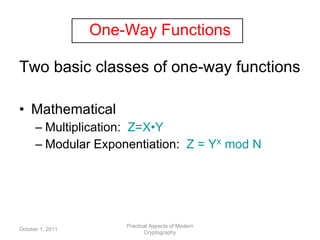
One-Way Functions Two basic classes of one-way functions Mathematical Multiplication:  Z=X•Y Modular Exponentiation:  Z =   Y X   mod N October 1, 2011 Practical Aspects of Modern Cryptography
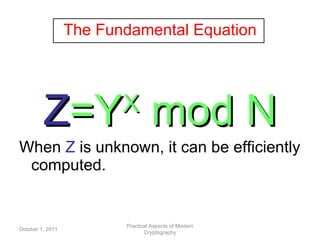
The Fundamental Equation Z =Y X  mod N When  Z  is unknown, it can be efficiently computed. October 1, 2011 Practical Aspects of Modern Cryptography
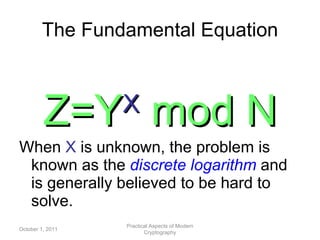
The Fundamental Equation Z=Y X   mod N When  X  is unknown, the problem is known as the  discrete logarithm   and is generally believed to be hard to solve. October 1, 2011 Practical Aspects of Modern Cryptography
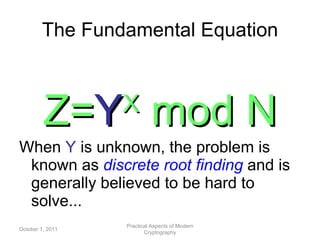
The Fundamental Equation Z= Y X   mod N When  Y  is unknown, the problem is known as  discrete root finding   and is generally believed to be hard to solve... October 1, 2011 Practical Aspects of Modern Cryptography
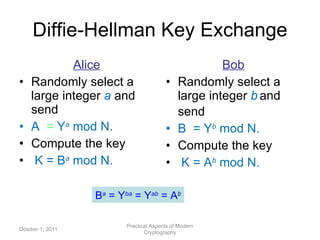
Diffie-Hellman Key Exchange Alice Randomly select a large integer  a   and send   A  =  Y a  mod N. Compute the key  K = B a   mod N. Bob Randomly select a large integer  b   and send B  = Y b  mod N. Compute the key  K = A b  mod N. October 1, 2011 Practical Aspects of Modern Cryptography B a  = Y ba  = Y ab  = A b
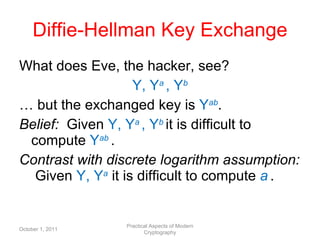
Diffie-Hellman Key Exchange What does Eve, the hacker, see? Y, Y a   , Y b …  but the exchanged key is  Y ab . Belief:  Given  Y, Y a   , Y b  it is difficult to compute  Y ab  . Contrast with discrete logarithm assumption:  Given  Y, Y a   it is difficult to compute  a   . October 1, 2011 Practical Aspects of Modern Cryptography
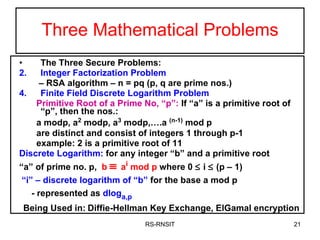
Three Mathematical Problems The Three Secure Problems: Integer Factorization Problem  –  RSA algorithm – n = pq (p, q are prime nos.) Finite Field Discrete Logarithm Problem Primitive Root of a Prime No, “p”:  If “a” is a primitive root of “p”, then the nos.: a modp, a 2  modp, a 3  modp,….a  (n-1)  mod p  are distinct and consist of integers 1 through p-1  example: 2 is a primitive root of 11 Discrete Logarithm:  for any integer “b” and a primitive root “ a” of prime no. p,  b     a i  mod p  where 0    i    (p – 1) “ i” – discrete logarithm of “b”  for the base a mod p - represented as  dlog a,p Being Used in:   Diffie-Hellman Key Exchange, ElGamal encryption RS-RNSIT
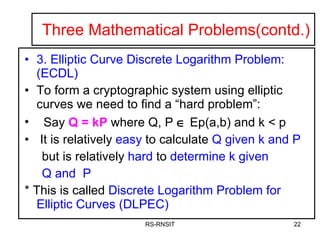
Three Mathematical Problems(contd.) 3. Elliptic Curve Discrete Logarithm Problem: (ECDL) To form a cryptographic system using elliptic curves we need to find a “hard problem”: Say  Q = kP  where Q, P     Ep(a,b) and k < p It is relatively  easy  to calculate  Q given k and P   but is relatively  hard  to  determine k   given  Q and  P * This is called  Discrete Logarithm Problem for Elliptic Curves (DLPEC) RS-RNSIT
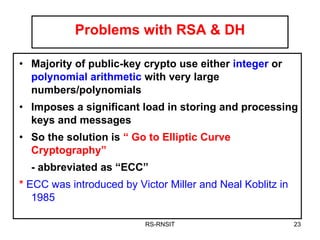
Problems with RSA & DH Majority of public-key crypto use either  integer  or  polynomial arithmetic  with very large numbers/polynomials Imposes a significant load in storing and processing keys and messages So the solution is  “ Go to Elliptic Curve Cryptography” - abbreviated as “ECC” *  ECC was introduced by Victor Miller and Neal Koblitz in 1985 . RS-RNSIT
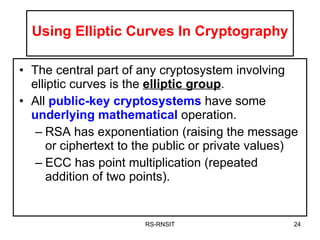
Using Elliptic Curves In Cryptography The central part of any cryptosystem involving elliptic curves is the  elliptic group . All  public-key cryptosystems  have some  underlying mathematical  operation. RSA has exponentiation (raising the message or ciphertext to the public or private values) ECC has point multiplication (repeated addition of two points). RS-RNSIT
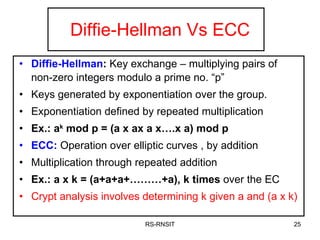
Diffie-Hellman Vs ECC Diffie-Hellman :  Key exchange – multiplying pairs of non-zero integers modulo a prime no. “p” Keys generated by exponentiation over the group. Exponentiation defined by repeated multiplication Ex.: a k  mod p = (a x ax a x….x a) mod p ECC:  Operation over elliptic curves , by addition Multiplication through repeated addition Ex.: a x k = (a+a+a+………+a), k   times  over the EC Crypt analysis involves determining k given a and (a x k)   RS-RNSIT
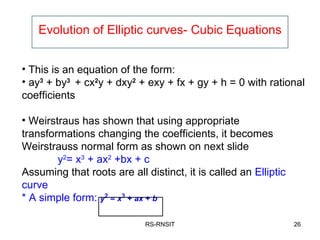
Evolution of Elliptic curves- Cubic Equations RS-RNSIT This is an equation of the form: ay 3  + by 3  + cx 2 y + dxy 2  + exy + fx + gy + h = 0 with rational coefficients Weirstraus has shown that using appropriate transformations changing the coefficients, it becomes Weirstrauss normal form as shown on next slide y 2 = x 3  + ax 2  +bx + c Assuming that roots are all distinct, it is called an  Elliptic curve * A simple form:  y 2  =  x 3  +  ax  +  b
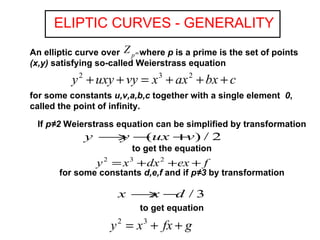
If  p≠2  Weierstrass equation can be simplified by transformation to get the equation for some constants  d,e,f  and if  p≠3  by transformation to get equation ELIPTIC CURVES - GENERALITY An elliptic curve over  where  p  is a prime is the set of points  (x,y)  satisfying so-called Weierstrass equation for some constants  u,v,a,b,c  together with a single element  0 , called the point of infinity.
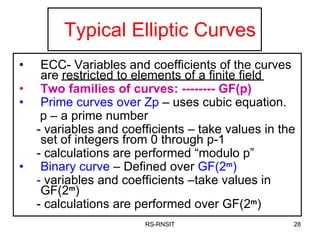
Typical Elliptic Curves ECC- Variables and coefficients of the curves are restricted to elements of a finite field Two families of curves: -------- GF(p) Prime curves   over Zp  – uses cubic equation. p – a prime number - variables and coefficients – take values in the set of integers from 0 through p-1 - calculations are performed “modulo p” Binary curve  – Defined over  GF(2 m ) -  variables and coefficients –take values in GF(2 m ) - calculations are performed over GF(2 m ) RS-RNSIT
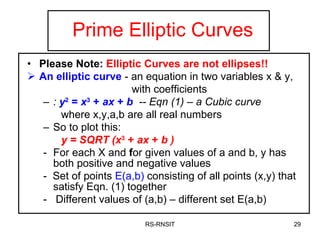
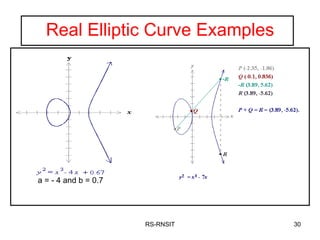
Prime Elliptic Curves Please Note:   Elliptic Curves are not ellipses!! An  elliptic curve  - an equation in two variables x & y,  with coefficients :  y 2  =  x 3  +  ax  +  b   -- Eqn (1) – a Cubic curve  where x,y,a,b are all real numbers So to plot this: y = SQRT (x 3  +  ax  +  b ) For each X and   f or given values of a and b, y has both positive and negative values -  Set of points  E(a,b)  consisting of all points (x,y) that satisfy Eqn. (1) together -  Different values of (a,b) – different set E(a,b) RS-RNSIT
Real Elliptic Curve Examples RS-RNSIT a = - 4 and b = 0.7
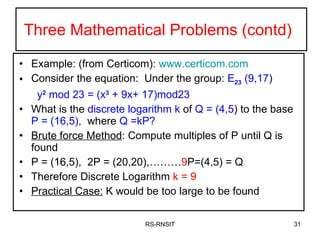
Three Mathematical Problems (contd)  Example: (from Certicom):  www.certicom.com Consider the equation:  Under the group:  E 23  (9,17 ) y 2  mod 23 = (x 3  + 9x+ 17)mod23 What is the  discrete logarithm k  of  Q = (4,5 ) to the base  P = (16,5),   where  Q =kP? Brute force Method : Compute multiples of P until Q is found P = (16,5),  2P = (20,20),……… 9 P=(4,5) = Q Therefore Discrete Logarithm  k = 9 Practical Case:  K would be too large to be found RS-RNSIT
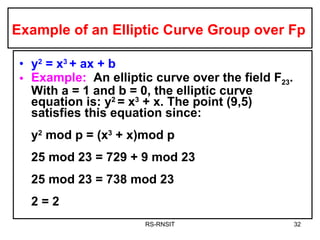
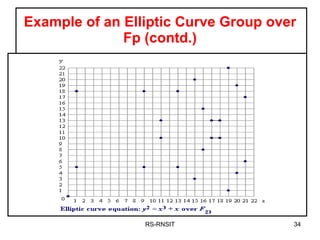
Example of an Elliptic Curve Group over Fp y 2  = x 3  + ax + b   Example:   An elliptic curve over the field F 23 . With a = 1 and b = 0, the elliptic curve equation is: y 2  = x 3  + x. The point (9,5) satisfies this equation since:  y 2  mod p = (x 3  + x)mod p  25 mod 23 = 729 + 9 mod 23  25 mod 23 = 738 mod 23  2 = 2  RS-RNSIT
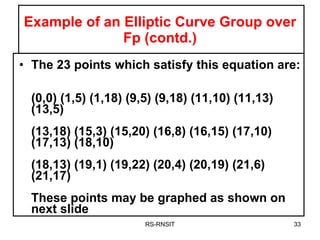
Example of an Elliptic Curve Group over Fp (contd.) The 23 points which satisfy this equation are:  (0,0) (1,5) (1,18) (9,5) (9,18) (11,10) (11,13) (13,5)  (13,18) (15,3) (15,20) (16,8) (16,15) (17,10) (17,13) (18,10)  (18,13) (19,1) (19,22) (20,4) (20,19) (21,6) (21,17)  These points may be graphed as shown on next slide  RS-RNSIT
Example of an Elliptic Curve Group over Fp (contd.) RS-RNSIT
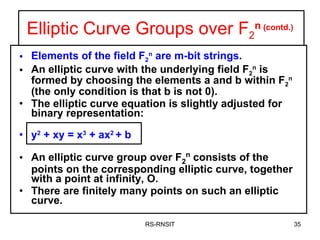
Elliptic Curve Groups over F 2 n  (contd.) Elements of the field F 2 n  are m-bit strings .  An elliptic curve with the underlying field F 2 n  is formed by choosing the elements a and b within F 2 n  (the only condition is that b is not 0).  The elliptic curve equation is slightly adjusted for binary representation:  y 2  + xy = x 3  + ax 2  + b   An elliptic curve group over F 2 n  consists of the points on the corresponding elliptic curve, together with a point at infinity, O.  There are finitely many points on such an elliptic curve. RS-RNSIT
Finite fields of the form  GF 2 n  (contd.) Computational considerations: A polynomial f(x) in GF(2 n ) is;   f(X) = a n-1 x n-I  + a n-2 x n-2  + ….a 1 x + a 0 Uniquely represented by its ‘n’ coefficients (a n-1 , a n-2 , ………a 0 ).  a i     {0,1} Thus every polynomial in GF(2 n ) can be represented by an n-bit number the coefficients and variables are in finite field Addition:  { a n-1 x n-I  + a n-2 x n-2  + ….a 1 x + a 0 } +{b n-1 x n-I  + b n-2 x n-2  + ….b 1 x + b 0 }  = r n-1 x n-I  + r n-2 x n-2  + ….r 1 x + r 0  with ri    [ai + bi] mod 2 RS-RNSIT
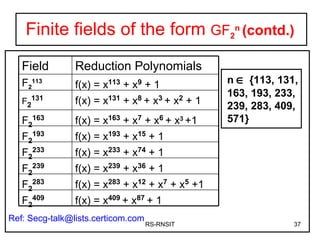
Finite fields of the form  GF 2 n  (contd.) RS-RNSIT n      {113, 131, 163, 193, 233, 239, 283, 409, 571} Ref: Secg-talk@lists.certicom.com Field  Reduction Polynomials F 2 113 f(x) = x 113  + x 9  + 1 F 2 131 f(x) = x 131  + x 8  + x 3  + x 2  + 1 F 2 163 f(x) = x 163  + x 7  + x 6  + x 3  +1 F 2 193 f(x) = x 193  + x 15  + 1 F 2 233 f(x) = x 233  + x 74  + 1 F 2 239 f(x) = x 239  + x 36  + 1 F 2 283 f(x) = x 283  + x 12  + x 7  + x 5  +1 F 2 409 f(x) = x 409  + x 87  + 1
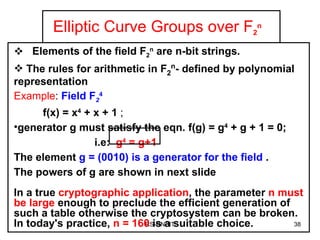
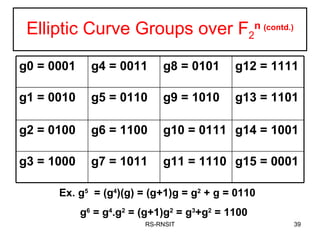
Elliptic Curve Groups over F 2 n   RS-RNSIT Elements of the field F 2 n  are n-bit strings.  The rules for arithmetic in F 2 n - defined by polynomial representation Example :  Field F 2 4   f(x) = x 4  + x + 1  ;  generator g must satisfy the eqn. f(g) = g 4  + g + 1 = 0;  i.e:  g 4  = g+1 The element  g = (0010) is a generator for the field  .  The powers of g are shown in next slide  In a true  cryptographic application , the parameter  n must be large  enough to preclude the efficient generation of such a table otherwise the cryptosystem can be broken. In today's practice,  n = 160  is a suitable choice.
Elliptic Curve Groups over F 2 n  (contd.) RS-RNSIT Ex. g 5   = (g 4 )(g) = (g+1)g = g 2  + g = 0110 g 6  = g 4 .g 2  = (g+1)g 2  = g 3 +g 2  = 1100 g0 = 0001 g4 = 0011 g8 = 0101 g12 = 1111 g1 = 0010 g5 = 0110 g9 = 1010 g13 = 1101 g2 = 0100 g6 = 1100 g10 = 0111 g14 = 1001 g3 = 1000 g7 = 1011 g11 = 1110 g15 = 0001
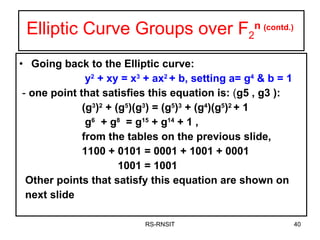
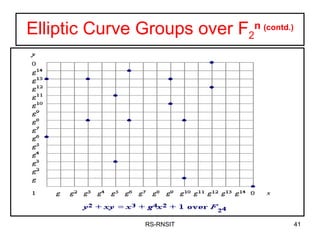
Elliptic Curve Groups over F 2 n  (contd.) Going back to the Elliptic curve: y 2  + xy = x 3  + ax 2  + b, setting a= g 4  & b = 1 -  one point that satisfies this equation is:  ( g5 , g3 ):  (g 3 ) 2  + (g 5 )(g 3 ) = (g 5 ) 3  + ( g 4 )( g 5 ) 2  + 1 g 6   + g 8   = g 15  + g 14  + 1 ,  from the tables on the previous slide, 1100 + 0101 = 0001 + 1001 + 0001 1001 = 1001  Other points that satisfy this equation are shown on  next slide  RS-RNSIT
Elliptic Curve Groups over F 2 n  (contd.) RS-RNSIT
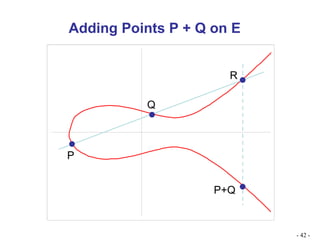
Adding Points P + Q on E -   - P Q P+Q R
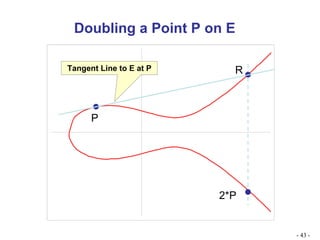
Doubling a Point P on E -   - P 2*P R Tangent Line to E at P
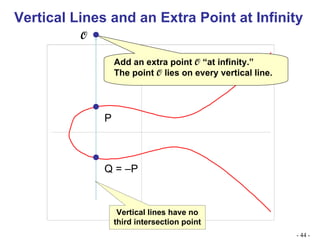
Vertical Lines and an Extra Point at Infinity Add an extra point  O  “at infinity.” The point  O  lies on every vertical line. -   - Vertical lines have no third intersection point Q O P Q = –P
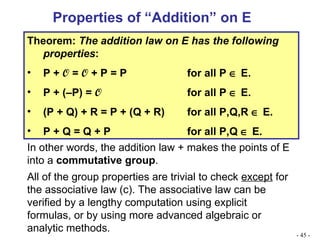
Properties of “Addition” on E Theorem:  The addition law on E has the following properties : P +  O  =  O  + P = P for all P    E. P + (–P) =  O   for all P    E. (P + Q) + R = P + (Q + R) for all P,Q,R    E. P + Q = Q + P for all P,Q    E. In other words, the addition law + makes the points of E into a  commutative group . All of the group properties are trivial to check  except  for the associative law (c). The associative law can be verified by a lengthy computation using explicit formulas, or by using more advanced algebraic or analytic methods. -   -
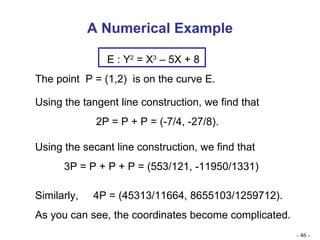
A Numerical Example Using the tangent line construction, we find that 2P = P + P = (-7/4, -27/8). Using the secant line construction, we find that 3P = P + P + P = (553/121, -11950/1331) Similarly,  4P = (45313/11664, 8655103/1259712). As you can see, the coordinates become complicated. -   - E : Y 2  = X 3  – 5X + 8 The point  P = (1,2)  is on the curve E.
Algebraic Description of Addition Calculation of Addition over elliptic curves: For two distinct points  P = (x p , y p )  and  Q = (x  Q , y  Q )  not negative to each other, Slope of the line ‘l’ that joins them is  :    = (y Q  – y P )/ (x Q  – x p ) We can express  R = P + Q  as follows: x R  =   2  – x p  – x Q   -------------  Eqn1 y R  = - y p  +   (x p  – x R )   ----Eqn 2 To add a point to itself, P + P = 2P = R, when y p     0, the expressions  are:  x R  = {[3x 2 p  + a]/2y p } 2  – 2 x p   y R  = {[ 3x 2 p  + a]/   2y p } (x p  – x R ) - y p
Algebraic Description of Addition  (contd.) Actually:    = (y Q  – y P )/ (x Q  – x p )  mod p if P    Q and      = {[3x 2 p  + a]/2y p } mod p if P = Q   Example:  P = (3, 10)   and  Q = (9,7)  in E 23 (1,1) in y 2  = x 3   + x + 1    = (7-10/9-3)mod 23 = 11 x R  = (11 2 -3-9)mod23 = 17 y R  = [11(3-17)-10]mod23 =20  So  (P+Q) = (17,20) To find 2P = P + P:    =  [{3(3 2 ) + 1}/2x10] mod23 =  (1/4)mod23 Multiplicative inverse of 4 under Z 23 ,    = (1/4)mid23 = 6  [to check(6x4)mod23 = 1] with xP= xQ = 3 and yP = 10 and substituting in Eqns 1 and 2 on last slide: x R  = (6 2  – 3 - 3)mod23 = 30mod23 = 7 y R  = {6(3-7) – 10} mod23 = (-34) mod 23 = 12 the point corresponding to  2P = (7, 12)
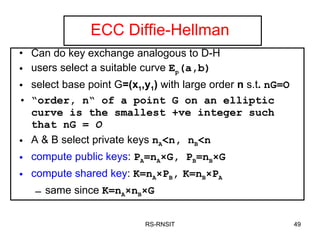
ECC Diffie-Hellman Can do key exchange analogous to D-H users select a suitable curve  E p (a,b)   select base point G =(x 1 ,y 1 )  with large order  n  s.t .  nG=O “ order, n“ of a point G on an elliptic curve is the smallest +ve integer such that nG =  O A & B select private keys  n A <n, n B <n compute public keys :  P A =n A ×G,  P B =n B ×G compute shared key :  K =n A × P B ,   K =n B × P A same since  K =n A × n B ×G RS-RNSIT
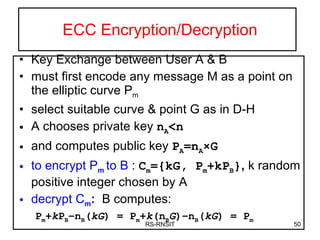
ECC Encryption/Decryption Key Exchange between User A & B must first encode any message M as a point on the elliptic curve P m select suitable curve & point G as in D-H A chooses private key  n A <n and computes public key  P A =n A ×G to encrypt P m  to B   :  C m ={kG, P m +kP B } ,  k random positive integer chosen by A decrypt C m :   B computes:  P m + k P B – n B ( kG ) =  P m + k ( n B G )– n B ( kG ) =  P m RS-RNSIT
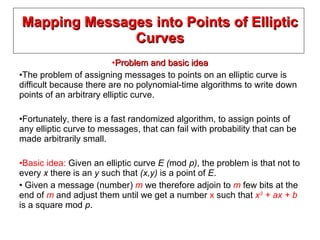
Mapping Messages into Points of Elliptic Curves Problem and basic idea The problem of assigning messages to points on an elliptic curve is difficult because there are no polynomial-time algorithms to write down points of an arbitrary elliptic curve. Fortunately, there is a fast randomized algorithm, to assign points of any elliptic curve to messages, that can fail with probability that can be made arbitrarily small. Basic idea:  Given an elliptic curve  E ( mod  p) , the problem is that not to every  x  there is an  y  such that  (x,y)  is a point of  E . Given a message (number)  m  we therefore adjoin to  m  few bits at the end of  m  and adjust them until we get a number  x  such that  x 3  + ax + b  is a square mod  p .
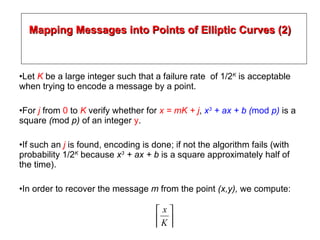
Mapping Messages into Points of Elliptic Curves (2) Let  K  be a large integer such that a failure rate  of 1/2 K  is acceptable when trying to encode a message by a point. For  j   from  0  to  K  verify whether for  x = mK + j ,  x 3  + ax + b ( mod  p)  is a square  ( mod  p)  of an integer  y . If such an  j   is found, encoding is done; if not the algorithm fails (with probability 1/2 K  because  x 3  + ax + b  is a square approximately half of the time). In order to recover the message  m  from the point  (x,y),  we compute:
RS-RNSIT Elliptic Curve Digital Signature Algorithm (ECDSA) Proposed by Abdalla , Bellare and Rogaway in 1999. Entity A has domain parameters D = (q, a, b, G, n, h) and public key Q A  and private key d A . And entity B has authentic copies of D and Q A .    To sign a message m,  A does the following:  Select a random integer k from [1,n-1].  Compute kG = (x 1 ,y 1 ) and r = x 1  mod n. If r = 0 then go to step 1.  Compute k -1  mod n. Compute e = SHA-1(m).  Compute s = k -1 {e + d A  . r} mod n.  If  s = 0 then go to step 1.  A's signature for the message m is (r, s).
RS-RNSIT Elliptic Curve Digital Signature Algorithm (ECDSA) To verify A's signature (r, s) on m, B performs the following steps: Verify that r and s are integers in [1,n-1].  Compute e = SHA-1(m). Compute w = s -1  mod n.  Compute u 1  = ew mod n and u 2  = rw mod n.  Compute (x 1 ,y 1 ) = u 1 G+ u 2  Q A Compute v = x 1  mod n.  Accept the signature if and only if v = r. SHA-1 denotes the 160-bit hash function
RS-RNSIT Analogue of the DSA, proposed by Scott  Vanstone in 1992.  To encrypt a message m for B, A performs :  Select a random integer r from [1,n-1].  Compute R = rG.  Compute K = hrQ B  = (K X , K Y ). Check that K    O:  Compute k 1 || k 2  = KDF(K X ).  Compute c = (k 1 , m). Compute t = MAC(k 2 , c).  Send (R; c; t) to B.  ENC a symmetric encryption scheme such as Triple-DES  MAC denotes a message authentication code (MAC) algorithm  “ RFC 2104 ”  ; KDF a key derivation function   Elliptic Curve Authenticated Encryption Scheme (ECAES)
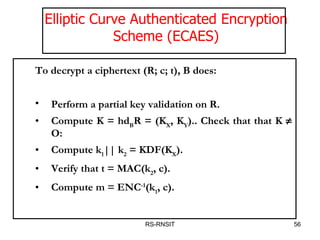
RS-RNSIT Elliptic Curve Authenticated Encryption Scheme (ECAES) To decrypt a ciphertext (R; c; t), B does:  Perform a partial key validation on R.  Compute K = hd B R = (K X , K Y ).. Check that that K    O:  Compute k 1 || k 2  = KDF(K X ). Verify that t = MAC(k 2 , c). Compute m = ENC -1 (k 1 , c).
Why use ECC? How do we analyze Cryptosystems? How difficult is the  underlying problem  that it is based upon RSA – Integer Factorization DH – Discrete Logarithms ECC - Elliptic Curve Discrete Logarithm problem How do we measure difficulty? We examine the algorithms used to solve these problems RS-RNSIT
Advantages of ECC Hence, ECC offers equivalent security with much small key size. Practical advantages of ECC : 1 Faster 2 Low power consumption 3 Low memory usage 4 Low CPU utilization 5 Benefits of over its competitors increases with increase in the security needs.
Key References Papers: J. Lopez and R. Dahab, “Fast Multiplication on Elliptic Curves over GF(2 m ) without pre-computation”, CHES 1999 K. Fong etal, “Field Inversion and Point Halving Revisited”, IEEE Trans on Comp, 2004 G. Orlando and C. Paar, “A High Performance Reconfigurable Elliptic Curve Processor for GF(2 m )”, CHES 2000 N. A. Saqib etal, “A Parallel Architecture for Fast Computation of Elliptic Curve Scalar Multiplication over GF(2 m )”, Elsevier Journal of Microprocessors and Microsystems, 2004 Sabiel Mercurio etal, “ An FPGA Arithmetic Logic Unit for Computing Scalar Multiplication using the Half-and-Add Method”, IEEE ReConfig 2005
RS-RNSIT Key References Books:   Elliptic Curves: Number Theory and Cryptography, by Lawrence C. Washington  Guide to Elliptic Curve Cryptography, Alfred J .  Menezes  Guide to Elliptic Curve Cryptography, Darrel R. Hankerson , A . Menezes and A. Vanstone http://cr.yp.to/ecdh.html  ( Daniel Bernstein)
RS-RNSIT Additional References : An Overview of Elliptic Curve Cryptography by Julio Lopez and Richard Dahab May 2000.   http://citeseer.ist.psu.edu/lop00overview.html M. Abdalla, M. Bellare and P. Rogaway.  “ DHAES: An encryption scheme on the Diffie- Hellman problem ” , preprint 1999 .  http://www-cse.ucsd.edu/users/mihir /   www.rsasecurity.com http://www.certicom.com/index.php?action=res,ecc_faq http://cgd.best.vwh.net/home/flt/flt03.htm http://mathworld.wolfram.com/EllipticCurve.html
RS-RNSIT Thank You !

Mathematics Towards Elliptic Curve Cryptography-by Dr. R.Srinivasan

  • 1.
    Mathematics Towards EllipticCurve Cryptography by Dr. R. Srinivasan Dean R & D and Post Graduate Studies RNS Institute of Technology, Bangalore Comp Sc. Dept, Mysore 10.9..2011
  • 2.
    Cryptography Definitions 1. Cryptography (or cryptology ; from Greek κρυπτός, kryptos , &quot;hidden, secret &quot;; and γράφειν , graphein , &quot;writing&quot;, or -λογία , -logia , &quot;study&quot;, respectively) [1] is the practice and study of hiding information . Modern cryptography intersects the disciplines of mathematics, computer science , and electrical engineering . 2 . Cryptography is the science of information security . The word is derived from the Greek kryptos , meaning hidden. Cryptography is closely related to the disciplines of cryptology and cryptanalysis    3. Discipline or techniques employed in protecting integrity or secrecy of electronic messages by converting them into unreadable (cipher text) form. Only the use of a secret key can convert the cipher text back into human readable (clear text) form. Cryptography software and/or hardware devices use mathematical formulas (algorithms) to change text from one form to another. Source: Internet
  • 3.
    Evolution of CryptographyThe origin of cryptography is usually dated from about 2000 BC , with the Egyptian practice of hieroglyphics . These consisted of complex pictograms , the full meaning of which was only known to an elite few . The earliest known use of cryptography is found in non-standard hieroglyphs carved into monuments from the Old Kingdom of Egypt circa 1900 BC . Some clay tablets from Mesopotamia somewhat later are clearly meant to protect information — one dated near 1500 BC was found to encrypt a craftsman's recipe for pottery glaze , presumably commercially valuable. Hebrew scholars made use of simple monoalphabetic substitution ciphers such as the Atbash cipher beginning perhaps around 500 to 600 BC Then Romans, Julius Caesar (110BC to 44BC ),….. It was probably religiously motivated textual analysis of the Qur’an which led to the invention of the frequency analysis technique for breaking monoalphabetic substitution ciphers, possibly by Al-Kindi , an Arab mathematician sometime around AD 800
  • 4.
    Hieroglyphs Hieroglyphs showing the words for Father, Mother, Son, Egyptian Hieroglyphs for Kids ! Source: Internet
  • 5.
    Zimmermann’s Telegram –January 16, 1917 The message came as a coded telegram dispatched by the Foreign Secretary of the German Empire, ARTHUR ZIMMERMANN, on January 16, 1917, to the German ambassador in Washington D.C., Johann von Bernstorff, at the height ofWorld War I. On January 19, Bernstorff, per Zimmermann's request, forwarded the telegram to the German ambassador in Mexico, Heinrich von Eckardt. Source: Internet
  • 6.
  • 7.
    Hopes and AssumptionsModern cryptographic algorithms – computational hardness assumptions - hoping such algorithms are hard to break by a HACKER - but only computationally secure !! Information theoretically secure algorithms – probably cannot be broken – like one time pad algorithm - but more difficult to implement compared to the former one But if you do something good , there are others to use it for criminal and bad purposes – Our example : Internet – it was not built with security in mind – leads to hacking – hence we go to cryptography
  • 8.
    Examples – badand terrifying Sony’s Play Station & Entertainment Networks : Repeatedly attacked - More than 100 million user’s accounts compromised and the on-line gaming halted for several weeks!! 2. Internet marketing co.: Millions of customer’s e-mail addresses taken from 100 major corporations 3. South Korea’s agricultural co-operative: banking systems crashed for a week – kept 30 million customers from accessing their accounts 4 . Hundai Capital: balckmailers broke into the financial systems – accessed personal details of 1.75 million customers and demanded US $460 000 – not to make the information public 5. Targetted attacks on security vendors also : a hacker fooled with SSL certificates to large websites like Google, Yahoo, Mozilla, and Skype 6. Cyber intrusions : government computer systems in Australia, Canada, France and United States British Government: saw more than 650 attempted intrusions per day !! US Government : received 15,000 hits per day – about one every 6 seconds!! Source: IEEE Spectrum - July 2011
  • 9.
    Case Study –an intelligent Hacker A stranger on the US Army Computer: few months after the world trade centre attacks: “ I am Solo. Your computer security system is crap . I will continue and disrupt at the highest levels”. Solo scanned thousands of US government machines and discovered glaring security flaws From Feb 2001 to March 2002 : Solo broke into hundreds of PC’s in the Army, Navy Air Force, NASA and US Department of Defense Surfed several months – copied files and passwords He brought down the US Army’s entire Washington D. C. networks – took about 2000 computers for three days He installed a software, “remote anywhere” in all machines and succeeded Alas!! Same software was discovered by Johnson Space Centre – place of purchase was traced and Solo was at last caught Solo’s real name is McKinnon from UK – is he intelligent ?? source: IEEE Spectrum July 2011, pp 27 - 31
  • 10.
    Cryptography RS-RNSIT TwoCategories : Using Private Key (secret key) Public Key – Each user has one pair of Public Key & Private Key - both are good and being used - but strength of Public Key Cryptography is better
  • 11.
    RS-RNSIT Whitfield DiffieMartin Hellman Pioneers of Public – Key Cryptography
  • 12.
    The Algorithms RS-RNSITDES, RSA, AES, Diffie Hellman Key Exchange - but they were proved to be vulnerable for hacker’s attack - in each case the strength is proved to be very good when the Encryption/Decryption Keys are long. * With advances in technology, processors of higher and higher speed are brought out frequently * So hackers are able to identify the key or break the code with little effort.
  • 13.
    Three Important Pointsto Note Security and practicality of a given cryptosystem: - depends upon the difference in difficulty between doing a given operation and its inverse. y= f(x) x = f -1 (y) 2. Because amount of efforts (difficulty) depends on functions of key length With longer key lengths – even legitimate forward operations get harder, and require greater resources (chip space and/or processor time), though by a lesser degree than do the inverse operations.
  • 14.
    Large Key SizeRS-RNSIT Y = KX , Y- encrypted message of Plain Text Message “x” with Key K X = K -1 Y – Inverse operation must be difficult – larger the key more difficult
  • 15.
    One-Way Functions Twobasic classes of one-way functions Mathematical Multiplication: Z=X•Y Modular Exponentiation: Z = Y X mod N October 1, 2011 Practical Aspects of Modern Cryptography
  • 16.
    The Fundamental EquationZ =Y X mod N When Z is unknown, it can be efficiently computed. October 1, 2011 Practical Aspects of Modern Cryptography
  • 17.
    The Fundamental EquationZ=Y X mod N When X is unknown, the problem is known as the discrete logarithm and is generally believed to be hard to solve. October 1, 2011 Practical Aspects of Modern Cryptography
  • 18.
    The Fundamental EquationZ= Y X mod N When Y is unknown, the problem is known as discrete root finding and is generally believed to be hard to solve... October 1, 2011 Practical Aspects of Modern Cryptography
  • 19.
    Diffie-Hellman Key ExchangeAlice Randomly select a large integer a and send A = Y a mod N. Compute the key K = B a mod N. Bob Randomly select a large integer b and send B = Y b mod N. Compute the key K = A b mod N. October 1, 2011 Practical Aspects of Modern Cryptography B a = Y ba = Y ab = A b
  • 20.
    Diffie-Hellman Key ExchangeWhat does Eve, the hacker, see? Y, Y a , Y b … but the exchanged key is Y ab . Belief: Given Y, Y a , Y b it is difficult to compute Y ab . Contrast with discrete logarithm assumption: Given Y, Y a it is difficult to compute a . October 1, 2011 Practical Aspects of Modern Cryptography
  • 21.
    Three Mathematical ProblemsThe Three Secure Problems: Integer Factorization Problem – RSA algorithm – n = pq (p, q are prime nos.) Finite Field Discrete Logarithm Problem Primitive Root of a Prime No, “p”: If “a” is a primitive root of “p”, then the nos.: a modp, a 2 modp, a 3 modp,….a (n-1) mod p are distinct and consist of integers 1 through p-1 example: 2 is a primitive root of 11 Discrete Logarithm: for any integer “b” and a primitive root “ a” of prime no. p, b  a i mod p where 0  i  (p – 1) “ i” – discrete logarithm of “b” for the base a mod p - represented as dlog a,p Being Used in: Diffie-Hellman Key Exchange, ElGamal encryption RS-RNSIT
  • 22.
    Three Mathematical Problems(contd.)3. Elliptic Curve Discrete Logarithm Problem: (ECDL) To form a cryptographic system using elliptic curves we need to find a “hard problem”: Say Q = kP where Q, P  Ep(a,b) and k < p It is relatively easy to calculate Q given k and P but is relatively hard to determine k given Q and P * This is called Discrete Logarithm Problem for Elliptic Curves (DLPEC) RS-RNSIT
  • 23.
    Problems with RSA& DH Majority of public-key crypto use either integer or polynomial arithmetic with very large numbers/polynomials Imposes a significant load in storing and processing keys and messages So the solution is “ Go to Elliptic Curve Cryptography” - abbreviated as “ECC” * ECC was introduced by Victor Miller and Neal Koblitz in 1985 . RS-RNSIT
  • 24.
    Using Elliptic CurvesIn Cryptography The central part of any cryptosystem involving elliptic curves is the elliptic group . All public-key cryptosystems have some underlying mathematical operation. RSA has exponentiation (raising the message or ciphertext to the public or private values) ECC has point multiplication (repeated addition of two points). RS-RNSIT
  • 25.
    Diffie-Hellman Vs ECCDiffie-Hellman : Key exchange – multiplying pairs of non-zero integers modulo a prime no. “p” Keys generated by exponentiation over the group. Exponentiation defined by repeated multiplication Ex.: a k mod p = (a x ax a x….x a) mod p ECC: Operation over elliptic curves , by addition Multiplication through repeated addition Ex.: a x k = (a+a+a+………+a), k times over the EC Crypt analysis involves determining k given a and (a x k) RS-RNSIT
  • 26.
    Evolution of Ellipticcurves- Cubic Equations RS-RNSIT This is an equation of the form: ay 3 + by 3 + cx 2 y + dxy 2 + exy + fx + gy + h = 0 with rational coefficients Weirstraus has shown that using appropriate transformations changing the coefficients, it becomes Weirstrauss normal form as shown on next slide y 2 = x 3 + ax 2 +bx + c Assuming that roots are all distinct, it is called an Elliptic curve * A simple form: y 2 = x 3 + ax + b
  • 27.
    If p≠2 Weierstrass equation can be simplified by transformation to get the equation for some constants d,e,f and if p≠3 by transformation to get equation ELIPTIC CURVES - GENERALITY An elliptic curve over where p is a prime is the set of points (x,y) satisfying so-called Weierstrass equation for some constants u,v,a,b,c together with a single element 0 , called the point of infinity.
  • 28.
    Typical Elliptic CurvesECC- Variables and coefficients of the curves are restricted to elements of a finite field Two families of curves: -------- GF(p) Prime curves over Zp – uses cubic equation. p – a prime number - variables and coefficients – take values in the set of integers from 0 through p-1 - calculations are performed “modulo p” Binary curve – Defined over GF(2 m ) - variables and coefficients –take values in GF(2 m ) - calculations are performed over GF(2 m ) RS-RNSIT
  • 29.
    Prime Elliptic CurvesPlease Note: Elliptic Curves are not ellipses!! An elliptic curve - an equation in two variables x & y, with coefficients : y 2 = x 3 + ax + b -- Eqn (1) – a Cubic curve where x,y,a,b are all real numbers So to plot this: y = SQRT (x 3 + ax + b ) For each X and f or given values of a and b, y has both positive and negative values - Set of points E(a,b) consisting of all points (x,y) that satisfy Eqn. (1) together - Different values of (a,b) – different set E(a,b) RS-RNSIT
  • 30.
    Real Elliptic CurveExamples RS-RNSIT a = - 4 and b = 0.7
  • 31.
    Three Mathematical Problems(contd) Example: (from Certicom): www.certicom.com Consider the equation: Under the group: E 23 (9,17 ) y 2 mod 23 = (x 3 + 9x+ 17)mod23 What is the discrete logarithm k of Q = (4,5 ) to the base P = (16,5), where Q =kP? Brute force Method : Compute multiples of P until Q is found P = (16,5), 2P = (20,20),……… 9 P=(4,5) = Q Therefore Discrete Logarithm k = 9 Practical Case: K would be too large to be found RS-RNSIT
  • 32.
    Example of anElliptic Curve Group over Fp y 2 = x 3 + ax + b Example: An elliptic curve over the field F 23 . With a = 1 and b = 0, the elliptic curve equation is: y 2 = x 3 + x. The point (9,5) satisfies this equation since: y 2 mod p = (x 3 + x)mod p 25 mod 23 = 729 + 9 mod 23 25 mod 23 = 738 mod 23 2 = 2 RS-RNSIT
  • 33.
    Example of anElliptic Curve Group over Fp (contd.) The 23 points which satisfy this equation are: (0,0) (1,5) (1,18) (9,5) (9,18) (11,10) (11,13) (13,5) (13,18) (15,3) (15,20) (16,8) (16,15) (17,10) (17,13) (18,10) (18,13) (19,1) (19,22) (20,4) (20,19) (21,6) (21,17) These points may be graphed as shown on next slide RS-RNSIT
  • 34.
    Example of anElliptic Curve Group over Fp (contd.) RS-RNSIT
  • 35.
    Elliptic Curve Groupsover F 2 n (contd.) Elements of the field F 2 n are m-bit strings . An elliptic curve with the underlying field F 2 n is formed by choosing the elements a and b within F 2 n (the only condition is that b is not 0). The elliptic curve equation is slightly adjusted for binary representation: y 2 + xy = x 3 + ax 2 + b An elliptic curve group over F 2 n consists of the points on the corresponding elliptic curve, together with a point at infinity, O. There are finitely many points on such an elliptic curve. RS-RNSIT
  • 36.
    Finite fields ofthe form GF 2 n (contd.) Computational considerations: A polynomial f(x) in GF(2 n ) is; f(X) = a n-1 x n-I + a n-2 x n-2 + ….a 1 x + a 0 Uniquely represented by its ‘n’ coefficients (a n-1 , a n-2 , ………a 0 ). a i  {0,1} Thus every polynomial in GF(2 n ) can be represented by an n-bit number the coefficients and variables are in finite field Addition: { a n-1 x n-I + a n-2 x n-2 + ….a 1 x + a 0 } +{b n-1 x n-I + b n-2 x n-2 + ….b 1 x + b 0 } = r n-1 x n-I + r n-2 x n-2 + ….r 1 x + r 0 with ri  [ai + bi] mod 2 RS-RNSIT
  • 37.
    Finite fields ofthe form GF 2 n (contd.) RS-RNSIT n  {113, 131, 163, 193, 233, 239, 283, 409, 571} Ref: Secg-talk@lists.certicom.com Field Reduction Polynomials F 2 113 f(x) = x 113 + x 9 + 1 F 2 131 f(x) = x 131 + x 8 + x 3 + x 2 + 1 F 2 163 f(x) = x 163 + x 7 + x 6 + x 3 +1 F 2 193 f(x) = x 193 + x 15 + 1 F 2 233 f(x) = x 233 + x 74 + 1 F 2 239 f(x) = x 239 + x 36 + 1 F 2 283 f(x) = x 283 + x 12 + x 7 + x 5 +1 F 2 409 f(x) = x 409 + x 87 + 1
  • 38.
    Elliptic Curve Groupsover F 2 n RS-RNSIT Elements of the field F 2 n are n-bit strings. The rules for arithmetic in F 2 n - defined by polynomial representation Example : Field F 2 4 f(x) = x 4 + x + 1 ; generator g must satisfy the eqn. f(g) = g 4 + g + 1 = 0; i.e: g 4 = g+1 The element g = (0010) is a generator for the field . The powers of g are shown in next slide In a true cryptographic application , the parameter n must be large enough to preclude the efficient generation of such a table otherwise the cryptosystem can be broken. In today's practice, n = 160 is a suitable choice.
  • 39.
    Elliptic Curve Groupsover F 2 n (contd.) RS-RNSIT Ex. g 5 = (g 4 )(g) = (g+1)g = g 2 + g = 0110 g 6 = g 4 .g 2 = (g+1)g 2 = g 3 +g 2 = 1100 g0 = 0001 g4 = 0011 g8 = 0101 g12 = 1111 g1 = 0010 g5 = 0110 g9 = 1010 g13 = 1101 g2 = 0100 g6 = 1100 g10 = 0111 g14 = 1001 g3 = 1000 g7 = 1011 g11 = 1110 g15 = 0001
  • 40.
    Elliptic Curve Groupsover F 2 n (contd.) Going back to the Elliptic curve: y 2 + xy = x 3 + ax 2 + b, setting a= g 4 & b = 1 - one point that satisfies this equation is: ( g5 , g3 ): (g 3 ) 2 + (g 5 )(g 3 ) = (g 5 ) 3 + ( g 4 )( g 5 ) 2 + 1 g 6 + g 8 = g 15 + g 14 + 1 , from the tables on the previous slide, 1100 + 0101 = 0001 + 1001 + 0001 1001 = 1001 Other points that satisfy this equation are shown on next slide RS-RNSIT
  • 41.
    Elliptic Curve Groupsover F 2 n (contd.) RS-RNSIT
  • 42.
    Adding Points P+ Q on E - - P Q P+Q R
  • 43.
    Doubling a PointP on E - - P 2*P R Tangent Line to E at P
  • 44.
    Vertical Lines andan Extra Point at Infinity Add an extra point O “at infinity.” The point O lies on every vertical line. - - Vertical lines have no third intersection point Q O P Q = –P
  • 45.
    Properties of “Addition”on E Theorem: The addition law on E has the following properties : P + O = O + P = P for all P  E. P + (–P) = O for all P  E. (P + Q) + R = P + (Q + R) for all P,Q,R  E. P + Q = Q + P for all P,Q  E. In other words, the addition law + makes the points of E into a commutative group . All of the group properties are trivial to check except for the associative law (c). The associative law can be verified by a lengthy computation using explicit formulas, or by using more advanced algebraic or analytic methods. - -
  • 46.
    A Numerical ExampleUsing the tangent line construction, we find that 2P = P + P = (-7/4, -27/8). Using the secant line construction, we find that 3P = P + P + P = (553/121, -11950/1331) Similarly, 4P = (45313/11664, 8655103/1259712). As you can see, the coordinates become complicated. - - E : Y 2 = X 3 – 5X + 8 The point P = (1,2) is on the curve E.
  • 47.
    Algebraic Description ofAddition Calculation of Addition over elliptic curves: For two distinct points P = (x p , y p ) and Q = (x Q , y Q ) not negative to each other, Slope of the line ‘l’ that joins them is :  = (y Q – y P )/ (x Q – x p ) We can express R = P + Q as follows: x R =  2 – x p – x Q ------------- Eqn1 y R = - y p +  (x p – x R ) ----Eqn 2 To add a point to itself, P + P = 2P = R, when y p  0, the expressions are: x R = {[3x 2 p + a]/2y p } 2 – 2 x p y R = {[ 3x 2 p + a]/ 2y p } (x p – x R ) - y p
  • 48.
    Algebraic Description ofAddition (contd.) Actually:  = (y Q – y P )/ (x Q – x p ) mod p if P  Q and  = {[3x 2 p + a]/2y p } mod p if P = Q Example: P = (3, 10) and Q = (9,7) in E 23 (1,1) in y 2 = x 3 + x + 1  = (7-10/9-3)mod 23 = 11 x R = (11 2 -3-9)mod23 = 17 y R = [11(3-17)-10]mod23 =20 So (P+Q) = (17,20) To find 2P = P + P:  = [{3(3 2 ) + 1}/2x10] mod23 = (1/4)mod23 Multiplicative inverse of 4 under Z 23 ,  = (1/4)mid23 = 6 [to check(6x4)mod23 = 1] with xP= xQ = 3 and yP = 10 and substituting in Eqns 1 and 2 on last slide: x R = (6 2 – 3 - 3)mod23 = 30mod23 = 7 y R = {6(3-7) – 10} mod23 = (-34) mod 23 = 12 the point corresponding to 2P = (7, 12)
  • 49.
    ECC Diffie-Hellman Cando key exchange analogous to D-H users select a suitable curve E p (a,b) select base point G =(x 1 ,y 1 ) with large order n s.t . nG=O “ order, n“ of a point G on an elliptic curve is the smallest +ve integer such that nG = O A & B select private keys n A <n, n B <n compute public keys : P A =n A ×G, P B =n B ×G compute shared key : K =n A × P B , K =n B × P A same since K =n A × n B ×G RS-RNSIT
  • 50.
    ECC Encryption/Decryption KeyExchange between User A & B must first encode any message M as a point on the elliptic curve P m select suitable curve & point G as in D-H A chooses private key n A <n and computes public key P A =n A ×G to encrypt P m to B : C m ={kG, P m +kP B } , k random positive integer chosen by A decrypt C m : B computes: P m + k P B – n B ( kG ) = P m + k ( n B G )– n B ( kG ) = P m RS-RNSIT
  • 51.
    Mapping Messages intoPoints of Elliptic Curves Problem and basic idea The problem of assigning messages to points on an elliptic curve is difficult because there are no polynomial-time algorithms to write down points of an arbitrary elliptic curve. Fortunately, there is a fast randomized algorithm, to assign points of any elliptic curve to messages, that can fail with probability that can be made arbitrarily small. Basic idea: Given an elliptic curve E ( mod p) , the problem is that not to every x there is an y such that (x,y) is a point of E . Given a message (number) m we therefore adjoin to m few bits at the end of m and adjust them until we get a number x such that x 3 + ax + b is a square mod p .
  • 52.
    Mapping Messages intoPoints of Elliptic Curves (2) Let K be a large integer such that a failure rate of 1/2 K is acceptable when trying to encode a message by a point. For j from 0 to K verify whether for x = mK + j , x 3 + ax + b ( mod p) is a square ( mod p) of an integer y . If such an j is found, encoding is done; if not the algorithm fails (with probability 1/2 K because x 3 + ax + b is a square approximately half of the time). In order to recover the message m from the point (x,y), we compute:
  • 53.
    RS-RNSIT Elliptic CurveDigital Signature Algorithm (ECDSA) Proposed by Abdalla , Bellare and Rogaway in 1999. Entity A has domain parameters D = (q, a, b, G, n, h) and public key Q A and private key d A . And entity B has authentic copies of D and Q A .   To sign a message m, A does the following: Select a random integer k from [1,n-1]. Compute kG = (x 1 ,y 1 ) and r = x 1 mod n. If r = 0 then go to step 1. Compute k -1 mod n. Compute e = SHA-1(m). Compute s = k -1 {e + d A . r} mod n. If s = 0 then go to step 1. A's signature for the message m is (r, s).
  • 54.
    RS-RNSIT Elliptic CurveDigital Signature Algorithm (ECDSA) To verify A's signature (r, s) on m, B performs the following steps: Verify that r and s are integers in [1,n-1]. Compute e = SHA-1(m). Compute w = s -1 mod n. Compute u 1 = ew mod n and u 2 = rw mod n. Compute (x 1 ,y 1 ) = u 1 G+ u 2 Q A Compute v = x 1 mod n. Accept the signature if and only if v = r. SHA-1 denotes the 160-bit hash function
  • 55.
    RS-RNSIT Analogue ofthe DSA, proposed by Scott Vanstone in 1992. To encrypt a message m for B, A performs : Select a random integer r from [1,n-1]. Compute R = rG. Compute K = hrQ B = (K X , K Y ). Check that K  O: Compute k 1 || k 2 = KDF(K X ). Compute c = (k 1 , m). Compute t = MAC(k 2 , c). Send (R; c; t) to B. ENC a symmetric encryption scheme such as Triple-DES MAC denotes a message authentication code (MAC) algorithm “ RFC 2104 ” ; KDF a key derivation function Elliptic Curve Authenticated Encryption Scheme (ECAES)
  • 56.
    RS-RNSIT Elliptic CurveAuthenticated Encryption Scheme (ECAES) To decrypt a ciphertext (R; c; t), B does: Perform a partial key validation on R. Compute K = hd B R = (K X , K Y ).. Check that that K  O: Compute k 1 || k 2 = KDF(K X ). Verify that t = MAC(k 2 , c). Compute m = ENC -1 (k 1 , c).
  • 57.
    Why use ECC?How do we analyze Cryptosystems? How difficult is the underlying problem that it is based upon RSA – Integer Factorization DH – Discrete Logarithms ECC - Elliptic Curve Discrete Logarithm problem How do we measure difficulty? We examine the algorithms used to solve these problems RS-RNSIT
  • 58.
    Advantages of ECCHence, ECC offers equivalent security with much small key size. Practical advantages of ECC : 1 Faster 2 Low power consumption 3 Low memory usage 4 Low CPU utilization 5 Benefits of over its competitors increases with increase in the security needs.
  • 59.
    Key References Papers:J. Lopez and R. Dahab, “Fast Multiplication on Elliptic Curves over GF(2 m ) without pre-computation”, CHES 1999 K. Fong etal, “Field Inversion and Point Halving Revisited”, IEEE Trans on Comp, 2004 G. Orlando and C. Paar, “A High Performance Reconfigurable Elliptic Curve Processor for GF(2 m )”, CHES 2000 N. A. Saqib etal, “A Parallel Architecture for Fast Computation of Elliptic Curve Scalar Multiplication over GF(2 m )”, Elsevier Journal of Microprocessors and Microsystems, 2004 Sabiel Mercurio etal, “ An FPGA Arithmetic Logic Unit for Computing Scalar Multiplication using the Half-and-Add Method”, IEEE ReConfig 2005
  • 60.
    RS-RNSIT Key ReferencesBooks: Elliptic Curves: Number Theory and Cryptography, by Lawrence C. Washington Guide to Elliptic Curve Cryptography, Alfred J . Menezes Guide to Elliptic Curve Cryptography, Darrel R. Hankerson , A . Menezes and A. Vanstone http://cr.yp.to/ecdh.html ( Daniel Bernstein)
  • 61.
    RS-RNSIT Additional References: An Overview of Elliptic Curve Cryptography by Julio Lopez and Richard Dahab May 2000. http://citeseer.ist.psu.edu/lop00overview.html M. Abdalla, M. Bellare and P. Rogaway. “ DHAES: An encryption scheme on the Diffie- Hellman problem ” , preprint 1999 . http://www-cse.ucsd.edu/users/mihir / www.rsasecurity.com http://www.certicom.com/index.php?action=res,ecc_faq http://cgd.best.vwh.net/home/flt/flt03.htm http://mathworld.wolfram.com/EllipticCurve.html
  • 62.

Editor's Notes

  • #30 See text for detailed rules of addition and relation to zero point O. Can derive an algebraic interpretation of addition, based on computing gradient of tangent and then solving for intersection with curve. This is what is used in practice.
  • #51 This is an analog of the ElGamal public-key encryption algorithm. Note that the ciphertext is a pair of points on the elliptic curve. The sender masks the message using random k, but also sends along a “clue” allowing the receiver who know the private-key to recover k and hence the message.