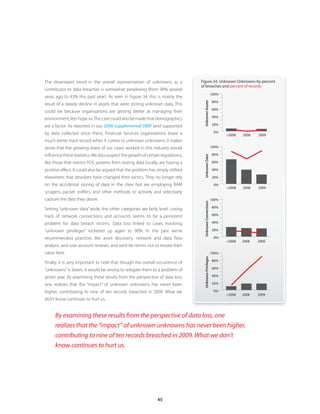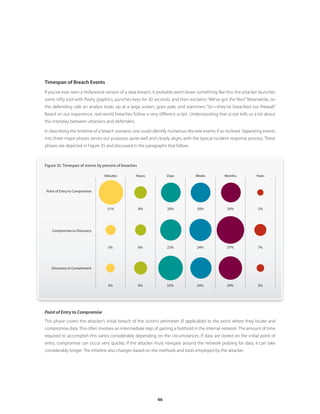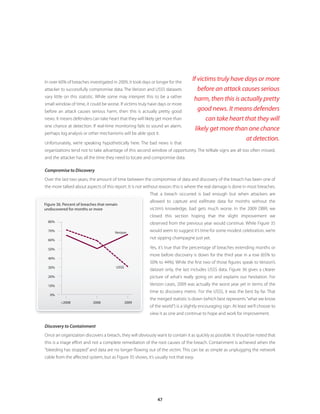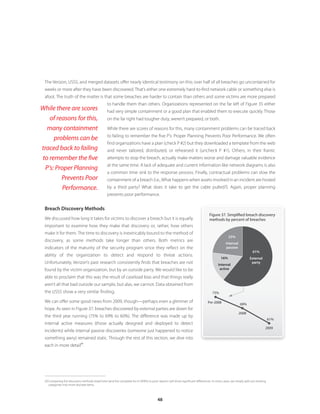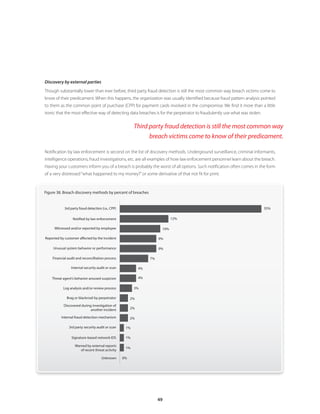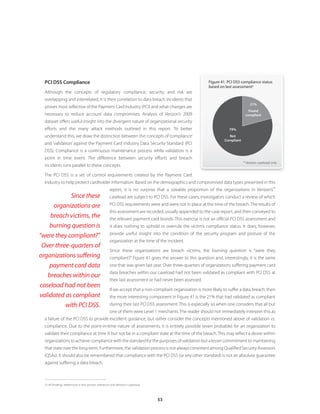
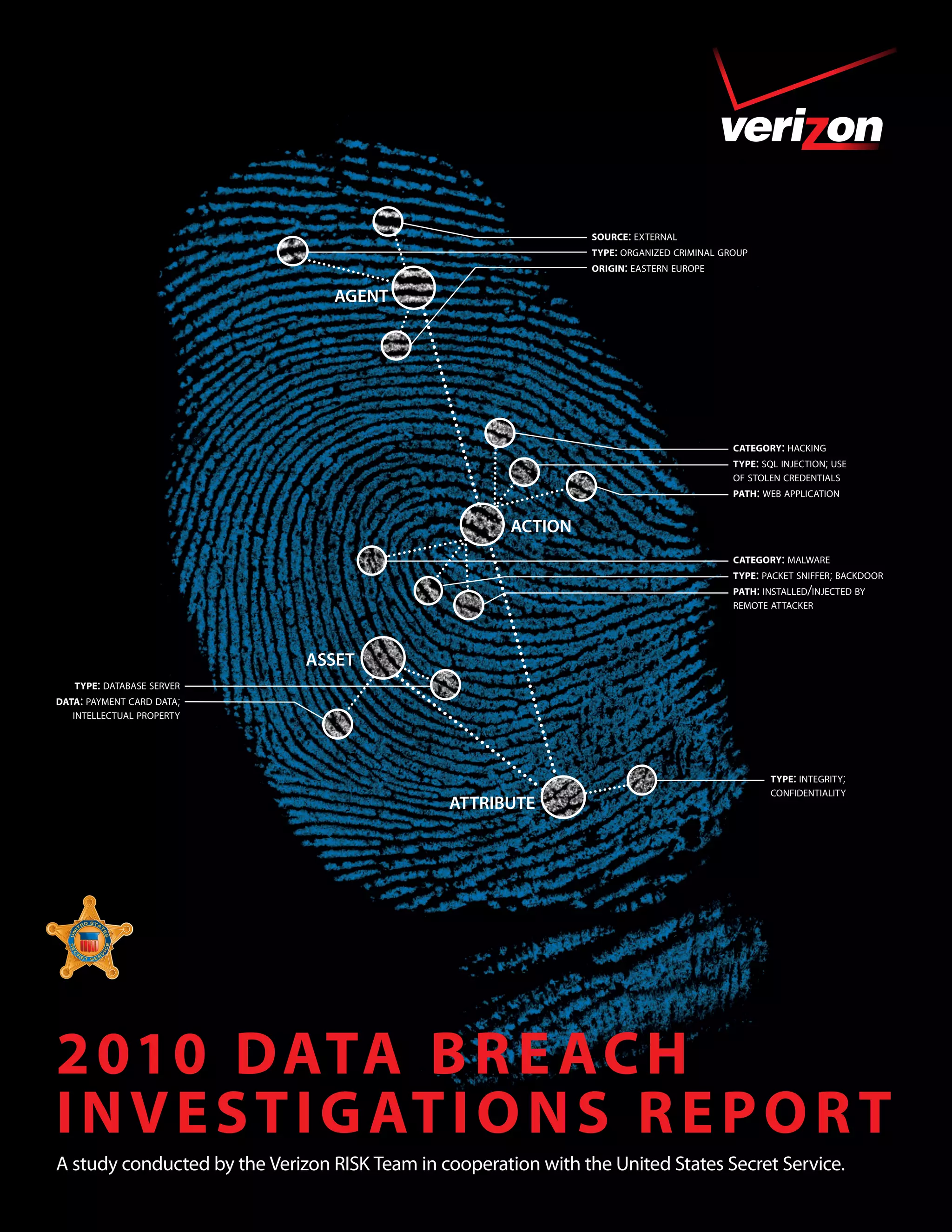
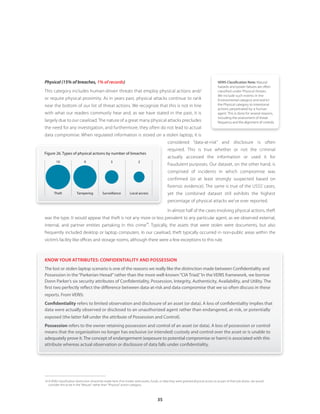
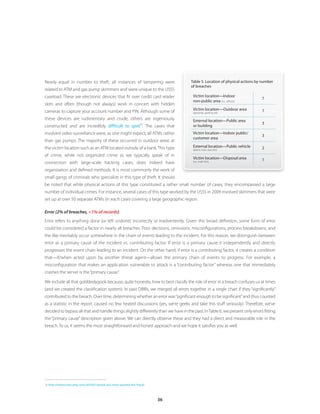
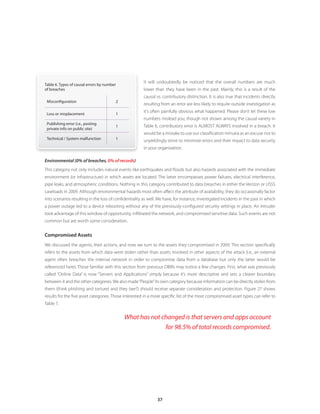
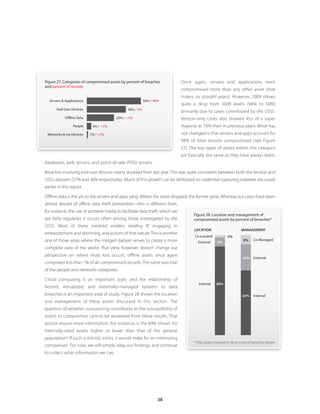
source: external
                                                                 type: organized criminal group
                                                                 origin: eastern europe


                                 AGENT


                                                                                            category: hacking
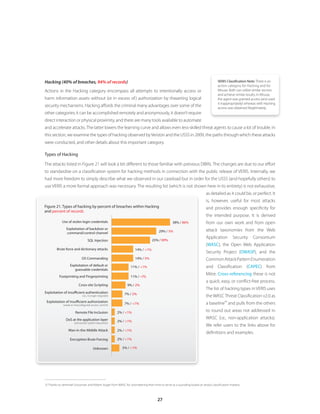
                                                                                            type: sql injection; use
                                                                                            of stolen credentials
                                                                                            path: web application


                                                       ACTION
                                                                                            category: malware
                                                                                            type: packet sniffer; backdoor
                                                                                            path: installed/injected by
                                                                                            remote attacker


                              ASSET
   type: database server
data: payment card data;
   intellectual property


                                                                                                   type: integrity;
                                                                                                   confidentiality
                                               ATTRIBUTE


2 010 DATA B R E AC H
I N V E S T I G AT I O N S R E P O R T
A study conducted by the Verizon RISK Team in cooperation with the United States Secret Service.
2010 Data Breach Investigations Report
AUTHORS:                       TABLE OF CONTENTS
Wade Baker                     Executive Summary  .  .  .  .  .  .  .  .  .  .  .  .  .  .  .  .  .  .  .  .  .  .  .  .  .  .  .  .  .  .  .  .  .  .  .  .  .  .  .  .  .  .  .  .  .  .  .  .  .  .  .  .  .  .  .  .  .  .  .  .  .  .  . 2
Mark Goudie                    Methodology  .  .  .  .  .  .  .  .  .  .  .  .  .  .  .  .  .  .  .  .  .  .  .  .  .  .  .  .  .  .  .  .  .  .  .  .  .  .  .  .  .  .  .  .  .  .  .  .  .  .  .  .  .  .  .  .  .  .  .  .  .  .  .  .  .  .  .  .  . 4
Alexander Hutton                      Verizon Data Collection Methodology  .  .  .  .  .  .  .  .  .  .  .  .  .  .  .  .  .  .  .  .  .  .  .  .  .  .  .  .  .  .  .  .  .  .  .  .  .  .  .  .  .  .  . 4
C. David Hylender                     USSS Data Collection Methodology  .  .  .  .  .  .  .  .  .  .  .  .  .  .  .  .  .  .  .  .  .  .  .  .  .  .  .  .  .  .  .  .  .  .  .  .  .  .  .  .  .  .  .  .  . 5
Jelle Niemantsverdriet         Cybercrime Year in Review, 2009  .  .  .  .  .  .  .  .  .  .  .  .  .  .  .  .  .  .  .  .  .  .  .  .  .  .  .  .  .  .  .  .  .  .  .  .  .  .  .  .  .  .  .  .  .  .  .  .  .  .  . 6
Christopher Novak              Results and Analysis  .  .  .  .  .  .  .  .  .  .  .  .  .  .  .  .  .  .  .  .  .  .  .  .  .  .  .  .  .  .  .  .  .  .  .  .  .  .  .  .  .  .  .  .  .  .  .  .  .  .  .  .  .  .  .  .  .  .  .  .  .  .  . 7
David Ostertag                        Demographics  .  .  .  .  .  .  .  .  .  .  .  .  .  .  .  .  .  .  .  .  .  .  .  .  .  .  .  .  .  .  .  .  .  .  .  .  .  .  .  .  .  .  .  .  .  .  .  .  .  .  .  .  .  .  .  .  .  .  .  .  .  .  .  .  . 8
Christopher Porter                    Threat Agents  .  .  .  .  .  .  .  .  .  .  .  .  .  .  .  .  .  .  .  .  .  .  .  .  .  .  .  .  .  .  .  .  .  .  .  .  .  .  .  .  .  .  .  .  .  .  .  .  .  .  .  .  .  .  .  .  .  .  .  .  .  .  .  .  . 11
Mike Rosen                                         Breach Size by Threat Agents  .  .  .  .  .  .  .  .  .  .  .  .  .  .  .  .  .  .  .  .  .  .  .  .  .  .  .  .  .  .  .  .  .  .  .  .  .  .  .  .  .  .  .  .  .  . 14
Bryan Sartin                                       External Agents .  .  .  .  .  .  .  .  .  .  .  .  .  .  .  .  .  .  .  .  .  .  .  .  .  .  .  .  .  .  .  .  .  .  .  .  .  .  .  .  .  .  .  .  .  .  .  .  .  .  .  .  .  .  .  .  .  .  . 15
Peter Tippett, M.D., Ph.D                          Internal Agents  .  .  .  .  .  .  .  .  .  .  .  .  .  .  .  .  .  .  .  .  .  .  .  .  .  .  .  .  .  .  .  .  .  .  .  .  .  .  .  .  .  .  .  .  .  .  .  .  .  .  .  .  .  .  .  .  .  .  . 17
Men and women of the                               Partner Agents  .  .  .  .  .  .  .  .  .  .  .  .  .  .  .  .  .  .  .  .  .  .  .  .  .  .  .  .  .  .  .  .  .  .  .  .  .  .  .  .  .  .  .  .  .  .  .  .  .  .  .  .  .  .  .  .  .  .  . 19
United States Secret Service          Threat Actions .  .  .  .  .  .  .  .  .  .  .  .  .  .  .  .  .  .  .  .  .  .  .  .  .  .  .  .  .  .  .  .  .  .  .  .  .  .  .  .  .  .  .  .  .  .  .  .  .  .  .  .  .  .  .  .  .  .  .  .  .  .  .  .  . 20
                                                   Malware  .  .  .  .  .  .  .  .  .  .  .  .  .  .  .  .  .  .  .  .  .  .  .  .  .  .  .  .  .  .  .  .  .  .  .  .  .  .  .  .  .  .  .  .  .  .  .  .  .  .  .  .  .  .  .  .  .  .  .  .  .  .  .  .  . 22
CONTRIBUTORS:                                      Hacking  .  .  .  .  .  .  .  .  .  .  .  .  .  .  .  .  .  .  .  .  .  .  .  .  .  .  .  .  .  .  .  .  .  .  .  .  .  .  .  .  .  .  .  .  .  .  .  .  .  .  .  .  .  .  .  .  .  .  .  .  .  .  .  .  .  . 27
                                                   Social  .  .  .  .  .  .  .  .  .  .  .  .  .  .  .  .  .  .  .  .  .  .  .  .  .  .  .  .  .  .  .  .  .  .  .  .  .  .  .  .  .  .  .  .  .  .  .  .  .  .  .  .  .  .  .  .  .  .  .  .  .  .  .  .  .  .  .  . 31
Thijs Bosschert
                                                   Misuse  .  .  .  .  .  .  .  .  .  .  .  .  .  .  .  .  .  .  .  .  .  .  .  .  .  .  .  .  .  .  .  .  .  .  .  .  .  .  .  .  .  .  .  .  .  .  .  .  .  .  .  .  .  .  .  .  .  .  .  .  .  .  .  .  .  .  . 33
Eric Brohm
                                                   Physical  .  .  .  .  .  .  .  .  .  .  .  .  .  .  .  .  .  .  .  .  .  .  .  .  .  .  .  .  .  .  .  .  .  .  .  .  .  .  .  .  .  .  .  .  .  .  .  .  .  .  .  .  .  .  .  .  .  .  .  .  .  .  .  .  .  . 35
Calvin Chang
                                                   Error  .  .  .  .  .  .  .  .  .  .  .  .  .  .  .  .  .  .  .  .  .  .  .  .  .  .  .  .  .  .  .  .  .  .  .  .  .  .  .  .  .  .  .  .  .  .  .  .  .  .  .  .  .  .  .  .  .  .  .  .  .  .  .  .  .  .  .  .  . 36
Michael Dahn
                                                   Environmental .  .  .  .  .  .  .  .  .  .  .  .  .  .  .  .  .  .  .  .  .  .  .  .  .  .  .  .  .  .  .  .  .  .  .  .  .  .  .  .  .  .  .  .  .  .  .  .  .  .  .  .  .  .  .  .  .  .  .  . 37
Ron Dormido
                                      Compromised Assets  .  .  .  .  .  .  .  .  .  .  .  .  .  .  .  .  .  .  .  .  .  .  .  .  .  .  .  .  .  .  .  .  .  .  .  .  .  .  .  .  .  .  .  .  .  .  .  .  .  .  .  .  .  .  .  .  .  . 37
Ben van Erck
                                      Compromised Data .  .  .  .  .  .  .  .  .  .  .  .  .  .  .  .  .  .  .  .  .  .  .  .  .  .  .  .  .  .  .  .  .  .  .  .  .  .  .  .  .  .  .  .  .  .  .  .  .  .  .  .  .  .  .  .  .  .  .  . 39
Kylee Evans
                                      Attack Difficulty  .  .  .  .  .  .  .  .  .  .  .  .  .  .  .  .  .  .  .  .  .  .  .  .  .  .  .  .  .  .  .  .  .  .  .  .  .  .  .  .  .  .  .  .  .  .  .  .  .  .  .  .  .  .  .  .  .  .  .  .  .  .  . 42
Eric Gentry
                                      Attack Targeting  .  .  .  .  .  .  .  .  .  .  .  .  .  .  .  .  .  .  .  .  .  .  .  .  .  .  .  .  .  .  .  .  .  .  .  .  .  .  .  .  .  .  .  .  .  .  .  .  .  .  .  .  .  .  .  .  .  .  .  .  .  .  . 43
John Grim
                                      Unknown Unknowns  .  .  .  .  .  .  .  .  .  .  .  .  .  .  .  .  .  .  .  .  .  .  .  .  .  .  .  .  .  .  .  .  .  .  .  .  .  .  .  .  .  .  .  .  .  .  .  .  .  .  .  .  .  .  .  .  .  . 44
Clarence Hill
                                      Timespan of Breach Events .  .  .  .  .  .  .  .  .  .  .  .  .  .  .  .  .  .  .  .  .  .  .  .  .  .  .  .  .  .  .  .  .  .  .  .  .  .  .  .  .  .  .  .  .  .  .  .  .  .  .  .  . 46
Adam Kunsemiller
                                      Breach Discovery Methods .  .  .  .  .  .  .  .  .  .  .  .  .  .  .  .  .  .  .  .  .  .  .  .  .  .  .  .  .  .  .  .  .  .  .  .  .  .  .  .  .  .  .  .  .  .  .  .  .  .  .  .  . 48
Kenny Lee
                                      Anti-Forensics  .  .  .  .  .  .  .  .  .  .  .  .  .  .  .  .  .  .  .  .  .  .  .  .  .  .  .  .  .  .  .  .  .  .  .  .  .  .  .  .  .  .  .  .  .  .  .  .  .  .  .  .  .  .  .  .  .  .  .  .  .  .  .  .  . 52
Wayne Lee
                                      PCI DSS Compliance  .  .  .  .  .  .  .  .  .  .  .  .  .  .  .  .  .  .  .  .  .  .  .  .  .  .  .  .  .  .  .  .  .  .  .  .  .  .  .  .  .  .  .  .  .  .  .  .  .  .  .  .  .  .  .  .  .  .  . 53
Kevin Long
                               Conclusions and Recommendations  .  .  .  .  .  .  .  .  .  .  .  .  .  .  .  .  .  .  .  .  .  .  .  .  .  .  .  .  .  .  .  .  .  .  .  .  .  .  .  .  .  .  .  .  .  . 56
Raphael Perelstein
                               Appendices from the United States Secret Service  .  .  .  .  .  .  .  .  .  .  .  .  .  .  .  .  .  .  .  .  .  .  .  .  .  .  .  .  .  .  .  .  . 58
Enrico Telemaque
                                      Appendix A: Online Criminal Communities  .  .  .  .  .  .  .  .  .  .  .  .  .  .  .  .  .  .  .  .  .  .  .  .  .  .  .  .  .  .  .  .  .  .  .  .  . 58
Denson Todd
                                      Appendix B: Prosecuting Cybercrime—The Albert Gonzalez story  .  .  .  .  .  .  .  .  .  .  .  .  .  .  . 62
Yuichi Uzawa
                               About Verizon Investigative Response .  .  .  .  .  .  .  .  .  .  .  .  .  .  .  .  .  .  .  .  .  .  .  .  .  .  .  .  .  .  .  .  .  .  .  .  .  .  .  .  .  .  .  .  . 63
J. Andrew Valentine
                               About the United States Secret Service  .  .  .  .  .  .  .  .  .  .  .  .  .  .  .  .  .  .  .  .  .  .  .  .  .  .  .  .  .  .  .  .  .  .  .  .  .  .  .  .  .  .  .  . 63
Nicolas Villatte
Matthijs van der Wel
Paul Wright                    For additional updates and commentary, please visit
                               http://securityblog .verizonbusiness .com .
SPECIAL THANKS TO:             For inquiries directed to the United States Secret Service, contact
                               databreachstudy@usss .dhs .gov .
Tracey Beeferman
Carl Dismukes
Paul Goulding
Carole Neal
2010 Data Breach Investigations Report
A study conducted by the Verizon Business RISK team
in cooperation with the United States Secret Service.
Executive Summary
In some ways, data breaches have a lot in common with fingerprints. Each is unique and we learn a great deal by analyzing the
various patterns, lines, and contours that comprise each one. The main value of fingerprints, however, lies in their ability to identify
a particular individual in particular circumstances. In this sense, studying them in bulk offers little additional benefit. On the other
hand, the analysis of breaches in aggregate can be of great benefit; the more we study, the more prepared we are to stop them.

Not surprisingly, the United States Secret Service (USSS) is also interested in studying and stopping data breaches. This was a
driving force in their decision to join us in this 2010 Data Breach Investigations Report. They’ve increased the scope of what
we’re able to study dramatically by including a few hundred of their own cases to the mix. Also included are two appendices
from the USSS. One delves into online criminal communities and the other focuses on prosecuting cybercrime. We’re grateful
for their contributions and believe organizations and individuals around the world will benefit from their efforts.

With the addition of Verizon’s 2009 caseload and data contributed from the USSS, the DBIR series now spans six years, 900+
breaches, and over 900 million compromised records. We’ve learned a great deal from this journey and we’re glad to have the
opportunity to share these findings with you. As always, our goal is that the data and analysis presented in this report proves
helpful to the planning and security efforts of our readers. We begin with a few highlights below.


  WHO IS BEHIND DATA BREACHES?

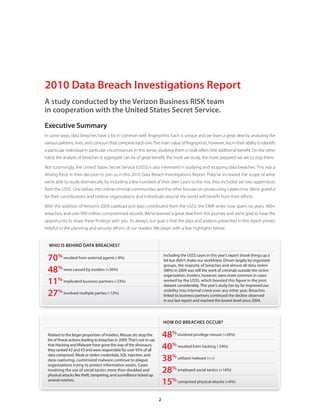
 70% resulted from external agents (-9%)                                      Including the USSS cases in this year’s report shook things up a
                                                                              bit but didn’t shake our worldview . Driven largely by organized
                                                                              groups, the majority of breaches and almost all data stolen
 48% were caused by insiders (+26%)                                           (98%) in 2009 was still the work of criminals outside the victim
                                                                              organization . Insiders, however, were more common in cases
 11% implicated business partners (-23%)                                      worked by the USSS, which boosted this figure in the joint
                                                                              dataset considerably . This year’s study has by far improved our

 27% involved multiple parties (-12%)                                         visibility into internal crime over any other year . Breaches
                                                                              linked to business partners continued the decline observed
                                                                              in our last report and reached the lowest level since 2004 .


                                                                              HOW DO BREACHES OCCUR?

 Related to the larger proportion of insiders, Misuse sits atop the
 list of threat actions leading to breaches in 2009 . That’s not to say
                                                                              48% involved privilege misuse (+26%)
 that Hacking and Malware have gone the way of the dinosaurs;
 they ranked #2 and #3 and were responsible for over 95% of all               40% resulted from hacking (-24%)
                                                                              38% utilized malware (<>)
 data comprised . Weak or stolen credentials, SQL injection, and
 data-capturing, customized malware continue to plague
 organizations trying to protect information assets . Cases
 involving the use of social tactics more than doubled and
 physical attacks like theft, tampering, and surveillance ticked up
                                                                              28% employed social tactics (+16%)
 several notches .
                                                                              15% comprised physical attacks (+6%)
                                                                          2
WHAT COMMONALITIES EXIST?

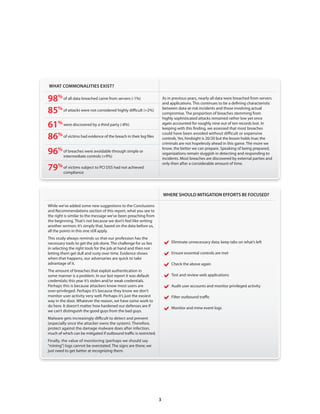
98% of all data breached came from servers (-1%)                         As in previous years, nearly all data were breached from servers
                                                                         and applications . This continues to be a defining characteristic

85% of attacks were not considered highly difficult (+2%)                between data-at-risk incidents and those involving actual
                                                                         compromise . The proportion of breaches stemming from
                                                                         highly sophisticated attacks remained rather low yet once
61% were discovered by a third party (-8%)                               again accounted for roughly nine out of ten records lost . In
                                                                         keeping with this finding, we assessed that most breaches

86% of victims had evidence of the breach in their log files             could have been avoided without difficult or expensive
                                                                         controls . Yes, hindsight is 20/20 but the lesson holds true; the
                                                                         criminals are not hopelessly ahead in this game . The more we

96% intermediatewere avoidable through simple or
    of breaches
                 controls (+9%)
                                                                         know, the better we can prepare . Speaking of being prepared,
                                                                         organizations remain sluggish in detecting and responding to
                                                                         incidents . Most breaches are discovered by external parties and
                                                                         only then after a considerable amount of time .
79% compliance to PCI DSS had not achieved
    of victims subject


                                                                         WHERE SHOULD MITIGATION EFFORTS BE FOCUSED?

While we’ve added some new suggestions to the Conclusions
and Recommendations section of this report, what you see to
the right is similar to the message we’ve been preaching from
the beginning . That’s not because we don’t feel like writing
another sermon; it’s simply that, based on the data before us,
all the points in this one still apply .
This study always reminds us that our profession has the
necessary tools to get the job done . The challenge for us lies          Eliminate unnecessary data; keep tabs on what’s left
in selecting the right tools for the job at hand and then not
letting them get dull and rusty over time . Evidence shows
when that happens, our adversaries are quick to take
                                                                         Ensure essential controls are met
advantage of it .
                                                                         Check the above again
The amount of breaches that exploit authentication in
some manner is a problem . In our last report it was default
credentials; this year it’s stolen and/or weak credentials .
                                                                         Test and review web applications
Perhaps this is because attackers know most users are
over-privileged . Perhaps it’s because they know we don’t
                                                                         Audit user accounts and monitor privileged activity
monitor user activity very well . Perhaps it’s just the easiest
way in the door . Whatever the reason, we have some work to
                                                                         Filter outbound traffic
do here . It doesn’t matter how hardened our defenses are if
we can’t distinguish the good guys from the bad guys .                   Monitor and mine event logs
Malware gets increasingly difficult to detect and prevent
(especially once the attacker owns the system) . Therefore,
protect against the damage malware does after infection,
much of which can be mitigated if outbound traffic is restricted .
Finally, the value of monitoring (perhaps we should say
“mining”) logs cannot be overstated . The signs are there; we
just need to get better at recognizing them .


                                                                     3
Methodology
It is often said that the role of science is to explain the “how” of things in the natural world. We find it a fitting description and
applaud all who study the intricacies of our field in pursuit of greater understanding. In that vein, the 2010 Data Breach
Investigations Report (DBIR) marks the third installment (fifth if you count supplemental reports) in our continuing effort to
shed light on the “how” of things in the world of computer crime.

The collection of data through rigorous observation is, of course, one of the cornerstones of any scientific endeavor. While
we like to think our methodology has been rigorous, it cannot be said that it has been entirely consistent. The 2008 DBIR was
a retrospective covering four years (2004-2007) of Verizon’s caseload in one massive data collection effort. The scope was
large but the level of analysis was somewhat limited due to the passage of time. The shift from historic to ongoing collection
for the 2009 DBIR opened the door to more active
observation, greater detail, and new areas of study. This                  Not only does this increase the size of the
approach certainly would have worked again for this year’s
                                                                         window of visibility we have into the world
report and would have maintained a state of consistency,
which is a good trait to have in a methodology. Our ultimate                 of data breaches but also grants a new
goal, however, is not a state of consistency; our ultimate               perspective into that world. As will be seen,
goal is a state of knowledge. It is to understand and explain
                                                                          our caseloads share many similarities, but
the “how.”
                                                                              there are some key differences as well.
For this reason, we are shaking things up again by including
a completely foreign and very different (yet still very reliable)
dataset in the 2010 DBIR. We’re thrilled to welcome the contributions (in data and expertise) of the United States Secret
Service (USSS) to this year’s report. Not only does this increase the size of the window of visibility we have into the world of
data breaches but also grants a new perspective into that world. As will be seen, our caseloads share many similarities, but
there are some key differences as well. Both are instructive and we firmly believe this joint effort will lead us closer to the goal
described above.

Pulling the two datasets together was quite an undertaking for both parties and the rest of this section will explain how it
was accomplished.


Verizon Data Collection Methodology
The underlying methodology used by Verizon remains unchanged from that of previous years. All results are based on
firsthand evidence collected during paid forensic investigations conducted by Verizon from 2004 to 2009. The 2009 caseload
is the primary analytical focus of the report, but the entire range of data is referenced extensively throughout. Though the
Investigative Response (IR) team works a variety of engagements, only those involving a confirmed breach are included in
this data set. To help ensure reliable and consistent input, all investigators use the Verizon Enterprise Risk and Incident Sharing
(VERIS) framework to record case data and other relevant details. The information collected using VERIS is then submitted to
members of the RISK Intelligence team for further validation and analysis. The aggregate repository of case data is sanitized
and contains no information that would enable one to ascertain a client’s identity.


                                                                    4
USSS Data Collection Methodology
With all the talk of “shaking things up” above, one might conclude that consistency was tossed out the window in this year’s
report. This is not the case. In terms of data collection, the USSS methodology differs little from that of Verizon. For the
purposes of this study, the USSS created an internal application based on the VERIS framework. From the thousands of cases
                                                                  1
worked by the USSS during 2008 and 2009 , the scope was narrowed to only those involving confirmed organizational data
             2
breaches in alignment with the focus of the DBIR. The scope was further narrowed to include only cases for which Verizon
                                                              3
did not conduct the forensic investigation . Of these cases, a sample was taken and requests to input data were sent to USSS
agents who worked each case. In doing so, these agents utilized investigative notes, reports provided by the victim or other
forensic firms, and their own experience gained in handling the case. This yielded 257 qualifying cases for which data were
collected within the time frame set for this report. The resulting dataset was purged of any information that might identify
organizations or individuals involved in the case and then provided to Verizon’s RISK Intelligence team for analysis.

In conclusion, we would like to reiterate that we make no claim that the findings of this report are representative of all data
breaches in all organizations at all times. Even though the merged Verizon-USSS dataset (presumably) more closely reflects
reality than either in isolation, it is still a sample. Although we believe many of the findings presented in this report to be
appropriate for generalization (and our confidence in this grows over time), bias undoubtedly exists. Even so, there is a wealth
of information here and no shortage of valid and clear takeaways. As with any study, readers will ultimately decide which
findings are applicable within their organization.


A BRIEF PRIMER ON VERIS
VERIS is a framework designed to provide a common language for describing security incidents in a structured and
repeatable manner . It takes the narrative of “who did what to what or whom with what result” and translates it into the
kind of data you see presented in this report . Because many readers asked about the methodology behind the DBIR
and because we hope to facilitate more information sharing on security incidents, we released VERIS earlier this year for
free public use . A brief overview of VERIS is available on our website4 and the complete framework can be obtained from the
VERIS community wiki5 . Both are good companion references to this report for understanding terminology and context .


1 The scope of data collection for the USSS was 2008 and 2009. However, over 70 cases worked in 2008 pertained to breaches that occurred in 2007. Because this is a large
  enough sample and allows for three-year trend analysis, we show them separate from 2008 breaches.
2 The USSS works many cases related to theft and fraud that are not included in this report. For instance, crimes committed against consumers that do not involve an organization
  or its assets are not included. Criminal activities that occur after data are stolen (i.e., “white plastic fraud” and identity theft) are also not within the scope of this study.
3 The USSS is often involved in one manner or another with cases worked by Verizon (especially the larger ones). To eliminate redundancy, these cases were removed from the
  USSS sample. Where both Verizon and the USSS worked a case, Verizon-contributed data were used.
4 http://www .verizonbusiness .com/resources/whitepapers/wp_verizon-incident-sharing-metrics-framework_en_xg .pdf
5 https://verisframework .wiki .zoho .com/


                                                                                          5
Cybercrime Year in Review, 2009
 2009 was, in many ways, a transformational year in the trenches. As attackers and defenders vied for advantage, there were
 numerous developments on many fronts around the world. It’s difficult to measure who’s winning with any certainty but
 there are, at least, some measurements available. One of them, public breach disclosures, fell noticeably in 2009. Organizations
                                              6                                      7
 that track disclosed breaches like DataLossDB and the Identity Theft Resource Center reported figures that were well off
 2008 totals. Private presentations and hallway conversations with many in the know suggested similar findings. Our own
 caseload reveals this as well. In a report dedicated to the analysis of annual breach trends, it seems wholly appropriate to
 reflect on why. It also provides a fitting backdrop for discussing some key 2009 milestones.

 In our last report, we observed that massive exposures of payment card data in recent years have effectively flooded the
 market and driven down the prices criminals can get for their stolen wares. 2009, then, may simply be the trough in a natural
                                                supply and demand cycle. If supply has outpaced demand, why release more product?
               Perhaps                          Perhaps cybercriminals are directing their resources elsewhere until market conditions
                                                improve. It is also possible that breaches are occurring at the same rate but the criminals are
       cybercriminals                           sitting on stolen data until demand picks up. Because fraud alerts are the leading method of
  are directing their                           discovering breaches, it stands to reason that many breaches could occur without anyone
resources elsewhere                             being the wiser if the criminal decided it was in his best interest to be patient.

          until market                          Another possible reason for this decline is law enforcement’s effectiveness in capturing the
                                                criminals. The prosecution of Albert Gonzalez was a major event in 2009. He and his
conditions improve.                             accomplices were responsible for some of the largest data breaches ever reported. Taking
    It is also possible                         them off the streets, so to speak, may have caused a temporary (but we can hope for
                                                permanent) dip in breaches. It is also possible that their prosecution made other
   that breaches are
                                                cybercriminals take some time off to reevaluate their priorities in life.
     occurring at the
                                                2009 witnessed much discussion and consideration around the world about breach
  same rate but the                             disclosure laws. As seen in the U.S., the creation of these laws can have a huge effect on
criminals are sitting                           breach statistics. So can the administration of them. Depending on how the legal
                                                environment evolves in this area, it could have a significant impact on the number of
on stolen data until
                                                known breaches worldwide.
  demand picks up.
                                                While it’s highly unlikely that cloud computing or virtualization had anything to do with breach
                                                disclosure rates, they were no doubt hot topics in 2009. We continue to search for a link between
 data breaches and cloud-based or virtualized infrastructure but continue to find none.

 Finally, we would be remiss if we did not touch on the subject of the hour, Advanced Persistent Threats (APTs). Yes, APTs are
 real but they are not new. Although the hype has grown exponentially, the post-2010 threat of APTs to your organization is
 more or less the same as pre-2010 levels. While we do appreciate the business, we would like to save you some expense and
 heartache: APTs are not the source of all malware infections and suspicious traffic on your network. Don’t get caught up in
 the hype. Manage your defenses based on reality, not on publicity. We hope this report helps with that.


 6 http://datalossdb .org/
 7 http://www .idtheftcenter .org/index .html


                                                                               6
Results and Analysis
The Verizon IR team worked over 100 cases in 2009; 57 of them were confirmed breaches. While lower than typical for our
caseload, many of these breaches were quite large and complex, often involving numerous parties, interrelated incidents,
                                                                                         8
multiple countries, and many affected assets. The 257 qualified cases in the USSS dataset included 84 cases from 2009, 102
from 2008, and 71 from 2007.

The primary dataset analyzed in this report contains the 141 (57 + 84) confirmed breach cases worked by Verizon and the
USSS in 2009. The total number of data records compromised across these cases exceeds 143 million. In several places
throughout the text, we show and discuss the entire range of data for both organizations (2004-2009 for Verizon, 2007-2009
for the USSS). No small amount of internal discussion took place regarding how best to present statistics on the combined
Verizon-USSS dataset. In the end, we decided that its most compelling feature was not simply the ability to compare and
contrast Verizon’s cases with those of the USSS but rather the opportunity to study a more representative sample. Therefore,
the chosen approach is to present the combined dataset intact and highlight interesting differences (or similarities) within
the text where appropriate. There are, however, certain data points that were collected by Verizon but not the USSS; these are
identified in the text/figures.

As was the case in our last report, about two-thirds of the breaches covered herein have either not yet been disclosed or
never will be. Many were related in some manner (i.e., same perpetrators or source IP). So far, almost 15% of Verizon’s 2009
cases led to known arrests while 66% of USSS cases resulted in the arrest of a suspect. Even more impressive is that most of
those ended in a conviction.


                                                                With the addition of Verizon’s 2009 caseload and data
                                                        contributed from the USSS, the DBIR series now spans six years,
                                                           900+ breaches, and over 900 million compromised records.

The figures in this report utilize a consistent format. Values shown in dark gray pertain to breaches while values in red pertain
to data records. The “breach” is the incident under investigation in a case and “records” refer to the amount of data units (files,
card numbers, etc.) compromised in the breach. Figures and tables do not always contain all possible options but only those
having a value greater than 0. If you are interested in seeing all options for any particular figure, these can be found in the
VERIS framework.

Without further delay, we present the investigative findings and analysis of Verizon and the USSS.


8 Refer to the Methodology section for an explanation of the qualification process.


                                                                                      7
Demographics
Of all sections in this report, demographics always present the greatest challenge for drawing out deeper meaning behind
the numbers. While attack trends, incident response metrics, and other results are certainly dependent upon a given year’s
caseload, demographic data seem particularly so. Does the fact that we have more/less of a particular industry or region
mean it is under increased attack? Is it more vulnerable? Did laws or other environmental factors change? Sheer coincidence?
Obviously, it’s difficult to know for certain. Demographic information is helpful, though, in establishing the context for other
results. Thus, in this section we will relay the statistics, infer what we can, and let you do the rest.


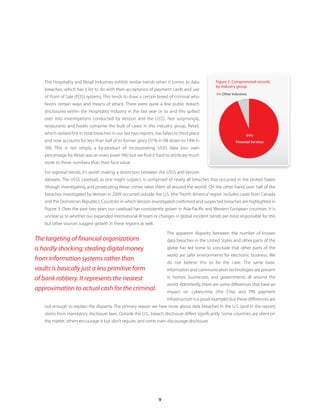
Figure 1 . Industry groups represented by percent of breaches
      33%               23%              15%                6%                5%               4%                4%                4%               3%                4%


   Financial        Hospitality         Retail       Manufacturing Tech Services            Business       Government            Media         Healthcare           Other
   Services                                                                                 Services


Data breaches continue to occur (in our caseload and elsewhere) within all types of organizations. These are categorized as
                                                                                                                                    9
they have been in previous reports according to the industry groups represented in Figure 1 . Financial Services, Hospitality,
and Retail still comprise the “Big Three” of industries affected (33%, 23%, and 15% respectively) in the merged Verizon-USSS
dataset, though Tech Services edged out Retail in Verizon’s caseload. That this is consistently true of both the Verizon and
USSS caseloads does seem to carry some significance.

The targeting of financial organizations is hardly shocking; stealing digital money from information systems rather than
vaults is basically just a less primitive form of bank robbery. It represents the nearest approximation to actual cash for the
criminal. Also, and perhaps more importantly, financial firms hold large volumes of sensitive consumer data for long periods
of time. For this reason (and others), they fall under more stringent regulation and reporting requirements. This, in turn,
increases the likelihood that breaches will require criminal and/or forensic investigation. In short, where other industries
might be able to “sweep it under the rug,” financial institutions are finding it increasingly difficult to do so. Regardless of the
root cause(s), a growing percentage of cases and an astounding 94% of all compromised records in 2009 were attributed to
Financial Services.


9 There are some changes in the way we categorize industries in this report. Most notably, “Food and Beverage” has been folded into the “Hospitality” group as this seems to be
  standard convention. A complete list of industries can be found in the VERIS framework.


                                                                                       8
The Hospitality and Retail industries exhibit similar trends when it comes to data            Figure 2 . Compromised records
                                                                                                 by industry group
   breaches, which has a lot to do with their acceptance of payment cards and use
                                                                                                 6% Other Industries
   of Point of Sale (POS) systems. This tends to draw a certain breed of criminal who
   favors certain ways and means of attack. There were quite a few public breach
   disclosures within the Hospitality industry in the last year or so and this spilled
   over into investigations conducted by Verizon and the USSS. Not surprisingly,
   restaurants and hotels comprise the bulk of cases in this industry group. Retail,
   which ranked first in total breaches in our last two reports, has fallen to third place                         94%
   and now accounts for less than half of its former glory (31% in ‘08 down to 14% in                        Financial Services
   ‘09). This is not simply a by-product of incorporating USSS data (our own
   percentage for Retail was an even lower 9%) but we find it hard to attribute much
   more to these numbers than their face value.

   For regional trends, it’s worth making a distinction between the USSS and Verizon
   datasets. The USSS caseload, as one might suspect, is comprised of nearly all breaches that occurred in the United States
   (though investigating and prosecuting these crimes takes them all around the world). On the other hand, over half of the
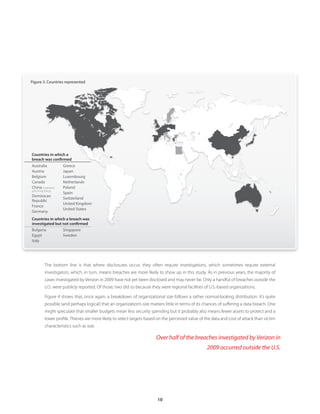
   breaches investigated by Verizon in 2009 occurred outside the U.S. (the “North America” region includes cases from Canada
   and the Dominican Republic). Countries in which Verizon investigated confirmed and suspected breaches are highlighted in
   Figure 3. Over the past two years our caseload has consistently grown in Asia-Pacific and Western European countries. It is
   unclear as to whether our expanded international IR team or changes in global incident trends are most responsible for this
   but other sources suggest growth in these regions as well.

                                                                       The apparent disparity between the number of known
The targeting of financial organizations                               data breaches in the United States and other parts of the
is hardly shocking; stealing digital money                             globe has led some to conclude that other parts of the
                                                                       world are safer environments for electronic business. We
from information systems rather than
                                                                       do not believe this to be the case. The same basic
vaults is basically just a less primitive form                         information and communication technologies are present
of bank robbery. It represents the nearest                             in homes, businesses, and governments all around the
                                                                       world. Admittedly, there are some differences that have an
approximation to actual cash for the criminal.                         impact on cybercrime (the Chip and PIN payment
                                                                       infrastructure is a good example) but these differences are
   not enough to explain the disparity. The primary reason we hear more about data breaches in the U.S. (and in the report)
   stems from mandatory disclosure laws. Outside the U.S., breach disclosure differs significantly. Some countries are silent on
   the matter, others encourage it but don’t require, and some even discourage disclosure.


                                                                   9
Figure 3 . Countries represented


Countries in which a
breach was confirmed
Australia          Greece
Austria            Japan
Belgium            Luxembourg
Canada             Netherlands
China (mainland    Poland
and Hong Kong)
                   Spain
Dominican
                   Switzerland
Republic
                   United Kingdom
France
                   United States
Germany
Countries in which a breach was
investigated but not confirmed
Bulgaria         Singapore
Egypt            Sweden
Italy


         The bottom line is that where disclosures occur, they often require investigations, which sometimes require external
         investigators, which, in turn, means breaches are more likely to show up in this study. As in previous years, the majority of
         cases investigated by Verizon in 2009 have not yet been disclosed and may never be. Only a handful of breaches outside the
         U.S. were publicly reported. Of those, two did so because they were regional facilities of U.S.-based organizations.

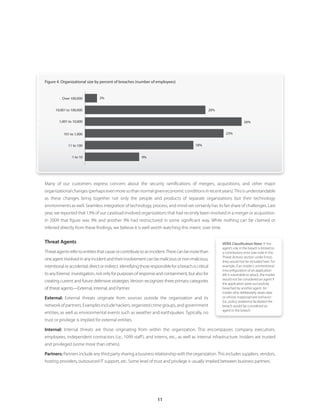
         Figure 4 shows that, once again, a breakdown of organizational size follows a rather normal-looking distribution. It’s quite
         possible (and perhaps logical) that an organization’s size matters little in terms of its chances of suffering a data breach. One
         might speculate that smaller budgets mean less security spending but it probably also means fewer assets to protect and a
         lower profile. Thieves are more likely to select targets based on the perceived value of the data and cost of attack than victim
         characteristics such as size.

                                                                       Over half of the breaches investigated by Verizon in
                                                                                                   2009 occurred outside the U.S.


                                                                        10
Figure 4 . Organizational size by percent of breaches (number of employees)


          Over 100,000           2%


      10,001 to 100,000                                                                             20%


        1,001 to 10,000                                                                             20%                   26%


           101 to 1,000                                                                                     23%


              11 to 100                                                                      18%


                1 to 10                                    9%


Many of our customers express concern about the security ramifications of mergers, acquisitions, and other major
organizational changes (perhaps even more so than normal given economic conditions in recent years). This is understandable
as these changes bring together not only the people and products of separate organizations but their technology
environments as well. Seamless integration of technology, process, and mind-set certainly has its fair share of challenges. Last
year, we reported that 13% of our caseload involved organizations that had recently been involved in a merger or acquisition.
In 2009 that figure was 9% and another 9% had restructured in some significant way. While nothing can be claimed or
inferred directly from these findings, we believe it is well worth watching this metric over time.


Threat Agents                                                                                             VERIS Classification Note: If the
                                                                                                          agent’s role in the breach is limited to
Threat agents refer to entities that cause or contribute to an incident. There can be more than           a contributory error (see note in the
                                                                                                          Threat Actions section under Error),
one agent involved in any incident and their involvement can be malicious or non-malicious,               they would not be included here. For
intentional or accidental, direct or indirect. Identifying those responsible for a breach is critical     example, if an insider’s unintentional
                                                                                                          misconfiguration of an application
to any forensic investigation, not only for purposes of response and containment, but also for            left it vulnerable to attack, the insider
                                                                                                          would not be considered an agent if
creating current and future defensive strategies. Verizon recognizes three primary categories
                                                                                                          the application were successfully
of threat agents—External, Internal, and Partner.                                                         breached by another agent. An
                                                                                                          insider who deliberately steals data
External: External threats originate from sources outside the organization and its                        or whose inappropriate behavior
                                                                                                          (i.e., policy violations) facilitated the
network of partners. Examples include hackers, organized crime groups, and government                     breach would be considered an
                                                                                                          agent in the breach.
entities, as well as environmental events such as weather and earthquakes. Typically, no
trust or privilege is implied for external entities.

Internal: Internal threats are those originating from within the organization. This encompasses company executives,
employees, independent contractors (i.e., 1099 staff ), and interns, etc., as well as internal infrastructure. Insiders are trusted
and privileged (some more than others).

Partners: Partners include any third party sharing a business relationship with the organization. This includes suppliers, vendors,
hosting providers, outsourced IT support, etc. Some level of trust and privilege is usually implied between business partners.


                                                                     11
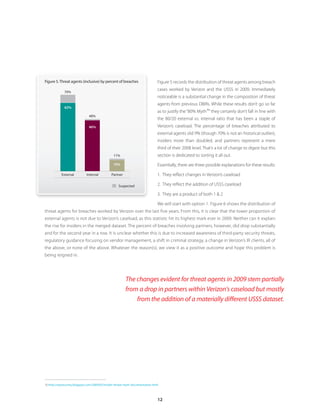
Figure 5 . Threat agents (inclusive) by percent of breaches                        Figure 5 records the distribution of threat agents among breach

              70%
                                                                                   cases worked by Verizon and the USSS in 2009. Immediately
                                                                                   noticeable is a substantial change in the composition of threat
                                                                                   agents from previous DBIRs. While these results don’t go so far
              62%                                                                                             10
                                                                                   as to justify the “80% Myth ” they certainly don’t fall in line with
                                48%
                                                                                   the 80/20 external vs. internal ratio that has been a staple of
                                46%                                                Verizon’s caseload. The percentage of breaches attributed to
                                                                                   external agents slid 9% (though 70% is not an historical outlier),
                                                                                   insiders more than doubled, and partners represent a mere
                                                                                   third of their 2008 level. That’s a lot of change to digest but this
                                                  11%                              section is dedicated to sorting it all out.
                                                  10%                              Essentially, there are three possible explanations for these results:

            External          Internal           Partner                           1. They reflect changes in Verizon’s caseload

                                                      Suspected                    2. They reflect the addition of USSS caseload

                                                                                   3. They are a product of both 1 & 2

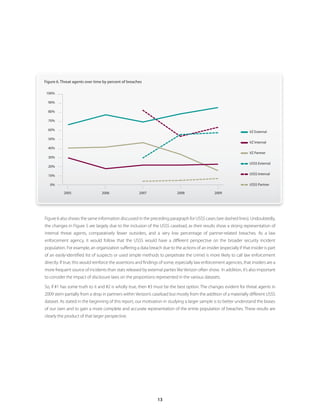
                                                                                   We will start with option 1. Figure 6 shows the distribution of
threat agents for breaches worked by Verizon over the last five years. From this, it is clear that the lower proportion of
external agents is not due to Verizon’s caseload, as this statistic hit its highest mark ever in 2009. Neither can it explain
the rise for insiders in the merged dataset. The percent of breaches involving partners, however, did drop substantially
and for the second year in a row. It is unclear whether this is due to increased awareness of third-party security threats,
regulatory guidance focusing on vendor management, a shift in criminal strategy, a change in Verizon’s IR clients, all of
the above, or none of the above. Whatever the reason(s), we view it as a positive outcome and hope this problem is
being reigned in.


                                                           The changes evident for threat agents in 2009 stem partially
                                                           from a drop in partners within Verizon’s caseload but mostly
                                                               from the addition of a materially different USSS dataset.


10 http://taosecurity .blogspot .com/2009/05/insider-threat-myth-documentation .html


                                                                                   12
Figure 6 . Threat agents over time by percent of breaches

 100%

  90%

  80%

  70%

  60%
                                                                                                                      VZ External
  50%
                                                                                                                      VZ Internal
  40%
                                                                                                                      VZ Partner
  30%
                                                                                                                      USSS External
  20%

  10%                                                                                                                 USSS Internal

   0%                                                                                                                 USSS Partner

           2005                  2006                  2007                 2008                 2009


Figure 6 also shows the same information discussed in the preceding paragraph for USSS cases (see dashed lines). Undoubtedly,
the changes in Figure 5 are largely due to the inclusion of the USSS caseload, as their results show a strong representation of
internal threat agents, comparatively fewer outsiders, and a very low percentage of partner-related breaches. As a law
enforcement agency, it would follow that the USSS would have a different perspective on the broader security incident
population. For example, an organization suffering a data breach due to the actions of an insider (especially if that insider is part
of an easily-identified list of suspects or used simple methods to perpetrate the crime) is more likely to call law enforcement
directly. If true, this would reinforce the assertions and findings of some, especially law enforcement agencies, that insiders are a
more frequent source of incidents than stats released by external parties like Verizon often show. In addition, it’s also important
to consider the impact of disclosure laws on the proportions represented in the various datasets.

So, if #1 has some truth to it and #2 is wholly true, then #3 must be the best option. The changes evident for threat agents in
2009 stem partially from a drop in partners within Verizon’s caseload but mostly from the addition of a materially different USSS
dataset. As stated in the beginning of this report, our motivation in studying a larger sample is to better understand the biases
of our own and to gain a more complete and accurate representation of the entire population of breaches. These results are
clearly the product of that larger perspective.


                                                                 13
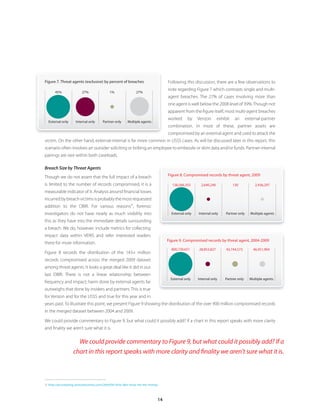
Figure 7 . Threat agents (exclusive) by percent of breaches                           Following this discussion, there are a few observations to
                                                                                      note regarding Figure 7 which contrasts single and multi-
       45%                27%                 1%                  27%
                                                                                      agent breaches. The 27% of cases involving more than
                                                                                      one agent is well below the 2008 level of 39%. Though not
                                                                                      apparent from the figure itself, most multi-agent breaches
                                                                                      worked       by   Verizon       exhibit    an       external-partner
  External only       Internal only      Partner only      Multiple agents
                                                                                      combination. In most of these, partner assets are
                                                                                      compromised by an external agent and used to attack the
victim. On the other hand, external-internal is far more common in USSS cases. As will be discussed later in this report, this
scenario often involves an outsider soliciting or bribing an employee to embezzle or skim data and/or funds. Partner-internal
pairings are rare within both caseloads.

Breach Size by Threat Agents
Though we do not assert that the full impact of a breach                              Figure 8 . Compromised records by threat agent, 2009

is limited to the number of records compromised, it is a                                 138,566,355      2,640,240             130            2,436,297
measurable indicator of it. Analysis around financial losses
incurred by breach victims is probably the most requested
                                         11
addition to the DBIR. For various reasons , forensic
investigators do not have nearly as much visibility into                                External only   Internal only      Partner only     Multiple agents

this as they have into the immediate details surrounding
a breach. We do, however, include metrics for collecting
impact data within VERIS and refer interested readers
                                                                                      Figure 9 . Compromised records by threat agent, 2004-2009
there for more information.
                                                                                        800,720,651     28,853,827         43,744,573         46,451,904
Figure 8 records the distribution of the 143+ million
records compromised across the merged 2009 dataset
among threat agents. It looks a great deal like it did in our
last DBIR. There is not a linear relationship between
                                                                                        External only   Internal only     Partner only      Multiple agents
frequency and impact; harm done by external agents far
outweighs that done by insiders and partners. This is true
for Verizon and for the USSS and true for this year and in
years past. To illustrate this point, we present Figure 9 showing the distribution of the over 900 million compromised records
in the merged dataset between 2004 and 2009.

We could provide commentary to Figure 9, but what could it possibly add? If a chart in this report speaks with more clarity
and finality we aren’t sure what it is.


                      We could provide commentary to Figure 9, but what could it possibly add? If a
                    chart in this report speaks with more clarity and finality we aren’t sure what it is.


11 http://securityblog .verizonbusiness .com/2009/04/16/to-dbir-show-me-the-money/


                                                                                 14
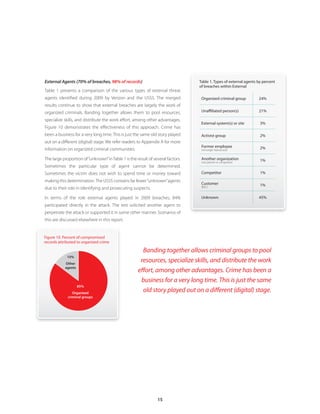
External Agents (70% of breaches, 98% of records)                                Table 1 . Types of external agents by percent
                                                                                 of breaches within External
Table 1 presents a comparison of the various types of external threat
agents identified during 2009 by Verizon and the USSS. The merged                 Organized criminal group          24%
results continue to show that external breaches are largely the work of
organized criminals. Banding together allows them to pool resources,              Unaffiliated person(s)            21%

specialize skills, and distribute the work effort, among other advantages.
                                                                                  External system(s) or site         3%
Figure 10 demonstrates the effectiveness of this approach. Crime has
been a business for a very long time. This is just the same old story played      Activist group                     2%
out on a different (digital) stage. We refer readers to Appendix A for more
                                                                                  Former employee                    2%
information on organized criminal communities.                                    (no longer had access)


The large proportion of “unknown” in Table 1 is the result of several factors.    Another organization               1%
                                                                                  (not partner or competitor)
Sometimes the particular type of agent cannot be determined.
Sometimes the victim does not wish to spend time or money toward                  Competitor                         1%
making this determination. The USSS contains far fewer “unknown” agents
                                                                                  Customer                           1%
due to their role in identifying and prosecuting suspects.                        (B2C)


In terms of the role external agents played in 2009 breaches, 84%                 Unknown                           45%
participated directly in the attack. The rest solicited another agent to
perpetrate the attack or supported it in some other manner. Scenarios of
this are discussed elsewhere in this report.


Figure 10 . Percent of compromised
records attributed to organized crime

                                                       Banding together allows criminal groups to pool
             15%
           Other
                                                      resources, specialize skills, and distribute the work
           agents
                                                     effort, among other advantages. Crime has been a
                                                      business for a very long time. This is just the same
                    85%
                Organized
                                                       old story played out on a different (digital) stage.
             criminal groups


                                                                15
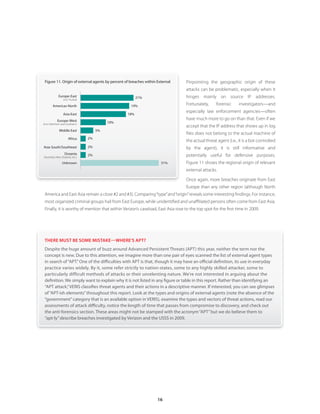
Figure 11 . Origin of external agents by percent of breaches within External     Pinpointing the geographic origin of these
                                                                                  attacks can be problematic, especially when it
             Europe-East                                 21%                      hinges mainly on source IP addresses.
                 (incl. Russia)

        Americas-North                               19%                          Fortunately,     forensic      investigators—and
                                                                                  especially law enforcement agencies—often
                 Asia-East                         18%
            Europe-West                                                           have much more to go on than that. Even if we
(incl. Northern and Southern)               10%
                                                                                  accept that the IP address that shows up in log
             Middle East               5%
                                                                                  files does not belong to the actual machine of
                      Africa      2%
                                                                                  the actual threat agent (i.e., it is a bot controlled
Asia-South/Southeast              2%                                              by the agent), it is still informative and
                  Oceania         2%                                              potentially useful for defensive purposes.
(Australia, New Zealand, etc.)

                Unknown                                                31%        Figure 11 shows the regional origin of relevant
                                                                                  external attacks.

                                                                                  Once again, more breaches originate from East
                                                                                  Europe than any other region (although North
 America and East Asia remain a close #2 and #3). Comparing “type” and “origin” reveals some interesting findings. For instance,
 most organized criminal groups hail from East Europe, while unidentified and unaffiliated persons often come from East Asia.
 Finally, it is worthy of mention that within Verizon’s caseload, East Asia rose to the top spot for the first time in 2009.


 THERE MUST BE SOME MISTAKE—WHERE’S APT?
 Despite the huge amount of buzz around Advanced Persistent Threats (APT) this year, neither the term nor the
 concept is new . Due to this attention, we imagine more than one pair of eyes scanned the list of external agent types
 in search of “APT .” One of the difficulties with APT is that, though it may have an official definition, its use in everyday
 practice varies widely . By it, some refer strictly to nation-states, some to any highly skilled attacker, some to
 particularly difficult methods of attacks or their unrelenting nature . We’re not interested in arguing about the
 definition . We simply want to explain why it is not listed in any figure or table in this report . Rather than identifying an
 “APT attack,” VERIS classifies threat agents and their actions in a descriptive manner . If interested, you can see glimpses
 of “APT-ish elements” throughout this report . Look at the types and origins of external agents (note the absence of the
 “government” category that is an available option in VERIS), examine the types and vectors of threat actions, read our
 assessments of attack difficulty, notice the length of time that passes from compromise to discovery, and check out
 the anti-forensics section . These areas might not be stamped with the acronym “APT” but we do believe them to
 “apt-ly” describe breaches investigated by Verizon and the USSS in 2009 .


                                                                     16
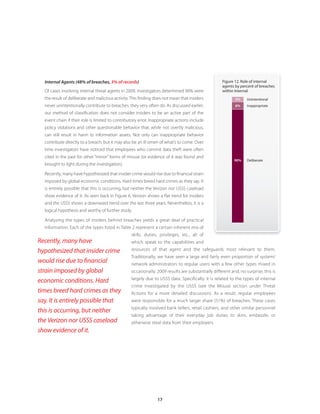
Internal Agents (48% of breaches, 3% of records)                                                  Figure 12 . Role of internal
                                                                                                    agents by percent of breaches
  Of cases involving internal threat agents in 2009, investigators determined 90% were              within Internal
  the result of deliberate and malicious activity. This finding does not mean that insiders                4%     Unintentional
  never unintentionally contribute to breaches; they very often do. As discussed earlier,                  6%     Inappropriate

  our method of classification does not consider insiders to be an active part of the
  event chain if their role is limited to contributory error. Inappropriate actions include
  policy violations and other questionable behavior that, while not overtly malicious,
  can still result in harm to information assets. Not only can inappropriate behavior
  contribute directly to a breach, but it may also be an ill omen of what’s to come. Over
  time investigators have noticed that employees who commit data theft were often
  cited in the past for other “minor” forms of misuse (or evidence of it was found and
                                                                                                           90%    Deliberate
  brought to light during the investigation).

  Recently, many have hypothesized that insider crime would rise due to financial strain
  imposed by global economic conditions. Hard times breed hard crimes as they say. It
  is entirely possible that this is occurring, but neither the Verizon nor USSS caseload
  show evidence of it. As seen back in Figure 6, Verizon shows a flat trend for insiders
  and the USSS shows a downward trend over the last three years. Nevertheless, it is a
  logical hypothesis and worthy of further study.

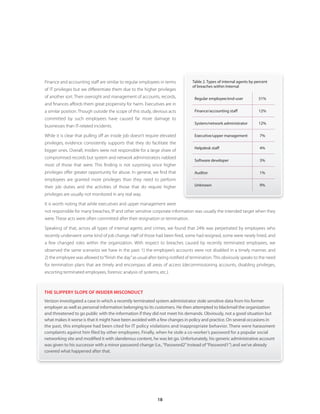
  Analyzing the types of insiders behind breaches yields a great deal of practical
  information. Each of the types listed in Table 2 represent a certain inherent mix of
                                                  skills, duties, privileges, etc., all of
Recently, many have                               which speak to the capabilities and
hypothesized that insider crime                   resources of that agent and the safeguards most relevant to them.
                                                  Traditionally, we have seen a large and fairly even proportion of system/
would rise due to financial                       network administrators to regular users with a few other types mixed in
strain imposed by global                          occasionally. 2009 results are substantially different and, no surprise, this is
                                                  largely due to USSS data. Specifically, it is related to the types of internal
economic conditions. Hard
                                                  crime investigated by the USSS (see the Misuse section under Threat
times breed hard crimes as they                   Actions for a more detailed discussion). As a result, regular employees
say. It is entirely possible that                 were responsible for a much larger share (51%) of breaches. These cases
                                                  typically involved bank tellers, retail cashiers, and other similar personnel
this is occurring, but neither
                                                  taking advantage of their everyday job duties to skim, embezzle, or
the Verizon nor USSS caseload                     otherwise steal data from their employers.
show evidence of it.


                                                                 17
Finance and accounting staff are similar to regular employees in terms           Table 2 . Types of internal agents by percent
                                                                                 of breaches within Internal
of IT privileges but we differentiate them due to the higher privileges
of another sort. Their oversight and management of accounts, records,             Regular employee/end-user             51%
and finances affords them great propensity for harm. Executives are in
a similar position. Though outside the scope of this study, devious acts          Finance/accounting staff              12%
committed by such employees have caused far more damage to
                                                                                  System/network administrator          12%
businesses than IT-related incidents.

While it is clear that pulling off an inside job doesn’t require elevated         Executive/upper management             7%
privileges, evidence consistently supports that they do facilitate the
                                                                                  Helpdesk staff                         4%
bigger ones. Overall, insiders were not responsible for a large share of
compromised records but system and network administrators nabbed
                                                                                  Software developer                     3%
most of those that were. This finding is not surprising since higher
privileges offer greater opportunity for abuse. In general, we find that          Auditor                                1%
employees are granted more privileges than they need to perform
their job duties and the activities of those that do require higher               Unknown                                9%

privileges are usually not monitored in any real way.

It is worth noting that while executives and upper management were
not responsible for many breaches, IP and other sensitive corporate information was usually the intended target when they
were. These acts were often committed after their resignation or termination.

Speaking of that, across all types of internal agents and crimes, we found that 24% was perpetrated by employees who
recently underwent some kind of job change. Half of those had been fired, some had resigned, some were newly hired, and
a few changed roles within the organization. With respect to breaches caused by recently terminated employees, we
observed the same scenarios we have in the past: 1) the employee’s accounts were not disabled in a timely manner, and
2) the employee was allowed to “finish the day” as usual after being notified of termination. This obviously speaks to the need
for termination plans that are timely and encompass all areas of access (decommissioning accounts, disabling privileges,
escorting terminated employees, forensic analysis of systems, etc.).


THE SLIPPERY SLOPE OF INSIDER MISCONDUCT
Verizon investigated a case in which a recently terminated system administrator stole sensitive data from his former
employer as well as personal information belonging to its customers . He then attempted to blackmail the organization
and threatened to go public with the information if they did not meet his demands . Obviously, not a good situation but
what makes it worse is that it might have been avoided with a few changes in policy and practice . On several occasions in
the past, this employee had been cited for IT policy violations and inappropriate behavior . There were harassment
complaints against him filed by other employees . Finally, when he stole a co-worker’s password for a popular social
networking site and modified it with slanderous content, he was let go . Unfortunately, his generic administrative account
was given to his successor with a minor password change (i .e ., “Password2” instead of “Password1”) and we’ve already
covered what happened after that .


                                                              18
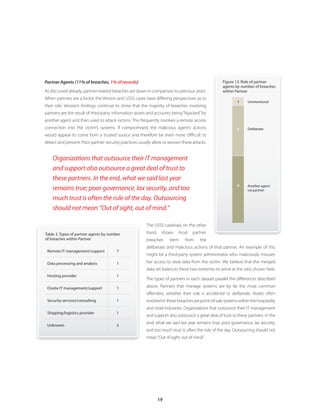
Partner Agents (11% of breaches, 1% of records)                                                     Figure 13 . Role of partner
                                                                                                    agents by number of breaches
As discussed already, partner-related breaches are down in comparison to previous years.            within Partner
When partners are a factor, the Verizon and USSS cases have differing perspectives as to
                                                                                                            1     Unintentional
their role. Verizon’s findings continue to show that the majority of breaches involving
partners are the result of third-party information assets and accounts being “hijacked” by
another agent and then used to attack victims. This frequently involves a remote access
connection into the victim’s systems. If compromised, the malicious agent’s actions                         6     Deliberate
would appear to come from a trusted source and therefore be even more difficult to
detect and prevent. Poor partner security practices usually allow or worsen these attacks.


    Organizations that outsource their IT management
    and support also outsource a great deal of trust to
    these partners. In the end, what we said last year
                                                                                                            8
    remains true; poor governance, lax security, and too                                                          Another agent
                                                                                                                  via partner

    much trust is often the rule of the day. Outsourcing
    should not mean “Out of sight, out of mind.”

                                                        The USSS caseload, on the other
Table 3 . Types of partner agents by number             hand,    shows    most    partner
of breaches within Partner                              breaches     stem     from     the
                                                        deliberate and malicious actions of that partner. An example of this
 Remote IT management/support           7
                                                        might be a third-party system administrator who maliciously misuses
 Data processing and analysis           1               her access to steal data from the victim. We believe that the merged
                                                        data set balances these two extremes to arrive at the ratio shown here.
 Hosting provider                       1
                                                        The types of partners in each dataset parallel the differences described
 Onsite IT management/support           1               above. Partners that manage systems are by far the most common
                                                        offenders, whether their role is accidental or deliberate. Assets often
 Security services/consulting           1               involved in these breaches are point-of-sale systems within the hospitality
                                                        and retail industries. Organizations that outsource their IT management
 Shipping/logistics provider            1
                                                        and support also outsource a great deal of trust to these partners. In the
                                                        end, what we said last year remains true; poor governance, lax security,
 Unknown                                3
                                                        and too much trust is often the rule of the day. Outsourcing should not
                                                        mean “Out of sight, out of mind.”


                                                                19
Threat Actions
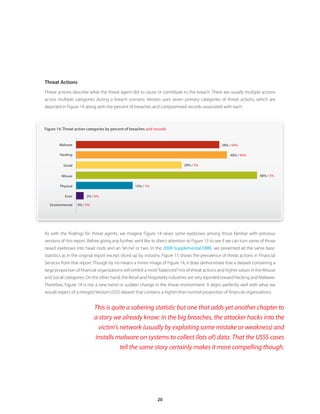
Threat actions describe what the threat agent did to cause or contribute to the breach. There are usually multiple actions
across multiple categories during a breach scenario. Verizon uses seven primary categories of threat actions, which are
depicted in Figure 14 along with the percent of breaches and compromised records associated with each.


Figure 14 . Threat action categories by percent of breaches and records


        Malware                                                                                    38% / 94%

        Hacking                                                                                        40% / 96%

           Social                                                            28% / 3%

          Misuse                                                                                                        48% / 3%

         Physical                                   15% / 1%

            Error        2% / 0%

   Environmental    0% / 0%


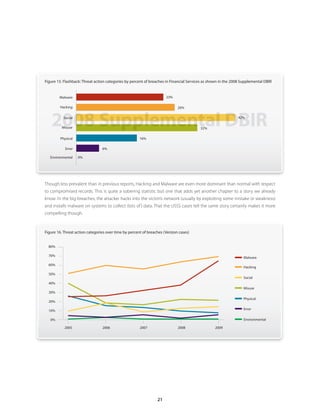
As with the findings for threat agents, we imagine Figure 14 raises some eyebrows among those familiar with previous
versions of this report. Before going any further, we’d like to direct attention to Figure 15 to see if we can turn some of those
raised eyebrows into head nods and an “ah-ha” or two. In the 2008 Supplemental DBIR, we presented all the same basic
statistics as in the original report except sliced up by industry. Figure 15 shows the prevalence of threat actions in Financial
Services from that report. Though by no means a mirror image of Figure 14, it does demonstrate that a dataset containing a
large proportion of financial organizations will exhibit a more “balanced” mix of threat actions and higher values in the Misuse
and Social categories. On the other hand, the Retail and Hospitality industries are very lopsided toward Hacking and Malware.
Therefore, Figure 14 is not a new trend or sudden change in the threat environment. It aligns perfectly well with what we
would expect of a merged Verizon-USSS dataset that contains a higher-than-normal proportion of financial organizations.


                              This is quite a sobering statistic but one that adds yet another chapter to
                              a story we already know: In the big breaches, the attacker hacks into the
                                victim’s network (usually by exploiting some mistake or weakness) and
                              installs malware on systems to collect (lots of) data. That the USSS cases
                                         tell the same story certainly makes it more compelling though.


                                                                 20
Figure 15 . Flashback: Threat action categories by percent of breaches in Financial Services as shown in the 2008 Supplemental DBIR


        Malware                                                        23%

         Hacking                                                              26%


    2008 Supplemental DBIR
           Social

          Misuse                                                                         32%
                                                                                                               42%


         Physical                                      16%

            Error                6%

   Environmental    0%


Though less prevalent than in previous reports, Hacking and Malware are even more dominant than normal with respect
to compromised records. This is quite a sobering statistic but one that adds yet another chapter to a story we already
know: In the big breaches, the attacker hacks into the victim’s network (usually by exploiting some mistake or weakness)
and installs malware on systems to collect (lots of ) data. That the USSS cases tell the same story certainly makes it more
compelling though.


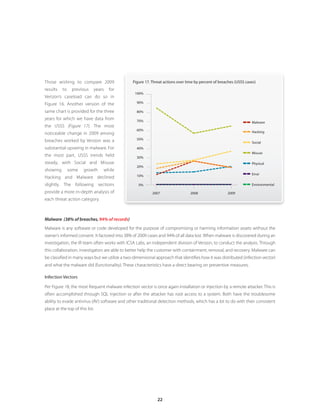
Figure 16 . Threat action categories over time by percent of breaches (Verizon cases)


  80%

  70%
                                                                                                                  Malware
  60%
                                                                                                                  Hacking
  50%
                                                                                                                  Social
  40%
                                                                                                                  Misuse
  30%
                                                                                                                  Physical
  20%

  10%                                                                                                             Error

   0%                                                                                                             Environmental

           2005                   2006                  2007                  2008                2009


                                                                  21
Those wishing to compare 2009                   Figure 17 . Threat actions over time by percent of breaches (USSS cases)
results   to    previous     years   for
                                                 100%
Verizon’s caseload can do so in
Figure 16. Another version of the                 90%

same chart is provided for the three              80%
years for which we have data from                 70%                                                                Malware
the USSS (Figure 17). The most
                                                  60%
noticeable change in 2009 among                                                                                      Hacking

breaches worked by Verizon was a                  50%
                                                                                                                     Social
substantial upswing in malware. For               40%
                                                                                                                     Misuse
the most part, USSS trends held                   30%
steady, with Social and Misuse                                                                                       Physical
                                                  20%
showing        some    growth    while
                                                  10%                                                                Error
Hacking and Malware declined
slightly. The following sections                   0%                                                                Environmental

provide a more in-depth analysis of                        2007                  2008                  2009
each threat action category.


Malware (38% of breaches, 94% of records)
Malware is any software or code developed for the purpose of compromising or harming information assets without the
owner’s informed consent. It factored into 38% of 2009 cases and 94% of all data lost. When malware is discovered during an
investigation, the IR team often works with ICSA Labs, an independent division of Verizon, to conduct the analysis. Through
this collaboration, investigators are able to better help the customer with containment, removal, and recovery. Malware can
be classified in many ways but we utilize a two-dimensional approach that identifies how it was distributed (infection vector)
and what the malware did (functionality). These characteristics have a direct bearing on preventive measures.

Infection Vectors

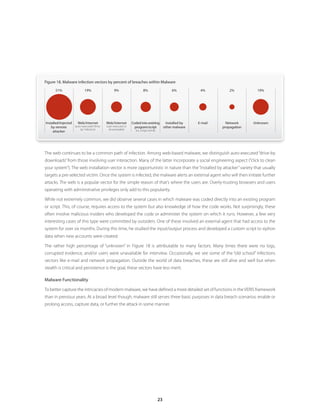
Per Figure 18, the most frequent malware infection vector is once again installation or injection by a remote attacker. This is
often accomplished through SQL injection or after the attacker has root access to a system. Both have the troublesome
ability to evade antivirus (AV) software and other traditional detection methods, which has a lot to do with their consistent
place at the top of this list.


                                                              22
Figure 18 . Malware infection vectors by percent of breaches within Malware
      51%                    19%                    9%                     8%                   6%     4%          2%         19%


Installed/Injected     Web/Internet           Web/Internet        Coded into existing  Installed by   E-mail     Network     Unknown
    by remote        (auto-executed/”drive-   (user-executed or     program/script    other malware            propagation
                          by” infection)        downloaded)         (i.e., a logic bomb)
     attacker


The web continues to be a common path of infection. Among web-based malware, we distinguish auto-executed “drive-by
downloads” from those involving user interaction. Many of the latter incorporate a social engineering aspect (“click to clean
your system”). The web installation vector is more opportunistic in nature than the “installed by attacker” variety that usually
targets a pre-selected victim. Once the system is infected, the malware alerts an external agent who will then initiate further
attacks. The web is a popular vector for the simple reason of that’s where the users are. Overly-trusting browsers and users
operating with administrative privileges only add to this popularity.

While not extremely common, we did observe several cases in which malware was coded directly into an existing program
or script. This, of course, requires access to the system but also knowledge of how the code works. Not surprisingly, these
often involve malicious insiders who developed the code or administer the system on which it runs. However, a few very
interesting cases of this type were committed by outsiders. One of these involved an external agent that had access to the
system for over six months. During this time, he studied the input/output process and developed a custom script to siphon
data when new accounts were created.

The rather high percentage of “unknown” in Figure 18 is attributable to many factors. Many times there were no logs,
corrupted evidence, and/or users were unavailable for interview. Occasionally, we see some of the “old school” infections
vectors like e-mail and network propagation. Outside the world of data breaches, these are still alive and well but when
stealth is critical and persistence is the goal, these vectors have less merit.

Malware Functionality

To better capture the intricacies of modern malware, we have defined a more detailed set of functions in the VERIS framework
than in previous years. At a broad level though, malware still serves three basic purposes in data breach scenarios: enable or
prolong access, capture data, or further the attack in some manner.


                                                                                           23
Figure 19 . Malware functionality by percent of breaches within Malware and percent of records


                                      Backdoor
                    (allows remote access/control)                                                            36% / 85%

                       Keylogger / Spyware                                                                    36% / 1%
                   (capture data from user activity)

          Send data to external site/entity                                                           32% / 81%

     Download/Install additional malware                                             15% / <1%

                  Initiate client-side attack                                        15% / 2%
                                     (i.e., XSS, MitB)

          Capture data resident on system                                        13% / 84%
                                   (i.e., cache, disk)

                                  RAM scraper
              (captures data from volatile memory)                               13% / <1%

                       Command & Control                                   11% / <1%
              (listens for and executes commands)

Destroy or corrupt data resident on system                                 11% / <1%

                     Capture data from an
                                                                       9% / 2%
               application/system process
                  System/network utilities                             9% / 83%
                                   (PsTools, Netcat)


          Redirect to another site/address                          8% / <1%

                                 Packet sniffer                 6% / 80%
                      (capture data from network)


           Brute force or dictionary attack                 4% / <1%

                 Infect other systems via
            network propagation (nw worm)                   4% / <1%

  Encrypt or seize data resident on system               2% / <1%

                                        Uknown                         9% / 1%


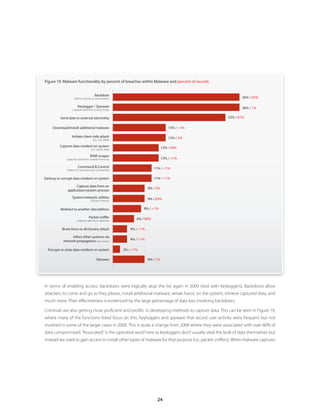
In terms of enabling access, backdoors were logically atop the list again in 2009 (tied with keyloggers). Backdoors allow
attackers to come and go as they please, install additional malware, wreak havoc on the system, retrieve captured data, and
much more. Their effectiveness is evidenced by the large percentage of data loss involving backdoors.

Criminals are also getting more proficient and prolific in developing methods to capture data. This can be seen in Figure 19,
where many of the functions listed focus on this. Keyloggers and spyware that record user activity were frequent but not
involved in some of the larger cases in 2009. This is quite a change from 2008 where they were associated with over 80% of
data compromised. “Associated” is the operative word here as keyloggers don’t usually steal the bulk of data themselves but
instead are used to gain access to install other types of malware for that purpose (i.e., packet sniffers). When malware captures


                                                                             24
data on the system (13% of cases), it often does so from forms that cache credentials and other sensitive info. Though only
used in some of the smaller cases in 2009, the use of “RAM scrapers” to capture data from a system’s volatile memory,
continues to increase (13%). We refer the reader to our 2009 Supplemental DBIR for more information on this type of
malware. Packet sniffers, while not as common as other varieties of malware, continue to compromise large numbers of
records and are usually a factor in the bigger breaches. Malware that “Captures data from an application/system process” (9%)
is often associated with the “Coded into existing program/script” infection vector discussed above.

The last major grouping of malware encompasses functions that facilitate the attack in some manner. As is evident, malware
often sends data to an external entity (32%). This is sometimes stolen data (like credentials) but is also used to let an attacker
know that a system is compromised. We also observed several cases in which malware was used to perform client-side
attacks such as man-in-the-browser and cross-site scripting. When malware downloads additional code (15%), it is often in
the form of updates or capability extensions. Attackers seem to have an affinity for system and network utilities like PsTools
and Netcat. Though these tools are not inherently malicious, criminals are deploying and using them in that way. To clarify, if
utilities were added to the system by an attacker, they are listed here under malware. If they were already on the system and
were abused as a part of the attack, this would show up under Hacking (i.e., via OS Commanding). It is very interesting to note
that there were no confirmed cases in which malware exploited a system or software vulnerability in 2009 (though it was
suspected based on partial samples that three may have done so).

In terms of malware furthering the attack, our investigations continue to highlight the importance of detecting and responding
to malware quickly. In some incidents, the affected company missed an opportunity to lessen the aftermath of infection by
ignoring or not adequately investigating initial antivirus alerts. Regrettably, those alerts sound less often these days.


HOW DO THEY GET MY DATA OUT?
When malware captures sensitive information, it must then be exfiltrated from (or taken out of) the victim’s environment .
There are two basic ways this happens: either the malware sends it out of the organization or the attacker re-enters the
network to retrieve it . The general rule of thumb is that smaller packets are sent out (i .e ., credentials captured by
keyloggers) while larger hauls of data are retrieved (i .e ., data collected by a packet sniffer) . While any amount of data
leaving the owner’s possession is never a good thing, the act does (or at least can) provide evidence of foul play . It’s a
matter of looking for the right indicators in the right places . We advocate paying attention to what goes out of your
network and what changes take place within your systems . Don’t have any customers or partners in Eastern Europe yet
periodic bursts of traffic are sent there from your networks? What about those ZIP or RAR files that showed up last week
and have been growing steadily ever since? Maybe there’s a perfectly good explanation for these things…but you’ll
never know unless you take steps to identify and verify them .


                                                                 25
Figure 20 . Malware customization over time                                                 Level of malware customization by
by percent of breaches within Malware*                                                      percent of breaches within Malware*
 60%                                                        59%


 50%                                                                        54%
                                                                                                      46%   No customization

 40%


 30%       28%                                                                                        6%    Repacked

                                                                                                      20%   Code modification
 20%                                          24%
                           21%


 10%
                                                                                                      29%   Custom-created

  0%
          2005             2006               2007          2008            2009
                                                                                                               * Verizon caseload only


Malware Customization

We are not so happy to say that the increase in customized malware we reported last year appears not to be a fluke limited
to 2008. 2009 revealed a similar proportion of breaches (54% of those involving malware) and an incredible 97% of the 140+
million records were compromised through customized malware across the Verizon-USSS caseload.

The level of customization apparent in malware varies substantially. Some are simply repackaged versions of existing malware
in order to avoid AV detection. From Figure 20, it is evident that many attackers do not stop there. More often than not in
2009, they altered the code of existing malware or created something entirely new. As an example of modified code, we
observed several instances of RAM scrapers that were
“last year’s models” with a few tweaks like the added               An incredible 97% of the 140+ million records
ability to hide and/or encrypt the output file of
captured data. Over the last two years, custom-created
                                                                         were compromised through customized
code was more prevalent and far more damaging than                   malware across the Verizon-USSS caseload.
lesser forms of customization.

As a defender, it’s hard not to get a little discouraged when examining data about malware. The attackers seem to be
improving in all areas: getting it on the system, making it do what they want, remaining undetected, continually adapting
and evolving, and scoring big for all the above. We are not, however, totally devoid of hope. A major improvement would be
to keep attackers from ever gaining access to the system before they are able to install malware. This, of course, is not without
its own challenges as will be discussed next.


                                                               26
Hacking (40% of breaches, 94% of records)                                                                                         VERIS Classification Note: There is an
                                                                                                                                  action category for Hacking and for
Actions in the Hacking category encompass all attempts to intentionally access or                                                 Misuse. Both can utilize similar vectors
                                                                                                                                  and achieve similar results; in Misuse,
harm information assets without (or in excess of ) authorization by thwarting logical                                             the agent was granted access (and used
                                                                                                                                  it inappropriately) whereas with Hacking
security mechanisms. Hacking affords the criminal many advantages over some of the                                                access was obtained illegitimately.
other categories; it can be accomplished remotely and anonymously, it doesn’t require
direct interaction or physical proximity, and there are many tools available to automate
and accelerate attacks. The latter lowers the learning curve and allows even less-skilled threat agents to cause a lot of trouble. In
this section, we examine the types of hacking observed by Verizon and the USSS in 2009, the paths through which these attacks
were conducted, and other details about this important category.

Types of Hacking

The attacks listed in Figure 21 will look a bit different to those familiar with previous DBIRs. The changes are due to our effort
to standardize on a classification system for hacking methods in connection with the public release of VERIS. Internally, we
had more freedom to simply describe what we observed in our caseload but in order for the USSS (and hopefully others) to
use VERIS a more formal approach was necessary. The resulting list (which is not shown here in its entirety) is not exhaustive,
                                                                                                                          as detailed as it could be, or perfect. It
                                                                                                                          is, however, useful for most attacks
Figure 21 . Types of hacking by percent of breaches within Hacking                                                        and provides enough specificity for
and percent of records
                                                                                                                          the intended purpose. It is derived
             Use of stolen login credentials                                                    38% / 86%                 from our own work and from open
                Exploitation of backdoor or                                                                               attack taxonomies from the Web
                command/control channel                                               29% / 5%
                                                                                                                          Application         Security    Consortium
                                   SQL Injection                                 25% / 89%
                                                                                                                          (WASC), the Open Web Application
         Brute force and dictionary attacks                          14% / <1%
                                                                                                                          Security Project (OWASP), and the
                             OS Commanding                           14% / 5%                                             Common Attack Pattern Enumeration
                   Exploitation of default or                    11% / <1%                                                and Classification (CAPEC) from
                      guessable credentials
           Footprinting and Fingerprinting
                                                                                                                          Mitre. Cross-referencing these is not
                                                                 11% / <!%
                                                                                                                          a quick, easy, or conflict-free process.
                           Cross-site Scripting                9% / 2%
                                                                                                                          The list of hacking types in VERIS uses
Exploitation of insufficient authentication                   7% / 2%
                              (i.e., no login required)                                                                   the WASC Threat Classification v2.0 as
 Exploitation of insufficient authorization                   7% / <1%
                                                                                                                                    12
                                                                                                                          a baseline and pulls from the others
              (weak or misconfigured access control)

                        Remote File Inclusion             2% / <1%                                                        to round out areas not addressed in
                DoS at the application layer                                                                              WASC (i.e., non-application attacks).
                       (consumes system resources)
                                                          2% / <1%
                                                                                                                          We refer users to the links above for
                  Man-in-the-Middle Attack                2% / <1%
                                                                                                                          definitions and examples.
                   Encryption Brute Forcing               2% / <1%

                                        Unknown             5% / <1%


12 Thanks to Jeremiah Grossman and Robert Auger from WASC for volunteering their time to serve as a sounding board on attack classification matters.


                                                                                     27
Evident from Figure 21, there are two standout types of hacking responsible for the majority of breaches and stolen
records in 2009—SQL injection and the use of stolen credentials. Both were among the top offenders in our previous
report but this year sees them at a whole new level.

The use of stolen credentials was the number one hacking type in both the Verizon and USSS datasets, which is pretty
amazing when you think about it. There are over 50 types recognized in the
VERIS framework—how can two completely different caseloads show the                  Though phishing, SQL injection,
same result? We have our theories. One of the main reasons behind this is                and other attacks can and
the proliferation of password-gathering malware like Zeus. In fact, though
phishing, SQL injection, and other attacks can and do steal credentials,
                                                                                       do steal credentials, malware
malware nabbed more than all others combined by a ratio of 2:1. There is               nabbed more than all others
much more discussion of this in the malware section. Stolen credentials                   combined by a ratio of 2:1.
offer an attacker many advantages, not the least of which is the ability to
disguise himself as a legitimate user. Authenticated activity is much less likely to trigger IDS alerts or be noticed by other
detection mechanisms. It also makes it easier to cover his tracks as he makes off with the victim’s data.

SQL injection is a technique for controlling the responses from the database server through the web application. At a very
high level, the attacker inserts another SQL statement into the application through the web server and gets the answer to
their query or the execution of other SQL statements. SQL injection is almost always an input validation failure. If the
application trusts user input and does not validate it at the server, it is likely to be vulnerable to SQL injection, cross-site
scripting, or one of the other input-validation vulnerabilities. In data breach scenarios, SQL Injection has three main uses:
1) query data from the database, 2) modify data within the database, and 3) deliver malware to the system. The versatility
and effectiveness of SQL Injection make it a multi-tool of choice among cybercriminals.


HAPPY 10TH BIRTHDAY SQL INJECTION!
Though first discussed publicly on Christmas Day in 1998, the first advisory on SQL injection was released in 1999 . So,
perhaps we should say “Happy (belated) 10th birthday” to one of the most widespread and harmful attack methods
we’ve investigated over the years . However, we’d like to alter the customary birthday jingle tagline and instead hope
that “not many more” will follow .
The secret to SQL injection’s longevity and success is due to a combination of many factors . It’s not a terribly difficult
technique, making it available to a large pool of miscreants . It exploits the inherently necessary functions of websites
and databases to accept and provide data . It can’t be fixed by simply applying a patch, tweaking a setting, or changing
a single page . SQL injection vulnerabilities are endemic, and to fix them you have to overhaul all your code . Needless
to say, this is difficult and sometimes nigh impossible if it is inherited code . There are some tools to help, but it still
comes down to coding and developer knowledge . Unfortunately, training gets cut when budgets get tight and
application testing is forfeited or compressed to make up time in overdue development projects . All in all, not an easy
concoction to swallow but just passing the cup isn’t working either . The data in this report testify to the fact that there
are many people on the Internet willing to do application testing for you if you don’t . Let’s pay the good guys instead
and make sure SQL injection doesn’t live through many more birthdays .


                                                              28
Exploitation of backdoors is another common method of network and system intrusion. In most cases a backdoor is
   created as a function of malware that was installed at an earlier stage of the attack. The agent then has control of or can
   access the system at will. It accomplishes the goals of concealment and persistence that cybercriminals crave. As in years
   past, we most often see backdoors utilized to exfiltrate data from compromised systems.

   OS Commanding involves running programs or commands via a web application or through the command prompt
   after gaining root on a system. Obviously not a capability one wants to grant to an adversary. It can also be used to
   manipulate systems utilities such as PsTools and Netcat that are legitimately on a system or that have been placed
   there by the attacker.

   What may be striking to many of our readers is the drop in “exploitation of default or guessable credentials” since our last
   report. This was the most common type in the Hacking category last year and responsible for over half of records breached.
   It was still fairly common in 2009 but associated with only a fraction of overall data loss (<1%). The drop seems to
   correspond with fewer cases in the Retail and Hospitality industries stemming from third party mismanagement of remote
   desktop connections to POS systems.

   Vulnerability Exploits

   In the past we have discussed a decreasing number of attacks that exploit software or system vulnerabilities versus
   those that exploit configuration weaknesses or functionality. That downward trend continued this year; so much so, in
                                                                                  13
   fact, that there wasn’t a single confirmed intrusion that exploited a patchable vulnerability. On the surface this is quite
   surprising—even shocking—but it begins to make sense when reviewing the types of hacking discussed above. SQL
                                                                    injection, stolen credentials, backdoors, and the like exploit problems that
There wasn’t a single confirmed                                     can’t readily be “patched.”
intrusion that exploited                                            Organizations exert a great deal of effort around the testing and
a patchable vulnerability.
                    13
                                                                    deployment of patches—and well they should. Vulnerability management
                                                                    is a critical aspect of any security program. However, based on evidence
   collected over the last six years, we have to wonder if we’re going about it in the most efficient and effective manner.
   Many organizations treat patching as if it were all they had to do to be secure. We’ve observed companies that were
   hell-bent on getting patch x deployed by week’s end but hadn’t even glanced at their log files in months. This kind of
   imbalance isn’t healthy. Therefore, we continue to maintain that patching strategies should focus on coverage and
   consistency rather than raw speed. The resources saved from doing that could then be put toward something more
   useful like code review and configuration management.


   13 The word “patchable” here is chosen carefully since we find that “vulnerability” does not have the same meaning for everyone within the security community. While
      programming errors and misconfigurations are vulnerabilities in the broader sense, lousy code can’t always be fixed through patching and the careless administration
      patch has yet to be released. Furthermore, many custom-developed or proprietary applications simply do not have routine patch creation or deployment schedules.


                                                                                         29
Attack Pathways

 After being edged out in 2008 as the most-used path of intrusion, web applications now reign supreme in both the number of
 breaches and the amount of data compromised through this vector. Both Verizon and USSS cases show the same trend. This falls
 perfectly in step with the findings pertaining to types of attacks discussed above. Web applications have the rather unfortunate
 calling to be public-facing, dynamic, user-friendly, and secure all at the same time. Needless to say, it’s a tough job.


 Figure 22 . Attack pathways by percent of breaches within Hacking and percent of records


                          Web application                                                                               54% / 92%


Remote access and control services/software                                                 34% / 2%

               Backdoor or control channel                                 23% / 5%


     Network file/resource sharing services     4% / 1%

              Physical access or connection   2% / <1%


                          Wireless network    2% / <1%


                                 Unknown            7% / <1%


 Remote access and control solutions also present challenges. On one side stands the organization’s internal assets and on the
 other side a perfectly benign and trusted entity. Well, as evidenced by these results, that last part is not always true and
 therein lies the rub. Because these solutions are so often picked on and because there are many different types of them, we
 gathered a bit more detail during 2009. This is what we found:

 y Third party remote desktop software (i.e., LogMeIn) – 13%

 y Native remote desktop services (i.e., VNC) – 9%

 y Remote access services (i.e., VPN) – 13%

 Backdoors were discussed briefly above and more fully in the Malware section. Since their entire existence is to allow
 malicious agents to traverse the perimeter unnoticed, it’s hardly surprising they are a common vector of intrusion. This marks
 the third year in a row that only a single incident occurred in which wireless networks were used to infiltrate organizational
 systems. It was completely open. The physical access or connection vector may seem odd in combination with hacking but
 there are instances in which this comes into play. For instance, one case involved connecting two systems and running a
 cracking utility against the SAM database on the target system.


                                                                  30
Social (28% of breaches, 3% of records)                                                          VERIS Classification Note: Those
                                                                                                 familiar with the 2008 and 2009 DBIRs
Social tactics employ deception, manipulation, intimidation, etc. to exploit the human           may recognize this as a new category.
                                                                                                 This category was previously referred
element, or users, of information assets. These actions are often used in conjunction            to as Deceit; we believe the change
                                                                                                 better reflects the broad nature of
with other categories of threat (i.e., malware designed to look like antivirus software)         human-targeted threats.
and can be conducted through technical and non-technical means. Within the past
year, social tactics played a role in a much larger percentage (28% vs. 12% in 2008) of
breaches, due mainly to the addition of the USSS cases.


Figure 23 . Types of social tactics by percent of breaches within Social


                         Solicitation / Bribery                                                                           31%

                                          Phishing
                              (or any type of *ishing)                                             23%

                                        Pretexting
                (invented scenario to deceive target)                                18%

                            Spoofing / Forgery                        10%
                             (fake website, docs, etc)


                                         Extortion              8%
                   (blackmail, threat of violence, etc)


                                     Hoax / Scam                8%

                                        Elicitation       3%
      (subtle extraction of info through conversation

                                              Spam        3%
                             (unsolicited messaging)


                                        Unknown                              15%


As seen in Figure 23, solicitation and bribery occurred more often than any of the other types of social tactics recognized by
the VERIS framework. This may seem odd, but the explanation is quite simple; these were scenarios in which someone
outside the organization conspired with an insider to engage in illegal behavior (usually embezzlement as seen in the next
section). According to the USSS, these are usually organized criminal groups conducting similar acts against numerous
organizations. They recruit, or even place, insiders in a position to embezzle or skim monetary assets and data, usually in
return for some cut of the score. The smaller end of these schemes often target cashiers at retail and hospitality establishments
while the upper end are more prone to involve bank employees and the like. Other common social tactics observed in 2009
were phishing and pretexting. These are classic attacks that have been discussed extensively in our previous reports.


                                                                     31
Figure 24 . Paths of social tactics by percent of breaches within Social
     26%              21%            13%            13%                5%             3%              3%             3%             23%


     E-mail         Phone         In-person     Web / Internet       Social         Instant       Peer-to-peer    Software       Unknown
                                                                 Networking site   messaging        network


Similar to last year’s report, e-mail is still the vector of choice for conducting social attacks. The criminals also apparently like
to maintain that personal touch by using the phone or even in-person contact with the victims to get the information they
need. Security concerns around social networking sites have been discussed quite frequently of late, but this vector did not
factor prominently into breach cases worked by Verizon or the USSS. However, the seemingly non-stop growth of these sites,
their extensive use from corporate assets, and the model they employ of inherently trusting everything your “friends” do may
be too attractive for criminals to ignore for long. We are interested to see if this vector plays a larger role in data breaches over
the next few years.

The targets of social tactics are overwhelmingly regular employees
and customers. As in years past, we continue to stress how important                       Table 4 . Targets of social tactics by percent of
                                                                                           breaches within Social
it is to train all employees about the various types of social attacks. A
security awareness campaign should, at the very least, train them to                           Regular employee/end-user            26%
recognize and avoid falling for the opportunistic varieties like phishing
and other scams. Employees in sensitive, trusted, or public-facing                             Customer (B2C)                       15%

positions should also be prepped for more targeted tactics and
                                                                                               Executive/upper management            5%
reminded of corporate policies that (hopefully) deter misconduct.
Including social tactics in mock incident or penetration tests can be a                        System/network administrator          5%
good measure of the effectiveness of awareness programs and overall
readiness of the organization to thwart these attacks.                                         Finance/accounting staff              3%

                                                                                               Helpdesk staff                        3%

                                                                                               Unknown                               3%
    According to the USSS, solicitation usually
    involves organized criminal groups conducting
    similar acts against numerous organizations. They recruit, or even place, insiders
    in a position to embezzle or skim monetary assets and data, usually in return for
    some cut of the score.


                                                                       32
Misuse (48% of breaches, 3% of records)                                                             VERIS Classification Note: There is an
                                                                                                    action category for Hacking and for
We define misuse as using organizational resources or privileges for any purpose or                 Misuse. Both can utilize similar vectors
                                                                                                    and achieve similar results; in Misuse,
in a manner contrary to that which was intended. These actions can be malicious or                  the agent was granted access (and
non-malicious in nature. The category is exclusive to parties that enjoy a degree of                used it inappropriately) whereas with
                                                                                                    Hacking, access was obtained
trust from the organization like insiders and partners. For the first time since we                 illegitimately. Additionally, the line
                                                                                                    between Misuse and Error can be a bit
began this study, Misuse was the most common of all threat actions (48%) in our                     blurry. In general, the categories divide
dataset. It was not, however, responsible for a large proportion of records breached                along the line of intent. Errors are
                                                                                                    wholly unintentional, whereas Misuse
(3%). It may seem strange that such a frequently occurring problem accounts for so                  involves willful actions typically done in
                                                                                                    ignorance of policy or for the sake of
small a number of records, but when one considers the circumstances that surround                   convenience, personal gain, or malice.
misuse it begins to make sense.

Embezzlement, skimming, and related fraud were seen more often than other forms of
misuse and were exclusive to cases worked by the USSS. These actions were typically perpetrated by employees entrusted with
the oversight or handling of financial transactions, accounts, record keeping, etc. Not surprisingly, this often occurred in financial
institutions, retail stores, and restaurants. In many cases the use of handheld skimmers and other devices were utilized to
facilitate the theft. This accounts for much of the “use of unapproved hardware/devices” depicted in Figure 25. While such activity
may not fit some people’s notions of cybercrime, cases included in this study did constitute a legitimate data breach. Payment
cards, personal information, bank account data, and other sensitive information were compromised and often sold to external
parties or used by the insider to commit fraud. It may not be the type of thing readers have come to associate with the DBIR but
that is precisely why the addition of the USSS data is so valuable; it lets us study cases we would otherwise never see.


Figure 25 . Types of misuse by percent of breaches within Misuse


Embezzlement, skimming, and related fraud                                                                                        49%

        Abuse of system access/privileges                                                                                 46%

     Use of unapproved hardware/devices                                                              36%
          Handling of data on unapproved
                            media/devices                                   21%

       Violation of web/Internet use policy                7%

Handling of data in an unapproved format                  6%

           Violation of email/IM use policy               6%

              Abuse of private knowledge             4%

   Handling of data in an unapproved area            4%

  Storage/transfer of unapproved content             4%

     Use of unapproved software/services            3%

   Unapproved changes and workarounds          1%

     Violation of asset/data disposal policy   1%

                                 Unknown       1%


                                                                   33
The prevalence of embezzlement and skimming is one of the major reasons why the total amount of data compromised
through misuse is so comparatively low. An employee engaging in this type of fraud has a completely different M.O. than an
uberhacker systematically draining data from a large payment card processor. The employee has a vested interest in keeping
their job, remaining undetected, and avoiding prosecution. Siphoning small amounts of data or monetary assets over a
longer period of time is more suited to this than a “grab as much as you can and run” approach. Embezzlers also have the
luxury of targeting exactly what they want in the amount they want when they want it.

Abuse of system access and privileges follows a close second behind embezzlement. As the name implies, it involves the
malicious use of information assets to which one is granted access. System access can be used for any manner of maliciousness
but in this report, naturally, its result was data compromise. While common among the USSS’ cases (42% of all those involving
misuse), it was even more so among Verizon’s (67%). Though not apparent from Figure 25, which covers 2009 cases, the
abuse of system access tends to compromise much more data than embezzlement and other types of misuse. It often
involves system and network administrators (especially the larger breaches) but also other types of employees.

Handling of data on unapproved media and devices was a common type of misuse in both caseloads. It is typically used in
conjunction with other forms like “abuse of access” as a convenient way to transport data. Sometimes the devices themselves
are contraband but more often the data in question were not approved for storage on an otherwise sanctioned device. We
continue to find that the success of a breach does not hinge on the perpetrator being able to use a certain portable device.
Unfortunately, insiders have a plethora of choices when it comes to media and devices fit for secreting data out of their
employer. For this reason, we have always held that it is easier to control the datasource than the media.

Figure 25 lists several other forms of misuse uncovered during 2009 investigations. Policy violations, storing unapproved
content, and other dubious activities can directly breach data (i.e., via personal e-mail accounts) and often pave the way for
other badness like the installation of malware. Also, experience shows that employees who willfully engage in “minor”
misconduct are often the very same employees engaging in major crimes down the road. Better to establish policies and
procedures that nip it in the bud early.


                                  Embezzlement, skimming, and related fraud were seen more often
                                   than other forms of misuse and were exclusive to cases worked by
                                    the USSS. These actions were typically perpetrated by employees
                                   entrusted with the oversight or handling of financial transactions,
                                                                       accounts, recordkeeping, etc.


                                                             34
Physical (15% of breaches, 1% of records)                                                                                                  VERIS Classification Note: Natural
                                                                                                                                           hazards and power failures are often
This category includes human-driven threats that employ physical actions and/                                                              classified under Physical threats.
                                                                                                                                           We include such events in the
or require physical proximity. As in years past, physical attacks continue to rank                                                         Environmental category and restrict
near the bottom of our list of threat actions. We recognize that this is not in line                                                       the Physical category to intentional
                                                                                                                                           actions perpetrated by a human
with what our readers commonly hear and, as we have stated in the past, it is                                                              agent. This is done for several reasons,
                                                                                                                                           including the assessment of threat
largely due to our caseload. The nature of a great many physical attacks precludes                                                         frequency and the alignment of controls.
the need for any investigation, and furthermore, they often do not lead to actual
data compromise. When regulated information is stored on a stolen laptop, it is
                                                                                                  considered “data-at-risk” and disclosure is often
                                                                                                  required. This is true whether or not the criminal
Figure 26 . Types of physical actions by number of breaches
                                                                                                  actually accessed the information or used it for
         10                    9                     3                     2
                                                                                                  fraudulent purposes. Our dataset, on the other hand, is
                                                                                                  comprised of incidents in which compromise was
                                                                                                  confirmed (or at least strongly suspected based on
                                                                                                  forensic evidence). The same is true of the USSS’ cases,
       Theft             Tampering            Surveillance          Local access                  yet the combined dataset still exhibits the highest
                                                                                                  percentage of physical attacks we’ve ever reported.

                                                                                                  In almost half of the cases involving physical actions, theft
was the type. It would appear that theft is not any more or less prevalent to any particular agent, as we observed external,
                                                      14
internal, and partner entities partaking in this crime . Typically, the assets that were stolen were documents, but also
frequently included desktop or laptop computers. In our caseload, theft typically occurred in non-public areas within the
victim’s facility like offices and storage rooms, although there were a few exceptions to this rule.


KNOW YOUR ATTRIBUTES: CONFIDENTIALITY AND POSSESSION
The lost or stolen laptop scenario is one of the reasons we really like the distinction made between Confidentiality and
Possession in the “Parkerian Hexad” rather than the more well-known “CIA Triad .” In the VERIS framework, we borrow
Donn Parker’s six security attributes of Confidentiality, Possession, Integrity, Authenticity, Availability, and Utility . The
first two perfectly reflect the difference between data-at-risk and data compromise that we so often discuss in these
reports . From VERIS:
Confidentiality refers to limited observation and disclosure of an asset (or data) . A loss of confidentiality implies that
data were actually observed or disclosed to an unauthorized agent rather than endangered, at-risk, or potentially
exposed (the latter fall under the attribute of Possession and Control) .
Possession refers to the owner retaining possession and control of an asset (or data) . A loss of possession or control
means that the organization no longer has exclusive (or intended) custody and control over the asset or is unable to
adequately prove it . The concept of endangerment (exposure to potential compromise or harm) is associated with this
attribute whereas actual observation or disclosure of data falls under confidentiality .


14 A VERIS classification distinction should be made here: If an insider stole assets, funds, or data they were granted physical access to as part of their job duties, we would
   consider this to be in the “Misuse” rather than “Physical” action category.


                                                                                          35
Nearly equal in number to theft, all instances of tampering were                     Table 5 . Location of physical actions by number
                                                                                     of breaches
related to ATM and gas pump skimmers and were unique to the USSS
caseload. These are electronic devices that fit over credit card reader               Victim location—Indoor
                                                                                                                              7
                                                                                      non-public area (i.e., offices)
slots and often (though not always) work in concert with hidden
                                                                                      Victim location—Outdoor area            7
cameras to capture your account number and PIN. Although some of                      (grounds, parking lot)

these devices are rudimentary and crude, others are ingeniously                       External location—Public area
                                                                                                                              3
constructed and are incredibly difficult to spot . The cases that
                                                15
                                                                                      or building
involved video surveillance were, as one might expect, all ATMs rather                Victim location—Indoor public/
                                                                                                                              3
                                                                                      customer area
than gas pumps. The majority of these occurred in outdoor areas at
the victim location such as an ATM located outside of a bank. This type               External location—Public vehicle        2
                                                                                      (plane, train, taxi, etc)

of crime, while not organized crime as we typically speak of in
                                                                                      Victim location—Disposal area           1
connection with large-scale hacking cases, does indeed have                           (i.e., trash bin)


organization and defined methods. It is most commonly the work of
small gangs of criminals who specialize in this type of theft. It should
be noted that while physical actions of this type constituted a rather small number of cases, they encompassed a large
number of individual crimes. For instance, several cases of this type worked by the USSS in 2009 involved skimmers that were
set up at over 50 separate ATMs (in each case) covering a large geographic region.

Error (2% of breaches, <1% of records)
Error refers to anything done (or left undone) incorrectly or inadvertently. Given this broad definition, some form of error
could be considered a factor in nearly all breaches. Poor decisions, omissions, misconfigurations, process breakdowns, and
the like inevitably occur somewhere in the chain of events leading to the incident. For this reason, we distinguish between
error as a primary cause of the incident vs. contributing factor. If error is a primary cause it independently and directly
progresses the event chain leading to an incident. On the other hand, if error is a contributing factor, it creates a condition
that—if/when acted upon by another threat agent—allows the primary chain of events to progress. For example, a
misconfiguration that makes an application vulnerable to attack is a “contributing factor” whereas one that immediately
crashes the server is the “primary cause.”

We include all that gobbledygook because, quite honestly, how to best classify the role of error in a breach confuses us at times
(and we created the classification system). In past DBIRs, we merged all errors together in a single chart if they “significantly”
contributed to the breach. Over time, determining whether an error was “significant enough to be significant” and thus counted
as a statistic in the report, caused no few heated discussions (yes, we’re geeks and take this stuff seriously). Therefore, we’ve
decided to bypass all that and handle things slightly differently than we have in the past. In Table 6, we present only errors fitting
the “primary cause” description given above. We can directly observe these and they had a direct and measurable role in the
breach. To us, it seems the most straightforward and honest approach and we hope it satisfies you as well.


15 http://krebsonsecurity .com/2010/01/would-you-have-spotted-the-fraud/


                                                                           36
It will undoubtedly be noticed that the overall numbers are much
Table 6 . Types of causal errors by number
of breaches                                             lower than they have been in the past. Mainly, this is a result of the
                                                        causal vs. contributory distinction. It is also true that incidents directly
 Misconfiguration                        2
                                                        resulting from an error are less likely to require outside investigation as
                                                        it’s often painfully obvious what happened. Please don’t let these low
 Loss or misplacement                    1
                                                        numbers mislead you; though not shown among the causal variety in
 Publishing error (i .e ., posting
                                         1              Table 6, contributory error is ALMOST ALWAYS involved in a breach. It
 private info on public site)
                                                        would be a mistake to use our classification minutia as an excuse not to
 Technical / System malfunction          1
                                                        unyieldingly strive to minimize errors and their impact to data security
                                                        in your organization.

Environmental (0% of breaches, 0% of records)
This category not only includes natural events like earthquakes and floods but also hazards associated with the immediate
environment (or infrastructure) in which assets are located. The latter encompasses power failures, electrical interference,
pipe leaks, and atmospheric conditions. Nothing in this category contributed to data breaches in either the Verizon or USSS
caseloads in 2009. Although environmental hazards most often affect the attribute of availability, they do occasionally factor
into scenarios resulting in the loss of confidentiality as well. We have, for instance, investigated incidents in the past in which
a power outage led to a device rebooting without any of the previously-configured security settings in place. An intruder
took advantage of this window of opportunity, infiltrated the network, and compromised sensitive data. Such events are not
common but are worth some consideration.


Compromised Assets
We discussed the agents, their actions, and now we turn to the assets they compromised in 2009. This section specifically
refers to the assets from which data were stolen rather than assets involved in other aspects of the attack (i.e., an external
agent often breaches the internal network in order to compromise data from a database but only the latter would be
referenced here). Those familiar with this section from previous DBIRs may notice a few changes. First, what was previously
called “Online Data” is now “Servers and Applications” simply because it’s more descriptive and sets a clearer boundary
between it and the other categories. We also made “People” its own category because information can be directly stolen from
them (think phishing and torture) and they (we?) should receive separate consideration and protection. Figure 27 shows
results for the five asset categories. Those interested in a more specific list of the most compromised asset types can refer to
Table 7.


                                             What has not changed is that servers and apps account
                                                           for 98.5% of total records compromised.


                                                                37
Figure 27 . Categories of compromised assets by percent of breaches          Once again, servers and applications were
and percent of records
                                                                             compromised more than any other asset (that
                                                                             makes six straight years). However, 2009 shows
  Servers & Applications                                   50% / 98%
                                                                             quite a drop from 2008 levels (94% to 50%)
       End-User Devices                         36% / 2%
                                                                             primarily due to cases contributed by the USSS.
            Offline Data                 25% / <1%                           Verizon-only cases also showed less of a super
                 People     4% / <1%                                         majority at 74% than in previous years. What has
 Networks & nw Devices     1% / <1%                                          not changed is that servers and apps account for
                                                                             98% of total records compromised (see Figure
                                                                             27). The top types of assets within this category
                                                                             are basically the same as they have always been:
databases, web servers, and point-of-sale (POS) servers.

Breaches involving end-user devices nearly doubled from last year. This was quite consistent between both the Verizon and
USSS datasets (37% and 36% respectively). Much of this growth can be attributed to credential-capturing malware discussed
earlier in this report.

Offline data is the yin to the servers and apps yang. Where the latter dropped, the former grew. Whereas our cases have been
almost devoid of offline data theft (remember—this is different from,
for instance, the use of portable media to facilitate data theft, which we
                                                                                   Figure 28 . Location and management of
see fairly regularly), it occurs often among those investigated by the             compromised assets by percent of breaches*
USSS. Most of these involved insiders stealing IP, engaging in
                                                                                   LOCATION                       MANAGEMENT
embezzlement and skimming, and actions of that nature. This is another
                                                                                    Co-Located           2%
one of those areas where the merged dataset serves to create a more                                                 9%    Co-Managed
                                                                                     External     9%
complete view of the world. That view, however, doesn’t change our
perspective on where most loss occurs; offline assets once again
                                                                                                                   26%    External
comprised less than 1% of all compromised records. The same was true
of the people and networks categories.

Cloud computing is an important topic and the relationship of
                                                                                      Internal    89%
hosted, virtualized, and externally-managed systems to data
breaches is an important area of study. Figure 28 shows the location                                               65%    Internal
and management of these assets discussed in this section. The
question of whether outsourcing contributes to the susceptibility of
assets to compromise cannot be answered from these results. That
would require more information. For instance, is the 89% shown for
internally-sited assets higher or lower than that of the general
population? If such a statistic exists, it would make for an interesting
                                                                                   * Only assets involved in 2% or more of breaches shown
comparison. For now, we will simply relay our findings and continue
to collect what information we can.


                                                                   38
Table 7 . Types of compromised assets by percent of breaches and percent of records*

  Type                                      Category                           % of Breaches                       % of Records
 Database server                           Servers & Applications                      25%                               92%

 Desktop computer                          End-User Devices                            21%                                1%

 Web app/server                            Servers & Applications                      19%                               13%

 Payment card                              Offline Data                                18%                               <1%

 POS server (store controller)             Servers & Applications                      11%                               <1%

 Laptop computer                           End-User Devices                             7%                               <1%

 Documents                                 Offline Data                                 7%                               <1%

 POS terminal                              End-User Devices                             6%                               <1%

 File server                               Servers & Applications                       4%                               81%

 Automated Teller Machine (ATM)            End-User Devices                             4%                               <1%

 FTP server                                Servers & Applications                       2%                                3%

 Mail server                               Servers & Applications                       2%                                4%

 Customer (B2C)                            People                                       2%                               <1%

 Regular employee/end-user                 People                                       2%                               <1%


                                                                                       * Only assets involved in 2% or more of breaches shown


Compromised Data
In terms of data theft, we are glad to say that 2009 was no 2008. Just among breach cases worked by Verizon and the
USSS, over 360 million records were compromised in 2008 (overlap removed). While nowhere near the 2008 figure,
2009 investigations uncovered evidence of 143 million stolen records, making it the third-highest year in the scope of
this study (see Figure 29). Not exactly a successful year for the defenders but we’d be happy if the 50% drop continued
over the next few.


                                                                39
Figure 29 . Number of records compromised per year in                      What’s not apparent in Figure 29 is that this total is
breaches investigated by Verizon and the United States
Secret Service                                                             the low-end estimate for 2009. In about 25% of cases,
                                              360,834,871                  investigators confirmed compromise but were
                                                                           unable to quantify losses, and so, these cases did not
                                                                           contribute to the 143 million figure. The true number
                                                                           is somewhere north of that. The difficulty in
                                                                           quantifying exact losses is also part of the reason
                                   171,077,984
                                                        143,643,022
                                                                           Figure 29 shows different values than in previous
                         124,235,000
               104,321,000                                                 years (the major reason being that 2007 onward
                                                                           reflects additional USSS cases). Occasionally, we learn
                                                                           of exact losses after the close of an investigation (i.e.,
   11,488,000
                                                                           when the case goes to trial) and we update our
      2004        2005      2006       2007      2008        2009
                                                                           figures accordingly.

                                                                           As was the case in the previous year, most of the losses
                                                                           in 2009 came from only a few breaches. The average
Figure 30 . Distribution of records compromised by                         number of records lost per breach was 1,381,183, the
percent of breaches, 2004-2009                                             median a scant 1,082, and the standard deviation a
        29%                                                                whopping 11,283,151. While those figures are
                             26%                                           interesting to understand a bit more about the
                                                                           variance among 2009 cases, loss distributions are far
                                                                           more interesting when they describe larger samples.
                                       18%
                                                                           Therefore, we’d like to break from discussing 2009 for a
                   14%                                                     moment and present what we hope will be useful
                                                 10%                       data for those of you who get into this kind of thing.
                                                                           Figure 30 and Table 8 present descriptive statistics on
                                                             3%            all breaches and all 900+ million records investigated
                                                                           by Verizon and the USSS since 2004 (at least those that
        < 1K      1K-10K   10K-100K 100K-1M 1M-10M          > 10M          have been studied and classified using VERIS for the
                                                                           purposes of this study).

                                                                           With that short excursion out of the way, let’s return to
examining 2009 results, specifically, which types of data were stolen during breaches worked last year. The first observation
is that Figure 31 is not as one-dimensional as in years past. Although still the most commonly breached type, payment card


                                                                      40
data dropped from 81% of cases to 54% in 2009. Both Verizon and the USSS                               Table 8 . Descriptive statistics on records
                                                                                                       compromised, 2004-2009
showed the same result within a few percentage points. It does still account
for 78% of total records breached but that is also down (from 98%). Payment                              Total records             912,902,042
cards are prized by criminals because they are an easy form of data to convert
                                                                                                               16
                                                                                                         Mean                       1,963,230
to cash (which is what most of them really want). Most payment card cases
worked by Verizon and the USSS involve fraudulent use of the stolen data.                                Median
                                                                                                                    17
                                                                                                                                     20,000
Losses associated with post-breach fraud are not counted as part of this study
                                                                                                                              18
but total in the tens of millions of dollars just for the subset of breaches for                         Standard deviation        13,141,644

which we know an amount.                                                                                 Percentiles
                                                                                                                         19


Personal information and bank account data were the second and third-most
                                                                                                            10th                       12
compromised data types. Like payment cards, both are useful to the criminal
for committing fraud. Bank account data rose substantially due to the many                                  25th                      360
cases of insider misuse at financial institutions worked by the USSS. Often
                                                                                                            50th                     20,000
related to this, monetary assets or funds stolen directly from these and other
compromised accounts were fairly common.                                                                    75th                    200,000

The usefulness of authentication credentials to cybercriminals has been
                                                                                                            90th                    1,200,001
discussed already in this report so we won’t do so again here. Sensitive
organizational data (like financial reports, e-mails, etc.), intellectual                                   99th                   60,720,000
property, and national security data were not nearly as common as some
of the more directly cashable types of data but there are reasons for this.
Perhaps the primary reason is that disclosure or outside investigation is not usually mandatory as it often is with
payment cards and personal information. This means we are less likely to conduct forensics. Furthermore, since most
                                                                                          organizations discover a breach only after the
Figure 31 . Compromised data types by percent of breaches and                             criminal’s use of stolen data triggers fraud alerts,
percent of records                                                                        we infer that breaches of data not useful for
                                                                                          fraud are less likely to be discovered. In other
Payment card data/numbers                                                     54% / 83%   words, this kind of information is likely stolen
         Personal information                                      38% / 4%               more often than these statistics show. It also
Bank account data/numbers                                      32% / 13%                  tends to harm the organization (or nation) a

  Authentication credentials
                                                                                          great deal more in smaller quantities than do
                                                        23% / <1%
                                                                                          payment cards and the like.
       Monetary assets/funds                    13%

Sensitive organizational data                9% / <1%

         Intellectual property              7% / <1%

        National security data         1% / <1%


16 The average of a set of numbers
17 The middle value in an ascending set of numbers
18 A measure of variability in a set of numbers
19 The value below which a certain percent of a population falls


                                                                                   41
Attack Difficulty
Given enough time, resources and inclination, criminals can breach virtually any single organization they choose but do not
have adequate resources to breach all organizations. Therefore, unless the value of the information to the criminal is
inordinately high, it is not optimal for him to expend his limited resources on a hardened target while a softer one is available.
While rating the difficulty of attacks involves some subjectivity, it does provide an indicator of the level of effort and expense
required to breach corporate assets. This, in turn, tells us a lot about the criminals behind these actions and the defenses we
put in place to stop them.

Our investigators assess the various details around the attack and then classify           Figure 32 . Attack difficulty by percent
it according to the following difficulty levels:                                           of breaches and records*

y None: No special skills or resources required. The average user could have
                                                                                                  15%     High—Advanced methods
  done it.                                                                                                and/or extensive resources
                                                                                                 (87%)    and/or elite skills, etc (rare)
y Low: Basic methods, no customization, and/or low resources required.
  Automated tools and script kiddies.

y Moderate: Skilled techniques, some customization, and/or significant
  resources required.                                                                                     Moderate—Skilled methods
                                                                                                  44%     and/or some customization
                                                                                                          and/or significant resources
y High: Advanced skills, significant customization, and/or extensive
  resources required.

Attack difficulty is not a part of the VERIS framework, so it is not a data point
collected by the USSS (the same applies to the Attack Targeting and other
sections). The primary focus of sharing between the organizations was on
                                                                                                          Low—Basic methods,
objective details about each case. Therefore, results in this section pertain only                28%     no customization, low
                                                                                                          resources required
to Verizon’s 2009 caseload.

From 2004–2008, over half of breaches fell in the “None” or “Low” difficulty
ratings. The scales tipped in 2009 with 60% now rated as “Moderate” or “High.”                            None—The average user
                                                                                                  13%
                                                                                                          could have pulled it off
This finding is in line with the assertions outlined in the beginning of the
Results and Analysis section: the breaches worked by our IR team are, in
                                                                                                                   * Verizon caseload only
general, getting larger and more complex. This also mirrors our historical data
pertaining to the Financial and Tech Services industries.


                     Given enough time, resources and inclination, criminals can breach
                          virtually any single organization they choose but do not have
                                         adequate resources to breach all organizations.


                                                               42
Looking more closely at the distributions, the percentage of                 Attack scenarios are most effectively
breaches on the low end (“None”) and high end (“High”) of the             and efficiently prevented earlier in their
difficult rating remains similar to that reported in last year’s study.
                                                                                progression rather than later. Said
Also, highly difficult attacks once again account for the
overwhelming majority of compromised data (87% of all records).           differently, stop adversaries before they
The real growth this year is in the moderately difficult category.         own the box because it’s awfully hard
As discussed in the section detailing hacking activity, and                          to stop them once they have.
continuing from last year’s report, techniques used by criminals
to infiltrate corporate systems remain relatively low in skill and resource requirements (though there are certainly
exceptions). The sophistication is once again found in the malware that is used in these attacks. These programs are often
written from scratch or customized substantially to evade detection and serve a particular purpose in the attack.

Difficult attacks, therefore, are not necessarily difficult to prevent. At the risk of stating the obvious, there is a message
here that should be clearly understood: attack scenarios are most effectively and efficiently prevented earlier in their
progression rather than later. Said differently, stop adversaries before they own the box because it’s awful hard to stop
them once they have.


Attack Targeting
Standard convention in the security industry classifies attacks into two broad          Figure 33 . Attack targeting by percent
                                                                                        of breaches and records*
categories: opportunistic and targeted. Due to significant grey area in this
distinction, we find it useful to separate opportunistic attacks into two
subgroups. The definitions are provided below:
                                                                                               27% (89%)          38%
y Random Opportunistic: Attacker(s) identified the victim while searching
                                                                                             Fully Targeted     Directed
  randomly or widely for weaknesses (i.e., scanning large address spaces)                                     Opportunistic
  and then exploited the weakness.
                                                                                                       36%
y Directed Opportunistic: Although the victim was specifically selected, it                         Random
  was because they were known to have a particular weakness that the                              Opportunistic

  attacker(s) could exploit.

y Fully Targeted: The victim was first chosen as the target and then the                                      * Verizon caseload only
  attacker(s) determined a way to exploit them.


                                                                43
The percentage of fully targeted attacks in our dataset (27%) is consistent with last year’s report (28%), which means the
majority of breach victims continue to be targets of opportunity. This is both good news and bad news. Good for those in
our profession who’s job difficulty levels correlate highly with criminal determination. Bad because it means many of us have
made ourselves targets when we otherwise might not have been. Doubly bad because when targeted attacks are successful,
they can be quite lucrative for the attacker. In 2009, targeted attacks accounted for 89% of records compromised. Laying this
                                  information side by side with data points in the Attack Difficulty section, one begins to get
                                  the message many criminals are hearing: find a juicy target (even if well-protected), apply
      We still believe
                                  your resources, work hard, and you’ll reap the reward. We need to change that message.
      that one of the
                                  Though the same overall proportion, random and directed opportunistic attacks have
   fundamental self-              fluctuated somewhat in the last year. As discussed in last year’s report, we encounter many
  assessments every               breaches that seem neither truly random nor fully targeted—particularly in the Retail and
                                  Hospitality industries. In a very common example, the attacker exploits Software X at Brand
organization should
                                  A Stores and later learns that Brand B Stores also runs Software X. An attack is then directed
      undertake is to             at Brand B Stores but only because of a known exploitable weakness. We don’t believe the
 determine whether                dip in directed opportunistic attacks stems from changes in the threat environment. Rather,
                                  it is more likely due to the lower percentage of retailers and breaches that involve
 they are a Target of
                                  compromised partner assets within our 2009 caseload.
  Choice or Target of             We still believe that one of the fundamental self-assessments every organization should
        Opportunity.              undertake is to determine whether they are a Target of Choice or Target of Opportunity. The
                                  security media hype machine would like us to believe that we’re all Targets of Choice and
there’s nothing we can do to stop the new [insert whatever you like here] threat. This simply isn’t true and is not a healthy line
of reasoning for security management. Consider instead questions like these: Do you have information the criminals want?
How badly do they want it? How can they profit from it? How far would they go to obtain it? How difficult would it be for
them to get it if they started trying today? What could you do to decrease the chances they will choose you or increase the
work required to overcome your defenses? Not answering such questions honestly and properly can result in serious
exposure on one hand and serious overspending on the other.


Unknown Unknowns
Past DBIRs have shown a strong correlation between security incidents and a victim’s lack of knowledge about their operating
environment, particularly with regard to the existence and status of information assets. Though the numbers are down in
2009, the year can hardly be called an exception. In nearly half of Verizon’s cases, investigators observed what we not so
affectionately call “unknown unknowns.” These are classified as meeting at least one of the following conditions:

y Assets unknown or unclaimed by the organization (or business group affected)

y Data the organization did not know existed on a particular asset

y Assets that had unknown network connections or accessibility

y Assets that had unknown user accounts or privileges


                                                               44
The downward trend in the overall representation of unknowns as a                Figure 34 . Unknown Unknowns by percent
                                                                                 of breaches and percent of records
contributor to data breaches is somewhat perplexing (from 90% several
                                                                                                        100%
years ago to 43% this past year). As seen in Figure 34, this is mainly the
                                                                                                        80%


                                                                                  Unknown Assets
result of a steady decline in assets that were storing unknown data. This
                                                                                                        60%
could be because organizations are getting better at managing their
                                                                                                        40%
environment; lets hope so. The case could also be made that demographics
are a factor. As reported in our 2008 Supplemental DBIR (and supported                                  20%

by data collected since then), Financial Services organizations boast a                                  0%
                                                                                                               <2008   2008   2009
much better track record when it comes to unknown unknowns. It makes
sense that the growing share of our cases worked in this industry would                                 100%

influence these statistics. We also suspect the growth of certain regulations,                          80%


                                                                                  Unknown Data
like those that restrict POS systems from storing data locally, are having a                            60%

positive effect. It could also be argued that the problem has simply shifted                            40%

elsewhere; that attackers have changed their tactics. They no longer rely                               20%

on the accidental storing of data in the clear but are employing RAM                                     0%
                                                                                                               <2008   2008   2009
scrapers, packet sniffers, and other methods to actively and selectively
capture the data they desire.                                                                           100%
                                                                                  Unknown Connections   80%
Setting “unknown data” aside, the other categories are fairly level. Losing
track of network connections and accounts seems to be a persistent                                      60%

problem for data breach victims. Data loss linked to cases involving                                    40%

“unknown privileges” rocketed up again to 90%. In the past we’ve                                        20%

recommended practices like asset discovery, network and data flow                                        0%
                                                                                                               <2008   2008   2009
analysis, and user account reviews, and we’d be remiss not to restate their
value here.                                                                                             100%
                                                                                  Unknown Privileges


                                                                                                        80%
Finally, it is very important to note that though the overall occurrence of
“unknowns” is down, it would be wrong to relegate them to a problem of                                  60%

yester year. By examining these results from the perspective of data loss,                              40%

one realizes that the “impact” of unknown unknowns has never been                                       20%

higher, contributing to nine of ten records breached in 2009. What we                                    0%
                                                                                                               <2008   2008   2009
don’t know continues to hurt us.


     By examining these results from the perspective of data loss, one
     realizes that the “impact” of unknown unknowns has never been higher,
     contributing to nine of ten records breached in 2009. What we don’t
     know continues to hurt us.


                                                               45
Timespan of Breach Events
If you’ve ever seen a Hollywood version of a data breach, it probably went down something like this: the attacker launches
some nifty tool with flashy graphics, punches keys for 30 seconds, and then exclaims “We’ve got the files!” Meanwhile, on
the defending side an analyst looks up at a large screen, goes pale, and stammers “Sir—they’ve breached our firewall.”
Based on our experience, real-world breaches follow a very different script. Understanding that script tells us a lot about
the interplay between attackers and defenders.

In describing the timeline of a breach scenario, one could identify numerous discrete events if so inclined. Separating events
into three major phases serves our purposes quite well and closely aligns with the typical incident response process. These
phases are depicted in Figure 35 and discussed in the paragraphs that follow.


Figure 35 . Timespan of events by percent of breaches

                                  Minutes           Hours         Days            Weeks           Months           Years


Point of Entry to Compromise


                                   31%                  8%        20%              20%             20%              2%


    Compromise to Discovery


                                    5%                  6%        22%              24%             37%              7%


   Discovery to Containment


                                    4%                  9%        32%              24%             29%              3%


Point of Entry to Compromise
This phase covers the attacker’s initial breach of the victim’s perimeter (if applicable) to the point where they locate and
compromise data. This often involves an intermediate step of gaining a foothold in the internal network. The amount of time
required to accomplish this varies considerably depending on the circumstances. If data are stored on the initial point of
entry, compromise can occur very quickly. If the attacker must navigate around the network probing for data, it can take
considerably longer. The timeline also changes based on the methods and tools employed by the attacker.


                                                             46
In over 60% of breaches investigated in 2009, it took days or longer for the
                                                                                  If victims truly have days or more
attacker to successfully compromise data. The Verizon and USSS datasets              before an attack causes serious
vary little on this statistic. While some may interpret this to be a rather
                                                                                   harm, then this is actually pretty
small window of time, it could be worse. If victims truly have days or more
before an attack causes serious harm, then this is actually pretty good               good news. It means defenders
news. It means defenders can take heart that they will likely get more than              can take heart that they will
one chance at detection. If real-time monitoring fails to sound an alarm,
                                                                                    likely get more than one chance
perhaps log analysis or other mechanisms will be able spot it.
                                                                                                         at detection.
Unfortunately, we’re speaking hypothetically here. The bad news is that
organizations tend not to take advantage of this second window of opportunity. The telltale signs are all too often missed,
and the attacker has all the time they need to locate and compromise data.

Compromise to Discovery
Over the last two years, the amount of time between the compromise of data and discovery of the breach has been one of
the more talked about aspects of this report. It is not without reason; this is where the real damage is done in most breaches.
                                                          That a breach occurred is bad enough but when attackers are
                                                          allowed to capture and exfiltrate data for months without the
Figure 36 . Percent of breaches that remain
undiscovered for months or more                           victim’s knowledge, bad gets much worse. In the 2009 DBIR, we
                                                          closed this section hoping that the slight improvement we
  80%                                                     observed from the previous year would continue. While Figure 35
  70%                                    Verizon          would seem to suggest it’s time for some modest celebration, we’re
  60%
                                                          not sipping champagne just yet.

  50%                                                     Yes, it’s true that the percentage of breaches extending months or
                                                          more before discovery is down for the third year in a row (65% to
  40%
                                                          50% to 44%). While the first two of those figures speak to Verizon’s
  30%                                     USSS
                                                          dataset only, the last includes USSS data. Figure 36 gives a clearer
  20%                                                     picture of what’s really going on and explains our hesitation. For
  10%                                                     Verizon cases, 2009 was actually the worst year yet in terms of the
                                                          time to discovery metric. For the USSS, it was the best by far. That
   0%
                                                          the merged statistic is down (which best represents “what we know
         <2008              2008                 2009
                                                          of the world”) is a slightly encouraging sign. At least we’ll choose to
                                                          view it as one and continue to hope and work for improvement.

Discovery to Containment
Once an organization discovers a breach, they will obviously want to contain it as quickly as possible. It should be noted that
this is a triage effort and not a complete remediation of the root causes of the breach. Containment is achieved when the
“bleeding has stopped” and data are no longer flowing out of the victim. This can be as simple as unplugging the network
cable from the affected system, but as Figure 35 shows, it’s usually not that easy.


                                                              47
The Verizon, USSS, and merged datasets offer nearly identical testimony on this; over half of all breaches go uncontained for
 weeks or more after they have been discovered. That’s either one extremely hard-to-find network cable or something else is
 afoot. The truth of the matter is that some breaches are harder to contain than others and some victims are more prepared
                                                  to handle them than others. Organizations represented on the far left of Figure 35 either
While there are scores                            had very simple containment or a good plan that enabled them to execute quickly. Those
    of reasons for this,                          on the far right had tougher duty, weren’t prepared, or both.

  many containment                                While there are scores of reasons for this, many containment problems can be traced back
                                                  to failing to remember the five P’s: Proper Planning Prevents Poor Performance. We often
      problems can be
                                                  find organizations have a plan (check P #2) but they downloaded a template from the web
traced back to failing                            and never tailored, distributed, or rehearsed it (uncheck P #1). Others, in their frantic
to remember the five                              attempts to stop the breach, actually make matters worse and damage valuable evidence
                                                  at the same time. A lack of adequate and current information like network diagrams is also
  P’s: Proper Planning
                                                  a common time sink to the response process. Finally, contractual problems can slow the
         Prevents Poor                            containment of a breach (i.e., What happens when assets involved in an incident are hosted
          Performance.                            by a third party? What does it take to get the cable pulled?). Again, proper planning
                                                  prevents poor performance.


 Breach Discovery Methods
                                                                                                                                   Figure 37 . Simplified breach discovery
 We discussed how long it takes for victims to discover a breach but it is equally                                                 methods by percent of breaches
 important to examine how they make that discovery or, rather, how others
 make it for them. The time to discovery is inextricably bound to the method of
                                                                                                                                                  23%
 discovery, as some methods take longer than others. Both metrics are
                                                                                                                                                Internal
 indicators of the maturity of the security program since they reflect on the                                                                   passive
                                                                                                                                                                     61%
 ability of the organization to detect and respond to threat actions.
                                                                                                                                            16%                    External
 Unfortunately, Verizon’s past research consistently finds that breaches are not                                                          Internal
                                                                                                                                                                    party

 found by the victim organization, but by an outside party. We would like to be                                                            active

 able to proclaim that this was the result of caseload bias and that things really
 aren’t all that bad outside our sample, but alas, we cannot. Data obtained from
 the USSS show a very similar finding.                                                                                               75%

 We can offer some good news from 2009, though—perhaps even a glimmer of                                                          Pre-2008
                                                                                                                                                           69%
 hope. As seen in Figure 37, breaches discovered by external parties are down for
                                                                                                                                                           2008
 the third year running (75% to 69% to 60%). The difference was made up by
                                                                                                                                                                                   61%
 internal active measures (those actually designed and deployed to detect
                                                                                                                                                                               2009
 incidents) while internal passive discoveries (someone just happened to notice
 something awry) remained static. Through the rest of this section, we dive into
                    20
 each in more detail .


 20 Comparing the discovery methods listed here (and the complete list in VERIS) to prior reports will show significant differences. In most cases, we simply split out existing
    categories into more discrete items.


                                                                                          48
Discovery by external parties
Though substantially lower than ever before, third party fraud detection is still the most common way breach victims come to
know of their predicament. When this happens, the organization was usually identified because fraud pattern analysis pointed
to them as the common point of purchase (CPP) for payment cards involved in the compromise. We find it more than a little
ironic that the most effective way of detecting data breaches is for the perpetrator to fraudulently use what was stolen.

                                                            Third party fraud detection is still the most common way
                                                                  breach victims come to know of their predicament.

Notification by law enforcement is second on the list of discovery methods. Underground surveillance, criminal informants,
intelligence operations, fraud investigations, etc. are all examples of how law enforcement personnel learn about the breach.
Having your customers inform you of a breach is probably the worst of all options. Such notification often comes in the form
of a very distressed “what happened to my money?” or some derivative of that not fit for print.


Figure 38 . Breach discovery methods by percent of breaches


            3rd party fraud detection (i .e ., CPP)                                                                         35%

                  Notified by law enforcement                                    12%

     Witnessed and/or reported by employee                                 10%

Reported by customer affected by the incident                             9%

     Unusual system behavior or performance                               9%

    Financial audit and reconcilliation process                      7%

                 Internal security audit or scan                4%

    Threat agent’s behavior aroused suspicion                   4%

           Log analysis and/or review process               3%

             Brag or blackmail by perpetrator              2%
           Discovered during investigation of
                            another incident               2%

          Internal fraud detection mechanism               2%

               3rd party security audit or scan        1%

                 Signature-based network IDS           1%

                   Warned by external reports
                                                       1%
                      of recent threat activity

                                       Unknown        0%


                                                                          49
Internal passive discovery
It turns out that employees aren’t bad breach detectors, which is a good thing because most organizations have a decent
amount of them. While performing their everyday duties, personnel occasionally witness an incident or stumble upon
something that makes them report it. Systems affected by a breach often exhibit unusual behavior or degraded performance.
These methods are consistently toward the top of our list and though such discoveries are accidental, it is proof that
employees can and should be considered a third line of defense against breaches. Training (good training) can enhance their
ability to identify and report incidents and so, seems like a smart direction in which to allocate some budget.

Internal active discovery
Organizations spend far more capital on active measures to detect incidents but results show—at least for breach victims—
disappointingly little return. Before discussing what’s not working, let’s touch on some things that are (sort of ).

Internal audit methods—both financial and technical—are the bright spot in all of this. Financial audit and reconciliation
processes found several account and ledger discrepancies that were investigated by the organization and discovered to be the
result of a breach (remember The Cuckoo’s Egg?). The increased prominence of this is likely due to the larger ratio of financial
institutions in the combined dataset and the nature of breaches worked by the USSS. Technical audits (routine system checks,
scans, etc.) also uncovered a respectable number of breaches. Organizations that treat routine security audits in a “just get it
done as cheaply and quickly as possible” manner are squandering what could be an effective detection method.


ON LOGS, NEEDLES, AND HAYSTACKS
These findings are not easy to digest, especially when you consider that the log data used by our forensic investigators
are the very same log data stored on the victim’s systems . It cannot be a pleasant experience to learn that the six
months of log data you’ve been collecting contained all the necessary indicators of a breach . It is, however, a common
experience . We consistently find that nearly 90% of the time logs are available but discovery via log analysis remains
under 5% . That is a very large margin of error . What gives?
Many claim—with good reason—that looking for evidence of malicious activity among the huge number of logs
collected in the typical organization is like looking for a needle in a haystack . Maybe they’re right (but there are good
needle-searching tools out there to help) . However, maybe looking for needles isn’t what we should be doing; maybe
we should be looking for haystacks .
Our investigators spend a great deal of time searching through log files for evidence . It is absolutely true that we have
the benefit of hindsight in doing this; we can narrow the search to a certain window of time, certain systems, certain
types of events, etc . Nevertheless, we often find what we’re looking for because of three major tip-offs: 1) abnormal
increase in log data, 2) abnormal length of lines within logs, 3) absence of (or abnormal decrease in) log data . We’ve seen
log entries increase by 500% following a breach . We’ve seen them completely disappear for months after the attacker
turned off logging . We’ve noticed SQL injection and other attacks leave much longer lines within logs than standard
activity . Those are more like haystacks than needles .
No, it’s not perfect . It won’t catch everything . By all means, if your solution finds needles effectively, do it . We have little
doubt, however, that if the organizations we’ve studied had tuned their systems to alert on abnormalities like this and
actually looked into them when alarms went off, that 5% would be a lot higher . We might need to find needles to find
perfection (close the gap to 86%), but just finding the haystacks would be a very real improvement .


                                                                50
Figure 39 . Availability of log evidence           Overall, however, the data in context of the broader security industry suggest that
for forensics by percent of breaches*
                                                   we must remain pessimistic about the state of active detection mechanisms
                                                   within organizations. In the 2009 DBIR, we reported that event monitoring and log
             14%
                                                   analysis, which should be the doyen of detection, successfully alerted only 6% of
          Unavailable
                                                   breach victims. This year that figure has dropped—yes dropped—to 4%. Of that
                                                   4%, log analysis lead to the discovery of a handful of breaches while intrusion
                                                   detection systems identified only one. As with each prior year, we will offer our
                        86%                        assessment as to why this situation exists. This time, we use a simple Q&A structure.
                   Available
                                                   Q: Are IDS and log analysis tools ineffective?
                                                   A: No. Among breach victims they aren’t very effective but the controls
                                                   themselves can be effective.
                         * Verizon caseload only
                                                   Q: Were these technologies utilized by organizations in your dataset?
                                                   A: Sometimes. The leading failure is definitely that these tools are not deployed.
None of these technologies showed more than a 40% adoption rate among our sample. As further evidence of this, see the
level of non-compliance with requirement 10 in PCI DSS.

Q: What happened with those that did use them? Why didn’t they help?
A: Usually poor configuration and monitoring. Event monitoring and analysis tools are not “set and forget” technologies, yet
many treat them that way. We commonly find these devices neutered (intentionally or unintentionally) to the point of
ineffectiveness so as to cause minimal noise and disruption (which is understandable). They are also often undermanned
and/or completely unwatched.

Q: You said “usually”—not “always.” Are you saying some do a decent job of deploying, configuring, and monitoring detective
technologies and the attacker still gives them the slip?
A: Yes. The techniques and level of artifice used in many threat actions discussed throughout this report are unlikely to be
seen as malicious by these tools. If an attacker authenticates using stolen credentials, this will look like a legitimate action.
Devices scanning for certain pre-defined signatures or hashes will not see those that are altered in some manner. There is no
such thing as a silver bullet and if there were, the werewolves would wear armor.

Q: Can you offer any hope?
A: Yes. We continue to find that victims usually have evidence of the attack in their log files. This year that figure was 86%, which
suggests that, while we might miss the attack as it happens in real-time, we have a good chance of detecting it later. Combine that
with the previous section showing that we have a little breathing room before actual data compromise occurs, and one begins to
see some brightness ahead through the gloom. We’ll never bask in that light, however, if we do nothing to adjust our course.

The short answer is that we are not seeing a significant representation of organizations making consistently strong efforts to detect
and respond to security events among the victims in these datasets. We truly hope to see that change in the coming years.


                Many claim—with good reason—that looking for evidence of malicious activity
                    among the huge number of logs collected in the typical organization is like
                   looking for a needle in a haystack. However, maybe looking for needles isn’t
                          what we should be doing; maybe we should be looking for haystacks.


                                                                    51
Anti-Forensics
Few criminals want to be behind bars and those who engage in actions to breach information assets are no different. In the
wake of the Albert Gonzalez prosecution and other crackdowns, cybercriminals have more reason than ever to hide their
tracks and not get caught. Anti-forensics consist of actions taken by the attacker to remove, hide, and corrupt evidence or
                                                 otherwise foil post-incident investigations. There are varying flavors of anti-
                                                 forensics, and their use is generally determined by the perpetrator’s intended
Figure 40 . Types of anti-forensics
by percent of breaches*                          actions. This type of activity is at least partially responsible for the breach
                                                 discovery and response struggles discussed earlier in this report.
      26%
                                                 Investigators found signs of anti-forensics in about one-third of cases in 2009—
                                                 roughly equivalent to the prior year’s DBIR. It should be understood, however,
                                                 that the very nature of these techniques centers on not leaving signs of their
                 15%                             use. Therefore, we believe this figure represents the low-end estimate of the
                                                 actual prevalence of anti-forensics across our caseload.
                               9%
                                                 While the overall use of anti-forensics remained relatively flat, there was some
                                                 movement among the techniques themselves. Data wiping, which includes
                                                 removal and deletion, is still the most common but declined slightly. Data hiding
                                                 and data corruption remain a distant—but gaining—second and third; the
     Data        Data         Data
    Wiping      Hiding     Corruption            former rose by over 50% and the latter tripled (we’re working with fairly small
                                                 numbers on those though). The use of encryption for the purposes of hiding
                       * Verizon caseload only
                                                 data contributed most significantly to the increase in that technique while the
                                                 most common use of data corruptions remains log tampering.

These changes reflect some broader trends observed by investigators over the last year and half with respect to anti-forensics.
While the objective to remain hidden is still very real, the ability of criminals to compromise and immediately exfiltrate large
quantities of data is diminishing. That’s not to say they aren’t successfully doing so, but positive action on the part of many
organizations has eliminated, for instance, large stores of
unencrypted data residing on systems. As a result, perpetrators                Perpetrators find it necessary to steal
find it necessary to steal data “on the fly” using malware like                  data “on the fly” using malware like
network sniffers and RAM scrapers. These tools accumulate a
stockpile of data over time and the criminal will want to protect
                                                                          network sniffers and RAM scrapers. These
and hide their loot to avoid discovery. Think pirates and buried           tools accumulate a stockpile of data over
treasure (which is mostly myth but let’s not ruin a good                  time and the criminal will want to protect
metaphor with technicalities).
                                                                              and hide their loot to avoid discovery.
Another recent trend is that anti-forensics seem to have trickled
down to smaller breaches. In the past, these techniques were much more common in large-scale breaches but the
distribution is becoming more uniform. The proliferation of commercial and freeware utilities that can perform these
functions makes anti-forensics more accessible and easy to share within criminal communities.

This is clearly a trend of interest to our IR team as the use of anti-forensics can have a profound impact on almost every facet
of an investigation. We will certainly continue to monitor and report on the evolution of anti-forensics within cybercrime.


                                                                 52
PCI DSS Compliance                                                                                        Figure 41 . PCI DSS compliance status
                                                                                                            based on last assessment*
  Although the concepts of regulatory compliance, security, and risk are
  overlapping and interrelated, it is their correlation to data breach incidents that
                                                                                                                                     21%
  proves most reflective of the Payment Card Industry (PCI) and what changes are
                                                                                                                                    Found
  necessary to reduce account data compromises. Analysis of Verizon’s 2009                                                        compliant
  dataset offers useful insight into the divergent nature of organizational security
  efforts and the many attack methods outlined in this report. To better                                               79%
  understand this, we draw the distinction between the concepts of ‘compliance’                                        Not
                                                                                                                     Compliant
  and ‘validation’ against the Payment Card Industry Data Security Standard (PCI
  DSS). Compliance is a continuous maintenance process while validation is a
  point in time event. The difference between security efforts and breach
                                                                                                                                 * Verizon caseload only
  incidents runs parallel to these concepts.

  The PCI DSS is a set of control requirements created by the Payment Card
  Industry to help protect cardholder information. Based on the demographics and compromised data types presented in this
                                                                                                                                                     21
                                                      report, it is no surprise that a sizeable proportion of the organizations in Verizon’s
            Since these                               caseload are subject to PCI DSS. For these cases, investigators conduct a review of which
     organizations are                                PCI DSS requirements were and were not in place at the time of the breach. The results of
                                                      this assessment are recorded, usually appended to the case report, and then conveyed to
    breach victims, the                               the relevant payment card brands. This exercise is not an official PCI DSS assessment and
    burning question is                               it does nothing to uphold or overrule the victim’s compliance status. It does, however,
                                                      provide useful insight into the condition of the security program and posture of the
“were they compliant?”
                                                      organization at the time of the incident.
 Over three-quarters of
                                                      Since these organizations are breach victims, the burning question is “were they
organizations suffering                               compliant?” Figure 41 gives the answer to this question and, interestingly, it is the same
    payment card data                                 one that was given last year. Over three-quarters of organizations suffering payment card
                                                      data breaches within our caseload had not been validated as compliant with PCI DSS at
   breaches within our
                                                      their last assessment or had never been assessed.
caseload had not been
                                                      If we accept that a non-compliant organization is more likely to suffer a data breach, then
validated as compliant                                the more interesting component in Figure 41 is the 21% that had validated as compliant
          with PCI DSS.                               during their last PCI DSS assessment. This is especially so when one considers that all but
                                                      one of them were Level 1 merchants. The reader should not immediately interpret this as
  a failure of the PCI DSS to provide excellent guidance, but rather consider the concepts mentioned above of validation vs.
  compliance. Due to the point-in-time nature of assessments, it is entirely possible (even probable) for an organization to
  validate their compliance at time A but not be in a compliant state at the time of the breach. This may reflect a desire within
  organizations to achieve compliance with the standard for the purposes of validation but a lesser commitment to maintaining
  that state over the long-term. Furthermore, the validation process is not always consistent among Qualified Security Assessors
  (QSAs). It should also be remembered that compliance with the PCI DSS (or any other standard) is not an absolute guarantee
  against suffering a data breach.


  21 All findings referenced in this section reference only Verizon’s caseload.


                                                                                  53
Regarding the size of the organizations suffering data breaches, although over a third of data breaches originated from the
largest merchants (Level 1) the remainder resulted from the small and medium sized merchant population. Although the
large data breaches may outstrip all others in volume of card numbers compromised, it is often the smaller merchants that
struggle the most in recovering from the fallout of a data breach. This analysis underscores the need for adoption of basic
security practices for these merchants such as the use of PA-DSS compliant payment applications, secure remote management
tools, and stronger controls when using trusted third party vendors for maintenance.

The aggregate data from the post-investigation PCI Requirements Matrix for 2009 is presented in Table 9, and is compared to
our 2008 findings.


Table 9 . Percent of relevant organizations in compliance with PCI DSS requirements based on post-breach reviews conducted by
Verizon IR team*

 Build and Maintain a Secure Network                                                                         2008        2009
 Requirement 1: Install and maintain a firewall configuration to protect data                                  30%         35%

 Requirement 2: Do not use vendor-supplied defaults for system passwords and other security parameters         49%         30%

 Protect Cardholder Data

 Requirement 3: Protect Stored Data                                                                            11%         30%

 Requirement 4: Encrypt transmission of cardholder data and sensitive information across public networks       68%         90%

 Maintain a Vulnerability Management Program

 Requirement 5: Use and regularly update anti-virus software                                                   62%         53%

 Requirement 6: Develop and maintain secure systems and applications                                           5%          21%

 Implement Strong Access Control Measures

 Requirement 7: Restrict access to data by business need-to-know                                               24%         30%

 Requirement 8: Assign a unique ID to each person with computer access                                         19%         35%

 Requirement 9: Restrict physical access to cardholder data                                                    43%         58%

 Regularly Monitor and Test Networks

 Requirement 10: Track and monitor all access to network resources and cardholder data                         5%          30%

 Requirement 11: Regularly test security systems and processes                                                 14%         25%

 Maintain an Information Security Policy

 Requirement 12: Maintain a policy that addresses information security                                         14%         40%

                                                                                                                * Verizon caseload only


                                                                 54
There have been a number of changes from 2008 to 2009 and it is important to highlight this delta and its implications and
impact on data breaches. Year over year the PCI DSS requirements that saw the greatest increase in compliance were 4, 10,
and 12 (22%, 25%, and 26% respectively). Those requirements with the greatest decrease in compliance were 2 and 5 (-19%
and -9% respectively). Although Requirement 10 (audit Logging) is still low at 30% compliance, the increase may pay
dividends in avoided compromise and shortened response time in the future. Requirement 6 (secure software development)
is also quite low but given the problems discussed in this report, any improvement in that area must be viewed as a plus.

When reviewing the percentages for each requirement, several very interesting statistics begin to surface. Requirements 6
and 11—which many organizations complain are the most onerous—are indeed the least compliant across our caseload.
These are trailed only slightly by Requirements 2, 3, 7, and 10. Considering the range of controls that this represents, it does
not bode well for the security of systems within these organizations.

At the top of the missed list are items in Requirement 6, including secure software development. Attacks relevant to this
practice, such as SQL injection, are consistently among the most common and damaging year over year. Considering the fact
that vulnerable code can exist not only in custom applications which a company can alter, but also in commercial off the
shelf software (COTS) suggests that iterative layers of protection are
needed to prevent attacks that exploit these vulnerabilities.                           The question most pertinent to
The lack of compliance in Requirement 11 reflects poorly as this section              security management becomes,
is meant to validate the proper implementation and robust nature of
other controls in the standard. Testing, measuring, and reviewing that
                                                                                     if companies fail to maintain the
reality is in line with belief is something we consistently recommend              ongoing operational maintenance
because it is consistently a problem. Knowing (not just recording) what is
                                                                                    of systems throughout time, does
actually occurring within networks and systems is likewise critical.
                                                                                       that increase the likelihood of a
At this point, it’s worth considering a common thread that readers may
have noticed among the least-met control areas discussed so far—they                                       data breach?
all require maintenance processes. If this doesn’t immediately sink in,
take a moment and let it do so. The question most pertinent to security management becomes, if companies fail to maintain
the ongoing operational maintenance of systems throughout time, does that increase the likelihood of a data breach?

On the other end of the spectrum, a staggering 90% of the organizations breached were found to be encrypting transmission
of cardholder data and sensitive information across public networks in compliance with PCI DSS Requirement 4. This is not
proof that encryption is useless; it is simply evidence of what we discuss often in this report. Attackers are adept at
maneuvering around a strong control (like encryption) to exploit other points of weakness. Perhaps the real strength of
encryption should not be measured in key size, but rather in the context of the organization’s aggregate security posture.

The use of AV software another requirement toward the top of the compliance list, shares a similar fate to that of encryption.
In order to skirt detection, attackers continue to develop and use repacked or customized malware to breach systems.

Clearly PCI DSS is designed not to be a series of compartmentalized controls operated independently to protect information assets.
The standard is authored to provide an approach towards security, built to make unauthorized access to systems and data iteratively
harder through a series of control gates. When viewed from that perspective, preventing a security breach from turning into a data
compromise becomes a much more realistic goal. Hopefully studies like this can be leveraged to complement compliance
requirements with risk management efforts to reduce the total cost of security.


                                                                55
Conclusions and Recommendations
Although the overall difficulty of attacks observed in 2009 was a bit higher than previous years, our findings show that the
difficulty of preventing them dropped. Only 4% of breaches were assessed to require difficult and expensive preventive
measures. This finding is partially explained by Figure 43 in which these
recommended preventive measures are divided into several broad
                                                                                               Figure 42 . Cost of recommended preventive
categories. Configuration changes and altering existing practices fix the                      measures by percent of breaches*
problem(s) much more often than major redeployments and new purchases.
                                                                                                      4% Difficult and expensive
The same was true of previous years.

There is an important lesson about security management in all this. Yes, our
adversaries are crafty and resourceful but this study always reminds us that
                                                                                                         32%                64%
our profession has the necessary tools to get the job done. The challenge for
                                                                                                     Intermediate        Simple and
us lies in selecting the right tools for the job at hand and then not letting                                              cheap
them get dull and rusty over time. Evidence shows when that happens, our
adversaries are quick to take advantage of it. Don’t let them.

Creating a list of solid recommendations gets progressively more difficult
every year we publish this report. Think about it; our findings shift and evolve
                                                                                                                        * Verizon caseload only
over time but rarely are they completely new or unexpected. Why would it
be any different for recommendations based on those findings? Sure, we
could wing it and prattle off a lengthy list of to-dos to meet a quota but we figure you can get that elsewhere. We’re more
interested in having merit than having many. We did find a few new ones (or extensions of old ones) that we believe to have
merit based on our analysis of 2009 and they are listed below. We do, of course, continue to recommend our old ones that
can be found in the 2008 and 2009 DBIRs and the 2009 Supplemental report.

Restrict and monitor privileged users: Thanks to data from the USSS, we saw more insider breaches this year than ever before.
Insiders, especially highly privileged ones can be difficult to control but there are some proven strategies. Trust but verify. Use pre-
employment screening to eliminate the problem before it starts. Don’t give users more privileges than they need (this is a biggie)
and use separation of duties. Make sure they have direction (they know policies and expectations) and supervision (to make sure
they adhere to them). Privileged use should be logged and generate messages to management. Unplanned privileged use should
generate alarms and be investigated.

Watch for “minor” policy violations: Sticking with the insider theme, we mentioned several times about a correlation between
“minor” policy violations and more serious abuse. Perhaps we should label this as the “Broken Window Theory of Cybercrime.” We
recommend, then, that organizations be wary of and adequately respond to policy violations. Based on case data, the presence of
illegal content, pornography, etc. on user systems (or other inappropriate behavior) is a reasonable indicator of a future breach.
Actively searching for such indicators rather than just handling them as they pop up may prove even more effective.

Implement measures to thwart stolen credentials: Stolen credentials were the most common way of gaining unauthorized
access into organizations in 2009. Regardless of whether it is a blip or a trend, it’s worth doing something to counter it. Keeping
credential-capturing malware off systems is priority number one. Consider two-factor authentication where appropriate. If possible,
implement time-of-use rules, IP blacklisting (consider blocking large address blocks/regions if they have no legitimate business
purpose), and restricting administrative connections (i.e., only from specific internal sources). A “last logon” banner and training users
to report/change passwords upon suspicion of theft also have promise.


                                                                   56
Figure 43 . Categorization of recommended mitigation measures by percent of breaches*


   Configuration change to existing assets                                                                                             40%


                        Alter existing practice                                                                   26%

                     Implement new practice                                                                 17%


                            Deploy new assets                            6%


            Alter or redeploy existing assets                      4%


                      Training and awareness                       4%


                                  Policy update               2%


                                                                                                                         * Verizon caseload only


Monitor and filter egress network traffic: Most organizations at least make a reasonable effort to filter incoming traffic from the
Internet. This probably stems from a (correct) view that there’s a lot out there that we don’t want in here. What many organizations
forget is that there is a lot in here that we don’t want out there. Thus, egress filtering doesn’t receive nearly the attention of its alter
ego. Our investigations suggest that perhaps it should. At some point during the sequence of events in many breaches, something
(data, communications, connections) goes out that, if prevented, could break the chain and stop the breach. By monitoring,
understanding, and controlling outbound traffic, an organization will greatly increase its chances of mitigating malicious activity.

Change your approach to event monitoring and log analysis: A quick review of a few findings from this report will set the stage
for this one. 1) In most attacks, the victim has several days or more before data are compromised. 2) Breaches take a long time to
discover and 3) when that finally happens, it usually isn’t the victim who finds it. 4) Finally, almost all victims have evidence of the
breach in their logs. It doesn’t take much to figure out that something is amiss and a few changes are in order. First, don’t put all your
eggs in the “real-time” basket. IDS/IPS should not be your only line of defense. You have some time to rely on more thorough batch
                                                                                                                            22
processing and analysis of logs. Next, focus on the obvious things (the “haystacks”) rather than the minutia (the “needles”) . This
need not be expensive; a simple script to count log lines/length and send an alert if out of tolerance can be quite effective. Finally,
make sure there are enough people, adequate tools, and/or sufficient processes in place to recognize and respond to anomalies.
We are confident that this approach will reap benefits and save time, effort, and money.

Share incident information: This final recommendation will also serve as our concluding paragraph. We think this report is a proof
that it can be done responsibly, securely, and effectively. We believe that the success of our security programs depends on the
practices we implement. Those practices depend upon the decisions we make. Our decisions depend upon what we believe to be
true. Those beliefs depend upon what we know and what we know is based upon the information available to us. The availability
of information depends upon those willing to collect, analyze, and share it. If that chain of dependencies holds, you could say that
the success of our security programs depends upon the information we are willing to share. We believe that this is a call to action
and commend all those who take part.

Thank you for taking the time to read this report.


22 See “On Logs, Needles, and Haystacks” in Discovery Methods if it isn’t clear what we’re talking about.


                                                                                         57
Appendices from the United States Secret Service
Many readers of the DBIR have questions surrounding what happens after the breach. Where does the information go? How
do the perpetrators move it? What goes on behind the scenes in the criminal community? What is being done to stop it?
While our investigators have some visibility into these matters, they are squarely in the purview of the United States Secret
Service. Thus, the following appendices come directly from the USSS. One delves into the shady world of online criminal
communities and the second focuses on prosecuting cybercrime using the example of the USSS’ efforts to bring Albert
Gonzalez to justice.


Appendix A: Online Criminal Communities

No Monolithic Computer Underground
One of the significant challenges in producing an analysis of the computer underground lies in the diversity of the
online criminal community, which manifests itself in a variety of ways. For example, criminals may choose to cluster
around a particular set of Internet Relay Chat channels, Internet-based chat rooms or web-based forums. In some
instances, a group of online criminals may come from a particular geographic area and may know each other in real life;
in other instances, the criminals may be dispersed across the globe and know one another only through their online
interaction. Many online underground venues are populated largely by the young and the curious who are not hard-
core criminals and whose capabilities and sophistication are as limited as their experience. Other, more exclusive online
groups count among their members professional criminals who have a decade or more of experience and extensive
contacts in diverse criminal communities.

This diversity also is reflected in the groups’ interests and aims. One group may see the researching of vulnerabilities and
development of new exploits as a technical challenge fundamentally related to the basics of computer security. Another
group may have little or no interest in underlying technological issues, but will happily use exploits developed by others in
order to intrude into third-party computer systems and harvest data of commercial value. Still other online criminal
communities show even less interest in coding and exploits, but utilize the Internet as an operating base, taking advantage
of the anonymity and instantaneous communications the Internet affords them. As such, one needs to keep in mind that
blanket statements such as, “Here is what the criminals are doing now...” may reflect only one particular group or type of
criminal community and not be universally applicable.

Well-Developed Organizational Structure
Two of the hallmarks that distinguish effective online criminal groups are organizational structure and access to a well-
developed criminal infrastructure. Again, these can be manifested in a variety of ways depending on the online community
from which the group emerged.

One striking manifestation of these trends in online criminality is found in the web-based online forums that first began to
emerge approximately a decade ago. In the early days, these online forums were established by hacking groups or by groups
of carders (criminals who traffic in or exploit stolen credit card data). Many of these forums have a strong representation of
members from Eastern Europe, although membership often spans the globe and includes members from multiple continents.
By utilizing the built-in capabilities of the forum software, the people behind the organization are able to set up a system of
forum administrators and moderators who form the core of the organization and who maintain order at the site.


                                                              58
These administrators control the membership of the organization and can simply banish or limit disruptive members,
members who cannot back up the claims they make or those who provide poor quality services. At the same time, other
members can be elevated within the organization and given enhanced status—such as the rank of Vendor or VIP Member—
which will be evident to all other forum members. As the forum continues to grow, existing members can develop good (or
bad) reputations for the goods and services they provide; at some forums, these informal authority structures have been
augmented by formalized reputation systems similar to those used at online auction sites, so that all forum members will be
able to assess another member’s reliability at a glance. At many forums, persons who want to become a full-time vendor of
goods or services must undergo a formal review process in which senior members of the forum must inspect and rate the
product to be vended. By studying the forums, a member who is interested in purchasing, for example, an exploit toolkit will
be able to compare the pricing, feature sets and terms of sale of the available toolkits, review the reputations of their
respective vendors and conduct interactive discussions with other customers in order to mine their experience with fielding
the toolkits under real-world conditions. These abilities enhance the buying experience as well as the quality of goods and
services available to the criminal community.

Some of these online forums developed into online bazaars for criminal goods and services. By 2004, such forums as
DumpsMarket, CarderPortal, Shadowcrew and CarderPlanet were already well-developed criminal marketplaces overseen by
an experienced group of administrators who were often established criminals. While these and similar forums are sometimes
called “carding forums,” in reality these sites serve as a business platform for a fusion of criminal communities, each of which
provides its own contribution to the development of the organization’s capabilities by making a greater variety of reliable
criminal services available to all members. Some of the major classes of participants in these forums include the following
broad categories:

y Carders (Traffic in and exploit stolen financial data)
y Hackers / Security Technologists
  –– Perform targeted intrusions for harvesting of data
  –– Develop exploits and exploit toolkits
  –– Decryption services
  –– Anonymity services (proxies, criminal-run VPNs, private messaging systems, etc.)
  –– Provide security engineering and consulting services
y Spammers
y Bot Herders (Build and run botnets, which have a variety of criminal uses)
y Money Launderers
y Renegade Hosters and Internet Developers
  –– Provide stable platform for criminal business, i.e., criminal sites
  –– “Bulletproof Hosts” for phishing, malware drop sites, etc.
y Malware Developers (Creation/dissemination of specialized crimeware)
y Document Forgers (Produce counterfeit drivers’ licenses, passports, checks, etc.)
y Information Services (Research services for identity theft)
y Specialized Hardware Providers (ATM skimmers, card production equipment, etc.)
y Calling Services (Provide fraudulent telephone calls to defeat out-of-band authentication)
y Drop Managers (Recruit and manage “drops” or money mules)


                                                                59
Over the past decade, there have been several dedicated carding forums operating at any one time, and many of the more
mainstream “hacking forums” (especially in Eastern Europe) have developed sub-forums which include many of the services
typically found at a carding forum. Not surprisingly, many of the most serious and/or widespread online attacks attributed to
criminal sources over the past decade—both in terms of malware and intrusions—have been linked to established members
of these online criminal forums.

As evident from the array of criminal service providers listed in the previous section, the development of diverse online
criminal organizations has greatly enhanced the criminal infrastructure available to pursue large-scale criminal activity. At the
same time, these criminals’ ability to operate anonymously has been augmented by parallel trends on the Internet. One
example of such a trend is found—paradoxically enough—in the increasing availability of easy-to-use security technologies;
e.g., professional online criminals tend to be avid users of strong encryption, which they use to complicate investigations and
conceal evidence of their online activities.

Another online phenomenon often preferred by the criminal community is the appearance of so-called digital currencies.
Online digital currencies, such as E-gold, whose operators pleaded guilty to money laundering and illegal money remitting
charges in 2008, have allowed online criminals to pay one another for services and goods and to move the proceeds of their
criminal schemes internationally with little to no regulation or oversight. The far-reaching availability of a reliable criminal
infrastructure in combination with other developments on the Internet presents a global challenge to law enforcement,
which has found itself forced to adapt in order to apprehend and prosecute online criminals.

Steady Growth in Attackers’ Numbers and Capabilities
By the mid-2000s, online criminal organizations such as those represented by the carding forums had already developed
effective and sustainable organizational models which allowed their members to perpetrate some of the most serious
security incidents of the time. By this time, even the computer trade and popular press began to notice a pronounced trend
which had long been obvious to observers of the carding scene: Today’s cybercriminals are not hobbyists seeking knowledge
or thrills; they are motivated by the illicit profits possible in online crime.

Since that time, the organizations have continued to evolve; many of the trends seen online have not been favorable to
the defenders:

y Online criminal organizations as represented by the Internet forums continue to grow in terms of membership.
  When it closed in August 2004, the infamous CarderPlanet site was the largest forum of its kind—at its height, the
  CarderPlanet forum had approximately 7,900 user accounts. By 2010, there are multiple analogous forums whose
  membership dwarfs that number. At the present time, there are multiple online hacking forums, venues with
  significant criminal traffic advertising malware, DDoS and hacking services on a daily basis, which have many tens of
  thousands of registered users.

y As time has gone by, an “old guard” of experienced cybercriminals has developed. It is no longer unusual for a professional
  criminal to have almost a decade of experience under his belt, during which time he may have been able to develop solid,
  long-term relationships with a trusted group of similarly experienced associates. Some of these professionals no longer
  operate with any sort of public presence on Internet venues, but rather deal exclusively with a smaller group of trusted
  associates. Some of these professionals also are believed to have developed operational relationships with established
  criminals in the real world as well, which augments their capabilities in ways that the Internet cannot.


                                                                  60
y At the same time, the illicit profits associated with top Internet criminals also appear to have grown significantly. A decade
  ago, someone whose criminal operations brought in tens of thousands of dollars annually was considered fairly successful,
  depending on the community in which he operated. More recently, experienced cybercriminals have been linked to
  various attacks and schemes that are known to have garnered them millions of dollars in profits.

y The commercialization of the computer underground continues to develop. One of the more visible manifestations of this
  phenomenon can be found in the various “affiliate programs” which recruit young hackers into schemes such as “software
  loads” or “software installs” or the promotion of dubious Internet pharmacies. Some of these affiliate programs have been
  known to advertise on underground forums, openly recruiting affiliates who will make their botnets available to these
  schemes in return for a small percentage of the final take.

y Some groups of attackers have been able to develop significant familiarity with and expertise in particular types of target
  systems, such as those used to process financial data. In some cases, this experience has allowed attackers to manipulate
  target systems in novel ways that have allowed them to mount attacks that may not have been envisioned before they
  were successfully executed. In some instances, attackers are known or believed to have had advanced technical or
  scientific training at prestigious foreign educational institutions, which they have been able to apply in their criminal work
  through such pursuits as attacking encryption systems.

y The criminal community continues to develop and deploy new back-office services that enhance existing practices. One
  example of this is found in the multiple antivirus checking services that are run by various criminal groups. These services
  have purchased subscriptions to dozens of commercially available antivirus and security software packages and allow
  their customers—for a small fee—to upload malware to see if any current security product will detect it. This type of
  service allows criminals to know with certainty if the malware they are planning to deploy will be detected by any of the
  widely deployed antivirus products.

y Criminals are surprisingly adaptive in developing entire new categories of online schemes. One example of this can be
  found in the fake anti-virus industry that has boomed over the past couple of years; this scam typically involves bogus
  alerts on the desktops of Internet users designed to trick them into purchasing a useless piece of software which would
  purportedly protect their system. While there had been scams along this line earlier in the 2000s, in 2008 traffic relating to
  this “business model” exploded on underground forums, and by 2010 fake security products comprised a significant
  percentage of all malware, according to industry estimates.

The Criminal Marketplace
One of the perennial questions surrounding the online underground marketplace concerns the cost of various goods and
services. Although such figures often appear in the popular press as part of titillating headlines, in reality the pricing of goods
tends to be a complex issue, as it depends on a wide variety of factors including the circumstances of the sale, the exclusivity
and quality of the goods in question, the volume in which they are acquired, the number of competing vendors, etc. Consider
the question, “How much does it cost to buy a car? A comprehensive answer would have to note that one can buy an aging
jalopy for a few hundred dollars, while a luxury sports car can cost more than a quarter of a million dollars. The underground
exhibits the same variety in terms of pricing. If a criminal needs a piece of spyware, he can download several samples of such
software (many of low quality in one regard or another) from several Internet archives, possibly trying to modify it for his
needs. Alternately, he can spend several thousand dollars and buy a full-featured, undetectable spyware package from a
current vendor who will support it. If he needs an exclusive package, there have been reports of other spyware products that
can cost tens of thousands of dollars, if one knows the right people.


                                                                61
Much the same is true in terms of prices of such goods as stolen credit cards. First of all, there is a wide variety of types of cards
(classic cards, gold cards, platinum cards, cards issued by U.S. banks, cards issued by foreign banks, etc.), and these distinctions
influence the price. Secondly, some vendors have an “all sales final” policy with no guarantee of validity, whereas others will
replace invalid card data; the latter group of vendors tends to have higher prices. Thirdly, buyers who deal in volume almost
always get a better price than people who purchase small amounts of stolen cards. Fourthly, cards are sold in the underground
in different formats, which is one of the main factors in determining the price of the data. So-called “cvv2s” typically include
the card number, expiration date, cardholder name and address, and the CVV2 security code from the back of the card. This
type of data typically sells for $1 to a few dollars per unit, depending on the type of card and circumstances of the sale.
Another type of card is called a “full-info” card—this type of card includes all the data associated with a “cvv2” but is enhanced
with other data about the cardholder such as his date of birth, mother’s maiden name, Social Security Number, place of birth,
and other information that will aid in authenticating fraudulent transactions. Full-info cards will typically cost more than $10
and up per unit in the underground, depending on a variety of factors. Credit card track data (electronic data from the
magnetic stripe on the back of a credit card) is called in the underground a “dump.” The price for dumps usually starts at
around $15 and may be considerably more, depending on the type of card and validity rate of the data being sold.


Appendix B: Prosecuting Cybercrime—The Albert Gonzalez story
In April 2005, the United States Secret Service (USSS) San Diego Field Office initiated an online undercover operation, Carder
Kaos, targeting top tier suspects participating in financial crimes committed through the Internet. Operation Carder Kaos
focused its investigation on a suspect known online as “Maksik”, since identified as Maksym Yastremskiy, a Ukrainian national
regarded as the most prolific vendor of compromised credit card numbers in the world. A series of undercover online
purchases of credit cards led to face-to-face meetings with Yastremskiy in Thailand, the United Arab Emirates, and Turkey
where enough evidence was obtained to secure an indictment. In July 2007 another undercover meeting in Turkey was
arranged and Yastremskiy was arrested and prosecuted by Turkish authorities. Maksym Yastremskiy is currently serving a
thirty-year sentence in Turkey.

As a result of the Carder Kaos investigation, the USSS, Criminal Intelligence Section (CIS) leveraged considerable intelligence
and directly identified two suspects who perpetrated the network intrusions that provided Maksik with his database of illicit
credit card numbers. The suspects were known online as “Johnnyhell” and “Segvec”. Based on the forensics from the intrusion
of the restaurant chain, Dave & Busters, and evidence recovered from Maksik’s computer, “Jonnyhell” was identified as
Alexander Suvorov. Following a coordinated international effort led by the USSS, Suvorov was arrested in Germany in March
2008, as he prepared to travel to Bali, Indonesia. In July 2009, Alexander Suvorov was extradited to the United States and has
pled guilty to his involvement in the network intrusion of Dave & Busters.

Building on this success, CIS and other agents concentrated efforts on identifying the real world identity of “Segvec”. Using
traditional law enforcement techniques, agents linked “Segvec” and additional high level targets to multiple network
intrusions including the TJX Corporation intrusion, acknowledged at the time to be the single largest compromise of
customer credit card numbers and accounts in the Unites States. Working in unprecedented cooperation with the private
sector, USSS agents associated Albert Gonzalez with the online moniker “Segvec”.


                                                                 62
In May 2008, USSS agents arrested Albert Gonzalez, and he was later indicted along with eight other co-conspirators for
hacking into the wireless computer networks of TJX Corporation, BJ’s Wholesale Club, OfficeMax, Barnes & Noble, Forever 21,
Discount Shoe Warehouse, Boston Market, and Sports Authority. The defendants from the United States, Estonia, Ukraine, the
People’s Republic of China, and Belarus demonstrate the worldwide reach of this illicit community.

In January 2009, Heartland Payment Systems detected an intrusion in its processing system and learned of the subsequent
theft of credit card data. The comprehensive USSS investigation revealed more than 130 million credit card accounts had
been compromised and data was sent to a command and control server managed by an international group related to
other ongoing USSS investigations. During the course of the investigation, the USSS revealed that this international group
committed other intrusions into multiple corporate networks from which they stole credit card and debit card data. The
USSS relied on a variety of investigative methods, including computer forensics, log analysis, malware analysis, search
warrants, Mutual Legal Assistance Treaties with our foreign law enforcement partners, and subpoenas to identify three
main suspects. Albert Gonzalez was again found to be involved, and in August 2009, Gonzalez and two other suspects
were charged for their involvement in the data breaches into Heartland Payment Systems, 7-11, JC Penny, Wet Seal, and
Hannaford Brothers.

In March 2010 Albert Gonzalez was sentenced to 20 years in prison for his involvement in these data breaches. This
investigation to date is the largest data breach in United States history and also represents the longest sentence for a
cyber criminal.


About Verizon Investigative Response
Security breaches and the compromise of sensitive information are a very real concern for organizations worldwide. When
such incidents are discovered, response is critical. The damage must be contained quickly, customer data protected, the root
causes found, and an accurate record of events produced for authorities. Furthermore, the investigation process must collect
this evidence without adversely affecting the integrity of the information assets involved in the crime.

The IR team has a wealth of experience and expertise, handling over 650 security breach and data compromise cases in the
last six years. Included among them are many of the largest breaches ever reported. During these investigations, the team
regularly interacts with governmental agencies and law enforcement personnel from around the world to transition case
evidence and set the stage for prosecution. The expansive data set generated through these activities offers an interesting
glimpse into the trends surrounding computer crime and data compromise.


About the United States Secret Service
As the original guardian of the nation’s financial payment system, the United States Secret Service has established a long
history of protecting American consumers, industries and financial institutions from fraud. Over the last 145 years, our
investigative mission and statutory authority have expanded, and today the Secret Service is recognized worldwide for our
expertise and innovative approaches to detecting, investigating and preventing financial and cyber fraud.


                                                             63
Today’s global economy has streamlined commerce for both corporations and consumers. Financial institutions and systems
are readily accessible worldwide. Today’s financial fraud and cybercriminals have adapted to this new means of global trade
and seek to exploit this dependence on information technology. Cybercriminals consequently have become experts at
stealing stored data, data in transit, and encrypted data. They operate based on trust, long standing criminal relationships,
high levels of operational security, and reliability. The culture also has evolved over the last decade and is now described as
non-state sponsored, transnational and is almost impossible to infiltrate due to its dynamic nature and operational security.

To combat these emerging threats, the Secret Service has adopted a multi-faceted approach to aggressively combat cyber
and computer related crimes by establishing a network of 29 Electronic Crimes Task Forces (ECTF), including the first
international ECTF located in Rome, Italy, 38 Financial Crimes Task Forces (FCTF) and a Cyber Investigations Branch. This
approach enables the Secret Service to detect, prevent, and aggressively investigate electronic crimes including cyber
attacks on the nation’s critical infrastructures and financial payment systems.

In Fiscal Year 2009, agents assigned to Secret Service offices across the United States arrested more than 5,800 suspects for
financial crimes violations.

For more information or to report a data breach, please contact your local Secret Service office: www .secretservice .gov.


Cyber Intelligence Section
The Cyber Intelligence Section (CIS) of the Secret Service was founded in 2005 to combat trends in fraud and identity theft.
The CIS serves as a central repository for the collection of data generated through the agency’s field investigations, open
source Internet content and a variety of information obtained through financial and private industry partnerships as it relates
to identity theft, credit card fraud, bank fraud, and telecommunications fraud.

CIS leverages technology and information obtained through private partnerships, to monitor developing technologies and
trends in the financial payments industry that may enhance the Secret Service’s abilities to detect and mitigate attacks
against the financial and telecommunications infrastructures. CIS penetrates, disrupts and dismantles online criminal
networks, investigates and coordinates network intrusion investigations, and provides case agents with actionable
intelligence to support their investigations.


How does the Secret Service get involved in a data breach investigation?
The Secret Service is the only entity within the Department of Homeland Security that has the authority to investigate
violations of Title 18, United States Code, Section 1030 (Computer Fraud). Congress also directed the Secret Service in Public
Law 107-56 to establish a nationwide network of Electronic Crimes Task Forces (ECTFs) to “prevent, detect, and investigate
various forms of electronic crimes, including potential terrorist attacks against critical infrastructure and financial payment
systems.” Members of ECTFs include academic partners, international, federal, state and local law enforcement partners, and
more than 3,100 private sector partners.

Furthermore, the methodology employed by CIS has prevented data theft by providing intelligence recovered during
criminal investigations to assist victim companies in mitigating further exposure of their network assets.


                                                              64
U2FsdGVkX1/igcsdctD3brMu4vDXkswNZZoHL6QVcI6eBlfN4aqvBBowRhf9wfsk
            hb5RIGVSpphM2bJe33tVKh7koZ85V5ebFI1mPlXEhnKHO+er8EIyDRYuVvju08qv
            u/jITmGEM4Mpk4gvL7aVeFB5lxoMFo0ds/CEA6zK80QprvV5B+c6+MWciIzLFJWI
            /4OcO96UGM2riMKj2iy4JgmRxjEUyX/TKQEIB1s7WLh6cW30JpvgAI8wILVdTWpt
            +gnIfyEGxio4Q2T9LM1ncA5K2P4lg/DsTiDIEEg3Ws4uW5sbz22qfE91frW7NnBg
            t46Iy0WhZgw0+wj4DCLzF4GBnIkplanSMdA+hiwhdR629KL7O8X1ZLg5eFHmjS6C
            VCXXuQJVSaVG77/5113N/eNMboD2RhXyq1kWzZZaW/lpJ8vIDs5OK7d1TPG6aVLJ
            hINx3qPZzNvtK4r4KfZ5fhjUXLcufOpE46gGnD0aHW+SCcGl2k7NPqbYfGtYSwuJ
            H Y n e 4 V T x R 7 7 2 v s V 5 R F g i r w = =


verizonbusiness.com
verizonbusiness.com/socialmedia                                  verizonbusiness.com/thinkforward
© 2010 Verizon. All Rights Reserved. MC14510 07/10. The Verizon and Verizon Business names and logos and all other names, logos, and slogans identifying Verizon’s products and services are trademarks and service marks
or registered trademarks and service marks of Verizon Trademark Services LLC or its affiliates in the United States and/or other countries. All other trademarks and service marks are the property of their respective owners.

Rp 2010 data-breach-report-en_xg

  • 1.
    source: external type: organized criminal group origin: eastern europe AGENT category: hacking type: sql injection; use of stolen credentials path: web application ACTION category: malware type: packet sniffer; backdoor path: installed/injected by remote attacker ASSET type: database server data: payment card data; intellectual property type: integrity; confidentiality ATTRIBUTE 2 010 DATA B R E AC H I N V E S T I G AT I O N S R E P O R T A study conducted by the Verizon RISK Team in cooperation with the United States Secret Service.
  • 2.
    2010 Data BreachInvestigations Report AUTHORS: TABLE OF CONTENTS Wade Baker Executive Summary . . . . . . . . . . . . . . . . . . . . . . . . . . . . . . . . . . . . . . . . . . . . . . . . . . . . . . . . . . . . . . . 2 Mark Goudie Methodology . . . . . . . . . . . . . . . . . . . . . . . . . . . . . . . . . . . . . . . . . . . . . . . . . . . . . . . . . . . . . . . . . . . . . 4 Alexander Hutton Verizon Data Collection Methodology . . . . . . . . . . . . . . . . . . . . . . . . . . . . . . . . . . . . . . . . . . . 4 C. David Hylender USSS Data Collection Methodology . . . . . . . . . . . . . . . . . . . . . . . . . . . . . . . . . . . . . . . . . . . . . 5 Jelle Niemantsverdriet Cybercrime Year in Review, 2009 . . . . . . . . . . . . . . . . . . . . . . . . . . . . . . . . . . . . . . . . . . . . . . . . . . . 6 Christopher Novak Results and Analysis . . . . . . . . . . . . . . . . . . . . . . . . . . . . . . . . . . . . . . . . . . . . . . . . . . . . . . . . . . . . . . . 7 David Ostertag Demographics . . . . . . . . . . . . . . . . . . . . . . . . . . . . . . . . . . . . . . . . . . . . . . . . . . . . . . . . . . . . . . . . . 8 Christopher Porter Threat Agents . . . . . . . . . . . . . . . . . . . . . . . . . . . . . . . . . . . . . . . . . . . . . . . . . . . . . . . . . . . . . . . . . 11 Mike Rosen Breach Size by Threat Agents . . . . . . . . . . . . . . . . . . . . . . . . . . . . . . . . . . . . . . . . . . . . . . 14 Bryan Sartin External Agents . . . . . . . . . . . . . . . . . . . . . . . . . . . . . . . . . . . . . . . . . . . . . . . . . . . . . . . . . . . 15 Peter Tippett, M.D., Ph.D Internal Agents . . . . . . . . . . . . . . . . . . . . . . . . . . . . . . . . . . . . . . . . . . . . . . . . . . . . . . . . . . . 17 Men and women of the Partner Agents . . . . . . . . . . . . . . . . . . . . . . . . . . . . . . . . . . . . . . . . . . . . . . . . . . . . . . . . . . . 19 United States Secret Service Threat Actions . . . . . . . . . . . . . . . . . . . . . . . . . . . . . . . . . . . . . . . . . . . . . . . . . . . . . . . . . . . . . . . . . 20 Malware . . . . . . . . . . . . . . . . . . . . . . . . . . . . . . . . . . . . . . . . . . . . . . . . . . . . . . . . . . . . . . . . . 22 CONTRIBUTORS: Hacking . . . . . . . . . . . . . . . . . . . . . . . . . . . . . . . . . . . . . . . . . . . . . . . . . . . . . . . . . . . . . . . . . . 27 Social . . . . . . . . . . . . . . . . . . . . . . . . . . . . . . . . . . . . . . . . . . . . . . . . . . . . . . . . . . . . . . . . . . . . 31 Thijs Bosschert Misuse . . . . . . . . . . . . . . . . . . . . . . . . . . . . . . . . . . . . . . . . . . . . . . . . . . . . . . . . . . . . . . . . . . . 33 Eric Brohm Physical . . . . . . . . . . . . . . . . . . . . . . . . . . . . . . . . . . . . . . . . . . . . . . . . . . . . . . . . . . . . . . . . . . 35 Calvin Chang Error . . . . . . . . . . . . . . . . . . . . . . . . . . . . . . . . . . . . . . . . . . . . . . . . . . . . . . . . . . . . . . . . . . . . . 36 Michael Dahn Environmental . . . . . . . . . . . . . . . . . . . . . . . . . . . . . . . . . . . . . . . . . . . . . . . . . . . . . . . . . . . . 37 Ron Dormido Compromised Assets . . . . . . . . . . . . . . . . . . . . . . . . . . . . . . . . . . . . . . . . . . . . . . . . . . . . . . . . . . 37 Ben van Erck Compromised Data . . . . . . . . . . . . . . . . . . . . . . . . . . . . . . . . . . . . . . . . . . . . . . . . . . . . . . . . . . . . 39 Kylee Evans Attack Difficulty . . . . . . . . . . . . . . . . . . . . . . . . . . . . . . . . . . . . . . . . . . . . . . . . . . . . . . . . . . . . . . . 42 Eric Gentry Attack Targeting . . . . . . . . . . . . . . . . . . . . . . . . . . . . . . . . . . . . . . . . . . . . . . . . . . . . . . . . . . . . . . . 43 John Grim Unknown Unknowns . . . . . . . . . . . . . . . . . . . . . . . . . . . . . . . . . . . . . . . . . . . . . . . . . . . . . . . . . . 44 Clarence Hill Timespan of Breach Events . . . . . . . . . . . . . . . . . . . . . . . . . . . . . . . . . . . . . . . . . . . . . . . . . . . . . 46 Adam Kunsemiller Breach Discovery Methods . . . . . . . . . . . . . . . . . . . . . . . . . . . . . . . . . . . . . . . . . . . . . . . . . . . . . 48 Kenny Lee Anti-Forensics . . . . . . . . . . . . . . . . . . . . . . . . . . . . . . . . . . . . . . . . . . . . . . . . . . . . . . . . . . . . . . . . . 52 Wayne Lee PCI DSS Compliance . . . . . . . . . . . . . . . . . . . . . . . . . . . . . . . . . . . . . . . . . . . . . . . . . . . . . . . . . . . 53 Kevin Long Conclusions and Recommendations . . . . . . . . . . . . . . . . . . . . . . . . . . . . . . . . . . . . . . . . . . . . . . 56 Raphael Perelstein Appendices from the United States Secret Service . . . . . . . . . . . . . . . . . . . . . . . . . . . . . . . . . 58 Enrico Telemaque Appendix A: Online Criminal Communities . . . . . . . . . . . . . . . . . . . . . . . . . . . . . . . . . . . . . 58 Denson Todd Appendix B: Prosecuting Cybercrime—The Albert Gonzalez story . . . . . . . . . . . . . . . 62 Yuichi Uzawa About Verizon Investigative Response . . . . . . . . . . . . . . . . . . . . . . . . . . . . . . . . . . . . . . . . . . . . . 63 J. Andrew Valentine About the United States Secret Service . . . . . . . . . . . . . . . . . . . . . . . . . . . . . . . . . . . . . . . . . . . . 63 Nicolas Villatte Matthijs van der Wel Paul Wright For additional updates and commentary, please visit http://securityblog .verizonbusiness .com . SPECIAL THANKS TO: For inquiries directed to the United States Secret Service, contact databreachstudy@usss .dhs .gov . Tracey Beeferman Carl Dismukes Paul Goulding Carole Neal
  • 3.
    2010 Data BreachInvestigations Report A study conducted by the Verizon Business RISK team in cooperation with the United States Secret Service. Executive Summary In some ways, data breaches have a lot in common with fingerprints. Each is unique and we learn a great deal by analyzing the various patterns, lines, and contours that comprise each one. The main value of fingerprints, however, lies in their ability to identify a particular individual in particular circumstances. In this sense, studying them in bulk offers little additional benefit. On the other hand, the analysis of breaches in aggregate can be of great benefit; the more we study, the more prepared we are to stop them. Not surprisingly, the United States Secret Service (USSS) is also interested in studying and stopping data breaches. This was a driving force in their decision to join us in this 2010 Data Breach Investigations Report. They’ve increased the scope of what we’re able to study dramatically by including a few hundred of their own cases to the mix. Also included are two appendices from the USSS. One delves into online criminal communities and the other focuses on prosecuting cybercrime. We’re grateful for their contributions and believe organizations and individuals around the world will benefit from their efforts. With the addition of Verizon’s 2009 caseload and data contributed from the USSS, the DBIR series now spans six years, 900+ breaches, and over 900 million compromised records. We’ve learned a great deal from this journey and we’re glad to have the opportunity to share these findings with you. As always, our goal is that the data and analysis presented in this report proves helpful to the planning and security efforts of our readers. We begin with a few highlights below. WHO IS BEHIND DATA BREACHES? 70% resulted from external agents (-9%) Including the USSS cases in this year’s report shook things up a bit but didn’t shake our worldview . Driven largely by organized groups, the majority of breaches and almost all data stolen 48% were caused by insiders (+26%) (98%) in 2009 was still the work of criminals outside the victim organization . Insiders, however, were more common in cases 11% implicated business partners (-23%) worked by the USSS, which boosted this figure in the joint dataset considerably . This year’s study has by far improved our 27% involved multiple parties (-12%) visibility into internal crime over any other year . Breaches linked to business partners continued the decline observed in our last report and reached the lowest level since 2004 . HOW DO BREACHES OCCUR? Related to the larger proportion of insiders, Misuse sits atop the list of threat actions leading to breaches in 2009 . That’s not to say 48% involved privilege misuse (+26%) that Hacking and Malware have gone the way of the dinosaurs; they ranked #2 and #3 and were responsible for over 95% of all 40% resulted from hacking (-24%) 38% utilized malware (<>) data comprised . Weak or stolen credentials, SQL injection, and data-capturing, customized malware continue to plague organizations trying to protect information assets . Cases involving the use of social tactics more than doubled and physical attacks like theft, tampering, and surveillance ticked up 28% employed social tactics (+16%) several notches . 15% comprised physical attacks (+6%) 2
  • 4.
    WHAT COMMONALITIES EXIST? 98%of all data breached came from servers (-1%) As in previous years, nearly all data were breached from servers and applications . This continues to be a defining characteristic 85% of attacks were not considered highly difficult (+2%) between data-at-risk incidents and those involving actual compromise . The proportion of breaches stemming from highly sophisticated attacks remained rather low yet once 61% were discovered by a third party (-8%) again accounted for roughly nine out of ten records lost . In keeping with this finding, we assessed that most breaches 86% of victims had evidence of the breach in their log files could have been avoided without difficult or expensive controls . Yes, hindsight is 20/20 but the lesson holds true; the criminals are not hopelessly ahead in this game . The more we 96% intermediatewere avoidable through simple or of breaches controls (+9%) know, the better we can prepare . Speaking of being prepared, organizations remain sluggish in detecting and responding to incidents . Most breaches are discovered by external parties and only then after a considerable amount of time . 79% compliance to PCI DSS had not achieved of victims subject WHERE SHOULD MITIGATION EFFORTS BE FOCUSED? While we’ve added some new suggestions to the Conclusions and Recommendations section of this report, what you see to the right is similar to the message we’ve been preaching from the beginning . That’s not because we don’t feel like writing another sermon; it’s simply that, based on the data before us, all the points in this one still apply . This study always reminds us that our profession has the necessary tools to get the job done . The challenge for us lies Eliminate unnecessary data; keep tabs on what’s left in selecting the right tools for the job at hand and then not letting them get dull and rusty over time . Evidence shows when that happens, our adversaries are quick to take Ensure essential controls are met advantage of it . Check the above again The amount of breaches that exploit authentication in some manner is a problem . In our last report it was default credentials; this year it’s stolen and/or weak credentials . Test and review web applications Perhaps this is because attackers know most users are over-privileged . Perhaps it’s because they know we don’t Audit user accounts and monitor privileged activity monitor user activity very well . Perhaps it’s just the easiest way in the door . Whatever the reason, we have some work to Filter outbound traffic do here . It doesn’t matter how hardened our defenses are if we can’t distinguish the good guys from the bad guys . Monitor and mine event logs Malware gets increasingly difficult to detect and prevent (especially once the attacker owns the system) . Therefore, protect against the damage malware does after infection, much of which can be mitigated if outbound traffic is restricted . Finally, the value of monitoring (perhaps we should say “mining”) logs cannot be overstated . The signs are there; we just need to get better at recognizing them . 3
  • 5.
    Methodology It is oftensaid that the role of science is to explain the “how” of things in the natural world. We find it a fitting description and applaud all who study the intricacies of our field in pursuit of greater understanding. In that vein, the 2010 Data Breach Investigations Report (DBIR) marks the third installment (fifth if you count supplemental reports) in our continuing effort to shed light on the “how” of things in the world of computer crime. The collection of data through rigorous observation is, of course, one of the cornerstones of any scientific endeavor. While we like to think our methodology has been rigorous, it cannot be said that it has been entirely consistent. The 2008 DBIR was a retrospective covering four years (2004-2007) of Verizon’s caseload in one massive data collection effort. The scope was large but the level of analysis was somewhat limited due to the passage of time. The shift from historic to ongoing collection for the 2009 DBIR opened the door to more active observation, greater detail, and new areas of study. This Not only does this increase the size of the approach certainly would have worked again for this year’s window of visibility we have into the world report and would have maintained a state of consistency, which is a good trait to have in a methodology. Our ultimate of data breaches but also grants a new goal, however, is not a state of consistency; our ultimate perspective into that world. As will be seen, goal is a state of knowledge. It is to understand and explain our caseloads share many similarities, but the “how.” there are some key differences as well. For this reason, we are shaking things up again by including a completely foreign and very different (yet still very reliable) dataset in the 2010 DBIR. We’re thrilled to welcome the contributions (in data and expertise) of the United States Secret Service (USSS) to this year’s report. Not only does this increase the size of the window of visibility we have into the world of data breaches but also grants a new perspective into that world. As will be seen, our caseloads share many similarities, but there are some key differences as well. Both are instructive and we firmly believe this joint effort will lead us closer to the goal described above. Pulling the two datasets together was quite an undertaking for both parties and the rest of this section will explain how it was accomplished. Verizon Data Collection Methodology The underlying methodology used by Verizon remains unchanged from that of previous years. All results are based on firsthand evidence collected during paid forensic investigations conducted by Verizon from 2004 to 2009. The 2009 caseload is the primary analytical focus of the report, but the entire range of data is referenced extensively throughout. Though the Investigative Response (IR) team works a variety of engagements, only those involving a confirmed breach are included in this data set. To help ensure reliable and consistent input, all investigators use the Verizon Enterprise Risk and Incident Sharing (VERIS) framework to record case data and other relevant details. The information collected using VERIS is then submitted to members of the RISK Intelligence team for further validation and analysis. The aggregate repository of case data is sanitized and contains no information that would enable one to ascertain a client’s identity. 4
  • 6.
    USSS Data CollectionMethodology With all the talk of “shaking things up” above, one might conclude that consistency was tossed out the window in this year’s report. This is not the case. In terms of data collection, the USSS methodology differs little from that of Verizon. For the purposes of this study, the USSS created an internal application based on the VERIS framework. From the thousands of cases 1 worked by the USSS during 2008 and 2009 , the scope was narrowed to only those involving confirmed organizational data 2 breaches in alignment with the focus of the DBIR. The scope was further narrowed to include only cases for which Verizon 3 did not conduct the forensic investigation . Of these cases, a sample was taken and requests to input data were sent to USSS agents who worked each case. In doing so, these agents utilized investigative notes, reports provided by the victim or other forensic firms, and their own experience gained in handling the case. This yielded 257 qualifying cases for which data were collected within the time frame set for this report. The resulting dataset was purged of any information that might identify organizations or individuals involved in the case and then provided to Verizon’s RISK Intelligence team for analysis. In conclusion, we would like to reiterate that we make no claim that the findings of this report are representative of all data breaches in all organizations at all times. Even though the merged Verizon-USSS dataset (presumably) more closely reflects reality than either in isolation, it is still a sample. Although we believe many of the findings presented in this report to be appropriate for generalization (and our confidence in this grows over time), bias undoubtedly exists. Even so, there is a wealth of information here and no shortage of valid and clear takeaways. As with any study, readers will ultimately decide which findings are applicable within their organization. A BRIEF PRIMER ON VERIS VERIS is a framework designed to provide a common language for describing security incidents in a structured and repeatable manner . It takes the narrative of “who did what to what or whom with what result” and translates it into the kind of data you see presented in this report . Because many readers asked about the methodology behind the DBIR and because we hope to facilitate more information sharing on security incidents, we released VERIS earlier this year for free public use . A brief overview of VERIS is available on our website4 and the complete framework can be obtained from the VERIS community wiki5 . Both are good companion references to this report for understanding terminology and context . 1 The scope of data collection for the USSS was 2008 and 2009. However, over 70 cases worked in 2008 pertained to breaches that occurred in 2007. Because this is a large enough sample and allows for three-year trend analysis, we show them separate from 2008 breaches. 2 The USSS works many cases related to theft and fraud that are not included in this report. For instance, crimes committed against consumers that do not involve an organization or its assets are not included. Criminal activities that occur after data are stolen (i.e., “white plastic fraud” and identity theft) are also not within the scope of this study. 3 The USSS is often involved in one manner or another with cases worked by Verizon (especially the larger ones). To eliminate redundancy, these cases were removed from the USSS sample. Where both Verizon and the USSS worked a case, Verizon-contributed data were used. 4 http://www .verizonbusiness .com/resources/whitepapers/wp_verizon-incident-sharing-metrics-framework_en_xg .pdf 5 https://verisframework .wiki .zoho .com/ 5
  • 7.
    Cybercrime Year inReview, 2009 2009 was, in many ways, a transformational year in the trenches. As attackers and defenders vied for advantage, there were numerous developments on many fronts around the world. It’s difficult to measure who’s winning with any certainty but there are, at least, some measurements available. One of them, public breach disclosures, fell noticeably in 2009. Organizations 6 7 that track disclosed breaches like DataLossDB and the Identity Theft Resource Center reported figures that were well off 2008 totals. Private presentations and hallway conversations with many in the know suggested similar findings. Our own caseload reveals this as well. In a report dedicated to the analysis of annual breach trends, it seems wholly appropriate to reflect on why. It also provides a fitting backdrop for discussing some key 2009 milestones. In our last report, we observed that massive exposures of payment card data in recent years have effectively flooded the market and driven down the prices criminals can get for their stolen wares. 2009, then, may simply be the trough in a natural supply and demand cycle. If supply has outpaced demand, why release more product? Perhaps Perhaps cybercriminals are directing their resources elsewhere until market conditions improve. It is also possible that breaches are occurring at the same rate but the criminals are cybercriminals sitting on stolen data until demand picks up. Because fraud alerts are the leading method of are directing their discovering breaches, it stands to reason that many breaches could occur without anyone resources elsewhere being the wiser if the criminal decided it was in his best interest to be patient. until market Another possible reason for this decline is law enforcement’s effectiveness in capturing the criminals. The prosecution of Albert Gonzalez was a major event in 2009. He and his conditions improve. accomplices were responsible for some of the largest data breaches ever reported. Taking It is also possible them off the streets, so to speak, may have caused a temporary (but we can hope for permanent) dip in breaches. It is also possible that their prosecution made other that breaches are cybercriminals take some time off to reevaluate their priorities in life. occurring at the 2009 witnessed much discussion and consideration around the world about breach same rate but the disclosure laws. As seen in the U.S., the creation of these laws can have a huge effect on criminals are sitting breach statistics. So can the administration of them. Depending on how the legal environment evolves in this area, it could have a significant impact on the number of on stolen data until known breaches worldwide. demand picks up. While it’s highly unlikely that cloud computing or virtualization had anything to do with breach disclosure rates, they were no doubt hot topics in 2009. We continue to search for a link between data breaches and cloud-based or virtualized infrastructure but continue to find none. Finally, we would be remiss if we did not touch on the subject of the hour, Advanced Persistent Threats (APTs). Yes, APTs are real but they are not new. Although the hype has grown exponentially, the post-2010 threat of APTs to your organization is more or less the same as pre-2010 levels. While we do appreciate the business, we would like to save you some expense and heartache: APTs are not the source of all malware infections and suspicious traffic on your network. Don’t get caught up in the hype. Manage your defenses based on reality, not on publicity. We hope this report helps with that. 6 http://datalossdb .org/ 7 http://www .idtheftcenter .org/index .html 6
  • 8.
    Results and Analysis TheVerizon IR team worked over 100 cases in 2009; 57 of them were confirmed breaches. While lower than typical for our caseload, many of these breaches were quite large and complex, often involving numerous parties, interrelated incidents, 8 multiple countries, and many affected assets. The 257 qualified cases in the USSS dataset included 84 cases from 2009, 102 from 2008, and 71 from 2007. The primary dataset analyzed in this report contains the 141 (57 + 84) confirmed breach cases worked by Verizon and the USSS in 2009. The total number of data records compromised across these cases exceeds 143 million. In several places throughout the text, we show and discuss the entire range of data for both organizations (2004-2009 for Verizon, 2007-2009 for the USSS). No small amount of internal discussion took place regarding how best to present statistics on the combined Verizon-USSS dataset. In the end, we decided that its most compelling feature was not simply the ability to compare and contrast Verizon’s cases with those of the USSS but rather the opportunity to study a more representative sample. Therefore, the chosen approach is to present the combined dataset intact and highlight interesting differences (or similarities) within the text where appropriate. There are, however, certain data points that were collected by Verizon but not the USSS; these are identified in the text/figures. As was the case in our last report, about two-thirds of the breaches covered herein have either not yet been disclosed or never will be. Many were related in some manner (i.e., same perpetrators or source IP). So far, almost 15% of Verizon’s 2009 cases led to known arrests while 66% of USSS cases resulted in the arrest of a suspect. Even more impressive is that most of those ended in a conviction. With the addition of Verizon’s 2009 caseload and data contributed from the USSS, the DBIR series now spans six years, 900+ breaches, and over 900 million compromised records. The figures in this report utilize a consistent format. Values shown in dark gray pertain to breaches while values in red pertain to data records. The “breach” is the incident under investigation in a case and “records” refer to the amount of data units (files, card numbers, etc.) compromised in the breach. Figures and tables do not always contain all possible options but only those having a value greater than 0. If you are interested in seeing all options for any particular figure, these can be found in the VERIS framework. Without further delay, we present the investigative findings and analysis of Verizon and the USSS. 8 Refer to the Methodology section for an explanation of the qualification process. 7
  • 9.
    Demographics Of all sectionsin this report, demographics always present the greatest challenge for drawing out deeper meaning behind the numbers. While attack trends, incident response metrics, and other results are certainly dependent upon a given year’s caseload, demographic data seem particularly so. Does the fact that we have more/less of a particular industry or region mean it is under increased attack? Is it more vulnerable? Did laws or other environmental factors change? Sheer coincidence? Obviously, it’s difficult to know for certain. Demographic information is helpful, though, in establishing the context for other results. Thus, in this section we will relay the statistics, infer what we can, and let you do the rest. Figure 1 . Industry groups represented by percent of breaches 33% 23% 15% 6% 5% 4% 4% 4% 3% 4% Financial Hospitality Retail Manufacturing Tech Services Business Government Media Healthcare Other Services Services Data breaches continue to occur (in our caseload and elsewhere) within all types of organizations. These are categorized as 9 they have been in previous reports according to the industry groups represented in Figure 1 . Financial Services, Hospitality, and Retail still comprise the “Big Three” of industries affected (33%, 23%, and 15% respectively) in the merged Verizon-USSS dataset, though Tech Services edged out Retail in Verizon’s caseload. That this is consistently true of both the Verizon and USSS caseloads does seem to carry some significance. The targeting of financial organizations is hardly shocking; stealing digital money from information systems rather than vaults is basically just a less primitive form of bank robbery. It represents the nearest approximation to actual cash for the criminal. Also, and perhaps more importantly, financial firms hold large volumes of sensitive consumer data for long periods of time. For this reason (and others), they fall under more stringent regulation and reporting requirements. This, in turn, increases the likelihood that breaches will require criminal and/or forensic investigation. In short, where other industries might be able to “sweep it under the rug,” financial institutions are finding it increasingly difficult to do so. Regardless of the root cause(s), a growing percentage of cases and an astounding 94% of all compromised records in 2009 were attributed to Financial Services. 9 There are some changes in the way we categorize industries in this report. Most notably, “Food and Beverage” has been folded into the “Hospitality” group as this seems to be standard convention. A complete list of industries can be found in the VERIS framework. 8
  • 10.
    The Hospitality andRetail industries exhibit similar trends when it comes to data Figure 2 . Compromised records by industry group breaches, which has a lot to do with their acceptance of payment cards and use 6% Other Industries of Point of Sale (POS) systems. This tends to draw a certain breed of criminal who favors certain ways and means of attack. There were quite a few public breach disclosures within the Hospitality industry in the last year or so and this spilled over into investigations conducted by Verizon and the USSS. Not surprisingly, restaurants and hotels comprise the bulk of cases in this industry group. Retail, which ranked first in total breaches in our last two reports, has fallen to third place 94% and now accounts for less than half of its former glory (31% in ‘08 down to 14% in Financial Services ‘09). This is not simply a by-product of incorporating USSS data (our own percentage for Retail was an even lower 9%) but we find it hard to attribute much more to these numbers than their face value. For regional trends, it’s worth making a distinction between the USSS and Verizon datasets. The USSS caseload, as one might suspect, is comprised of nearly all breaches that occurred in the United States (though investigating and prosecuting these crimes takes them all around the world). On the other hand, over half of the breaches investigated by Verizon in 2009 occurred outside the U.S. (the “North America” region includes cases from Canada and the Dominican Republic). Countries in which Verizon investigated confirmed and suspected breaches are highlighted in Figure 3. Over the past two years our caseload has consistently grown in Asia-Pacific and Western European countries. It is unclear as to whether our expanded international IR team or changes in global incident trends are most responsible for this but other sources suggest growth in these regions as well. The apparent disparity between the number of known The targeting of financial organizations data breaches in the United States and other parts of the is hardly shocking; stealing digital money globe has led some to conclude that other parts of the world are safer environments for electronic business. We from information systems rather than do not believe this to be the case. The same basic vaults is basically just a less primitive form information and communication technologies are present of bank robbery. It represents the nearest in homes, businesses, and governments all around the world. Admittedly, there are some differences that have an approximation to actual cash for the criminal. impact on cybercrime (the Chip and PIN payment infrastructure is a good example) but these differences are not enough to explain the disparity. The primary reason we hear more about data breaches in the U.S. (and in the report) stems from mandatory disclosure laws. Outside the U.S., breach disclosure differs significantly. Some countries are silent on the matter, others encourage it but don’t require, and some even discourage disclosure. 9
  • 11.
    Figure 3 .Countries represented Countries in which a breach was confirmed Australia Greece Austria Japan Belgium Luxembourg Canada Netherlands China (mainland Poland and Hong Kong) Spain Dominican Switzerland Republic United Kingdom France United States Germany Countries in which a breach was investigated but not confirmed Bulgaria Singapore Egypt Sweden Italy The bottom line is that where disclosures occur, they often require investigations, which sometimes require external investigators, which, in turn, means breaches are more likely to show up in this study. As in previous years, the majority of cases investigated by Verizon in 2009 have not yet been disclosed and may never be. Only a handful of breaches outside the U.S. were publicly reported. Of those, two did so because they were regional facilities of U.S.-based organizations. Figure 4 shows that, once again, a breakdown of organizational size follows a rather normal-looking distribution. It’s quite possible (and perhaps logical) that an organization’s size matters little in terms of its chances of suffering a data breach. One might speculate that smaller budgets mean less security spending but it probably also means fewer assets to protect and a lower profile. Thieves are more likely to select targets based on the perceived value of the data and cost of attack than victim characteristics such as size. Over half of the breaches investigated by Verizon in 2009 occurred outside the U.S. 10
  • 12.
    Figure 4 .Organizational size by percent of breaches (number of employees) Over 100,000 2% 10,001 to 100,000 20% 1,001 to 10,000 20% 26% 101 to 1,000 23% 11 to 100 18% 1 to 10 9% Many of our customers express concern about the security ramifications of mergers, acquisitions, and other major organizational changes (perhaps even more so than normal given economic conditions in recent years). This is understandable as these changes bring together not only the people and products of separate organizations but their technology environments as well. Seamless integration of technology, process, and mind-set certainly has its fair share of challenges. Last year, we reported that 13% of our caseload involved organizations that had recently been involved in a merger or acquisition. In 2009 that figure was 9% and another 9% had restructured in some significant way. While nothing can be claimed or inferred directly from these findings, we believe it is well worth watching this metric over time. Threat Agents VERIS Classification Note: If the agent’s role in the breach is limited to Threat agents refer to entities that cause or contribute to an incident. There can be more than a contributory error (see note in the Threat Actions section under Error), one agent involved in any incident and their involvement can be malicious or non-malicious, they would not be included here. For intentional or accidental, direct or indirect. Identifying those responsible for a breach is critical example, if an insider’s unintentional misconfiguration of an application to any forensic investigation, not only for purposes of response and containment, but also for left it vulnerable to attack, the insider would not be considered an agent if creating current and future defensive strategies. Verizon recognizes three primary categories the application were successfully of threat agents—External, Internal, and Partner. breached by another agent. An insider who deliberately steals data External: External threats originate from sources outside the organization and its or whose inappropriate behavior (i.e., policy violations) facilitated the network of partners. Examples include hackers, organized crime groups, and government breach would be considered an agent in the breach. entities, as well as environmental events such as weather and earthquakes. Typically, no trust or privilege is implied for external entities. Internal: Internal threats are those originating from within the organization. This encompasses company executives, employees, independent contractors (i.e., 1099 staff ), and interns, etc., as well as internal infrastructure. Insiders are trusted and privileged (some more than others). Partners: Partners include any third party sharing a business relationship with the organization. This includes suppliers, vendors, hosting providers, outsourced IT support, etc. Some level of trust and privilege is usually implied between business partners. 11
  • 13.
    Figure 5 .Threat agents (inclusive) by percent of breaches Figure 5 records the distribution of threat agents among breach 70% cases worked by Verizon and the USSS in 2009. Immediately noticeable is a substantial change in the composition of threat agents from previous DBIRs. While these results don’t go so far 62% 10 as to justify the “80% Myth ” they certainly don’t fall in line with 48% the 80/20 external vs. internal ratio that has been a staple of 46% Verizon’s caseload. The percentage of breaches attributed to external agents slid 9% (though 70% is not an historical outlier), insiders more than doubled, and partners represent a mere third of their 2008 level. That’s a lot of change to digest but this 11% section is dedicated to sorting it all out. 10% Essentially, there are three possible explanations for these results: External Internal Partner 1. They reflect changes in Verizon’s caseload Suspected 2. They reflect the addition of USSS caseload 3. They are a product of both 1 & 2 We will start with option 1. Figure 6 shows the distribution of threat agents for breaches worked by Verizon over the last five years. From this, it is clear that the lower proportion of external agents is not due to Verizon’s caseload, as this statistic hit its highest mark ever in 2009. Neither can it explain the rise for insiders in the merged dataset. The percent of breaches involving partners, however, did drop substantially and for the second year in a row. It is unclear whether this is due to increased awareness of third-party security threats, regulatory guidance focusing on vendor management, a shift in criminal strategy, a change in Verizon’s IR clients, all of the above, or none of the above. Whatever the reason(s), we view it as a positive outcome and hope this problem is being reigned in. The changes evident for threat agents in 2009 stem partially from a drop in partners within Verizon’s caseload but mostly from the addition of a materially different USSS dataset. 10 http://taosecurity .blogspot .com/2009/05/insider-threat-myth-documentation .html 12
  • 14.
    Figure 6 .Threat agents over time by percent of breaches 100% 90% 80% 70% 60% VZ External 50% VZ Internal 40% VZ Partner 30% USSS External 20% 10% USSS Internal 0% USSS Partner 2005 2006 2007 2008 2009 Figure 6 also shows the same information discussed in the preceding paragraph for USSS cases (see dashed lines). Undoubtedly, the changes in Figure 5 are largely due to the inclusion of the USSS caseload, as their results show a strong representation of internal threat agents, comparatively fewer outsiders, and a very low percentage of partner-related breaches. As a law enforcement agency, it would follow that the USSS would have a different perspective on the broader security incident population. For example, an organization suffering a data breach due to the actions of an insider (especially if that insider is part of an easily-identified list of suspects or used simple methods to perpetrate the crime) is more likely to call law enforcement directly. If true, this would reinforce the assertions and findings of some, especially law enforcement agencies, that insiders are a more frequent source of incidents than stats released by external parties like Verizon often show. In addition, it’s also important to consider the impact of disclosure laws on the proportions represented in the various datasets. So, if #1 has some truth to it and #2 is wholly true, then #3 must be the best option. The changes evident for threat agents in 2009 stem partially from a drop in partners within Verizon’s caseload but mostly from the addition of a materially different USSS dataset. As stated in the beginning of this report, our motivation in studying a larger sample is to better understand the biases of our own and to gain a more complete and accurate representation of the entire population of breaches. These results are clearly the product of that larger perspective. 13
  • 15.
    Figure 7 .Threat agents (exclusive) by percent of breaches Following this discussion, there are a few observations to note regarding Figure 7 which contrasts single and multi- 45% 27% 1% 27% agent breaches. The 27% of cases involving more than one agent is well below the 2008 level of 39%. Though not apparent from the figure itself, most multi-agent breaches worked by Verizon exhibit an external-partner External only Internal only Partner only Multiple agents combination. In most of these, partner assets are compromised by an external agent and used to attack the victim. On the other hand, external-internal is far more common in USSS cases. As will be discussed later in this report, this scenario often involves an outsider soliciting or bribing an employee to embezzle or skim data and/or funds. Partner-internal pairings are rare within both caseloads. Breach Size by Threat Agents Though we do not assert that the full impact of a breach Figure 8 . Compromised records by threat agent, 2009 is limited to the number of records compromised, it is a 138,566,355 2,640,240 130 2,436,297 measurable indicator of it. Analysis around financial losses incurred by breach victims is probably the most requested 11 addition to the DBIR. For various reasons , forensic investigators do not have nearly as much visibility into External only Internal only Partner only Multiple agents this as they have into the immediate details surrounding a breach. We do, however, include metrics for collecting impact data within VERIS and refer interested readers Figure 9 . Compromised records by threat agent, 2004-2009 there for more information. 800,720,651 28,853,827 43,744,573 46,451,904 Figure 8 records the distribution of the 143+ million records compromised across the merged 2009 dataset among threat agents. It looks a great deal like it did in our last DBIR. There is not a linear relationship between External only Internal only Partner only Multiple agents frequency and impact; harm done by external agents far outweighs that done by insiders and partners. This is true for Verizon and for the USSS and true for this year and in years past. To illustrate this point, we present Figure 9 showing the distribution of the over 900 million compromised records in the merged dataset between 2004 and 2009. We could provide commentary to Figure 9, but what could it possibly add? If a chart in this report speaks with more clarity and finality we aren’t sure what it is. We could provide commentary to Figure 9, but what could it possibly add? If a chart in this report speaks with more clarity and finality we aren’t sure what it is. 11 http://securityblog .verizonbusiness .com/2009/04/16/to-dbir-show-me-the-money/ 14
  • 16.
    External Agents (70%of breaches, 98% of records) Table 1 . Types of external agents by percent of breaches within External Table 1 presents a comparison of the various types of external threat agents identified during 2009 by Verizon and the USSS. The merged Organized criminal group 24% results continue to show that external breaches are largely the work of organized criminals. Banding together allows them to pool resources, Unaffiliated person(s) 21% specialize skills, and distribute the work effort, among other advantages. External system(s) or site 3% Figure 10 demonstrates the effectiveness of this approach. Crime has been a business for a very long time. This is just the same old story played Activist group 2% out on a different (digital) stage. We refer readers to Appendix A for more Former employee 2% information on organized criminal communities. (no longer had access) The large proportion of “unknown” in Table 1 is the result of several factors. Another organization 1% (not partner or competitor) Sometimes the particular type of agent cannot be determined. Sometimes the victim does not wish to spend time or money toward Competitor 1% making this determination. The USSS contains far fewer “unknown” agents Customer 1% due to their role in identifying and prosecuting suspects. (B2C) In terms of the role external agents played in 2009 breaches, 84% Unknown 45% participated directly in the attack. The rest solicited another agent to perpetrate the attack or supported it in some other manner. Scenarios of this are discussed elsewhere in this report. Figure 10 . Percent of compromised records attributed to organized crime Banding together allows criminal groups to pool 15% Other resources, specialize skills, and distribute the work agents effort, among other advantages. Crime has been a business for a very long time. This is just the same 85% Organized old story played out on a different (digital) stage. criminal groups 15
  • 17.
    Figure 11 .Origin of external agents by percent of breaches within External Pinpointing the geographic origin of these attacks can be problematic, especially when it Europe-East 21% hinges mainly on source IP addresses. (incl. Russia) Americas-North 19% Fortunately, forensic investigators—and especially law enforcement agencies—often Asia-East 18% Europe-West have much more to go on than that. Even if we (incl. Northern and Southern) 10% accept that the IP address that shows up in log Middle East 5% files does not belong to the actual machine of Africa 2% the actual threat agent (i.e., it is a bot controlled Asia-South/Southeast 2% by the agent), it is still informative and Oceania 2% potentially useful for defensive purposes. (Australia, New Zealand, etc.) Unknown 31% Figure 11 shows the regional origin of relevant external attacks. Once again, more breaches originate from East Europe than any other region (although North America and East Asia remain a close #2 and #3). Comparing “type” and “origin” reveals some interesting findings. For instance, most organized criminal groups hail from East Europe, while unidentified and unaffiliated persons often come from East Asia. Finally, it is worthy of mention that within Verizon’s caseload, East Asia rose to the top spot for the first time in 2009. THERE MUST BE SOME MISTAKE—WHERE’S APT? Despite the huge amount of buzz around Advanced Persistent Threats (APT) this year, neither the term nor the concept is new . Due to this attention, we imagine more than one pair of eyes scanned the list of external agent types in search of “APT .” One of the difficulties with APT is that, though it may have an official definition, its use in everyday practice varies widely . By it, some refer strictly to nation-states, some to any highly skilled attacker, some to particularly difficult methods of attacks or their unrelenting nature . We’re not interested in arguing about the definition . We simply want to explain why it is not listed in any figure or table in this report . Rather than identifying an “APT attack,” VERIS classifies threat agents and their actions in a descriptive manner . If interested, you can see glimpses of “APT-ish elements” throughout this report . Look at the types and origins of external agents (note the absence of the “government” category that is an available option in VERIS), examine the types and vectors of threat actions, read our assessments of attack difficulty, notice the length of time that passes from compromise to discovery, and check out the anti-forensics section . These areas might not be stamped with the acronym “APT” but we do believe them to “apt-ly” describe breaches investigated by Verizon and the USSS in 2009 . 16
  • 18.
    Internal Agents (48%of breaches, 3% of records) Figure 12 . Role of internal agents by percent of breaches Of cases involving internal threat agents in 2009, investigators determined 90% were within Internal the result of deliberate and malicious activity. This finding does not mean that insiders 4% Unintentional never unintentionally contribute to breaches; they very often do. As discussed earlier, 6% Inappropriate our method of classification does not consider insiders to be an active part of the event chain if their role is limited to contributory error. Inappropriate actions include policy violations and other questionable behavior that, while not overtly malicious, can still result in harm to information assets. Not only can inappropriate behavior contribute directly to a breach, but it may also be an ill omen of what’s to come. Over time investigators have noticed that employees who commit data theft were often cited in the past for other “minor” forms of misuse (or evidence of it was found and 90% Deliberate brought to light during the investigation). Recently, many have hypothesized that insider crime would rise due to financial strain imposed by global economic conditions. Hard times breed hard crimes as they say. It is entirely possible that this is occurring, but neither the Verizon nor USSS caseload show evidence of it. As seen back in Figure 6, Verizon shows a flat trend for insiders and the USSS shows a downward trend over the last three years. Nevertheless, it is a logical hypothesis and worthy of further study. Analyzing the types of insiders behind breaches yields a great deal of practical information. Each of the types listed in Table 2 represent a certain inherent mix of skills, duties, privileges, etc., all of Recently, many have which speak to the capabilities and hypothesized that insider crime resources of that agent and the safeguards most relevant to them. Traditionally, we have seen a large and fairly even proportion of system/ would rise due to financial network administrators to regular users with a few other types mixed in strain imposed by global occasionally. 2009 results are substantially different and, no surprise, this is largely due to USSS data. Specifically, it is related to the types of internal economic conditions. Hard crime investigated by the USSS (see the Misuse section under Threat times breed hard crimes as they Actions for a more detailed discussion). As a result, regular employees say. It is entirely possible that were responsible for a much larger share (51%) of breaches. These cases typically involved bank tellers, retail cashiers, and other similar personnel this is occurring, but neither taking advantage of their everyday job duties to skim, embezzle, or the Verizon nor USSS caseload otherwise steal data from their employers. show evidence of it. 17
  • 19.
    Finance and accountingstaff are similar to regular employees in terms Table 2 . Types of internal agents by percent of breaches within Internal of IT privileges but we differentiate them due to the higher privileges of another sort. Their oversight and management of accounts, records, Regular employee/end-user 51% and finances affords them great propensity for harm. Executives are in a similar position. Though outside the scope of this study, devious acts Finance/accounting staff 12% committed by such employees have caused far more damage to System/network administrator 12% businesses than IT-related incidents. While it is clear that pulling off an inside job doesn’t require elevated Executive/upper management 7% privileges, evidence consistently supports that they do facilitate the Helpdesk staff 4% bigger ones. Overall, insiders were not responsible for a large share of compromised records but system and network administrators nabbed Software developer 3% most of those that were. This finding is not surprising since higher privileges offer greater opportunity for abuse. In general, we find that Auditor 1% employees are granted more privileges than they need to perform their job duties and the activities of those that do require higher Unknown 9% privileges are usually not monitored in any real way. It is worth noting that while executives and upper management were not responsible for many breaches, IP and other sensitive corporate information was usually the intended target when they were. These acts were often committed after their resignation or termination. Speaking of that, across all types of internal agents and crimes, we found that 24% was perpetrated by employees who recently underwent some kind of job change. Half of those had been fired, some had resigned, some were newly hired, and a few changed roles within the organization. With respect to breaches caused by recently terminated employees, we observed the same scenarios we have in the past: 1) the employee’s accounts were not disabled in a timely manner, and 2) the employee was allowed to “finish the day” as usual after being notified of termination. This obviously speaks to the need for termination plans that are timely and encompass all areas of access (decommissioning accounts, disabling privileges, escorting terminated employees, forensic analysis of systems, etc.). THE SLIPPERY SLOPE OF INSIDER MISCONDUCT Verizon investigated a case in which a recently terminated system administrator stole sensitive data from his former employer as well as personal information belonging to its customers . He then attempted to blackmail the organization and threatened to go public with the information if they did not meet his demands . Obviously, not a good situation but what makes it worse is that it might have been avoided with a few changes in policy and practice . On several occasions in the past, this employee had been cited for IT policy violations and inappropriate behavior . There were harassment complaints against him filed by other employees . Finally, when he stole a co-worker’s password for a popular social networking site and modified it with slanderous content, he was let go . Unfortunately, his generic administrative account was given to his successor with a minor password change (i .e ., “Password2” instead of “Password1”) and we’ve already covered what happened after that . 18
  • 20.
    Partner Agents (11%of breaches, 1% of records) Figure 13 . Role of partner agents by number of breaches As discussed already, partner-related breaches are down in comparison to previous years. within Partner When partners are a factor, the Verizon and USSS cases have differing perspectives as to 1 Unintentional their role. Verizon’s findings continue to show that the majority of breaches involving partners are the result of third-party information assets and accounts being “hijacked” by another agent and then used to attack victims. This frequently involves a remote access connection into the victim’s systems. If compromised, the malicious agent’s actions 6 Deliberate would appear to come from a trusted source and therefore be even more difficult to detect and prevent. Poor partner security practices usually allow or worsen these attacks. Organizations that outsource their IT management and support also outsource a great deal of trust to these partners. In the end, what we said last year 8 remains true; poor governance, lax security, and too Another agent via partner much trust is often the rule of the day. Outsourcing should not mean “Out of sight, out of mind.” The USSS caseload, on the other Table 3 . Types of partner agents by number hand, shows most partner of breaches within Partner breaches stem from the deliberate and malicious actions of that partner. An example of this Remote IT management/support 7 might be a third-party system administrator who maliciously misuses Data processing and analysis 1 her access to steal data from the victim. We believe that the merged data set balances these two extremes to arrive at the ratio shown here. Hosting provider 1 The types of partners in each dataset parallel the differences described Onsite IT management/support 1 above. Partners that manage systems are by far the most common offenders, whether their role is accidental or deliberate. Assets often Security services/consulting 1 involved in these breaches are point-of-sale systems within the hospitality and retail industries. Organizations that outsource their IT management Shipping/logistics provider 1 and support also outsource a great deal of trust to these partners. In the end, what we said last year remains true; poor governance, lax security, Unknown 3 and too much trust is often the rule of the day. Outsourcing should not mean “Out of sight, out of mind.” 19
  • 21.
    Threat Actions Threat actionsdescribe what the threat agent did to cause or contribute to the breach. There are usually multiple actions across multiple categories during a breach scenario. Verizon uses seven primary categories of threat actions, which are depicted in Figure 14 along with the percent of breaches and compromised records associated with each. Figure 14 . Threat action categories by percent of breaches and records Malware 38% / 94% Hacking 40% / 96% Social 28% / 3% Misuse 48% / 3% Physical 15% / 1% Error 2% / 0% Environmental 0% / 0% As with the findings for threat agents, we imagine Figure 14 raises some eyebrows among those familiar with previous versions of this report. Before going any further, we’d like to direct attention to Figure 15 to see if we can turn some of those raised eyebrows into head nods and an “ah-ha” or two. In the 2008 Supplemental DBIR, we presented all the same basic statistics as in the original report except sliced up by industry. Figure 15 shows the prevalence of threat actions in Financial Services from that report. Though by no means a mirror image of Figure 14, it does demonstrate that a dataset containing a large proportion of financial organizations will exhibit a more “balanced” mix of threat actions and higher values in the Misuse and Social categories. On the other hand, the Retail and Hospitality industries are very lopsided toward Hacking and Malware. Therefore, Figure 14 is not a new trend or sudden change in the threat environment. It aligns perfectly well with what we would expect of a merged Verizon-USSS dataset that contains a higher-than-normal proportion of financial organizations. This is quite a sobering statistic but one that adds yet another chapter to a story we already know: In the big breaches, the attacker hacks into the victim’s network (usually by exploiting some mistake or weakness) and installs malware on systems to collect (lots of) data. That the USSS cases tell the same story certainly makes it more compelling though. 20
  • 22.
    Figure 15 .Flashback: Threat action categories by percent of breaches in Financial Services as shown in the 2008 Supplemental DBIR Malware 23% Hacking 26% 2008 Supplemental DBIR Social Misuse 32% 42% Physical 16% Error 6% Environmental 0% Though less prevalent than in previous reports, Hacking and Malware are even more dominant than normal with respect to compromised records. This is quite a sobering statistic but one that adds yet another chapter to a story we already know: In the big breaches, the attacker hacks into the victim’s network (usually by exploiting some mistake or weakness) and installs malware on systems to collect (lots of ) data. That the USSS cases tell the same story certainly makes it more compelling though. Figure 16 . Threat action categories over time by percent of breaches (Verizon cases) 80% 70% Malware 60% Hacking 50% Social 40% Misuse 30% Physical 20% 10% Error 0% Environmental 2005 2006 2007 2008 2009 21
  • 23.
    Those wishing tocompare 2009 Figure 17 . Threat actions over time by percent of breaches (USSS cases) results to previous years for 100% Verizon’s caseload can do so in Figure 16. Another version of the 90% same chart is provided for the three 80% years for which we have data from 70% Malware the USSS (Figure 17). The most 60% noticeable change in 2009 among Hacking breaches worked by Verizon was a 50% Social substantial upswing in malware. For 40% Misuse the most part, USSS trends held 30% steady, with Social and Misuse Physical 20% showing some growth while 10% Error Hacking and Malware declined slightly. The following sections 0% Environmental provide a more in-depth analysis of 2007 2008 2009 each threat action category. Malware (38% of breaches, 94% of records) Malware is any software or code developed for the purpose of compromising or harming information assets without the owner’s informed consent. It factored into 38% of 2009 cases and 94% of all data lost. When malware is discovered during an investigation, the IR team often works with ICSA Labs, an independent division of Verizon, to conduct the analysis. Through this collaboration, investigators are able to better help the customer with containment, removal, and recovery. Malware can be classified in many ways but we utilize a two-dimensional approach that identifies how it was distributed (infection vector) and what the malware did (functionality). These characteristics have a direct bearing on preventive measures. Infection Vectors Per Figure 18, the most frequent malware infection vector is once again installation or injection by a remote attacker. This is often accomplished through SQL injection or after the attacker has root access to a system. Both have the troublesome ability to evade antivirus (AV) software and other traditional detection methods, which has a lot to do with their consistent place at the top of this list. 22
  • 24.
    Figure 18 .Malware infection vectors by percent of breaches within Malware 51% 19% 9% 8% 6% 4% 2% 19% Installed/Injected Web/Internet Web/Internet Coded into existing Installed by E-mail Network Unknown by remote (auto-executed/”drive- (user-executed or program/script other malware propagation by” infection) downloaded) (i.e., a logic bomb) attacker The web continues to be a common path of infection. Among web-based malware, we distinguish auto-executed “drive-by downloads” from those involving user interaction. Many of the latter incorporate a social engineering aspect (“click to clean your system”). The web installation vector is more opportunistic in nature than the “installed by attacker” variety that usually targets a pre-selected victim. Once the system is infected, the malware alerts an external agent who will then initiate further attacks. The web is a popular vector for the simple reason of that’s where the users are. Overly-trusting browsers and users operating with administrative privileges only add to this popularity. While not extremely common, we did observe several cases in which malware was coded directly into an existing program or script. This, of course, requires access to the system but also knowledge of how the code works. Not surprisingly, these often involve malicious insiders who developed the code or administer the system on which it runs. However, a few very interesting cases of this type were committed by outsiders. One of these involved an external agent that had access to the system for over six months. During this time, he studied the input/output process and developed a custom script to siphon data when new accounts were created. The rather high percentage of “unknown” in Figure 18 is attributable to many factors. Many times there were no logs, corrupted evidence, and/or users were unavailable for interview. Occasionally, we see some of the “old school” infections vectors like e-mail and network propagation. Outside the world of data breaches, these are still alive and well but when stealth is critical and persistence is the goal, these vectors have less merit. Malware Functionality To better capture the intricacies of modern malware, we have defined a more detailed set of functions in the VERIS framework than in previous years. At a broad level though, malware still serves three basic purposes in data breach scenarios: enable or prolong access, capture data, or further the attack in some manner. 23
  • 25.
    Figure 19 .Malware functionality by percent of breaches within Malware and percent of records Backdoor (allows remote access/control) 36% / 85% Keylogger / Spyware 36% / 1% (capture data from user activity) Send data to external site/entity 32% / 81% Download/Install additional malware 15% / <1% Initiate client-side attack 15% / 2% (i.e., XSS, MitB) Capture data resident on system 13% / 84% (i.e., cache, disk) RAM scraper (captures data from volatile memory) 13% / <1% Command & Control 11% / <1% (listens for and executes commands) Destroy or corrupt data resident on system 11% / <1% Capture data from an 9% / 2% application/system process System/network utilities 9% / 83% (PsTools, Netcat) Redirect to another site/address 8% / <1% Packet sniffer 6% / 80% (capture data from network) Brute force or dictionary attack 4% / <1% Infect other systems via network propagation (nw worm) 4% / <1% Encrypt or seize data resident on system 2% / <1% Uknown 9% / 1% In terms of enabling access, backdoors were logically atop the list again in 2009 (tied with keyloggers). Backdoors allow attackers to come and go as they please, install additional malware, wreak havoc on the system, retrieve captured data, and much more. Their effectiveness is evidenced by the large percentage of data loss involving backdoors. Criminals are also getting more proficient and prolific in developing methods to capture data. This can be seen in Figure 19, where many of the functions listed focus on this. Keyloggers and spyware that record user activity were frequent but not involved in some of the larger cases in 2009. This is quite a change from 2008 where they were associated with over 80% of data compromised. “Associated” is the operative word here as keyloggers don’t usually steal the bulk of data themselves but instead are used to gain access to install other types of malware for that purpose (i.e., packet sniffers). When malware captures 24
  • 26.
    data on thesystem (13% of cases), it often does so from forms that cache credentials and other sensitive info. Though only used in some of the smaller cases in 2009, the use of “RAM scrapers” to capture data from a system’s volatile memory, continues to increase (13%). We refer the reader to our 2009 Supplemental DBIR for more information on this type of malware. Packet sniffers, while not as common as other varieties of malware, continue to compromise large numbers of records and are usually a factor in the bigger breaches. Malware that “Captures data from an application/system process” (9%) is often associated with the “Coded into existing program/script” infection vector discussed above. The last major grouping of malware encompasses functions that facilitate the attack in some manner. As is evident, malware often sends data to an external entity (32%). This is sometimes stolen data (like credentials) but is also used to let an attacker know that a system is compromised. We also observed several cases in which malware was used to perform client-side attacks such as man-in-the-browser and cross-site scripting. When malware downloads additional code (15%), it is often in the form of updates or capability extensions. Attackers seem to have an affinity for system and network utilities like PsTools and Netcat. Though these tools are not inherently malicious, criminals are deploying and using them in that way. To clarify, if utilities were added to the system by an attacker, they are listed here under malware. If they were already on the system and were abused as a part of the attack, this would show up under Hacking (i.e., via OS Commanding). It is very interesting to note that there were no confirmed cases in which malware exploited a system or software vulnerability in 2009 (though it was suspected based on partial samples that three may have done so). In terms of malware furthering the attack, our investigations continue to highlight the importance of detecting and responding to malware quickly. In some incidents, the affected company missed an opportunity to lessen the aftermath of infection by ignoring or not adequately investigating initial antivirus alerts. Regrettably, those alerts sound less often these days. HOW DO THEY GET MY DATA OUT? When malware captures sensitive information, it must then be exfiltrated from (or taken out of) the victim’s environment . There are two basic ways this happens: either the malware sends it out of the organization or the attacker re-enters the network to retrieve it . The general rule of thumb is that smaller packets are sent out (i .e ., credentials captured by keyloggers) while larger hauls of data are retrieved (i .e ., data collected by a packet sniffer) . While any amount of data leaving the owner’s possession is never a good thing, the act does (or at least can) provide evidence of foul play . It’s a matter of looking for the right indicators in the right places . We advocate paying attention to what goes out of your network and what changes take place within your systems . Don’t have any customers or partners in Eastern Europe yet periodic bursts of traffic are sent there from your networks? What about those ZIP or RAR files that showed up last week and have been growing steadily ever since? Maybe there’s a perfectly good explanation for these things…but you’ll never know unless you take steps to identify and verify them . 25
  • 27.
    Figure 20 .Malware customization over time Level of malware customization by by percent of breaches within Malware* percent of breaches within Malware* 60% 59% 50% 54% 46% No customization 40% 30% 28% 6% Repacked 20% Code modification 20% 24% 21% 10% 29% Custom-created 0% 2005 2006 2007 2008 2009 * Verizon caseload only Malware Customization We are not so happy to say that the increase in customized malware we reported last year appears not to be a fluke limited to 2008. 2009 revealed a similar proportion of breaches (54% of those involving malware) and an incredible 97% of the 140+ million records were compromised through customized malware across the Verizon-USSS caseload. The level of customization apparent in malware varies substantially. Some are simply repackaged versions of existing malware in order to avoid AV detection. From Figure 20, it is evident that many attackers do not stop there. More often than not in 2009, they altered the code of existing malware or created something entirely new. As an example of modified code, we observed several instances of RAM scrapers that were “last year’s models” with a few tweaks like the added An incredible 97% of the 140+ million records ability to hide and/or encrypt the output file of captured data. Over the last two years, custom-created were compromised through customized code was more prevalent and far more damaging than malware across the Verizon-USSS caseload. lesser forms of customization. As a defender, it’s hard not to get a little discouraged when examining data about malware. The attackers seem to be improving in all areas: getting it on the system, making it do what they want, remaining undetected, continually adapting and evolving, and scoring big for all the above. We are not, however, totally devoid of hope. A major improvement would be to keep attackers from ever gaining access to the system before they are able to install malware. This, of course, is not without its own challenges as will be discussed next. 26
  • 28.
    Hacking (40% ofbreaches, 94% of records) VERIS Classification Note: There is an action category for Hacking and for Actions in the Hacking category encompass all attempts to intentionally access or Misuse. Both can utilize similar vectors and achieve similar results; in Misuse, harm information assets without (or in excess of ) authorization by thwarting logical the agent was granted access (and used it inappropriately) whereas with Hacking security mechanisms. Hacking affords the criminal many advantages over some of the access was obtained illegitimately. other categories; it can be accomplished remotely and anonymously, it doesn’t require direct interaction or physical proximity, and there are many tools available to automate and accelerate attacks. The latter lowers the learning curve and allows even less-skilled threat agents to cause a lot of trouble. In this section, we examine the types of hacking observed by Verizon and the USSS in 2009, the paths through which these attacks were conducted, and other details about this important category. Types of Hacking The attacks listed in Figure 21 will look a bit different to those familiar with previous DBIRs. The changes are due to our effort to standardize on a classification system for hacking methods in connection with the public release of VERIS. Internally, we had more freedom to simply describe what we observed in our caseload but in order for the USSS (and hopefully others) to use VERIS a more formal approach was necessary. The resulting list (which is not shown here in its entirety) is not exhaustive, as detailed as it could be, or perfect. It is, however, useful for most attacks Figure 21 . Types of hacking by percent of breaches within Hacking and provides enough specificity for and percent of records the intended purpose. It is derived Use of stolen login credentials 38% / 86% from our own work and from open Exploitation of backdoor or attack taxonomies from the Web command/control channel 29% / 5% Application Security Consortium SQL Injection 25% / 89% (WASC), the Open Web Application Brute force and dictionary attacks 14% / <1% Security Project (OWASP), and the OS Commanding 14% / 5% Common Attack Pattern Enumeration Exploitation of default or 11% / <1% and Classification (CAPEC) from guessable credentials Footprinting and Fingerprinting Mitre. Cross-referencing these is not 11% / <!% a quick, easy, or conflict-free process. Cross-site Scripting 9% / 2% The list of hacking types in VERIS uses Exploitation of insufficient authentication 7% / 2% (i.e., no login required) the WASC Threat Classification v2.0 as Exploitation of insufficient authorization 7% / <1% 12 a baseline and pulls from the others (weak or misconfigured access control) Remote File Inclusion 2% / <1% to round out areas not addressed in DoS at the application layer WASC (i.e., non-application attacks). (consumes system resources) 2% / <1% We refer users to the links above for Man-in-the-Middle Attack 2% / <1% definitions and examples. Encryption Brute Forcing 2% / <1% Unknown 5% / <1% 12 Thanks to Jeremiah Grossman and Robert Auger from WASC for volunteering their time to serve as a sounding board on attack classification matters. 27
  • 29.
    Evident from Figure21, there are two standout types of hacking responsible for the majority of breaches and stolen records in 2009—SQL injection and the use of stolen credentials. Both were among the top offenders in our previous report but this year sees them at a whole new level. The use of stolen credentials was the number one hacking type in both the Verizon and USSS datasets, which is pretty amazing when you think about it. There are over 50 types recognized in the VERIS framework—how can two completely different caseloads show the Though phishing, SQL injection, same result? We have our theories. One of the main reasons behind this is and other attacks can and the proliferation of password-gathering malware like Zeus. In fact, though phishing, SQL injection, and other attacks can and do steal credentials, do steal credentials, malware malware nabbed more than all others combined by a ratio of 2:1. There is nabbed more than all others much more discussion of this in the malware section. Stolen credentials combined by a ratio of 2:1. offer an attacker many advantages, not the least of which is the ability to disguise himself as a legitimate user. Authenticated activity is much less likely to trigger IDS alerts or be noticed by other detection mechanisms. It also makes it easier to cover his tracks as he makes off with the victim’s data. SQL injection is a technique for controlling the responses from the database server through the web application. At a very high level, the attacker inserts another SQL statement into the application through the web server and gets the answer to their query or the execution of other SQL statements. SQL injection is almost always an input validation failure. If the application trusts user input and does not validate it at the server, it is likely to be vulnerable to SQL injection, cross-site scripting, or one of the other input-validation vulnerabilities. In data breach scenarios, SQL Injection has three main uses: 1) query data from the database, 2) modify data within the database, and 3) deliver malware to the system. The versatility and effectiveness of SQL Injection make it a multi-tool of choice among cybercriminals. HAPPY 10TH BIRTHDAY SQL INJECTION! Though first discussed publicly on Christmas Day in 1998, the first advisory on SQL injection was released in 1999 . So, perhaps we should say “Happy (belated) 10th birthday” to one of the most widespread and harmful attack methods we’ve investigated over the years . However, we’d like to alter the customary birthday jingle tagline and instead hope that “not many more” will follow . The secret to SQL injection’s longevity and success is due to a combination of many factors . It’s not a terribly difficult technique, making it available to a large pool of miscreants . It exploits the inherently necessary functions of websites and databases to accept and provide data . It can’t be fixed by simply applying a patch, tweaking a setting, or changing a single page . SQL injection vulnerabilities are endemic, and to fix them you have to overhaul all your code . Needless to say, this is difficult and sometimes nigh impossible if it is inherited code . There are some tools to help, but it still comes down to coding and developer knowledge . Unfortunately, training gets cut when budgets get tight and application testing is forfeited or compressed to make up time in overdue development projects . All in all, not an easy concoction to swallow but just passing the cup isn’t working either . The data in this report testify to the fact that there are many people on the Internet willing to do application testing for you if you don’t . Let’s pay the good guys instead and make sure SQL injection doesn’t live through many more birthdays . 28
  • 30.
    Exploitation of backdoorsis another common method of network and system intrusion. In most cases a backdoor is created as a function of malware that was installed at an earlier stage of the attack. The agent then has control of or can access the system at will. It accomplishes the goals of concealment and persistence that cybercriminals crave. As in years past, we most often see backdoors utilized to exfiltrate data from compromised systems. OS Commanding involves running programs or commands via a web application or through the command prompt after gaining root on a system. Obviously not a capability one wants to grant to an adversary. It can also be used to manipulate systems utilities such as PsTools and Netcat that are legitimately on a system or that have been placed there by the attacker. What may be striking to many of our readers is the drop in “exploitation of default or guessable credentials” since our last report. This was the most common type in the Hacking category last year and responsible for over half of records breached. It was still fairly common in 2009 but associated with only a fraction of overall data loss (<1%). The drop seems to correspond with fewer cases in the Retail and Hospitality industries stemming from third party mismanagement of remote desktop connections to POS systems. Vulnerability Exploits In the past we have discussed a decreasing number of attacks that exploit software or system vulnerabilities versus those that exploit configuration weaknesses or functionality. That downward trend continued this year; so much so, in 13 fact, that there wasn’t a single confirmed intrusion that exploited a patchable vulnerability. On the surface this is quite surprising—even shocking—but it begins to make sense when reviewing the types of hacking discussed above. SQL injection, stolen credentials, backdoors, and the like exploit problems that There wasn’t a single confirmed can’t readily be “patched.” intrusion that exploited Organizations exert a great deal of effort around the testing and a patchable vulnerability. 13 deployment of patches—and well they should. Vulnerability management is a critical aspect of any security program. However, based on evidence collected over the last six years, we have to wonder if we’re going about it in the most efficient and effective manner. Many organizations treat patching as if it were all they had to do to be secure. We’ve observed companies that were hell-bent on getting patch x deployed by week’s end but hadn’t even glanced at their log files in months. This kind of imbalance isn’t healthy. Therefore, we continue to maintain that patching strategies should focus on coverage and consistency rather than raw speed. The resources saved from doing that could then be put toward something more useful like code review and configuration management. 13 The word “patchable” here is chosen carefully since we find that “vulnerability” does not have the same meaning for everyone within the security community. While programming errors and misconfigurations are vulnerabilities in the broader sense, lousy code can’t always be fixed through patching and the careless administration patch has yet to be released. Furthermore, many custom-developed or proprietary applications simply do not have routine patch creation or deployment schedules. 29
  • 31.
    Attack Pathways Afterbeing edged out in 2008 as the most-used path of intrusion, web applications now reign supreme in both the number of breaches and the amount of data compromised through this vector. Both Verizon and USSS cases show the same trend. This falls perfectly in step with the findings pertaining to types of attacks discussed above. Web applications have the rather unfortunate calling to be public-facing, dynamic, user-friendly, and secure all at the same time. Needless to say, it’s a tough job. Figure 22 . Attack pathways by percent of breaches within Hacking and percent of records Web application 54% / 92% Remote access and control services/software 34% / 2% Backdoor or control channel 23% / 5% Network file/resource sharing services 4% / 1% Physical access or connection 2% / <1% Wireless network 2% / <1% Unknown 7% / <1% Remote access and control solutions also present challenges. On one side stands the organization’s internal assets and on the other side a perfectly benign and trusted entity. Well, as evidenced by these results, that last part is not always true and therein lies the rub. Because these solutions are so often picked on and because there are many different types of them, we gathered a bit more detail during 2009. This is what we found: y Third party remote desktop software (i.e., LogMeIn) – 13% y Native remote desktop services (i.e., VNC) – 9% y Remote access services (i.e., VPN) – 13% Backdoors were discussed briefly above and more fully in the Malware section. Since their entire existence is to allow malicious agents to traverse the perimeter unnoticed, it’s hardly surprising they are a common vector of intrusion. This marks the third year in a row that only a single incident occurred in which wireless networks were used to infiltrate organizational systems. It was completely open. The physical access or connection vector may seem odd in combination with hacking but there are instances in which this comes into play. For instance, one case involved connecting two systems and running a cracking utility against the SAM database on the target system. 30
  • 32.
    Social (28% ofbreaches, 3% of records) VERIS Classification Note: Those familiar with the 2008 and 2009 DBIRs Social tactics employ deception, manipulation, intimidation, etc. to exploit the human may recognize this as a new category. This category was previously referred element, or users, of information assets. These actions are often used in conjunction to as Deceit; we believe the change better reflects the broad nature of with other categories of threat (i.e., malware designed to look like antivirus software) human-targeted threats. and can be conducted through technical and non-technical means. Within the past year, social tactics played a role in a much larger percentage (28% vs. 12% in 2008) of breaches, due mainly to the addition of the USSS cases. Figure 23 . Types of social tactics by percent of breaches within Social Solicitation / Bribery 31% Phishing (or any type of *ishing) 23% Pretexting (invented scenario to deceive target) 18% Spoofing / Forgery 10% (fake website, docs, etc) Extortion 8% (blackmail, threat of violence, etc) Hoax / Scam 8% Elicitation 3% (subtle extraction of info through conversation Spam 3% (unsolicited messaging) Unknown 15% As seen in Figure 23, solicitation and bribery occurred more often than any of the other types of social tactics recognized by the VERIS framework. This may seem odd, but the explanation is quite simple; these were scenarios in which someone outside the organization conspired with an insider to engage in illegal behavior (usually embezzlement as seen in the next section). According to the USSS, these are usually organized criminal groups conducting similar acts against numerous organizations. They recruit, or even place, insiders in a position to embezzle or skim monetary assets and data, usually in return for some cut of the score. The smaller end of these schemes often target cashiers at retail and hospitality establishments while the upper end are more prone to involve bank employees and the like. Other common social tactics observed in 2009 were phishing and pretexting. These are classic attacks that have been discussed extensively in our previous reports. 31
  • 33.
    Figure 24 .Paths of social tactics by percent of breaches within Social 26% 21% 13% 13% 5% 3% 3% 3% 23% E-mail Phone In-person Web / Internet Social Instant Peer-to-peer Software Unknown Networking site messaging network Similar to last year’s report, e-mail is still the vector of choice for conducting social attacks. The criminals also apparently like to maintain that personal touch by using the phone or even in-person contact with the victims to get the information they need. Security concerns around social networking sites have been discussed quite frequently of late, but this vector did not factor prominently into breach cases worked by Verizon or the USSS. However, the seemingly non-stop growth of these sites, their extensive use from corporate assets, and the model they employ of inherently trusting everything your “friends” do may be too attractive for criminals to ignore for long. We are interested to see if this vector plays a larger role in data breaches over the next few years. The targets of social tactics are overwhelmingly regular employees and customers. As in years past, we continue to stress how important Table 4 . Targets of social tactics by percent of breaches within Social it is to train all employees about the various types of social attacks. A security awareness campaign should, at the very least, train them to Regular employee/end-user 26% recognize and avoid falling for the opportunistic varieties like phishing and other scams. Employees in sensitive, trusted, or public-facing Customer (B2C) 15% positions should also be prepped for more targeted tactics and Executive/upper management 5% reminded of corporate policies that (hopefully) deter misconduct. Including social tactics in mock incident or penetration tests can be a System/network administrator 5% good measure of the effectiveness of awareness programs and overall readiness of the organization to thwart these attacks. Finance/accounting staff 3% Helpdesk staff 3% Unknown 3% According to the USSS, solicitation usually involves organized criminal groups conducting similar acts against numerous organizations. They recruit, or even place, insiders in a position to embezzle or skim monetary assets and data, usually in return for some cut of the score. 32
  • 34.
    Misuse (48% ofbreaches, 3% of records) VERIS Classification Note: There is an action category for Hacking and for We define misuse as using organizational resources or privileges for any purpose or Misuse. Both can utilize similar vectors and achieve similar results; in Misuse, in a manner contrary to that which was intended. These actions can be malicious or the agent was granted access (and non-malicious in nature. The category is exclusive to parties that enjoy a degree of used it inappropriately) whereas with Hacking, access was obtained trust from the organization like insiders and partners. For the first time since we illegitimately. Additionally, the line between Misuse and Error can be a bit began this study, Misuse was the most common of all threat actions (48%) in our blurry. In general, the categories divide dataset. It was not, however, responsible for a large proportion of records breached along the line of intent. Errors are wholly unintentional, whereas Misuse (3%). It may seem strange that such a frequently occurring problem accounts for so involves willful actions typically done in ignorance of policy or for the sake of small a number of records, but when one considers the circumstances that surround convenience, personal gain, or malice. misuse it begins to make sense. Embezzlement, skimming, and related fraud were seen more often than other forms of misuse and were exclusive to cases worked by the USSS. These actions were typically perpetrated by employees entrusted with the oversight or handling of financial transactions, accounts, record keeping, etc. Not surprisingly, this often occurred in financial institutions, retail stores, and restaurants. In many cases the use of handheld skimmers and other devices were utilized to facilitate the theft. This accounts for much of the “use of unapproved hardware/devices” depicted in Figure 25. While such activity may not fit some people’s notions of cybercrime, cases included in this study did constitute a legitimate data breach. Payment cards, personal information, bank account data, and other sensitive information were compromised and often sold to external parties or used by the insider to commit fraud. It may not be the type of thing readers have come to associate with the DBIR but that is precisely why the addition of the USSS data is so valuable; it lets us study cases we would otherwise never see. Figure 25 . Types of misuse by percent of breaches within Misuse Embezzlement, skimming, and related fraud 49% Abuse of system access/privileges 46% Use of unapproved hardware/devices 36% Handling of data on unapproved media/devices 21% Violation of web/Internet use policy 7% Handling of data in an unapproved format 6% Violation of email/IM use policy 6% Abuse of private knowledge 4% Handling of data in an unapproved area 4% Storage/transfer of unapproved content 4% Use of unapproved software/services 3% Unapproved changes and workarounds 1% Violation of asset/data disposal policy 1% Unknown 1% 33
  • 35.
    The prevalence ofembezzlement and skimming is one of the major reasons why the total amount of data compromised through misuse is so comparatively low. An employee engaging in this type of fraud has a completely different M.O. than an uberhacker systematically draining data from a large payment card processor. The employee has a vested interest in keeping their job, remaining undetected, and avoiding prosecution. Siphoning small amounts of data or monetary assets over a longer period of time is more suited to this than a “grab as much as you can and run” approach. Embezzlers also have the luxury of targeting exactly what they want in the amount they want when they want it. Abuse of system access and privileges follows a close second behind embezzlement. As the name implies, it involves the malicious use of information assets to which one is granted access. System access can be used for any manner of maliciousness but in this report, naturally, its result was data compromise. While common among the USSS’ cases (42% of all those involving misuse), it was even more so among Verizon’s (67%). Though not apparent from Figure 25, which covers 2009 cases, the abuse of system access tends to compromise much more data than embezzlement and other types of misuse. It often involves system and network administrators (especially the larger breaches) but also other types of employees. Handling of data on unapproved media and devices was a common type of misuse in both caseloads. It is typically used in conjunction with other forms like “abuse of access” as a convenient way to transport data. Sometimes the devices themselves are contraband but more often the data in question were not approved for storage on an otherwise sanctioned device. We continue to find that the success of a breach does not hinge on the perpetrator being able to use a certain portable device. Unfortunately, insiders have a plethora of choices when it comes to media and devices fit for secreting data out of their employer. For this reason, we have always held that it is easier to control the datasource than the media. Figure 25 lists several other forms of misuse uncovered during 2009 investigations. Policy violations, storing unapproved content, and other dubious activities can directly breach data (i.e., via personal e-mail accounts) and often pave the way for other badness like the installation of malware. Also, experience shows that employees who willfully engage in “minor” misconduct are often the very same employees engaging in major crimes down the road. Better to establish policies and procedures that nip it in the bud early. Embezzlement, skimming, and related fraud were seen more often than other forms of misuse and were exclusive to cases worked by the USSS. These actions were typically perpetrated by employees entrusted with the oversight or handling of financial transactions, accounts, recordkeeping, etc. 34
  • 36.
    Physical (15% ofbreaches, 1% of records) VERIS Classification Note: Natural hazards and power failures are often This category includes human-driven threats that employ physical actions and/ classified under Physical threats. We include such events in the or require physical proximity. As in years past, physical attacks continue to rank Environmental category and restrict near the bottom of our list of threat actions. We recognize that this is not in line the Physical category to intentional actions perpetrated by a human with what our readers commonly hear and, as we have stated in the past, it is agent. This is done for several reasons, including the assessment of threat largely due to our caseload. The nature of a great many physical attacks precludes frequency and the alignment of controls. the need for any investigation, and furthermore, they often do not lead to actual data compromise. When regulated information is stored on a stolen laptop, it is considered “data-at-risk” and disclosure is often required. This is true whether or not the criminal Figure 26 . Types of physical actions by number of breaches actually accessed the information or used it for 10 9 3 2 fraudulent purposes. Our dataset, on the other hand, is comprised of incidents in which compromise was confirmed (or at least strongly suspected based on forensic evidence). The same is true of the USSS’ cases, Theft Tampering Surveillance Local access yet the combined dataset still exhibits the highest percentage of physical attacks we’ve ever reported. In almost half of the cases involving physical actions, theft was the type. It would appear that theft is not any more or less prevalent to any particular agent, as we observed external, 14 internal, and partner entities partaking in this crime . Typically, the assets that were stolen were documents, but also frequently included desktop or laptop computers. In our caseload, theft typically occurred in non-public areas within the victim’s facility like offices and storage rooms, although there were a few exceptions to this rule. KNOW YOUR ATTRIBUTES: CONFIDENTIALITY AND POSSESSION The lost or stolen laptop scenario is one of the reasons we really like the distinction made between Confidentiality and Possession in the “Parkerian Hexad” rather than the more well-known “CIA Triad .” In the VERIS framework, we borrow Donn Parker’s six security attributes of Confidentiality, Possession, Integrity, Authenticity, Availability, and Utility . The first two perfectly reflect the difference between data-at-risk and data compromise that we so often discuss in these reports . From VERIS: Confidentiality refers to limited observation and disclosure of an asset (or data) . A loss of confidentiality implies that data were actually observed or disclosed to an unauthorized agent rather than endangered, at-risk, or potentially exposed (the latter fall under the attribute of Possession and Control) . Possession refers to the owner retaining possession and control of an asset (or data) . A loss of possession or control means that the organization no longer has exclusive (or intended) custody and control over the asset or is unable to adequately prove it . The concept of endangerment (exposure to potential compromise or harm) is associated with this attribute whereas actual observation or disclosure of data falls under confidentiality . 14 A VERIS classification distinction should be made here: If an insider stole assets, funds, or data they were granted physical access to as part of their job duties, we would consider this to be in the “Misuse” rather than “Physical” action category. 35
  • 37.
    Nearly equal innumber to theft, all instances of tampering were Table 5 . Location of physical actions by number of breaches related to ATM and gas pump skimmers and were unique to the USSS caseload. These are electronic devices that fit over credit card reader Victim location—Indoor 7 non-public area (i.e., offices) slots and often (though not always) work in concert with hidden Victim location—Outdoor area 7 cameras to capture your account number and PIN. Although some of (grounds, parking lot) these devices are rudimentary and crude, others are ingeniously External location—Public area 3 constructed and are incredibly difficult to spot . The cases that 15 or building involved video surveillance were, as one might expect, all ATMs rather Victim location—Indoor public/ 3 customer area than gas pumps. The majority of these occurred in outdoor areas at the victim location such as an ATM located outside of a bank. This type External location—Public vehicle 2 (plane, train, taxi, etc) of crime, while not organized crime as we typically speak of in Victim location—Disposal area 1 connection with large-scale hacking cases, does indeed have (i.e., trash bin) organization and defined methods. It is most commonly the work of small gangs of criminals who specialize in this type of theft. It should be noted that while physical actions of this type constituted a rather small number of cases, they encompassed a large number of individual crimes. For instance, several cases of this type worked by the USSS in 2009 involved skimmers that were set up at over 50 separate ATMs (in each case) covering a large geographic region. Error (2% of breaches, <1% of records) Error refers to anything done (or left undone) incorrectly or inadvertently. Given this broad definition, some form of error could be considered a factor in nearly all breaches. Poor decisions, omissions, misconfigurations, process breakdowns, and the like inevitably occur somewhere in the chain of events leading to the incident. For this reason, we distinguish between error as a primary cause of the incident vs. contributing factor. If error is a primary cause it independently and directly progresses the event chain leading to an incident. On the other hand, if error is a contributing factor, it creates a condition that—if/when acted upon by another threat agent—allows the primary chain of events to progress. For example, a misconfiguration that makes an application vulnerable to attack is a “contributing factor” whereas one that immediately crashes the server is the “primary cause.” We include all that gobbledygook because, quite honestly, how to best classify the role of error in a breach confuses us at times (and we created the classification system). In past DBIRs, we merged all errors together in a single chart if they “significantly” contributed to the breach. Over time, determining whether an error was “significant enough to be significant” and thus counted as a statistic in the report, caused no few heated discussions (yes, we’re geeks and take this stuff seriously). Therefore, we’ve decided to bypass all that and handle things slightly differently than we have in the past. In Table 6, we present only errors fitting the “primary cause” description given above. We can directly observe these and they had a direct and measurable role in the breach. To us, it seems the most straightforward and honest approach and we hope it satisfies you as well. 15 http://krebsonsecurity .com/2010/01/would-you-have-spotted-the-fraud/ 36
  • 38.
    It will undoubtedlybe noticed that the overall numbers are much Table 6 . Types of causal errors by number of breaches lower than they have been in the past. Mainly, this is a result of the causal vs. contributory distinction. It is also true that incidents directly Misconfiguration 2 resulting from an error are less likely to require outside investigation as it’s often painfully obvious what happened. Please don’t let these low Loss or misplacement 1 numbers mislead you; though not shown among the causal variety in Publishing error (i .e ., posting 1 Table 6, contributory error is ALMOST ALWAYS involved in a breach. It private info on public site) would be a mistake to use our classification minutia as an excuse not to Technical / System malfunction 1 unyieldingly strive to minimize errors and their impact to data security in your organization. Environmental (0% of breaches, 0% of records) This category not only includes natural events like earthquakes and floods but also hazards associated with the immediate environment (or infrastructure) in which assets are located. The latter encompasses power failures, electrical interference, pipe leaks, and atmospheric conditions. Nothing in this category contributed to data breaches in either the Verizon or USSS caseloads in 2009. Although environmental hazards most often affect the attribute of availability, they do occasionally factor into scenarios resulting in the loss of confidentiality as well. We have, for instance, investigated incidents in the past in which a power outage led to a device rebooting without any of the previously-configured security settings in place. An intruder took advantage of this window of opportunity, infiltrated the network, and compromised sensitive data. Such events are not common but are worth some consideration. Compromised Assets We discussed the agents, their actions, and now we turn to the assets they compromised in 2009. This section specifically refers to the assets from which data were stolen rather than assets involved in other aspects of the attack (i.e., an external agent often breaches the internal network in order to compromise data from a database but only the latter would be referenced here). Those familiar with this section from previous DBIRs may notice a few changes. First, what was previously called “Online Data” is now “Servers and Applications” simply because it’s more descriptive and sets a clearer boundary between it and the other categories. We also made “People” its own category because information can be directly stolen from them (think phishing and torture) and they (we?) should receive separate consideration and protection. Figure 27 shows results for the five asset categories. Those interested in a more specific list of the most compromised asset types can refer to Table 7. What has not changed is that servers and apps account for 98.5% of total records compromised. 37
  • 39.
    Figure 27 .Categories of compromised assets by percent of breaches Once again, servers and applications were and percent of records compromised more than any other asset (that makes six straight years). However, 2009 shows Servers & Applications 50% / 98% quite a drop from 2008 levels (94% to 50%) End-User Devices 36% / 2% primarily due to cases contributed by the USSS. Offline Data 25% / <1% Verizon-only cases also showed less of a super People 4% / <1% majority at 74% than in previous years. What has Networks & nw Devices 1% / <1% not changed is that servers and apps account for 98% of total records compromised (see Figure 27). The top types of assets within this category are basically the same as they have always been: databases, web servers, and point-of-sale (POS) servers. Breaches involving end-user devices nearly doubled from last year. This was quite consistent between both the Verizon and USSS datasets (37% and 36% respectively). Much of this growth can be attributed to credential-capturing malware discussed earlier in this report. Offline data is the yin to the servers and apps yang. Where the latter dropped, the former grew. Whereas our cases have been almost devoid of offline data theft (remember—this is different from, for instance, the use of portable media to facilitate data theft, which we Figure 28 . Location and management of see fairly regularly), it occurs often among those investigated by the compromised assets by percent of breaches* USSS. Most of these involved insiders stealing IP, engaging in LOCATION MANAGEMENT embezzlement and skimming, and actions of that nature. This is another Co-Located 2% one of those areas where the merged dataset serves to create a more 9% Co-Managed External 9% complete view of the world. That view, however, doesn’t change our perspective on where most loss occurs; offline assets once again 26% External comprised less than 1% of all compromised records. The same was true of the people and networks categories. Cloud computing is an important topic and the relationship of Internal 89% hosted, virtualized, and externally-managed systems to data breaches is an important area of study. Figure 28 shows the location 65% Internal and management of these assets discussed in this section. The question of whether outsourcing contributes to the susceptibility of assets to compromise cannot be answered from these results. That would require more information. For instance, is the 89% shown for internally-sited assets higher or lower than that of the general population? If such a statistic exists, it would make for an interesting * Only assets involved in 2% or more of breaches shown comparison. For now, we will simply relay our findings and continue to collect what information we can. 38
  • 40.
    Table 7 .Types of compromised assets by percent of breaches and percent of records* Type Category % of Breaches % of Records Database server Servers & Applications 25% 92% Desktop computer End-User Devices 21% 1% Web app/server Servers & Applications 19% 13% Payment card Offline Data 18% <1% POS server (store controller) Servers & Applications 11% <1% Laptop computer End-User Devices 7% <1% Documents Offline Data 7% <1% POS terminal End-User Devices 6% <1% File server Servers & Applications 4% 81% Automated Teller Machine (ATM) End-User Devices 4% <1% FTP server Servers & Applications 2% 3% Mail server Servers & Applications 2% 4% Customer (B2C) People 2% <1% Regular employee/end-user People 2% <1% * Only assets involved in 2% or more of breaches shown Compromised Data In terms of data theft, we are glad to say that 2009 was no 2008. Just among breach cases worked by Verizon and the USSS, over 360 million records were compromised in 2008 (overlap removed). While nowhere near the 2008 figure, 2009 investigations uncovered evidence of 143 million stolen records, making it the third-highest year in the scope of this study (see Figure 29). Not exactly a successful year for the defenders but we’d be happy if the 50% drop continued over the next few. 39
  • 41.
    Figure 29 .Number of records compromised per year in What’s not apparent in Figure 29 is that this total is breaches investigated by Verizon and the United States Secret Service the low-end estimate for 2009. In about 25% of cases, 360,834,871 investigators confirmed compromise but were unable to quantify losses, and so, these cases did not contribute to the 143 million figure. The true number is somewhere north of that. The difficulty in quantifying exact losses is also part of the reason 171,077,984 143,643,022 Figure 29 shows different values than in previous 124,235,000 104,321,000 years (the major reason being that 2007 onward reflects additional USSS cases). Occasionally, we learn of exact losses after the close of an investigation (i.e., 11,488,000 when the case goes to trial) and we update our 2004 2005 2006 2007 2008 2009 figures accordingly. As was the case in the previous year, most of the losses in 2009 came from only a few breaches. The average Figure 30 . Distribution of records compromised by number of records lost per breach was 1,381,183, the percent of breaches, 2004-2009 median a scant 1,082, and the standard deviation a 29% whopping 11,283,151. While those figures are 26% interesting to understand a bit more about the variance among 2009 cases, loss distributions are far more interesting when they describe larger samples. 18% Therefore, we’d like to break from discussing 2009 for a 14% moment and present what we hope will be useful 10% data for those of you who get into this kind of thing. Figure 30 and Table 8 present descriptive statistics on 3% all breaches and all 900+ million records investigated by Verizon and the USSS since 2004 (at least those that < 1K 1K-10K 10K-100K 100K-1M 1M-10M > 10M have been studied and classified using VERIS for the purposes of this study). With that short excursion out of the way, let’s return to examining 2009 results, specifically, which types of data were stolen during breaches worked last year. The first observation is that Figure 31 is not as one-dimensional as in years past. Although still the most commonly breached type, payment card 40
  • 42.
    data dropped from81% of cases to 54% in 2009. Both Verizon and the USSS Table 8 . Descriptive statistics on records compromised, 2004-2009 showed the same result within a few percentage points. It does still account for 78% of total records breached but that is also down (from 98%). Payment Total records 912,902,042 cards are prized by criminals because they are an easy form of data to convert 16 Mean 1,963,230 to cash (which is what most of them really want). Most payment card cases worked by Verizon and the USSS involve fraudulent use of the stolen data. Median 17 20,000 Losses associated with post-breach fraud are not counted as part of this study 18 but total in the tens of millions of dollars just for the subset of breaches for Standard deviation 13,141,644 which we know an amount. Percentiles 19 Personal information and bank account data were the second and third-most 10th 12 compromised data types. Like payment cards, both are useful to the criminal for committing fraud. Bank account data rose substantially due to the many 25th 360 cases of insider misuse at financial institutions worked by the USSS. Often 50th 20,000 related to this, monetary assets or funds stolen directly from these and other compromised accounts were fairly common. 75th 200,000 The usefulness of authentication credentials to cybercriminals has been 90th 1,200,001 discussed already in this report so we won’t do so again here. Sensitive organizational data (like financial reports, e-mails, etc.), intellectual 99th 60,720,000 property, and national security data were not nearly as common as some of the more directly cashable types of data but there are reasons for this. Perhaps the primary reason is that disclosure or outside investigation is not usually mandatory as it often is with payment cards and personal information. This means we are less likely to conduct forensics. Furthermore, since most organizations discover a breach only after the Figure 31 . Compromised data types by percent of breaches and criminal’s use of stolen data triggers fraud alerts, percent of records we infer that breaches of data not useful for fraud are less likely to be discovered. In other Payment card data/numbers 54% / 83% words, this kind of information is likely stolen Personal information 38% / 4% more often than these statistics show. It also Bank account data/numbers 32% / 13% tends to harm the organization (or nation) a Authentication credentials great deal more in smaller quantities than do 23% / <1% payment cards and the like. Monetary assets/funds 13% Sensitive organizational data 9% / <1% Intellectual property 7% / <1% National security data 1% / <1% 16 The average of a set of numbers 17 The middle value in an ascending set of numbers 18 A measure of variability in a set of numbers 19 The value below which a certain percent of a population falls 41
  • 43.
    Attack Difficulty Given enoughtime, resources and inclination, criminals can breach virtually any single organization they choose but do not have adequate resources to breach all organizations. Therefore, unless the value of the information to the criminal is inordinately high, it is not optimal for him to expend his limited resources on a hardened target while a softer one is available. While rating the difficulty of attacks involves some subjectivity, it does provide an indicator of the level of effort and expense required to breach corporate assets. This, in turn, tells us a lot about the criminals behind these actions and the defenses we put in place to stop them. Our investigators assess the various details around the attack and then classify Figure 32 . Attack difficulty by percent it according to the following difficulty levels: of breaches and records* y None: No special skills or resources required. The average user could have 15% High—Advanced methods done it. and/or extensive resources (87%) and/or elite skills, etc (rare) y Low: Basic methods, no customization, and/or low resources required. Automated tools and script kiddies. y Moderate: Skilled techniques, some customization, and/or significant resources required. Moderate—Skilled methods 44% and/or some customization and/or significant resources y High: Advanced skills, significant customization, and/or extensive resources required. Attack difficulty is not a part of the VERIS framework, so it is not a data point collected by the USSS (the same applies to the Attack Targeting and other sections). The primary focus of sharing between the organizations was on Low—Basic methods, objective details about each case. Therefore, results in this section pertain only 28% no customization, low resources required to Verizon’s 2009 caseload. From 2004–2008, over half of breaches fell in the “None” or “Low” difficulty ratings. The scales tipped in 2009 with 60% now rated as “Moderate” or “High.” None—The average user 13% could have pulled it off This finding is in line with the assertions outlined in the beginning of the Results and Analysis section: the breaches worked by our IR team are, in * Verizon caseload only general, getting larger and more complex. This also mirrors our historical data pertaining to the Financial and Tech Services industries. Given enough time, resources and inclination, criminals can breach virtually any single organization they choose but do not have adequate resources to breach all organizations. 42
  • 44.
    Looking more closelyat the distributions, the percentage of Attack scenarios are most effectively breaches on the low end (“None”) and high end (“High”) of the and efficiently prevented earlier in their difficult rating remains similar to that reported in last year’s study. progression rather than later. Said Also, highly difficult attacks once again account for the overwhelming majority of compromised data (87% of all records). differently, stop adversaries before they The real growth this year is in the moderately difficult category. own the box because it’s awfully hard As discussed in the section detailing hacking activity, and to stop them once they have. continuing from last year’s report, techniques used by criminals to infiltrate corporate systems remain relatively low in skill and resource requirements (though there are certainly exceptions). The sophistication is once again found in the malware that is used in these attacks. These programs are often written from scratch or customized substantially to evade detection and serve a particular purpose in the attack. Difficult attacks, therefore, are not necessarily difficult to prevent. At the risk of stating the obvious, there is a message here that should be clearly understood: attack scenarios are most effectively and efficiently prevented earlier in their progression rather than later. Said differently, stop adversaries before they own the box because it’s awful hard to stop them once they have. Attack Targeting Standard convention in the security industry classifies attacks into two broad Figure 33 . Attack targeting by percent of breaches and records* categories: opportunistic and targeted. Due to significant grey area in this distinction, we find it useful to separate opportunistic attacks into two subgroups. The definitions are provided below: 27% (89%) 38% y Random Opportunistic: Attacker(s) identified the victim while searching Fully Targeted Directed randomly or widely for weaknesses (i.e., scanning large address spaces) Opportunistic and then exploited the weakness. 36% y Directed Opportunistic: Although the victim was specifically selected, it Random was because they were known to have a particular weakness that the Opportunistic attacker(s) could exploit. y Fully Targeted: The victim was first chosen as the target and then the * Verizon caseload only attacker(s) determined a way to exploit them. 43
  • 45.
    The percentage offully targeted attacks in our dataset (27%) is consistent with last year’s report (28%), which means the majority of breach victims continue to be targets of opportunity. This is both good news and bad news. Good for those in our profession who’s job difficulty levels correlate highly with criminal determination. Bad because it means many of us have made ourselves targets when we otherwise might not have been. Doubly bad because when targeted attacks are successful, they can be quite lucrative for the attacker. In 2009, targeted attacks accounted for 89% of records compromised. Laying this information side by side with data points in the Attack Difficulty section, one begins to get the message many criminals are hearing: find a juicy target (even if well-protected), apply We still believe your resources, work hard, and you’ll reap the reward. We need to change that message. that one of the Though the same overall proportion, random and directed opportunistic attacks have fundamental self- fluctuated somewhat in the last year. As discussed in last year’s report, we encounter many assessments every breaches that seem neither truly random nor fully targeted—particularly in the Retail and Hospitality industries. In a very common example, the attacker exploits Software X at Brand organization should A Stores and later learns that Brand B Stores also runs Software X. An attack is then directed undertake is to at Brand B Stores but only because of a known exploitable weakness. We don’t believe the determine whether dip in directed opportunistic attacks stems from changes in the threat environment. Rather, it is more likely due to the lower percentage of retailers and breaches that involve they are a Target of compromised partner assets within our 2009 caseload. Choice or Target of We still believe that one of the fundamental self-assessments every organization should Opportunity. undertake is to determine whether they are a Target of Choice or Target of Opportunity. The security media hype machine would like us to believe that we’re all Targets of Choice and there’s nothing we can do to stop the new [insert whatever you like here] threat. This simply isn’t true and is not a healthy line of reasoning for security management. Consider instead questions like these: Do you have information the criminals want? How badly do they want it? How can they profit from it? How far would they go to obtain it? How difficult would it be for them to get it if they started trying today? What could you do to decrease the chances they will choose you or increase the work required to overcome your defenses? Not answering such questions honestly and properly can result in serious exposure on one hand and serious overspending on the other. Unknown Unknowns Past DBIRs have shown a strong correlation between security incidents and a victim’s lack of knowledge about their operating environment, particularly with regard to the existence and status of information assets. Though the numbers are down in 2009, the year can hardly be called an exception. In nearly half of Verizon’s cases, investigators observed what we not so affectionately call “unknown unknowns.” These are classified as meeting at least one of the following conditions: y Assets unknown or unclaimed by the organization (or business group affected) y Data the organization did not know existed on a particular asset y Assets that had unknown network connections or accessibility y Assets that had unknown user accounts or privileges 44
  • 46.
    The downward trendin the overall representation of unknowns as a Figure 34 . Unknown Unknowns by percent of breaches and percent of records contributor to data breaches is somewhat perplexing (from 90% several 100% years ago to 43% this past year). As seen in Figure 34, this is mainly the 80% Unknown Assets result of a steady decline in assets that were storing unknown data. This 60% could be because organizations are getting better at managing their 40% environment; lets hope so. The case could also be made that demographics are a factor. As reported in our 2008 Supplemental DBIR (and supported 20% by data collected since then), Financial Services organizations boast a 0% <2008 2008 2009 much better track record when it comes to unknown unknowns. It makes sense that the growing share of our cases worked in this industry would 100% influence these statistics. We also suspect the growth of certain regulations, 80% Unknown Data like those that restrict POS systems from storing data locally, are having a 60% positive effect. It could also be argued that the problem has simply shifted 40% elsewhere; that attackers have changed their tactics. They no longer rely 20% on the accidental storing of data in the clear but are employing RAM 0% <2008 2008 2009 scrapers, packet sniffers, and other methods to actively and selectively capture the data they desire. 100% Unknown Connections 80% Setting “unknown data” aside, the other categories are fairly level. Losing track of network connections and accounts seems to be a persistent 60% problem for data breach victims. Data loss linked to cases involving 40% “unknown privileges” rocketed up again to 90%. In the past we’ve 20% recommended practices like asset discovery, network and data flow 0% <2008 2008 2009 analysis, and user account reviews, and we’d be remiss not to restate their value here. 100% Unknown Privileges 80% Finally, it is very important to note that though the overall occurrence of “unknowns” is down, it would be wrong to relegate them to a problem of 60% yester year. By examining these results from the perspective of data loss, 40% one realizes that the “impact” of unknown unknowns has never been 20% higher, contributing to nine of ten records breached in 2009. What we 0% <2008 2008 2009 don’t know continues to hurt us. By examining these results from the perspective of data loss, one realizes that the “impact” of unknown unknowns has never been higher, contributing to nine of ten records breached in 2009. What we don’t know continues to hurt us. 45
  • 47.
    Timespan of BreachEvents If you’ve ever seen a Hollywood version of a data breach, it probably went down something like this: the attacker launches some nifty tool with flashy graphics, punches keys for 30 seconds, and then exclaims “We’ve got the files!” Meanwhile, on the defending side an analyst looks up at a large screen, goes pale, and stammers “Sir—they’ve breached our firewall.” Based on our experience, real-world breaches follow a very different script. Understanding that script tells us a lot about the interplay between attackers and defenders. In describing the timeline of a breach scenario, one could identify numerous discrete events if so inclined. Separating events into three major phases serves our purposes quite well and closely aligns with the typical incident response process. These phases are depicted in Figure 35 and discussed in the paragraphs that follow. Figure 35 . Timespan of events by percent of breaches Minutes Hours Days Weeks Months Years Point of Entry to Compromise 31% 8% 20% 20% 20% 2% Compromise to Discovery 5% 6% 22% 24% 37% 7% Discovery to Containment 4% 9% 32% 24% 29% 3% Point of Entry to Compromise This phase covers the attacker’s initial breach of the victim’s perimeter (if applicable) to the point where they locate and compromise data. This often involves an intermediate step of gaining a foothold in the internal network. The amount of time required to accomplish this varies considerably depending on the circumstances. If data are stored on the initial point of entry, compromise can occur very quickly. If the attacker must navigate around the network probing for data, it can take considerably longer. The timeline also changes based on the methods and tools employed by the attacker. 46
  • 48.
    In over 60%of breaches investigated in 2009, it took days or longer for the If victims truly have days or more attacker to successfully compromise data. The Verizon and USSS datasets before an attack causes serious vary little on this statistic. While some may interpret this to be a rather harm, then this is actually pretty small window of time, it could be worse. If victims truly have days or more before an attack causes serious harm, then this is actually pretty good good news. It means defenders news. It means defenders can take heart that they will likely get more than can take heart that they will one chance at detection. If real-time monitoring fails to sound an alarm, likely get more than one chance perhaps log analysis or other mechanisms will be able spot it. at detection. Unfortunately, we’re speaking hypothetically here. The bad news is that organizations tend not to take advantage of this second window of opportunity. The telltale signs are all too often missed, and the attacker has all the time they need to locate and compromise data. Compromise to Discovery Over the last two years, the amount of time between the compromise of data and discovery of the breach has been one of the more talked about aspects of this report. It is not without reason; this is where the real damage is done in most breaches. That a breach occurred is bad enough but when attackers are allowed to capture and exfiltrate data for months without the Figure 36 . Percent of breaches that remain undiscovered for months or more victim’s knowledge, bad gets much worse. In the 2009 DBIR, we closed this section hoping that the slight improvement we 80% observed from the previous year would continue. While Figure 35 70% Verizon would seem to suggest it’s time for some modest celebration, we’re 60% not sipping champagne just yet. 50% Yes, it’s true that the percentage of breaches extending months or more before discovery is down for the third year in a row (65% to 40% 50% to 44%). While the first two of those figures speak to Verizon’s 30% USSS dataset only, the last includes USSS data. Figure 36 gives a clearer 20% picture of what’s really going on and explains our hesitation. For 10% Verizon cases, 2009 was actually the worst year yet in terms of the time to discovery metric. For the USSS, it was the best by far. That 0% the merged statistic is down (which best represents “what we know <2008 2008 2009 of the world”) is a slightly encouraging sign. At least we’ll choose to view it as one and continue to hope and work for improvement. Discovery to Containment Once an organization discovers a breach, they will obviously want to contain it as quickly as possible. It should be noted that this is a triage effort and not a complete remediation of the root causes of the breach. Containment is achieved when the “bleeding has stopped” and data are no longer flowing out of the victim. This can be as simple as unplugging the network cable from the affected system, but as Figure 35 shows, it’s usually not that easy. 47
  • 49.
    The Verizon, USSS,and merged datasets offer nearly identical testimony on this; over half of all breaches go uncontained for weeks or more after they have been discovered. That’s either one extremely hard-to-find network cable or something else is afoot. The truth of the matter is that some breaches are harder to contain than others and some victims are more prepared to handle them than others. Organizations represented on the far left of Figure 35 either While there are scores had very simple containment or a good plan that enabled them to execute quickly. Those of reasons for this, on the far right had tougher duty, weren’t prepared, or both. many containment While there are scores of reasons for this, many containment problems can be traced back to failing to remember the five P’s: Proper Planning Prevents Poor Performance. We often problems can be find organizations have a plan (check P #2) but they downloaded a template from the web traced back to failing and never tailored, distributed, or rehearsed it (uncheck P #1). Others, in their frantic to remember the five attempts to stop the breach, actually make matters worse and damage valuable evidence at the same time. A lack of adequate and current information like network diagrams is also P’s: Proper Planning a common time sink to the response process. Finally, contractual problems can slow the Prevents Poor containment of a breach (i.e., What happens when assets involved in an incident are hosted Performance. by a third party? What does it take to get the cable pulled?). Again, proper planning prevents poor performance. Breach Discovery Methods Figure 37 . Simplified breach discovery We discussed how long it takes for victims to discover a breach but it is equally methods by percent of breaches important to examine how they make that discovery or, rather, how others make it for them. The time to discovery is inextricably bound to the method of 23% discovery, as some methods take longer than others. Both metrics are Internal indicators of the maturity of the security program since they reflect on the passive 61% ability of the organization to detect and respond to threat actions. 16% External Unfortunately, Verizon’s past research consistently finds that breaches are not Internal party found by the victim organization, but by an outside party. We would like to be active able to proclaim that this was the result of caseload bias and that things really aren’t all that bad outside our sample, but alas, we cannot. Data obtained from the USSS show a very similar finding. 75% We can offer some good news from 2009, though—perhaps even a glimmer of Pre-2008 69% hope. As seen in Figure 37, breaches discovered by external parties are down for 2008 the third year running (75% to 69% to 60%). The difference was made up by 61% internal active measures (those actually designed and deployed to detect 2009 incidents) while internal passive discoveries (someone just happened to notice something awry) remained static. Through the rest of this section, we dive into 20 each in more detail . 20 Comparing the discovery methods listed here (and the complete list in VERIS) to prior reports will show significant differences. In most cases, we simply split out existing categories into more discrete items. 48
  • 50.
    Discovery by externalparties Though substantially lower than ever before, third party fraud detection is still the most common way breach victims come to know of their predicament. When this happens, the organization was usually identified because fraud pattern analysis pointed to them as the common point of purchase (CPP) for payment cards involved in the compromise. We find it more than a little ironic that the most effective way of detecting data breaches is for the perpetrator to fraudulently use what was stolen. Third party fraud detection is still the most common way breach victims come to know of their predicament. Notification by law enforcement is second on the list of discovery methods. Underground surveillance, criminal informants, intelligence operations, fraud investigations, etc. are all examples of how law enforcement personnel learn about the breach. Having your customers inform you of a breach is probably the worst of all options. Such notification often comes in the form of a very distressed “what happened to my money?” or some derivative of that not fit for print. Figure 38 . Breach discovery methods by percent of breaches 3rd party fraud detection (i .e ., CPP) 35% Notified by law enforcement 12% Witnessed and/or reported by employee 10% Reported by customer affected by the incident 9% Unusual system behavior or performance 9% Financial audit and reconcilliation process 7% Internal security audit or scan 4% Threat agent’s behavior aroused suspicion 4% Log analysis and/or review process 3% Brag or blackmail by perpetrator 2% Discovered during investigation of another incident 2% Internal fraud detection mechanism 2% 3rd party security audit or scan 1% Signature-based network IDS 1% Warned by external reports 1% of recent threat activity Unknown 0% 49
  • 51.
    Internal passive discovery Itturns out that employees aren’t bad breach detectors, which is a good thing because most organizations have a decent amount of them. While performing their everyday duties, personnel occasionally witness an incident or stumble upon something that makes them report it. Systems affected by a breach often exhibit unusual behavior or degraded performance. These methods are consistently toward the top of our list and though such discoveries are accidental, it is proof that employees can and should be considered a third line of defense against breaches. Training (good training) can enhance their ability to identify and report incidents and so, seems like a smart direction in which to allocate some budget. Internal active discovery Organizations spend far more capital on active measures to detect incidents but results show—at least for breach victims— disappointingly little return. Before discussing what’s not working, let’s touch on some things that are (sort of ). Internal audit methods—both financial and technical—are the bright spot in all of this. Financial audit and reconciliation processes found several account and ledger discrepancies that were investigated by the organization and discovered to be the result of a breach (remember The Cuckoo’s Egg?). The increased prominence of this is likely due to the larger ratio of financial institutions in the combined dataset and the nature of breaches worked by the USSS. Technical audits (routine system checks, scans, etc.) also uncovered a respectable number of breaches. Organizations that treat routine security audits in a “just get it done as cheaply and quickly as possible” manner are squandering what could be an effective detection method. ON LOGS, NEEDLES, AND HAYSTACKS These findings are not easy to digest, especially when you consider that the log data used by our forensic investigators are the very same log data stored on the victim’s systems . It cannot be a pleasant experience to learn that the six months of log data you’ve been collecting contained all the necessary indicators of a breach . It is, however, a common experience . We consistently find that nearly 90% of the time logs are available but discovery via log analysis remains under 5% . That is a very large margin of error . What gives? Many claim—with good reason—that looking for evidence of malicious activity among the huge number of logs collected in the typical organization is like looking for a needle in a haystack . Maybe they’re right (but there are good needle-searching tools out there to help) . However, maybe looking for needles isn’t what we should be doing; maybe we should be looking for haystacks . Our investigators spend a great deal of time searching through log files for evidence . It is absolutely true that we have the benefit of hindsight in doing this; we can narrow the search to a certain window of time, certain systems, certain types of events, etc . Nevertheless, we often find what we’re looking for because of three major tip-offs: 1) abnormal increase in log data, 2) abnormal length of lines within logs, 3) absence of (or abnormal decrease in) log data . We’ve seen log entries increase by 500% following a breach . We’ve seen them completely disappear for months after the attacker turned off logging . We’ve noticed SQL injection and other attacks leave much longer lines within logs than standard activity . Those are more like haystacks than needles . No, it’s not perfect . It won’t catch everything . By all means, if your solution finds needles effectively, do it . We have little doubt, however, that if the organizations we’ve studied had tuned their systems to alert on abnormalities like this and actually looked into them when alarms went off, that 5% would be a lot higher . We might need to find needles to find perfection (close the gap to 86%), but just finding the haystacks would be a very real improvement . 50
  • 52.
    Figure 39 .Availability of log evidence Overall, however, the data in context of the broader security industry suggest that for forensics by percent of breaches* we must remain pessimistic about the state of active detection mechanisms within organizations. In the 2009 DBIR, we reported that event monitoring and log 14% analysis, which should be the doyen of detection, successfully alerted only 6% of Unavailable breach victims. This year that figure has dropped—yes dropped—to 4%. Of that 4%, log analysis lead to the discovery of a handful of breaches while intrusion detection systems identified only one. As with each prior year, we will offer our 86% assessment as to why this situation exists. This time, we use a simple Q&A structure. Available Q: Are IDS and log analysis tools ineffective? A: No. Among breach victims they aren’t very effective but the controls themselves can be effective. * Verizon caseload only Q: Were these technologies utilized by organizations in your dataset? A: Sometimes. The leading failure is definitely that these tools are not deployed. None of these technologies showed more than a 40% adoption rate among our sample. As further evidence of this, see the level of non-compliance with requirement 10 in PCI DSS. Q: What happened with those that did use them? Why didn’t they help? A: Usually poor configuration and monitoring. Event monitoring and analysis tools are not “set and forget” technologies, yet many treat them that way. We commonly find these devices neutered (intentionally or unintentionally) to the point of ineffectiveness so as to cause minimal noise and disruption (which is understandable). They are also often undermanned and/or completely unwatched. Q: You said “usually”—not “always.” Are you saying some do a decent job of deploying, configuring, and monitoring detective technologies and the attacker still gives them the slip? A: Yes. The techniques and level of artifice used in many threat actions discussed throughout this report are unlikely to be seen as malicious by these tools. If an attacker authenticates using stolen credentials, this will look like a legitimate action. Devices scanning for certain pre-defined signatures or hashes will not see those that are altered in some manner. There is no such thing as a silver bullet and if there were, the werewolves would wear armor. Q: Can you offer any hope? A: Yes. We continue to find that victims usually have evidence of the attack in their log files. This year that figure was 86%, which suggests that, while we might miss the attack as it happens in real-time, we have a good chance of detecting it later. Combine that with the previous section showing that we have a little breathing room before actual data compromise occurs, and one begins to see some brightness ahead through the gloom. We’ll never bask in that light, however, if we do nothing to adjust our course. The short answer is that we are not seeing a significant representation of organizations making consistently strong efforts to detect and respond to security events among the victims in these datasets. We truly hope to see that change in the coming years. Many claim—with good reason—that looking for evidence of malicious activity among the huge number of logs collected in the typical organization is like looking for a needle in a haystack. However, maybe looking for needles isn’t what we should be doing; maybe we should be looking for haystacks. 51
  • 53.
    Anti-Forensics Few criminals wantto be behind bars and those who engage in actions to breach information assets are no different. In the wake of the Albert Gonzalez prosecution and other crackdowns, cybercriminals have more reason than ever to hide their tracks and not get caught. Anti-forensics consist of actions taken by the attacker to remove, hide, and corrupt evidence or otherwise foil post-incident investigations. There are varying flavors of anti- forensics, and their use is generally determined by the perpetrator’s intended Figure 40 . Types of anti-forensics by percent of breaches* actions. This type of activity is at least partially responsible for the breach discovery and response struggles discussed earlier in this report. 26% Investigators found signs of anti-forensics in about one-third of cases in 2009— roughly equivalent to the prior year’s DBIR. It should be understood, however, that the very nature of these techniques centers on not leaving signs of their 15% use. Therefore, we believe this figure represents the low-end estimate of the actual prevalence of anti-forensics across our caseload. 9% While the overall use of anti-forensics remained relatively flat, there was some movement among the techniques themselves. Data wiping, which includes removal and deletion, is still the most common but declined slightly. Data hiding and data corruption remain a distant—but gaining—second and third; the Data Data Data Wiping Hiding Corruption former rose by over 50% and the latter tripled (we’re working with fairly small numbers on those though). The use of encryption for the purposes of hiding * Verizon caseload only data contributed most significantly to the increase in that technique while the most common use of data corruptions remains log tampering. These changes reflect some broader trends observed by investigators over the last year and half with respect to anti-forensics. While the objective to remain hidden is still very real, the ability of criminals to compromise and immediately exfiltrate large quantities of data is diminishing. That’s not to say they aren’t successfully doing so, but positive action on the part of many organizations has eliminated, for instance, large stores of unencrypted data residing on systems. As a result, perpetrators Perpetrators find it necessary to steal find it necessary to steal data “on the fly” using malware like data “on the fly” using malware like network sniffers and RAM scrapers. These tools accumulate a stockpile of data over time and the criminal will want to protect network sniffers and RAM scrapers. These and hide their loot to avoid discovery. Think pirates and buried tools accumulate a stockpile of data over treasure (which is mostly myth but let’s not ruin a good time and the criminal will want to protect metaphor with technicalities). and hide their loot to avoid discovery. Another recent trend is that anti-forensics seem to have trickled down to smaller breaches. In the past, these techniques were much more common in large-scale breaches but the distribution is becoming more uniform. The proliferation of commercial and freeware utilities that can perform these functions makes anti-forensics more accessible and easy to share within criminal communities. This is clearly a trend of interest to our IR team as the use of anti-forensics can have a profound impact on almost every facet of an investigation. We will certainly continue to monitor and report on the evolution of anti-forensics within cybercrime. 52
  • 54.
    PCI DSS Compliance Figure 41 . PCI DSS compliance status based on last assessment* Although the concepts of regulatory compliance, security, and risk are overlapping and interrelated, it is their correlation to data breach incidents that 21% proves most reflective of the Payment Card Industry (PCI) and what changes are Found necessary to reduce account data compromises. Analysis of Verizon’s 2009 compliant dataset offers useful insight into the divergent nature of organizational security efforts and the many attack methods outlined in this report. To better 79% understand this, we draw the distinction between the concepts of ‘compliance’ Not Compliant and ‘validation’ against the Payment Card Industry Data Security Standard (PCI DSS). Compliance is a continuous maintenance process while validation is a point in time event. The difference between security efforts and breach * Verizon caseload only incidents runs parallel to these concepts. The PCI DSS is a set of control requirements created by the Payment Card Industry to help protect cardholder information. Based on the demographics and compromised data types presented in this 21 report, it is no surprise that a sizeable proportion of the organizations in Verizon’s Since these caseload are subject to PCI DSS. For these cases, investigators conduct a review of which organizations are PCI DSS requirements were and were not in place at the time of the breach. The results of this assessment are recorded, usually appended to the case report, and then conveyed to breach victims, the the relevant payment card brands. This exercise is not an official PCI DSS assessment and burning question is it does nothing to uphold or overrule the victim’s compliance status. It does, however, provide useful insight into the condition of the security program and posture of the “were they compliant?” organization at the time of the incident. Over three-quarters of Since these organizations are breach victims, the burning question is “were they organizations suffering compliant?” Figure 41 gives the answer to this question and, interestingly, it is the same payment card data one that was given last year. Over three-quarters of organizations suffering payment card data breaches within our caseload had not been validated as compliant with PCI DSS at breaches within our their last assessment or had never been assessed. caseload had not been If we accept that a non-compliant organization is more likely to suffer a data breach, then validated as compliant the more interesting component in Figure 41 is the 21% that had validated as compliant with PCI DSS. during their last PCI DSS assessment. This is especially so when one considers that all but one of them were Level 1 merchants. The reader should not immediately interpret this as a failure of the PCI DSS to provide excellent guidance, but rather consider the concepts mentioned above of validation vs. compliance. Due to the point-in-time nature of assessments, it is entirely possible (even probable) for an organization to validate their compliance at time A but not be in a compliant state at the time of the breach. This may reflect a desire within organizations to achieve compliance with the standard for the purposes of validation but a lesser commitment to maintaining that state over the long-term. Furthermore, the validation process is not always consistent among Qualified Security Assessors (QSAs). It should also be remembered that compliance with the PCI DSS (or any other standard) is not an absolute guarantee against suffering a data breach. 21 All findings referenced in this section reference only Verizon’s caseload. 53
  • 55.
    Regarding the sizeof the organizations suffering data breaches, although over a third of data breaches originated from the largest merchants (Level 1) the remainder resulted from the small and medium sized merchant population. Although the large data breaches may outstrip all others in volume of card numbers compromised, it is often the smaller merchants that struggle the most in recovering from the fallout of a data breach. This analysis underscores the need for adoption of basic security practices for these merchants such as the use of PA-DSS compliant payment applications, secure remote management tools, and stronger controls when using trusted third party vendors for maintenance. The aggregate data from the post-investigation PCI Requirements Matrix for 2009 is presented in Table 9, and is compared to our 2008 findings. Table 9 . Percent of relevant organizations in compliance with PCI DSS requirements based on post-breach reviews conducted by Verizon IR team* Build and Maintain a Secure Network 2008 2009 Requirement 1: Install and maintain a firewall configuration to protect data 30% 35% Requirement 2: Do not use vendor-supplied defaults for system passwords and other security parameters 49% 30% Protect Cardholder Data Requirement 3: Protect Stored Data 11% 30% Requirement 4: Encrypt transmission of cardholder data and sensitive information across public networks 68% 90% Maintain a Vulnerability Management Program Requirement 5: Use and regularly update anti-virus software 62% 53% Requirement 6: Develop and maintain secure systems and applications 5% 21% Implement Strong Access Control Measures Requirement 7: Restrict access to data by business need-to-know 24% 30% Requirement 8: Assign a unique ID to each person with computer access 19% 35% Requirement 9: Restrict physical access to cardholder data 43% 58% Regularly Monitor and Test Networks Requirement 10: Track and monitor all access to network resources and cardholder data 5% 30% Requirement 11: Regularly test security systems and processes 14% 25% Maintain an Information Security Policy Requirement 12: Maintain a policy that addresses information security 14% 40% * Verizon caseload only 54
  • 56.
    There have beena number of changes from 2008 to 2009 and it is important to highlight this delta and its implications and impact on data breaches. Year over year the PCI DSS requirements that saw the greatest increase in compliance were 4, 10, and 12 (22%, 25%, and 26% respectively). Those requirements with the greatest decrease in compliance were 2 and 5 (-19% and -9% respectively). Although Requirement 10 (audit Logging) is still low at 30% compliance, the increase may pay dividends in avoided compromise and shortened response time in the future. Requirement 6 (secure software development) is also quite low but given the problems discussed in this report, any improvement in that area must be viewed as a plus. When reviewing the percentages for each requirement, several very interesting statistics begin to surface. Requirements 6 and 11—which many organizations complain are the most onerous—are indeed the least compliant across our caseload. These are trailed only slightly by Requirements 2, 3, 7, and 10. Considering the range of controls that this represents, it does not bode well for the security of systems within these organizations. At the top of the missed list are items in Requirement 6, including secure software development. Attacks relevant to this practice, such as SQL injection, are consistently among the most common and damaging year over year. Considering the fact that vulnerable code can exist not only in custom applications which a company can alter, but also in commercial off the shelf software (COTS) suggests that iterative layers of protection are needed to prevent attacks that exploit these vulnerabilities. The question most pertinent to The lack of compliance in Requirement 11 reflects poorly as this section security management becomes, is meant to validate the proper implementation and robust nature of other controls in the standard. Testing, measuring, and reviewing that if companies fail to maintain the reality is in line with belief is something we consistently recommend ongoing operational maintenance because it is consistently a problem. Knowing (not just recording) what is of systems throughout time, does actually occurring within networks and systems is likewise critical. that increase the likelihood of a At this point, it’s worth considering a common thread that readers may have noticed among the least-met control areas discussed so far—they data breach? all require maintenance processes. If this doesn’t immediately sink in, take a moment and let it do so. The question most pertinent to security management becomes, if companies fail to maintain the ongoing operational maintenance of systems throughout time, does that increase the likelihood of a data breach? On the other end of the spectrum, a staggering 90% of the organizations breached were found to be encrypting transmission of cardholder data and sensitive information across public networks in compliance with PCI DSS Requirement 4. This is not proof that encryption is useless; it is simply evidence of what we discuss often in this report. Attackers are adept at maneuvering around a strong control (like encryption) to exploit other points of weakness. Perhaps the real strength of encryption should not be measured in key size, but rather in the context of the organization’s aggregate security posture. The use of AV software another requirement toward the top of the compliance list, shares a similar fate to that of encryption. In order to skirt detection, attackers continue to develop and use repacked or customized malware to breach systems. Clearly PCI DSS is designed not to be a series of compartmentalized controls operated independently to protect information assets. The standard is authored to provide an approach towards security, built to make unauthorized access to systems and data iteratively harder through a series of control gates. When viewed from that perspective, preventing a security breach from turning into a data compromise becomes a much more realistic goal. Hopefully studies like this can be leveraged to complement compliance requirements with risk management efforts to reduce the total cost of security. 55
  • 57.
    Conclusions and Recommendations Althoughthe overall difficulty of attacks observed in 2009 was a bit higher than previous years, our findings show that the difficulty of preventing them dropped. Only 4% of breaches were assessed to require difficult and expensive preventive measures. This finding is partially explained by Figure 43 in which these recommended preventive measures are divided into several broad Figure 42 . Cost of recommended preventive categories. Configuration changes and altering existing practices fix the measures by percent of breaches* problem(s) much more often than major redeployments and new purchases. 4% Difficult and expensive The same was true of previous years. There is an important lesson about security management in all this. Yes, our adversaries are crafty and resourceful but this study always reminds us that 32% 64% our profession has the necessary tools to get the job done. The challenge for Intermediate Simple and us lies in selecting the right tools for the job at hand and then not letting cheap them get dull and rusty over time. Evidence shows when that happens, our adversaries are quick to take advantage of it. Don’t let them. Creating a list of solid recommendations gets progressively more difficult every year we publish this report. Think about it; our findings shift and evolve * Verizon caseload only over time but rarely are they completely new or unexpected. Why would it be any different for recommendations based on those findings? Sure, we could wing it and prattle off a lengthy list of to-dos to meet a quota but we figure you can get that elsewhere. We’re more interested in having merit than having many. We did find a few new ones (or extensions of old ones) that we believe to have merit based on our analysis of 2009 and they are listed below. We do, of course, continue to recommend our old ones that can be found in the 2008 and 2009 DBIRs and the 2009 Supplemental report. Restrict and monitor privileged users: Thanks to data from the USSS, we saw more insider breaches this year than ever before. Insiders, especially highly privileged ones can be difficult to control but there are some proven strategies. Trust but verify. Use pre- employment screening to eliminate the problem before it starts. Don’t give users more privileges than they need (this is a biggie) and use separation of duties. Make sure they have direction (they know policies and expectations) and supervision (to make sure they adhere to them). Privileged use should be logged and generate messages to management. Unplanned privileged use should generate alarms and be investigated. Watch for “minor” policy violations: Sticking with the insider theme, we mentioned several times about a correlation between “minor” policy violations and more serious abuse. Perhaps we should label this as the “Broken Window Theory of Cybercrime.” We recommend, then, that organizations be wary of and adequately respond to policy violations. Based on case data, the presence of illegal content, pornography, etc. on user systems (or other inappropriate behavior) is a reasonable indicator of a future breach. Actively searching for such indicators rather than just handling them as they pop up may prove even more effective. Implement measures to thwart stolen credentials: Stolen credentials were the most common way of gaining unauthorized access into organizations in 2009. Regardless of whether it is a blip or a trend, it’s worth doing something to counter it. Keeping credential-capturing malware off systems is priority number one. Consider two-factor authentication where appropriate. If possible, implement time-of-use rules, IP blacklisting (consider blocking large address blocks/regions if they have no legitimate business purpose), and restricting administrative connections (i.e., only from specific internal sources). A “last logon” banner and training users to report/change passwords upon suspicion of theft also have promise. 56
  • 58.
    Figure 43 .Categorization of recommended mitigation measures by percent of breaches* Configuration change to existing assets 40% Alter existing practice 26% Implement new practice 17% Deploy new assets 6% Alter or redeploy existing assets 4% Training and awareness 4% Policy update 2% * Verizon caseload only Monitor and filter egress network traffic: Most organizations at least make a reasonable effort to filter incoming traffic from the Internet. This probably stems from a (correct) view that there’s a lot out there that we don’t want in here. What many organizations forget is that there is a lot in here that we don’t want out there. Thus, egress filtering doesn’t receive nearly the attention of its alter ego. Our investigations suggest that perhaps it should. At some point during the sequence of events in many breaches, something (data, communications, connections) goes out that, if prevented, could break the chain and stop the breach. By monitoring, understanding, and controlling outbound traffic, an organization will greatly increase its chances of mitigating malicious activity. Change your approach to event monitoring and log analysis: A quick review of a few findings from this report will set the stage for this one. 1) In most attacks, the victim has several days or more before data are compromised. 2) Breaches take a long time to discover and 3) when that finally happens, it usually isn’t the victim who finds it. 4) Finally, almost all victims have evidence of the breach in their logs. It doesn’t take much to figure out that something is amiss and a few changes are in order. First, don’t put all your eggs in the “real-time” basket. IDS/IPS should not be your only line of defense. You have some time to rely on more thorough batch 22 processing and analysis of logs. Next, focus on the obvious things (the “haystacks”) rather than the minutia (the “needles”) . This need not be expensive; a simple script to count log lines/length and send an alert if out of tolerance can be quite effective. Finally, make sure there are enough people, adequate tools, and/or sufficient processes in place to recognize and respond to anomalies. We are confident that this approach will reap benefits and save time, effort, and money. Share incident information: This final recommendation will also serve as our concluding paragraph. We think this report is a proof that it can be done responsibly, securely, and effectively. We believe that the success of our security programs depends on the practices we implement. Those practices depend upon the decisions we make. Our decisions depend upon what we believe to be true. Those beliefs depend upon what we know and what we know is based upon the information available to us. The availability of information depends upon those willing to collect, analyze, and share it. If that chain of dependencies holds, you could say that the success of our security programs depends upon the information we are willing to share. We believe that this is a call to action and commend all those who take part. Thank you for taking the time to read this report. 22 See “On Logs, Needles, and Haystacks” in Discovery Methods if it isn’t clear what we’re talking about. 57
  • 59.
    Appendices from theUnited States Secret Service Many readers of the DBIR have questions surrounding what happens after the breach. Where does the information go? How do the perpetrators move it? What goes on behind the scenes in the criminal community? What is being done to stop it? While our investigators have some visibility into these matters, they are squarely in the purview of the United States Secret Service. Thus, the following appendices come directly from the USSS. One delves into the shady world of online criminal communities and the second focuses on prosecuting cybercrime using the example of the USSS’ efforts to bring Albert Gonzalez to justice. Appendix A: Online Criminal Communities No Monolithic Computer Underground One of the significant challenges in producing an analysis of the computer underground lies in the diversity of the online criminal community, which manifests itself in a variety of ways. For example, criminals may choose to cluster around a particular set of Internet Relay Chat channels, Internet-based chat rooms or web-based forums. In some instances, a group of online criminals may come from a particular geographic area and may know each other in real life; in other instances, the criminals may be dispersed across the globe and know one another only through their online interaction. Many online underground venues are populated largely by the young and the curious who are not hard- core criminals and whose capabilities and sophistication are as limited as their experience. Other, more exclusive online groups count among their members professional criminals who have a decade or more of experience and extensive contacts in diverse criminal communities. This diversity also is reflected in the groups’ interests and aims. One group may see the researching of vulnerabilities and development of new exploits as a technical challenge fundamentally related to the basics of computer security. Another group may have little or no interest in underlying technological issues, but will happily use exploits developed by others in order to intrude into third-party computer systems and harvest data of commercial value. Still other online criminal communities show even less interest in coding and exploits, but utilize the Internet as an operating base, taking advantage of the anonymity and instantaneous communications the Internet affords them. As such, one needs to keep in mind that blanket statements such as, “Here is what the criminals are doing now...” may reflect only one particular group or type of criminal community and not be universally applicable. Well-Developed Organizational Structure Two of the hallmarks that distinguish effective online criminal groups are organizational structure and access to a well- developed criminal infrastructure. Again, these can be manifested in a variety of ways depending on the online community from which the group emerged. One striking manifestation of these trends in online criminality is found in the web-based online forums that first began to emerge approximately a decade ago. In the early days, these online forums were established by hacking groups or by groups of carders (criminals who traffic in or exploit stolen credit card data). Many of these forums have a strong representation of members from Eastern Europe, although membership often spans the globe and includes members from multiple continents. By utilizing the built-in capabilities of the forum software, the people behind the organization are able to set up a system of forum administrators and moderators who form the core of the organization and who maintain order at the site. 58
  • 60.
    These administrators controlthe membership of the organization and can simply banish or limit disruptive members, members who cannot back up the claims they make or those who provide poor quality services. At the same time, other members can be elevated within the organization and given enhanced status—such as the rank of Vendor or VIP Member— which will be evident to all other forum members. As the forum continues to grow, existing members can develop good (or bad) reputations for the goods and services they provide; at some forums, these informal authority structures have been augmented by formalized reputation systems similar to those used at online auction sites, so that all forum members will be able to assess another member’s reliability at a glance. At many forums, persons who want to become a full-time vendor of goods or services must undergo a formal review process in which senior members of the forum must inspect and rate the product to be vended. By studying the forums, a member who is interested in purchasing, for example, an exploit toolkit will be able to compare the pricing, feature sets and terms of sale of the available toolkits, review the reputations of their respective vendors and conduct interactive discussions with other customers in order to mine their experience with fielding the toolkits under real-world conditions. These abilities enhance the buying experience as well as the quality of goods and services available to the criminal community. Some of these online forums developed into online bazaars for criminal goods and services. By 2004, such forums as DumpsMarket, CarderPortal, Shadowcrew and CarderPlanet were already well-developed criminal marketplaces overseen by an experienced group of administrators who were often established criminals. While these and similar forums are sometimes called “carding forums,” in reality these sites serve as a business platform for a fusion of criminal communities, each of which provides its own contribution to the development of the organization’s capabilities by making a greater variety of reliable criminal services available to all members. Some of the major classes of participants in these forums include the following broad categories: y Carders (Traffic in and exploit stolen financial data) y Hackers / Security Technologists –– Perform targeted intrusions for harvesting of data –– Develop exploits and exploit toolkits –– Decryption services –– Anonymity services (proxies, criminal-run VPNs, private messaging systems, etc.) –– Provide security engineering and consulting services y Spammers y Bot Herders (Build and run botnets, which have a variety of criminal uses) y Money Launderers y Renegade Hosters and Internet Developers –– Provide stable platform for criminal business, i.e., criminal sites –– “Bulletproof Hosts” for phishing, malware drop sites, etc. y Malware Developers (Creation/dissemination of specialized crimeware) y Document Forgers (Produce counterfeit drivers’ licenses, passports, checks, etc.) y Information Services (Research services for identity theft) y Specialized Hardware Providers (ATM skimmers, card production equipment, etc.) y Calling Services (Provide fraudulent telephone calls to defeat out-of-band authentication) y Drop Managers (Recruit and manage “drops” or money mules) 59
  • 61.
    Over the pastdecade, there have been several dedicated carding forums operating at any one time, and many of the more mainstream “hacking forums” (especially in Eastern Europe) have developed sub-forums which include many of the services typically found at a carding forum. Not surprisingly, many of the most serious and/or widespread online attacks attributed to criminal sources over the past decade—both in terms of malware and intrusions—have been linked to established members of these online criminal forums. As evident from the array of criminal service providers listed in the previous section, the development of diverse online criminal organizations has greatly enhanced the criminal infrastructure available to pursue large-scale criminal activity. At the same time, these criminals’ ability to operate anonymously has been augmented by parallel trends on the Internet. One example of such a trend is found—paradoxically enough—in the increasing availability of easy-to-use security technologies; e.g., professional online criminals tend to be avid users of strong encryption, which they use to complicate investigations and conceal evidence of their online activities. Another online phenomenon often preferred by the criminal community is the appearance of so-called digital currencies. Online digital currencies, such as E-gold, whose operators pleaded guilty to money laundering and illegal money remitting charges in 2008, have allowed online criminals to pay one another for services and goods and to move the proceeds of their criminal schemes internationally with little to no regulation or oversight. The far-reaching availability of a reliable criminal infrastructure in combination with other developments on the Internet presents a global challenge to law enforcement, which has found itself forced to adapt in order to apprehend and prosecute online criminals. Steady Growth in Attackers’ Numbers and Capabilities By the mid-2000s, online criminal organizations such as those represented by the carding forums had already developed effective and sustainable organizational models which allowed their members to perpetrate some of the most serious security incidents of the time. By this time, even the computer trade and popular press began to notice a pronounced trend which had long been obvious to observers of the carding scene: Today’s cybercriminals are not hobbyists seeking knowledge or thrills; they are motivated by the illicit profits possible in online crime. Since that time, the organizations have continued to evolve; many of the trends seen online have not been favorable to the defenders: y Online criminal organizations as represented by the Internet forums continue to grow in terms of membership. When it closed in August 2004, the infamous CarderPlanet site was the largest forum of its kind—at its height, the CarderPlanet forum had approximately 7,900 user accounts. By 2010, there are multiple analogous forums whose membership dwarfs that number. At the present time, there are multiple online hacking forums, venues with significant criminal traffic advertising malware, DDoS and hacking services on a daily basis, which have many tens of thousands of registered users. y As time has gone by, an “old guard” of experienced cybercriminals has developed. It is no longer unusual for a professional criminal to have almost a decade of experience under his belt, during which time he may have been able to develop solid, long-term relationships with a trusted group of similarly experienced associates. Some of these professionals no longer operate with any sort of public presence on Internet venues, but rather deal exclusively with a smaller group of trusted associates. Some of these professionals also are believed to have developed operational relationships with established criminals in the real world as well, which augments their capabilities in ways that the Internet cannot. 60
  • 62.
    y At thesame time, the illicit profits associated with top Internet criminals also appear to have grown significantly. A decade ago, someone whose criminal operations brought in tens of thousands of dollars annually was considered fairly successful, depending on the community in which he operated. More recently, experienced cybercriminals have been linked to various attacks and schemes that are known to have garnered them millions of dollars in profits. y The commercialization of the computer underground continues to develop. One of the more visible manifestations of this phenomenon can be found in the various “affiliate programs” which recruit young hackers into schemes such as “software loads” or “software installs” or the promotion of dubious Internet pharmacies. Some of these affiliate programs have been known to advertise on underground forums, openly recruiting affiliates who will make their botnets available to these schemes in return for a small percentage of the final take. y Some groups of attackers have been able to develop significant familiarity with and expertise in particular types of target systems, such as those used to process financial data. In some cases, this experience has allowed attackers to manipulate target systems in novel ways that have allowed them to mount attacks that may not have been envisioned before they were successfully executed. In some instances, attackers are known or believed to have had advanced technical or scientific training at prestigious foreign educational institutions, which they have been able to apply in their criminal work through such pursuits as attacking encryption systems. y The criminal community continues to develop and deploy new back-office services that enhance existing practices. One example of this is found in the multiple antivirus checking services that are run by various criminal groups. These services have purchased subscriptions to dozens of commercially available antivirus and security software packages and allow their customers—for a small fee—to upload malware to see if any current security product will detect it. This type of service allows criminals to know with certainty if the malware they are planning to deploy will be detected by any of the widely deployed antivirus products. y Criminals are surprisingly adaptive in developing entire new categories of online schemes. One example of this can be found in the fake anti-virus industry that has boomed over the past couple of years; this scam typically involves bogus alerts on the desktops of Internet users designed to trick them into purchasing a useless piece of software which would purportedly protect their system. While there had been scams along this line earlier in the 2000s, in 2008 traffic relating to this “business model” exploded on underground forums, and by 2010 fake security products comprised a significant percentage of all malware, according to industry estimates. The Criminal Marketplace One of the perennial questions surrounding the online underground marketplace concerns the cost of various goods and services. Although such figures often appear in the popular press as part of titillating headlines, in reality the pricing of goods tends to be a complex issue, as it depends on a wide variety of factors including the circumstances of the sale, the exclusivity and quality of the goods in question, the volume in which they are acquired, the number of competing vendors, etc. Consider the question, “How much does it cost to buy a car? A comprehensive answer would have to note that one can buy an aging jalopy for a few hundred dollars, while a luxury sports car can cost more than a quarter of a million dollars. The underground exhibits the same variety in terms of pricing. If a criminal needs a piece of spyware, he can download several samples of such software (many of low quality in one regard or another) from several Internet archives, possibly trying to modify it for his needs. Alternately, he can spend several thousand dollars and buy a full-featured, undetectable spyware package from a current vendor who will support it. If he needs an exclusive package, there have been reports of other spyware products that can cost tens of thousands of dollars, if one knows the right people. 61
  • 63.
    Much the sameis true in terms of prices of such goods as stolen credit cards. First of all, there is a wide variety of types of cards (classic cards, gold cards, platinum cards, cards issued by U.S. banks, cards issued by foreign banks, etc.), and these distinctions influence the price. Secondly, some vendors have an “all sales final” policy with no guarantee of validity, whereas others will replace invalid card data; the latter group of vendors tends to have higher prices. Thirdly, buyers who deal in volume almost always get a better price than people who purchase small amounts of stolen cards. Fourthly, cards are sold in the underground in different formats, which is one of the main factors in determining the price of the data. So-called “cvv2s” typically include the card number, expiration date, cardholder name and address, and the CVV2 security code from the back of the card. This type of data typically sells for $1 to a few dollars per unit, depending on the type of card and circumstances of the sale. Another type of card is called a “full-info” card—this type of card includes all the data associated with a “cvv2” but is enhanced with other data about the cardholder such as his date of birth, mother’s maiden name, Social Security Number, place of birth, and other information that will aid in authenticating fraudulent transactions. Full-info cards will typically cost more than $10 and up per unit in the underground, depending on a variety of factors. Credit card track data (electronic data from the magnetic stripe on the back of a credit card) is called in the underground a “dump.” The price for dumps usually starts at around $15 and may be considerably more, depending on the type of card and validity rate of the data being sold. Appendix B: Prosecuting Cybercrime—The Albert Gonzalez story In April 2005, the United States Secret Service (USSS) San Diego Field Office initiated an online undercover operation, Carder Kaos, targeting top tier suspects participating in financial crimes committed through the Internet. Operation Carder Kaos focused its investigation on a suspect known online as “Maksik”, since identified as Maksym Yastremskiy, a Ukrainian national regarded as the most prolific vendor of compromised credit card numbers in the world. A series of undercover online purchases of credit cards led to face-to-face meetings with Yastremskiy in Thailand, the United Arab Emirates, and Turkey where enough evidence was obtained to secure an indictment. In July 2007 another undercover meeting in Turkey was arranged and Yastremskiy was arrested and prosecuted by Turkish authorities. Maksym Yastremskiy is currently serving a thirty-year sentence in Turkey. As a result of the Carder Kaos investigation, the USSS, Criminal Intelligence Section (CIS) leveraged considerable intelligence and directly identified two suspects who perpetrated the network intrusions that provided Maksik with his database of illicit credit card numbers. The suspects were known online as “Johnnyhell” and “Segvec”. Based on the forensics from the intrusion of the restaurant chain, Dave & Busters, and evidence recovered from Maksik’s computer, “Jonnyhell” was identified as Alexander Suvorov. Following a coordinated international effort led by the USSS, Suvorov was arrested in Germany in March 2008, as he prepared to travel to Bali, Indonesia. In July 2009, Alexander Suvorov was extradited to the United States and has pled guilty to his involvement in the network intrusion of Dave & Busters. Building on this success, CIS and other agents concentrated efforts on identifying the real world identity of “Segvec”. Using traditional law enforcement techniques, agents linked “Segvec” and additional high level targets to multiple network intrusions including the TJX Corporation intrusion, acknowledged at the time to be the single largest compromise of customer credit card numbers and accounts in the Unites States. Working in unprecedented cooperation with the private sector, USSS agents associated Albert Gonzalez with the online moniker “Segvec”. 62
  • 64.
    In May 2008,USSS agents arrested Albert Gonzalez, and he was later indicted along with eight other co-conspirators for hacking into the wireless computer networks of TJX Corporation, BJ’s Wholesale Club, OfficeMax, Barnes & Noble, Forever 21, Discount Shoe Warehouse, Boston Market, and Sports Authority. The defendants from the United States, Estonia, Ukraine, the People’s Republic of China, and Belarus demonstrate the worldwide reach of this illicit community. In January 2009, Heartland Payment Systems detected an intrusion in its processing system and learned of the subsequent theft of credit card data. The comprehensive USSS investigation revealed more than 130 million credit card accounts had been compromised and data was sent to a command and control server managed by an international group related to other ongoing USSS investigations. During the course of the investigation, the USSS revealed that this international group committed other intrusions into multiple corporate networks from which they stole credit card and debit card data. The USSS relied on a variety of investigative methods, including computer forensics, log analysis, malware analysis, search warrants, Mutual Legal Assistance Treaties with our foreign law enforcement partners, and subpoenas to identify three main suspects. Albert Gonzalez was again found to be involved, and in August 2009, Gonzalez and two other suspects were charged for their involvement in the data breaches into Heartland Payment Systems, 7-11, JC Penny, Wet Seal, and Hannaford Brothers. In March 2010 Albert Gonzalez was sentenced to 20 years in prison for his involvement in these data breaches. This investigation to date is the largest data breach in United States history and also represents the longest sentence for a cyber criminal. About Verizon Investigative Response Security breaches and the compromise of sensitive information are a very real concern for organizations worldwide. When such incidents are discovered, response is critical. The damage must be contained quickly, customer data protected, the root causes found, and an accurate record of events produced for authorities. Furthermore, the investigation process must collect this evidence without adversely affecting the integrity of the information assets involved in the crime. The IR team has a wealth of experience and expertise, handling over 650 security breach and data compromise cases in the last six years. Included among them are many of the largest breaches ever reported. During these investigations, the team regularly interacts with governmental agencies and law enforcement personnel from around the world to transition case evidence and set the stage for prosecution. The expansive data set generated through these activities offers an interesting glimpse into the trends surrounding computer crime and data compromise. About the United States Secret Service As the original guardian of the nation’s financial payment system, the United States Secret Service has established a long history of protecting American consumers, industries and financial institutions from fraud. Over the last 145 years, our investigative mission and statutory authority have expanded, and today the Secret Service is recognized worldwide for our expertise and innovative approaches to detecting, investigating and preventing financial and cyber fraud. 63
  • 65.
    Today’s global economyhas streamlined commerce for both corporations and consumers. Financial institutions and systems are readily accessible worldwide. Today’s financial fraud and cybercriminals have adapted to this new means of global trade and seek to exploit this dependence on information technology. Cybercriminals consequently have become experts at stealing stored data, data in transit, and encrypted data. They operate based on trust, long standing criminal relationships, high levels of operational security, and reliability. The culture also has evolved over the last decade and is now described as non-state sponsored, transnational and is almost impossible to infiltrate due to its dynamic nature and operational security. To combat these emerging threats, the Secret Service has adopted a multi-faceted approach to aggressively combat cyber and computer related crimes by establishing a network of 29 Electronic Crimes Task Forces (ECTF), including the first international ECTF located in Rome, Italy, 38 Financial Crimes Task Forces (FCTF) and a Cyber Investigations Branch. This approach enables the Secret Service to detect, prevent, and aggressively investigate electronic crimes including cyber attacks on the nation’s critical infrastructures and financial payment systems. In Fiscal Year 2009, agents assigned to Secret Service offices across the United States arrested more than 5,800 suspects for financial crimes violations. For more information or to report a data breach, please contact your local Secret Service office: www .secretservice .gov. Cyber Intelligence Section The Cyber Intelligence Section (CIS) of the Secret Service was founded in 2005 to combat trends in fraud and identity theft. The CIS serves as a central repository for the collection of data generated through the agency’s field investigations, open source Internet content and a variety of information obtained through financial and private industry partnerships as it relates to identity theft, credit card fraud, bank fraud, and telecommunications fraud. CIS leverages technology and information obtained through private partnerships, to monitor developing technologies and trends in the financial payments industry that may enhance the Secret Service’s abilities to detect and mitigate attacks against the financial and telecommunications infrastructures. CIS penetrates, disrupts and dismantles online criminal networks, investigates and coordinates network intrusion investigations, and provides case agents with actionable intelligence to support their investigations. How does the Secret Service get involved in a data breach investigation? The Secret Service is the only entity within the Department of Homeland Security that has the authority to investigate violations of Title 18, United States Code, Section 1030 (Computer Fraud). Congress also directed the Secret Service in Public Law 107-56 to establish a nationwide network of Electronic Crimes Task Forces (ECTFs) to “prevent, detect, and investigate various forms of electronic crimes, including potential terrorist attacks against critical infrastructure and financial payment systems.” Members of ECTFs include academic partners, international, federal, state and local law enforcement partners, and more than 3,100 private sector partners. Furthermore, the methodology employed by CIS has prevented data theft by providing intelligence recovered during criminal investigations to assist victim companies in mitigating further exposure of their network assets. 64
  • 66.
    U2FsdGVkX1/igcsdctD3brMu4vDXkswNZZoHL6QVcI6eBlfN4aqvBBowRhf9wfsk hb5RIGVSpphM2bJe33tVKh7koZ85V5ebFI1mPlXEhnKHO+er8EIyDRYuVvju08qv u/jITmGEM4Mpk4gvL7aVeFB5lxoMFo0ds/CEA6zK80QprvV5B+c6+MWciIzLFJWI /4OcO96UGM2riMKj2iy4JgmRxjEUyX/TKQEIB1s7WLh6cW30JpvgAI8wILVdTWpt +gnIfyEGxio4Q2T9LM1ncA5K2P4lg/DsTiDIEEg3Ws4uW5sbz22qfE91frW7NnBg t46Iy0WhZgw0+wj4DCLzF4GBnIkplanSMdA+hiwhdR629KL7O8X1ZLg5eFHmjS6C VCXXuQJVSaVG77/5113N/eNMboD2RhXyq1kWzZZaW/lpJ8vIDs5OK7d1TPG6aVLJ hINx3qPZzNvtK4r4KfZ5fhjUXLcufOpE46gGnD0aHW+SCcGl2k7NPqbYfGtYSwuJ H Y n e 4 V T x R 7 7 2 v s V 5 R F g i r w = = verizonbusiness.com verizonbusiness.com/socialmedia verizonbusiness.com/thinkforward © 2010 Verizon. All Rights Reserved. MC14510 07/10. The Verizon and Verizon Business names and logos and all other names, logos, and slogans identifying Verizon’s products and services are trademarks and service marks or registered trademarks and service marks of Verizon Trademark Services LLC or its affiliates in the United States and/or other countries. All other trademarks and service marks are the property of their respective owners.