Megan White
Tiffany McNeish
Nikki Devante
Jem Rogich
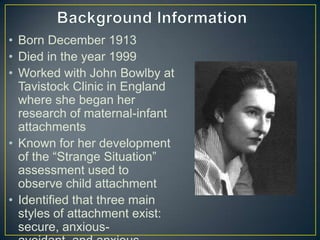
• Born December 1913
• Died in the year 1999
• Worked with John Bowlby at
Tavistock Clinic in England
where she began her
research of maternal-infant
attachments
• Known for her development
of the “Strange Situation”
assessment used to
observe child attachment
• Identified that three main
styles of attachment exist:
secure, anxious-
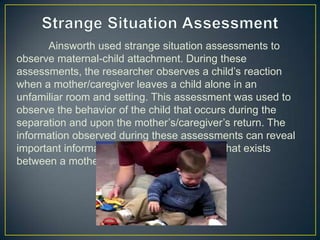
Ainsworth used strange situation assessments to
observe maternal-child attachment. During these
assessments, the researcher observes a child’s reaction
when a mother/caregiver leaves a child alone in an
unfamiliar room and setting. This assessment was used to
observe the behavior of the child that occurs during the
separation and upon the mother’s/caregiver’s return. The
information observed during these assessments can reveal
important information about the attachment that exists
between a mother and child.
1. Caregiver and infant are introduced to the experimental room.
2. Caregiver and infant are left alone. Caregiver does not participate
while infant plays and explores.
3. Stranger enters, converses with parent, then approaches infant.
Caregiver leaves inconspicuously.
4. First separation episode: Stranger's adjusts his behavior to that of the
infant.
5. First reunion episode: Caregiver greets and comforts the infant, then
leaves again.
6. Second separation episode: Infant is left alone.
7. Continuation of second separation episode: Stranger enters and
again adjusts his behavior to that of the infant.
8. Second reunion episode: Parent enters, greets infant, and picks up
infant; stranger leaves inconspicuously.
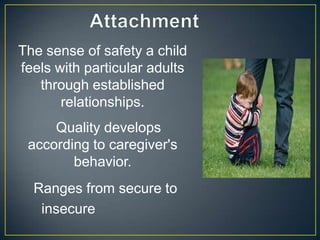
The sense of safety a child
feels with particular adults
through established
relationships.
Quality develops
according to caregiver's
behavior.
Ranges from secure to
insecure
• Secure Attachment
• Anxious-Ambivalent Insecure
Attachment
• Anxious-Avoidant Insecure
Attachment
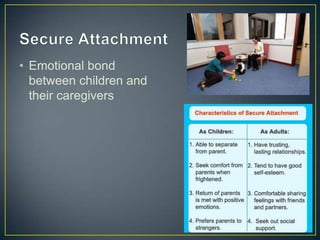
• Emotional bond
between children and
their caregivers
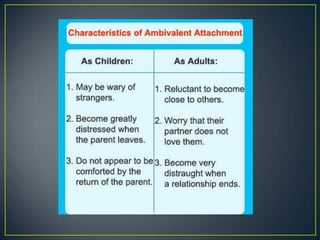
• The child is extremely
distressed, when the
caregiver departs.
• Child is anxious of
exploration and of
strangers, even when
the caregiver is present.
• When caregiver
returns, the child will
seek to remain close to
the caregiver, but will be
resentful, and resistant
to caregiver's attention
• Can be a result of a
caregiver who ignores
or tends to the child's
needs according to the
caregiver's own needs
or interest rather than in
response to the child's
cues.
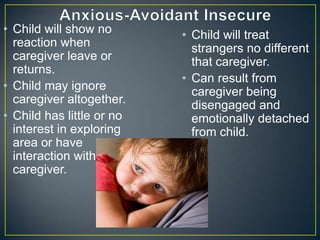
• Child will show no
reaction when
caregiver leave or
returns.
• Child may ignore
caregiver altogether.
• Child has little or no
interest in exploring
area or have
interaction with
caregiver.
• Child will treat
strangers no different
that caregiver.
• Can result from
caregiver being
disengaged and
emotionally detached
from child.
• Ainsworth validated her colleague Mary Main’s modification to
the three known attachment styles.
• Disorganized/disoriented attachment
• An example of this attachment is when a child is upset by the
separation of the primary caregiver. These children tend to
avoid their caregiver when they return at times or may seem
nervous when approaching the caregiver.
• Things to Look for in Disorganized/Disoriented Attachment
Children:
• Children rocking back and forth, freezing, throwing themselves
on the floor and/or hitting themselves repeatedly.
• Cherry, Kendra.(2013). Attachment Styles.
http://psychology.about.com/od/loveandattraction/ss/attachmentstyle_2.htm
Web. 28 Aug. 2013.
• Petersen, S. H., and Wittmer D. S. (2009).Endless Opportunities for Infant
and Toddler Curriculum: A Relationship-based Approach. Upper Saddle
River, NJ: Pearson Education Inc. Chapter 7: Endless Opportunities for
Attachment and Emotional Development 113-130. Print.
• Main, M. & Morgan, H. (1996). Disorganization and Disorientation in Infant
Strange Situation Behaviors: Phenotypic Resemblance to Dissociative
States. Michelson, L. & Ray W. Handbook of Dissociation:
Theoretical, Empirical, and Clinical Perspectives. Plenum Press, NY. 107-
108.
http://books.google.com/books?hl=en&lr=&id=p6MlaWBl0l4C&oi=fnd&p
g=PA107&dq=Mary+Ainsworth+accepted+validation+of+Disorganized/di
soriented+attachment&ots=x33YU-
Zg5P&sig=eyIdtZ_2Y2IAADVHIwunYkuL8_Y#v=onepage&q&f=false.
Web. 28 Aug. 2013
• Brodie, R.(2012). Mary Ainsworth and Attachment
Theory. http://www.childdevelopmentmedia.com/mary-
ainsworth-and-attachment-theory.html Web. 28 Aug.
2013.

Mary Ainsworth Attachment Theory

  • 1.
  • 2.
    • Born December1913 • Died in the year 1999 • Worked with John Bowlby at Tavistock Clinic in England where she began her research of maternal-infant attachments • Known for her development of the “Strange Situation” assessment used to observe child attachment • Identified that three main styles of attachment exist: secure, anxious-
  • 3.
    Ainsworth used strangesituation assessments to observe maternal-child attachment. During these assessments, the researcher observes a child’s reaction when a mother/caregiver leaves a child alone in an unfamiliar room and setting. This assessment was used to observe the behavior of the child that occurs during the separation and upon the mother’s/caregiver’s return. The information observed during these assessments can reveal important information about the attachment that exists between a mother and child.
  • 4.
    1. Caregiver andinfant are introduced to the experimental room. 2. Caregiver and infant are left alone. Caregiver does not participate while infant plays and explores. 3. Stranger enters, converses with parent, then approaches infant. Caregiver leaves inconspicuously. 4. First separation episode: Stranger's adjusts his behavior to that of the infant. 5. First reunion episode: Caregiver greets and comforts the infant, then leaves again. 6. Second separation episode: Infant is left alone. 7. Continuation of second separation episode: Stranger enters and again adjusts his behavior to that of the infant. 8. Second reunion episode: Parent enters, greets infant, and picks up infant; stranger leaves inconspicuously.
  • 5.
    The sense ofsafety a child feels with particular adults through established relationships. Quality develops according to caregiver's behavior. Ranges from secure to insecure
  • 6.
    • Secure Attachment •Anxious-Ambivalent Insecure Attachment • Anxious-Avoidant Insecure Attachment
  • 7.
    • Emotional bond betweenchildren and their caregivers
  • 8.
    • The childis extremely distressed, when the caregiver departs. • Child is anxious of exploration and of strangers, even when the caregiver is present. • When caregiver returns, the child will seek to remain close to the caregiver, but will be resentful, and resistant to caregiver's attention • Can be a result of a caregiver who ignores or tends to the child's needs according to the caregiver's own needs or interest rather than in response to the child's cues.
  • 10.
    • Child willshow no reaction when caregiver leave or returns. • Child may ignore caregiver altogether. • Child has little or no interest in exploring area or have interaction with caregiver. • Child will treat strangers no different that caregiver. • Can result from caregiver being disengaged and emotionally detached from child.
  • 12.
    • Ainsworth validatedher colleague Mary Main’s modification to the three known attachment styles. • Disorganized/disoriented attachment • An example of this attachment is when a child is upset by the separation of the primary caregiver. These children tend to avoid their caregiver when they return at times or may seem nervous when approaching the caregiver. • Things to Look for in Disorganized/Disoriented Attachment Children: • Children rocking back and forth, freezing, throwing themselves on the floor and/or hitting themselves repeatedly.
  • 13.
    • Cherry, Kendra.(2013).Attachment Styles. http://psychology.about.com/od/loveandattraction/ss/attachmentstyle_2.htm Web. 28 Aug. 2013. • Petersen, S. H., and Wittmer D. S. (2009).Endless Opportunities for Infant and Toddler Curriculum: A Relationship-based Approach. Upper Saddle River, NJ: Pearson Education Inc. Chapter 7: Endless Opportunities for Attachment and Emotional Development 113-130. Print. • Main, M. & Morgan, H. (1996). Disorganization and Disorientation in Infant Strange Situation Behaviors: Phenotypic Resemblance to Dissociative States. Michelson, L. & Ray W. Handbook of Dissociation: Theoretical, Empirical, and Clinical Perspectives. Plenum Press, NY. 107- 108. http://books.google.com/books?hl=en&lr=&id=p6MlaWBl0l4C&oi=fnd&p g=PA107&dq=Mary+Ainsworth+accepted+validation+of+Disorganized/di soriented+attachment&ots=x33YU- Zg5P&sig=eyIdtZ_2Y2IAADVHIwunYkuL8_Y#v=onepage&q&f=false. Web. 28 Aug. 2013
  • 14.
    • Brodie, R.(2012).Mary Ainsworth and Attachment Theory. http://www.childdevelopmentmedia.com/mary- ainsworth-and-attachment-theory.html Web. 28 Aug. 2013.