


things you
didn’t know
about
Bluetooth
PREPARE
forsom
e
BIG
CHANGES
in
the
IoT
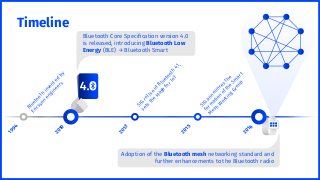
Bluetooth Core Specification version 4.0
is released, introducing Bluetooth Low
Energy (BLE) → Bluetooth Smart
Bluetooth
invented
by
Ericsson
engineers
2015
2013
2010
1994
2016
Adoption of the Bluetooth mesh networking standard and
further enhancements to the Bluetooth radio
Timeline
SIG
announces
the
form
ation
ofthe
Sm
art
M
esh
W
orking
Group
SIG
rolls
outBluetooth
4.1,
sets
the
stage
forIoT
It has an
impressive
range
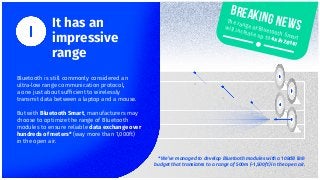
* We’ve managed to develop Bluetooth modules with a 108dB link
budget that translates to a range of 500m (~1,500ft) in the open air.
Bluetooth is still commonly considered an
ultra-low range communication protocol,
a one just about sufficient to wirelessly
transmit data between a laptop and a mouse.
But with Bluetooth Smart, manufacturers may
choose to optimize the range of Bluetooth
modules to ensure reliable data exchange over
hundreds of meters* (way more than 1,000ft)
in the open air.
Breaking newsThe range of Bluetooth Smart
will increase up to 4x in 2016!
It's blazingly
fast
Few people consider the Bluetooth radio to be
particularly fast, especially given the fact that
so far it has been used in relatively simple
applications.
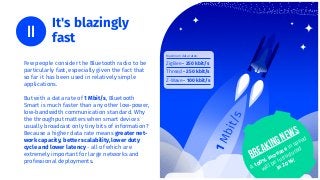
But with a data rate of 1 Mbit/s, Bluetooth
Smart is much faster than any other low-power,
low-bandwidth communication standard. Why
the throughput matters when smart devices
usually broadcast only tiny bits of information?
Because a higher data rate means greater net-
work capacity, better scalability, lower duty
cycle and lower latency - all of which are
extremely important for large networks and
professional deployments.
Maximum data rates:
ZigBee - 250 kbit/s
Thread - 250 kbit/s
Z-Wave - 100 kbit/s
Breaking news
A 100%
increase in speed
will be introduced
in 2016!
Bluetooth was initially designed as a cable
-replacement technology for point-to-point
communications. While Bluetooth Smart
introduced numerous important improvements,
it still was architected to support relatively simple
hub-and-spoke networks.
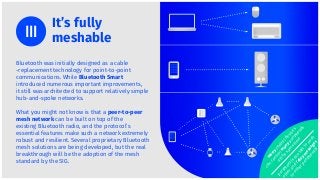
What you might not know is that a peer-to-peer
mesh network can be built on top of the
existing Bluetooth radio, and the protocol’s
essential features make such a network extremely
robust and resilient. Several proprietary Bluetooth
mesh solutions are being developed, but the real
breakthrough will be the adoption of the mesh
standard by the SIG.
It’s fully
meshable
m
any
centraldevices
can
controlm
any
peripherals
atthe
sam
e
tim
e
peripheralscan
talk
to
each
otherand
relay
m
essages
to
otherperipherals
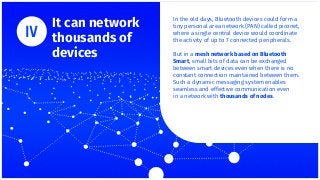
It can network
thousands of
devices
In the old days, Bluetooth devices could form a
tiny personal area network (PAN) called piconet,
where a single central device would coordinate
the activity of up to 7 connected peripherals.
But in a mesh network based on Bluetooth
Smart, small bits of data can be exchanged
between smart devices even when there is no
constant connection maintained between them.
Such a dynamic messaging system enables
seamless and effective communication even
in a network with thousands of nodes.
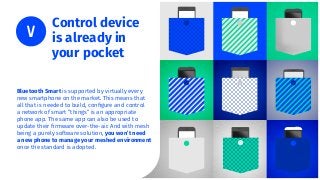
Bluetooth Smart is supported by virtually every
new smartphone on the market. This means that
all that is needed to build, configure and control
a network of smart “things” is an appropriate
phone app. The same app can also be used to
update their firmware over-the-air. And with mesh
being a purely software solution, you won’t need
a new phone to manage your meshed environment
once the standard is adopted.
Control device
is already in
your pocket
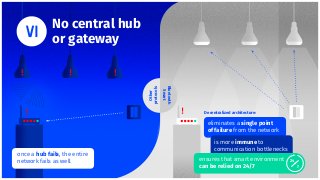
No central hub
or gateway
once a hub fails, the entire
network fails as well
eliminates a single point
of failure from the network
is more immune to
communication bottlenecks
ensures that smart environment
can be relied on 24/7
24
7Bluetooth
Smart
Decentralized architecture:
Other
protocols
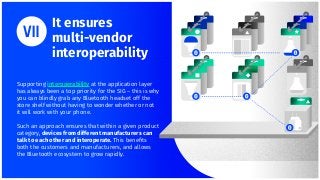
It ensures
multi-vendor
interoperability
Supporting interoperability at the application layer
has always been a top priority for the SIG – this is why
you can blindly grab any Bluetooth headset off the
store shelf without having to wonder whether or not
it will work with your phone.
Such an approach ensures that within a given product
category, devices from different manufacturers can
talk to each other and interoperate. This benefits
both the customers and manufacturers, and allows
the Bluetooth ecosystem to grow rapidly.
The beacon capability is one of those value-added
features that only Bluetooth can provide.
Bluetooth’s proximity sensing feature can
make your smartphone perform certain actions
whenever you get close to a given smart device.
This enables a wide array of unique applications
and can radically improve the user experience.
Beacons!
It’s as secure
as your online
bank account
Bluetooth Smart uses the proven 128-bit
Advanced Encryption Standard (AES) for
encoding information, making it virtually
unbreakable
The new pairing model called Secure Connections
prevents long-term key sniffing attacks
Bluetooth Smart supports a feature that reduces
the ability to track a device over a period of time
by changing its address on a frequent basis
•
•
•
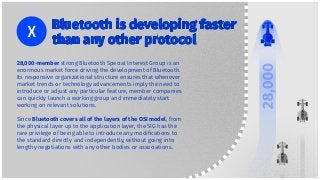
28,000-member strong Bluetooth Special Interest Group is an
enormous market force driving the development of Bluetooth.
Its responsive organizational structure ensures that whenever
market trends or technology advancements imply the need to
introduce or adjust any particular feature, member companies
can quickly launch a working group and immediately start
working on relevant solutions.
Since Bluetooth covers all of the layers of the OSI model, from
the physical layer up to the application layer, the SIG has the
rare privilege of being able to introduce any modifications to
the standard directly and independently, without going into
lengthy negotiations with any other bodies or associations.
Bluetooth is developing faster
than any other protocol
If you’d like to get more detailed information
on where Bluetooth stands at the moment, and
where it will be heading over the next few months,
take a look at
Over the past few weeks we’ve also reviewed
multiple other IoT protocols as part of our
Wireless protocols showdown series:
Why Bluetooth?
We bet on Bluetooth not because of what it is
today but because of what it will become in the
future. And being an active member of the SIG, we
know that things are going in the right direction.
Our deep involvement in both the Smart Mesh
Working Group and the Internet Working Group
allows us to exchange our knowledge and experi-
ence with other industry leading companies to
shape the future of Bluetooth technology. We’ll
keep sharing our core IP with the SIG to drive and
influence the direction of Bluetooth in the exciting
IoT universe.
About us
Silvair is a wireless technology provider empowering manufacturers to build
cutting-edge smart devices and enrich user experience in a software-defined
environment. We’ve created a complete end-to-end solution which allows our
manufacturing customers to add connectivity to their products.
The lighting sector is our primary focus at this early stage of the IoT era. The
omnipresence of lighting infrastructure across commercial, institutional and
residential spaces allows us to fully realize the potential of smart technologies
within the built environment. Our partners can improve time-to-market and
minimize risks as we assist them through the entire process, from developing
the product concept down to the assembly line setup.
For more information about Silvair please visit
Follow us on and

10 things about Bluetooth by Silvair

  • 1.
  • 2.
    Bluetooth Core Specificationversion 4.0 is released, introducing Bluetooth Low Energy (BLE) → Bluetooth Smart Bluetooth invented by Ericsson engineers 2015 2013 2010 1994 2016 Adoption of the Bluetooth mesh networking standard and further enhancements to the Bluetooth radio Timeline SIG announces the form ation ofthe Sm art M esh W orking Group SIG rolls outBluetooth 4.1, sets the stage forIoT
  • 3.
    It has an impressive range *We’ve managed to develop Bluetooth modules with a 108dB link budget that translates to a range of 500m (~1,500ft) in the open air. Bluetooth is still commonly considered an ultra-low range communication protocol, a one just about sufficient to wirelessly transmit data between a laptop and a mouse. But with Bluetooth Smart, manufacturers may choose to optimize the range of Bluetooth modules to ensure reliable data exchange over hundreds of meters* (way more than 1,000ft) in the open air. Breaking newsThe range of Bluetooth Smart will increase up to 4x in 2016!
  • 4.
    It's blazingly fast Few peopleconsider the Bluetooth radio to be particularly fast, especially given the fact that so far it has been used in relatively simple applications. But with a data rate of 1 Mbit/s, Bluetooth Smart is much faster than any other low-power, low-bandwidth communication standard. Why the throughput matters when smart devices usually broadcast only tiny bits of information? Because a higher data rate means greater net- work capacity, better scalability, lower duty cycle and lower latency - all of which are extremely important for large networks and professional deployments. Maximum data rates: ZigBee - 250 kbit/s Thread - 250 kbit/s Z-Wave - 100 kbit/s Breaking news A 100% increase in speed will be introduced in 2016!
  • 5.
    Bluetooth was initiallydesigned as a cable -replacement technology for point-to-point communications. While Bluetooth Smart introduced numerous important improvements, it still was architected to support relatively simple hub-and-spoke networks. What you might not know is that a peer-to-peer mesh network can be built on top of the existing Bluetooth radio, and the protocol’s essential features make such a network extremely robust and resilient. Several proprietary Bluetooth mesh solutions are being developed, but the real breakthrough will be the adoption of the mesh standard by the SIG. It’s fully meshable m any centraldevices can controlm any peripherals atthe sam e tim e peripheralscan talk to each otherand relay m essages to otherperipherals
  • 6.
    It can network thousandsof devices In the old days, Bluetooth devices could form a tiny personal area network (PAN) called piconet, where a single central device would coordinate the activity of up to 7 connected peripherals. But in a mesh network based on Bluetooth Smart, small bits of data can be exchanged between smart devices even when there is no constant connection maintained between them. Such a dynamic messaging system enables seamless and effective communication even in a network with thousands of nodes.
  • 7.
    Bluetooth Smart issupported by virtually every new smartphone on the market. This means that all that is needed to build, configure and control a network of smart “things” is an appropriate phone app. The same app can also be used to update their firmware over-the-air. And with mesh being a purely software solution, you won’t need a new phone to manage your meshed environment once the standard is adopted. Control device is already in your pocket
  • 8.
    No central hub orgateway once a hub fails, the entire network fails as well eliminates a single point of failure from the network is more immune to communication bottlenecks ensures that smart environment can be relied on 24/7 24 7Bluetooth Smart Decentralized architecture: Other protocols
  • 9.
    It ensures multi-vendor interoperability Supporting interoperabilityat the application layer has always been a top priority for the SIG – this is why you can blindly grab any Bluetooth headset off the store shelf without having to wonder whether or not it will work with your phone. Such an approach ensures that within a given product category, devices from different manufacturers can talk to each other and interoperate. This benefits both the customers and manufacturers, and allows the Bluetooth ecosystem to grow rapidly.
  • 10.
    The beacon capabilityis one of those value-added features that only Bluetooth can provide. Bluetooth’s proximity sensing feature can make your smartphone perform certain actions whenever you get close to a given smart device. This enables a wide array of unique applications and can radically improve the user experience. Beacons!
  • 11.
    It’s as secure asyour online bank account Bluetooth Smart uses the proven 128-bit Advanced Encryption Standard (AES) for encoding information, making it virtually unbreakable The new pairing model called Secure Connections prevents long-term key sniffing attacks Bluetooth Smart supports a feature that reduces the ability to track a device over a period of time by changing its address on a frequent basis • • •
  • 12.
    28,000-member strong BluetoothSpecial Interest Group is an enormous market force driving the development of Bluetooth. Its responsive organizational structure ensures that whenever market trends or technology advancements imply the need to introduce or adjust any particular feature, member companies can quickly launch a working group and immediately start working on relevant solutions. Since Bluetooth covers all of the layers of the OSI model, from the physical layer up to the application layer, the SIG has the rare privilege of being able to introduce any modifications to the standard directly and independently, without going into lengthy negotiations with any other bodies or associations. Bluetooth is developing faster than any other protocol
  • 13.
    If you’d liketo get more detailed information on where Bluetooth stands at the moment, and where it will be heading over the next few months, take a look at Over the past few weeks we’ve also reviewed multiple other IoT protocols as part of our Wireless protocols showdown series: Why Bluetooth? We bet on Bluetooth not because of what it is today but because of what it will become in the future. And being an active member of the SIG, we know that things are going in the right direction. Our deep involvement in both the Smart Mesh Working Group and the Internet Working Group allows us to exchange our knowledge and experi- ence with other industry leading companies to shape the future of Bluetooth technology. We’ll keep sharing our core IP with the SIG to drive and influence the direction of Bluetooth in the exciting IoT universe.
  • 14.
    About us Silvair isa wireless technology provider empowering manufacturers to build cutting-edge smart devices and enrich user experience in a software-defined environment. We’ve created a complete end-to-end solution which allows our manufacturing customers to add connectivity to their products. The lighting sector is our primary focus at this early stage of the IoT era. The omnipresence of lighting infrastructure across commercial, institutional and residential spaces allows us to fully realize the potential of smart technologies within the built environment. Our partners can improve time-to-market and minimize risks as we assist them through the entire process, from developing the product concept down to the assembly line setup. For more information about Silvair please visit Follow us on and