Farming-related injury
– a special challenge
By Phil Byass, 4th Year, HYMS
Picture: Google Maps
Some headlines…
Epidemiology of farm-related accidents
• Non-fatal injury – grossly under-reported,
especially in self-employed (c. 5% report rate?)
• Major injury – 242/100,000 employees sustained
major injury = 2x any other industry
• Fatalities - Less than 1.5% employed in agriculture,
yet accounts for 15-20% of work-related fatality
• 436 fatalities in last 10 years (32% employees, 56%
self-employed, 12% members of public)
• Among self-employed fatalites, a quarter were
over 65
• i.e. 43 fatalities each year – nearly 1 per week!
Source: Health & Safety Executive
Causes of major injury and death
• Transport (being run over or vehicle overturns, includes
tractors, forklifts, quad-bikes etc.) – 26%
• Falls (through fragile roofs, ladders, trees etc.) – 16%
• Struck by moving or falling objects (bales, trees, etc.) - 16%
• Asphyxiation/drowning - 10% (e.g. falls into grain-bin)
• Livestock-related fatalities - 10%
• Direct contact with machinery - 8% (e.g. amputations from
threshers, augers, PTO shafts etc.)
• Trapped by something collapsing
or overturning - 6%
• Burns e.g. combine fires – 5%
• Contact with electricity - 3% PTO shaft: particularly problematic
Types of farm-related injury
• Minor - cuts and bruises
• Severe - deep wounds and fractures
• Permanent – amputations and spinal cord
injury
• Fatal injury
Causes of farm-related ill-health
• Occupational related e.g. ‘Farmer’s lung’
• Pesticide poisoning
• Zoonotic infections e.g. TB
• Musculoskeletal problems from repetitive
movements or uncomfortable driving position
Farm injury – a special challenge
• High proportion of self-employed and family-
based farms
• Self-employed numbers increased as
workforce declined due to mechanisation and
reduced need for employees e.g. our farm: 8
workers/foremen in 1960 to just Dad in 2009
• Increasing age of self-employed, especially
with less pressure on young to ‘take over’
(12% of fatalities in over 65s)
STRUCTURAL: ageing workforce,
self-employment, migrant
workers & language barriers,
increased public access to
farmland
ENVIORNMENTAL: time (often
no daylight) and adverse
weather conditions e.g. wet
harvest
ECONOMIC: low productivity,
marginal returns, low
investment; especially in
health/safety measures
TECHNICAL: naturally
hazardous environments;
heavy machinery, poor
maintenance.
BEHAVIOURAL/CULTURAL: culture
of resourcefulness, unwise risk
taking and unsafe practices,
resistance to officialdom; see
regulation and red tape as a burden
INADEQUEATE TRAINING:
particularly in the middle-aged
and elderly sections of the
farming community
HISTORIC LACK OF INTEREST in the
industry on health and safety
FARM
INJURY
Farm injury – a special challenge
SEASONAL: greater workload
and pressures in narrower
timeframe i.e. harvest
WORKING ALONE in hazardous
conditions
Prevention
• No simple fix – needs shift in culture
• New generation of farmers brought up in ‘age’
of health and safety
• Cochrane review of RCTs and case-control:
No evidence for educational interventions
(included leaflets, safety training days,
presentations by injured farmers)
Evidence for financial incentives offered to
farmers to bring about change
Source: Rautiainen et. Al (2009)
Prevention
• As of 1st October 2012, HSE now charge
£124/hour for any accident investigations or
‘interventions’ in farm safety (FFI)
• Shifts costs of implementing safer
environments from public purse direct to
individual farmer
• Farmers urged to avoid these costs
Source: Health & Safety Executive
References
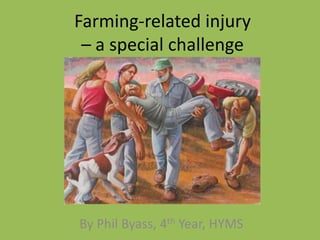
• Painting: Nora Othic, Ashby Hodge Gallery of American Art.
• Health and Safety Executive: http://www.hse.gov.uk/agriculture/hsagriculture.htm
• Guidance on FFI: http://www.hse.gov.uk/pubns/hse47.pdf
• Rautiainen R. et al (2009). Interventions for preventing injuries in the agricultural
industry. The Cochrane Library. Issue 3.

Farm-related injuries

  • 1.
    Farming-related injury – aspecial challenge By Phil Byass, 4th Year, HYMS
  • 2.
  • 3.
  • 4.
    Epidemiology of farm-relatedaccidents • Non-fatal injury – grossly under-reported, especially in self-employed (c. 5% report rate?) • Major injury – 242/100,000 employees sustained major injury = 2x any other industry • Fatalities - Less than 1.5% employed in agriculture, yet accounts for 15-20% of work-related fatality • 436 fatalities in last 10 years (32% employees, 56% self-employed, 12% members of public) • Among self-employed fatalites, a quarter were over 65 • i.e. 43 fatalities each year – nearly 1 per week! Source: Health & Safety Executive
  • 5.
    Causes of majorinjury and death • Transport (being run over or vehicle overturns, includes tractors, forklifts, quad-bikes etc.) – 26% • Falls (through fragile roofs, ladders, trees etc.) – 16% • Struck by moving or falling objects (bales, trees, etc.) - 16% • Asphyxiation/drowning - 10% (e.g. falls into grain-bin) • Livestock-related fatalities - 10% • Direct contact with machinery - 8% (e.g. amputations from threshers, augers, PTO shafts etc.) • Trapped by something collapsing or overturning - 6% • Burns e.g. combine fires – 5% • Contact with electricity - 3% PTO shaft: particularly problematic
  • 8.
    Types of farm-relatedinjury • Minor - cuts and bruises • Severe - deep wounds and fractures • Permanent – amputations and spinal cord injury • Fatal injury
  • 9.
    Causes of farm-relatedill-health • Occupational related e.g. ‘Farmer’s lung’ • Pesticide poisoning • Zoonotic infections e.g. TB • Musculoskeletal problems from repetitive movements or uncomfortable driving position
  • 10.
    Farm injury –a special challenge • High proportion of self-employed and family- based farms • Self-employed numbers increased as workforce declined due to mechanisation and reduced need for employees e.g. our farm: 8 workers/foremen in 1960 to just Dad in 2009 • Increasing age of self-employed, especially with less pressure on young to ‘take over’ (12% of fatalities in over 65s)
  • 11.
    STRUCTURAL: ageing workforce, self-employment,migrant workers & language barriers, increased public access to farmland ENVIORNMENTAL: time (often no daylight) and adverse weather conditions e.g. wet harvest ECONOMIC: low productivity, marginal returns, low investment; especially in health/safety measures TECHNICAL: naturally hazardous environments; heavy machinery, poor maintenance. BEHAVIOURAL/CULTURAL: culture of resourcefulness, unwise risk taking and unsafe practices, resistance to officialdom; see regulation and red tape as a burden INADEQUEATE TRAINING: particularly in the middle-aged and elderly sections of the farming community HISTORIC LACK OF INTEREST in the industry on health and safety FARM INJURY Farm injury – a special challenge SEASONAL: greater workload and pressures in narrower timeframe i.e. harvest WORKING ALONE in hazardous conditions
  • 12.
    Prevention • No simplefix – needs shift in culture • New generation of farmers brought up in ‘age’ of health and safety • Cochrane review of RCTs and case-control: No evidence for educational interventions (included leaflets, safety training days, presentations by injured farmers) Evidence for financial incentives offered to farmers to bring about change Source: Rautiainen et. Al (2009)
  • 13.
    Prevention • As of1st October 2012, HSE now charge £124/hour for any accident investigations or ‘interventions’ in farm safety (FFI) • Shifts costs of implementing safer environments from public purse direct to individual farmer • Farmers urged to avoid these costs Source: Health & Safety Executive
  • 14.
    References • Painting: NoraOthic, Ashby Hodge Gallery of American Art. • Health and Safety Executive: http://www.hse.gov.uk/agriculture/hsagriculture.htm • Guidance on FFI: http://www.hse.gov.uk/pubns/hse47.pdf • Rautiainen R. et al (2009). Interventions for preventing injuries in the agricultural industry. The Cochrane Library. Issue 3.