1
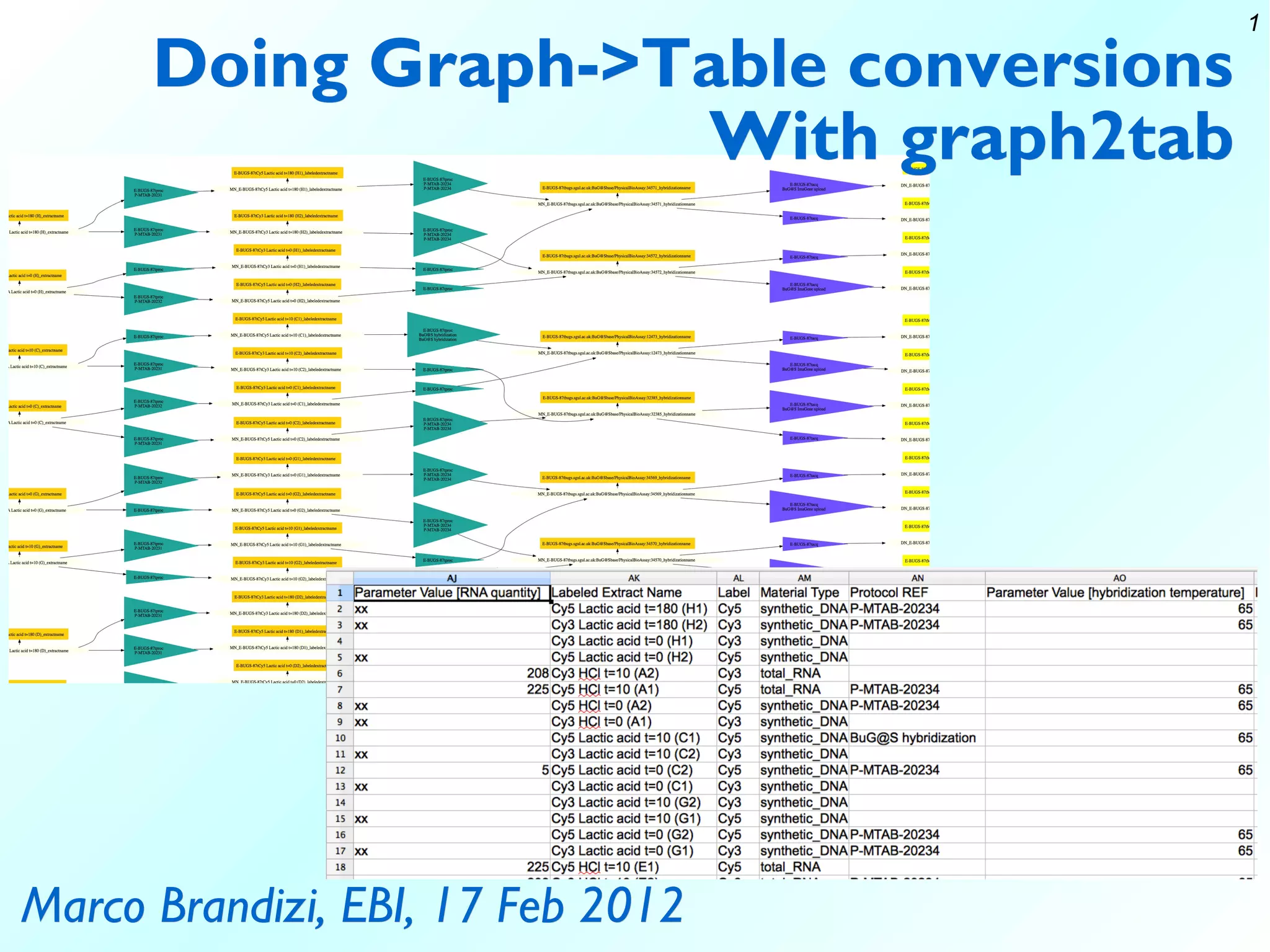
Doing Graph->Table conversionsDoing Graph->Table conversions
With graph2tabWith graph2tab
Marco Brandizi, EBI, 17 Feb 2012Marco Brandizi, EBI, 17 Feb 2012
2
Sources: www.dilbert.com, http://www.flickr.com/photos/joao_trindade/4362414729/in/photostream/,
http://www.boringmeetingssuck.com/, http://jflashman.wordpress.com/2011/06/17/venerdi-17-con-rispetto/
3
Mainly interesting to developers dealing with
databases like AE and formats like MAGETAB
Others may be interested things around you
And affected by the software presented here
Mainly interesting to developers dealing with
databases like AE and formats like MAGETAB
Others may be interested things around you
And affected by the software presented here
Details are rather technical (graph theory and
operative research)
But obviously I'll keep them at a minimum here
I'm finalising a document for those keen on Maths
Details are rather technical (graph theory and
operative research)
But obviously I'll keep them at a minimum here
I'm finalising a document for those keen on Maths
Come on! We do science here!Come on! We do science here!
STOP PLEASE! I was joking!
4
What graph2tab is for
e.g., MAGETAB, ISA-Tab,e.g., MAGETAB, ISA-Tab,
SampleTABSampleTAB
e.g., MAGETAB, ISA-Tab,e.g., MAGETAB, ISA-Tab,
SampleTABSampleTAB(*) as long as it's Java-encoded(*) as long as it's Java-encoded
e.g., ArrayExpress, GXAe.g., ArrayExpress, GXA
BII, BiosamplesDBBII, BiosamplesDB
e.g., ArrayExpress, GXAe.g., ArrayExpress, GXA
BII, BiosamplesDBBII, BiosamplesDB
Generic, you can adapt it to anyGeneric, you can adapt it to any
model(*)/format combinationmodel(*)/format combination
Generic, you can adapt it to anyGeneric, you can adapt it to any
model(*)/format combinationmodel(*)/format combination
5
Three sub-problems
To find a suitable/optimal set of paths and rows
To layer the graph, so that homogeneous node will go
under the same set of columns when possible
To arrange node attributes in a way that allows one to
build the table from them
To find a suitable/optimal set of paths and rows
To layer the graph, so that homogeneous node will go
under the same set of columns when possible
To arrange node attributes in a way that allows one to
build the table from them
6
Pb 1, Basic rule: Paths = Rows
7
Requirement #1: A covering path set
OKOKOKOK
Wrong!Wrong!Wrong!Wrong!
8
Requirement #2: A minimum covering path set
OKOKOKOK
OK, but bigger!OK, but bigger!OK, but bigger!OK, but bigger!
9
Optimisation is not so simple
7 rows are enough.7 rows are enough.
But try to prove it andBut try to prove it and
to find them!to find them!
7 rows are enough.7 rows are enough.
But try to prove it andBut try to prove it and
to find them!to find them!
10
Flow Networks
f (N ,i)− f (i , N )=
{
−v i=s
0 i≠s ,t
v i=t
FlowFlow
11
Flow Networks
f (N ,i)− f (i , N )=
{
−v i=s
0 i≠s ,t
v i=t
Constrained flow
and admissible flow
Constrained flow
and admissible flow
l(i, j) ≤ f(i, j) ≤ c(i, j), (i,j) A∀ ∈
12
Flow Networks
f (N ,i)− f (i , N )=
{
−v i=s
0 i≠s ,t
v i=t
Minimum flowMinimum flowl(i, j) ≤ f(i, j) ≤ c(i, j), (i,j) A∀ ∈
f is minimal
13
From Minimum Flow to Minimum Covering Path Set
A fictitious source and sink
l(virtual arcs) = 0
l(real arcs) = 1
No upper bound
A fictitious source and sink
l(virtual arcs) = 0
l(real arcs) = 1
No upper bound
14
From Minimum Flow to Minimum Covering Path Set
i.e., the f(i,j) = no of times
we pass through (i,j)
Or no of repetitions for (i,j)
i.e., the f(i,j) = no of times
we pass through (i,j)
Or no of repetitions for (i,j)
15
Minimum Flow: Ford-Fulkerson Algorithm
16
Three sub-problems
To find a suitable/optimal set of paths and rows
To layer the graph, so that homogeneous node will
go under the same set of columns when possible
To arrange node attributes in a way that allows one to
build the table from them
To find a suitable/optimal set of paths and rows
To layer the graph, so that homogeneous node will
go under the same set of columns when possible
To arrange node attributes in a way that allows one to
build the table from them
17
Layering
18
Conceptually simple
You start by marking every node with its topological distance from
the farthest connected left node
Then for layer = 0..max
For each pair of nodes in the layer
Shift one of the two if they haven't the same type
You start by marking every node with its topological distance from
the farthest connected left node
Then for layer = 0..max
For each pair of nodes in the layer
Shift one of the two if they haven't the same type
19
Conceptually simple, but...
Computers understand biology even less than me!Computers understand biology even less than me!
'Source', 'Sample', 'Labeled Extract' are just symbols'Source', 'Sample', 'Labeled Extract' are just symbols
Either solution is acceptable without further informationEither solution is acceptable without further information
Computers understand biology even less than me!Computers understand biology even less than me!
'Source', 'Sample', 'Labeled Extract' are just symbols'Source', 'Sample', 'Labeled Extract' are just symbols
Either solution is acceptable without further informationEither solution is acceptable without further information
20
Conceptually simple, but...
Map<String, Integer> TYPE_ORDER =
new HashMap<String, Integer> ()
{{
put ( "Source Name", 0 );
put ( "Sample Name", 1 );
put ( "Extract Name", 2 );
put ( "Labeled Extract Name", 3 );
put ( "Assay Name", 4 );
put ( "Data File Name", 5 );
}};
Ah-Ah! Now I know what toAh-Ah! Now I know what to
choose!choose!
Ah-Ah! Now I know what toAh-Ah! Now I know what to
choose!choose!
+interface Node
extends Comparable<Node>
{
getInputs (): SortedSet<Node>
getOutputs (): SortedSet<Node>
getTabValues (): TabValueGroup[]
getType (): String
getOrder (): int
}
21
More cases, same trick
22
Three sub-problems
To find a suitable/optimal set of paths and rows
To layer the graph, so that homogeneous node will go
under the same set of columns when possible
To arrange node attributes in a way that allows one
to build the table from them
To find a suitable/optimal set of paths and rows
To layer the graph, so that homogeneous node will go
under the same set of columns when possible
To arrange node attributes in a way that allows one
to build the table from them
23
Basic Algorithm
For every path in the minimum covering path set:
For every node in the path:
Cover with empty cells any layer between previous node and
layer(node)
Merge attributes(node) into the columns/rows built so far for
layer(node)
For every path in the minimum covering path set:
For every node in the path:
Cover with empty cells any layer between previous node and
layer(node)
Merge attributes(node) into the columns/rows built so far for
layer(node)
24
Representing Node Attributes
TabValueGroup (
header = "Organism"
value = "Mus-mus"
tail = ( TabValueGroup (
header = "Term Source REF"
value = "NCBI-Tax"
tail = ( TabValueGroup (
header = "Term Accession"
value = "123"
))
))
)
StructuredTable (
header = "Organism"
rows = "R. Norvegicus"
tail = []
)
StructuredTable (
header = "Organism"
rows = "R. Norvegicus", "Mus-mus"
tail = ( StructuredTable (
header = "Term Source REF"
rows = "", "", "NCBI-Tax"
tail = ( StructuredTable (
header = "Term Accession"
rows = "", "", "123"
))
))
)
+ =
25
Merging Node Attributes
26
graph2tab on the Road
public interface TabValueGroup
{
public String getHeader();
public String getValue();
public List<TabValueGroup> getTail ();
}
public abstract class DefaultAbstractNode implements Node
27
Two ways to extend from basic interfaces
Simpler approach: just let the classes of your model to
implement the Node interface
Or, much simpler, to extend the DefaultAbstractNode
Simpler, but unrealistic
In fact, sorry, but I realised I don't have any
significant example about...
More realistic approach: wrappers, ie, a 1-1 mapping
from your nodes to graph2tab nodes
Simpler approach: just let the classes of your model to
implement the Node interface
Or, much simpler, to extend the DefaultAbstractNode
Simpler, but unrealistic
In fact, sorry, but I realised I don't have any
significant example about...
More realistic approach: wrappers, ie, a 1-1 mapping
from your nodes to graph2tab nodes
28
Extending through wrappers
public abstract class ExpNodeWrapper extends DefaultAbstractNode
{
ExpNodeWrapper ( ExperimentNode base, NodeFactory nodeFactory )
{
this.base = base;
this.nodeFactory = nodeFactory;
}
public List<TabValueGroup> getTabValues ()
{
List<TabValueGroup> result = new ArrayList<TabValueGroup> ();
result.add ( new DefaultTabValueGroup ( nameHeader, base.getName () ) );
for ( Annotation annotation: base.getAnnotations () )
{
DefaultTabValueGroup tbg = new DefaultTabValueGroup (
annotation.getType (), annotation.getValue () );
OntoTerm ot = annotation.getOntoTerm ();
if ( ot != null ) tbg.append (
new DefaultTabValueGroup ( "Term Accession Number", ot.getAcc (),
new DefaultTabValueGroup ( "Term Source REF", ot.getSource () ) ));
result.add ( tbg );
}
return result;
}
public int getOrder ()
{
String header = getType();
Integer order = TYPE_ORDER.get ( header );
return order == null ? -1 : order;
}
...
}
29
Extending through wrappers
public abstract class ExpNodeWrapper extends DefaultAbstractNode
{
...
public SortedSet<Node> getInputs ()
{
if ( inputs != null )
return super.getInputs ();
inputs = new TreeSet<Node> ();
for ( ExperimentNode in: base.getInputs () )
inputs.add ( nodeFactory.getNode ( in ) );
return super.getInputs ();
}
}
public class NodeFactory extends
org.isatools.tablib.export.graph2tab.simple_biomodel_tests.node_wrappers.NodeFactory
{
private NodeFactory () {}
private static final NodeFactory instance = new NodeFactory ();
public static NodeFactory getInstance () { return instance; }
protected ExpNodeWrapper createNewNode ( ExperimentNode base ) {
if ( base instanceof BioSource ) return new BioSourceWrapper ( (BioSource) base, this );
if ( base instanceof BioSample ) return new BioSampleWrapper ( (BioSample) base, this );
if ( base instanceof BioExtract ) return
new BioExtractWrapper ( (BioExtract) base, this );
if ( base instanceof BioLabeledExtract )
...
}
}
30
Real Use Cases so Far
Was born while I was working on the BII project, it's now part of
the ISA tools (exports studies from BII database to ISA-Tab
format, works out the sample and assay file)
ArrayExpress2 to MAGETAB exporter
Being integrated in the production environment, will allow to
re-generate SDRF files from (possibly re-annotated) database
records (ie, uses the AE2 object model)
MAGE-ML to MAGETAB converter
Thanks to Natalja Kurbatova
Re-Exporter in the Limpopo Library
Thanks to Natalja, Tony Burdett
Adam Faulconbridge, working with graph2tab for the SampleDB
project (???)
Was born while I was working on the BII project, it's now part of
the ISA tools (exports studies from BII database to ISA-Tab
format, works out the sample and assay file)
ArrayExpress2 to MAGETAB exporter
Being integrated in the production environment, will allow to
re-generate SDRF files from (possibly re-annotated) database
records (ie, uses the AE2 object model)
MAGE-ML to MAGETAB converter
Thanks to Natalja Kurbatova
Re-Exporter in the Limpopo Library
Thanks to Natalja, Tony Burdett
Adam Faulconbridge, working with graph2tab for the SampleDB
project (???)
31
Possibly in Future
Maybe a better extension mechanism
Java Annotations or XML mapping files
Translation to other languages
If someone is interested...
More biomedical use cases
Eg, several efforts in progress to represent experimental meta-
data in RDF/OWL (such as OBI)
One may need to convert such models back to tabular formats
Or to visualise them as tables
Non biomedical applications?
Maybe, workflows occur in many fields
Not so sure about tabular formats
Maybe a better extension mechanism
Java Annotations or XML mapping files
Translation to other languages
If someone is interested...
More biomedical use cases
Eg, several efforts in progress to represent experimental meta-
data in RDF/OWL (such as OBI)
One may need to convert such models back to tabular formats
Or to visualise them as tables
Non biomedical applications?
Maybe, workflows occur in many fields
Not so sure about tabular formats
32
Acknowledgements
Philippe Rocca-Serra, Susanna Sansone (Team leaders for BII), Eamonn
Maguire
For their support and their patience while I had struggled to come up to
an acceptable solution
Ugis Sarkans (team leader for AE) and AE team
Support and help for the AE exporter
Tony Burdett
Support for the Limpopo use case
Natalja Kurbatova
Worked out the MAGE-ML converter and on the Limpopo too
Adam Falcounbridge
Help in spotting and fixing a few bugs
Alvis Brazma, Natalja
Discussions on the ambiguities with the layering
Funders (CarcinoGENOMICS and EMBL)
Philippe Rocca-Serra, Susanna Sansone (Team leaders for BII), Eamonn
Maguire
For their support and their patience while I had struggled to come up to
an acceptable solution
Ugis Sarkans (team leader for AE) and AE team
Support and help for the AE exporter
Tony Burdett
Support for the Limpopo use case
Natalja Kurbatova
Worked out the MAGE-ML converter and on the Limpopo too
Adam Falcounbridge
Help in spotting and fixing a few bugs
Alvis Brazma, Natalja
Discussions on the ambiguities with the layering
Funders (CarcinoGENOMICS and EMBL)
And you all!And you all!And you all!And you all!

graph2tab, a library to convert experimental workflow graphs into tabular formats

  • 1.
    1 Doing Graph->Table conversionsDoingGraph->Table conversions With graph2tabWith graph2tab Marco Brandizi, EBI, 17 Feb 2012Marco Brandizi, EBI, 17 Feb 2012
  • 2.
  • 3.
    3 Mainly interesting todevelopers dealing with databases like AE and formats like MAGETAB Others may be interested things around you And affected by the software presented here Mainly interesting to developers dealing with databases like AE and formats like MAGETAB Others may be interested things around you And affected by the software presented here Details are rather technical (graph theory and operative research) But obviously I'll keep them at a minimum here I'm finalising a document for those keen on Maths Details are rather technical (graph theory and operative research) But obviously I'll keep them at a minimum here I'm finalising a document for those keen on Maths Come on! We do science here!Come on! We do science here! STOP PLEASE! I was joking!
  • 4.
    4 What graph2tab isfor e.g., MAGETAB, ISA-Tab,e.g., MAGETAB, ISA-Tab, SampleTABSampleTAB e.g., MAGETAB, ISA-Tab,e.g., MAGETAB, ISA-Tab, SampleTABSampleTAB(*) as long as it's Java-encoded(*) as long as it's Java-encoded e.g., ArrayExpress, GXAe.g., ArrayExpress, GXA BII, BiosamplesDBBII, BiosamplesDB e.g., ArrayExpress, GXAe.g., ArrayExpress, GXA BII, BiosamplesDBBII, BiosamplesDB Generic, you can adapt it to anyGeneric, you can adapt it to any model(*)/format combinationmodel(*)/format combination Generic, you can adapt it to anyGeneric, you can adapt it to any model(*)/format combinationmodel(*)/format combination
  • 5.
    5 Three sub-problems To finda suitable/optimal set of paths and rows To layer the graph, so that homogeneous node will go under the same set of columns when possible To arrange node attributes in a way that allows one to build the table from them To find a suitable/optimal set of paths and rows To layer the graph, so that homogeneous node will go under the same set of columns when possible To arrange node attributes in a way that allows one to build the table from them
  • 6.
    6 Pb 1, Basicrule: Paths = Rows
  • 7.
    7 Requirement #1: Acovering path set OKOKOKOK Wrong!Wrong!Wrong!Wrong!
  • 8.
    8 Requirement #2: Aminimum covering path set OKOKOKOK OK, but bigger!OK, but bigger!OK, but bigger!OK, but bigger!
  • 9.
    9 Optimisation is notso simple 7 rows are enough.7 rows are enough. But try to prove it andBut try to prove it and to find them!to find them! 7 rows are enough.7 rows are enough. But try to prove it andBut try to prove it and to find them!to find them!
  • 10.
    10 Flow Networks f (N,i)− f (i , N )= { −v i=s 0 i≠s ,t v i=t FlowFlow
  • 11.
    11 Flow Networks f (N,i)− f (i , N )= { −v i=s 0 i≠s ,t v i=t Constrained flow and admissible flow Constrained flow and admissible flow l(i, j) ≤ f(i, j) ≤ c(i, j), (i,j) A∀ ∈
  • 12.
    12 Flow Networks f (N,i)− f (i , N )= { −v i=s 0 i≠s ,t v i=t Minimum flowMinimum flowl(i, j) ≤ f(i, j) ≤ c(i, j), (i,j) A∀ ∈ f is minimal
  • 13.
    13 From Minimum Flowto Minimum Covering Path Set A fictitious source and sink l(virtual arcs) = 0 l(real arcs) = 1 No upper bound A fictitious source and sink l(virtual arcs) = 0 l(real arcs) = 1 No upper bound
  • 14.
    14 From Minimum Flowto Minimum Covering Path Set i.e., the f(i,j) = no of times we pass through (i,j) Or no of repetitions for (i,j) i.e., the f(i,j) = no of times we pass through (i,j) Or no of repetitions for (i,j)
  • 15.
  • 16.
    16 Three sub-problems To finda suitable/optimal set of paths and rows To layer the graph, so that homogeneous node will go under the same set of columns when possible To arrange node attributes in a way that allows one to build the table from them To find a suitable/optimal set of paths and rows To layer the graph, so that homogeneous node will go under the same set of columns when possible To arrange node attributes in a way that allows one to build the table from them
  • 17.
  • 18.
    18 Conceptually simple You startby marking every node with its topological distance from the farthest connected left node Then for layer = 0..max For each pair of nodes in the layer Shift one of the two if they haven't the same type You start by marking every node with its topological distance from the farthest connected left node Then for layer = 0..max For each pair of nodes in the layer Shift one of the two if they haven't the same type
  • 19.
    19 Conceptually simple, but... Computersunderstand biology even less than me!Computers understand biology even less than me! 'Source', 'Sample', 'Labeled Extract' are just symbols'Source', 'Sample', 'Labeled Extract' are just symbols Either solution is acceptable without further informationEither solution is acceptable without further information Computers understand biology even less than me!Computers understand biology even less than me! 'Source', 'Sample', 'Labeled Extract' are just symbols'Source', 'Sample', 'Labeled Extract' are just symbols Either solution is acceptable without further informationEither solution is acceptable without further information
  • 20.
    20 Conceptually simple, but... Map<String,Integer> TYPE_ORDER = new HashMap<String, Integer> () {{ put ( "Source Name", 0 ); put ( "Sample Name", 1 ); put ( "Extract Name", 2 ); put ( "Labeled Extract Name", 3 ); put ( "Assay Name", 4 ); put ( "Data File Name", 5 ); }}; Ah-Ah! Now I know what toAh-Ah! Now I know what to choose!choose! Ah-Ah! Now I know what toAh-Ah! Now I know what to choose!choose! +interface Node extends Comparable<Node> { getInputs (): SortedSet<Node> getOutputs (): SortedSet<Node> getTabValues (): TabValueGroup[] getType (): String getOrder (): int }
  • 21.
  • 22.
    22 Three sub-problems To finda suitable/optimal set of paths and rows To layer the graph, so that homogeneous node will go under the same set of columns when possible To arrange node attributes in a way that allows one to build the table from them To find a suitable/optimal set of paths and rows To layer the graph, so that homogeneous node will go under the same set of columns when possible To arrange node attributes in a way that allows one to build the table from them
  • 23.
    23 Basic Algorithm For everypath in the minimum covering path set: For every node in the path: Cover with empty cells any layer between previous node and layer(node) Merge attributes(node) into the columns/rows built so far for layer(node) For every path in the minimum covering path set: For every node in the path: Cover with empty cells any layer between previous node and layer(node) Merge attributes(node) into the columns/rows built so far for layer(node)
  • 24.
    24 Representing Node Attributes TabValueGroup( header = "Organism" value = "Mus-mus" tail = ( TabValueGroup ( header = "Term Source REF" value = "NCBI-Tax" tail = ( TabValueGroup ( header = "Term Accession" value = "123" )) )) ) StructuredTable ( header = "Organism" rows = "R. Norvegicus" tail = [] ) StructuredTable ( header = "Organism" rows = "R. Norvegicus", "Mus-mus" tail = ( StructuredTable ( header = "Term Source REF" rows = "", "", "NCBI-Tax" tail = ( StructuredTable ( header = "Term Accession" rows = "", "", "123" )) )) ) + =
  • 25.
  • 26.
    26 graph2tab on theRoad public interface TabValueGroup { public String getHeader(); public String getValue(); public List<TabValueGroup> getTail (); } public abstract class DefaultAbstractNode implements Node
  • 27.
    27 Two ways toextend from basic interfaces Simpler approach: just let the classes of your model to implement the Node interface Or, much simpler, to extend the DefaultAbstractNode Simpler, but unrealistic In fact, sorry, but I realised I don't have any significant example about... More realistic approach: wrappers, ie, a 1-1 mapping from your nodes to graph2tab nodes Simpler approach: just let the classes of your model to implement the Node interface Or, much simpler, to extend the DefaultAbstractNode Simpler, but unrealistic In fact, sorry, but I realised I don't have any significant example about... More realistic approach: wrappers, ie, a 1-1 mapping from your nodes to graph2tab nodes
  • 28.
    28 Extending through wrappers publicabstract class ExpNodeWrapper extends DefaultAbstractNode { ExpNodeWrapper ( ExperimentNode base, NodeFactory nodeFactory ) { this.base = base; this.nodeFactory = nodeFactory; } public List<TabValueGroup> getTabValues () { List<TabValueGroup> result = new ArrayList<TabValueGroup> (); result.add ( new DefaultTabValueGroup ( nameHeader, base.getName () ) ); for ( Annotation annotation: base.getAnnotations () ) { DefaultTabValueGroup tbg = new DefaultTabValueGroup ( annotation.getType (), annotation.getValue () ); OntoTerm ot = annotation.getOntoTerm (); if ( ot != null ) tbg.append ( new DefaultTabValueGroup ( "Term Accession Number", ot.getAcc (), new DefaultTabValueGroup ( "Term Source REF", ot.getSource () ) )); result.add ( tbg ); } return result; } public int getOrder () { String header = getType(); Integer order = TYPE_ORDER.get ( header ); return order == null ? -1 : order; } ... }
  • 29.
    29 Extending through wrappers publicabstract class ExpNodeWrapper extends DefaultAbstractNode { ... public SortedSet<Node> getInputs () { if ( inputs != null ) return super.getInputs (); inputs = new TreeSet<Node> (); for ( ExperimentNode in: base.getInputs () ) inputs.add ( nodeFactory.getNode ( in ) ); return super.getInputs (); } } public class NodeFactory extends org.isatools.tablib.export.graph2tab.simple_biomodel_tests.node_wrappers.NodeFactory { private NodeFactory () {} private static final NodeFactory instance = new NodeFactory (); public static NodeFactory getInstance () { return instance; } protected ExpNodeWrapper createNewNode ( ExperimentNode base ) { if ( base instanceof BioSource ) return new BioSourceWrapper ( (BioSource) base, this ); if ( base instanceof BioSample ) return new BioSampleWrapper ( (BioSample) base, this ); if ( base instanceof BioExtract ) return new BioExtractWrapper ( (BioExtract) base, this ); if ( base instanceof BioLabeledExtract ) ... } }
  • 30.
    30 Real Use Casesso Far Was born while I was working on the BII project, it's now part of the ISA tools (exports studies from BII database to ISA-Tab format, works out the sample and assay file) ArrayExpress2 to MAGETAB exporter Being integrated in the production environment, will allow to re-generate SDRF files from (possibly re-annotated) database records (ie, uses the AE2 object model) MAGE-ML to MAGETAB converter Thanks to Natalja Kurbatova Re-Exporter in the Limpopo Library Thanks to Natalja, Tony Burdett Adam Faulconbridge, working with graph2tab for the SampleDB project (???) Was born while I was working on the BII project, it's now part of the ISA tools (exports studies from BII database to ISA-Tab format, works out the sample and assay file) ArrayExpress2 to MAGETAB exporter Being integrated in the production environment, will allow to re-generate SDRF files from (possibly re-annotated) database records (ie, uses the AE2 object model) MAGE-ML to MAGETAB converter Thanks to Natalja Kurbatova Re-Exporter in the Limpopo Library Thanks to Natalja, Tony Burdett Adam Faulconbridge, working with graph2tab for the SampleDB project (???)
  • 31.
    31 Possibly in Future Maybea better extension mechanism Java Annotations or XML mapping files Translation to other languages If someone is interested... More biomedical use cases Eg, several efforts in progress to represent experimental meta- data in RDF/OWL (such as OBI) One may need to convert such models back to tabular formats Or to visualise them as tables Non biomedical applications? Maybe, workflows occur in many fields Not so sure about tabular formats Maybe a better extension mechanism Java Annotations or XML mapping files Translation to other languages If someone is interested... More biomedical use cases Eg, several efforts in progress to represent experimental meta- data in RDF/OWL (such as OBI) One may need to convert such models back to tabular formats Or to visualise them as tables Non biomedical applications? Maybe, workflows occur in many fields Not so sure about tabular formats
  • 32.
    32 Acknowledgements Philippe Rocca-Serra, SusannaSansone (Team leaders for BII), Eamonn Maguire For their support and their patience while I had struggled to come up to an acceptable solution Ugis Sarkans (team leader for AE) and AE team Support and help for the AE exporter Tony Burdett Support for the Limpopo use case Natalja Kurbatova Worked out the MAGE-ML converter and on the Limpopo too Adam Falcounbridge Help in spotting and fixing a few bugs Alvis Brazma, Natalja Discussions on the ambiguities with the layering Funders (CarcinoGENOMICS and EMBL) Philippe Rocca-Serra, Susanna Sansone (Team leaders for BII), Eamonn Maguire For their support and their patience while I had struggled to come up to an acceptable solution Ugis Sarkans (team leader for AE) and AE team Support and help for the AE exporter Tony Burdett Support for the Limpopo use case Natalja Kurbatova Worked out the MAGE-ML converter and on the Limpopo too Adam Falcounbridge Help in spotting and fixing a few bugs Alvis Brazma, Natalja Discussions on the ambiguities with the layering Funders (CarcinoGENOMICS and EMBL) And you all!And you all!And you all!And you all!