Welcome to
Our Presentation
Dynamic Systems
Development
Method (DSDM)
Members Intro
Rebeka Sultana {{ 181-25-666
}}
Tapasy Rabeya {{ 183-25-
704 }}
Imran Hossain {{ 183-25-
691 }}
Maruf Abdullah {{ 183-25-
706 }}
3
Contents
Title Page
Dynamic Systems Development Method 5 - 6
Advantages of DSDM 7
Disadvantages of DSDM 8
Principles of DSDM 9 - 10
Process Overview of DSDM 11 - 12
Tools and Techniques 13
DSDM in Real Life Practice 14 - 18
4
Dynamic Systems Development
Method
 DSDM is currently known as an agile
development type.
 DSDM is a methodology that prioritizes
schedule and quality over functionality.
DSDM methodology has evolved and
matured to provide a comprehensive
foundation for planning, managing, executing
and scaling agile process and iterative
software development projects.
5
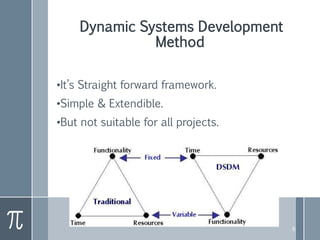
•It’s Straight forward framework.
•Simple & Extendible.
•But not suitable for all projects.
Dynamic Systems Development
Method
6
Advantages of DSDM
› Users are highly involved in the
development.
› Basic functionality is delivered within very
short time.
› Provides easy access for Developers to
end-users.
› Projects are delivered On time within a
specific budget.
7
Disadvantages of DSDM
› Sometimes it’s Costly.
› May not suitable for Small Organizations.
› Not suitable for one time projects.
› Users and Developers both need to be
trained.
8
a. Active user involvement is
imperative.
b. Team must be empowered to
make decisions.
c. Focus is on frequent delivery.
d. Fitness for business is criterion
for acceptance of deliverables.
Principles of DSDM
9
e. Iterative and incremental
development is mandatory.
f. All changes during development
must be reversible.
g. Collaborative and Co-operative
approach.
Principles of DSDM
10
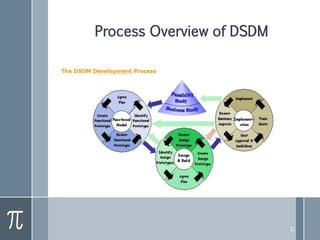
Process Overview of DSDM
11
o Feasibility Study.
o Business Study.
o Functional Model.
o Design and Build.
o Implementation
Process Overview of DSDM
12
 Time-Boxing
 MoScoW Rules
 Prototyping
 Testing
 Workshop
 Modeling
 Configuration Management
Tools and Techniques
13
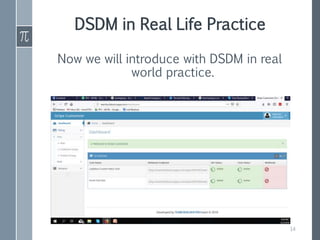
DSDM in Real Life Practice
Now we will introduce with DSDM in real
world practice.
14
DSDM in Real Life Practice
Time-Boxing and scheduling the Tasks
15
DSDM in Real Life Practice
MoScoW
16
DSDM in Real Life Practice
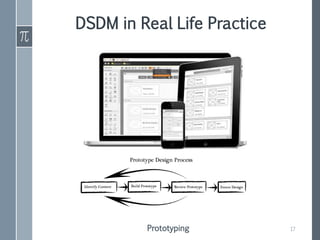
Prototyping 17
DSDM in Real Life Practice
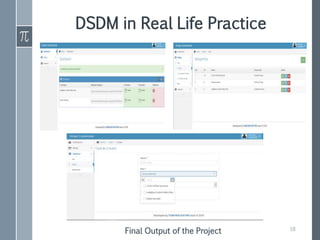
Final Output of the Project 18
19

Dynamic Systems Development Method (DSDM) - Agile

  • 1.
  • 2.
  • 3.
    Members Intro Rebeka Sultana{{ 181-25-666 }} Tapasy Rabeya {{ 183-25- 704 }} Imran Hossain {{ 183-25- 691 }} Maruf Abdullah {{ 183-25- 706 }} 3
  • 4.
    Contents Title Page Dynamic SystemsDevelopment Method 5 - 6 Advantages of DSDM 7 Disadvantages of DSDM 8 Principles of DSDM 9 - 10 Process Overview of DSDM 11 - 12 Tools and Techniques 13 DSDM in Real Life Practice 14 - 18 4
  • 5.
    Dynamic Systems Development Method DSDM is currently known as an agile development type.  DSDM is a methodology that prioritizes schedule and quality over functionality. DSDM methodology has evolved and matured to provide a comprehensive foundation for planning, managing, executing and scaling agile process and iterative software development projects. 5
  • 6.
    •It’s Straight forwardframework. •Simple & Extendible. •But not suitable for all projects. Dynamic Systems Development Method 6
  • 7.
    Advantages of DSDM ›Users are highly involved in the development. › Basic functionality is delivered within very short time. › Provides easy access for Developers to end-users. › Projects are delivered On time within a specific budget. 7
  • 8.
    Disadvantages of DSDM ›Sometimes it’s Costly. › May not suitable for Small Organizations. › Not suitable for one time projects. › Users and Developers both need to be trained. 8
  • 9.
    a. Active userinvolvement is imperative. b. Team must be empowered to make decisions. c. Focus is on frequent delivery. d. Fitness for business is criterion for acceptance of deliverables. Principles of DSDM 9
  • 10.
    e. Iterative andincremental development is mandatory. f. All changes during development must be reversible. g. Collaborative and Co-operative approach. Principles of DSDM 10
  • 11.
  • 12.
    o Feasibility Study. oBusiness Study. o Functional Model. o Design and Build. o Implementation Process Overview of DSDM 12
  • 13.
     Time-Boxing  MoScoWRules  Prototyping  Testing  Workshop  Modeling  Configuration Management Tools and Techniques 13
  • 14.
    DSDM in RealLife Practice Now we will introduce with DSDM in real world practice. 14
  • 15.
    DSDM in RealLife Practice Time-Boxing and scheduling the Tasks 15
  • 16.
    DSDM in RealLife Practice MoScoW 16
  • 17.
    DSDM in RealLife Practice Prototyping 17
  • 18.
    DSDM in RealLife Practice Final Output of the Project 18
  • 19.