GRASS GIS 6.4.0 Marku s Neteler  & GRASS Development Team Fondazione Mach – Centro Ricerca e Innovazione Cagliari, 26-27 February 2009 GRASS GIS
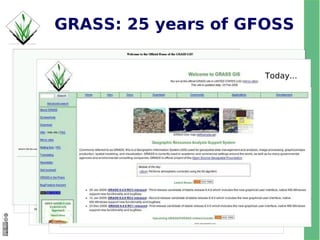
GRASS: 25 years of GFOSS 1987 USA (GRASS 2.0,  no Web!) 1995 USA 1997, Univ. of Hannover, Germany 1999 Baylor Univ., USA 2002 ITC-irst Trento + Baylor ITC-irst 2002 Today...
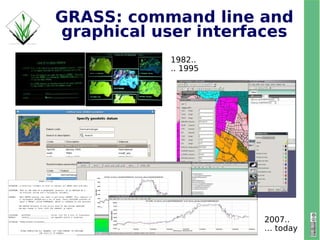
GRASS: command line and graphical user interfaces 1982.. .. 1995 2007.. … today
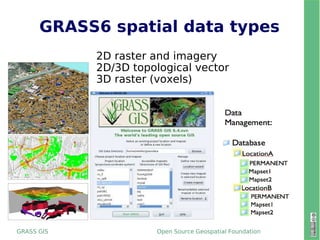
GRASS6 spatial data types 2D raster and imagery 2D/3D topological vector  3D raster (voxels)
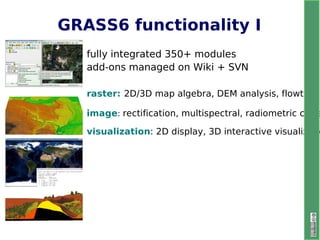
GRASS6 functionality I  fully integrated 350+ modules
add-ons managed on Wiki + SVN raster:   2D/3D map algebra, DEM analysis, flowtracing, buffers, neighbourhood analysis, solar, cost surfaces, covariance, image :  rectification, multispectral, radiometric correction, principal and canonical component analysis, reclassification visualization : 2D display, 3D interactive visualization
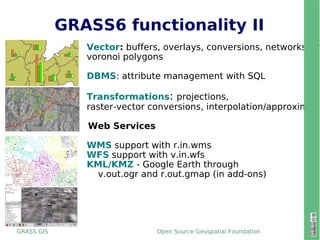
GRASS6 functionality II  Vector :  buffers, overlays, conversions, networks, linear referencing system, digitizing, topology, triangulation,  voronoi polygons DBMS : attribute management with SQL Transformations :  projections,  raster-vector conversions, interpolation/approximation Web Services WMS  support with r.in.wms
WFS  support with v.in.wfs
KML/KMZ  - Google Earth through   v.out.ogr and r.out.gmap (in add-ons) GRASS GIS  Open Source Geospatial Foundation
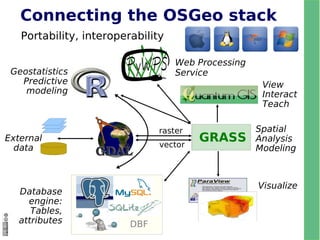
Connecting the OSGeo stack Spatial Analysis Modeling Portability, interoperability GRASS View  Interact Teach Geostatistics Predictive modeling Database engine: Tables, attributes DBF vector raster External  data Visualize Web Processing Service
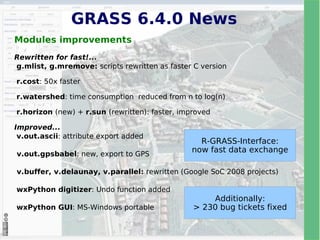
GRASS 6.4.0 News New modules NVIZ  for wxPython: new
r.external : link raster maps instead of import
v.colors : new, easy vector color tables

The upcoming GRASS GIS 6.4.0 release

  • 1.
    GRASS GIS 6.4.0Marku s Neteler & GRASS Development Team Fondazione Mach – Centro Ricerca e Innovazione Cagliari, 26-27 February 2009 GRASS GIS
  • 2.
    GRASS: 25 yearsof GFOSS 1987 USA (GRASS 2.0, no Web!) 1995 USA 1997, Univ. of Hannover, Germany 1999 Baylor Univ., USA 2002 ITC-irst Trento + Baylor ITC-irst 2002 Today...
  • 3.
    GRASS: command lineand graphical user interfaces 1982.. .. 1995 2007.. … today
  • 4.
    GRASS6 spatial datatypes 2D raster and imagery 2D/3D topological vector 3D raster (voxels)
  • 5.
    GRASS6 functionality I fully integrated 350+ modules
  • 6.
    add-ons managed onWiki + SVN raster: 2D/3D map algebra, DEM analysis, flowtracing, buffers, neighbourhood analysis, solar, cost surfaces, covariance, image : rectification, multispectral, radiometric correction, principal and canonical component analysis, reclassification visualization : 2D display, 3D interactive visualization
  • 7.
    GRASS6 functionality II Vector : buffers, overlays, conversions, networks, linear referencing system, digitizing, topology, triangulation, voronoi polygons DBMS : attribute management with SQL Transformations : projections, raster-vector conversions, interpolation/approximation Web Services WMS support with r.in.wms
  • 8.
    WFS supportwith v.in.wfs
  • 9.
    KML/KMZ -Google Earth through v.out.ogr and r.out.gmap (in add-ons) GRASS GIS Open Source Geospatial Foundation
  • 10.
    Connecting the OSGeostack Spatial Analysis Modeling Portability, interoperability GRASS View Interact Teach Geostatistics Predictive modeling Database engine: Tables, attributes DBF vector raster External data Visualize Web Processing Service
  • 11.
    GRASS 6.4.0 NewsNew modules NVIZ for wxPython: new
  • 12.
    r.external : linkraster maps instead of import
  • 13.
    v.colors : new,easy vector color tables

Editor's Notes

  • #2 Over the past decade free and open source software (FOSS) has moved into mainstreem and its growth includes a wide range of geospatial software tools. The presentation will briefly describe the principles of FOSS and provide an overview of major FOSS projects that support management, processing, analysis, visualization and on-line distribution of georeferenced data. Interoperability between the different tools enabled by the FOSS concept will be highlighted using examples of applications that combine software developed by several projects, such as GRASS, Mapserver, GDAL, PROJ, R-stats, PostGIS, paraview and others. Special focus will be given to the recent new developments in Geographic Resources Analysis Support System (GRASS, http://grass.itc.it ). Since its original design as a land management tool for military installationsthe system has evolved into one of the most comprehensive, general purpose GIS and support for environmental modeling has been an integral part of its development. Overview of the GRASS6 capabilities relevant to environmental modeling will be provided, including tools for working with 2D and 3D raster data, the completely redesigned topological 2D/3D vector engine, vector network analysis and SQL-based attribute management. Various graphical user interfaces, such as QGIS and JAVAGRASS, that are being used with GRASS will be introduced and enhancements to 3D dynamic visualization will be presented. Environmental modeling will be illustrated by examples in the area of coastal management and sediment pollution control using the latest lidar data and new or updated GRASS6 modules. The talk will conclude with discussion of visions for the future of FOSS geospatial modeling.