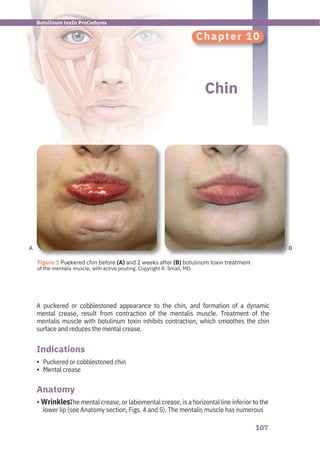
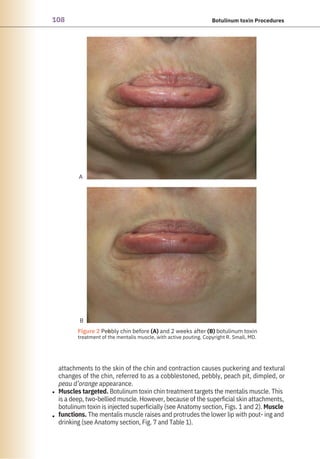
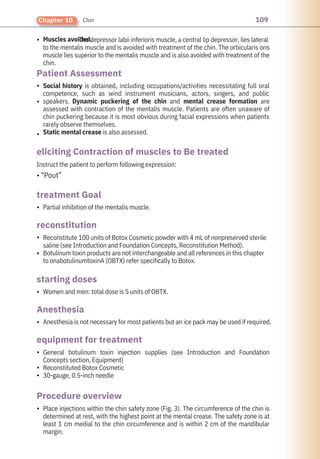
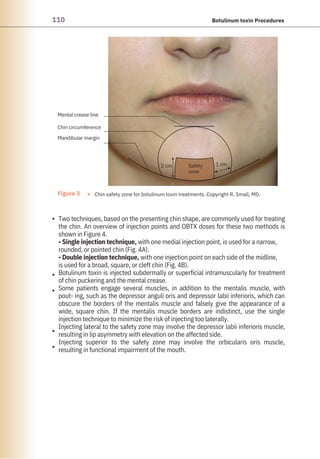
A Practical Guide to
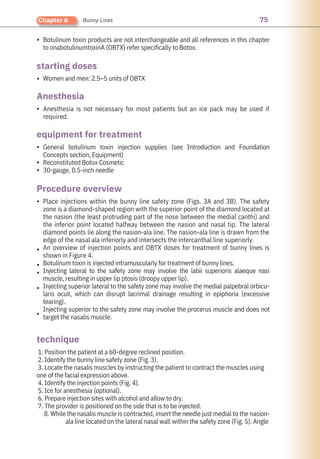
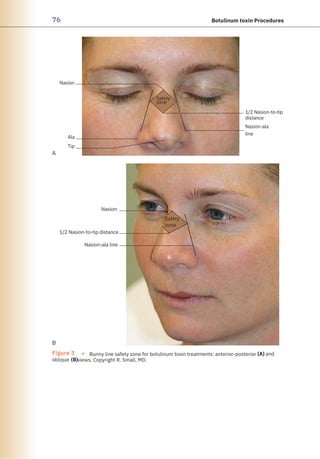
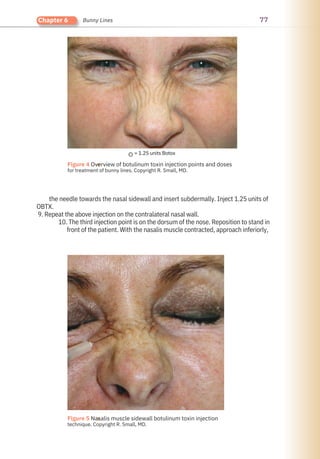
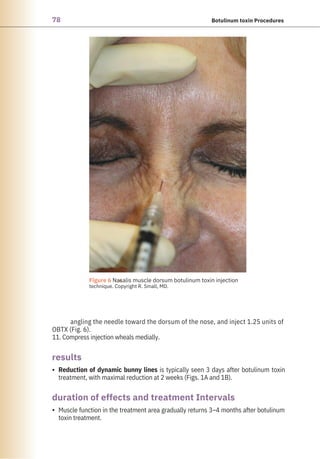
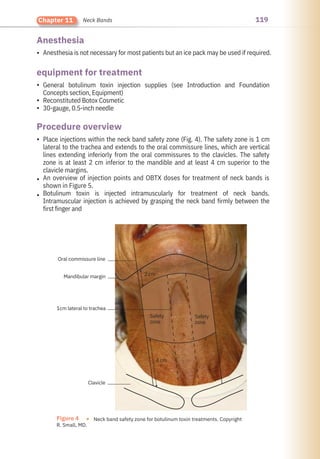
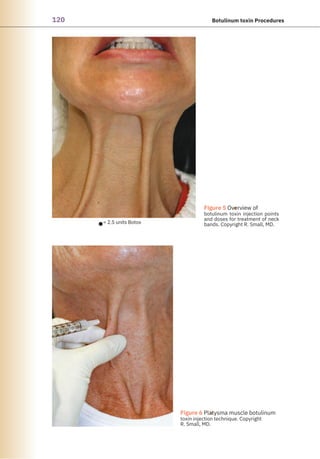
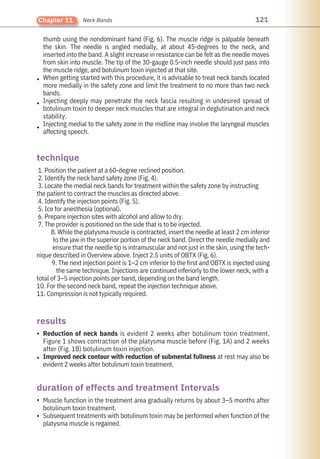
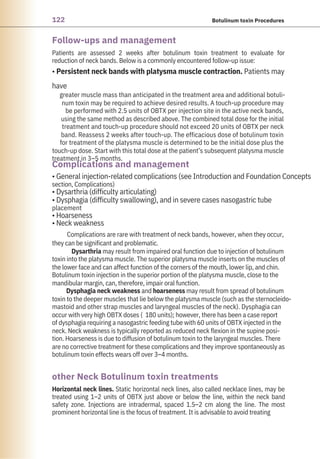
Botulinum
Toxin
Procedures
Dalano Hoang, D.C.
Clinic Director,
Monterey Bay Laser
Aesthetics, Capitola, CA
Assistant Clinical Professor,
Family and Community Medicine,
University of California, San Francisco, CA
Director, Medical Aesthetics Training,
Natividad Medical Center,
Family Medicine Residency Program—UCSF Affiliate,
Salinas, CA
Private Practice,
Capitola, CA
Associate Editor
A Practical Guide to
Botulinum
Toxin
Procedures
Series Editor
Rebecca Small, M.D., F.A.A.F.P.
Acquisitions Editor: Sonya Seigafuse
Product Manager: Kerry Barrett
Production Manager: Bridgett Dougherty
Senior Manufacturing Manager: Benjamin Rivera
Marketing Manager: Kim Schonberger
Creative Director: Doug Smock
Illustrator: Liana Bauman
Production Service: Aptara, Inc.
© 2012 by LIPPINCOTT WILLIAMS & WILKINS, a WOLTERS KLUWER business
Two Commerce Square
2001 Market Street
Philadelphia, PA 19103 USA
LWW.com
All photos copyright R. Small, M.D. unless otherwise noted.
All rights reserved. This book is protected by copyright. No part of this book may be reproduced in any form by
any means, including photocopying, or utilized by any information storage and retrieval system without written
permission from the copyright owner, except for brief quotations embodied in critical articles and reviews. Mate-
rials appearing in this book prepared by individuals as part of their official duties as U.S. government employees
are not covered by the above-mentioned copyright.
Printed in China
Library of Congress Cataloging-in-Publication Data
Small, Rebecca.
A practical guide to botulinum toxin procedures / Rebecca Small ;
associate editor, Dalano Hoang.
p. cm.
Includes bibliographical references and index.
ISBN-13: 978-1-60913-147-0 (alk. paper)
ISBN-10: 1-60913-147-9 (alk. paper)
1. Botulinum toxin–Therapeutic use. 2. Injections, Intradermal.
I. Hoang, Dalano. II. Title.
[DNLM: 1. Botulinum Toxins–therapeutic use–Handbooks. 2. Cosmetic
Techniques–Handbooks. 3. Injections, Intradermal–methods–Handbooks.
QV 39]
RL120.B66S63 2012
615′.778–dc23
2011015537
Care has been taken to confirm the accuracy of the information presented and to describe generally
accepted practices. However, the authors, editors, and publisher are not responsible for errors or omissions
or for any consequences from application of the information in this book and make no warranty, expressed or
implied, with respect to the currency, completeness, or accuracy of the contents of the publication.
Application of the informa- tion in a particular situation remains the professional responsibility of the
practitioner.
The authors, editors, and publisher have exerted every effort to ensure that drug selection and dosage set
forth in this text are in accordance with current recommendations and practice at the time of publication.
However, in view of ongoing research, changes in government regulations, and the constant flow of
information relating to drug therapy and drug reactions, the reader is urged to check the package insert for
each drug for any change in indications and dosage and for added warnings and precautions. This is
particularly important when the recom- mended agent is a new or infrequently employed drug.
Some drugs and medical devices presented in the publication have Food and Drug Administration (FDA)
clearance for limited use in restricted research settings. It is the responsibility of the health care providers to
ascertain the FDA status of each drug or device planned for use in their clinical practice.
To purchase additional copies of this book, call our customer service department at (800) 638-3030 or fax orders
to (301) 223-2320. International customers should call (301) 223-2300.
Visit Lippincott Williams & Wilkins on the Internet: at LWW.com. Lippincott Williams & Wilkins customer service
representatives are available from 8:30 am to 6 pm, EST.
10 9 8 7 6 5 4 3 2 1
v
Foreword
As a lecturer, editor, author, and medical reviewer,
I have had ample opportunity to evaluate many speakers
as well as extensive medical literature. After reviewing
this series of books on cosmetic procedures by Rebecca
Small, MD, I have concluded that it has to be one of the
best and most detailed, yet practical, presentation of the topics that I have ever
encoun- tered. As a physician whose practice is limited solely to providing office
procedures, I see great value in these texts for clinicians and the patients they serve.
The goal of medical care is to make patients feel better and to help them experi-
ence an improved quality of life that extends for an optimal, productive period. Inter-
ventions may be directed at the emotional/psychiatric, medical/physical, or self-
image areas.
For many physicians, performing medical procedures provides excitement in the
practice of medicine. The ability to see what has been accomplished in a concrete
way provides the positive feedback we all seek in providing care. Sometimes, it
involves removing a tumor. At other times, it may be performing a screening
procedure to be sure no disease is present. Maybe it is making patients feel better
about their appear- ance. For whatever reason, the “hands on” practice of medicine
is more rewarding for
some practitioners.
In the late 1980s and early 1990s, there was resurgence in the interest of perform-
ing procedures in primary care. It did not involve hospital procedures but rather those
that could be performed in the office. Coincidentally, patients also became interested
in less invasive procedures such as laparoscopic cholecystectomy, endometrial
ablation, and more. The desire for plastic surgery “extreme makeovers” waned, as
technology was developed to provide a gentle, more kind approach to “rejuvenation.”
Baby boom- ers were increasing in numbers and wanted to maintain their youthful
appearance. This not only improved self-image but it also helped when competing
with a younger generation both socially and in the workplace.
These forces then of technological advances, provider interest, and patient desires
have led to a huge increase in and demand for “minimally invasive procedures” that
has extended to all of medicine. Plastic surgery and aesthetic procedures have
indeed been affected by this movement. There have been many new procedures
developed in just the last 10–15 years along with constant updates and
improvements. As patient demand has soared for these new treatments, physicians
have found that there is a
whole new world of procedures they need to incorporate into their practice if they are
going to provide the latest in aesthetic services.
Rebecca Small, MD, the editor and author of this series of books on cosmetic
procedures, has been at the forefront of the aesthetic procedures movement. She
has written extensively and conducted numerous workshops to help others learn
the latest techniques. She has the practical experience to know just what the
physician needs to develop a practice and provides “the latest and the best” in
these books. Using her
knowledge of the field, she has selected the topics wisely to include
• A Practical Guide to: Botulinum Toxin Procedures
• A Practical Guide to: Dermal Filler Procedures
• A Practical Guide to: Skin Care Procedures and Products
• A Practical Guide to: Cosmetic Laser Procedures
Dr. Small does not just provide a cursory, quick review of these subjects. Rather,
they are an in-depth practical guide to performing these procedures. The emphasis
here
should be on “practical” and “in depth.” There is no extra esoteric waste of words, yet
every procedure is explained in a clear, concise, useful format that allows
practitioners
of all levels of experience to learn and gain from reading these texts.
The basic outline of these books consists of the pertinent anatomy, the specific
indications and contraindications, specific how to diagram and explanations on per-
forming the procedures, complications and how to deal with them, tables with com-
parisons and amounts of materials needed, before and after patient instructions as
well
as consent forms (an immense time-saving feature), sample procedure notes, and
a
list of supply sources. An extensive updated bibliography is provided in each text for
further reading. Photos are abundant depicting the performance of the procedures
as
well as before and after results. These comprehensive texts are clearly written for the
practitioner who wants to “learn everything” about the topics covered. Patients defi-
nitely desire these procedures, and Dr. Small has provided the information to meet the
physician demand to learn them.
For those interested in aesthetic procedures, these books will be a godsend. Even
for those not so interested in performing the procedures described, the reading is
easy
and interesting and will update the reader on what is currently available so they might
better advise their patients.
Dr. Small has truly written a one-of-a-kind series of books on Cosmetic Proce-
dures. It is my prediction that it will be received very well and be most appreciated by
all who make use of it.
John L. Pfenninger, MD, FAAFP
Founder and President, The Medical Procedures Center
PC Founder and Senior Consultant, The National Procedures Institute
Clinical Professor of Family Medicine, Michigan State College
of Human Medicine
vi Foreword
After the publication of the American Family Physi-
cian article “Aesthetic Procedures in Office Practice”
(December 2009 Vol. 80 No. 11), I have received
an overwhelming amount of inquiries and requests
for aesthetic training from primary care providers and
residents. The common thread of these inquiries has been a need for
educational resources and quality training in aesthetic procedures that can be
readily incorpo- rated into office practice.
As the trend in aesthetic medicine shifts away from surgical procedures that can
radically alter appearance, toward procedures that have minimal recovery time and
offer more subtle enhancements, the number of minimally invasive aesthetic proce-
dures performed continues to increase. These procedures, which include botulinum
toxin and dermal filler injections, lasers and light-based technologies, and exfoliation
treatments, have become the primary modalities for treatment of facial aging and
skin rejuvenation. This aesthetic procedures series is designed to be a truly practical
guide for physicians, physician assistants, nurse practitioners, residents in training,
and other health care providers interested in aesthetics. It is not comprehensive but
is inclusive of current minimally invasive aesthetic procedures that can be readily
incorporated into office practice, which directly benefit our patients and achieve
good outcomes with a
low incidence of side effects.
This botulinum toxin injection book is the first in the aesthetic practical guide
series and is intended for both novice practitioners learning a new aesthetic
procedure, and for more seasoned practitioners seeking advanced procedures.
Providers-in-train- ing and teachers can benefit from the step-by-step approach
and the online videos of each procedure performed by the author. Also included
are suggestions for manage- ment of the most commonly encountered issues seen
in follow-up visits. Seasoned practitioners may appreciate the concise summary of
each procedure’s complications and up-to-date suggestions for management,
combining aesthetic treatments to maxi- mize outcomes, current product
developments, and reimbursement recommendations. The Introduction and
Foundation Concepts section in this book, provides basic aesthetic medicine
concepts essential to successfully performing aesthetic procedures. Each chapter
is dedicated to a single botulinum toxin procedure with all relevant anat- omy
reviewed, including the target muscles and their functions, as well as the muscles
to be avoided. Injection points and the injection safety zones are highlighted to
help the providers perform the procedures more effectively and minimize
complications. The
Preface
vii
first three chapters, which cover treatment in the upper third of the face for frown lines,
horizontal forehead lines, and crow’s feet, are ideal for providers getting started with
cosmetic botulinum toxin treatments. The remaining chapters of the book cover more
advanced cosmetic treatments in the lower face, neck, and axillary hyperhidrosis.
This book is intended to serve as a guide and not a replacement for experience.
When learning aesthetic procedural skills, preceptorship with a skilled provider or a
formal training course is recommended to minimize undesired outcomes. When get-
ting started with these procedures, providers may consider performing initial treat-
ments on staff and family to get feedback and closely observe the effects of
botulinum toxin. Also consider receiving a treatment to gain personal knowledge
about botulinum
toxin procedures.
viii Preface
Acknowledgments
I have profound gratitude and respect for Dr. Dalano Hoang,
my associate editor and husband. He has been with me at every
step of the way as the clinic director of our aesthetic practice, and
much more. Although he personally does not perform aesthetic
procedures, his knowledge of the multiple aspects of aesthetic
medicine is extensive and invaluable. His clear, concise writing
style combined with my knowledge of minimally invasive aes-
thetic procedures yielded this straightforward procedure book.
A special thanks to Drs. John L. Pfenninger and E. J. Mayeaux, who have inspired
and supported me, and taught me much about educating and writing.
The University of California, San Francisco and the Natividad Medical Center family
medicine residents deserve special recognition. Their interest and enthusiasm for
aesthetic procedures led me to develop the first family medicine aesthetics training
curriculum in 2008. Special recognition is also due to the primary-care providers
who participated in my aesthetic courses at the American Academy of Family
Physicians’ national conferences over the years. Their questions and input further
solidified the
need for this practical guide series.
I am indebted to my Capitola office staff for their ongoing logistical and adminis-
trative support, which made it possible to write this series.
Special acknowledgments are due to those at Wolters Kluwer Health, who made
this book series possible, in particular, Kerry Barrett, Sonya Seigafuse, Freddie Patane,
Brett MacNaughton, and Doug Smock. It has been a pleasure working with Liana
Bauman, the gifted artist who created all of the illustrations for these books.
Finally, I would like to dedicate this book to my 5-year-old son, Kaidan Hoang,
for the unending hugs and kisses that greeted me no matter how late I got home from
working on this project.
ix
e.l.f. Hydrating Face Primer,
Makeup Primer For Flawless,
Smooth Skin & Long-Lasting Makeup,
Fills In Pores & Fine Lines, Vegan & Cruelty-free, Small
Click here to see
the product on Amazon
Contents
Foreword v
Preface vii
Acknowledgments
ix
Section 1: Anatomy 1
Section 2: Introduction and
Foundation Concepts 9
Section 3: Treatment Areas 23
1 Frown Lines 25
2 Horizontal Forehead Lines 35
3 Crow’s Feet 45
4 Lower Eyelid Wrinkles 55
5 Eyebrow Lift 65
6 Bunny Lines 73
7 Lip Lines 81
8 Gummy Smile 91
9 Marionette Lines 97
10 Chin 107
11 Neck Bands 115
12 Axillary Hyperhidrosis 125
Appendix 1: Botulinum Toxin Treatment Tables 133
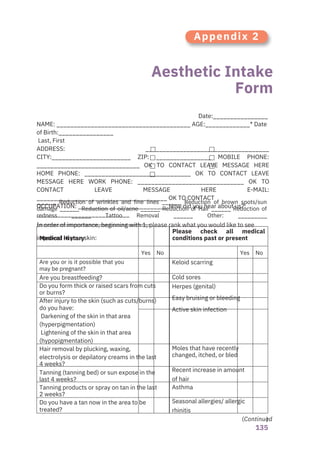
Appendix 2: Aesthetic Intake Form 135
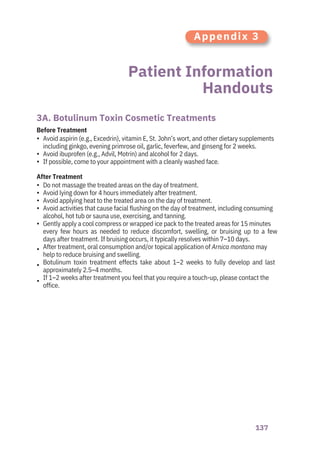
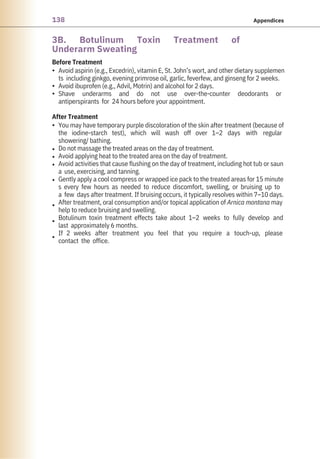
Appendix 3: Patient Information Handouts 137
Appendix 4: Consent Forms 139
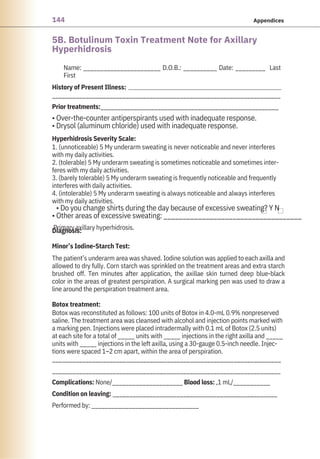
Appendix 5: Procedure Notes 143
Appendix 6: Supply Sources 145
Bibliography 147
Index 151
xi
BoTulInum ToxIn ProCedureS
A video clip for every procedure can be found on the book’s website.
1
S e c t i o n 1
Anatomy
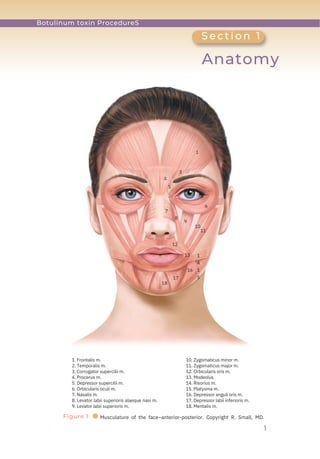
1. Frontalis m.
2. Temporalis m.
3. Corrugator supercilii m.
4. Procerus m.
5. Depressor supercilii m.
6. Orbicularis oculi m.
7. Nasalis m.
8. Levator labii superioris alaeque nasi m.
9. Levator labii superioris m.
18
7
4
5
12
8
17
3
9
13
16
1
1
4
1
5
10
11
6
2
10. Zygomaticus minor m.
11. Zygomaticus major m.
12. Orbicularis oris m.
13. Modeolus
14. Risorius m.
15. Platysma m.
16. Depressor anguli oris m.
17. Depressor labii inferioris m.
18. Mentalis m.
Figure 1 ● Musculature of the face–anterior-posterior. Copyright R. Small, MD.
Botulinum toxin ProcedureS
2 Botulinum toxin Procedures
4
18
7
5
12
17
8
3
9
13
16
1
14
15
10
11
6
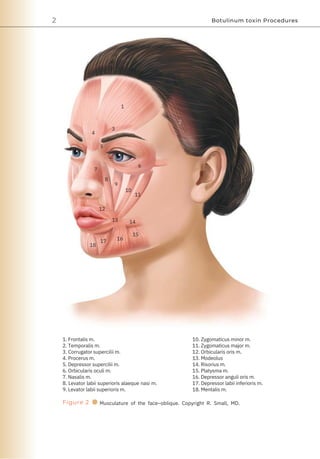
1. Frontalis m.
2. Temporalis m.
3. Corrugator supercilii m.
4. Procerus m.
5. Depressor supercilii m.
6. Orbicularis oculi m.
7. Nasalis m.
8. Levator labii superioris alaeque nasi m.
9. Levator labii superioris m.
2
10. Zygomaticus minor m.
11. Zygomaticus major m.
12. Orbicularis oris m.
13. Modeolus
14. Risorius m.
15. Platysma m.
16. Depressor anguli oris m.
17. Depressor labii inferioris m.
18. Mentalis m.
Figure 2 ● Musculature of the face–oblique. Copyright R. Small, MD.
3
Section 1 Anatomy
2
6
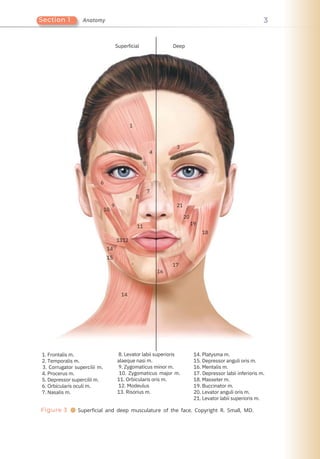
1. Frontalis m.
2. Temporalis m.
3. Corrugator supercilii m.
4. Procerus m.
5. Depressor supercilii m.
6. Orbicularis oculi m.
7. Nasalis m.
9
10
14
1312
14
15
1
Superficial
8
11
7
4
5
16
17
8. Levator labii superioris
alaeque nasi m.
9. Zygomaticus minor m.
10. Zygomaticus major m.
11. Orbicularis oris m.
12. Modeulus
13. Risorius m.
3
Deep
21
20
19
18
14. Platysma m.
15. Depressor anguli oris m.
16. Mentalis m.
17. Depressor labii inferioris m.
18. Masseter m.
19. Buccinator m.
20. Levator anguli oris m.
21. Levator labii superioris m.
Figure 3 ● Superficial and deep musculature of the face. Copyright R. Small, MD.
4 Botulinum toxin Procedures
3
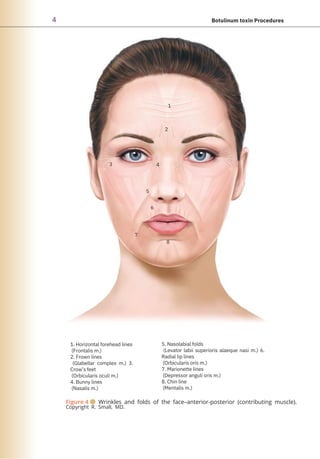
1. Horizontal forehead lines
(Frontalis m.)
2. Frown lines
(Glabellar complex m.) 3.
Crow’s feet
(Orbicularis oculi m.)
4. Bunny lines
(Nasalis m.)
7
5
6
4
2
8
1
5. Nasolabial folds
(Levator labii superioris alaeque nasi m.) 6.
Radial lip lines
(Orbicularis oris m.)
7. Marionette lines
(Depressor anguli oris m.)
8. Chin line
(Mentalis m.)
Figure 4 ● Wrinkles and folds of the face–anterior-posterior (contributing muscle).
Copyright R. Small, MD.
e.l.f. Monochromatic Multi Stick,
Luxuriously Creamy & Blendable Color,
For Eyes, Lips & Cheeks, Dazzling
Peony, 0.17 oz (5 g)
Click here to see
the product on
Amazon
5
Section 1 Anatomy
8
2
1
6
4
5
7
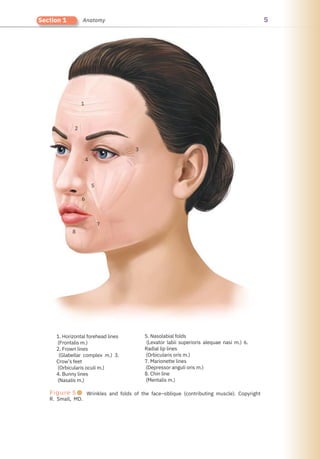
1. Horizontal forehead lines
(Frontalis m.)
2. Frown lines
(Glabellar complex m.) 3.
Crow’s feet
(Orbicularis oculi m.)
4. Bunny lines
(Nasalis m.)
3
5. Nasolabial folds
(Levator labii superioris alequae nasi m.) 6.
Radial lip lines
(Orbicularis oris m.)
7. Marionette lines
(Depressor anguli oris m.)
8. Chin line
(Mentalis m.)
Figure 5●
R. Small, MD.
Wrinkles and folds of the face–oblique (contributing muscle). Copyright
6 Botulinum toxin Procedures
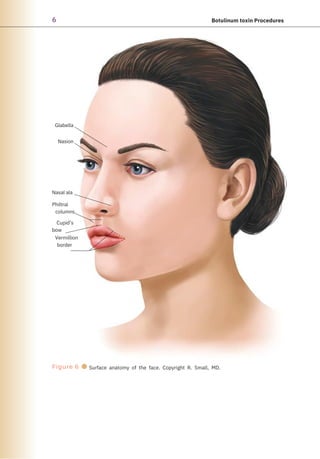
Nasion
Glabella
Nasal ala
Philtral
columns
Cupid’s
bow
Vermillion
border
Figure 6 ● Surface anatomy of the face. Copyright R. Small, MD.
7
Section 1 Anatomy
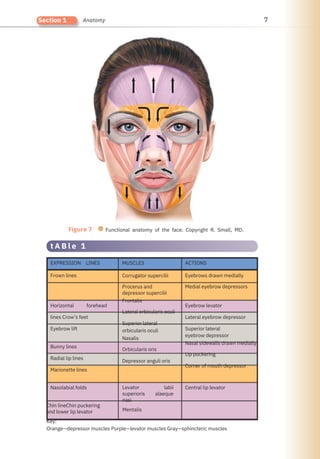
Figure 7 ● Functional anatomy of the face. Copyright R. Small, MD.
Nasolabial folds
Bunny lines
Radial lip lines
Marionette lines
EXPRESSION LINES
Frown lines
Horizontal forehead
lines Crow’s feet
Eyebrow lift
Levator labii
superioris alaeque
nasi
Mentalis
MUSCLES
Corrugator supercilii
Procerus and
depressor supercilii
Frontalis
Lateral orbicularis oculi
Superior lateral
orbicularis oculi
Nasalis
Orbicularis oris
Depressor anguli oris
Central lip levator
ACTIONS
Eyebrows drawn medially
Medial eyebrow depressors
Chin lineChin puckering
and lower lip levator
Key:
Orange—depressor muscles Purple—levator muscles Gray—sphincteric muscles
Eyebrow levator
Lateral eyebrow depressor
Superior lateral
eyebrow depressor
Nasal sidewalls drawn medially
Lip puckering
Corner of mouth depressor
t A B l e 1
9
Section 2
Introduction and
Foundation Concepts
Wrinkling is a prominent feature of skin aging. Skin naturally thins and loses volume
over time as dermal collagen, hyaluronic acid, and elastin gradually diminish. This
process of dermal atrophy is accelerated and compounded by sun exposure and other
extrinsic factors such as smoking. Hyperdynamic facial musculature also contributes
to formation of visible lines and wrinkles. Initially, lines and wrinkles are seen only
during active facial expression such as frowning, laughing, or smiling and are referred
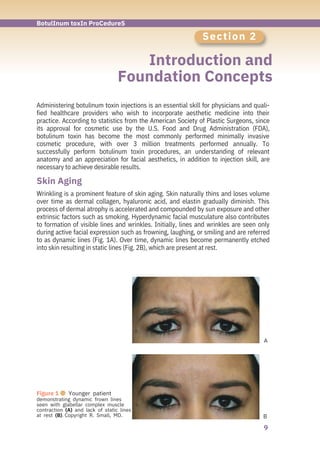
to as dynamic lines (Fig. 1A). Over time, dynamic lines become permanently etched
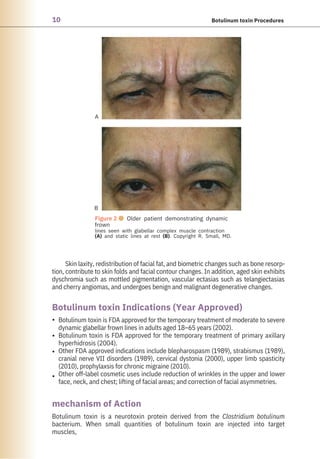
into skin resulting in static lines (Fig. 2B), which are present at rest.
Administering botulinum toxin injections is an essential skill for physicians and quali-
fied healthcare providers who wish to incorporate aesthetic medicine into their
practice. According to statistics from the American Society of Plastic Surgeons, since
its approval for cosmetic use by the U.S. Food and Drug Administration (FDA),
botulinum toxin has become the most commonly performed minimally invasive
cosmetic procedure, with over 3 million treatments performed annually. To
successfully perform botulinum toxin procedures, an understanding of relevant
anatomy and an appreciation for facial aesthetics, in addition to injection skill, are
necessary to achieve desirable results.
Skin Aging
B
A
Figure 1 ● Younger patient
demonstrating dynamic frown lines
seen with glabellar complex muscle
contraction (A) and lack of static lines
at rest (B). Copyright R. Small, MD.
BotulInum toxIn ProCedureS
10 Botulinum toxin Procedures
Botulinum toxin is a neurotoxin protein derived from the Clostridium botulinum
bacterium. When small quantities of botulinum toxin are injected into target
muscles,
Skin laxity, redistribution of facial fat, and biometric changes such as bone resorp-
tion, contribute to skin folds and facial contour changes. In addition, aged skin exhibits
dyschromia such as mottled pigmentation, vascular ectasias such as telangiectasias
and cherry angiomas, and undergoes benign and malignant degenerative changes.
Botulinum toxin is FDA approved for the temporary treatment of moderate to severe
dynamic glabellar frown lines in adults aged 18–65 years (2002).
Botulinum toxin is FDA approved for the temporary treatment of primary axillary
hyperhidrosis (2004).
Other FDA approved indications include blepharospasm (1989), strabismus (1989),
cranial nerve VII disorders (1989), cervical dystonia (2000), upper limb spasticity
(2010), prophylaxsis for chronic migraine (2010).
Other off-label cosmetic uses include reduction of wrinkles in the upper and lower
face, neck, and chest; lifting of facial areas; and correction of facial asymmetries.
mechanism of Action
Botulinum toxin Indications (Year Approved)
•
•
•
•
B
A
Figure 2 ● Older patient demonstrating dynamic
frown
lines seen with glabellar complex muscle contraction
(A) and static lines at rest (B). Copyright R. Small, MD.
Grande Cosmetics GrandeLASH-MD Lash
Enhancing Serum
Click here to see the
product on Amazon
11
Section 2 Introduction and Foundation Concepts
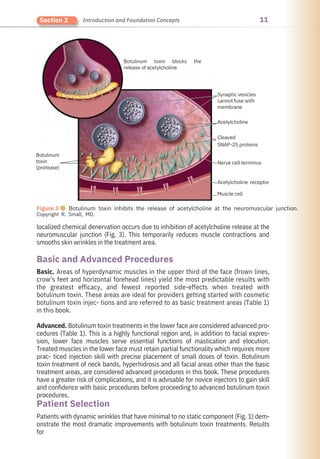
localized chemical denervation occurs due to inhibition of acetylcholine release at the
neuromuscular junction (Fig. 3). This temporarily reduces muscle contractions and
smooths skin wrinkles in the treatment area.
Patients with dynamic wrinkles that have minimal to no static component (Fig. 1) dem-
onstrate the most dramatic improvements with botulinum toxin treatments. Results
for
Basic. Areas of hyperdynamic muscles in the upper third of the face (frown lines,
crow’s feet and horizontal forehead lines) yield the most predictable results with
the greatest efficacy, and fewest reported side-effects when treated with
botulinum toxin. These areas are ideal for providers getting started with cosmetic
botulinum toxin injec- tions and are referred to as basic treatment areas (Table 1)
in this book.
Advanced. Botulinum toxin treatments in the lower face are considered advanced pro-
cedures (Table 1). This is a highly functional region and, in addition to facial expres-
sion, lower face muscles serve essential functions of mastication and elocution.
Treated muscles in the lower face must retain partial functionality which requires more
prac- ticed injection skill with precise placement of small doses of toxin. Botulinum
toxin treatment of neck bands, hyperhidrosis and all facial areas other than the basic
treatment areas, are considered advanced procedures in this book. These procedures
have a greater risk of complications, and it is advisable for novice injectors to gain skill
and confidence with basic procedures before proceeding to advanced botulinum toxin
procedures.
Patient Selection
Basic and Advanced Procedures
Figure 3 ● Botulinum toxin inhibits the release of acetylcholine at the neuromuscular junction.
Copyright R. Small, MD.
Botulinum
toxin
(protease)
Botulinum toxin blocks the
release of acetylcholine
Synaptic vesicles
cannot fuse with
membrane
Acetylcholine
Cleaved
SNAP-25 proteins
Nerve cell terminus
Acetylcholine receptor
Muscle cell
12 Botulinum Toxin Procedures
patients with static wrinkles (Fig. 2) are slower and cumulative, and may require two
to three consecutive treatments for significant improvements. Deep static lines may
not fully respond to botulinum toxin treatment alone and may require combination
treatment with dermal fillers or resurfacing procedures to achieve optimal results.
Severe static wrinkles and laxity, commonly seen in patients aged 65 years or older,
may require surgical intervention. Discussion regarding realistic expectations and
results during the evaluation and consultation process is essential.
Botulinum toxin treatments are directed at specifically targeted muscles or regions of
muscles to focally inhibit contraction and achieve intended effects such as smoothing
the skin or elevating facial areas. An optimal result yields a pleasing aesthetic effect
with minimal to no functional impairment in the treatment area and, lack of other
undesired effects and complications.
The degree of muscle inhibition achieved with botulinum toxin in a given treat-
ment area is determined by patient preference and the need to preserve functionality
Treatment Goals
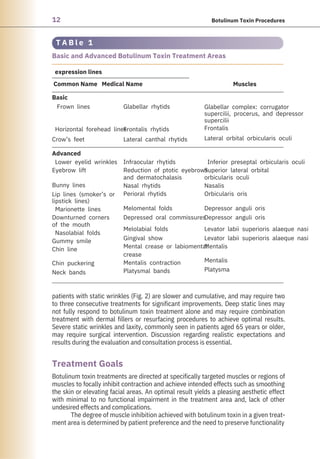
T A B l e 1
Basic and Advanced Botulinum Toxin Treatment Areas
Advanced
expression lines
Common Name Medical Name
Basic
Muscles
Frown lines
Lower eyelid wrinkles
Eyebrow lift
Bunny lines
Lip lines (smoker’s or
lipstick lines)
Marionette lines
Downturned corners
of the mouth
Nasolabial folds
Gummy smile
Chin line
Chin puckering
Neck bands
Horizontal forehead lines
Crow’s feet
Glabellar rhytids
Frontalis rhytids
Lateral canthal rhytids
Infraocular rhytids
Reduction of ptotic eyebrows
and dermatochalasis
Nasal rhytids
Perioral rhytids
Melomental folds
Depressed oral commissures
Melolabial folds
Gingival show
Mental crease or labiomental
crease
Mentalis contraction
Platysmal bands
Glabellar complex: corrugator
supercilii, procerus, and depressor
supercilii
Frontalis
Lateral orbital orbicularis oculi
Inferior preseptal orbicularis oculi
Superior lateral orbital
orbicularis oculi
Nasalis
Orbicularis oris
Depressor anguli oris
Levator labii superioris alaeque nasi
Mentalis
Mentalis
Platysma
13
Section 2 Introduction and Foundation Concepts
Botulinum toxin is the only treatment for dynamic wrinkles currently approved by the
FDA. Other treatments for static wrinkles include chemical peels; microdermabra-
sion; topical products such as retinoids, nonablative lasers for soft-tissue coagulation
and tightening such as infrared and radiofrequency; nonablative lasers for collagen
remodeling such as 1320-nm, 1540-nm, and Q-switched lasers; ablative and fractional
ablative lasers such as erbium and carbon dioxide lasers; and operative procedures
such as dermabrasion and plastic surgery.
in the treated muscles. For example, some patients may desire complete inhibition of
the glabellar complex muscles with botulinum toxin treatment of frown lines, whereas
others may desire partial muscle inhibition with retention of some ability to frown. A
greater degree of muscle inhibition is typically sought for treatments in the upper third
of the face than in the lower face. In the lower face, partial muscle inhibition is the
desired result as the treated muscles must still be able to perform essential functions,
such as eating, drinking, and speaking. Treatment goals listed in the following
chapters are based on common patient preferences and considerations of muscle
functionality in the treatment areas.
C. botulinum bacteria produce eight serotypes of botulinum toxin proteins (A, B, Ca, Cb,
D, E, F, and G). Botulinum toxin serotype A is the most potent and is used for cosmetic
indications. The FDA currently approve two botulinum toxin serotype A products for
the treatment of the glabellar complex muscles that form frown lines:
onabotulinumtoxinA (OBTX) (Botox® manufactured by Allergan, Inc, Irvine, CA) and
abobotulinumtoxinA (Dysport® manufactured by Medicis Pharmaceutical Corp,
Scottsdale, AZ), both of which were formerly known as botulinum toxin type A. OBTX
and abobotulinumtoxinA vary in formulation, diffusion capability, onset of action,
efficacy, and complications and are not interchangeable. All references to OBTX in this
book refer specifically to Botox.
Pregnancy or nursing
Active infection in the treatment area (e.g., herpes simplex, pustular acne, cellulitis)
Hypertrophic or keloidal scarring
Bleeding abnormality (e.g., thrombocytopenia, anticoagulant use)
Impaired healing (e.g., due to immunosuppression)
Skin atrophy (e.g., chronic oral steroid use, genetic syndromes such as Ehlers-
Danlos syndrome)
Active dermatoses in the treatment area (e.g., psoriasis, eczema)
Sensitivity or allergy to constituents of botulinum toxin (including botulinum toxin
serotype A, human albumin, lactose, or sodium succinate)
Milk allergy with abobotulinumtoxinA products
Gross motor weakness in the treatment area (e.g., due to polio, Bell’s palsy)
Neuromuscular disorder including, but not limited to amyotrophic lateral sclerosis,
myasthenia gravis, Lambert-Eaton syndrome, and myopathies
Products
Contraindications
Alternative therapies
•
•
•
•
•
•
•
•
•
•
•
14 Botulinum toxin Procedures
•
•
•
•
•
•
•
•
•
•
•
•
•
•
•
•
•
•
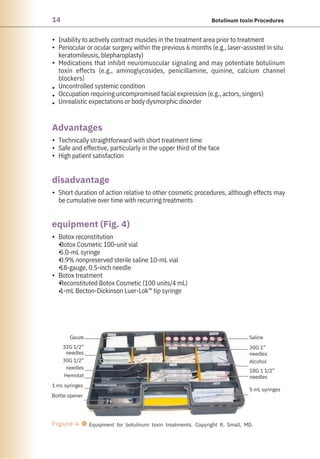
Botox reconstitution
Botox Cosmetic 100-unit vial
5.0-mL syringe
0.9% nonpreserved sterile saline 10-mL vial
18-gauge, 0.5-inch needle
Botox treatment
Reconstituted Botox Cosmetic (100 units/4 mL)
1-mL Becton-Dickinson Luer-Lok™ tip syringe
Technically straightforward with short treatment time
Safe and effective, particularly in the upper third of the face
High patient satisfaction
Short duration of action relative to other cosmetic procedures, although effects may
be cumulative over time with recurring treatments
Inability to actively contract muscles in the treatment area prior to treatment
Periocular or ocular surgery within the previous 6 months (e.g., laser-assisted in situ
keratomileusis, blepharoplasty)
Medications that inhibit neuromuscular signaling and may potentiate botulinum
toxin effects (e.g., aminoglycosides, penicillamine, quinine, calcium channel
blockers)
Uncontrolled systemic condition
Occupation requiring uncompromised facial expression (e.g., actors, singers)
Unrealistic expectations or body dysmorphic disorder
Advantages
disadvantage
equipment (Fig. 4)
Figure 4 ● Equipment for botulinum toxin treatments. Copyright R. Small, MD.
Gauze
32G 1/2”
needles
30G 1/2”
needles
Hemotat
1 mL syringes
Bottle opener
Saline
30G 1”
needles
Alcohol
18G 1 1/2”
needles
5 mL syringes
15
Section 2 Introduction and Foundation Concepts
• 30-gauge, 1-inch needle
• 30-gauge, 0.5-inch needle
• 32-gauge, 0.5-inch needle
• 3 3 3-inch nonwoven gauze
• Hand-held mirror (for consultation)
• Nonsterile gloves
• Alcohol pads
• Ice pack
• Bottle opener (for removing metal cap of the botulinum toxin vial for aspiration
of fluid at the bottom of the vial)
• Hemostat (for loosening tight Luer-Lok connections)
• Soft, white eyeliner pencil or surgical pen (for marking injection points)
Small volumes of reconstituted botulinum toxin solution are injected for cosmetic
facial and neck treatments and a 1.0-mL syringe is used for injections. Providers
must be aware of the exact dose associated with each 0.1-mL increment on the
syringe for accurate dosing of botulinum toxin.
• With the earlier Botox reconstitution concentration of 100 units/4 mL:
• 4.0 mL of reconstituted Botox has 100 units
• 1.0 mL of reconstituted Botox has 25 units
• 0.1 mL of reconstituted Botox has 2.5 units
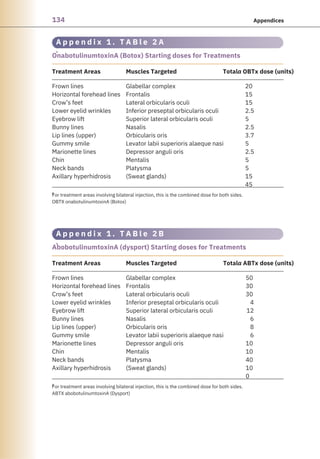
• A table for conversion of botulinum toxin dose (in units) to injection
volume (in
mL) for Botox reconstituted at 100 units/4 mL is given in the appendix (Appendix 1,
Table 1)
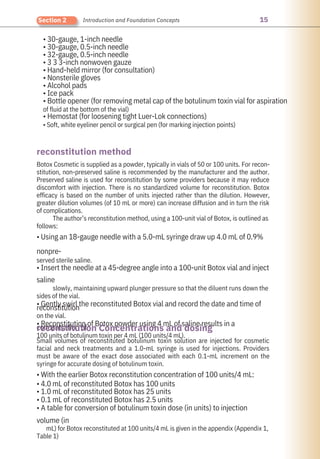
Botox Cosmetic is supplied as a powder, typically in vials of 50 or 100 units. For recon-
stitution, non-preserved saline is recommended by the manufacturer and the author.
Preserved saline is used for reconstitution by some providers because it may reduce
discomfort with injection. There is no standardized volume for reconstitution. Botox
efficacy is based on the number of units injected rather than the dilution. However,
greater dilution volumes (of 10 mL or more) can increase diffusion and in turn the risk
of complications.
The author’s reconstitution method, using a 100-unit vial of Botox, is outlined as
follows:
• Using an 18-gauge needle with a 5.0-mL syringe draw up 4.0 mL of 0.9%
nonpre-
served sterile saline.
• Insert the needle at a 45-degree angle into a 100-unit Botox vial and inject
saline
slowly, maintaining upward plunger pressure so that the diluent runs down the
sides of the vial.
• Gently swirl the reconstituted Botox vial and record the date and time of
reconstitution
on the vial.
• Reconstitution of Botox powder using 4 mL of saline results in a
concentration of
100 units of botulinum toxin per 4 mL (100 units/4 mL).
reconstitution method
reconstitution Concentrations and dosing
Highly Pigmented Eye Makeup Palette, Matt
Shimmer Metallic Eyeshadow Pallet Long
Lasting Blendable Natural Colors Make Up Ey
Shadows Cosmetics Gift Kit
Click here to see
the product on
Amazon
16 Botulinum toxin Procedures
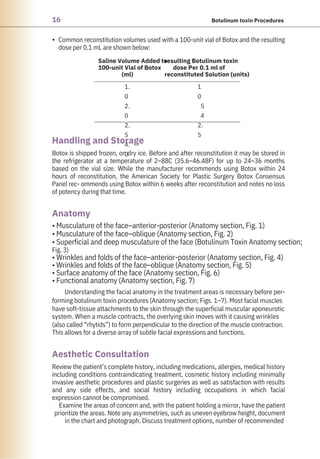
• Common reconstitution volumes used with a 100-unit vial of Botox and the resulting
dose per 0.1 mL are shown below:
Review the patient’s complete history, including medications, allergies, medical history
including conditions contraindicating treatment, cosmetic history including minimally
invasive aesthetic procedures and plastic surgeries as well as satisfaction with results
and any side effects, and social history including occupations in which facial
expression cannot be compromised.
Examine the areas of concern and, with the patient holding a mirror, have the patient
prioritize the areas. Note any asymmetries, such as uneven eyebrow height, document
in the chart and photograph. Discuss treatment options, number of recommended
• Musculature of the face–anterior-posterior (Anatomy section, Fig. 1)
• Musculature of the face–oblique (Anatomy section, Fig. 2)
• Superficial and deep musculature of the face (Botulinum Toxin Anatomy section;
Fig. 3)
• Wrinkles and folds of the face–anterior-posterior (Anatomy section, Fig. 4)
• Wrinkles and folds of the face–oblique (Anatomy section, Fig. 5)
• Surface anatomy of the face (Anatomy section, Fig. 6)
• Functional anatomy (Anatomy section, Fig. 7)
Understanding the facial anatomy in the treatment areas is necessary before per-
forming botulinum toxin procedures (Anatomy section; Figs. 1–7). Most facial muscles
have soft-tissue attachments to the skin through the superficial muscular aponeurotic
system. When a muscle contracts, the overlying skin moves with it causing wrinkles
(also called “rhytids”) to form perpendicular to the direction of the muscle contraction.
This allows for a diverse array of subtle facial expressions and functions.
Botox is shipped frozen, on dry ice. Before and after reconstitution it may be stored in
the refrigerator at a temperature of 2–88C (35.6–46.48F) for up to 24–36 months
based on the vial size. While the manufacturer recommends using Botox within 24
hours of reconstitution, the American Society for Plastic Surgery Botox Consensus
Panel rec- ommends using Botox within 6 weeks after reconstitution and notes no loss
of potency during that time.
Saline Volume Added to
100-unit Vial of Botox
(ml)
resulting Botulinum toxin
dose Per 0.1 ml of
reconstituted Solution (units)
1.
0
2.
0
2.
5
4.
0
1
0
5
4
2.
5
Anatomy
Handling and Storage
Aesthetic Consultation
17
Section 2 Introduction and Foundation Concepts
treatments, anticipated results, realistic expectations, and procedure cost. Review
risks of complications associated with the procedure. Formulate a cosmetic treatment
plan and record in the chart along with a consent form signed by the patient. It is
advisable to use photographic documentation (referred to as photodocumentation)
with aesthetic procedures and take dynamic and static photographs before botulinum
toxin treatment and approximately 2 weeks posttreatment to demonstrate results.
When discussing botulinum toxin or other injection treatments, it can be helpful to
use nonmedical or “patient friendly” terminology to reduce patient anxiety. Examples
of terms used include the following:
Anesthesia is typically not required for botulinum toxin treatments. If necessary, ice
or a topical anesthetic may be used before injections (e.g., benzocaine, lidocaine,
tetracaine).
Pretreat the anesthetic injection sites with a topical anesthetic such as benzocaine
20% : lidocaine 6% : tetracaine 4% (BLT) for 15–20 minutes prior to treatment.
Perform an aesthetic consultation and obtain informed consent.
Take pretreatment photographs with the patient actively contracting the muscles in
the intended treatment area and with the muscles at rest.
Document and discuss any notable asymmetries before treatment.
Minimize bruising by discontinuation of aspirin, vitamin E, St. John’s wort, and other
similar-action dietary supplements including: ginkgo, evening primrose oil, garlic,
feverfew, and ginseng for 2 weeks. Discontinue other nonsteroidal anti-
inflammatory medications and alcohol consumption 2 days before treatment.
For hyperhidrosis treatment, discontinue antiperspirant use 24 hours before
treatment and see Hyperhidrosis chapter for other preprocedure steps.
For the procedure, position the patient comfortably in a reclined position at about 65
degrees.
Identify the safety zone for treatment, which is the recommended region within
which injections are administered. Confining treatments to the safety zone area can
maximize efficacy and minimize side effects.
Locate the target muscles for botulinum toxin injection, which are located within the
safety zone, by instructing the patient to contract the relevant muscles using
particular facial expressions as outlined in each chapter.
Identify the botulinum toxin injection points and OBTX starting doses from the
overview figure, which accompanies each chapter.
Instruct the patient to close their eyes during the procedure.
Cleanse the treatment areas with alcohol prior to injection and allow alcohol to dry.
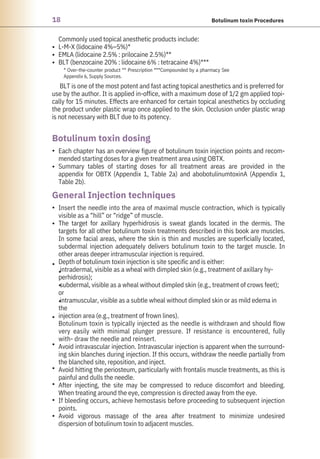
medical terms Patient-Friendly terms
• Toxin
• Paralyzes
• Pain
• Natural purified
protein • Relaxes
• Discomfort
Anesthesia
Preprocedure Checklist
•
•
•
•
•
•
•
•
•
•
•
18 Botulinum toxin Procedures
Commonly used topical anesthetic products include:
L-M-X (lidocaine 4%–5%)*
EMLA (lidocaine 2.5% : prilocaine 2.5%)**
BLT (benzocaine 20% : lidocaine 6% : tetracaine 4%)***
BLT is one of the most potent and fast acting topical anesthetics and is preferred for
use by the author. It is applied in-office, with a maximum dose of 1/2 gm applied topi-
cally for 15 minutes. Effects are enhanced for certain topical anesthetics by occluding
the product under plastic wrap once applied to the skin. Occlusion under plastic wrap
is not necessary with BLT due to its potency.
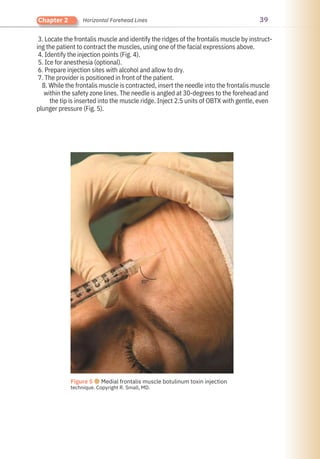
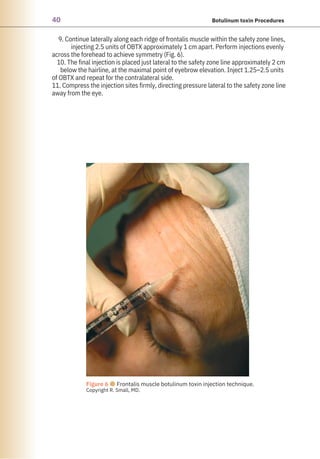
Insert the needle into the area of maximal muscle contraction, which is typically
visible as a “hill” or “ridge” of muscle.
The target for axillary hyperhidrosis is sweat glands located in the dermis. The
targets for all other botulinum toxin treatments described in this book are muscles.
In some facial areas, where the skin is thin and muscles are superficially located,
subdermal injection adequately delivers botulinum toxin to the target muscle. In
other areas deeper intramuscular injection is required.
Depth of botulinum toxin injection is site specific and is either:
intradermal, visible as a wheal with dimpled skin (e.g., treatment of axillary hy-
perhidrosis);
subdermal, visible as a wheal without dimpled skin (e.g., treatment of crows feet);
or
intramuscular, visible as a subtle wheal without dimpled skin or as mild edema in
the
injection area (e.g., treatment of frown lines).
Botulinum toxin is typically injected as the needle is withdrawn and should flow
very easily with minimal plunger pressure. If resistance is encountered, fully
with- draw the needle and reinsert.
Avoid intravascular injection. Intravascular injection is apparent when the surround-
ing skin blanches during injection. If this occurs, withdraw the needle partially from
the blanched site, reposition, and inject.
Avoid hitting the periosteum, particularly with frontalis muscle treatments, as this is
painful and dulls the needle.
After injecting, the site may be compressed to reduce discomfort and bleeding.
When treating around the eye, compression is directed away from the eye.
If bleeding occurs, achieve hemostasis before proceeding to subsequent injection
points.
Avoid vigorous massage of the area after treatment to minimize undesired
dispersion of botulinum toxin to adjacent muscles.
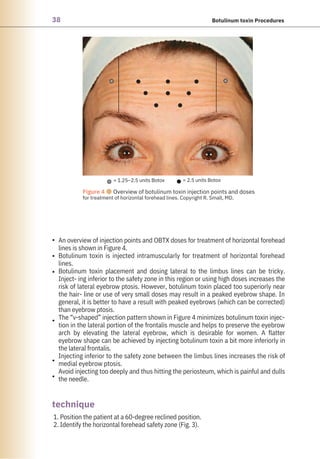
Each chapter has an overview figure of botulinum toxin injection points and recom-
mended starting doses for a given treatment area using OBTX.
Summary tables of starting doses for all treatment areas are provided in the
appendix for OBTX (Appendix 1, Table 2a) and abobotulinumtoxinA (Appendix 1,
Table 2b).
•
•
•
•
•
•
•
•
•
•
•
•
•
•
•
•
•
* Over-the-counter product ** Prescription ***Compounded by a pharmacy See
Appendix 6, Supply Sources.
Botulinum toxin dosing
General Injection techniques
19
Section 2 Introduction and Foundation Concepts
•
•
•
•
•
•
•
•
•
•
Marking the safety zone with a soft, white eyeliner pencil or surgical marker before
treatment can help with locating the target muscles for treatment and marking the
injection points can help with needle placement.
It is advisable to start with conservative botulinum toxin doses; each chapter has
recommended starting doses for a given treatment area.
Consider performing initial treatments on staff and family to get feedback and to
closely observe the effects of botulinum toxin.
Touch-up procedures may be performed 2 weeks after initial treatment if necessary.
Consider receiving a treatment to gain personal knowledge about botulinum toxin
procedures.
On the day of treatment, instruct the patient to avoid lying down for 4 hours
immediately after treatment, manipulating the treated area (e.g., a facial or massage),
and activities that can cause facial flushing (e.g., application of heat to the face, alcohol
consumption, exercising, and tanning) to reduce the likelihood of product migration
and risk of side effects. If bruising or swelling occurs, a soft ice pack may be applied for
10–15 minutes to each bruise site, every 1–2 hours until it is improved.
Changing needles after six or more injections maintains a sharp needle and
minimizes discomfort.
Treated muscles typically demonstrate partial reduction in function 2–3 days after
botulinum toxin treatment, with maximal reduction 1–2 weeks after treatment.
Effects are most noticeable for treatment of dynamic lines. Static lines are slower
to respond, typically requiring two to three consecutive treatments and may need
to be combined with other minimally invasive aesthetic procedures such as dermal
fillers or resurfac- ing procedures to achieve optimal results.
If desired reduction of muscle function is not achieved in the treatment area, a
touch-up procedure may be performed 2 weeks after the initial treatment. The
botulinum toxin touch-up dose varies according to the degree of movement
remaining in the target muscles and the treatment area (see individual chapters for
recommended touch-up doses). Reassess the treatment area 2 weeks after the
touch-up procedure. Document and include photographs at each visit.
Results of botulinum toxin treatments in the lower face are subtle, relative to the
dra- matic changes seen in the upper third of the face. Patients may be able to
appreciate pre- and posttreatment improvements in dynamic lines of the lower face
if they are schooled in how to make these assessments with animation. In addition
to a pleasing aesthetic effect, a desirable result in the lower face also has minimal to
no functional impairment of the mouth.
Muscle function in the treatment area gradually returns 2–5 months after treatment,
based on the dose of botulinum toxin used, treatment area and the patient’s physiol-
ogy. Subsequent treatments are recommended when muscles in the treated area
begin to contract, prior to facial lines returning to their pretreatment appearance.
Aftercare
results and Follow-up
learning the techniques
20 Botulinum toxin Procedures
Complications
Complications and side effects can be categorized into injection-related or botulinum
toxin– related issues. Botulinum toxin–related complications listed below may be
associated with treatment of the face and the neck. Complications associated with
treatment of specific areas, as well as suggestions for management, are discussed in
their respective chapters.
• Pain
• Bruising
• Erythema
• Edema
• Tenderness
• Headache
• Infection
• Numbness or dysesthesia
• Anxiety
• Vasovagal episode and loss of consciousness
Pain with botulinum toxin injections is minimal as small-gauge needles are used for
treatment. If necessary, injection pain can be reduced using ice, or topical anesthetics. Pre-
treatment anesthesia, especially with topical anesthetics, can prolong treatment times.
Bruising is commonly seen with botulinum toxin injections, particularly with treat-
ment of crow’s feet.. Bruises can range in size from pinpoint needle insertion marks
to quarter-sized ecchymoses or, rarely, hematomas. The time for resolution of a bruise
depends on the patients’ physiology and the size of the bruise, where larger bruises can
be visible for up to 1–2 weeks. Prevention of bruising is preferable and several sugges-
tions for bruise prevention are listed in the Preprocedure Checklist above. Immediate
application of ice and pressure to a bruise can minimize bruise formation. Bruises can
be camouflaged after treatment with makeup.
Erythema and edema are seen with almost all injections and usually resolve within
a few hours after treatment. Firm compression of injection sites, particularly on the fore-
head, can effectively reduce edema. Icing is not typically necessary for these issues.
Headaches can occur with upper face injections and usually resolve within a few
days after treatment without medication. There are reports of idiosyncratic severe
headaches lasting 2–4 weeks. Nonsteroidal anti-inflammatory medications are usually
adequate for management of headaches.
Infection is rare with botulinum toxin injections but can occur with any procedure
that breaches the skin. The most common etiologies are bacterial or reactivation of herpes
simplex. Prolonged pain, tenderness, and erythema, of more than a few days’ duration
can signal infection and necessitates evaluation, with infection-specific treatment.
Numbness or dysesthesia in the treatment area is extremely rare and could result
from nerve injury with injections.
Anxiety with injection procedures is common. Most patients have mild procedural
anxiety, which can be reduced by ensuring that injection equipment is not visible during
treatment and can be managed with breathing techniques. Rarely, patients with more severe
anxiety may require preprocedural medications (e.g., tramadol 50 mg, 1 tablet 30 minutes
prior to procedure). Vasovagal episodes associated with severe anxiety are possible, and it is
advisable for offices to have emergency protocols when performing injection procedures.
General Injection-related Complications
21
Section 2 Introduction and Foundation Concepts
Botulinum toxin–related Complications
Botulinum toxin treatments in the upper third of the face can be safely and easily com-
bined with treatment in the lower face during a given visit.
• Localized burning or stinging pain during injection
• Blepharoptosis (droopy eyelid)
• Eyebrow ptosis (droopy eyebrow)
• Ectropion of the lower eyelid (eyelid margin eversion)
• Lagophthalmos (incomplete eyelid closure)
• Xerophthalmia (dry eyes)
• Epiphora (excess tearing)
• Diplopia (double vision)
• Impaired blink reflex
• Photophobia (light sensitivity)
• Globe trauma
• Infraorbital festooning (worsening of eye bags)
• Lip ptosis with resultant smile asymmetry
• Oral incompetence with resultant drooling and impaired speaking, eating,
or drinking • Cheek flaccidity
• Dysarthria (difficulty articulating)
• Dysphagia (difficulty swallowing), necessitating nasogastric tube
placement in severe
cases
• Hoarseness
• Neck weakness
• Facial asymmetry, alteration, or poor aesthetic result
• Inadequate reduction of wrinkles or lack of intended effect in the
treatment area
• Worsening wrinkles in areas adjacent to the treatment area
• Weakening muscles adjacent to the treatment area
• Autoantibodies against botulinum toxin. Autoantibodies may be present or
develop
after injection, rendering treatments ineffective (1–2% of patients treated for cosmetic
indications per Allergan)
• Extremely rare, immediate hypersensitivity reaction with signs of urticaria,
edema,
and a remote possibility of anaphylaxis
• Case reports of severe side effects due to distant spread from the site of
injection have been
reported with large doses of botulinum toxin, including: generalized muscle weakness,
urinary incontinence, respiratory difficulties, and death due to respiratory compromise.
These complications have been reported in patients hours to weeks after receiving
large doses of botulinum toxin for noncosmetic indications (e.g., 300 units in the calf
muscles). They have not been reported with cosmetic use of botulinum toxin at the
labeled dose
of 20 units (for glabellar lines) or 100 units (for primary axillary hyperhidrosis).
Some complications can be improved with botulinum toxin treatment of muscles that
antagonize the affected muscles. However, for most complications, there are no
correc-
tive treatments and they spontaneously resolve as botulinum toxin effects diminish.
Utilizing precise injection technique into targeted muscles and minimizing diffusion
of botulinum toxin with low reconstitution volumes, reduce involvement of adjacent
muscles and decrease the likelihood of undesired effects and complications.
Botulinum toxin treatments in multiple Facial Areas
22 Botulinum toxin Procedures
Cosmetic botulinum toxin treatments are not covered by insurance. Fees for botulinum
toxin injections are usually based on the number of units used, or on the treatment
site. Prices vary widely according to community pricing in different geographic regions
and range from $10–$25 per unit or $250–$500 per site. The Current Procedural
Terminol- ogy (CPT) designation for botulinum toxin procedures of the face is
chemodenervation of muscles innervated by the facial nerve (CPT code 64612).
IncobotulinumtoxinA (Xeomin® manufactured by Merz Pharmaceuticals, Greensboro,
NC), and PurTox® (manufactured by Mentor Corporation, Santa Barbara, CA) are new
injectable botulinum toxin products currently undergoing FDA approval for cosmetic
use in the United States.
RT001 or ReVance (ReVance Therapeutics, Newark, CA) is a physician-applied topical
botulinum toxin under investigation for cosmetic applications including treat-
ment of the crow’s feet and axillary hyperhidrosis.
Concomitant botulinum toxin treatment of multiple areas in the upper face may
be performed; however, this can decrease expressivity. Some patients may, therefore,
prefer to space out treatments in the upper face. For example, two areas may be
treated together, such as the crow’s feet and frown, and 1–2 months later, treatment
of the forehead and an eyebrow lift may be performed.
The lower face is a highly functional region, responsible for speaking, eating, and
drinking. Excessive weakening of the muscles in this region can result in significant
complications from functional impairment and it is advisable to use caution when
treat- ing multiple areas in the lower face and the neck. A conservative approach is to
rotate treatment areas every 3–4 months such that only one area is treated with
botulinum toxin at any give time. For example, if botulinum toxin treatment of upper lip
lines and mental crease are desired, then the orbicularis oris muscle may be treated
initially, fol- lowed by treatment of the mentalis muscle 3 months later once the upper
lip botulinum
toxin effect has resolved.
Facial aging is a multifaceted process involving not only the formation of facial lines
and wrinkles but also contour changes, skin laxity, formation of dyschromic and
vascular lesions, undesired hair growth, as well as benign and malignant degenerative
changes. Achieving optimal rejuvenation results often requires a combination of
treatments to address these different aspects of facial aging. Botulinum toxin can be
easily combined with other minimally invasive aesthetic procedures such as dermal
fillers to treat static lines and volume loss; lasers and intense pulsed light for hair
reduction, skin resurfac- ing, and treatment of benign pigmented and vascular lesion;
exfoliation procedures like microdermabrasion and chemical peels; and topical skin
care products.
Minimally invasive aesthetic procedures like botulinum toxin offer patients a means
to enhance their appearance in a subtle, natural way and maintain a healthy youthful
appearance. From the provider’s perspective, these procedures can be readily
incorpo- rated into practice to provide office-based aesthetic care.
Combining Aesthetic treatments
new Products and Current developments
reimbursement and Financial Considerations
Section 3
Treatment Areas
23
BoTulinum Toxin ProcedureS
JUNO & Co. Clean 10 Cleansing Balm
10 Ingredients Makeup Remover 85g
3.0oz
Click here to see the
product on Amazon
25
A B
Frown Lines
Frown lines
Medial eyebrow elevation
Frown lines, or glabellar rhytids, are vertical lines between the medial
eyebrows (see Anatomy section, Figs. 4 and 5).
. Botulinum toxin frown line treatment targets the glabellar
complex depressor muscles, which include the corrugator supercilii, procerus,
and depressor supercilii (see Anatomy section, Figs. 1 and 2). The corrugator
Dynamic frown lines result from contraction of glabellar complex muscles. These
lines convey irritation, frustration, or anger and reduction of frown lines is one of the
most common cosmetic complaints. Botulinum toxin treatment of the glabellar com-
plex reduces frown lines by inhibiting contraction of these muscles and smoothing
the overlying skin.
Anatomy
Indications
•
•
• Wrinkles.
• Muscles targeted
●
Figure 1 Frown lines before (A) and 1 month after (B) botulinum toxin treatment of
the glabellar complex, with active frowning. Copyright R. Small, MD.
BotuLInum toxIn ProCedures
Chapter 1
26 Botulinum Toxin Procedures
2
4
3
1. Frontalis m.
2. Procerus m.
3. Corrugator supercilii m.
1
5
4. Depressor supercilii m.
5. Orbicularis oculi m.
Figure 2 ●
MD.
Glabellar complex detailed anatomy. Copyright R. Small,
Instruct the patient to perform any of the following expressions:
• “Frown like you’re mad”
• “Concentrate”
Dynamic (with muscle contraction) and static (at rest) frown lines are assessed.
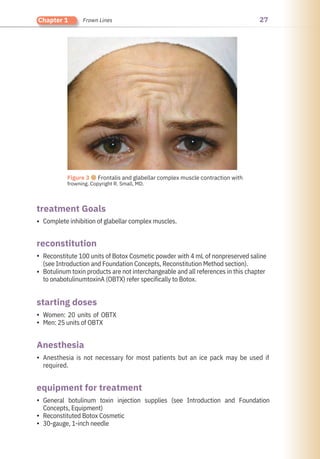
Concomitant frontalis and glabellar complex muscle contraction with frowning
(Fig. 3) are assessed. Patients who use both these muscle groups when frowning may
require treatment of the frontalis in addition to treatment of the glabellar complex
muscles to smooth frown lines.
and depressor supercilii muscles lie beneath the frontalis and procerus muscles
(Fig. 2).
Muscle functions. Contraction of the glabellar complex muscles draws the
eyebrows medially and inferiorly (see Anatomy section; Fig. 7 and Table 1).
Muscles avoided. The portion of the frontalis muscle which is lateral to the corruga-
tor muscles is avoided with treatment of the glabellar complex.
•
•
•
•
Patient Assessment
Eliciting Contraction of Muscles to Be Treated
27
Chapter 1 Frown Lines
Figure 3 ●Frontalis and glabellar complex muscle contraction with
frowning. Copyright R. Small, MD.
Anesthesia
reconstitution
starting doses
treatment Goals
equipment for treatment
•
•
•
•
•
•
•
•
•
Women: 20 units of OBTX
Men: 25 units of OBTX
Complete inhibition of glabellar complex muscles.
Anesthesia is not necessary for most patients but an ice pack may be used if
required.
Reconstitute 100 units of Botox Cosmetic powder with 4 mL of nonpreserved saline
(see Introduction and Foundation Concepts, Reconstitution Method section).
Botulinum toxin products are not interchangeable and all references in this chapter
to onabotulinumtoxinA (OBTX) refer specifically to Botox.
General botulinum toxin injection supplies (see Introduction and Foundation
Concepts, Equipment)
Reconstituted Botox Cosmetic
30-gauge, 1-inch needle
28 Botulinum toxin Procedures
Figure 4 ●
Small, MD.
Frown line safety zone for botulinum toxin treatments. Copyright R.
Figure 5 ●Overview of botulinum toxin injection points and doses for treatment of frown
lines. Copyright R. Small, MD.
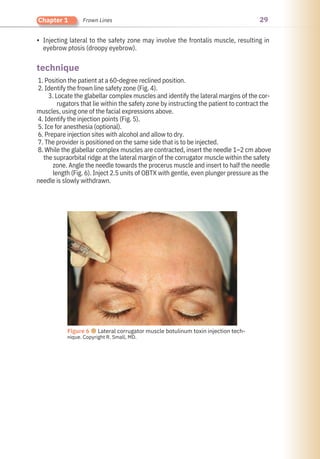
= 2.5 units Botox
= 2.5–5 units Botox
Safety zone
=5 units Botox, insert needle
in direction of arrow
1 cm
Supraorbita
l r idge
Lateral
limbus line
Corrugator m. margin
Procerus m.
Corrugator m. margin
Procedure overview
•
•
•
•
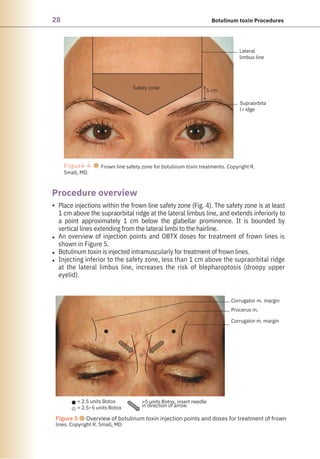
Place injections within the frown line safety zone (Fig. 4). The safety zone is at least
1 cm above the supraorbital ridge at the lateral limbus line, and extends inferiorly to
a point approximately 1 cm below the glabellar prominence. It is bounded by
vertical lines extending from the lateral limbi to the hairline.
An overview of injection points and OBTX doses for treatment of frown lines is
shown in Figure 5.
Botulinum toxin is injected intramuscularly for treatment of frown lines.
Injecting inferior to the safety zone, less than 1 cm above the supraorbital ridge
at the lateral limbus line, increases the risk of blepharoptosis (droopy upper
eyelid).
29
Chapter 1 Frown Lines
• Injecting lateral to the safety zone may involve the frontalis muscle, resulting in
eyebrow ptosis (droopy eyebrow).
1. Position the patient at a 60-degree reclined position.
2. Identify the frown line safety zone (Fig. 4).
3. Locate the glabellar complex muscles and identify the lateral margins of the cor-
rugators that lie within the safety zone by instructing the patient to contract the
muscles, using one of the facial expressions above.
4. Identify the injection points (Fig. 5).
5. Ice for anesthesia (optional).
6. Prepare injection sites with alcohol and allow to dry.
7. The provider is positioned on the same side that is to be injected.
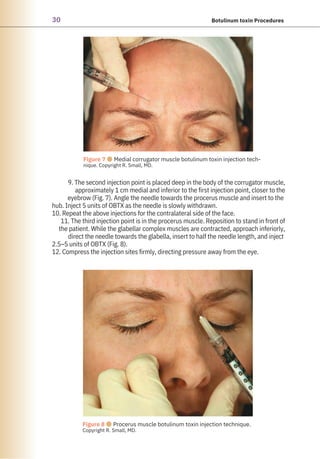
8. While the glabellar complex muscles are contracted, insert the needle 1–2 cm above
the supraorbital ridge at the lateral margin of the corrugator muscle within the safety
zone. Angle the needle towards the procerus muscle and insert to half the needle
length (Fig. 6). Inject 2.5 units of OBTX with gentle, even plunger pressure as the
needle is slowly withdrawn.
technique
Figure 6 ●Lateral corrugator muscle botulinum toxin injection tech-
nique. Copyright R. Small, MD.
30 Botulinum toxin Procedures
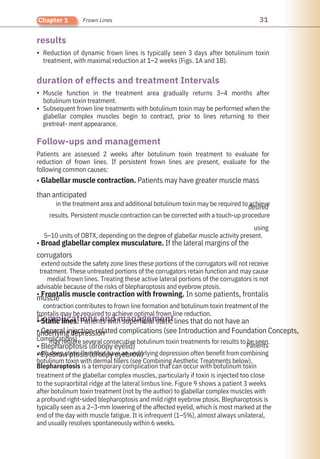
Figure 8 ●Procerus muscle botulinum toxin injection technique.
Copyright R. Small, MD.
Figure 7 ●Medial corrugator muscle botulinum toxin injection tech-
nique. Copyright R. Small, MD.
9. The second injection point is placed deep in the body of the corrugator muscle,
approximately 1 cm medial and inferior to the first injection point, closer to the
eyebrow (Fig. 7). Angle the needle towards the procerus muscle and insert to the
hub. Inject 5 units of OBTX as the needle is slowly withdrawn.
10. Repeat the above injections for the contralateral side of the face.
11. The third injection point is in the procerus muscle. Reposition to stand in front of
the patient. While the glabellar complex muscles are contracted, approach inferiorly,
direct the needle towards the glabella, insert to half the needle length, and inject
2.5–5 units of OBTX (Fig. 8).
12. Compress the injection sites firmly, directing pressure away from the eye.
31
Chapter 1 Frown Lines
results
Follow-ups and management
Complications and management
duration of effects and treatment Intervals
•
•
•
Reduction of dynamic frown lines is typically seen 3 days after botulinum toxin
treatment, with maximal reduction at 1–2 weeks (Figs. 1A and 1B).
• General injection-related complications (see Introduction and Foundation Concepts,
Complications)
• Blepharoptosis (droopy eyelid)
• Eyebrow ptosis (droopy eyebrow)
Blepharoptosis is a temporary complication that can occur with botulinum toxin
treatment of the glabellar complex muscles, particularly if toxin is injected too close
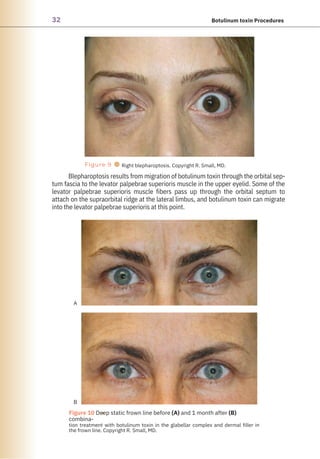
to the supraorbital ridge at the lateral limbus line. Figure 9 shows a patient 3 weeks
after botulinum toxin treatment (not by the author) to glabellar complex muscles with
a profound right-sided blepharoptosis and mild right eyebrow ptosis. Blepharoptosis is
typically seen as a 2–3-mm lowering of the affected eyelid, which is most marked at the
end of the day with muscle fatigue. It is infrequent (1–5%), almost always unilateral,
and usually resolves spontaneously within 6 weeks.
Muscle function in the treatment area gradually returns 3–4 months after
botulinum toxin treatment.
Subsequent frown line treatments with botulinum toxin may be performed when the
glabellar complex muscles begin to contract, prior to lines returning to their
pretreat- ment appearance.
Patients are assessed 2 weeks after botulinum toxin treatment to evaluate for
reduction of frown lines. If persistent frown lines are present, evaluate for the
following common causes:
• Glabellar muscle contraction. Patients may have greater muscle mass
than anticipated
in the treatment area and additional botulinum toxin may be required to achieve
desired
results. Persistent muscle contraction can be corrected with a touch-up procedure
using
5–10 units of OBTX, depending on the degree of glabellar muscle activity present.
• Broad glabellar complex musculature. If the lateral margins of the
corrugators
extend outside the safety zone lines these portions of the corrugators will not receive
treatment. These untreated portions of the corrugators retain function and may cause
medial frown lines. Treating these active lateral portions of the corrugators is not
advisable because of the risks of blepharoptosis and eyebrow ptosis.
• Frontalis muscle contraction with frowning. In some patients, frontalis
muscle
contraction contributes to frown line formation and botulinum toxin treatment of the
frontalis may be required to achieve optimal frown line reduction.
• Static lines. Patients with superficial static lines that do not have an
underlying depression
may require several consecutive botulinum toxin treatments for results to be seen.
Patients
with deep static lines that have an underlying depression often benefit from combining
botulinum toxin with dermal fillers (see Combining Aesthetic Treatments below).
L'Oréal Paris Makeup Magic Skin Beautifier
Anti-Redness BB Cream Tinted Moisturizer, 1
Ounce
Click here to see
the product on
Amazon
32 Botulinum toxin Procedures
Figure 9
●
● Right blepharoptosis. Copyright R. Small, MD.
Figure 10 Deep static frown line before (A) and 1 month after (B)
combina-
tion treatment with botulinum toxin in the glabellar complex and dermal filler in
the frown line. Copyright R. Small, MD.
A
B
Blepharoptosis results from migration of botulinum toxin through the orbital sep-
tum fascia to the levator palpebrae superioris muscle in the upper eyelid. Some of the
levator palpebrae superioris muscle fibers pass up through the orbital septum to
attach on the supraorbital ridge at the lateral limbus, and botulinum toxin can migrate
into the levator palpebrae superioris at this point.
33
Chapter 1 Frown Lines
Charges for botulinum toxin treatment of frown lines range from $200–$500 per
treat- ment or $10–$25 per unit of OBTX.
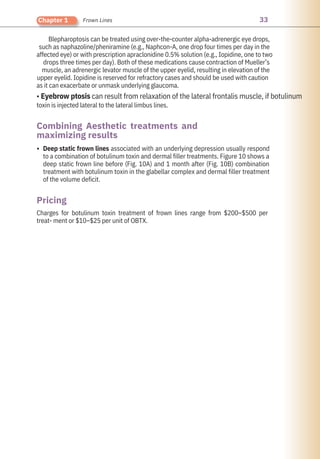
Deep static frown lines associated with an underlying depression usually respond
to a combination of botulinum toxin and dermal filler treatments. Figure 10 shows a
deep static frown line before (Fig. 10A) and 1 month after (Fig. 10B) combination
treatment with botulinum toxin in the glabellar complex and dermal filler treatment
of the volume deficit.
Blepharoptosis can be treated using over-the-counter alpha-adrenergic eye drops,
such as naphazoline/pheniramine (e.g., Naphcon-A, one drop four times per day in the
affected eye) or with prescription apraclonidine 0.5% solution (e.g., Iopidine, one to two
drops three times per day). Both of these medications cause contraction of Mueller’s
muscle, an adrenergic levator muscle of the upper eyelid, resulting in elevation of the
upper eyelid. Iopidine is reserved for refractory cases and should be used with caution
as it can exacerbate or unmask underlying glaucoma.
• Eyebrow ptosis can result from relaxation of the lateral frontalis muscle, if botulinum
toxin is injected lateral to the lateral limbus lines.
•
Pricing
Combining Aesthetic treatments and
maximizing results
35
Chapter 2
Horizontal
Forehead Lines
Horizontal forehead lines
Lateral eyebrow elevation
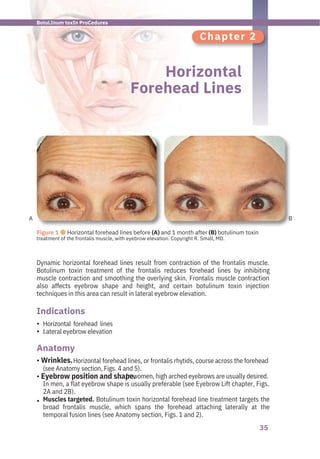
Dynamic horizontal forehead lines result from contraction of the frontalis muscle.
Botulinum toxin treatment of the frontalis reduces forehead lines by inhibiting
muscle contraction and smoothing the overlying skin. Frontalis muscle contraction
also affects eyebrow shape and height, and certain botulinum toxin injection
techniques in this area can result in lateral eyebrow elevation.
Horizontal forehead lines, or frontalis rhytids, course across the forehead
(see Anatomy section, Figs. 4 and 5).
In women, high arched eyebrows are usually desired.
In men, a flat eyebrow shape is usually preferable (see Eyebrow Lift chapter, Figs.
2A and 2B).
Muscles targeted. Botulinum toxin horizontal forehead line treatment targets the
broad frontalis muscle, which spans the forehead attaching laterally at the
temporal fusion lines (see Anatomy section, Figs. 1 and 2).
Anatomy
Indications
•
•
•
• Wrinkles.
• Eyebrow position and shape.
A B
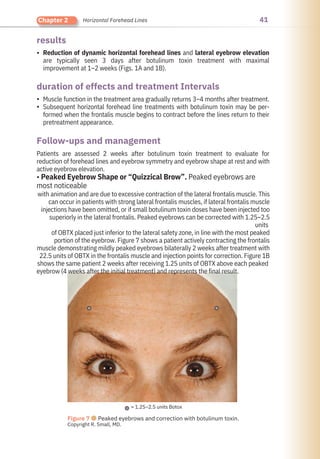
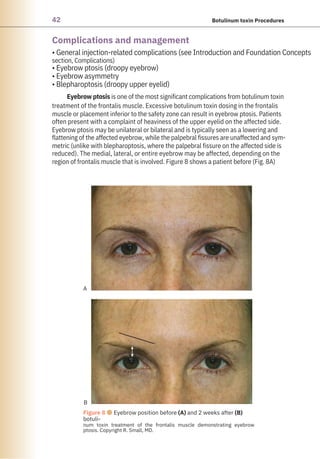
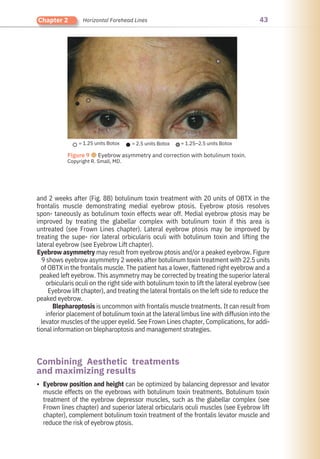
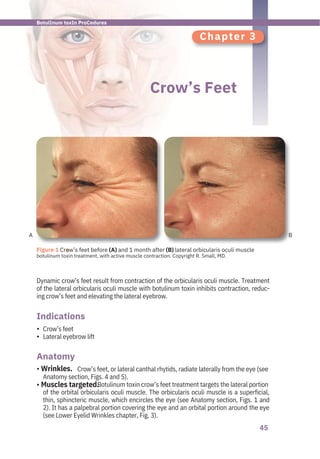
Figure 1 ●Horizontal forehead lines before (A) and 1 month after (B) botulinum toxin
treatment of the frontalis muscle, with eyebrow elevation. Copyright R. Small, MD.
BotuLInum toxIn ProCedures
36 Botulinum toxin Procedures
•
•
•
•
•
Instruct the patient to perform any of the following expressions:
• “Raise your eyebrows up like you’re surprised”
• “Lift up your forehead”
Muscle functions. Frontalis muscle fibers are oriented vertically and contraction
of this levator muscle raises the eyebrows. The inferior 2-cm portion has the most
significant effect on eyebrow height and shape (see Anatomy section, Fig. 7 and
Table 1).
Complete inhibition of the medial frontalis muscle to reduce horizontal forehead
lines with partial inhibition of the lateral frontalis muscle in order to maintain a
desirable eyebrow shape.
Dynamic (with muscle contraction) and static (at rest) horizontal forehead lines
are assessed.
Dynamic and static eyebrow shape is assessed.
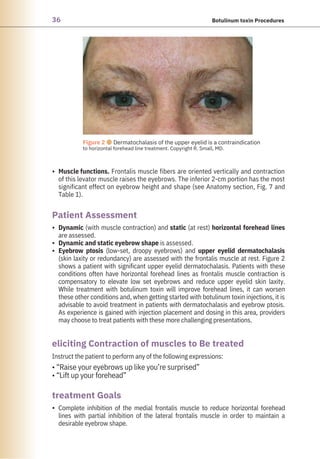
Eyebrow ptosis (low-set, droopy eyebrows) and upper eyelid dermatochalasis
(skin laxity or redundancy) are assessed with the frontalis muscle at rest. Figure 2
shows a patient with significant upper eyelid dermatochalasis. Patients with these
conditions often have horizontal forehead lines as frontalis muscle contraction is
compensatory to elevate low set eyebrows and reduce upper eyelid skin laxity.
While treatment with botulinum toxin will improve forehead lines, it can worsen
these other conditions and, when getting started with botulinum toxin injections, it is
advisable to avoid treatment in patients with dermatochalasis and eyebrow ptosis.
As experience is gained with injection placement and dosing in this area, providers
may choose to treat patients with these more challenging presentations.
treatment Goals
Patient Assessment
eliciting Contraction of muscles to Be treated
Figure 2 ●Dermatochalasis of the upper eyelid is a contraindication
to horizontal forehead line treatment. Copyright R. Small, MD.
37
Chapter 2 Horizontal Forehead Lines
Anesthesia
reconstitution
starting doses
Procedure overview
equipment for treatment
•
•
•
•
•
•
•
•
•
Women: 15–22.5 units of OBTX
Men: 20–25 units of OBTX
Anesthesia is not necessary for most patients but an ice pack may be used if
required.
Reconstitute 100 units of Botox Cosmetic powder with 4 mL of nonpreserved saline
(see Introduction and Foundation Concepts section, Reconstitution Method)
Botulinum toxin products are not interchangeable and all references in this chapter
to onabotulinumtoxinA (OBTX) refer specifically to Botox.
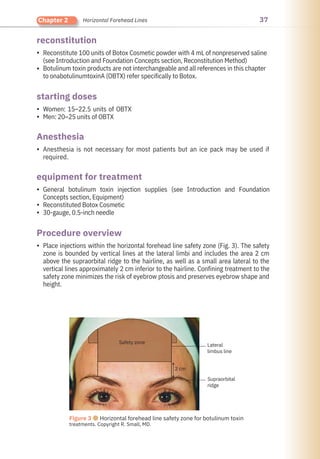
Place injections within the horizontal forehead line safety zone (Fig. 3). The safety
zone is bounded by vertical lines at the lateral limbi and includes the area 2 cm
above the supraorbital ridge to the hairline, as well as a small area lateral to the
vertical lines approximately 2 cm inferior to the hairline. Confining treatment to the
safety zone minimizes the risk of eyebrow ptosis and preserves eyebrow shape and
height.
General botulinum toxin injection supplies (see Introduction and Foundation
Concepts section, Equipment)
Reconstituted Botox Cosmetic
30-gauge, 0.5-inch needle
Figure 3 ●Horizontal forehead line safety zone for botulinum toxin
treatments. Copyright R. Small, MD.
Safety zone
2 cm
Lateral
limbus line
Supraorbital
ridge
L'Oreal Paris Makeup True Match Lumi Glotion,
Natural Glow Enhancer, Illuminator Highlighter
Skin Tint, for an All Day Radiant Glow, Medium,
1.35 Ounces
Your paragraph text
Click here to see
the product on
Amazon
38 Botulinum toxin Procedures
•
•
•
•
•
•
1. Position the patient at a 60-degree reclined position.
2. Identify the horizontal forehead safety zone (Fig. 3).
An overview of injection points and OBTX doses for treatment of horizontal forehead
lines is shown in Figure 4.
Botulinum toxin is injected intramuscularly for treatment of horizontal forehead
lines.
Botulinum toxin placement and dosing lateral to the limbus lines can be tricky.
Inject- ing inferior to the safety zone in this region or using high doses increases the
risk of lateral eyebrow ptosis. However, botulinum toxin placed too superiorly near
the hair- line or use of very small doses may result in a peaked eyebrow shape. In
general, it is better to have a result with peaked eyebrows (which can be corrected)
than eyebrow ptosis.
The “v-shaped” injection pattern shown in Figure 4 minimizes botulinum toxin injec-
tion in the lateral portion of the frontalis muscle and helps to preserve the eyebrow
arch by elevating the lateral eyebrow, which is desirable for women. A flatter
eyebrow shape can be achieved by injecting botulinum toxin a bit more inferiorly in
the lateral frontalis.
Injecting inferior to the safety zone between the limbus lines increases the risk of
medial eyebrow ptosis.
Avoid injecting too deeply and thus hitting the periosteum, which is painful and dulls
the needle.
technique
= 1.25–2.5 units Botox = 2.5 units Botox
Figure 4 ●Overview of botulinum toxin injection points and doses
for treatment of horizontal forehead lines. Copyright R. Small, MD.
39
Chapter 2 Horizontal Forehead Lines
3. Locate the frontalis muscle and identify the ridges of the frontalis muscle by instruct-
ing the patient to contract the muscles, using one of the facial expressions above.
4. Identify the injection points (Fig. 4).
5. Ice for anesthesia (optional).
6. Prepare injection sites with alcohol and allow to dry.
7. The provider is positioned in front of the patient.
8. While the frontalis muscle is contracted, insert the needle into the frontalis muscle
within the safety zone lines. The needle is angled at 30-degrees to the forehead and
the tip is inserted into the muscle ridge. Inject 2.5 units of OBTX with gentle, even
plunger pressure (Fig. 5).
30°
Figure 5 ●Medial frontalis muscle botulinum toxin injection
technique. Copyright R. Small, MD.
40 Botulinum toxin Procedures
9. Continue laterally along each ridge of frontalis muscle within the safety zone lines,
injecting 2.5 units of OBTX approximately 1 cm apart. Perform injections evenly
across the forehead to achieve symmetry (Fig. 6).
10. The final injection is placed just lateral to the safety zone line approximately 2 cm
below the hairline, at the maximal point of eyebrow elevation. Inject 1.25–2.5 units
of OBTX and repeat for the contralateral side.
11. Compress the injection sites firmly, directing pressure lateral to the safety zone line
away from the eye.
Figure 6 ●Frontalis muscle botulinum toxin injection technique.
Copyright R. Small, MD.
41
Chapter 2 Horizontal Forehead Lines
results
Follow-ups and management
duration of effects and treatment Intervals
•
•
•
Muscle function in the treatment area gradually returns 3–4 months after treatment.
Subsequent horizontal forehead line treatments with botulinum toxin may be per-
formed when the frontalis muscle begins to contract before the lines return to their
pretreatment appearance.
Reduction of dynamic horizontal forehead lines and lateral eyebrow elevation
are typically seen 3 days after botulinum toxin treatment with maximal
improvement at 1–2 weeks (Figs. 1A and 1B).
Patients are assessed 2 weeks after botulinum toxin treatment to evaluate for
reduction of forehead lines and eyebrow symmetry and eyebrow shape at rest and with
active eyebrow elevation.
• Peaked Eyebrow Shape or “Quizzical Brow”. Peaked eyebrows are
most noticeable
with animation and are due to excessive contraction of the lateral frontalis muscle. This
can occur in patients with strong lateral frontalis muscles, if lateral frontalis muscle
injections have been omitted, or if small botulinum toxin doses have been injected too
superiorly in the lateral frontalis. Peaked eyebrows can be corrected with 1.25–2.5
units
of OBTX placed just inferior to the lateral safety zone, in line with the most peaked
portion of the eyebrow. Figure 7 shows a patient actively contracting the frontalis
muscle demonstrating mildly peaked eyebrows bilaterally 2 weeks after treatment with
22.5 units of OBTX in the frontalis muscle and injection points for correction. Figure 1B
shows the same patient 2 weeks after receiving 1.25 units of OBTX above each peaked
eyebrow (4 weeks after the initial treatment) and represents the final result.
= 1.25–2.5 units Botox
Figure 7 ●Peaked eyebrows and correction with botulinum toxin.
Copyright R. Small, MD.
42 Botulinum toxin Procedures
Complications and management
• General injection-related complications (see Introduction and Foundation Concepts
section, Complications)
• Eyebrow ptosis (droopy eyebrow)
• Eyebrow asymmetry
• Blepharoptosis (droopy upper eyelid)
Eyebrow ptosis is one of the most significant complications from botulinum toxin
treatment of the frontalis muscle. Excessive botulinum toxin dosing in the frontalis
muscle or placement inferior to the safety zone can result in eyebrow ptosis. Patients
often present with a complaint of heaviness of the upper eyelid on the affected side.
Eyebrow ptosis may be unilateral or bilateral and is typically seen as a lowering and
flattening of the affected eyebrow, while the palpebral fissures are unaffected and sym-
metric (unlike with blepharoptosis, where the palpebral fissure on the affected side is
reduced). The medial, lateral, or entire eyebrow may be affected, depending on the
region of frontalis muscle that is involved. Figure 8 shows a patient before (Fig. 8A)
A
B
Figure 8 ●Eyebrow position before (A) and 2 weeks after (B)
botuli-
num toxin treatment of the frontalis muscle demonstrating eyebrow
ptosis. Copyright R. Small, MD.
43
Chapter 2 Horizontal Forehead Lines
Eyebrow position and height can be optimized by balancing depressor and levator
muscle effects on the eyebrows with botulinum toxin treatments. Botulinum toxin
treatment of the eyebrow depressor muscles, such as the glabellar complex (see
Frown lines chapter) and superior lateral orbicularis oculi muscles (see Eyebrow lift
chapter), complement botulinum toxin treatment of the frontalis levator muscle and
reduce the risk of eyebrow ptosis.
and 2 weeks after (Fig. 8B) botulinum toxin treatment with 20 units of OBTX in the
frontalis muscle demonstrating medial eyebrow ptosis. Eyebrow ptosis resolves
spon- taneously as botulinum toxin effects wear off. Medial eyebrow ptosis may be
improved by treating the glabellar complex with botulinum toxin if this area is
untreated (see Frown Lines chapter). Lateral eyebrow ptosis may be improved by
treating the supe- rior lateral orbicularis oculi with botulinum toxin and lifting the
lateral eyebrow (see Eyebrow Lift chapter).
Eyebrow asymmetry may result from eyebrow ptosis and/or a peaked eyebrow. Figure
9 shows eyebrow asymmetry 2 weeks after botulinum toxin treatment with 22.5 units
of OBTX in the frontalis muscle. The patient has a lower, flattened right eyebrow and a
peaked left eyebrow. This asymmetry may be corrected by treating the superior lateral
orbicularis oculi on the right side with botulinum toxin to lift the lateral eyebrow (see
Eyebrow lift chapter), and treating the lateral frontalis on the left side to reduce the
peaked eyebrow.
Blepharoptosis is uncommon with frontalis muscle treatments. It can result from
inferior placement of botulinum toxin at the lateral limbus line with diffusion into the
levator muscles of the upper eyelid. See Frown Lines chapter, Complications, for addi-
tional information on blepharoptosis and management strategies.
Combining Aesthetic treatments
and maximizing results
•
= 1.25 units Botox = 2.5 units Botox = 1.25–2.5 units Botox
Figure 9 ●Eyebrow asymmetry and correction with botulinum toxin.
Copyright R. Small, MD.
44 Botulinum toxin Procedures
• Deep static horizontal forehead line results can be enhanced by combining botuli-
num toxin treatments with resurfacing procedures such as fractional ablative lasers
or chemical peels.
Charges for botulinum toxin treatment of horizontal forehead lines range from $200–
$500 per treatment or $10–$25 per unit of OBTX.
Pricing
Maybelline Lash Sensational Sky High Washable
Mascara Makeup, Volumizing, Lengthening,
Defining, Curling, Multiplying, Buildable Formula,
Blackest Black, 1 Count
Click here to see the
product on Amazon
45
Chapter 3
Crow’s Feet
Crow’s feet
Lateral eyebrow lift
Dynamic crow’s feet result from contraction of the orbicularis oculi muscle. Treatment
of the lateral orbicularis oculi muscle with botulinum toxin inhibits contraction, reduc-
ing crow’s feet and elevating the lateral eyebrow.
Crow’s feet, or lateral canthal rhytids, radiate laterally from the eye (see
Anatomy section, Figs. 4 and 5).
Botulinum toxin crow’s feet treatment targets the lateral portion
of the orbital orbicularis oculi muscle. The orbicularis oculi muscle is a superficial,
thin, sphincteric muscle, which encircles the eye (see Anatomy section, Figs. 1 and
2). It has a palpebral portion covering the eye and an orbital portion around the eye
(see Lower Eyelid Wrinkles chapter, Fig. 3).
Anatomy
Indications
•
•
• Wrinkles.
• Muscles targeted.
A B
●
Figure 1 Crow’s feet before (A) and 1 month after (B) lateral orbicularis oculi muscle
botulinum toxin treatment, with active muscle contraction. Copyright R. Small, MD.
BotulInum toxIn ProCedures
46 Botulinum toxin Procedures
•
•
•
•
•
•
•
•
•
•
Women: total (bilateral) dose is 15–20 units of OBTX
Men: total (bilateral) dose is 20–25 units of OBTX
Complete inhibition of the lateral orbicularis oculi muscle.
Instruct the patient to perform any of the following expressions:
• “Make a cheesy grin” or “make a big smile”
• “Squint like the sun is in your eyes”
• “Wink”
Reconstitute 100 units of Botox Cosmetic powder with 4 mL of nonpreserved saline
(see Introduction and Foundation Concepts section, Reconstitution Method).
Botulinum toxin products are not interchangeable and all references in this chapter
to onabotulinumtoxinA (OBTX) refer specifically to Botox.
Blepharoplasty and other facial surgery history is reviewed. Surgically altered
anatomy may increase the risk of complications such as lip ptosis from lip levator
muscle involvement. Ophthalmologic history, including keratorefractive (LASIK)
surgery, is obtained as this may increase the risk of dry eyes.
Dynamic (with muscle contraction) and static (at rest) crow’s feet are assessed.
Anesthesia with ice is not recommended as it vasoconstricts and can obscure blood
vessels.
Muscle functions. Different regions of the orbicularis oculi muscle have different
functions (see Anatomy section, Fig. 7 and Table 1). The lateral orbital portion of
the orbicularis oculi muscle functions as a lateral eyebrow depressor (see Eyebrow
Lift chapter) and contributes to formation of crow’s feet. The palpebral portion of
the orbicularis oculi muscle functions to close the eyelid both voluntarily and as
part of the blink reflex. Lacrimal function, with lacrimal flow from the superior
lateral gland to the medial lacrimal sac, is dependent on overall orbicularis oculi
muscle strength.
Muscles avoided. The lip levator muscles lie deep to the orbicularis oculi muscle and
are avoided with treatment of crow’s feet. The upper lip levators include the zygo-
maticus major and minor which are located near the lateral portion of the orbicularis
oculi muscle at the superior margin of the zygomatic arch (see Anatomy section; and
the levator labii superioris, levator labii superioris alaeque nasi, and levator anguli
oris muscles which are located medially (see Anatomy section, Figs. 1, 2, and 3).
Anesthesia
reconstitution
starting doses
treatment Goals
Patient Assessment
eliciting Contraction of muscles to Be treated
47
Chapter 3 Crow’s Feet
Procedure overview
equipment for treatment
•
•
•
•
Place injections within the crow’s feet safety zone (Figs. 2A and 2B). The safety
zone is 1 cm outside the orbital rim, above the level of the superior margin of the
zygoma and extends under the eyebrow to the lateral limbus line. Botulinum toxin
is concentrated within the central crow’s feet safety zone, but injections may also
be placed in the extended safety zone according to patients’ anatomy.
General botulinum toxin injection supplies (see Introduction and Foundation
Concepts section, Equipment)
Reconstituted Botox Cosmetic
30- or 32-gauge, 0.5-inch needle
Figure 2 ●Crow’s feet safety zone for botulinum toxin treatments: front
views. Copyright R. Small, MD.
and lateral
(B)
(A)
Lateral limbus line
1 cm outside of
the orbital rim
Lateral limbus line
Supraorbital ridge
1 cm outside of
the orbital rim
Zygoma
= Central Crow’s Feet Safety Zone
= Extended Crow’s Feet Safety Zone
= Central Crow’s Feet Safety Zone
= Extended Crow’s Feet Safety Zone
Zygoma
Supraorbital ridge
A
B
48 Botulinum toxin Procedures
•
•
•
•
•
An overview of injection points and OBTX doses for treatment of crow’s feet is shown
in Figure 3. Injection points are located at the “ridges” of contracted muscle.
Patterns of crow’s feet vary; some extend superiorly toward the eyebrow and others
extend inferiorly toward the cheek. Optimal treatment of the crow’s feet is achieved
by adapting the injection technique below to the patient’s specific crow’s feet
pattern.
Botulinum toxin is injected subdermally for treatment of crow’s feet. It is important
to place injections superficially in this region as the orbicularis oculi muscle overlies
other muscles, which, if affected by botulinum toxin, can result in lip ptosis and other
more serious complications. Subdermal injection can be achieved using the following
technique: instruct the patient to contract the muscle in the treatment area by
smiling and insert the needle just below the skin. Once the needle tip is inserted,
instruct the patient to relax the muscle by slowly releasing their smile, and inject
botulinum toxin to raise a visible wheal. The wheal is more visible at rest.
The lateral canthal region has many veins and bruising is common. Veins are best
seen and avoided using oblique lighting. If numerous vessels are visible in the
treat- ment area, ecchymosis may be reduced by injecting a series of continuous
wheals, where each injection is placed at the border of the previous wheal.
Injecting superior to the crow’s feet safety zone near the lateral limbus line at the
orbital rim, can be associated with botulinum toxin migration into the levator
muscles of the upper eyelid, resulting in blepharoptosis.
= 2.5 units Botox, insert needle in direction of arrow
●
Figure 3 Overview of botulinum toxin injection points and doses
for treatment of crow’s feet. Copyright R. Small, MD.
49
Chapter 3 Crow’s Feet
•
•
•
Injecting medial to the crow’s feet safety zone near the orbital rim at the lateral
canthus, can be associated with deep migration of botulinum toxin into
extraocular muscles, resulting in diplopia.
Injecting deeply and inferior lateral to the crow’s feet safety zone below the
superior margin of the zygoma, may involve the lip levator muscles and
increase the risk of cheek and lip ptosis, smile asymmetry, and possibly oral
incompe- tence.
Injecting deeply and inferior medial to the crow’s feet safety zone may involve other
lip levator muscles and increase the risk of cheek and lip ptosis, smile asymmetry,
and profound oral incompetence.
1. Position the patient at a 60-degree reclined position.
2. Identify the crow’s feet safety zone and palpate the orbital rim (Fig. 2).
3. Locate the orbicularis oculi muscle by instructing the patient to contract the muscles
using one of the facial expressions above.
4. Identify the injection points (Fig. 3).
5. Prepare injection sites with alcohol and allow to dry.
6. The provider is positioned on the side that is to be injected.
7. While the lateral orbicularis oculi muscle is contracted, insert the needle 1 cm outside
the orbital rim, near the lateral canthal line into the first injection point located at the
muscle “ridge”. The needle is inserted subdermally using the technique described
earlier in the Procedure Overview. Inject 2.5 units of OBTX with gentle plunger
pressure (Fig. 4).
technique
●
Figure 4 First lateral orbicularis oculi muscle botulinum toxin
injection. Copyright R. Small, MD.
50 Botulinum toxin Procedures
8. The second injection point is approximately 0.5 cm superior to the first injection
point. Inject 2.5 units of OBTX (Fig. 5).
9. The third injection point is approximately 0.5 cm inferior to the first injection point.
The needle is angled inferiorly and threaded superficially to the hub. Inject 2.5 units
of OBTX as the needle is withdrawn (see Fig. 6).
10. Repeat injections for the contralateral orbicularis oculi muscle.
11. Compress the injection sites firmly, directing pressure away from the eye.
●
●
Figure 6 Third lateral orbicularis oculi muscle botulinum toxin
injection. Copyright R. Small, MD.
Figure 5 Second lateral orbicularis oculi muscle botulinum toxin
injection. Copyright R. Small, MD.
51
Chapter 3 Crow’s Feet
results
Follow-ups and management
duration of effects and treatment Intervals
•
•
•
Reduction of dynamic crow’s feet and lateral eyebrow elevation is typically seen
3 days after botulinum toxin treatment, with maximal improvements at 1–2 weeks
(see Figs. 1A and 1B).
Muscle function in the treatment area gradually returns 2.5–3 months after
botulinum toxin treatment.
Subsequent crow’s feet treatments with botulinum toxin may be performed when
the orbicularis oculi muscle begins to contract, before the lines return to their
pretreat- ment appearance.
Patients are assessed 2 weeks after botulinum toxin treatment to evaluate for
reduction of crow’s feet.
• Persistent crow’s feet. If persistent crow’s feet are present, evaluate for
the following
common causes:
• Orbicularis oculi muscle contraction. Patients may have greater muscle mass
than anticipated in the treatment area and additional botulinum toxin may be re-
quired to achieve desired results. Persistent muscle contraction can be corrected
with a touch-up procedure using 2.5–10 units of OBTX, depending on the degree
of orbicularis oculi muscle activity present. Reassess the treatment area 2 weeks
after the touch-up procedure.
• Cheek muscle contraction. Some patients will retain a few wrinkles inferior to
the crow’s feet treatment area, which are most noticeable with smiling (see Fig.
1B). These wrinkles are due to appropriately retained function of the zygomatic
muscles and require no additional treatment.
• Static lines. If static crow’s feet are present, patients may require several consecu-
tive botulinum toxin treatments for results to be seen. Combining botulinum toxin
with other minimally invasive aesthetic procedures can offer enhanced results for
treatment of static crow’s feet (see Combining Aesthetic Treatments below).
• Adjacent muscle involvement. Some patients may complain of
accentuated wrinkles
in adjacent untreated areas, such as bunny lines on the nose, wrinkles under eyebrows
or under the lower eyelids.
• Bunny lines are readily treated with botulinum toxin in the nasalis muscle (see
Bunny lines chapter).
• Lines under the eyebrow. The infrabrow region contains the superior lateral
orbicularis oculi muscle, which is not treated as part of botulinum toxin treat-
ment for crow’s feet. In some patients, wrinkles under the eyebrow may form
due to compensatory contraction of this untreated portion of the orbicularis oculi
muscle. Botulinum toxin may be directly placed in the superior lateral orbicularis
oculi muscle to reduce these wrinkles (see Eyebrow Lift chapter).
• Lower eyelid wrinkles can be due to several different causes, and a stepwise ap-
proach may be used to achieve improvement, which is outlined as follows:
Milani Make It Dewy 3-In-1 Setting Spray -
Hydrate + Illuminate + Set (2.03 Fl. Oz.)
Cruelty-Free Makeup Setting Spray - Prime &
Hydrate Skin for a Bright, Refreshing Look
Click here to see
the product on Amazon
52 Botulinum toxin Procedures
• Lower eyelid wrinkles may result from compensatory contraction of the medial
preseptal orbicularis oculi muscle after treatment of the crow’s feet. Reducing
the botulinum toxin dose at the third injection point may reduce lower eyelid
wrinkles resulting from medial orbicularis oculi contraction.
• If this does not effect enough reduction in lower eyelid wrinkles, botulinum toxin
may be placed directly in the preseptal orbicularis oculi muscle (see Lower
Eyelid Wrinkles chapter).
• General injection-related complications (see Introduction and Foundation Concepts
section, Complications)
• Bruising
• Photophobia
• Lip ptosis with resultant smile asymmetry
• Oral incompetence with resultant drooling and impaired speaking, eating, or
drinking
• Blepharoptosis (droopy upper eyelid)
• Diplopia (double vision)
• Lagophthalmos (incomplete eyelid closure)
• Impaired blink reflex
• Ectropion of the lower eyelid (eyelid margin eversion)
• Xerophthalmia (dry eye)
• Globe trauma
Bruising (ecchymosis) is the most common complication seen with treatment of
crow’s feet. Bruises can range in size from pinpoint needle insertion marks to quarter-
sized bruises or hematomas, and if extravasated blood spreads, a “black eye” seen as
a large infraocular ecchymotic crescent may occur. The time for resolution of a bruise
depends on the patients’ physiology and the size of the bruise. Larger bruises can be
visible for 1–2 weeks. Prevention of bruising is preferable and several suggestions
for bruise prevention are listed in the Introduction and Foundation Concepts section,
Preprocedure Checklist. Immediate application of ice and pressure to a bruise can
minimize bruising.
Photophobia is uncommon and when it occurs, is usually mild. It typically results
from reduced squinting. Using sun protective measures such as sunglasses and hats can
alleviate this problem.
Lip and cheek ptosis causing smile asymmetry and/or oral incompetence with
resultant drooling and impaired speaking, eating, or drinking can occur with injections
placed deeply and inferiorly, below the superior margin of the zygoma. The zygomaticus
major lip levator muscle is most frequently involved as it is adjacent to the orbicularis
oculi muscle and when affected, typically presents with lip and cheek ptosis similar
to Bell’s palsy, without oral incompetence. Patients who have undergone facial plastic
surgery may be at increased risk of zygomaticus major involvement because of altered
periocular anatomy.
Blepharoptosis is uncommon with crow’s feet treatments and more commonly seen
with frown line treatments. Botulinum toxin placed superiorly can migrate into the levator
muscles of the upper eyelid causing blepharoptosis. See Frown Lines chapter, Complica-
tions for additional information on blepharoptosis and management strategies.
Complications and management
53
Chapter 3 Crow’s Feet
Impaired eyelid function and altered lower eyelid position, such as ectropion
and lagophthalmos,
Xerophthalmia,
Static crow’s feet. Botulinum toxin in the orbicularis oculi muscle can be combined
with other minimally invasive aesthetic procedures to enhance static crow’s feet
results.
• Dermal fillers. Static crow’s feet are shown in Figure 7, before (Fig. 7A)
and
after (Fig. 7B) combination treatment with botulinum toxin in the orbicularis oc-
uli muscle and dermal filler treatment of the zygoma.
are very rare and can occur with high botulinum toxin doses
which excessively weaken the palpebral orbicularis oculi, or if botulinum toxin is
placed too close to the eyelid. which is extremely rare, can result from impaired
eyelid function with reduced lacrimal flow, or may be secondary to ectropion and
lagophthalmos. Patients who have had LASIK surgery may be more susceptible to
xerophthalmia. Diplopia can occur with deep migration of botulinum toxin into
extraocular muscles. Globe trauma is a risk with injections placed near the eye. Con-
sultation with an ophthalmologist is advisable with any of these conditions to help in
preventing corneal injury and other ocular complications.
Combining Aesthetic treatments
and maximizing results
•
●
(B)
Figure 7 Static crow’s feet before
(A) and after combination treatment
with botulinum toxin in the orbicularis
oculi muscle and dermal filler treatment
of the zygoma. Copyright R. Small, MD.
A
B
54 Botulinum toxin Procedures
Charges for botulinum toxin treatment of crow’s feet range from $200–$500 per treat-
ment or $10–$25 per unit of OBTX.
• Resurfacing procedures, such as fractional ablative lasers or chemical peels.
Static crow’s feet are shown in Figure 8, before (Fig. 8A) and after (Fig. 8B)
combination treatment with botulinum toxin in the orbicularis oculi muscle and
periocular fractional ablative resurfacing.
Pricing
A
B
●
(B)
Figure 8 Static crow’s feet before
(A) and after combination treatment
with botulinum toxin in the orbicularis
oculi muscle and periocular fractional
ablative resurfacing. Copyright
R. Small, MD.
55
A B
Chapter 4
Lower Eyelid
Wrinkles
See Introduction and Foundation Concepts section, Contraindications.
Severe lower eyelid dermatochalasis (skin laxity).
Abnormal snap test.
Prominent infraorbital festoons (eye bags).
Lower eyelid wrinkles
Palpebral aperture enlargement (i.e., the distance between upper and lower eyelid
margins) and rounding of the eye shape
Lower eyelid muscle bulge, also called a “jelly roll”
Contraction of the inferior portion of the orbicularis oculi muscle contributes to forma-
tion of lower eyelid wrinkles. Treatment of the inferior orbicularis oculi muscle with
botulinum toxin focally inhibits contraction, which results in reduction of lower eyelid
wrinkles and opening of the eye aperture.
Indications
Contraindications
•
•
•
•
•
•
•
●
Figure 1 Infraocular lines before (A) and 1 month after
of the inferior orbicularis oculi muscle. Copyright R. Small, MD.
botulinum toxin treatment
BotuLInum toxIn ProCEdurEs
(B)
56 Botulinum toxin Procedures
•
• Lagophthalmos (incomplete closure of eyelids).
• Excessive lower eyelid scleral show.
• Ectropion (eversion of eyelid margin).
It is advisable to use caution in patients who have had previous lower eyelid surgery
(e.g., blepharoplasty) or aggressive lower eyelid resurfacing (e.g., ablative laser resurfac-
ing or deeper chemical peels) as they may exhibit lagophthalmos, excessive lower eyelid
scleral show, or an ectropion, which contraindicate treatment with botulinum toxin.
Lower eyelid wrinkles, or infraocular rhytids, course horizontally and
radiate inferior laterally away from the lower eyelid (Fig. 1A and 2B). They are often
associated with a lower eyelid muscle bulge seen with animation, referred to as a
“jelly roll” (Fig. 2A). Lower eyelid wrinkles occur with facial expressions and may be
accentuated by botulinum toxin treatment of the crow’s feet.
Muscles targeted. Lower eyelid wrinkle treatments with botulinum toxin target
the preseptal orbicularis oculi muscle. The orbicularis oculi muscle has an orbital
portion which surrounds the eye and a palpebral portion which covers the eye.
The palpebral portion is further divided into the preseptal fibers, which course in
front of the orbital septum, and the pretarsal fibers, which form the eyelids (Fig.
3).
Anatomy
• Wrinkles.
Figure 2 ● Lower eyelid dynamic wrinkles and muscle bulge
. Copyright R. Small, MD.
and static wrinkles
(B)
(A)
Eyelid muscle bulge
or “jelly roll”
A
B
NYX PROFESSIONAL MAKEUP Butter
Gloss, Non-Sticky Lip Gloss - Creme Brulee
(Natural)
Click here to see the
product on Amazon
57
Chapter 4 Lower Eyelid Wrinkles
•
•
•
Muscle functions. Contraction of several different muscles and muscle regions can
contribute to formation of lower eyelid wrinkles including the: preseptal orbicularis
oculi medial to the mid pupilary line, preseptal orbicularis oculi lateral to the mid
pupilary line, and lip levators such as zygomaticus major and levator labii superioris
which primarily functions as a lip levator. A lower eyelid muscle bulge is due to
contraction of the palpebral portion of the orbicularis muscle.
Facial surgery history is obtained, including blepharoplasty and skin resurfacing
procedures such as ablative laser resurfacing or deep chemical peels of the lower
eye- lids. Ophthalmologic history including keratorefractive surgery (LASIK) is
obtained as these patients may have a greater risk of dry eyes.
Dynamic (with muscle contraction) assessments of the lower eyelid are made
includ- ing:
• Lower eyelid wrinkles are evaluated while having the patient perform one of the
facial expressions listed below (Fig. 2A). The botulinum toxin injection techniques
described in this chapter can reduce lower eyelid wrinkles at or lateral to the mid pu-
pilary line. They do not reduce lower eyelid wrinkles medial to the mid pupilary line.
• Lower eyelid wrinkles muscle bulge is also assessed while the patient is con-
tracting the lower eyelid muscles (Fig. 2A). Botulinum toxin injection of the lower
Patient Assessment
2
4
3
7
1
1. Frontalis m.
2. Procerus m.
3. Corrugator supercilii m.
4. Depressor supercilli m.
5. Orbicularis oculi m. (orbital portion)
6a
6b
6a
8
5
9
6. Orbicularis oculi m. (palpebral portion)
a. Preseptal
b. Pretarsal
7. Levator labii superioris m.
8. Zygomaticus minor m.
9. Zygomaticus major m.
Figure 3 ● Periocular detailed anatomy. Copyright R. Small, MD.
58 Botulinum toxin Procedures
eyelid can soften this muscle bulge and increase the palpebral aperture, which can
widen and round the eye shape.
(at rest) assessments of the lower eyelid are made including:
are assessed with the face at rest (Fig. 2B).
of the lower eyelids may be clinically evident as wrinkles and folds
of skin in the lower eyelid area (Fig. 4). Botulinum toxin treatment of the lower
eyelid may exacerbate these wrinkles and treatment should be avoided in patients
with obvious skin laxity. Surgery is often required to improve lower eyelid wrin-
kles due to severe skin laxity.
• Elasticity of the lower eyelids is assessed using the snap test. It is performed
by grasping the skin of the lower eyelid between the thumb and the first finger,
pulling the skin gently away from the eye and releasing (Fig. 5). If the skin re-
coils immediately, the snap test is normal and botulinum toxin treatment may be
performed. If the skin recoils slowly (more than 3 seconds), the lower eyelid has
insufficient elasticity and should not be treated with botulinum toxin.
•
•
•
Static
Static lowereyelid wrinkles
Skin laxity
●
●
Figure 5 Snap test for evaluation of lower eyelid elasticity.
Copyright R. Small, MD.
Figure 4 Laxity of the lower eyelid is a contraindication to botulinum toxin treat-
ment of the lower eyelid. Copyright R. Small, MD.
Skin laxity
59
Chapter 4 Lower Eyelid Wrinkles
• Infraorbital festoons, or lower eye bags, are soft tissue bulges, which are visible at
rest (Fig. 6). The orbital septum, which is a facial layer that helps to retain infraorbital
fat pads, weakens with age. Eye bags are typically due to bulging of the infraorbital
fat pad as a result of a weakened orbital septum. The orbicularis oculi also supports
the inferior orbital septum and weakening of this muscle with botulinum toxin may
exacerbate festooning. Treatment should be avoided in patients with eye bags.
• Scleral show refers to the crescent of white sclera visible between the iris and the
lower eyelid margin at rest with forward level gaze. Scleral show is due to lower
lid retraction and, while a small amount of sclera show is common and a normal
finding, excessive sclera show of more than 2 mm is a contraindication to botuli-
num toxin treatment of the lower eyelid.
• Lagophthalmos is incomplete closure of eyelids and can be assessed by instruct-
ing the patient to “roll their eyes upwards” while trying to keep their eyelids
closed. Figure 7 shows a patient with a history of a blepharoplasty demonstrating
lagophthalmos with upward gaze. This is a contraindication to botulinum toxin
treatment of the lower eyelids.
Infraorbital
festoon
●
●
Figure 7 Incomplete eyelid closure (lagophthalmos), shown in a
patient with a history of a blepharoplasty, is a contraindication to botuli-
num toxin treatment of the lower eyelids. Copyright R. Small, MD.
Figure 6 Infraorbital festoons are a contraindication to botulinum toxin treatment
of the lower eyelids. Copyright R. Small, MD.
60 Botulinum toxin Procedures
Anesthesia
reconstitution
starting doses
treatment Goal
Procedure overview
Equipment for treatment
Eliciting Contraction of muscles to Be treated
Partial inhibition of the inferior orbicularis oculi muscle.
Women and men: total (bilateral) dose is 2.5 units of OBTX
Instruct the patient to perform any of the following expressions:
• “Make a cheesy grin” or “make a big smile”
• “Squint like the sun is in your eyes”
Reconstitute 100 units of Botox Cosmetic powder with 4 mL of nonpreserved
sterile saline (see Introduction and Foundation Concepts section, Reconstitution
Method).
Botulinum toxin products are not interchangeable and all references in this chapter
to onabotulinumtoxinA (OBTX) refer specifically to Botox.
Anesthesia with ice is not recommended because it vasoconstricts and can obscure
blood vessels.
General botulinum toxin supplies (see Introduction and Foundation Concepts
section, Equipment)
Reconstituted Botox Cosmetic
30- or 32-gauge 0.5-inch needle
An overview of injection points and OBTX doses for treatment of lower eyelid
wrinkles is shown in Figure 8. Two injections are usually performed for each eye, one
medial (Fig. 8A) and one lateral (Fig. 8B). Providers getting started with botulinum
toxin injections may choose to start with injection of the medial point only (Fig. 8A),
to reduce the risk of complications.
Botulinum toxin is injected subdermally for treatment of lower eyelid wrinkles. These
injections require a light touch as the orbicularis oculi muscle is a superficial muscle
and the lower eyelid skin is very thin.
For patients with long eyelashes that obscure the medial injection point instruct
them to “roll their eyes upward” while keeping their eyelids closed when performing
this injection.
The inferior eyelid region has many tiny veins, which are best seen and avoided using
oblique lighting.
•
•
•
•
•
•
•
•
•
•
•
•
61
Chapter 4 Lower Eyelid Wrinkles
• Injecting superiorly may involve the pretarsal orbicularis oculi muscle and increase
the risk of lower eyelid ectropion and lagophthalmos.
1. Position the patient at a 60-degree reclined position.
2. Identify facial landmarks. Palpate the orbital rim (Fig. 9). Identify the lateral canthal
and midpupillary lines (Fig. 8).
3. Prepare injection sites with alcohol and allow them to dry.
4. The provider is positioned on the side that is to be injected.
5. Medial lower eyelid injection. The medial lower eyelid injection is located in
the midpupillary line, 0.5 cm inferior to the eyelid margin ( Fig. 8A ). While the
muscles are at rest and patient’s eyes are closed, angle the needle medially, almost
parallel to the skin, and insert the needle tip subdermally just under the skin. Inject
0.6 units of OBTX to raise a wheal (Fig. 10).
6. Lateral lower eyelid injection. The lateral lower eyelid injection point is located
midway between the first injection point and the lateral canthal line, 1 cm inferior to
technique
Midpupil line
Midpupil line
Lateral canthal line
= 0.6 units Botox
= 0.6 units Botox A
B
●
Figure 8 Overview of botulinum toxin injection points and doses for treatment
of lower eyelid wrinkles. The medial injection is placed with the muscles at rest (A) and
the lateral injection is placed during orbicularis oculi muscle contraction (B). Copyright
R. Small, MD.
62 Botulinum toxin Procedures
Figure 9 ●
●
Palpation of the infraorbital rim. Copyright R. Small, MD.
Figure 10 Medial botulinum toxin injection of the inferior orbicularis
oculi muscle. Copyright R. Small, MD.
the eyelid margin ( Fig. 8B). While the orbicularis oculi muscle contracted, angle the
needle inferiorly, almost parallel to the skin, and insert the needle tip subdermally
just under the skin. Inject 0.6 units of OBTX to raise a wheal (Fig. 11).
7. Repeat injections for the contralateral inferior orbicularis oculi muscle.
8. Compress the injection sites, directing pressure away from the eye.
63
Chapter 4 Lower Eyelid Wrinkles
Results
Follow-Ups and Management
Duration of Effects and Treatment Intervals
•
•
•
Muscle function in the treatment area gradually returns 2.5–3 months after botulinum
toxin treatment.
Subsequent lower eyelid treatments with botulinum toxin may be performed when
the orbicularis oculi muscle begins to contract, before lines and wrinkles return to
their pretreatment appearance.
Patients are assessed 2 weeks after botulinum toxin treatment to evaluate for reductio
n
of lower eyelid wrinkles and eyelid position. Persistent lower eyelid wrinkles are often
due to one of the following reasons:
• Deep static
wrinkling. If static wrinkles are present, patients may require several
consecutive botulinum toxin treatments for results to be seen. Botulinum toxin doses
are not routinely escalated in the lower eyelid region because of the increased risk of
complications with higher doses. Combining botulinum toxin with other minimally
invasive aesthetic procedures can offer enhanced results for treatment of static lower
eyelid wrinkles (see Combining Aesthetic Treatments on next page).
Reduction of lower eyelid wrinkles, “jelly rolls”, and eye aperture
enlargement are
typically seen 3 days after botulinum toxin treatment, with maximal improvements at
1–2 weeks (Figs. 1A and 1B). Unlike with botulinum toxin treatments in other
regions of the face, both static and dynamic lower eyelid wrinkles usually
respond well to treatment.
●
Figure 11 Lateral botulinum toxin injection of the inferior orbicu-
laris oculi muscle. Copyright R. Small, MD.
64 Botulinum toxin Procedures
•
•
Treatment of lower eyelid wrinkles is typically performed concomitantly with treatment
of the crow’s feet. This is an advanced botulinum toxin treatment area and charges
range from $50–$60 per unit of OBTX.
Adjacent muscle involvement. In some patients, lower eyelid wrinkles result from
upward movement of the cheek due to contraction of the zygomaticus and/or levator
labii superioris muscles. These patients will not benefit from botulinum toxin
treatment of the lower eyelid.
Static lower eyelid wrinkles. Combination therapy with resurfacing procedures
such as fractional ablative lasers or chemical peels, together with botulinum toxin in
the inferior orbicularis oculi muscle, can enhance static lower eyelid wrinkle results.
• General Injection-Related Complications (see Introduction and Foundation Concepts,
Complications)
• Worsening infraocular festooning (eye bags)
• Lagophthalmos (incomplete eyelid closure)
• Impaired blink reflex
• Ectropion of the lower eyelid (eyelid margin eversion)
• Xerophthalmia (dry eyes)
• Globe trauma
• Epiphora (tearing)
Infraocular festoons may worsen due to botulinum toxin injection in the lower
eyelid area due to weakening of the inferior orbicularis oculi muscle and/or impaired
lymphatic drainage.
Impaired eyelid function and altered eyelid position, such as ectropion and lago-
phthalmos, are very rare and can occur with high botulinum toxin doses excessively
weakening the palpebral orbicularis oculi or if botulinum toxin is placed too close to
the eyelid. One study (Flynn, 2003) suggests that botulinum toxin placed in the lateral
palpebral orbicularis oculi muscle injection point described earlier, may be associated
with an increased risk of ectropion.
Xerophthalmia, which is extremely rare, can result from impaired eyelid func-
tion with reduced lacrimal flow or may be secondary to ectropion and lagophthalmos.
Patients who have had LASIK surgery may be more susceptible to xerophthalmia.
Epiphora may result from lacrimal dysfunction, if botulinum toxin is placed medial
to the midpupillary line. Globe trauma is a risk as injections in the lower eyelid area
are usually superior to the bony orbital rim.
There are no corrective treatments for most of these complications; however, they
will spontaneously resolve as botulinum toxin effects diminish. Consultation with an
ophthalmologist is advisable with any of these complications.
Pricing
Complications and management
Combining Aesthetic treatments
and maximizing results
65
A B
Chapter 5
Eyebrow Lift
Lateral eyebrow ptosis
Upper eyelid dermatochalasis
Lateral eyebrow lift
Low-positioned eyebrows (eyebrow ptosis) and upper eyelid skin laxity (dermatochala-
sis) convey a tired or sad appearance and are accentuated by contraction of the
superior lateral orbicularis oculi muscle. These conditions can often be improved with
botulinum toxin treatment of the superior lateral orbicularis oculi which inhibits muscle
contrac- tion resulting in lateral eyebrow elevation, also called a chemical brow lift or
eyebrow lift. Treatment of other muscle groups in the upper face can also elevate
eyebrows (see Combining Aesthetic Treatments at the end of this chapter), however,
botulinum toxin treatment of the superior lateral orbicularis oculi muscle is the focus of
this chapter.
Eyebrow position and shape. In women, ideal eyebrow position is slightly above the
supraorbital ridge and that the brow has an arched, tapering gull-wing shape
(Fig. 2A).
Anatomy
Indications
•
•
•
•
●
Figure 1 Eyebrow lift before (A) and 2 weeks after (B) botulinum toxin treatment
of
the infrabrow orbicularis oculi muscle in a patient also receiving botulinum toxin treatment
of the glabellar complex muscles for frown line treatment, at rest. Copyright R. Small, MD.
BotuLInum toxIn ProCEdurEs
66 Botulinum toxin Procedures
In men, eyebrows are positioned at the supraorbital ridge and are horizontal in shape
(Fig. 2B).
Muscles targeted. Lateral eyebrow lift with botulinum toxin targets the superior
lateral orbital portion of the orbicularis oculi muscle. Other muscles in the upper
face affecting eyebrow height position and are listed in Table 1.
•
tABLE 1
Eyebrow Height and Position: Effects of muscle Contraction and
Botulinum toxin treatments
muscle
muscle Contraction Effect
on Eyebrow
Botulinum toxin Effect
on Eyebrow
Glabellar complex
Superior lateral orbicularis oculi
Lateral orbicularis oculi
Frontalis
Medial eyebrow
depressor Lateral
eyebrow depressor
Lateral eyebrow
depressor
Medial and lateral
eyebrow
levator
Elevates medial
eyebrow Elevates
lateral eyebrow
Elevates lateral
eyebrow
Lowers medial and
lateral
eyebrow
A
B
●
Figure 2 Eyebrow shapes:
women (A) and men (B). Copyright
R. Small, MD.
67
Chapter 5 Eyebrow Lift
•
•
•
•
•
Instruct the patient to perform the following expression:
• “Blink hard and hold it”
Partial inhibition of the superior lateral orbicularis oculi muscle.
Reconstitute 100 units of Botox Cosmetic powder with 4 mL of nonpreserved saline
(see Introduction and Foundation Concepts section, Reconstitution Method).
Muscle functions. Contraction of the superior lateral orbicularis oculi muscle low-
ers the lateral eyebrow, and aids in closure of the eyelid and lacrimal function (see
Anatomy section, Figs. 1 and 2).
Eyebrow ptosis and dermatochalasis (hooding) are assessed with the frontalis
muscle at rest. Patients with severe dermatochalasis who have excessive folds of
lax skin resting on the upper eyelid, or significant eyebrow ptosis, typically do not
show marked improvement with lateral eyebrow lifting and may require surgical
interven- tions such as blepharoplasty and a forehead lift, respectively.
Strength of the superior lateral orbicularis oculi muscle is assessed by placing
the index finger beneath this portion of the muscle and having the patient contract
the muscle (Fig. 3). If the patient can exert forceful pressure against the finger with
a visible roll of contracted muscle, the eyebrow lift procedure will typically yield
noticeable elevation of the lateral eyebrow.
reconstitution
treatment Goal
Patient Assessment
Eliciting Contraction of the muscles to Be treated
●
Figure 3 Superior lateral orbicularis muscle targeted with botulinum
toxin eyebrow lift treatments. Copyright R. Small, MD.
68 Botulinum toxin Procedures
•
•
•
•
•
•
•
•
•
•
•
•
Women: total (bilateral) dose is 5–7.5 units of OBTX.
Men: total (bilateral) dose is 7.5–10 units of OBTX.
Anesthesia is not necessary for most patients but an ice pack may be used if
required.
Botulinum toxin products are not interchangeable and all references in this chapter
to onabotulinumtoxinA (OBTX) refer specifically to Botox.
Place injections in the eyebrow lift safety zone (Fig. 4). The safety zone is at least 1
cm outside the orbital rim, below the supraorbital ridge and lateral to the lateral
limbus line.
An overview of injection points and OBTX doses for a lateral eyebrow lift is shown in
Figure 5.
Botulinum toxin is injected intramuscularly with the eyebrow lift procedure.
Injecting superior lateral to the safety zone may involve the frontalis muscle,
resulting in eyebrow ptosis.
Injecting superior medial to the safety zone at the lateral limbus line may involve
eyelid levator muscles, resulting in blepharoptosis (droopy upper eyelid).
General botulinum toxin injection supplies (see Introduction and Foundation
Concepts section, Equipment)
Reconstituted Botox Cosmetic
30-gauge, 0.5-inch needle
Anesthesia
starting doses
Procedure overview
Equipment for treatment
Supraorbital
ridge
Safety
zone
Lateral
limbus line
1 cm outside
of orbital rim
Figure 4 ● Eyebrow lift safety zone for botulinum toxin treatments. Copyright R. Small, MD.
69
Chapter 5 Eyebrow Lift
technique
1. Position the patient at a 60-degree reclined position.
2. Identify the eyebrow lift safety zone (Fig. 4).
3. Identify the superior lateral portion of the orbicularis oculi muscle by instructing
the patient to contract the muscle as described above and visualizing/palpating the
roll of contracted muscle (Fig. 3).
4. Identify the injection points (Fig. 5).
5. Ice for anesthesia (optional).
6. Prepare injection sites with alcohol and allow to dry.
7. The provider is positioned on the side that is to be injected.
= 1.25 unit Botox = 2.5 units Botox
Lateral
limbus line
●
●
Figure 6 Lateral eyebrow lift botulinum toxin injection technique.
Copyright R. Small, MD.
Figure 5 Overview of botulinum toxin injection points and doses for lateral eye-
brow lift. Copyright R. Small, MD.
70 Botulinum toxin Procedures
Lateral eyebrow elevation is typically noticeable 1–2 weeks after botulinum toxin
treatment (Figs. 1A and 1B).
Eyebrow position and height can be optimized by combining a lateral eyebrow lift with
the following procedures:
Muscle function in the treatment area gradually returns 2–3 months after botulinum
toxin treatment.
Eyebrow lifting is subtle and determining when to return for treatment can be chal-
lenging for patients. Subsequent treatments may be performed when eyebrow
descent is noticeable or when patients notice recurrence of eyelid heaviness or a
fatigued appearance. The author typically performs an eyebrow lift every 3–4
months with the same time intervals as other upper face botulinum toxin
treatments.
8. While the orbicularis oculi muscle is relaxed, insert the needle in the first injection
point located approximately 1.5 cm lateral to the lateral limbus line, within the
safety zone (Fig. 6). Angle the needle towards the forehead and insert subdermally.
Inject 2.5 units of OBTX.
9. The second injection point is 1 cm medial to the first injection point, closer to the
lateral limbus line. Insert the needle similarly and inject 1.25 units of OBTX.
10. Repeat the above injections for the contralateral side of the face.
11. Compress the injection sites firmly, directing pressure away from the eye.
Patients are assessed 2 weeks after botulinum toxin treatment to evaluate for
reduction of eyebrow ptosis. If more lateral eyebrow elevation is desired, assess the
strength of the superior lateral orbicularis oculi muscle. If significant contractility is still
present, additional OBTX may be injected in the same areas previously treated. Total
bilateral doses for this touch-up procedure are usually 2.5–5 units of OBTX.
• General injection-related complications (see Botulinum Toxin Introduction and
Foundation Concepts section, Complications topic)
• Blepharoptosis
Blepharoptosis may occur as a complication from eyebrow lift treatments, par-
ticularly if botulinum toxin is injected too close to the supraorbital ridge at the lateral
limbus line. Blepharoptosis results from migration of botulinum toxin through the orbital
septum fascia to the levator palpebrae superioris muscle in the upper eyelid (See Frown
Lines chapter for treatment of blepharoptosis).
results
Follow-ups and management
Complications and management
Combining Aesthetic treatments
and maximizing results
duration of Effects and treatment Intervals
•
•
•
71
Chapter 5 Eyebrow Lift
•
•
Charges for botulinum toxin eyebrow lift treatments range from $150–$200 per treat-
ment or $10–$25 per unit of OBTX.
Botulinum toxin. Treatments in other muscles of the upper face can enhance
eyebrow elevation, including:
• Glabellar complex muscles (see Frown Lines chapter) for additional medial eye-
brow elevation.
• Lateral orbicularis oculi muscle (see Crow’s Feet chapter) for additional lateral
eyebrow elevation.
• Frontalis muscle, using the “V-shaped” injection pattern (see Horizontal Forehead
Lines chapter) for additional lateral eyebrow elevation.
Dermal fillers. Lateral eyebrow elevation can also be augmented by combining
botulinum toxin lateral eyebrow lift with infrabrow dermal filler treatments.
Pricing
73
A B
Chapter 6
Bunny Lines
Bunny lines
Bunny lines, or nasalis rhytids, are wrinkles formed on the lateral and
dorsal aspects of the nose. They typically course diagonally over the nasal sidewalls
and nasal bridge (Fig. 1A and see Anatomy section, Figs. 4 and 5). Transverse lines
across the root of the nose are not related to the nasalis muscle but rather are due to
contraction of the procerus muscle seen with frowning (Fig. 2).
Muscles targeted. Botulinum toxin bunny line treatment targets the nasalis muscle
(see Anatomy section, Figs. 1 and 2).
Dynamic bunny lines result from contraction of the nasalis muscle. They are part of
facial expressions such as frowning, squinting, or smiling and may also be
accentuated by botulinum toxin treatments in the upper face for frown lines and
crow’s feet. Botuli- num toxin treatment of the nasalis reduces bunny lines by
inhibiting muscle contraction and smoothing the overlying skin.
Anatomy
Indication
•
•
• Wrinkles.
●
Figure 1 Bunny lines before (A) and 2 weeks after (B) botulinum toxin treatment of
the nasalis muscle, with active nasal scrunching. Copyright R. Small, MD.
BotuLInum toxIn ProCedures
74 Botulinum toxin Procedures
•
•
•
•
•
•
Complete inhibition of the nasalis muscle.
Instruct the patient to perform the following expression:
• “Think of a bad skunk smell”
Reconstitute 100 units of Botox Cosmetic powder with 4 mL of nonpreserved saline
(see Introduction and Foundation Concepts section, Reconstitution Method).
Muscle functions. Nasalis contraction draws the nasal sidewalls superiorly and
medially, producing bunny lines (see Anatomy section, Fig. 7). In some individuals
this also leads to fine medial infraocular lines.
Muscles avoided. The levator labii superioris alaeque nasi muscle that lies on the
lateral border of the nasalis muscle can also contribute to formation of bunny lines.
This is primarily an upper lip levator and, as with other lip levators, it is avoided
with treatment of bunny lines. Other upper lip levator muscles that are avoided
with botu- linum toxin treatment of bunny lines include, in order of medial to lateral
location, levator labii superioris, zygomaticus minor, and zygomaticus major (see
Anatomy section, Fig. 3).
Dynamic (with muscle contraction) and static (at rest) bunny lines are assessed.
Concomitant contraction of the nasalis, glabellar and/or orbicularis oculi muscles
during facial animation are assessed. Patients that form bunny lines with these other
facial expressions will benefit from botulinum toxin treatment of bunny lines con-
comitantly with these other facial areas.
reconstitution
treatment Goal
Patient Assessment
eliciting Contraction of muscles to Be treated
●
Figure 2 Transverse nasal lines due to contraction of the procerus
muscle. Copyright R. Small, MD.
75
Chapter 6 Bunny Lines
•
•
•
•
•
•
•
•
•
•
•
•
Women and men: 2.5–5 units of OBTX
Anesthesia is not necessary for most patients but an ice pack may be used if
required.
Botulinum toxin products are not interchangeable and all references in this chapter
to onabotulinumtoxinA (OBTX) refer specifically to Botox.
1. Position the patient at a 60-degree reclined position.
2. Identify the bunny line safety zone (Fig. 3).
3. Locate the nasalis muscles by instructing the patient to contract the muscles using
one of the facial expression above.
4. Identify the injection points (Fig. 4).
5. Ice for anesthesia (optional).
6. Prepare injection sites with alcohol and allow to dry.
7. The provider is positioned on the side that is to be injected.
8. While the nasalis muscle is contracted, insert the needle just medial to the nasion-
ala line located on the lateral nasal wall within the safety zone (Fig. 5). Angle
General botulinum toxin injection supplies (see Introduction and Foundation
Concepts section, Equipment)
Reconstituted Botox Cosmetic
30-gauge, 0.5-inch needle
Place injections within the bunny line safety zone (Figs. 3A and 3B). The safety
zone is a diamond-shaped region with the superior point of the diamond located at
the nasion (the least protruding part of the nose between the medial canthi) and
the inferior point located halfway between the nasion and nasal tip. The lateral
diamond points lie along the nasion-ala line. The nasion-ala line is drawn from the
edge of the nasal ala inferiorly and intersects the intercanthal line superiorly.
An overview of injection points and OBTX doses for treatment of bunny lines is
shown in Figure 4.
Botulinum toxin is injected intramuscularly for treatment of bunny lines.
Injecting lateral to the safety zone may involve the labii superioris alaeque nasi
muscle, resulting in upper lip ptosis (droopy upper lip).
Injecting superior lateral to the safety zone may involve the medial palpebral orbicu-
laris oculi, which can disrupt lacrimal drainage resulting in epiphoria (excessive
tearing).
Injecting superior to the safety zone may involve the procerus muscle and does not
target the nasalis muscle.
technique
Anesthesia
starting doses
Procedure overview
equipment for treatment
76 Botulinum toxin Procedures
Nasion
Ala
Tip
Safety
zone
1/2 Nasion-to-tip
distance
Nasion-ala
line
A
B
Figure 3 ●
oblique
Bunny line safety zone for botulinum toxin treatments: anterior-posterior
views. Copyright R. Small, MD.
and
(B)
(A)
Nasion
1/2 Nasion-to-tip distance
Nasion-ala line
Safety
zone
77
Chapter 6 Bunny Lines
●
●
Figure 5 Nasalis muscle sidewall botulinum toxin injection
technique. Copyright R. Small, MD.
Figure 4 Overview of botulinum toxin injection points and doses
for treatment of bunny lines. Copyright R. Small, MD.
= 1.25 units Botox
the needle towards the nasal sidewall and insert subdermally. Inject 1.25 units of
OBTX.
9. Repeat the above injection on the contralateral nasal wall.
10. The third injection point is on the dorsum of the nose. Reposition to stand in
front of the patient. With the nasalis muscle contracted, approach inferiorly,
78 Botulinum toxin Procedures
angling the needle toward the dorsum of the nose, and inject 1.25 units of
OBTX (Fig. 6).
11. Compress injection wheals medially.
Reduction of dynamic bunny lines is typically seen 3 days after botulinum toxin
treatment, with maximal reduction at 2 weeks (Figs. 1A and 1B).
Muscle function in the treatment area gradually returns 3–4 months after botulinum
toxin treatment.
results
duration of effects and treatment Intervals
•
•
●
Figure 6 Nasalis muscle dorsum botulinum toxin injection
technique. Copyright R. Small, MD.
79
Chapter 6 Bunny Lines
•
•
Treatment of bunny lines is often performed concomitantly with botulinum toxin
treat- ment of frown lines or crow’s feet (see Frown Lines and Crow’s Feet chapters).
Charges for botulinum toxin treatment of bunny lines range from $150–$200 per
treatment or $10–$25 per unit of OBTX.
• General injection-related complications (see Introduction and Foundation
Concepts
section, Complications)
• Lip ptosis with resultant smile asymmetry
• Oral incompetence with resultant drooling and impaired speaking, eating,
or drinking • Epiphoria
• Diplopia
Most complications with bunny line treatments occur if injections are placed laterally
along the nasal sidewall, such that botulinum toxin affects the lip levator muscles.
These
complications can range from mild lip ptosis and smile asymmetry due to involvement
of
the levator labii superioris alaeque nasi, to more serious functional impairments
resulting
from oral incompetence such as drooling, impaired speech, and difficulty eating or
drink-
ing, due to involvement of zygomaticus and levator labii superioris lip levator muscles.
Epiphoria can result from impaired lacrimal drainage if the medial palpebral portion
of the orbicularis oculi is affected. With injections near the lateral canthus, diffusion to
extraocular muscles can result in diplopia.
There are no corrective treatments for most of these complications; however, they
will spontaneously resolve as botulinum toxin effects diminish. With any of these condi-
tions, consultation with an ophthalmologist is advisable to help prevent corneal injury
and other ocular complications.
Patients are assessed 2 weeks after botulinum toxin treatment to evaluate for reduced
bunny lines. If persistent bunny lines are present, evaluate for one of the following
common causes:
• Persistent nasalis muscle contraction. Some patients may have greater
muscle
mass than anticipated in the treatment area and additional botulinum toxin may be
required to achieve desired results. Persistent muscle contraction can be corrected
with a touch-up procedure using 1.25–2.5 units of OBTX, depending on the degree
of nasalis muscle activity present.
• Static lines. If static lines are present, patients may require several
consecutive treat-
ments for results to be seen.
Subsequent bunny line treatments with botulinum toxin may be performed when the
nasalis muscle begins to contract, before the lines return to their pretreatment
appearance.
Pricing
Follow-ups and management
Complications and management
Combining Aesthetic treatments
and maximizing results
81
A B
Chapter 7
Lip Lines
Radial lip lines
Enhanced lip fullness
Dynamic lip lines result from contraction of the perioral musculature, primarily the
orbicularis oris muscle. Botulinum toxin treatment of the orbicularis oris reduces lip
lines by inhibiting muscle contraction and smoothing the overlying skin. Treatment of
the orbicularis oculi muscle also increases lip eversion resulting in a fuller lip
appearance. Upper lip lines are a common complaint and, while safety zones and
injection points for both upper and lower lips are discussed, the focus of this chapter is
botulinum toxin treat- ment of the upper lip.
Lip lines, medically referred to as perioral rhytids and commonly referred
to as lipstick lines or smoker’s lines, are wrinkles that extend radially from the upper
and lower lip borders (see Anatomy section, Figs. 4 and 5).
Anatomy
Indications
•
•
• Wrinkles.
●
Figure 1 Upper lip lines before (A) and 2 weeks after (B) botulinum toxin treatment
of the upper orbicularis oris muscle, with active muscle contraction. Copyright R. Small, MD.
BotuLInum toxIn ProCedures
82 Botulinum toxin Procedures
•
•
•
•
•
•
•
•
•
•
Instruct the patient to perform any of the following expressions:
• “Whistle”
• “Sip on a straw”
• “Pucker”
Women and men: total (bilateral) dose is 3.75–5 units of OBTX for the upper lip
Social history is obtained including occupations/activities necessitating full oral com-
petence, such as wind instrument musicians, actors, singers, and public speakers.
Dynamic (with muscle contraction) and static (at rest) lip lines are assessed.
Partial inhibition of the upper lip orbicularis oris muscle to reduce lip lines with
avoidance of the philtral area to maintain a desirable lip shape.
Reconstitute 100 units of Botox Cosmetic powder with 4 mL of nonpreserved saline
(see Introduction and Foundation Concepts section, Reconstitution Method).
Botulinum toxin products are not interchangeable and all references in this chapter
to onabotulinumtoxinA (OBTX) refer specifically to Botox.
The upper lip is very sensitive and anesthesia is required. Topical anesthetics reduce
motor function in the applied area, and therefore, are applied after evaluating the
area for dynamic wrinkling and taking photographs.
Muscles targeted. Botulinum toxin lip line treatment targets the orbicularis oris, a
sphincteric muscle that encircles the mouth.
Muscle functions. The orbicularis oris muscle functions to draw the lips medially and
to invert the lip border (see Anatomy section, Fig. 7 and Table 1). Adequate strength
of the orbicularis oris muscle is required for facial expressions such as smiling and
puckering as well as the essential functions of speaking, kissing, eating, and drinking.
Muscles avoided. Many muscles of the middle and lower face insert and exert
effects on the lips and most of these muscles lie deep to the orbicularis oris muscle.
Upper lip levator muscles avoided with botulinum toxin treatment of lip lines include:
levator labii superioris alaeque nasi, levator labii superioris, zygomaticus minor,
zygomaticus major, and levator anguli oris (see Anatomy section, Fig. 3).
Anesthesia
reconstitution
starting doses
treatment Goal
Patient Assessment
eliciting Contraction of muscles to Be treated
83
Chapter 7 Lip Lines
•
•
•
•
•
Apply a topical anesthetic such as benzocaine/lidocaine/tetracaine without
occlusion, for 15 minutes before treatment.
In addition, application of ice to patient tolerance, for up to 1–2 minutes,
immediately before treatment is also recommended.
General botulinum toxin injection supplies (see Introduction and Foundation
Concepts section, Equipment)
Reconstituted Botox Cosmetic
30-gauge, 0.5-inch needle
equipment for treatment
●
Figure 2 Upper lip fullness before (A) and 2 weeks after (B) botulinum toxin
treatment of the upper orbicularis oris muscle, at rest. Copyright R. Small, MD.
A
B
84 Botulinum toxin Procedures
Procedure overview
•
•
Place injections in the lip line safety zone (Fig. 3).
• Upper lip safety zone is at least 1 cm from the lateral corners of the mouth, 0.5 cm
or less from the vermillion border, and extends to the lateral edge of the philtral
column
(Fig. 3A).
• Lower lip line safety zone is at least 2 cm from the lateral corners of the mouth
and is 0.5 cm or less from the vermillion border (Fig. 3B).
An overview of injection points and OBTX doses for treatment of lip lines is
shown in Figure 4. The upper lip requires one injection per side (Fig. 4A). The
lower lip typically requires three injections, two laterally and one in the midline
(Fig. 4B).
1/2 cm
2 cm
Safety
zone
●
Figure 3 Lip line safety zones for the upper lip
treatments. Copyright R. Small, MD.
and lower lip , with botulinum toxin
(A) (B)
1 cm
Philtral column
1/2 cm
Vermillion border
Safety
zone
Safety
zone
A
B
85
Chapter 7 Lip Lines
= 1.25 units Botox
= 2.5 units Botox, insert needle in direction of arrow
A
B
Figure 4 ●
per
Overview of botulinum toxin injection points and doses in the up-
and lower (B) lips for treatment of lip lines. Copyright R. Small, MD.
(A)
•
•
•
•
Marking injection points with the muscle contracted before anesthesia is helpful
because once anesthetized, patients are unable to contract this muscle.
Botulinum toxin is injected subdermally using a threading technique for treatment of
upper lip lines. Superficial injection is important to avoid the deeper muscles, which
insert in the lip area and affect lip function.
Injecting too deep or lateral to the lip line safety zone may involve muscles that
control lip function and increase the risk of oral incompetence.
Injecting medial to the lip line safety zone, into the philtral columns, may result in
an undesired flattening of the Cupid’s bow.
86 Botulinum toxin Procedures
•
•
Take care to inject equal doses bilaterally to avoid lip asymmetry.
In patients who have never had botulinum toxin treatment of the lips, and for provid-
ers who are getting started with lip line botulinum toxin treatments, it is advisable to
treat only the upper or the lower lip in a given visit.
1. Position the patient at a 60-degree reclined position.
2. Identify the lip line safety zone (Fig. 3).
3. Locate the orbicularis oris muscle by instructing the patient to contract the muscle
using one of the facial expressions above.
4. Identify the injection points (Fig. 4). With the orbicularis oris muscle contracted,
mark the two injection points on the upper lip in the ridges of the muscle, near the
vermillion border, at least 1 cm from the corners of the mouth.
5. Apply topical anesthetic to the treatment area for 10–15 minutes and remove before
treatment.
6. Apply ice for anesthesia to the side of the upper lip to be treated.
7. Prepare injection sites with alcohol and allow to dry.
8. The provider is positioned on the side that is to be injected.
9. While the mouth is at rest, insert the needle into the first injection point and thread
superficially, such that the needle tip ends at the lateral edge of the philtral column.
Use the first finger of the noninjecting hand to gently palpate the needle tip in the
tissue and confirm placement. Inject 2.5 units with gentle, even plunger pressure
as the needle is withdrawn (Fig. 5).
10. Compress the injection sites firmly to relieve discomfort.
technique
●
Figure 5 Orbicularis oris muscle botulinum toxin injection technique.
Copyright R. Small, MD.
87
Chapter 7 Lip Lines
11. Apply ice for anesthesia to the contralateral side of the upper lip to be treated.
12. Prepare injection sites with alcohol and allow to dry.
13. Repeat the above technique for the contralateral side of the upper lip.
Reduction of dynamic lip lines is typically seen 2 weeks after botulinum toxin treat-
ment (see Figs. 1A and 1B).
Lip eversion with enhanced lip fullness is also evident 2 weeks after botulinum
toxin treatment (see Figs. 2A and 2B).
Preservation of the philtral columns and Cupid’s bow, with minimal functional
impairment of the mouth, such that routine functions of eating, drinking, and speak-
ing remain unaffected, are also desirable outcomes. Difficulty with puckering tightly,
whistling, blowing a wind instrument, and sipping from a straw are anticipated and
indicate that an adequate dose has been used.
Patients are assessed 2 weeks after botulinum toxin treatment to evaluate for
reduction of dynamic lip lines, lip eversion and preservation of oral function. Below are
some commonly encountered follow-up issues:
• Mild oral functional impairment. Patients may complain of difficulty
enunciat-
ing the letters “p” and “b,” swishing and spitting after brushing teeth, or difficulty
sipping from a spoon. These effects typically resolve spontaneously by 2 weeks.
If they are bothersome to the patient or are prolonged for more than 2 weeks,
decrease the OBTX dose in the upper lip to 1 unit per side at subsequent treat-
ments.
• Persistent lip lines. If lip lines are present, evaluate for the following
common
causes:
• Orbicularis oris muscle contraction. Patients may have greater muscle
mass
than anticipated in the treatment area and additional botulinum toxin may be re-
quired to achieve desired results. Excessive orbicularis oris muscle function can
be reduced with a touch-up procedure using 1.25 units of OBTX per side, depend-
ing on the degree of muscle activity present. Botulinum toxin is injected in the
areas with excessive contractility demonstrating muscle ridges. Reassess patients
2 weeks after the touch-up. The efficacious dose of botulinum toxin for treatment
of the upper lip is determined to be the initial dose plus the touch-up dose. Start
with this total dose at the patient’s subsequent upper lip treatment in approxi-
mately 2–3 months.
Muscle function in the treatment area gradually returns by about 2 months after
botulinum toxin treatment.
Subsequent lip line treatments with botulinum toxin may be performed when
function of the orbicularis oris muscle is regained and muscle ridges are visible.
results
Follow-ups and management
duration of effects and treatment Intervals
•
•
•
•
•
88 Botulinum toxin Procedures
•
•
•
• Static lines. If static lines are present, patients may require several consecutive
botulinum toxin treatments for improvements to be seen. Combining botulinum
toxin with other minimally invasive aesthetic procedures can offer enhanced results
for treatment of static lip lines (see Combining Aesthetic Treatments below).
Static lip lines. Static lip lines respond well to a combination of botulinum toxin
and dermal fillers and skin resurfacing procedures such as fractional ablative
lasers.
Upper and lower lips. When getting started with botulinum toxin treatment of
the lips, it is advisable to take a conservative approach and treat only the upper
or the lower lip at the initial visit. Upper lip lines are a more common complaint
than lower lip lines, and therefore, botulinum toxin treatment of the lips usually
starts with the upper lip. After patients have successfully received at least one
treatment of the upper lip with an efficacious botulinum toxin dose that
achieves a favorable aesthetic effect with minimal to no compromise of oral
functioning, patients may then receive treatment of the lower lip concomitantly
with treatment of the upper lip.
Lower face. The lower face is a highly functional region, responsible for speaking,
eating, and drinking. It is therefore advisable to use a conservative approach to treat-
ment in this region by rotating treatment areas, such that only one area is treated
with botulinum toxin at any give time (see Introduction and Foundation Concepts
section, Botulinum Toxin Treatments in Multiple Facial Areas).
• General injection-related complications (see Introduction and Foundation Concepts
section, Complications)
• Lip asymmetry
• Alteration of lip shape (static or dynamic)
• Oral incompetence with resultant drooling, impaired speaking, eating, or drinking
Lip asymmetry can result from unequal injection of botulinum toxin in the
treatment area. This is rare and can be corrected by injecting small amounts of
botulinum toxin into areas with excessive muscle contraction. The dose used will
depend on the degree of muscle activity present, but typically 1.25 units of OBTX
are placed in the areas of excessive contractility.
Alteration of lip shape, particularly flattening of the Cupid’s bow, can result from
medial injection of botulinum toxin in the philtral columns. Lip shape will be restored
as botulinum toxin effects diminish.
Oral incompetence is a severe and rare complication, which can result in drooling,
impaired speaking, eating, or drinking. Injecting too deeply or too laterally may involve the
muscles that are important for oral competence. There is no corrective treatment for this
complication and lip function will be regained as botulinum toxin effects diminish.
Complications and management
Combining Aesthetic treatments
and maximizing results
Botulinum toxin treatments in multiple Areas
89
Chapter 7 Lip Lines
●
Figure 6 Upper lip lines before (A) and 1 month after (B) combination
treatment with botulinum toxin and dermal filler above the upper lip, with
active muscle contraction. Copyright R. Small, MD.
A
B
Figure 6 shows a patient before (Fig. 6A) and after (Fig. 6B) receiving a combina-
tion of botulinum toxin (Botox) and dermal filler (Radiesse® manufactured by Merz
Aesthetics, Inc, San Mateo, CA) above the upper lip. Figure 7 shows a patient with
more severe radial lip lines before (Fig. 7A) and after (Fig. 7B) receiving a
combination of botulinum toxin (Botox), dermal filler (Radiesse), and fractional
ablative skin resurfacing with an erbium laser (DermaSculpt manufactured by
HOYA ConBio, Fremont, CA) above the upper lip.
90 Botulinum toxin Procedures
●
Figure 7 Upper lip lines before (A) and 1 month after (B)
combination treatment with botulinum toxin, dermal filler, and
fractional ablative laser resurfacing above the upper lip. Copyright
R. Small, MD.
A
B
Pricing
Charges for botulinum toxin treatment of the upper lip or the lower lip range from
$125–$200 per treatment or $25–$40 per unit of OBTX. This is an advanced
treatment area and the unit price is greater than that for the basic areas of the upper
face.
91
A B
Chapter 8
Gummy Smile
Gummy smile
Nasolabial folds
Exaggerated upper lip retraction during smiling can result in a gummy smile with exces-
sive gingival show. Gummy smiles associated with deep nasolabial folds result from
contraction of the levator labii superioris alaeque nasi muscle. Treatment of the levator
labii superioris alaeque nasi with botulinum toxin inhibits muscle contraction, which
lengthens the upper lip reducing gingival show, and also reduces nasolabial folds.
Aesthetic norms. A gummy smile reveals excessive gingiva, typically more than 2
mm above the central incisors, and is associated with inversion and thinning of the
upper lip. The aesthetic norm for smiling is an upper lip covering the upper third of
the central incisors during smiling.
Muscles targeted. A gummy smile associated with a deep nasolabial fold results
from contraction of the levator labii superioris alaeque nasi muscle (see Anatomy
section,
Anatomy
Indications
•
•
•
•
●
Figure 1 Gummy smile before (A) and 2 weeks after (B) botulinum toxin treatment of
the levator labii superioris alaeque nasi muscle, while smiling. Copyright R. Small, MD.
BotulInum toxIn ProCedureS
92 Botulinum toxin Procedures
Instruct the patient to perform the following expression:
• “Smile as hard as you can”
Women and men: total (bilateral) dose is 2.5 units of OBTX.
Partial inhibition of the inferior labii superioris alaeque nasi muscle.
Anesthesia is not necessary for most patients but an ice pack may be used if required.
Reconstitute 100 units of Botox Cosmetic powder with 4 mL of nonpreserved saline
(see Introduction and Foundation Concepts section, Reconstitution Method).
Botulinum toxin products are not interchangeable and all references in this chapter
to onabotulinumtoxinA (OBTX) refer specifically to Botox.
Social history is obtained, including occupations/activities necessitating full oral
competence, such as wind instrument musicians, actors, singers, and public
speakers.
Gingival show with smiling is assessed as follows:
Gummy smiles associated with deep nasolabial folds are amenable to botuli-
num toxin treatment using the technique outlined in this chapter.
Gummy smiles and flat nasolabial folds are not amenable to treatment with
botulinum toxin.
Smile asymmetry is assessed, and if present, pointed out to the patient before
treatment.
Static lip structure is assessed. The best candidates for treatment of a gummy smile
often have upper lip retraction in which their upper incisors are visible at rest. The
risk of excessive lip lengthening in these patients is minimal.
Figs. 1 and 2) and is amenable to treatment with botulinum toxin as outlined in this
chapter.
Muscle functions. The levator labii superioris alaeque nasi muscle engages with
smiling to function as a medial lip levator and contributes to formation of
nasolabial folds (see Anatomy section, Fig. 7 and Table 1).
Muscles avoided. A gummy smile associated with a flat nasolabial fold usually
results from contraction of the levator labii superioris muscle, which is not amenable
to botulinum toxin treatment. Other levator muscles that contribute to smile
formation such as the levator anguli oris, zygomaticus major, and zygomaticus minor
are also avoided with botulinum toxin treatment for a gummy smile (see Anatomy
section, Fig. 3).
•
•
•
•
•
•
•
•
•
•
•
•
•
Anesthesia
reconstitution
Starting doses
treatment Goal
Patient Assessment
eliciting Contraction of muscles to Be treated
93
Chapter 8 Gummy Smile
technique
Procedure overview
equipment for treatment
•
•
•
•
•
•
•
1. Position the patient at a 60-degree reclined position.
2. Locate the levator labii superioris alaeque nasi muscle by instructing the patient to
contract the muscle using the facial expression above.
3. Identify the injection points (Fig. 2).
4. Ice for anesthesia (optional).
5. Prepare injection sites with alcohol and allow them to dry.
An overview of injection points and OBTX doses for treatment of a gummy smile is
shown in Figure 2.
Treatment of a gummy smile requires precise injection into the levator labii
superioris alaeque nasi muscle and the outcome is highly dependent on the
botulinum toxin dose and injection location.
Botulinum toxin is injected intramuscularly for treatment of a gummy smile and the
leva- tor labii superioris alaeque nasi must be clearly visible for treatment to be
performed. Injecting laterally may involve other lip levator muscles and increase the
risk of smile asymmetry and oral incompetence.
General botulinum toxin injection supplies (see Introduction and Foundation
Concepts section, Equipment)
Reconstituted Botox Cosmetic
30-gauge, 0.5-inch needle
●
Figure 2 Overview of botulinum toxin injection points and doses
for treatment of a gummy smile. Copyright R. Small, MD.
= 1.25 units Botox
94 Botulinum toxin Procedures
Muscle function in the treatment area gradually returns by about 2 months after
botulinum toxin injection.
Subsequent treatments with botulinum toxin may be performed when function of the
levator labii superioris alaeque nasi muscle is regained.
6. The provider is positioned on the same side that is to be injected.
7. While the levator labii superioris alaeque nasi muscle is contracted, insert the needle
in the muscle bulge at the uppermost part of the nasolabial fold (Fig. 3). The needle is
angled medially and inserted to half the needle length. Inject 1.25 units of OBTX.
8. Compress the injection sites medially.
9. Repeat for the contralateral side of the face.
are evident 2 weeks after botulinum toxin treatment. Figure 1
shows a gummy smile and deep nasolabial fold with contraction of the levator labii
superioris alaeque nasi muscle before (Fig. 1A) and 2 weeks after (Fig. 1B) botulinum
toxin injection. Note that before treatment, the upper lip appears inverted and
thinned whereas after treatment, lip fullness is enhanced.
Minimal or no functional impairment of the mouth such that routine functions of
eating, drinking, and speaking are unaffected, is also a desirable outcome.
Patients are assessed 2 weeks after botulinum toxin treatment to evaluate for
reduction of a gummy smile with lengthening of the upper lip, reduction of nasolabial
folds, oral func- tion, and asymmetries. Some commonly encountered follow-up issues
are as follows:
• Persistent gummy smile. It is desirable for patients to retain some levator labii
superioris alaeque nasi muscle function, visible as elevation of the upper lip with
results
Follow-ups and management
duration of effects and treatment Intervals
•
•
•
•
Lengthening of the upper lip with reduction of gummy smile, and reduction of
nasolabial folds
●
Figure 3 Levator labii superioris alaeque nasi muscle botulinum
toxin injection technique. Copyright R. Small, MD.
95
Chapter 8 Gummy Smile
The lower face is a highly functional region, responsible for speaking, eat- ing, and
drinking. It is, therefore, advisable to use a conservative approach to treatment in
this region by rotating treatment areas, such that only one area is treated with
botulinum toxin at any give time (see Introduction and Foundation Concepts sec-
tion, Botulinum Toxin Treatments in Multiple Facial Areas).
smiling. However, if the treated labii superioris alaeque nasi muscle has excessive
muscle strength after treatment and gingival show is not reduced relative to the
pre- treatment appearance, additional botulinum toxin may be required to achieve
desired results. A touch-up procedure may be performed with 1.25 units of OBTX
using the same method described above. Reassess 2 weeks after the touch-up. The
dose of botulinum toxin for treatment of the labii superioris alaeque nasi muscle is
determined to be the initial dose plus the touch-up dose. Start with this total dose
at the patient’s subsequent gummy smile treatment in approximately 2 months.
Upper lip enhancement. Patients who present with a gummy smile and deep naso-
labial folds often have a thin upper lip as well. These patients can often benefit from
combining botulinum toxin treatment of the levator labii superioris alaeque nasi
muscle
• General injection-related complications (see Introduction and Foundation Concepts
section, Complications)
• Smile asymmetry
• Lip ptosis
• Other lip asymmetry or alteration of lip shape (static or dynamic)
• Oral incompetence with resultant drooling or impaired elocution, eating, or
drinking
Complications can occur frequently with treatment of gummy smiles. Patients often
have asymmetric smiles at baseline, which they may not be aware of. A subtle pretreat-
ment lip asymmetry may become exaggerated after symmetric botulinum toxin treatment
of the levator labii superioris alaeque nasi muscle. Lip asymmetry may also result from
unequal botulinum toxin doses administered to the levator labii superioris alaeque nasi
muscle. In either case, a smile asymmetry may be corrected with a touch-up procedure
(as outlined above), with injection on the side that has greater muscle contractility.
Lip ptosis may result from complete relaxation of the levator labii superioris alaeque
nasi muscle with excessive dosing of botulinum toxin. Lateral injection or diffusion of
botulinum toxin into other lip levator muscles (levator labii superioris, levator anguli oris,
zygomaticus major, and zygomaticus minor) can also result in lip ptosis and/or impair
oral competence resulting in drooling, or impaired elocution, eating, or drinking. There
is no corrective treatment for these complications and they improve spontaneously as
botulinum toxin effects wear off over 2 months.
Complications and management
Combining Aesthetic treatments
and maximizing results
Botulinum toxin treatments in multiple lower
Face Areas
•
96 Botulinum toxin Procedures
with dermal filler in the body of the lips. Dermal filler alone often yields suboptimal
results in these patients.
Nasolabial folds. Nasolabial folds respond well to dermal filler treatment alone and
rarely require combination treatment with botulinum toxin in the levator labii supe-
rioris alaeque nasi muscle.
Charges for botulinum toxin treatment of a gummy smile range from $125–$200 per
treatment or $25–$40 per unit of OBTX. This is an advanced treatment area and the
price per unit is greater than that for the basic areas of the upper face.
•
Pricing
97
A B
Chapter 9
Marionette
Lines
Marionette lines
Elevation of down-turned corners of the mouth
Enhanced smile
Marionette lines and down-turned corners of the mouth result from contraction of the
depressor anguli oris muscle as well as the loss of perioral soft-tissue density. These
lines can give the face a sad or sullen expression. Treatment of the depressor anguli
oris with botulinum toxin inhibits muscle contraction, resulting in elevation of the
corners of the mouth and reduction of marionette lines.
Marionette lines, or melomental folds, extend inferiorly from the oral
commissures toward the jaw line (see Anatomy section, Figs. 4 and 5). The oral
commissure is the junction between the upper and lower lip at the corner of the
mouth.
Anatomy
Indications
•
•
•
• Wrinkles.
●
Figure 1 Marionette lines before (A) and 2 weeks after (B) botulinum toxin treatment
of the depressor anguli oris muscle, with active muscle contraction. Copyright R. Small, MD.
BotuLInuM toxIn ProCedures
98 Botulinum toxin Procedures
•
•
•
•
•
•
•
•
Partial inhibition of the depressor anguli oris muscle.
Instruct the patient to perform any of the following expressions:
• “Clench your teeth and pull the corners of your mouth downward”
• “Show me your bottom teeth”
• “Grimace”
• Say “ew” or “eek”
Social history is obtained, including occupations/activities necessitating full oral
competence such as wind instrument musicians, actors, singers, and public
speakers.
Dynamic (with muscle contraction) and static (at rest) marionette lines and down-
turned corners of the mouth are assessed.
Reconstitute 100 units of Botox Cosmetic powder with 4 mL of nonpreserved saline
(see Introduction and Foundation Concepts section, Reconstitution Method).
Botulinum toxin products are not interchangeable and all references in this chapter
to onabotulinumtoxinA (OBTX) refer specifically to Botox.
Muscles targeted. Botulinum toxin treatment of marionette lines targets the depres-
sor anguli oris muscle. This triangular shaped muscle originates on the mandibular
border and inserts on the corner of the mouth. The superior platysma muscle inter-
digitates with the depressor anguli oris near the mandible and can also contribute to
marionette line formation (see Anatomy section, Figs. 1 and 2).
Muscle functions. The depressor anguli oris muscle is activated with frowning and
functions to draw the corners of the mouth inferiorly (see Anatomy section, Fig. 7
and Table 1). It antagonizes the levator muscles of the corners of the mouth (levator
anguli oris, zygomaticus major, and zygomaticus minor), which are activated with
smiling. Adequate strength of the depressor anguli oris is required for moving food
intraorally with mastication and also functions to limit elevation of the corners of the
mouth with smiling.
Muscles avoided. The depressor labii inferioris muscle, a central lip depressor, lies
medial to the depressor anguli oris muscle and is avoided with treatment of mari-
onette lines. The buccinator muscle, involved in flattening the cheek, lies lateral to
the depressor anguli oris and is also avoided (see Anatomy section, Fig. 3).
reconstitution
treatment Goal
Patient Assessment
eliciting Contraction of Muscles to Be treated
99
Chapter 9 Marionette Lines
Anesthesia
starting doses
Procedure overview
equipment for treatment
•
•
•
•
•
•
Women and men: total (bilateral) dose is 5 units of OBTX.
Anesthesia is not necessary for most patients but an ice pack may be used if
required.
Place injections within the marionette line safety zone (Fig. 2). The safety zone is at
least 1 cm anterior to the border of the masseter muscle, posterior to the mari-
onette line, and within 2 cm of the mandibular margin. The anterior margin of the
masseter muscle can be identified by palpating the middle of the mandible and
directing the patient to contract the masseter muscle by clenching their teeth. The
marionette line is a perpendicular line drawn from the corner of the mouth to the
jaw at rest.
General botulinum toxin injection supplies (see Introduction and Foundation
Concepts section, Equipment)
Reconstituted Botox Cosmetic
30-gauge, 0.5-inch needle
Figure 2 ●
R. Small, MD.
Marionette line safety zone for botulinum toxin treatments. Copyright
Masseter m.
1 cm
2 cm
Marionette line
Safety
zone
100 Botulinum toxin Procedures
•
•
•
•
•
•
1. Position the patient at a 60-degree reclined position.
2. Identify the marionette line safety zone (Fig. 2).
3. Locate of the inferior portion of the depressor anguli oris muscle that lies within
the safety zone by instructing the patient to contract the muscle, using one of the
facial expressions above, and palpate the muscle (Fig. 3).
4. Identify the injection points. The needle insertion point is at the intersection of the
lateral canthal line and the nasolabial fold line (Figs. 4A and 4B).
An overview of injection points and OBTX doses for treatment of marionette lines is
shown in Figure 4, from the front (Fig. 4A) and oblique (Fig. 4B) views. Treatment of
marionette lines requires only one injection per side.
Precise injection at the depressor anguli oris muscle is achieved through visualization
and direct palpation of the contracted muscle. If the depressor anguli oris muscle
cannot be identified, treatment of marionette lines with botulinum toxin should not
be performed.
Botulinum toxin is injected intramuscularly for treatment of marionette lines.
Injecting inferior to the marionette line safety zone may involve muscles that control
the central lower lip, such as the depressor labii inferioris, increasing the risk of lip
asymmetry.
Injecting lateral to the marionette line safety zone may involve the cheek buccinator
muscle, increasing the risk of cheek flaccidity.
Injecting too close to the lip outside of the marionette line safety zone may involve
the orbicularis oris, increasing the risk or oral incompetence.
technique
Figure 3 ●
Small, MD.
Depressor anguli oris muscle palpation. Copyright R.
101
Chapter 9 Marionette Lines
Figure 4 ●
lines:
Overview of botulinum toxin injection points and doses for treatment of marionette
front and (B) oblique view. Copyright R. Small, MD.
(A)
>1
cm
Lateral
canthal
line
Nasolabial
fold line
B
A
Lateral
canthal
line
= 2.5 units Botox, insert needle in direction of arrow
Nasolabial
fold line
5. Ice for anesthesia (optional).
6. Prepare injection sites with alcohol and allow to dry.
7. The provider is positioned on the same side that is to be injected.
8. While the depressor anguli oris muscle is contracted, insert the needle in the depressor
anguli oris muscle, at least 1 cm inferior to the corner of the lip. Angle the needle
towards the corner of the mouth with the tip at the depressor anguli muscle. Inject
2.5 units of OBTX (Fig. 5).
9. Compress the injection sites firmly in an inferior direction.
10. Repeat this injection technique for the contralateral side of the face.
102 Botulinum toxin Procedures
results
duration of effects and treatment Intervals
•
•
•
• Minimal or no functional impairment of the mouth,
Reduction of dynamic marionette lines, depressor anguli oris muscle strength
and elevation of the corners of the mouth are evident 2 weeks after botuli- num
toxin treatment. Figure 1 shows contraction of the depressor anguli oris muscle
before (Fig. 1A) and 2 weeks after (Fig. 1B) botulinum toxin injection. Botulinum
toxin treatment results in the lower face are subtle, relative to the dramatic changes
seen in the upper third of the face. Patients may appreciate pre- and posttreatment
dynamic improvements if they are schooled in how to make these assessments with
animation. However, they may not be able to appreciate a difference when the face
is static.
such that routine
functions of eating, drinking, and speaking are unaffected, is also a desirable
outcome.
Muscle function in the treatment area gradually returns by about 2–3 months after
botulinum toxin injection.
Subsequent treatments with botulinum toxin may be performed when function of the
depressor anguli oris muscle is regained.
●
Figure 5 Depressor anguli oris
muscle botulinum toxin injection
technique. Copyright R. Small, MD.
103
Chapter 9 Marionette Lines
Follow-ups and Management
Complications and Management
Patients are assessed 2 weeks after botulinum toxin treatment to evaluate for weaken-
ing of the depressor anguli oris muscle, reduction of marionette lines, elevation of the
corners of the mouth and retention of oral function. Some commonly encountered
follow-up issues are as follows:
• Persistent depressor anguli oris muscle strength. Patients may retain
depressor
anguli oris strength if they have greater muscle mass than anticipated or with improper
placement of botulinum toxin at the time of treatment. Excessive depressor anguli
oris strength can be reduced with a touch-up procedure using 1.25–2.5 units of OBTX
per side, depending on the degree of muscle activity present. Reassess 2 weeks after
the touch-up. The efficacious dose of botulinum toxin for treatment of the depressor
anguli oris muscle is determined to be the initial dose plus the touch-up dose. Start
with this total dose at the patient’s subsequent marionette lines treatment in approxi-
mately 2–3 months.
• Persistent marionette lines. Static marionette lines with down-turned
corners of the
mouth typically require combination treatment with dermal fillers to achieve dramatic
improvements (see Combining Aesthetic Treatments given later).
• Mild oral functional impairment. Difficulty with swishing liquids (e.g.,
after brush-
ing teeth) and mild food trapping in the lower gingivobuccal groove are anticipated,
which indicate that an adequate dose has been used. These effects typically resolve
spontaneously by 2–4 weeks.
• General injection-related complications (see Introduction and Foundation Concepts
section, Complications).
• Lip asymmetry or alteration of lip shape (static or dynamic).
• Cheek flaccidity.
• Oral incompetence with resultant drooling or impaired elocution, eating, or drinking.
Lip asymmetry can result from unequal injection of botulinum toxin in the depres-
sor anguli oris muscles. Lowering of the corner of the mouth with depressor anguli
oris muscle contraction is evident on the untreated side (Fig. 6) because of retained
depressor function of the depressor anguli oris. This can be corrected by injection of
small botulinum toxin doses in the untreated side, as described earlier, for treatment of
persistent depressor anguli oris muscle strength.
Lip asymmetry may also result from medial injection or diffusion of botulinum
toxin into the depressor labii inferioris muscle. The depressor labii inferioris functions
to lower the central lip, and relaxation of this muscle with botulinum toxin, therefore,
results in elevation of the lip (see Chin chapter, Fig. 6), which is most noticeable with
smiling. This effect typically resolves spontaneously over 2–4 weeks. It may be cor-
rected with injection of 1.25 units of OBTX in the unaffected depressor labii inferioris
muscle. However, watchful waiting for botulinum toxin effects to spontaneously resolve
is recommended for management if lip asymmetry due to depressor labii inferioris
muscle involvement is not too significant.
Cheek flaccidity may result from lateral injection or diffusion of botulinum toxin
into the buccinator muscle. Patients may experience difficulty with mastication and be
predisposed to biting the cheek.
104 Botulinum toxin Procedures
The lower face is a highly functional region, responsible for speaking, eating, and
drinking. It is, therefore, advisable to use a conservative approach to treatment in
this region by rotating treatment areas, such that only one area is treated with
botulinum toxin at any give time (see Introduction and Foundation Concepts
section, Botulinum Toxin Treatments in Multiple Facial Areas).
Oral incompetence is a severe and rare complication that can result in drooling or
impaired elocution, eating, or drinking. Injecting too close to the lip may involve the
orbicularis oris muscle, which is important for oral competence. There is no corrective
treatment for this complication and it improves spontaneously as the botulinum toxin
effect wears off over 2–3 months.
Static marionette lines. Static marionette lines and downturned oral commissures
respond well to a combination of botulinum toxin and dermal fillers. Figure 7 shows
a patient before (Fig. 7A) and after (Fig. 7B) receiving a combination of botulinum
toxin (Botox) in the depressor anguli oris muscle and dermal filler (Juvederm;
Allergan, Inc., Irvine, CA) in the marionette lines.
Botulinum toxin treatments in
Multiple Lower Face Areas
Combining Aesthetic treatments
and Maximizing results
•
•
= 2.5 units Botox, insert needle in direction of arrow
●
Figure 6 Asymmetric depressor anguli oris muscle strength with
increased contraction on the right side and correction with botulinum
toxin. Copyright R. Small, MD.
105
Chapter 9 Marionette Lines
Pricing
Charges for botulinum toxin treatment of marionette lines range from $125–$200 per
treatment or $25–$40 per unit of OBTX. This is an advanced treatment area and the
price per unit is greater than that for the basic areas of the upper face.
●
Figure 7 Marionette lines before (A) and after (B) combination
treatment with botulinum toxin in the depressor anguli oris muscle and
dermal filler in the marionette lines and oral commissures. Copyright
R. Small, MD.
A
B
107
A B
Chapter 10
Chin
Puckered or cobblestoned chin
Mental crease
The mental crease, or labiomental crease, is a horizontal line inferior to the
lower lip (see Anatomy section, Figs. 4 and 5). The mentalis muscle has numerous
A puckered or cobblestoned appearance to the chin, and formation of a dynamic
mental crease, result from contraction of the mentalis muscle. Treatment of the
mentalis muscle with botulinum toxin inhibits contraction, which smoothes the chin
surface and reduces the mental crease.
Anatomy
Indications
•
•
• Wrinkles.
●
Figure 1 Puckered chin before (A) and 2 weeks after (B) botulinum toxin treatment
of the mentalis muscle, with active pouting. Copyright R. Small, MD.
BotulInum toxIn ProCedures
108 Botulinum toxin Procedures
attachments to the skin of the chin and contraction causes puckering and textural
changes of the chin, referred to as a cobblestoned, pebbly, peach pit, dimpled, or
peau d’orange appearance.
Muscles targeted. Botulinum toxin chin treatment targets the mentalis muscle. This
is a deep, two-bellied muscle. However, because of the superficial skin attachments,
botulinum toxin is injected superficially (see Anatomy section, Figs. 1 and 2). Muscle
functions. The mentalis muscle raises and protrudes the lower lip with pout- ing and
drinking (see Anatomy section, Fig. 7 and Table 1).
•
•
●
Figure 2 Pebbly chin before (A) and 2 weeks after (B) botulinum toxin
treatment of the mentalis muscle, with active pouting. Copyright R. Small, MD.
A
B
109
Chapter 10 Chin
•
•
•
•
•
•
•
•
•
•
•
•
•
Muscles avoided.
Partial inhibition of the mentalis muscle.
Women and men: total dose is 5 units of OBTX.
Instruct the patient to perform following expression:
• “Pout”
Anesthesia is not necessary for most patients but an ice pack may be used if required.
Place injections within the chin safety zone (Fig. 3). The circumference of the chin is
determined at rest, with the highest point at the mental crease. The safety zone is at
least 1 cm medial to the chin circumference and is within 2 cm of the mandibular
margin.
Reconstitute 100 units of Botox Cosmetic powder with 4 mL of nonpreserved sterile
saline (see Introduction and Foundation Concepts, Reconstitution Method).
Botulinum toxin products are not interchangeable and all references in this chapter
to onabotulinumtoxinA (OBTX) refer specifically to Botox.
Social history is obtained, including occupations/activities necessitating full oral
competence, such as wind instrument musicians, actors, singers, and public
speakers. Dynamic puckering of the chin and mental crease formation are
assessed with contraction of the mentalis muscle. Patients are often unaware of
chin puckering because it is most obvious during facial expressions when patients
rarely observe themselves.
Static mental crease is also assessed.
The depressor labii inferioris muscle, a central lip depressor, lies lateral
to the mentalis muscle and is avoided with treatment of the chin. The orbicularis oris
muscle lies superior to the mentalis muscle and is also avoided with treatment of the
chin.
General botulinum toxin injection supplies (see Introduction and Foundation
Concepts section, Equipment)
Reconstituted Botox Cosmetic
30-gauge, 0.5-inch needle
Anesthesia
reconstitution
starting doses
treatment Goal
Patient Assessment
Procedure overview
equipment for treatment
eliciting Contraction of muscles to Be treated
110 Botulinum toxin Procedures
•
•
•
•
•
Two techniques, based on the presenting chin shape, are commonly used for treating
the chin. An overview of injection points and OBTX doses for these two methods is
shown in Figure 4.
• Single injection technique, with one medial injection point, is used for a narrow,
rounded, or pointed chin (Fig. 4A).
• Double injection technique, with one injection point on each side of the midline,
is used for a broad, square, or cleft chin (Fig. 4B).
Botulinum toxin is injected subdermally or superficial intramuscularly for treatment
of chin puckering and the mental crease.
Some patients engage several muscles, in addition to the mentalis muscle, with
pout- ing, such as the depressor anguli oris and depressor labii inferioris, which can
obscure the borders of the mentalis muscle and falsely give the appearance of a
wide, square chin. If the mentalis muscle borders are indistinct, use the single
injection technique to minimize the risk of injecting too laterally.
Injecting lateral to the safety zone may involve the depressor labii inferioris muscle,
resulting in lip asymmetry with elevation on the affected side.
Injecting superior to the safety zone may involve the orbicularis oris muscle,
resulting in functional impairment of the mouth.
Figure 3 ● Chin safety zone for botulinum toxin treatments. Copyright R. Small, MD.
Mental crease line
Chin circumference
Mandibular margin
2 cm Safety
zone
1 cm
111
Chapter 10 Chin
●
Figure 4 Overview of botulinum toxin injection points and doses for
treatment of the chin using single (A) and double (B) injection techniques.
Copyright R. Small, MD.
= 2.5 units Botox, insert needle in direction of arrow
= 5 units Botox, insert needle in direction of arrow
A
B
112 Botulinum toxin Procedures
results
technique
Smoothing of the chin and reduction of a dynamic mental crease are evi- dent 2
weeks after botulinum toxin treatment. Figure 1 shows contraction of the mentalis
muscle in a patient with a narrow, rounded chin before (Fig. 1A) and 2 weeks after
(Fig. 1B) botulinum toxin injection using the single injection technique. Figure 2
shows contraction of the mentalis muscle in a patient with a broader, square
1. Position the patient at a 60-degree reclined position.
2. Identify the chin safety zone (Fig. 3).
3. Locate the mentalis muscle by instructing the patient to contract the muscle using
the facial expression above.
4. Select the single or double injection technique on the basis of the shape of the chin.
Identify the injection points (Fig. 4).
5. Ice for anesthesia (optional).
6. Prepare injection sites with alcohol and allow to dry.
7. The provider is positioned in front of the patient.
8. Single injection technique. While the mentalis muscle is contracted, insert the
needle just superior to the mandibular margin within the safety zone in the midline.
Angle the needle and thread towards the lip such that the needle tip ends at the chin
protuberance, at least 2 cm inferior to the vermillion border (Fig. 5). Inject 5 units
of OBTX as the needle is slowly withdrawn, using gentle even plunger pressure.
9. Double injection technique. While the mentalis muscle is contracted, insert the
needle lateral to the midline, just superior to the mandibular margin within the safety
zone. Angle the needle and thread toward the lip such that the needle tip ends at the
chin protuberance, at least 2 cm inferior to the vermillion border. Inject 2.5 units
of OBTX in each site as the needle is slowly withdrawn, using gentle even plunger
pressure. Repeat the above injection for the opposite site of the chin, equidistant
from the midline.
10. Compress the injection sites firmly in an inferior direction.
•
●
Figure 5 Botulinum toxin treatment of the mentalis muscle
using the single injection technique. Copyright R. Small, MD.
113
Chapter 10 Chin
Muscle function in the treatment area gradually returns by about 2–3 months after
botulinum toxin injection.
Subsequent treatments with botulinum toxin may be performed when function of the
mentalis muscle is regained.
chin before (Fig. 2A) and 2 weeks after (Fig. 2B) botulinum toxin injection using the
double injection technique. Note that this patient engages the depressor anguli oris
muscle with pouting and, as anticipated, this muscle is still active after treatment of
the mentalis muscle (Fig. 2B). Patients are able to appreciate pre- and posttreatment
improvements when schooled in making dynamic assessments of the chin.
Minimal or no functional impairment of the mouth, such that routine functions of
eating, drinking, and speaking are unaffected, is also a desirable outcome.
Patients are assessed 2 weeks after botulinum toxin treatment to evaluate for
weakening of the mentalis muscle and oral function. If persistent cobblestone or
puckered appear- ance is present, evaluate for the following common causes:
• Persistent chin puckering and/or dynamic mental crease. It is desirable
for patients
to retain some mentalis muscle function, which may be visible as mild chin pucker-
ing or cobblestoning and mental crease formation. If significant puckering is present
after treatment, with minimal chin smoothing relative to the pretreatment appearance,
additional botulinum toxin may be required to achieve a desirable result. A touch-up
procedure may be performed with 2.5 units or less of OBTX using the same method
as described earlier. Reassess for aesthetic results and oral function 2 weeks after the
touch-up. The efficacious dose of botulinum toxin for mentalis muscle treatment is
determined to be the initial dose plus the touch-up dose. Start with this total dose at
the patient’s subsequent mentalis muscle treatment in approximately 2–3 months.
• Static mental crease. A static mental crease seen with the chin at rest,
may improve
with several consecutive botulinum toxin treatments. Combination treatment with
dermal fillers is typically required to achieve a dramatic improvement.
•
•
•
Follow-ups and management
duration of effects and treatment Intervals
●
Figure 6 Lip asymmetry with elevation of the right lower lip due
to weakening of the right depressor labii inferioris muscle with botulinum
toxin. Copyright R. Small, MD.
114 Botulinum toxin Procedures
Pricing
Complications and management
Combining Aesthetic treatments
and maximizing results
Botulinum toxin treatments in multiple lower
Face Areas
•
• Static mental crease. Static mental creases respond well to combination treatment
of botulinum toxin injection in the mentalis muscle and dermal fillers in the mental
crease.
The lower face is a highly functional region, responsible for speaking, eating, and
drinking. It is, therefore, advisable to use a conservative approach to treatment in
this region by rotating treatment areas, such that only one area is treated with
botulinum toxin at any given time (see Introduction and Foundation Concepts
section, Botulinum Toxin Treatments in Multiple Facial Areas).
• General injection-related complications (see Introduction and Foundation Concepts
section, Complications).
• Lip asymmetry or alteration of lip shape (static or dynamic).
• Oral incompetence with resultant drooling and impaired elocution, eating, or drinking.
Lip asymmetry or alteration of lip shape may result from lateral injection or
diffusion of botulinum toxin into the depressor labii inferioris muscle. The depressor
labii inferioris muscle functions to lower the central lip and relaxation of this muscle
with botulinum toxin, therefore, results in elevation of the lip. Figure 6 shows lip asym-
metry with elevation of the right lower lip due to weakening of the right depressor labii
inferioris muscle with botulinum toxin. This effect typically resolves spontaneously
over 2–4 weeks. Lower lip symmetry may be restored with injection of 1.25 units of
OBTX into the unaffected depressor labii inferioris muscle. However, watchful waiting
for botulinum toxin effects to spontaneously resolve is recommended for management
if the lip asymmetry is not too bothersome to the patient.
Oral incompetence is a severe and rare complication, which can result in drooling
or impaired elocution, eating, or drinking. Injecting too close to the lip may involve the
orbicularis oris muscle, which is important for oral competence. Full immobilization of
the mentalis muscle with excessively high botulinum toxin doses may also result in oral
incompetence from impaired ability to elevate the lower lip. There are no corrective
treatments for these complications and they improve spontaneously as the botulinum
toxin effect wears off over 2–3 months.
Charges for botulinum toxin treatment of the mental crease range from $125–$250 per
treatment or $25–$50 per unit of OBTX. This is an advanced treatment area and the
price per unit is greater than that for the basic areas of the upper face.
115
A B
Chapter 11
Neck Bands
Neck bands
Reduction of submental fullness, also referred to as neck lifting
Vertical neck bands result from contraction of the platysma muscle. Treatment of the
platysma muscle with botulinum toxin inhibits contraction, which reduces neck band
formation and submental fullness, resulting in a more defined neck contour.
Neck bands. Neck bands, or platysmal bands, are typically two or more vertical folds
that extend from the margin of the mandible to the clavicles (Fig. 1A). They are most
Anatomy
Indications
•
•
•
●
Figure 1 Neck bands before (A) and 2 weeks after (B) botulinum toxin treatment of
the platysma muscle, with active muscle contraction. Copyright R. Small, MD.
BotulINum toxIN ProCedures
116 Botulinum toxin Procedures
1. Orbicularis oris m.
2. Zygomaticus major m.
3. Risorius m.
6
5
3
4. Depressor anguli oris m.
5. Platysma m.
6. Sternocleidomastoid m.
4
2
1
Figure 2 ● Neck and lower face muscles. Copyright R. Small, MD.
117
Chapter 11 Neck Bands
Complete inhibition of the anterior neck platysma muscle.
Instruct the patient to perform any of the following expressions:
• “Strain as if lifting heavy dumbbells with your arms”
• “Clench your teeth and pull the corners of your mouth downward”
• Say “ew” or “eek”
Reconstitute 100 units of Botox Cosmetic powder with 4 mL of nonpreserved sterile
saline (see Introduction and Foundation Concepts section, Reconstitution Method).
Neck aging changes are assessed, including platysmal bands, wrinkles, skin laxity,
and increased adiposity.
Platysmal muscle bands are identified with platysma contraction while the pa-
tient is straining. These bands are responsive to treatment with botulinum toxin.
Skin laxity and adiposity are visible at rest. They are not improved with botuli- num
toxin treatment, and skin laxity may actually worsen with treatment. Figure
3 shows a patient at rest with lax skin folds that lie in a similar position to folds
seen with platysmal neck bands. Lax skin folds and submental adiposity are not
an indication for botulinum toxin treatment.
• Wrinkles on the neck usually appear as static horizontal “necklace”
lines. Some
evidence suggests that horizontal neck lines improve with botulinum toxin treat-
ments of the platysma muscle using a different method from that used to treat
neck bands (see Other Neck Botulinum Toxin Treatments below).
evident with straining, for example when lifting a heavy weight or when speaking
animatedly. Increased resting tone in the platysma muscle with age also
contributes to platysmal band formation.
Muscle targeted. Botulinum toxin neck band treatment targets the anterior neck
platysma muscle. The platysma is a broad muscle that covers the anterior and
lateral neck and the lower face (Fig. 2). It originates at pectoralis and deltoid
muscles, extends over the clavicle, and inserts into different regions of the lower
face.
Muscle functions. The platysma muscle depresses the jaw and the corners of the
mouth, expands the diameter of the neck, and in some cases, depresses the
cheek. The anterior lower face fibers, which insert on the mandible, function as
jaw depres- sors. The posterior lower face fibers, which pass over the mandible
and interdigitate with the inferior perioral muscles such as the depressor anguli
oris muscle, draw the corners of the mouth, and in some cases, the cheek,
downward and laterally. The neck fibers expand the diameter of the neck.
Muscles avoided. The platysma muscle overlies deeper neck muscles, including the
sternocleidomastoid and laryngeal muscles, and is separated from them by a thin
fascial layer. These deeper neck muscles are avoided with botulinum toxin treatment
of neck bands.
•
•
•
•
•
•
•
•
reconstitution
treatment Goal
Patient Assessment
eliciting Contraction of muscles to Be treated
118 Botulinum toxin Procedures
A
B
●
Figure 3 Skin laxity seen from the front (A) and lateral (B) views is not
an indication for botulinum toxin treatment of the neck. Copyright R. Small, MD.
•
•
Botulinum toxin products are not interchangeable and all references in this chapter
to onabotulinumtoxinA (OBTX) refer specifically to Botox.
Women and men: 7.5–12.5 units of OBTX per neck band for a total of 15–25 units
for two neck bands.
starting doses
119
Chapter 11 Neck Bands
Anesthesia
Procedure overview
equipment for treatment
•
•
•
•
•
•
•
Anesthesia is not necessary for most patients but an ice pack may be used if required.
General botulinum toxin injection supplies (see Introduction and Foundation
Concepts section, Equipment)
Reconstituted Botox Cosmetic
30-gauge, 0.5-inch needle
Place injections within the neck band safety zone (Fig. 4). The safety zone is 1 cm
lateral to the trachea and extends to the oral commissure lines, which are vertical
lines extending inferiorly from the oral commissures to the clavicles. The safety
zone is at least 2 cm inferior to the mandible and at least 4 cm superior to the
clavicle margins.
An overview of injection points and OBTX doses for treatment of neck bands is
shown in Figure 5.
Botulinum toxin is injected intramuscularly for treatment of neck bands.
Intramuscular injection is achieved by grasping the neck band firmly between the
first finger and
Oral commissure line
Clavicle
Mandibular margin
1cm lateral to trachea
2 cm
4 cm
Safety
zone
Safety
zone
Figure 4 ●
R. Small, MD.
Neck band safety zone for botulinum toxin treatments. Copyright
120 Botulinum toxin Procedures
●
●
Figure 5 Overview of
botulinum toxin injection points
and doses for treatment of neck
bands. Copyright R. Small, MD.
Figure 6 Platysma muscle botulinum
toxin injection technique. Copyright
R. Small, MD.
= 2.5 units Botox
121
Chapter 11 Neck Bands
Reduction of neck bands is evident 2 weeks after botulinum toxin treatment.
Figure 1 shows contraction of the platysma muscle before (Fig. 1A) and 2 weeks
after (Fig. 1B) botulinum toxin injection.
Improved neck contour with reduction of submental fullness at rest may also be
evident 2 weeks after botulinum toxin treatment.
thumb using the nondominant hand (Fig. 6). The muscle ridge is palpable beneath
the skin. The needle is angled medially, at about 45-degrees to the neck, and
inserted into the band. A slight increase in resistance can be felt as the needle moves
from skin into muscle. The tip of the 30-gauge 0.5-inch needle should just pass into
the muscle ridge, and botulinum toxin injected at that site.
When getting started with this procedure, it is advisable to treat neck bands located
more medially in the safety zone and limit the treatment to no more than two neck
bands.
Injecting deeply may penetrate the neck fascia resulting in undesired spread of
botulinum toxin to deeper neck muscles that are integral in deglutination and neck
stability.
Injecting medial to the safety zone in the midline may involve the laryngeal muscles
affecting speech.
Muscle function in the treatment area gradually returns by about 3–5 months after
botulinum toxin treatment.
Subsequent treatments with botulinum toxin may be performed when function of the
platysma muscle is regained.
1. Position the patient at a 60-degree reclined position.
2. Identify the neck band safety zone (Fig. 4).
3. Locate the medial neck bands for treatment within the safety zone by instructing
the patient to contract the muscles as directed above.
4. Identify the injection points (Fig. 5).
5. Ice for anesthesia (optional).
6. Prepare injection sites with alcohol and allow to dry.
7. The provider is positioned on the side that is to be injected.
8. While the platysma muscle is contracted, insert the needle at least 2 cm inferior
to the jaw in the superior portion of the neck band. Direct the needle medially and
ensure that the needle tip is intramuscular and not just in the skin, using the tech-
nique described in Overview above. Inject 2.5 units of OBTX (Fig. 6).
9. The next injection point is 1–2 cm inferior to the first and OBTX is injected using
the same technique. Injections are continued inferiorly to the lower neck, with a
total of 3–5 injection points per band, depending on the band length.
10. For the second neck band, repeat the injection technique above.
11. Compression is not typically required.
•
•
•
•
•
•
•
results
technique
duration of effects and treatment Intervals
122 Botulinum toxin Procedures
Follow-ups and management
Complications and management
other Neck Botulinum toxin treatments
Horizontal neck lines. Static horizontal neck lines, also called necklace lines, may be
treated using 1–2 units of OBTX just above or below the line, within the neck band
safety zone. Injections are intradermal, spaced 1.5–2 cm along the line. The most
prominent horizontal line is the focus of treatment. It is advisable to avoid treating
• General injection-related complications (see Introduction and Foundation Concepts
section, Complications)
• Dysarthria (difficulty articulating)
• Dysphagia (difficulty swallowing), and in severe cases nasogastric tube
placement
• Hoarseness
• Neck weakness
Complications are rare with treatment of neck bands, however, when they occur,
they can be significant and problematic.
Dysarthria may result from impaired oral function due to injection of botulinum
toxin into the platysma muscle. The superior platysma muscle inserts on the muscles of
the lower face and can affect function of the corners of the mouth, lower lip, and chin.
Botulinum toxin injection in the superior portion of the platysma muscle, close to the
mandibular margin, can, therefore, impair oral function.
Dysphagia neck weakness and hoarseness may result from spread of botulinum
toxin to the deeper muscles that lie below the platysma muscle (such as the sternocleido-
mastoid and other strap muscles and laryngeal muscles of the neck). Dysphagia can
occur with very high OBTX doses (180 units); however, there has been a case report
of dysphagia requiring a nasogastric feeding tube with 60 units of OBTX injected in the
neck. Neck weakness is typically reported as reduced neck flexion in the supine posi-
tion. Hoarseness is due to diffusion of botulinum toxin to the laryngeal muscles. There
are no corrective treatment for these complications and they improve spontaneously as
botulinum toxin effects wears off over 3–4 months.
Patients are assessed 2 weeks after botulinum toxin treatment to evaluate for
reduction of neck bands. Below is a commonly encountered follow-up issue:
• Persistent neck bands with platysma muscle contraction. Patients may
have
greater muscle mass than anticipated in the treatment area and additional botuli-
num toxin may be required to achieve desired results. A touch-up procedure may
be performed with 2.5 units of OBTX per injection site in the active neck bands,
using the same method as described above. The combined total dose for the initial
treatment and touch-up procedure should not exceed 20 units of OBTX per neck
band. Reassess 2 weeks after touch-up. The efficacious dose of botulinum toxin
for treatment of the platysma muscle is determined to be the initial dose plus the
touch-up dose. Start with this total dose at the patient’s subsequent platysma muscle
treatment in 3–5 months.
123
Chapter 11 Neck Bands
both neck bands and horizontal neck lines in the same visit, to limit botulinum toxin
dosing in the neck.
Charges for botulinum toxin treatment of neck bands range from $600–$800 per
treatment for two neck bands or $25–$40 per unit of OBTX. This is an advanced
treatment area and the price per unit is greater than that for the basic areas of
the upper face.
Pricing
125
●
Figure 1 Axillary hyperhidrosis.
Copyright R. Small, MD.
Chapter 12
Axillary
Hyperhidrosis
Primary axillary hyperhidrosis
Primary axillary hyperhidrosis, defined as idiopathic focal excessive sweating, is
estimated to affect more than 7.8 million people in the United States, with the highest
incidence in adults aged 18–54 years. This condition impacts sufferers’ quality of life
through interference with social and occupational interactions and daily activities.
Treatment of sweat glands in the dermis with botulinum toxin inhibits acetylcholine
release, which decreases sweat production and reduces hyperhidrosis.
Indications
•
BotulInum toxIn ProCedures
126 Botulinum toxin Procedures
Anatomy
Patient Assessment
•
•
•
•
•
•
•
•
•
•
•
•
•
•
•
Sweat glands. Sweat glands are located in the dermis and are sympathetically
inner- vated by the acetylcholine neurotransmitter, which stimulates perspiration.
Patients with axillary hyperhidrosis do not have an increased density of axillary
sweat glands and the pathophysiologic mechanism of primary axillary hyperhidrosis
is presumed to be due to sympathetic nervous system hyperactivity or dysregulation,
resulting in excessive perspiration.
Diagnosis of primary axillary hyperhidrosis is made after secondary causes of
excessive sweating are excluded, such as spinal cord injury, peripheral nervous
system pathology, hyperthyroidism, diabetes, malignancies, and others.
Diagnostic criteria for primary axillary hyperhidrosis include focal, visible, and
excessive sweating (Fig. 1) without apparent cause for at least 6 months’ duration
and at least two of the following:
Bilateral sweating.
Impairment in daily activities.
Frequency of at least one episode per week.
Age of onset less than 25 years.
Positive family history (65% of patients have a positive family history).
Cessation of focal sweating during sleep.
Hyperhidrosis Disease Severity Scale is a self-reported qualitative tool that may be
used to assess the severity of axillary hyperhidrosis. The degree of disruption to daily
activities is categorized on a four-point scale, where a score of 3 or 4 is considered as
severe hyperhidrosis.
The Hyperhidrosis Disease Severity Scale is summarized in the table below.
A stepwise treatment algorithm is commonly used for axillary hyperhidrosis, which
includes:
Initial therapy with over-the-counter antiperspirants.
Aluminum chloride 10–25% topical antiperspirant.
Intradermal injections of botulinum toxin.
Surgery with local sweat gland resection or endoscopic thoracic sympathectomy.
Hyperhidrosis disease
severity scale
description
1
2
3
4
Underarm sweating is characterized as follows:
Never noticeable and never interferes with my daily
activities.
Tolerable but sometimes interferes with my daily
activities.
Barely tolerable and frequently interferes with my
daily activities.
Intolerable and always interferes with my daily
activities.
127
Chapter 12 Axillary Hyperhidrosis
Anesthesia
reconstitution
starting doses
treatment Goal
equipment for treatment
equipment for Iodine-starch test
Procedure Preparation and overview
•
•
•
•
•
•
•
•
•
•
•
•
•
•
•
•
•
Iodine solution or swab (1–5%)
Cornstarch
Brush or gauze to wipe off excess starch
Surgical marker
Tape measure
Alcohol
Small sieve (optional)
Anesthesia is not necessary or most patients but an ice pack may be used if
required.
Complete cessation of axillary perspiration or reduction of severity, such that the
symptoms can be managed with over-the-counter antiperspirants.
Reconstitute 100 units of Botox Cosmetic powder with 4 mL of nonpreserved
sterile saline (see Introduction and Foundation Concepts section, Reconstitution
Method).
Botulinum toxin products are not interchangeable and all references in this chapter
to onabotulinumtoxinA (OBTX) refer specifically to Botox.
Women and men: 45–50 units of OBTX per axilla. A total of 20 injections per axilla
are performed using 2.5 units of OBTX per injection point
Before treatment with botulinum toxin, the hyperhidrotic area is determined using
the Minor’s Iodine-Starch Test. Excessive perspiration is indicated with this test by
a purple color change in the affected area when starch, iodine, and perspiration
combine.
To prepare for the starch-iodine test, patients are instructed to shave underarms and
abstain from the use of over-the-counter deodorants or antiperspirants for 24 hours
before the test.
General botulinum toxin injection supplies (see Introduction and Foundation
Concepts section, Equipment)
Reconstituted Botox Cosmetic
30-gauge, 0.5-inch needle
128 Botulinum toxin Procedures
•
•
• Significant or complete reduction of underarm sweating occurs 1–2 weeks after
treatment.
Botulinum toxin is injected intradermally for treatment of axillary hyperhidrosis.

Effects may be diminished with deeper injection.
Do not inject directly into ink marks to avoid inadvertently tattooing the skin.
1. Position the patient supine on the treatment bed, with arms raised.
2. Dry the axilla and then paint with iodine solution, making sure to cover the area
surrounding the axilla. Allow the iodine to dry (Fig. 2).
3. Sprinkle starch on the area using a sieve (Fig. 3).
4. Brush off excess starch powder and wait for 10 minutes (Fig. 4).
5. An intense purple color will be evident in the hyperhidrotic areas. Encircle the
purple area with a surgical marker (Fig. 5) and document with photographs.
6. Clean the area inside the circle with alcohol to remove all the purple color and
prepare the skin for injections. Use a surgical marker and tape measure to mark 20
evenly distributed injection points, 1.5–2 cm apart, per axilla (Fig. 6).
1. Using a 30-gauge 0.5-inch needle, inject 2.5 units of OBTX intradermally at each
marked injection point. The needle is angled at 45-degrees to the skin surface,
with the bevel up and the tip inserted just under the skin to approximately 2 mm
in depth, to raise a wheal (Fig. 7). After injections, clean the area with alcohol to
remove all marks.
2. Repeat this injection technique for the other axilla.
3. Compress injection sites.
results
technique
minor’s Iodine-starch test
Botulinum toxin treatment
●
Figure 2 Axilla painted with iodine solution for iodine-starch test.
Copyright R. Small, MD.
129
Chapter 12 Axillary Hyperhidrosis
●
●
Figure 3 Starch powder applied to axilla for
iodine-starch test. Copyright R. Small, MD.
Figure 4 Excess starch powder removed for iodine-starch test.
Copyright R. Small, MD.
130 Botulinum toxin Procedures
●
●
Figure 5 Circled hyperhidrotic area of purple
coloration for iodine-starch test. Copyright R. Small,
MD.
Figure 6 Injection points marked for botulinum toxin treatment of
axillary hyperhidrosis. Copyright R. Small, MD.

131
Chapter 12 Axillary Hyperhidrosis
Pricing
Follow-ups and management
Complications and management
duration of effects and treatment Intervals
Botulinum toxin treatments in multiple Areas
•
•
•
Charges for botulinum toxin treatment of bilateral axillary hyperhidrosis are typically
$900–$1200 per treatment or $10–$12 per unit of OBTX.
General injection-related complications (see Introduction and Foundation Concepts
section, Complications)
As the dose used for treatment of axillary hyperhidrosis is large, it is recommended
that treatment of other areas with botulinum toxin be reserved for a separate visit.
Perspiration gradually returns by about 6 months after botulinum toxin treatment
and subsequent treatments with botulinum toxin may be performed at that time.
Patients are assessed 2 weeks after botulinum toxin treatment to evaluate for
reduction of perspiration. Follow-up issues are rare and include the following:
• Persistent perspiration in the treatment area. This can be corrected
with a touch-up
procedure using 2.5 units of OBTX per injection site in the area of residual perspira-
tion. Patients may be able to identify the area where residual perspiration is occurring
and the treatment directed there. Otherwise, an iodine-starch test may be performed
to identify the areas of perspiration for the touch-up procedure. Touch-up procedures
for axillary hyperhidrosis typically require 10–20 units of OBTX per axilla. At sub-
sequent visits, use 45–50 units of OBTX, as it still may be possible to achieve an
adequate response with this dose.
●
Figure 7 Intradermal injection technique for botulinum toxin treat-
ment of axillary hyperhidrosis. Copyright R. Small, MD.
133
Botulinum Toxin
Treatment Tables
Appendix 1
A p p e n d i x 1 . T A B l e 1
Botulinum Toxin Unit-to-Volume Conversion Table for Treatments
Botulinum Toxin dose (units)
Botulinum Toxin injection Volume (ml) Using a Reconstitution
Concentration of 100 units/4 ml
1.25
2.50
3.75
5
7.5
10
12.5
15
17.5
20
22.5
25
27.5
30
32.5
35
37.5
40
42.5
45
47.5
50
0.0
5
0.1
0
0.1
5
0.2
0
0.3
0
0.4
0
0.5
0
0.6
0
0.7
0
0.8
0
0.9
0
1.0
0
1.1
0
1.2
0
1.3
0
1.4
0
1.5
0
1.6
134 Appendices
A p p e n d i x 1 . T A B l e 2 A
®
A p p e n d i x 1 . T A B l e 2 B
®
OnabotulinumtoxinA (Botox) Starting doses for Treatments
AbobotulinumtoxinA (dysport) Starting doses for Treatments
Treatment Areas
Treatment Areas
Muscles Targeted
Muscles Targeted Totala ABTx dose (units)
Totala OBTx dose (units)
Frown lines
Horizontal forehead lines
Crow’s feet
Lower eyelid wrinkles
Eyebrow lift
Bunny lines
Lip lines (upper)
Gummy smile
Marionette lines
Chin
Neck bands
Axillary hyperhidrosis
Frown lines
Horizontal forehead lines
Crow’s feet
Lower eyelid wrinkles
Eyebrow lift
Bunny lines
Lip lines (upper)
Gummy smile
Marionette lines
Chin
Neck bands
Axillary hyperhidrosis
Glabellar complex
Frontalis
Lateral orbicularis oculi
Inferior preseptal orbicularis oculi
Superior lateral orbicularis oculi
Nasalis
Orbicularis oris
Levator labii superioris alaeque nasi
Depressor anguli oris
Mentalis
Platysma
(Sweat glands)
Glabellar complex
Frontalis
Lateral orbicularis oculi
Inferior preseptal orbicularis oculi
Superior lateral orbicularis oculi
Nasalis
Orbicularis oris
Levator labii superioris alaeque nasi
Depressor anguli oris
Mentalis
Platysma
(Sweat glands)
50
30
30
4
12
6
8
6
10
10
40
10
0
20
15
15
2.5
5
2.5
3.7
5
2.5
5
5
15
45
a
For treatment areas involving bilateral injection, this is the combined dose for both sides.
OBTX onabotulinumtoxinA (Botox)
a
For treatment areas involving bilateral injection, this is the combined dose for both sides.
ABTX abobotulinumtoxinA (Dysport)
)
135
Aesthetic Intake
Form
Appendix 2
Are you breastfeeding?
Do you form thick or raised scars from cuts
or burns?
After injury to the skin (such as cuts/burns)
do you have:
Darkening of the skin in that area
(hyperpigmentation)
Lightening of the skin in that area
(hypopigmentation)
Hair removal by plucking, waxing,
electrolysis or depilatory creams in the last
4 weeks?
Tanning (tanning bed) or sun expose in the
last 4 weeks?
Tanning products or spray on tan in the last
2 weeks?
Do you have a tan now in the area to be
treated?
Keloid scarring
Cold sores
Herpes (genital)
Easy bruising or bleeding
Active skin infection
Moles that have recently
changed, itched, or bled
Recent increase in amount
of hair
Asthma
Seasonal allergies/ allergic
rhinitis
Date:________________
NAME: _______________________________________ AGE:_____________* Date
of Birth:________________
Last, First
ADDRESS: ____________________________________
CITY:_______________________ ZIP: ________________ MOBILE PHONE:
______________________________ OK TO CONTACT LEAVE MESSAGE HERE
HOME PHONE: _______________________________ OK TO CONTACT LEAVE
MESSAGE HERE WORK PHONE: _______________________________ OK TO
CONTACT LEAVE MESSAGE HERE E-MAIL:
______________________________________ OK TO CONTACT
OCCUPATION: __________________________ How did you hear about us?:
___________________________
In order of importance, beginning with 1, please rank what you would like to see
improved in your skin:
Are you or is it possible that you
may be pregnant?
Yes No Yes No
______ Reduction of wrinkles and fine lines ______ Reduction of brown spots/sun
damage ______ Reduction of oil/acne ______ Reduction of Hair ______ Reduction of
redness ______ Tattoo Removal ______ Other: _________
___________________________________
Medical History
Please check all medical
conditions past or present
(Continued
136 Appendices
Medical History
For Internal Use Only Below This Line
Please check all medical
conditions past or present
Yes No Yes No
Do you use sunscreen daily with
SPF 30 or higher?
Have you ever had a skin cancer?
Type:
List your common outdoor
activities:
Have you ever had a
photosensitive
disorder? (e.g. Lupus)
Do you have a personal history of
seizures?
Permanent make-up or tattoos?
Where:
Have you used Accutane in the last
6
months?
Are you currently taking any
antibiotics?
Which:
Are you using Retin-A or Glycolic
products?
What is the name of your regular
physician:
Do you have an allergy or
sensitivity
to lidocaine, latex, sulfa
medications,
hydroquinone, aloe, bee stings?
(circle)
Life threatening allergy to
anything?
Do you currently smoke?
Do you have scars on the face?
Explanation of items marked
“Yes”:
Eczema
Thyroid imbalance
Poor healing
Diabetes
Heart condition
High blood pressure
Pacemaker
Disease of nerves or muscles
(e.g. ALS, Myasthenia gravis,
Lambert-Eaton or other)
Cancer
HIV/AIDS
Autoimmune disease
(e.g. rheumatoid arthritis,
Scleroderma)
Hepatitis
Shingles
Migraine headaches
Other illness, health
problems or medical
conditions not listed:
I certify that the information I have given is complete and accurate. _______Initials ______ Staff in
* For minors, please request Guardian information form.
137
Patient Information
Handouts
3A. Botulinum Toxin Cosmetic Treatments
After Treatment
Before Treatment
•
•
•
•
•
•
•
•
•
•
•
Do not massage the treated areas on the day of treatment.
Avoid lying down for 4 hours immediately after treatment.
Avoid applying heat to the treated area on the day of treatment.
Avoid activities that cause facial flushing on the day of treatment, including consuming
alcohol, hot tub or sauna use, exercising, and tanning.
Gently apply a cool compress or wrapped ice pack to the treated areas for 15 minutes
every few hours as needed to reduce discomfort, swelling, or bruising up to a few
days after treatment. If bruising occurs, it typically resolves within 7–10 days.
After treatment, oral consumption and/or topical application of Arnica montana may
help to reduce bruising and swelling.
Botulinum toxin treatment effects take about 1–2 weeks to fully develop and last
approximately 2.5–4 months.
If 1–2 weeks after treatment you feel that you require a touch-up, please contact the
office.
Avoid aspirin (e.g., Excedrin), vitamin E, St. John’s wort, and other dietary supplements
including ginkgo, evening primrose oil, garlic, feverfew, and ginseng for 2 weeks.
Avoid ibuprofen (e.g., Advil, Motrin) and alcohol for 2 days.
If possible, come to your appointment with a cleanly washed face.
Appendix 3
138 Appendices
3B. Botulinum Toxin Treatment of
Underarm Sweating
After Treatment
Before Treatment
•
•
•
•
•
•
•
•
•
•
•
You may have temporary purple discoloration of the skin after treatment (because of
the iodine-starch test), which will wash off over 1–2 days with regular
showering/ bathing.
Do not massage the treated areas on the day of treatment.
Avoid applying heat to the treated area on the day of treatment.
Avoid activities that cause flushing on the day of treatment, including hot tub or saun
a use, exercising, and tanning.
Gently apply a cool compress or wrapped ice pack to the treated areas for 15 minute
s every few hours as needed to reduce discomfort, swelling, or bruising up to
a few days after treatment. If bruising occurs, it typically resolves within 7–10 days.
After treatment, oral consumption and/or topical application of Arnica montana may
help to reduce bruising and swelling.
Botulinum toxin treatment effects take about 1–2 weeks to fully develop and
last approximately 6 months.
If 2 weeks after treatment you feel that you require a touch-up, please
contact the office.
Avoid aspirin (e.g., Excedrin), vitamin E, St. John’s wort, and other dietary supplemen
ts including ginkgo, evening primrose oil, garlic, feverfew, and ginseng for 2 weeks.
Avoid ibuprofen (e.g., Advil, Motrin) and alcohol for 2 days.
Shave underarms and do not use over-the-counter deodorants or
antiperspirants for 24 hours before your appointment.
139
Consent Forms
4A. Botulinum Toxin Treatment of the
Face and Neck
This consent form is designed to provide the information necessary when considering
whether or not to undergo botulinum toxin treatment for facial and neck wrinkles with
Botox®.
Injection of botulinum toxin (Botox) causes weakness of targeted muscles, which
can last approximately 3–4 months. Injection of small amounts of Botox relaxes the
treated muscles and can reduce facial wrinkles such as frown lines. Botox solution is
injected with a small needle into the targeted muscles. Effects are typically seen in a
few days and can take 1–2 weeks to fully develop.
Botox is approved by the Food and Drug Administration for the temporary treat-
ment of moderate to severe dynamic frown lines in adults aged 18–65 years and is
used off-label for all other cosmetic treatment areas.
The risks, side effects, and complications in treatment with Botox on facial and
neck areas include, but are not limited to the following:
• Localized burning or stinging pain during injection
• Bruising
• Redness
• Tenderness
• Swelling
• Infection
• Numbness or dysesthesia
• Headache
• Anxiety
• Vasovagal episode with loss of consciousness
• Facial asymmetry, alteration, or poor aesthetic results
• Inadequate reduction of wrinkles or lack of intended effect
• Blepharoptosis (droopy eyelid)
• Eyebrow ptosis (droopy eyebrow)
• Photophobia (light sensitivity)
• Impaired eyelid closure and blink reflex
• Ectropian (lower eyelid exposure)
• Lagophthalmos (incomplete eyelid closure)
• Xerophthalmia (dry eyes)
• Epiphora (tearing)
• Diplopia (double vision) or vision changes
• Eye trauma
• Worsening eye bags
• Lip ptosis with resultant smile asymmetry
Appendix 4
140 Appendices
• Oral incompetence with resultant drooling and/or impaired speaking,
eating, or drinking • Cheek flaccidity
• Dysarthria (difficulty articulating)
• Dysphagia (difficulty swallowing), necessitating nasogastric tube
placement in severe
cases
• Hoarseness
• Neck weakness
• Weakening of muscles adjacent to the intended treatment area
• Autoantibodies against botulinum toxin may be present or develop after
treatments
rendering treatments ineffective (1–2% of patients treated for cosmetic indications
per Allergan).
• Extremely rare, immediate hypersensitivity reaction with signs of urticaria,
edema,
and a remote possibility of anaphylaxis.
• Case reports of side effects due to distant spread from the site of injection
have been
reported with large doses of botulinum toxin, including generalized muscle weakness,
ptosis, dysphagia, dysarthria, urinary incontinence, respiratory difficulties, and death
due to respiratory compromise.
Postmarketing safety data suggest that botulinum toxin effects may, in some cases,
be observed beyond the site of local injection. The symptoms may include generalized
muscle weakness, double vision, blurred vision, eyelid droop, difficulty swallowing,
difficulty speaking, urinary incontinence, and breathing difficulties. These symptoms
have been reported hours to weeks after injection. Swallowing and breathing
difficulties
can be life threatening and there have been reports of death related to spread of toxin
effects. The risk of symptoms is probably greatest in children treated for spasticity but
symptoms can also occur in adults, particularly in those patients who have underlying
conditions that would predispose them to these symptoms. No definite serious adverse
event reports of distant spread of toxin effect associated with dermatologic use of cos-
metic botulinum toxin at the labeled dose of 20 units (for frown lines) or 100 units (for
underarm sweating) have been reported.
My signature below certifies that I have fully read this consent form and under-
stand the information provided to me regarding the proposed procedure. I have been
adequately informed about the procedure including the potential benefits, limitations,
and alternative treatments, and I have had all questions and concerns answered to my
satisfaction. I understand that results are not guaranteed and I accept the risks, side
effects, and possible complications inherent in undergoing Botox treatments.
Patient Name _________________________
Patient Signature ______________________ Date ___________
141
Appendix 4 Consent Forms
4B. Botulinum Toxin Treatment of
Underarm Sweating (Axillary Hyperhidrosis)
This consent form is designed to provide the information necessary when considering
whether or not to undergo botulinum toxin treatment for underarm sweating, also
called primary axillary hyperhidrosis, with Botox®.
Botulinum toxin (Botox) injections can reduce underarm sweating that is not due to
an underlying medical condition. Botox is approved by the Food and Drug Administra-
tion for the temporary treatment of primary axillary hyperhidrosis. Botox solution is
injected with a small needle into the skin to target the sweat glands. Reduced
underarm sweating is typically reported 1–2 weeks after treatment and effects last for
approxi- mately 6 months or more in some cases.
Before receiving Botox treatment for underarm sweating, you should receive an
evaluation from you regular physician to ensure that you do not have an underlying
medical condition that is causing the excessive underarm sweating. Also, Botox is not
intended as the first treatment to prevent underarm sweating. It is indicated once
other therapies such as over-the-counter antiperspirants and aluminum chloride
topical anti-
perspirants have been tried and found ineffective.
The risks, side effects, and complications in treatment with Botox on underarm
areas include, but are not limited to the following:
• Localized burning or stinging pain during injection
• Bruising
• Redness
• Tenderness
• Swelling
• Infection
• Numbness or dysesthesia
• Anxiety
• Vasovagal episode with loss of consciousness
• Inadequate reduction of sweating or lack of intended effect
• Autoantibodies against botulinum toxin may be present or develop after
treatments
rendering treatments ineffective (1–2% of patients treated for cosmetic indications
per Allergan).
• Extremely rare, immediate hypersensitivity reaction with signs of urticaria,
edema,
and a remote possibility of anaphylaxis.
• Case reports of side effects due to distant spread from the site of injection
have been
reported with large doses of botulinum toxin, including generalized muscle weakness,
ptosis, dysphagia, dysarthria, urinary incontinence, respiratory difficulties, and death
due to respiratory compromise.
Postmarketing safety data suggest that botulinum toxin effects may, in some cases,
be observed beyond the site of local injection. The symptoms may include generalized
muscle weakness, double vision, blurred vision, eyelid droop, difficulty swallowing,
difficulty speaking, urinary incontinence, and breathing difficulties. These symptoms
have been reported hours to weeks after injection. Swallowing and breathing
difficulties
can be life threatening and there have been reports of death related to spread of toxin
effects. The risk of symptoms is probably greatest in children treated for spasticity but
symptoms can also occur in adults, particularly in those patients who have underlying
conditions that would predispose them to these symptoms. No definite serious adverse
142 Appendices
event reports of distant spread of toxin effect associated with dermatologic use of
cosmetic botulinum toxin at the labeled dose of 100 units for underarm sweating
have been reported.
My signature below certifies that I have fully read this consent form and under-
stand the information provided to me regarding the proposed procedure. I have been
adequately informed about the procedure including the potential benefits, limitations,
and alternative treatments, and I have had all questions and concerns answered to
my satisfaction. I understand that results are not guaranteed and I accept the risks,
side effects, and possible complications inherent in undergoing Botox treatments.
Patient Name _________________________
Patient Signature ______________________ Date ___________
143
Procedure Notes
5A. Botulinum Toxin Procedure Note for Cosmetic
Treatments
Appendix 5
144 Appendices
5B. Botulinum Toxin Treatment Note for Axillary
Hyperhidrosis
Name: _______________________ D.O.B.: __________ Date: _________ Last
First
____________________________________________________________________
Prior treatments:_____________________________________________________
• Over-the-counter antiperspirants used with inadequate response.
• Drysol (aluminum chloride) used with inadequate response.
1. (unnoticeable) 5 My underarm sweating is never noticeable and never interferes
with my daily activities.
2. (tolerable) 5 My underarm sweating is sometimes noticeable and sometimes inter-
feres with my daily activities.
3. (barely tolerable) 5 My underarm sweating is frequently noticeable and frequently
interferes with daily activities.
4. (intolerable) 5 My underarm sweating is always noticeable and always interferes
with my daily activities.
• Do you change shirts during the day because of excessive sweating? Y N
• Other areas of excessive sweating: ____________________________________
Primary axillary hyperhidrosis.
Botox was reconstituted as follows: 100 units of Botox in 4.0-mL 0.9% nonpreserved
saline. The treatment area was cleansed with alcohol and injection points marked with
a marking pen. Injections were placed intradermally with 0.1 mL of Botox (2.5 units)
at each site for a total of _____ units with _____ injections in the right axilla and _____
units with _____ injections in the left axilla, using a 30-gauge 0.5-inch needle. Injec-
tions were spaced 1–2 cm apart, within the area of perspiration.
____________________________________________________________________
____________________________________________________________________
Complications: None/_____________________ Blood loss: ,1 mL/___________
Condition on leaving: _________________________________________________
Performed by: ________________________________
The patient’s underarm area was shaved. Iodine solution was applied to each axilla and
allowed to dry fully. Corn starch was sprinkled on the treatment areas and extra starch
brushed off. Ten minutes after application, the axillae skin turned deep blue-black
color in the areas of greatest perspiration. A surgical marking pen was used to draw a
line around the perspiration treatment area.
Botox treatment:
History of Present Illness:
Diagnosis:
Minor’s Iodine-Starch Test:
Hyperhidrosis Severity Scale:
145
Supply Sources
Botulinum Toxin
Topical Anesthetics
Allergan, Inc.
®
PharmaDerm
®
APP Pharmaceuticals
®
American Health Solutions Pharmacy
Medicis Pharmaceutical Corporation
®
Dysport
Phone: 602-808-
8800
www.medicis.com
Botox
Phone: 1-800-377-
7790
www.allergan.com
L-M-X (lidocaine 4%–5%)
1-973-514-4240
www.pharmaderm.com
EMLA (lidocaine 2.5% : prilocaine 2.5%)
Schaumburg, IL 60173-5837
1-847-413-2075
www.apppharma.com
Benzocaine/lidocaine/tetracaine (BLT) (20:6:4) ointment
1-310-838-7422.
www.AHSRx.com
Appendix 6
General
Aftercare
Reconstitution
Complications
147
Bibliography
Hsu TS, Dover JS, Kaminer MS, et al. Why make patients exercise facial muscles for 4 hours after botulinum toxin
treatment? Arch Dermatol. 2003;139(7):948.
Alam M, Dover JS, Arndt KA. Pain associated with injection of botulinum A exotoxin reconstituted using isotonic
sodium chloride with and without preservative: a double-blind, randomized controlled trial. Arch Dermatol.
2002;138(4):510–514.
Carruthers A, Carruthers J, Cohen J. Dilution volume of botulinum toxin type A for the treatment of glabellar
rhytides: does it matter? Derm Surg. 2007;33:S97–S104.
Hexsel DM, De Almeida AT, Rutowitsch M, et al. Multicenter double-blind study of the efficacy of injections with
botulinum toxin type A reconstituted up to 6 weeks before application. Derm Surg. 2003;29:523.
Carruthers A, Bogle M, Carruthers J, et al. A randomized, evaluator-blinded, two-center study of the safety and
effect of volume on the diffusion and efficacy of botulinum toxin type A in the treatment of lateral orbital rhytides.
Derm Surg. 2007;33(5):567–571.
Carruthers A, Carruthers J. Clinical indications and injection techniques for the cosmetic use of botulinum A
exotoxin. Derm Surg. 1998;24:1189–1194.
Carruthers J, Lowe NJ, Menter MA, et al. A multicenter, double-blind, randomized, placebo-controlled study
of the efficacy and safety of botulinum toxin type A in the treatment of glabellar lines. J Am Acad Dermatol.
2002;46(6):840–849.
Fagien S. Temporary management of upper lid ptosis, lid malposition, and eyelid fissure asymmetry with botulinum
toxin type A. Plast Reconstr Surg. 2004;114(7):1892–1902.
Carruthers J, Fagien S, Matarasso SL, et al. The Botox consensus group: Consensus recommendations on the use
of botulinum toxin type A in facial aesthetics. Plas Recon Surg. 2004;114(6)(supp):1S–22S.
Small R. Aesthetic procedures in office practice. Am Fam Physician. 2009;80(11):1231–1237.
Small R. Botulinum Toxin. In: Usatine R, Pfenninger J, Stuhlberg D, and Small R, eds. Dermatologic and Cosmetic
Procedures in Office Practice. Philadelphia, PA. Elsevier. Pending 2011.
Small R. Botulinum Toxin Type A for Facial Rejuvenation. In: Mayeaux E, ed. The Essential Guide to Primary
Care Procedures. Philadelphia, PA. Lippincott Williams & Wilkins. 2009:200–213.
Small R. Aesthetic Principles and Consultation. In: Usatine R, Pfenninger J, Stuhlberg D, and Small R, eds. Der-
matologic and Cosmetic Procedures in Office Practice. Philadelphia, PA. Elsevier. Pending 2011.
Small R. Aesthetic Procedures Introduction. In: Mayeaux E, ed. The Essential Guide to Primary Care Procedures.
Philadelphia, PA. Lippincott Williams & Wilkins. 2009:195–199.
Small R and Hoang D. Combining Cosmetic Treatments. In: Usatine R, Pfenninger J, Stuhlberg D, and Small R,
eds. Dermatologic and Cosmetic Procedures in Office Practice. Philadelphia, PA. Elsevier. Pending 2011.
Sommer B, Zschocke I, Bergfeld D, et al. Satisfaction of patients after treatment with botulinum toxin for dynamic
facial lines. Derm Surg. 2003;29:456.
148
Lip Lines
Upper Face
Bunny Lines
Frown Lines
Crow’s Feet
Eyebrow Lift
Lower Eyelid Wrinkles
Middle and Lower Face
Horizontal Forehead Lines
Bibliography
Klein AW. Complications, adverse reactions, and insights with the use of botulinum toxin. Derm Surg.
2003;29:549–556.
Klein AW. Complications and adverse reactions with the use of botulinum toxin. Dis Mon. 2002;48:336–356.
Klein AW. Contraindications and complications with the use of botulinum toxin. Clin Dermatol. 2004;22(1):66–75.
Tamura BM, Odo MY, Chang B, et al. Treatment of nasal wrinkles with botulinum toxin. Dermatol Surg.
2005;31(3):271–275.
Ahn MS, Catten M, Maas CS. Temporal brow lift using botulinum toxin A. Plas Reconstr Surg. 2000;105:
1129–1135.
Frankel AS, Kamer FM. Chemical browlift. Arch Otolaryngol Head Neck Surg. 1998;124:321–323.
Huang W, Rogachefsky AS, Foster JA. Browlift with botulinum toxin. Dermatol Surg. 2000;26(1):55–60.
Carruthers J, Carruthers A. The use of botulinum toxin type A in the upper face. Facial Plast Surg Clin North Am.
2006;14(3):253–260.
Maas CS. Botulinum neurotoxins and injectable fillers: minimally invasive management of the aging upper face.
Facial Plast Surg Clin North Am. 2006;14(3):241–245.
Carruthers J, Carruthers A. Botox use in the mid and lower face and neck. Semin Cutan Med Surg. 2001;20(2):
85–92.
Carruthers J, Carruthers A. Botulinum toxin A in the mid and lower face and neck. Dermatol Clin. 2004;22(2):
51–158.
Carruthers J, Carruthers A. Botulinum toxin below the eyes. Int Ophthalmol Clin. 2005;45(3):133–141.
Carruthers A, Carruthers J, Cohen JL. A prospective, double-blind, randomized, parallel- group, dose-ranging
study of botulinum toxin type A in female subjects with horizontal forehead rhytides. Derm Surg. 2003;29(5):
461–467.
Flynn TC, Carruthers A, Carruthers J. Botulinum-A toxin treatment of the lower eyelid improves infraorbital
rhytides and widens the eye. Dermatol Surg. 2001;27(8):703–708.
Flynn TC, Carruthers J, Carruthers A, et al. Botulinum A toxin (BOTOX) in the lower eyelid: dose-finding study.
Dermatol Surg. 2003;29(9):943–950.
Carruthers J, Lowe NJ, Menter MA, et al. A multicenter, double-blind, randomized, placebo-controlled study
of the efficacy and safety of botulinum toxin type A in the treatment of glabellar lines. J Am Acad Dermatol.
2002;46(6):840–849.
Carruthers J, Lowe NJ, Menter MA, et al. Double-blind, placebo-controlled study of the safety and efficacy of
botulinum toxin type A for patients with glabellar lines. Plast Reconstr Surg. 2003;112(4):1089–1098.
Kaplan SE, Sherris DA, Gassner HG, et al. The use of botulinum toxin A in perioral rejuvenation. Facial Plast Surg
Clin North Am. 2007;15(4):415–421, v–vi.
Balikian RV, Zimbler MS. Primary and adjunctive uses of botulinum toxin type A in the periorbital region. Oto-
laryngol Clin North Am. 2007;40(2):291–303.
Lowe NJ, Lask GP, Yamauchi PS, et al. Bilateral, double-blind, randomized comparison of 3 doses of botulinum
toxin type A and placebo in patients with crow’s feet. J Am Acad Dermatol. 2002;47(6):834–840.
Chin
Dysport
Neck Bands
Gummy Smile
Marionette Lines
Axillary Hyperhidrosis
Combining Aesthetic Treatments
149
Bibliography
Lowe P, Patnaik R, Lowe N. Comparison of two formulations of botulinum toxin type A for the treatment of
glabellar lines: a double-blind, randomized study. J Am Acad Dermatol. 2006;55(6):975–980.
Gassia V, Beylot C, Bechaux S, et al. Botulinum toxin injection techniques in the lower third and middle of the
face, the neck, and the decollete: the “Nefertiti lift.” [in French]. Ann Dermatol Venereol. 2009;136(suppl
4):S111–S118.
Polo M. Botulinum toxin type A (Botox) for the neuromuscular correction of excessive gingival display on smiling
(gummy smile). Am J Orthod Dentofacial Orthop. 2008;133(2):195–203.
Papel ID, Capone RB. Botulinum toxin A for mentalis muscle dysfunction. Arch Facial Plast Surg. 2001;3(4):
268–269.
Brandt FS, Boker A. Botulinum toxin for the treatment of neck lines and neck bands. Dermatol Clin. 2004;22:
159–166.
Matarasso A, Matarasso SL, Brandt FS, et al. Botulinum A exotoxin for the management of platysma bands. Plast
Reconstr Surg. 1999;103(2):645–652.
Absar MS, Onwudike M. Efficacy of botulinum toxin type A in the treatment of focal axillary hyperhidrosis.
Dermatol Surg. 2008;34(6):751–755.
Hornberger J, Grimes K, Naumann M, et al. Recognition, diagnosis, and treatment of primary focal hyperhidrosis.
J Am Acad Dermatol. 2004;51(2):274–286.
Kowalski JW, Eadie N, Daggett S. Development, validity, and reliability of the Hyperhidrosis Disease Sever-
ity Scale (HDSS). Poster Presented at: 62nd Annual Meeting of the American Academy of Dermatology;
February 6–10, 2004; Washington, DC.
Lowe NJ, Glaser DA, Eadie N, et al. Botulinum toxin type A in the treatment of primary axillary hyperhidrosis:
a 52-week multicenter double-blind, randomized, placebo-controlled study of efficacy and safety. J Am Acad
Dermatol. 2007;56(4):604–611.
Strutton DS, Kowalski JW, Glaser DA, et al. US prevalence of hyperhidrosis and impact on individuals with axillary
hyperhidrosis: results from a national survey. J Am Acad Dermatol. 2004;51(2):241–248.
Blitzer A, Binder WJ, Boyd J, et al, eds. Management of Facial Lines and Wrinkles. Philadelphia, PA. Lippincott
Williams & Wilkins. 2000.
Carruthers J, Carruthers A. A prospective, randomized, parallel group study analyzing the effect of BTX-A
(Botox) and nonanimal sourced hyaluronic acid (NASHA, Restylane) in combination compared with
NASHA (Restylane) alone in severe glabellar rhytides in adult female subjects: treatment of severe
glabellar rhytides with a hyaluronic acid derivative compared with the derivative and BTX-A. Derm Surg.
2003;29(8):802–809.
Carruthers J, Glogau RG, Blitzer A. Advances in facial rejuvenation: botulinum toxin type A, hyaluronic acid
dermal fillers, and combination therapies—consensus recommendations. Plast Reconstr Surg. 2008;121(suppl 5):
5S–30S.
Coleman KR, Carruthers J. Combination therapy with BOTOX and fillers: the new rejuvenation paradigm. Der-
matol Ther. 2006;19(3):177–188.
De Maio M. Botulinum toxin in association with other rejuvenation methods. J Cosmet Laser Ther. 2003;5(3–4):
210–212.
De Maio M. Combination Therapy—The Microlift Procedure. In: De Maio M, Rzany B, eds. Botulinum Toxin in
Aesthetic Medicine. New York, NY. Springer. 2007:127–136.
Fedok FG. Advances in minimally invasive facial rejuvenation. Curr Opin Otolaryngol Head Neck Surg.
2008;16(4):359–368.
Micheals J, Micheals B. Coupling advanced injection techniques for cosmetic enhancement. Cosmet Dermatol.
2008;21(1):31–36.
150 Bibliography
Monheit G, Carruthers A, Brandt F, et al. A randomized, double-blind, placebo-controlled study of botulinum
toxin type-A for the treatment of glabellar line: determination of optimal dose. Derm Surg. 2007;33(suppl 1):
S51–S59.
Moy R, Maas C, Monheit G, et al. Long-term safety and efficacy of a new botulinum toxin type A in treating
glabellar lines. Arch Facial Plast Surg. 2009;11(2):77–83.
Trindade De Almeda AR, Marques E, de Almeida J, et al. Pilot study comparing the diffusion of two formulations
of botulinum toxin type A in patients with forehead hyperhydrosis. Derm Surg. 2007;33:S37–S43.
151
Index
Note: Page numbers followed by f and t indicates figure and table respectively.
Ainjection-related, 19–20
AbobotulinumtoxinA (Dysport), 13toxin–related, 20–21
starting doses for treatment, 134tcontraindications to, 13–14
American Society for Plastic Surgery Botox disadvantages of, 14
Consensus Panel, 16facial anatomy in treatment areas, knowledge of, 16
American Society of Plastic Surgeons, 9functional anatomy, 7f
Anxiety, with botulinum toxin injection, 20musculature of face–anterior-posterior, 1f
Axillary hyperhidrosis treatment, 125, 125fmusculature of face–oblique, 2f
and botulinum toxin treatments in multiple superficial and deep musculature of face, 3f
areas, 132surface anatomy of face, 6f
complications and management, 131wrinkles and folds of face–anterior-posterior, 4f
consent form for, 138–140wrinkles and folds of face–oblique, 5f
duration of effects and treatment interval, 131indications for, 10
equipment for, 127informed consent for treatment
follow-ups and management after, 131face and neck, 137–138
goal for, 127underarm sweating, 138–140
ice pack, use of, 127injection techniques, 18
indications for, 125mechanism of action of, 10–11, 11f
intradermal injection technique for, 131new products, in approval stage, 22
patient assessment for, 126procedure note
patient information handout for, 135–136for axillary hyperhidrosis, 141–142
pricing for, 132for cosmetic, 141
procedure note for, 141–142products, 13
procedure, preparation and overview of, 127–128supply sources, 143
recommended Botox reconstitution, 127treatment (See also specific treatment areas)
and starting doses, 127abobotulinumtoxinA (Dysport) starting doses
and related anatomy, 126for, 134t
results of, 131advanced procedures, 11, 12t
techniqueaesthetic consultation before, 16–17
botulinum toxin treatment, 128, 131faftercare, 18
minor’s iodine-starch test, 128, 128f–130fanesthesia before, 17
basic procedures, 11, 12t
equipment for, 14–15, 14f
Bgoals, 12–13
Blepharoptosisin multiple facial areas, 21–22
after eyebrow lift treatment, 70onabotulinumtoxina (Botox) starting doses
from frontalis muscle treatment, 43for, 134t
from glabellar complex muscles treatment, patient selection for, 12
31, 32fpreprocedure checklist, 17
Botox, 13. See also OnabotulinumtoxinA (OBTX) reimbursement and financial considerations in, 22
(Botox)results and follow-up after, 18–19
concentrations and dosing, 15–16safety zone for, 17
equipment for, 14fstarting doses for, 18
reconstitution, 14unit-to-volume conversion table for, 133t
treatment, 15Botulinum toxin injections, administration of, 9.
handling and storage of, 16See also Botulinum toxin; specific treatment
reconstitution method for, 15areas
Botulinum toxin, 9Botulinum toxin serotype A, 13
advantages of, 14Bruising
from Clostridium botulinum, 10after crow’s feet treatment, 52
complications of, 19as complication of botulinum toxin injection, 20
152 Index
Bunny lines treatment, 73, 73f
combining aesthetic treatments with, 79
complications and management, 79
duration of effects and treatment intervals,
78–79
eliciting contraction of muscles in, 74
equipment for, 75
follow-ups and management, 79
goal of, 74
ice pack, use of, 75
indication for, 73
injection points and doses for, overview of, 77f
injection technique in, 77f, 78f
patient assessment in, 74
pricing for, 79
procedure, overview of, 75
recommended Botox reconstitution in,
74–75
and starting doses, 75
and related anatomy, 73–74
results of, 78
safety zone for, 75, 76f
technique, 75–78, 76f–78f
C
Cheek flaccidity, after marionette lines treatment,
103
Chin treatment, 107, 107f, 108f
and botulinum toxin treatments in multiple areas,
114
combining aesthetic treatments with, 114
complications and management, 114, 113f
duration of effects and treatment interval, 113
eliciting contraction of muscles in, 109
equipment for, 109
follow-ups and management after, 113
goals of, 109
ice pack, use of, 109
indications for, 107
injection points and OBTX doses for, overview of,
110, 111f
injection technique, 112f
patient assessment for, 109
procedure, overview of, 109–110
recommended Botox reconstitution, 109
and starting doses, 109
and related anatomy, 107–109
safety zone for, 110f
target for, 108
technique, 111f, 112
Clostridium botulinum, botulinum toxin from, 10
Consent form
for face and neck, 137–138
for underarm sweating, 138–140
Crow’s feet treatment, 45
combining aesthetic treatments with, 53–54
complications and management of, 52–53
blepharoptosis, 52
bruising, 52
diplopia, 53
ectropion, 53
globe trauma, 53
lagophthalmos, 53
lip and cheek ptosis, 52
photophobia, 52
xerophthalmia, 53
E
Edema, 20
Erythema, 20
Eyebrow asymmetry, 43
Eyebrow lift treatment, 65, 65f
combining aesthetic treatments with, 70–71
complications and management, 70
duration of effects and treatment intervals, 70
eliciting contraction of muscles in, 67
equipment for, 68
follow-ups and management, 70
goals of, 67
ice pack, use of, 68
indications for, 65
injection points and doses for, 69f
muscles effecting, 66t
patient assessment for, 67
pricing for, 71
procedure, overview of, 68, 68f
recommended Botox reconstitution, 67–68
and starting doses, 68
and related anatomy, 65–67, 66f
results of, 70
target for, 66
technique, 69–70
Eyebrow ptosis, 42–43, 42f
duration of effects and treatment interval, 51
eliciting contraction of muscles in, 46
equipment for, 47
follow-ups and management in, 51–52
goals of, 46
indications for, 45
injection points and OBTX doses for, overview
of, 48f
patient assessment in, 46
pricing for, 54
procedure, overview of, 47–49
recommended botox reconstitution, 46
and starting doses, 46
and related anatomy, 45–46
results of, 51
safety zone in, 47, 47f
target for, 45
technique, 49–50, 49f, 50f
F
Facial aging, 22
combining aesthetic treatments for, 22 (See also
Botulinum toxin)
Food and Drug Administration (FDA), 9, 10, 13, 22
D
Depressor anguli oris muscle, 97, 98
botulinum toxin treatment of (See Marionette lines
treatment)
Dermatochalasis of upper eyelid, 36, 36f
Dynamic frown lines
in older patient, 10f
treatment for, 12, 13 (See also Botulinum toxin)
in younger patient, 9f
Dysarthria, 122
Dysphagia, 122
Dysport. See AbobotulinumtoxinA (Dysport)
153
Index
H
Headaches, 20
Horizontal forehead lines, 35
Frontalis muscle, 35–36
botulinum toxin treatment of (See Horizontal
forehead lines treatment)
horizontal forehead lines from, 35
Frown lines, 25
reduction of, 25
treatment of (See Frown lines treatment)
Frown lines treatment, 25, 25f
botulinum toxin injection points and doses, 28f
combining aesthetic treatments with, 32f, 33
complications and management, 31–33
blepharoptosis, 31–33, 32f
injection-related, 31
duration of effects and treatment intervals, 31
eliciting contraction of muscles in, 26
equipment for, 27
follow-ups and management after, 31glabellar
complex detailed anatomy, 25–26, 26f
indications for, 25
injection technique in, 29f–30f
patient assessment before, 26, 27f
pricing for, 33
procedure, overview of, 28–29
procerus muscle botulinum toxin injection
technique in, 30f
recommended Botox reconstitution, 27
and starting doses, 27
results of, 31
safety zone, 28, 28f
targets for, 25–26
technique of, 29–30
treatment goals, 27
G
Glabellar complex, 25–26
anatomy, 26f
botulinum toxin treatment of (See Frown lines
treatment)
frown lines from contraction of, 25
Gummy smile treatment, 91, 91f
and botulinum toxin treatments in multiple areas,
95
combining aesthetic treatments with, 95–96
complications and management, 95
duration of effects and treatment interval, 94
eliciting contraction of muscles in, 92
equipment for, 93
follow-ups and management after, 94–95
ice pack, use of, 92
indications for, 91
injection points and doses for, overview of, 93f
muscle botulinum toxin injection technique, 94f
muscles targeted in, 91–92
patient assessment before, 92
pricing for, 96
procedure, overview of, 93
recommended Botox reconstitution, 92
and starting doses, 92
and related anatomy, 91–92
results of, 94
technique, 93–94, 94f
I
IncobotulinumtoxinA (Xeomin), 22
Infection, 20
Injection techniques, 18
Iopidine, 33
L
Levator labii superioris alaeque nasi, 91–92
botulinum toxin treatment of (See Gummy smile
treatment)
Lip asymmetry, 103, 114
after chin treatment, 113f, 114
after marionette lines treatment, 103–104, 105f
Lip lines, 81
botulinum toxin treatment for (See Lip lines
treatment)
cause of, 81
Lip lines treatment, 81, 81f
anesthesia for, 82–83
combining aesthetic treatments with, 88–90
combination of Botox, dermal fillers and skin
resurfacing procedures, 90f
combination of botulinum toxin and dermal
filler, 89f
complications and management, 88
alteration of lip shape, 88
lip asymmetry, 88
oral incompetence, 88
reduction of (See Horizontal forehead lines
treatment)
Horizontal forehead lines treatment, 35f
by botulinum toxin treatment of frontalis muscle,
35
combining aesthetic treatments with, 43–44
complications and management, 42–43
blepharoptosis, 43
eyebrow asymmetry, 43, 43f
eyebrow ptosis, 42–43, 42f
contraindications to, 36, 36f
duration of effects and treatment interval, 41
eliciting contraction of muscles in, 36
equipment for, 37
follow-ups and management after, 41
frontalis muscle injection technique in, 40f
goals of, 36–37
ice packs, use of, 37
indications for, 35
injection points and doses for, overview of, 38f
medial frontalis muscle injection technique in, 39f
patient assessment before, 36
peaked eyebrows and correction with, 41, 41f
pricing for, 44
procedure, overview of, 37–38
recommended Botox reconstitution, 37
and starting doses, 37
and related anatomy, 35–36
results of, 41
safety zone in, 37f
target for, 35
technique of, 38–40, 39f, 40f
Horizontal neck lines, 117. See also Neck band
treatment
treatment of, 123
Hyperhidrosis Disease Severity Scale, 126
154 Index
Lip lines treatment (continued)
duration of effects and treatment interval, 87
eliciting contraction of muscles in, 82
equipment for, 83
follow-ups and management after, 87–88
goal of, 82
indications for, 81
injection points and doses in, overview of, 85f
patient assessment in, 82
pricing for, 90
procedure, overview of, 84–86
recommended Botox reconstitution, 82
and starting doses, 82
and related anatomy, 81–82
results of, 87
safety zone for, 84f
target muscle for, 82
technique, 85f, 86–87, 86f
and treatments in multiple areas
lower face, 88
upper and lower lips, 88
Lip ptosis, 95
Lipstick lines. See Lip lines
Lower eyelid wrinkles treatment, 55, 55f
combining aesthetic treatments with, 64
complications and management, 64
ectropion, 64
epiphora, 64
globe trauma, 64
infraocular festoons, 64
lagophthalmos, 64
xerophthalmia, 64
contraindications for, 55–56
duration of effects and treatment interval, 63
eliciting contraction of muscles in, 60
equipment for, 60
follow-ups and management in, 63–64
goal of, 60
indications for, 55
injection points and OBTX doses for, overview
of, 61f
patient assessment for, 57–59
dynamic lower eyelid wrinkles, 57
facial surgery history, 57
infraorbital festoons (eye bags), 59, 59f
jelly roll, presence of, 57
lagophthalmos, 59, 59f
lower eyelid elasticity, 58, 58f
scleral show, 59
skin laxity of lower eyelids, 58, 58f
pricing for, 64
procedure, overview of, 60–61
recommended Botox reconstitution, 60
and starting doses, 60
and related anatomy, 56–57, 56f, 57f
results of, 63
target for, 56
technique, 61–62, 61f–63f
M
Marionette lines treatment, 97, 97f
and botulinum toxin treatments in multiple areas,
104
combining aesthetic treatments with, 104–105, 105f
complications and management, 103–104, 104f
depressor anguli oris muscle palpation in, 100f
duration of effects and treatment interval, 102
O
OnabotulinumtoxinA (OBTX) (Botox), 13
starting doses for treatment, 134t (
treatment areas)
Oral incompetence, 21, 79, 88, 95
after chin treatment, 114
after marionette lines treatment, 104
Orbicularis oculi muscle, 45–46, 56–57
eliciting contraction of muscles in, 98
equipment for, 99
follow-ups and management after, 103
goals of, 98
ice pack, use of, 99
indications for, 97
injection points and OBTX doses for, overview
of, 101f
muscle botulinum toxin injection technique in,
102f
patient assessment before, 98
pricing for, 105
procedure, overview of, 99–100
recommended Botox reconstitution, 98
and starting doses, 99
and related anatomy, 97–98
results, 102
safety zone, 99–100, 99f
target for, 98
technique, 100–101
Mentalis muscle, 107, 108
botulinum toxin treatment of (See Chin treatment)
Mueller’s muscle, contraction of, 33
N
Nasalis muscle, 73–74
botulinum toxin treatment of (See Bunny lines
treatment)
bunny lines from, 73
Neck band treatment, 115
and botulinum toxin treatments in multiple areas,
122
complications and management after, 122
duration of effects and treatment interval, 121
eliciting contraction of muscles in, 117
equipment for, 119
follow-ups and management after, 122
goal of, 117
and horizontal neck lines treatment, 123
ice pack, use of, 119
indications for, 115
injection points and doses for, overview of, 120f
injection technique, 120f
patient assessment for, 117
pricing for, 123
procedure, overview of, 119–121, 119f, 120f
recommended Botox reconstitution, 117–118
and starting doses, 118
and related anatomy, 115–117, 116f
results of, 121
safety zone for, 119f
skin laxity and, 117, 118f
target for, 117
technique, 121
Necklace lines. See also Horizontal neck lines
Neck weakness, 122
Numbness, 20
See also specific
155
Index
R
Reconstitution method, 15
RT001/ReVance, 22
botulinum toxin treatment of (See Crow’s feet
treatment; Lower eyelid wrinkles treatment)
crow’s feet from, 45
function of, 46
lower eyelid wrinkles from, 55
Orbicularis oris, 81, 82
P
Pain, as complication of botulinum toxin injection,
20
Patient information handout
for cosmetic treatments, 135
for treatment of underarm sweating, 135–136
Peaked eyebrows, 41, 41f
Platysma muscle, 115, 117
botulinum toxin treatment of (See Neck band
treatment)
PurTox, 22
W
Wrinkling
skin aging and, 9, 9f, 10f
treatment of (See Botulinum toxin)
S
Safety zone, 17
Skin aging
and formation of lines and wrinkles, 9, 9f, 10f
other changes with, 10
Smile asymmetry, after gummy smile treatment, 95
Smoker’s lines. See Lip lines
Snap test, for lower eyelid elasticity evaluation, 58,
58f
Static lines, 9
in older patient, 10f
treatment for, 12, 13 (See also Botulinum toxin)
Superior lateral orbicularis oculi muscle,
65, 66
botulinum toxin treatment of (See Eyebrow lift
treatment)
Sweat glands, 126

A Practical Guide to Botulinum Toxin Procedures

  • 2.
    A Practical Guideto Botulinum Toxin Procedures
  • 4.
    Dalano Hoang, D.C. ClinicDirector, Monterey Bay Laser Aesthetics, Capitola, CA Assistant Clinical Professor, Family and Community Medicine, University of California, San Francisco, CA Director, Medical Aesthetics Training, Natividad Medical Center, Family Medicine Residency Program—UCSF Affiliate, Salinas, CA Private Practice, Capitola, CA Associate Editor A Practical Guide to Botulinum Toxin Procedures Series Editor Rebecca Small, M.D., F.A.A.F.P.
  • 5.
    Acquisitions Editor: SonyaSeigafuse Product Manager: Kerry Barrett Production Manager: Bridgett Dougherty Senior Manufacturing Manager: Benjamin Rivera Marketing Manager: Kim Schonberger Creative Director: Doug Smock Illustrator: Liana Bauman Production Service: Aptara, Inc. © 2012 by LIPPINCOTT WILLIAMS & WILKINS, a WOLTERS KLUWER business Two Commerce Square 2001 Market Street Philadelphia, PA 19103 USA LWW.com All photos copyright R. Small, M.D. unless otherwise noted. All rights reserved. This book is protected by copyright. No part of this book may be reproduced in any form by any means, including photocopying, or utilized by any information storage and retrieval system without written permission from the copyright owner, except for brief quotations embodied in critical articles and reviews. Mate- rials appearing in this book prepared by individuals as part of their official duties as U.S. government employees are not covered by the above-mentioned copyright. Printed in China Library of Congress Cataloging-in-Publication Data Small, Rebecca. A practical guide to botulinum toxin procedures / Rebecca Small ; associate editor, Dalano Hoang. p. cm. Includes bibliographical references and index. ISBN-13: 978-1-60913-147-0 (alk. paper) ISBN-10: 1-60913-147-9 (alk. paper) 1. Botulinum toxin–Therapeutic use. 2. Injections, Intradermal. I. Hoang, Dalano. II. Title. [DNLM: 1. Botulinum Toxins–therapeutic use–Handbooks. 2. Cosmetic Techniques–Handbooks. 3. Injections, Intradermal–methods–Handbooks. QV 39] RL120.B66S63 2012 615′.778–dc23 2011015537 Care has been taken to confirm the accuracy of the information presented and to describe generally accepted practices. However, the authors, editors, and publisher are not responsible for errors or omissions or for any consequences from application of the information in this book and make no warranty, expressed or implied, with respect to the currency, completeness, or accuracy of the contents of the publication. Application of the informa- tion in a particular situation remains the professional responsibility of the practitioner. The authors, editors, and publisher have exerted every effort to ensure that drug selection and dosage set forth in this text are in accordance with current recommendations and practice at the time of publication. However, in view of ongoing research, changes in government regulations, and the constant flow of information relating to drug therapy and drug reactions, the reader is urged to check the package insert for each drug for any change in indications and dosage and for added warnings and precautions. This is particularly important when the recom- mended agent is a new or infrequently employed drug. Some drugs and medical devices presented in the publication have Food and Drug Administration (FDA) clearance for limited use in restricted research settings. It is the responsibility of the health care providers to ascertain the FDA status of each drug or device planned for use in their clinical practice. To purchase additional copies of this book, call our customer service department at (800) 638-3030 or fax orders to (301) 223-2320. International customers should call (301) 223-2300. Visit Lippincott Williams & Wilkins on the Internet: at LWW.com. Lippincott Williams & Wilkins customer service representatives are available from 8:30 am to 6 pm, EST. 10 9 8 7 6 5 4 3 2 1
  • 6.
    v Foreword As a lecturer,editor, author, and medical reviewer, I have had ample opportunity to evaluate many speakers as well as extensive medical literature. After reviewing this series of books on cosmetic procedures by Rebecca Small, MD, I have concluded that it has to be one of the best and most detailed, yet practical, presentation of the topics that I have ever encoun- tered. As a physician whose practice is limited solely to providing office procedures, I see great value in these texts for clinicians and the patients they serve. The goal of medical care is to make patients feel better and to help them experi- ence an improved quality of life that extends for an optimal, productive period. Inter- ventions may be directed at the emotional/psychiatric, medical/physical, or self- image areas. For many physicians, performing medical procedures provides excitement in the practice of medicine. The ability to see what has been accomplished in a concrete way provides the positive feedback we all seek in providing care. Sometimes, it involves removing a tumor. At other times, it may be performing a screening procedure to be sure no disease is present. Maybe it is making patients feel better about their appear- ance. For whatever reason, the “hands on” practice of medicine is more rewarding for some practitioners. In the late 1980s and early 1990s, there was resurgence in the interest of perform- ing procedures in primary care. It did not involve hospital procedures but rather those that could be performed in the office. Coincidentally, patients also became interested in less invasive procedures such as laparoscopic cholecystectomy, endometrial ablation, and more. The desire for plastic surgery “extreme makeovers” waned, as technology was developed to provide a gentle, more kind approach to “rejuvenation.” Baby boom- ers were increasing in numbers and wanted to maintain their youthful appearance. This not only improved self-image but it also helped when competing with a younger generation both socially and in the workplace. These forces then of technological advances, provider interest, and patient desires have led to a huge increase in and demand for “minimally invasive procedures” that has extended to all of medicine. Plastic surgery and aesthetic procedures have indeed been affected by this movement. There have been many new procedures developed in just the last 10–15 years along with constant updates and improvements. As patient demand has soared for these new treatments, physicians have found that there is a
  • 7.
    whole new worldof procedures they need to incorporate into their practice if they are going to provide the latest in aesthetic services. Rebecca Small, MD, the editor and author of this series of books on cosmetic procedures, has been at the forefront of the aesthetic procedures movement. She has written extensively and conducted numerous workshops to help others learn the latest techniques. She has the practical experience to know just what the physician needs to develop a practice and provides “the latest and the best” in these books. Using her knowledge of the field, she has selected the topics wisely to include • A Practical Guide to: Botulinum Toxin Procedures • A Practical Guide to: Dermal Filler Procedures • A Practical Guide to: Skin Care Procedures and Products • A Practical Guide to: Cosmetic Laser Procedures Dr. Small does not just provide a cursory, quick review of these subjects. Rather, they are an in-depth practical guide to performing these procedures. The emphasis here should be on “practical” and “in depth.” There is no extra esoteric waste of words, yet every procedure is explained in a clear, concise, useful format that allows practitioners of all levels of experience to learn and gain from reading these texts. The basic outline of these books consists of the pertinent anatomy, the specific indications and contraindications, specific how to diagram and explanations on per- forming the procedures, complications and how to deal with them, tables with com- parisons and amounts of materials needed, before and after patient instructions as well as consent forms (an immense time-saving feature), sample procedure notes, and a list of supply sources. An extensive updated bibliography is provided in each text for further reading. Photos are abundant depicting the performance of the procedures as well as before and after results. These comprehensive texts are clearly written for the practitioner who wants to “learn everything” about the topics covered. Patients defi- nitely desire these procedures, and Dr. Small has provided the information to meet the physician demand to learn them. For those interested in aesthetic procedures, these books will be a godsend. Even for those not so interested in performing the procedures described, the reading is easy and interesting and will update the reader on what is currently available so they might better advise their patients. Dr. Small has truly written a one-of-a-kind series of books on Cosmetic Proce- dures. It is my prediction that it will be received very well and be most appreciated by all who make use of it. John L. Pfenninger, MD, FAAFP Founder and President, The Medical Procedures Center PC Founder and Senior Consultant, The National Procedures Institute Clinical Professor of Family Medicine, Michigan State College of Human Medicine vi Foreword
  • 8.
    After the publicationof the American Family Physi- cian article “Aesthetic Procedures in Office Practice” (December 2009 Vol. 80 No. 11), I have received an overwhelming amount of inquiries and requests for aesthetic training from primary care providers and residents. The common thread of these inquiries has been a need for educational resources and quality training in aesthetic procedures that can be readily incorpo- rated into office practice. As the trend in aesthetic medicine shifts away from surgical procedures that can radically alter appearance, toward procedures that have minimal recovery time and offer more subtle enhancements, the number of minimally invasive aesthetic proce- dures performed continues to increase. These procedures, which include botulinum toxin and dermal filler injections, lasers and light-based technologies, and exfoliation treatments, have become the primary modalities for treatment of facial aging and skin rejuvenation. This aesthetic procedures series is designed to be a truly practical guide for physicians, physician assistants, nurse practitioners, residents in training, and other health care providers interested in aesthetics. It is not comprehensive but is inclusive of current minimally invasive aesthetic procedures that can be readily incorporated into office practice, which directly benefit our patients and achieve good outcomes with a low incidence of side effects. This botulinum toxin injection book is the first in the aesthetic practical guide series and is intended for both novice practitioners learning a new aesthetic procedure, and for more seasoned practitioners seeking advanced procedures. Providers-in-train- ing and teachers can benefit from the step-by-step approach and the online videos of each procedure performed by the author. Also included are suggestions for manage- ment of the most commonly encountered issues seen in follow-up visits. Seasoned practitioners may appreciate the concise summary of each procedure’s complications and up-to-date suggestions for management, combining aesthetic treatments to maxi- mize outcomes, current product developments, and reimbursement recommendations. The Introduction and Foundation Concepts section in this book, provides basic aesthetic medicine concepts essential to successfully performing aesthetic procedures. Each chapter is dedicated to a single botulinum toxin procedure with all relevant anat- omy reviewed, including the target muscles and their functions, as well as the muscles to be avoided. Injection points and the injection safety zones are highlighted to help the providers perform the procedures more effectively and minimize complications. The Preface vii
  • 9.
    first three chapters,which cover treatment in the upper third of the face for frown lines, horizontal forehead lines, and crow’s feet, are ideal for providers getting started with cosmetic botulinum toxin treatments. The remaining chapters of the book cover more advanced cosmetic treatments in the lower face, neck, and axillary hyperhidrosis. This book is intended to serve as a guide and not a replacement for experience. When learning aesthetic procedural skills, preceptorship with a skilled provider or a formal training course is recommended to minimize undesired outcomes. When get- ting started with these procedures, providers may consider performing initial treat- ments on staff and family to get feedback and closely observe the effects of botulinum toxin. Also consider receiving a treatment to gain personal knowledge about botulinum toxin procedures. viii Preface
  • 10.
    Acknowledgments I have profoundgratitude and respect for Dr. Dalano Hoang, my associate editor and husband. He has been with me at every step of the way as the clinic director of our aesthetic practice, and much more. Although he personally does not perform aesthetic procedures, his knowledge of the multiple aspects of aesthetic medicine is extensive and invaluable. His clear, concise writing style combined with my knowledge of minimally invasive aes- thetic procedures yielded this straightforward procedure book. A special thanks to Drs. John L. Pfenninger and E. J. Mayeaux, who have inspired and supported me, and taught me much about educating and writing. The University of California, San Francisco and the Natividad Medical Center family medicine residents deserve special recognition. Their interest and enthusiasm for aesthetic procedures led me to develop the first family medicine aesthetics training curriculum in 2008. Special recognition is also due to the primary-care providers who participated in my aesthetic courses at the American Academy of Family Physicians’ national conferences over the years. Their questions and input further solidified the need for this practical guide series. I am indebted to my Capitola office staff for their ongoing logistical and adminis- trative support, which made it possible to write this series. Special acknowledgments are due to those at Wolters Kluwer Health, who made this book series possible, in particular, Kerry Barrett, Sonya Seigafuse, Freddie Patane, Brett MacNaughton, and Doug Smock. It has been a pleasure working with Liana Bauman, the gifted artist who created all of the illustrations for these books. Finally, I would like to dedicate this book to my 5-year-old son, Kaidan Hoang, for the unending hugs and kisses that greeted me no matter how late I got home from working on this project. ix
  • 11.
    e.l.f. Hydrating FacePrimer, Makeup Primer For Flawless, Smooth Skin & Long-Lasting Makeup, Fills In Pores & Fine Lines, Vegan & Cruelty-free, Small Click here to see the product on Amazon
  • 13.
    Contents Foreword v Preface vii Acknowledgments ix Section1: Anatomy 1 Section 2: Introduction and Foundation Concepts 9 Section 3: Treatment Areas 23 1 Frown Lines 25 2 Horizontal Forehead Lines 35 3 Crow’s Feet 45 4 Lower Eyelid Wrinkles 55 5 Eyebrow Lift 65 6 Bunny Lines 73 7 Lip Lines 81 8 Gummy Smile 91 9 Marionette Lines 97 10 Chin 107 11 Neck Bands 115 12 Axillary Hyperhidrosis 125 Appendix 1: Botulinum Toxin Treatment Tables 133 Appendix 2: Aesthetic Intake Form 135 Appendix 3: Patient Information Handouts 137 Appendix 4: Consent Forms 139 Appendix 5: Procedure Notes 143 Appendix 6: Supply Sources 145 Bibliography 147 Index 151 xi BoTulInum ToxIn ProCedureS A video clip for every procedure can be found on the book’s website.
  • 15.
    1 S e ct i o n 1 Anatomy 1. Frontalis m. 2. Temporalis m. 3. Corrugator supercilii m. 4. Procerus m. 5. Depressor supercilii m. 6. Orbicularis oculi m. 7. Nasalis m. 8. Levator labii superioris alaeque nasi m. 9. Levator labii superioris m. 18 7 4 5 12 8 17 3 9 13 16 1 1 4 1 5 10 11 6 2 10. Zygomaticus minor m. 11. Zygomaticus major m. 12. Orbicularis oris m. 13. Modeolus 14. Risorius m. 15. Platysma m. 16. Depressor anguli oris m. 17. Depressor labii inferioris m. 18. Mentalis m. Figure 1 ● Musculature of the face–anterior-posterior. Copyright R. Small, MD. Botulinum toxin ProcedureS
  • 16.
    2 Botulinum toxinProcedures 4 18 7 5 12 17 8 3 9 13 16 1 14 15 10 11 6 1. Frontalis m. 2. Temporalis m. 3. Corrugator supercilii m. 4. Procerus m. 5. Depressor supercilii m. 6. Orbicularis oculi m. 7. Nasalis m. 8. Levator labii superioris alaeque nasi m. 9. Levator labii superioris m. 2 10. Zygomaticus minor m. 11. Zygomaticus major m. 12. Orbicularis oris m. 13. Modeolus 14. Risorius m. 15. Platysma m. 16. Depressor anguli oris m. 17. Depressor labii inferioris m. 18. Mentalis m. Figure 2 ● Musculature of the face–oblique. Copyright R. Small, MD.
  • 17.
    3 Section 1 Anatomy 2 6 1.Frontalis m. 2. Temporalis m. 3. Corrugator supercilii m. 4. Procerus m. 5. Depressor supercilii m. 6. Orbicularis oculi m. 7. Nasalis m. 9 10 14 1312 14 15 1 Superficial 8 11 7 4 5 16 17 8. Levator labii superioris alaeque nasi m. 9. Zygomaticus minor m. 10. Zygomaticus major m. 11. Orbicularis oris m. 12. Modeulus 13. Risorius m. 3 Deep 21 20 19 18 14. Platysma m. 15. Depressor anguli oris m. 16. Mentalis m. 17. Depressor labii inferioris m. 18. Masseter m. 19. Buccinator m. 20. Levator anguli oris m. 21. Levator labii superioris m. Figure 3 ● Superficial and deep musculature of the face. Copyright R. Small, MD.
  • 18.
    4 Botulinum toxinProcedures 3 1. Horizontal forehead lines (Frontalis m.) 2. Frown lines (Glabellar complex m.) 3. Crow’s feet (Orbicularis oculi m.) 4. Bunny lines (Nasalis m.) 7 5 6 4 2 8 1 5. Nasolabial folds (Levator labii superioris alaeque nasi m.) 6. Radial lip lines (Orbicularis oris m.) 7. Marionette lines (Depressor anguli oris m.) 8. Chin line (Mentalis m.) Figure 4 ● Wrinkles and folds of the face–anterior-posterior (contributing muscle). Copyright R. Small, MD.
  • 19.
    e.l.f. Monochromatic MultiStick, Luxuriously Creamy & Blendable Color, For Eyes, Lips & Cheeks, Dazzling Peony, 0.17 oz (5 g) Click here to see the product on Amazon
  • 20.
    5 Section 1 Anatomy 8 2 1 6 4 5 7 1.Horizontal forehead lines (Frontalis m.) 2. Frown lines (Glabellar complex m.) 3. Crow’s feet (Orbicularis oculi m.) 4. Bunny lines (Nasalis m.) 3 5. Nasolabial folds (Levator labii superioris alequae nasi m.) 6. Radial lip lines (Orbicularis oris m.) 7. Marionette lines (Depressor anguli oris m.) 8. Chin line (Mentalis m.) Figure 5● R. Small, MD. Wrinkles and folds of the face–oblique (contributing muscle). Copyright
  • 21.
    6 Botulinum toxinProcedures Nasion Glabella Nasal ala Philtral columns Cupid’s bow Vermillion border Figure 6 ● Surface anatomy of the face. Copyright R. Small, MD.
  • 22.
    7 Section 1 Anatomy Figure7 ● Functional anatomy of the face. Copyright R. Small, MD. Nasolabial folds Bunny lines Radial lip lines Marionette lines EXPRESSION LINES Frown lines Horizontal forehead lines Crow’s feet Eyebrow lift Levator labii superioris alaeque nasi Mentalis MUSCLES Corrugator supercilii Procerus and depressor supercilii Frontalis Lateral orbicularis oculi Superior lateral orbicularis oculi Nasalis Orbicularis oris Depressor anguli oris Central lip levator ACTIONS Eyebrows drawn medially Medial eyebrow depressors Chin lineChin puckering and lower lip levator Key: Orange—depressor muscles Purple—levator muscles Gray—sphincteric muscles Eyebrow levator Lateral eyebrow depressor Superior lateral eyebrow depressor Nasal sidewalls drawn medially Lip puckering Corner of mouth depressor t A B l e 1
  • 24.
    9 Section 2 Introduction and FoundationConcepts Wrinkling is a prominent feature of skin aging. Skin naturally thins and loses volume over time as dermal collagen, hyaluronic acid, and elastin gradually diminish. This process of dermal atrophy is accelerated and compounded by sun exposure and other extrinsic factors such as smoking. Hyperdynamic facial musculature also contributes to formation of visible lines and wrinkles. Initially, lines and wrinkles are seen only during active facial expression such as frowning, laughing, or smiling and are referred to as dynamic lines (Fig. 1A). Over time, dynamic lines become permanently etched into skin resulting in static lines (Fig. 2B), which are present at rest. Administering botulinum toxin injections is an essential skill for physicians and quali- fied healthcare providers who wish to incorporate aesthetic medicine into their practice. According to statistics from the American Society of Plastic Surgeons, since its approval for cosmetic use by the U.S. Food and Drug Administration (FDA), botulinum toxin has become the most commonly performed minimally invasive cosmetic procedure, with over 3 million treatments performed annually. To successfully perform botulinum toxin procedures, an understanding of relevant anatomy and an appreciation for facial aesthetics, in addition to injection skill, are necessary to achieve desirable results. Skin Aging B A Figure 1 ● Younger patient demonstrating dynamic frown lines seen with glabellar complex muscle contraction (A) and lack of static lines at rest (B). Copyright R. Small, MD. BotulInum toxIn ProCedureS
  • 25.
    10 Botulinum toxinProcedures Botulinum toxin is a neurotoxin protein derived from the Clostridium botulinum bacterium. When small quantities of botulinum toxin are injected into target muscles, Skin laxity, redistribution of facial fat, and biometric changes such as bone resorp- tion, contribute to skin folds and facial contour changes. In addition, aged skin exhibits dyschromia such as mottled pigmentation, vascular ectasias such as telangiectasias and cherry angiomas, and undergoes benign and malignant degenerative changes. Botulinum toxin is FDA approved for the temporary treatment of moderate to severe dynamic glabellar frown lines in adults aged 18–65 years (2002). Botulinum toxin is FDA approved for the temporary treatment of primary axillary hyperhidrosis (2004). Other FDA approved indications include blepharospasm (1989), strabismus (1989), cranial nerve VII disorders (1989), cervical dystonia (2000), upper limb spasticity (2010), prophylaxsis for chronic migraine (2010). Other off-label cosmetic uses include reduction of wrinkles in the upper and lower face, neck, and chest; lifting of facial areas; and correction of facial asymmetries. mechanism of Action Botulinum toxin Indications (Year Approved) • • • • B A Figure 2 ● Older patient demonstrating dynamic frown lines seen with glabellar complex muscle contraction (A) and static lines at rest (B). Copyright R. Small, MD.
  • 26.
    Grande Cosmetics GrandeLASH-MDLash Enhancing Serum Click here to see the product on Amazon
  • 27.
    11 Section 2 Introductionand Foundation Concepts localized chemical denervation occurs due to inhibition of acetylcholine release at the neuromuscular junction (Fig. 3). This temporarily reduces muscle contractions and smooths skin wrinkles in the treatment area. Patients with dynamic wrinkles that have minimal to no static component (Fig. 1) dem- onstrate the most dramatic improvements with botulinum toxin treatments. Results for Basic. Areas of hyperdynamic muscles in the upper third of the face (frown lines, crow’s feet and horizontal forehead lines) yield the most predictable results with the greatest efficacy, and fewest reported side-effects when treated with botulinum toxin. These areas are ideal for providers getting started with cosmetic botulinum toxin injec- tions and are referred to as basic treatment areas (Table 1) in this book. Advanced. Botulinum toxin treatments in the lower face are considered advanced pro- cedures (Table 1). This is a highly functional region and, in addition to facial expres- sion, lower face muscles serve essential functions of mastication and elocution. Treated muscles in the lower face must retain partial functionality which requires more prac- ticed injection skill with precise placement of small doses of toxin. Botulinum toxin treatment of neck bands, hyperhidrosis and all facial areas other than the basic treatment areas, are considered advanced procedures in this book. These procedures have a greater risk of complications, and it is advisable for novice injectors to gain skill and confidence with basic procedures before proceeding to advanced botulinum toxin procedures. Patient Selection Basic and Advanced Procedures Figure 3 ● Botulinum toxin inhibits the release of acetylcholine at the neuromuscular junction. Copyright R. Small, MD. Botulinum toxin (protease) Botulinum toxin blocks the release of acetylcholine Synaptic vesicles cannot fuse with membrane Acetylcholine Cleaved SNAP-25 proteins Nerve cell terminus Acetylcholine receptor Muscle cell
  • 28.
    12 Botulinum ToxinProcedures patients with static wrinkles (Fig. 2) are slower and cumulative, and may require two to three consecutive treatments for significant improvements. Deep static lines may not fully respond to botulinum toxin treatment alone and may require combination treatment with dermal fillers or resurfacing procedures to achieve optimal results. Severe static wrinkles and laxity, commonly seen in patients aged 65 years or older, may require surgical intervention. Discussion regarding realistic expectations and results during the evaluation and consultation process is essential. Botulinum toxin treatments are directed at specifically targeted muscles or regions of muscles to focally inhibit contraction and achieve intended effects such as smoothing the skin or elevating facial areas. An optimal result yields a pleasing aesthetic effect with minimal to no functional impairment in the treatment area and, lack of other undesired effects and complications. The degree of muscle inhibition achieved with botulinum toxin in a given treat- ment area is determined by patient preference and the need to preserve functionality Treatment Goals T A B l e 1 Basic and Advanced Botulinum Toxin Treatment Areas Advanced expression lines Common Name Medical Name Basic Muscles Frown lines Lower eyelid wrinkles Eyebrow lift Bunny lines Lip lines (smoker’s or lipstick lines) Marionette lines Downturned corners of the mouth Nasolabial folds Gummy smile Chin line Chin puckering Neck bands Horizontal forehead lines Crow’s feet Glabellar rhytids Frontalis rhytids Lateral canthal rhytids Infraocular rhytids Reduction of ptotic eyebrows and dermatochalasis Nasal rhytids Perioral rhytids Melomental folds Depressed oral commissures Melolabial folds Gingival show Mental crease or labiomental crease Mentalis contraction Platysmal bands Glabellar complex: corrugator supercilii, procerus, and depressor supercilii Frontalis Lateral orbital orbicularis oculi Inferior preseptal orbicularis oculi Superior lateral orbital orbicularis oculi Nasalis Orbicularis oris Depressor anguli oris Depressor anguli oris Levator labii superioris alaeque nasi Levator labii superioris alaeque nasi Mentalis Mentalis Platysma
  • 29.
    13 Section 2 Introductionand Foundation Concepts Botulinum toxin is the only treatment for dynamic wrinkles currently approved by the FDA. Other treatments for static wrinkles include chemical peels; microdermabra- sion; topical products such as retinoids, nonablative lasers for soft-tissue coagulation and tightening such as infrared and radiofrequency; nonablative lasers for collagen remodeling such as 1320-nm, 1540-nm, and Q-switched lasers; ablative and fractional ablative lasers such as erbium and carbon dioxide lasers; and operative procedures such as dermabrasion and plastic surgery. in the treated muscles. For example, some patients may desire complete inhibition of the glabellar complex muscles with botulinum toxin treatment of frown lines, whereas others may desire partial muscle inhibition with retention of some ability to frown. A greater degree of muscle inhibition is typically sought for treatments in the upper third of the face than in the lower face. In the lower face, partial muscle inhibition is the desired result as the treated muscles must still be able to perform essential functions, such as eating, drinking, and speaking. Treatment goals listed in the following chapters are based on common patient preferences and considerations of muscle functionality in the treatment areas. C. botulinum bacteria produce eight serotypes of botulinum toxin proteins (A, B, Ca, Cb, D, E, F, and G). Botulinum toxin serotype A is the most potent and is used for cosmetic indications. The FDA currently approve two botulinum toxin serotype A products for the treatment of the glabellar complex muscles that form frown lines: onabotulinumtoxinA (OBTX) (Botox® manufactured by Allergan, Inc, Irvine, CA) and abobotulinumtoxinA (Dysport® manufactured by Medicis Pharmaceutical Corp, Scottsdale, AZ), both of which were formerly known as botulinum toxin type A. OBTX and abobotulinumtoxinA vary in formulation, diffusion capability, onset of action, efficacy, and complications and are not interchangeable. All references to OBTX in this book refer specifically to Botox. Pregnancy or nursing Active infection in the treatment area (e.g., herpes simplex, pustular acne, cellulitis) Hypertrophic or keloidal scarring Bleeding abnormality (e.g., thrombocytopenia, anticoagulant use) Impaired healing (e.g., due to immunosuppression) Skin atrophy (e.g., chronic oral steroid use, genetic syndromes such as Ehlers- Danlos syndrome) Active dermatoses in the treatment area (e.g., psoriasis, eczema) Sensitivity or allergy to constituents of botulinum toxin (including botulinum toxin serotype A, human albumin, lactose, or sodium succinate) Milk allergy with abobotulinumtoxinA products Gross motor weakness in the treatment area (e.g., due to polio, Bell’s palsy) Neuromuscular disorder including, but not limited to amyotrophic lateral sclerosis, myasthenia gravis, Lambert-Eaton syndrome, and myopathies Products Contraindications Alternative therapies • • • • • • • • • • •
  • 30.
    14 Botulinum toxinProcedures • • • • • • • • • • • • • • • • • • Botox reconstitution Botox Cosmetic 100-unit vial 5.0-mL syringe 0.9% nonpreserved sterile saline 10-mL vial 18-gauge, 0.5-inch needle Botox treatment Reconstituted Botox Cosmetic (100 units/4 mL) 1-mL Becton-Dickinson Luer-Lok™ tip syringe Technically straightforward with short treatment time Safe and effective, particularly in the upper third of the face High patient satisfaction Short duration of action relative to other cosmetic procedures, although effects may be cumulative over time with recurring treatments Inability to actively contract muscles in the treatment area prior to treatment Periocular or ocular surgery within the previous 6 months (e.g., laser-assisted in situ keratomileusis, blepharoplasty) Medications that inhibit neuromuscular signaling and may potentiate botulinum toxin effects (e.g., aminoglycosides, penicillamine, quinine, calcium channel blockers) Uncontrolled systemic condition Occupation requiring uncompromised facial expression (e.g., actors, singers) Unrealistic expectations or body dysmorphic disorder Advantages disadvantage equipment (Fig. 4) Figure 4 ● Equipment for botulinum toxin treatments. Copyright R. Small, MD. Gauze 32G 1/2” needles 30G 1/2” needles Hemotat 1 mL syringes Bottle opener Saline 30G 1” needles Alcohol 18G 1 1/2” needles 5 mL syringes
  • 31.
    15 Section 2 Introductionand Foundation Concepts • 30-gauge, 1-inch needle • 30-gauge, 0.5-inch needle • 32-gauge, 0.5-inch needle • 3 3 3-inch nonwoven gauze • Hand-held mirror (for consultation) • Nonsterile gloves • Alcohol pads • Ice pack • Bottle opener (for removing metal cap of the botulinum toxin vial for aspiration of fluid at the bottom of the vial) • Hemostat (for loosening tight Luer-Lok connections) • Soft, white eyeliner pencil or surgical pen (for marking injection points) Small volumes of reconstituted botulinum toxin solution are injected for cosmetic facial and neck treatments and a 1.0-mL syringe is used for injections. Providers must be aware of the exact dose associated with each 0.1-mL increment on the syringe for accurate dosing of botulinum toxin. • With the earlier Botox reconstitution concentration of 100 units/4 mL: • 4.0 mL of reconstituted Botox has 100 units • 1.0 mL of reconstituted Botox has 25 units • 0.1 mL of reconstituted Botox has 2.5 units • A table for conversion of botulinum toxin dose (in units) to injection volume (in mL) for Botox reconstituted at 100 units/4 mL is given in the appendix (Appendix 1, Table 1) Botox Cosmetic is supplied as a powder, typically in vials of 50 or 100 units. For recon- stitution, non-preserved saline is recommended by the manufacturer and the author. Preserved saline is used for reconstitution by some providers because it may reduce discomfort with injection. There is no standardized volume for reconstitution. Botox efficacy is based on the number of units injected rather than the dilution. However, greater dilution volumes (of 10 mL or more) can increase diffusion and in turn the risk of complications. The author’s reconstitution method, using a 100-unit vial of Botox, is outlined as follows: • Using an 18-gauge needle with a 5.0-mL syringe draw up 4.0 mL of 0.9% nonpre- served sterile saline. • Insert the needle at a 45-degree angle into a 100-unit Botox vial and inject saline slowly, maintaining upward plunger pressure so that the diluent runs down the sides of the vial. • Gently swirl the reconstituted Botox vial and record the date and time of reconstitution on the vial. • Reconstitution of Botox powder using 4 mL of saline results in a concentration of 100 units of botulinum toxin per 4 mL (100 units/4 mL). reconstitution method reconstitution Concentrations and dosing
  • 32.
    Highly Pigmented EyeMakeup Palette, Matt Shimmer Metallic Eyeshadow Pallet Long Lasting Blendable Natural Colors Make Up Ey Shadows Cosmetics Gift Kit Click here to see the product on Amazon
  • 33.
    16 Botulinum toxinProcedures • Common reconstitution volumes used with a 100-unit vial of Botox and the resulting dose per 0.1 mL are shown below: Review the patient’s complete history, including medications, allergies, medical history including conditions contraindicating treatment, cosmetic history including minimally invasive aesthetic procedures and plastic surgeries as well as satisfaction with results and any side effects, and social history including occupations in which facial expression cannot be compromised. Examine the areas of concern and, with the patient holding a mirror, have the patient prioritize the areas. Note any asymmetries, such as uneven eyebrow height, document in the chart and photograph. Discuss treatment options, number of recommended • Musculature of the face–anterior-posterior (Anatomy section, Fig. 1) • Musculature of the face–oblique (Anatomy section, Fig. 2) • Superficial and deep musculature of the face (Botulinum Toxin Anatomy section; Fig. 3) • Wrinkles and folds of the face–anterior-posterior (Anatomy section, Fig. 4) • Wrinkles and folds of the face–oblique (Anatomy section, Fig. 5) • Surface anatomy of the face (Anatomy section, Fig. 6) • Functional anatomy (Anatomy section, Fig. 7) Understanding the facial anatomy in the treatment areas is necessary before per- forming botulinum toxin procedures (Anatomy section; Figs. 1–7). Most facial muscles have soft-tissue attachments to the skin through the superficial muscular aponeurotic system. When a muscle contracts, the overlying skin moves with it causing wrinkles (also called “rhytids”) to form perpendicular to the direction of the muscle contraction. This allows for a diverse array of subtle facial expressions and functions. Botox is shipped frozen, on dry ice. Before and after reconstitution it may be stored in the refrigerator at a temperature of 2–88C (35.6–46.48F) for up to 24–36 months based on the vial size. While the manufacturer recommends using Botox within 24 hours of reconstitution, the American Society for Plastic Surgery Botox Consensus Panel rec- ommends using Botox within 6 weeks after reconstitution and notes no loss of potency during that time. Saline Volume Added to 100-unit Vial of Botox (ml) resulting Botulinum toxin dose Per 0.1 ml of reconstituted Solution (units) 1. 0 2. 0 2. 5 4. 0 1 0 5 4 2. 5 Anatomy Handling and Storage Aesthetic Consultation
  • 34.
    17 Section 2 Introductionand Foundation Concepts treatments, anticipated results, realistic expectations, and procedure cost. Review risks of complications associated with the procedure. Formulate a cosmetic treatment plan and record in the chart along with a consent form signed by the patient. It is advisable to use photographic documentation (referred to as photodocumentation) with aesthetic procedures and take dynamic and static photographs before botulinum toxin treatment and approximately 2 weeks posttreatment to demonstrate results. When discussing botulinum toxin or other injection treatments, it can be helpful to use nonmedical or “patient friendly” terminology to reduce patient anxiety. Examples of terms used include the following: Anesthesia is typically not required for botulinum toxin treatments. If necessary, ice or a topical anesthetic may be used before injections (e.g., benzocaine, lidocaine, tetracaine). Pretreat the anesthetic injection sites with a topical anesthetic such as benzocaine 20% : lidocaine 6% : tetracaine 4% (BLT) for 15–20 minutes prior to treatment. Perform an aesthetic consultation and obtain informed consent. Take pretreatment photographs with the patient actively contracting the muscles in the intended treatment area and with the muscles at rest. Document and discuss any notable asymmetries before treatment. Minimize bruising by discontinuation of aspirin, vitamin E, St. John’s wort, and other similar-action dietary supplements including: ginkgo, evening primrose oil, garlic, feverfew, and ginseng for 2 weeks. Discontinue other nonsteroidal anti- inflammatory medications and alcohol consumption 2 days before treatment. For hyperhidrosis treatment, discontinue antiperspirant use 24 hours before treatment and see Hyperhidrosis chapter for other preprocedure steps. For the procedure, position the patient comfortably in a reclined position at about 65 degrees. Identify the safety zone for treatment, which is the recommended region within which injections are administered. Confining treatments to the safety zone area can maximize efficacy and minimize side effects. Locate the target muscles for botulinum toxin injection, which are located within the safety zone, by instructing the patient to contract the relevant muscles using particular facial expressions as outlined in each chapter. Identify the botulinum toxin injection points and OBTX starting doses from the overview figure, which accompanies each chapter. Instruct the patient to close their eyes during the procedure. Cleanse the treatment areas with alcohol prior to injection and allow alcohol to dry. medical terms Patient-Friendly terms • Toxin • Paralyzes • Pain • Natural purified protein • Relaxes • Discomfort Anesthesia Preprocedure Checklist • • • • • • • • • • •
  • 35.
    18 Botulinum toxinProcedures Commonly used topical anesthetic products include: L-M-X (lidocaine 4%–5%)* EMLA (lidocaine 2.5% : prilocaine 2.5%)** BLT (benzocaine 20% : lidocaine 6% : tetracaine 4%)*** BLT is one of the most potent and fast acting topical anesthetics and is preferred for use by the author. It is applied in-office, with a maximum dose of 1/2 gm applied topi- cally for 15 minutes. Effects are enhanced for certain topical anesthetics by occluding the product under plastic wrap once applied to the skin. Occlusion under plastic wrap is not necessary with BLT due to its potency. Insert the needle into the area of maximal muscle contraction, which is typically visible as a “hill” or “ridge” of muscle. The target for axillary hyperhidrosis is sweat glands located in the dermis. The targets for all other botulinum toxin treatments described in this book are muscles. In some facial areas, where the skin is thin and muscles are superficially located, subdermal injection adequately delivers botulinum toxin to the target muscle. In other areas deeper intramuscular injection is required. Depth of botulinum toxin injection is site specific and is either: intradermal, visible as a wheal with dimpled skin (e.g., treatment of axillary hy- perhidrosis); subdermal, visible as a wheal without dimpled skin (e.g., treatment of crows feet); or intramuscular, visible as a subtle wheal without dimpled skin or as mild edema in the injection area (e.g., treatment of frown lines). Botulinum toxin is typically injected as the needle is withdrawn and should flow very easily with minimal plunger pressure. If resistance is encountered, fully with- draw the needle and reinsert. Avoid intravascular injection. Intravascular injection is apparent when the surround- ing skin blanches during injection. If this occurs, withdraw the needle partially from the blanched site, reposition, and inject. Avoid hitting the periosteum, particularly with frontalis muscle treatments, as this is painful and dulls the needle. After injecting, the site may be compressed to reduce discomfort and bleeding. When treating around the eye, compression is directed away from the eye. If bleeding occurs, achieve hemostasis before proceeding to subsequent injection points. Avoid vigorous massage of the area after treatment to minimize undesired dispersion of botulinum toxin to adjacent muscles. Each chapter has an overview figure of botulinum toxin injection points and recom- mended starting doses for a given treatment area using OBTX. Summary tables of starting doses for all treatment areas are provided in the appendix for OBTX (Appendix 1, Table 2a) and abobotulinumtoxinA (Appendix 1, Table 2b). • • • • • • • • • • • • • • • • • * Over-the-counter product ** Prescription ***Compounded by a pharmacy See Appendix 6, Supply Sources. Botulinum toxin dosing General Injection techniques
  • 36.
    19 Section 2 Introductionand Foundation Concepts • • • • • • • • • • Marking the safety zone with a soft, white eyeliner pencil or surgical marker before treatment can help with locating the target muscles for treatment and marking the injection points can help with needle placement. It is advisable to start with conservative botulinum toxin doses; each chapter has recommended starting doses for a given treatment area. Consider performing initial treatments on staff and family to get feedback and to closely observe the effects of botulinum toxin. Touch-up procedures may be performed 2 weeks after initial treatment if necessary. Consider receiving a treatment to gain personal knowledge about botulinum toxin procedures. On the day of treatment, instruct the patient to avoid lying down for 4 hours immediately after treatment, manipulating the treated area (e.g., a facial or massage), and activities that can cause facial flushing (e.g., application of heat to the face, alcohol consumption, exercising, and tanning) to reduce the likelihood of product migration and risk of side effects. If bruising or swelling occurs, a soft ice pack may be applied for 10–15 minutes to each bruise site, every 1–2 hours until it is improved. Changing needles after six or more injections maintains a sharp needle and minimizes discomfort. Treated muscles typically demonstrate partial reduction in function 2–3 days after botulinum toxin treatment, with maximal reduction 1–2 weeks after treatment. Effects are most noticeable for treatment of dynamic lines. Static lines are slower to respond, typically requiring two to three consecutive treatments and may need to be combined with other minimally invasive aesthetic procedures such as dermal fillers or resurfac- ing procedures to achieve optimal results. If desired reduction of muscle function is not achieved in the treatment area, a touch-up procedure may be performed 2 weeks after the initial treatment. The botulinum toxin touch-up dose varies according to the degree of movement remaining in the target muscles and the treatment area (see individual chapters for recommended touch-up doses). Reassess the treatment area 2 weeks after the touch-up procedure. Document and include photographs at each visit. Results of botulinum toxin treatments in the lower face are subtle, relative to the dra- matic changes seen in the upper third of the face. Patients may be able to appreciate pre- and posttreatment improvements in dynamic lines of the lower face if they are schooled in how to make these assessments with animation. In addition to a pleasing aesthetic effect, a desirable result in the lower face also has minimal to no functional impairment of the mouth. Muscle function in the treatment area gradually returns 2–5 months after treatment, based on the dose of botulinum toxin used, treatment area and the patient’s physiol- ogy. Subsequent treatments are recommended when muscles in the treated area begin to contract, prior to facial lines returning to their pretreatment appearance. Aftercare results and Follow-up learning the techniques
  • 37.
    20 Botulinum toxinProcedures Complications Complications and side effects can be categorized into injection-related or botulinum toxin– related issues. Botulinum toxin–related complications listed below may be associated with treatment of the face and the neck. Complications associated with treatment of specific areas, as well as suggestions for management, are discussed in their respective chapters. • Pain • Bruising • Erythema • Edema • Tenderness • Headache • Infection • Numbness or dysesthesia • Anxiety • Vasovagal episode and loss of consciousness Pain with botulinum toxin injections is minimal as small-gauge needles are used for treatment. If necessary, injection pain can be reduced using ice, or topical anesthetics. Pre- treatment anesthesia, especially with topical anesthetics, can prolong treatment times. Bruising is commonly seen with botulinum toxin injections, particularly with treat- ment of crow’s feet.. Bruises can range in size from pinpoint needle insertion marks to quarter-sized ecchymoses or, rarely, hematomas. The time for resolution of a bruise depends on the patients’ physiology and the size of the bruise, where larger bruises can be visible for up to 1–2 weeks. Prevention of bruising is preferable and several sugges- tions for bruise prevention are listed in the Preprocedure Checklist above. Immediate application of ice and pressure to a bruise can minimize bruise formation. Bruises can be camouflaged after treatment with makeup. Erythema and edema are seen with almost all injections and usually resolve within a few hours after treatment. Firm compression of injection sites, particularly on the fore- head, can effectively reduce edema. Icing is not typically necessary for these issues. Headaches can occur with upper face injections and usually resolve within a few days after treatment without medication. There are reports of idiosyncratic severe headaches lasting 2–4 weeks. Nonsteroidal anti-inflammatory medications are usually adequate for management of headaches. Infection is rare with botulinum toxin injections but can occur with any procedure that breaches the skin. The most common etiologies are bacterial or reactivation of herpes simplex. Prolonged pain, tenderness, and erythema, of more than a few days’ duration can signal infection and necessitates evaluation, with infection-specific treatment. Numbness or dysesthesia in the treatment area is extremely rare and could result from nerve injury with injections. Anxiety with injection procedures is common. Most patients have mild procedural anxiety, which can be reduced by ensuring that injection equipment is not visible during treatment and can be managed with breathing techniques. Rarely, patients with more severe anxiety may require preprocedural medications (e.g., tramadol 50 mg, 1 tablet 30 minutes prior to procedure). Vasovagal episodes associated with severe anxiety are possible, and it is advisable for offices to have emergency protocols when performing injection procedures. General Injection-related Complications
  • 38.
    21 Section 2 Introductionand Foundation Concepts Botulinum toxin–related Complications Botulinum toxin treatments in the upper third of the face can be safely and easily com- bined with treatment in the lower face during a given visit. • Localized burning or stinging pain during injection • Blepharoptosis (droopy eyelid) • Eyebrow ptosis (droopy eyebrow) • Ectropion of the lower eyelid (eyelid margin eversion) • Lagophthalmos (incomplete eyelid closure) • Xerophthalmia (dry eyes) • Epiphora (excess tearing) • Diplopia (double vision) • Impaired blink reflex • Photophobia (light sensitivity) • Globe trauma • Infraorbital festooning (worsening of eye bags) • Lip ptosis with resultant smile asymmetry • Oral incompetence with resultant drooling and impaired speaking, eating, or drinking • Cheek flaccidity • Dysarthria (difficulty articulating) • Dysphagia (difficulty swallowing), necessitating nasogastric tube placement in severe cases • Hoarseness • Neck weakness • Facial asymmetry, alteration, or poor aesthetic result • Inadequate reduction of wrinkles or lack of intended effect in the treatment area • Worsening wrinkles in areas adjacent to the treatment area • Weakening muscles adjacent to the treatment area • Autoantibodies against botulinum toxin. Autoantibodies may be present or develop after injection, rendering treatments ineffective (1–2% of patients treated for cosmetic indications per Allergan) • Extremely rare, immediate hypersensitivity reaction with signs of urticaria, edema, and a remote possibility of anaphylaxis • Case reports of severe side effects due to distant spread from the site of injection have been reported with large doses of botulinum toxin, including: generalized muscle weakness, urinary incontinence, respiratory difficulties, and death due to respiratory compromise. These complications have been reported in patients hours to weeks after receiving large doses of botulinum toxin for noncosmetic indications (e.g., 300 units in the calf muscles). They have not been reported with cosmetic use of botulinum toxin at the labeled dose of 20 units (for glabellar lines) or 100 units (for primary axillary hyperhidrosis). Some complications can be improved with botulinum toxin treatment of muscles that antagonize the affected muscles. However, for most complications, there are no correc- tive treatments and they spontaneously resolve as botulinum toxin effects diminish. Utilizing precise injection technique into targeted muscles and minimizing diffusion of botulinum toxin with low reconstitution volumes, reduce involvement of adjacent muscles and decrease the likelihood of undesired effects and complications. Botulinum toxin treatments in multiple Facial Areas
  • 39.
    22 Botulinum toxinProcedures Cosmetic botulinum toxin treatments are not covered by insurance. Fees for botulinum toxin injections are usually based on the number of units used, or on the treatment site. Prices vary widely according to community pricing in different geographic regions and range from $10–$25 per unit or $250–$500 per site. The Current Procedural Terminol- ogy (CPT) designation for botulinum toxin procedures of the face is chemodenervation of muscles innervated by the facial nerve (CPT code 64612). IncobotulinumtoxinA (Xeomin® manufactured by Merz Pharmaceuticals, Greensboro, NC), and PurTox® (manufactured by Mentor Corporation, Santa Barbara, CA) are new injectable botulinum toxin products currently undergoing FDA approval for cosmetic use in the United States. RT001 or ReVance (ReVance Therapeutics, Newark, CA) is a physician-applied topical botulinum toxin under investigation for cosmetic applications including treat- ment of the crow’s feet and axillary hyperhidrosis. Concomitant botulinum toxin treatment of multiple areas in the upper face may be performed; however, this can decrease expressivity. Some patients may, therefore, prefer to space out treatments in the upper face. For example, two areas may be treated together, such as the crow’s feet and frown, and 1–2 months later, treatment of the forehead and an eyebrow lift may be performed. The lower face is a highly functional region, responsible for speaking, eating, and drinking. Excessive weakening of the muscles in this region can result in significant complications from functional impairment and it is advisable to use caution when treat- ing multiple areas in the lower face and the neck. A conservative approach is to rotate treatment areas every 3–4 months such that only one area is treated with botulinum toxin at any give time. For example, if botulinum toxin treatment of upper lip lines and mental crease are desired, then the orbicularis oris muscle may be treated initially, fol- lowed by treatment of the mentalis muscle 3 months later once the upper lip botulinum toxin effect has resolved. Facial aging is a multifaceted process involving not only the formation of facial lines and wrinkles but also contour changes, skin laxity, formation of dyschromic and vascular lesions, undesired hair growth, as well as benign and malignant degenerative changes. Achieving optimal rejuvenation results often requires a combination of treatments to address these different aspects of facial aging. Botulinum toxin can be easily combined with other minimally invasive aesthetic procedures such as dermal fillers to treat static lines and volume loss; lasers and intense pulsed light for hair reduction, skin resurfac- ing, and treatment of benign pigmented and vascular lesion; exfoliation procedures like microdermabrasion and chemical peels; and topical skin care products. Minimally invasive aesthetic procedures like botulinum toxin offer patients a means to enhance their appearance in a subtle, natural way and maintain a healthy youthful appearance. From the provider’s perspective, these procedures can be readily incorpo- rated into practice to provide office-based aesthetic care. Combining Aesthetic treatments new Products and Current developments reimbursement and Financial Considerations
  • 40.
  • 41.
    JUNO & Co.Clean 10 Cleansing Balm 10 Ingredients Makeup Remover 85g 3.0oz Click here to see the product on Amazon
  • 43.
    25 A B Frown Lines Frownlines Medial eyebrow elevation Frown lines, or glabellar rhytids, are vertical lines between the medial eyebrows (see Anatomy section, Figs. 4 and 5). . Botulinum toxin frown line treatment targets the glabellar complex depressor muscles, which include the corrugator supercilii, procerus, and depressor supercilii (see Anatomy section, Figs. 1 and 2). The corrugator Dynamic frown lines result from contraction of glabellar complex muscles. These lines convey irritation, frustration, or anger and reduction of frown lines is one of the most common cosmetic complaints. Botulinum toxin treatment of the glabellar com- plex reduces frown lines by inhibiting contraction of these muscles and smoothing the overlying skin. Anatomy Indications • • • Wrinkles. • Muscles targeted ● Figure 1 Frown lines before (A) and 1 month after (B) botulinum toxin treatment of the glabellar complex, with active frowning. Copyright R. Small, MD. BotuLInum toxIn ProCedures Chapter 1
  • 44.
    26 Botulinum ToxinProcedures 2 4 3 1. Frontalis m. 2. Procerus m. 3. Corrugator supercilii m. 1 5 4. Depressor supercilii m. 5. Orbicularis oculi m. Figure 2 ● MD. Glabellar complex detailed anatomy. Copyright R. Small, Instruct the patient to perform any of the following expressions: • “Frown like you’re mad” • “Concentrate” Dynamic (with muscle contraction) and static (at rest) frown lines are assessed. Concomitant frontalis and glabellar complex muscle contraction with frowning (Fig. 3) are assessed. Patients who use both these muscle groups when frowning may require treatment of the frontalis in addition to treatment of the glabellar complex muscles to smooth frown lines. and depressor supercilii muscles lie beneath the frontalis and procerus muscles (Fig. 2). Muscle functions. Contraction of the glabellar complex muscles draws the eyebrows medially and inferiorly (see Anatomy section; Fig. 7 and Table 1). Muscles avoided. The portion of the frontalis muscle which is lateral to the corruga- tor muscles is avoided with treatment of the glabellar complex. • • • • Patient Assessment Eliciting Contraction of Muscles to Be Treated
  • 45.
    27 Chapter 1 FrownLines Figure 3 ●Frontalis and glabellar complex muscle contraction with frowning. Copyright R. Small, MD. Anesthesia reconstitution starting doses treatment Goals equipment for treatment • • • • • • • • • Women: 20 units of OBTX Men: 25 units of OBTX Complete inhibition of glabellar complex muscles. Anesthesia is not necessary for most patients but an ice pack may be used if required. Reconstitute 100 units of Botox Cosmetic powder with 4 mL of nonpreserved saline (see Introduction and Foundation Concepts, Reconstitution Method section). Botulinum toxin products are not interchangeable and all references in this chapter to onabotulinumtoxinA (OBTX) refer specifically to Botox. General botulinum toxin injection supplies (see Introduction and Foundation Concepts, Equipment) Reconstituted Botox Cosmetic 30-gauge, 1-inch needle
  • 46.
    28 Botulinum toxinProcedures Figure 4 ● Small, MD. Frown line safety zone for botulinum toxin treatments. Copyright R. Figure 5 ●Overview of botulinum toxin injection points and doses for treatment of frown lines. Copyright R. Small, MD. = 2.5 units Botox = 2.5–5 units Botox Safety zone =5 units Botox, insert needle in direction of arrow 1 cm Supraorbita l r idge Lateral limbus line Corrugator m. margin Procerus m. Corrugator m. margin Procedure overview • • • • Place injections within the frown line safety zone (Fig. 4). The safety zone is at least 1 cm above the supraorbital ridge at the lateral limbus line, and extends inferiorly to a point approximately 1 cm below the glabellar prominence. It is bounded by vertical lines extending from the lateral limbi to the hairline. An overview of injection points and OBTX doses for treatment of frown lines is shown in Figure 5. Botulinum toxin is injected intramuscularly for treatment of frown lines. Injecting inferior to the safety zone, less than 1 cm above the supraorbital ridge at the lateral limbus line, increases the risk of blepharoptosis (droopy upper eyelid).
  • 47.
    29 Chapter 1 FrownLines • Injecting lateral to the safety zone may involve the frontalis muscle, resulting in eyebrow ptosis (droopy eyebrow). 1. Position the patient at a 60-degree reclined position. 2. Identify the frown line safety zone (Fig. 4). 3. Locate the glabellar complex muscles and identify the lateral margins of the cor- rugators that lie within the safety zone by instructing the patient to contract the muscles, using one of the facial expressions above. 4. Identify the injection points (Fig. 5). 5. Ice for anesthesia (optional). 6. Prepare injection sites with alcohol and allow to dry. 7. The provider is positioned on the same side that is to be injected. 8. While the glabellar complex muscles are contracted, insert the needle 1–2 cm above the supraorbital ridge at the lateral margin of the corrugator muscle within the safety zone. Angle the needle towards the procerus muscle and insert to half the needle length (Fig. 6). Inject 2.5 units of OBTX with gentle, even plunger pressure as the needle is slowly withdrawn. technique Figure 6 ●Lateral corrugator muscle botulinum toxin injection tech- nique. Copyright R. Small, MD.
  • 48.
    30 Botulinum toxinProcedures Figure 8 ●Procerus muscle botulinum toxin injection technique. Copyright R. Small, MD. Figure 7 ●Medial corrugator muscle botulinum toxin injection tech- nique. Copyright R. Small, MD. 9. The second injection point is placed deep in the body of the corrugator muscle, approximately 1 cm medial and inferior to the first injection point, closer to the eyebrow (Fig. 7). Angle the needle towards the procerus muscle and insert to the hub. Inject 5 units of OBTX as the needle is slowly withdrawn. 10. Repeat the above injections for the contralateral side of the face. 11. The third injection point is in the procerus muscle. Reposition to stand in front of the patient. While the glabellar complex muscles are contracted, approach inferiorly, direct the needle towards the glabella, insert to half the needle length, and inject 2.5–5 units of OBTX (Fig. 8). 12. Compress the injection sites firmly, directing pressure away from the eye.
  • 49.
    31 Chapter 1 FrownLines results Follow-ups and management Complications and management duration of effects and treatment Intervals • • • Reduction of dynamic frown lines is typically seen 3 days after botulinum toxin treatment, with maximal reduction at 1–2 weeks (Figs. 1A and 1B). • General injection-related complications (see Introduction and Foundation Concepts, Complications) • Blepharoptosis (droopy eyelid) • Eyebrow ptosis (droopy eyebrow) Blepharoptosis is a temporary complication that can occur with botulinum toxin treatment of the glabellar complex muscles, particularly if toxin is injected too close to the supraorbital ridge at the lateral limbus line. Figure 9 shows a patient 3 weeks after botulinum toxin treatment (not by the author) to glabellar complex muscles with a profound right-sided blepharoptosis and mild right eyebrow ptosis. Blepharoptosis is typically seen as a 2–3-mm lowering of the affected eyelid, which is most marked at the end of the day with muscle fatigue. It is infrequent (1–5%), almost always unilateral, and usually resolves spontaneously within 6 weeks. Muscle function in the treatment area gradually returns 3–4 months after botulinum toxin treatment. Subsequent frown line treatments with botulinum toxin may be performed when the glabellar complex muscles begin to contract, prior to lines returning to their pretreat- ment appearance. Patients are assessed 2 weeks after botulinum toxin treatment to evaluate for reduction of frown lines. If persistent frown lines are present, evaluate for the following common causes: • Glabellar muscle contraction. Patients may have greater muscle mass than anticipated in the treatment area and additional botulinum toxin may be required to achieve desired results. Persistent muscle contraction can be corrected with a touch-up procedure using 5–10 units of OBTX, depending on the degree of glabellar muscle activity present. • Broad glabellar complex musculature. If the lateral margins of the corrugators extend outside the safety zone lines these portions of the corrugators will not receive treatment. These untreated portions of the corrugators retain function and may cause medial frown lines. Treating these active lateral portions of the corrugators is not advisable because of the risks of blepharoptosis and eyebrow ptosis. • Frontalis muscle contraction with frowning. In some patients, frontalis muscle contraction contributes to frown line formation and botulinum toxin treatment of the frontalis may be required to achieve optimal frown line reduction. • Static lines. Patients with superficial static lines that do not have an underlying depression may require several consecutive botulinum toxin treatments for results to be seen. Patients with deep static lines that have an underlying depression often benefit from combining botulinum toxin with dermal fillers (see Combining Aesthetic Treatments below).
  • 50.
    L'Oréal Paris MakeupMagic Skin Beautifier Anti-Redness BB Cream Tinted Moisturizer, 1 Ounce Click here to see the product on Amazon
  • 51.
    32 Botulinum toxinProcedures Figure 9 ● ● Right blepharoptosis. Copyright R. Small, MD. Figure 10 Deep static frown line before (A) and 1 month after (B) combina- tion treatment with botulinum toxin in the glabellar complex and dermal filler in the frown line. Copyright R. Small, MD. A B Blepharoptosis results from migration of botulinum toxin through the orbital sep- tum fascia to the levator palpebrae superioris muscle in the upper eyelid. Some of the levator palpebrae superioris muscle fibers pass up through the orbital septum to attach on the supraorbital ridge at the lateral limbus, and botulinum toxin can migrate into the levator palpebrae superioris at this point.
  • 52.
    33 Chapter 1 FrownLines Charges for botulinum toxin treatment of frown lines range from $200–$500 per treat- ment or $10–$25 per unit of OBTX. Deep static frown lines associated with an underlying depression usually respond to a combination of botulinum toxin and dermal filler treatments. Figure 10 shows a deep static frown line before (Fig. 10A) and 1 month after (Fig. 10B) combination treatment with botulinum toxin in the glabellar complex and dermal filler treatment of the volume deficit. Blepharoptosis can be treated using over-the-counter alpha-adrenergic eye drops, such as naphazoline/pheniramine (e.g., Naphcon-A, one drop four times per day in the affected eye) or with prescription apraclonidine 0.5% solution (e.g., Iopidine, one to two drops three times per day). Both of these medications cause contraction of Mueller’s muscle, an adrenergic levator muscle of the upper eyelid, resulting in elevation of the upper eyelid. Iopidine is reserved for refractory cases and should be used with caution as it can exacerbate or unmask underlying glaucoma. • Eyebrow ptosis can result from relaxation of the lateral frontalis muscle, if botulinum toxin is injected lateral to the lateral limbus lines. • Pricing Combining Aesthetic treatments and maximizing results
  • 54.
    35 Chapter 2 Horizontal Forehead Lines Horizontalforehead lines Lateral eyebrow elevation Dynamic horizontal forehead lines result from contraction of the frontalis muscle. Botulinum toxin treatment of the frontalis reduces forehead lines by inhibiting muscle contraction and smoothing the overlying skin. Frontalis muscle contraction also affects eyebrow shape and height, and certain botulinum toxin injection techniques in this area can result in lateral eyebrow elevation. Horizontal forehead lines, or frontalis rhytids, course across the forehead (see Anatomy section, Figs. 4 and 5). In women, high arched eyebrows are usually desired. In men, a flat eyebrow shape is usually preferable (see Eyebrow Lift chapter, Figs. 2A and 2B). Muscles targeted. Botulinum toxin horizontal forehead line treatment targets the broad frontalis muscle, which spans the forehead attaching laterally at the temporal fusion lines (see Anatomy section, Figs. 1 and 2). Anatomy Indications • • • • Wrinkles. • Eyebrow position and shape. A B Figure 1 ●Horizontal forehead lines before (A) and 1 month after (B) botulinum toxin treatment of the frontalis muscle, with eyebrow elevation. Copyright R. Small, MD. BotuLInum toxIn ProCedures
  • 55.
    36 Botulinum toxinProcedures • • • • • Instruct the patient to perform any of the following expressions: • “Raise your eyebrows up like you’re surprised” • “Lift up your forehead” Muscle functions. Frontalis muscle fibers are oriented vertically and contraction of this levator muscle raises the eyebrows. The inferior 2-cm portion has the most significant effect on eyebrow height and shape (see Anatomy section, Fig. 7 and Table 1). Complete inhibition of the medial frontalis muscle to reduce horizontal forehead lines with partial inhibition of the lateral frontalis muscle in order to maintain a desirable eyebrow shape. Dynamic (with muscle contraction) and static (at rest) horizontal forehead lines are assessed. Dynamic and static eyebrow shape is assessed. Eyebrow ptosis (low-set, droopy eyebrows) and upper eyelid dermatochalasis (skin laxity or redundancy) are assessed with the frontalis muscle at rest. Figure 2 shows a patient with significant upper eyelid dermatochalasis. Patients with these conditions often have horizontal forehead lines as frontalis muscle contraction is compensatory to elevate low set eyebrows and reduce upper eyelid skin laxity. While treatment with botulinum toxin will improve forehead lines, it can worsen these other conditions and, when getting started with botulinum toxin injections, it is advisable to avoid treatment in patients with dermatochalasis and eyebrow ptosis. As experience is gained with injection placement and dosing in this area, providers may choose to treat patients with these more challenging presentations. treatment Goals Patient Assessment eliciting Contraction of muscles to Be treated Figure 2 ●Dermatochalasis of the upper eyelid is a contraindication to horizontal forehead line treatment. Copyright R. Small, MD.
  • 56.
    37 Chapter 2 HorizontalForehead Lines Anesthesia reconstitution starting doses Procedure overview equipment for treatment • • • • • • • • • Women: 15–22.5 units of OBTX Men: 20–25 units of OBTX Anesthesia is not necessary for most patients but an ice pack may be used if required. Reconstitute 100 units of Botox Cosmetic powder with 4 mL of nonpreserved saline (see Introduction and Foundation Concepts section, Reconstitution Method) Botulinum toxin products are not interchangeable and all references in this chapter to onabotulinumtoxinA (OBTX) refer specifically to Botox. Place injections within the horizontal forehead line safety zone (Fig. 3). The safety zone is bounded by vertical lines at the lateral limbi and includes the area 2 cm above the supraorbital ridge to the hairline, as well as a small area lateral to the vertical lines approximately 2 cm inferior to the hairline. Confining treatment to the safety zone minimizes the risk of eyebrow ptosis and preserves eyebrow shape and height. General botulinum toxin injection supplies (see Introduction and Foundation Concepts section, Equipment) Reconstituted Botox Cosmetic 30-gauge, 0.5-inch needle Figure 3 ●Horizontal forehead line safety zone for botulinum toxin treatments. Copyright R. Small, MD. Safety zone 2 cm Lateral limbus line Supraorbital ridge
  • 57.
    L'Oreal Paris MakeupTrue Match Lumi Glotion, Natural Glow Enhancer, Illuminator Highlighter Skin Tint, for an All Day Radiant Glow, Medium, 1.35 Ounces Your paragraph text Click here to see the product on Amazon
  • 58.
    38 Botulinum toxinProcedures • • • • • • 1. Position the patient at a 60-degree reclined position. 2. Identify the horizontal forehead safety zone (Fig. 3). An overview of injection points and OBTX doses for treatment of horizontal forehead lines is shown in Figure 4. Botulinum toxin is injected intramuscularly for treatment of horizontal forehead lines. Botulinum toxin placement and dosing lateral to the limbus lines can be tricky. Inject- ing inferior to the safety zone in this region or using high doses increases the risk of lateral eyebrow ptosis. However, botulinum toxin placed too superiorly near the hair- line or use of very small doses may result in a peaked eyebrow shape. In general, it is better to have a result with peaked eyebrows (which can be corrected) than eyebrow ptosis. The “v-shaped” injection pattern shown in Figure 4 minimizes botulinum toxin injec- tion in the lateral portion of the frontalis muscle and helps to preserve the eyebrow arch by elevating the lateral eyebrow, which is desirable for women. A flatter eyebrow shape can be achieved by injecting botulinum toxin a bit more inferiorly in the lateral frontalis. Injecting inferior to the safety zone between the limbus lines increases the risk of medial eyebrow ptosis. Avoid injecting too deeply and thus hitting the periosteum, which is painful and dulls the needle. technique = 1.25–2.5 units Botox = 2.5 units Botox Figure 4 ●Overview of botulinum toxin injection points and doses for treatment of horizontal forehead lines. Copyright R. Small, MD.
  • 59.
    39 Chapter 2 HorizontalForehead Lines 3. Locate the frontalis muscle and identify the ridges of the frontalis muscle by instruct- ing the patient to contract the muscles, using one of the facial expressions above. 4. Identify the injection points (Fig. 4). 5. Ice for anesthesia (optional). 6. Prepare injection sites with alcohol and allow to dry. 7. The provider is positioned in front of the patient. 8. While the frontalis muscle is contracted, insert the needle into the frontalis muscle within the safety zone lines. The needle is angled at 30-degrees to the forehead and the tip is inserted into the muscle ridge. Inject 2.5 units of OBTX with gentle, even plunger pressure (Fig. 5). 30° Figure 5 ●Medial frontalis muscle botulinum toxin injection technique. Copyright R. Small, MD.
  • 60.
    40 Botulinum toxinProcedures 9. Continue laterally along each ridge of frontalis muscle within the safety zone lines, injecting 2.5 units of OBTX approximately 1 cm apart. Perform injections evenly across the forehead to achieve symmetry (Fig. 6). 10. The final injection is placed just lateral to the safety zone line approximately 2 cm below the hairline, at the maximal point of eyebrow elevation. Inject 1.25–2.5 units of OBTX and repeat for the contralateral side. 11. Compress the injection sites firmly, directing pressure lateral to the safety zone line away from the eye. Figure 6 ●Frontalis muscle botulinum toxin injection technique. Copyright R. Small, MD.
  • 61.
    41 Chapter 2 HorizontalForehead Lines results Follow-ups and management duration of effects and treatment Intervals • • • Muscle function in the treatment area gradually returns 3–4 months after treatment. Subsequent horizontal forehead line treatments with botulinum toxin may be per- formed when the frontalis muscle begins to contract before the lines return to their pretreatment appearance. Reduction of dynamic horizontal forehead lines and lateral eyebrow elevation are typically seen 3 days after botulinum toxin treatment with maximal improvement at 1–2 weeks (Figs. 1A and 1B). Patients are assessed 2 weeks after botulinum toxin treatment to evaluate for reduction of forehead lines and eyebrow symmetry and eyebrow shape at rest and with active eyebrow elevation. • Peaked Eyebrow Shape or “Quizzical Brow”. Peaked eyebrows are most noticeable with animation and are due to excessive contraction of the lateral frontalis muscle. This can occur in patients with strong lateral frontalis muscles, if lateral frontalis muscle injections have been omitted, or if small botulinum toxin doses have been injected too superiorly in the lateral frontalis. Peaked eyebrows can be corrected with 1.25–2.5 units of OBTX placed just inferior to the lateral safety zone, in line with the most peaked portion of the eyebrow. Figure 7 shows a patient actively contracting the frontalis muscle demonstrating mildly peaked eyebrows bilaterally 2 weeks after treatment with 22.5 units of OBTX in the frontalis muscle and injection points for correction. Figure 1B shows the same patient 2 weeks after receiving 1.25 units of OBTX above each peaked eyebrow (4 weeks after the initial treatment) and represents the final result. = 1.25–2.5 units Botox Figure 7 ●Peaked eyebrows and correction with botulinum toxin. Copyright R. Small, MD.
  • 62.
    42 Botulinum toxinProcedures Complications and management • General injection-related complications (see Introduction and Foundation Concepts section, Complications) • Eyebrow ptosis (droopy eyebrow) • Eyebrow asymmetry • Blepharoptosis (droopy upper eyelid) Eyebrow ptosis is one of the most significant complications from botulinum toxin treatment of the frontalis muscle. Excessive botulinum toxin dosing in the frontalis muscle or placement inferior to the safety zone can result in eyebrow ptosis. Patients often present with a complaint of heaviness of the upper eyelid on the affected side. Eyebrow ptosis may be unilateral or bilateral and is typically seen as a lowering and flattening of the affected eyebrow, while the palpebral fissures are unaffected and sym- metric (unlike with blepharoptosis, where the palpebral fissure on the affected side is reduced). The medial, lateral, or entire eyebrow may be affected, depending on the region of frontalis muscle that is involved. Figure 8 shows a patient before (Fig. 8A) A B Figure 8 ●Eyebrow position before (A) and 2 weeks after (B) botuli- num toxin treatment of the frontalis muscle demonstrating eyebrow ptosis. Copyright R. Small, MD.
  • 63.
    43 Chapter 2 HorizontalForehead Lines Eyebrow position and height can be optimized by balancing depressor and levator muscle effects on the eyebrows with botulinum toxin treatments. Botulinum toxin treatment of the eyebrow depressor muscles, such as the glabellar complex (see Frown lines chapter) and superior lateral orbicularis oculi muscles (see Eyebrow lift chapter), complement botulinum toxin treatment of the frontalis levator muscle and reduce the risk of eyebrow ptosis. and 2 weeks after (Fig. 8B) botulinum toxin treatment with 20 units of OBTX in the frontalis muscle demonstrating medial eyebrow ptosis. Eyebrow ptosis resolves spon- taneously as botulinum toxin effects wear off. Medial eyebrow ptosis may be improved by treating the glabellar complex with botulinum toxin if this area is untreated (see Frown Lines chapter). Lateral eyebrow ptosis may be improved by treating the supe- rior lateral orbicularis oculi with botulinum toxin and lifting the lateral eyebrow (see Eyebrow Lift chapter). Eyebrow asymmetry may result from eyebrow ptosis and/or a peaked eyebrow. Figure 9 shows eyebrow asymmetry 2 weeks after botulinum toxin treatment with 22.5 units of OBTX in the frontalis muscle. The patient has a lower, flattened right eyebrow and a peaked left eyebrow. This asymmetry may be corrected by treating the superior lateral orbicularis oculi on the right side with botulinum toxin to lift the lateral eyebrow (see Eyebrow lift chapter), and treating the lateral frontalis on the left side to reduce the peaked eyebrow. Blepharoptosis is uncommon with frontalis muscle treatments. It can result from inferior placement of botulinum toxin at the lateral limbus line with diffusion into the levator muscles of the upper eyelid. See Frown Lines chapter, Complications, for addi- tional information on blepharoptosis and management strategies. Combining Aesthetic treatments and maximizing results • = 1.25 units Botox = 2.5 units Botox = 1.25–2.5 units Botox Figure 9 ●Eyebrow asymmetry and correction with botulinum toxin. Copyright R. Small, MD.
  • 64.
    44 Botulinum toxinProcedures • Deep static horizontal forehead line results can be enhanced by combining botuli- num toxin treatments with resurfacing procedures such as fractional ablative lasers or chemical peels. Charges for botulinum toxin treatment of horizontal forehead lines range from $200– $500 per treatment or $10–$25 per unit of OBTX. Pricing
  • 65.
    Maybelline Lash SensationalSky High Washable Mascara Makeup, Volumizing, Lengthening, Defining, Curling, Multiplying, Buildable Formula, Blackest Black, 1 Count Click here to see the product on Amazon
  • 66.
    45 Chapter 3 Crow’s Feet Crow’sfeet Lateral eyebrow lift Dynamic crow’s feet result from contraction of the orbicularis oculi muscle. Treatment of the lateral orbicularis oculi muscle with botulinum toxin inhibits contraction, reduc- ing crow’s feet and elevating the lateral eyebrow. Crow’s feet, or lateral canthal rhytids, radiate laterally from the eye (see Anatomy section, Figs. 4 and 5). Botulinum toxin crow’s feet treatment targets the lateral portion of the orbital orbicularis oculi muscle. The orbicularis oculi muscle is a superficial, thin, sphincteric muscle, which encircles the eye (see Anatomy section, Figs. 1 and 2). It has a palpebral portion covering the eye and an orbital portion around the eye (see Lower Eyelid Wrinkles chapter, Fig. 3). Anatomy Indications • • • Wrinkles. • Muscles targeted. A B ● Figure 1 Crow’s feet before (A) and 1 month after (B) lateral orbicularis oculi muscle botulinum toxin treatment, with active muscle contraction. Copyright R. Small, MD. BotulInum toxIn ProCedures
  • 67.
    46 Botulinum toxinProcedures • • • • • • • • • • Women: total (bilateral) dose is 15–20 units of OBTX Men: total (bilateral) dose is 20–25 units of OBTX Complete inhibition of the lateral orbicularis oculi muscle. Instruct the patient to perform any of the following expressions: • “Make a cheesy grin” or “make a big smile” • “Squint like the sun is in your eyes” • “Wink” Reconstitute 100 units of Botox Cosmetic powder with 4 mL of nonpreserved saline (see Introduction and Foundation Concepts section, Reconstitution Method). Botulinum toxin products are not interchangeable and all references in this chapter to onabotulinumtoxinA (OBTX) refer specifically to Botox. Blepharoplasty and other facial surgery history is reviewed. Surgically altered anatomy may increase the risk of complications such as lip ptosis from lip levator muscle involvement. Ophthalmologic history, including keratorefractive (LASIK) surgery, is obtained as this may increase the risk of dry eyes. Dynamic (with muscle contraction) and static (at rest) crow’s feet are assessed. Anesthesia with ice is not recommended as it vasoconstricts and can obscure blood vessels. Muscle functions. Different regions of the orbicularis oculi muscle have different functions (see Anatomy section, Fig. 7 and Table 1). The lateral orbital portion of the orbicularis oculi muscle functions as a lateral eyebrow depressor (see Eyebrow Lift chapter) and contributes to formation of crow’s feet. The palpebral portion of the orbicularis oculi muscle functions to close the eyelid both voluntarily and as part of the blink reflex. Lacrimal function, with lacrimal flow from the superior lateral gland to the medial lacrimal sac, is dependent on overall orbicularis oculi muscle strength. Muscles avoided. The lip levator muscles lie deep to the orbicularis oculi muscle and are avoided with treatment of crow’s feet. The upper lip levators include the zygo- maticus major and minor which are located near the lateral portion of the orbicularis oculi muscle at the superior margin of the zygomatic arch (see Anatomy section; and the levator labii superioris, levator labii superioris alaeque nasi, and levator anguli oris muscles which are located medially (see Anatomy section, Figs. 1, 2, and 3). Anesthesia reconstitution starting doses treatment Goals Patient Assessment eliciting Contraction of muscles to Be treated
  • 68.
    47 Chapter 3 Crow’sFeet Procedure overview equipment for treatment • • • • Place injections within the crow’s feet safety zone (Figs. 2A and 2B). The safety zone is 1 cm outside the orbital rim, above the level of the superior margin of the zygoma and extends under the eyebrow to the lateral limbus line. Botulinum toxin is concentrated within the central crow’s feet safety zone, but injections may also be placed in the extended safety zone according to patients’ anatomy. General botulinum toxin injection supplies (see Introduction and Foundation Concepts section, Equipment) Reconstituted Botox Cosmetic 30- or 32-gauge, 0.5-inch needle Figure 2 ●Crow’s feet safety zone for botulinum toxin treatments: front views. Copyright R. Small, MD. and lateral (B) (A) Lateral limbus line 1 cm outside of the orbital rim Lateral limbus line Supraorbital ridge 1 cm outside of the orbital rim Zygoma = Central Crow’s Feet Safety Zone = Extended Crow’s Feet Safety Zone = Central Crow’s Feet Safety Zone = Extended Crow’s Feet Safety Zone Zygoma Supraorbital ridge A B
  • 69.
    48 Botulinum toxinProcedures • • • • • An overview of injection points and OBTX doses for treatment of crow’s feet is shown in Figure 3. Injection points are located at the “ridges” of contracted muscle. Patterns of crow’s feet vary; some extend superiorly toward the eyebrow and others extend inferiorly toward the cheek. Optimal treatment of the crow’s feet is achieved by adapting the injection technique below to the patient’s specific crow’s feet pattern. Botulinum toxin is injected subdermally for treatment of crow’s feet. It is important to place injections superficially in this region as the orbicularis oculi muscle overlies other muscles, which, if affected by botulinum toxin, can result in lip ptosis and other more serious complications. Subdermal injection can be achieved using the following technique: instruct the patient to contract the muscle in the treatment area by smiling and insert the needle just below the skin. Once the needle tip is inserted, instruct the patient to relax the muscle by slowly releasing their smile, and inject botulinum toxin to raise a visible wheal. The wheal is more visible at rest. The lateral canthal region has many veins and bruising is common. Veins are best seen and avoided using oblique lighting. If numerous vessels are visible in the treat- ment area, ecchymosis may be reduced by injecting a series of continuous wheals, where each injection is placed at the border of the previous wheal. Injecting superior to the crow’s feet safety zone near the lateral limbus line at the orbital rim, can be associated with botulinum toxin migration into the levator muscles of the upper eyelid, resulting in blepharoptosis. = 2.5 units Botox, insert needle in direction of arrow ● Figure 3 Overview of botulinum toxin injection points and doses for treatment of crow’s feet. Copyright R. Small, MD.
  • 70.
    49 Chapter 3 Crow’sFeet • • • Injecting medial to the crow’s feet safety zone near the orbital rim at the lateral canthus, can be associated with deep migration of botulinum toxin into extraocular muscles, resulting in diplopia. Injecting deeply and inferior lateral to the crow’s feet safety zone below the superior margin of the zygoma, may involve the lip levator muscles and increase the risk of cheek and lip ptosis, smile asymmetry, and possibly oral incompe- tence. Injecting deeply and inferior medial to the crow’s feet safety zone may involve other lip levator muscles and increase the risk of cheek and lip ptosis, smile asymmetry, and profound oral incompetence. 1. Position the patient at a 60-degree reclined position. 2. Identify the crow’s feet safety zone and palpate the orbital rim (Fig. 2). 3. Locate the orbicularis oculi muscle by instructing the patient to contract the muscles using one of the facial expressions above. 4. Identify the injection points (Fig. 3). 5. Prepare injection sites with alcohol and allow to dry. 6. The provider is positioned on the side that is to be injected. 7. While the lateral orbicularis oculi muscle is contracted, insert the needle 1 cm outside the orbital rim, near the lateral canthal line into the first injection point located at the muscle “ridge”. The needle is inserted subdermally using the technique described earlier in the Procedure Overview. Inject 2.5 units of OBTX with gentle plunger pressure (Fig. 4). technique ● Figure 4 First lateral orbicularis oculi muscle botulinum toxin injection. Copyright R. Small, MD.
  • 71.
    50 Botulinum toxinProcedures 8. The second injection point is approximately 0.5 cm superior to the first injection point. Inject 2.5 units of OBTX (Fig. 5). 9. The third injection point is approximately 0.5 cm inferior to the first injection point. The needle is angled inferiorly and threaded superficially to the hub. Inject 2.5 units of OBTX as the needle is withdrawn (see Fig. 6). 10. Repeat injections for the contralateral orbicularis oculi muscle. 11. Compress the injection sites firmly, directing pressure away from the eye. ● ● Figure 6 Third lateral orbicularis oculi muscle botulinum toxin injection. Copyright R. Small, MD. Figure 5 Second lateral orbicularis oculi muscle botulinum toxin injection. Copyright R. Small, MD.
  • 72.
    51 Chapter 3 Crow’sFeet results Follow-ups and management duration of effects and treatment Intervals • • • Reduction of dynamic crow’s feet and lateral eyebrow elevation is typically seen 3 days after botulinum toxin treatment, with maximal improvements at 1–2 weeks (see Figs. 1A and 1B). Muscle function in the treatment area gradually returns 2.5–3 months after botulinum toxin treatment. Subsequent crow’s feet treatments with botulinum toxin may be performed when the orbicularis oculi muscle begins to contract, before the lines return to their pretreat- ment appearance. Patients are assessed 2 weeks after botulinum toxin treatment to evaluate for reduction of crow’s feet. • Persistent crow’s feet. If persistent crow’s feet are present, evaluate for the following common causes: • Orbicularis oculi muscle contraction. Patients may have greater muscle mass than anticipated in the treatment area and additional botulinum toxin may be re- quired to achieve desired results. Persistent muscle contraction can be corrected with a touch-up procedure using 2.5–10 units of OBTX, depending on the degree of orbicularis oculi muscle activity present. Reassess the treatment area 2 weeks after the touch-up procedure. • Cheek muscle contraction. Some patients will retain a few wrinkles inferior to the crow’s feet treatment area, which are most noticeable with smiling (see Fig. 1B). These wrinkles are due to appropriately retained function of the zygomatic muscles and require no additional treatment. • Static lines. If static crow’s feet are present, patients may require several consecu- tive botulinum toxin treatments for results to be seen. Combining botulinum toxin with other minimally invasive aesthetic procedures can offer enhanced results for treatment of static crow’s feet (see Combining Aesthetic Treatments below). • Adjacent muscle involvement. Some patients may complain of accentuated wrinkles in adjacent untreated areas, such as bunny lines on the nose, wrinkles under eyebrows or under the lower eyelids. • Bunny lines are readily treated with botulinum toxin in the nasalis muscle (see Bunny lines chapter). • Lines under the eyebrow. The infrabrow region contains the superior lateral orbicularis oculi muscle, which is not treated as part of botulinum toxin treat- ment for crow’s feet. In some patients, wrinkles under the eyebrow may form due to compensatory contraction of this untreated portion of the orbicularis oculi muscle. Botulinum toxin may be directly placed in the superior lateral orbicularis oculi muscle to reduce these wrinkles (see Eyebrow Lift chapter). • Lower eyelid wrinkles can be due to several different causes, and a stepwise ap- proach may be used to achieve improvement, which is outlined as follows:
  • 73.
    Milani Make ItDewy 3-In-1 Setting Spray - Hydrate + Illuminate + Set (2.03 Fl. Oz.) Cruelty-Free Makeup Setting Spray - Prime & Hydrate Skin for a Bright, Refreshing Look Click here to see the product on Amazon
  • 74.
    52 Botulinum toxinProcedures • Lower eyelid wrinkles may result from compensatory contraction of the medial preseptal orbicularis oculi muscle after treatment of the crow’s feet. Reducing the botulinum toxin dose at the third injection point may reduce lower eyelid wrinkles resulting from medial orbicularis oculi contraction. • If this does not effect enough reduction in lower eyelid wrinkles, botulinum toxin may be placed directly in the preseptal orbicularis oculi muscle (see Lower Eyelid Wrinkles chapter). • General injection-related complications (see Introduction and Foundation Concepts section, Complications) • Bruising • Photophobia • Lip ptosis with resultant smile asymmetry • Oral incompetence with resultant drooling and impaired speaking, eating, or drinking • Blepharoptosis (droopy upper eyelid) • Diplopia (double vision) • Lagophthalmos (incomplete eyelid closure) • Impaired blink reflex • Ectropion of the lower eyelid (eyelid margin eversion) • Xerophthalmia (dry eye) • Globe trauma Bruising (ecchymosis) is the most common complication seen with treatment of crow’s feet. Bruises can range in size from pinpoint needle insertion marks to quarter- sized bruises or hematomas, and if extravasated blood spreads, a “black eye” seen as a large infraocular ecchymotic crescent may occur. The time for resolution of a bruise depends on the patients’ physiology and the size of the bruise. Larger bruises can be visible for 1–2 weeks. Prevention of bruising is preferable and several suggestions for bruise prevention are listed in the Introduction and Foundation Concepts section, Preprocedure Checklist. Immediate application of ice and pressure to a bruise can minimize bruising. Photophobia is uncommon and when it occurs, is usually mild. It typically results from reduced squinting. Using sun protective measures such as sunglasses and hats can alleviate this problem. Lip and cheek ptosis causing smile asymmetry and/or oral incompetence with resultant drooling and impaired speaking, eating, or drinking can occur with injections placed deeply and inferiorly, below the superior margin of the zygoma. The zygomaticus major lip levator muscle is most frequently involved as it is adjacent to the orbicularis oculi muscle and when affected, typically presents with lip and cheek ptosis similar to Bell’s palsy, without oral incompetence. Patients who have undergone facial plastic surgery may be at increased risk of zygomaticus major involvement because of altered periocular anatomy. Blepharoptosis is uncommon with crow’s feet treatments and more commonly seen with frown line treatments. Botulinum toxin placed superiorly can migrate into the levator muscles of the upper eyelid causing blepharoptosis. See Frown Lines chapter, Complica- tions for additional information on blepharoptosis and management strategies. Complications and management
  • 75.
    53 Chapter 3 Crow’sFeet Impaired eyelid function and altered lower eyelid position, such as ectropion and lagophthalmos, Xerophthalmia, Static crow’s feet. Botulinum toxin in the orbicularis oculi muscle can be combined with other minimally invasive aesthetic procedures to enhance static crow’s feet results. • Dermal fillers. Static crow’s feet are shown in Figure 7, before (Fig. 7A) and after (Fig. 7B) combination treatment with botulinum toxin in the orbicularis oc- uli muscle and dermal filler treatment of the zygoma. are very rare and can occur with high botulinum toxin doses which excessively weaken the palpebral orbicularis oculi, or if botulinum toxin is placed too close to the eyelid. which is extremely rare, can result from impaired eyelid function with reduced lacrimal flow, or may be secondary to ectropion and lagophthalmos. Patients who have had LASIK surgery may be more susceptible to xerophthalmia. Diplopia can occur with deep migration of botulinum toxin into extraocular muscles. Globe trauma is a risk with injections placed near the eye. Con- sultation with an ophthalmologist is advisable with any of these conditions to help in preventing corneal injury and other ocular complications. Combining Aesthetic treatments and maximizing results • ● (B) Figure 7 Static crow’s feet before (A) and after combination treatment with botulinum toxin in the orbicularis oculi muscle and dermal filler treatment of the zygoma. Copyright R. Small, MD. A B
  • 76.
    54 Botulinum toxinProcedures Charges for botulinum toxin treatment of crow’s feet range from $200–$500 per treat- ment or $10–$25 per unit of OBTX. • Resurfacing procedures, such as fractional ablative lasers or chemical peels. Static crow’s feet are shown in Figure 8, before (Fig. 8A) and after (Fig. 8B) combination treatment with botulinum toxin in the orbicularis oculi muscle and periocular fractional ablative resurfacing. Pricing A B ● (B) Figure 8 Static crow’s feet before (A) and after combination treatment with botulinum toxin in the orbicularis oculi muscle and periocular fractional ablative resurfacing. Copyright R. Small, MD.
  • 77.
    55 A B Chapter 4 LowerEyelid Wrinkles See Introduction and Foundation Concepts section, Contraindications. Severe lower eyelid dermatochalasis (skin laxity). Abnormal snap test. Prominent infraorbital festoons (eye bags). Lower eyelid wrinkles Palpebral aperture enlargement (i.e., the distance between upper and lower eyelid margins) and rounding of the eye shape Lower eyelid muscle bulge, also called a “jelly roll” Contraction of the inferior portion of the orbicularis oculi muscle contributes to forma- tion of lower eyelid wrinkles. Treatment of the inferior orbicularis oculi muscle with botulinum toxin focally inhibits contraction, which results in reduction of lower eyelid wrinkles and opening of the eye aperture. Indications Contraindications • • • • • • • ● Figure 1 Infraocular lines before (A) and 1 month after of the inferior orbicularis oculi muscle. Copyright R. Small, MD. botulinum toxin treatment BotuLInum toxIn ProCEdurEs (B)
  • 78.
    56 Botulinum toxinProcedures • • Lagophthalmos (incomplete closure of eyelids). • Excessive lower eyelid scleral show. • Ectropion (eversion of eyelid margin). It is advisable to use caution in patients who have had previous lower eyelid surgery (e.g., blepharoplasty) or aggressive lower eyelid resurfacing (e.g., ablative laser resurfac- ing or deeper chemical peels) as they may exhibit lagophthalmos, excessive lower eyelid scleral show, or an ectropion, which contraindicate treatment with botulinum toxin. Lower eyelid wrinkles, or infraocular rhytids, course horizontally and radiate inferior laterally away from the lower eyelid (Fig. 1A and 2B). They are often associated with a lower eyelid muscle bulge seen with animation, referred to as a “jelly roll” (Fig. 2A). Lower eyelid wrinkles occur with facial expressions and may be accentuated by botulinum toxin treatment of the crow’s feet. Muscles targeted. Lower eyelid wrinkle treatments with botulinum toxin target the preseptal orbicularis oculi muscle. The orbicularis oculi muscle has an orbital portion which surrounds the eye and a palpebral portion which covers the eye. The palpebral portion is further divided into the preseptal fibers, which course in front of the orbital septum, and the pretarsal fibers, which form the eyelids (Fig. 3). Anatomy • Wrinkles. Figure 2 ● Lower eyelid dynamic wrinkles and muscle bulge . Copyright R. Small, MD. and static wrinkles (B) (A) Eyelid muscle bulge or “jelly roll” A B
  • 79.
    NYX PROFESSIONAL MAKEUPButter Gloss, Non-Sticky Lip Gloss - Creme Brulee (Natural) Click here to see the product on Amazon
  • 80.
    57 Chapter 4 LowerEyelid Wrinkles • • • Muscle functions. Contraction of several different muscles and muscle regions can contribute to formation of lower eyelid wrinkles including the: preseptal orbicularis oculi medial to the mid pupilary line, preseptal orbicularis oculi lateral to the mid pupilary line, and lip levators such as zygomaticus major and levator labii superioris which primarily functions as a lip levator. A lower eyelid muscle bulge is due to contraction of the palpebral portion of the orbicularis muscle. Facial surgery history is obtained, including blepharoplasty and skin resurfacing procedures such as ablative laser resurfacing or deep chemical peels of the lower eye- lids. Ophthalmologic history including keratorefractive surgery (LASIK) is obtained as these patients may have a greater risk of dry eyes. Dynamic (with muscle contraction) assessments of the lower eyelid are made includ- ing: • Lower eyelid wrinkles are evaluated while having the patient perform one of the facial expressions listed below (Fig. 2A). The botulinum toxin injection techniques described in this chapter can reduce lower eyelid wrinkles at or lateral to the mid pu- pilary line. They do not reduce lower eyelid wrinkles medial to the mid pupilary line. • Lower eyelid wrinkles muscle bulge is also assessed while the patient is con- tracting the lower eyelid muscles (Fig. 2A). Botulinum toxin injection of the lower Patient Assessment 2 4 3 7 1 1. Frontalis m. 2. Procerus m. 3. Corrugator supercilii m. 4. Depressor supercilli m. 5. Orbicularis oculi m. (orbital portion) 6a 6b 6a 8 5 9 6. Orbicularis oculi m. (palpebral portion) a. Preseptal b. Pretarsal 7. Levator labii superioris m. 8. Zygomaticus minor m. 9. Zygomaticus major m. Figure 3 ● Periocular detailed anatomy. Copyright R. Small, MD.
  • 81.
    58 Botulinum toxinProcedures eyelid can soften this muscle bulge and increase the palpebral aperture, which can widen and round the eye shape. (at rest) assessments of the lower eyelid are made including: are assessed with the face at rest (Fig. 2B). of the lower eyelids may be clinically evident as wrinkles and folds of skin in the lower eyelid area (Fig. 4). Botulinum toxin treatment of the lower eyelid may exacerbate these wrinkles and treatment should be avoided in patients with obvious skin laxity. Surgery is often required to improve lower eyelid wrin- kles due to severe skin laxity. • Elasticity of the lower eyelids is assessed using the snap test. It is performed by grasping the skin of the lower eyelid between the thumb and the first finger, pulling the skin gently away from the eye and releasing (Fig. 5). If the skin re- coils immediately, the snap test is normal and botulinum toxin treatment may be performed. If the skin recoils slowly (more than 3 seconds), the lower eyelid has insufficient elasticity and should not be treated with botulinum toxin. • • • Static Static lowereyelid wrinkles Skin laxity ● ● Figure 5 Snap test for evaluation of lower eyelid elasticity. Copyright R. Small, MD. Figure 4 Laxity of the lower eyelid is a contraindication to botulinum toxin treat- ment of the lower eyelid. Copyright R. Small, MD. Skin laxity
  • 82.
    59 Chapter 4 LowerEyelid Wrinkles • Infraorbital festoons, or lower eye bags, are soft tissue bulges, which are visible at rest (Fig. 6). The orbital septum, which is a facial layer that helps to retain infraorbital fat pads, weakens with age. Eye bags are typically due to bulging of the infraorbital fat pad as a result of a weakened orbital septum. The orbicularis oculi also supports the inferior orbital septum and weakening of this muscle with botulinum toxin may exacerbate festooning. Treatment should be avoided in patients with eye bags. • Scleral show refers to the crescent of white sclera visible between the iris and the lower eyelid margin at rest with forward level gaze. Scleral show is due to lower lid retraction and, while a small amount of sclera show is common and a normal finding, excessive sclera show of more than 2 mm is a contraindication to botuli- num toxin treatment of the lower eyelid. • Lagophthalmos is incomplete closure of eyelids and can be assessed by instruct- ing the patient to “roll their eyes upwards” while trying to keep their eyelids closed. Figure 7 shows a patient with a history of a blepharoplasty demonstrating lagophthalmos with upward gaze. This is a contraindication to botulinum toxin treatment of the lower eyelids. Infraorbital festoon ● ● Figure 7 Incomplete eyelid closure (lagophthalmos), shown in a patient with a history of a blepharoplasty, is a contraindication to botuli- num toxin treatment of the lower eyelids. Copyright R. Small, MD. Figure 6 Infraorbital festoons are a contraindication to botulinum toxin treatment of the lower eyelids. Copyright R. Small, MD.
  • 83.
    60 Botulinum toxinProcedures Anesthesia reconstitution starting doses treatment Goal Procedure overview Equipment for treatment Eliciting Contraction of muscles to Be treated Partial inhibition of the inferior orbicularis oculi muscle. Women and men: total (bilateral) dose is 2.5 units of OBTX Instruct the patient to perform any of the following expressions: • “Make a cheesy grin” or “make a big smile” • “Squint like the sun is in your eyes” Reconstitute 100 units of Botox Cosmetic powder with 4 mL of nonpreserved sterile saline (see Introduction and Foundation Concepts section, Reconstitution Method). Botulinum toxin products are not interchangeable and all references in this chapter to onabotulinumtoxinA (OBTX) refer specifically to Botox. Anesthesia with ice is not recommended because it vasoconstricts and can obscure blood vessels. General botulinum toxin supplies (see Introduction and Foundation Concepts section, Equipment) Reconstituted Botox Cosmetic 30- or 32-gauge 0.5-inch needle An overview of injection points and OBTX doses for treatment of lower eyelid wrinkles is shown in Figure 8. Two injections are usually performed for each eye, one medial (Fig. 8A) and one lateral (Fig. 8B). Providers getting started with botulinum toxin injections may choose to start with injection of the medial point only (Fig. 8A), to reduce the risk of complications. Botulinum toxin is injected subdermally for treatment of lower eyelid wrinkles. These injections require a light touch as the orbicularis oculi muscle is a superficial muscle and the lower eyelid skin is very thin. For patients with long eyelashes that obscure the medial injection point instruct them to “roll their eyes upward” while keeping their eyelids closed when performing this injection. The inferior eyelid region has many tiny veins, which are best seen and avoided using oblique lighting. • • • • • • • • • • • •
  • 84.
    61 Chapter 4 LowerEyelid Wrinkles • Injecting superiorly may involve the pretarsal orbicularis oculi muscle and increase the risk of lower eyelid ectropion and lagophthalmos. 1. Position the patient at a 60-degree reclined position. 2. Identify facial landmarks. Palpate the orbital rim (Fig. 9). Identify the lateral canthal and midpupillary lines (Fig. 8). 3. Prepare injection sites with alcohol and allow them to dry. 4. The provider is positioned on the side that is to be injected. 5. Medial lower eyelid injection. The medial lower eyelid injection is located in the midpupillary line, 0.5 cm inferior to the eyelid margin ( Fig. 8A ). While the muscles are at rest and patient’s eyes are closed, angle the needle medially, almost parallel to the skin, and insert the needle tip subdermally just under the skin. Inject 0.6 units of OBTX to raise a wheal (Fig. 10). 6. Lateral lower eyelid injection. The lateral lower eyelid injection point is located midway between the first injection point and the lateral canthal line, 1 cm inferior to technique Midpupil line Midpupil line Lateral canthal line = 0.6 units Botox = 0.6 units Botox A B ● Figure 8 Overview of botulinum toxin injection points and doses for treatment of lower eyelid wrinkles. The medial injection is placed with the muscles at rest (A) and the lateral injection is placed during orbicularis oculi muscle contraction (B). Copyright R. Small, MD.
  • 85.
    62 Botulinum toxinProcedures Figure 9 ● ● Palpation of the infraorbital rim. Copyright R. Small, MD. Figure 10 Medial botulinum toxin injection of the inferior orbicularis oculi muscle. Copyright R. Small, MD. the eyelid margin ( Fig. 8B). While the orbicularis oculi muscle contracted, angle the needle inferiorly, almost parallel to the skin, and insert the needle tip subdermally just under the skin. Inject 0.6 units of OBTX to raise a wheal (Fig. 11). 7. Repeat injections for the contralateral inferior orbicularis oculi muscle. 8. Compress the injection sites, directing pressure away from the eye.
  • 86.
    63 Chapter 4 LowerEyelid Wrinkles Results Follow-Ups and Management Duration of Effects and Treatment Intervals • • • Muscle function in the treatment area gradually returns 2.5–3 months after botulinum toxin treatment. Subsequent lower eyelid treatments with botulinum toxin may be performed when the orbicularis oculi muscle begins to contract, before lines and wrinkles return to their pretreatment appearance. Patients are assessed 2 weeks after botulinum toxin treatment to evaluate for reductio n of lower eyelid wrinkles and eyelid position. Persistent lower eyelid wrinkles are often due to one of the following reasons: • Deep static wrinkling. If static wrinkles are present, patients may require several consecutive botulinum toxin treatments for results to be seen. Botulinum toxin doses are not routinely escalated in the lower eyelid region because of the increased risk of complications with higher doses. Combining botulinum toxin with other minimally invasive aesthetic procedures can offer enhanced results for treatment of static lower eyelid wrinkles (see Combining Aesthetic Treatments on next page). Reduction of lower eyelid wrinkles, “jelly rolls”, and eye aperture enlargement are typically seen 3 days after botulinum toxin treatment, with maximal improvements at 1–2 weeks (Figs. 1A and 1B). Unlike with botulinum toxin treatments in other regions of the face, both static and dynamic lower eyelid wrinkles usually respond well to treatment. ● Figure 11 Lateral botulinum toxin injection of the inferior orbicu- laris oculi muscle. Copyright R. Small, MD.
  • 87.
    64 Botulinum toxinProcedures • • Treatment of lower eyelid wrinkles is typically performed concomitantly with treatment of the crow’s feet. This is an advanced botulinum toxin treatment area and charges range from $50–$60 per unit of OBTX. Adjacent muscle involvement. In some patients, lower eyelid wrinkles result from upward movement of the cheek due to contraction of the zygomaticus and/or levator labii superioris muscles. These patients will not benefit from botulinum toxin treatment of the lower eyelid. Static lower eyelid wrinkles. Combination therapy with resurfacing procedures such as fractional ablative lasers or chemical peels, together with botulinum toxin in the inferior orbicularis oculi muscle, can enhance static lower eyelid wrinkle results. • General Injection-Related Complications (see Introduction and Foundation Concepts, Complications) • Worsening infraocular festooning (eye bags) • Lagophthalmos (incomplete eyelid closure) • Impaired blink reflex • Ectropion of the lower eyelid (eyelid margin eversion) • Xerophthalmia (dry eyes) • Globe trauma • Epiphora (tearing) Infraocular festoons may worsen due to botulinum toxin injection in the lower eyelid area due to weakening of the inferior orbicularis oculi muscle and/or impaired lymphatic drainage. Impaired eyelid function and altered eyelid position, such as ectropion and lago- phthalmos, are very rare and can occur with high botulinum toxin doses excessively weakening the palpebral orbicularis oculi or if botulinum toxin is placed too close to the eyelid. One study (Flynn, 2003) suggests that botulinum toxin placed in the lateral palpebral orbicularis oculi muscle injection point described earlier, may be associated with an increased risk of ectropion. Xerophthalmia, which is extremely rare, can result from impaired eyelid func- tion with reduced lacrimal flow or may be secondary to ectropion and lagophthalmos. Patients who have had LASIK surgery may be more susceptible to xerophthalmia. Epiphora may result from lacrimal dysfunction, if botulinum toxin is placed medial to the midpupillary line. Globe trauma is a risk as injections in the lower eyelid area are usually superior to the bony orbital rim. There are no corrective treatments for most of these complications; however, they will spontaneously resolve as botulinum toxin effects diminish. Consultation with an ophthalmologist is advisable with any of these complications. Pricing Complications and management Combining Aesthetic treatments and maximizing results
  • 88.
    65 A B Chapter 5 EyebrowLift Lateral eyebrow ptosis Upper eyelid dermatochalasis Lateral eyebrow lift Low-positioned eyebrows (eyebrow ptosis) and upper eyelid skin laxity (dermatochala- sis) convey a tired or sad appearance and are accentuated by contraction of the superior lateral orbicularis oculi muscle. These conditions can often be improved with botulinum toxin treatment of the superior lateral orbicularis oculi which inhibits muscle contrac- tion resulting in lateral eyebrow elevation, also called a chemical brow lift or eyebrow lift. Treatment of other muscle groups in the upper face can also elevate eyebrows (see Combining Aesthetic Treatments at the end of this chapter), however, botulinum toxin treatment of the superior lateral orbicularis oculi muscle is the focus of this chapter. Eyebrow position and shape. In women, ideal eyebrow position is slightly above the supraorbital ridge and that the brow has an arched, tapering gull-wing shape (Fig. 2A). Anatomy Indications • • • • ● Figure 1 Eyebrow lift before (A) and 2 weeks after (B) botulinum toxin treatment of the infrabrow orbicularis oculi muscle in a patient also receiving botulinum toxin treatment of the glabellar complex muscles for frown line treatment, at rest. Copyright R. Small, MD. BotuLInum toxIn ProCEdurEs
  • 89.
    66 Botulinum toxinProcedures In men, eyebrows are positioned at the supraorbital ridge and are horizontal in shape (Fig. 2B). Muscles targeted. Lateral eyebrow lift with botulinum toxin targets the superior lateral orbital portion of the orbicularis oculi muscle. Other muscles in the upper face affecting eyebrow height position and are listed in Table 1. • tABLE 1 Eyebrow Height and Position: Effects of muscle Contraction and Botulinum toxin treatments muscle muscle Contraction Effect on Eyebrow Botulinum toxin Effect on Eyebrow Glabellar complex Superior lateral orbicularis oculi Lateral orbicularis oculi Frontalis Medial eyebrow depressor Lateral eyebrow depressor Lateral eyebrow depressor Medial and lateral eyebrow levator Elevates medial eyebrow Elevates lateral eyebrow Elevates lateral eyebrow Lowers medial and lateral eyebrow A B ● Figure 2 Eyebrow shapes: women (A) and men (B). Copyright R. Small, MD.
  • 90.
    67 Chapter 5 EyebrowLift • • • • • Instruct the patient to perform the following expression: • “Blink hard and hold it” Partial inhibition of the superior lateral orbicularis oculi muscle. Reconstitute 100 units of Botox Cosmetic powder with 4 mL of nonpreserved saline (see Introduction and Foundation Concepts section, Reconstitution Method). Muscle functions. Contraction of the superior lateral orbicularis oculi muscle low- ers the lateral eyebrow, and aids in closure of the eyelid and lacrimal function (see Anatomy section, Figs. 1 and 2). Eyebrow ptosis and dermatochalasis (hooding) are assessed with the frontalis muscle at rest. Patients with severe dermatochalasis who have excessive folds of lax skin resting on the upper eyelid, or significant eyebrow ptosis, typically do not show marked improvement with lateral eyebrow lifting and may require surgical interven- tions such as blepharoplasty and a forehead lift, respectively. Strength of the superior lateral orbicularis oculi muscle is assessed by placing the index finger beneath this portion of the muscle and having the patient contract the muscle (Fig. 3). If the patient can exert forceful pressure against the finger with a visible roll of contracted muscle, the eyebrow lift procedure will typically yield noticeable elevation of the lateral eyebrow. reconstitution treatment Goal Patient Assessment Eliciting Contraction of the muscles to Be treated ● Figure 3 Superior lateral orbicularis muscle targeted with botulinum toxin eyebrow lift treatments. Copyright R. Small, MD.
  • 91.
    68 Botulinum toxinProcedures • • • • • • • • • • • • Women: total (bilateral) dose is 5–7.5 units of OBTX. Men: total (bilateral) dose is 7.5–10 units of OBTX. Anesthesia is not necessary for most patients but an ice pack may be used if required. Botulinum toxin products are not interchangeable and all references in this chapter to onabotulinumtoxinA (OBTX) refer specifically to Botox. Place injections in the eyebrow lift safety zone (Fig. 4). The safety zone is at least 1 cm outside the orbital rim, below the supraorbital ridge and lateral to the lateral limbus line. An overview of injection points and OBTX doses for a lateral eyebrow lift is shown in Figure 5. Botulinum toxin is injected intramuscularly with the eyebrow lift procedure. Injecting superior lateral to the safety zone may involve the frontalis muscle, resulting in eyebrow ptosis. Injecting superior medial to the safety zone at the lateral limbus line may involve eyelid levator muscles, resulting in blepharoptosis (droopy upper eyelid). General botulinum toxin injection supplies (see Introduction and Foundation Concepts section, Equipment) Reconstituted Botox Cosmetic 30-gauge, 0.5-inch needle Anesthesia starting doses Procedure overview Equipment for treatment Supraorbital ridge Safety zone Lateral limbus line 1 cm outside of orbital rim Figure 4 ● Eyebrow lift safety zone for botulinum toxin treatments. Copyright R. Small, MD.
  • 92.
    69 Chapter 5 EyebrowLift technique 1. Position the patient at a 60-degree reclined position. 2. Identify the eyebrow lift safety zone (Fig. 4). 3. Identify the superior lateral portion of the orbicularis oculi muscle by instructing the patient to contract the muscle as described above and visualizing/palpating the roll of contracted muscle (Fig. 3). 4. Identify the injection points (Fig. 5). 5. Ice for anesthesia (optional). 6. Prepare injection sites with alcohol and allow to dry. 7. The provider is positioned on the side that is to be injected. = 1.25 unit Botox = 2.5 units Botox Lateral limbus line ● ● Figure 6 Lateral eyebrow lift botulinum toxin injection technique. Copyright R. Small, MD. Figure 5 Overview of botulinum toxin injection points and doses for lateral eye- brow lift. Copyright R. Small, MD.
  • 93.
    70 Botulinum toxinProcedures Lateral eyebrow elevation is typically noticeable 1–2 weeks after botulinum toxin treatment (Figs. 1A and 1B). Eyebrow position and height can be optimized by combining a lateral eyebrow lift with the following procedures: Muscle function in the treatment area gradually returns 2–3 months after botulinum toxin treatment. Eyebrow lifting is subtle and determining when to return for treatment can be chal- lenging for patients. Subsequent treatments may be performed when eyebrow descent is noticeable or when patients notice recurrence of eyelid heaviness or a fatigued appearance. The author typically performs an eyebrow lift every 3–4 months with the same time intervals as other upper face botulinum toxin treatments. 8. While the orbicularis oculi muscle is relaxed, insert the needle in the first injection point located approximately 1.5 cm lateral to the lateral limbus line, within the safety zone (Fig. 6). Angle the needle towards the forehead and insert subdermally. Inject 2.5 units of OBTX. 9. The second injection point is 1 cm medial to the first injection point, closer to the lateral limbus line. Insert the needle similarly and inject 1.25 units of OBTX. 10. Repeat the above injections for the contralateral side of the face. 11. Compress the injection sites firmly, directing pressure away from the eye. Patients are assessed 2 weeks after botulinum toxin treatment to evaluate for reduction of eyebrow ptosis. If more lateral eyebrow elevation is desired, assess the strength of the superior lateral orbicularis oculi muscle. If significant contractility is still present, additional OBTX may be injected in the same areas previously treated. Total bilateral doses for this touch-up procedure are usually 2.5–5 units of OBTX. • General injection-related complications (see Botulinum Toxin Introduction and Foundation Concepts section, Complications topic) • Blepharoptosis Blepharoptosis may occur as a complication from eyebrow lift treatments, par- ticularly if botulinum toxin is injected too close to the supraorbital ridge at the lateral limbus line. Blepharoptosis results from migration of botulinum toxin through the orbital septum fascia to the levator palpebrae superioris muscle in the upper eyelid (See Frown Lines chapter for treatment of blepharoptosis). results Follow-ups and management Complications and management Combining Aesthetic treatments and maximizing results duration of Effects and treatment Intervals • • •
  • 94.
    71 Chapter 5 EyebrowLift • • Charges for botulinum toxin eyebrow lift treatments range from $150–$200 per treat- ment or $10–$25 per unit of OBTX. Botulinum toxin. Treatments in other muscles of the upper face can enhance eyebrow elevation, including: • Glabellar complex muscles (see Frown Lines chapter) for additional medial eye- brow elevation. • Lateral orbicularis oculi muscle (see Crow’s Feet chapter) for additional lateral eyebrow elevation. • Frontalis muscle, using the “V-shaped” injection pattern (see Horizontal Forehead Lines chapter) for additional lateral eyebrow elevation. Dermal fillers. Lateral eyebrow elevation can also be augmented by combining botulinum toxin lateral eyebrow lift with infrabrow dermal filler treatments. Pricing
  • 96.
    73 A B Chapter 6 BunnyLines Bunny lines Bunny lines, or nasalis rhytids, are wrinkles formed on the lateral and dorsal aspects of the nose. They typically course diagonally over the nasal sidewalls and nasal bridge (Fig. 1A and see Anatomy section, Figs. 4 and 5). Transverse lines across the root of the nose are not related to the nasalis muscle but rather are due to contraction of the procerus muscle seen with frowning (Fig. 2). Muscles targeted. Botulinum toxin bunny line treatment targets the nasalis muscle (see Anatomy section, Figs. 1 and 2). Dynamic bunny lines result from contraction of the nasalis muscle. They are part of facial expressions such as frowning, squinting, or smiling and may also be accentuated by botulinum toxin treatments in the upper face for frown lines and crow’s feet. Botuli- num toxin treatment of the nasalis reduces bunny lines by inhibiting muscle contraction and smoothing the overlying skin. Anatomy Indication • • • Wrinkles. ● Figure 1 Bunny lines before (A) and 2 weeks after (B) botulinum toxin treatment of the nasalis muscle, with active nasal scrunching. Copyright R. Small, MD. BotuLInum toxIn ProCedures
  • 97.
    74 Botulinum toxinProcedures • • • • • • Complete inhibition of the nasalis muscle. Instruct the patient to perform the following expression: • “Think of a bad skunk smell” Reconstitute 100 units of Botox Cosmetic powder with 4 mL of nonpreserved saline (see Introduction and Foundation Concepts section, Reconstitution Method). Muscle functions. Nasalis contraction draws the nasal sidewalls superiorly and medially, producing bunny lines (see Anatomy section, Fig. 7). In some individuals this also leads to fine medial infraocular lines. Muscles avoided. The levator labii superioris alaeque nasi muscle that lies on the lateral border of the nasalis muscle can also contribute to formation of bunny lines. This is primarily an upper lip levator and, as with other lip levators, it is avoided with treatment of bunny lines. Other upper lip levator muscles that are avoided with botu- linum toxin treatment of bunny lines include, in order of medial to lateral location, levator labii superioris, zygomaticus minor, and zygomaticus major (see Anatomy section, Fig. 3). Dynamic (with muscle contraction) and static (at rest) bunny lines are assessed. Concomitant contraction of the nasalis, glabellar and/or orbicularis oculi muscles during facial animation are assessed. Patients that form bunny lines with these other facial expressions will benefit from botulinum toxin treatment of bunny lines con- comitantly with these other facial areas. reconstitution treatment Goal Patient Assessment eliciting Contraction of muscles to Be treated ● Figure 2 Transverse nasal lines due to contraction of the procerus muscle. Copyright R. Small, MD.
  • 98.
    75 Chapter 6 BunnyLines • • • • • • • • • • • • Women and men: 2.5–5 units of OBTX Anesthesia is not necessary for most patients but an ice pack may be used if required. Botulinum toxin products are not interchangeable and all references in this chapter to onabotulinumtoxinA (OBTX) refer specifically to Botox. 1. Position the patient at a 60-degree reclined position. 2. Identify the bunny line safety zone (Fig. 3). 3. Locate the nasalis muscles by instructing the patient to contract the muscles using one of the facial expression above. 4. Identify the injection points (Fig. 4). 5. Ice for anesthesia (optional). 6. Prepare injection sites with alcohol and allow to dry. 7. The provider is positioned on the side that is to be injected. 8. While the nasalis muscle is contracted, insert the needle just medial to the nasion- ala line located on the lateral nasal wall within the safety zone (Fig. 5). Angle General botulinum toxin injection supplies (see Introduction and Foundation Concepts section, Equipment) Reconstituted Botox Cosmetic 30-gauge, 0.5-inch needle Place injections within the bunny line safety zone (Figs. 3A and 3B). The safety zone is a diamond-shaped region with the superior point of the diamond located at the nasion (the least protruding part of the nose between the medial canthi) and the inferior point located halfway between the nasion and nasal tip. The lateral diamond points lie along the nasion-ala line. The nasion-ala line is drawn from the edge of the nasal ala inferiorly and intersects the intercanthal line superiorly. An overview of injection points and OBTX doses for treatment of bunny lines is shown in Figure 4. Botulinum toxin is injected intramuscularly for treatment of bunny lines. Injecting lateral to the safety zone may involve the labii superioris alaeque nasi muscle, resulting in upper lip ptosis (droopy upper lip). Injecting superior lateral to the safety zone may involve the medial palpebral orbicu- laris oculi, which can disrupt lacrimal drainage resulting in epiphoria (excessive tearing). Injecting superior to the safety zone may involve the procerus muscle and does not target the nasalis muscle. technique Anesthesia starting doses Procedure overview equipment for treatment
  • 99.
    76 Botulinum toxinProcedures Nasion Ala Tip Safety zone 1/2 Nasion-to-tip distance Nasion-ala line A B Figure 3 ● oblique Bunny line safety zone for botulinum toxin treatments: anterior-posterior views. Copyright R. Small, MD. and (B) (A) Nasion 1/2 Nasion-to-tip distance Nasion-ala line Safety zone
  • 100.
    77 Chapter 6 BunnyLines ● ● Figure 5 Nasalis muscle sidewall botulinum toxin injection technique. Copyright R. Small, MD. Figure 4 Overview of botulinum toxin injection points and doses for treatment of bunny lines. Copyright R. Small, MD. = 1.25 units Botox the needle towards the nasal sidewall and insert subdermally. Inject 1.25 units of OBTX. 9. Repeat the above injection on the contralateral nasal wall. 10. The third injection point is on the dorsum of the nose. Reposition to stand in front of the patient. With the nasalis muscle contracted, approach inferiorly,
  • 101.
    78 Botulinum toxinProcedures angling the needle toward the dorsum of the nose, and inject 1.25 units of OBTX (Fig. 6). 11. Compress injection wheals medially. Reduction of dynamic bunny lines is typically seen 3 days after botulinum toxin treatment, with maximal reduction at 2 weeks (Figs. 1A and 1B). Muscle function in the treatment area gradually returns 3–4 months after botulinum toxin treatment. results duration of effects and treatment Intervals • • ● Figure 6 Nasalis muscle dorsum botulinum toxin injection technique. Copyright R. Small, MD.
  • 102.
    79 Chapter 6 BunnyLines • • Treatment of bunny lines is often performed concomitantly with botulinum toxin treat- ment of frown lines or crow’s feet (see Frown Lines and Crow’s Feet chapters). Charges for botulinum toxin treatment of bunny lines range from $150–$200 per treatment or $10–$25 per unit of OBTX. • General injection-related complications (see Introduction and Foundation Concepts section, Complications) • Lip ptosis with resultant smile asymmetry • Oral incompetence with resultant drooling and impaired speaking, eating, or drinking • Epiphoria • Diplopia Most complications with bunny line treatments occur if injections are placed laterally along the nasal sidewall, such that botulinum toxin affects the lip levator muscles. These complications can range from mild lip ptosis and smile asymmetry due to involvement of the levator labii superioris alaeque nasi, to more serious functional impairments resulting from oral incompetence such as drooling, impaired speech, and difficulty eating or drink- ing, due to involvement of zygomaticus and levator labii superioris lip levator muscles. Epiphoria can result from impaired lacrimal drainage if the medial palpebral portion of the orbicularis oculi is affected. With injections near the lateral canthus, diffusion to extraocular muscles can result in diplopia. There are no corrective treatments for most of these complications; however, they will spontaneously resolve as botulinum toxin effects diminish. With any of these condi- tions, consultation with an ophthalmologist is advisable to help prevent corneal injury and other ocular complications. Patients are assessed 2 weeks after botulinum toxin treatment to evaluate for reduced bunny lines. If persistent bunny lines are present, evaluate for one of the following common causes: • Persistent nasalis muscle contraction. Some patients may have greater muscle mass than anticipated in the treatment area and additional botulinum toxin may be required to achieve desired results. Persistent muscle contraction can be corrected with a touch-up procedure using 1.25–2.5 units of OBTX, depending on the degree of nasalis muscle activity present. • Static lines. If static lines are present, patients may require several consecutive treat- ments for results to be seen. Subsequent bunny line treatments with botulinum toxin may be performed when the nasalis muscle begins to contract, before the lines return to their pretreatment appearance. Pricing Follow-ups and management Complications and management Combining Aesthetic treatments and maximizing results
  • 104.
    81 A B Chapter 7 LipLines Radial lip lines Enhanced lip fullness Dynamic lip lines result from contraction of the perioral musculature, primarily the orbicularis oris muscle. Botulinum toxin treatment of the orbicularis oris reduces lip lines by inhibiting muscle contraction and smoothing the overlying skin. Treatment of the orbicularis oculi muscle also increases lip eversion resulting in a fuller lip appearance. Upper lip lines are a common complaint and, while safety zones and injection points for both upper and lower lips are discussed, the focus of this chapter is botulinum toxin treat- ment of the upper lip. Lip lines, medically referred to as perioral rhytids and commonly referred to as lipstick lines or smoker’s lines, are wrinkles that extend radially from the upper and lower lip borders (see Anatomy section, Figs. 4 and 5). Anatomy Indications • • • Wrinkles. ● Figure 1 Upper lip lines before (A) and 2 weeks after (B) botulinum toxin treatment of the upper orbicularis oris muscle, with active muscle contraction. Copyright R. Small, MD. BotuLInum toxIn ProCedures
  • 105.
    82 Botulinum toxinProcedures • • • • • • • • • • Instruct the patient to perform any of the following expressions: • “Whistle” • “Sip on a straw” • “Pucker” Women and men: total (bilateral) dose is 3.75–5 units of OBTX for the upper lip Social history is obtained including occupations/activities necessitating full oral com- petence, such as wind instrument musicians, actors, singers, and public speakers. Dynamic (with muscle contraction) and static (at rest) lip lines are assessed. Partial inhibition of the upper lip orbicularis oris muscle to reduce lip lines with avoidance of the philtral area to maintain a desirable lip shape. Reconstitute 100 units of Botox Cosmetic powder with 4 mL of nonpreserved saline (see Introduction and Foundation Concepts section, Reconstitution Method). Botulinum toxin products are not interchangeable and all references in this chapter to onabotulinumtoxinA (OBTX) refer specifically to Botox. The upper lip is very sensitive and anesthesia is required. Topical anesthetics reduce motor function in the applied area, and therefore, are applied after evaluating the area for dynamic wrinkling and taking photographs. Muscles targeted. Botulinum toxin lip line treatment targets the orbicularis oris, a sphincteric muscle that encircles the mouth. Muscle functions. The orbicularis oris muscle functions to draw the lips medially and to invert the lip border (see Anatomy section, Fig. 7 and Table 1). Adequate strength of the orbicularis oris muscle is required for facial expressions such as smiling and puckering as well as the essential functions of speaking, kissing, eating, and drinking. Muscles avoided. Many muscles of the middle and lower face insert and exert effects on the lips and most of these muscles lie deep to the orbicularis oris muscle. Upper lip levator muscles avoided with botulinum toxin treatment of lip lines include: levator labii superioris alaeque nasi, levator labii superioris, zygomaticus minor, zygomaticus major, and levator anguli oris (see Anatomy section, Fig. 3). Anesthesia reconstitution starting doses treatment Goal Patient Assessment eliciting Contraction of muscles to Be treated
  • 106.
    83 Chapter 7 LipLines • • • • • Apply a topical anesthetic such as benzocaine/lidocaine/tetracaine without occlusion, for 15 minutes before treatment. In addition, application of ice to patient tolerance, for up to 1–2 minutes, immediately before treatment is also recommended. General botulinum toxin injection supplies (see Introduction and Foundation Concepts section, Equipment) Reconstituted Botox Cosmetic 30-gauge, 0.5-inch needle equipment for treatment ● Figure 2 Upper lip fullness before (A) and 2 weeks after (B) botulinum toxin treatment of the upper orbicularis oris muscle, at rest. Copyright R. Small, MD. A B
  • 107.
    84 Botulinum toxinProcedures Procedure overview • • Place injections in the lip line safety zone (Fig. 3). • Upper lip safety zone is at least 1 cm from the lateral corners of the mouth, 0.5 cm or less from the vermillion border, and extends to the lateral edge of the philtral column (Fig. 3A). • Lower lip line safety zone is at least 2 cm from the lateral corners of the mouth and is 0.5 cm or less from the vermillion border (Fig. 3B). An overview of injection points and OBTX doses for treatment of lip lines is shown in Figure 4. The upper lip requires one injection per side (Fig. 4A). The lower lip typically requires three injections, two laterally and one in the midline (Fig. 4B). 1/2 cm 2 cm Safety zone ● Figure 3 Lip line safety zones for the upper lip treatments. Copyright R. Small, MD. and lower lip , with botulinum toxin (A) (B) 1 cm Philtral column 1/2 cm Vermillion border Safety zone Safety zone A B
  • 108.
    85 Chapter 7 LipLines = 1.25 units Botox = 2.5 units Botox, insert needle in direction of arrow A B Figure 4 ● per Overview of botulinum toxin injection points and doses in the up- and lower (B) lips for treatment of lip lines. Copyright R. Small, MD. (A) • • • • Marking injection points with the muscle contracted before anesthesia is helpful because once anesthetized, patients are unable to contract this muscle. Botulinum toxin is injected subdermally using a threading technique for treatment of upper lip lines. Superficial injection is important to avoid the deeper muscles, which insert in the lip area and affect lip function. Injecting too deep or lateral to the lip line safety zone may involve muscles that control lip function and increase the risk of oral incompetence. Injecting medial to the lip line safety zone, into the philtral columns, may result in an undesired flattening of the Cupid’s bow.
  • 109.
    86 Botulinum toxinProcedures • • Take care to inject equal doses bilaterally to avoid lip asymmetry. In patients who have never had botulinum toxin treatment of the lips, and for provid- ers who are getting started with lip line botulinum toxin treatments, it is advisable to treat only the upper or the lower lip in a given visit. 1. Position the patient at a 60-degree reclined position. 2. Identify the lip line safety zone (Fig. 3). 3. Locate the orbicularis oris muscle by instructing the patient to contract the muscle using one of the facial expressions above. 4. Identify the injection points (Fig. 4). With the orbicularis oris muscle contracted, mark the two injection points on the upper lip in the ridges of the muscle, near the vermillion border, at least 1 cm from the corners of the mouth. 5. Apply topical anesthetic to the treatment area for 10–15 minutes and remove before treatment. 6. Apply ice for anesthesia to the side of the upper lip to be treated. 7. Prepare injection sites with alcohol and allow to dry. 8. The provider is positioned on the side that is to be injected. 9. While the mouth is at rest, insert the needle into the first injection point and thread superficially, such that the needle tip ends at the lateral edge of the philtral column. Use the first finger of the noninjecting hand to gently palpate the needle tip in the tissue and confirm placement. Inject 2.5 units with gentle, even plunger pressure as the needle is withdrawn (Fig. 5). 10. Compress the injection sites firmly to relieve discomfort. technique ● Figure 5 Orbicularis oris muscle botulinum toxin injection technique. Copyright R. Small, MD.
  • 110.
    87 Chapter 7 LipLines 11. Apply ice for anesthesia to the contralateral side of the upper lip to be treated. 12. Prepare injection sites with alcohol and allow to dry. 13. Repeat the above technique for the contralateral side of the upper lip. Reduction of dynamic lip lines is typically seen 2 weeks after botulinum toxin treat- ment (see Figs. 1A and 1B). Lip eversion with enhanced lip fullness is also evident 2 weeks after botulinum toxin treatment (see Figs. 2A and 2B). Preservation of the philtral columns and Cupid’s bow, with minimal functional impairment of the mouth, such that routine functions of eating, drinking, and speak- ing remain unaffected, are also desirable outcomes. Difficulty with puckering tightly, whistling, blowing a wind instrument, and sipping from a straw are anticipated and indicate that an adequate dose has been used. Patients are assessed 2 weeks after botulinum toxin treatment to evaluate for reduction of dynamic lip lines, lip eversion and preservation of oral function. Below are some commonly encountered follow-up issues: • Mild oral functional impairment. Patients may complain of difficulty enunciat- ing the letters “p” and “b,” swishing and spitting after brushing teeth, or difficulty sipping from a spoon. These effects typically resolve spontaneously by 2 weeks. If they are bothersome to the patient or are prolonged for more than 2 weeks, decrease the OBTX dose in the upper lip to 1 unit per side at subsequent treat- ments. • Persistent lip lines. If lip lines are present, evaluate for the following common causes: • Orbicularis oris muscle contraction. Patients may have greater muscle mass than anticipated in the treatment area and additional botulinum toxin may be re- quired to achieve desired results. Excessive orbicularis oris muscle function can be reduced with a touch-up procedure using 1.25 units of OBTX per side, depend- ing on the degree of muscle activity present. Botulinum toxin is injected in the areas with excessive contractility demonstrating muscle ridges. Reassess patients 2 weeks after the touch-up. The efficacious dose of botulinum toxin for treatment of the upper lip is determined to be the initial dose plus the touch-up dose. Start with this total dose at the patient’s subsequent upper lip treatment in approxi- mately 2–3 months. Muscle function in the treatment area gradually returns by about 2 months after botulinum toxin treatment. Subsequent lip line treatments with botulinum toxin may be performed when function of the orbicularis oris muscle is regained and muscle ridges are visible. results Follow-ups and management duration of effects and treatment Intervals • • • • •
  • 111.
    88 Botulinum toxinProcedures • • • • Static lines. If static lines are present, patients may require several consecutive botulinum toxin treatments for improvements to be seen. Combining botulinum toxin with other minimally invasive aesthetic procedures can offer enhanced results for treatment of static lip lines (see Combining Aesthetic Treatments below). Static lip lines. Static lip lines respond well to a combination of botulinum toxin and dermal fillers and skin resurfacing procedures such as fractional ablative lasers. Upper and lower lips. When getting started with botulinum toxin treatment of the lips, it is advisable to take a conservative approach and treat only the upper or the lower lip at the initial visit. Upper lip lines are a more common complaint than lower lip lines, and therefore, botulinum toxin treatment of the lips usually starts with the upper lip. After patients have successfully received at least one treatment of the upper lip with an efficacious botulinum toxin dose that achieves a favorable aesthetic effect with minimal to no compromise of oral functioning, patients may then receive treatment of the lower lip concomitantly with treatment of the upper lip. Lower face. The lower face is a highly functional region, responsible for speaking, eating, and drinking. It is therefore advisable to use a conservative approach to treat- ment in this region by rotating treatment areas, such that only one area is treated with botulinum toxin at any give time (see Introduction and Foundation Concepts section, Botulinum Toxin Treatments in Multiple Facial Areas). • General injection-related complications (see Introduction and Foundation Concepts section, Complications) • Lip asymmetry • Alteration of lip shape (static or dynamic) • Oral incompetence with resultant drooling, impaired speaking, eating, or drinking Lip asymmetry can result from unequal injection of botulinum toxin in the treatment area. This is rare and can be corrected by injecting small amounts of botulinum toxin into areas with excessive muscle contraction. The dose used will depend on the degree of muscle activity present, but typically 1.25 units of OBTX are placed in the areas of excessive contractility. Alteration of lip shape, particularly flattening of the Cupid’s bow, can result from medial injection of botulinum toxin in the philtral columns. Lip shape will be restored as botulinum toxin effects diminish. Oral incompetence is a severe and rare complication, which can result in drooling, impaired speaking, eating, or drinking. Injecting too deeply or too laterally may involve the muscles that are important for oral competence. There is no corrective treatment for this complication and lip function will be regained as botulinum toxin effects diminish. Complications and management Combining Aesthetic treatments and maximizing results Botulinum toxin treatments in multiple Areas
  • 112.
    89 Chapter 7 LipLines ● Figure 6 Upper lip lines before (A) and 1 month after (B) combination treatment with botulinum toxin and dermal filler above the upper lip, with active muscle contraction. Copyright R. Small, MD. A B Figure 6 shows a patient before (Fig. 6A) and after (Fig. 6B) receiving a combina- tion of botulinum toxin (Botox) and dermal filler (Radiesse® manufactured by Merz Aesthetics, Inc, San Mateo, CA) above the upper lip. Figure 7 shows a patient with more severe radial lip lines before (Fig. 7A) and after (Fig. 7B) receiving a combination of botulinum toxin (Botox), dermal filler (Radiesse), and fractional ablative skin resurfacing with an erbium laser (DermaSculpt manufactured by HOYA ConBio, Fremont, CA) above the upper lip.
  • 113.
    90 Botulinum toxinProcedures ● Figure 7 Upper lip lines before (A) and 1 month after (B) combination treatment with botulinum toxin, dermal filler, and fractional ablative laser resurfacing above the upper lip. Copyright R. Small, MD. A B Pricing Charges for botulinum toxin treatment of the upper lip or the lower lip range from $125–$200 per treatment or $25–$40 per unit of OBTX. This is an advanced treatment area and the unit price is greater than that for the basic areas of the upper face.
  • 114.
    91 A B Chapter 8 GummySmile Gummy smile Nasolabial folds Exaggerated upper lip retraction during smiling can result in a gummy smile with exces- sive gingival show. Gummy smiles associated with deep nasolabial folds result from contraction of the levator labii superioris alaeque nasi muscle. Treatment of the levator labii superioris alaeque nasi with botulinum toxin inhibits muscle contraction, which lengthens the upper lip reducing gingival show, and also reduces nasolabial folds. Aesthetic norms. A gummy smile reveals excessive gingiva, typically more than 2 mm above the central incisors, and is associated with inversion and thinning of the upper lip. The aesthetic norm for smiling is an upper lip covering the upper third of the central incisors during smiling. Muscles targeted. A gummy smile associated with a deep nasolabial fold results from contraction of the levator labii superioris alaeque nasi muscle (see Anatomy section, Anatomy Indications • • • • ● Figure 1 Gummy smile before (A) and 2 weeks after (B) botulinum toxin treatment of the levator labii superioris alaeque nasi muscle, while smiling. Copyright R. Small, MD. BotulInum toxIn ProCedureS
  • 115.
    92 Botulinum toxinProcedures Instruct the patient to perform the following expression: • “Smile as hard as you can” Women and men: total (bilateral) dose is 2.5 units of OBTX. Partial inhibition of the inferior labii superioris alaeque nasi muscle. Anesthesia is not necessary for most patients but an ice pack may be used if required. Reconstitute 100 units of Botox Cosmetic powder with 4 mL of nonpreserved saline (see Introduction and Foundation Concepts section, Reconstitution Method). Botulinum toxin products are not interchangeable and all references in this chapter to onabotulinumtoxinA (OBTX) refer specifically to Botox. Social history is obtained, including occupations/activities necessitating full oral competence, such as wind instrument musicians, actors, singers, and public speakers. Gingival show with smiling is assessed as follows: Gummy smiles associated with deep nasolabial folds are amenable to botuli- num toxin treatment using the technique outlined in this chapter. Gummy smiles and flat nasolabial folds are not amenable to treatment with botulinum toxin. Smile asymmetry is assessed, and if present, pointed out to the patient before treatment. Static lip structure is assessed. The best candidates for treatment of a gummy smile often have upper lip retraction in which their upper incisors are visible at rest. The risk of excessive lip lengthening in these patients is minimal. Figs. 1 and 2) and is amenable to treatment with botulinum toxin as outlined in this chapter. Muscle functions. The levator labii superioris alaeque nasi muscle engages with smiling to function as a medial lip levator and contributes to formation of nasolabial folds (see Anatomy section, Fig. 7 and Table 1). Muscles avoided. A gummy smile associated with a flat nasolabial fold usually results from contraction of the levator labii superioris muscle, which is not amenable to botulinum toxin treatment. Other levator muscles that contribute to smile formation such as the levator anguli oris, zygomaticus major, and zygomaticus minor are also avoided with botulinum toxin treatment for a gummy smile (see Anatomy section, Fig. 3). • • • • • • • • • • • • • Anesthesia reconstitution Starting doses treatment Goal Patient Assessment eliciting Contraction of muscles to Be treated
  • 116.
    93 Chapter 8 GummySmile technique Procedure overview equipment for treatment • • • • • • • 1. Position the patient at a 60-degree reclined position. 2. Locate the levator labii superioris alaeque nasi muscle by instructing the patient to contract the muscle using the facial expression above. 3. Identify the injection points (Fig. 2). 4. Ice for anesthesia (optional). 5. Prepare injection sites with alcohol and allow them to dry. An overview of injection points and OBTX doses for treatment of a gummy smile is shown in Figure 2. Treatment of a gummy smile requires precise injection into the levator labii superioris alaeque nasi muscle and the outcome is highly dependent on the botulinum toxin dose and injection location. Botulinum toxin is injected intramuscularly for treatment of a gummy smile and the leva- tor labii superioris alaeque nasi must be clearly visible for treatment to be performed. Injecting laterally may involve other lip levator muscles and increase the risk of smile asymmetry and oral incompetence. General botulinum toxin injection supplies (see Introduction and Foundation Concepts section, Equipment) Reconstituted Botox Cosmetic 30-gauge, 0.5-inch needle ● Figure 2 Overview of botulinum toxin injection points and doses for treatment of a gummy smile. Copyright R. Small, MD. = 1.25 units Botox
  • 117.
    94 Botulinum toxinProcedures Muscle function in the treatment area gradually returns by about 2 months after botulinum toxin injection. Subsequent treatments with botulinum toxin may be performed when function of the levator labii superioris alaeque nasi muscle is regained. 6. The provider is positioned on the same side that is to be injected. 7. While the levator labii superioris alaeque nasi muscle is contracted, insert the needle in the muscle bulge at the uppermost part of the nasolabial fold (Fig. 3). The needle is angled medially and inserted to half the needle length. Inject 1.25 units of OBTX. 8. Compress the injection sites medially. 9. Repeat for the contralateral side of the face. are evident 2 weeks after botulinum toxin treatment. Figure 1 shows a gummy smile and deep nasolabial fold with contraction of the levator labii superioris alaeque nasi muscle before (Fig. 1A) and 2 weeks after (Fig. 1B) botulinum toxin injection. Note that before treatment, the upper lip appears inverted and thinned whereas after treatment, lip fullness is enhanced. Minimal or no functional impairment of the mouth such that routine functions of eating, drinking, and speaking are unaffected, is also a desirable outcome. Patients are assessed 2 weeks after botulinum toxin treatment to evaluate for reduction of a gummy smile with lengthening of the upper lip, reduction of nasolabial folds, oral func- tion, and asymmetries. Some commonly encountered follow-up issues are as follows: • Persistent gummy smile. It is desirable for patients to retain some levator labii superioris alaeque nasi muscle function, visible as elevation of the upper lip with results Follow-ups and management duration of effects and treatment Intervals • • • • Lengthening of the upper lip with reduction of gummy smile, and reduction of nasolabial folds ● Figure 3 Levator labii superioris alaeque nasi muscle botulinum toxin injection technique. Copyright R. Small, MD.
  • 118.
    95 Chapter 8 GummySmile The lower face is a highly functional region, responsible for speaking, eat- ing, and drinking. It is, therefore, advisable to use a conservative approach to treatment in this region by rotating treatment areas, such that only one area is treated with botulinum toxin at any give time (see Introduction and Foundation Concepts sec- tion, Botulinum Toxin Treatments in Multiple Facial Areas). smiling. However, if the treated labii superioris alaeque nasi muscle has excessive muscle strength after treatment and gingival show is not reduced relative to the pre- treatment appearance, additional botulinum toxin may be required to achieve desired results. A touch-up procedure may be performed with 1.25 units of OBTX using the same method described above. Reassess 2 weeks after the touch-up. The dose of botulinum toxin for treatment of the labii superioris alaeque nasi muscle is determined to be the initial dose plus the touch-up dose. Start with this total dose at the patient’s subsequent gummy smile treatment in approximately 2 months. Upper lip enhancement. Patients who present with a gummy smile and deep naso- labial folds often have a thin upper lip as well. These patients can often benefit from combining botulinum toxin treatment of the levator labii superioris alaeque nasi muscle • General injection-related complications (see Introduction and Foundation Concepts section, Complications) • Smile asymmetry • Lip ptosis • Other lip asymmetry or alteration of lip shape (static or dynamic) • Oral incompetence with resultant drooling or impaired elocution, eating, or drinking Complications can occur frequently with treatment of gummy smiles. Patients often have asymmetric smiles at baseline, which they may not be aware of. A subtle pretreat- ment lip asymmetry may become exaggerated after symmetric botulinum toxin treatment of the levator labii superioris alaeque nasi muscle. Lip asymmetry may also result from unequal botulinum toxin doses administered to the levator labii superioris alaeque nasi muscle. In either case, a smile asymmetry may be corrected with a touch-up procedure (as outlined above), with injection on the side that has greater muscle contractility. Lip ptosis may result from complete relaxation of the levator labii superioris alaeque nasi muscle with excessive dosing of botulinum toxin. Lateral injection or diffusion of botulinum toxin into other lip levator muscles (levator labii superioris, levator anguli oris, zygomaticus major, and zygomaticus minor) can also result in lip ptosis and/or impair oral competence resulting in drooling, or impaired elocution, eating, or drinking. There is no corrective treatment for these complications and they improve spontaneously as botulinum toxin effects wear off over 2 months. Complications and management Combining Aesthetic treatments and maximizing results Botulinum toxin treatments in multiple lower Face Areas •
  • 119.
    96 Botulinum toxinProcedures with dermal filler in the body of the lips. Dermal filler alone often yields suboptimal results in these patients. Nasolabial folds. Nasolabial folds respond well to dermal filler treatment alone and rarely require combination treatment with botulinum toxin in the levator labii supe- rioris alaeque nasi muscle. Charges for botulinum toxin treatment of a gummy smile range from $125–$200 per treatment or $25–$40 per unit of OBTX. This is an advanced treatment area and the price per unit is greater than that for the basic areas of the upper face. • Pricing
  • 120.
    97 A B Chapter 9 Marionette Lines Marionettelines Elevation of down-turned corners of the mouth Enhanced smile Marionette lines and down-turned corners of the mouth result from contraction of the depressor anguli oris muscle as well as the loss of perioral soft-tissue density. These lines can give the face a sad or sullen expression. Treatment of the depressor anguli oris with botulinum toxin inhibits muscle contraction, resulting in elevation of the corners of the mouth and reduction of marionette lines. Marionette lines, or melomental folds, extend inferiorly from the oral commissures toward the jaw line (see Anatomy section, Figs. 4 and 5). The oral commissure is the junction between the upper and lower lip at the corner of the mouth. Anatomy Indications • • • • Wrinkles. ● Figure 1 Marionette lines before (A) and 2 weeks after (B) botulinum toxin treatment of the depressor anguli oris muscle, with active muscle contraction. Copyright R. Small, MD. BotuLInuM toxIn ProCedures
  • 121.
    98 Botulinum toxinProcedures • • • • • • • • Partial inhibition of the depressor anguli oris muscle. Instruct the patient to perform any of the following expressions: • “Clench your teeth and pull the corners of your mouth downward” • “Show me your bottom teeth” • “Grimace” • Say “ew” or “eek” Social history is obtained, including occupations/activities necessitating full oral competence such as wind instrument musicians, actors, singers, and public speakers. Dynamic (with muscle contraction) and static (at rest) marionette lines and down- turned corners of the mouth are assessed. Reconstitute 100 units of Botox Cosmetic powder with 4 mL of nonpreserved saline (see Introduction and Foundation Concepts section, Reconstitution Method). Botulinum toxin products are not interchangeable and all references in this chapter to onabotulinumtoxinA (OBTX) refer specifically to Botox. Muscles targeted. Botulinum toxin treatment of marionette lines targets the depres- sor anguli oris muscle. This triangular shaped muscle originates on the mandibular border and inserts on the corner of the mouth. The superior platysma muscle inter- digitates with the depressor anguli oris near the mandible and can also contribute to marionette line formation (see Anatomy section, Figs. 1 and 2). Muscle functions. The depressor anguli oris muscle is activated with frowning and functions to draw the corners of the mouth inferiorly (see Anatomy section, Fig. 7 and Table 1). It antagonizes the levator muscles of the corners of the mouth (levator anguli oris, zygomaticus major, and zygomaticus minor), which are activated with smiling. Adequate strength of the depressor anguli oris is required for moving food intraorally with mastication and also functions to limit elevation of the corners of the mouth with smiling. Muscles avoided. The depressor labii inferioris muscle, a central lip depressor, lies medial to the depressor anguli oris muscle and is avoided with treatment of mari- onette lines. The buccinator muscle, involved in flattening the cheek, lies lateral to the depressor anguli oris and is also avoided (see Anatomy section, Fig. 3). reconstitution treatment Goal Patient Assessment eliciting Contraction of Muscles to Be treated
  • 122.
    99 Chapter 9 MarionetteLines Anesthesia starting doses Procedure overview equipment for treatment • • • • • • Women and men: total (bilateral) dose is 5 units of OBTX. Anesthesia is not necessary for most patients but an ice pack may be used if required. Place injections within the marionette line safety zone (Fig. 2). The safety zone is at least 1 cm anterior to the border of the masseter muscle, posterior to the mari- onette line, and within 2 cm of the mandibular margin. The anterior margin of the masseter muscle can be identified by palpating the middle of the mandible and directing the patient to contract the masseter muscle by clenching their teeth. The marionette line is a perpendicular line drawn from the corner of the mouth to the jaw at rest. General botulinum toxin injection supplies (see Introduction and Foundation Concepts section, Equipment) Reconstituted Botox Cosmetic 30-gauge, 0.5-inch needle Figure 2 ● R. Small, MD. Marionette line safety zone for botulinum toxin treatments. Copyright Masseter m. 1 cm 2 cm Marionette line Safety zone
  • 123.
    100 Botulinum toxinProcedures • • • • • • 1. Position the patient at a 60-degree reclined position. 2. Identify the marionette line safety zone (Fig. 2). 3. Locate of the inferior portion of the depressor anguli oris muscle that lies within the safety zone by instructing the patient to contract the muscle, using one of the facial expressions above, and palpate the muscle (Fig. 3). 4. Identify the injection points. The needle insertion point is at the intersection of the lateral canthal line and the nasolabial fold line (Figs. 4A and 4B). An overview of injection points and OBTX doses for treatment of marionette lines is shown in Figure 4, from the front (Fig. 4A) and oblique (Fig. 4B) views. Treatment of marionette lines requires only one injection per side. Precise injection at the depressor anguli oris muscle is achieved through visualization and direct palpation of the contracted muscle. If the depressor anguli oris muscle cannot be identified, treatment of marionette lines with botulinum toxin should not be performed. Botulinum toxin is injected intramuscularly for treatment of marionette lines. Injecting inferior to the marionette line safety zone may involve muscles that control the central lower lip, such as the depressor labii inferioris, increasing the risk of lip asymmetry. Injecting lateral to the marionette line safety zone may involve the cheek buccinator muscle, increasing the risk of cheek flaccidity. Injecting too close to the lip outside of the marionette line safety zone may involve the orbicularis oris, increasing the risk or oral incompetence. technique Figure 3 ● Small, MD. Depressor anguli oris muscle palpation. Copyright R.
  • 124.
    101 Chapter 9 MarionetteLines Figure 4 ● lines: Overview of botulinum toxin injection points and doses for treatment of marionette front and (B) oblique view. Copyright R. Small, MD. (A) >1 cm Lateral canthal line Nasolabial fold line B A Lateral canthal line = 2.5 units Botox, insert needle in direction of arrow Nasolabial fold line 5. Ice for anesthesia (optional). 6. Prepare injection sites with alcohol and allow to dry. 7. The provider is positioned on the same side that is to be injected. 8. While the depressor anguli oris muscle is contracted, insert the needle in the depressor anguli oris muscle, at least 1 cm inferior to the corner of the lip. Angle the needle towards the corner of the mouth with the tip at the depressor anguli muscle. Inject 2.5 units of OBTX (Fig. 5). 9. Compress the injection sites firmly in an inferior direction. 10. Repeat this injection technique for the contralateral side of the face.
  • 125.
    102 Botulinum toxinProcedures results duration of effects and treatment Intervals • • • • Minimal or no functional impairment of the mouth, Reduction of dynamic marionette lines, depressor anguli oris muscle strength and elevation of the corners of the mouth are evident 2 weeks after botuli- num toxin treatment. Figure 1 shows contraction of the depressor anguli oris muscle before (Fig. 1A) and 2 weeks after (Fig. 1B) botulinum toxin injection. Botulinum toxin treatment results in the lower face are subtle, relative to the dramatic changes seen in the upper third of the face. Patients may appreciate pre- and posttreatment dynamic improvements if they are schooled in how to make these assessments with animation. However, they may not be able to appreciate a difference when the face is static. such that routine functions of eating, drinking, and speaking are unaffected, is also a desirable outcome. Muscle function in the treatment area gradually returns by about 2–3 months after botulinum toxin injection. Subsequent treatments with botulinum toxin may be performed when function of the depressor anguli oris muscle is regained. ● Figure 5 Depressor anguli oris muscle botulinum toxin injection technique. Copyright R. Small, MD.
  • 126.
    103 Chapter 9 MarionetteLines Follow-ups and Management Complications and Management Patients are assessed 2 weeks after botulinum toxin treatment to evaluate for weaken- ing of the depressor anguli oris muscle, reduction of marionette lines, elevation of the corners of the mouth and retention of oral function. Some commonly encountered follow-up issues are as follows: • Persistent depressor anguli oris muscle strength. Patients may retain depressor anguli oris strength if they have greater muscle mass than anticipated or with improper placement of botulinum toxin at the time of treatment. Excessive depressor anguli oris strength can be reduced with a touch-up procedure using 1.25–2.5 units of OBTX per side, depending on the degree of muscle activity present. Reassess 2 weeks after the touch-up. The efficacious dose of botulinum toxin for treatment of the depressor anguli oris muscle is determined to be the initial dose plus the touch-up dose. Start with this total dose at the patient’s subsequent marionette lines treatment in approxi- mately 2–3 months. • Persistent marionette lines. Static marionette lines with down-turned corners of the mouth typically require combination treatment with dermal fillers to achieve dramatic improvements (see Combining Aesthetic Treatments given later). • Mild oral functional impairment. Difficulty with swishing liquids (e.g., after brush- ing teeth) and mild food trapping in the lower gingivobuccal groove are anticipated, which indicate that an adequate dose has been used. These effects typically resolve spontaneously by 2–4 weeks. • General injection-related complications (see Introduction and Foundation Concepts section, Complications). • Lip asymmetry or alteration of lip shape (static or dynamic). • Cheek flaccidity. • Oral incompetence with resultant drooling or impaired elocution, eating, or drinking. Lip asymmetry can result from unequal injection of botulinum toxin in the depres- sor anguli oris muscles. Lowering of the corner of the mouth with depressor anguli oris muscle contraction is evident on the untreated side (Fig. 6) because of retained depressor function of the depressor anguli oris. This can be corrected by injection of small botulinum toxin doses in the untreated side, as described earlier, for treatment of persistent depressor anguli oris muscle strength. Lip asymmetry may also result from medial injection or diffusion of botulinum toxin into the depressor labii inferioris muscle. The depressor labii inferioris functions to lower the central lip, and relaxation of this muscle with botulinum toxin, therefore, results in elevation of the lip (see Chin chapter, Fig. 6), which is most noticeable with smiling. This effect typically resolves spontaneously over 2–4 weeks. It may be cor- rected with injection of 1.25 units of OBTX in the unaffected depressor labii inferioris muscle. However, watchful waiting for botulinum toxin effects to spontaneously resolve is recommended for management if lip asymmetry due to depressor labii inferioris muscle involvement is not too significant. Cheek flaccidity may result from lateral injection or diffusion of botulinum toxin into the buccinator muscle. Patients may experience difficulty with mastication and be predisposed to biting the cheek.
  • 127.
    104 Botulinum toxinProcedures The lower face is a highly functional region, responsible for speaking, eating, and drinking. It is, therefore, advisable to use a conservative approach to treatment in this region by rotating treatment areas, such that only one area is treated with botulinum toxin at any give time (see Introduction and Foundation Concepts section, Botulinum Toxin Treatments in Multiple Facial Areas). Oral incompetence is a severe and rare complication that can result in drooling or impaired elocution, eating, or drinking. Injecting too close to the lip may involve the orbicularis oris muscle, which is important for oral competence. There is no corrective treatment for this complication and it improves spontaneously as the botulinum toxin effect wears off over 2–3 months. Static marionette lines. Static marionette lines and downturned oral commissures respond well to a combination of botulinum toxin and dermal fillers. Figure 7 shows a patient before (Fig. 7A) and after (Fig. 7B) receiving a combination of botulinum toxin (Botox) in the depressor anguli oris muscle and dermal filler (Juvederm; Allergan, Inc., Irvine, CA) in the marionette lines. Botulinum toxin treatments in Multiple Lower Face Areas Combining Aesthetic treatments and Maximizing results • • = 2.5 units Botox, insert needle in direction of arrow ● Figure 6 Asymmetric depressor anguli oris muscle strength with increased contraction on the right side and correction with botulinum toxin. Copyright R. Small, MD.
  • 128.
    105 Chapter 9 MarionetteLines Pricing Charges for botulinum toxin treatment of marionette lines range from $125–$200 per treatment or $25–$40 per unit of OBTX. This is an advanced treatment area and the price per unit is greater than that for the basic areas of the upper face. ● Figure 7 Marionette lines before (A) and after (B) combination treatment with botulinum toxin in the depressor anguli oris muscle and dermal filler in the marionette lines and oral commissures. Copyright R. Small, MD. A B
  • 130.
    107 A B Chapter 10 Chin Puckeredor cobblestoned chin Mental crease The mental crease, or labiomental crease, is a horizontal line inferior to the lower lip (see Anatomy section, Figs. 4 and 5). The mentalis muscle has numerous A puckered or cobblestoned appearance to the chin, and formation of a dynamic mental crease, result from contraction of the mentalis muscle. Treatment of the mentalis muscle with botulinum toxin inhibits contraction, which smoothes the chin surface and reduces the mental crease. Anatomy Indications • • • Wrinkles. ● Figure 1 Puckered chin before (A) and 2 weeks after (B) botulinum toxin treatment of the mentalis muscle, with active pouting. Copyright R. Small, MD. BotulInum toxIn ProCedures
  • 131.
    108 Botulinum toxinProcedures attachments to the skin of the chin and contraction causes puckering and textural changes of the chin, referred to as a cobblestoned, pebbly, peach pit, dimpled, or peau d’orange appearance. Muscles targeted. Botulinum toxin chin treatment targets the mentalis muscle. This is a deep, two-bellied muscle. However, because of the superficial skin attachments, botulinum toxin is injected superficially (see Anatomy section, Figs. 1 and 2). Muscle functions. The mentalis muscle raises and protrudes the lower lip with pout- ing and drinking (see Anatomy section, Fig. 7 and Table 1). • • ● Figure 2 Pebbly chin before (A) and 2 weeks after (B) botulinum toxin treatment of the mentalis muscle, with active pouting. Copyright R. Small, MD. A B
  • 132.
    109 Chapter 10 Chin • • • • • • • • • • • • • Musclesavoided. Partial inhibition of the mentalis muscle. Women and men: total dose is 5 units of OBTX. Instruct the patient to perform following expression: • “Pout” Anesthesia is not necessary for most patients but an ice pack may be used if required. Place injections within the chin safety zone (Fig. 3). The circumference of the chin is determined at rest, with the highest point at the mental crease. The safety zone is at least 1 cm medial to the chin circumference and is within 2 cm of the mandibular margin. Reconstitute 100 units of Botox Cosmetic powder with 4 mL of nonpreserved sterile saline (see Introduction and Foundation Concepts, Reconstitution Method). Botulinum toxin products are not interchangeable and all references in this chapter to onabotulinumtoxinA (OBTX) refer specifically to Botox. Social history is obtained, including occupations/activities necessitating full oral competence, such as wind instrument musicians, actors, singers, and public speakers. Dynamic puckering of the chin and mental crease formation are assessed with contraction of the mentalis muscle. Patients are often unaware of chin puckering because it is most obvious during facial expressions when patients rarely observe themselves. Static mental crease is also assessed. The depressor labii inferioris muscle, a central lip depressor, lies lateral to the mentalis muscle and is avoided with treatment of the chin. The orbicularis oris muscle lies superior to the mentalis muscle and is also avoided with treatment of the chin. General botulinum toxin injection supplies (see Introduction and Foundation Concepts section, Equipment) Reconstituted Botox Cosmetic 30-gauge, 0.5-inch needle Anesthesia reconstitution starting doses treatment Goal Patient Assessment Procedure overview equipment for treatment eliciting Contraction of muscles to Be treated
  • 133.
    110 Botulinum toxinProcedures • • • • • Two techniques, based on the presenting chin shape, are commonly used for treating the chin. An overview of injection points and OBTX doses for these two methods is shown in Figure 4. • Single injection technique, with one medial injection point, is used for a narrow, rounded, or pointed chin (Fig. 4A). • Double injection technique, with one injection point on each side of the midline, is used for a broad, square, or cleft chin (Fig. 4B). Botulinum toxin is injected subdermally or superficial intramuscularly for treatment of chin puckering and the mental crease. Some patients engage several muscles, in addition to the mentalis muscle, with pout- ing, such as the depressor anguli oris and depressor labii inferioris, which can obscure the borders of the mentalis muscle and falsely give the appearance of a wide, square chin. If the mentalis muscle borders are indistinct, use the single injection technique to minimize the risk of injecting too laterally. Injecting lateral to the safety zone may involve the depressor labii inferioris muscle, resulting in lip asymmetry with elevation on the affected side. Injecting superior to the safety zone may involve the orbicularis oris muscle, resulting in functional impairment of the mouth. Figure 3 ● Chin safety zone for botulinum toxin treatments. Copyright R. Small, MD. Mental crease line Chin circumference Mandibular margin 2 cm Safety zone 1 cm
  • 134.
    111 Chapter 10 Chin ● Figure4 Overview of botulinum toxin injection points and doses for treatment of the chin using single (A) and double (B) injection techniques. Copyright R. Small, MD. = 2.5 units Botox, insert needle in direction of arrow = 5 units Botox, insert needle in direction of arrow A B
  • 135.
    112 Botulinum toxinProcedures results technique Smoothing of the chin and reduction of a dynamic mental crease are evi- dent 2 weeks after botulinum toxin treatment. Figure 1 shows contraction of the mentalis muscle in a patient with a narrow, rounded chin before (Fig. 1A) and 2 weeks after (Fig. 1B) botulinum toxin injection using the single injection technique. Figure 2 shows contraction of the mentalis muscle in a patient with a broader, square 1. Position the patient at a 60-degree reclined position. 2. Identify the chin safety zone (Fig. 3). 3. Locate the mentalis muscle by instructing the patient to contract the muscle using the facial expression above. 4. Select the single or double injection technique on the basis of the shape of the chin. Identify the injection points (Fig. 4). 5. Ice for anesthesia (optional). 6. Prepare injection sites with alcohol and allow to dry. 7. The provider is positioned in front of the patient. 8. Single injection technique. While the mentalis muscle is contracted, insert the needle just superior to the mandibular margin within the safety zone in the midline. Angle the needle and thread towards the lip such that the needle tip ends at the chin protuberance, at least 2 cm inferior to the vermillion border (Fig. 5). Inject 5 units of OBTX as the needle is slowly withdrawn, using gentle even plunger pressure. 9. Double injection technique. While the mentalis muscle is contracted, insert the needle lateral to the midline, just superior to the mandibular margin within the safety zone. Angle the needle and thread toward the lip such that the needle tip ends at the chin protuberance, at least 2 cm inferior to the vermillion border. Inject 2.5 units of OBTX in each site as the needle is slowly withdrawn, using gentle even plunger pressure. Repeat the above injection for the opposite site of the chin, equidistant from the midline. 10. Compress the injection sites firmly in an inferior direction. • ● Figure 5 Botulinum toxin treatment of the mentalis muscle using the single injection technique. Copyright R. Small, MD.
  • 136.
    113 Chapter 10 Chin Musclefunction in the treatment area gradually returns by about 2–3 months after botulinum toxin injection. Subsequent treatments with botulinum toxin may be performed when function of the mentalis muscle is regained. chin before (Fig. 2A) and 2 weeks after (Fig. 2B) botulinum toxin injection using the double injection technique. Note that this patient engages the depressor anguli oris muscle with pouting and, as anticipated, this muscle is still active after treatment of the mentalis muscle (Fig. 2B). Patients are able to appreciate pre- and posttreatment improvements when schooled in making dynamic assessments of the chin. Minimal or no functional impairment of the mouth, such that routine functions of eating, drinking, and speaking are unaffected, is also a desirable outcome. Patients are assessed 2 weeks after botulinum toxin treatment to evaluate for weakening of the mentalis muscle and oral function. If persistent cobblestone or puckered appear- ance is present, evaluate for the following common causes: • Persistent chin puckering and/or dynamic mental crease. It is desirable for patients to retain some mentalis muscle function, which may be visible as mild chin pucker- ing or cobblestoning and mental crease formation. If significant puckering is present after treatment, with minimal chin smoothing relative to the pretreatment appearance, additional botulinum toxin may be required to achieve a desirable result. A touch-up procedure may be performed with 2.5 units or less of OBTX using the same method as described earlier. Reassess for aesthetic results and oral function 2 weeks after the touch-up. The efficacious dose of botulinum toxin for mentalis muscle treatment is determined to be the initial dose plus the touch-up dose. Start with this total dose at the patient’s subsequent mentalis muscle treatment in approximately 2–3 months. • Static mental crease. A static mental crease seen with the chin at rest, may improve with several consecutive botulinum toxin treatments. Combination treatment with dermal fillers is typically required to achieve a dramatic improvement. • • • Follow-ups and management duration of effects and treatment Intervals ● Figure 6 Lip asymmetry with elevation of the right lower lip due to weakening of the right depressor labii inferioris muscle with botulinum toxin. Copyright R. Small, MD.
  • 137.
    114 Botulinum toxinProcedures Pricing Complications and management Combining Aesthetic treatments and maximizing results Botulinum toxin treatments in multiple lower Face Areas • • Static mental crease. Static mental creases respond well to combination treatment of botulinum toxin injection in the mentalis muscle and dermal fillers in the mental crease. The lower face is a highly functional region, responsible for speaking, eating, and drinking. It is, therefore, advisable to use a conservative approach to treatment in this region by rotating treatment areas, such that only one area is treated with botulinum toxin at any given time (see Introduction and Foundation Concepts section, Botulinum Toxin Treatments in Multiple Facial Areas). • General injection-related complications (see Introduction and Foundation Concepts section, Complications). • Lip asymmetry or alteration of lip shape (static or dynamic). • Oral incompetence with resultant drooling and impaired elocution, eating, or drinking. Lip asymmetry or alteration of lip shape may result from lateral injection or diffusion of botulinum toxin into the depressor labii inferioris muscle. The depressor labii inferioris muscle functions to lower the central lip and relaxation of this muscle with botulinum toxin, therefore, results in elevation of the lip. Figure 6 shows lip asym- metry with elevation of the right lower lip due to weakening of the right depressor labii inferioris muscle with botulinum toxin. This effect typically resolves spontaneously over 2–4 weeks. Lower lip symmetry may be restored with injection of 1.25 units of OBTX into the unaffected depressor labii inferioris muscle. However, watchful waiting for botulinum toxin effects to spontaneously resolve is recommended for management if the lip asymmetry is not too bothersome to the patient. Oral incompetence is a severe and rare complication, which can result in drooling or impaired elocution, eating, or drinking. Injecting too close to the lip may involve the orbicularis oris muscle, which is important for oral competence. Full immobilization of the mentalis muscle with excessively high botulinum toxin doses may also result in oral incompetence from impaired ability to elevate the lower lip. There are no corrective treatments for these complications and they improve spontaneously as the botulinum toxin effect wears off over 2–3 months. Charges for botulinum toxin treatment of the mental crease range from $125–$250 per treatment or $25–$50 per unit of OBTX. This is an advanced treatment area and the price per unit is greater than that for the basic areas of the upper face.
  • 138.
    115 A B Chapter 11 NeckBands Neck bands Reduction of submental fullness, also referred to as neck lifting Vertical neck bands result from contraction of the platysma muscle. Treatment of the platysma muscle with botulinum toxin inhibits contraction, which reduces neck band formation and submental fullness, resulting in a more defined neck contour. Neck bands. Neck bands, or platysmal bands, are typically two or more vertical folds that extend from the margin of the mandible to the clavicles (Fig. 1A). They are most Anatomy Indications • • • ● Figure 1 Neck bands before (A) and 2 weeks after (B) botulinum toxin treatment of the platysma muscle, with active muscle contraction. Copyright R. Small, MD. BotulINum toxIN ProCedures
  • 139.
    116 Botulinum toxinProcedures 1. Orbicularis oris m. 2. Zygomaticus major m. 3. Risorius m. 6 5 3 4. Depressor anguli oris m. 5. Platysma m. 6. Sternocleidomastoid m. 4 2 1 Figure 2 ● Neck and lower face muscles. Copyright R. Small, MD.
  • 140.
    117 Chapter 11 NeckBands Complete inhibition of the anterior neck platysma muscle. Instruct the patient to perform any of the following expressions: • “Strain as if lifting heavy dumbbells with your arms” • “Clench your teeth and pull the corners of your mouth downward” • Say “ew” or “eek” Reconstitute 100 units of Botox Cosmetic powder with 4 mL of nonpreserved sterile saline (see Introduction and Foundation Concepts section, Reconstitution Method). Neck aging changes are assessed, including platysmal bands, wrinkles, skin laxity, and increased adiposity. Platysmal muscle bands are identified with platysma contraction while the pa- tient is straining. These bands are responsive to treatment with botulinum toxin. Skin laxity and adiposity are visible at rest. They are not improved with botuli- num toxin treatment, and skin laxity may actually worsen with treatment. Figure 3 shows a patient at rest with lax skin folds that lie in a similar position to folds seen with platysmal neck bands. Lax skin folds and submental adiposity are not an indication for botulinum toxin treatment. • Wrinkles on the neck usually appear as static horizontal “necklace” lines. Some evidence suggests that horizontal neck lines improve with botulinum toxin treat- ments of the platysma muscle using a different method from that used to treat neck bands (see Other Neck Botulinum Toxin Treatments below). evident with straining, for example when lifting a heavy weight or when speaking animatedly. Increased resting tone in the platysma muscle with age also contributes to platysmal band formation. Muscle targeted. Botulinum toxin neck band treatment targets the anterior neck platysma muscle. The platysma is a broad muscle that covers the anterior and lateral neck and the lower face (Fig. 2). It originates at pectoralis and deltoid muscles, extends over the clavicle, and inserts into different regions of the lower face. Muscle functions. The platysma muscle depresses the jaw and the corners of the mouth, expands the diameter of the neck, and in some cases, depresses the cheek. The anterior lower face fibers, which insert on the mandible, function as jaw depres- sors. The posterior lower face fibers, which pass over the mandible and interdigitate with the inferior perioral muscles such as the depressor anguli oris muscle, draw the corners of the mouth, and in some cases, the cheek, downward and laterally. The neck fibers expand the diameter of the neck. Muscles avoided. The platysma muscle overlies deeper neck muscles, including the sternocleidomastoid and laryngeal muscles, and is separated from them by a thin fascial layer. These deeper neck muscles are avoided with botulinum toxin treatment of neck bands. • • • • • • • • reconstitution treatment Goal Patient Assessment eliciting Contraction of muscles to Be treated
  • 141.
    118 Botulinum toxinProcedures A B ● Figure 3 Skin laxity seen from the front (A) and lateral (B) views is not an indication for botulinum toxin treatment of the neck. Copyright R. Small, MD. • • Botulinum toxin products are not interchangeable and all references in this chapter to onabotulinumtoxinA (OBTX) refer specifically to Botox. Women and men: 7.5–12.5 units of OBTX per neck band for a total of 15–25 units for two neck bands. starting doses
  • 142.
    119 Chapter 11 NeckBands Anesthesia Procedure overview equipment for treatment • • • • • • • Anesthesia is not necessary for most patients but an ice pack may be used if required. General botulinum toxin injection supplies (see Introduction and Foundation Concepts section, Equipment) Reconstituted Botox Cosmetic 30-gauge, 0.5-inch needle Place injections within the neck band safety zone (Fig. 4). The safety zone is 1 cm lateral to the trachea and extends to the oral commissure lines, which are vertical lines extending inferiorly from the oral commissures to the clavicles. The safety zone is at least 2 cm inferior to the mandible and at least 4 cm superior to the clavicle margins. An overview of injection points and OBTX doses for treatment of neck bands is shown in Figure 5. Botulinum toxin is injected intramuscularly for treatment of neck bands. Intramuscular injection is achieved by grasping the neck band firmly between the first finger and Oral commissure line Clavicle Mandibular margin 1cm lateral to trachea 2 cm 4 cm Safety zone Safety zone Figure 4 ● R. Small, MD. Neck band safety zone for botulinum toxin treatments. Copyright
  • 143.
    120 Botulinum toxinProcedures ● ● Figure 5 Overview of botulinum toxin injection points and doses for treatment of neck bands. Copyright R. Small, MD. Figure 6 Platysma muscle botulinum toxin injection technique. Copyright R. Small, MD. = 2.5 units Botox
  • 144.
    121 Chapter 11 NeckBands Reduction of neck bands is evident 2 weeks after botulinum toxin treatment. Figure 1 shows contraction of the platysma muscle before (Fig. 1A) and 2 weeks after (Fig. 1B) botulinum toxin injection. Improved neck contour with reduction of submental fullness at rest may also be evident 2 weeks after botulinum toxin treatment. thumb using the nondominant hand (Fig. 6). The muscle ridge is palpable beneath the skin. The needle is angled medially, at about 45-degrees to the neck, and inserted into the band. A slight increase in resistance can be felt as the needle moves from skin into muscle. The tip of the 30-gauge 0.5-inch needle should just pass into the muscle ridge, and botulinum toxin injected at that site. When getting started with this procedure, it is advisable to treat neck bands located more medially in the safety zone and limit the treatment to no more than two neck bands. Injecting deeply may penetrate the neck fascia resulting in undesired spread of botulinum toxin to deeper neck muscles that are integral in deglutination and neck stability. Injecting medial to the safety zone in the midline may involve the laryngeal muscles affecting speech. Muscle function in the treatment area gradually returns by about 3–5 months after botulinum toxin treatment. Subsequent treatments with botulinum toxin may be performed when function of the platysma muscle is regained. 1. Position the patient at a 60-degree reclined position. 2. Identify the neck band safety zone (Fig. 4). 3. Locate the medial neck bands for treatment within the safety zone by instructing the patient to contract the muscles as directed above. 4. Identify the injection points (Fig. 5). 5. Ice for anesthesia (optional). 6. Prepare injection sites with alcohol and allow to dry. 7. The provider is positioned on the side that is to be injected. 8. While the platysma muscle is contracted, insert the needle at least 2 cm inferior to the jaw in the superior portion of the neck band. Direct the needle medially and ensure that the needle tip is intramuscular and not just in the skin, using the tech- nique described in Overview above. Inject 2.5 units of OBTX (Fig. 6). 9. The next injection point is 1–2 cm inferior to the first and OBTX is injected using the same technique. Injections are continued inferiorly to the lower neck, with a total of 3–5 injection points per band, depending on the band length. 10. For the second neck band, repeat the injection technique above. 11. Compression is not typically required. • • • • • • • results technique duration of effects and treatment Intervals
  • 145.
    122 Botulinum toxinProcedures Follow-ups and management Complications and management other Neck Botulinum toxin treatments Horizontal neck lines. Static horizontal neck lines, also called necklace lines, may be treated using 1–2 units of OBTX just above or below the line, within the neck band safety zone. Injections are intradermal, spaced 1.5–2 cm along the line. The most prominent horizontal line is the focus of treatment. It is advisable to avoid treating • General injection-related complications (see Introduction and Foundation Concepts section, Complications) • Dysarthria (difficulty articulating) • Dysphagia (difficulty swallowing), and in severe cases nasogastric tube placement • Hoarseness • Neck weakness Complications are rare with treatment of neck bands, however, when they occur, they can be significant and problematic. Dysarthria may result from impaired oral function due to injection of botulinum toxin into the platysma muscle. The superior platysma muscle inserts on the muscles of the lower face and can affect function of the corners of the mouth, lower lip, and chin. Botulinum toxin injection in the superior portion of the platysma muscle, close to the mandibular margin, can, therefore, impair oral function. Dysphagia neck weakness and hoarseness may result from spread of botulinum toxin to the deeper muscles that lie below the platysma muscle (such as the sternocleido- mastoid and other strap muscles and laryngeal muscles of the neck). Dysphagia can occur with very high OBTX doses (180 units); however, there has been a case report of dysphagia requiring a nasogastric feeding tube with 60 units of OBTX injected in the neck. Neck weakness is typically reported as reduced neck flexion in the supine posi- tion. Hoarseness is due to diffusion of botulinum toxin to the laryngeal muscles. There are no corrective treatment for these complications and they improve spontaneously as botulinum toxin effects wears off over 3–4 months. Patients are assessed 2 weeks after botulinum toxin treatment to evaluate for reduction of neck bands. Below is a commonly encountered follow-up issue: • Persistent neck bands with platysma muscle contraction. Patients may have greater muscle mass than anticipated in the treatment area and additional botuli- num toxin may be required to achieve desired results. A touch-up procedure may be performed with 2.5 units of OBTX per injection site in the active neck bands, using the same method as described above. The combined total dose for the initial treatment and touch-up procedure should not exceed 20 units of OBTX per neck band. Reassess 2 weeks after touch-up. The efficacious dose of botulinum toxin for treatment of the platysma muscle is determined to be the initial dose plus the touch-up dose. Start with this total dose at the patient’s subsequent platysma muscle treatment in 3–5 months.
  • 146.
    123 Chapter 11 NeckBands both neck bands and horizontal neck lines in the same visit, to limit botulinum toxin dosing in the neck. Charges for botulinum toxin treatment of neck bands range from $600–$800 per treatment for two neck bands or $25–$40 per unit of OBTX. This is an advanced treatment area and the price per unit is greater than that for the basic areas of the upper face. Pricing
  • 148.
    125 ● Figure 1 Axillaryhyperhidrosis. Copyright R. Small, MD. Chapter 12 Axillary Hyperhidrosis Primary axillary hyperhidrosis Primary axillary hyperhidrosis, defined as idiopathic focal excessive sweating, is estimated to affect more than 7.8 million people in the United States, with the highest incidence in adults aged 18–54 years. This condition impacts sufferers’ quality of life through interference with social and occupational interactions and daily activities. Treatment of sweat glands in the dermis with botulinum toxin inhibits acetylcholine release, which decreases sweat production and reduces hyperhidrosis. Indications • BotulInum toxIn ProCedures
  • 149.
    126 Botulinum toxinProcedures Anatomy Patient Assessment • • • • • • • • • • • • • • • Sweat glands. Sweat glands are located in the dermis and are sympathetically inner- vated by the acetylcholine neurotransmitter, which stimulates perspiration. Patients with axillary hyperhidrosis do not have an increased density of axillary sweat glands and the pathophysiologic mechanism of primary axillary hyperhidrosis is presumed to be due to sympathetic nervous system hyperactivity or dysregulation, resulting in excessive perspiration. Diagnosis of primary axillary hyperhidrosis is made after secondary causes of excessive sweating are excluded, such as spinal cord injury, peripheral nervous system pathology, hyperthyroidism, diabetes, malignancies, and others. Diagnostic criteria for primary axillary hyperhidrosis include focal, visible, and excessive sweating (Fig. 1) without apparent cause for at least 6 months’ duration and at least two of the following: Bilateral sweating. Impairment in daily activities. Frequency of at least one episode per week. Age of onset less than 25 years. Positive family history (65% of patients have a positive family history). Cessation of focal sweating during sleep. Hyperhidrosis Disease Severity Scale is a self-reported qualitative tool that may be used to assess the severity of axillary hyperhidrosis. The degree of disruption to daily activities is categorized on a four-point scale, where a score of 3 or 4 is considered as severe hyperhidrosis. The Hyperhidrosis Disease Severity Scale is summarized in the table below. A stepwise treatment algorithm is commonly used for axillary hyperhidrosis, which includes: Initial therapy with over-the-counter antiperspirants. Aluminum chloride 10–25% topical antiperspirant. Intradermal injections of botulinum toxin. Surgery with local sweat gland resection or endoscopic thoracic sympathectomy. Hyperhidrosis disease severity scale description 1 2 3 4 Underarm sweating is characterized as follows: Never noticeable and never interferes with my daily activities. Tolerable but sometimes interferes with my daily activities. Barely tolerable and frequently interferes with my daily activities. Intolerable and always interferes with my daily activities.
  • 150.
    127 Chapter 12 AxillaryHyperhidrosis Anesthesia reconstitution starting doses treatment Goal equipment for treatment equipment for Iodine-starch test Procedure Preparation and overview • • • • • • • • • • • • • • • • • Iodine solution or swab (1–5%) Cornstarch Brush or gauze to wipe off excess starch Surgical marker Tape measure Alcohol Small sieve (optional) Anesthesia is not necessary or most patients but an ice pack may be used if required. Complete cessation of axillary perspiration or reduction of severity, such that the symptoms can be managed with over-the-counter antiperspirants. Reconstitute 100 units of Botox Cosmetic powder with 4 mL of nonpreserved sterile saline (see Introduction and Foundation Concepts section, Reconstitution Method). Botulinum toxin products are not interchangeable and all references in this chapter to onabotulinumtoxinA (OBTX) refer specifically to Botox. Women and men: 45–50 units of OBTX per axilla. A total of 20 injections per axilla are performed using 2.5 units of OBTX per injection point Before treatment with botulinum toxin, the hyperhidrotic area is determined using the Minor’s Iodine-Starch Test. Excessive perspiration is indicated with this test by a purple color change in the affected area when starch, iodine, and perspiration combine. To prepare for the starch-iodine test, patients are instructed to shave underarms and abstain from the use of over-the-counter deodorants or antiperspirants for 24 hours before the test. General botulinum toxin injection supplies (see Introduction and Foundation Concepts section, Equipment) Reconstituted Botox Cosmetic 30-gauge, 0.5-inch needle
  • 151.
    128 Botulinum toxinProcedures • • • Significant or complete reduction of underarm sweating occurs 1–2 weeks after treatment. Botulinum toxin is injected intradermally for treatment of axillary hyperhidrosis. Effects may be diminished with deeper injection. Do not inject directly into ink marks to avoid inadvertently tattooing the skin. 1. Position the patient supine on the treatment bed, with arms raised. 2. Dry the axilla and then paint with iodine solution, making sure to cover the area surrounding the axilla. Allow the iodine to dry (Fig. 2). 3. Sprinkle starch on the area using a sieve (Fig. 3). 4. Brush off excess starch powder and wait for 10 minutes (Fig. 4). 5. An intense purple color will be evident in the hyperhidrotic areas. Encircle the purple area with a surgical marker (Fig. 5) and document with photographs. 6. Clean the area inside the circle with alcohol to remove all the purple color and prepare the skin for injections. Use a surgical marker and tape measure to mark 20 evenly distributed injection points, 1.5–2 cm apart, per axilla (Fig. 6). 1. Using a 30-gauge 0.5-inch needle, inject 2.5 units of OBTX intradermally at each marked injection point. The needle is angled at 45-degrees to the skin surface, with the bevel up and the tip inserted just under the skin to approximately 2 mm in depth, to raise a wheal (Fig. 7). After injections, clean the area with alcohol to remove all marks. 2. Repeat this injection technique for the other axilla. 3. Compress injection sites. results technique minor’s Iodine-starch test Botulinum toxin treatment ● Figure 2 Axilla painted with iodine solution for iodine-starch test. Copyright R. Small, MD.
  • 152.
    129 Chapter 12 AxillaryHyperhidrosis ● ● Figure 3 Starch powder applied to axilla for iodine-starch test. Copyright R. Small, MD. Figure 4 Excess starch powder removed for iodine-starch test. Copyright R. Small, MD.
  • 153.
    130 Botulinum toxinProcedures ● ● Figure 5 Circled hyperhidrotic area of purple coloration for iodine-starch test. Copyright R. Small, MD. Figure 6 Injection points marked for botulinum toxin treatment of axillary hyperhidrosis. Copyright R. Small, MD.
  • 154.
    131 Chapter 12 AxillaryHyperhidrosis Pricing Follow-ups and management Complications and management duration of effects and treatment Intervals Botulinum toxin treatments in multiple Areas • • • Charges for botulinum toxin treatment of bilateral axillary hyperhidrosis are typically $900–$1200 per treatment or $10–$12 per unit of OBTX. General injection-related complications (see Introduction and Foundation Concepts section, Complications) As the dose used for treatment of axillary hyperhidrosis is large, it is recommended that treatment of other areas with botulinum toxin be reserved for a separate visit. Perspiration gradually returns by about 6 months after botulinum toxin treatment and subsequent treatments with botulinum toxin may be performed at that time. Patients are assessed 2 weeks after botulinum toxin treatment to evaluate for reduction of perspiration. Follow-up issues are rare and include the following: • Persistent perspiration in the treatment area. This can be corrected with a touch-up procedure using 2.5 units of OBTX per injection site in the area of residual perspira- tion. Patients may be able to identify the area where residual perspiration is occurring and the treatment directed there. Otherwise, an iodine-starch test may be performed to identify the areas of perspiration for the touch-up procedure. Touch-up procedures for axillary hyperhidrosis typically require 10–20 units of OBTX per axilla. At sub- sequent visits, use 45–50 units of OBTX, as it still may be possible to achieve an adequate response with this dose. ● Figure 7 Intradermal injection technique for botulinum toxin treat- ment of axillary hyperhidrosis. Copyright R. Small, MD.
  • 156.
    133 Botulinum Toxin Treatment Tables Appendix1 A p p e n d i x 1 . T A B l e 1 Botulinum Toxin Unit-to-Volume Conversion Table for Treatments Botulinum Toxin dose (units) Botulinum Toxin injection Volume (ml) Using a Reconstitution Concentration of 100 units/4 ml 1.25 2.50 3.75 5 7.5 10 12.5 15 17.5 20 22.5 25 27.5 30 32.5 35 37.5 40 42.5 45 47.5 50 0.0 5 0.1 0 0.1 5 0.2 0 0.3 0 0.4 0 0.5 0 0.6 0 0.7 0 0.8 0 0.9 0 1.0 0 1.1 0 1.2 0 1.3 0 1.4 0 1.5 0 1.6
  • 157.
    134 Appendices A pp e n d i x 1 . T A B l e 2 A ® A p p e n d i x 1 . T A B l e 2 B ® OnabotulinumtoxinA (Botox) Starting doses for Treatments AbobotulinumtoxinA (dysport) Starting doses for Treatments Treatment Areas Treatment Areas Muscles Targeted Muscles Targeted Totala ABTx dose (units) Totala OBTx dose (units) Frown lines Horizontal forehead lines Crow’s feet Lower eyelid wrinkles Eyebrow lift Bunny lines Lip lines (upper) Gummy smile Marionette lines Chin Neck bands Axillary hyperhidrosis Frown lines Horizontal forehead lines Crow’s feet Lower eyelid wrinkles Eyebrow lift Bunny lines Lip lines (upper) Gummy smile Marionette lines Chin Neck bands Axillary hyperhidrosis Glabellar complex Frontalis Lateral orbicularis oculi Inferior preseptal orbicularis oculi Superior lateral orbicularis oculi Nasalis Orbicularis oris Levator labii superioris alaeque nasi Depressor anguli oris Mentalis Platysma (Sweat glands) Glabellar complex Frontalis Lateral orbicularis oculi Inferior preseptal orbicularis oculi Superior lateral orbicularis oculi Nasalis Orbicularis oris Levator labii superioris alaeque nasi Depressor anguli oris Mentalis Platysma (Sweat glands) 50 30 30 4 12 6 8 6 10 10 40 10 0 20 15 15 2.5 5 2.5 3.7 5 2.5 5 5 15 45 a For treatment areas involving bilateral injection, this is the combined dose for both sides. OBTX onabotulinumtoxinA (Botox) a For treatment areas involving bilateral injection, this is the combined dose for both sides. ABTX abobotulinumtoxinA (Dysport)
  • 158.
    ) 135 Aesthetic Intake Form Appendix 2 Areyou breastfeeding? Do you form thick or raised scars from cuts or burns? After injury to the skin (such as cuts/burns) do you have: Darkening of the skin in that area (hyperpigmentation) Lightening of the skin in that area (hypopigmentation) Hair removal by plucking, waxing, electrolysis or depilatory creams in the last 4 weeks? Tanning (tanning bed) or sun expose in the last 4 weeks? Tanning products or spray on tan in the last 2 weeks? Do you have a tan now in the area to be treated? Keloid scarring Cold sores Herpes (genital) Easy bruising or bleeding Active skin infection Moles that have recently changed, itched, or bled Recent increase in amount of hair Asthma Seasonal allergies/ allergic rhinitis Date:________________ NAME: _______________________________________ AGE:_____________* Date of Birth:________________ Last, First ADDRESS: ____________________________________ CITY:_______________________ ZIP: ________________ MOBILE PHONE: ______________________________ OK TO CONTACT LEAVE MESSAGE HERE HOME PHONE: _______________________________ OK TO CONTACT LEAVE MESSAGE HERE WORK PHONE: _______________________________ OK TO CONTACT LEAVE MESSAGE HERE E-MAIL: ______________________________________ OK TO CONTACT OCCUPATION: __________________________ How did you hear about us?: ___________________________ In order of importance, beginning with 1, please rank what you would like to see improved in your skin: Are you or is it possible that you may be pregnant? Yes No Yes No ______ Reduction of wrinkles and fine lines ______ Reduction of brown spots/sun damage ______ Reduction of oil/acne ______ Reduction of Hair ______ Reduction of redness ______ Tattoo Removal ______ Other: _________ ___________________________________ Medical History Please check all medical conditions past or present (Continued
  • 159.
    136 Appendices Medical History ForInternal Use Only Below This Line Please check all medical conditions past or present Yes No Yes No Do you use sunscreen daily with SPF 30 or higher? Have you ever had a skin cancer? Type: List your common outdoor activities: Have you ever had a photosensitive disorder? (e.g. Lupus) Do you have a personal history of seizures? Permanent make-up or tattoos? Where: Have you used Accutane in the last 6 months? Are you currently taking any antibiotics? Which: Are you using Retin-A or Glycolic products? What is the name of your regular physician: Do you have an allergy or sensitivity to lidocaine, latex, sulfa medications, hydroquinone, aloe, bee stings? (circle) Life threatening allergy to anything? Do you currently smoke? Do you have scars on the face? Explanation of items marked “Yes”: Eczema Thyroid imbalance Poor healing Diabetes Heart condition High blood pressure Pacemaker Disease of nerves or muscles (e.g. ALS, Myasthenia gravis, Lambert-Eaton or other) Cancer HIV/AIDS Autoimmune disease (e.g. rheumatoid arthritis, Scleroderma) Hepatitis Shingles Migraine headaches Other illness, health problems or medical conditions not listed: I certify that the information I have given is complete and accurate. _______Initials ______ Staff in * For minors, please request Guardian information form.
  • 160.
    137 Patient Information Handouts 3A. BotulinumToxin Cosmetic Treatments After Treatment Before Treatment • • • • • • • • • • • Do not massage the treated areas on the day of treatment. Avoid lying down for 4 hours immediately after treatment. Avoid applying heat to the treated area on the day of treatment. Avoid activities that cause facial flushing on the day of treatment, including consuming alcohol, hot tub or sauna use, exercising, and tanning. Gently apply a cool compress or wrapped ice pack to the treated areas for 15 minutes every few hours as needed to reduce discomfort, swelling, or bruising up to a few days after treatment. If bruising occurs, it typically resolves within 7–10 days. After treatment, oral consumption and/or topical application of Arnica montana may help to reduce bruising and swelling. Botulinum toxin treatment effects take about 1–2 weeks to fully develop and last approximately 2.5–4 months. If 1–2 weeks after treatment you feel that you require a touch-up, please contact the office. Avoid aspirin (e.g., Excedrin), vitamin E, St. John’s wort, and other dietary supplements including ginkgo, evening primrose oil, garlic, feverfew, and ginseng for 2 weeks. Avoid ibuprofen (e.g., Advil, Motrin) and alcohol for 2 days. If possible, come to your appointment with a cleanly washed face. Appendix 3
  • 161.
    138 Appendices 3B. BotulinumToxin Treatment of Underarm Sweating After Treatment Before Treatment • • • • • • • • • • • You may have temporary purple discoloration of the skin after treatment (because of the iodine-starch test), which will wash off over 1–2 days with regular showering/ bathing. Do not massage the treated areas on the day of treatment. Avoid applying heat to the treated area on the day of treatment. Avoid activities that cause flushing on the day of treatment, including hot tub or saun a use, exercising, and tanning. Gently apply a cool compress or wrapped ice pack to the treated areas for 15 minute s every few hours as needed to reduce discomfort, swelling, or bruising up to a few days after treatment. If bruising occurs, it typically resolves within 7–10 days. After treatment, oral consumption and/or topical application of Arnica montana may help to reduce bruising and swelling. Botulinum toxin treatment effects take about 1–2 weeks to fully develop and last approximately 6 months. If 2 weeks after treatment you feel that you require a touch-up, please contact the office. Avoid aspirin (e.g., Excedrin), vitamin E, St. John’s wort, and other dietary supplemen ts including ginkgo, evening primrose oil, garlic, feverfew, and ginseng for 2 weeks. Avoid ibuprofen (e.g., Advil, Motrin) and alcohol for 2 days. Shave underarms and do not use over-the-counter deodorants or antiperspirants for 24 hours before your appointment.
  • 162.
    139 Consent Forms 4A. BotulinumToxin Treatment of the Face and Neck This consent form is designed to provide the information necessary when considering whether or not to undergo botulinum toxin treatment for facial and neck wrinkles with Botox®. Injection of botulinum toxin (Botox) causes weakness of targeted muscles, which can last approximately 3–4 months. Injection of small amounts of Botox relaxes the treated muscles and can reduce facial wrinkles such as frown lines. Botox solution is injected with a small needle into the targeted muscles. Effects are typically seen in a few days and can take 1–2 weeks to fully develop. Botox is approved by the Food and Drug Administration for the temporary treat- ment of moderate to severe dynamic frown lines in adults aged 18–65 years and is used off-label for all other cosmetic treatment areas. The risks, side effects, and complications in treatment with Botox on facial and neck areas include, but are not limited to the following: • Localized burning or stinging pain during injection • Bruising • Redness • Tenderness • Swelling • Infection • Numbness or dysesthesia • Headache • Anxiety • Vasovagal episode with loss of consciousness • Facial asymmetry, alteration, or poor aesthetic results • Inadequate reduction of wrinkles or lack of intended effect • Blepharoptosis (droopy eyelid) • Eyebrow ptosis (droopy eyebrow) • Photophobia (light sensitivity) • Impaired eyelid closure and blink reflex • Ectropian (lower eyelid exposure) • Lagophthalmos (incomplete eyelid closure) • Xerophthalmia (dry eyes) • Epiphora (tearing) • Diplopia (double vision) or vision changes • Eye trauma • Worsening eye bags • Lip ptosis with resultant smile asymmetry Appendix 4
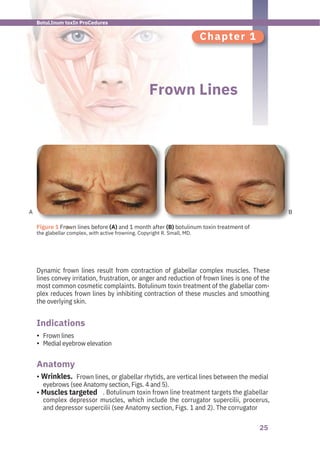
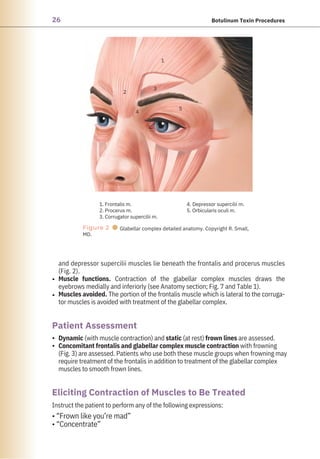
  • 163.
    140 Appendices • Oralincompetence with resultant drooling and/or impaired speaking, eating, or drinking • Cheek flaccidity • Dysarthria (difficulty articulating) • Dysphagia (difficulty swallowing), necessitating nasogastric tube placement in severe cases • Hoarseness • Neck weakness • Weakening of muscles adjacent to the intended treatment area • Autoantibodies against botulinum toxin may be present or develop after treatments rendering treatments ineffective (1–2% of patients treated for cosmetic indications per Allergan). • Extremely rare, immediate hypersensitivity reaction with signs of urticaria, edema, and a remote possibility of anaphylaxis. • Case reports of side effects due to distant spread from the site of injection have been reported with large doses of botulinum toxin, including generalized muscle weakness, ptosis, dysphagia, dysarthria, urinary incontinence, respiratory difficulties, and death due to respiratory compromise. Postmarketing safety data suggest that botulinum toxin effects may, in some cases, be observed beyond the site of local injection. The symptoms may include generalized muscle weakness, double vision, blurred vision, eyelid droop, difficulty swallowing, difficulty speaking, urinary incontinence, and breathing difficulties. These symptoms have been reported hours to weeks after injection. Swallowing and breathing difficulties can be life threatening and there have been reports of death related to spread of toxin effects. The risk of symptoms is probably greatest in children treated for spasticity but symptoms can also occur in adults, particularly in those patients who have underlying conditions that would predispose them to these symptoms. No definite serious adverse event reports of distant spread of toxin effect associated with dermatologic use of cos- metic botulinum toxin at the labeled dose of 20 units (for frown lines) or 100 units (for underarm sweating) have been reported. My signature below certifies that I have fully read this consent form and under- stand the information provided to me regarding the proposed procedure. I have been adequately informed about the procedure including the potential benefits, limitations, and alternative treatments, and I have had all questions and concerns answered to my satisfaction. I understand that results are not guaranteed and I accept the risks, side effects, and possible complications inherent in undergoing Botox treatments. Patient Name _________________________ Patient Signature ______________________ Date ___________

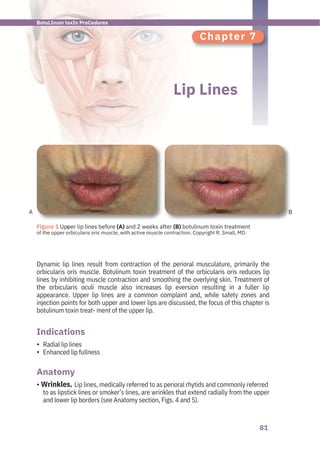
  • 164.
    141 Appendix 4 ConsentForms 4B. Botulinum Toxin Treatment of Underarm Sweating (Axillary Hyperhidrosis) This consent form is designed to provide the information necessary when considering whether or not to undergo botulinum toxin treatment for underarm sweating, also called primary axillary hyperhidrosis, with Botox®. Botulinum toxin (Botox) injections can reduce underarm sweating that is not due to an underlying medical condition. Botox is approved by the Food and Drug Administra- tion for the temporary treatment of primary axillary hyperhidrosis. Botox solution is injected with a small needle into the skin to target the sweat glands. Reduced underarm sweating is typically reported 1–2 weeks after treatment and effects last for approxi- mately 6 months or more in some cases. Before receiving Botox treatment for underarm sweating, you should receive an evaluation from you regular physician to ensure that you do not have an underlying medical condition that is causing the excessive underarm sweating. Also, Botox is not intended as the first treatment to prevent underarm sweating. It is indicated once other therapies such as over-the-counter antiperspirants and aluminum chloride topical anti- perspirants have been tried and found ineffective. The risks, side effects, and complications in treatment with Botox on underarm areas include, but are not limited to the following: • Localized burning or stinging pain during injection • Bruising • Redness • Tenderness • Swelling • Infection • Numbness or dysesthesia • Anxiety • Vasovagal episode with loss of consciousness • Inadequate reduction of sweating or lack of intended effect • Autoantibodies against botulinum toxin may be present or develop after treatments rendering treatments ineffective (1–2% of patients treated for cosmetic indications per Allergan). • Extremely rare, immediate hypersensitivity reaction with signs of urticaria, edema, and a remote possibility of anaphylaxis. • Case reports of side effects due to distant spread from the site of injection have been reported with large doses of botulinum toxin, including generalized muscle weakness, ptosis, dysphagia, dysarthria, urinary incontinence, respiratory difficulties, and death due to respiratory compromise. Postmarketing safety data suggest that botulinum toxin effects may, in some cases, be observed beyond the site of local injection. The symptoms may include generalized muscle weakness, double vision, blurred vision, eyelid droop, difficulty swallowing, difficulty speaking, urinary incontinence, and breathing difficulties. These symptoms have been reported hours to weeks after injection. Swallowing and breathing difficulties can be life threatening and there have been reports of death related to spread of toxin effects. The risk of symptoms is probably greatest in children treated for spasticity but symptoms can also occur in adults, particularly in those patients who have underlying conditions that would predispose them to these symptoms. No definite serious adverse
  • 165.
    142 Appendices event reportsof distant spread of toxin effect associated with dermatologic use of cosmetic botulinum toxin at the labeled dose of 100 units for underarm sweating have been reported. My signature below certifies that I have fully read this consent form and under- stand the information provided to me regarding the proposed procedure. I have been adequately informed about the procedure including the potential benefits, limitations, and alternative treatments, and I have had all questions and concerns answered to my satisfaction. I understand that results are not guaranteed and I accept the risks, side effects, and possible complications inherent in undergoing Botox treatments. Patient Name _________________________ Patient Signature ______________________ Date ___________
  • 166.
    143 Procedure Notes 5A. BotulinumToxin Procedure Note for Cosmetic Treatments Appendix 5
  • 167.
    144 Appendices 5B. BotulinumToxin Treatment Note for Axillary Hyperhidrosis Name: _______________________ D.O.B.: __________ Date: _________ Last First ____________________________________________________________________ Prior treatments:_____________________________________________________ • Over-the-counter antiperspirants used with inadequate response. • Drysol (aluminum chloride) used with inadequate response. 1. (unnoticeable) 5 My underarm sweating is never noticeable and never interferes with my daily activities. 2. (tolerable) 5 My underarm sweating is sometimes noticeable and sometimes inter- feres with my daily activities. 3. (barely tolerable) 5 My underarm sweating is frequently noticeable and frequently interferes with daily activities. 4. (intolerable) 5 My underarm sweating is always noticeable and always interferes with my daily activities. • Do you change shirts during the day because of excessive sweating? Y N • Other areas of excessive sweating: ____________________________________ Primary axillary hyperhidrosis. Botox was reconstituted as follows: 100 units of Botox in 4.0-mL 0.9% nonpreserved saline. The treatment area was cleansed with alcohol and injection points marked with a marking pen. Injections were placed intradermally with 0.1 mL of Botox (2.5 units) at each site for a total of _____ units with _____ injections in the right axilla and _____ units with _____ injections in the left axilla, using a 30-gauge 0.5-inch needle. Injec- tions were spaced 1–2 cm apart, within the area of perspiration. ____________________________________________________________________ ____________________________________________________________________ Complications: None/_____________________ Blood loss: ,1 mL/___________ Condition on leaving: _________________________________________________ Performed by: ________________________________ The patient’s underarm area was shaved. Iodine solution was applied to each axilla and allowed to dry fully. Corn starch was sprinkled on the treatment areas and extra starch brushed off. Ten minutes after application, the axillae skin turned deep blue-black color in the areas of greatest perspiration. A surgical marking pen was used to draw a line around the perspiration treatment area. Botox treatment: History of Present Illness: Diagnosis: Minor’s Iodine-Starch Test: Hyperhidrosis Severity Scale:
  • 168.
    145 Supply Sources Botulinum Toxin TopicalAnesthetics Allergan, Inc. ® PharmaDerm ® APP Pharmaceuticals ® American Health Solutions Pharmacy Medicis Pharmaceutical Corporation ® Dysport Phone: 602-808- 8800 www.medicis.com Botox Phone: 1-800-377- 7790 www.allergan.com L-M-X (lidocaine 4%–5%) 1-973-514-4240 www.pharmaderm.com EMLA (lidocaine 2.5% : prilocaine 2.5%) Schaumburg, IL 60173-5837 1-847-413-2075 www.apppharma.com Benzocaine/lidocaine/tetracaine (BLT) (20:6:4) ointment 1-310-838-7422. www.AHSRx.com Appendix 6
  • 170.
    General Aftercare Reconstitution Complications 147 Bibliography Hsu TS, DoverJS, Kaminer MS, et al. Why make patients exercise facial muscles for 4 hours after botulinum toxin treatment? Arch Dermatol. 2003;139(7):948. Alam M, Dover JS, Arndt KA. Pain associated with injection of botulinum A exotoxin reconstituted using isotonic sodium chloride with and without preservative: a double-blind, randomized controlled trial. Arch Dermatol. 2002;138(4):510–514. Carruthers A, Carruthers J, Cohen J. Dilution volume of botulinum toxin type A for the treatment of glabellar rhytides: does it matter? Derm Surg. 2007;33:S97–S104. Hexsel DM, De Almeida AT, Rutowitsch M, et al. Multicenter double-blind study of the efficacy of injections with botulinum toxin type A reconstituted up to 6 weeks before application. Derm Surg. 2003;29:523. Carruthers A, Bogle M, Carruthers J, et al. A randomized, evaluator-blinded, two-center study of the safety and effect of volume on the diffusion and efficacy of botulinum toxin type A in the treatment of lateral orbital rhytides. Derm Surg. 2007;33(5):567–571. Carruthers A, Carruthers J. Clinical indications and injection techniques for the cosmetic use of botulinum A exotoxin. Derm Surg. 1998;24:1189–1194. Carruthers J, Lowe NJ, Menter MA, et al. A multicenter, double-blind, randomized, placebo-controlled study of the efficacy and safety of botulinum toxin type A in the treatment of glabellar lines. J Am Acad Dermatol. 2002;46(6):840–849. Fagien S. Temporary management of upper lid ptosis, lid malposition, and eyelid fissure asymmetry with botulinum toxin type A. Plast Reconstr Surg. 2004;114(7):1892–1902. Carruthers J, Fagien S, Matarasso SL, et al. The Botox consensus group: Consensus recommendations on the use of botulinum toxin type A in facial aesthetics. Plas Recon Surg. 2004;114(6)(supp):1S–22S. Small R. Aesthetic procedures in office practice. Am Fam Physician. 2009;80(11):1231–1237. Small R. Botulinum Toxin. In: Usatine R, Pfenninger J, Stuhlberg D, and Small R, eds. Dermatologic and Cosmetic Procedures in Office Practice. Philadelphia, PA. Elsevier. Pending 2011. Small R. Botulinum Toxin Type A for Facial Rejuvenation. In: Mayeaux E, ed. The Essential Guide to Primary Care Procedures. Philadelphia, PA. Lippincott Williams & Wilkins. 2009:200–213. Small R. Aesthetic Principles and Consultation. In: Usatine R, Pfenninger J, Stuhlberg D, and Small R, eds. Der- matologic and Cosmetic Procedures in Office Practice. Philadelphia, PA. Elsevier. Pending 2011. Small R. Aesthetic Procedures Introduction. In: Mayeaux E, ed. The Essential Guide to Primary Care Procedures. Philadelphia, PA. Lippincott Williams & Wilkins. 2009:195–199. Small R and Hoang D. Combining Cosmetic Treatments. In: Usatine R, Pfenninger J, Stuhlberg D, and Small R, eds. Dermatologic and Cosmetic Procedures in Office Practice. Philadelphia, PA. Elsevier. Pending 2011. Sommer B, Zschocke I, Bergfeld D, et al. Satisfaction of patients after treatment with botulinum toxin for dynamic facial lines. Derm Surg. 2003;29:456.
  • 171.
    148 Lip Lines Upper Face BunnyLines Frown Lines Crow’s Feet Eyebrow Lift Lower Eyelid Wrinkles Middle and Lower Face Horizontal Forehead Lines Bibliography Klein AW. Complications, adverse reactions, and insights with the use of botulinum toxin. Derm Surg. 2003;29:549–556. Klein AW. Complications and adverse reactions with the use of botulinum toxin. Dis Mon. 2002;48:336–356. Klein AW. Contraindications and complications with the use of botulinum toxin. Clin Dermatol. 2004;22(1):66–75. Tamura BM, Odo MY, Chang B, et al. Treatment of nasal wrinkles with botulinum toxin. Dermatol Surg. 2005;31(3):271–275. Ahn MS, Catten M, Maas CS. Temporal brow lift using botulinum toxin A. Plas Reconstr Surg. 2000;105: 1129–1135. Frankel AS, Kamer FM. Chemical browlift. Arch Otolaryngol Head Neck Surg. 1998;124:321–323. Huang W, Rogachefsky AS, Foster JA. Browlift with botulinum toxin. Dermatol Surg. 2000;26(1):55–60. Carruthers J, Carruthers A. The use of botulinum toxin type A in the upper face. Facial Plast Surg Clin North Am. 2006;14(3):253–260. Maas CS. Botulinum neurotoxins and injectable fillers: minimally invasive management of the aging upper face. Facial Plast Surg Clin North Am. 2006;14(3):241–245. Carruthers J, Carruthers A. Botox use in the mid and lower face and neck. Semin Cutan Med Surg. 2001;20(2): 85–92. Carruthers J, Carruthers A. Botulinum toxin A in the mid and lower face and neck. Dermatol Clin. 2004;22(2): 51–158. Carruthers J, Carruthers A. Botulinum toxin below the eyes. Int Ophthalmol Clin. 2005;45(3):133–141. Carruthers A, Carruthers J, Cohen JL. A prospective, double-blind, randomized, parallel- group, dose-ranging study of botulinum toxin type A in female subjects with horizontal forehead rhytides. Derm Surg. 2003;29(5): 461–467. Flynn TC, Carruthers A, Carruthers J. Botulinum-A toxin treatment of the lower eyelid improves infraorbital rhytides and widens the eye. Dermatol Surg. 2001;27(8):703–708. Flynn TC, Carruthers J, Carruthers A, et al. Botulinum A toxin (BOTOX) in the lower eyelid: dose-finding study. Dermatol Surg. 2003;29(9):943–950. Carruthers J, Lowe NJ, Menter MA, et al. A multicenter, double-blind, randomized, placebo-controlled study of the efficacy and safety of botulinum toxin type A in the treatment of glabellar lines. J Am Acad Dermatol. 2002;46(6):840–849. Carruthers J, Lowe NJ, Menter MA, et al. Double-blind, placebo-controlled study of the safety and efficacy of botulinum toxin type A for patients with glabellar lines. Plast Reconstr Surg. 2003;112(4):1089–1098. Kaplan SE, Sherris DA, Gassner HG, et al. The use of botulinum toxin A in perioral rejuvenation. Facial Plast Surg Clin North Am. 2007;15(4):415–421, v–vi. Balikian RV, Zimbler MS. Primary and adjunctive uses of botulinum toxin type A in the periorbital region. Oto- laryngol Clin North Am. 2007;40(2):291–303. Lowe NJ, Lask GP, Yamauchi PS, et al. Bilateral, double-blind, randomized comparison of 3 doses of botulinum toxin type A and placebo in patients with crow’s feet. J Am Acad Dermatol. 2002;47(6):834–840.
  • 172.
    Chin Dysport Neck Bands Gummy Smile MarionetteLines Axillary Hyperhidrosis Combining Aesthetic Treatments 149 Bibliography Lowe P, Patnaik R, Lowe N. Comparison of two formulations of botulinum toxin type A for the treatment of glabellar lines: a double-blind, randomized study. J Am Acad Dermatol. 2006;55(6):975–980. Gassia V, Beylot C, Bechaux S, et al. Botulinum toxin injection techniques in the lower third and middle of the face, the neck, and the decollete: the “Nefertiti lift.” [in French]. Ann Dermatol Venereol. 2009;136(suppl 4):S111–S118. Polo M. Botulinum toxin type A (Botox) for the neuromuscular correction of excessive gingival display on smiling (gummy smile). Am J Orthod Dentofacial Orthop. 2008;133(2):195–203. Papel ID, Capone RB. Botulinum toxin A for mentalis muscle dysfunction. Arch Facial Plast Surg. 2001;3(4): 268–269. Brandt FS, Boker A. Botulinum toxin for the treatment of neck lines and neck bands. Dermatol Clin. 2004;22: 159–166. Matarasso A, Matarasso SL, Brandt FS, et al. Botulinum A exotoxin for the management of platysma bands. Plast Reconstr Surg. 1999;103(2):645–652. Absar MS, Onwudike M. Efficacy of botulinum toxin type A in the treatment of focal axillary hyperhidrosis. Dermatol Surg. 2008;34(6):751–755. Hornberger J, Grimes K, Naumann M, et al. Recognition, diagnosis, and treatment of primary focal hyperhidrosis. J Am Acad Dermatol. 2004;51(2):274–286. Kowalski JW, Eadie N, Daggett S. Development, validity, and reliability of the Hyperhidrosis Disease Sever- ity Scale (HDSS). Poster Presented at: 62nd Annual Meeting of the American Academy of Dermatology; February 6–10, 2004; Washington, DC. Lowe NJ, Glaser DA, Eadie N, et al. Botulinum toxin type A in the treatment of primary axillary hyperhidrosis: a 52-week multicenter double-blind, randomized, placebo-controlled study of efficacy and safety. J Am Acad Dermatol. 2007;56(4):604–611. Strutton DS, Kowalski JW, Glaser DA, et al. US prevalence of hyperhidrosis and impact on individuals with axillary hyperhidrosis: results from a national survey. J Am Acad Dermatol. 2004;51(2):241–248. Blitzer A, Binder WJ, Boyd J, et al, eds. Management of Facial Lines and Wrinkles. Philadelphia, PA. Lippincott Williams & Wilkins. 2000. Carruthers J, Carruthers A. A prospective, randomized, parallel group study analyzing the effect of BTX-A (Botox) and nonanimal sourced hyaluronic acid (NASHA, Restylane) in combination compared with NASHA (Restylane) alone in severe glabellar rhytides in adult female subjects: treatment of severe glabellar rhytides with a hyaluronic acid derivative compared with the derivative and BTX-A. Derm Surg. 2003;29(8):802–809. Carruthers J, Glogau RG, Blitzer A. Advances in facial rejuvenation: botulinum toxin type A, hyaluronic acid dermal fillers, and combination therapies—consensus recommendations. Plast Reconstr Surg. 2008;121(suppl 5): 5S–30S. Coleman KR, Carruthers J. Combination therapy with BOTOX and fillers: the new rejuvenation paradigm. Der- matol Ther. 2006;19(3):177–188. De Maio M. Botulinum toxin in association with other rejuvenation methods. J Cosmet Laser Ther. 2003;5(3–4): 210–212. De Maio M. Combination Therapy—The Microlift Procedure. In: De Maio M, Rzany B, eds. Botulinum Toxin in Aesthetic Medicine. New York, NY. Springer. 2007:127–136. Fedok FG. Advances in minimally invasive facial rejuvenation. Curr Opin Otolaryngol Head Neck Surg. 2008;16(4):359–368. Micheals J, Micheals B. Coupling advanced injection techniques for cosmetic enhancement. Cosmet Dermatol. 2008;21(1):31–36.
  • 173.
    150 Bibliography Monheit G,Carruthers A, Brandt F, et al. A randomized, double-blind, placebo-controlled study of botulinum toxin type-A for the treatment of glabellar line: determination of optimal dose. Derm Surg. 2007;33(suppl 1): S51–S59. Moy R, Maas C, Monheit G, et al. Long-term safety and efficacy of a new botulinum toxin type A in treating glabellar lines. Arch Facial Plast Surg. 2009;11(2):77–83. Trindade De Almeda AR, Marques E, de Almeida J, et al. Pilot study comparing the diffusion of two formulations of botulinum toxin type A in patients with forehead hyperhydrosis. Derm Surg. 2007;33:S37–S43.
  • 174.
    151 Index Note: Page numbersfollowed by f and t indicates figure and table respectively. Ainjection-related, 19–20 AbobotulinumtoxinA (Dysport), 13toxin–related, 20–21 starting doses for treatment, 134tcontraindications to, 13–14 American Society for Plastic Surgery Botox disadvantages of, 14 Consensus Panel, 16facial anatomy in treatment areas, knowledge of, 16 American Society of Plastic Surgeons, 9functional anatomy, 7f Anxiety, with botulinum toxin injection, 20musculature of face–anterior-posterior, 1f Axillary hyperhidrosis treatment, 125, 125fmusculature of face–oblique, 2f and botulinum toxin treatments in multiple superficial and deep musculature of face, 3f areas, 132surface anatomy of face, 6f complications and management, 131wrinkles and folds of face–anterior-posterior, 4f consent form for, 138–140wrinkles and folds of face–oblique, 5f duration of effects and treatment interval, 131indications for, 10 equipment for, 127informed consent for treatment follow-ups and management after, 131face and neck, 137–138 goal for, 127underarm sweating, 138–140 ice pack, use of, 127injection techniques, 18 indications for, 125mechanism of action of, 10–11, 11f intradermal injection technique for, 131new products, in approval stage, 22 patient assessment for, 126procedure note patient information handout for, 135–136for axillary hyperhidrosis, 141–142 pricing for, 132for cosmetic, 141 procedure note for, 141–142products, 13 procedure, preparation and overview of, 127–128supply sources, 143 recommended Botox reconstitution, 127treatment (See also specific treatment areas) and starting doses, 127abobotulinumtoxinA (Dysport) starting doses and related anatomy, 126for, 134t results of, 131advanced procedures, 11, 12t techniqueaesthetic consultation before, 16–17 botulinum toxin treatment, 128, 131faftercare, 18 minor’s iodine-starch test, 128, 128f–130fanesthesia before, 17 basic procedures, 11, 12t equipment for, 14–15, 14f Bgoals, 12–13 Blepharoptosisin multiple facial areas, 21–22 after eyebrow lift treatment, 70onabotulinumtoxina (Botox) starting doses from frontalis muscle treatment, 43for, 134t from glabellar complex muscles treatment, patient selection for, 12 31, 32fpreprocedure checklist, 17 Botox, 13. See also OnabotulinumtoxinA (OBTX) reimbursement and financial considerations in, 22 (Botox)results and follow-up after, 18–19 concentrations and dosing, 15–16safety zone for, 17 equipment for, 14fstarting doses for, 18 reconstitution, 14unit-to-volume conversion table for, 133t treatment, 15Botulinum toxin injections, administration of, 9. handling and storage of, 16See also Botulinum toxin; specific treatment reconstitution method for, 15areas Botulinum toxin, 9Botulinum toxin serotype A, 13 advantages of, 14Bruising from Clostridium botulinum, 10after crow’s feet treatment, 52 complications of, 19as complication of botulinum toxin injection, 20
  • 175.
    152 Index Bunny linestreatment, 73, 73f combining aesthetic treatments with, 79 complications and management, 79 duration of effects and treatment intervals, 78–79 eliciting contraction of muscles in, 74 equipment for, 75 follow-ups and management, 79 goal of, 74 ice pack, use of, 75 indication for, 73 injection points and doses for, overview of, 77f injection technique in, 77f, 78f patient assessment in, 74 pricing for, 79 procedure, overview of, 75 recommended Botox reconstitution in, 74–75 and starting doses, 75 and related anatomy, 73–74 results of, 78 safety zone for, 75, 76f technique, 75–78, 76f–78f C Cheek flaccidity, after marionette lines treatment, 103 Chin treatment, 107, 107f, 108f and botulinum toxin treatments in multiple areas, 114 combining aesthetic treatments with, 114 complications and management, 114, 113f duration of effects and treatment interval, 113 eliciting contraction of muscles in, 109 equipment for, 109 follow-ups and management after, 113 goals of, 109 ice pack, use of, 109 indications for, 107 injection points and OBTX doses for, overview of, 110, 111f injection technique, 112f patient assessment for, 109 procedure, overview of, 109–110 recommended Botox reconstitution, 109 and starting doses, 109 and related anatomy, 107–109 safety zone for, 110f target for, 108 technique, 111f, 112 Clostridium botulinum, botulinum toxin from, 10 Consent form for face and neck, 137–138 for underarm sweating, 138–140 Crow’s feet treatment, 45 combining aesthetic treatments with, 53–54 complications and management of, 52–53 blepharoptosis, 52 bruising, 52 diplopia, 53 ectropion, 53 globe trauma, 53 lagophthalmos, 53 lip and cheek ptosis, 52 photophobia, 52 xerophthalmia, 53 E Edema, 20 Erythema, 20 Eyebrow asymmetry, 43 Eyebrow lift treatment, 65, 65f combining aesthetic treatments with, 70–71 complications and management, 70 duration of effects and treatment intervals, 70 eliciting contraction of muscles in, 67 equipment for, 68 follow-ups and management, 70 goals of, 67 ice pack, use of, 68 indications for, 65 injection points and doses for, 69f muscles effecting, 66t patient assessment for, 67 pricing for, 71 procedure, overview of, 68, 68f recommended Botox reconstitution, 67–68 and starting doses, 68 and related anatomy, 65–67, 66f results of, 70 target for, 66 technique, 69–70 Eyebrow ptosis, 42–43, 42f duration of effects and treatment interval, 51 eliciting contraction of muscles in, 46 equipment for, 47 follow-ups and management in, 51–52 goals of, 46 indications for, 45 injection points and OBTX doses for, overview of, 48f patient assessment in, 46 pricing for, 54 procedure, overview of, 47–49 recommended botox reconstitution, 46 and starting doses, 46 and related anatomy, 45–46 results of, 51 safety zone in, 47, 47f target for, 45 technique, 49–50, 49f, 50f F Facial aging, 22 combining aesthetic treatments for, 22 (See also Botulinum toxin) Food and Drug Administration (FDA), 9, 10, 13, 22 D Depressor anguli oris muscle, 97, 98 botulinum toxin treatment of (See Marionette lines treatment) Dermatochalasis of upper eyelid, 36, 36f Dynamic frown lines in older patient, 10f treatment for, 12, 13 (See also Botulinum toxin) in younger patient, 9f Dysarthria, 122 Dysphagia, 122 Dysport. See AbobotulinumtoxinA (Dysport)
  • 176.
    153 Index H Headaches, 20 Horizontal foreheadlines, 35 Frontalis muscle, 35–36 botulinum toxin treatment of (See Horizontal forehead lines treatment) horizontal forehead lines from, 35 Frown lines, 25 reduction of, 25 treatment of (See Frown lines treatment) Frown lines treatment, 25, 25f botulinum toxin injection points and doses, 28f combining aesthetic treatments with, 32f, 33 complications and management, 31–33 blepharoptosis, 31–33, 32f injection-related, 31 duration of effects and treatment intervals, 31 eliciting contraction of muscles in, 26 equipment for, 27 follow-ups and management after, 31glabellar complex detailed anatomy, 25–26, 26f indications for, 25 injection technique in, 29f–30f patient assessment before, 26, 27f pricing for, 33 procedure, overview of, 28–29 procerus muscle botulinum toxin injection technique in, 30f recommended Botox reconstitution, 27 and starting doses, 27 results of, 31 safety zone, 28, 28f targets for, 25–26 technique of, 29–30 treatment goals, 27 G Glabellar complex, 25–26 anatomy, 26f botulinum toxin treatment of (See Frown lines treatment) frown lines from contraction of, 25 Gummy smile treatment, 91, 91f and botulinum toxin treatments in multiple areas, 95 combining aesthetic treatments with, 95–96 complications and management, 95 duration of effects and treatment interval, 94 eliciting contraction of muscles in, 92 equipment for, 93 follow-ups and management after, 94–95 ice pack, use of, 92 indications for, 91 injection points and doses for, overview of, 93f muscle botulinum toxin injection technique, 94f muscles targeted in, 91–92 patient assessment before, 92 pricing for, 96 procedure, overview of, 93 recommended Botox reconstitution, 92 and starting doses, 92 and related anatomy, 91–92 results of, 94 technique, 93–94, 94f I IncobotulinumtoxinA (Xeomin), 22 Infection, 20 Injection techniques, 18 Iopidine, 33 L Levator labii superioris alaeque nasi, 91–92 botulinum toxin treatment of (See Gummy smile treatment) Lip asymmetry, 103, 114 after chin treatment, 113f, 114 after marionette lines treatment, 103–104, 105f Lip lines, 81 botulinum toxin treatment for (See Lip lines treatment) cause of, 81 Lip lines treatment, 81, 81f anesthesia for, 82–83 combining aesthetic treatments with, 88–90 combination of Botox, dermal fillers and skin resurfacing procedures, 90f combination of botulinum toxin and dermal filler, 89f complications and management, 88 alteration of lip shape, 88 lip asymmetry, 88 oral incompetence, 88 reduction of (See Horizontal forehead lines treatment) Horizontal forehead lines treatment, 35f by botulinum toxin treatment of frontalis muscle, 35 combining aesthetic treatments with, 43–44 complications and management, 42–43 blepharoptosis, 43 eyebrow asymmetry, 43, 43f eyebrow ptosis, 42–43, 42f contraindications to, 36, 36f duration of effects and treatment interval, 41 eliciting contraction of muscles in, 36 equipment for, 37 follow-ups and management after, 41 frontalis muscle injection technique in, 40f goals of, 36–37 ice packs, use of, 37 indications for, 35 injection points and doses for, overview of, 38f medial frontalis muscle injection technique in, 39f patient assessment before, 36 peaked eyebrows and correction with, 41, 41f pricing for, 44 procedure, overview of, 37–38 recommended Botox reconstitution, 37 and starting doses, 37 and related anatomy, 35–36 results of, 41 safety zone in, 37f target for, 35 technique of, 38–40, 39f, 40f Horizontal neck lines, 117. See also Neck band treatment treatment of, 123 Hyperhidrosis Disease Severity Scale, 126
  • 177.
    154 Index Lip linestreatment (continued) duration of effects and treatment interval, 87 eliciting contraction of muscles in, 82 equipment for, 83 follow-ups and management after, 87–88 goal of, 82 indications for, 81 injection points and doses in, overview of, 85f patient assessment in, 82 pricing for, 90 procedure, overview of, 84–86 recommended Botox reconstitution, 82 and starting doses, 82 and related anatomy, 81–82 results of, 87 safety zone for, 84f target muscle for, 82 technique, 85f, 86–87, 86f and treatments in multiple areas lower face, 88 upper and lower lips, 88 Lip ptosis, 95 Lipstick lines. See Lip lines Lower eyelid wrinkles treatment, 55, 55f combining aesthetic treatments with, 64 complications and management, 64 ectropion, 64 epiphora, 64 globe trauma, 64 infraocular festoons, 64 lagophthalmos, 64 xerophthalmia, 64 contraindications for, 55–56 duration of effects and treatment interval, 63 eliciting contraction of muscles in, 60 equipment for, 60 follow-ups and management in, 63–64 goal of, 60 indications for, 55 injection points and OBTX doses for, overview of, 61f patient assessment for, 57–59 dynamic lower eyelid wrinkles, 57 facial surgery history, 57 infraorbital festoons (eye bags), 59, 59f jelly roll, presence of, 57 lagophthalmos, 59, 59f lower eyelid elasticity, 58, 58f scleral show, 59 skin laxity of lower eyelids, 58, 58f pricing for, 64 procedure, overview of, 60–61 recommended Botox reconstitution, 60 and starting doses, 60 and related anatomy, 56–57, 56f, 57f results of, 63 target for, 56 technique, 61–62, 61f–63f M Marionette lines treatment, 97, 97f and botulinum toxin treatments in multiple areas, 104 combining aesthetic treatments with, 104–105, 105f complications and management, 103–104, 104f depressor anguli oris muscle palpation in, 100f duration of effects and treatment interval, 102 O OnabotulinumtoxinA (OBTX) (Botox), 13 starting doses for treatment, 134t ( treatment areas) Oral incompetence, 21, 79, 88, 95 after chin treatment, 114 after marionette lines treatment, 104 Orbicularis oculi muscle, 45–46, 56–57 eliciting contraction of muscles in, 98 equipment for, 99 follow-ups and management after, 103 goals of, 98 ice pack, use of, 99 indications for, 97 injection points and OBTX doses for, overview of, 101f muscle botulinum toxin injection technique in, 102f patient assessment before, 98 pricing for, 105 procedure, overview of, 99–100 recommended Botox reconstitution, 98 and starting doses, 99 and related anatomy, 97–98 results, 102 safety zone, 99–100, 99f target for, 98 technique, 100–101 Mentalis muscle, 107, 108 botulinum toxin treatment of (See Chin treatment) Mueller’s muscle, contraction of, 33 N Nasalis muscle, 73–74 botulinum toxin treatment of (See Bunny lines treatment) bunny lines from, 73 Neck band treatment, 115 and botulinum toxin treatments in multiple areas, 122 complications and management after, 122 duration of effects and treatment interval, 121 eliciting contraction of muscles in, 117 equipment for, 119 follow-ups and management after, 122 goal of, 117 and horizontal neck lines treatment, 123 ice pack, use of, 119 indications for, 115 injection points and doses for, overview of, 120f injection technique, 120f patient assessment for, 117 pricing for, 123 procedure, overview of, 119–121, 119f, 120f recommended Botox reconstitution, 117–118 and starting doses, 118 and related anatomy, 115–117, 116f results of, 121 safety zone for, 119f skin laxity and, 117, 118f target for, 117 technique, 121 Necklace lines. See also Horizontal neck lines Neck weakness, 122 Numbness, 20 See also specific
  • 178.
    155 Index R Reconstitution method, 15 RT001/ReVance,22 botulinum toxin treatment of (See Crow’s feet treatment; Lower eyelid wrinkles treatment) crow’s feet from, 45 function of, 46 lower eyelid wrinkles from, 55 Orbicularis oris, 81, 82 P Pain, as complication of botulinum toxin injection, 20 Patient information handout for cosmetic treatments, 135 for treatment of underarm sweating, 135–136 Peaked eyebrows, 41, 41f Platysma muscle, 115, 117 botulinum toxin treatment of (See Neck band treatment) PurTox, 22 W Wrinkling skin aging and, 9, 9f, 10f treatment of (See Botulinum toxin) S Safety zone, 17 Skin aging and formation of lines and wrinkles, 9, 9f, 10f other changes with, 10 Smile asymmetry, after gummy smile treatment, 95 Smoker’s lines. See Lip lines Snap test, for lower eyelid elasticity evaluation, 58, 58f Static lines, 9 in older patient, 10f treatment for, 12, 13 (See also Botulinum toxin) Superior lateral orbicularis oculi muscle, 65, 66 botulinum toxin treatment of (See Eyebrow lift treatment) Sweat glands, 126