

The Information Warfare
   - how it can affect us -

            Luis Borges Gouveia
         lmbg@ufp.edu.pt (UFP)
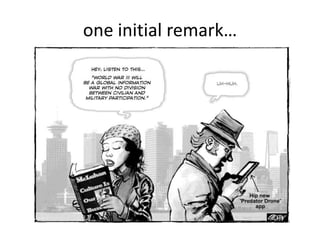
one initial remark…
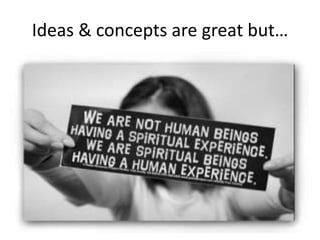
Ideas & concepts are great but…
One of the main topics in
           warfare in the 21st Century
• NETWORK-CENTRIC AND INFORMATION WARFARE,
  OPERATIONS, AND RELATED TECHNOLOGY
    – Networks (focus on computers and telecommunications)
    – Memory and storage & information analysis – intelligence
      (focus on digital information)
    – Electronic based tech to influence, alter, reduce and
      change information (focus on how humans process
      information)

• Gibish, E. (2003). WARFARE IN THE 21ST CENTURY - A Selected
  Bibliography. U.S. Army War College Library. Carlisle Barracks, PA. EUA
  http://www.carlisle.army.mil/library/bibs/warfar03.htm
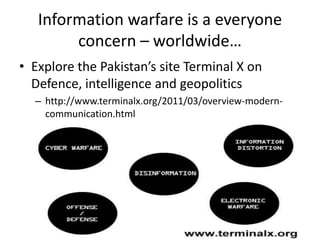
Information warfare is a everyone
        concern – worldwide…
• Explore the Pakistan’s site Terminal X on
  Defence, intelligence and geopolitics
  – http://www.terminalx.org/2011/03/overview-modern-
    communication.html
One (big) example…
• On June 23 2009, the United States Secretary of Defense Robert Gates
  issued notifications for the establishment of the world's first dedicated
  CYBERCOM (Cyber Command), the USCYBERCOM based on growing
  concerns of Chinese military penetration into Pentagon defense systems.
  He outlined the objective in the following statement:

   "My own view is that the only way to counteract both criminal and
   espionage activity online is to be proactive. If the U.S. is taking a formal
   approach to this, then that has to be a good thing. The Chinese are
   viewed as the source of a great many attacks on Western infrastructure
   and just recently, the U.S. electrical grid. If that is determined to be an
   organized attack, I would want to go and take down the source of those
   attacks. The only problem is that the Internet, by its very nature, has no
   borders and if the U.S. takes on the mantle of the world's police; that
   might not go down so well."
Another one…
•   On January 15 2011, the NY Times reported:
    Over the past two years, according to intelligence and military experts familiar
    with its operations, Dimona has taken on a new, equally secret role — as a critical
    testing ground in a joint American and Israeli effort to undermine Iran’s efforts to
    make a bomb of its own.
    Behind Dimona’s barbed wire, the experts say, Israel has spun nuclear centrifuges
    virtually identical to Iran’s at Natanz, where Iranian scientists are struggling to
    enrich uranium. They say Dimona tested the effectiveness of the Stuxnet computer
    worm, a destructive program that appears to have wiped out roughly a fifth of
    Iran’s nuclear centrifuges and helped delay, though not destroy, Tehran’s ability to
    make its first nuclear arms.

•   Conflicting reports just recently now suggest that it was the US which was behind
    the design, trial and injection of the Stuxnet worm. There can be a strong
    possibility that both Israel and the US cyber commands worked in tandem against
    Irani cyber command which was setup to "prevent espionage and sabotage in
    Information Technology (IT) tools" according to General Syed Kamal Hadianfar,
    Head of the Information Production and Exchange Department of the Law
    Enforcement Police in Iran.
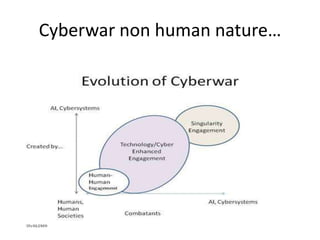
Cyberwar non human nature…
Working Definition
Information warfare is comprised of operations
  directed against information in any form,
  transmitted over any media, including
  operations against information content, its
  supporting systems and software, the physical
  hardware device that stores the data or
  instructions, and also human practices and
  perceptions
Information Operations (IO)
• Military Information Warfare
• IO is conducted during time of crisis or
  conflict to affect adversary information and
  information systems while defending one's
  own information and systems
peace as an ultimate goal
". . . attaining one hundred victories in one
   hundred battles is not the pinnacle of
   excellence. Subjugating the enemy's army
   without fighting is the true pinnacle of
   excellence."

                   Sun Tzu, The Art of War
Better than brute force
"There are but two powers in the world, the
sword and the mind. In the long run the
sword is always beaten by the mind."

                  Napoleon Bonaparte
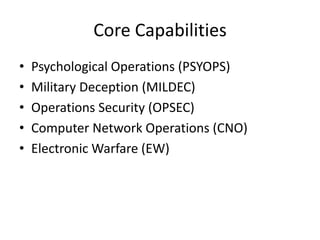
Core Capabilities
•   Psychological Operations (PSYOPS)
•   Military Deception (MILDEC)
•   Operations Security (OPSEC)
•   Computer Network Operations (CNO)
•   Electronic Warfare (EW)
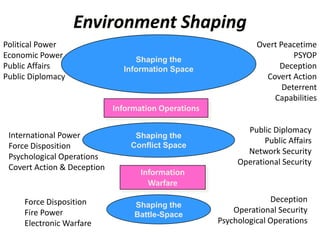
Environment Shaping
Political Power                                                 Overt Peacetime
Economic Power                    Shaping the
                                                                          PSYOP
Public Affairs                 Information Space                      Deception
Public Diplomacy                                                  Covert Action
                                                                       Deterrent
                                                                    Capabilities
                             Information Operations

                                                             Public Diplomacy
 International Power              Shaping the
                                                                  Public Affairs
 Force Disposition               Conflict Space
                                                             Network Security
 Psychological Operations
                                                           Operational Security
 Covert Action & Deception
                                    Information
                                      Warfare

     Force Disposition                                              Deception
                                  Shaping the
     Fire Power                                           Operational Security
                                  Battle-Space
     Electronic Warfare                               Psychological Operations
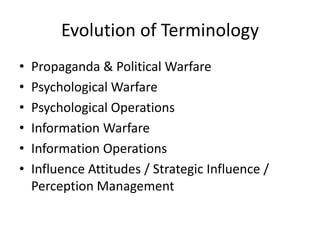
Evolution of Terminology
•   Propaganda & Political Warfare
•   Psychological Warfare
•   Psychological Operations
•   Information Warfare
•   Information Operations
•   Influence Attitudes / Strategic Influence /
    Perception Management
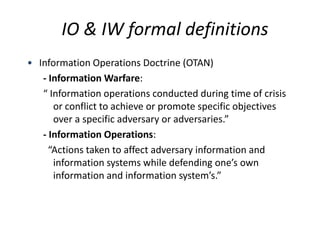
IO & IW formal definitions
• Information Operations Doctrine (OTAN)
   - Information Warfare:
   “ Information operations conducted during time of crisis
      or conflict to achieve or promote specific objectives
      over a specific adversary or adversaries.”
   - Information Operations:
     “Actions taken to affect adversary information and
      information systems while defending one’s own
      information and information system’s.”
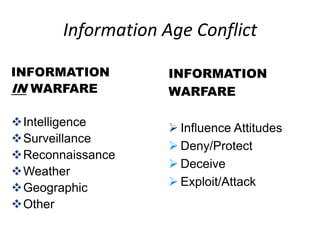
Information Age Conflict

INFORMATION         INFORMATION
IN WARFARE          WARFARE

Intelligence        Influence Attitudes
Surveillance
                     Deny/Protect
Reconnaissance
                     Deceive
Weather
Geographic          Exploit/Attack
Other
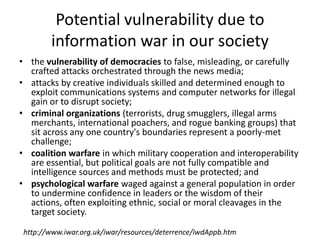
Potential vulnerability due to
        information war in our society
• the vulnerability of democracies to false, misleading, or carefully
  crafted attacks orchestrated through the news media;
• attacks by creative individuals skilled and determined enough to
  exploit communications systems and computer networks for illegal
  gain or to disrupt society;
• criminal organizations (terrorists, drug smugglers, illegal arms
  merchants, international poachers, and rogue banking groups) that
  sit across any one country's boundaries represent a poorly-met
  challenge;
• coalition warfare in which military cooperation and interoperability
  are essential, but political goals are not fully compatible and
  intelligence sources and methods must be protected; and
• psychological warfare waged against a general population in order
  to undermine confidence in leaders or the wisdom of their
  actions, often exploiting ethnic, social or moral cleavages in the
  target society.

 http://www.iwar.org.uk/iwar/resources/deterrence/iwdAppb.htm
Final
remarks
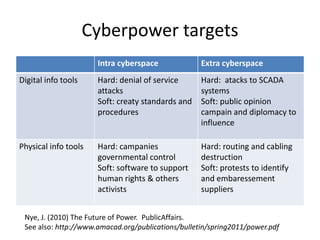
Cyberpower targets
                      Intra cyberspace              Extra cyberspace
Digital info tools    Hard: denial of service       Hard: atacks to SCADA
                      attacks                       systems
                      Soft: creaty standards and    Soft: public opinion
                      procedures                    campain and diplomacy to
                                                    influence

Physical info tools   Hard: campanies               Hard: routing and cabling
                      governmental control          destruction
                      Soft: software to support     Soft: protests to identify
                      human rights & others         and embaressement
                      activists                     suppliers


 Nye, J. (2010) The Future of Power. PublicAffairs.
 See also: http://www.amacad.org/publications/bulletin/spring2011/power.pdf
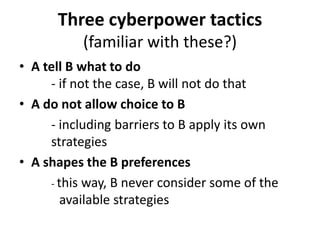
Three cyberpower tactics
           (familiar with these?)
• A tell B what to do
     - if not the case, B will not do that
• A do not allow choice to B
     - including barriers to B apply its own
     strategies
• A shapes the B preferences
     - this way, B never consider some of the
        available strategies
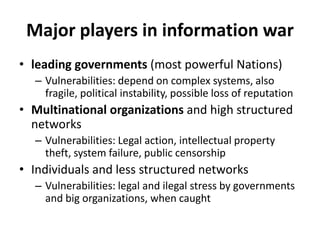
Major players in information war
• leading governments (most powerful Nations)
  – Vulnerabilities: depend on complex systems, also
    fragile, political instability, possible loss of reputation
• Multinational organizations and high structured
  networks
  – Vulnerabilities: Legal action, intellectual property
    theft, system failure, public censorship
• Individuals and less structured networks
  – Vulnerabilities: legal and ilegal stress by governments
    and big organizations, when caught
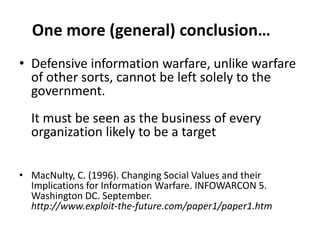
One more (general) conclusion…
• Defensive information warfare, unlike warfare
  of other sorts, cannot be left solely to the
  government.
  It must be seen as the business of every
  organization likely to be a target

• MacNulty, C. (1996). Changing Social Values and their
  Implications for Information Warfare. INFOWARCON 5.
  Washington DC. September.
  http://www.exploit-the-future.com/paper1/paper1.htm

The Information Warfare: how it can affect us

  • 1.
    The Information Warfare - how it can affect us - Luis Borges Gouveia lmbg@ufp.edu.pt (UFP)
  • 2.
  • 3.
    Ideas & conceptsare great but…
  • 4.
    One of themain topics in warfare in the 21st Century • NETWORK-CENTRIC AND INFORMATION WARFARE, OPERATIONS, AND RELATED TECHNOLOGY – Networks (focus on computers and telecommunications) – Memory and storage & information analysis – intelligence (focus on digital information) – Electronic based tech to influence, alter, reduce and change information (focus on how humans process information) • Gibish, E. (2003). WARFARE IN THE 21ST CENTURY - A Selected Bibliography. U.S. Army War College Library. Carlisle Barracks, PA. EUA http://www.carlisle.army.mil/library/bibs/warfar03.htm
  • 5.
    Information warfare isa everyone concern – worldwide… • Explore the Pakistan’s site Terminal X on Defence, intelligence and geopolitics – http://www.terminalx.org/2011/03/overview-modern- communication.html
  • 6.
    One (big) example… •On June 23 2009, the United States Secretary of Defense Robert Gates issued notifications for the establishment of the world's first dedicated CYBERCOM (Cyber Command), the USCYBERCOM based on growing concerns of Chinese military penetration into Pentagon defense systems. He outlined the objective in the following statement: "My own view is that the only way to counteract both criminal and espionage activity online is to be proactive. If the U.S. is taking a formal approach to this, then that has to be a good thing. The Chinese are viewed as the source of a great many attacks on Western infrastructure and just recently, the U.S. electrical grid. If that is determined to be an organized attack, I would want to go and take down the source of those attacks. The only problem is that the Internet, by its very nature, has no borders and if the U.S. takes on the mantle of the world's police; that might not go down so well."
  • 7.
    Another one… • On January 15 2011, the NY Times reported: Over the past two years, according to intelligence and military experts familiar with its operations, Dimona has taken on a new, equally secret role — as a critical testing ground in a joint American and Israeli effort to undermine Iran’s efforts to make a bomb of its own. Behind Dimona’s barbed wire, the experts say, Israel has spun nuclear centrifuges virtually identical to Iran’s at Natanz, where Iranian scientists are struggling to enrich uranium. They say Dimona tested the effectiveness of the Stuxnet computer worm, a destructive program that appears to have wiped out roughly a fifth of Iran’s nuclear centrifuges and helped delay, though not destroy, Tehran’s ability to make its first nuclear arms. • Conflicting reports just recently now suggest that it was the US which was behind the design, trial and injection of the Stuxnet worm. There can be a strong possibility that both Israel and the US cyber commands worked in tandem against Irani cyber command which was setup to "prevent espionage and sabotage in Information Technology (IT) tools" according to General Syed Kamal Hadianfar, Head of the Information Production and Exchange Department of the Law Enforcement Police in Iran.
  • 9.
  • 10.
    Working Definition Information warfareis comprised of operations directed against information in any form, transmitted over any media, including operations against information content, its supporting systems and software, the physical hardware device that stores the data or instructions, and also human practices and perceptions
  • 11.
    Information Operations (IO) •Military Information Warfare • IO is conducted during time of crisis or conflict to affect adversary information and information systems while defending one's own information and systems
  • 12.
    peace as anultimate goal ". . . attaining one hundred victories in one hundred battles is not the pinnacle of excellence. Subjugating the enemy's army without fighting is the true pinnacle of excellence." Sun Tzu, The Art of War
  • 13.
    Better than bruteforce "There are but two powers in the world, the sword and the mind. In the long run the sword is always beaten by the mind." Napoleon Bonaparte
  • 14.
    Core Capabilities • Psychological Operations (PSYOPS) • Military Deception (MILDEC) • Operations Security (OPSEC) • Computer Network Operations (CNO) • Electronic Warfare (EW)
  • 15.
    Environment Shaping Political Power Overt Peacetime Economic Power Shaping the PSYOP Public Affairs Information Space Deception Public Diplomacy Covert Action Deterrent Capabilities Information Operations Public Diplomacy International Power Shaping the Public Affairs Force Disposition Conflict Space Network Security Psychological Operations Operational Security Covert Action & Deception Information Warfare Force Disposition Deception Shaping the Fire Power Operational Security Battle-Space Electronic Warfare Psychological Operations
  • 16.
    Evolution of Terminology • Propaganda & Political Warfare • Psychological Warfare • Psychological Operations • Information Warfare • Information Operations • Influence Attitudes / Strategic Influence / Perception Management
  • 17.
    IO & IWformal definitions • Information Operations Doctrine (OTAN) - Information Warfare: “ Information operations conducted during time of crisis or conflict to achieve or promote specific objectives over a specific adversary or adversaries.” - Information Operations: “Actions taken to affect adversary information and information systems while defending one’s own information and information system’s.”
  • 18.
    Information Age Conflict INFORMATION INFORMATION IN WARFARE WARFARE Intelligence  Influence Attitudes Surveillance  Deny/Protect Reconnaissance  Deceive Weather Geographic  Exploit/Attack Other
  • 20.
    Potential vulnerability dueto information war in our society • the vulnerability of democracies to false, misleading, or carefully crafted attacks orchestrated through the news media; • attacks by creative individuals skilled and determined enough to exploit communications systems and computer networks for illegal gain or to disrupt society; • criminal organizations (terrorists, drug smugglers, illegal arms merchants, international poachers, and rogue banking groups) that sit across any one country's boundaries represent a poorly-met challenge; • coalition warfare in which military cooperation and interoperability are essential, but political goals are not fully compatible and intelligence sources and methods must be protected; and • psychological warfare waged against a general population in order to undermine confidence in leaders or the wisdom of their actions, often exploiting ethnic, social or moral cleavages in the target society. http://www.iwar.org.uk/iwar/resources/deterrence/iwdAppb.htm
  • 22.
  • 23.
    Cyberpower targets Intra cyberspace Extra cyberspace Digital info tools Hard: denial of service Hard: atacks to SCADA attacks systems Soft: creaty standards and Soft: public opinion procedures campain and diplomacy to influence Physical info tools Hard: campanies Hard: routing and cabling governmental control destruction Soft: software to support Soft: protests to identify human rights & others and embaressement activists suppliers Nye, J. (2010) The Future of Power. PublicAffairs. See also: http://www.amacad.org/publications/bulletin/spring2011/power.pdf
  • 24.
    Three cyberpower tactics (familiar with these?) • A tell B what to do - if not the case, B will not do that • A do not allow choice to B - including barriers to B apply its own strategies • A shapes the B preferences - this way, B never consider some of the available strategies
  • 25.
    Major players ininformation war • leading governments (most powerful Nations) – Vulnerabilities: depend on complex systems, also fragile, political instability, possible loss of reputation • Multinational organizations and high structured networks – Vulnerabilities: Legal action, intellectual property theft, system failure, public censorship • Individuals and less structured networks – Vulnerabilities: legal and ilegal stress by governments and big organizations, when caught
  • 26.
    One more (general)conclusion… • Defensive information warfare, unlike warfare of other sorts, cannot be left solely to the government. It must be seen as the business of every organization likely to be a target • MacNulty, C. (1996). Changing Social Values and their Implications for Information Warfare. INFOWARCON 5. Washington DC. September. http://www.exploit-the-future.com/paper1/paper1.htm