
1
Latest Trends In Payments Industry
Ramanan Jagannathan
July 2017
http://mysicmundane.blogspot.in
2
Agenda
• Why the interest in Payments Industry
• Payment Trends
• Challenges Ahead
• Resources to Dig Deeper
3
Agenda
• Why the interest in Payments Industry
• Trends
• Challenges Ahead
• Resources to Dig Deeper
4
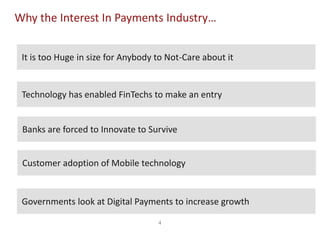
Why the Interest In Payments Industry…
Technology has enabled FinTechs to make an entry
Customer adoption of Mobile technology
Governments look at Digital Payments to increase growth
It is too Huge in size for Anybody to Not-Care about it
Banks are forced to Innovate to Survive
5
• Why the interest in Payments Industry
• Trends
• Challenges Ahead
• Resources to Dig Deeper
6
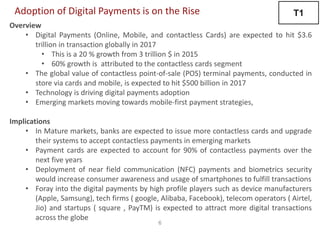
Adoption of Digital Payments is on the Rise
Overview
• Digital Payments (Online, Mobile, and contactless Cards) are expected to hit $3.6
trillion in transaction globally in 2017
• This is a 20 % growth from 3 trillion $ in 2015
• 60% growth is attributed to the contactless cards segment
• The global value of contactless point-of-sale (POS) terminal payments, conducted in
store via cards and mobile, is expected to hit $500 billion in 2017
• Technology is driving digital payments adoption
• Emerging markets moving towards mobile-first payment strategies,
Implications
• In Mature markets, banks are expected to issue more contactless cards and upgrade
their systems to accept contactless payments in emerging markets
• Payment cards are expected to account for 90% of contactless payments over the
next five years
• Deployment of near field communication (NFC) payments and biometrics security
would increase consumer awareness and usage of smartphones to fulfill transactions
• Foray into the digital payments by high profile players such as device manufacturers
(Apple, Samsung), tech firms ( google, Alibaba, Facebook), telecom operators ( Airtel,
Jio) and startups ( square , PayTM) is expected to attract more digital transactions
across the globe
T1
7
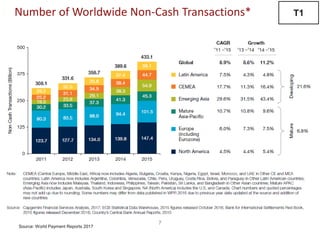
Number of Worldwide Non-Cash Transactions* T1
Source: World Payment Reports 2017
8
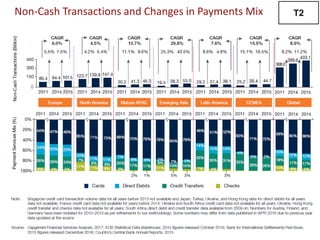
T2Instant Payments Emerge as Alternatives to Existing Instruments
Overview
• The availability of instant payments is triggering new customer needs and
requirements,
• Instant Payments also forces service providers to offer newer business propositions
• The introduction of PSD II is expected to disrupt payments landscape
• Several countries including Australia, US and India are actively pursuing the
development and implementation of instant payment infrastructure
Implications
• Overlay services such as PayTM in India, can increase the adoption of instant
payments across retail and corporate environments
• Instant payments could drive the growth of non-cash transactions by doing away
with less efficient instruments like cash and check or even Cards
• Instant payments could replace POS terminals in cases where the fees charged is
lesser
9
Non-Cash Transactions and Changes in Payments Mix T2
10
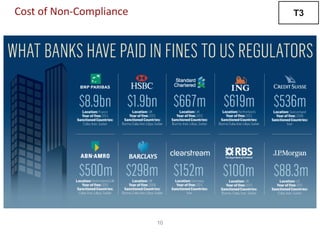
Cost of Non-Compliance T3
11
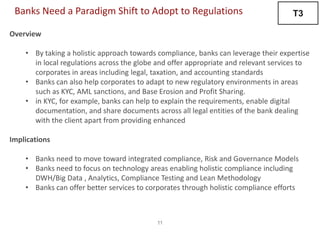
T3Banks Need a Paradigm Shift to Adopt to Regulations
Overview
• By taking a holistic approach towards compliance, banks can leverage their expertise
in local regulations across the globe and offer appropriate and relevant services to
corporates in areas including legal, taxation, and accounting standards
• Banks can also help corporates to adapt to new regulatory environments in areas
such as KYC, AML sanctions, and Base Erosion and Profit Sharing.
• in KYC, for example, banks can help to explain the requirements, enable digital
documentation, and share documents across all legal entities of the bank dealing
with the client apart from providing enhanced
Implications
• Banks need to move toward integrated compliance, Risk and Governance Models
• Banks need to focus on technology areas enabling holistic compliance including
DWH/Big Data , Analytics, Compliance Testing and Lean Methodology
• Banks can offer better services to corporates through holistic compliance efforts
12
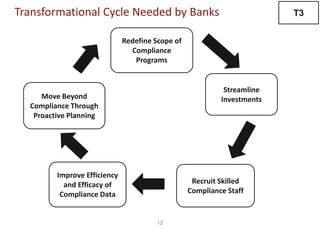
Transformational Cycle Needed by Banks
Redefine Scope of
Compliance
Programs
Streamline
Investments
Recruit Skilled
Compliance Staff
Move Beyond
Compliance Through
Proactive Planning
Improve Efficiency
and Efficacy of
Compliance Data
T3
13
RegTechs and Regulatory Sandboxes emerge as key Themes
Overview
• The regulatory compliance software industry is headed toward strong growth as the
demand for regulatory and compliance software is expected to reach $118.7 billion
by 2020
• Banks have always played the role of catch-up and have struggled to devise and
implement a robust and efficient approach
• RegTech firms can help in analyzing and implementing governance rules apart from
extracting, analyzing, and storing data
Implications
• Initial Target Areas for compliance solutions by RegTechs include Basel III/ CRDIV-
related compliance, risk analytics, KYC utilities for storing due diligence information,
and cloud based plug-and-play software
• Banks benefit from RegTechs by becoming more flexible and agile
• As banks adopt to a more pro-active cycle, more tactical compliance tasks will be
automated in order to reduce operational risks associated with compliance and
reporting obligations
T4
14
Regulatory Compliance Eco System*
* https://www.421.se/regtech-time-turn-regulatory-compliance-competitive-advantage/
T4
15
Regulatory Sandbox… T4
• A Regulatory Sandbox is a regulator driven initiative where businesses can Test
products, services, offerings in a live environment
Source: http://industrysandbox.org/regulatory-sandboxes/
16
Adoption of Open API - A Paradigm shift in Payments
Trend Overview
• An Open API is a public interface that is a set of functions and procedures that
provides means to access data based on open standards
• Open APIs are slowly gaining traction in Indian Banking Sector, fueled by the
government's Open API policy for programs like Aadhar, e-KYC, e-sign, and the
Unified Payments Interface (UPI)
• Data thus accessed by Open APIs may be used to develop micro services for the end
customers such as building custom applications on existing banking platforms to
create a new revenue model
Implications
• Banks are expected to forge inter-bank collaborations to develop standards and
protocols for 3rd party partnerships based on open banking platforms
• There exists an opportunity for corporates to become more involved with their
payment processing partners
• On one hand there is a need to accelerate service innovation through adoption of
APIs in the market while on the other hand, collaboration between banks and third
party API developers in a win-win deal for both
T5
17
Advantages of Open API T5
18
Security and Authentication
Trend Overview
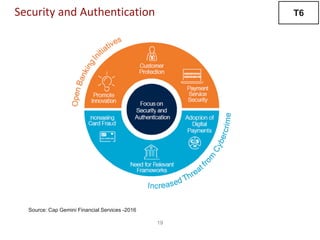
• Regulations such as PSD II and Open API banking projects are forcing implementation
of standards to reduce security breaches
• Focus on Authentication has increased , with growth of Fingerprint ID for single sign
on across multiple bank accounts
• Security Risk is not only on the network and can't be only secured with software, in
view of the technology developments and increasing volume of online and mobile
payment transactions
Implications
• Customer adoption of Digital Payments relies heavily on reliable and consistent user
experience
• Industry leaders and central authorities will have to ensure that the security
standards and frameworks are uniform and dependable
• Banks may review their payment system architecture to reduce the external touch
points, making it easier for the bank to manage end-to-end process
• Banks should also implement solutions that can strengthen its cybersecurity
processes against cyber fraud and protect it against risks of system breach such as
denial of service attacks
T6
19
Security and Authentication
Source: Cap Gemini Financial Services -2016
T6
20
• Why the interest in Payments Industry
• Trends
• Challenges Ahead
• Resources to Dig Deeper
21
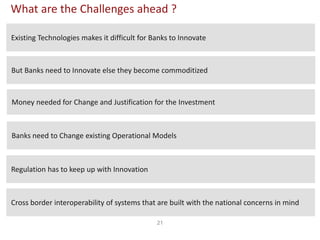
What are the Challenges ahead ?
Existing Technologies makes it difficult for Banks to Innovate
Banks need to Change existing Operational Models
Cross border interoperability of systems that are built with the national concerns in mind
Regulation has to keep up with Innovation
Money needed for Change and Justification for the Investment
But Banks need to Innovate else they become commoditized
22
• Why the interest in Payments Industry
• Trends
• Challenges Ahead
• Resources to Dig Deeper
23
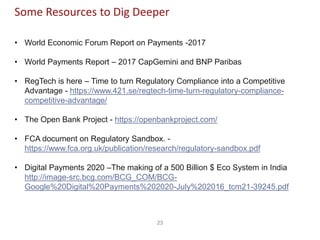
Some Resources to Dig Deeper
• World Economic Forum Report on Payments -2017
• World Payments Report – 2017 CapGemini and BNP Paribas
• RegTech is here – Time to turn Regulatory Compliance into a Competitive
Advantage - https://www.421.se/regtech-time-turn-regulatory-compliance-
competitive-advantage/
• The Open Bank Project - https://openbankproject.com/
• FCA document on Regulatory Sandbox. -
https://www.fca.org.uk/publication/research/regulatory-sandbox.pdf
• Digital Payments 2020 –The making of a 500 Billion $ Eco System in India
http://image-src.bcg.com/BCG_COM/BCG-
Google%20Digital%20Payments%202020-July%202016_tcm21-39245.pdf
24
Questions?

Latest Trends Payments Industry

  • 1.
    1 Latest Trends InPayments Industry Ramanan Jagannathan July 2017 http://mysicmundane.blogspot.in
  • 2.
    2 Agenda • Why theinterest in Payments Industry • Payment Trends • Challenges Ahead • Resources to Dig Deeper
  • 3.
    3 Agenda • Why theinterest in Payments Industry • Trends • Challenges Ahead • Resources to Dig Deeper
  • 4.
    4 Why the InterestIn Payments Industry… Technology has enabled FinTechs to make an entry Customer adoption of Mobile technology Governments look at Digital Payments to increase growth It is too Huge in size for Anybody to Not-Care about it Banks are forced to Innovate to Survive
  • 5.
    5 • Why theinterest in Payments Industry • Trends • Challenges Ahead • Resources to Dig Deeper
  • 6.
    6 Adoption of DigitalPayments is on the Rise Overview • Digital Payments (Online, Mobile, and contactless Cards) are expected to hit $3.6 trillion in transaction globally in 2017 • This is a 20 % growth from 3 trillion $ in 2015 • 60% growth is attributed to the contactless cards segment • The global value of contactless point-of-sale (POS) terminal payments, conducted in store via cards and mobile, is expected to hit $500 billion in 2017 • Technology is driving digital payments adoption • Emerging markets moving towards mobile-first payment strategies, Implications • In Mature markets, banks are expected to issue more contactless cards and upgrade their systems to accept contactless payments in emerging markets • Payment cards are expected to account for 90% of contactless payments over the next five years • Deployment of near field communication (NFC) payments and biometrics security would increase consumer awareness and usage of smartphones to fulfill transactions • Foray into the digital payments by high profile players such as device manufacturers (Apple, Samsung), tech firms ( google, Alibaba, Facebook), telecom operators ( Airtel, Jio) and startups ( square , PayTM) is expected to attract more digital transactions across the globe T1
  • 7.
    7 Number of WorldwideNon-Cash Transactions* T1 Source: World Payment Reports 2017
  • 8.
    8 T2Instant Payments Emergeas Alternatives to Existing Instruments Overview • The availability of instant payments is triggering new customer needs and requirements, • Instant Payments also forces service providers to offer newer business propositions • The introduction of PSD II is expected to disrupt payments landscape • Several countries including Australia, US and India are actively pursuing the development and implementation of instant payment infrastructure Implications • Overlay services such as PayTM in India, can increase the adoption of instant payments across retail and corporate environments • Instant payments could drive the growth of non-cash transactions by doing away with less efficient instruments like cash and check or even Cards • Instant payments could replace POS terminals in cases where the fees charged is lesser
  • 9.
    9 Non-Cash Transactions andChanges in Payments Mix T2
  • 10.
  • 11.
    11 T3Banks Need aParadigm Shift to Adopt to Regulations Overview • By taking a holistic approach towards compliance, banks can leverage their expertise in local regulations across the globe and offer appropriate and relevant services to corporates in areas including legal, taxation, and accounting standards • Banks can also help corporates to adapt to new regulatory environments in areas such as KYC, AML sanctions, and Base Erosion and Profit Sharing. • in KYC, for example, banks can help to explain the requirements, enable digital documentation, and share documents across all legal entities of the bank dealing with the client apart from providing enhanced Implications • Banks need to move toward integrated compliance, Risk and Governance Models • Banks need to focus on technology areas enabling holistic compliance including DWH/Big Data , Analytics, Compliance Testing and Lean Methodology • Banks can offer better services to corporates through holistic compliance efforts
  • 12.
    12 Transformational Cycle Neededby Banks Redefine Scope of Compliance Programs Streamline Investments Recruit Skilled Compliance Staff Move Beyond Compliance Through Proactive Planning Improve Efficiency and Efficacy of Compliance Data T3
  • 13.
    13 RegTechs and RegulatorySandboxes emerge as key Themes Overview • The regulatory compliance software industry is headed toward strong growth as the demand for regulatory and compliance software is expected to reach $118.7 billion by 2020 • Banks have always played the role of catch-up and have struggled to devise and implement a robust and efficient approach • RegTech firms can help in analyzing and implementing governance rules apart from extracting, analyzing, and storing data Implications • Initial Target Areas for compliance solutions by RegTechs include Basel III/ CRDIV- related compliance, risk analytics, KYC utilities for storing due diligence information, and cloud based plug-and-play software • Banks benefit from RegTechs by becoming more flexible and agile • As banks adopt to a more pro-active cycle, more tactical compliance tasks will be automated in order to reduce operational risks associated with compliance and reporting obligations T4
  • 14.
    14 Regulatory Compliance EcoSystem* * https://www.421.se/regtech-time-turn-regulatory-compliance-competitive-advantage/ T4
  • 15.
    15 Regulatory Sandbox… T4 •A Regulatory Sandbox is a regulator driven initiative where businesses can Test products, services, offerings in a live environment Source: http://industrysandbox.org/regulatory-sandboxes/
  • 16.
    16 Adoption of OpenAPI - A Paradigm shift in Payments Trend Overview • An Open API is a public interface that is a set of functions and procedures that provides means to access data based on open standards • Open APIs are slowly gaining traction in Indian Banking Sector, fueled by the government's Open API policy for programs like Aadhar, e-KYC, e-sign, and the Unified Payments Interface (UPI) • Data thus accessed by Open APIs may be used to develop micro services for the end customers such as building custom applications on existing banking platforms to create a new revenue model Implications • Banks are expected to forge inter-bank collaborations to develop standards and protocols for 3rd party partnerships based on open banking platforms • There exists an opportunity for corporates to become more involved with their payment processing partners • On one hand there is a need to accelerate service innovation through adoption of APIs in the market while on the other hand, collaboration between banks and third party API developers in a win-win deal for both T5
  • 17.
  • 18.
    18 Security and Authentication TrendOverview • Regulations such as PSD II and Open API banking projects are forcing implementation of standards to reduce security breaches • Focus on Authentication has increased , with growth of Fingerprint ID for single sign on across multiple bank accounts • Security Risk is not only on the network and can't be only secured with software, in view of the technology developments and increasing volume of online and mobile payment transactions Implications • Customer adoption of Digital Payments relies heavily on reliable and consistent user experience • Industry leaders and central authorities will have to ensure that the security standards and frameworks are uniform and dependable • Banks may review their payment system architecture to reduce the external touch points, making it easier for the bank to manage end-to-end process • Banks should also implement solutions that can strengthen its cybersecurity processes against cyber fraud and protect it against risks of system breach such as denial of service attacks T6
  • 19.
    19 Security and Authentication Source:Cap Gemini Financial Services -2016 T6
  • 20.
    20 • Why theinterest in Payments Industry • Trends • Challenges Ahead • Resources to Dig Deeper
  • 21.
    21 What are theChallenges ahead ? Existing Technologies makes it difficult for Banks to Innovate Banks need to Change existing Operational Models Cross border interoperability of systems that are built with the national concerns in mind Regulation has to keep up with Innovation Money needed for Change and Justification for the Investment But Banks need to Innovate else they become commoditized
  • 22.
    22 • Why theinterest in Payments Industry • Trends • Challenges Ahead • Resources to Dig Deeper
  • 23.
    23 Some Resources toDig Deeper • World Economic Forum Report on Payments -2017 • World Payments Report – 2017 CapGemini and BNP Paribas • RegTech is here – Time to turn Regulatory Compliance into a Competitive Advantage - https://www.421.se/regtech-time-turn-regulatory-compliance- competitive-advantage/ • The Open Bank Project - https://openbankproject.com/ • FCA document on Regulatory Sandbox. - https://www.fca.org.uk/publication/research/regulatory-sandbox.pdf • Digital Payments 2020 –The making of a 500 Billion $ Eco System in India http://image-src.bcg.com/BCG_COM/BCG- Google%20Digital%20Payments%202020-July%202016_tcm21-39245.pdf
  • 24.