CELEBRITY
                          Media Issues and Debates
A2 Media Studies @ KKS
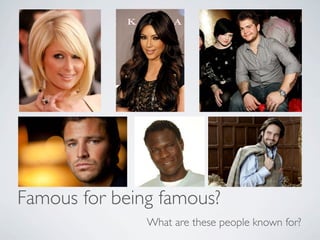
Do you recognise any of
    these people?

                          What are they famous for?
Famous for being famous?
               What are these people known for?
Some critical perspectives see modern celebrity as an example of
      cultural decline, with fame no longer based on talent,
 achievements or expertise. They argue that fame is often based
                       on luck and exposure.


                                A more positive interpretation of contemporary celebrity points
                               to the wider range of social groups being represented and this can
                               be seen as the ‘democratisation’ of celebrity as well as evidence of
                                                    a more inclusive society.


   DISCUSSION
    Do you see contemporary celebrities as an example of a more inclusive and democratic society?
    Is it relevant whether they are famous for their achievements and talent or simply ‘famous for
    being famous’
THE ATTRIBUTES OF A MODERN CELEBRITY                               SOURCE: AQA Media Studies A2 Textbook p9


•   Well known for being well known

•   Frequently seen in magazines such as Heat, OK and Hello and tabloid newspapers

•   Informal and intimate

•   Seen as familiar, down-to-earth and ‘someone like us’

•   Boundaries between private and public life are often blurred - Discussion of relationships and
    personal problems in the media.

•   Often the subject of gossip and speculation


INDIVIDUALTASK
Think critically about 3 celebrities that are frequently seen in the media. Is their fame based
on being famous or do they have unique skills and attributes that account for their fame?
CRITICALPERSPECTIVES
  Stacey (1994) argued that the meaning audiences place on
 celebrities is linked to a sense of escapism. The idea that an
     audience can dream or fantasise about being part of a
     lifestyle that celebrities are perceived to have. Stacey
 investigated the attachment of British women to Hollywood
  actresses in the post-war 40’s and 50’s (We will look at this
idea of ‘Female Spectatorship’ in more detail when we look at
                     Feminism and the media)
CRITICALPERSPECTIVES
Dyer (1994) suggests that a celebrity must resonate with the
ideas, values and spirit of the time. The celebrity is very much
of their time and culture. ‘a product of their generation’ if you
will. Think about the discussion in magazines about celebrities
   and whether or not they conform to preconceived or in
  some cases hegemonic ideals. Celebrities are often lauded
   and derided in equal measure for what they where, what
           shape they are in, who they are dating e.t.c.

        Click here to read more about Dyer’s ‘Star Theory’ on the mediaknowall site.
CRITICALPERSPECTIVES
Adorno and the Frankfurt School (1991) looked at both the
positive and negative influence of celebrity. They argued that
 the general public might identify with charismatic celebrity
    individuals with negative consequences. For example,
 connecting the rise in incidences of anorexia in young girls
 with the popularity and endorsement of supermodels and
              other prominent celebrity figures.
HOMEWORK
 Select a contemporary celebrity to research. Look at online newspapers. The celebrity’s
 websites and the websites of celebrity magazines such as OK! or Heat. Write a short
 essay style answer that considers the following:

 Production - Through what medium did this celebrity gain their status and how is it
 maintained
 Text - What is ordinary and extraordinary about this celebrity? How can they be seen as
 being symptomatic of the context or culture in which they are produced.
 Audience - Who consumes the media coverage of this celebrity; What meaning does it
 have to them do you think?

 Do the various media theorists’ critical perspectives on celebrity help to explain the popularity
                         of the celebrity that you have researched?
FURTHERREADING
AQA A2 Media Studies Textbook - Pg8-11
Adorno. T.,The Culture Industry: Selected Essays on Mass
Culture,Routledge,1991 - (Heavy reading but there are lots of summaries
and overviews online!)
Stacey. J., Star Gazing: Hollywood Cinema and Female Spectatorship,
Routledge, 1994
Dyer, R., Heavenly Bodies: Film Stars and Society, Routledge, 2004

 This list is simply to encourage you to investigate these the
 theories discussed in class further should you choose to do
                               so.

Celebrity

  • 1.
    CELEBRITY Media Issues and Debates A2 Media Studies @ KKS
  • 2.
    Do you recogniseany of these people? What are they famous for?
  • 3.
    Famous for beingfamous? What are these people known for?
  • 4.
    Some critical perspectivessee modern celebrity as an example of cultural decline, with fame no longer based on talent, achievements or expertise. They argue that fame is often based on luck and exposure. A more positive interpretation of contemporary celebrity points to the wider range of social groups being represented and this can be seen as the ‘democratisation’ of celebrity as well as evidence of a more inclusive society. DISCUSSION Do you see contemporary celebrities as an example of a more inclusive and democratic society? Is it relevant whether they are famous for their achievements and talent or simply ‘famous for being famous’
  • 5.
    THE ATTRIBUTES OFA MODERN CELEBRITY SOURCE: AQA Media Studies A2 Textbook p9 • Well known for being well known • Frequently seen in magazines such as Heat, OK and Hello and tabloid newspapers • Informal and intimate • Seen as familiar, down-to-earth and ‘someone like us’ • Boundaries between private and public life are often blurred - Discussion of relationships and personal problems in the media. • Often the subject of gossip and speculation INDIVIDUALTASK Think critically about 3 celebrities that are frequently seen in the media. Is their fame based on being famous or do they have unique skills and attributes that account for their fame?
  • 6.
    CRITICALPERSPECTIVES Stacey(1994) argued that the meaning audiences place on celebrities is linked to a sense of escapism. The idea that an audience can dream or fantasise about being part of a lifestyle that celebrities are perceived to have. Stacey investigated the attachment of British women to Hollywood actresses in the post-war 40’s and 50’s (We will look at this idea of ‘Female Spectatorship’ in more detail when we look at Feminism and the media)
  • 7.
    CRITICALPERSPECTIVES Dyer (1994) suggeststhat a celebrity must resonate with the ideas, values and spirit of the time. The celebrity is very much of their time and culture. ‘a product of their generation’ if you will. Think about the discussion in magazines about celebrities and whether or not they conform to preconceived or in some cases hegemonic ideals. Celebrities are often lauded and derided in equal measure for what they where, what shape they are in, who they are dating e.t.c. Click here to read more about Dyer’s ‘Star Theory’ on the mediaknowall site.
  • 8.
    CRITICALPERSPECTIVES Adorno and theFrankfurt School (1991) looked at both the positive and negative influence of celebrity. They argued that the general public might identify with charismatic celebrity individuals with negative consequences. For example, connecting the rise in incidences of anorexia in young girls with the popularity and endorsement of supermodels and other prominent celebrity figures.
  • 9.
    HOMEWORK Select acontemporary celebrity to research. Look at online newspapers. The celebrity’s websites and the websites of celebrity magazines such as OK! or Heat. Write a short essay style answer that considers the following: Production - Through what medium did this celebrity gain their status and how is it maintained Text - What is ordinary and extraordinary about this celebrity? How can they be seen as being symptomatic of the context or culture in which they are produced. Audience - Who consumes the media coverage of this celebrity; What meaning does it have to them do you think? Do the various media theorists’ critical perspectives on celebrity help to explain the popularity of the celebrity that you have researched?
  • 10.
    FURTHERREADING AQA A2 MediaStudies Textbook - Pg8-11 Adorno. T.,The Culture Industry: Selected Essays on Mass Culture,Routledge,1991 - (Heavy reading but there are lots of summaries and overviews online!) Stacey. J., Star Gazing: Hollywood Cinema and Female Spectatorship, Routledge, 1994 Dyer, R., Heavenly Bodies: Film Stars and Society, Routledge, 2004 This list is simply to encourage you to investigate these the theories discussed in class further should you choose to do so.

Editor's Notes