CONTRACT DRAFTING BY. Kiran Sangam
Fundamentals In USA contracts have a common law. There is no contract law in USA. Courts interpret the contract in case of disputes arising out of a contract. Parties are free to make any kind of contract, but they have to make it legally correct and must not be against law and public policy. Contracts are based on the creativity of the parties.
Elements of a Contract Offer  Acceptance Mutual Consideration The above elements should be between the parties only.
Goals of the Contract Drafting The contract should be done in a framework and that should be Analytical framework. While drafting a contract we must think of the most important things which must be satisfied and make a contract fruitful.
Below are the points that need to be kept in mind while drafting a contract 1. Who is our Client? Attorney should first under who is client to whom he is drafting the contract. Further he must see concerns of the client, challenges the client faces after signing and also the attorney must know the importance of the contract to the client.
2. What does our client hope to accomplish with this Agreement? Attorney must first understand for what the contract is being drafted and he must consider the interests and rights of the client. In other words, to say the profit or gain the client intends to achieve, or the intention of the client should be the main aspect. The attorney must protect while drafting the contract. Some examples where the client intends to gain by the contract are to build a customer relationship, purchase a land or house property, leasing a property, altering the terms in an existing contract, selling a land or house property, supplier relationship, joint ventures etc.
3. Who is the Opposing party? The opposing party is the other party or opposite party with whom the Client intends to make a contract. It’s a must for the attorney to know the details of the opposing party for drafting the contract more effectively, because the attorney can prepare a strategy or framework to protect the interest of the client.
4. What is the opposing party hoping to accomplish with this agreement? The goals or the objectives of the opposing party should be known to the client’s attorney, because to work out a draft contract which will protect the client being carried away by any obligations made by the opposing party in the contract which may effect the client and put him under any loss or damage. And also on other part, to protect the client from any undue advantage or enrichment take by the opposing party through the contract.  Because both the parties agree on the terms is the core issue, the opposing party may impose terms or get into a commanding position which may affect the client.
5. What are the most vital elements of this relationship for each? These are called as “DEAL BREAKERS”. Deal breakers are the terms made by both the parties for their own benefits and if one party objects the terms then that term or condition will be a deal breaker. In other words, it is the sensitivity of the information in the contract, the clauses of the contract are so sensitive or delicate some discussion or arguments on them can break a contract. Deal breakers can be terms and conditions which are illegal or against law and public policy.
6. Which terms are negotiable for each party? The terms which are drafted by the parties for their goodness and both agree with contract on all terms. But there will be some terms they can be negotiated and some alterations can be made after a discussion between the parties. For instance: one party on soft terms can ask the opposite party to reduce the rates or price, or in other instance may ask for increase in price or rates and in return he will provide some concessions or benefits. In negotiation both of the parties get something for themselves. Negotiation works like one party gives and takes something; one party gives and gets something.
7. What are the key concerns for our client that must be addressed in the agreement?   The key concerns are the client’s rights in case of breach, liability in case of breach. The extent of liability faced by the client in case of breach of contract. All important things should which is favour in the client and against the client should be take care of.
What are the relative bargaining strengths of each party in the agreement? The bargaining strength of each party relatively depends on the three things: Size of the party Resources with the party Who needs who more?
Size of the Party  The bargaining strength depends on the size of the party. The bigger party in the contract has an upper hand and can dictate the terms on the other party who is relatively small in size. The smaller party is always on the receiving end and has a less say in the contract. The bargaining strength is more for the bigger party. In case of equal in size the parties having equal bargaining strength then there will be a balance in the contract, give and take or give and get policy works here. When the party has a bargaining strength then the party can ask for what he wants.
Resources with the Party If one party has resources he will bargain in a better way than the other party.
Who needs who more  ? It depends on the each party who depends on either party to fulfill the needs through the contract. It’s the importance of the parties to each other.
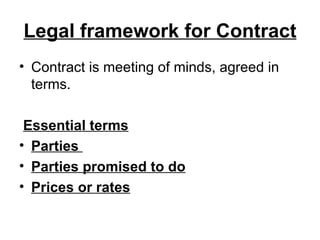
Legal framework for Contract Contract is meeting of minds, agreed in terms.  Essential terms Parties  Parties promised to do Prices or rates
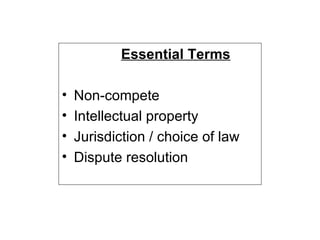
Essential Terms Non-compete Intellectual property Jurisdiction / choice of law Dispute resolution
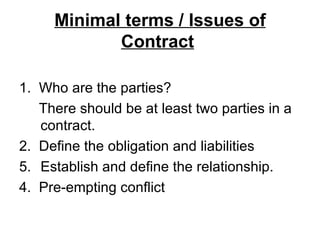
Minimal terms / Issues of Contract   1.  Who are the parties? There should be at least two parties in a contract.  2.  Define the obligation and liabilities Establish and define the relationship. 4.  Pre-empting conflict
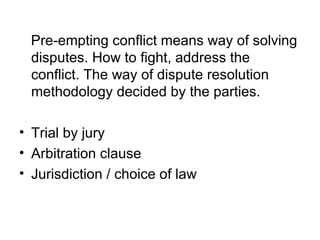
Pre-empting conflict means way of solving disputes. How to fight, address the conflict. The way of dispute resolution methodology decided by the parties. Trial by jury Arbitration clause Jurisdiction / choice of law
5. Projecting or predicting conflicts and attempt to protect the client 6. Determine the termination of the agreement
Specifics of Contract Drafting How contracts are interpreted? Coker v. Coker , in this case the Texas Supreme Court explained how to interpret a contract.  Plain language: If the language is unambiguous we don’t have to interpret If the language is ambiguous then the court has to interpret  The language should be plain, simple, and direct Harmonize the contract Leave no provision meaningless Earlier provision will triumph the later provisions Earlier provisions are given more importance and have more force
Actual ingredients that make a successful contract Parties 2.  Consideration (Mutual) Duties and obligations Contours of liability  Jurisdiction / Choice of law Conflict resolution
Relationship Definition and defined terms Create uniformity of interpretations Preambles -- Author wishes to do -- Client wishes to do Special obligation -- Non-disclosure, non-compete and non-solicit
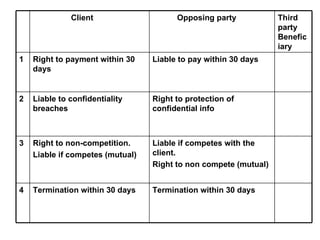
Liable if competes with the client. Right to non compete (mutual) Right to non-competition. Liable if competes (mutual)  3 Termination within 30 days  Termination within 30 days  4 Right to protection of confidential info  Liable to confidentiality breaches  2 Liable to pay within 30 days  Right to payment within 30 days  1 Third party Beneficiary  Opposing party Client
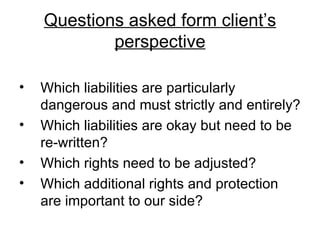
Questions asked form client’s perspective Which liabilities are particularly dangerous and must strictly and entirely? Which liabilities are okay but need to be re-written? Which rights need to be adjusted? Which additional rights and protection are important to our side?
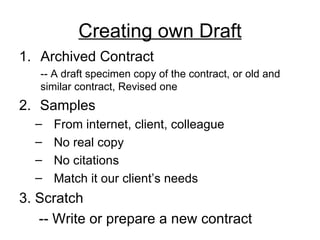
Creating own Draft Archived Contract -- A draft specimen copy of the contract, or old and  similar contract, Revised one 2.   Samples  From internet, client, colleague No real copy No citations Match it our client’s needs 3. Scratch -- Write or prepare a new contract
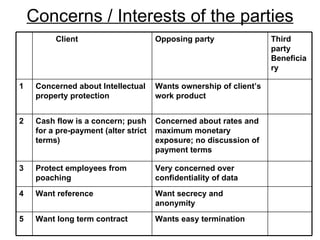
Concerns / Interests of the parties Wants easy termination   Want long term contract   5 Want secrecy and anonymity   Want reference   4 Very concerned over confidentiality of data   Protect employees from poaching   3 Concerned about rates and maximum monetary exposure; no discussion of payment terms   Cash flow is a concern; push for a pre-payment (alter strict terms)   2 Wants ownership of client’s work product   Concerned about Intellectual property protection   1 Third party Beneficiary Opposing party  Client
With Regards, Kiran S Sangam

Contract Drafting

  • 1.
  • 2.
    Fundamentals In USAcontracts have a common law. There is no contract law in USA. Courts interpret the contract in case of disputes arising out of a contract. Parties are free to make any kind of contract, but they have to make it legally correct and must not be against law and public policy. Contracts are based on the creativity of the parties.
  • 3.
    Elements of aContract Offer Acceptance Mutual Consideration The above elements should be between the parties only.
  • 4.
    Goals of theContract Drafting The contract should be done in a framework and that should be Analytical framework. While drafting a contract we must think of the most important things which must be satisfied and make a contract fruitful.
  • 5.
    Below are thepoints that need to be kept in mind while drafting a contract 1. Who is our Client? Attorney should first under who is client to whom he is drafting the contract. Further he must see concerns of the client, challenges the client faces after signing and also the attorney must know the importance of the contract to the client.
  • 6.
    2. What doesour client hope to accomplish with this Agreement? Attorney must first understand for what the contract is being drafted and he must consider the interests and rights of the client. In other words, to say the profit or gain the client intends to achieve, or the intention of the client should be the main aspect. The attorney must protect while drafting the contract. Some examples where the client intends to gain by the contract are to build a customer relationship, purchase a land or house property, leasing a property, altering the terms in an existing contract, selling a land or house property, supplier relationship, joint ventures etc.
  • 7.
    3. Who isthe Opposing party? The opposing party is the other party or opposite party with whom the Client intends to make a contract. It’s a must for the attorney to know the details of the opposing party for drafting the contract more effectively, because the attorney can prepare a strategy or framework to protect the interest of the client.
  • 8.
    4. What isthe opposing party hoping to accomplish with this agreement? The goals or the objectives of the opposing party should be known to the client’s attorney, because to work out a draft contract which will protect the client being carried away by any obligations made by the opposing party in the contract which may effect the client and put him under any loss or damage. And also on other part, to protect the client from any undue advantage or enrichment take by the opposing party through the contract. Because both the parties agree on the terms is the core issue, the opposing party may impose terms or get into a commanding position which may affect the client.
  • 9.
    5. What arethe most vital elements of this relationship for each? These are called as “DEAL BREAKERS”. Deal breakers are the terms made by both the parties for their own benefits and if one party objects the terms then that term or condition will be a deal breaker. In other words, it is the sensitivity of the information in the contract, the clauses of the contract are so sensitive or delicate some discussion or arguments on them can break a contract. Deal breakers can be terms and conditions which are illegal or against law and public policy.
  • 10.
    6. Which termsare negotiable for each party? The terms which are drafted by the parties for their goodness and both agree with contract on all terms. But there will be some terms they can be negotiated and some alterations can be made after a discussion between the parties. For instance: one party on soft terms can ask the opposite party to reduce the rates or price, or in other instance may ask for increase in price or rates and in return he will provide some concessions or benefits. In negotiation both of the parties get something for themselves. Negotiation works like one party gives and takes something; one party gives and gets something.
  • 11.
    7. What arethe key concerns for our client that must be addressed in the agreement? The key concerns are the client’s rights in case of breach, liability in case of breach. The extent of liability faced by the client in case of breach of contract. All important things should which is favour in the client and against the client should be take care of.
  • 12.
    What are therelative bargaining strengths of each party in the agreement? The bargaining strength of each party relatively depends on the three things: Size of the party Resources with the party Who needs who more?
  • 13.
    Size of theParty The bargaining strength depends on the size of the party. The bigger party in the contract has an upper hand and can dictate the terms on the other party who is relatively small in size. The smaller party is always on the receiving end and has a less say in the contract. The bargaining strength is more for the bigger party. In case of equal in size the parties having equal bargaining strength then there will be a balance in the contract, give and take or give and get policy works here. When the party has a bargaining strength then the party can ask for what he wants.
  • 14.
    Resources with theParty If one party has resources he will bargain in a better way than the other party.
  • 15.
    Who needs whomore ? It depends on the each party who depends on either party to fulfill the needs through the contract. It’s the importance of the parties to each other.
  • 16.
    Legal framework forContract Contract is meeting of minds, agreed in terms. Essential terms Parties Parties promised to do Prices or rates
  • 17.
    Essential Terms Non-competeIntellectual property Jurisdiction / choice of law Dispute resolution
  • 18.
    Minimal terms /Issues of Contract 1. Who are the parties? There should be at least two parties in a contract. 2. Define the obligation and liabilities Establish and define the relationship. 4. Pre-empting conflict
  • 19.
    Pre-empting conflict meansway of solving disputes. How to fight, address the conflict. The way of dispute resolution methodology decided by the parties. Trial by jury Arbitration clause Jurisdiction / choice of law
  • 20.
    5. Projecting orpredicting conflicts and attempt to protect the client 6. Determine the termination of the agreement
  • 21.
    Specifics of ContractDrafting How contracts are interpreted? Coker v. Coker , in this case the Texas Supreme Court explained how to interpret a contract. Plain language: If the language is unambiguous we don’t have to interpret If the language is ambiguous then the court has to interpret The language should be plain, simple, and direct Harmonize the contract Leave no provision meaningless Earlier provision will triumph the later provisions Earlier provisions are given more importance and have more force
  • 22.
    Actual ingredients thatmake a successful contract Parties 2. Consideration (Mutual) Duties and obligations Contours of liability Jurisdiction / Choice of law Conflict resolution
  • 23.
    Relationship Definition anddefined terms Create uniformity of interpretations Preambles -- Author wishes to do -- Client wishes to do Special obligation -- Non-disclosure, non-compete and non-solicit
  • 24.
    Liable if competeswith the client. Right to non compete (mutual) Right to non-competition. Liable if competes (mutual) 3 Termination within 30 days Termination within 30 days 4 Right to protection of confidential info Liable to confidentiality breaches 2 Liable to pay within 30 days Right to payment within 30 days 1 Third party Beneficiary Opposing party Client
  • 25.
    Questions asked formclient’s perspective Which liabilities are particularly dangerous and must strictly and entirely? Which liabilities are okay but need to be re-written? Which rights need to be adjusted? Which additional rights and protection are important to our side?
  • 26.
    Creating own DraftArchived Contract -- A draft specimen copy of the contract, or old and similar contract, Revised one 2. Samples From internet, client, colleague No real copy No citations Match it our client’s needs 3. Scratch -- Write or prepare a new contract
  • 27.
    Concerns / Interestsof the parties Wants easy termination Want long term contract 5 Want secrecy and anonymity Want reference 4 Very concerned over confidentiality of data Protect employees from poaching 3 Concerned about rates and maximum monetary exposure; no discussion of payment terms Cash flow is a concern; push for a pre-payment (alter strict terms) 2 Wants ownership of client’s work product Concerned about Intellectual property protection 1 Third party Beneficiary Opposing party Client
  • 28.