





KCL Model United Nations Society
Today’s sessionResolution writingKCL MUN First Simulation - The Israeli-Palestinian conflict
I. Resolution writing
I. Resolution writingRole callGathering supportIntroductory formalitiesPre-ambulatory clausesOperative clausesIntroducing a resolutionAmendmentsVotingAny questions?
Step 1: Role Call At the beginning of a conference, the first action of the chair will be to make a roll call.When called, delegates must answer either ‘present’ or ‘present and voting’Delegates who respond ‘present and voting’ will not be able to abstain on votes concerning resolutions or amendments.
Step 2: Gathering Support Resolutions are about teamwork. You need to write them with your fellow delegates and you need them to sign off on them. Gathering support is therefore a key requirement to any resolution!You will need:Sponsors- They write the resolution with you and fully agree to its content.Signatories- they do not help you write the resolution and they may not agree with it but they want to see it debated to make amendments. For this session, we will require at least 5 signatories.
Step 3: Introductory formalitiesAny formal resolution must first include the name of the signatories followed by the name of its sponsors.You must then write down the topic of debate (eg: Cooperation between the Un and the African union)You then need to write down the date and the name of your committee followed by a comma (eg: On the 21/09/1967 the security council,..) All resolutions need to end with the sentence ‘decides to remain seized on the matter.’
Step 4: Perambulatory Clauses These compose the first part of a resolution. They outline the signatories point of view and motivations for the resolution.Each Perambulatory clause must be introduced with one out of a set list of verbs available.Perambulatory clauses are numbered from A-Z and are ended with a comma.
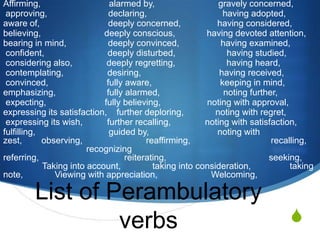
Affirming,                            alarmed by,                          gravely concerned, approving,                         declaring,                               having adopted,aware of,                            deeply concerned,               having considered,believing,                          deeply conscious,             having devoted attention,bearing in mind,                 deeply convinced,                 having examined, confident,                          deeply disturbed,                     having studied, considering also,              deeply regretting,                     having heard, contemplating,                  desiring,                                having received, convinced,                        fully aware,                            keeping in mind,emphasizing,                     fully alarmed,                          noting further, expecting,                        fully believing,                   noting with approval,expressing its satisfaction,    further deploring,             noting with regret, expressing its wish,          further recalling,              noting with satisfaction,fulfilling,                              guided by,                            noting with zest,        observing,                          reaffirming,                                 recalling,                                      recognizing                          referring,                                   reiterating,                                          seeking,                      Taking into account,             taking into consideration,                taking note,             Viewing with appreciation,                      Welcoming,List of Perambulatory verbs
Step 5: Operative Clauses These form the second part of a resolution. They form the policy which the signatories wish to see enacted within the body.An operative clause must be introduced with one out of a set list of verbs.Operative clauses are numbered 1-80, and must be ended with a semi-colon.
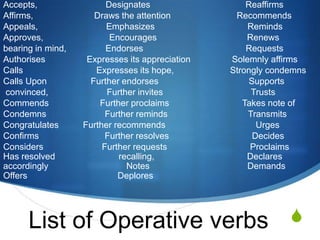
Accepts,                            Designates                                       ReaffirmsAffirms,                         Draws the attention                           RecommendsAppeals,                            Emphasizes                                      RemindsApproves,                           Encourages                                     Renewsbearing in mind,                Endorses                                          RequestsAuthorises                 Expresses its appreciation                 Solemnly affirmsCalls                              Expresses its hope,                       Strongly condemnsCalls Upon                  Further endorses                                     Supports convinced,                        Further invites                                    TrustsCommends                     Further proclaims                              Takes note ofCondemns                        Further reminds                                 TransmitsCongratulates          Further recommends                                     UrgesConfirms                           Further resolves                                  DecidesConsiders                        Further requests                                  Proclaims                 Has resolved                          recalling,                                      Declares accordingly                                Notes                                        Demands                      Offers                                     Deplores            List of Operative verbs
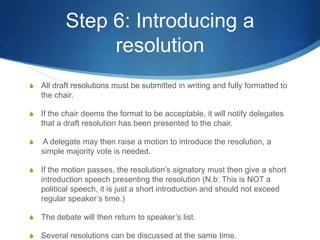
Step 6: Introducing a resolutionAll draft resolutions must be submitted in writing and fully formatted to the chair.If the chair deems the format to be acceptable, it will notify delegates that a draft resolution has been presented to the chair.A delegate may then raise a motion to introduce the resolution, a simple majority vote is needed.If the motion passes, the resolution’s signatory must then give a short introduction speech presenting the resolution (N.b: This is NOT a political speech, it is just a short introduction and should not exceed regular speaker’s time.)The debate will then return to speaker’s list.Several resolutions can be discussed at the same time.
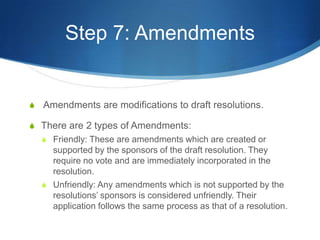
Step 7: Amendments Amendments are modifications to draft resolutions.There are 2 types of Amendments:Friendly: These are amendments which are created or supported by the sponsors of the draft resolution. They require no vote and are immediately incorporated in the resolution.Unfriendly: Any amendments which is not supported by the resolutions’ sponsors is considered unfriendly. Their application follows the same process as that of a resolution.
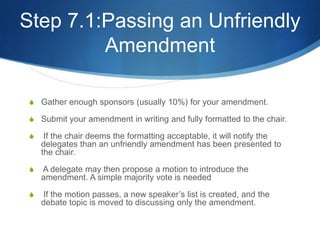
Step 7.1:Passing an Unfriendly AmendmentGather enough sponsors (usually 10%) for your amendment.Submit your amendment in writing and fully formatted to the chair. If the chair deems the formatting acceptable, it will notify the delegates than an unfriendly amendment has been presented to the chair. A delegate may then propose a motion to introduce the amendment. A simple majority vote is needed If the motion passes, a new speaker’s list is created, and the debate topic is moved to discussing only the amendment.
Step 8: Voting Voting on Resolutions and amendments is resolved by a simple majority vote.A delegate may introduce a motion to close the debate on an amendment. A second is needed, as well as 2 speakers for and 2 speakers against. The motion is then subject to a vote. If it fails, debate continues. If it passes, the debate is ended and the amendment is put to a vote. If it passes, it is incorporated into the resolution. If it fails, it is abandoned.A delegate may introduce a motion to vote on a resolution. If the motion passes, the resolution is put to a vote. If the resolution fails, it can still be subject to further debate and amendments.A resolution, once passed, becomes part of the body’s policy and can so longer be subject to amendments.These votes are not procedural, therefore delegates who did not respond ‘present and voting’ in roll call are able to abstain if they wish.
Any Questions?
KCL Model United Nations Society
"The Israeli-Palestinian conflict and the Humanitarian Crisis in Gaza”

KCL MUN Introduction to Resolution Writing (18/10/2011)

  • 1.
    KCL Model UnitedNations Society
  • 2.
    Today’s sessionResolution writingKCLMUN First Simulation - The Israeli-Palestinian conflict
  • 3.
  • 4.
    I. Resolution writingRolecallGathering supportIntroductory formalitiesPre-ambulatory clausesOperative clausesIntroducing a resolutionAmendmentsVotingAny questions?
  • 5.
    Step 1: RoleCall At the beginning of a conference, the first action of the chair will be to make a roll call.When called, delegates must answer either ‘present’ or ‘present and voting’Delegates who respond ‘present and voting’ will not be able to abstain on votes concerning resolutions or amendments.
  • 6.
    Step 2: GatheringSupport Resolutions are about teamwork. You need to write them with your fellow delegates and you need them to sign off on them. Gathering support is therefore a key requirement to any resolution!You will need:Sponsors- They write the resolution with you and fully agree to its content.Signatories- they do not help you write the resolution and they may not agree with it but they want to see it debated to make amendments. For this session, we will require at least 5 signatories.
  • 7.
    Step 3: IntroductoryformalitiesAny formal resolution must first include the name of the signatories followed by the name of its sponsors.You must then write down the topic of debate (eg: Cooperation between the Un and the African union)You then need to write down the date and the name of your committee followed by a comma (eg: On the 21/09/1967 the security council,..) All resolutions need to end with the sentence ‘decides to remain seized on the matter.’
  • 8.
    Step 4: PerambulatoryClauses These compose the first part of a resolution. They outline the signatories point of view and motivations for the resolution.Each Perambulatory clause must be introduced with one out of a set list of verbs available.Perambulatory clauses are numbered from A-Z and are ended with a comma.
  • 9.
    Affirming, alarmed by, gravely concerned, approving, declaring, having adopted,aware of, deeply concerned, having considered,believing, deeply conscious, having devoted attention,bearing in mind, deeply convinced, having examined, confident, deeply disturbed, having studied, considering also, deeply regretting, having heard, contemplating, desiring, having received, convinced, fully aware, keeping in mind,emphasizing, fully alarmed, noting further, expecting, fully believing, noting with approval,expressing its satisfaction, further deploring, noting with regret, expressing its wish, further recalling, noting with satisfaction,fulfilling, guided by, noting with zest, observing, reaffirming, recalling, recognizing referring, reiterating, seeking, Taking into account, taking into consideration, taking note, Viewing with appreciation, Welcoming,List of Perambulatory verbs
  • 10.
    Step 5: OperativeClauses These form the second part of a resolution. They form the policy which the signatories wish to see enacted within the body.An operative clause must be introduced with one out of a set list of verbs.Operative clauses are numbered 1-80, and must be ended with a semi-colon.
  • 11.
    Accepts, Designates ReaffirmsAffirms, Draws the attention RecommendsAppeals, Emphasizes RemindsApproves, Encourages Renewsbearing in mind, Endorses RequestsAuthorises Expresses its appreciation Solemnly affirmsCalls Expresses its hope, Strongly condemnsCalls Upon Further endorses Supports convinced, Further invites TrustsCommends Further proclaims Takes note ofCondemns Further reminds TransmitsCongratulates Further recommends UrgesConfirms Further resolves DecidesConsiders Further requests Proclaims Has resolved recalling, Declares accordingly Notes Demands Offers Deplores List of Operative verbs
  • 12.
    Step 6: Introducinga resolutionAll draft resolutions must be submitted in writing and fully formatted to the chair.If the chair deems the format to be acceptable, it will notify delegates that a draft resolution has been presented to the chair.A delegate may then raise a motion to introduce the resolution, a simple majority vote is needed.If the motion passes, the resolution’s signatory must then give a short introduction speech presenting the resolution (N.b: This is NOT a political speech, it is just a short introduction and should not exceed regular speaker’s time.)The debate will then return to speaker’s list.Several resolutions can be discussed at the same time.
  • 13.
    Step 7: AmendmentsAmendments are modifications to draft resolutions.There are 2 types of Amendments:Friendly: These are amendments which are created or supported by the sponsors of the draft resolution. They require no vote and are immediately incorporated in the resolution.Unfriendly: Any amendments which is not supported by the resolutions’ sponsors is considered unfriendly. Their application follows the same process as that of a resolution.
  • 14.
    Step 7.1:Passing anUnfriendly AmendmentGather enough sponsors (usually 10%) for your amendment.Submit your amendment in writing and fully formatted to the chair. If the chair deems the formatting acceptable, it will notify the delegates than an unfriendly amendment has been presented to the chair. A delegate may then propose a motion to introduce the amendment. A simple majority vote is needed If the motion passes, a new speaker’s list is created, and the debate topic is moved to discussing only the amendment.
  • 15.
    Step 8: VotingVoting on Resolutions and amendments is resolved by a simple majority vote.A delegate may introduce a motion to close the debate on an amendment. A second is needed, as well as 2 speakers for and 2 speakers against. The motion is then subject to a vote. If it fails, debate continues. If it passes, the debate is ended and the amendment is put to a vote. If it passes, it is incorporated into the resolution. If it fails, it is abandoned.A delegate may introduce a motion to vote on a resolution. If the motion passes, the resolution is put to a vote. If the resolution fails, it can still be subject to further debate and amendments.A resolution, once passed, becomes part of the body’s policy and can so longer be subject to amendments.These votes are not procedural, therefore delegates who did not respond ‘present and voting’ in roll call are able to abstain if they wish.
  • 16.
  • 17.
    KCL Model UnitedNations Society
  • 18.
    "The Israeli-Palestinian conflictand the Humanitarian Crisis in Gaza”