
RELIGION OF
ANCIENT EGYPT
BY GROUP 6
• Ancient Egyptian religion was a complex system of
polytheistic beliefs and rituals which were an integral
part of ancient Egyptian society. It centered on the
Egyptians' interaction with many deities who were
believed to be present in, and in control of, the
forces and elements of nature. The practices of
Egyptian religion were efforts to provide for the gods
and gain their favor. Formal religious practice
centered on the pharaoh, the king of Egypt. Although
a human, the Pharaoh was believed to be descended
from the gods. He acted as the intermediary between
his people and the gods, and was obligated to sustain
the gods through rituals and offerings so that they
could maintain order in the universe. The state
dedicated enormous resources to Egyptian rituals and
to the construction of the temples.
GODS AND
GODDESSES
AMUN
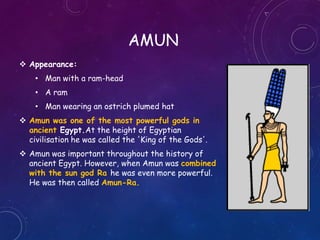
 Appearance:
• Man with a ram-head
• A ram
• Man wearing an ostrich plumed hat
 Amun was one of the most powerful gods in
ancient Egypt.At the height of Egyptian
civilisation he was called the 'King of the Gods'.
 Amun was important throughout the history of
ancient Egypt. However, when Amun was combined
with the sun god Ra he was even more powerful.
He was then called Amun-Ra.
RA
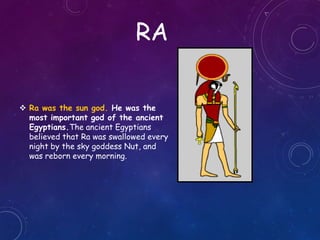
 Ra was the sun god. He was the
most important god of the ancient
Egyptians.The ancient Egyptians
believed that Ra was swallowed every
night by the sky goddess Nut, and
was reborn every morning.
GEB
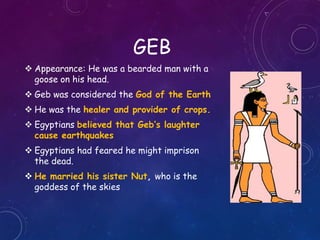
 Appearance: He was a bearded man with a
goose on his head.
 Geb was considered the God of the Earth
 He was the healer and provider of crops.
 Egyptians believed that Geb’s laughter
cause earthquakes
 Egyptians had feared he might imprison
the dead.
 He married his sister Nut, who is the
goddess of the skies
ANUBIS
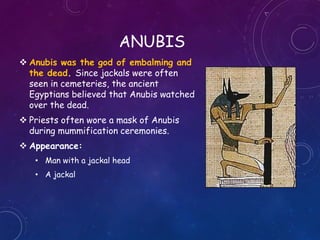
 Anubis was the god of embalming and
the dead. Since jackals were often
seen in cemeteries, the ancient
Egyptians believed that Anubis watched
over the dead.
 Priests often wore a mask of Anubis
during mummification ceremonies.
 Appearance:
• Man with a jackal head
• A jackal
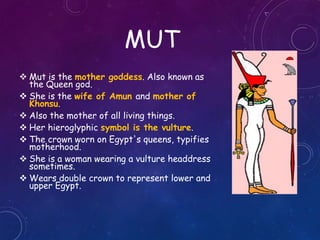
MUT
 Mut is the mother goddess. Also known as
the Queen god.
 She is the wife of Amun and mother of
Khonsu.
 Also the mother of all living things.
 Her hieroglyphic symbol is the vulture.
 The crown worn on Egypt's queens, typifies
motherhood.
 She is a woman wearing a vulture headdress
sometimes.
 Wears double crown to represent lower and
upper Egypt.
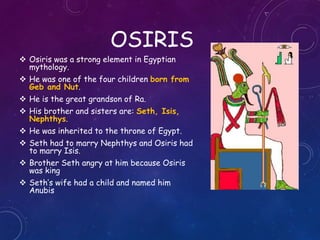
OSIRIS
 Osiris was a strong element in Egyptian
mythology.
 He was one of the four children born from
Geb and Nut.
 He is the great grandson of Ra.
 His brother and sisters are: Seth, Isis,
Nephthys.
 He was inherited to the throne of Egypt.
 Seth had to marry Nephthys and Osiris had
to marry Isis.
 Brother Seth angry at him because Osiris
was king
 Seth’s wife had a child and named him
Anubis
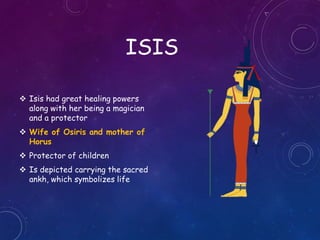
ISIS
 Isis had great healing powers
along with her being a magician
and a protector
 Wife of Osiris and mother of
Horus
 Protector of children
 Is depicted carrying the sacred
ankh, which symbolizes life
THE STORY OF ISIS AND
OSIRIS
 In the beginning, Ra sent Osiris and Isis to Egypt to teach the
people goodness. Osiris was murdered by his jealous brother Seth,
who scattered his body across the land in 14 pieces. Isis collected
the parts and magically bound them together with cloth strips,
making the first Egyptian mummy. Isis then became a bird, enfolded
Osiris in her wings, and brought him back to life
OTHER GODS AND GODDESSES
• Thoth – God of Wisdom
• Horus – God of War
• Hathor – Goddess of fertility
• Taweret – Goddess of Childbirth
• Bastet – Goddess of protection and cats
• When a cat died in an ancient Egyptian family, they would
shave their eyebrows off in mourning
MUMMIFICATION
 The ancient Egyptians believed that a person’s body should
be prepared for the afterlife.
 Mummification is the process of slowly drying a dead body to
stop it from rotting. In ancient Egypt, this process took
about 70 days.
 They removed the brain with a hooked wire and put some
internal organs in canopic jars shaped to look like the sons of
Horus: Imset for the liver, Ha’py for the lungs, Duamutef for
the stomach, and Qebehsenuf for the intestines.
 They also folded amulets into the strips they used
THANK YOU FOR DOWNLOADING
!

Religion

  • 1.
  • 2.
    • Ancient Egyptianreligion was a complex system of polytheistic beliefs and rituals which were an integral part of ancient Egyptian society. It centered on the Egyptians' interaction with many deities who were believed to be present in, and in control of, the forces and elements of nature. The practices of Egyptian religion were efforts to provide for the gods and gain their favor. Formal religious practice centered on the pharaoh, the king of Egypt. Although a human, the Pharaoh was believed to be descended from the gods. He acted as the intermediary between his people and the gods, and was obligated to sustain the gods through rituals and offerings so that they could maintain order in the universe. The state dedicated enormous resources to Egyptian rituals and to the construction of the temples.
  • 3.
  • 4.
    AMUN  Appearance: • Manwith a ram-head • A ram • Man wearing an ostrich plumed hat  Amun was one of the most powerful gods in ancient Egypt.At the height of Egyptian civilisation he was called the 'King of the Gods'.  Amun was important throughout the history of ancient Egypt. However, when Amun was combined with the sun god Ra he was even more powerful. He was then called Amun-Ra.
  • 5.
    RA  Ra wasthe sun god. He was the most important god of the ancient Egyptians.The ancient Egyptians believed that Ra was swallowed every night by the sky goddess Nut, and was reborn every morning.
  • 6.
    GEB  Appearance: Hewas a bearded man with a goose on his head.  Geb was considered the God of the Earth  He was the healer and provider of crops.  Egyptians believed that Geb’s laughter cause earthquakes  Egyptians had feared he might imprison the dead.  He married his sister Nut, who is the goddess of the skies
  • 7.
    ANUBIS  Anubis wasthe god of embalming and the dead. Since jackals were often seen in cemeteries, the ancient Egyptians believed that Anubis watched over the dead.  Priests often wore a mask of Anubis during mummification ceremonies.  Appearance: • Man with a jackal head • A jackal
  • 8.
    MUT  Mut isthe mother goddess. Also known as the Queen god.  She is the wife of Amun and mother of Khonsu.  Also the mother of all living things.  Her hieroglyphic symbol is the vulture.  The crown worn on Egypt's queens, typifies motherhood.  She is a woman wearing a vulture headdress sometimes.  Wears double crown to represent lower and upper Egypt.
  • 9.
    OSIRIS  Osiris wasa strong element in Egyptian mythology.  He was one of the four children born from Geb and Nut.  He is the great grandson of Ra.  His brother and sisters are: Seth, Isis, Nephthys.  He was inherited to the throne of Egypt.  Seth had to marry Nephthys and Osiris had to marry Isis.  Brother Seth angry at him because Osiris was king  Seth’s wife had a child and named him Anubis
  • 10.
    ISIS  Isis hadgreat healing powers along with her being a magician and a protector  Wife of Osiris and mother of Horus  Protector of children  Is depicted carrying the sacred ankh, which symbolizes life
  • 11.
    THE STORY OFISIS AND OSIRIS  In the beginning, Ra sent Osiris and Isis to Egypt to teach the people goodness. Osiris was murdered by his jealous brother Seth, who scattered his body across the land in 14 pieces. Isis collected the parts and magically bound them together with cloth strips, making the first Egyptian mummy. Isis then became a bird, enfolded Osiris in her wings, and brought him back to life
  • 12.
    OTHER GODS ANDGODDESSES • Thoth – God of Wisdom • Horus – God of War • Hathor – Goddess of fertility • Taweret – Goddess of Childbirth • Bastet – Goddess of protection and cats • When a cat died in an ancient Egyptian family, they would shave their eyebrows off in mourning
  • 13.
    MUMMIFICATION  The ancientEgyptians believed that a person’s body should be prepared for the afterlife.  Mummification is the process of slowly drying a dead body to stop it from rotting. In ancient Egypt, this process took about 70 days.  They removed the brain with a hooked wire and put some internal organs in canopic jars shaped to look like the sons of Horus: Imset for the liver, Ha’py for the lungs, Duamutef for the stomach, and Qebehsenuf for the intestines.  They also folded amulets into the strips they used
  • 14.
    THANK YOU FORDOWNLOADING !