Frost & Sullivan
Overview of the General Insurance Industry

Malaysia
The Financial System Structure in Malaysia
Regulatory Bodies and Policy Makers
- i.e. BNM, MOF and other Government agencies

Financial Service Providers

Financial Institutions

Financial Market

•

Banking Institutions
- BNM
- Commercial banks

Non-Banking

- Money & Foreign
exchange operators

Financial Intermediaries
- Private equities

- Investment banks

- Social securities (EPF,
pension fund, etc.)

- Public debt
securities

- Islamic banks

- Insurance, Reinsurance
and Takaful

- Stock exchanges

- Others (discount
houses,
representatives of
foreign banks)

- Savings institutions
- Leasing companies
- Development Finance
Institutions
- Others (unit trusts,
venture capital
companies, credit
guarantee, etc.)

•

•

- International
offshore financial
centres

•

The financial system in Malaysia is regulated by Bank
Negara Malaysia and the Ministry of Finance (MOF).
Other governing bodies of the financial system
includes the Securities Commission and the General
Insurance Associate of Malaysia.
The financial institutions in Malaysia are categorized
under Banking Institutions and Non-Banking Financial
Intermediaries.
In Malaysia, the Securities Commission Malaysia
(SC) is entrusted with the responsibility of regulating
and systematically developing the capital markets. It
reports to the MOF. The SC’s ultimate responsibility is
to protect the investors.
Under the purview of the SC and the MOF, Bursa
Malaysia operates a fully-integrated exchange, offering
the complete range of exchange-related services
including trading, clearing, settlement and depository
services.
Source : Bank Negara Malaysia , Frost and Sullivan Analysis

2
Overview of General Insurance Industry in Malaysia
•

The insurance industry in Malaysia is categorized into Life
insurance, General insurance and Takaful insurance.

•

The major categories of general insurance are marine, aviation
and transit insurance (MAT), fire insurance, medical and
personal accident insurance (PA) and motor insurance. Other
miscellaneous insurance schemes include, among others,
bonds, liabilities, contractor’s all risk and engineering risk
insurance, workmen’s compensation and employers’ liability
insurance as well as other types of miscellaneous insurance not
falling within any of the classification mentioned.

Insurance

General

Life

Marine,
Aviation and
Transit

Fire

Medical and
Personal
Accident

Takaful

Motor

Others

Breakdown of Insurance Segments in Malaysia, 2012
Takaful
4.2%

General Insurance
35.5%

Life Insurance
60.3%

o Marine, Aviation and Transit (MAT) insurance schemes
include insurance coverage for the marine hull, aviation,
cargo and offshore oil and gas related
o Fire insurance schemes cover losses or damages to
properties caused by fire, lightning, or explosion of domestic
boiler or domestic gas cylinder not forming part of any gas
work.
o Medical and health insurance schemes provide coverage on
the cost of medical treatment at private clinics or hospitals.
PA schemes provide personal compensation in the event of
injuries, disabilities or death caused by accidental means.
Additionally, PA schemes also include travel insurance which
provides coverage against travel related accidents, losses or
interruption.
o Motor insurance provides financial protection against physical
damage and/or bodily injury resulting from moving vehicle
accidents and against liability that could result from it.
o Other miscellaneous insurance schemes include, among
others, bonds, liabilities, contractor’s all risk and engineering
risk insurance, workmen’s compensation and employers’
liability insurance
Source : Bank Negara Malaysia , Frost and Sullivan Analysis

3
Overview of General Insurance Industry in Malaysia

Gross Direct Premium (RM million)

General Insurance Market Size and Growth Rate in
Malaysia, 2009-2018F
25,000

Other
9.6%
20,000

MAT
10.5%

15,000

5,000

2009

2010

MAT

•

•

Motor
48.4%

Medical and PA
14.2%

10,000

0

•

Breakdown of the General Insurance Segments in
Malaysia, 2012

2011

Fire

2012 2013E 2014F 2015F 2016F 2017F 2018F

Medical and PA

Motor

Misc

Fire
17.1%
Total Gross Direct Premium 2012 : RM 14.1 billion(show 2011
figures)

The general insurance market in Malaysia has sustained a robust growth trend, recording a CAGR of 7.0% for the period 2009 to 2012. In 2012,
the size of the general insurance market in Malaysia as measured by gross direct premium was approximately RM14.1 billion, having grown by
3.8% from the previous year. The industry is expected to grow with a CAGR of 8.8% for the period of 2013E to 2018F.
In 2012, the motor insurance market segment accounted for RM6.8 billion or 48.4% towards the total general insurance market size (based on total
gross direct premium). This was followed by the fire insurance segment of RM2.24billion (17.1%), medical and PA insurance segment of RM2.0
billion (14.2%), and MAT insurance segment of RM1.5 billion (10.5%). Other miscellaneous segment contributed RM1.3 billion, or 9.6% towards
the total gross direct premiums.
The motor insurance segment continues to be a key segment for the general insurance industry in Malaysia due to the growing number of
vehicles in the country and the mandatory regulatory requirement for all vehicles to have insurance coverage. The large market share is mainly
due to the regulation, where the Road Transport Act 1987 requires that all vehicle owners to have at least a minimum third party liability
coverage. This policy provides liability coverage against the injury or death of other people caused by an accident.

Source : Bank Negara Malaysia , Frost and Sullivan Analysis

4
Malaysia’s Economy
Inflation Rate, Real Gross Domestic Product and Real Interest Rate (1981-2012)
12
10
8

% Change

6
4
2
0
-2
-4
-6

Year
Commodity Crisis

Asian Financial Crisis Dot-com Bubble,
9/11

-8
US/Europe recession

-7.4%

Global Financial
Crisis

US sub-prime mortgage crisis
Thai Flood, Japan Earthquake

Inflation Rate (%)

Real GDP Growth (%)

Real Interest Rate (%)

Key Takeaways
• The financial liberation measure started since the 1970’s but was temporarily rescinded during the global economic crisis
of 1985-86 (Commodity Crisis). Having learned the lesson from the series of events that led to the Commodity Crisis,
Malaysia since embarked on adopting prudent fiscal and monetary measures that helped the country to pull through
during the adverse economic conditions of 1997-98 (Asian Financial Crisis), 2001-03 (Dot-com Bubble and Post-9/11) and
2008-09 (Global Financial Crisis) with shorter recovery periods.
Source : Bank Negara Malaysia , Frost and Sullivan Analysis

5
General Insurance Segment in Malaysia, 2009 – 2018F
Gross Direct Premium (RM million)

Key Takeaways
16,000

8.0%

9.1%

5.9%

14,000

3.8%

12,000
10,000
8,000
6,000
4,000
2,000
0
2009
MAT

Fire

2010
Medical and PA

2011
Motor

2012

Misc

Annual Growth Rate

Gross Direct Premium (RM million)

9.3%
25,000

9.3%

9.3%

8.6%
8.3%
20,000

8.4%

23,330

21,327

20,554

18,812
17.361
16,029

15,000

• This industry is forecast to grow at a CAGR of 8.8%
between 2013E and 2018F to reach RM23.3 billion.
Growth is expected to be highest in the medical and
PA insurance segment (CAGR 2013E-2018F:
11.7%).

• Prospect in the motor segment is expected to
improve further with the expected lifting of the motor
insurance tariff by 2016. This segment is forecast to
grow at a CAGR of 8.4% from 2013E to 2018F.

10,000

5,000

0
MAT

• Between 2009 and 2012, the medical and PA
insurance segment experienced the highest
growth, with a CAGR of 10.0%. The strong growth
is largely driven by a number of factors such as
rising middle class population, rising medical
costs, rapid urbanisation and GDP growth. This
was followed by the insurance segments for motor,
fire and MAT with CAGR of 9.2%, 5.9% and 8.2%
respectively during the same period. Meanwhile,
other miscellaneous segments recorded a CAGR of
-4.4%.

2013E
Fire

2014F
2015F
Medical and PA

2016F
Motor

2017F
Misc

2018F
Annual Growth Rate

• The fire and MAT insurance segments are forecast
to grow at a CAGR of 7.4% and 6.2% respectively
for the period 2013E-2018F.
Source : Bank Negara Malaysia , Frost and Sullivan Analysis

6
Overview of General Insurance Segment in Malaysia,
Market Size and Growth Rate, 2009 - 2012

Motor
Gross Direct
Premium
2012

MAT
CAGR
2009 - 2012
9.2%

RM6.8 Billion

Gross Direct
Premium
2012

RM2.0 Billion

CAGR
2009 - 2012
10.0%

8.2%

RM1.5 Billion

Fire

Medical and PA
Gross Direct
Premium
2012

CAGR
2009 - 2012

Gross Direct
Premium
2012
RM2.4 Billion

CAGR
2009 - 2012
5.9%

•Medical and PA segment has the highest double digit growth with 10.0% CAGR from 2009 until 2012, followed by Motor segment with 9.2%
CAGR.
•Motor segment has more Gross Direct Premium in 2012 with all MAT, Medical and PA and Fire combined, this explains the volume of motor
segment in Malaysia and the high growth factor.
•MAT, Medical & PA and Fire has almost similar amount of Gross Direct Premium in 2012, but growing at different rate mainly due to the
difference in market demand.
Source : Bank Negara Malaysia , Frost and Sullivan 7
Analysis
General Insurance Segment in Malaysia, 2009 – 2018F
Market Size and Forecast Growth Rate

Gross Direct Premium (RM million)

Motor
12,000
10,000
8,000
6,000
4,000
2,000
0

Gross Direct Premium (RM million)

2009

2010

2011

2012 2013E 2014F 2015F 2016F 2017F 2018F

Medical and PA
5,000
4,500
4,000
3,500
3,000
2,500
2,000
1,500
1,000
500
0
2009

2010

2011

2012

2013E 2014F 2015F 2016F 2017F 2018F

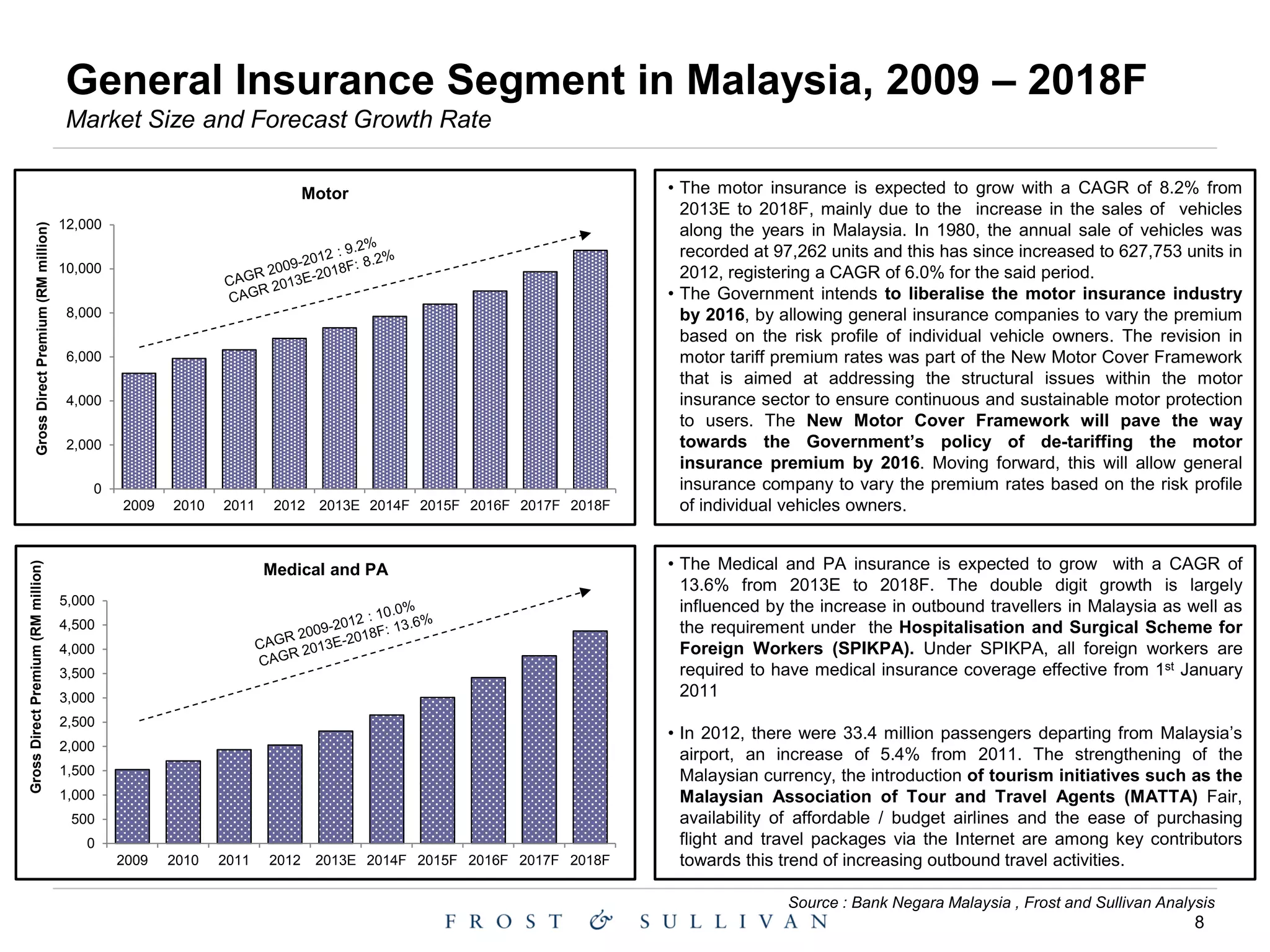
• The motor insurance is expected to grow with a CAGR of 8.2% from
2013E to 2018F, mainly due to the increase in the sales of vehicles
along the years in Malaysia. In 1980, the annual sale of vehicles was
recorded at 97,262 units and this has since increased to 627,753 units in
2012, registering a CAGR of 6.0% for the said period.
• The Government intends to liberalise the motor insurance industry
by 2016, by allowing general insurance companies to vary the premium
based on the risk profile of individual vehicle owners. The revision in
motor tariff premium rates was part of the New Motor Cover Framework
that is aimed at addressing the structural issues within the motor
insurance sector to ensure continuous and sustainable motor protection
to users. The New Motor Cover Framework will pave the way
towards the Government’s policy of de-tariffing the motor
insurance premium by 2016. Moving forward, this will allow general
insurance company to vary the premium rates based on the risk profile
of individual vehicles owners.
• The Medical and PA insurance is expected to grow with a CAGR of
13.6% from 2013E to 2018F. The double digit growth is largely
influenced by the increase in outbound travellers in Malaysia as well as
the requirement under the Hospitalisation and Surgical Scheme for
Foreign Workers (SPIKPA). Under SPIKPA, all foreign workers are
required to have medical insurance coverage effective from 1st January
2011
• In 2012, there were 33.4 million passengers departing from Malaysia’s
airport, an increase of 5.4% from 2011. The strengthening of the
Malaysian currency, the introduction of tourism initiatives such as the
Malaysian Association of Tour and Travel Agents (MATTA) Fair,
availability of affordable / budget airlines and the ease of purchasing
flight and travel packages via the Internet are among key contributors
towards this trend of increasing outbound travel activities.
Source : Bank Negara Malaysia , Frost and Sullivan Analysis

8
General Insurance Segment in Malaysia, 2009 – 2018F
Gross Direct Premium (RM million)

Market Size and Forecast Growth Rate
MAT

• The MAT segment of the general insurance is expected to grow with
CAGR of 6.7% from 2013E to 2018F.

2,500

• Under the ETP, the Performance Management & Delivery Unit
(PEMANDU) has identified eight strategic reform initiatives that are
expected to boost the local economic growth which in turn may spur
trading activities and improve business sentiments in the country.
Increasing business activities may also provide insurance opportunity for
general insurance companies especially in the MAT insurance segment.

2,000

1,500

1,000

500

0

Gross Direct Premium (RM million)

2009

2010

2011

2012

2013F 2014F 2015F 2016F 2017F 2018F

Fire
4,000
3,500
3,000
2,500
2,000
1,500
1,000
500

• The growth of fire insurance is expected to also grow with a CAGR of
7.6% from 2013E to 2018F, due to the strengthening of Malaysian
property market from 430,403 transactions worth RM137.8 billion in
2011 to 427,520 transactions worth RM142.8 billion in 2012.
• The increasing number of property units in Malaysia provides an
opportunity for general insurance companies to provide fire insurance
coverage for these property owners.
• The incoming supply of residential units increased by 11.9% from
553,884 units in 2011 to 619,950 units in 2012. Regulatory requirement
such as the Strata Titles (Amendment) Act 2013 requires the
management corporation to provide sufficient insurance coverage
against fire for buildings under their care is a key driver for the uptake of
fire insurance.

0
2009

2010

2011

2012

2013F 2014F 2015F 2016F 2017F 2018F

Source : Bank Negara Malaysia , Frost and Sullivan Analysis

9
General Insurance: Claims ratio, Expense ratio & Underwriting Margin
120%
100%
80%
60%
40%
20%
0%
2008
Claims Ratio

2009

2010

2011

Expense Ratio

2012

Combined Ratio

• The general insurance industry shows a slightly declining
combined ratio, where both claims ratio and expense ratio is
moving downwards year on year. This shows that the general
insurance companies are having to pay lesser amount of
claims despite charging the same amount of premiums
yearly.
• However, there is a wider opportunity for general insurance
companies, as the level of insurance penetration in Malaysia is
still well below 50% according to PIAM.
• The general insurance segment is very fragmented, therefore
BNM has urged for consolidation among general insurance
players. This step is to strengthen the industry as a whole in
years to come.
• Underwriting margin of these industry is growing with a CAGR of
92.7% from 2008 until 2012, this is a huge growth and states that
general insurance companies are growing healthily.

2008

2009

2010

2011

2012

Underwriting Margin (RM
Million)

101.4

791.5

767.1

1078.9

1399.0

Claims Ratio

65.9%

60.7%

62.6%

60.2%

56.9%

Expense Ratio

26.0%

24.7%

23.4%

22.8%

23.7%

Combined Ratio

91.9%

85.4%

86.0%

83.0%

80.6%

Source : Bank Negara Malaysia , Frost and Sullivan Analysis

10
Demand Dynamics
MAT

Fire

Medical and PA

Motor

Increased number of
outbound travelers

New Motor Cover
Framework

Regulatory Requirement

Increased sales of
vehicles

Rising Income Per Capita

Drivers

Increasing Awareness

Restraints

Implementation of ETP

Growing Property Market

Competition from Takaful Products

Global Economic Slowdown Resulted in
Decline of Import and Export Activities

-

Heavily Subsidised
Public Healthcare
System

-

Key Takeaways
• BNM liberalised the domestic insurance sector in 2009 by increasing foreign equity participation threshold in insurance
companies from 49% to 70% as well as allowing locally-incorporated foreign insurance companies to establish branches
nationwide without restrictions.
• The implementation of the RBC framework and the liberalisation plan by BNM has made domestic insurance companies
become more attractive as M&A targets. As a result, the general insurance industry in Malaysia has become less fragmented.
Source : Frost and Sullivan Analysis

11
M&A in General Insurance Industry in Malaysia, 2010 - 2013
Year

Description



2010





2011







2012

2013








AXA Affin General Insurance Berhad acquired BH Insurance (M) Berhad for RM363 million.
Overseas Assurance Corporation (Malaysia) Berhad acquired Tahan Insurance Malaysia Berhad’s general
insurance business for RM15.0 million
The general insurance arm of Hong Leong Assurance Berhad was acquired by MSIG Insurance (Malaysia) Berhad
for RM33.64 million
Canada’s Fairfax Financial Holdings acquired The Pacific Insurance Berhad for USD64 million
ACE Group merged two of its units, Ace Synergy Insurance Berhad and Ace Jerneh Insurance Berhad into one –
Ace Jerneh Insurance Berhad.
Japan’s Sompo acquired 40% stake in Berjaya Sompo Insurance Berhad for RM496 million.
Zurich Insurance Group acquired Malaysian Assurance Alliance Berhad and renamed it to Zurich Insurance
Malaysia Berhad for USD287 million.
AmG Insurance Berhad, the local affiliate of Insurance Australia Group (IAG) acquired Kurnia Insurans Malaysia
Berhad for RM1.63 billion.
AMMB Holdings Bhd has completed the acquisition of Kurnia Insurance Bhd and the latter is now a unit of
AMMB’s 51% subsidiary AmG Insurance Bhd.
Canada-based Sun Life Financial Inc/Khazanah Nasional’s acquisition of 98% stake in CIMB Aviva Assurance and
CIMB Aviva Takaful (from Aviva International Holdings Ltd and CIMB Group Holdings Bhd) for RM1.8 billion.
Tune Ins Holdings bought a 77.92% controlling stake at Oriental Capital Assurance Bhd (OCA) from Maika
Holdings Bhd and G Team Resources & Holding for RM153.13mil cash.
AIA Group’s purchase of ING’s Malaysian insurance and takaful business.. For USD1.7 billion
Zurich Group’s acquisition of MAA Assurance completed.
Sanlam Ltd completed their acquisition of Pacific & Orient Insurance Co. Berhad in 2013 for RM270million.
AMMB Holdings Bhd who is in search of a suitable partner to hive off its 51%.
Source: Frost & Sullivan analysis.
Source : Frost and Sullivan Analysis

12
THANK YOU
For Full Slide Deck please contact
june.liang@frost.com
Business & Financial Services Department
Malaysia

13

Malaysia's general insurance : summary

  • 1.
    Frost & Sullivan Overviewof the General Insurance Industry Malaysia
  • 2.
    The Financial SystemStructure in Malaysia Regulatory Bodies and Policy Makers - i.e. BNM, MOF and other Government agencies Financial Service Providers Financial Institutions Financial Market • Banking Institutions - BNM - Commercial banks Non-Banking - Money & Foreign exchange operators Financial Intermediaries - Private equities - Investment banks - Social securities (EPF, pension fund, etc.) - Public debt securities - Islamic banks - Insurance, Reinsurance and Takaful - Stock exchanges - Others (discount houses, representatives of foreign banks) - Savings institutions - Leasing companies - Development Finance Institutions - Others (unit trusts, venture capital companies, credit guarantee, etc.) • • - International offshore financial centres • The financial system in Malaysia is regulated by Bank Negara Malaysia and the Ministry of Finance (MOF). Other governing bodies of the financial system includes the Securities Commission and the General Insurance Associate of Malaysia. The financial institutions in Malaysia are categorized under Banking Institutions and Non-Banking Financial Intermediaries. In Malaysia, the Securities Commission Malaysia (SC) is entrusted with the responsibility of regulating and systematically developing the capital markets. It reports to the MOF. The SC’s ultimate responsibility is to protect the investors. Under the purview of the SC and the MOF, Bursa Malaysia operates a fully-integrated exchange, offering the complete range of exchange-related services including trading, clearing, settlement and depository services. Source : Bank Negara Malaysia , Frost and Sullivan Analysis 2
  • 3.
    Overview of GeneralInsurance Industry in Malaysia • The insurance industry in Malaysia is categorized into Life insurance, General insurance and Takaful insurance. • The major categories of general insurance are marine, aviation and transit insurance (MAT), fire insurance, medical and personal accident insurance (PA) and motor insurance. Other miscellaneous insurance schemes include, among others, bonds, liabilities, contractor’s all risk and engineering risk insurance, workmen’s compensation and employers’ liability insurance as well as other types of miscellaneous insurance not falling within any of the classification mentioned. Insurance General Life Marine, Aviation and Transit Fire Medical and Personal Accident Takaful Motor Others Breakdown of Insurance Segments in Malaysia, 2012 Takaful 4.2% General Insurance 35.5% Life Insurance 60.3% o Marine, Aviation and Transit (MAT) insurance schemes include insurance coverage for the marine hull, aviation, cargo and offshore oil and gas related o Fire insurance schemes cover losses or damages to properties caused by fire, lightning, or explosion of domestic boiler or domestic gas cylinder not forming part of any gas work. o Medical and health insurance schemes provide coverage on the cost of medical treatment at private clinics or hospitals. PA schemes provide personal compensation in the event of injuries, disabilities or death caused by accidental means. Additionally, PA schemes also include travel insurance which provides coverage against travel related accidents, losses or interruption. o Motor insurance provides financial protection against physical damage and/or bodily injury resulting from moving vehicle accidents and against liability that could result from it. o Other miscellaneous insurance schemes include, among others, bonds, liabilities, contractor’s all risk and engineering risk insurance, workmen’s compensation and employers’ liability insurance Source : Bank Negara Malaysia , Frost and Sullivan Analysis 3
  • 4.
    Overview of GeneralInsurance Industry in Malaysia Gross Direct Premium (RM million) General Insurance Market Size and Growth Rate in Malaysia, 2009-2018F 25,000 Other 9.6% 20,000 MAT 10.5% 15,000 5,000 2009 2010 MAT • • Motor 48.4% Medical and PA 14.2% 10,000 0 • Breakdown of the General Insurance Segments in Malaysia, 2012 2011 Fire 2012 2013E 2014F 2015F 2016F 2017F 2018F Medical and PA Motor Misc Fire 17.1% Total Gross Direct Premium 2012 : RM 14.1 billion(show 2011 figures) The general insurance market in Malaysia has sustained a robust growth trend, recording a CAGR of 7.0% for the period 2009 to 2012. In 2012, the size of the general insurance market in Malaysia as measured by gross direct premium was approximately RM14.1 billion, having grown by 3.8% from the previous year. The industry is expected to grow with a CAGR of 8.8% for the period of 2013E to 2018F. In 2012, the motor insurance market segment accounted for RM6.8 billion or 48.4% towards the total general insurance market size (based on total gross direct premium). This was followed by the fire insurance segment of RM2.24billion (17.1%), medical and PA insurance segment of RM2.0 billion (14.2%), and MAT insurance segment of RM1.5 billion (10.5%). Other miscellaneous segment contributed RM1.3 billion, or 9.6% towards the total gross direct premiums. The motor insurance segment continues to be a key segment for the general insurance industry in Malaysia due to the growing number of vehicles in the country and the mandatory regulatory requirement for all vehicles to have insurance coverage. The large market share is mainly due to the regulation, where the Road Transport Act 1987 requires that all vehicle owners to have at least a minimum third party liability coverage. This policy provides liability coverage against the injury or death of other people caused by an accident. Source : Bank Negara Malaysia , Frost and Sullivan Analysis 4
  • 5.
    Malaysia’s Economy Inflation Rate,Real Gross Domestic Product and Real Interest Rate (1981-2012) 12 10 8 % Change 6 4 2 0 -2 -4 -6 Year Commodity Crisis Asian Financial Crisis Dot-com Bubble, 9/11 -8 US/Europe recession -7.4% Global Financial Crisis US sub-prime mortgage crisis Thai Flood, Japan Earthquake Inflation Rate (%) Real GDP Growth (%) Real Interest Rate (%) Key Takeaways • The financial liberation measure started since the 1970’s but was temporarily rescinded during the global economic crisis of 1985-86 (Commodity Crisis). Having learned the lesson from the series of events that led to the Commodity Crisis, Malaysia since embarked on adopting prudent fiscal and monetary measures that helped the country to pull through during the adverse economic conditions of 1997-98 (Asian Financial Crisis), 2001-03 (Dot-com Bubble and Post-9/11) and 2008-09 (Global Financial Crisis) with shorter recovery periods. Source : Bank Negara Malaysia , Frost and Sullivan Analysis 5
  • 6.
    General Insurance Segmentin Malaysia, 2009 – 2018F Gross Direct Premium (RM million) Key Takeaways 16,000 8.0% 9.1% 5.9% 14,000 3.8% 12,000 10,000 8,000 6,000 4,000 2,000 0 2009 MAT Fire 2010 Medical and PA 2011 Motor 2012 Misc Annual Growth Rate Gross Direct Premium (RM million) 9.3% 25,000 9.3% 9.3% 8.6% 8.3% 20,000 8.4% 23,330 21,327 20,554 18,812 17.361 16,029 15,000 • This industry is forecast to grow at a CAGR of 8.8% between 2013E and 2018F to reach RM23.3 billion. Growth is expected to be highest in the medical and PA insurance segment (CAGR 2013E-2018F: 11.7%). • Prospect in the motor segment is expected to improve further with the expected lifting of the motor insurance tariff by 2016. This segment is forecast to grow at a CAGR of 8.4% from 2013E to 2018F. 10,000 5,000 0 MAT • Between 2009 and 2012, the medical and PA insurance segment experienced the highest growth, with a CAGR of 10.0%. The strong growth is largely driven by a number of factors such as rising middle class population, rising medical costs, rapid urbanisation and GDP growth. This was followed by the insurance segments for motor, fire and MAT with CAGR of 9.2%, 5.9% and 8.2% respectively during the same period. Meanwhile, other miscellaneous segments recorded a CAGR of -4.4%. 2013E Fire 2014F 2015F Medical and PA 2016F Motor 2017F Misc 2018F Annual Growth Rate • The fire and MAT insurance segments are forecast to grow at a CAGR of 7.4% and 6.2% respectively for the period 2013E-2018F. Source : Bank Negara Malaysia , Frost and Sullivan Analysis 6
  • 7.
    Overview of GeneralInsurance Segment in Malaysia, Market Size and Growth Rate, 2009 - 2012 Motor Gross Direct Premium 2012 MAT CAGR 2009 - 2012 9.2% RM6.8 Billion Gross Direct Premium 2012 RM2.0 Billion CAGR 2009 - 2012 10.0% 8.2% RM1.5 Billion Fire Medical and PA Gross Direct Premium 2012 CAGR 2009 - 2012 Gross Direct Premium 2012 RM2.4 Billion CAGR 2009 - 2012 5.9% •Medical and PA segment has the highest double digit growth with 10.0% CAGR from 2009 until 2012, followed by Motor segment with 9.2% CAGR. •Motor segment has more Gross Direct Premium in 2012 with all MAT, Medical and PA and Fire combined, this explains the volume of motor segment in Malaysia and the high growth factor. •MAT, Medical & PA and Fire has almost similar amount of Gross Direct Premium in 2012, but growing at different rate mainly due to the difference in market demand. Source : Bank Negara Malaysia , Frost and Sullivan 7 Analysis
  • 8.
    General Insurance Segmentin Malaysia, 2009 – 2018F Market Size and Forecast Growth Rate Gross Direct Premium (RM million) Motor 12,000 10,000 8,000 6,000 4,000 2,000 0 Gross Direct Premium (RM million) 2009 2010 2011 2012 2013E 2014F 2015F 2016F 2017F 2018F Medical and PA 5,000 4,500 4,000 3,500 3,000 2,500 2,000 1,500 1,000 500 0 2009 2010 2011 2012 2013E 2014F 2015F 2016F 2017F 2018F • The motor insurance is expected to grow with a CAGR of 8.2% from 2013E to 2018F, mainly due to the increase in the sales of vehicles along the years in Malaysia. In 1980, the annual sale of vehicles was recorded at 97,262 units and this has since increased to 627,753 units in 2012, registering a CAGR of 6.0% for the said period. • The Government intends to liberalise the motor insurance industry by 2016, by allowing general insurance companies to vary the premium based on the risk profile of individual vehicle owners. The revision in motor tariff premium rates was part of the New Motor Cover Framework that is aimed at addressing the structural issues within the motor insurance sector to ensure continuous and sustainable motor protection to users. The New Motor Cover Framework will pave the way towards the Government’s policy of de-tariffing the motor insurance premium by 2016. Moving forward, this will allow general insurance company to vary the premium rates based on the risk profile of individual vehicles owners. • The Medical and PA insurance is expected to grow with a CAGR of 13.6% from 2013E to 2018F. The double digit growth is largely influenced by the increase in outbound travellers in Malaysia as well as the requirement under the Hospitalisation and Surgical Scheme for Foreign Workers (SPIKPA). Under SPIKPA, all foreign workers are required to have medical insurance coverage effective from 1st January 2011 • In 2012, there were 33.4 million passengers departing from Malaysia’s airport, an increase of 5.4% from 2011. The strengthening of the Malaysian currency, the introduction of tourism initiatives such as the Malaysian Association of Tour and Travel Agents (MATTA) Fair, availability of affordable / budget airlines and the ease of purchasing flight and travel packages via the Internet are among key contributors towards this trend of increasing outbound travel activities. Source : Bank Negara Malaysia , Frost and Sullivan Analysis 8
  • 9.
    General Insurance Segmentin Malaysia, 2009 – 2018F Gross Direct Premium (RM million) Market Size and Forecast Growth Rate MAT • The MAT segment of the general insurance is expected to grow with CAGR of 6.7% from 2013E to 2018F. 2,500 • Under the ETP, the Performance Management & Delivery Unit (PEMANDU) has identified eight strategic reform initiatives that are expected to boost the local economic growth which in turn may spur trading activities and improve business sentiments in the country. Increasing business activities may also provide insurance opportunity for general insurance companies especially in the MAT insurance segment. 2,000 1,500 1,000 500 0 Gross Direct Premium (RM million) 2009 2010 2011 2012 2013F 2014F 2015F 2016F 2017F 2018F Fire 4,000 3,500 3,000 2,500 2,000 1,500 1,000 500 • The growth of fire insurance is expected to also grow with a CAGR of 7.6% from 2013E to 2018F, due to the strengthening of Malaysian property market from 430,403 transactions worth RM137.8 billion in 2011 to 427,520 transactions worth RM142.8 billion in 2012. • The increasing number of property units in Malaysia provides an opportunity for general insurance companies to provide fire insurance coverage for these property owners. • The incoming supply of residential units increased by 11.9% from 553,884 units in 2011 to 619,950 units in 2012. Regulatory requirement such as the Strata Titles (Amendment) Act 2013 requires the management corporation to provide sufficient insurance coverage against fire for buildings under their care is a key driver for the uptake of fire insurance. 0 2009 2010 2011 2012 2013F 2014F 2015F 2016F 2017F 2018F Source : Bank Negara Malaysia , Frost and Sullivan Analysis 9
  • 10.
    General Insurance: Claimsratio, Expense ratio & Underwriting Margin 120% 100% 80% 60% 40% 20% 0% 2008 Claims Ratio 2009 2010 2011 Expense Ratio 2012 Combined Ratio • The general insurance industry shows a slightly declining combined ratio, where both claims ratio and expense ratio is moving downwards year on year. This shows that the general insurance companies are having to pay lesser amount of claims despite charging the same amount of premiums yearly. • However, there is a wider opportunity for general insurance companies, as the level of insurance penetration in Malaysia is still well below 50% according to PIAM. • The general insurance segment is very fragmented, therefore BNM has urged for consolidation among general insurance players. This step is to strengthen the industry as a whole in years to come. • Underwriting margin of these industry is growing with a CAGR of 92.7% from 2008 until 2012, this is a huge growth and states that general insurance companies are growing healthily. 2008 2009 2010 2011 2012 Underwriting Margin (RM Million) 101.4 791.5 767.1 1078.9 1399.0 Claims Ratio 65.9% 60.7% 62.6% 60.2% 56.9% Expense Ratio 26.0% 24.7% 23.4% 22.8% 23.7% Combined Ratio 91.9% 85.4% 86.0% 83.0% 80.6% Source : Bank Negara Malaysia , Frost and Sullivan Analysis 10
  • 11.
    Demand Dynamics MAT Fire Medical andPA Motor Increased number of outbound travelers New Motor Cover Framework Regulatory Requirement Increased sales of vehicles Rising Income Per Capita Drivers Increasing Awareness Restraints Implementation of ETP Growing Property Market Competition from Takaful Products Global Economic Slowdown Resulted in Decline of Import and Export Activities - Heavily Subsidised Public Healthcare System - Key Takeaways • BNM liberalised the domestic insurance sector in 2009 by increasing foreign equity participation threshold in insurance companies from 49% to 70% as well as allowing locally-incorporated foreign insurance companies to establish branches nationwide without restrictions. • The implementation of the RBC framework and the liberalisation plan by BNM has made domestic insurance companies become more attractive as M&A targets. As a result, the general insurance industry in Malaysia has become less fragmented. Source : Frost and Sullivan Analysis 11
  • 12.
    M&A in GeneralInsurance Industry in Malaysia, 2010 - 2013 Year Description   2010    2011      2012 2013      AXA Affin General Insurance Berhad acquired BH Insurance (M) Berhad for RM363 million. Overseas Assurance Corporation (Malaysia) Berhad acquired Tahan Insurance Malaysia Berhad’s general insurance business for RM15.0 million The general insurance arm of Hong Leong Assurance Berhad was acquired by MSIG Insurance (Malaysia) Berhad for RM33.64 million Canada’s Fairfax Financial Holdings acquired The Pacific Insurance Berhad for USD64 million ACE Group merged two of its units, Ace Synergy Insurance Berhad and Ace Jerneh Insurance Berhad into one – Ace Jerneh Insurance Berhad. Japan’s Sompo acquired 40% stake in Berjaya Sompo Insurance Berhad for RM496 million. Zurich Insurance Group acquired Malaysian Assurance Alliance Berhad and renamed it to Zurich Insurance Malaysia Berhad for USD287 million. AmG Insurance Berhad, the local affiliate of Insurance Australia Group (IAG) acquired Kurnia Insurans Malaysia Berhad for RM1.63 billion. AMMB Holdings Bhd has completed the acquisition of Kurnia Insurance Bhd and the latter is now a unit of AMMB’s 51% subsidiary AmG Insurance Bhd. Canada-based Sun Life Financial Inc/Khazanah Nasional’s acquisition of 98% stake in CIMB Aviva Assurance and CIMB Aviva Takaful (from Aviva International Holdings Ltd and CIMB Group Holdings Bhd) for RM1.8 billion. Tune Ins Holdings bought a 77.92% controlling stake at Oriental Capital Assurance Bhd (OCA) from Maika Holdings Bhd and G Team Resources & Holding for RM153.13mil cash. AIA Group’s purchase of ING’s Malaysian insurance and takaful business.. For USD1.7 billion Zurich Group’s acquisition of MAA Assurance completed. Sanlam Ltd completed their acquisition of Pacific & Orient Insurance Co. Berhad in 2013 for RM270million. AMMB Holdings Bhd who is in search of a suitable partner to hive off its 51%. Source: Frost & Sullivan analysis. Source : Frost and Sullivan Analysis 12
  • 13.
    THANK YOU For FullSlide Deck please contact june.liang@frost.com Business & Financial Services Department Malaysia 13