Radially-Distorted Conjugate
Translations
James Pritts, Zuzana Kukelova, Viktor Larsson, Ondrej Chum
In CVPR 18
Motivation
• Joint estimation of lens distortion and rectification is needed for large
distortions
• Sampling lens distortion parameters during RANSAC increases sampling time
• Ex-post correction of lens distortion is difficult because problem is highly non-
convex
• Translations are common, minimal solvers require few correspondences
SequentialOriginal Joint
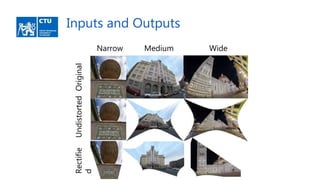
Inputs and Outputs
OriginalUndistortedRectifie
d
Narrow Medium Wide
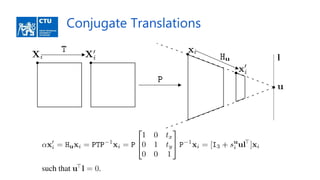
Conjugate Translations
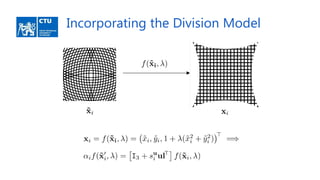
Incorporating the Division Model
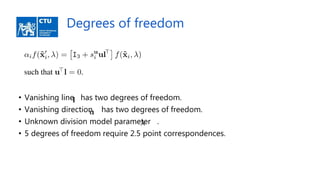
Degrees of freedom
• Vanishing line has two degrees of freedom.
• Vanishing direction has two degrees of freedom.
• Unknown division model parameter .
• 5 degrees of freedom require 2.5 point correspondences.
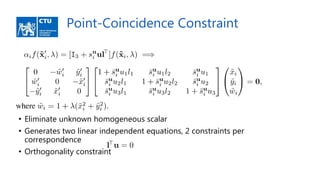
Point-Coincidence Constraint
• Eliminate unknown homogeneous scalar
• Generates two linear independent equations, 2 constraints per
correspondence
• Orthogonality constraint
Solver Variants Generated
Reference [1] Proposed Minimal Solvers [2] [3] [4]
Undistorts ✓ ✓ ✓ ✓ ✓
Rectifies ✓ ✓ ✓ ✓ ✓ ✓
# points 2 2.5 3 3.5 4 4 5 5
Directions 1 1 1 2 2 2 1 1
# solutions 1 4 2 6 4 1 18 5
• One and two-direction variants of the proposed solvers are in colors.
• Each variant has a version that can rectify reflections (green, blue).
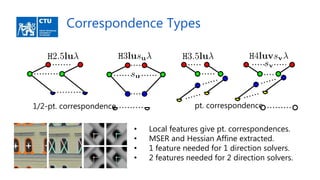
Correspondence Types
1/2-pt. correspondence pt. correspondence
• Local features give pt. correspondences.
• MSER and Hessian Affine extracted.
• 1 feature needed for 1 direction solvers.
• 2 features needed for 2 direction solvers.
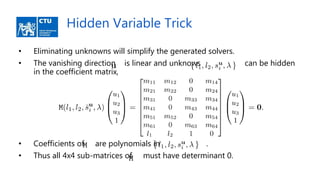
Hidden Variable Trick
• Eliminating unknowns will simplify the generated solvers.
• The vanishing direction is linear and unknows can be hidden
in the coefficient matrix,
• Coefficients of are polynomials in .
• Thus all 4x4 sub-matrices of must have determinant 0.
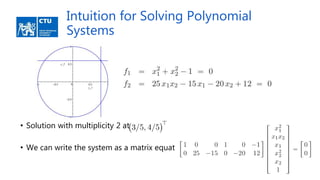
Intuition for Solving Polynomial
Systems
• Solution with multiplicity 2 at
• We can write the system as a matrix equation
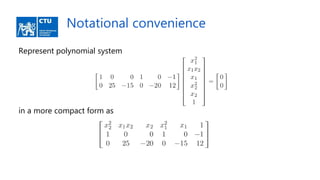
Represent polynomial system
in a more compact form as
Notational convenience
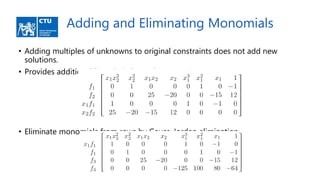
Adding and Eliminating Monomials
• Adding multiples of unknowns to original constraints does not add new
solutions.
• Provides additional linearly independent equations
• Eliminate monomials from rows by Gauss-Jordan elimination
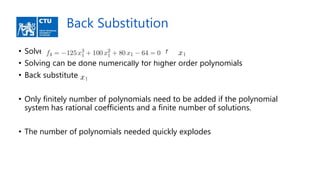
Back Substitution
• Solve for
• Solving can be done numerically for higher order polynomials
• Back substitute
• Only finitely number of polynomials need to be added if the polynomial
system has rational coefficients and a finite number of solutions.
• The number of polynomials needed quickly explodes
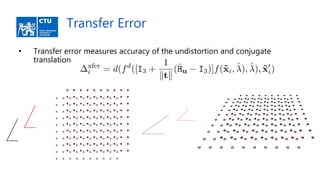
Transfer Error
• Transfer error measures accuracy of the undistortion and conjugate
translation
Comparison of Generated Solvers
z Original
(dashed)
Hidden
(solid)
80x84 14x18
74x76 24x26
348x354 54x60
730x734 76x80
Solvers based on constraints using the hidden variable trick are smaller and
more stable than solvers generated using [5] with the original constraints.
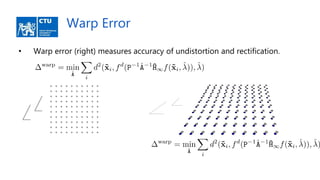
Warp Error
• Warp error (right) measures accuracy of undistortion and rectification.
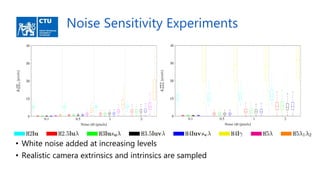
Noise Sensitivity Experiments
• White noise added at increasing levels
• Realistic camera extrinsics and intrinsics are sampled
Narrow and Wide Angle results
Feature Problems
Robustness

Radially-Distorted Conjugate Translations

  • 1.
    Radially-Distorted Conjugate Translations James Pritts,Zuzana Kukelova, Viktor Larsson, Ondrej Chum In CVPR 18
  • 2.
    Motivation • Joint estimationof lens distortion and rectification is needed for large distortions • Sampling lens distortion parameters during RANSAC increases sampling time • Ex-post correction of lens distortion is difficult because problem is highly non- convex • Translations are common, minimal solvers require few correspondences SequentialOriginal Joint
  • 3.
  • 4.
  • 5.
  • 6.
    Degrees of freedom •Vanishing line has two degrees of freedom. • Vanishing direction has two degrees of freedom. • Unknown division model parameter . • 5 degrees of freedom require 2.5 point correspondences.
  • 7.
    Point-Coincidence Constraint • Eliminateunknown homogeneous scalar • Generates two linear independent equations, 2 constraints per correspondence • Orthogonality constraint
  • 8.
    Solver Variants Generated Reference[1] Proposed Minimal Solvers [2] [3] [4] Undistorts ✓ ✓ ✓ ✓ ✓ Rectifies ✓ ✓ ✓ ✓ ✓ ✓ # points 2 2.5 3 3.5 4 4 5 5 Directions 1 1 1 2 2 2 1 1 # solutions 1 4 2 6 4 1 18 5 • One and two-direction variants of the proposed solvers are in colors. • Each variant has a version that can rectify reflections (green, blue).
  • 9.
    Correspondence Types 1/2-pt. correspondencept. correspondence • Local features give pt. correspondences. • MSER and Hessian Affine extracted. • 1 feature needed for 1 direction solvers. • 2 features needed for 2 direction solvers.
  • 10.
    Hidden Variable Trick •Eliminating unknowns will simplify the generated solvers. • The vanishing direction is linear and unknows can be hidden in the coefficient matrix, • Coefficients of are polynomials in . • Thus all 4x4 sub-matrices of must have determinant 0.
  • 11.
    Intuition for SolvingPolynomial Systems • Solution with multiplicity 2 at • We can write the system as a matrix equation
  • 12.
    Represent polynomial system ina more compact form as Notational convenience
  • 13.
    Adding and EliminatingMonomials • Adding multiples of unknowns to original constraints does not add new solutions. • Provides additional linearly independent equations • Eliminate monomials from rows by Gauss-Jordan elimination
  • 14.
    Back Substitution • Solvefor • Solving can be done numerically for higher order polynomials • Back substitute • Only finitely number of polynomials need to be added if the polynomial system has rational coefficients and a finite number of solutions. • The number of polynomials needed quickly explodes
  • 15.
    Transfer Error • Transfererror measures accuracy of the undistortion and conjugate translation
  • 16.
    Comparison of GeneratedSolvers z Original (dashed) Hidden (solid) 80x84 14x18 74x76 24x26 348x354 54x60 730x734 76x80 Solvers based on constraints using the hidden variable trick are smaller and more stable than solvers generated using [5] with the original constraints.
  • 17.
    Warp Error • Warperror (right) measures accuracy of undistortion and rectification.
  • 18.
    Noise Sensitivity Experiments •White noise added at increasing levels • Realistic camera extrinsics and intrinsics are sampled
  • 19.
    Narrow and WideAngle results
  • 20.
  • 21.