The Importance of Reproducibility in
  High-Throughput Studies: Case
 Studies in Forensic Bioinformatics
                Keith A. Baggerly
    Bioinformatics and Computational Biology
        UT M. D. Anderson Cancer Center
           kabagg@mdanderson.org

               CSE, May 3, 2011
G ENOMIC S IGNATURES                                            1


     Why is Reproducibility Important in H-T-S?
Our intuition about what “makes sense” is very poor in high
dimensions. To use “genomic signatures” as biomarkers, we
need to know they’ve been assembled correctly.

Without documentation, we may need to employ forensic
bioinformatics to infer what was done to obtain the results.

Let’s examine some case studies involving an important
clinical problem: can we predict how a given patient will
respond to available chemotherapeutics?


c Copyright 2007-2011, Keith A. Baggerly and Kevin R. Coombes
G ENOMIC S IGNATURES                                            2


           Using the NCI60 to Predict Sensitivity


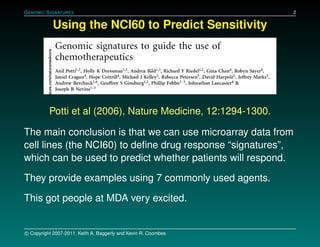
          Potti et al (2006), Nature Medicine, 12:1294-1300.

The main conclusion is that we can use microarray data from
cell lines (the NCI60) to define drug response “signatures”,
which can be used to predict whether patients will respond.

They provide examples using 7 commonly used agents.

This got people at MDA very excited.


c Copyright 2007-2011, Keith A. Baggerly and Kevin R. Coombes
G ENOMIC S IGNATURES                                            3

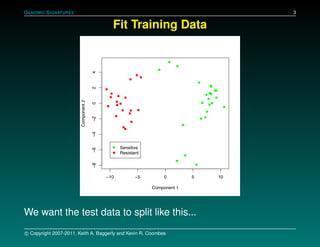
                                      Fit Training Data


We want the test data to split like this...
c Copyright 2007-2011, Keith A. Baggerly and Kevin R. Coombes
G ENOMIC S IGNATURES                                            4

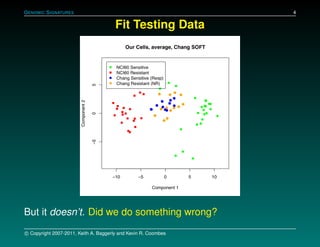
                                       Fit Testing Data


But it doesn’t. Did we do something wrong?
c Copyright 2007-2011, Keith A. Baggerly and Kevin R. Coombes
G ENOMIC S IGNATURES                   5

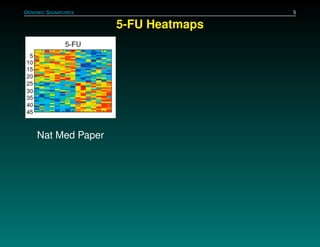
                       5-FU Heatmaps


     Nat Med Paper
G ENOMIC S IGNATURES                    5

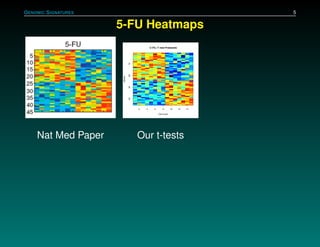
                       5-FU Heatmaps


     Nat Med Paper        Our t-tests
G ENOMIC S IGNATURES                                                             5

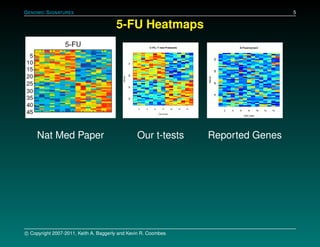
                                       5-FU Heatmaps


     Nat Med Paper                              Our t-tests     Reported Genes


c Copyright 2007-2011, Keith A. Baggerly and Kevin R. Coombes
G ENOMIC S IGNATURES                                            6


                                  Their List and Ours
> temp <- cbind(
    sort(rownames(pottiUpdated)[fuRows]),
    sort(rownames(pottiUpdated)[
         fuTQNorm@p.values <= fuCut]);
> colnames(temp) <- c("Theirs", "Ours");
> temp
     Theirs        Ours
...
[3,] "1881_at"     "1882_g_at"
[4,] "31321_at"    "31322_at"
[5,] "31725_s_at" "31726_at"
[6,] "32307_r_at" "32308_r_at"
...

c Copyright 2007-2011, Keith A. Baggerly and Kevin R. Coombes
G ENOMIC S IGNATURES                                                                                                                                                              7


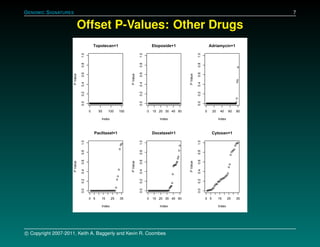
                             Offset P-Values: Other Drugs
                                           Topotecan+1                                         Etoposide+1                                      Adriamycin+1


                                 1.0


                                                                                     1.0


                                                                                                                                      1.0
                                 0.8


                                                                                     0.8


                                                                                                                                      0.8
                                                                                                                                                                             q


                                 0.6


                                                                                     0.6


                                                                                                                                      0.6
                       P Value


                                                                           P Value


                                                                                                                            P Value
                                                                                                                                                                             q
                                 0.4                                                                                                                                         q


                                                                                     0.4


                                                                                                                                      0.4
                                 0.2


                                                                                     0.2


                                                                                                                                      0.2
                                                                                                                                                                             q
                                 0.0


                                                                                     0.0


                                                                                                                                      0.0
                                                                                                                                                                     q
                                        qqqqqqqqqqqqqqqqqqqqqqqqq
                                       qqqqqqqqqqqqqqqqqqqqqqqqq
                                       qqqqqqqqqqqqqqqqqqqqqqqqq
                                       qqqqqqqqqqqqqqqqqqqqqqqqq
                                       qqqqqqqqqqqqqqqqqqqqqqqqq
                                        qqqqqqqqqqqqqqqqqqqqqqqqq                          qqqqqqqqqqqqqqqqqqqqqqqqq
                                                                                           qqqqqqqqqqqqqqqqqqqqqqqqq                        qqqqqqqqqqqqqqqqqqqqqqqqq
                                                                                                                                            qqqqqqqqqqqqqqqqqqqqqqqqq
                                                                                                                                             qqqqqqqqqqqqqqqqqqqqqqqqq


                                       0      50     100             150                   0   10 20 30 40 50                               0     20     40      60          80

                                                Index                                               Index                                              Index


                                           Paclitaxel+1                                        Docetaxel+1                                        Cytoxan+1
                                 1.0


                                                                                     1.0


                                                                                                                                      1.0
                                                                      q                                                                                                    qq
                                                                                                                                                                          q
                                                                     q                                                  q                                                q
                                                                     q                                                                                                   q
                                                                                                                        q                                               q
                                 0.8


                                                                                     0.8


                                                                                                                                      0.8
                                                                                                                                                                       q
                                                                                                                                                                      q
                                                                                                                                                                     q
                                                                                                                    q
                                                                                                                    q
                                 0.6


                                                                                     0.6


                                                                                                                                      0.6
                       P Value


                                                                           P Value


                                                                                                                    q


                                                                                                                            P Value
                                                                                                                   q
                                                                                                                  qq                                              q
                                                                                                                 qq
                                                                                                                 q                                               q
                                                                 q
                                 0.4


                                                                                     0.4


                                                                                                                                      0.4
                                                                                                             q                                                   q
                                                                                                                                                               qq
                                                                 q                                                                                            q
                                                                                                                                                         qqqq
                                                                                                                                                            q
                                                             q
                                 0.2


                                                                                     0.2


                                                                                                                                      0.2
                                                                                                                                                      qq
                                                                                                                                                       q
                                                                                                             q
                                                                                                                                                   qq
                                                                                                                                                    q
                                                                                                             q
                                                                                                             q                                    q
                                                             q                                             qq                                    q
                                                                                                                                                q
                                 0.0


                                                                                     0.0


                                                                                                                                      0.0
                                       qqqqqqqqqqqqqq
                                        qqqqqqqqqqqqqq                                     qqqqqqqqqqqqqqqqq
                                                                                           qqqqqqqqqqqqqqqq                                  qqq
                                                                                                                                            qqq


                                       0 5      15      25           35                    0   10 20 30 40 50                               0 5        15       25           35

                                                Index                                               Index                                              Index


c Copyright 2007-2011, Keith A. Baggerly and Kevin R. Coombes
G ENOMIC S IGNATURES                                            8


                                Using Their Software
Their software requires two input files:

1. a quantification matrix, genes by samples, with a header
   giving classifications (0 = Resistant, 1 = Sensitive, 2 = Test)

2. a list of probeset ids in the same order as the quantification
   matrix. This list must not have a header row.

What do we get?


c Copyright 2007-2011, Keith A. Baggerly and Kevin R. Coombes
G ENOMIC S IGNATURES                            9

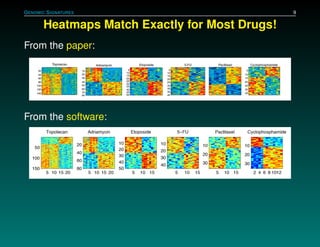
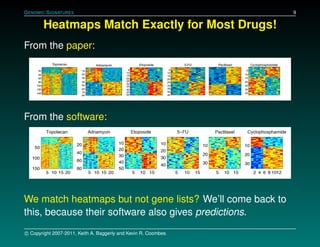
       Heatmaps Match Exactly for Most Drugs!
From the paper:


From the software:
G ENOMIC S IGNATURES                                            9

       Heatmaps Match Exactly for Most Drugs!
From the paper:


From the software:


We match heatmaps but not gene lists? We’ll come back to
this, because their software also gives predictions.
c Copyright 2007-2011, Keith A. Baggerly and Kevin R. Coombes
G ENOMIC S IGNATURES                                            10


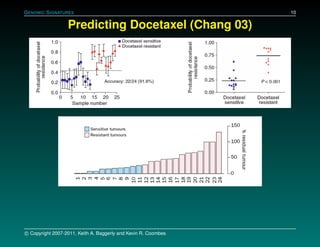
                  Predicting Docetaxel (Chang 03)


c Copyright 2007-2011, Keith A. Baggerly and Kevin R. Coombes
G ENOMIC S IGNATURES                                            11

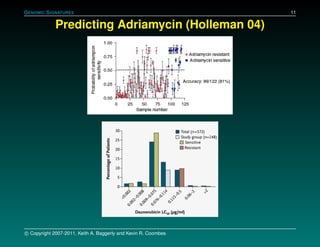
             Predicting Adriamycin (Holleman 04)


c Copyright 2007-2011, Keith A. Baggerly and Kevin R. Coombes
G ENOMIC S IGNATURES                                              12


                         There Were Other Genes...
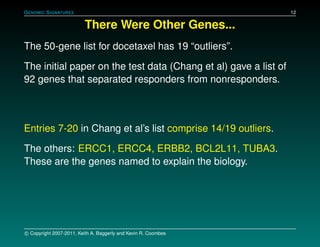
The 50-gene list for docetaxel has 19 “outliers”.

The initial paper on the test data (Chang et al) gave a list of
92 genes that separated responders from nonresponders.


Entries 7-20 in Chang et al’s list comprise 14/19 outliers.

The others: ERCC1, ERCC4, ERBB2, BCL2L11, TUBA3.
These are the genes named to explain the biology.


c Copyright 2007-2011, Keith A. Baggerly and Kevin R. Coombes
G ENOMIC S IGNATURES                                            13

    A Repro Theme: Don’t Take My Word For It!
Read the paper! Coombes, Wang & Baggerly, Nat Med, Nov
6, 2007, 13:1276-7, author reply 1277-8.

Try it yourselves! All of the raw data, documentation*, and
code* is available from our web site (*and from Nat Med):

http://bioinformatics.mdanderson.org/
Supplements/ReproRsch-Chemo.


c Copyright 2007-2011, Keith A. Baggerly and Kevin R. Coombes
G ENOMIC S IGNATURES                                            14


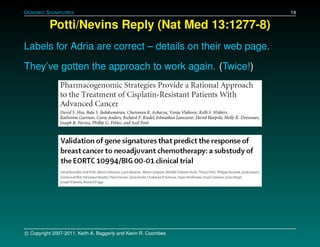
          Potti/Nevins Reply (Nat Med 13:1277-8)
Labels for Adria are correct – details on their web page.

They’ve gotten the approach to work again. (Twice!)


c Copyright 2007-2011, Keith A. Baggerly and Kevin R. Coombes
G ENOMIC S IGNATURES                              15


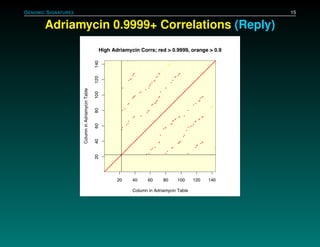
        Adriamycin 0.9999+ Correlations (Reply)
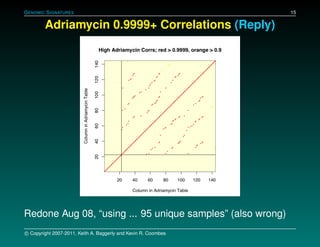
G ENOMIC S IGNATURES                                            15


        Adriamycin 0.9999+ Correlations (Reply)


Redone Aug 08, “using ... 95 unique samples” (also wrong)
c Copyright 2007-2011, Keith A. Baggerly and Kevin R. Coombes
G ENOMIC S IGNATURES                                            16

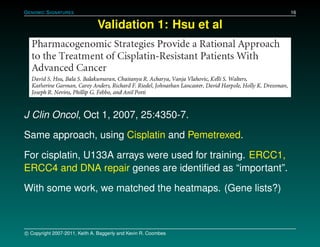
                               Validation 1: Hsu et al


J Clin Oncol, Oct 1, 2007, 25:4350-7.

Same approach, using Cisplatin and Pemetrexed.

For cisplatin, U133A arrays were used for training. ERCC1,
ERCC4 and DNA repair genes are identified as “important”.

With some work, we matched the heatmaps. (Gene lists?)


c Copyright 2007-2011, Keith A. Baggerly and Kevin R. Coombes
G ENOMIC S IGNATURES                                  17


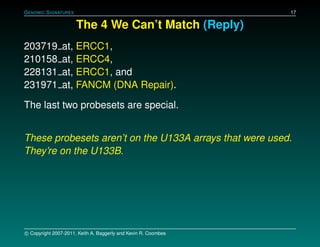
                       The 4 We Can’t Match (Reply)
203719         at, ERCC1,
210158         at, ERCC4,
228131         at, ERCC1, and
231971         at, FANCM (DNA Repair).

The last two probesets are special.
G ENOMIC S IGNATURES                                            17


                       The 4 We Can’t Match (Reply)
203719         at, ERCC1,
210158         at, ERCC4,
228131         at, ERCC1, and
231971         at, FANCM (DNA Repair).

The last two probesets are special.


These probesets aren’t on the U133A arrays that were used.
They’re on the U133B.


c Copyright 2007-2011, Keith A. Baggerly and Kevin R. Coombes
G ENOMIC S IGNATURES                                            18

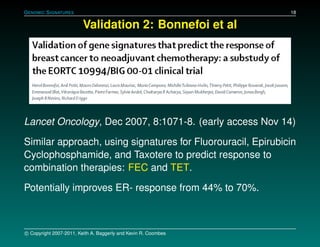
                         Validation 2: Bonnefoi et al


Lancet Oncology, Dec 2007, 8:1071-8. (early access Nov 14)

Similar approach, using signatures for Fluorouracil, Epirubicin
Cyclophosphamide, and Taxotere to predict response to
combination therapies: FEC and TET.

Potentially improves ER- response from 44% to 70%.


c Copyright 2007-2011, Keith A. Baggerly and Kevin R. Coombes
G ENOMIC S IGNATURES                                                              19


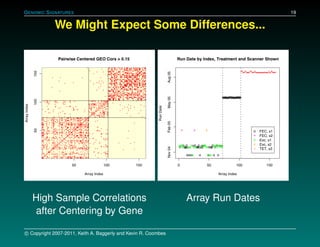
            We Might Expect Some Differences...


   High Sample Correlations                                     Array Run Dates
    after Centering by Gene

c Copyright 2007-2011, Keith A. Baggerly and Kevin R. Coombes
G ENOMIC S IGNATURES                                           20


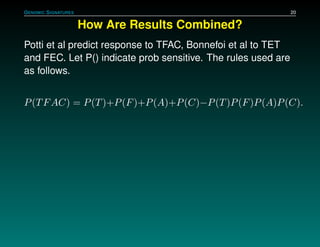
                       How Are Results Combined?
Potti et al predict response to TFAC, Bonnefoi et al to TET
and FEC. Let P() indicate prob sensitive. The rules used are
as follows.
G ENOMIC S IGNATURES                                           20


                       How Are Results Combined?
Potti et al predict response to TFAC, Bonnefoi et al to TET
and FEC. Let P() indicate prob sensitive. The rules used are
as follows.


P (T F AC) = P (T )+P (F )+P (A)+P (C)−P (T )P (F )P (A)P (C).
G ENOMIC S IGNATURES                                           20


                       How Are Results Combined?
Potti et al predict response to TFAC, Bonnefoi et al to TET
and FEC. Let P() indicate prob sensitive. The rules used are
as follows.


P (T F AC) = P (T )+P (F )+P (A)+P (C)−P (T )P (F )P (A)P (C).


                          P (ET ) = max[P (E), P (T )].
G ENOMIC S IGNATURES                                           20


                       How Are Results Combined?
Potti et al predict response to TFAC, Bonnefoi et al to TET
and FEC. Let P() indicate prob sensitive. The rules used are
as follows.


P (T F AC) = P (T )+P (F )+P (A)+P (C)−P (T )P (F )P (A)P (C).


                          P (ET ) = max[P (E), P (T )].


                            5                          1
                  P (F EC) = [P (F ) + P (E) + P (C)] − .
                            8                          4
G ENOMIC S IGNATURES                                            20


                       How Are Results Combined?
Potti et al predict response to TFAC, Bonnefoi et al to TET
and FEC. Let P() indicate prob sensitive. The rules used are
as follows.


P (T F AC) = P (T )+P (F )+P (A)+P (C)−P (T )P (F )P (A)P (C).


                                P (ET ) = max[P (E), P (T )].


                             5                          1
                   P (F EC) = [P (F ) + P (E) + P (C)] − .
                             8                          4

Each rule is different.
c Copyright 2007-2011, Keith A. Baggerly and Kevin R. Coombes
G ENOMIC S IGNATURES                                            21

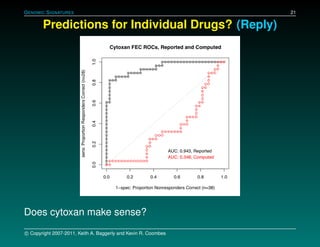
       Predictions for Individual Drugs? (Reply)


Does cytoxan make sense?
c Copyright 2007-2011, Keith A. Baggerly and Kevin R. Coombes
G ENOMIC S IGNATURES                           22

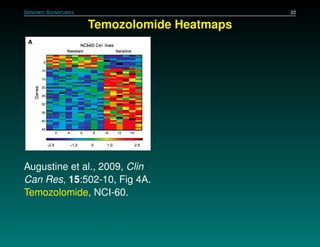
                       Temozolomide Heatmaps


Augustine et al., 2009, Clin
Can Res, 15:502-10, Fig 4A.
Temozolomide, NCI-60.
G ENOMIC S IGNATURES                                                                        22

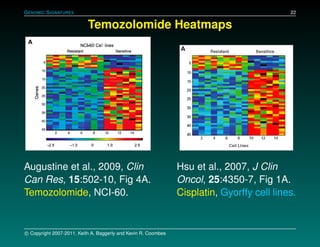
                           Temozolomide Heatmaps


Augustine et al., 2009, Clin                                    Hsu et al., 2007, J Clin
Can Res, 15:502-10, Fig 4A.                                     Oncol, 25:4350-7, Fig 1A.
Temozolomide, NCI-60.                                           Cisplatin, Gyorffy cell lines.


c Copyright 2007-2011, Keith A. Baggerly and Kevin R. Coombes
G ENOMIC S IGNATURES                                      23


                       Some Timeline Here...
Nat Med Nov 06*, Nov 07*, Aug 08. JCO Feb 07*, Oct 07*.
Lancet Oncology Dec 07*. PLoS One Apr 08. CCR Jan 09*.
(* errors reported)
G ENOMIC S IGNATURES                                         23


                       Some Timeline Here...
Nat Med Nov 06*, Nov 07*, Aug 08. JCO Feb 07*, Oct 07*.
Lancet Oncology Dec 07*. PLoS One Apr 08. CCR Jan 09*.
(* errors reported)


May/June 2009: we learn clinical trials had begun.
2007: pemetrexed vs cisplatin, pem vs vinorelbine.
2008: docetaxel vs doxorubicin, topotecan vs dox (Moffitt).
G ENOMIC S IGNATURES                                            23


                               Some Timeline Here...
Nat Med Nov 06*, Nov 07*, Aug 08. JCO Feb 07*, Oct 07*.
Lancet Oncology Dec 07*. PLoS One Apr 08. CCR Jan 09*.
(* errors reported)


May/June 2009: we learn clinical trials had begun.
2007: pemetrexed vs cisplatin, pem vs vinorelbine.
2008: docetaxel vs doxorubicin, topotecan vs dox (Moffitt).


Sep 1. Paper submitted to Annals of Applied Statistics.
Sep 14. Paper online at Annals of Applied Statistics.
Sep-Oct: Story covered by The Cancer Letter, Duke starts
internal investigation, suspends trials.

c Copyright 2007-2011, Keith A. Baggerly and Kevin R. Coombes
G ENOMIC S IGNATURES                                              24

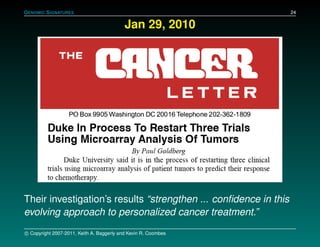
                                           Jan 29, 2010


Their investigation’s results “strengthen ... confidence in this
evolving approach to personalized cancer treatment.”
c Copyright 2007-2011, Keith A. Baggerly and Kevin R. Coombes
G ENOMIC S IGNATURES                                           25

                       Why We’re Unhappy...
“While the reviewers approved of our sharing the report with
the NCI, we consider it a confidential document” (Duke). A
future paper will explain the methods.
G ENOMIC S IGNATURES                                            25

                               Why We’re Unhappy...
“While the reviewers approved of our sharing the report with
the NCI, we consider it a confidential document” (Duke). A
future paper will explain the methods.


There was also a major new development that the restart
announcement didn’t mention.

In mid-Nov (mid-investigation), the Duke team posted new
data for cisplatin and pemetrexed (in trials since ’07).

These included quantifications for 59 ovarian cancer test
samples (from GSE3149) used for predictor validation.


c Copyright 2007-2011, Keith A. Baggerly and Kevin R. Coombes
G ENOMIC S IGNATURES                                            26


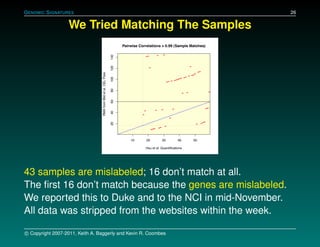
                  We Tried Matching The Samples


43 samples are mislabeled; 16 don’t match at all.
The first 16 don’t match because the genes are mislabeled.
We reported this to Duke and to the NCI in mid-November.
All data was stripped from the websites within the week.

c Copyright 2007-2011, Keith A. Baggerly and Kevin R. Coombes
G ENOMIC S IGNATURES                                           27

                       More Timeline
“While the reviewers approved of our sharing the report with
the NCI...”
G ENOMIC S IGNATURES                                           27

                       More Timeline
“While the reviewers approved of our sharing the report with
the NCI...”


April, 2010. Review report sought from the NCI under the
Freedom of Information Act (FOIA).
May, 2010. Redacted report supplied; gaps noted.
G ENOMIC S IGNATURES                                            27

                                        More Timeline
“While the reviewers approved of our sharing the report with
the NCI...”


April, 2010. Review report sought from the NCI under the
Freedom of Information Act (FOIA).
May, 2010. Redacted report supplied; gaps noted.

May, 2010. NCI and CALGB pull lung metagene signature
from an ongoing phase III trial.

Duke trials continue.


c Copyright 2007-2011, Keith A. Baggerly and Kevin R. Coombes
G ENOMIC S IGNATURES                                            28

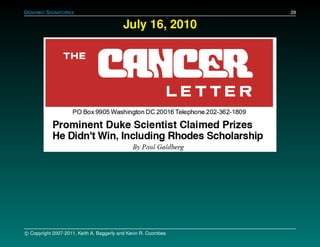
                                          July 16, 2010


c Copyright 2007-2011, Keith A. Baggerly and Kevin R. Coombes
G ENOMIC S IGNATURES                                            29


                                  Subsequent Events
July 19/20: letter to Varmus; Duke resuspends trials
July 30: Varmus & Duke request IOM Involvement
Oct 22/29: call to retract JCO paper
Nov 9: Duke announces trials terminated
Nov 19: call to retract Nat Med paper, Potti resigns

There have been at least three developments since.

These involve the NCI, the FDA, and Duke.


c Copyright 2007-2011, Keith A. Baggerly and Kevin R. Coombes
G ENOMIC S IGNATURES                                            30


  Dec 20, 2010: The IOM Meets, the NCI Speaks
At the first meeting of the IOM review panel, Lisa McShane
outlined some NCI interactions with the Duke group.
An MP3 is available from the Cancer Letter.

Our questions prompted the NCI to ask questions of its own.
The NCI released about 550 pages of documents giving the
details.

We posted our annotation of these documents and an overall
timeline on Jan 14th.

We’re going to look at one case they examined.


c Copyright 2007-2011, Keith A. Baggerly and Kevin R. Coombes
G ENOMIC S IGNATURES                                            31


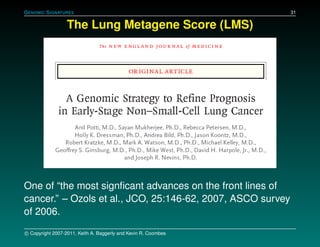
                  The Lung Metagene Score (LMS)


One of “the most signficant advances on the front lines of
cancer.” – Ozols et al., JCO, 25:146-62, 2007, ASCO survey
of 2006.
c Copyright 2007-2011, Keith A. Baggerly and Kevin R. Coombes
G ENOMIC S IGNATURES                                        32


                The Background of CALGB 30506
When this trial was proposed to the NCI, they had questions
about the amount of blinding, so they asked for one more test.
G ENOMIC S IGNATURES                                        32


                The Background of CALGB 30506
When this trial was proposed to the NCI, they had questions
about the amount of blinding, so they asked for one more test.


The LMS failed.

It almost achieved significance going the wrong way.
G ENOMIC S IGNATURES                                            32


                The Background of CALGB 30506
When this trial was proposed to the NCI, they had questions
about the amount of blinding, so they asked for one more test.


The LMS failed.

It almost achieved significance going the wrong way.


After post-hoc adjustments (adjusting for batches), the Duke
group attained some success (with IB, not IA).

At CALGB’s urging, this went forward, but the NCI only
allowed the LMS to be used for stratification, not allocation.


c Copyright 2007-2011, Keith A. Baggerly and Kevin R. Coombes
G ENOMIC S IGNATURES                                     33

                       After our Paper
The NCI asked to see the data and code associated with the
post-hoc adjustment.

Using the code and data provided, the NCI couldn’t
reproduce the success of the post-hoc adjustment.

More, they noticed another problem.

They ran the algorithm and got predictions.
G ENOMIC S IGNATURES                                     33

                       After our Paper
The NCI asked to see the data and code associated with the
post-hoc adjustment.

Using the code and data provided, the NCI couldn’t
reproduce the success of the post-hoc adjustment.

More, they noticed another problem.

They ran the algorithm and got predictions.


They ran it again.
G ENOMIC S IGNATURES                                            33

                                       After our Paper
The NCI asked to see the data and code associated with the
post-hoc adjustment.

Using the code and data provided, the NCI couldn’t
reproduce the success of the post-hoc adjustment.

More, they noticed another problem.

They ran the algorithm and got predictions.


They ran it again.


The predictions changed.


c Copyright 2007-2011, Keith A. Baggerly and Kevin R. Coombes
G ENOMIC S IGNATURES                                        34


                       The Changes Weren’t Subtle
Some scores changed from 5% to 95%.

From one run to the next, high/low classifications changed
about 25% of the time.
G ENOMIC S IGNATURES                                        34


                       The Changes Weren’t Subtle
Some scores changed from 5% to 95%.

From one run to the next, high/low classifications changed
about 25% of the time.


The NCI was unhappy. They had understood the rule to be
“locked down”, so that predictions wouldn’t change.
G ENOMIC S IGNATURES                                        34


                       The Changes Weren’t Subtle
Some scores changed from 5% to 95%.

From one run to the next, high/low classifications changed
about 25% of the time.


The NCI was unhappy. They had understood the rule to be
“locked down”, so that predictions wouldn’t change.


The NCI publicly yanked the LMS from CALGB 30506 in May
2010.
G ENOMIC S IGNATURES                                            34


                       The Changes Weren’t Subtle
Some scores changed from 5% to 95%.

From one run to the next, high/low classifications changed
about 25% of the time.


The NCI was unhappy. They had understood the rule to be
“locked down”, so that predictions wouldn’t change.


The NCI publicly yanked the LMS from CALGB 30506 in May
2010.


The NEJM paper was retracted March 2, 2011.

c Copyright 2007-2011, Keith A. Baggerly and Kevin R. Coombes
G ENOMIC S IGNATURES                                         35

                       The FDA Visits
On Jan 28, 2011, the Cancer Letter reported that an FDA
Audit team was visiting Duke to examine how the trials had
been run.

A key question was whether Investigational Device
Exemptions (IDEs) were obtained before the signatures were
used to guide therapy. They weren’t.
G ENOMIC S IGNATURES                                            35

                                        The FDA Visits
On Jan 28, 2011, the Cancer Letter reported that an FDA
Audit team was visiting Duke to examine how the trials had
been run.

A key question was whether Investigational Device
Exemptions (IDEs) were obtained before the signatures were
used to guide therapy. They weren’t.


Some aspects of this issue were anticipated by the IOM
committee (Baggerly and Coombes, Clinical Chemistry,
57(5):688-90).

Per the FDA, genomic signatures are medical devices.


c Copyright 2007-2011, Keith A. Baggerly and Kevin R. Coombes
G ENOMIC S IGNATURES                                        36

                       Duke’s Initial Investigation
One thing that had puzzled us since the trial restarts was how
the external reviewers missed the new errors we reported.
G ENOMIC S IGNATURES                                            36

                         Duke’s Initial Investigation
One thing that had puzzled us since the trial restarts was how
the external reviewers missed the new errors we reported.


Jan 11, 2011: Nature talks to Duke.

The Duke deans overseeing the investigation, in consultation
with the acting head of Duke’s IRB, decided not to forward
our report to the reviewers.

This was done to avoid “biasing the review”.


c Copyright 2007-2011, Keith A. Baggerly and Kevin R. Coombes
G ENOMIC S IGNATURES                                            37


                  The IOM Meets Again: Mar 30-31
Science: Ned Calogne, Rich Simon, Chuck Perou, Sumitha
Mandrekar

Institutional Responsibilty: Peter Pronovost (Hopkins)

Case Studies: Laura Van’t Veer, Steve Shak, Joe Nevins

Responsible Parties: journal editors (Cathy DeAngelis,
JAMA, Veronique Kiermer, Nature, Katrina Kelner, Science),
authors and PIs (Stott Zeger), institutions (Albert Reece, U
Md, Harold Paz, Penn State, Scott Zeger, Hopkins)

Forensics: Keith Baggerly

http://bioinformatics.mdanderson.org/
Supplements/ReproRsch-All/Modified/IOM/

c Copyright 2007-2011, Keith A. Baggerly and Kevin R. Coombes
G ENOMIC S IGNATURES                                            38


                       Some Cautions/Observations
We’ve seen problems like these before.

The most common mistakes are simple.

Confounding in the Experimental Design
Mixing up the sample labels
Mixing up the gene labels
Mixing up the group labels
(Most mixups involve simple switches or offsets)

This simplicity is often hidden.

Incomplete documentation

Unfortunately, we suspect
The most simple mistakes are common.

c Copyright 2007-2011, Keith A. Baggerly and Kevin R. Coombes
G ENOMIC S IGNATURES                                            39


        How Should We Pursue Reproducibility?
AAAS, Feb 19: All slides and an MP3 of the audio are
available from
http://www.stanford.edu/˜vcs/AAAS2011/
ENAR, Mar 23: Panel on ethics in biostatistics. Handouts are
available from our Google Group.
What’s Missing? Nature, Mar 23
AACR, Apr 5: Difficulties in moving biomarkers to the clinic.
CSE, May 3
NCI, Jun 23-4 What should the NCI be looking for in grants
that it funds?
Check back...
c Copyright 2007-2011, Keith A. Baggerly and Kevin R. Coombes
G ENOMIC S IGNATURES                                            40


                        What Should the Norm Be?
For our group? Since 2007, we have prepared reports in
Sweave.

For papers? (Baggerly, Nature, Sep 22, 2010)

Things we look for:
1. Data (often mentioned, given MIAME)
2. Provenance
3. Code
4. Descriptions of Nonscriptable Steps
5. Descriptions of Planned Design, if Used.

For clinical trials?


c Copyright 2007-2011, Keith A. Baggerly and Kevin R. Coombes
G ENOMIC S IGNATURES                                            41


                          Some Acknowledgements
Kevin Coombes

Shannon Neeley, Jing Wang

David Ransohoff, Gordon Mills

Jane Fridlyand, Lajos Pusztai, Zoltan Szallasi

MDACC Ovarian SPORE, Lung SPORE, Breast SPORE

Now in the Annals of Applied Statistics! Baggerly and
Coombes (2009), 3(4):1309-34.
http://bioinformatics.mdanderson.org/
Supplements/ReproRsch-All


c Copyright 2007-2011, Keith A. Baggerly and Kevin R. Coombes
G ENOMIC S IGNATURES                                            42

                                                   Index
Title
Cell Line Story
Trying it Ourselves
Matching Features
Using Software/Making Predictions
Outliers
The Reply
Adriamycin Followup
Hsu et al (Cisplatin)
Timeline, Trials, Cancer Letter
Trial Restart and Objections
Final Lessons


c Copyright 2007-2011, Keith A. Baggerly and Kevin R. Coombes

Baggerly presentation from CSE

  • 1.
    The Importance ofReproducibility in High-Throughput Studies: Case Studies in Forensic Bioinformatics Keith A. Baggerly Bioinformatics and Computational Biology UT M. D. Anderson Cancer Center kabagg@mdanderson.org CSE, May 3, 2011
  • 2.
    G ENOMIC SIGNATURES 1 Why is Reproducibility Important in H-T-S? Our intuition about what “makes sense” is very poor in high dimensions. To use “genomic signatures” as biomarkers, we need to know they’ve been assembled correctly. Without documentation, we may need to employ forensic bioinformatics to infer what was done to obtain the results. Let’s examine some case studies involving an important clinical problem: can we predict how a given patient will respond to available chemotherapeutics? c Copyright 2007-2011, Keith A. Baggerly and Kevin R. Coombes
  • 3.
    G ENOMIC SIGNATURES 2 Using the NCI60 to Predict Sensitivity Potti et al (2006), Nature Medicine, 12:1294-1300. The main conclusion is that we can use microarray data from cell lines (the NCI60) to define drug response “signatures”, which can be used to predict whether patients will respond. They provide examples using 7 commonly used agents. This got people at MDA very excited. c Copyright 2007-2011, Keith A. Baggerly and Kevin R. Coombes
  • 4.
    G ENOMIC SIGNATURES 3 Fit Training Data We want the test data to split like this... c Copyright 2007-2011, Keith A. Baggerly and Kevin R. Coombes
  • 5.
    G ENOMIC SIGNATURES 4 Fit Testing Data But it doesn’t. Did we do something wrong? c Copyright 2007-2011, Keith A. Baggerly and Kevin R. Coombes
  • 6.
    G ENOMIC SIGNATURES 5 5-FU Heatmaps Nat Med Paper
  • 7.
    G ENOMIC SIGNATURES 5 5-FU Heatmaps Nat Med Paper Our t-tests
  • 8.
    G ENOMIC SIGNATURES 5 5-FU Heatmaps Nat Med Paper Our t-tests Reported Genes c Copyright 2007-2011, Keith A. Baggerly and Kevin R. Coombes
  • 9.
    G ENOMIC SIGNATURES 6 Their List and Ours > temp <- cbind( sort(rownames(pottiUpdated)[fuRows]), sort(rownames(pottiUpdated)[ fuTQNorm@p.values <= fuCut]); > colnames(temp) <- c("Theirs", "Ours"); > temp Theirs Ours ... [3,] "1881_at" "1882_g_at" [4,] "31321_at" "31322_at" [5,] "31725_s_at" "31726_at" [6,] "32307_r_at" "32308_r_at" ... c Copyright 2007-2011, Keith A. Baggerly and Kevin R. Coombes
  • 10.
    G ENOMIC SIGNATURES 7 Offset P-Values: Other Drugs Topotecan+1 Etoposide+1 Adriamycin+1 1.0 1.0 1.0 0.8 0.8 0.8 q 0.6 0.6 0.6 P Value P Value P Value q 0.4 q 0.4 0.4 0.2 0.2 0.2 q 0.0 0.0 0.0 q qqqqqqqqqqqqqqqqqqqqqqqqq qqqqqqqqqqqqqqqqqqqqqqqqq qqqqqqqqqqqqqqqqqqqqqqqqq qqqqqqqqqqqqqqqqqqqqqqqqq qqqqqqqqqqqqqqqqqqqqqqqqq qqqqqqqqqqqqqqqqqqqqqqqqq qqqqqqqqqqqqqqqqqqqqqqqqq qqqqqqqqqqqqqqqqqqqqqqqqq qqqqqqqqqqqqqqqqqqqqqqqqq qqqqqqqqqqqqqqqqqqqqqqqqq qqqqqqqqqqqqqqqqqqqqqqqqq 0 50 100 150 0 10 20 30 40 50 0 20 40 60 80 Index Index Index Paclitaxel+1 Docetaxel+1 Cytoxan+1 1.0 1.0 1.0 q qq q q q q q q q q 0.8 0.8 0.8 q q q q q 0.6 0.6 0.6 P Value P Value q P Value q qq q qq q q q 0.4 0.4 0.4 q q qq q q qqqq q q 0.2 0.2 0.2 qq q q qq q q q q q qq q q 0.0 0.0 0.0 qqqqqqqqqqqqqq qqqqqqqqqqqqqq qqqqqqqqqqqqqqqqq qqqqqqqqqqqqqqqq qqq qqq 0 5 15 25 35 0 10 20 30 40 50 0 5 15 25 35 Index Index Index c Copyright 2007-2011, Keith A. Baggerly and Kevin R. Coombes
  • 11.
    G ENOMIC SIGNATURES 8 Using Their Software Their software requires two input files: 1. a quantification matrix, genes by samples, with a header giving classifications (0 = Resistant, 1 = Sensitive, 2 = Test) 2. a list of probeset ids in the same order as the quantification matrix. This list must not have a header row. What do we get? c Copyright 2007-2011, Keith A. Baggerly and Kevin R. Coombes
  • 12.
    G ENOMIC SIGNATURES 9 Heatmaps Match Exactly for Most Drugs! From the paper: From the software:
  • 13.
    G ENOMIC SIGNATURES 9 Heatmaps Match Exactly for Most Drugs! From the paper: From the software: We match heatmaps but not gene lists? We’ll come back to this, because their software also gives predictions. c Copyright 2007-2011, Keith A. Baggerly and Kevin R. Coombes
  • 14.
    G ENOMIC SIGNATURES 10 Predicting Docetaxel (Chang 03) c Copyright 2007-2011, Keith A. Baggerly and Kevin R. Coombes
  • 15.
    G ENOMIC SIGNATURES 11 Predicting Adriamycin (Holleman 04) c Copyright 2007-2011, Keith A. Baggerly and Kevin R. Coombes
  • 16.
    G ENOMIC SIGNATURES 12 There Were Other Genes... The 50-gene list for docetaxel has 19 “outliers”. The initial paper on the test data (Chang et al) gave a list of 92 genes that separated responders from nonresponders. Entries 7-20 in Chang et al’s list comprise 14/19 outliers. The others: ERCC1, ERCC4, ERBB2, BCL2L11, TUBA3. These are the genes named to explain the biology. c Copyright 2007-2011, Keith A. Baggerly and Kevin R. Coombes
  • 17.
    G ENOMIC SIGNATURES 13 A Repro Theme: Don’t Take My Word For It! Read the paper! Coombes, Wang & Baggerly, Nat Med, Nov 6, 2007, 13:1276-7, author reply 1277-8. Try it yourselves! All of the raw data, documentation*, and code* is available from our web site (*and from Nat Med): http://bioinformatics.mdanderson.org/ Supplements/ReproRsch-Chemo. c Copyright 2007-2011, Keith A. Baggerly and Kevin R. Coombes
  • 18.
    G ENOMIC SIGNATURES 14 Potti/Nevins Reply (Nat Med 13:1277-8) Labels for Adria are correct – details on their web page. They’ve gotten the approach to work again. (Twice!) c Copyright 2007-2011, Keith A. Baggerly and Kevin R. Coombes
  • 19.
    G ENOMIC SIGNATURES 15 Adriamycin 0.9999+ Correlations (Reply)
  • 20.
    G ENOMIC SIGNATURES 15 Adriamycin 0.9999+ Correlations (Reply) Redone Aug 08, “using ... 95 unique samples” (also wrong) c Copyright 2007-2011, Keith A. Baggerly and Kevin R. Coombes
  • 21.
    G ENOMIC SIGNATURES 16 Validation 1: Hsu et al J Clin Oncol, Oct 1, 2007, 25:4350-7. Same approach, using Cisplatin and Pemetrexed. For cisplatin, U133A arrays were used for training. ERCC1, ERCC4 and DNA repair genes are identified as “important”. With some work, we matched the heatmaps. (Gene lists?) c Copyright 2007-2011, Keith A. Baggerly and Kevin R. Coombes
  • 22.
    G ENOMIC SIGNATURES 17 The 4 We Can’t Match (Reply) 203719 at, ERCC1, 210158 at, ERCC4, 228131 at, ERCC1, and 231971 at, FANCM (DNA Repair). The last two probesets are special.
  • 23.
    G ENOMIC SIGNATURES 17 The 4 We Can’t Match (Reply) 203719 at, ERCC1, 210158 at, ERCC4, 228131 at, ERCC1, and 231971 at, FANCM (DNA Repair). The last two probesets are special. These probesets aren’t on the U133A arrays that were used. They’re on the U133B. c Copyright 2007-2011, Keith A. Baggerly and Kevin R. Coombes
  • 24.
    G ENOMIC SIGNATURES 18 Validation 2: Bonnefoi et al Lancet Oncology, Dec 2007, 8:1071-8. (early access Nov 14) Similar approach, using signatures for Fluorouracil, Epirubicin Cyclophosphamide, and Taxotere to predict response to combination therapies: FEC and TET. Potentially improves ER- response from 44% to 70%. c Copyright 2007-2011, Keith A. Baggerly and Kevin R. Coombes
  • 25.
    G ENOMIC SIGNATURES 19 We Might Expect Some Differences... High Sample Correlations Array Run Dates after Centering by Gene c Copyright 2007-2011, Keith A. Baggerly and Kevin R. Coombes
  • 26.
    G ENOMIC SIGNATURES 20 How Are Results Combined? Potti et al predict response to TFAC, Bonnefoi et al to TET and FEC. Let P() indicate prob sensitive. The rules used are as follows.
  • 27.
    G ENOMIC SIGNATURES 20 How Are Results Combined? Potti et al predict response to TFAC, Bonnefoi et al to TET and FEC. Let P() indicate prob sensitive. The rules used are as follows. P (T F AC) = P (T )+P (F )+P (A)+P (C)−P (T )P (F )P (A)P (C).
  • 28.
    G ENOMIC SIGNATURES 20 How Are Results Combined? Potti et al predict response to TFAC, Bonnefoi et al to TET and FEC. Let P() indicate prob sensitive. The rules used are as follows. P (T F AC) = P (T )+P (F )+P (A)+P (C)−P (T )P (F )P (A)P (C). P (ET ) = max[P (E), P (T )].
  • 29.
    G ENOMIC SIGNATURES 20 How Are Results Combined? Potti et al predict response to TFAC, Bonnefoi et al to TET and FEC. Let P() indicate prob sensitive. The rules used are as follows. P (T F AC) = P (T )+P (F )+P (A)+P (C)−P (T )P (F )P (A)P (C). P (ET ) = max[P (E), P (T )]. 5 1 P (F EC) = [P (F ) + P (E) + P (C)] − . 8 4
  • 30.
    G ENOMIC SIGNATURES 20 How Are Results Combined? Potti et al predict response to TFAC, Bonnefoi et al to TET and FEC. Let P() indicate prob sensitive. The rules used are as follows. P (T F AC) = P (T )+P (F )+P (A)+P (C)−P (T )P (F )P (A)P (C). P (ET ) = max[P (E), P (T )]. 5 1 P (F EC) = [P (F ) + P (E) + P (C)] − . 8 4 Each rule is different. c Copyright 2007-2011, Keith A. Baggerly and Kevin R. Coombes
  • 31.
    G ENOMIC SIGNATURES 21 Predictions for Individual Drugs? (Reply) Does cytoxan make sense? c Copyright 2007-2011, Keith A. Baggerly and Kevin R. Coombes
  • 32.
    G ENOMIC SIGNATURES 22 Temozolomide Heatmaps Augustine et al., 2009, Clin Can Res, 15:502-10, Fig 4A. Temozolomide, NCI-60.
  • 33.
    G ENOMIC SIGNATURES 22 Temozolomide Heatmaps Augustine et al., 2009, Clin Hsu et al., 2007, J Clin Can Res, 15:502-10, Fig 4A. Oncol, 25:4350-7, Fig 1A. Temozolomide, NCI-60. Cisplatin, Gyorffy cell lines. c Copyright 2007-2011, Keith A. Baggerly and Kevin R. Coombes
  • 34.
    G ENOMIC SIGNATURES 23 Some Timeline Here... Nat Med Nov 06*, Nov 07*, Aug 08. JCO Feb 07*, Oct 07*. Lancet Oncology Dec 07*. PLoS One Apr 08. CCR Jan 09*. (* errors reported)
  • 35.
    G ENOMIC SIGNATURES 23 Some Timeline Here... Nat Med Nov 06*, Nov 07*, Aug 08. JCO Feb 07*, Oct 07*. Lancet Oncology Dec 07*. PLoS One Apr 08. CCR Jan 09*. (* errors reported) May/June 2009: we learn clinical trials had begun. 2007: pemetrexed vs cisplatin, pem vs vinorelbine. 2008: docetaxel vs doxorubicin, topotecan vs dox (Moffitt).
  • 36.
    G ENOMIC SIGNATURES 23 Some Timeline Here... Nat Med Nov 06*, Nov 07*, Aug 08. JCO Feb 07*, Oct 07*. Lancet Oncology Dec 07*. PLoS One Apr 08. CCR Jan 09*. (* errors reported) May/June 2009: we learn clinical trials had begun. 2007: pemetrexed vs cisplatin, pem vs vinorelbine. 2008: docetaxel vs doxorubicin, topotecan vs dox (Moffitt). Sep 1. Paper submitted to Annals of Applied Statistics. Sep 14. Paper online at Annals of Applied Statistics. Sep-Oct: Story covered by The Cancer Letter, Duke starts internal investigation, suspends trials. c Copyright 2007-2011, Keith A. Baggerly and Kevin R. Coombes
  • 37.
    G ENOMIC SIGNATURES 24 Jan 29, 2010 Their investigation’s results “strengthen ... confidence in this evolving approach to personalized cancer treatment.” c Copyright 2007-2011, Keith A. Baggerly and Kevin R. Coombes
  • 38.
    G ENOMIC SIGNATURES 25 Why We’re Unhappy... “While the reviewers approved of our sharing the report with the NCI, we consider it a confidential document” (Duke). A future paper will explain the methods.
  • 39.
    G ENOMIC SIGNATURES 25 Why We’re Unhappy... “While the reviewers approved of our sharing the report with the NCI, we consider it a confidential document” (Duke). A future paper will explain the methods. There was also a major new development that the restart announcement didn’t mention. In mid-Nov (mid-investigation), the Duke team posted new data for cisplatin and pemetrexed (in trials since ’07). These included quantifications for 59 ovarian cancer test samples (from GSE3149) used for predictor validation. c Copyright 2007-2011, Keith A. Baggerly and Kevin R. Coombes
  • 40.
    G ENOMIC SIGNATURES 26 We Tried Matching The Samples 43 samples are mislabeled; 16 don’t match at all. The first 16 don’t match because the genes are mislabeled. We reported this to Duke and to the NCI in mid-November. All data was stripped from the websites within the week. c Copyright 2007-2011, Keith A. Baggerly and Kevin R. Coombes
  • 41.
    G ENOMIC SIGNATURES 27 More Timeline “While the reviewers approved of our sharing the report with the NCI...”
  • 42.
    G ENOMIC SIGNATURES 27 More Timeline “While the reviewers approved of our sharing the report with the NCI...” April, 2010. Review report sought from the NCI under the Freedom of Information Act (FOIA). May, 2010. Redacted report supplied; gaps noted.
  • 43.
    G ENOMIC SIGNATURES 27 More Timeline “While the reviewers approved of our sharing the report with the NCI...” April, 2010. Review report sought from the NCI under the Freedom of Information Act (FOIA). May, 2010. Redacted report supplied; gaps noted. May, 2010. NCI and CALGB pull lung metagene signature from an ongoing phase III trial. Duke trials continue. c Copyright 2007-2011, Keith A. Baggerly and Kevin R. Coombes
  • 44.
    G ENOMIC SIGNATURES 28 July 16, 2010 c Copyright 2007-2011, Keith A. Baggerly and Kevin R. Coombes
  • 45.
    G ENOMIC SIGNATURES 29 Subsequent Events July 19/20: letter to Varmus; Duke resuspends trials July 30: Varmus & Duke request IOM Involvement Oct 22/29: call to retract JCO paper Nov 9: Duke announces trials terminated Nov 19: call to retract Nat Med paper, Potti resigns There have been at least three developments since. These involve the NCI, the FDA, and Duke. c Copyright 2007-2011, Keith A. Baggerly and Kevin R. Coombes
  • 46.
    G ENOMIC SIGNATURES 30 Dec 20, 2010: The IOM Meets, the NCI Speaks At the first meeting of the IOM review panel, Lisa McShane outlined some NCI interactions with the Duke group. An MP3 is available from the Cancer Letter. Our questions prompted the NCI to ask questions of its own. The NCI released about 550 pages of documents giving the details. We posted our annotation of these documents and an overall timeline on Jan 14th. We’re going to look at one case they examined. c Copyright 2007-2011, Keith A. Baggerly and Kevin R. Coombes
  • 47.
    G ENOMIC SIGNATURES 31 The Lung Metagene Score (LMS) One of “the most signficant advances on the front lines of cancer.” – Ozols et al., JCO, 25:146-62, 2007, ASCO survey of 2006. c Copyright 2007-2011, Keith A. Baggerly and Kevin R. Coombes
  • 48.
    G ENOMIC SIGNATURES 32 The Background of CALGB 30506 When this trial was proposed to the NCI, they had questions about the amount of blinding, so they asked for one more test.
  • 49.
    G ENOMIC SIGNATURES 32 The Background of CALGB 30506 When this trial was proposed to the NCI, they had questions about the amount of blinding, so they asked for one more test. The LMS failed. It almost achieved significance going the wrong way.
  • 50.
    G ENOMIC SIGNATURES 32 The Background of CALGB 30506 When this trial was proposed to the NCI, they had questions about the amount of blinding, so they asked for one more test. The LMS failed. It almost achieved significance going the wrong way. After post-hoc adjustments (adjusting for batches), the Duke group attained some success (with IB, not IA). At CALGB’s urging, this went forward, but the NCI only allowed the LMS to be used for stratification, not allocation. c Copyright 2007-2011, Keith A. Baggerly and Kevin R. Coombes
  • 51.
    G ENOMIC SIGNATURES 33 After our Paper The NCI asked to see the data and code associated with the post-hoc adjustment. Using the code and data provided, the NCI couldn’t reproduce the success of the post-hoc adjustment. More, they noticed another problem. They ran the algorithm and got predictions.
  • 52.
    G ENOMIC SIGNATURES 33 After our Paper The NCI asked to see the data and code associated with the post-hoc adjustment. Using the code and data provided, the NCI couldn’t reproduce the success of the post-hoc adjustment. More, they noticed another problem. They ran the algorithm and got predictions. They ran it again.
  • 53.
    G ENOMIC SIGNATURES 33 After our Paper The NCI asked to see the data and code associated with the post-hoc adjustment. Using the code and data provided, the NCI couldn’t reproduce the success of the post-hoc adjustment. More, they noticed another problem. They ran the algorithm and got predictions. They ran it again. The predictions changed. c Copyright 2007-2011, Keith A. Baggerly and Kevin R. Coombes
  • 54.
    G ENOMIC SIGNATURES 34 The Changes Weren’t Subtle Some scores changed from 5% to 95%. From one run to the next, high/low classifications changed about 25% of the time.
  • 55.
    G ENOMIC SIGNATURES 34 The Changes Weren’t Subtle Some scores changed from 5% to 95%. From one run to the next, high/low classifications changed about 25% of the time. The NCI was unhappy. They had understood the rule to be “locked down”, so that predictions wouldn’t change.
  • 56.
    G ENOMIC SIGNATURES 34 The Changes Weren’t Subtle Some scores changed from 5% to 95%. From one run to the next, high/low classifications changed about 25% of the time. The NCI was unhappy. They had understood the rule to be “locked down”, so that predictions wouldn’t change. The NCI publicly yanked the LMS from CALGB 30506 in May 2010.
  • 57.
    G ENOMIC SIGNATURES 34 The Changes Weren’t Subtle Some scores changed from 5% to 95%. From one run to the next, high/low classifications changed about 25% of the time. The NCI was unhappy. They had understood the rule to be “locked down”, so that predictions wouldn’t change. The NCI publicly yanked the LMS from CALGB 30506 in May 2010. The NEJM paper was retracted March 2, 2011. c Copyright 2007-2011, Keith A. Baggerly and Kevin R. Coombes
  • 58.
    G ENOMIC SIGNATURES 35 The FDA Visits On Jan 28, 2011, the Cancer Letter reported that an FDA Audit team was visiting Duke to examine how the trials had been run. A key question was whether Investigational Device Exemptions (IDEs) were obtained before the signatures were used to guide therapy. They weren’t.
  • 59.
    G ENOMIC SIGNATURES 35 The FDA Visits On Jan 28, 2011, the Cancer Letter reported that an FDA Audit team was visiting Duke to examine how the trials had been run. A key question was whether Investigational Device Exemptions (IDEs) were obtained before the signatures were used to guide therapy. They weren’t. Some aspects of this issue were anticipated by the IOM committee (Baggerly and Coombes, Clinical Chemistry, 57(5):688-90). Per the FDA, genomic signatures are medical devices. c Copyright 2007-2011, Keith A. Baggerly and Kevin R. Coombes
  • 60.
    G ENOMIC SIGNATURES 36 Duke’s Initial Investigation One thing that had puzzled us since the trial restarts was how the external reviewers missed the new errors we reported.
  • 61.
    G ENOMIC SIGNATURES 36 Duke’s Initial Investigation One thing that had puzzled us since the trial restarts was how the external reviewers missed the new errors we reported. Jan 11, 2011: Nature talks to Duke. The Duke deans overseeing the investigation, in consultation with the acting head of Duke’s IRB, decided not to forward our report to the reviewers. This was done to avoid “biasing the review”. c Copyright 2007-2011, Keith A. Baggerly and Kevin R. Coombes
  • 62.
    G ENOMIC SIGNATURES 37 The IOM Meets Again: Mar 30-31 Science: Ned Calogne, Rich Simon, Chuck Perou, Sumitha Mandrekar Institutional Responsibilty: Peter Pronovost (Hopkins) Case Studies: Laura Van’t Veer, Steve Shak, Joe Nevins Responsible Parties: journal editors (Cathy DeAngelis, JAMA, Veronique Kiermer, Nature, Katrina Kelner, Science), authors and PIs (Stott Zeger), institutions (Albert Reece, U Md, Harold Paz, Penn State, Scott Zeger, Hopkins) Forensics: Keith Baggerly http://bioinformatics.mdanderson.org/ Supplements/ReproRsch-All/Modified/IOM/ c Copyright 2007-2011, Keith A. Baggerly and Kevin R. Coombes
  • 63.
    G ENOMIC SIGNATURES 38 Some Cautions/Observations We’ve seen problems like these before. The most common mistakes are simple. Confounding in the Experimental Design Mixing up the sample labels Mixing up the gene labels Mixing up the group labels (Most mixups involve simple switches or offsets) This simplicity is often hidden. Incomplete documentation Unfortunately, we suspect The most simple mistakes are common. c Copyright 2007-2011, Keith A. Baggerly and Kevin R. Coombes
  • 64.
    G ENOMIC SIGNATURES 39 How Should We Pursue Reproducibility? AAAS, Feb 19: All slides and an MP3 of the audio are available from http://www.stanford.edu/˜vcs/AAAS2011/ ENAR, Mar 23: Panel on ethics in biostatistics. Handouts are available from our Google Group. What’s Missing? Nature, Mar 23 AACR, Apr 5: Difficulties in moving biomarkers to the clinic. CSE, May 3 NCI, Jun 23-4 What should the NCI be looking for in grants that it funds? Check back... c Copyright 2007-2011, Keith A. Baggerly and Kevin R. Coombes
  • 65.
    G ENOMIC SIGNATURES 40 What Should the Norm Be? For our group? Since 2007, we have prepared reports in Sweave. For papers? (Baggerly, Nature, Sep 22, 2010) Things we look for: 1. Data (often mentioned, given MIAME) 2. Provenance 3. Code 4. Descriptions of Nonscriptable Steps 5. Descriptions of Planned Design, if Used. For clinical trials? c Copyright 2007-2011, Keith A. Baggerly and Kevin R. Coombes
  • 66.
    G ENOMIC SIGNATURES 41 Some Acknowledgements Kevin Coombes Shannon Neeley, Jing Wang David Ransohoff, Gordon Mills Jane Fridlyand, Lajos Pusztai, Zoltan Szallasi MDACC Ovarian SPORE, Lung SPORE, Breast SPORE Now in the Annals of Applied Statistics! Baggerly and Coombes (2009), 3(4):1309-34. http://bioinformatics.mdanderson.org/ Supplements/ReproRsch-All c Copyright 2007-2011, Keith A. Baggerly and Kevin R. Coombes
  • 67.
    G ENOMIC SIGNATURES 42 Index Title Cell Line Story Trying it Ourselves Matching Features Using Software/Making Predictions Outliers The Reply Adriamycin Followup Hsu et al (Cisplatin) Timeline, Trials, Cancer Letter Trial Restart and Objections Final Lessons c Copyright 2007-2011, Keith A. Baggerly and Kevin R. Coombes