Smart policy: Regulations as
enabler of local innovations
A.S.Rao
motguru.com
1
2
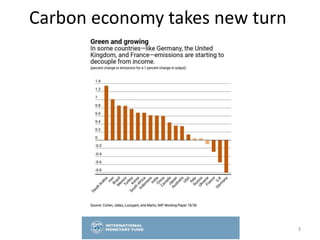
Carbon economy takes new turn
3
Public Policy
Innovation is rarely a goal in itself, but a means to
achieve broader political goals like economic
growth, increased employment, environmental
protection, military capacity or public health, to
name some of the most important ultimate
objectives. Hence, put in other words, innovation
policy instruments are intended to influence
innovation processes, and thereby contribute to
fulfilling these ultimate political goals by means of
achieving the direct objectives formulated in
innovation terms.
4
Regulatory instruments
Regulatory instruments, use legal tools for the regulation
of social and market interactions. The logic behind this
type of instrument is the willingness from the
government to define the frameworks of the interactions
taking place in the society and in the economy. Naturally,
there are many different types, but common for them all
is that these regulatory instruments (laws, rules,
directives, etc.) are obligatory in nature, meaning that
actors are obliged to act within some clearly defined
boundaries of what is allowed and what is not allowed.
Obligatory measures are typically backed by threats of
sanctions in cases of non-compliance.
5
Economic and financial instruments
Fundamental instruments using economic
incentives are competitive research funding
(industrial or basic research), tax incentives for R&D
performed at firm level, support to technology
transfer and support to venture and seed capital.
There has been a significant trend towards selecting
and designing ‘market-based’ or ‘market-like’
economic incentives in the past two decades. A
case in point is the relative reduction of institutional
support to research organisations in most OECD
countries, and the parallel increase of schemes
using competitive research funding.
6
Soft instruments
The growing use of soft instruments is at the heart
of fundamental transformations in the public
administration of most countries (particularly
visible in Europe and the US). This has been termed
‘governance’, meaning that the extensive use of
these instruments has transformed the role of the
government from being a provider and regulator to
being a coordinator and facilitator. What is
important at this stage is to underline the fact that
there has also been a rapid growth in the number
of these types of instruments in the field of
innovation policy.
7
Different forms of soft instruments
• Voluntary technical standards at the national or
international level,
• Support of innovation friendly private regulation
activities: The state stimulates self-regulation (norms,
standards) of firms and supports or moderates this
process and plays a role as catalyst by using standards.
• Standards to create a market: State action creates
markets for the consequences of the use of
technologies (emission trading) or sets market
conditions which intensify the demand for Innovations.
8
Carbon credits market
The Carbon Neutral Protocol was launched in
2002. Foot-print, concerns a business’s own
emissions, either caused directly through its
own operations or indirectly through its use of
non-renewable energy and motorised transport.
Companies can reduce their footprints through a
mix of in-house reduction initiatives, purchasing
and generating renewable energy, and offsetting
emissions through low-carbon sustainable
development projects.
9
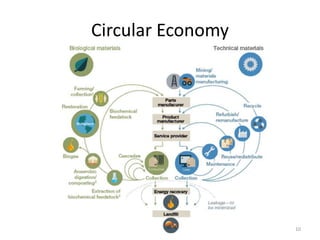
Circular Economy
10
Genetic engineering
Also in 2003 the Codex Alimentarius
Commission of the FAO/WHO adopted a set of
"Principles and Guidelines on foods derived
from biotechnology" to help countries
coordinate and standardize regulation of GM
food to help ensure public safety and facilitate
international trade. The European Union first
introduced laws requiring GMO's to be labelled
in 1997.
11
Organ transplantation
For a number or reasons, including size, anatomical,
and physiological similarities with humans the pig is
the preferred donor species. Importantly, pigs can
be optimized by genetic engineering as a source of
cells, tissues, and organs for xenotransplantation.
Recent advances in gen(om)e editing are speeding
up progress in this field. Numerous genetically
(multi-)modified pig lines have been generated to
prevent immune rejection of xenotransplants, to
overcome physiological incompatibilities, and to
reduce the risk of transmitting zoonotic pathogens.
12
Genes editing
CRISPR technology is a simple yet powerful tool
for editing genomes. It allows researchers to
easily alter DNA sequences and modify gene
function. Its many potential applications include
correcting genetic defects, treating and
preventing the spread of diseases and improving
crops.
13
Data and privacy
Cloud computing is the storing of documents, photos,
music and files online. Governments, in possession of
citizen data along with their own national security
secrets, are increasingly utilizing cloud services for
internal government communications, hosting
documents and enabling the sharing of vast amounts of
data between government departments. One matter of
concern in Europe is that businesses, schools and
universities located outside the United States including
foreign governments which use cloud services offered by
a company that conducts business in the U.S., could be
forced by U.S. law enforcement to transfer data to U.S.
territory for inspection by law enforcement agencies.
14
Algorithm wars
Chinese are more relaxed about data privacy
than Westerners, at least for now. What may be
viewed as a violation of privacy by some could
be advantageous for AI developers wanting to
extract a large amount of data. This situation
allows Chinese AI developers to achieve more
accurate machine learning models in areas such
as facial recognition, voice and gesture
recognition, consumer behaviour analysis and
robotics process automation.
15
Crypto currency
Not all countries see the advent of block chain
technology and crypto currencies as a threat, albeit
for different reasons. Some of the nations while
not recognizing crypto currencies as legal tender,
see a potential in the technology behind it and are
developing a crypto currency-friendly regulatory
regime as a means to attract investment in
technology companies that excel in this sector. In
this class are countries like Spain, Belarus, the
Cayman Islands, and Luxemburg. Some jurisdictions
are seeking to go even further and develop their
own system of crypto currencies.
16
Immigration
In a recent paper Nicholas Bloom, John Van Reenen
and Heidi Williams analysed different policy
instruments for promoting innovation and provided
a basic “toolkit” describing which policies are most
effective. In the short-run, R&D tax credits or direct
public funding seem the most productive, but in the
longer-run increasing the supply of human capital
(e.g. relaxing immigration rules or expanding
university STEM admissions) are likely more
effective.
17
Global Value Chain (GVC)
GVCs have boosted employment, enabled increased
specialization and larger scale production, driven more
efficient geographical allocation of industrial activities,
and increased the availability of a variety of intermediate
goods in the developing world. As a result, GVCs tend to
“compress” the development experience, making non-
linear catch up possible, as has been the case in China.
The rise of GVCs, and the increasing competence of local
suppliers and transnational corporation (TNCs) affiliates
in developing countries suggests that trade in
“customized” intermediates should be increasing in
relation to “generic” products and commodities.
18
SEZ (Special Economic Zone)
In Asia and in Latin America and the Caribbean,
some champions of GVC integration such as the
Republic of Korea, Malaysia or Mexico have
heavily relied on SEZs to sustain their GVC
integration strategy, but others have achieved
good results with a limited presence of SEZs
(e.g. Chile).
19
Lead markets
Lead markets are countries that adopt
successful innovations quickly, despite the fact
that they did not necessarily invent the
technology. Frequently, users in other countries
have adopted rival innovation designs before
which never became a success abroad. But only
the innovation design adopted in the lead
market becomes adopted in other countries and
finally supersedes designs previously preferred
in other countries.
20
Non-Tariff Measures (NTMs)
NTMs are categorized depending on their scope
and/or design and are broadly distinguished in
technical measures (SPS measures, TBTs and
pre-shipment inspections) and non-technical
measures. These are further distinguished in
hard measures (e.g. price and quantity control
measures), threat measures (e.g. anti-dumping
and safeguards) and other measures such as
trade-related finance and investment measures.
21
Further Reading
22

Regulations that impact innovations

  • 1.
    Smart policy: Regulationsas enabler of local innovations A.S.Rao motguru.com 1
  • 2.
  • 3.
  • 4.
    Public Policy Innovation israrely a goal in itself, but a means to achieve broader political goals like economic growth, increased employment, environmental protection, military capacity or public health, to name some of the most important ultimate objectives. Hence, put in other words, innovation policy instruments are intended to influence innovation processes, and thereby contribute to fulfilling these ultimate political goals by means of achieving the direct objectives formulated in innovation terms. 4
  • 5.
    Regulatory instruments Regulatory instruments,use legal tools for the regulation of social and market interactions. The logic behind this type of instrument is the willingness from the government to define the frameworks of the interactions taking place in the society and in the economy. Naturally, there are many different types, but common for them all is that these regulatory instruments (laws, rules, directives, etc.) are obligatory in nature, meaning that actors are obliged to act within some clearly defined boundaries of what is allowed and what is not allowed. Obligatory measures are typically backed by threats of sanctions in cases of non-compliance. 5
  • 6.
    Economic and financialinstruments Fundamental instruments using economic incentives are competitive research funding (industrial or basic research), tax incentives for R&D performed at firm level, support to technology transfer and support to venture and seed capital. There has been a significant trend towards selecting and designing ‘market-based’ or ‘market-like’ economic incentives in the past two decades. A case in point is the relative reduction of institutional support to research organisations in most OECD countries, and the parallel increase of schemes using competitive research funding. 6
  • 7.
    Soft instruments The growinguse of soft instruments is at the heart of fundamental transformations in the public administration of most countries (particularly visible in Europe and the US). This has been termed ‘governance’, meaning that the extensive use of these instruments has transformed the role of the government from being a provider and regulator to being a coordinator and facilitator. What is important at this stage is to underline the fact that there has also been a rapid growth in the number of these types of instruments in the field of innovation policy. 7
  • 8.
    Different forms ofsoft instruments • Voluntary technical standards at the national or international level, • Support of innovation friendly private regulation activities: The state stimulates self-regulation (norms, standards) of firms and supports or moderates this process and plays a role as catalyst by using standards. • Standards to create a market: State action creates markets for the consequences of the use of technologies (emission trading) or sets market conditions which intensify the demand for Innovations. 8
  • 9.
    Carbon credits market TheCarbon Neutral Protocol was launched in 2002. Foot-print, concerns a business’s own emissions, either caused directly through its own operations or indirectly through its use of non-renewable energy and motorised transport. Companies can reduce their footprints through a mix of in-house reduction initiatives, purchasing and generating renewable energy, and offsetting emissions through low-carbon sustainable development projects. 9
  • 10.
  • 11.
    Genetic engineering Also in2003 the Codex Alimentarius Commission of the FAO/WHO adopted a set of "Principles and Guidelines on foods derived from biotechnology" to help countries coordinate and standardize regulation of GM food to help ensure public safety and facilitate international trade. The European Union first introduced laws requiring GMO's to be labelled in 1997. 11
  • 12.
    Organ transplantation For anumber or reasons, including size, anatomical, and physiological similarities with humans the pig is the preferred donor species. Importantly, pigs can be optimized by genetic engineering as a source of cells, tissues, and organs for xenotransplantation. Recent advances in gen(om)e editing are speeding up progress in this field. Numerous genetically (multi-)modified pig lines have been generated to prevent immune rejection of xenotransplants, to overcome physiological incompatibilities, and to reduce the risk of transmitting zoonotic pathogens. 12
  • 13.
    Genes editing CRISPR technologyis a simple yet powerful tool for editing genomes. It allows researchers to easily alter DNA sequences and modify gene function. Its many potential applications include correcting genetic defects, treating and preventing the spread of diseases and improving crops. 13
  • 14.
    Data and privacy Cloudcomputing is the storing of documents, photos, music and files online. Governments, in possession of citizen data along with their own national security secrets, are increasingly utilizing cloud services for internal government communications, hosting documents and enabling the sharing of vast amounts of data between government departments. One matter of concern in Europe is that businesses, schools and universities located outside the United States including foreign governments which use cloud services offered by a company that conducts business in the U.S., could be forced by U.S. law enforcement to transfer data to U.S. territory for inspection by law enforcement agencies. 14
  • 15.
    Algorithm wars Chinese aremore relaxed about data privacy than Westerners, at least for now. What may be viewed as a violation of privacy by some could be advantageous for AI developers wanting to extract a large amount of data. This situation allows Chinese AI developers to achieve more accurate machine learning models in areas such as facial recognition, voice and gesture recognition, consumer behaviour analysis and robotics process automation. 15
  • 16.
    Crypto currency Not allcountries see the advent of block chain technology and crypto currencies as a threat, albeit for different reasons. Some of the nations while not recognizing crypto currencies as legal tender, see a potential in the technology behind it and are developing a crypto currency-friendly regulatory regime as a means to attract investment in technology companies that excel in this sector. In this class are countries like Spain, Belarus, the Cayman Islands, and Luxemburg. Some jurisdictions are seeking to go even further and develop their own system of crypto currencies. 16
  • 17.
    Immigration In a recentpaper Nicholas Bloom, John Van Reenen and Heidi Williams analysed different policy instruments for promoting innovation and provided a basic “toolkit” describing which policies are most effective. In the short-run, R&D tax credits or direct public funding seem the most productive, but in the longer-run increasing the supply of human capital (e.g. relaxing immigration rules or expanding university STEM admissions) are likely more effective. 17
  • 18.
    Global Value Chain(GVC) GVCs have boosted employment, enabled increased specialization and larger scale production, driven more efficient geographical allocation of industrial activities, and increased the availability of a variety of intermediate goods in the developing world. As a result, GVCs tend to “compress” the development experience, making non- linear catch up possible, as has been the case in China. The rise of GVCs, and the increasing competence of local suppliers and transnational corporation (TNCs) affiliates in developing countries suggests that trade in “customized” intermediates should be increasing in relation to “generic” products and commodities. 18
  • 19.
    SEZ (Special EconomicZone) In Asia and in Latin America and the Caribbean, some champions of GVC integration such as the Republic of Korea, Malaysia or Mexico have heavily relied on SEZs to sustain their GVC integration strategy, but others have achieved good results with a limited presence of SEZs (e.g. Chile). 19
  • 20.
    Lead markets Lead marketsare countries that adopt successful innovations quickly, despite the fact that they did not necessarily invent the technology. Frequently, users in other countries have adopted rival innovation designs before which never became a success abroad. But only the innovation design adopted in the lead market becomes adopted in other countries and finally supersedes designs previously preferred in other countries. 20
  • 21.
    Non-Tariff Measures (NTMs) NTMsare categorized depending on their scope and/or design and are broadly distinguished in technical measures (SPS measures, TBTs and pre-shipment inspections) and non-technical measures. These are further distinguished in hard measures (e.g. price and quantity control measures), threat measures (e.g. anti-dumping and safeguards) and other measures such as trade-related finance and investment measures. 21
  • 22.