Read Write Inc Phonics 
Parents’ meeting 
16.01.14 
Please turn off your mobile phone 
21/09/14 Copyright Ruth Miskin Training 1
Why Read Write Inc. Phonics? 
A rapid learn to read programme so 
children read to learn for the rest of their 
lives. 
Tried and tested over many years 
Systematic and structured 
Early success in reading 
Training 09/21/14 
and ongoing staff development
Who is it for? 
Early years and KS1 (Four-year-olds plus) 
Older children who need to ‘catch-up’ (stage 
not age). Therefore certain children in KS2. 
Children new to English 
SEN children 
16.01.14
How does it work? 
Children: 
Learn 44 sounds and matching letters 
Learn to blend sounds to read words 
Read lots of specially written books 
09/21/14 
This is decoding
How does it work? 
Children: 
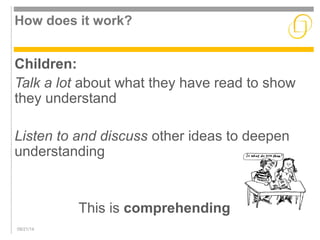
Talk a lot about what they have read to show 
they understand 
Listen to and discuss other ideas to deepen 
understanding 
09/21/14 
This is comprehending
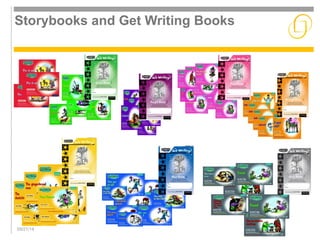
Storybooks and Get Writing Books 
09/21/14
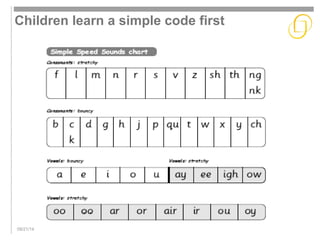
Children learn a simple code first 
09/21/14
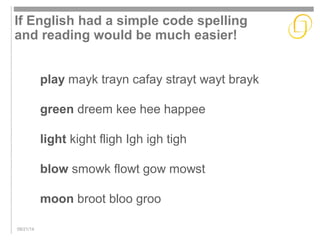
If English had a simple code spelling 
and reading would be much easier! 
09/21/14 
play mayk trayn cafay strayt wayt brayk 
green dreem kee hee happee 
light kight fligh Igh igh tigh 
blow smowk flowt gow mowst 
moon broot bloo groo
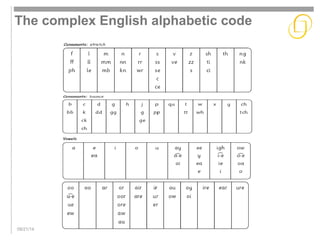
The complex English alphabetic code 
09/21/14
f l m n r s v z sh th ng 
nk 
ff 
ph 
ll 
le 
mm 
mb 
nn 
kn 
rr 
wr 
ss 
se 
c 
ce 
ve zz 
s 
ti 
ci 
b c 
k 
d g h j p qu t w x y ch 
bb ck 
ch 
dd gg g 
ge 
dge 
pp tt wh tch 
a e i o u ay ee igh ow 
ea a_e 
ai 
y 
ea 
e 
i_e 
ie 
i 
o_e 
oa 
o 
oo oo ar or air ir ou oy ire ear ure 
u_e 
ue 
ew 
oor 
ore 
aw 
au 
are ur 
er 
ow oi
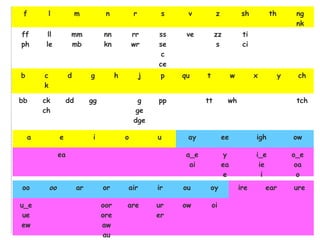
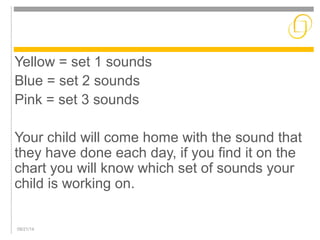
Yellow = set 1 sounds 
Blue = set 2 sounds 
Pink = set 3 sounds 
Your child will come home with the sound that 
they have done each day, if you find it on the 
chart you will know which set of sounds your 
child is working on. 
09/21/14
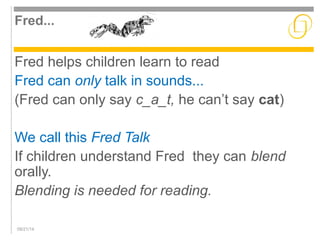
Fred... 
Fred helps children learn to read 
Fred can only talk in sounds... 
(Fred can only say c_a_t, he can’t say cat) 
We call this Fred Talk 
If children understand Fred they can blend 
orally. 
Blending is needed for reading. 
09/21/14
Fred... 
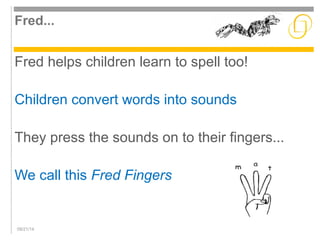
Fred helps children learn to spell too! 
Children convert words into sounds 
They press the sounds on to their fingers... 
We call this Fred Fingers 
09/21/14
Read Write Inc - Biggest changes you 
will notice. 
• Stage not age – children are grouped 
based on their reading level, on-going 
assessments help identify children who 
are making speedy progress and 
children who may need one to one 
tuition.
Home reading books – for children on 
the RWInc programme. 
- RWInc book – this is the book that your child has worked on 
in lessons and is sent home approximately every third day 
or every fifth day. They should know this book inside out! It 
should not be difficult, it should be effortless as it is at their 
reading level. It is your child’s opportunity to review their 
sounds and to build confidence. 
-Guided choice: a book your child has chosen. They may need 
your help with this book as it may not be at their level. Great 
opportunity to read together, to model reading and enrich 
vocabulary. 
21/09/14 Copyright Ruth Miskin Training 15
Home readers 
Group A children will only get a guided choice 
book as they are not ready for the RWInc 
books yet. (If you wish to know which group 
your child is in please ask their class 
teacher). 
Group B & C children will be sent home with a 
‘Red Ditty’ either in a paper book format or a 
photocopied sheet. 
Your child’s class teacher can tell you which 
group your child is in. 
21/09/14 Copyright Ruth Miskin Training 16
For children on the RWInc programme 
• Spellings – will not be sent home for chdn in 
the programme as children are tested within 
the RWInc lessons. Some children may be 
sent home ‘red words’. 
• Attendance is vital due to the speed of the 
programme. 
21/09/14 Copyright Ruth Miskin Training 17
How can you help your child? 
By using pure sounds, no ‘ugh’ (Youtube – 
Read Write Inc – pure sounds) 
http://www.youtube.com/watch?v=5J2Ddf_0Om8 
Knowing the graphemes (letters ‘ng’ ‘igh’)
And... 
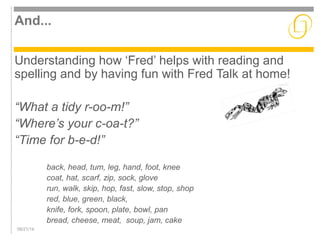
Understanding how ‘Fred’ helps with reading and 
spelling and by having fun with Fred Talk at home! 
“What a tidy r-oo-m!” 
“Where’s your c-oa-t?” 
“Time for b-e-d!” 
back, head, tum, leg, hand, foot, knee 
coat, hat, scarf, zip, sock, glove 
run, walk, skip, hop, fast, slow, stop, shop 
red, blue, green, black, 
knife, fork, spoon, plate, bowl, pan 
bread, cheese, meat, soup, jam, cake 
09/21/14
And... 
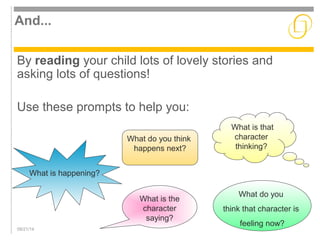
By reading your child lots of lovely stories and 
asking lots of questions! 
Use these prompts to help you: 
09/21/14 
What is that 
character 
thinking? 
What is the 
character 
saying? 
What do you 
think that character is 
feeling now? 
What is happening? 
What do you think 
happens next?
And... 
By talking to your child as much as possible and 
‘feeding’ them new and different words: 
“Let’s eat our lunch now.” 
“Let’s munch our lunch now.” 
“Let’s scoff our lunch now.” 
“Let’s devour our lunch now!” 
By enriching conversations through description: 
“Look at that rain. It looks like little diamonds 
sparkling on the window pane!”
And... 
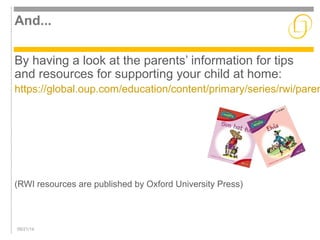
By having a look at the parents’ information for tips 
and resources for supporting your child at home: 
https://global.oup.com/education/content/primary/series/rwi/parents/ 
(RWI resources are published by Oxford University Press) 
09/21/14
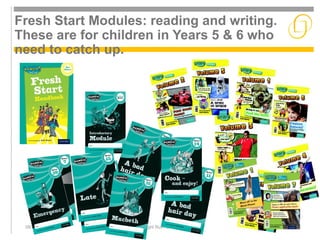
Fresh Start Modules: reading and writing. 
These are for children in Years 5 & 6 who 
need to catch up. 
09/21/14 Copyright Ruth Miskin Literacy
Thank you... 
09/21/14 
Happy reading!

Rwinc presentation

  • 1.
    Read Write IncPhonics Parents’ meeting 16.01.14 Please turn off your mobile phone 21/09/14 Copyright Ruth Miskin Training 1
  • 2.
    Why Read WriteInc. Phonics? A rapid learn to read programme so children read to learn for the rest of their lives. Tried and tested over many years Systematic and structured Early success in reading Training 09/21/14 and ongoing staff development
  • 3.
    Who is itfor? Early years and KS1 (Four-year-olds plus) Older children who need to ‘catch-up’ (stage not age). Therefore certain children in KS2. Children new to English SEN children 16.01.14
  • 4.
    How does itwork? Children: Learn 44 sounds and matching letters Learn to blend sounds to read words Read lots of specially written books 09/21/14 This is decoding
  • 5.
    How does itwork? Children: Talk a lot about what they have read to show they understand Listen to and discuss other ideas to deepen understanding 09/21/14 This is comprehending
  • 6.
    Storybooks and GetWriting Books 09/21/14
  • 7.
    Children learn asimple code first 09/21/14
  • 8.
    If English hada simple code spelling and reading would be much easier! 09/21/14 play mayk trayn cafay strayt wayt brayk green dreem kee hee happee light kight fligh Igh igh tigh blow smowk flowt gow mowst moon broot bloo groo
  • 9.
    The complex Englishalphabetic code 09/21/14
  • 10.
    f l mn r s v z sh th ng nk ff ph ll le mm mb nn kn rr wr ss se c ce ve zz s ti ci b c k d g h j p qu t w x y ch bb ck ch dd gg g ge dge pp tt wh tch a e i o u ay ee igh ow ea a_e ai y ea e i_e ie i o_e oa o oo oo ar or air ir ou oy ire ear ure u_e ue ew oor ore aw au are ur er ow oi
  • 11.
    Yellow = set1 sounds Blue = set 2 sounds Pink = set 3 sounds Your child will come home with the sound that they have done each day, if you find it on the chart you will know which set of sounds your child is working on. 09/21/14
  • 12.
    Fred... Fred helpschildren learn to read Fred can only talk in sounds... (Fred can only say c_a_t, he can’t say cat) We call this Fred Talk If children understand Fred they can blend orally. Blending is needed for reading. 09/21/14
  • 13.
    Fred... Fred helpschildren learn to spell too! Children convert words into sounds They press the sounds on to their fingers... We call this Fred Fingers 09/21/14
  • 14.
    Read Write Inc- Biggest changes you will notice. • Stage not age – children are grouped based on their reading level, on-going assessments help identify children who are making speedy progress and children who may need one to one tuition.
  • 15.
    Home reading books– for children on the RWInc programme. - RWInc book – this is the book that your child has worked on in lessons and is sent home approximately every third day or every fifth day. They should know this book inside out! It should not be difficult, it should be effortless as it is at their reading level. It is your child’s opportunity to review their sounds and to build confidence. -Guided choice: a book your child has chosen. They may need your help with this book as it may not be at their level. Great opportunity to read together, to model reading and enrich vocabulary. 21/09/14 Copyright Ruth Miskin Training 15
  • 16.
    Home readers GroupA children will only get a guided choice book as they are not ready for the RWInc books yet. (If you wish to know which group your child is in please ask their class teacher). Group B & C children will be sent home with a ‘Red Ditty’ either in a paper book format or a photocopied sheet. Your child’s class teacher can tell you which group your child is in. 21/09/14 Copyright Ruth Miskin Training 16
  • 17.
    For children onthe RWInc programme • Spellings – will not be sent home for chdn in the programme as children are tested within the RWInc lessons. Some children may be sent home ‘red words’. • Attendance is vital due to the speed of the programme. 21/09/14 Copyright Ruth Miskin Training 17
  • 18.
    How can youhelp your child? By using pure sounds, no ‘ugh’ (Youtube – Read Write Inc – pure sounds) http://www.youtube.com/watch?v=5J2Ddf_0Om8 Knowing the graphemes (letters ‘ng’ ‘igh’)
  • 19.
    And... Understanding how‘Fred’ helps with reading and spelling and by having fun with Fred Talk at home! “What a tidy r-oo-m!” “Where’s your c-oa-t?” “Time for b-e-d!” back, head, tum, leg, hand, foot, knee coat, hat, scarf, zip, sock, glove run, walk, skip, hop, fast, slow, stop, shop red, blue, green, black, knife, fork, spoon, plate, bowl, pan bread, cheese, meat, soup, jam, cake 09/21/14
  • 20.
    And... By readingyour child lots of lovely stories and asking lots of questions! Use these prompts to help you: 09/21/14 What is that character thinking? What is the character saying? What do you think that character is feeling now? What is happening? What do you think happens next?
  • 21.
    And... By talkingto your child as much as possible and ‘feeding’ them new and different words: “Let’s eat our lunch now.” “Let’s munch our lunch now.” “Let’s scoff our lunch now.” “Let’s devour our lunch now!” By enriching conversations through description: “Look at that rain. It looks like little diamonds sparkling on the window pane!”
  • 22.
    And... By havinga look at the parents’ information for tips and resources for supporting your child at home: https://global.oup.com/education/content/primary/series/rwi/parents/ (RWI resources are published by Oxford University Press) 09/21/14
  • 23.
    Fresh Start Modules:reading and writing. These are for children in Years 5 & 6 who need to catch up. 09/21/14 Copyright Ruth Miskin Literacy
  • 24.
    Thank you... 09/21/14 Happy reading!

Editor's Notes

  • #2 At St Wilfs we have always taught chdn how to read through Phonics. However each teacher has taught this in their own particular way, following a programme of their choice. We have decided that in order to push reading standards even higher we want a whole school approach, so all teachers are teaching sounds in the same way which will aid transition. Also our school is getting bigger so even more reason for us all to be doing the same thing so our chdn have consistency. We have chosen Read Write Inc because:
  • #3 is rooted in synthetic phonics. has been tried and tested over and over again is systematic, structured and therefore results in rapid teaching and learning of sounds & blending means that, importantly and simply, when children know these sounds well and they can blend, they read books that are carefully matched to the sounds they know. Which means that children are successful from the very beginning! gave all staff 2 whole days intensive training to teach the programme Quote from Ruth: “When children can’t read there is low self esteem. We want them to be reading with confidence, to be able to read quite sophisticated texts at an early age.” Ruth Miskin – former headteacher and creator of Read Write Inc Phonics
  • #4 In using Read Write Inc. we will ensure two things: That new children who come to our school read fluently by the age of 7. It also catches those children who have already slipped through the net; those who are struggling. Read Write Inc. teaches all these children to read. EAL, SEN, dyslexic children also learn on this programme. Teaching and learning focuses on what children already know and what they need to learn next in order to make best possible progress - by stage not age. Read Write Inc. lasts two years for most children, if they start to learn to read in the Reception class. There are some children with learning difficulties who spend longer on the programme.
  • #5 Hold up some Set 1, 2 & 3 cards (including digraphs such as sh, ch, igh, ay, ai) as you say the 1st & 2nd point but don’t explain further yet! Hold up some RWI storybooks as you say the 3rd point but don’t explain further yet
  • #6 Explain that Speaking & Listening elements of literacy are built in to RWI from the very beginning through lots of talking and partner work. We teach them to understand everything they read.
  • #7 Every day, your child will read and write the words that contain the sounds and graphemes they have learned so far, using lively, fun, phonic storybooks and a Get Writing book. Hold up some Storybooks and Get Writing Books. There are lots of non-fiction books as well! Show a few. Children use their sound knowledge and comprehension knowledge to write in a variety of formats.
  • #8 Explain that this chart shows just one grapheme per sound. We divide them into set 1 and set 2 and we systematically teach set 1 and blending and then set 2. Then we go on to the full chart which includes set 3. Don’t go into detail – say this is just to explain the basics. Quickly ‘show-off’ by whizzing through the chart in pure sounds! Explain we use pure sounds (‘m’ not’ muh’, ’s’ not ‘suh’, etc.) so that your child will be able to blend the sounds into words more easily. Say that in school we use a puppet called Fred who can do this beautifully! We call talking like this Fred Talk. Hold up a Fred!
  • #9 If English had a simple code spelling and reading would be much easier!! Have a quick read for fun. But of course, it’s not like this!!
  • #10 This chart shows the most usual graphemes for the 44 sounds. Explain that each box is a sound box showing different ways to read and write the sound. Demo with the or sound box with examples of words such as or, morning, door, more, dawn, author. As they learn the sounds and graphemes, we will teach your child to blend by hearing the words in Fred Talk 1st. Once they know the graphemes they can sound-blend/Fred Talk to read words.
  • #11 Explain again the sound boxes and say this chart show the many different graphemes for the same sounds! No other language has as many to learn! Pink graphemes are Set 3 – explain they only learn these once they know all of Set 1 & 2 effortlessly – systematic and structured! Explain that in English we have more than 150 ways to represent the 44 sounds using our 26 alphabet letters so groups of letters are used as well as single letters – these are called graphemes. Explain that we will teach the 100 most commonly used graphemes for the 44 sounds. But we will teach them systematically and very thoroughly.
  • #13 Hold up Fred! Say you too can have a Fred at home – use one like this or any stuffed toy. Use My Turn Your Turn with the parents to have a go at some Fred Talk – you Fred Talk a CVC word d_o_g, they Fred Talk it back & ask them to tell you what word Fred is trying to say. Do a few words – sh_o_p, d_ay, s_p_l_a_sh etc. This is oral blending. Say that once your child knows the graphemes for each sound, they can use Fred Talk for reading any word – write one of the words on a board and Fred Talk then say whole word – point to each grapheme as you Fred Talk it.
  • #14 Show how to use fingers to spell some of the words you have just blended. Use My Turn Your Turn with the parents – say “show me three fingers – the word is dog.” (or shop or wish or any 3 sound word) “Now put your sounds on your fingers!” This is the reversibility principle of decoding for reading and encoding for writing.
  • #19 First of all, you can help your child if you know how to pronounce the 44 sounds perfectly and understand the blending process. There are lots of other ways but 1st let’s look at the 44 sounds, then the ways we read and write those sounds and then meet Fred!
  • #20 Give a couple of examples e.g. Where is your c_oa_t? Time for b_e_d! Make sure your child can tell you what the word is. Use only single syllable words (no Fred Talking multi-syllabic words) and only the last word in a sentence or it gets very silly! E.g. P_u_t o_n y_our b_l_ue c_oa_t (you’ll never get out!).
  • #21 Reading to your child lots of lovely stories that are at a higher level than your child can read yet. School might want to make these discussion prompts on card, laminate them and send them home in book bags? What is happening in this part of the story?
  • #22 Explain that a rich vocabulary is essential for high levels of comprehension. The more words your child has in his/her head when they come to school, the quicker they will understand when they read, e.g. “Wow that’s a big dog!” “Wow that’s an enormous dog!” “Wow that’s a massive dog!” “You’re looking pleased… not just pleased but delighted!” (thrilled/ecstatic/euphoric! Etc) Then the quicker their understanding (comprehension) when they learn to read (decode) the words.
  • #23 Hold up an example of these resources. You could also explain about One-to-one Tutoring. If you have the One-to-one Tutoring kit in school you could show this. Explain that this is designed to help slowest progress readers make accelerated progress by working on a 1:1 with an adult for 10 - 20 mins a day. There is a handbook in the One-to-one Tutoring box to guide the adult and Ruth Miskin Literacy provide training in this as well. This one day training is open to anyone - parents and carers as well as schools, either at central training venues or school based; see the RML website for details.
  • #24 Optional slide showing Fresh Start resources for older pupils (Y5 onwards) who need to catch up quickly. Same process but reading material more tailored towards older chdn.