@BreathingCity breathingcity.org
contact@breathingcity.org
Enabling resilient indoor environments – learning from a
pandemic
Professor Cath Noakes OBE, FREng, CEng, FIMechE, FIHEEM
School of Civil Engineering, University of Leeds
Honorary Fellow, IAQM
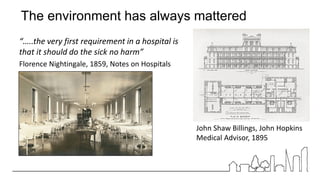
The environment has always mattered
“…..the very first requirement in a hospital is
that it should do the sick no harm”
Florence Nightingale, 1859, Notes on Hospitals
John Shaw Billings, John Hopkins
Medical Advisor, 1895
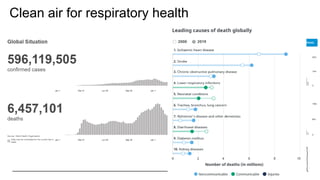
Clean air for respiratory health
Growing IAQ focus pre-pandemic
SPF Clean Air Networks
Back in January 2020…
Factors
Constraints
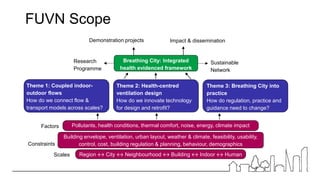
Theme 1: Coupled indoor-
outdoor flows
How do we connect flow &
transport models across scales?
Theme 2: Health-centred
ventilation design
How do we innovate technology
for design and retrofit?
Theme 3: Breathing City into
practice
How do regulation, practice and
guidance need to change?
Breathing City: Integrated
health evidenced framework
Research
Programme
Sustainable
Network
Building envelope, ventilation, urban layout, weather & climate, feasibility, usability,
control, cost, building regulation & planning, behaviour, demographics
Pollutants, health conditions, thermal comfort, noise, energy, climate impact
Region ↔ City ↔ Neighbourhood ↔ Building ↔ Indoor ↔ Human
Scales
Demonstration projects Impact & dissemination
FUVN Scope
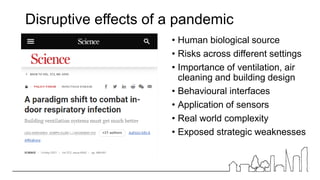
Disruptive effects of a pandemic
• Human biological source
• Risks across different settings
• Importance of ventilation, air
cleaning and building design
• Behavioural interfaces
• Application of sensors
• Real world complexity
• Exposed strategic weaknesses
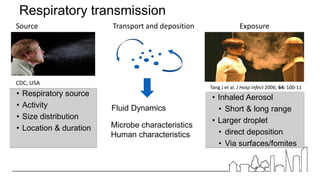
Respiratory transmission
Source Transport and deposition Exposure
Microbe characteristics
Human characteristics
CDC, USA
• Respiratory source
• Activity
• Size distribution
• Location & duration
• Inhaled Aerosol
• Short & long range
• Larger droplet
• direct deposition
• Via surfaces/fomites
Tang J et al. J Hosp Infect 2006; 64: 100-11
Fluid Dynamics
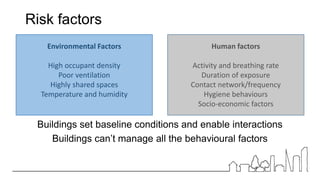
Risk factors
Buildings set baseline conditions and enable interactions
Buildings can’t manage all the behavioural factors
Environmental Factors
High occupant density
Poor ventilation
Highly shared spaces
Temperature and humidity
Human factors
Activity and breathing rate
Duration of exposure
Contact network/frequency
Hygiene behaviours
Socio-economic factors
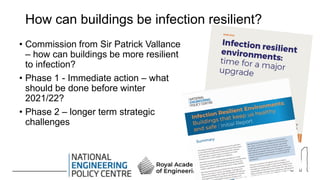
• Commission from Sir Patrick Vallance
– how can buildings be more resilient
to infection?
• Phase 1 - Immediate action – what
should be done before winter
2021/22?
• Phase 2 – longer term strategic
challenges
How can buildings be infection resilient?
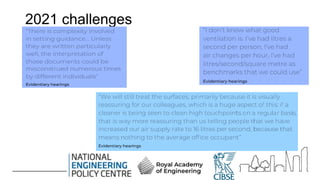
2021 challenges
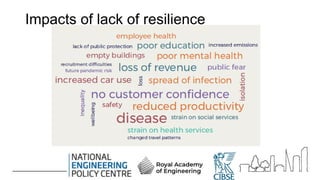
Impacts of lack of resilience
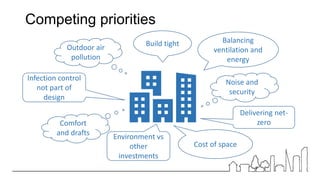
Competing priorities
Balancing
ventilation and
energy
Outdoor air
pollution
Infection control
not part of
design
Build tight
Noise and
security
Comfort
and drafts
Cost of space
Environment vs
other
investments
Delivering net-
zero
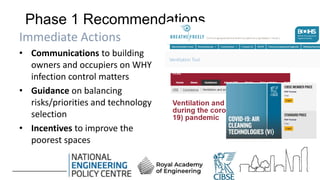
Phase 1 Recommendations
Immediate Actions
• Communications to building
owners and occupiers on WHY
infection control matters
• Guidance on balancing
risks/priorities and technology
selection
• Incentives to improve the
poorest spaces
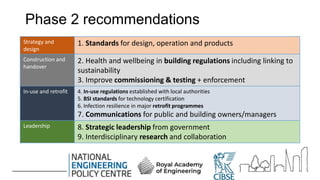
Phase 2 recommendations
Strategy and
design
1. Standards for design, operation and products
Construction and
handover
2. Health and wellbeing in building regulations including linking to
sustainability
3. Improve commissioning & testing + enforcement
In-use and retrofit 4. In-use regulations established with local authorities
5. BSI standards for technology certification
6. Infection resilience in major retrofit programmes
7. Communications for public and building owners/managers
Leadership 8. Strategic leadership from government
9. Interdisciplinary research and collaboration
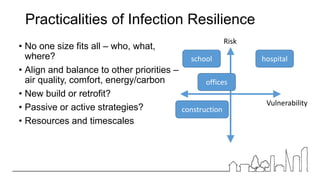
Practicalities of Infection Resilience
• No one size fits all – who, what,
where?
• Align and balance to other priorities –
air quality, comfort, energy/carbon
• New build or retrofit?
• Passive or active strategies?
• Resources and timescales
Risk
Vulnerability
hospital
school
offices
construction
Ventilation and exposure?
Jones et al (2021) Building
and Environment
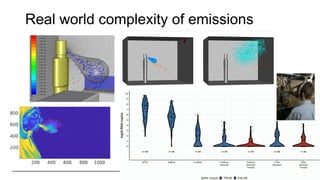
Real world complexity of emissions
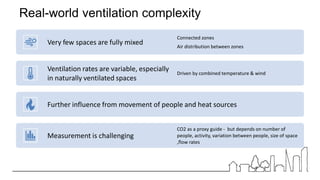
Real-world ventilation complexity
Very few spaces are fully mixed
Connected zones
Air distribution between zones
Ventilation rates are variable, especially
in naturally ventilated spaces
Driven by combined temperature & wind
Further influence from movement of people and heat sources
Measurement is challenging
CO2 as a proxy guide - but depends on number of
people, activity, variation between people, size of space
,flow rates
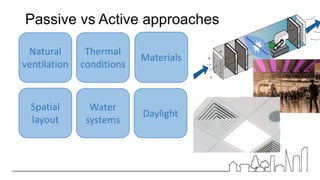
Passive vs Active approaches
Natural
ventilation
Thermal
conditions
Materials
Spatial
layout
Water
systems
Daylight
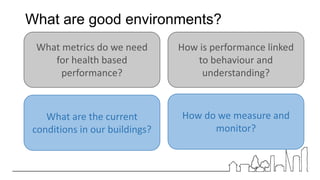
What are good environments?
What metrics do we need
for health based
performance?
How is performance linked
to behaviour and
understanding?
What are the current
conditions in our buildings?
How do we measure and
monitor?
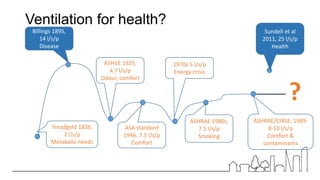
Ventilation for health?
Treadgold 1836,
2 l/s/p
Metabolic needs
Billings 1895,
14 l/s/p
Disease
ASHVE 1925,
4.7 l/s/p
Odour, comfort
ASA standard
1946, 7.5 l/s/p
Comfort
1970s 5 l/s/p
Energy crisis
ASHRAE 1980s,
7.5 l/s/p
Smoking
ASHRAE/CIBSE, 1989-
8-10 l/s/p
Comfort &
contaminants
?
Sundell et al
2011, 25 l/s/p
Health
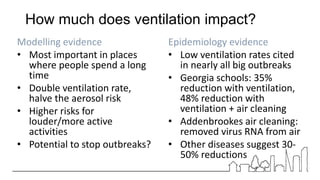
How much does ventilation impact?
Epidemiology evidence
• Low ventilation rates cited
in nearly all big outbreaks
• Georgia schools: 35%
reduction with ventilation,
48% reduction with
ventilation + air cleaning
• Addenbrookes air cleaning:
removed virus RNA from air
• Other diseases suggest 30-
50% reductions
Modelling evidence
• Most important in places
where people spend a long
time
• Double ventilation rate,
halve the aerosol risk
• Higher risks for
louder/more active
activities
• Potential to stop outbreaks?
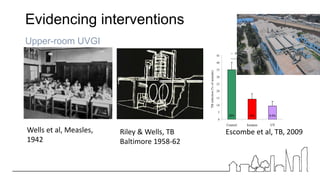
Evidencing interventions
Upper-room UVGI
Riley & Wells, TB
Baltimore 1958-62
Wells et al, Measles,
1942
35% 14% 9.5%
0
5
10
15
20
25
30
35
40
45
Control Ionizers UV
TB
infection
(%
of
animals)
p<0.0001
p<0.0001
p=0.07
35% 14% 9.5%
0
5
10
15
20
25
30
35
40
45
Control Ionizers UV
TB
infection
(%
of
animals)
p<0.0001
p<0.0001
p=0.07
Escombe et al, TB, 2009
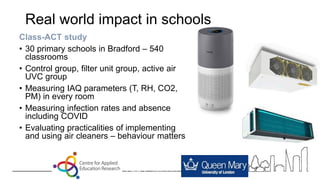
Real world impact in schools
Class-ACT study
• 30 primary schools in Bradford – 540
classrooms
• Control group, filter unit group, active air
UVC group
• Measuring IAQ parameters (T, RH, CO2,
PM) in every room
• Measuring infection rates and absence
including COVID
• Evaluating practicalities of implementing
and using air cleaners – behaviour matters
Cost effectiveness
Yellow – Cost Benefit Ratio > 1.5
Enabling impact
• Policy dreams – simple
messages and magic bullets
• Evidence – Complex, emerging
and uncertain
• Overturning embedded beliefs
• Impacts of decisions
• Translating science
• Communications
#HandsFaceSpaceFreshAir
A paradigm shift
• Focus on human centred design
• Holistic approach to indoors & outdoors
• Recognise the complexity – this is not easy
• Recognise the behaviour-technology link
• Driving the economic and societal case for better
buildings
• Embed in policy, design, training and education to build
capability and capacity
Acknowledgements
• Leeds academic colleagues, postdocs, PhD students,
technicians
• SAGE and SAGE EMG
• Research project teams: TRACK, PROTECT, HECOIRA, Far
UV, Class ACT, FUVN
• Royal Academy of Engineering, CIBSE, IMechE
• Group of 36, ISIAQ
• Funders: EPSRC, DHSC, HM government, NHS Scotland
There are no magic bullets…..
Thank you
C.J.Noakes@leeds.ac.uk
@CathNoakes

Cath Noakes.pdf

  • 1.
    @BreathingCity breathingcity.org contact@breathingcity.org Enabling resilientindoor environments – learning from a pandemic Professor Cath Noakes OBE, FREng, CEng, FIMechE, FIHEEM School of Civil Engineering, University of Leeds Honorary Fellow, IAQM
  • 2.
    The environment hasalways mattered “…..the very first requirement in a hospital is that it should do the sick no harm” Florence Nightingale, 1859, Notes on Hospitals John Shaw Billings, John Hopkins Medical Advisor, 1895
  • 3.
    Clean air forrespiratory health
  • 4.
    Growing IAQ focuspre-pandemic
  • 5.
    SPF Clean AirNetworks Back in January 2020…
  • 6.
    Factors Constraints Theme 1: Coupledindoor- outdoor flows How do we connect flow & transport models across scales? Theme 2: Health-centred ventilation design How do we innovate technology for design and retrofit? Theme 3: Breathing City into practice How do regulation, practice and guidance need to change? Breathing City: Integrated health evidenced framework Research Programme Sustainable Network Building envelope, ventilation, urban layout, weather & climate, feasibility, usability, control, cost, building regulation & planning, behaviour, demographics Pollutants, health conditions, thermal comfort, noise, energy, climate impact Region ↔ City ↔ Neighbourhood ↔ Building ↔ Indoor ↔ Human Scales Demonstration projects Impact & dissemination FUVN Scope
  • 7.
    Disruptive effects ofa pandemic • Human biological source • Risks across different settings • Importance of ventilation, air cleaning and building design • Behavioural interfaces • Application of sensors • Real world complexity • Exposed strategic weaknesses
  • 8.
    Respiratory transmission Source Transportand deposition Exposure Microbe characteristics Human characteristics CDC, USA • Respiratory source • Activity • Size distribution • Location & duration • Inhaled Aerosol • Short & long range • Larger droplet • direct deposition • Via surfaces/fomites Tang J et al. J Hosp Infect 2006; 64: 100-11 Fluid Dynamics
  • 9.
    Risk factors Buildings setbaseline conditions and enable interactions Buildings can’t manage all the behavioural factors Environmental Factors High occupant density Poor ventilation Highly shared spaces Temperature and humidity Human factors Activity and breathing rate Duration of exposure Contact network/frequency Hygiene behaviours Socio-economic factors
  • 10.
    • Commission fromSir Patrick Vallance – how can buildings be more resilient to infection? • Phase 1 - Immediate action – what should be done before winter 2021/22? • Phase 2 – longer term strategic challenges How can buildings be infection resilient?
  • 11.
  • 12.
    Impacts of lackof resilience
  • 13.
    Competing priorities Balancing ventilation and energy Outdoorair pollution Infection control not part of design Build tight Noise and security Comfort and drafts Cost of space Environment vs other investments Delivering net- zero
  • 14.
    Phase 1 Recommendations ImmediateActions • Communications to building owners and occupiers on WHY infection control matters • Guidance on balancing risks/priorities and technology selection • Incentives to improve the poorest spaces
  • 15.
    Phase 2 recommendations Strategyand design 1. Standards for design, operation and products Construction and handover 2. Health and wellbeing in building regulations including linking to sustainability 3. Improve commissioning & testing + enforcement In-use and retrofit 4. In-use regulations established with local authorities 5. BSI standards for technology certification 6. Infection resilience in major retrofit programmes 7. Communications for public and building owners/managers Leadership 8. Strategic leadership from government 9. Interdisciplinary research and collaboration
  • 16.
    Practicalities of InfectionResilience • No one size fits all – who, what, where? • Align and balance to other priorities – air quality, comfort, energy/carbon • New build or retrofit? • Passive or active strategies? • Resources and timescales Risk Vulnerability hospital school offices construction
  • 17.
    Ventilation and exposure? Joneset al (2021) Building and Environment
  • 18.
  • 19.
    Real-world ventilation complexity Veryfew spaces are fully mixed Connected zones Air distribution between zones Ventilation rates are variable, especially in naturally ventilated spaces Driven by combined temperature & wind Further influence from movement of people and heat sources Measurement is challenging CO2 as a proxy guide - but depends on number of people, activity, variation between people, size of space ,flow rates
  • 20.
    Passive vs Activeapproaches Natural ventilation Thermal conditions Materials Spatial layout Water systems Daylight
  • 21.
    What are goodenvironments? What metrics do we need for health based performance? How is performance linked to behaviour and understanding? What are the current conditions in our buildings? How do we measure and monitor?
  • 22.
    Ventilation for health? Treadgold1836, 2 l/s/p Metabolic needs Billings 1895, 14 l/s/p Disease ASHVE 1925, 4.7 l/s/p Odour, comfort ASA standard 1946, 7.5 l/s/p Comfort 1970s 5 l/s/p Energy crisis ASHRAE 1980s, 7.5 l/s/p Smoking ASHRAE/CIBSE, 1989- 8-10 l/s/p Comfort & contaminants ? Sundell et al 2011, 25 l/s/p Health
  • 23.
    How much doesventilation impact? Epidemiology evidence • Low ventilation rates cited in nearly all big outbreaks • Georgia schools: 35% reduction with ventilation, 48% reduction with ventilation + air cleaning • Addenbrookes air cleaning: removed virus RNA from air • Other diseases suggest 30- 50% reductions Modelling evidence • Most important in places where people spend a long time • Double ventilation rate, halve the aerosol risk • Higher risks for louder/more active activities • Potential to stop outbreaks?
  • 24.
    Evidencing interventions Upper-room UVGI Riley& Wells, TB Baltimore 1958-62 Wells et al, Measles, 1942 35% 14% 9.5% 0 5 10 15 20 25 30 35 40 45 Control Ionizers UV TB infection (% of animals) p<0.0001 p<0.0001 p=0.07 35% 14% 9.5% 0 5 10 15 20 25 30 35 40 45 Control Ionizers UV TB infection (% of animals) p<0.0001 p<0.0001 p=0.07 Escombe et al, TB, 2009
  • 25.
    Real world impactin schools Class-ACT study • 30 primary schools in Bradford – 540 classrooms • Control group, filter unit group, active air UVC group • Measuring IAQ parameters (T, RH, CO2, PM) in every room • Measuring infection rates and absence including COVID • Evaluating practicalities of implementing and using air cleaners – behaviour matters
  • 26.
    Cost effectiveness Yellow –Cost Benefit Ratio > 1.5
  • 27.
    Enabling impact • Policydreams – simple messages and magic bullets • Evidence – Complex, emerging and uncertain • Overturning embedded beliefs • Impacts of decisions • Translating science • Communications #HandsFaceSpaceFreshAir
  • 28.
    A paradigm shift •Focus on human centred design • Holistic approach to indoors & outdoors • Recognise the complexity – this is not easy • Recognise the behaviour-technology link • Driving the economic and societal case for better buildings • Embed in policy, design, training and education to build capability and capacity
  • 29.
    Acknowledgements • Leeds academiccolleagues, postdocs, PhD students, technicians • SAGE and SAGE EMG • Research project teams: TRACK, PROTECT, HECOIRA, Far UV, Class ACT, FUVN • Royal Academy of Engineering, CIBSE, IMechE • Group of 36, ISIAQ • Funders: EPSRC, DHSC, HM government, NHS Scotland
  • 30.
    There are nomagic bullets….. Thank you C.J.Noakes@leeds.ac.uk @CathNoakes