Reducing Construction
Emissions
Exemplar sites
Construction emissions tool
In partnership with:
Sam Bradley
11th October 2023
Reducing Construction Emissions
Agenda
• Introduce work in partnership with Impact on Urban Health – Exemplar
sites
• Construction Non-Road Mobile Machinery (NRMM) emissions tool
• NRMM emissions tool update and future application
Reducing Construction Emissions
Partnership with Impact on Urban Health: Introduction
Exemplar construction sites for air quality - Impact on Urban Health
Reducing Construction Emissions
Partnership with Impact on Urban Health: Consultation and engagement
Research feasibility and barriers
of options/measures:
• Literature review (e.g. papers,
case studies)
• Stakeholder engagement
High
• Plan for zero emissions:
• Plan sites to allow for diesel free construction
Medium
• Use low/ zero emissions equipment:
• Select low/ zero emission alternatives (alternative
fuel and exhaust abatement technology)
Low
• Reduce emissions:
• Select more stringent EU Stage compliant
equipment
• Reduce equipment usage
Reducing Construction Emissions
Partnership with Impact on Urban Health: Knowledge acquired
Considerations
• Emission impact = achievable
reduction
• Cost = money/time. Capital and
operational
• Market = readiness and
availability
• Recommendations need to be
site-specific
Reducing Construction Emissions
Partnership with Impact on Urban Health: Exemplar Sites
Our approach:
• Involvement at procurement stage
– Input into environmental Contract
Clauses and Tender Questions
– Site-specific evidence pack
– Assess answers to tender questions
• Inception of the construction NRMM
emissions tool
Tustin estate
Reducing Construction Emissions
Partnership with Impact on Urban Health: Inception of NRMM emissions tool
Original application:
• Calculate and evidence reductions
• Monitor progress towards targets
Requirements of the tool:
• Accessible and user friendly
• Calculate emission comparisons
• Provide insights
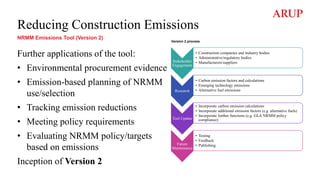
Stakeholder
Engagement
• Construction companies and industry bodies
• Administrative/regulatory bodies
• Manufacturers/suppliers
Research
• Carbon emission factors and calculations
• Emerging technology emissions
• Alternative fuel emissions
Tool Update
• Incorporate carbon emission calculations
• Incorporate additional emission factors (e.g. alternative fuels)
• Incorporate further functions (e.g. GLA NRMM policy
compliance)
Future
Maintenance
• Testing
• Feedback
• Publishing
Reducing Construction Emissions
NRMM Emissions Tool (Version 2)
Further applications of the tool:
• Environmental procurement evidence
• Emission-based planning of NRMM
use/selection
• Tracking emission reductions
• Meeting policy requirements
• Evaluating NRMM policy/targets
based on emissions
Inception of Version 2
Version 2 process
Reducing Construction Emissions
NRMM Emissions Tool (Version 2): About the tool
Flow of data in the tool
Emission calculation
Emission factors
(EMEP/EEA and
BEIS)
NRMM details
Power rating (kW)
Euro Stage
Equipment type
(variable speed
engine/constant speed
engine)
Estimated hours of use
Alternative fuel
assumptions/emission
factors (manufacturer
sheets, papers)
Reducing Construction Emissions
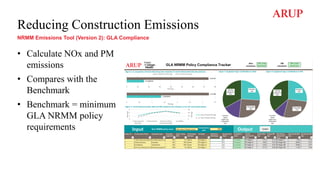
NRMM Emissions Tool (Version 2): GLA Compliance
• Calculate NOx and PM
emissions
• Compares with the
Benchmark
• Benchmark = minimum
GLA NRMM policy
requirements
Reducing Construction Emissions
NRMM Emissions Tool (Version 2): Carbon breakdown
• Calculate CO2e emissions
• Compares with the
Benchmark
• Benchmark = minimum
GLA NRMM policy
requirements
Reducing Construction Emissions
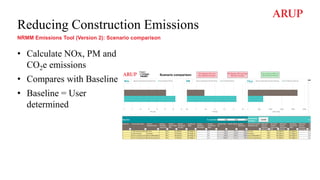
NRMM Emissions Tool (Version 2): Scenario comparison
• Calculate NOx, PM and
CO2e emissions
• Compares with Baseline
• Baseline = User
determined
Reducing Construction Emissions
NRMM Emissions Tool (Version 2): Next steps
• Sharing as widely as possible
• Continue to maintain and update
Current aspirations for updates include:
• Using Real World Emissions data
• More intuitive inputs informed from trends in telemetry data (e.g.
average engine setting/speed, idle times, usage)
Contact
Senior Environmental Consultant, UK Air Quality team
Sam Bradley
Sam.Bradley@arup.com
Reducing Construction Emissions
NRMM Emissions Tool (Version 2): Limitations
• Not all available alternative fuel options (e.g. Hydrogen as combustion
fuel – limited data held on emissions and uncertainty for CO2e)
• EMEP/EEA emissions guidebook methodology – emission standard basis
– Note that this will vary from Real World Emissions – see work from
our friends at Centre for Low Emission Construction (C.D. Desouza et
al. 20201)
1 C.D. Desouza, D.J. Marsh, S.D. Beevers, N. Molden, D.C. Green, Real-world emissions from non-road mobile machinery in London, Atmospheric Environment, Volume 223, 2020, 117301, ISSN 1352-2310,
https://doi.org/10.1016/j.atmosenv.2020.117301.

15.30 Reducing Construction Emissions.pdf

  • 1.
    Reducing Construction Emissions Exemplar sites Constructionemissions tool In partnership with: Sam Bradley 11th October 2023
  • 2.
    Reducing Construction Emissions Agenda •Introduce work in partnership with Impact on Urban Health – Exemplar sites • Construction Non-Road Mobile Machinery (NRMM) emissions tool • NRMM emissions tool update and future application
  • 3.
    Reducing Construction Emissions Partnershipwith Impact on Urban Health: Introduction Exemplar construction sites for air quality - Impact on Urban Health
  • 4.
    Reducing Construction Emissions Partnershipwith Impact on Urban Health: Consultation and engagement Research feasibility and barriers of options/measures: • Literature review (e.g. papers, case studies) • Stakeholder engagement
  • 5.
    High • Plan forzero emissions: • Plan sites to allow for diesel free construction Medium • Use low/ zero emissions equipment: • Select low/ zero emission alternatives (alternative fuel and exhaust abatement technology) Low • Reduce emissions: • Select more stringent EU Stage compliant equipment • Reduce equipment usage Reducing Construction Emissions Partnership with Impact on Urban Health: Knowledge acquired Considerations • Emission impact = achievable reduction • Cost = money/time. Capital and operational • Market = readiness and availability • Recommendations need to be site-specific
  • 6.
    Reducing Construction Emissions Partnershipwith Impact on Urban Health: Exemplar Sites Our approach: • Involvement at procurement stage – Input into environmental Contract Clauses and Tender Questions – Site-specific evidence pack – Assess answers to tender questions • Inception of the construction NRMM emissions tool Tustin estate
  • 7.
    Reducing Construction Emissions Partnershipwith Impact on Urban Health: Inception of NRMM emissions tool Original application: • Calculate and evidence reductions • Monitor progress towards targets Requirements of the tool: • Accessible and user friendly • Calculate emission comparisons • Provide insights
  • 8.
    Stakeholder Engagement • Construction companiesand industry bodies • Administrative/regulatory bodies • Manufacturers/suppliers Research • Carbon emission factors and calculations • Emerging technology emissions • Alternative fuel emissions Tool Update • Incorporate carbon emission calculations • Incorporate additional emission factors (e.g. alternative fuels) • Incorporate further functions (e.g. GLA NRMM policy compliance) Future Maintenance • Testing • Feedback • Publishing Reducing Construction Emissions NRMM Emissions Tool (Version 2) Further applications of the tool: • Environmental procurement evidence • Emission-based planning of NRMM use/selection • Tracking emission reductions • Meeting policy requirements • Evaluating NRMM policy/targets based on emissions Inception of Version 2 Version 2 process
  • 9.
    Reducing Construction Emissions NRMMEmissions Tool (Version 2): About the tool Flow of data in the tool Emission calculation Emission factors (EMEP/EEA and BEIS) NRMM details Power rating (kW) Euro Stage Equipment type (variable speed engine/constant speed engine) Estimated hours of use Alternative fuel assumptions/emission factors (manufacturer sheets, papers)
  • 10.
    Reducing Construction Emissions NRMMEmissions Tool (Version 2): GLA Compliance • Calculate NOx and PM emissions • Compares with the Benchmark • Benchmark = minimum GLA NRMM policy requirements
  • 11.
    Reducing Construction Emissions NRMMEmissions Tool (Version 2): Carbon breakdown • Calculate CO2e emissions • Compares with the Benchmark • Benchmark = minimum GLA NRMM policy requirements
  • 12.
    Reducing Construction Emissions NRMMEmissions Tool (Version 2): Scenario comparison • Calculate NOx, PM and CO2e emissions • Compares with Baseline • Baseline = User determined
  • 13.
    Reducing Construction Emissions NRMMEmissions Tool (Version 2): Next steps • Sharing as widely as possible • Continue to maintain and update Current aspirations for updates include: • Using Real World Emissions data • More intuitive inputs informed from trends in telemetry data (e.g. average engine setting/speed, idle times, usage)
  • 14.
    Contact Senior Environmental Consultant,UK Air Quality team Sam Bradley Sam.Bradley@arup.com
  • 16.
    Reducing Construction Emissions NRMMEmissions Tool (Version 2): Limitations • Not all available alternative fuel options (e.g. Hydrogen as combustion fuel – limited data held on emissions and uncertainty for CO2e) • EMEP/EEA emissions guidebook methodology – emission standard basis – Note that this will vary from Real World Emissions – see work from our friends at Centre for Low Emission Construction (C.D. Desouza et al. 20201) 1 C.D. Desouza, D.J. Marsh, S.D. Beevers, N. Molden, D.C. Green, Real-world emissions from non-road mobile machinery in London, Atmospheric Environment, Volume 223, 2020, 117301, ISSN 1352-2310, https://doi.org/10.1016/j.atmosenv.2020.117301.