
Welcome to our Bible Study
18th Sunday in Ordinary Time
3 August 2014
In preparation for this Sunday’s Liturgy
In aid of focusing our homilies and sharing
Prepared by Fr. Cielo R. Almazan, OFM
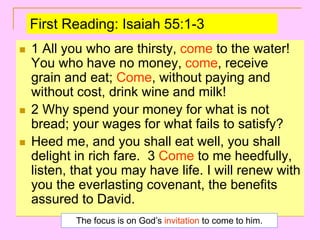
 1 All you who are thirsty, come to the water!
You who have no money, come, receive
grain and eat; Come, without paying and
without cost, drink wine and milk!
 2 Why spend your money for what is not
bread; your wages for what fails to satisfy?
 Heed me, and you shall eat well, you shall
delight in rich fare. 3 Come to me heedfully,
listen, that you may have life. I will renew with
you the everlasting covenant, the benefits
assured to David.
First Reading: Isaiah 55:1-3
The focus is on God’s invitation to come to him.
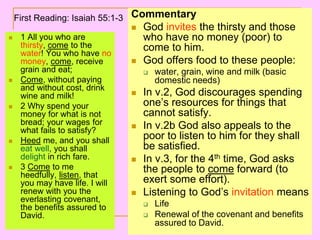
 1 All you who are
thirsty, come to the
water! You who have no
money, come, receive
grain and eat;
 Come, without paying
and without cost, drink
wine and milk!
 2 Why spend your
money for what is not
bread; your wages for
what fails to satisfy?
 Heed me, and you shall
eat well, you shall
delight in rich fare.
 3 Come to me
heedfully, listen, that
you may have life. I will
renew with you the
everlasting covenant,
the benefits assured to
David.
Commentary
 God invites the thirsty and those
who have no money (poor) to
come to him.
 God offers food to these people:
 water, grain, wine and milk (basic
domestic needs)
 In v.2, God discourages spending
one’s resources for things that
cannot satisfy.
 In v.2b God also appeals to the
poor to listen to him for they shall
be satisfied.
 In v.3, for the 4th time, God asks
the people to come forward (to
exert some effort).
 Listening to God’s invitation means
 Life
 Renewal of the covenant and benefits
assured to David.
First Reading: Isaiah 55:1-3
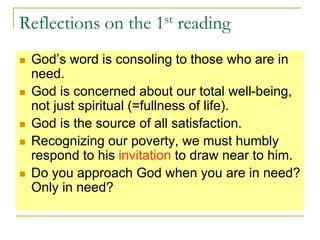
Reflections on the 1st reading
 God’s word is consoling to those who are in
need.
 God is concerned about our total well-being,
not just spiritual (=fullness of life).
 God is the source of all satisfaction.
 Recognizing our poverty, we must humbly
respond to his invitation to draw near to him.
 Do you approach God when you are in need?
Only in need?
Resp. Ps 145:8-9. 15-16. 17-18
 R. (cf. 16) The hand of the Lord feeds us; he answers all our
needs.
8 The LORD is gracious and merciful,
slow to anger and of great kindness.
9 The LORD is good to all
and compassionate toward all his works.
 15 The eyes of all look hopefully to you,
and you give them their food in due season;
16 you open your hand
and satisfy the desire of every living thing.
 17 The LORD is just in all his ways
and holy in all his works.
18 The LORD is near to all who call upon him,
to all who call upon him in truth.
Resp. Ps 145:8-9, 15-16, 17-18
 R. (cf. 16) The hand of the Lord
feeds us; he answers all our needs.

8 The LORD is gracious and merciful,
slow to anger and of great kindness.
9 The LORD is good to all
and compassionate toward all his
works.
 15 The eyes of all look hopefully to
you,
and you give them their food in due
season;
16 you open your hand
and satisfy the desire of every living
thing.
 17 The LORD is just in all his ways
and holy in all his works.
18 The LORD is near to all who call
upon him,
to all who call upon him in truth.
Commentary
 Vv.8-9 mention the
characteristic traits of
God:
 Gracious, merciful, slow to
anger, kind, good to all and
compassionate
 In vv.15-16, the psalmist
says that God provides
food for those who pray
to him. God is generous.
 Vv.17-18 enumerate once
again the characteristic
traits of God:
 Just, holy, near to all
Reflections on the Psalm
 We, Christians, must seek God for our needs.
 In our prayer, we must recognize that he
feeds the poor.
 The poor survives because of God’s
mysterious generosity and love.
 We can also imitate the characteristics of
God, mentioned in the psalm.
 Gracious, just, merciful…
Second Reading: Romans 8:35-39
 35 What will separate us from the love of Christ?
Will anguish, or distress, or persecution, or famine,
or nakedness, or peril, or the sword?
 37 No, in all these things we conquer
overwhelmingly through him who loved us. 38 For I
am convinced that neither death, nor life, nor
angels, nor principalities, nor present things, nor
future things, nor powers, 39 nor height, nor depth,
nor any other creature will be able to separate us
from the love of God in Christ Jesus our Lord.
Second Reading: Romans 8:35-39
 35 What will separate us from the love of Christ?
Will anguish, or distress, or persecution, or famine,
or nakedness, or peril, or the sword?
 37 No, in all these things we conquer
overwhelmingly through him who loved us. 38 For I
am convinced that neither death, nor life, nor
angels, nor principalities, nor present things, nor
future things, nor powers, 39 nor height, nor depth,
nor any other creature will be able to separate us
from the love of God in Christ Jesus our Lord.
The focus is on the “love of Christ”?
Second Reading: Romans 8:35-39
 35 What will separate us from
the love of Christ? Will
anguish, or distress, or
persecution, or famine, or
nakedness, or peril, or the
sword?
 37 No, in all these things we
conquer overwhelmingly
through him who loved us.
38 For I am convinced that
neither death, nor life, nor
angels, nor principalities, nor
present things, nor future
things, nor powers, 39 nor
height, nor depth, nor any
other creature will be able to
separate us from the love of
God in Christ Jesus our Lord.
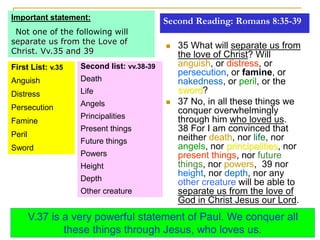
Important statement:
Not one of the following will
separate us from the Love of
Christ. Vv.35 and 39
First List: v.35
Anguish
Distress
Persecution
Famine
Peril
Sword
Second list: vv.38-39
Death
Life
Angels
Principalities
Present things
Future things
Powers
Height
Depth
Other creature
V.37 is a very powerful statement of Paul. We conquer all
these things through Jesus, who loves us.
Reflections on the 2nd reading
 No one can separate us from the love of Christ.
 The love of Christ is invincible, it cannot be defeated
by any hostile element.
 The love of Christ assures the Christian believer of
Christ’s total support in the midst of persecution.
 In all circumstances, we can never be separated
from the love of Christ, if we have it.
 Do you harbor this love of Christ?
Gospel: Matthew 14:13-21
 13 When Jesus heard of it, he withdrew in a boat to a deserted
place by himself. The crowds heard of this and followed him on foot
from their towns. 14 When he disembarked and saw the vast crowd,
his heart was moved with pity for them, and he cured their sick.
 15 When it was evening, the disciples approached him and said,
"This is a deserted place and it is already late; dismiss the crowds
so that they can go to the villages and buy food for themselves." 16
(Jesus) said to them, "There is no need for them to go away; give
them some food yourselves." 17 But they said to him, "Five loaves
and two fish are all we have here." 18 Then he said, "Bring them
here to me," 19 and he ordered the crowds to sit down on the grass.
 Taking the five loaves and the two fish, and looking up to heaven, he
said the blessing, broke the loaves, and gave them to the disciples,
who in turn gave them to the crowds. 20 They all ate and were
satisfied, and they picked up the fragments left over -- twelve wicker
baskets full. 21 Those who ate were about five thousand men, not
counting women and children.
Gospel: Matthew 14:13-21
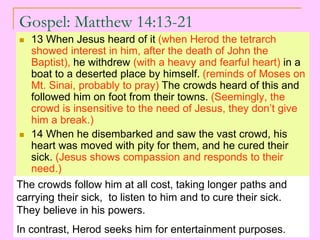
 13 When Jesus heard of it (when Herod the tetrarch
showed interest in him, after the death of John the
Baptist), he withdrew (with a heavy and fearful heart) in a
boat to a deserted place by himself. (reminds of Moses on
Mt. Sinai, probably to pray) The crowds heard of this and
followed him on foot from their towns. (Seemingly, the
crowd is insensitive to the need of Jesus, they don’t give
him a break.)
 14 When he disembarked and saw the vast crowd, his
heart was moved with pity for them, and he cured their
sick. (Jesus shows compassion and responds to their
need.)
The crowds follow him at all cost, taking longer paths and
carrying their sick, to listen to him and to cure their sick.
They believe in his powers.
In contrast, Herod seeks him for entertainment purposes.
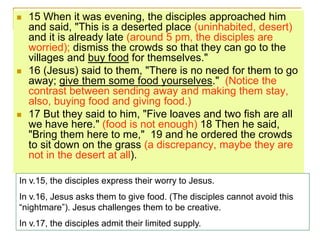
 15 When it was evening, the disciples approached him
and said, "This is a deserted place (uninhabited, desert)
and it is already late (around 5 pm, the disciples are
worried); dismiss the crowds so that they can go to the
villages and buy food for themselves."
 16 (Jesus) said to them, "There is no need for them to go
away; give them some food yourselves." (Notice the
contrast between sending away and making them stay,
also, buying food and giving food.)
 17 But they said to him, "Five loaves and two fish are all
we have here." (food is not enough) 18 Then he said,
"Bring them here to me," 19 and he ordered the crowds
to sit down on the grass (a discrepancy, maybe they are
not in the desert at all).
In v.15, the disciples express their worry to Jesus.
In v.16, Jesus asks them to give food. (The disciples cannot avoid this
“nightmare”). Jesus challenges them to be creative.
In v.17, the disciples admit their limited supply.
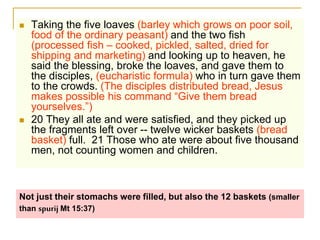
 Taking the five loaves (barley which grows on poor soil,
food of the ordinary peasant) and the two fish
(processed fish – cooked, pickled, salted, dried for
shipping and marketing) and looking up to heaven, he
said the blessing, broke the loaves, and gave them to
the disciples, (eucharistic formula) who in turn gave them
to the crowds. (The disciples distributed bread, Jesus
makes possible his command “Give them bread
yourselves.”)
 20 They all ate and were satisfied, and they picked up
the fragments left over -- twelve wicker baskets (bread
basket) full. 21 Those who ate were about five thousand
men, not counting women and children.
Not just their stomachs were filled, but also the 12 baskets (smaller
than spurij Mt 15:37)
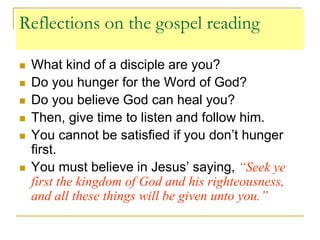
Reflections on the gospel reading
 What kind of a disciple are you?
 Do you hunger for the Word of God?
 Do you believe God can heal you?
 Then, give time to listen and follow him.
 You cannot be satisfied if you don’t hunger
first.
 You must believe in Jesus’ saying, “Seek ye
first the kingdom of God and his righteousness,
and all these things will be given unto you.”
Tying the 3 readings and the Psalm
 1st Reading: “Heed and you shall eat well.”
 The Psalm: “The hand of the Lord feeds..”
 2nd Reading: “Who can separate us… famine?
 Gospel Reading: “They all ate and are satisfied…”
• Based on the readings, the homilist must teach that the
satisfaction of human needs (material and spiritual) comes
from God.
• To be satisfied, we must avail of God’s grace. The person
must go forward to God, must draw close to him; must
believe in the love of God (Christ), must listen to the words
of the compassionate God.
We, the Christian disciples, must also make “food” available
to the hungry and thirsty.
How to develop your homily/sharing
 Are you spiritually hungry? Do you
experience spiritual dryness?
 What do you do to make your life
meaningful?
 Other formulation:
 What do you do to attain “fullness of life?”
 The readings help us discern how to make
our lives worth living.
 The first reading invites us to approach God
for our needs.
 God will certainly satisfy our needs.
 God promises us life, when we approach him.
 We have to help ourselves.
 Help is not given to us on a silver platter.
 We have to move forward to the Giver.
 There is no meaning on waiting endlessly for
help to come, yet, doing nothing.
 The second reading teaches us to possess
God’s love.
 For, once we have the love of Christ, nothing
will separate us from it.
 Christ’s love is invincible. It cannot be defeated
by any hostile element.
 Even if we are undergoing material hunger
(famine) and we are under threat, the love of
God will always be there.
 Even sufferings will have meaning.
 The gospel suggests for us to follow Jesus.
 There is satisfaction in listening to the Word
of God.
 There is no hunger for those who stay close
to him.
 In Jesus, there is spiritual and material
satisfaction.
 Wasting time with the Lord has meaning.
 The eucharist is a sacrament that satisfies our
hungry souls.
 The eucharist is intended for those who recognize
their poverty and are seeking deeper relationship
with God.
 The eucharist is not for those who make other
people hungry and who hinder their spiritual growth.
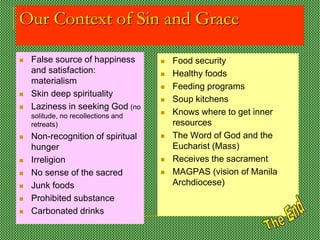
Our Context of Sin and Grace
 False source of happiness
and satisfaction:
materialism
 Skin deep spirituality
 Laziness in seeking God (no
solitude, no recollections and
retreats)
 Non-recognition of spiritual
hunger
 Irreligion
 No sense of the sacred
 Junk foods
 Prohibited substance
 Carbonated drinks
 Food security
 Healthy foods
 Feeding programs
 Soup kitchens
 Knows where to get inner
resources
 The Word of God and the
Eucharist (Mass)
 Receives the sacrament
 MAGPAS (vision of Manila
Archdiocese)
Suggested Songs
 Come To Me
 http://www.youtube.com/watch?v=ID90ryPYU00
 Sino Ang Makapaghihiwalay?
 Bayang Tinawag
 http://www.youtube.com/watch?v=MhzcbwbfMe8

18th sunday a

  • 1.
    Welcome to ourBible Study 18th Sunday in Ordinary Time 3 August 2014 In preparation for this Sunday’s Liturgy In aid of focusing our homilies and sharing Prepared by Fr. Cielo R. Almazan, OFM
  • 2.
     1 Allyou who are thirsty, come to the water! You who have no money, come, receive grain and eat; Come, without paying and without cost, drink wine and milk!  2 Why spend your money for what is not bread; your wages for what fails to satisfy?  Heed me, and you shall eat well, you shall delight in rich fare. 3 Come to me heedfully, listen, that you may have life. I will renew with you the everlasting covenant, the benefits assured to David. First Reading: Isaiah 55:1-3 The focus is on God’s invitation to come to him.
  • 3.
     1 Allyou who are thirsty, come to the water! You who have no money, come, receive grain and eat;  Come, without paying and without cost, drink wine and milk!  2 Why spend your money for what is not bread; your wages for what fails to satisfy?  Heed me, and you shall eat well, you shall delight in rich fare.  3 Come to me heedfully, listen, that you may have life. I will renew with you the everlasting covenant, the benefits assured to David. Commentary  God invites the thirsty and those who have no money (poor) to come to him.  God offers food to these people:  water, grain, wine and milk (basic domestic needs)  In v.2, God discourages spending one’s resources for things that cannot satisfy.  In v.2b God also appeals to the poor to listen to him for they shall be satisfied.  In v.3, for the 4th time, God asks the people to come forward (to exert some effort).  Listening to God’s invitation means  Life  Renewal of the covenant and benefits assured to David. First Reading: Isaiah 55:1-3
  • 4.
    Reflections on the1st reading  God’s word is consoling to those who are in need.  God is concerned about our total well-being, not just spiritual (=fullness of life).  God is the source of all satisfaction.  Recognizing our poverty, we must humbly respond to his invitation to draw near to him.  Do you approach God when you are in need? Only in need?
  • 5.
    Resp. Ps 145:8-9.15-16. 17-18  R. (cf. 16) The hand of the Lord feeds us; he answers all our needs. 8 The LORD is gracious and merciful, slow to anger and of great kindness. 9 The LORD is good to all and compassionate toward all his works.  15 The eyes of all look hopefully to you, and you give them their food in due season; 16 you open your hand and satisfy the desire of every living thing.  17 The LORD is just in all his ways and holy in all his works. 18 The LORD is near to all who call upon him, to all who call upon him in truth.
  • 6.
    Resp. Ps 145:8-9,15-16, 17-18  R. (cf. 16) The hand of the Lord feeds us; he answers all our needs.  8 The LORD is gracious and merciful, slow to anger and of great kindness. 9 The LORD is good to all and compassionate toward all his works.  15 The eyes of all look hopefully to you, and you give them their food in due season; 16 you open your hand and satisfy the desire of every living thing.  17 The LORD is just in all his ways and holy in all his works. 18 The LORD is near to all who call upon him, to all who call upon him in truth. Commentary  Vv.8-9 mention the characteristic traits of God:  Gracious, merciful, slow to anger, kind, good to all and compassionate  In vv.15-16, the psalmist says that God provides food for those who pray to him. God is generous.  Vv.17-18 enumerate once again the characteristic traits of God:  Just, holy, near to all
  • 7.
    Reflections on thePsalm  We, Christians, must seek God for our needs.  In our prayer, we must recognize that he feeds the poor.  The poor survives because of God’s mysterious generosity and love.  We can also imitate the characteristics of God, mentioned in the psalm.  Gracious, just, merciful…
  • 8.
    Second Reading: Romans8:35-39  35 What will separate us from the love of Christ? Will anguish, or distress, or persecution, or famine, or nakedness, or peril, or the sword?  37 No, in all these things we conquer overwhelmingly through him who loved us. 38 For I am convinced that neither death, nor life, nor angels, nor principalities, nor present things, nor future things, nor powers, 39 nor height, nor depth, nor any other creature will be able to separate us from the love of God in Christ Jesus our Lord.
  • 9.
    Second Reading: Romans8:35-39  35 What will separate us from the love of Christ? Will anguish, or distress, or persecution, or famine, or nakedness, or peril, or the sword?  37 No, in all these things we conquer overwhelmingly through him who loved us. 38 For I am convinced that neither death, nor life, nor angels, nor principalities, nor present things, nor future things, nor powers, 39 nor height, nor depth, nor any other creature will be able to separate us from the love of God in Christ Jesus our Lord. The focus is on the “love of Christ”?
  • 10.
    Second Reading: Romans8:35-39  35 What will separate us from the love of Christ? Will anguish, or distress, or persecution, or famine, or nakedness, or peril, or the sword?  37 No, in all these things we conquer overwhelmingly through him who loved us. 38 For I am convinced that neither death, nor life, nor angels, nor principalities, nor present things, nor future things, nor powers, 39 nor height, nor depth, nor any other creature will be able to separate us from the love of God in Christ Jesus our Lord. Important statement: Not one of the following will separate us from the Love of Christ. Vv.35 and 39 First List: v.35 Anguish Distress Persecution Famine Peril Sword Second list: vv.38-39 Death Life Angels Principalities Present things Future things Powers Height Depth Other creature V.37 is a very powerful statement of Paul. We conquer all these things through Jesus, who loves us.
  • 11.
    Reflections on the2nd reading  No one can separate us from the love of Christ.  The love of Christ is invincible, it cannot be defeated by any hostile element.  The love of Christ assures the Christian believer of Christ’s total support in the midst of persecution.  In all circumstances, we can never be separated from the love of Christ, if we have it.  Do you harbor this love of Christ?
  • 12.
    Gospel: Matthew 14:13-21 13 When Jesus heard of it, he withdrew in a boat to a deserted place by himself. The crowds heard of this and followed him on foot from their towns. 14 When he disembarked and saw the vast crowd, his heart was moved with pity for them, and he cured their sick.  15 When it was evening, the disciples approached him and said, "This is a deserted place and it is already late; dismiss the crowds so that they can go to the villages and buy food for themselves." 16 (Jesus) said to them, "There is no need for them to go away; give them some food yourselves." 17 But they said to him, "Five loaves and two fish are all we have here." 18 Then he said, "Bring them here to me," 19 and he ordered the crowds to sit down on the grass.  Taking the five loaves and the two fish, and looking up to heaven, he said the blessing, broke the loaves, and gave them to the disciples, who in turn gave them to the crowds. 20 They all ate and were satisfied, and they picked up the fragments left over -- twelve wicker baskets full. 21 Those who ate were about five thousand men, not counting women and children.
  • 13.
    Gospel: Matthew 14:13-21 13 When Jesus heard of it (when Herod the tetrarch showed interest in him, after the death of John the Baptist), he withdrew (with a heavy and fearful heart) in a boat to a deserted place by himself. (reminds of Moses on Mt. Sinai, probably to pray) The crowds heard of this and followed him on foot from their towns. (Seemingly, the crowd is insensitive to the need of Jesus, they don’t give him a break.)  14 When he disembarked and saw the vast crowd, his heart was moved with pity for them, and he cured their sick. (Jesus shows compassion and responds to their need.) The crowds follow him at all cost, taking longer paths and carrying their sick, to listen to him and to cure their sick. They believe in his powers. In contrast, Herod seeks him for entertainment purposes.
  • 14.
     15 Whenit was evening, the disciples approached him and said, "This is a deserted place (uninhabited, desert) and it is already late (around 5 pm, the disciples are worried); dismiss the crowds so that they can go to the villages and buy food for themselves."  16 (Jesus) said to them, "There is no need for them to go away; give them some food yourselves." (Notice the contrast between sending away and making them stay, also, buying food and giving food.)  17 But they said to him, "Five loaves and two fish are all we have here." (food is not enough) 18 Then he said, "Bring them here to me," 19 and he ordered the crowds to sit down on the grass (a discrepancy, maybe they are not in the desert at all). In v.15, the disciples express their worry to Jesus. In v.16, Jesus asks them to give food. (The disciples cannot avoid this “nightmare”). Jesus challenges them to be creative. In v.17, the disciples admit their limited supply.
  • 15.
     Taking thefive loaves (barley which grows on poor soil, food of the ordinary peasant) and the two fish (processed fish – cooked, pickled, salted, dried for shipping and marketing) and looking up to heaven, he said the blessing, broke the loaves, and gave them to the disciples, (eucharistic formula) who in turn gave them to the crowds. (The disciples distributed bread, Jesus makes possible his command “Give them bread yourselves.”)  20 They all ate and were satisfied, and they picked up the fragments left over -- twelve wicker baskets (bread basket) full. 21 Those who ate were about five thousand men, not counting women and children. Not just their stomachs were filled, but also the 12 baskets (smaller than spurij Mt 15:37)
  • 16.
    Reflections on thegospel reading  What kind of a disciple are you?  Do you hunger for the Word of God?  Do you believe God can heal you?  Then, give time to listen and follow him.  You cannot be satisfied if you don’t hunger first.  You must believe in Jesus’ saying, “Seek ye first the kingdom of God and his righteousness, and all these things will be given unto you.”
  • 17.
    Tying the 3readings and the Psalm  1st Reading: “Heed and you shall eat well.”  The Psalm: “The hand of the Lord feeds..”  2nd Reading: “Who can separate us… famine?  Gospel Reading: “They all ate and are satisfied…” • Based on the readings, the homilist must teach that the satisfaction of human needs (material and spiritual) comes from God. • To be satisfied, we must avail of God’s grace. The person must go forward to God, must draw close to him; must believe in the love of God (Christ), must listen to the words of the compassionate God. We, the Christian disciples, must also make “food” available to the hungry and thirsty.
  • 18.
    How to developyour homily/sharing  Are you spiritually hungry? Do you experience spiritual dryness?  What do you do to make your life meaningful?  Other formulation:  What do you do to attain “fullness of life?”  The readings help us discern how to make our lives worth living.
  • 19.
     The firstreading invites us to approach God for our needs.  God will certainly satisfy our needs.  God promises us life, when we approach him.  We have to help ourselves.  Help is not given to us on a silver platter.  We have to move forward to the Giver.  There is no meaning on waiting endlessly for help to come, yet, doing nothing.
  • 20.
     The secondreading teaches us to possess God’s love.  For, once we have the love of Christ, nothing will separate us from it.  Christ’s love is invincible. It cannot be defeated by any hostile element.  Even if we are undergoing material hunger (famine) and we are under threat, the love of God will always be there.  Even sufferings will have meaning.
  • 21.
     The gospelsuggests for us to follow Jesus.  There is satisfaction in listening to the Word of God.  There is no hunger for those who stay close to him.  In Jesus, there is spiritual and material satisfaction.  Wasting time with the Lord has meaning.
  • 22.
     The eucharistis a sacrament that satisfies our hungry souls.  The eucharist is intended for those who recognize their poverty and are seeking deeper relationship with God.  The eucharist is not for those who make other people hungry and who hinder their spiritual growth.
  • 23.
    Our Context ofSin and Grace  False source of happiness and satisfaction: materialism  Skin deep spirituality  Laziness in seeking God (no solitude, no recollections and retreats)  Non-recognition of spiritual hunger  Irreligion  No sense of the sacred  Junk foods  Prohibited substance  Carbonated drinks  Food security  Healthy foods  Feeding programs  Soup kitchens  Knows where to get inner resources  The Word of God and the Eucharist (Mass)  Receives the sacrament  MAGPAS (vision of Manila Archdiocese)
  • 24.
    Suggested Songs  ComeTo Me  http://www.youtube.com/watch?v=ID90ryPYU00  Sino Ang Makapaghihiwalay?  Bayang Tinawag  http://www.youtube.com/watch?v=MhzcbwbfMe8