
Care Management Analytics:
Six Ways Data Drives Program Success
© 2016 Health Catalyst
Proprietary. Feel free to share but we would appreciate a Health Catalyst citation.
Care Management Analytics
The foundation of successful care management is
identifying the right high-risk and rising-risk patients
to participate in a care management program.
To reliably select the patients most likely to benefit
from care management, health systems need data
from across the continuum of care, as claims data
alone doesn’t give a full picture of a patient’s health.
Care managers need other critical data,
such as clinical data, pharmaceutical data,
and social determinants of health data to
truly understand a patient’s risk and
plan effective intervention.
© 2016 Health Catalyst
Proprietary. Feel free to share but we would appreciate a Health Catalyst citation.
Care Management Analytics
Health systems can’t make informed
decisions about care management without
near real-time access to all patient data
and care management analytics-driven
decision support tools.
This presentation discusses how care
managers today use analytics-driven
technologies to effectively identify patients
for their programs and manage their care
to improve outcomes and lower costs.
© 2016 Health Catalyst
Proprietary. Feel free to share but we would appreciate a Health Catalyst citation.
Care Management Analytics-Driven Technology
Shows the Whole Patient Story
Before the transition to value-based care
reimbursement models, care management
departments primarily managed patients as
primary care providers (PCPs) referred them.
As health systems take on more financial risk,
however, care management programs need
to be more selective by focusing on the
patients most likely to benefit, and they
need to understand how to best allocate
their resources.
© 2016 Health Catalyst
Proprietary. Feel free to share but we would appreciate a Health Catalyst citation.
Care Management Analytics-Driven Technology
Shows the Whole Patient Story
The right patients for care management are
not necessarily the highest-cost patients.
If cost were the only consideration, identifying
patients based on claims or utilization data
alone would be easy.
However, patient identification is rarely so
simple; here are two examples:
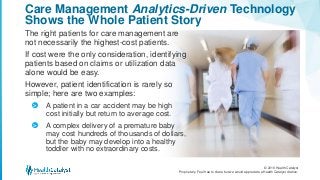
A patient in a car accident may be high
cost initially but return to average cost.
A complex delivery of a premature baby
may cost hundreds of thousands of dollars,
but the baby may develop into a healthy
toddler with no extraordinary costs.
>
>
© 2016 Health Catalyst
Proprietary. Feel free to share but we would appreciate a Health Catalyst citation.
Care Management Analytics-Driven Technology
Shows the Whole Patient Story
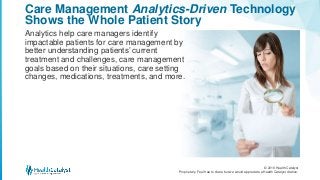
Analytics help care managers identify
impactable patients for care management by
better understanding patients’ current
treatment and challenges, care management
goals based on their situations, care setting
changes, medications, treatments, and more.
© 2016 Health Catalyst
Proprietary. Feel free to share but we would appreciate a Health Catalyst citation.
Six Ways Analytics Support Successful Care Management
Analytics-driven care management tools help
care managers identify the right patients for their
programs and deliver optimal care in key ways:
#1: Identifies Rising-Risk Patients
#2: Uses a Specific Social Determinant Assessment to Capture
Factors Beyond Claims Data
#3: Integrates EMR Data to Achieve Quality Measures
#4: Identifies Patients for Palliative or Hospice Care
#5: Identifies Patients with Chronic Conditions (in Combination
with Functional Limitations and Consistently High Cost)
#6: Increases Patient Engagement
© 2016 Health Catalyst
Proprietary. Feel free to share but we would appreciate a Health Catalyst citation.
#1: Identifies Rising-Risk Patients
Six Ways Analytics Support Successful Care Management
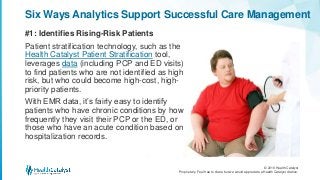
Patient stratification technology, such as the
Health Catalyst Patient Stratification tool,
leverages data (including PCP and ED visits)
to find patients who are not identified as high
risk, but who could become high-cost, high-
priority patients.
With EMR data, it’s fairly easy to identify
patients who have chronic conditions by how
frequently they visit their PCP or the ED, or
those who have an acute condition based on
hospitalization records.
© 2016 Health Catalyst
Proprietary. Feel free to share but we would appreciate a Health Catalyst citation.
#1: Identifies Rising-Risk Patients
Six Ways Analytics Support Successful Care Management
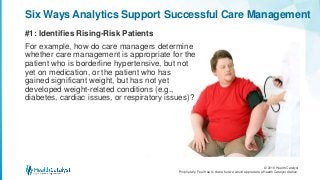
For example, how do care managers determine
whether care management is appropriate for the
patient who is borderline hypertensive, but not
yet on medication, or the patient who has
gained significant weight, but has not yet
developed weight-related conditions (e.g.,
diabetes, cardiac issues, or respiratory issues)?
© 2016 Health Catalyst
Proprietary. Feel free to share but we would appreciate a Health Catalyst citation.
#1: Identifies Rising-Risk Patients
Six Ways Analytics Support Successful Care Management
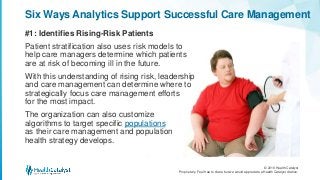
Patient stratification also uses risk models to
help care managers determine which patients
are at risk of becoming ill in the future.
With this understanding of rising risk, leadership
and care management can determine where to
strategically focus care management efforts
for the most impact.
The organization can also customize
algorithms to target specific populations
as their care management and population
health strategy develops.
© 2016 Health Catalyst
Proprietary. Feel free to share but we would appreciate a Health Catalyst citation.
#2: Uses a Specific Social Determinant Assessment to Capture Factors
Beyond Claims Data
Six Ways Analytics Support Successful Care Management
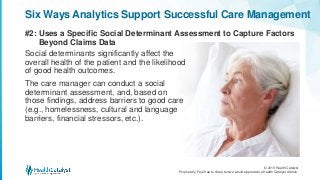
Social determinants significantly affect the
overall health of the patient and the likelihood
of good health outcomes.
The care manager can conduct a social
determinant assessment, and, based on
those findings, address barriers to good care
(e.g., homelessness, cultural and language
barriers, financial stressors, etc.).
© 2016 Health Catalyst
Proprietary. Feel free to share but we would appreciate a Health Catalyst citation.
#2: Uses a Specific Social Determinant Assessment to Capture Factors
Beyond Claims Data
Six Ways Analytics Support Successful Care Management
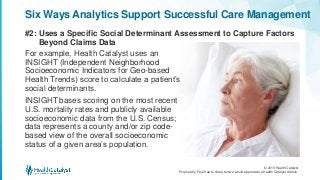
For example, Health Catalyst uses an
INSIGHT (Independent Neighborhood
Socioeconomic Indicators for Geo-based
Health Trends) score to calculate a patient’s
social determinants.
INSIGHT bases scoring on the most recent
U.S. mortality rates and publicly available
socioeconomic data from the U.S. Census;
data represents a county and/or zip code-
based view of the overall socioeconomic
status of a given area’s population.
© 2016 Health Catalyst
Proprietary. Feel free to share but we would appreciate a Health Catalyst citation.
#3: Integrates EMR Data to Achieve Quality Measures
Six Ways Analytics Support Successful Care Management
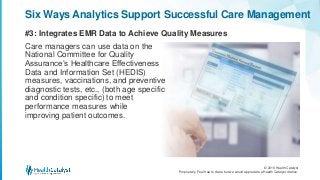
Care managers can use data on the
National Committee for Quality
Assurance’s Healthcare Effectiveness
Data and Information Set (HEDIS)
measures, vaccinations, and preventive
diagnostic tests, etc., (both age specific
and condition specific) to meet
performance measures while
improving patient outcomes.
© 2016 Health Catalyst
Proprietary. Feel free to share but we would appreciate a Health Catalyst citation.
#4: Identifies Patients for Palliative or Hospice Care
Six Ways Analytics Support Successful Care Management
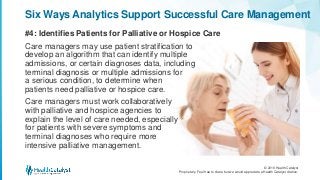
Care managers may use patient stratification to
develop an algorithm that can identify multiple
admissions, or certain diagnoses data, including
terminal diagnosis or multiple admissions for
a serious condition, to determine when
patients need palliative or hospice care.
Care managers must work collaboratively
with palliative and hospice agencies to
explain the level of care needed, especially
for patients with severe symptoms and
terminal diagnoses who require more
intensive palliative management.
© 2016 Health Catalyst
Proprietary. Feel free to share but we would appreciate a Health Catalyst citation.
#4: Identifies Patients for Palliative or Hospice Care
Six Ways Analytics Support Successful Care Management
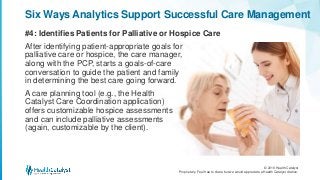
After identifying patient-appropriate goals for
palliative care or hospice, the care manager,
along with the PCP, starts a goals-of-care
conversation to guide the patient and family
in determining the best care going forward.
A care planning tool (e.g., the Health
Catalyst Care Coordination application)
offers customizable hospice assessments
and can include palliative assessments
(again, customizable by the client).
© 2016 Health Catalyst
Proprietary. Feel free to share but we would appreciate a Health Catalyst citation.
#5: Identifies Patients with Chronic Conditions (in Combination with
Functional Limitations and Consistently High Cost)
Six Ways Analytics Support Successful Care Management
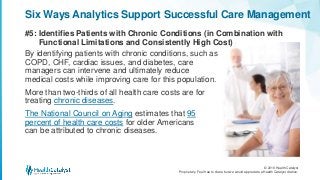
By identifying patients with chronic conditions, such as
COPD, CHF, cardiac issues, and diabetes, care
managers can intervene and ultimately reduce
medical costs while improving care for this population.
More than two-thirds of all health care costs are for
treating chronic diseases.
The National Council on Aging estimates that 95
percent of health care costs for older Americans
can be attributed to chronic diseases.
© 2016 Health Catalyst
Proprietary. Feel free to share but we would appreciate a Health Catalyst citation.
#6: Increases Patient Engagement
Six Ways Analytics Support Successful Care Management
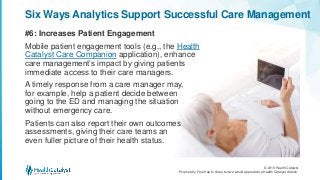
Mobile patient engagement tools (e.g., the Health
Catalyst Care Companion application), enhance
care management’s impact by giving patients
immediate access to their care managers.
A timely response from a care manager may,
for example, help a patient decide between
going to the ED and managing the situation
without emergency care.
Patients can also report their own outcomes
assessments, giving their care teams an
even fuller picture of their health status.
© 2016 Health Catalyst
Proprietary. Feel free to share but we would appreciate a Health Catalyst citation.
Analytics-Driven Technologies Give Care Management a
Critical Edge in Outcomes Improvement
Cost data alone doesn’t give organizations a
robust understanding of care management
needs within their populations.
To provide the right care for the right patient
at the right time, care managers must have
analytics-driven technology to understand
which patients will benefit most from care
management and to plan the best
program for each patient.
© 2016 Health Catalyst
Proprietary. Feel free to share but we would appreciate a Health Catalyst citation.
Analytics-Driven Technologies Give Care Management a
Critical Edge in Outcomes Improvement
Health systems that use analytics
tools to drive their care management
programs, from patient identification
to care coordination, will improve
outcomes and cost savings.
The combination of the right data
with an experienced care manager
can decrease cost, improve
outcomes, and, ultimately, provide
quality care for the patients who
need the most support.
© 2016 Health Catalyst
Proprietary. Feel free to share but we would appreciate a Health Catalyst citation.
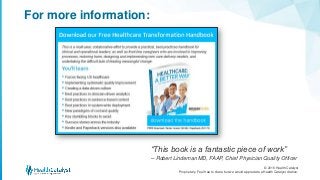
For more information:
“This book is a fantastic piece of work”
– Robert Lindeman MD, FAAP, Chief Physician Quality Officer
© 2016 Health Catalyst
Proprietary. Feel free to share but we would appreciate a Health Catalyst citation.
More about this topic
Link to original article for a more in-depth discussion.
Care Management Analytics: Six Ways Data Drives Program Success
Is Your Care Management Program Working: A Guide to ROI Challenges and Solutions
Dr. Amy Flaster, VP, Population Health Management and Care Management
Kathleen Clary, BSN, MSN, DNP, VP of Care Management & Patient Engagement
Three Essential Systems for Effective Population Health Management
Russ Staheli, Analytics VP
Introducing the Breakthrough Health Catalyst Care Management Product Suite
Paul Horstmeier, Senior VP
How Care Management Improves Performance for Clinicians, Compliance with MACRA,
and Outcomes for Patients Like Olivia – Dr. John Haughom, Senior Advisor, Health Catalyst
How Care Management Done Right Improves Patient Satisfaction and ROI
Dr. Amy Flaster, VP, Population Health Management and Care Management
© 2016 Health Catalyst
Proprietary. Feel free to share but we would appreciate a Health Catalyst citation.
Other Clinical Quality Improvement Resources
Click to read additional information at www.healthcatalyst.com
KimSu Marder joined Health Catalyst in September 2015 as Care Manager Lead. Prior to
coming to Health Catalyst, she worked for Tufts Health Plan as Care Management
Relationship Manager. KimSu has a degree in Education from Lesley University, a degree
in Nursing from Regis College, and is currently working on a Psychiatric Nurse Practitioner
MSN at Regis College.
KimSu Marder

Care Management Analytics: Six Ways Data Drives Program Success

  • 1.
    Care Management Analytics: SixWays Data Drives Program Success
  • 2.
    © 2016 HealthCatalyst Proprietary. Feel free to share but we would appreciate a Health Catalyst citation. Care Management Analytics The foundation of successful care management is identifying the right high-risk and rising-risk patients to participate in a care management program. To reliably select the patients most likely to benefit from care management, health systems need data from across the continuum of care, as claims data alone doesn’t give a full picture of a patient’s health. Care managers need other critical data, such as clinical data, pharmaceutical data, and social determinants of health data to truly understand a patient’s risk and plan effective intervention.
  • 3.
    © 2016 HealthCatalyst Proprietary. Feel free to share but we would appreciate a Health Catalyst citation. Care Management Analytics Health systems can’t make informed decisions about care management without near real-time access to all patient data and care management analytics-driven decision support tools. This presentation discusses how care managers today use analytics-driven technologies to effectively identify patients for their programs and manage their care to improve outcomes and lower costs.
  • 4.
    © 2016 HealthCatalyst Proprietary. Feel free to share but we would appreciate a Health Catalyst citation. Care Management Analytics-Driven Technology Shows the Whole Patient Story Before the transition to value-based care reimbursement models, care management departments primarily managed patients as primary care providers (PCPs) referred them. As health systems take on more financial risk, however, care management programs need to be more selective by focusing on the patients most likely to benefit, and they need to understand how to best allocate their resources.
  • 5.
    © 2016 HealthCatalyst Proprietary. Feel free to share but we would appreciate a Health Catalyst citation. Care Management Analytics-Driven Technology Shows the Whole Patient Story The right patients for care management are not necessarily the highest-cost patients. If cost were the only consideration, identifying patients based on claims or utilization data alone would be easy. However, patient identification is rarely so simple; here are two examples: A patient in a car accident may be high cost initially but return to average cost. A complex delivery of a premature baby may cost hundreds of thousands of dollars, but the baby may develop into a healthy toddler with no extraordinary costs. > >
  • 6.
    © 2016 HealthCatalyst Proprietary. Feel free to share but we would appreciate a Health Catalyst citation. Care Management Analytics-Driven Technology Shows the Whole Patient Story Analytics help care managers identify impactable patients for care management by better understanding patients’ current treatment and challenges, care management goals based on their situations, care setting changes, medications, treatments, and more.
  • 7.
    © 2016 HealthCatalyst Proprietary. Feel free to share but we would appreciate a Health Catalyst citation. Six Ways Analytics Support Successful Care Management Analytics-driven care management tools help care managers identify the right patients for their programs and deliver optimal care in key ways: #1: Identifies Rising-Risk Patients #2: Uses a Specific Social Determinant Assessment to Capture Factors Beyond Claims Data #3: Integrates EMR Data to Achieve Quality Measures #4: Identifies Patients for Palliative or Hospice Care #5: Identifies Patients with Chronic Conditions (in Combination with Functional Limitations and Consistently High Cost) #6: Increases Patient Engagement
  • 8.
    © 2016 HealthCatalyst Proprietary. Feel free to share but we would appreciate a Health Catalyst citation. #1: Identifies Rising-Risk Patients Six Ways Analytics Support Successful Care Management Patient stratification technology, such as the Health Catalyst Patient Stratification tool, leverages data (including PCP and ED visits) to find patients who are not identified as high risk, but who could become high-cost, high- priority patients. With EMR data, it’s fairly easy to identify patients who have chronic conditions by how frequently they visit their PCP or the ED, or those who have an acute condition based on hospitalization records.
  • 9.
    © 2016 HealthCatalyst Proprietary. Feel free to share but we would appreciate a Health Catalyst citation. #1: Identifies Rising-Risk Patients Six Ways Analytics Support Successful Care Management For example, how do care managers determine whether care management is appropriate for the patient who is borderline hypertensive, but not yet on medication, or the patient who has gained significant weight, but has not yet developed weight-related conditions (e.g., diabetes, cardiac issues, or respiratory issues)?
  • 10.
    © 2016 HealthCatalyst Proprietary. Feel free to share but we would appreciate a Health Catalyst citation. #1: Identifies Rising-Risk Patients Six Ways Analytics Support Successful Care Management Patient stratification also uses risk models to help care managers determine which patients are at risk of becoming ill in the future. With this understanding of rising risk, leadership and care management can determine where to strategically focus care management efforts for the most impact. The organization can also customize algorithms to target specific populations as their care management and population health strategy develops.
  • 11.
    © 2016 HealthCatalyst Proprietary. Feel free to share but we would appreciate a Health Catalyst citation. #2: Uses a Specific Social Determinant Assessment to Capture Factors Beyond Claims Data Six Ways Analytics Support Successful Care Management Social determinants significantly affect the overall health of the patient and the likelihood of good health outcomes. The care manager can conduct a social determinant assessment, and, based on those findings, address barriers to good care (e.g., homelessness, cultural and language barriers, financial stressors, etc.).
  • 12.
    © 2016 HealthCatalyst Proprietary. Feel free to share but we would appreciate a Health Catalyst citation. #2: Uses a Specific Social Determinant Assessment to Capture Factors Beyond Claims Data Six Ways Analytics Support Successful Care Management For example, Health Catalyst uses an INSIGHT (Independent Neighborhood Socioeconomic Indicators for Geo-based Health Trends) score to calculate a patient’s social determinants. INSIGHT bases scoring on the most recent U.S. mortality rates and publicly available socioeconomic data from the U.S. Census; data represents a county and/or zip code- based view of the overall socioeconomic status of a given area’s population.
  • 13.
    © 2016 HealthCatalyst Proprietary. Feel free to share but we would appreciate a Health Catalyst citation. #3: Integrates EMR Data to Achieve Quality Measures Six Ways Analytics Support Successful Care Management Care managers can use data on the National Committee for Quality Assurance’s Healthcare Effectiveness Data and Information Set (HEDIS) measures, vaccinations, and preventive diagnostic tests, etc., (both age specific and condition specific) to meet performance measures while improving patient outcomes.
  • 14.
    © 2016 HealthCatalyst Proprietary. Feel free to share but we would appreciate a Health Catalyst citation. #4: Identifies Patients for Palliative or Hospice Care Six Ways Analytics Support Successful Care Management Care managers may use patient stratification to develop an algorithm that can identify multiple admissions, or certain diagnoses data, including terminal diagnosis or multiple admissions for a serious condition, to determine when patients need palliative or hospice care. Care managers must work collaboratively with palliative and hospice agencies to explain the level of care needed, especially for patients with severe symptoms and terminal diagnoses who require more intensive palliative management.
  • 15.
    © 2016 HealthCatalyst Proprietary. Feel free to share but we would appreciate a Health Catalyst citation. #4: Identifies Patients for Palliative or Hospice Care Six Ways Analytics Support Successful Care Management After identifying patient-appropriate goals for palliative care or hospice, the care manager, along with the PCP, starts a goals-of-care conversation to guide the patient and family in determining the best care going forward. A care planning tool (e.g., the Health Catalyst Care Coordination application) offers customizable hospice assessments and can include palliative assessments (again, customizable by the client).
  • 16.
    © 2016 HealthCatalyst Proprietary. Feel free to share but we would appreciate a Health Catalyst citation. #5: Identifies Patients with Chronic Conditions (in Combination with Functional Limitations and Consistently High Cost) Six Ways Analytics Support Successful Care Management By identifying patients with chronic conditions, such as COPD, CHF, cardiac issues, and diabetes, care managers can intervene and ultimately reduce medical costs while improving care for this population. More than two-thirds of all health care costs are for treating chronic diseases. The National Council on Aging estimates that 95 percent of health care costs for older Americans can be attributed to chronic diseases.
  • 17.
    © 2016 HealthCatalyst Proprietary. Feel free to share but we would appreciate a Health Catalyst citation. #6: Increases Patient Engagement Six Ways Analytics Support Successful Care Management Mobile patient engagement tools (e.g., the Health Catalyst Care Companion application), enhance care management’s impact by giving patients immediate access to their care managers. A timely response from a care manager may, for example, help a patient decide between going to the ED and managing the situation without emergency care. Patients can also report their own outcomes assessments, giving their care teams an even fuller picture of their health status.
  • 18.
    © 2016 HealthCatalyst Proprietary. Feel free to share but we would appreciate a Health Catalyst citation. Analytics-Driven Technologies Give Care Management a Critical Edge in Outcomes Improvement Cost data alone doesn’t give organizations a robust understanding of care management needs within their populations. To provide the right care for the right patient at the right time, care managers must have analytics-driven technology to understand which patients will benefit most from care management and to plan the best program for each patient.
  • 19.
    © 2016 HealthCatalyst Proprietary. Feel free to share but we would appreciate a Health Catalyst citation. Analytics-Driven Technologies Give Care Management a Critical Edge in Outcomes Improvement Health systems that use analytics tools to drive their care management programs, from patient identification to care coordination, will improve outcomes and cost savings. The combination of the right data with an experienced care manager can decrease cost, improve outcomes, and, ultimately, provide quality care for the patients who need the most support.
  • 20.
    © 2016 HealthCatalyst Proprietary. Feel free to share but we would appreciate a Health Catalyst citation. For more information: “This book is a fantastic piece of work” – Robert Lindeman MD, FAAP, Chief Physician Quality Officer
  • 21.
    © 2016 HealthCatalyst Proprietary. Feel free to share but we would appreciate a Health Catalyst citation. More about this topic Link to original article for a more in-depth discussion. Care Management Analytics: Six Ways Data Drives Program Success Is Your Care Management Program Working: A Guide to ROI Challenges and Solutions Dr. Amy Flaster, VP, Population Health Management and Care Management Kathleen Clary, BSN, MSN, DNP, VP of Care Management & Patient Engagement Three Essential Systems for Effective Population Health Management Russ Staheli, Analytics VP Introducing the Breakthrough Health Catalyst Care Management Product Suite Paul Horstmeier, Senior VP How Care Management Improves Performance for Clinicians, Compliance with MACRA, and Outcomes for Patients Like Olivia – Dr. John Haughom, Senior Advisor, Health Catalyst How Care Management Done Right Improves Patient Satisfaction and ROI Dr. Amy Flaster, VP, Population Health Management and Care Management
  • 22.
    © 2016 HealthCatalyst Proprietary. Feel free to share but we would appreciate a Health Catalyst citation. Other Clinical Quality Improvement Resources Click to read additional information at www.healthcatalyst.com KimSu Marder joined Health Catalyst in September 2015 as Care Manager Lead. Prior to coming to Health Catalyst, she worked for Tufts Health Plan as Care Management Relationship Manager. KimSu has a degree in Education from Lesley University, a degree in Nursing from Regis College, and is currently working on a Psychiatric Nurse Practitioner MSN at Regis College. KimSu Marder