Geospatial
Knowledge
Infrastructure
Sanjay Kumar
CEO & Secretary General, World
Geospatial Industry Council (WGIC) &
CEO, Geospatial Media and
Communications
Role of Geospatial
in COVID-19
response
How geospatial industry responded
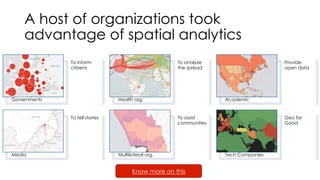
A host of organizations took
advantage of spatial analytics
Governments
To inform
citizens
Media
To tell stories
Health org.
To analyze
the spread
Multilateral org.
To assist
communities
Academic
Provide
open data
Tech Companies
Geo for
Good
Know more on this
We have seen hundreds of dashboards in use by thousands of organizations
and billions of users to understand the COVID-19 scenario
Location
tracking
gaining
significance
We have seen 30+
use cases across
20+ countries
Know more on this
Challenges so far
Information explosion leading to
chaos
Too late and Too little
Data availability and data silos
Policy barriers
Next
Generation
Geospatial
Enterprise
Landscape
Providing a way to the future
Know more on this
Co-Organizer & Organizer
Partners
(rffifi&)
��
United Nations
S1at�l1CS Oivisk,n
-_.,,_,..,.
brgm
NIAS
GEOSPATIALmedia +c:orrwn.rica!ions
ICIMOD •JRCGEONOVUM EUROPEAN COMMISSION
Spatial.
dVision·
�Trimble.
SINGAPORE
LAND AUTHORITY
musGsSCWfa fot•chMflngworld
1wG,�c1Wcwtd�tllllndust,yCClunc:il
-=-�--==-
Data Infrastructure Integrated Policy Framework
Spatial Dimension to
Data Ecosystem
Partnerships &
Collaborations
REALTIME INFORMATION
Citizen Generated Data
Commercial Service Provider
Earth Observation
IoT
ALLIED INFORMATION
ENTERPRISE
Weather
Environmental Information,
Building Information Modeling (BIM)
Business Data
FOUNDATIONAL DATA
Foundational Layers
Thematic Data
Reference Data
POSITIONING
INFRASTRUCTURE
CORS Network
GNSS Augmentation
Indoor Positioning
INTEGRATED GEOSPATIAL
POLICY FRAMEWORK
Topography
Earth Observation Systems
Photogrammetry
Cadaster and Land Information
ALIGNMENT WITH ICT,
INNOVATION, TRADE &
OTHER POLICIES
Innovation and Technology Policy
Open and Link data
Pricing Policy
Data sovereignty & protection
Personal Privacy
Intellectual Property Rights
Emergency and Safety
SPATIAL DIMENSION TO
NATIONAL DATA ECOSYSTEM:
As the foundation for data
economy & knowledge
economy, serving:
• Governance
• Security & public safety
• Business enterprise
• Citizen services
• Good Governance
• Accountability and
Transparency
• Efficiency and Productivity
• Value Impact and ROI
PARTNERSHIPS &
COLLABORATIONS
• Collaborative Engagement
with multiple stakeholders
• Partnership with User
Departments
• Equity Inclusive Approach
• Co-creating geospatial
knowledge infrastructure
through Public-Private
Partnerships
• Defining scope, mechanisms
and business models of
collaboration and
partnerships
Decentralized system| Real-time data processing | Analytical capability
Predictive and prescriptive modelling | Delivery of knowledge services
Impact of GKI on IGIF
SP 1: Governance and
Institutions:
Transparency, accountability,
inclusiveness, collaboration
SP 2: Policy and Legal:
Clear integrated policies,
supported by strong
legislation
SP 3: Finance:
Improved RoI and social
benefits.
SP 4: Data:
From data to knowledge. Near real-
time. Big Data, AI/ML, Predictive
and Prescriptive Analytics
SP 5: Innovation:
Knowledge indicators and
services – user focus. Adaptability,
Flexibility. New rapid data capture
technologies and techniques. IoT.
SP 6: Standards:
Absolute essential
SP 7: Partnerships:
New forms of PPPs. Collaborative
synergy
SP 8: Capacity and Education:
Increase in breadth and depth of
knowledge.
SP 9: Communication and
Engagement:
Increased user focus. Increased
collaboration of all stakeholders
Contact us
at WGICEmail us: info@wgicouncil.org
Know more: https://wgicouncil.org/

Geospatial Knowledge Infrastructure - Sanjay Kumar, WGIC

  • 1.
    Geospatial Knowledge Infrastructure Sanjay Kumar CEO &Secretary General, World Geospatial Industry Council (WGIC) & CEO, Geospatial Media and Communications
  • 7.
    Role of Geospatial inCOVID-19 response
  • 8.
  • 9.
    A host oforganizations took advantage of spatial analytics Governments To inform citizens Media To tell stories Health org. To analyze the spread Multilateral org. To assist communities Academic Provide open data Tech Companies Geo for Good Know more on this
  • 10.
    We have seenhundreds of dashboards in use by thousands of organizations and billions of users to understand the COVID-19 scenario
  • 11.
    Location tracking gaining significance We have seen30+ use cases across 20+ countries Know more on this
  • 12.
    Challenges so far Informationexplosion leading to chaos Too late and Too little Data availability and data silos Policy barriers
  • 13.
  • 14.
    Co-Organizer & Organizer Partners (rffifi&) �� UnitedNations S1at�l1CS Oivisk,n -_.,,_,..,. brgm NIAS GEOSPATIALmedia +c:orrwn.rica!ions ICIMOD •JRCGEONOVUM EUROPEAN COMMISSION Spatial. dVision· �Trimble. SINGAPORE LAND AUTHORITY musGsSCWfa fot•chMflngworld 1wG,�c1Wcwtd�tllllndust,yCClunc:il -=-�--==-
  • 15.
    Data Infrastructure IntegratedPolicy Framework Spatial Dimension to Data Ecosystem Partnerships & Collaborations REALTIME INFORMATION Citizen Generated Data Commercial Service Provider Earth Observation IoT ALLIED INFORMATION ENTERPRISE Weather Environmental Information, Building Information Modeling (BIM) Business Data FOUNDATIONAL DATA Foundational Layers Thematic Data Reference Data POSITIONING INFRASTRUCTURE CORS Network GNSS Augmentation Indoor Positioning INTEGRATED GEOSPATIAL POLICY FRAMEWORK Topography Earth Observation Systems Photogrammetry Cadaster and Land Information ALIGNMENT WITH ICT, INNOVATION, TRADE & OTHER POLICIES Innovation and Technology Policy Open and Link data Pricing Policy Data sovereignty & protection Personal Privacy Intellectual Property Rights Emergency and Safety SPATIAL DIMENSION TO NATIONAL DATA ECOSYSTEM: As the foundation for data economy & knowledge economy, serving: • Governance • Security & public safety • Business enterprise • Citizen services • Good Governance • Accountability and Transparency • Efficiency and Productivity • Value Impact and ROI PARTNERSHIPS & COLLABORATIONS • Collaborative Engagement with multiple stakeholders • Partnership with User Departments • Equity Inclusive Approach • Co-creating geospatial knowledge infrastructure through Public-Private Partnerships • Defining scope, mechanisms and business models of collaboration and partnerships Decentralized system| Real-time data processing | Analytical capability Predictive and prescriptive modelling | Delivery of knowledge services
  • 16.
    Impact of GKIon IGIF SP 1: Governance and Institutions: Transparency, accountability, inclusiveness, collaboration SP 2: Policy and Legal: Clear integrated policies, supported by strong legislation SP 3: Finance: Improved RoI and social benefits. SP 4: Data: From data to knowledge. Near real- time. Big Data, AI/ML, Predictive and Prescriptive Analytics SP 5: Innovation: Knowledge indicators and services – user focus. Adaptability, Flexibility. New rapid data capture technologies and techniques. IoT. SP 6: Standards: Absolute essential SP 7: Partnerships: New forms of PPPs. Collaborative synergy SP 8: Capacity and Education: Increase in breadth and depth of knowledge. SP 9: Communication and Engagement: Increased user focus. Increased collaboration of all stakeholders
  • 17.
    Contact us at WGICEmailus: info@wgicouncil.org Know more: https://wgicouncil.org/