Successful New Drug Development for Small Companies
Not to know is bad; not to wish to know is worse  (African proverb)
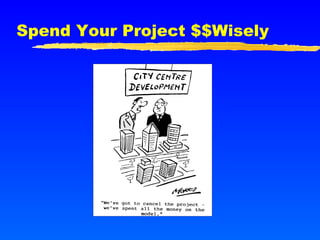
Spend Your Project $$Wisely
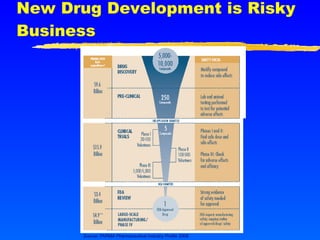
New Drug Development is Risky Business Source: PhRMA Pharmaceutical Industry Profile 2006
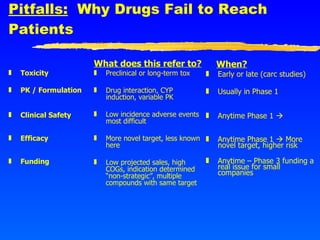
Pitfalls:   Why Drugs Fail to Reach Patients Toxicity PK / Formulation Clinical Safety Efficacy Funding What does this refer to? Preclinical or long-term tox Drug interaction, CYP induction, variable PK Low incidence adverse events most difficult  More novel target, less known here Low projected sales, high COGs, indication determined “non-strategic”, multiple compounds with same target When? Early or late (carc studies) Usually in Phase 1 Anytime Phase 1     Anytime Phase 1    More novel target, higher risk Anytime – Phase 3 funding a real issue for small companies
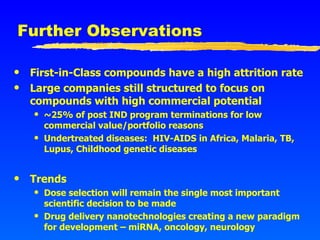
Further Observations First-in-Class compounds have a high attrition rate Large companies still structured to focus on compounds with high commercial potential  ~25% of post IND program terminations for low commercial value/portfolio reasons Undertreated diseases:  HIV-AIDS in Africa, Malaria, TB, Lupus, Childhood genetic diseases Trends Dose selection will remain the single most important scientific decision to be made Drug delivery nanotechnologies creating a new paradigm for development – miRNA, oncology, neurology
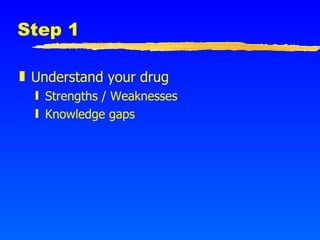
Understand your drug Strengths / Weaknesses Knowledge gaps Step 1
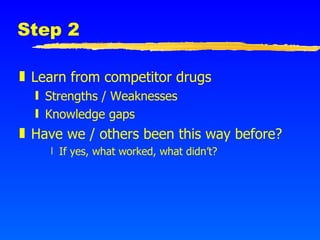
Learn from competitor drugs Strengths / Weaknesses Knowledge gaps Have we / others been this way before? If yes, what worked, what didn’t?  Step 2
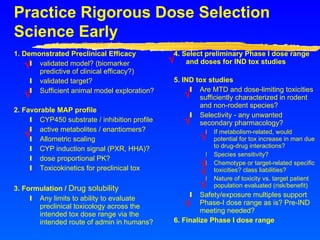
1. Demonstrated Preclinical Efficacy validated model? (biomarker predictive of clinical efficacy?) validated target? Sufficient animal model exploration? 2. Favorable MAP profile CYP450 substrate / inhibition profile active metabolites / enantiomers? Allometric scaling  CYP induction signal (PXR, HHA)? dose proportional PK?  Toxicokinetics for preclinical tox 3. Formulation /  Drug solubility Any limits to ability to evaluate preclinical toxicology across the intended tox dose range via the intended route of admin in humans? Practice Rigorous Dose Selection Science Early 4. Select preliminary Phase I dose range and doses for IND tox studies 5. IND tox studies Are MTD and dose-limiting toxicities sufficiently characterized in rodent and non-rodent species? Selectivity - any unwanted secondary pharmacology? If metabolism-related, would potential for tox increase in man due to drug-drug interactions? Species sensitivity? Chemotype or target-related specific toxicities? class liabilities? Nature of toxicity vs. target patient population evaluated (risk/benefit) Safety/exposure multiples support Phase-I dose range as is? Pre-IND meeting needed? 6. Finalize Phase I dose range           
The person who knows everything has a lot to learn (anonymous)
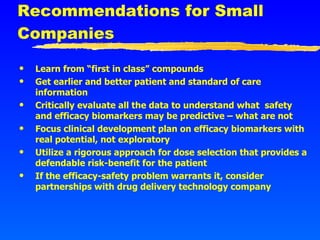
Recommendations for Small Companies Learn from “first in class” compounds Get earlier and better patient and standard of care information Critically evaluate all the data to understand what  safety and efficacy biomarkers may be predictive – what are not Focus clinical development plan on efficacy biomarkers with real potential, not exploratory Utilize a rigorous approach for dose selection that provides a defendable risk-benefit for the patient If the efficacy-safety problem warrants it, consider partnerships with drug delivery technology company
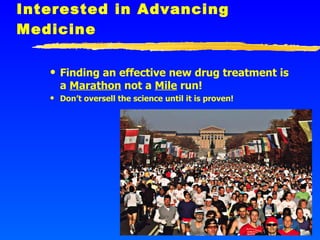
Advice for Business People Interested in Advancing Medicine Finding an effective new drug treatment is a  Marathon  not a  Mile  run! Don’t oversell the science until it is proven!

Successful New Drug Development Strategies for Small Companies

  • 1.
    Successful New DrugDevelopment for Small Companies
  • 2.
    Not to knowis bad; not to wish to know is worse (African proverb)
  • 3.
  • 4.
    New Drug Developmentis Risky Business Source: PhRMA Pharmaceutical Industry Profile 2006
  • 5.
    Pitfalls: Why Drugs Fail to Reach Patients Toxicity PK / Formulation Clinical Safety Efficacy Funding What does this refer to? Preclinical or long-term tox Drug interaction, CYP induction, variable PK Low incidence adverse events most difficult More novel target, less known here Low projected sales, high COGs, indication determined “non-strategic”, multiple compounds with same target When? Early or late (carc studies) Usually in Phase 1 Anytime Phase 1  Anytime Phase 1  More novel target, higher risk Anytime – Phase 3 funding a real issue for small companies
  • 6.
    Further Observations First-in-Classcompounds have a high attrition rate Large companies still structured to focus on compounds with high commercial potential ~25% of post IND program terminations for low commercial value/portfolio reasons Undertreated diseases: HIV-AIDS in Africa, Malaria, TB, Lupus, Childhood genetic diseases Trends Dose selection will remain the single most important scientific decision to be made Drug delivery nanotechnologies creating a new paradigm for development – miRNA, oncology, neurology
  • 7.
    Understand your drugStrengths / Weaknesses Knowledge gaps Step 1
  • 8.
    Learn from competitordrugs Strengths / Weaknesses Knowledge gaps Have we / others been this way before? If yes, what worked, what didn’t? Step 2
  • 9.
    1. Demonstrated PreclinicalEfficacy validated model? (biomarker predictive of clinical efficacy?) validated target? Sufficient animal model exploration? 2. Favorable MAP profile CYP450 substrate / inhibition profile active metabolites / enantiomers? Allometric scaling CYP induction signal (PXR, HHA)? dose proportional PK? Toxicokinetics for preclinical tox 3. Formulation / Drug solubility Any limits to ability to evaluate preclinical toxicology across the intended tox dose range via the intended route of admin in humans? Practice Rigorous Dose Selection Science Early 4. Select preliminary Phase I dose range and doses for IND tox studies 5. IND tox studies Are MTD and dose-limiting toxicities sufficiently characterized in rodent and non-rodent species? Selectivity - any unwanted secondary pharmacology? If metabolism-related, would potential for tox increase in man due to drug-drug interactions? Species sensitivity? Chemotype or target-related specific toxicities? class liabilities? Nature of toxicity vs. target patient population evaluated (risk/benefit) Safety/exposure multiples support Phase-I dose range as is? Pre-IND meeting needed? 6. Finalize Phase I dose range           
  • 10.
    The person whoknows everything has a lot to learn (anonymous)
  • 11.
    Recommendations for SmallCompanies Learn from “first in class” compounds Get earlier and better patient and standard of care information Critically evaluate all the data to understand what safety and efficacy biomarkers may be predictive – what are not Focus clinical development plan on efficacy biomarkers with real potential, not exploratory Utilize a rigorous approach for dose selection that provides a defendable risk-benefit for the patient If the efficacy-safety problem warrants it, consider partnerships with drug delivery technology company
  • 12.
    Advice for BusinessPeople Interested in Advancing Medicine Finding an effective new drug treatment is a Marathon not a Mile run! Don’t oversell the science until it is proven!