Intravenous Fluid Computations
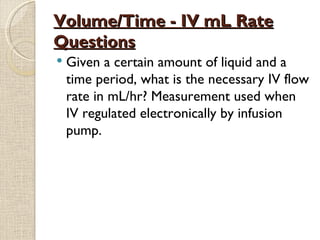
Volume/Time - IV mL Rate
Questions
   Given a certain amount of liquid and a
    time period, what is the necessary IV flow
    rate in mL/hr? Measurement used when
    IV regulated electronically by infusion
    pump. 
   Formula: 
       Volume (mL)
       Time (hr)        =  Y (Flow Rate in
    mL/hr)

   Example: Infuse 250 mL over the
    next 120 minutes by infusion pump.
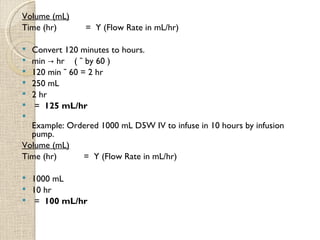
Volume (mL)
Time (hr)         =  Y (Flow Rate in mL/hr)

   Convert 120 minutes to hours.
   min → hr    ( ÷ by 60 )
   120 min ÷ 60 = 2 hr
   250 mL
   2 hr
    =  125 mL/hr

  Example: Ordered 1000 mL D5W IV to infuse in 10 hours by infusion
  pump.
Volume (mL)
Time (hr)      =  Y (Flow Rate in mL/hr)
 
 1000 mL
 10 hr
  =  100 mL/hr
Volume/Time - IV Drop Rate
Questions
   Given a certain amount of liquid, a time
    period, and a drop factor (gtts/mL), what
    is the necessary IV flow rate in gtts/min?
    Measurement used when IV is regulated
    manually. Because it is not possible to
    give a patient a fraction of a drop, it is
    typical to round answers for these
    problems up or down to the nearest
    whole number. 
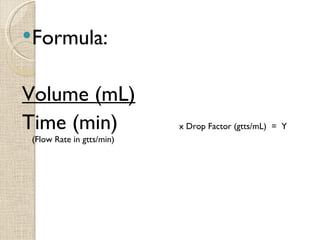
Formula: 


Volume (mL)
Time (min)                 x Drop Factor (gtts/mL)  =  Y
 (Flow Rate in gtts/min)
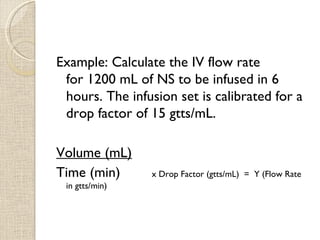
Example: Calculate the IV flow rate
 for 1200 mL of NS to be infused in 6
 hours. The infusion set is calibrated for a
 drop factor of 15 gtts/mL.

Volume (mL)
Time (min)       x Drop Factor (gtts/mL)  =  Y (Flow Rate
 in gtts/min)
Convert 6 hours to minutes.
min ← hr    ( x by 60 )
6 hr x 60 = 360 min
1200 mL
360 min
x 15 gtts/mL  =  50 gtts/min
Fluid Maintenance
Requirement Questions
   Given the weight of a child or infant,
    calculate the necessary amount of fluid
    per day. Different hospitals may have
    different policies, but for learning how to
    perform these pediatric dosage
    calculations, the following commonly
    used table of fluid requirements may be
    used. 
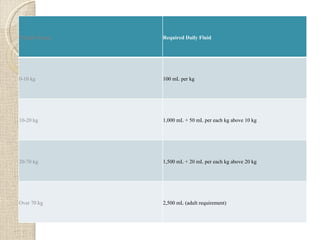
Weight Range   Required Daily Fluid


0-10 kg        100 mL per kg


10-20 kg       1,000 mL + 50 mL per each kg above 10 kg


20-70 kg       1,500 mL + 20 mL per each kg above 20 kg


Over 70 kg     2,500 mL (adult requirement)
   Example: An infant weighs 4 kg. What is
    the required amount of fluid per day in
    mL?

0-10 kg
100 mL per kg
4 kg x 100 mL/kg = 400 mL

Intravenous fluid computations

  • 1.
  • 2.
    Volume/Time - IVmL Rate Questions  Given a certain amount of liquid and a time period, what is the necessary IV flow rate in mL/hr? Measurement used when IV regulated electronically by infusion pump. 
  • 3.
    Formula:  Volume (mL) Time (hr)  =  Y (Flow Rate in mL/hr)  Example: Infuse 250 mL over the next 120 minutes by infusion pump.
  • 4.
    Volume (mL) Time (hr)  =  Y (Flow Rate in mL/hr)  Convert 120 minutes to hours.  min → hr    ( ÷ by 60 )  120 min ÷ 60 = 2 hr  250 mL  2 hr   =  125 mL/hr  Example: Ordered 1000 mL D5W IV to infuse in 10 hours by infusion pump. Volume (mL) Time (hr)  =  Y (Flow Rate in mL/hr)    1000 mL  10 hr   =  100 mL/hr
  • 5.
    Volume/Time - IVDrop Rate Questions  Given a certain amount of liquid, a time period, and a drop factor (gtts/mL), what is the necessary IV flow rate in gtts/min? Measurement used when IV is regulated manually. Because it is not possible to give a patient a fraction of a drop, it is typical to round answers for these problems up or down to the nearest whole number. 
  • 6.
    Formula:  Volume (mL) Time (min) x Drop Factor (gtts/mL)  =  Y (Flow Rate in gtts/min)
  • 7.
    Example: Calculate theIV flow rate for 1200 mL of NS to be infused in 6 hours. The infusion set is calibrated for a drop factor of 15 gtts/mL. Volume (mL) Time (min) x Drop Factor (gtts/mL)  =  Y (Flow Rate in gtts/min)
  • 8.
    Convert 6 hoursto minutes. min ← hr    ( x by 60 ) 6 hr x 60 = 360 min 1200 mL 360 min x 15 gtts/mL  =  50 gtts/min
  • 9.
    Fluid Maintenance Requirement Questions  Given the weight of a child or infant, calculate the necessary amount of fluid per day. Different hospitals may have different policies, but for learning how to perform these pediatric dosage calculations, the following commonly used table of fluid requirements may be used. 
  • 10.
    Weight Range Required Daily Fluid 0-10 kg 100 mL per kg 10-20 kg 1,000 mL + 50 mL per each kg above 10 kg 20-70 kg 1,500 mL + 20 mL per each kg above 20 kg Over 70 kg 2,500 mL (adult requirement)
  • 11.
    Example: An infant weighs 4 kg. What is the required amount of fluid per day in mL? 0-10 kg 100 mL per kg 4 kg x 100 mL/kg = 400 mL