8 
8 
JJDDTT eemmbbrraacceess TTyyppee AAnnnnoottaattiioonnss 
Stephan Herrmann 
GK Software 
Java 8 ready
Stephan Herrmann: JDT Embraces Type Annotations - EclipseCon North America 2014 # 2 
8 
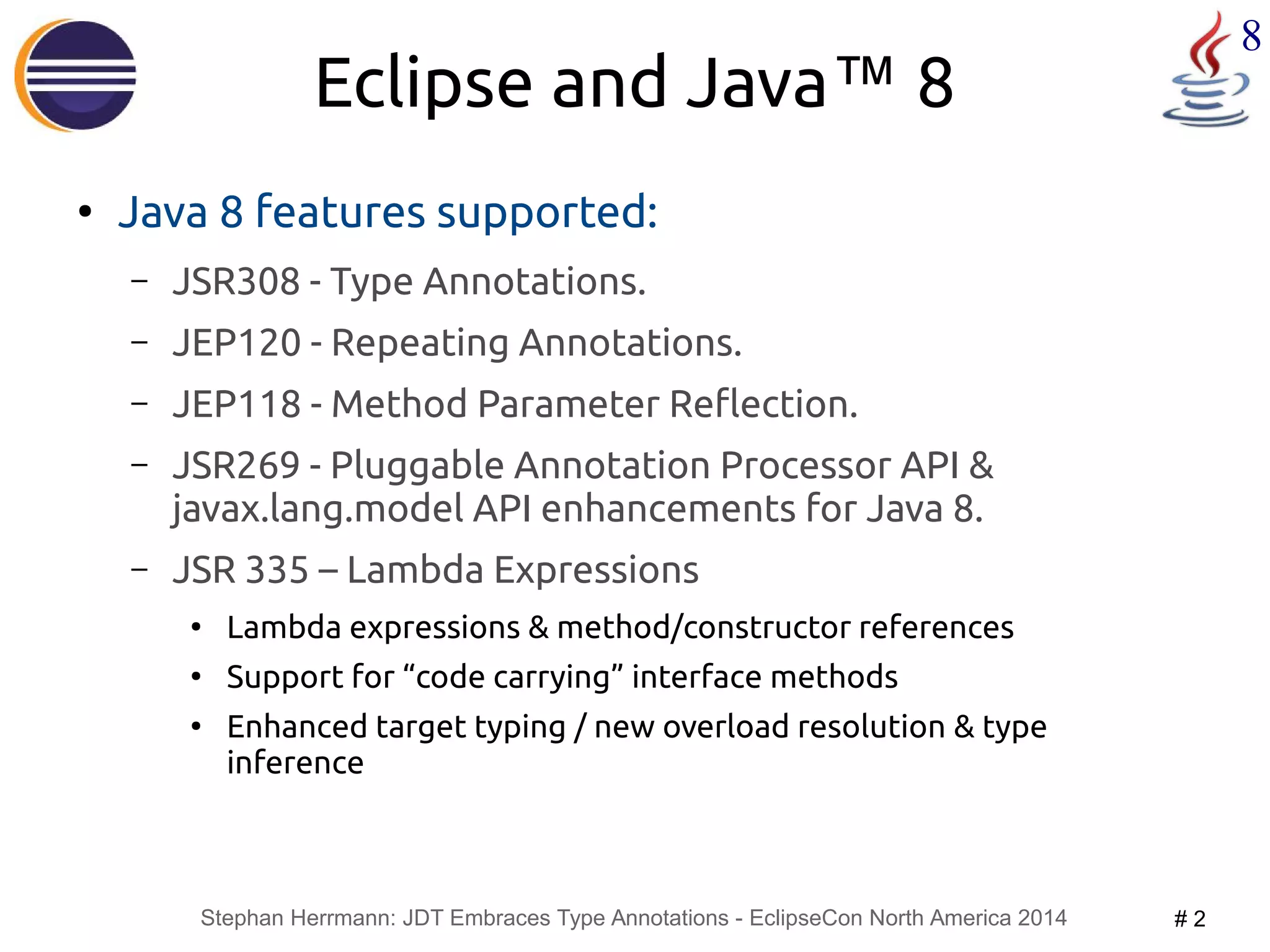
Eclipse and Java™ 8 
● Java 8 features supported: 
– JSR308 - Type Annotations. 
– JEP120 - Repeating Annotations. 
– JEP118 - Method Parameter Reflection. 
– JSR269 - Pluggable Annotation Processor API & 
javax.lang.model API enhancements for Java 8. 
– JSR 335 – Lambda Expressions 
● Lambda expressions & method/constructor references 
● Support for “code carrying” interface methods 
● Enhanced target typing / new overload resolution & type 
inference
Stephan Herrmann: JDT Embraces Type Annotations - EclipseCon North America 2014 # 3 
8 
λ 
(JSR 335)
Stephan Herrmann: JDT Embraces Type Annotations - EclipseCon North America 2014 # 4 
8 
λ 
(JSR 335) Tomorrow 17:00 to 18:00: 
Grand Peninsula C 
JDT embraces lambda expressions 
● Srikanth [IBM India] 
● Noopur Gupta [IBM India] 
● Stephan Herrmann
Stephan Herrmann: JDT Embraces Type Annotations - EclipseCon North America 2014 # 5 
8 
@ 
(JSR 308)
Stephan Herrmann: JDT Embraces Type Annotations - EclipseCon North America 2014 # 6 
8 
Annotations in more Places 
● Java 5: annotate declarations 
– ElementType: packages, classes, fields, methods, locals … 
● Java 8: annotate types 
– ElementType.TYPE_USE 
– ElementType.TYPE_PARAMETER 
SSoo wwhhaatt??
Stephan Herrmann: JDT Embraces Type Annotations - EclipseCon North America 2014 # 7 
8 
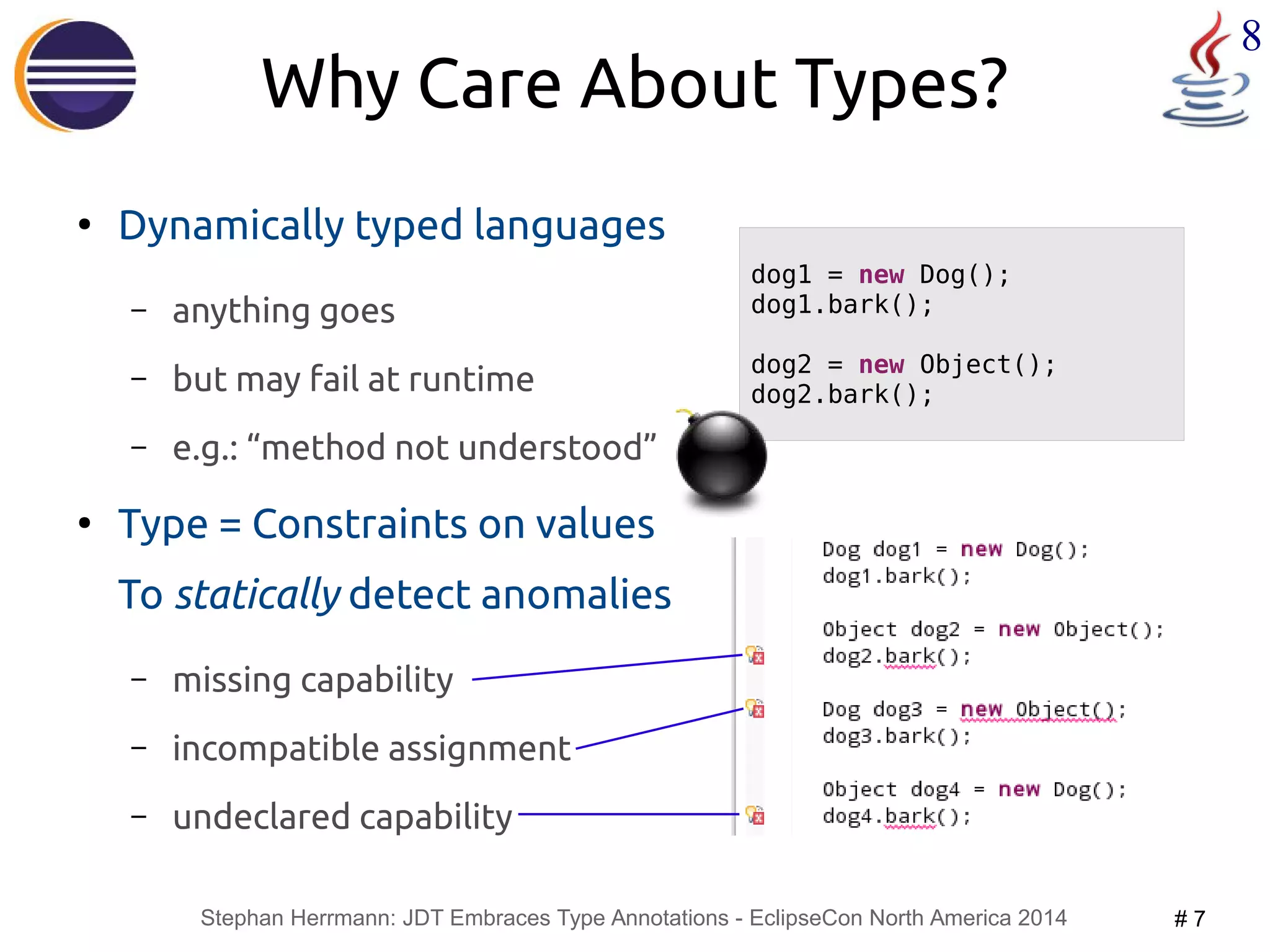
Why Care About Types? 
● Dynamically typed languages 
– anything goes 
– but may fail at runtime 
– e.g.: “method not understood” 
● Type = Constraints on values 
To statically detect anomalies 
– missing capability 
– incompatible assignment 
– undeclared capability 
dog1 = new Dog(); 
dog1.bark(); 
dog2 = new Object(); 
dog2.bark();
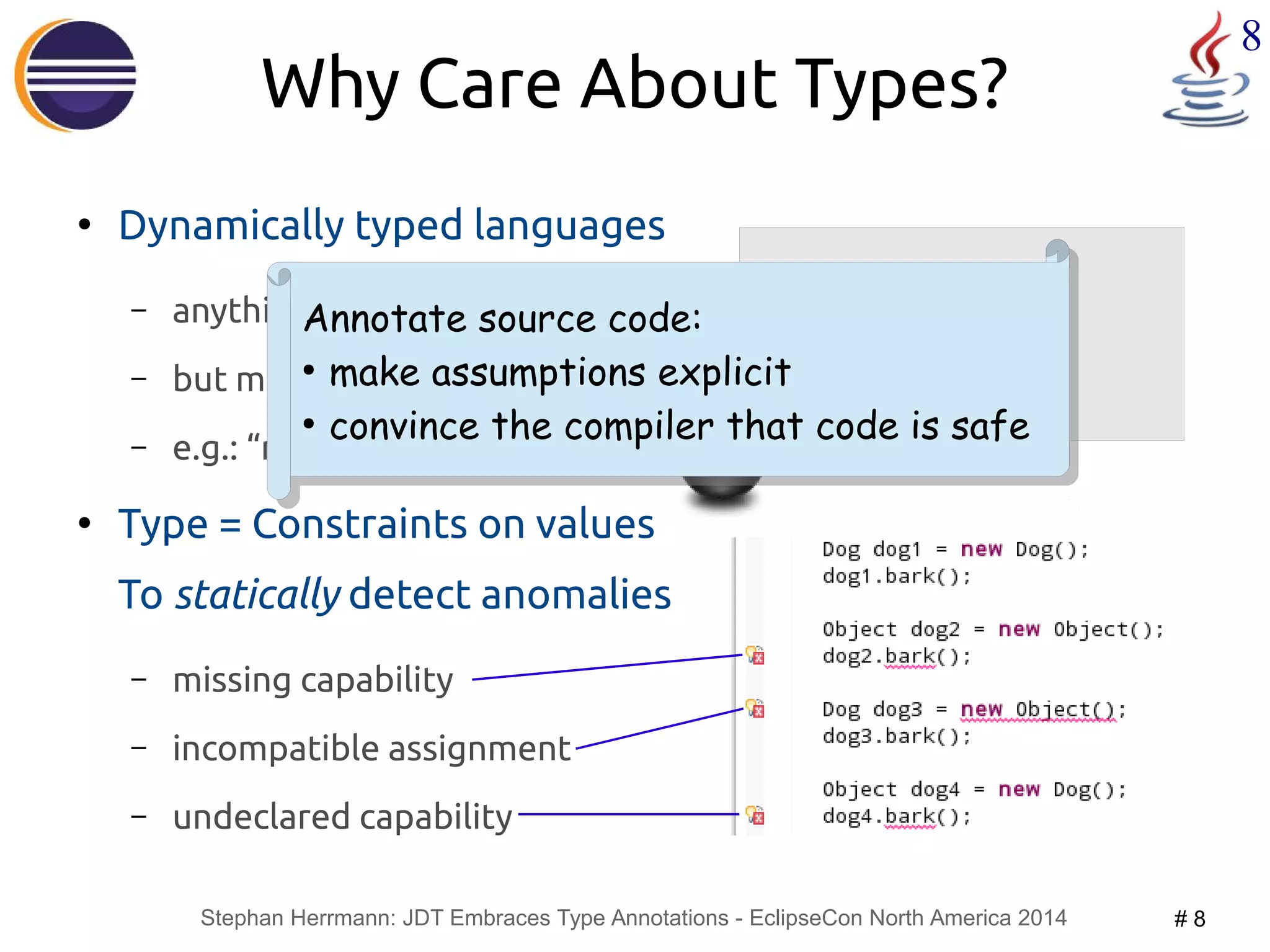
Annotate source code: 
● make assumptions explicit 
● convince the compiler that code is safe 
Stephan Herrmann: JDT Embraces Type Annotations - EclipseCon North America 2014 # 8 
8 
Why Care About Types? 
● Dynamically typed languages 
– anything goes 
– but may fail at runtime 
– e.g.: “method not understood” 
● Type = Constraints on values 
To statically detect anomalies 
– missing capability 
– incompatible assignment 
– undeclared capability 
dog1 = new Dog(); 
dog1.bark(); 
dog2 = new Object(); 
dog2.bark(); 
Annotate source code: 
● make assumptions explicit 
● convince the compiler that code is safe
Stephan Herrmann: JDT Embraces Type Annotations - EclipseCon North America 2014 # 9 
8 
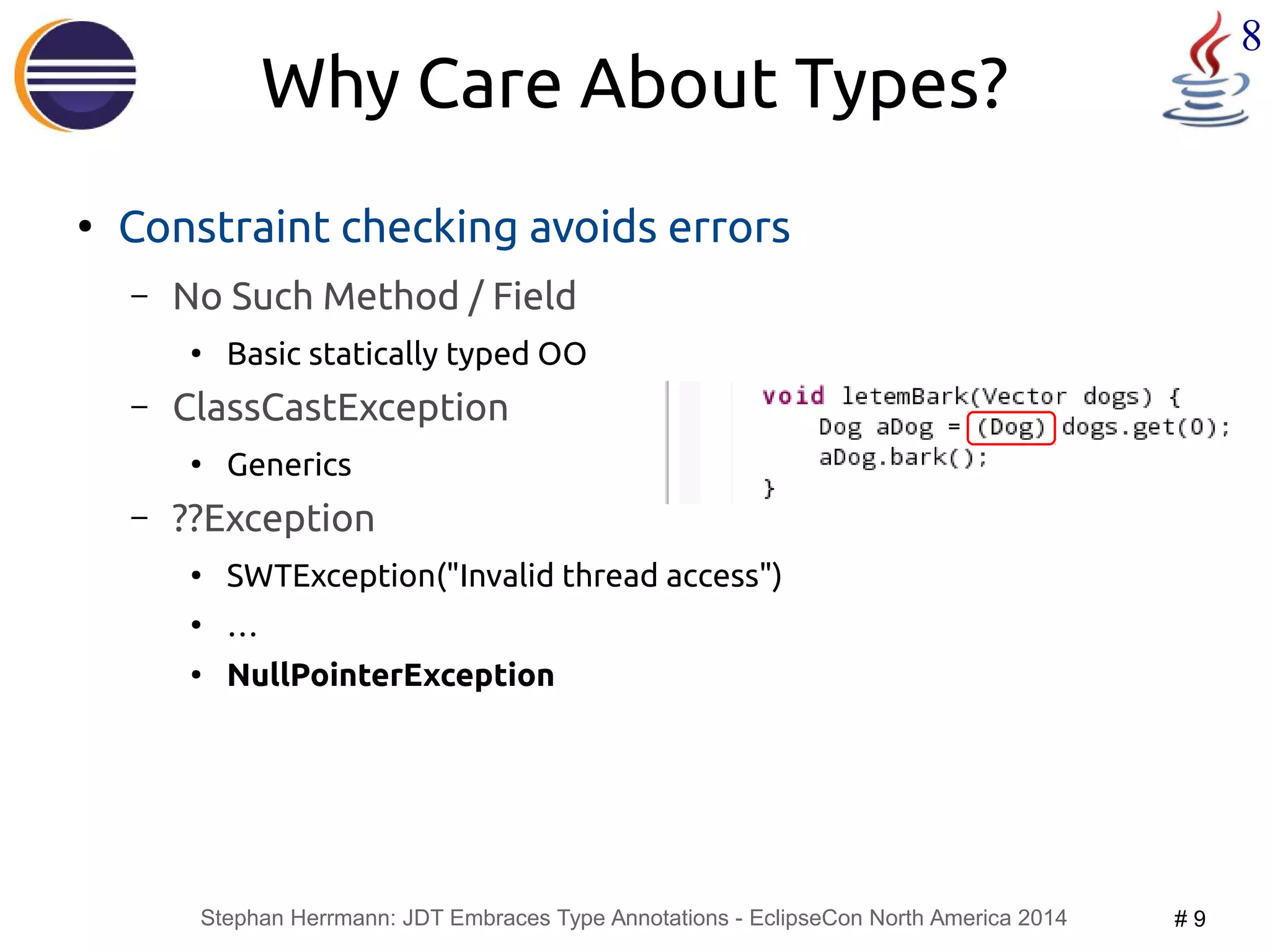
Why Care About Types? 
● Constraint checking avoids errors 
– No Such Method / Field 
● Basic statically typed OO 
– ClassCastException 
● Generics 
– ??Exception 
● SWTException("Invalid thread access") 
● … 
● NullPointerException
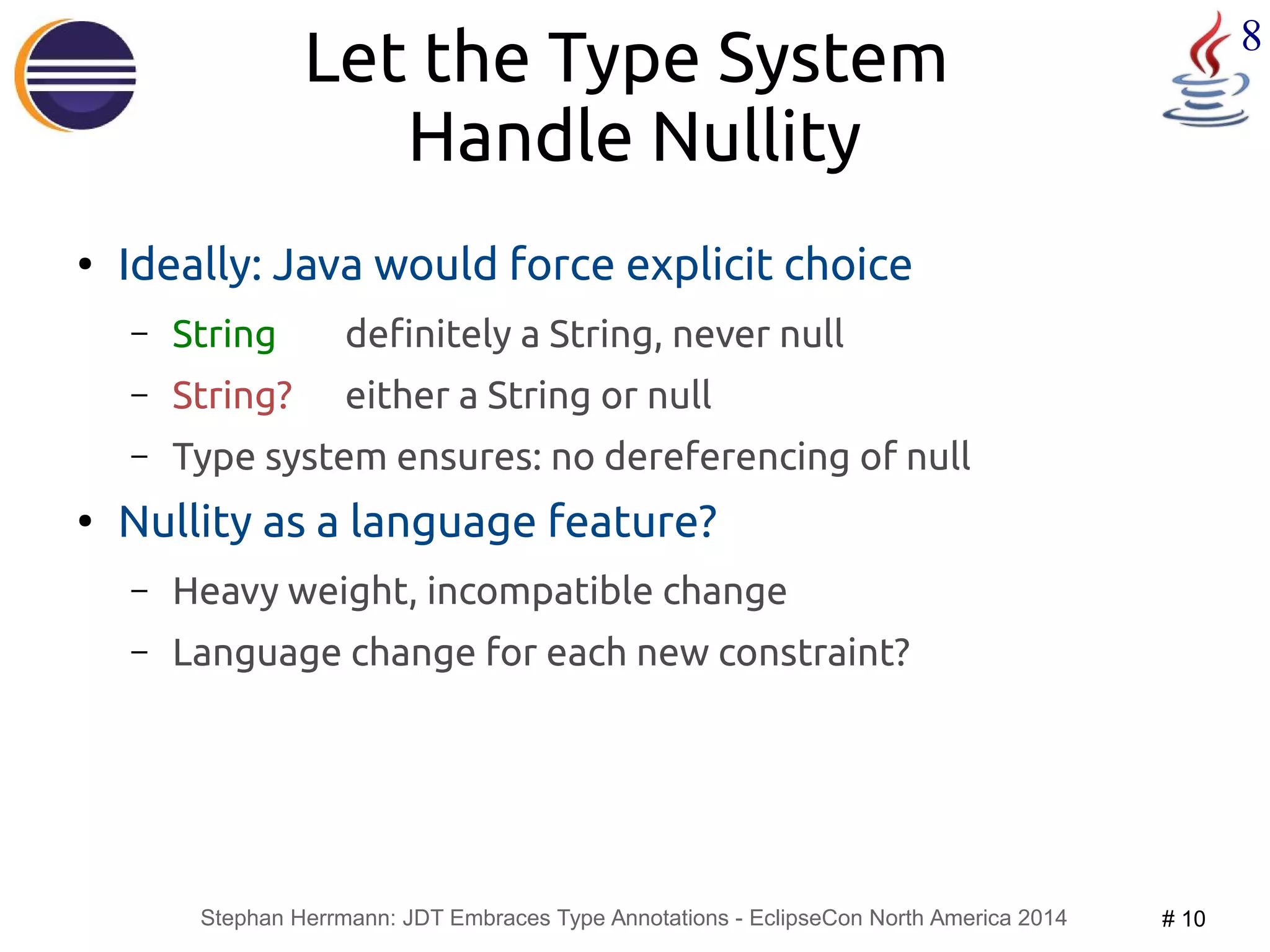
Let the Type System 8 
Handle Nullity 
● Ideally: Java would force explicit choice 
– String definitely a String, never null 
– String? either a String or null 
– Type system ensures: no dereferencing of null 
● Nullity as a language feature? 
– Heavy weight, incompatible change 
– Language change for each new constraint? 
Stephan Herrmann: JDT Embraces Type Annotations - EclipseCon North America 2014 # 10
Stephan Herrmann: JDT Embraces Type Annotations - EclipseCon North America 2014 # 11 
8 
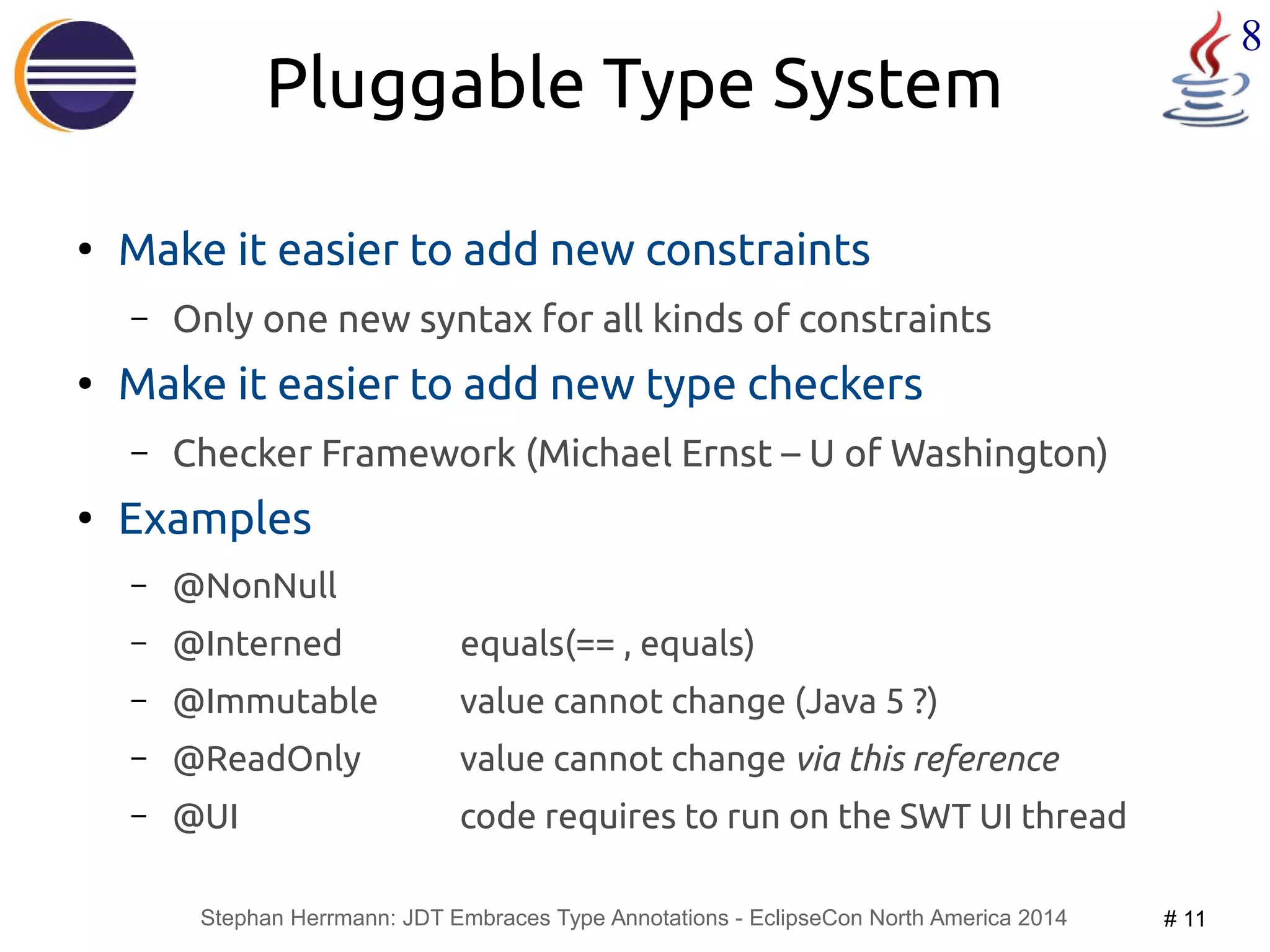
Pluggable Type System 
● Make it easier to add new constraints 
– Only one new syntax for all kinds of constraints 
● Make it easier to add new type checkers 
– Checker Framework (Michael Ernst – U of Washington) 
● Examples 
– @NonNull 
– @Interned equals(== , equals) 
– @Immutable value cannot change (Java 5 ?) 
– @ReadOnly value cannot change via this reference 
– @UI code requires to run on the SWT UI thread
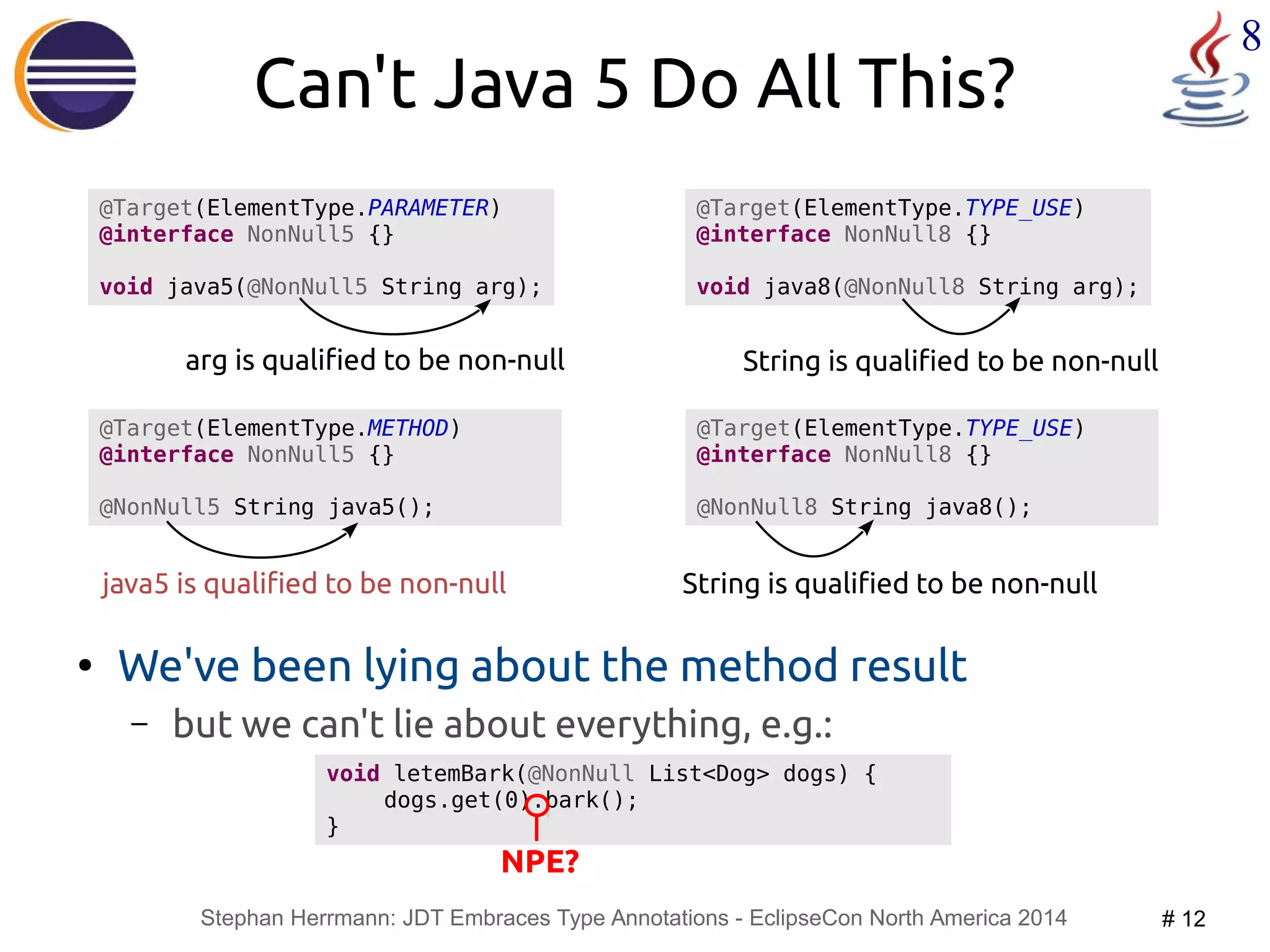
Can't Java 5 Do All This? 
@Target(ElementType.PARAMETER) 
@interface NonNull5 {} 
void java5(@NonNull5 String arg); 
arg is qualified to be non-null 
@Target(ElementType.TYPE_USE) 
@interface NonNull8 {} 
void java8(@NonNull8 String arg); 
String is qualified to be non-null 
@Target(ElementType.METHOD) 
@interface NonNull5 {} 
@NonNull5 String java5(); 
String is java5 is qualified to be non-null qualified to be non-null 
Stephan Herrmann: JDT Embraces Type Annotations - EclipseCon North America 2014 # 12 
8 
@Target(ElementType.TYPE_USE) 
@interface NonNull8 {} 
@NonNull8 String java8(); 
● We've been lying about the method result 
– but we can't lie about everything, e.g.: 
void letemBark(@NonNull List<Dog> dogs) { 
dogs.get(0).bark(); 
} 
NPE?
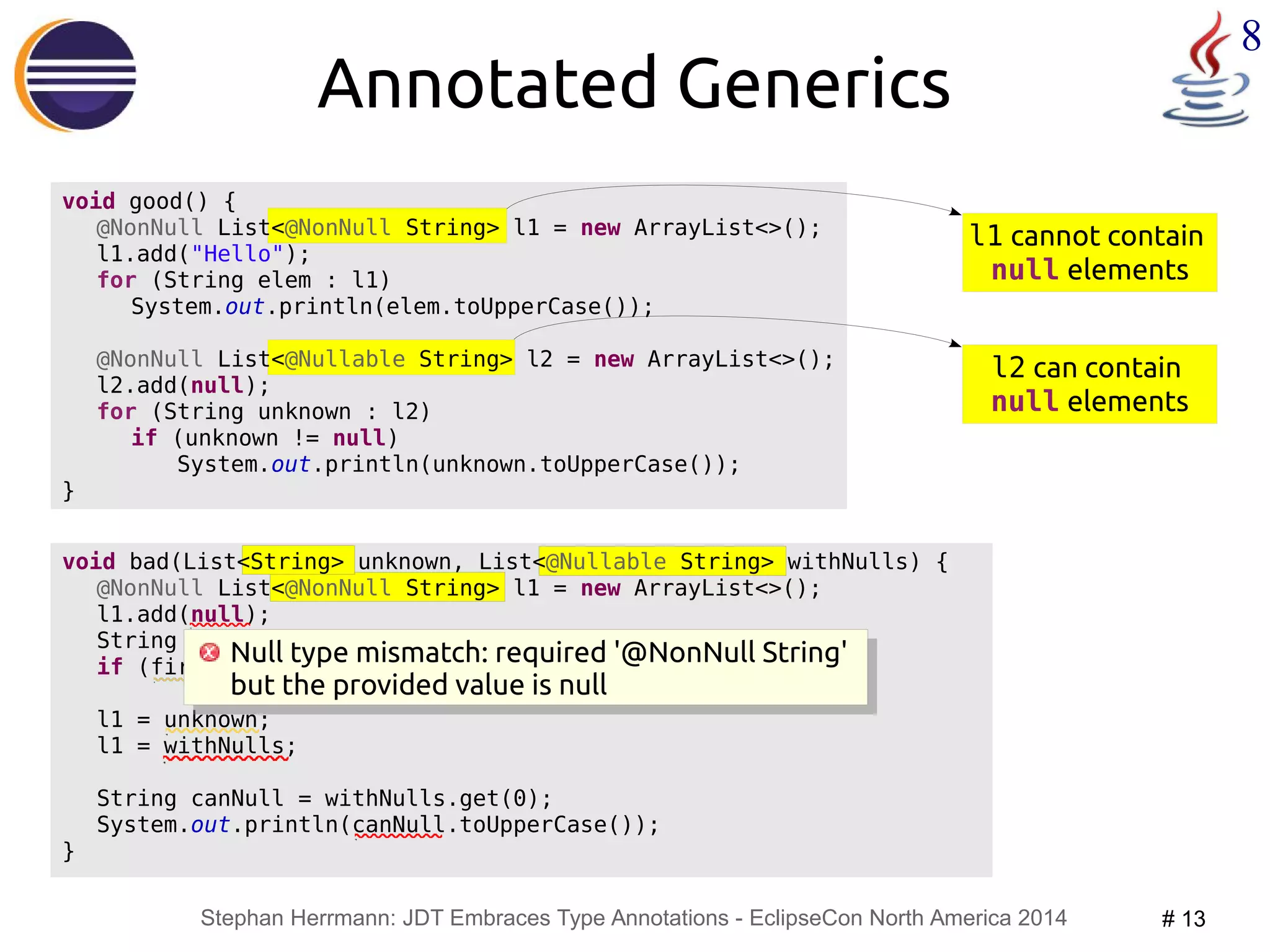
l1 cannot contain 
null elements 
Null type mismatch: required '@NonNull String' 
but the provided value is null 
Stephan Herrmann: JDT Embraces Type Annotations - EclipseCon North America 2014 # 13 
8 
void bad(List<String> unknown, List<@Nullable String> withNulls) { 
@NonNull List<@NonNull String> l1 = new ArrayList<>(); 
l1.add(null); 
String first = l1.get(0); 
if (first == null) return; 
l1 = unknown; 
l1 = withNulls; 
String canNull = withNulls.get(0); 
System.out.println(canNull.toUpperCase()); 
} 
@NonNull List<@Nullable String> l2 = new ArrayList<>(); 
l2 can contain 
null elements 
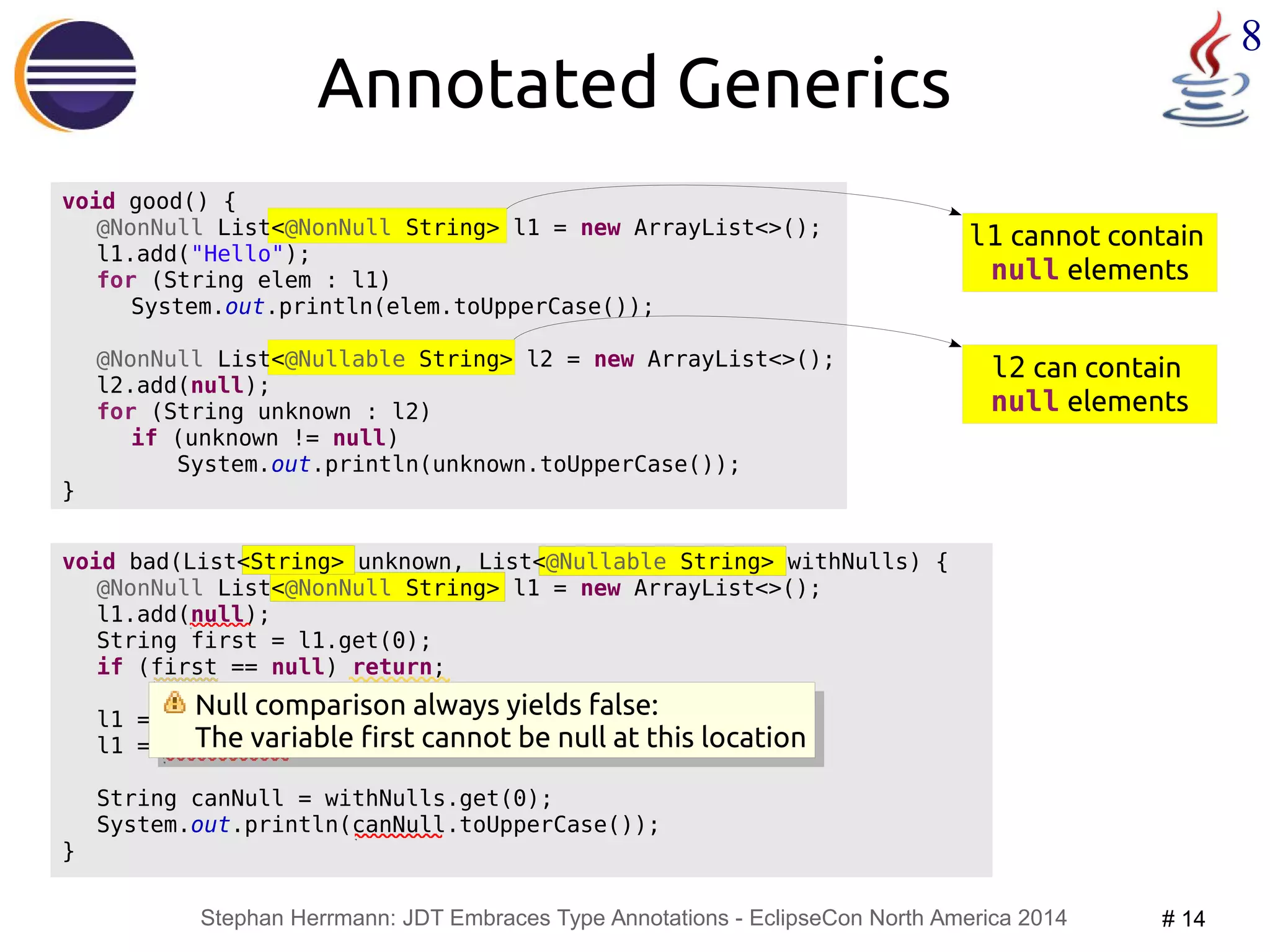
Annotated Generics 
void good() { 
@NonNull List<@NonNull String> l1 = new ArrayList<>(); 
l1.add("Hello"); 
for (String elem : l1) 
System.out.println(elem.toUpperCase()); 
l2.add(null); 
for (String unknown : l2) 
if (unknown != null) 
System.out.println(unknown.toUpperCase()); 
} 
Null type mismatch: required '@NonNull String' 
but the provided value is null
l1 cannot contain 
null elements 
Null comparison always yields false: 
The variable first cannot be null at this location 
Stephan Herrmann: JDT Embraces Type Annotations - EclipseCon North America 2014 # 14 
8 
void bad(List<String> unknown, List<@Nullable String> withNulls) { 
@NonNull List<@NonNull String> l1 = new ArrayList<>(); 
l1.add(null); 
String first = l1.get(0); 
if (first == null) return; 
l1 = unknown; 
l1 = withNulls; 
String canNull = withNulls.get(0); 
System.out.println(canNull.toUpperCase()); 
} 
@NonNull List<@Nullable String> l2 = new ArrayList<>(); 
l2 can contain 
null elements 
Annotated Generics 
void good() { 
@NonNull List<@NonNull String> l1 = new ArrayList<>(); 
l1.add("Hello"); 
for (String elem : l1) 
System.out.println(elem.toUpperCase()); 
l2.add(null); 
for (String unknown : l2) 
if (unknown != null) 
System.out.println(unknown.toUpperCase()); 
} 
Null comparison always yields false: 
The variable first cannot be null at this location
l1 cannot contain 
null elements 
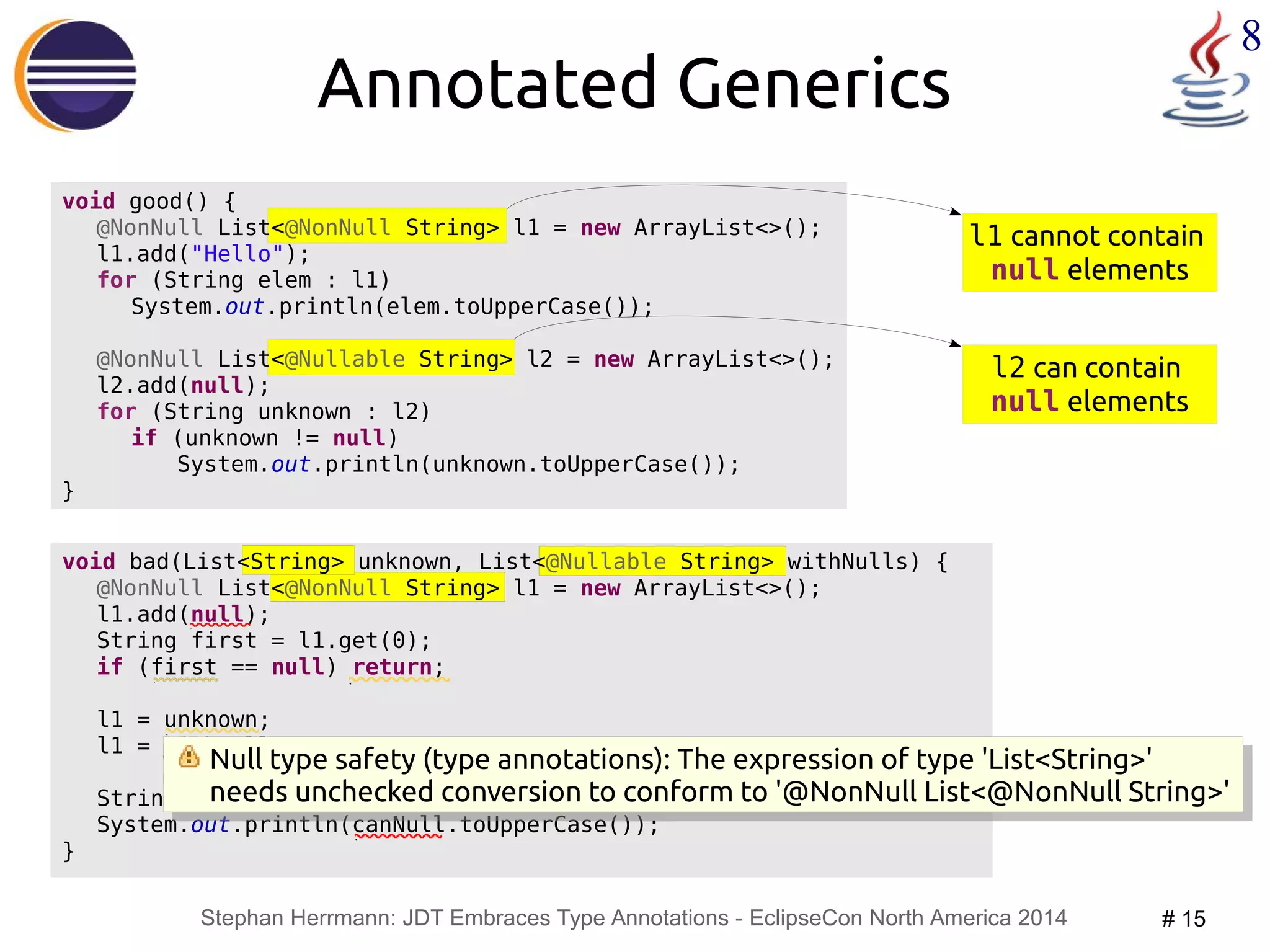
Null type safety (type annotations): The expression of type 'List<String>' 
needs unchecked conversion to conform to '@NonNull List<@NonNull String>' 
Stephan Herrmann: JDT Embraces Type Annotations - EclipseCon North America 2014 # 15 
8 
void bad(List<String> unknown, List<@Nullable String> withNulls) { 
@NonNull List<@NonNull String> l1 = new ArrayList<>(); 
l1.add(null); 
String first = l1.get(0); 
if (first == null) return; 
l1 = unknown; 
l1 = withNulls; 
String canNull = withNulls.get(0); 
System.out.println(canNull.toUpperCase()); 
} 
@NonNull List<@Nullable String> l2 = new ArrayList<>(); 
l2 can contain 
null elements 
Annotated Generics 
void good() { 
@NonNull List<@NonNull String> l1 = new ArrayList<>(); 
l1.add("Hello"); 
for (String elem : l1) 
System.out.println(elem.toUpperCase()); 
l2.add(null); 
for (String unknown : l2) 
if (unknown != null) 
System.out.println(unknown.toUpperCase()); 
} 
Null type safety (type annotations): The expression of type 'List<String>' 
needs unchecked conversion to conform to '@NonNull List<@NonNull String>'
l1 cannot contain 
null elements 
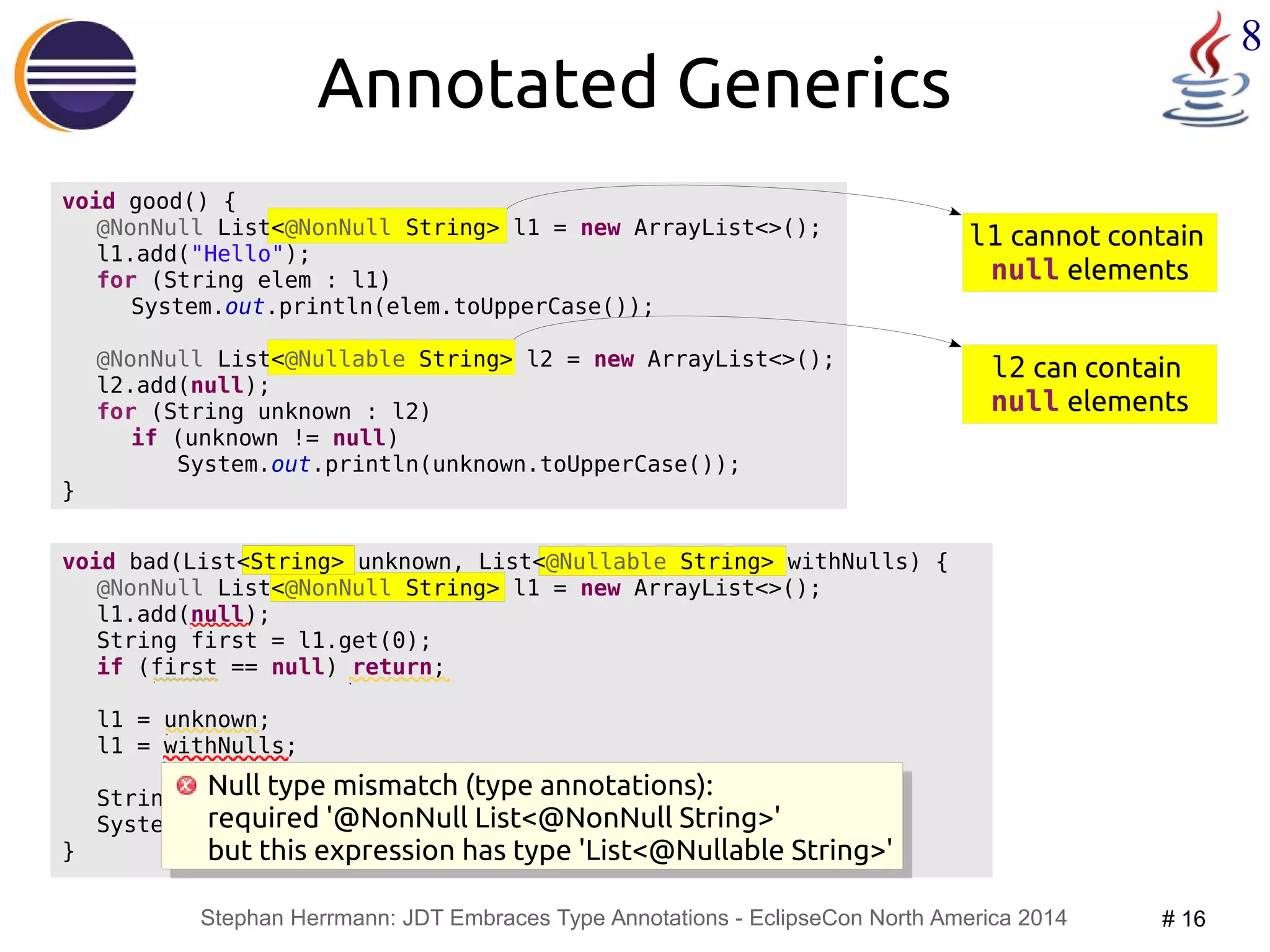
Null type mismatch (type annotations): 
required '@NonNull List<@NonNull String>' 
but this expression has type 'List<@Nullable String>' 
Stephan Herrmann: JDT Embraces Type Annotations - EclipseCon North America 2014 # 16 
8 
void bad(List<String> unknown, List<@Nullable String> withNulls) { 
@NonNull List<@NonNull String> l1 = new ArrayList<>(); 
l1.add(null); 
String first = l1.get(0); 
if (first == null) return; 
l1 = unknown; 
l1 = withNulls; 
String canNull = withNulls.get(0); 
System.out.println(canNull.toUpperCase()); 
} 
@NonNull List<@Nullable String> l2 = new ArrayList<>(); 
l2 can contain 
null elements 
Annotated Generics 
void good() { 
@NonNull List<@NonNull String> l1 = new ArrayList<>(); 
l1.add("Hello"); 
for (String elem : l1) 
System.out.println(elem.toUpperCase()); 
l2.add(null); 
for (String unknown : l2) 
if (unknown != null) 
System.out.println(unknown.toUpperCase()); 
} 
Null type mismatch (type annotations): 
required '@NonNull List<@NonNull String>' 
but this expression has type 'List<@Nullable String>'
l1 cannot contain 
null elements 
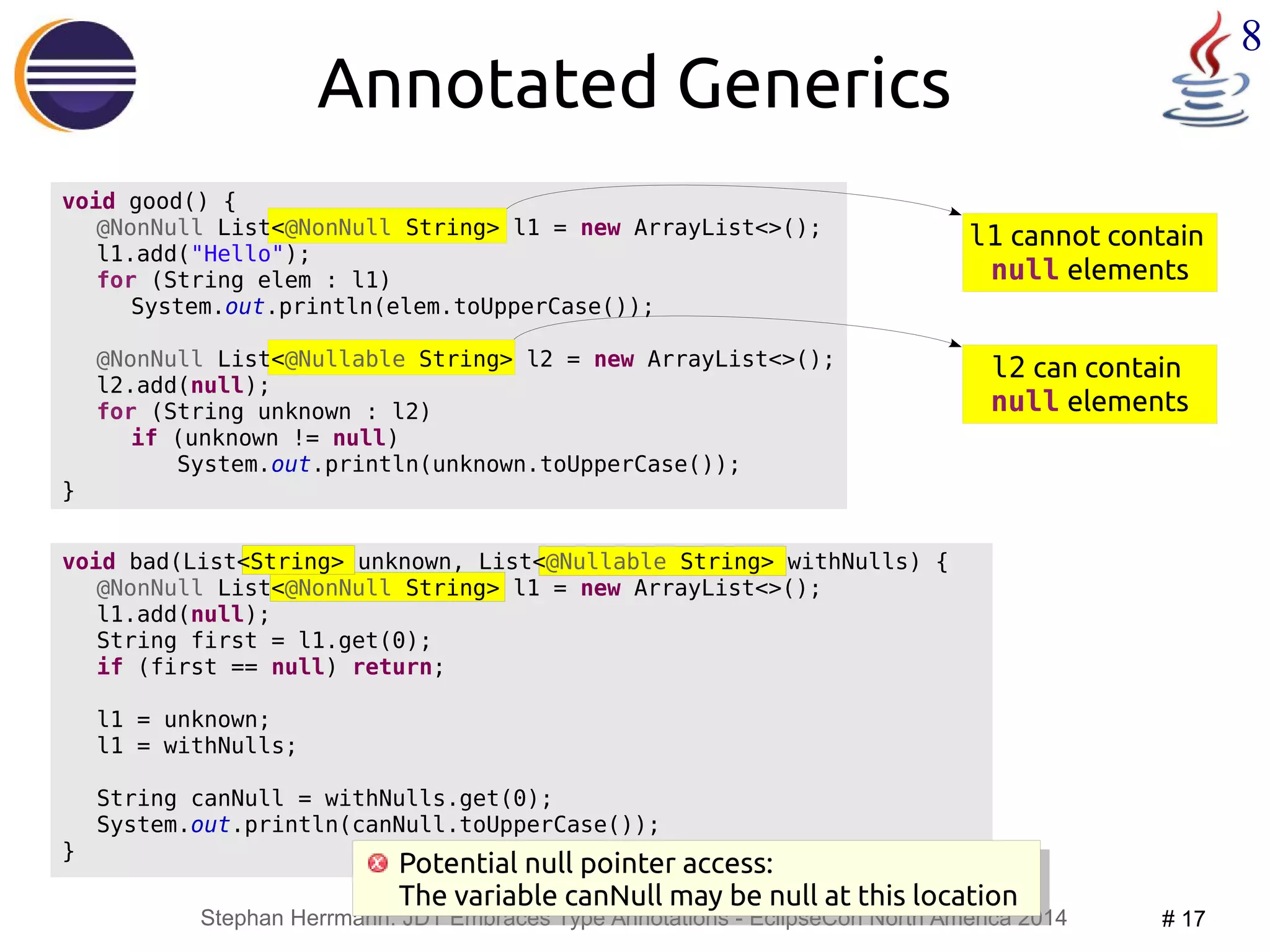
Potential null pointer access: 
The variable canNull may be null at this location 
Stephan Herrmann: JDT Embraces Type Annotations - EclipseCon North America 2014 # 17 
8 
void bad(List<String> unknown, List<@Nullable String> withNulls) { 
@NonNull List<@NonNull String> l1 = new ArrayList<>(); 
l1.add(null); 
String first = l1.get(0); 
if (first == null) return; 
l1 = unknown; 
l1 = withNulls; 
String canNull = withNulls.get(0); 
System.out.println(canNull.toUpperCase()); 
} 
@NonNull List<@Nullable String> l2 = new ArrayList<>(); 
l2 can contain 
null elements 
Annotated Generics 
void good() { 
@NonNull List<@NonNull String> l1 = new ArrayList<>(); 
l1.add("Hello"); 
for (String elem : l1) 
System.out.println(elem.toUpperCase()); 
l2.add(null); 
for (String unknown : l2) 
if (unknown != null) 
System.out.println(unknown.toUpperCase()); 
} 
Potential null pointer access: 
The variable canNull may be null at this location
Stephan Herrmann: JDT Embraces Type Annotations - EclipseCon North America 2014 # 18 
8 
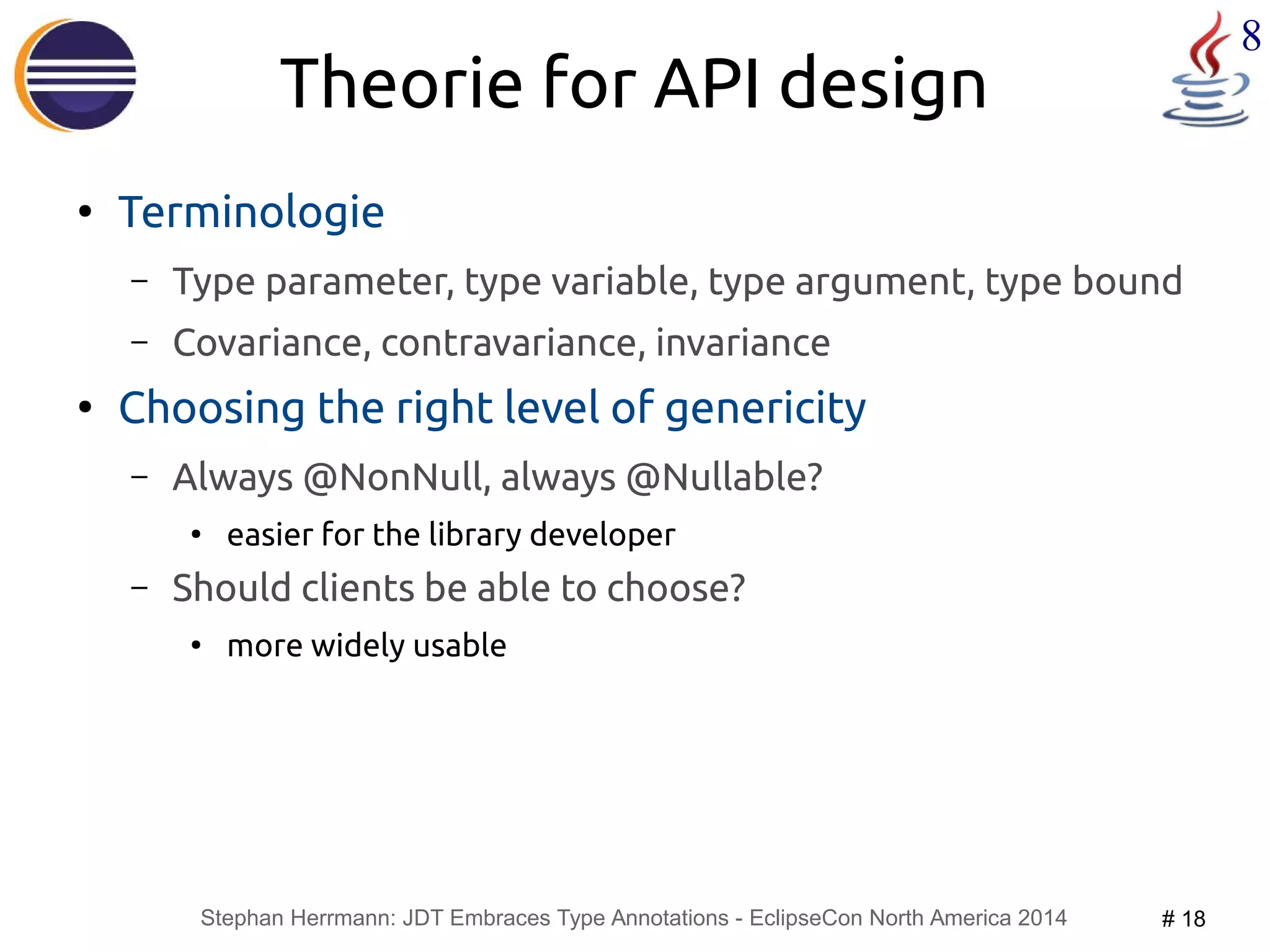
Theorie for API design 
● Terminologie 
– Type parameter, type variable, type argument, type bound 
– Covariance, contravariance, invariance 
● Choosing the right level of genericity 
– Always @NonNull, always @Nullable? 
● easier for the library developer 
– Should clients be able to choose? 
● more widely usable
Stephan Herrmann: JDT Embraces Type Annotations - EclipseCon North America 2014 # 19 
8 
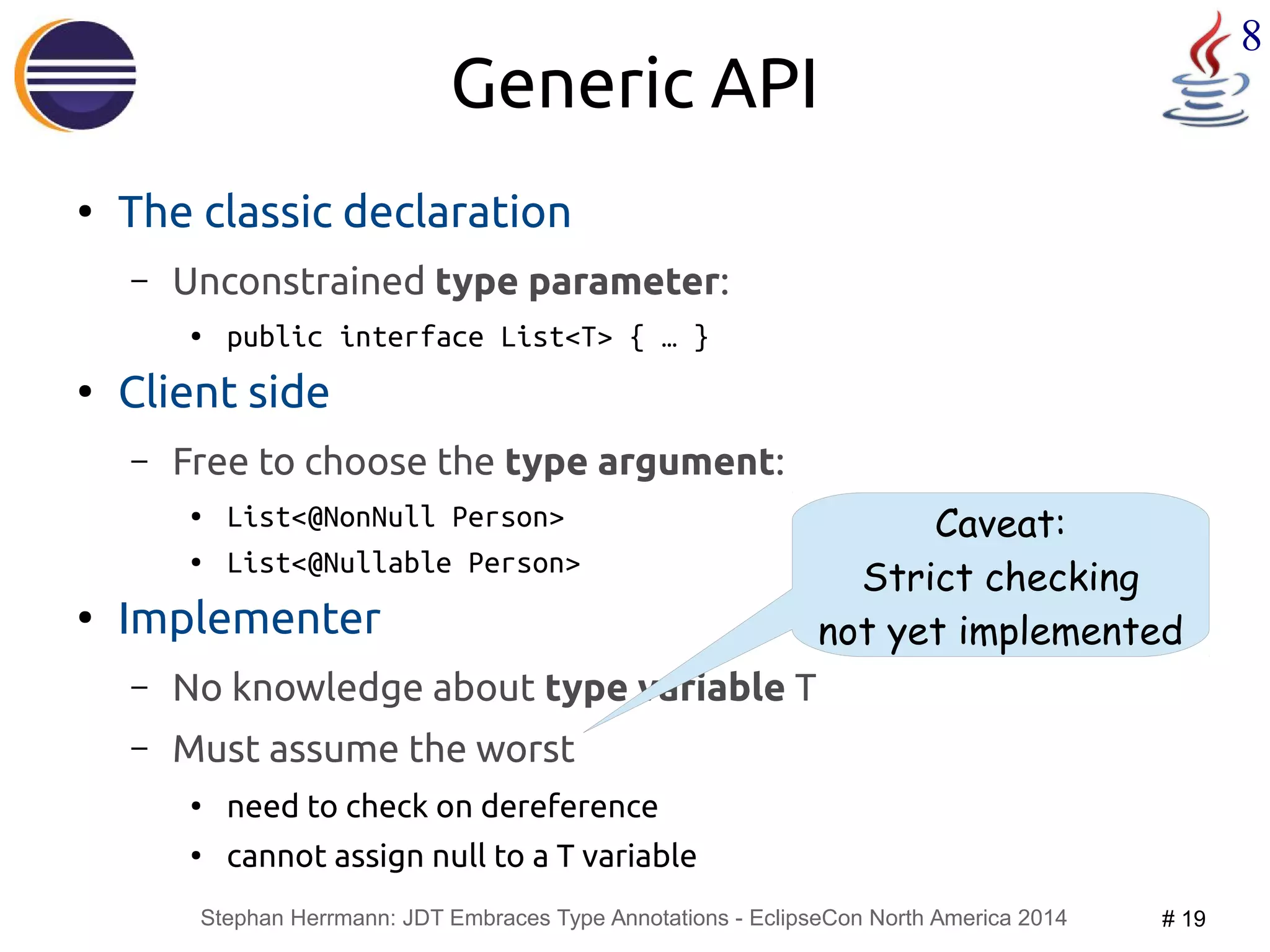
Generic API 
● The classic declaration 
– Unconstrained type parameter: 
● public interface List<T> { … } 
● Client side 
– Free to choose the type argument: 
● List<@NonNull Person> 
● List<@Nullable Person> 
● Implementer 
– No knowledge about type variable T 
– Must assume the worst 
● need to check on dereference 
● cannot assign null to a T variable 
Caveat: 
Strict checking 
not yet implemented
Stephan Herrmann: JDT Embraces Type Annotations - EclipseCon North America 2014 # 20 
8 
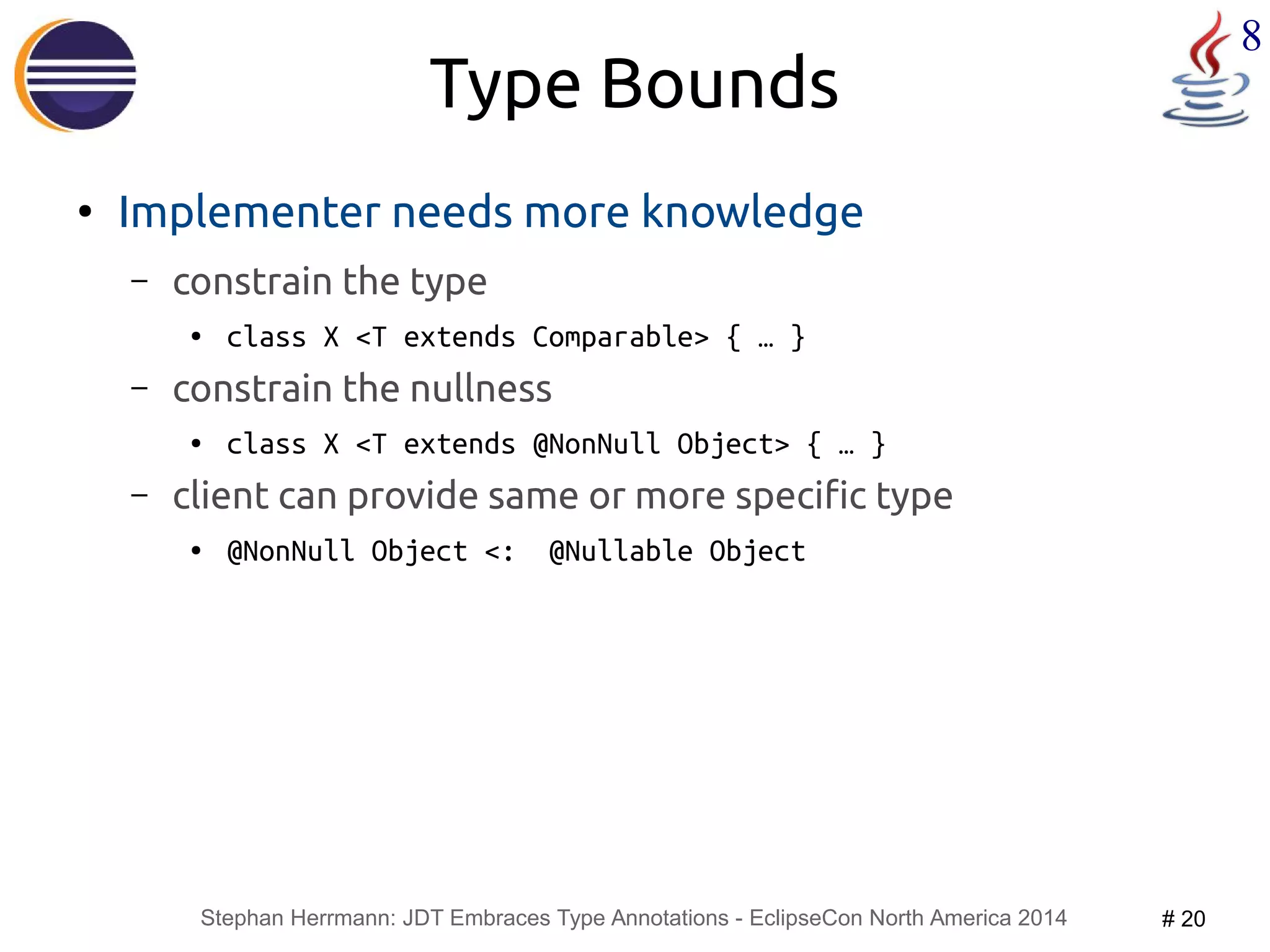
Type Bounds 
● Implementer needs more knowledge 
– constrain the type 
● class X <T extends Comparable> { … } 
– constrain the nullness 
● class X <T extends @NonNull Object> { … } 
– client can provide same or more specific type 
● @NonNull Object <: @Nullable Object
Stephan Herrmann: JDT Embraces Type Annotations - EclipseCon North America 2014 # 21 
8 
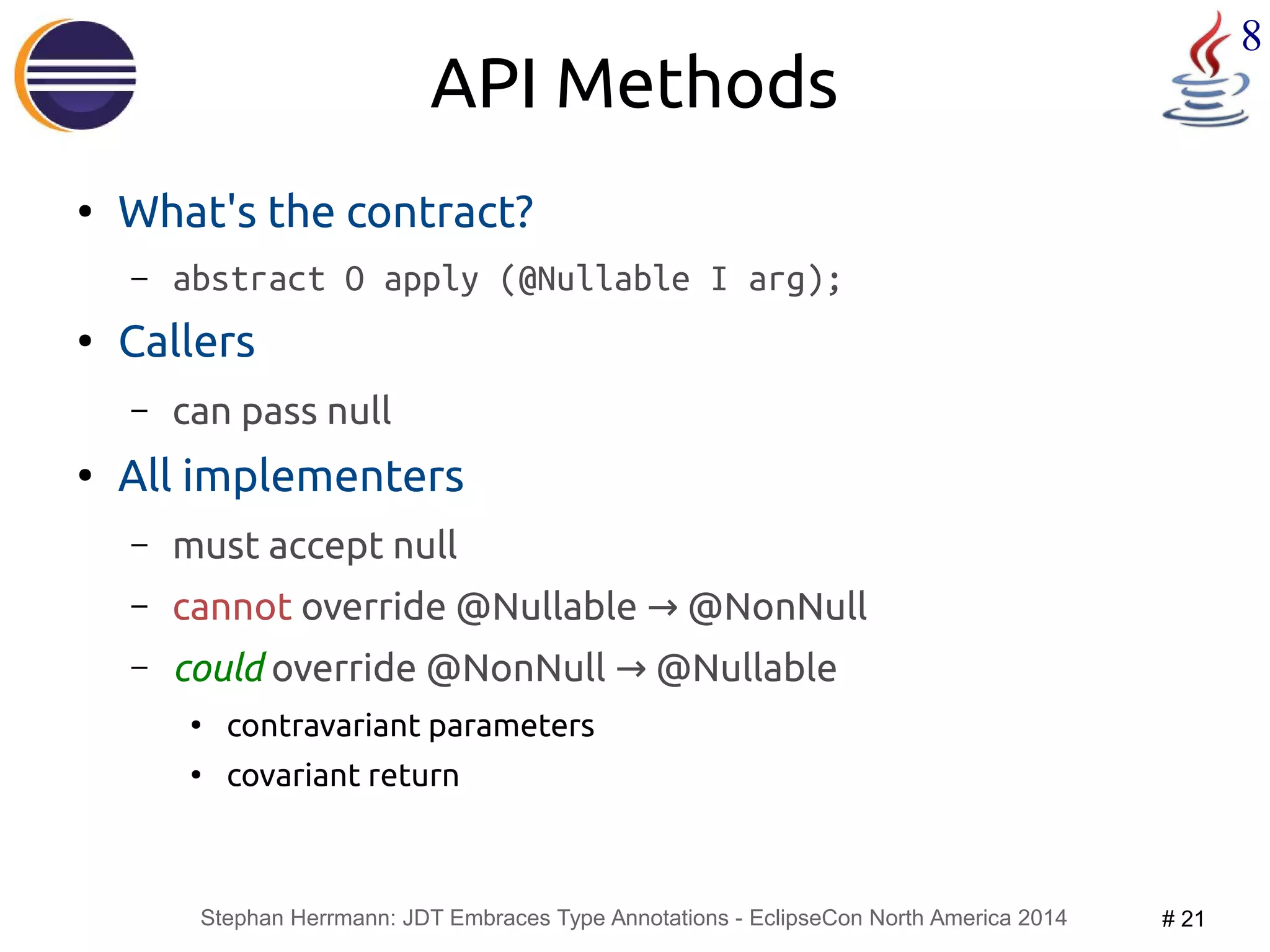
API Methods 
● What's the contract? 
– abstract O apply (@Nullable I arg); 
● Callers 
– can pass null 
● All implementers 
– must accept null 
– cannot override @Nullable → @NonNull 
– could override @NonNull → @Nullable 
● contravariant parameters 
● covariant return
Stephan Herrmann: JDT Embraces Type Annotations - EclipseCon North America 2014 # 22 
8 
What does it cost? 
● How many additional annotations? 
– will code become unreadable due to null annotations? 
● We have 2 strong mechanisms to alleviate the burden 
DDeemmoo TTiimmee
void test (@NonNull String [] stringsOrNulls) { 
System.out.println(stringsOrNulls[0]); 
Stephan Herrmann: JDT Embraces Type Annotations - EclipseCon North America 2014 # 23 
8 
Caveat: Arrays 
● Semantics are changing from Java 7 to Java 8 
} 
array of nonnull elements the array can still be null Þ NPE 
void test (String @NonNull [] stringsOrNulls) { 
System.out.println(stringsOrNulls[0]); 
} 
nonnull array NPE- safe (but may print “null”)
Stephan Herrmann: JDT Embraces Type Annotations - EclipseCon North America 2014 # 24 
8 
More Type Annotations
Stephan Herrmann: JDT Embraces Type Annotations - EclipseCon North America 2014 # 25 
8 
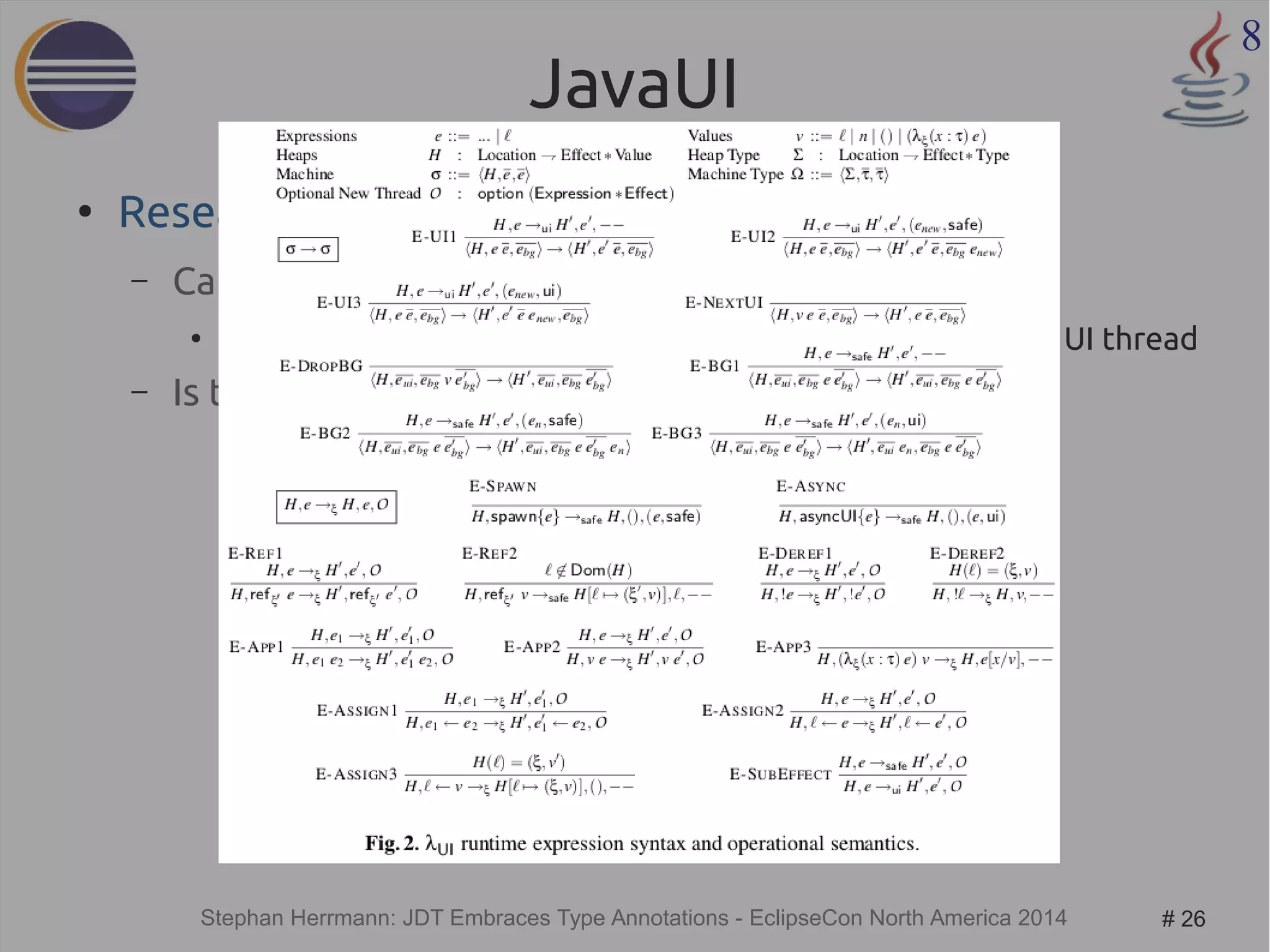
JavaUI 
● Research by Colin Gordon et al 
– Statically check that 
● code needing access to the SWT display is called from the UI thread 
– Is the approach safe?
Stephan Herrmann: JDT Embraces Type Annotations - EclipseCon North America 2014 # 26 
8 
JavaUI 
● Research by Colin Gordon et al 
– Can we statically check that 
● code needing access to the SWT display is called from the UI thread 
– Is the approach safe?
Stephan Herrmann: JDT Embraces Type Annotations - EclipseCon North America 2014 # 27 
8 
JavaUI 
● Research by Colin Gordon et al 
– To statically check that 
● code needing access to the SWT display is called from the UI thread 
– Is the approach safe? 
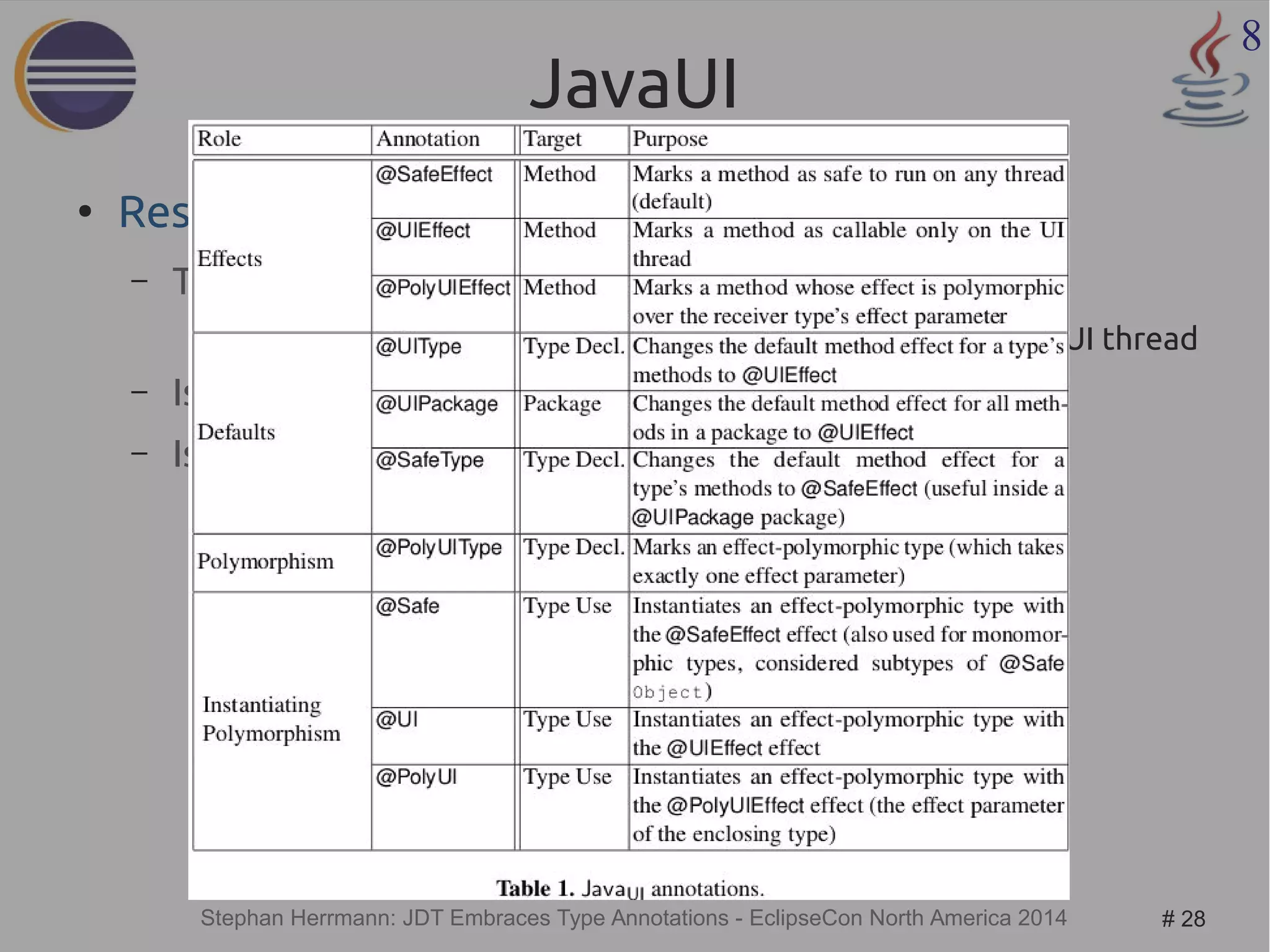
– Is it practical?
Stephan Herrmann: JDT Embraces Type Annotations - EclipseCon North America 2014 # 28 
8 
JavaUI 
● Research by Colin Gordon et al 
– To statically check that 
● code needing access to the SWT display is called from the UI thread 
– Is the approach safe? 
– Is it practical?
Stephan Herrmann: JDT Embraces Type Annotations - EclipseCon North America 2014 # 29 
8 
JavaUI 
● Research by Colin Gordon et al 
– To statically check that 
● code needing access to the SWT display is called from the UI thread 
– Is the approach safe? 
– Is it practical? 
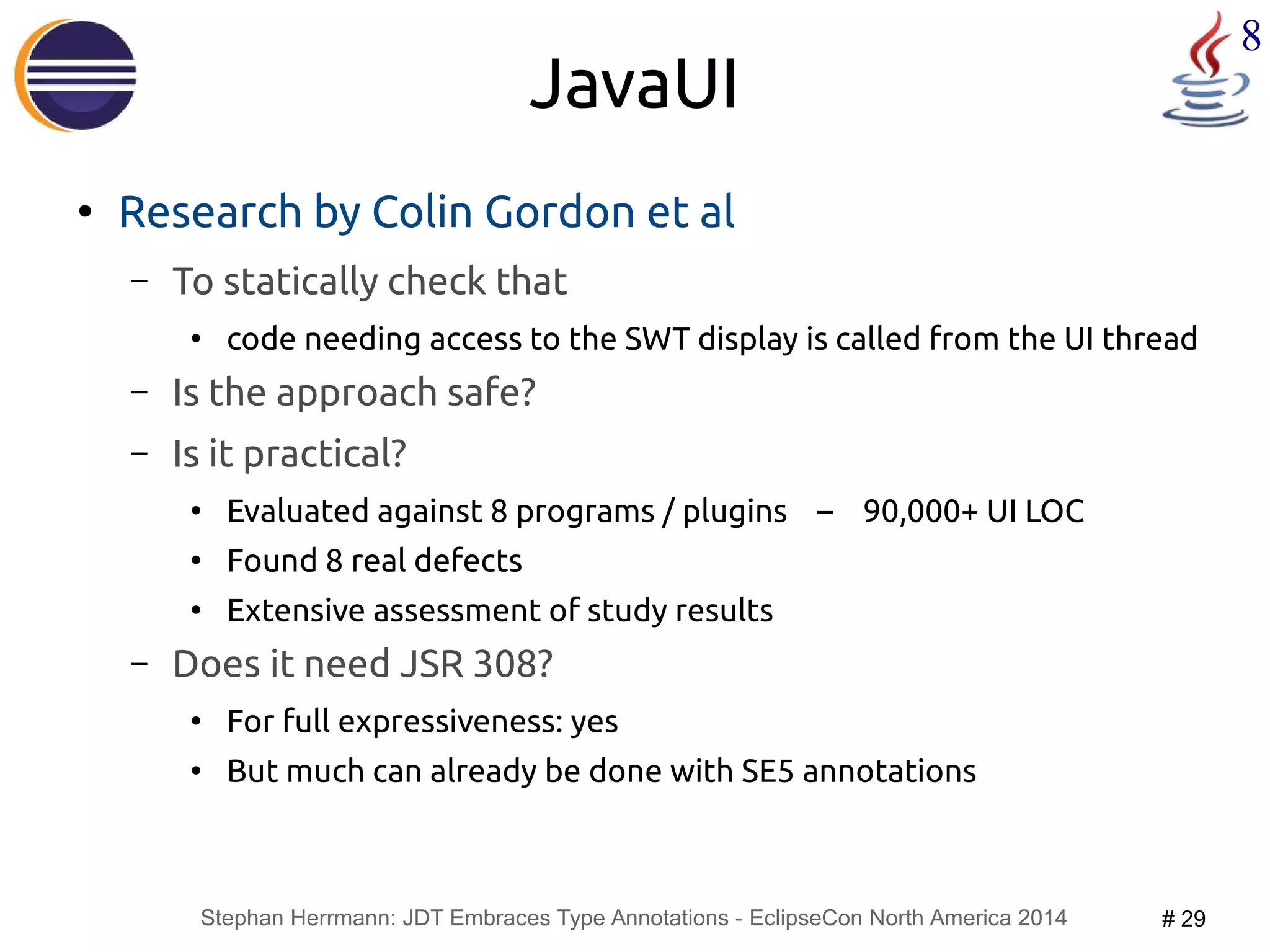
● Evaluated against 8 programs / plugins – 90,000+ UI LOC 
● Found 8 real defects 
● Extensive assessment of study results 
– Does it need JSR 308? 
● For full expressiveness: yes 
● But much can already be done with SE5 annotations
aka “Symbol” 
Stephan Herrmann: JDT Embraces Type Annotations - EclipseCon North America 2014 # 30 
8 
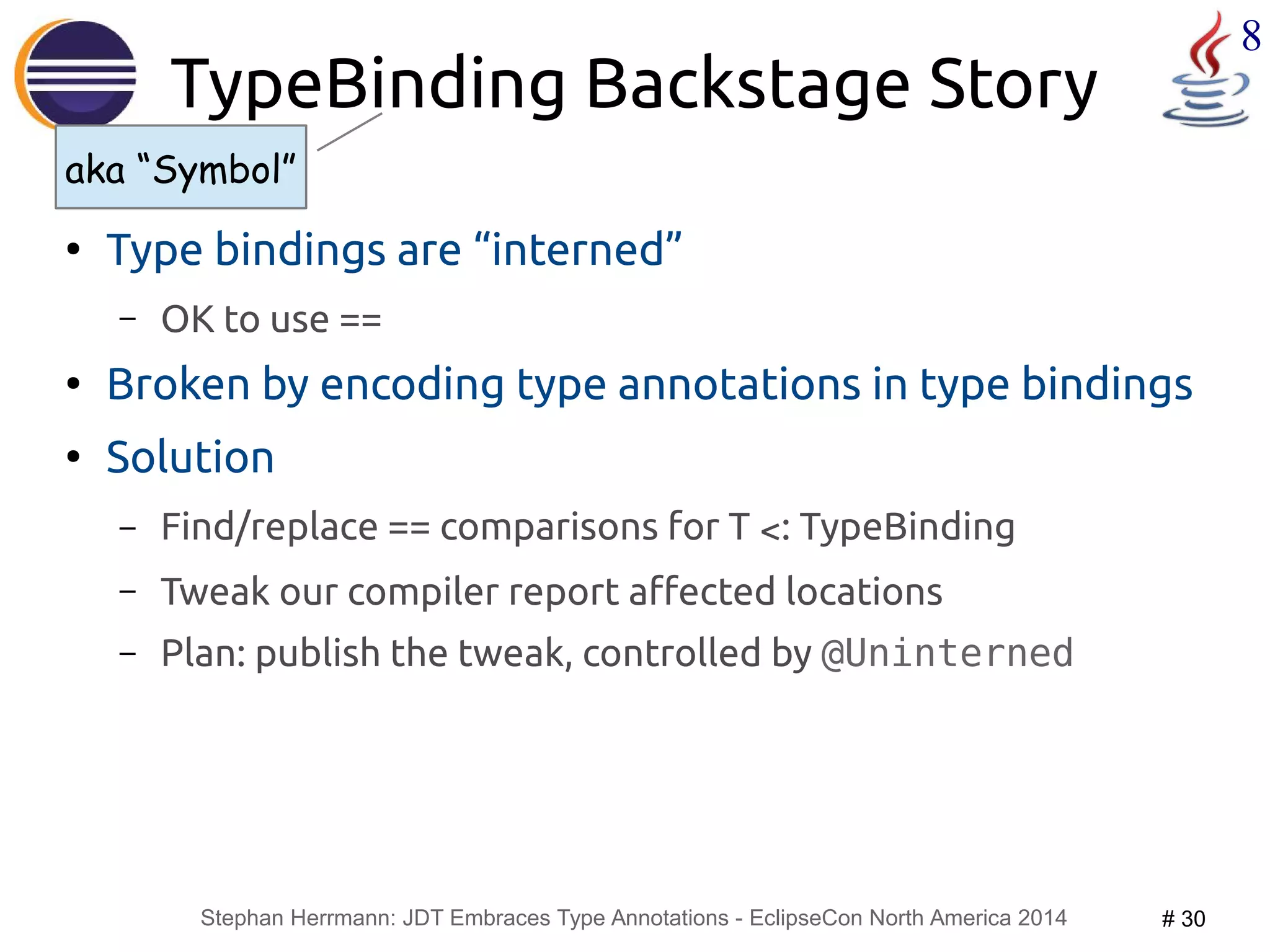
TypeBinding Backstage Story 
● Type bindings are “interned” 
– OK to use == 
● Broken by encoding type annotations in type bindings 
● Solution 
– Find/replace == comparisons for T <: TypeBinding 
– Tweak our compiler report affected locations 
– Plan: publish the tweak, controlled by @Uninterned
Stephan Herrmann: JDT Embraces Type Annotations - EclipseCon North America 2014 # 31 
8 
Status 
● Null Annotations 
– org.eclipse.jdt.annotation_2.0.0 
● @NonNull, @Nullable specify Target(TYPE_USE) 
● @NonNullByDefault: more fine tuning 
● Null Analysis (per compiler option) 
– Nullness is an integral part of the type system 
– Fine tuned defaults only in Luna 
– TODO: Strict checking against type variables
Stephan Herrmann: JDT Embraces Type Annotations - EclipseCon North America 2014 # 32 
8 
Status 
● Null Annotations 
● Null Analysis (per compiler option) 
● Planned: @Uninterned 
– Detect accidental comparison using == or != 
● Proposed: @UiEffect, @Ui … 
– by [Colin S. Gordon, Werner Dietl, Michael D. Ernst, and Dan 
Grossman] 
– SWT: bye, bye, “Invalid thread access”
Stephan Herrmann: JDT Embraces Type Annotations - EclipseCon North America 2014 # 33 
8 
Status 
● Null Annotations 
● Null Analysis (per compiler option) 
● Planned: @Uninterned 
● Proposed: @UiEffect, @Ui … 
● JDT/UI 
– OK: completion, refactoring, etc. 
– TODO: show in hover 
– TODO: update / add more quickfixes
Stephan Herrmann: JDT Embraces Type Annotations - EclipseCon North America 2014 # 34 
8 
Status 
● Null Annotations 
● Null Analysis (per compiler option) 
● Planned: @Uninterned 
● Proposed: @UiEffect, @Ui … 
● JDT/UI 
DDoo YYoouu ccaarree aabboouutt TTyyppeess??
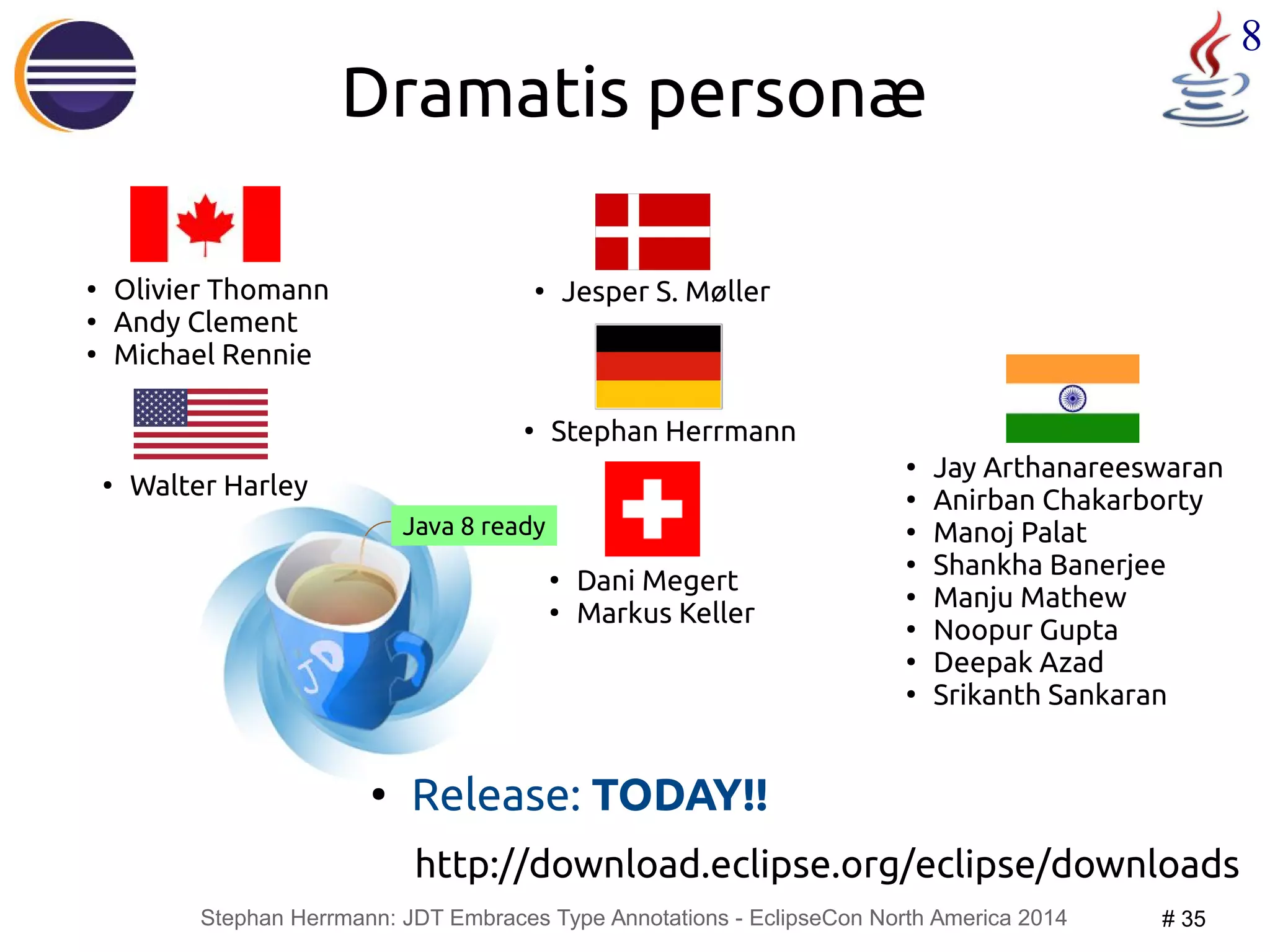
Dramatis personæ 
Stephan Herrmann: JDT Embraces Type Annotations - EclipseCon North America 2014 # 35 
8 
Java 8 ready 
● Jay Arthanareeswaran 
● Anirban Chakarborty 
● Manoj Palat 
● Shankha Banerjee 
● Manju Mathew 
● Noopur Gupta 
● Deepak Azad 
● Srikanth Sankaran 
● Olivier Thomann 
● Andy Clement 
● Michael Rennie 
● Jesper S. Møller 
● Walter Harley 
● Stephan Herrmann 
● Dani Megert 
● Markus Keller 
● Release: TODAY!! 
http://download.eclipse.org/eclipse/downloads

Annotation based null analysis in Eclipse JDT

  • 1.
    8 8 JJDDTTeemmbbrraacceess TTyyppee AAnnnnoottaattiioonnss Stephan Herrmann GK Software Java 8 ready
  • 2.
    Stephan Herrmann: JDTEmbraces Type Annotations - EclipseCon North America 2014 # 2 8 Eclipse and Java™ 8 ● Java 8 features supported: – JSR308 - Type Annotations. – JEP120 - Repeating Annotations. – JEP118 - Method Parameter Reflection. – JSR269 - Pluggable Annotation Processor API & javax.lang.model API enhancements for Java 8. – JSR 335 – Lambda Expressions ● Lambda expressions & method/constructor references ● Support for “code carrying” interface methods ● Enhanced target typing / new overload resolution & type inference
  • 3.
    Stephan Herrmann: JDTEmbraces Type Annotations - EclipseCon North America 2014 # 3 8 λ (JSR 335)
  • 4.
    Stephan Herrmann: JDTEmbraces Type Annotations - EclipseCon North America 2014 # 4 8 λ (JSR 335) Tomorrow 17:00 to 18:00: Grand Peninsula C JDT embraces lambda expressions ● Srikanth [IBM India] ● Noopur Gupta [IBM India] ● Stephan Herrmann
  • 5.
    Stephan Herrmann: JDTEmbraces Type Annotations - EclipseCon North America 2014 # 5 8 @ (JSR 308)
  • 6.
    Stephan Herrmann: JDTEmbraces Type Annotations - EclipseCon North America 2014 # 6 8 Annotations in more Places ● Java 5: annotate declarations – ElementType: packages, classes, fields, methods, locals … ● Java 8: annotate types – ElementType.TYPE_USE – ElementType.TYPE_PARAMETER SSoo wwhhaatt??
  • 7.
    Stephan Herrmann: JDTEmbraces Type Annotations - EclipseCon North America 2014 # 7 8 Why Care About Types? ● Dynamically typed languages – anything goes – but may fail at runtime – e.g.: “method not understood” ● Type = Constraints on values To statically detect anomalies – missing capability – incompatible assignment – undeclared capability dog1 = new Dog(); dog1.bark(); dog2 = new Object(); dog2.bark();
  • 8.
    Annotate source code: ● make assumptions explicit ● convince the compiler that code is safe Stephan Herrmann: JDT Embraces Type Annotations - EclipseCon North America 2014 # 8 8 Why Care About Types? ● Dynamically typed languages – anything goes – but may fail at runtime – e.g.: “method not understood” ● Type = Constraints on values To statically detect anomalies – missing capability – incompatible assignment – undeclared capability dog1 = new Dog(); dog1.bark(); dog2 = new Object(); dog2.bark(); Annotate source code: ● make assumptions explicit ● convince the compiler that code is safe
  • 9.
    Stephan Herrmann: JDTEmbraces Type Annotations - EclipseCon North America 2014 # 9 8 Why Care About Types? ● Constraint checking avoids errors – No Such Method / Field ● Basic statically typed OO – ClassCastException ● Generics – ??Exception ● SWTException("Invalid thread access") ● … ● NullPointerException
  • 10.
    Let the TypeSystem 8 Handle Nullity ● Ideally: Java would force explicit choice – String definitely a String, never null – String? either a String or null – Type system ensures: no dereferencing of null ● Nullity as a language feature? – Heavy weight, incompatible change – Language change for each new constraint? Stephan Herrmann: JDT Embraces Type Annotations - EclipseCon North America 2014 # 10
  • 11.
    Stephan Herrmann: JDTEmbraces Type Annotations - EclipseCon North America 2014 # 11 8 Pluggable Type System ● Make it easier to add new constraints – Only one new syntax for all kinds of constraints ● Make it easier to add new type checkers – Checker Framework (Michael Ernst – U of Washington) ● Examples – @NonNull – @Interned equals(== , equals) – @Immutable value cannot change (Java 5 ?) – @ReadOnly value cannot change via this reference – @UI code requires to run on the SWT UI thread
  • 12.
    Can't Java 5Do All This? @Target(ElementType.PARAMETER) @interface NonNull5 {} void java5(@NonNull5 String arg); arg is qualified to be non-null @Target(ElementType.TYPE_USE) @interface NonNull8 {} void java8(@NonNull8 String arg); String is qualified to be non-null @Target(ElementType.METHOD) @interface NonNull5 {} @NonNull5 String java5(); String is java5 is qualified to be non-null qualified to be non-null Stephan Herrmann: JDT Embraces Type Annotations - EclipseCon North America 2014 # 12 8 @Target(ElementType.TYPE_USE) @interface NonNull8 {} @NonNull8 String java8(); ● We've been lying about the method result – but we can't lie about everything, e.g.: void letemBark(@NonNull List<Dog> dogs) { dogs.get(0).bark(); } NPE?
  • 13.
    l1 cannot contain null elements Null type mismatch: required '@NonNull String' but the provided value is null Stephan Herrmann: JDT Embraces Type Annotations - EclipseCon North America 2014 # 13 8 void bad(List<String> unknown, List<@Nullable String> withNulls) { @NonNull List<@NonNull String> l1 = new ArrayList<>(); l1.add(null); String first = l1.get(0); if (first == null) return; l1 = unknown; l1 = withNulls; String canNull = withNulls.get(0); System.out.println(canNull.toUpperCase()); } @NonNull List<@Nullable String> l2 = new ArrayList<>(); l2 can contain null elements Annotated Generics void good() { @NonNull List<@NonNull String> l1 = new ArrayList<>(); l1.add("Hello"); for (String elem : l1) System.out.println(elem.toUpperCase()); l2.add(null); for (String unknown : l2) if (unknown != null) System.out.println(unknown.toUpperCase()); } Null type mismatch: required '@NonNull String' but the provided value is null
  • 14.
    l1 cannot contain null elements Null comparison always yields false: The variable first cannot be null at this location Stephan Herrmann: JDT Embraces Type Annotations - EclipseCon North America 2014 # 14 8 void bad(List<String> unknown, List<@Nullable String> withNulls) { @NonNull List<@NonNull String> l1 = new ArrayList<>(); l1.add(null); String first = l1.get(0); if (first == null) return; l1 = unknown; l1 = withNulls; String canNull = withNulls.get(0); System.out.println(canNull.toUpperCase()); } @NonNull List<@Nullable String> l2 = new ArrayList<>(); l2 can contain null elements Annotated Generics void good() { @NonNull List<@NonNull String> l1 = new ArrayList<>(); l1.add("Hello"); for (String elem : l1) System.out.println(elem.toUpperCase()); l2.add(null); for (String unknown : l2) if (unknown != null) System.out.println(unknown.toUpperCase()); } Null comparison always yields false: The variable first cannot be null at this location
  • 15.
    l1 cannot contain null elements Null type safety (type annotations): The expression of type 'List<String>' needs unchecked conversion to conform to '@NonNull List<@NonNull String>' Stephan Herrmann: JDT Embraces Type Annotations - EclipseCon North America 2014 # 15 8 void bad(List<String> unknown, List<@Nullable String> withNulls) { @NonNull List<@NonNull String> l1 = new ArrayList<>(); l1.add(null); String first = l1.get(0); if (first == null) return; l1 = unknown; l1 = withNulls; String canNull = withNulls.get(0); System.out.println(canNull.toUpperCase()); } @NonNull List<@Nullable String> l2 = new ArrayList<>(); l2 can contain null elements Annotated Generics void good() { @NonNull List<@NonNull String> l1 = new ArrayList<>(); l1.add("Hello"); for (String elem : l1) System.out.println(elem.toUpperCase()); l2.add(null); for (String unknown : l2) if (unknown != null) System.out.println(unknown.toUpperCase()); } Null type safety (type annotations): The expression of type 'List<String>' needs unchecked conversion to conform to '@NonNull List<@NonNull String>'
  • 16.
    l1 cannot contain null elements Null type mismatch (type annotations): required '@NonNull List<@NonNull String>' but this expression has type 'List<@Nullable String>' Stephan Herrmann: JDT Embraces Type Annotations - EclipseCon North America 2014 # 16 8 void bad(List<String> unknown, List<@Nullable String> withNulls) { @NonNull List<@NonNull String> l1 = new ArrayList<>(); l1.add(null); String first = l1.get(0); if (first == null) return; l1 = unknown; l1 = withNulls; String canNull = withNulls.get(0); System.out.println(canNull.toUpperCase()); } @NonNull List<@Nullable String> l2 = new ArrayList<>(); l2 can contain null elements Annotated Generics void good() { @NonNull List<@NonNull String> l1 = new ArrayList<>(); l1.add("Hello"); for (String elem : l1) System.out.println(elem.toUpperCase()); l2.add(null); for (String unknown : l2) if (unknown != null) System.out.println(unknown.toUpperCase()); } Null type mismatch (type annotations): required '@NonNull List<@NonNull String>' but this expression has type 'List<@Nullable String>'
  • 17.
    l1 cannot contain null elements Potential null pointer access: The variable canNull may be null at this location Stephan Herrmann: JDT Embraces Type Annotations - EclipseCon North America 2014 # 17 8 void bad(List<String> unknown, List<@Nullable String> withNulls) { @NonNull List<@NonNull String> l1 = new ArrayList<>(); l1.add(null); String first = l1.get(0); if (first == null) return; l1 = unknown; l1 = withNulls; String canNull = withNulls.get(0); System.out.println(canNull.toUpperCase()); } @NonNull List<@Nullable String> l2 = new ArrayList<>(); l2 can contain null elements Annotated Generics void good() { @NonNull List<@NonNull String> l1 = new ArrayList<>(); l1.add("Hello"); for (String elem : l1) System.out.println(elem.toUpperCase()); l2.add(null); for (String unknown : l2) if (unknown != null) System.out.println(unknown.toUpperCase()); } Potential null pointer access: The variable canNull may be null at this location
  • 18.
    Stephan Herrmann: JDTEmbraces Type Annotations - EclipseCon North America 2014 # 18 8 Theorie for API design ● Terminologie – Type parameter, type variable, type argument, type bound – Covariance, contravariance, invariance ● Choosing the right level of genericity – Always @NonNull, always @Nullable? ● easier for the library developer – Should clients be able to choose? ● more widely usable
  • 19.
    Stephan Herrmann: JDTEmbraces Type Annotations - EclipseCon North America 2014 # 19 8 Generic API ● The classic declaration – Unconstrained type parameter: ● public interface List<T> { … } ● Client side – Free to choose the type argument: ● List<@NonNull Person> ● List<@Nullable Person> ● Implementer – No knowledge about type variable T – Must assume the worst ● need to check on dereference ● cannot assign null to a T variable Caveat: Strict checking not yet implemented
  • 20.
    Stephan Herrmann: JDTEmbraces Type Annotations - EclipseCon North America 2014 # 20 8 Type Bounds ● Implementer needs more knowledge – constrain the type ● class X <T extends Comparable> { … } – constrain the nullness ● class X <T extends @NonNull Object> { … } – client can provide same or more specific type ● @NonNull Object <: @Nullable Object
  • 21.
    Stephan Herrmann: JDTEmbraces Type Annotations - EclipseCon North America 2014 # 21 8 API Methods ● What's the contract? – abstract O apply (@Nullable I arg); ● Callers – can pass null ● All implementers – must accept null – cannot override @Nullable → @NonNull – could override @NonNull → @Nullable ● contravariant parameters ● covariant return
  • 22.
    Stephan Herrmann: JDTEmbraces Type Annotations - EclipseCon North America 2014 # 22 8 What does it cost? ● How many additional annotations? – will code become unreadable due to null annotations? ● We have 2 strong mechanisms to alleviate the burden DDeemmoo TTiimmee
  • 23.
    void test (@NonNullString [] stringsOrNulls) { System.out.println(stringsOrNulls[0]); Stephan Herrmann: JDT Embraces Type Annotations - EclipseCon North America 2014 # 23 8 Caveat: Arrays ● Semantics are changing from Java 7 to Java 8 } array of nonnull elements the array can still be null Þ NPE void test (String @NonNull [] stringsOrNulls) { System.out.println(stringsOrNulls[0]); } nonnull array NPE- safe (but may print “null”)
  • 24.
    Stephan Herrmann: JDTEmbraces Type Annotations - EclipseCon North America 2014 # 24 8 More Type Annotations
  • 25.
    Stephan Herrmann: JDTEmbraces Type Annotations - EclipseCon North America 2014 # 25 8 JavaUI ● Research by Colin Gordon et al – Statically check that ● code needing access to the SWT display is called from the UI thread – Is the approach safe?
  • 26.
    Stephan Herrmann: JDTEmbraces Type Annotations - EclipseCon North America 2014 # 26 8 JavaUI ● Research by Colin Gordon et al – Can we statically check that ● code needing access to the SWT display is called from the UI thread – Is the approach safe?
  • 27.
    Stephan Herrmann: JDTEmbraces Type Annotations - EclipseCon North America 2014 # 27 8 JavaUI ● Research by Colin Gordon et al – To statically check that ● code needing access to the SWT display is called from the UI thread – Is the approach safe? – Is it practical?
  • 28.
    Stephan Herrmann: JDTEmbraces Type Annotations - EclipseCon North America 2014 # 28 8 JavaUI ● Research by Colin Gordon et al – To statically check that ● code needing access to the SWT display is called from the UI thread – Is the approach safe? – Is it practical?
  • 29.
    Stephan Herrmann: JDTEmbraces Type Annotations - EclipseCon North America 2014 # 29 8 JavaUI ● Research by Colin Gordon et al – To statically check that ● code needing access to the SWT display is called from the UI thread – Is the approach safe? – Is it practical? ● Evaluated against 8 programs / plugins – 90,000+ UI LOC ● Found 8 real defects ● Extensive assessment of study results – Does it need JSR 308? ● For full expressiveness: yes ● But much can already be done with SE5 annotations
  • 30.
    aka “Symbol” StephanHerrmann: JDT Embraces Type Annotations - EclipseCon North America 2014 # 30 8 TypeBinding Backstage Story ● Type bindings are “interned” – OK to use == ● Broken by encoding type annotations in type bindings ● Solution – Find/replace == comparisons for T <: TypeBinding – Tweak our compiler report affected locations – Plan: publish the tweak, controlled by @Uninterned
  • 31.
    Stephan Herrmann: JDTEmbraces Type Annotations - EclipseCon North America 2014 # 31 8 Status ● Null Annotations – org.eclipse.jdt.annotation_2.0.0 ● @NonNull, @Nullable specify Target(TYPE_USE) ● @NonNullByDefault: more fine tuning ● Null Analysis (per compiler option) – Nullness is an integral part of the type system – Fine tuned defaults only in Luna – TODO: Strict checking against type variables
  • 32.
    Stephan Herrmann: JDTEmbraces Type Annotations - EclipseCon North America 2014 # 32 8 Status ● Null Annotations ● Null Analysis (per compiler option) ● Planned: @Uninterned – Detect accidental comparison using == or != ● Proposed: @UiEffect, @Ui … – by [Colin S. Gordon, Werner Dietl, Michael D. Ernst, and Dan Grossman] – SWT: bye, bye, “Invalid thread access”
  • 33.
    Stephan Herrmann: JDTEmbraces Type Annotations - EclipseCon North America 2014 # 33 8 Status ● Null Annotations ● Null Analysis (per compiler option) ● Planned: @Uninterned ● Proposed: @UiEffect, @Ui … ● JDT/UI – OK: completion, refactoring, etc. – TODO: show in hover – TODO: update / add more quickfixes
  • 34.
    Stephan Herrmann: JDTEmbraces Type Annotations - EclipseCon North America 2014 # 34 8 Status ● Null Annotations ● Null Analysis (per compiler option) ● Planned: @Uninterned ● Proposed: @UiEffect, @Ui … ● JDT/UI DDoo YYoouu ccaarree aabboouutt TTyyppeess??
  • 35.
    Dramatis personæ StephanHerrmann: JDT Embraces Type Annotations - EclipseCon North America 2014 # 35 8 Java 8 ready ● Jay Arthanareeswaran ● Anirban Chakarborty ● Manoj Palat ● Shankha Banerjee ● Manju Mathew ● Noopur Gupta ● Deepak Azad ● Srikanth Sankaran ● Olivier Thomann ● Andy Clement ● Michael Rennie ● Jesper S. Møller ● Walter Harley ● Stephan Herrmann ● Dani Megert ● Markus Keller ● Release: TODAY!! http://download.eclipse.org/eclipse/downloads