DIZI
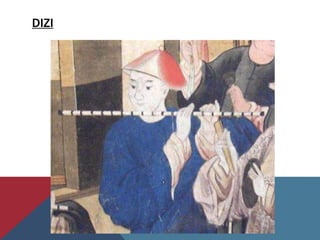
It is made of bamboo and is played horizontally held.
The player blows through the mouth-hole on the
left side while his fingers close or open the six-
finger hole on the right side. Between the mouth-
hole and the finger-holes, is a hole covered by a
membrane. It is an extremely agile instrument with
bright and articulate tone, suitable for depicting
joyous moods. The dizi is a unique solo
instrument and is also an important instrument in
the Chinese orchestral music. It was also known
as hengchui
THE XIAO
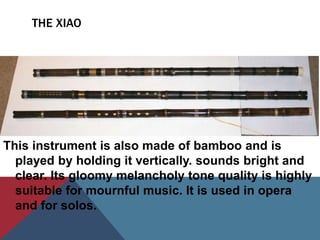
This instrument is also made of bamboo and is
played by holding it vertically. sounds bright and
clear. Its gloomy melancholy tone quality is highly
suitable for mournful music. It is used in opera
and for solos.
THE SHENG
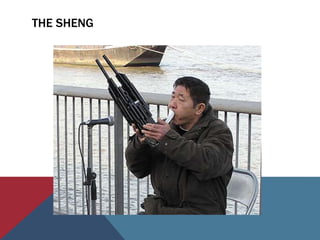
The sheng is a reed wind instrument with a history of over three thousand years. It consists
of a series of bamboo pipes of various lengths attached in a circle to a base. Originally
the base was made of calabash and the instrument is traditionally listed in the gourd
category. Later, wood or copper was introduced. Thesheng is one of the oldest Chinese
instruments. The number of pipes has varied but there are two most widespread
contemporary types of sheng. One that is popular in southern China has only 13 pipes
which are sounded. The sheng is played by blowing through a mouthpiece at the side. It
can produce chords for accompaniment purposes. It is also used widely as a solo
instrument.
THE GUAN
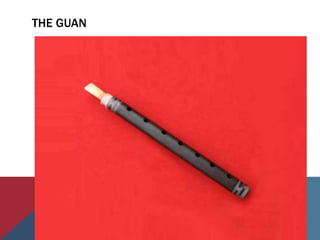
It is a double reed instrument. The tube is
made of wood or bamboo and there are 8
finger-holes on it. The mouthpiece
of guan is made of two piece of reeds. The
tone in the high register is strident, while
that in the low register, melancholic.
The guan was introduced into China from
Central Asia during the Eastern Jin dynasty
(A.D.317-420). It was employed in the court
and theatrical music. It is commonly used
both in ensembles and in solos.
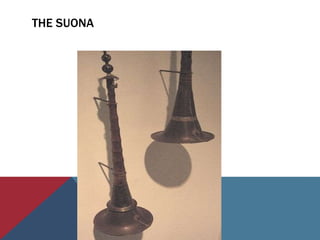
THE SUONA
The suona is an ancient double-reed wind
instrument and is also called the dida or laba. It
was introduced into China from Persia and Arabia
during the Ming dynasty (A.D. 1368-1644). The
mouthpiece of suona is made of two small and
thin pieces of reeds. The middle section is a metal
bell. Its tone is sonorous and penetrating. The
instrument is famous for its capacity to depict
joyous and vigorous moods. Its role at first was to
inspire the army of the Ming dynasty. Gradually it
came to be commonly used in wedding and
funeral ceremonies, orchestral, and theatrical
music.
Dizi, https://www.youtube.com/watch?v=x-
IYinLD9WU
Xiao,
https://www.youtube.com/watch?v=EdpIgrDWd0k
Sheng
https://www.youtube.com/watch?v=p7OYBK9E6-U
Guan
https://www.youtube.com/watch?v=yD9TNLfCM4w
Suona
https://www.youtube.com/watch?v=xOwtigOXPcc

Chinese wind instruments

  • 2.
  • 3.
    It is madeof bamboo and is played horizontally held. The player blows through the mouth-hole on the left side while his fingers close or open the six- finger hole on the right side. Between the mouth- hole and the finger-holes, is a hole covered by a membrane. It is an extremely agile instrument with bright and articulate tone, suitable for depicting joyous moods. The dizi is a unique solo instrument and is also an important instrument in the Chinese orchestral music. It was also known as hengchui
  • 4.
    THE XIAO This instrumentis also made of bamboo and is played by holding it vertically. sounds bright and clear. Its gloomy melancholy tone quality is highly suitable for mournful music. It is used in opera and for solos.
  • 5.
  • 6.
    The sheng isa reed wind instrument with a history of over three thousand years. It consists of a series of bamboo pipes of various lengths attached in a circle to a base. Originally the base was made of calabash and the instrument is traditionally listed in the gourd category. Later, wood or copper was introduced. Thesheng is one of the oldest Chinese instruments. The number of pipes has varied but there are two most widespread contemporary types of sheng. One that is popular in southern China has only 13 pipes which are sounded. The sheng is played by blowing through a mouthpiece at the side. It can produce chords for accompaniment purposes. It is also used widely as a solo instrument.
  • 7.
  • 8.
    It is adouble reed instrument. The tube is made of wood or bamboo and there are 8 finger-holes on it. The mouthpiece of guan is made of two piece of reeds. The tone in the high register is strident, while that in the low register, melancholic. The guan was introduced into China from Central Asia during the Eastern Jin dynasty (A.D.317-420). It was employed in the court and theatrical music. It is commonly used both in ensembles and in solos.
  • 9.
  • 10.
    The suona isan ancient double-reed wind instrument and is also called the dida or laba. It was introduced into China from Persia and Arabia during the Ming dynasty (A.D. 1368-1644). The mouthpiece of suona is made of two small and thin pieces of reeds. The middle section is a metal bell. Its tone is sonorous and penetrating. The instrument is famous for its capacity to depict joyous and vigorous moods. Its role at first was to inspire the army of the Ming dynasty. Gradually it came to be commonly used in wedding and funeral ceremonies, orchestral, and theatrical music.
  • 11.