1
Make a copy and edit in
Google Slides.
1. On the menu bar, click File and then
Make a copy and Entire Presentation.
2. Type a name for the file.
3. Choose where to save it on your
Google Drive.
4. Click Ok.
5. A new tab will open. Wait for the file to
be completely loaded on a new tab.
6. Once the file has loaded, edit this
presentation using Google Slides.
Download an offline copy and
edit in Microsoft PowerPoint.
1. On the menu bar, click File and then
Download as.
2. Choose a file type. Select Microsoft
PowerPoint (.pptx).
3. Wait for the file to be downloaded to your
local disk.
4. Once completely downloaded, open the
file and edit it using Microsoft PowerPoint
or any offline presentation program.
Do You Want to Edit This Presentation?
Music
MAPEH
Music of East Asia: China
Grade 8 • Unit 2
The knowledge gained in this unit can be applied to the following:
● identifying examples of Chinese music by listening to their distinct
musical qualities and characteristics
● acquiring a working repertoire of classical and contemporary
musical pieces from China
● enumerating different instruments and ensembles from China
3
Practical Applications
Central Question
4
What unique musical characteristics does
China contribute to the world stage?
Music
MAPEH
Traditional Instruments of
China
Lesson 2
At the end of this lesson, the learners should be able to do the following:
● Discuss the philosophical background of instrumental tuning and
classification in Chinese music.
● Identify the different Chinese musical instruments aurally and
visually.
● Perform music inspired by traditional Chinese instruments using
available instruments.
6
Learning Targets
7
Recharge
● Man playing ruan instrument
Recharge
1. Observe the following pictures of traditional Chinese instruments:
● guzheng
● ruan
● yangqin
● pipa
● erhu
● dizi
● tanggu
8
Instructions
Recharge
2. Listen to the sound the instrument produces and identify how to play it.
For example, the ruan sounds like a guitar. Therefore, it produces sound
by strumming the strings.
3. Raise your hand if you know the answer.
9
Instructions
Recharge
10
ruan
guzheng
Recharge
11
pipa
yangqin
Recharge
12
dizi
tanggu erhu
Enlighten
13
Man playing ruan instrument
1. Which of the instruments is
difficult to guess how to
play?
2. Which one is easiest to
guess? Why?
3. Do you think instruments
are essential for Chinese
people when composing or
playing music? Why or why
not?
Activity Processing
Enlighten
Enlighten
14
In this lesson, we will be learning
about the traditional
instruments of China and how
they influenced Western musical
instruments. Chinese traditional
instruments are classified into
eight groups based on the
materials they are made of.
Enlighten
15
Chinese Traditional
Instruments
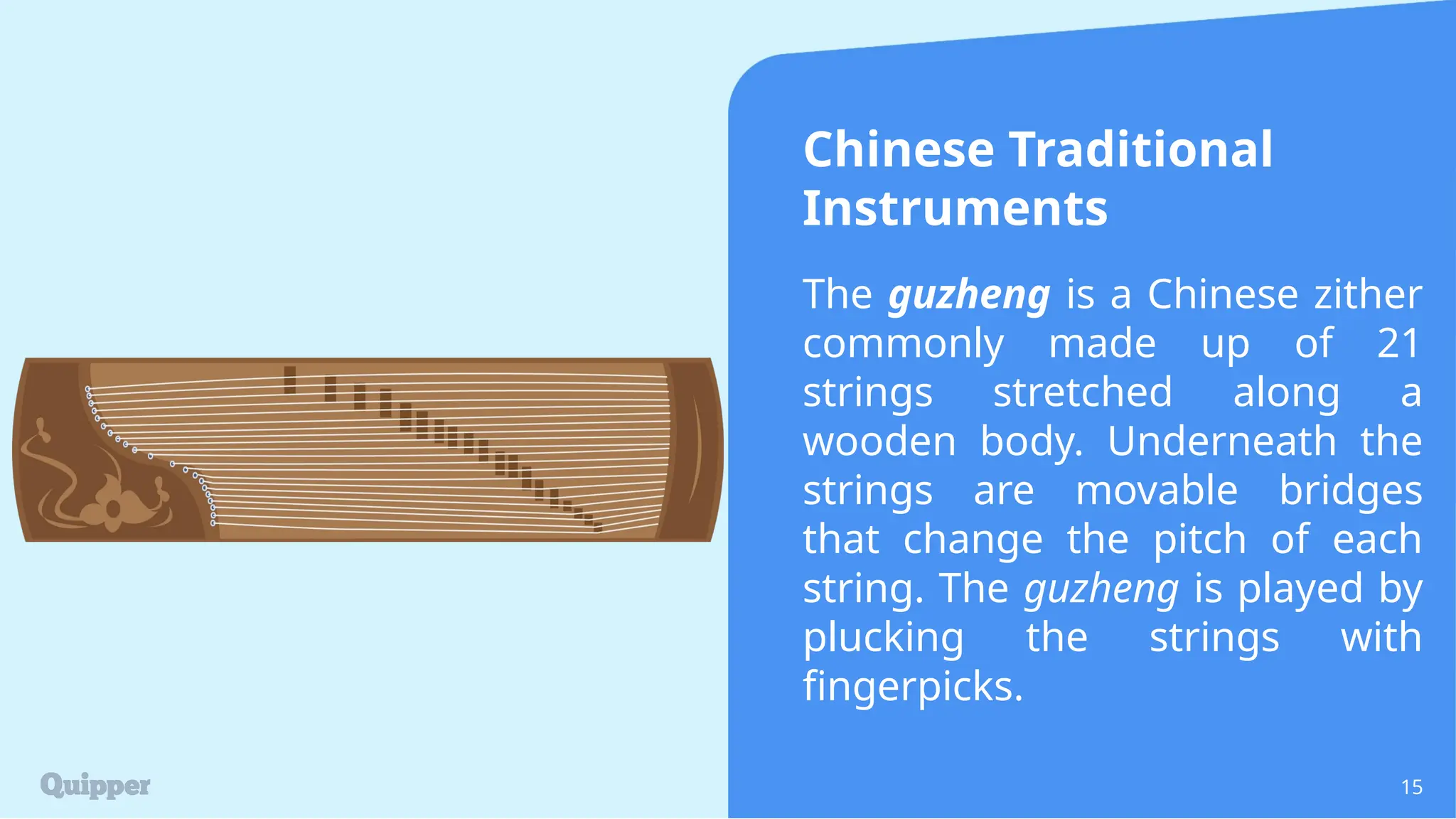
The guzheng is a Chinese zither
commonly made up of 21
strings stretched along a
wooden body. Underneath the
strings are movable bridges
that change the pitch of each
string. The guzheng is played by
plucking the strings with
fingerpicks.
16
Chinese Traditional
Instruments
17
The ruan is often referred to as
the “Chinese guitar.” Unlike a
guitar, however, the ruan has a
big circular body. It has four
strings and a fretboard. It is
played through plucking.
18
19
The yangqin is a Chinese-
hammered dulcimer shaped like
a trapezoid. It has a wooden
body with steel strings. It is
played by striking the strings
with a rubber-tipped wooden
hammer.
Chinese Traditional
Instruments
20
Chinese Traditional
Instruments
21
The pipa is a Chinese lute with a
pear-shaped body made of
wood. It has four strings and a
fretboard and is played by
plucking, typically with
fingerpicks.
22
23
Chinese Traditional
Instruments
The erhu is a Chinese fiddle with
two strings tuned a fifth apart.
It is played by placing the
instrument vertically on the
performer’s thighs and bowing
the strings horizontally.
24
Chinese Traditional
Instruments
25
The dizi is a Chinese bamboo
flute. It has six finger holes, one
blowhole, and an extra hole in
between that is covered by a
thin tissue-like membrane made
of reed, which gives the
instrument its distinct bright
and hum-like sound. It is one of
China's oldest and most well-
known instruments.
26
27
Chinese Traditional
Instruments
The tanggu is a Chinese drum
made of wood, with a drum
head usually made from animal
skin. It is cylindrical and played
with two sticks. It is often used
as a ceremonial instrument.
28
29
Instructions
1. Search online for and listen to a performance of “Mo Li Hua,” a Chinese
folk song that uses the wu sheng.
2. Sing the folk song twice with your classmates.
3. Search online for the song’s lyrics and observe the following musical
elements: rhythm, melody, harmony, and dynamics.
Enlighten
Enlighten
30
Man playing ruan instrument
1. Which tones are used in the
song?
2. Which Western scale best
resembles the wu sheng
scale you constructed?
3. Sing the hymn “Amazing
Grace.” Does it have the
same scale as “Mo Li Hua”?
Explain your answer.
Activity Processing
Enlighten
Enlighten
31
Instructions
1. Match the following instruments to their group or classification:
● guzheng
● ruan
● yangqin
● pipa
● erhu
● dizi
● tanggu
Enlighten
32
Instructions
2. Use the table in the next slide.
● bamboo/zhu
● wood/mu
● stone/shi
● metal/jinshu
● clay/niantu
● gourd/hulu
● skin/pi
● silk/si
Enlighten
33
Enlighten
Instruments Classification
Guzheng
Ruan
Yangqin
Pipa
Erhu
Dizi
Tanggu
Table 1. Eight Groups of Chinese Traditional Instruments
Enlighten
34
Man playing ruan instrument
1. Is the ruan instrument made out
of silk or metal?
2. Compare this system to the
Western one. Which parts are
different, and which ones are the
same?
3. Examine how each instrument is
played. Which instrument
classifications share similarities
to how the instruments are
played?
Activity Processing
Enlighten
Enlighten
35
● Chinese traditional instruments
Reexplore
36
Instructions
1. Form four groups.
2. Search online and watch a Jiangnan sizhu ensemble performance.
3. Listen to how each instrument produces sound.
4. Within the ensemble, identify the following instruments:
● erhu
● sanxian
● pipa
● yangqin
Reexplore
37
Instructions
● di and xiao
● sheng
5. Briefly describe how each instrument produces sound using the chart on
the next slide.
6. Once done, share your output with the class.
Reexplore
38
Reexplore
Instruments Description
Erhu
Sanxian
Pipa
Yangqin
Di and Xiao
Dizi
Sheng
Table 2. Jiangnan Sizhu Ensemble
Recharge
39
Activity Processing
1. How are the ensemble’s
musicians arranged? Are
they seated according to
instrument class?
2. Compare the ensemble to a
Western chamber ensemble.
What are the similarities
between the two?
Reexplore
Man playing ruan instrument
Recharge
40
Activity Processing
3. Do musicians in Jiangnan
sizhu ensembles typically
read scores while
performing? Why or why
not?
Reexplore
Man playing ruan instrument
Photo Credits
41
Slide 5: Watercolor of musician playing ruan(?) MET DP211160.jpg by Pharos is free from commercial use under Public Domain
via Wikimedia Commons.
Slides 7, 13, 23, 27 and 32-33: 阮 Ruan Жуань (7851401654).jpg by Nikolaj Potanin is licensed under CC-BY-SA-2.0 via
Wikimedia Commons.
Slides 14 and 28: Musical instruments of Cantonese opera.jpg by Pauloleong2002 is licensed under CC-BY-SA-4.0 via
Wikimedia Commons.
References
42
The Editors of Encyclopaedia of Britannica. 2017. “sizhu.” Encyclopedia Britannica. https://www.britannica.com/art/sizhu.
Ho, Wai-Chung. 2018. Culture, Music Education and the Chinese Dream in Mainland China. Singapore: Springer Singapore.
Lau, Frederick. 2008. Music in China: Experiencing Music, Experiencing Culture. Oxford: Oxford University Press.
Malm, William P. 2021. “Chinese music.” Encyclopedia Britannica. https://www.britannica.com/art/Chinese-music.
Wang, Ban. 2016. “Third World Internationalism: Films and Operas in the Chinese Cultural Revolution.” In Listening to China’s
Cultural Revolution: Music, Politics, and Cultural Continuities. Edited by Laikwan Pang, Paul Clark, and Tsan-Huang Tsai, 85-
106. London and New York: Palgrave Macmillan.

WEEK1-2.pptx china's traditional instrument

  • 1.
    1 Make a copyand edit in Google Slides. 1. On the menu bar, click File and then Make a copy and Entire Presentation. 2. Type a name for the file. 3. Choose where to save it on your Google Drive. 4. Click Ok. 5. A new tab will open. Wait for the file to be completely loaded on a new tab. 6. Once the file has loaded, edit this presentation using Google Slides. Download an offline copy and edit in Microsoft PowerPoint. 1. On the menu bar, click File and then Download as. 2. Choose a file type. Select Microsoft PowerPoint (.pptx). 3. Wait for the file to be downloaded to your local disk. 4. Once completely downloaded, open the file and edit it using Microsoft PowerPoint or any offline presentation program. Do You Want to Edit This Presentation?
  • 2.
    Music MAPEH Music of EastAsia: China Grade 8 • Unit 2
  • 3.
    The knowledge gainedin this unit can be applied to the following: ● identifying examples of Chinese music by listening to their distinct musical qualities and characteristics ● acquiring a working repertoire of classical and contemporary musical pieces from China ● enumerating different instruments and ensembles from China 3 Practical Applications
  • 4.
    Central Question 4 What uniquemusical characteristics does China contribute to the world stage?
  • 5.
  • 6.
    At the endof this lesson, the learners should be able to do the following: ● Discuss the philosophical background of instrumental tuning and classification in Chinese music. ● Identify the different Chinese musical instruments aurally and visually. ● Perform music inspired by traditional Chinese instruments using available instruments. 6 Learning Targets
  • 7.
  • 8.
    Recharge 1. Observe thefollowing pictures of traditional Chinese instruments: ● guzheng ● ruan ● yangqin ● pipa ● erhu ● dizi ● tanggu 8 Instructions
  • 9.
    Recharge 2. Listen tothe sound the instrument produces and identify how to play it. For example, the ruan sounds like a guitar. Therefore, it produces sound by strumming the strings. 3. Raise your hand if you know the answer. 9 Instructions
  • 10.
  • 11.
  • 12.
  • 13.
    Enlighten 13 Man playing ruaninstrument 1. Which of the instruments is difficult to guess how to play? 2. Which one is easiest to guess? Why? 3. Do you think instruments are essential for Chinese people when composing or playing music? Why or why not? Activity Processing Enlighten Enlighten
  • 14.
    14 In this lesson,we will be learning about the traditional instruments of China and how they influenced Western musical instruments. Chinese traditional instruments are classified into eight groups based on the materials they are made of. Enlighten
  • 15.
    15 Chinese Traditional Instruments The guzhengis a Chinese zither commonly made up of 21 strings stretched along a wooden body. Underneath the strings are movable bridges that change the pitch of each string. The guzheng is played by plucking the strings with fingerpicks.
  • 16.
  • 17.
    Chinese Traditional Instruments 17 The ruanis often referred to as the “Chinese guitar.” Unlike a guitar, however, the ruan has a big circular body. It has four strings and a fretboard. It is played through plucking.
  • 18.
  • 19.
    19 The yangqin isa Chinese- hammered dulcimer shaped like a trapezoid. It has a wooden body with steel strings. It is played by striking the strings with a rubber-tipped wooden hammer. Chinese Traditional Instruments
  • 20.
  • 21.
    Chinese Traditional Instruments 21 The pipais a Chinese lute with a pear-shaped body made of wood. It has four strings and a fretboard and is played by plucking, typically with fingerpicks.
  • 22.
  • 23.
    23 Chinese Traditional Instruments The erhuis a Chinese fiddle with two strings tuned a fifth apart. It is played by placing the instrument vertically on the performer’s thighs and bowing the strings horizontally.
  • 24.
  • 25.
    Chinese Traditional Instruments 25 The diziis a Chinese bamboo flute. It has six finger holes, one blowhole, and an extra hole in between that is covered by a thin tissue-like membrane made of reed, which gives the instrument its distinct bright and hum-like sound. It is one of China's oldest and most well- known instruments.
  • 26.
  • 27.
    27 Chinese Traditional Instruments The tangguis a Chinese drum made of wood, with a drum head usually made from animal skin. It is cylindrical and played with two sticks. It is often used as a ceremonial instrument.
  • 28.
  • 29.
    29 Instructions 1. Search onlinefor and listen to a performance of “Mo Li Hua,” a Chinese folk song that uses the wu sheng. 2. Sing the folk song twice with your classmates. 3. Search online for the song’s lyrics and observe the following musical elements: rhythm, melody, harmony, and dynamics. Enlighten
  • 30.
    Enlighten 30 Man playing ruaninstrument 1. Which tones are used in the song? 2. Which Western scale best resembles the wu sheng scale you constructed? 3. Sing the hymn “Amazing Grace.” Does it have the same scale as “Mo Li Hua”? Explain your answer. Activity Processing Enlighten Enlighten
  • 31.
    31 Instructions 1. Match thefollowing instruments to their group or classification: ● guzheng ● ruan ● yangqin ● pipa ● erhu ● dizi ● tanggu Enlighten
  • 32.
    32 Instructions 2. Use thetable in the next slide. ● bamboo/zhu ● wood/mu ● stone/shi ● metal/jinshu ● clay/niantu ● gourd/hulu ● skin/pi ● silk/si Enlighten
  • 33.
  • 34.
    Enlighten 34 Man playing ruaninstrument 1. Is the ruan instrument made out of silk or metal? 2. Compare this system to the Western one. Which parts are different, and which ones are the same? 3. Examine how each instrument is played. Which instrument classifications share similarities to how the instruments are played? Activity Processing Enlighten Enlighten
  • 35.
    35 ● Chinese traditionalinstruments Reexplore
  • 36.
    36 Instructions 1. Form fourgroups. 2. Search online and watch a Jiangnan sizhu ensemble performance. 3. Listen to how each instrument produces sound. 4. Within the ensemble, identify the following instruments: ● erhu ● sanxian ● pipa ● yangqin Reexplore
  • 37.
    37 Instructions ● di andxiao ● sheng 5. Briefly describe how each instrument produces sound using the chart on the next slide. 6. Once done, share your output with the class. Reexplore
  • 38.
    38 Reexplore Instruments Description Erhu Sanxian Pipa Yangqin Di andXiao Dizi Sheng Table 2. Jiangnan Sizhu Ensemble
  • 39.
    Recharge 39 Activity Processing 1. Howare the ensemble’s musicians arranged? Are they seated according to instrument class? 2. Compare the ensemble to a Western chamber ensemble. What are the similarities between the two? Reexplore Man playing ruan instrument
  • 40.
    Recharge 40 Activity Processing 3. Domusicians in Jiangnan sizhu ensembles typically read scores while performing? Why or why not? Reexplore Man playing ruan instrument
  • 41.
    Photo Credits 41 Slide 5:Watercolor of musician playing ruan(?) MET DP211160.jpg by Pharos is free from commercial use under Public Domain via Wikimedia Commons. Slides 7, 13, 23, 27 and 32-33: 阮 Ruan Жуань (7851401654).jpg by Nikolaj Potanin is licensed under CC-BY-SA-2.0 via Wikimedia Commons. Slides 14 and 28: Musical instruments of Cantonese opera.jpg by Pauloleong2002 is licensed under CC-BY-SA-4.0 via Wikimedia Commons.
  • 42.
    References 42 The Editors ofEncyclopaedia of Britannica. 2017. “sizhu.” Encyclopedia Britannica. https://www.britannica.com/art/sizhu. Ho, Wai-Chung. 2018. Culture, Music Education and the Chinese Dream in Mainland China. Singapore: Springer Singapore. Lau, Frederick. 2008. Music in China: Experiencing Music, Experiencing Culture. Oxford: Oxford University Press. Malm, William P. 2021. “Chinese music.” Encyclopedia Britannica. https://www.britannica.com/art/Chinese-music. Wang, Ban. 2016. “Third World Internationalism: Films and Operas in the Chinese Cultural Revolution.” In Listening to China’s Cultural Revolution: Music, Politics, and Cultural Continuities. Edited by Laikwan Pang, Paul Clark, and Tsan-Huang Tsai, 85- 106. London and New York: Palgrave Macmillan.

Editor's Notes

  • #2 Teacher’s script: “In this unit, we will learn about the music of East Asia: China.”
  • #3 Teacher’s script: “The knowledge gained in this unit can be applied to the following: identifying examples of Chinese music by listening to their distinct musical qualities and characteristics acquiring a working repertoire of classical and contemporary musical pieces from China enumerating different instruments and ensembles from China. ”
  • #4 Teacher’s script: “Before we start this unit, let me ask you a question: What unique musical characteristics does China contribute to the world stage?”
  • #5 Teacher’s script: “In today’s lesson, we will learn about the traditional instruments of China.”
  • #6 Teacher’s script: “At the end of our lesson, you should be able to discuss the philosophical background of instrumental tuning and classification in Chinese music, identify the different Chinese musical instruments aurally and visually, and perform music inspired by traditional Chinese instruments using available instruments.”
  • #7 Teacher’s script: Use this prompt to introduce the activity: “Chinese traditional instruments are classified into eight groups based on the materials they are made of. For today’s activity, let us try to guess how to play the instruments and how they produce sound by listening.”
  • #8 Teacher’s script: Provide the following instructions to the class: Observe the following pictures of traditional Chinese instruments: guzheng ruan yangqin pipa erhu dizi tanggu
  • #9 Teacher’s script: Provide the following instructions to the class: Listen to the sound the instrument produces and identify how to play it. For example, the ruan sounds like a guitar. Therefore, it produces sound by strumming the strings. Raise your hand if you know the answer.
  • #13 Teacher’s script: Ask the following questions to process the activity: Which of the instruments is difficult to guess how to play? Possible answer: Answers may vary. “It is hard to guess the yangqin because it uses a wooden hammer to play and produce sound.” Which one is easiest to guess? Why? Possible answer: Answers may vary. “The pipa is the easiest to guess because it produces sound by plucking the strings like a guitar.” Do you think instruments are essential for Chinese people when composing or playing music? Why or why not? Possible answer: Answers may vary. “Yes, they are important for Chinese people when composing or playing music because they are part of their culture and tradition. Also, these instruments imitate the sounds of man and nature, which reflects the value of the unity between these two concepts.”
  • #14 Teacher’s script: Use this prompt to introduce the activity: “In this activity, we will take a look at how the Chinese musical scale is used.”
  • #29 Teacher’s script: Provide the following instructions to the class: Search online for and listen to a performance of “Mo Li Hua,” a Chinese folk song that uses the wu sheng. Sing the folk song twice with your classmates. Search online for the song’s lyrics and observe the following musical elements: rhythm, melody, harmony, and dynamics.
  • #30 Teacher’s script: Ask the following questions to process the activity: Which tones are used in the song? (The learners may answer through singing. Dictate the solfège syllables if possible.) Answer: “It depends on the key of the song. However, in terms of numbered scale degrees, they are 1, 2, 3, 5, and 6.” Which Western scale best resembles the wu sheng scale you constructed? Answer: “the major pentatonic scale” Sing the hymn “Amazing Grace.” Does it have the same scale as “Mo Li Hua”? Explain your answer. Answer: “Yes, they have almost the same scale degree. Both Chinese and Western scales are constructed based on the same principle: the overtone series. Thus, they have the same approximant tones.”
  • #31 Teacher’s script: Use this prompt to introduce the activity: “Chinese traditional instruments are classified into eight groups known as the bayin. In this activity, we will match the different instruments with their classifications.” Provide the following instructions to the class: Match the following instruments to their group or classification: guzheng ruan yangqin pipa erhu dizi tanggu
  • #32 Teacher’s script: Provide the following instructions to the class: b. Use the table in the next slide. bamboo/zhu wood/mu stone/shi metal/jinshu clay/niantu gourd/hulu skin/pi silk/si
  • #34 Teacher’s script: Ask the following questions to process the activity: Is the ruan instrument made out of silk or metal? Answer: “Formerly, the ruan instrument was made of silk but soon became metal.” Compare this system to the Western one. Which parts are different, and which ones are the same? Answer: “Both Western and Chinese instruments follow the same classification: according to the material. However, Western music is more specific in how these instruments are played, such as bowing, plucking, or striking with mallets, sticks, hammers, etc.” Examine how each instrument is played. Which instrument classifications share similarities to how the instruments are played? Possible answer: Answers may vary. “Most classifications are percussion instruments, while bamboo is mostly wind instruments and silk is mostly stringed instruments.”
  • #35 Teacher’s script: Use this prompt to introduce the activity: “In this activity, we will identify the instruments used in the sizhu ensemble.”
  • #36 Teacher’s script: Provide the following instructions to the class: Form four groups. Search online and watch a Jiangnan sizhu ensemble performance. Listen to how each instrument produces sound. Within the ensemble, identify the following instruments: erhu sanxian pipa yangqin
  • #37 Teacher’s script: Provide the following instructions to the class: di and xiao sheng Briefly describe how each instrument produces sound using the chart on the next slide. Once done, share your output with the class.
  • #39 Teacher’s script: Ask the following questions to process the activity: How are the ensemble’s musicians arranged? Are they seated according to instrument class? Possible answer: Answers may vary. “The musicians are grouped by instrument, similar to the standard in Western ensembles.” Compare the ensemble to a Western chamber ensemble. What are the similarities between the two? Possible answer: Answers may vary. “There is an organization of instruments according to how they are played and their pitch registers. For instance, bowed instruments and plucked instruments are seated near each other and arranged from high- to low-pitch register.”
  • #40 Teacher’s script: Ask the following questions to process the activity: Do musicians in Jiangnan sizhu ensembles typically read scores while performing? Why or why not? Possible answer: Answers may vary. “Jiangnan sizhu ensembles do not typically read scores. There is no conductor to dictate the pace of the performance like in Western ensembles, and the performers are expected to know the piece by heart.”