E.A. Draffan
https://globalsymbols.com/
AAC Symbols for
Everyone, Everywhere
2
Wider Objectives
• Improve availability of open source, customizable
local AT/AAC solutions
• Improve capacity of professionals to support early
inclusion of children with AAC solutions
• Nurture partnerships and capacity that can build
sustainable national AT/AAC ecosystems
Barriers
• Hard to gather initial AAC User and
communication partner information.
•Poor globalisation and localisation
• Lack of standardisation and harmonisation of
open symbols sets
•Silos of awareness, knowledge and training
• Cost
4
Implementing AAC
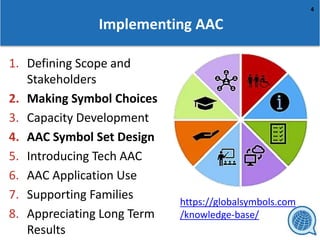
1. Defining Scope and
Stakeholders
2. Making Symbol Choices
3. Capacity Development
4. AAC Symbol Set Design
5. Introducing Tech AAC
6. AAC Application Use
7. Supporting Families
8. Appreciating Long Term
Results
https://globalsymbols.com
/knowledge-base/
5
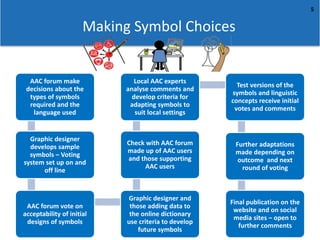
Making Symbol Choices
AAC forum make
decisions about the
types of symbols
required and the
language used
Graphic designer
develops sample
symbols – Voting
system set up on and
off line
AAC forum vote on
acceptability of initial
designs of symbols
Graphic designer and
those adding data to
the online dictionary
use criteria to develop
future symbols
Check with AAC forum
made up of AAC users
and those supporting
AAC users
Local AAC experts
analyse comments and
develop criteria for
adapting symbols to
suit local settings
Test versions of the
symbols and linguistic
concepts receive initial
votes and comments
Further adaptations
made depending on
outcome and next
round of voting
Final publication on the
website and on social
media sites – open to
further comments
6
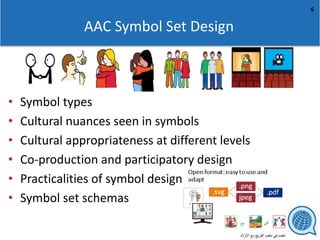
AAC Symbol Set Design
• Symbol types
• Cultural nuances seen in symbols
• Cultural appropriateness at different levels
• Co-production and participatory design
• Practicalities of symbol design
• Symbol set schemas
7
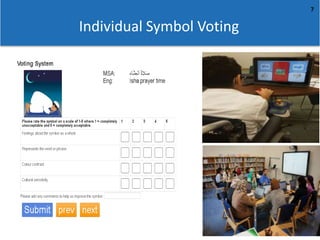
Individual Symbol Voting
8
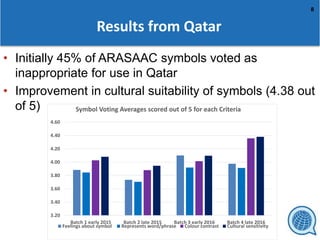
Results from Qatar
• Initially 45% of ARASAAC symbols voted as
inappropriate for use in Qatar
• Improvement in cultural suitability of symbols (4.38 out
of 5)
3.20
3.40
3.60
3.80
4.00
4.20
4.40
4.60
Batch 1 early 2015 Batch 2 late 2015 Batch 3 early 2016 Batch 4 late 2016
Symbol Voting Averages scored out of 5 for each Criteria
Feelings about symbol Represents word/phrase Colour contrast Cultural sensitivity
9
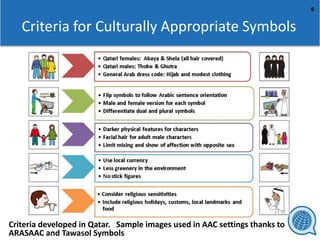
Criteria for Culturally Appropriate Symbols
Criteria developed in Qatar. Sample images used in AAC settings thanks to
ARASAAC and Tawasol Symbols
10
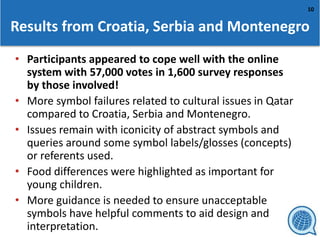
Results from Croatia, Serbia and Montenegro
• Participants appeared to cope well with the online
system with 57,000 votes in 1,600 survey responses
by those involved!
• More symbol failures related to cultural issues in Qatar
compared to Croatia, Serbia and Montenegro.
• Issues remain with iconicity of abstract symbols and
queries around some symbol labels/glosses (concepts)
or referents used.
• Food differences were highlighted as important for
young children.
• More guidance is needed to ensure unacceptable
symbols have helpful comments to aid design and
interpretation.
11
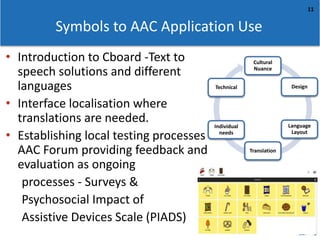
Symbols to AAC Application Use
• Introduction to Cboard -Text to
speech solutions and different
languages
• Interface localisation where
translations are needed.
• Establishing local testing processes –
AAC Forum providing feedback and
evaluation as ongoing
processes - Surveys &
Psychosocial Impact of
Assistive Devices Scale (PIADS)
Cultural
Nuance
Design
Language
Layout
Translation
Individual
needs
Technical
12
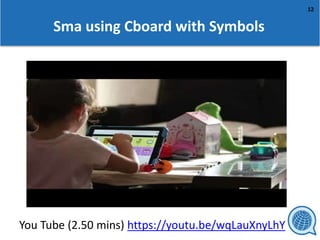
Sma using Cboard with Symbols
You Tube (2.50 mins) https://youtu.be/wqLauXnyLhY
13
Appreciating Long Term Results
UNICEF “A Voice for Every Child” after two years results included:
– Increased awareness AAC/AT value & national coalitions for AAC/AT
strategies
– Strengthened collaboration between global & national experts and
universities
– More Continual Professional Development opportunities available
– Development of national resource centres for AAC/AT support
– Professionals (preschool teachers, psychologists, speech and
language specialists) adopt and update methods in line with social
model of disability
– Support for in-house and national design and development of AT
solutions
– Markets shaped to improve accessibility and affordability of AT
solutions
https://www.unicef.org/eca/media/22051/file/Case_study_1.pdf
14
Thank You
E.A. Draffan
ea@globalsymbols.com
Thank you also to those who worked on the Arabic
Symbol Dictionary Project, UNICEF ECARO
colleagues and participants in Croatia, Serbia and
Montenegro, plus symbol developers including
ARASAAC, Tawasol, Mulberry, Jellow and Sclera.

AAC Symbols for Everyone, Everywhere.pptx

  • 1.
  • 2.
    2 Wider Objectives • Improveavailability of open source, customizable local AT/AAC solutions • Improve capacity of professionals to support early inclusion of children with AAC solutions • Nurture partnerships and capacity that can build sustainable national AT/AAC ecosystems
  • 3.
    Barriers • Hard togather initial AAC User and communication partner information. •Poor globalisation and localisation • Lack of standardisation and harmonisation of open symbols sets •Silos of awareness, knowledge and training • Cost
  • 4.
    4 Implementing AAC 1. DefiningScope and Stakeholders 2. Making Symbol Choices 3. Capacity Development 4. AAC Symbol Set Design 5. Introducing Tech AAC 6. AAC Application Use 7. Supporting Families 8. Appreciating Long Term Results https://globalsymbols.com /knowledge-base/
  • 5.
    5 Making Symbol Choices AACforum make decisions about the types of symbols required and the language used Graphic designer develops sample symbols – Voting system set up on and off line AAC forum vote on acceptability of initial designs of symbols Graphic designer and those adding data to the online dictionary use criteria to develop future symbols Check with AAC forum made up of AAC users and those supporting AAC users Local AAC experts analyse comments and develop criteria for adapting symbols to suit local settings Test versions of the symbols and linguistic concepts receive initial votes and comments Further adaptations made depending on outcome and next round of voting Final publication on the website and on social media sites – open to further comments
  • 6.
    6 AAC Symbol SetDesign • Symbol types • Cultural nuances seen in symbols • Cultural appropriateness at different levels • Co-production and participatory design • Practicalities of symbol design • Symbol set schemas
  • 7.
  • 8.
    8 Results from Qatar •Initially 45% of ARASAAC symbols voted as inappropriate for use in Qatar • Improvement in cultural suitability of symbols (4.38 out of 5) 3.20 3.40 3.60 3.80 4.00 4.20 4.40 4.60 Batch 1 early 2015 Batch 2 late 2015 Batch 3 early 2016 Batch 4 late 2016 Symbol Voting Averages scored out of 5 for each Criteria Feelings about symbol Represents word/phrase Colour contrast Cultural sensitivity
  • 9.
    9 Criteria for CulturallyAppropriate Symbols Criteria developed in Qatar. Sample images used in AAC settings thanks to ARASAAC and Tawasol Symbols
  • 10.
    10 Results from Croatia,Serbia and Montenegro • Participants appeared to cope well with the online system with 57,000 votes in 1,600 survey responses by those involved! • More symbol failures related to cultural issues in Qatar compared to Croatia, Serbia and Montenegro. • Issues remain with iconicity of abstract symbols and queries around some symbol labels/glosses (concepts) or referents used. • Food differences were highlighted as important for young children. • More guidance is needed to ensure unacceptable symbols have helpful comments to aid design and interpretation.
  • 11.
    11 Symbols to AACApplication Use • Introduction to Cboard -Text to speech solutions and different languages • Interface localisation where translations are needed. • Establishing local testing processes – AAC Forum providing feedback and evaluation as ongoing processes - Surveys & Psychosocial Impact of Assistive Devices Scale (PIADS) Cultural Nuance Design Language Layout Translation Individual needs Technical
  • 12.
    12 Sma using Cboardwith Symbols You Tube (2.50 mins) https://youtu.be/wqLauXnyLhY
  • 13.
    13 Appreciating Long TermResults UNICEF “A Voice for Every Child” after two years results included: – Increased awareness AAC/AT value & national coalitions for AAC/AT strategies – Strengthened collaboration between global & national experts and universities – More Continual Professional Development opportunities available – Development of national resource centres for AAC/AT support – Professionals (preschool teachers, psychologists, speech and language specialists) adopt and update methods in line with social model of disability – Support for in-house and national design and development of AT solutions – Markets shaped to improve accessibility and affordability of AT solutions https://www.unicef.org/eca/media/22051/file/Case_study_1.pdf
  • 14.
    14 Thank You E.A. Draffan ea@globalsymbols.com Thankyou also to those who worked on the Arabic Symbol Dictionary Project, UNICEF ECARO colleagues and participants in Croatia, Serbia and Montenegro, plus symbol developers including ARASAAC, Tawasol, Mulberry, Jellow and Sclera.

Editor's Notes

  • #4 Hard to gather initial AAC User and communication partner information. Poor globalisation and localisation Lack of standardisation and harmonisation of open symbols sets Siloes of awareness, knowledge and training Cost
  • #6 AAC forum make decisions about the types of symbols required and the language used Graphic designer develops sample symbols – Voting system set up on and off line AAC forum vote on acceptability of initial designs of symbols Graphic designer and those adding data to the online dictionary use criteria to develop future symbols Check with AAC forum made up of AAC users and those supporting AAC users Local AAC experts analyse comments and develop criteria for adapting symbols to suit local settings Test versions of the symbols and linguistic concepts receive initial votes and comments Further adaptations made depending on outcome and next round of voting Final publication on the website and on social media sites – open to further comments