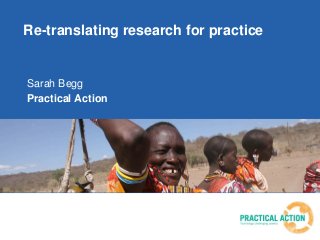
Re-translating research for practice
Sarah Begg
Practical Action
Two colliding worlds, one common problem:
Uptake
 Academic world: pressure to demonstrate impact of
research tangibly
 NGO world: Under continuous pressure to evidence what
works to leverage scale up
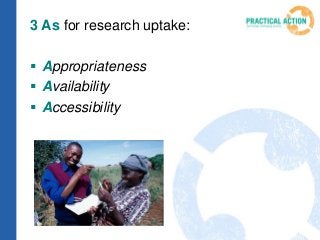
3 As for research uptake:
 Appropriateness
 Availability
 Accessibility
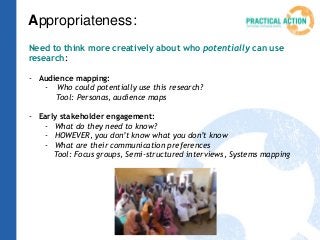
Appropriateness:
Need to think more creatively about who potentially can use
research:
- Audience mapping:
- Who could potentially use this research?
Tool: Personas, audience maps
- Early stakeholder engagement:
- What do they need to know?
- HOWEVER, you don’t know what you don’t know
- What are their communication preferences
Tool: Focus groups, Semi-structured interviews, Systems mapping
Availability:
“There is enough knowledge in the world to solve our greatest
problems”
• What knowledge already exists, and what form does it take:
• Academic literature
• NGO papers
• Policy papers
• Private sector-led research
Knowledge is highly fragmented, is it a matter of capture and
re-formatting?
If it is a gap, is there a practice need? And, how can this be useful for
practitioners?
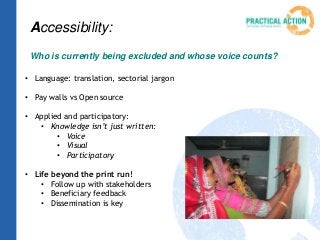
Accessibility:
Who is currently being excluded and whose voice counts?
• Language: translation, sectorial jargon
• Pay walls vs Open source
• Applied and participatory:
• Knowledge isn’t just written:
• Voice
• Visual
• Participatory
• Life beyond the print run!
• Follow up with stakeholders
• Beneficiary feedback
• Dissemination is key
We believe:
“There is enough knowledge in the world to solve our greatest problems,
but if we fail to learn and get the knowledge to right people at the right
time and in the right format we will never succeed”
Case study:
Low Carbon Development Network and Practical Action
Energy Access in Kenya and Bangladesh:
- Stakeholder mapping
- Needs identification
- Communication preference mapping
- Capture and reformat
- Follow up
 In your experience, what has been the most successful
approach to ensure research is used in practice?
 What has not worked? And, why!
 Is research really useful for practice?
 Is it really answering to needs?
 How can it be applied by practitioners?
 How can practitioners influence the research agenda?
Discussion
Thank you
Sarah.Begg@practicalaction.org.uk
Global Knowledge and Learning Officer
Policy and Practice

WEBINAR | DEC 2017 | Retranslating Research for Practice - Sarah Begg

  • 1.
    Re-translating research forpractice Sarah Begg Practical Action
  • 2.
    Two colliding worlds,one common problem: Uptake  Academic world: pressure to demonstrate impact of research tangibly  NGO world: Under continuous pressure to evidence what works to leverage scale up
  • 3.
    3 As forresearch uptake:  Appropriateness  Availability  Accessibility
  • 4.
    Appropriateness: Need to thinkmore creatively about who potentially can use research: - Audience mapping: - Who could potentially use this research? Tool: Personas, audience maps - Early stakeholder engagement: - What do they need to know? - HOWEVER, you don’t know what you don’t know - What are their communication preferences Tool: Focus groups, Semi-structured interviews, Systems mapping
  • 5.
    Availability: “There is enoughknowledge in the world to solve our greatest problems” • What knowledge already exists, and what form does it take: • Academic literature • NGO papers • Policy papers • Private sector-led research Knowledge is highly fragmented, is it a matter of capture and re-formatting? If it is a gap, is there a practice need? And, how can this be useful for practitioners?
  • 6.
    Accessibility: Who is currentlybeing excluded and whose voice counts? • Language: translation, sectorial jargon • Pay walls vs Open source • Applied and participatory: • Knowledge isn’t just written: • Voice • Visual • Participatory • Life beyond the print run! • Follow up with stakeholders • Beneficiary feedback • Dissemination is key
  • 7.
    We believe: “There isenough knowledge in the world to solve our greatest problems, but if we fail to learn and get the knowledge to right people at the right time and in the right format we will never succeed” Case study: Low Carbon Development Network and Practical Action Energy Access in Kenya and Bangladesh: - Stakeholder mapping - Needs identification - Communication preference mapping - Capture and reformat - Follow up
  • 8.
     In yourexperience, what has been the most successful approach to ensure research is used in practice?  What has not worked? And, why!  Is research really useful for practice?  Is it really answering to needs?  How can it be applied by practitioners?  How can practitioners influence the research agenda? Discussion
  • 9.
    Thank you Sarah.Begg@practicalaction.org.uk Global Knowledgeand Learning Officer Policy and Practice