Venture Capital  2.0 : The  Lean VC Dave McClure 500 Startups ( @DaveMcClure )  http://500startups.com  SlideShare ZipCast, Feb 2011 Re-Inventing Venture Capital Investing through Innovation, Incubation, & Iteration
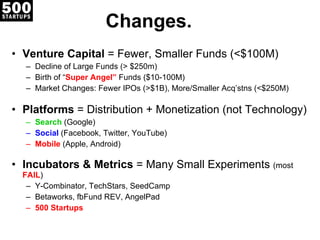
Changes. Venture Capital  = Fewer, Smaller Funds (<$100M) Decline of Large Funds (> $250m) Birth of “ Super Angel”  Funds ($10-100M) Market Changes: Fewer IPOs (>$1B), More/Smaller Acq’stns (<$250M) Platforms  = Distribution + Monetization (not Technology) Search  (Google) Social  (Facebook, Twitter, YouTube) Mobile  (Apple, Android) Incubators & Metrics  = Many Small Experiments  (most  FAIL ) Y-Combinator, TechStars, SeedCamp Betaworks, fbFund REV, AngelPad 500 Startups
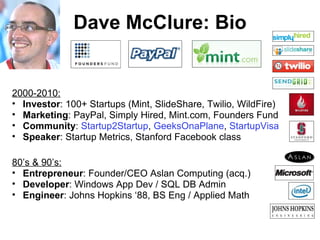
Dave McClure: Bio 2000-2010: Investor : 100+ Startups (Mint, SlideShare, Twilio, WildFire) Marketing : PayPal, Simply Hired, Mint.com, Founders Fund Community :   Startup2Startup ,  GeeksOnaPlane ,  StartupVisa Speaker : Startup Metrics, Stanford Facebook class 80’s & 90’s: Entrepreneur : Founder/CEO Aslan Computing (acq.) Developer : Windows App Dev / SQL DB Admin Engineer : Johns Hopkins ‘88, BS Eng / Applied Math
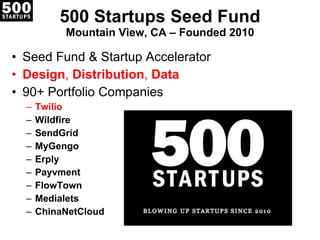
500 Startups Seed Fund Mountain View, CA – Founded 2010 Seed Fund & Startup Accelerator Design ,  Distribution ,  Data 90+ Portfolio Companies Twilio Wildfire SendGrid MyGengo Erply Payvment FlowTown Medialets ChinaNetCloud
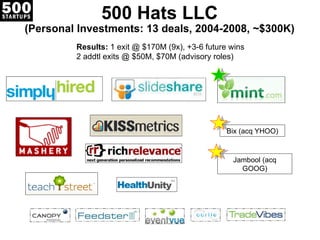
500 Hats LLC (Personal Investments: 13 deals, 2004-2008, ~$300K) Results:  1 exit @ $170M (9x), +3-6 future wins 2 addtl exits @ $50M, $70M (advisory roles) Bix (acq YHOO) Jambool (acq GOOG)
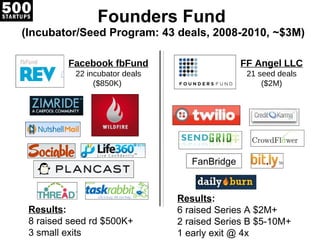
Founders Fund  (Incubator/Seed Program: 43 deals, 2008-2010, ~$3M) Results : 8 raised seed rd $500K+  3 small exits Results : 6 raised Series A $2M+ 2 raised Series B $5-10M+ 1 early exit @ 4x FanBridge Facebook fbFund 22 incubator deals ($850K)  FF Angel LLC 21 seed deals ($2M)
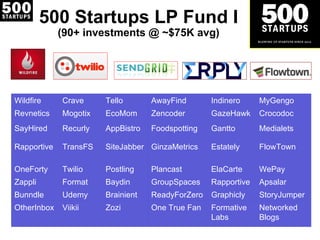
500 Startups LP Fund I (90+ investments @ ~$75K avg) Wildfire Crave Tello AwayFind Indinero MyGengo Revnetics Mogotix EcoMom Zencoder GazeHawk Crocodoc SayHired Recurly AppBistro Foodspotting Gantto Medialets Rapportive TransFS SiteJabber GinzaMetrics Estately FlowTown OneForty Twilio Postling Plancast ElaCarte WePay Zappli Format Baydin GroupSpaces Rapportive Apsalar Bunndle Udemy Brainient ReadyForZero Graphicly StoryJumper OtherInbox Viikii Zozi One True Fan Formative Labs Networked Blogs
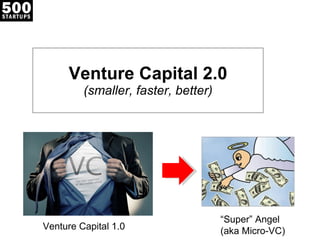
Venture Capital 2.0 (smaller, faster, better) Venture Capital 1.0  “ Super” Angel  (aka Micro-VC)
Silicon Valley Investor Ecosystem True Ventures First Round Capital Benchmark Accel Angels &  Incubators ($0-10M) “ Seed” Funds  ($10-50M) VC Funds  ($50-250M) VC Funds  (>$250M) Y-Combinator TechStars SoftTech (Clavier) FloodGate (Maples) Felicis (Senkut) SV Angel (Conway)
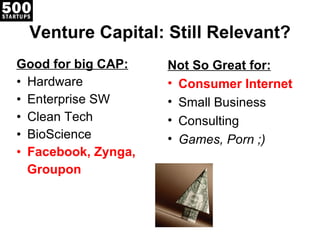
Venture Capital: Still Relevant? Good for big CAP: Hardware Enterprise SW Clean Tech BioScience Facebook, Zynga, Groupon Not So Great for: Consumer Internet Small Business Consulting Games, Porn ;)
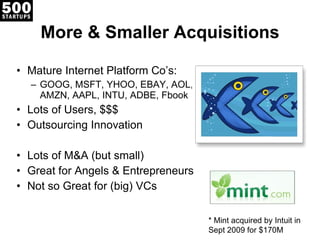
More & Smaller Acquisitions Mature Internet Platform Co’s: GOOG, MSFT, YHOO, EBAY, AOL, AMZN, AAPL, INTU, ADBE, Fbook Lots of Users, $$$ Outsourcing Innovation Lots of M&A (but small) Great for Angels & Entrepreneurs Not so Great for (big) VCs * Mint acquired by Intuit in Sept 2009 for $170M
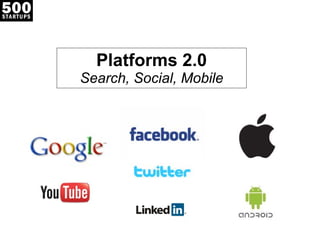
Platforms 2.0 Search, Social, Mobile
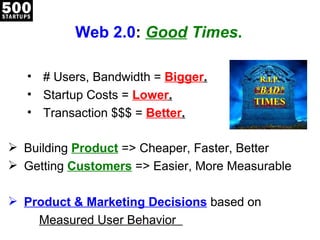
Web 2.0 :  Good  Times . # Users, Bandwidth =  Bigger . Startup Costs =  Lower . Transaction $$$ =  Better . Building  Product   => Cheaper, Faster, Better Getting  Customers   => Easier, More Measurable Product & Marketing Decisions   based on Measured User Behavior  R.I.P. *BAD* TIMES
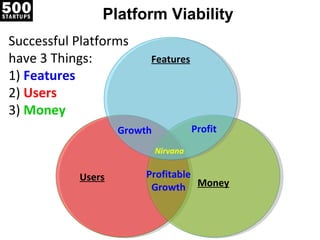
Platform Viability Successful Platforms  have 3 Things: 1)  Features 2)  Users 3)  Money Users   . .  Money Features Growth Profit Profitable Growth Nirvana
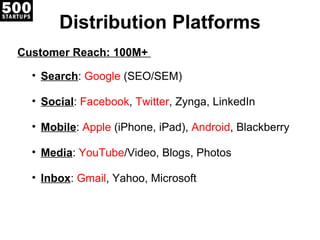
Distribution Platforms Customer Reach: 100M+  Search :  Google  (SEO/SEM) Social :  Facebook ,  Twitter , Zynga, LinkedIn Mobile :  Apple  (iPhone, iPad),  Android , Blackberry Media :  YouTube /Video, Blogs, Photos Inbox :  Gmail , Yahoo, Microsoft
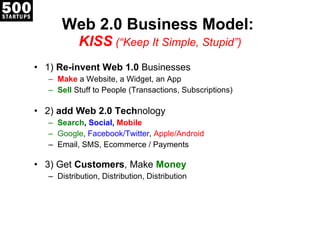
Web 2.0 Business Model:  KISS  (“Keep It Simple, Stupid”) 1)  Re-invent Web 1.0  Businesses Make  a Website, a Widget, an App Sell  Stuff to People (Transactions, Subscriptions) 2)  add Web 2.0 Tech nology Search ,  Social ,  Mobile Google ,  Facebook/Twitter ,  Apple/Android Email, SMS, Ecommerce / Payments 3) Get  Customers , Make  Money Distribution, Distribution, Distribution
Startup Incubators  Lots of Hot, Cool, Web 2.0! (+ lots of  FAIL .)
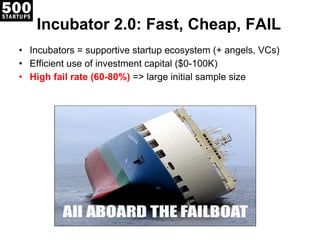
Incubator 2.0: Fast, Cheap, FAIL Incubators = supportive startup ecosystem (+ angels, VCs) Efficient use of investment capital ($0-100K) High fail rate (60-80%)  => large initial sample size
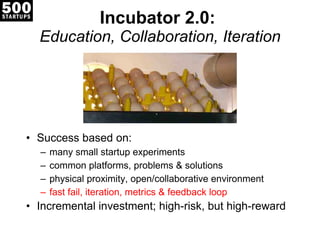
Incubator 2.0:  Education, Collaboration, Iteration Success based on: many small startup experiments common platforms, problems & solutions physical proximity, open/collaborative environment fast fail, iteration, metrics & feedback loop Incremental investment; high-risk, but high-reward
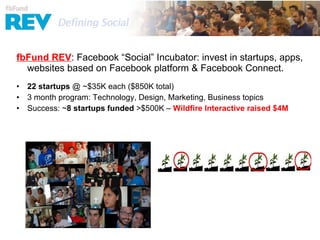
fbFund REV fbFund REV : Facebook “Social” Incubator: invest in startups, apps, websites based on Facebook platform & Facebook Connect. 22 startups  @ ~$35K each ($850K total) 3 month program: Technology, Design, Marketing, Business topics  Success: ~ 8 startups funded  >$500K –  Wildfire Interactive raised $4M
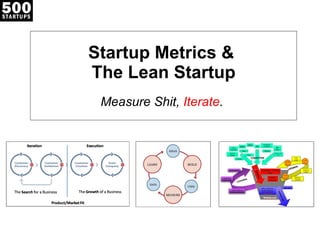
Startup Metrics &  The Lean Startup Measure Shit,  Iterate .
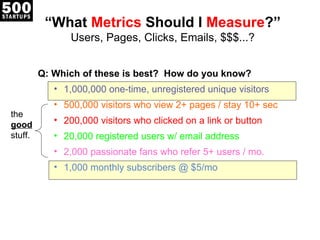
“ What  Metrics  Should I  Measure ?” Users, Pages, Clicks, Emails, $$$...? Q: Which of these is best?  How do you know? 1,000,000 one-time, unregistered unique visitors 500,000 visitors who view 2+ pages / stay 10+ sec 200,000 visitors who clicked on a link or button 20,000 registered users w/ email address 2,000 passionate fans who refer 5+ users / mo. 1,000 monthly subscribers @ $5/mo the  good   stuff.
Read  Geoffrey Miller Sex  +  Evolution  +  Consumer Mktg  =  Awesome Sauce
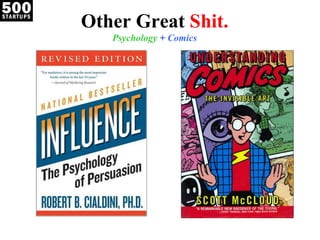
Other Great  Shit. Psychology  +  Comics
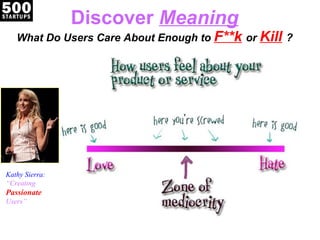
Discover  Meaning What Do Users Care About Enough to  F**k   or  Kill   ? Kathy Sierra: “ Creating Passionate Users”
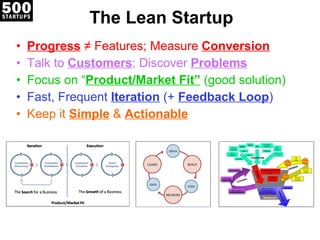
The Lean Startup Progress  ≠ Features; Measure  Conversion Talk to  Customers ; Discover  Problems Focus on “ Product/Market Fit”  (good solution) Fast, Frequent  Iteration  (+  Feedback Loop ) Keep it  Simple  &  Actionable
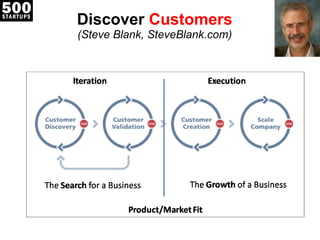
Discover  Customers (Steve Blank, SteveBlank.com)
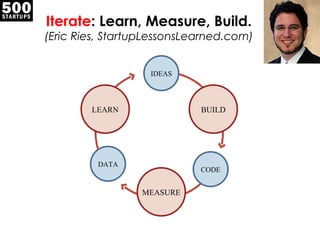
Iterate : Learn, Measure, Build. (Eric Ries, StartupLessonsLearned.com) LEARN BUILD MEASURE IDEAS CODE DATA
Product/Market Fit  Before “Launch” (Sean Ellis, Startup-Marketing.com) [email_address] Blog: startup-marketing.com
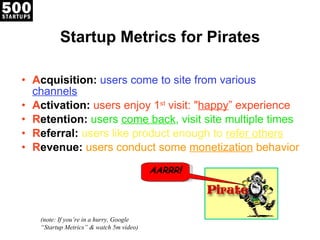
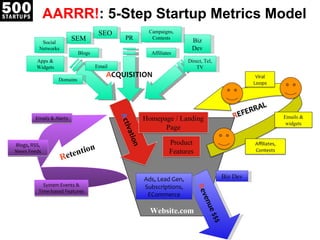
Startup Metrics for Pirates A cquisition:   users come to site from various  channels A ctivation:  users enjoy 1 st  visit: &quot; happy ” experience R etention:  users  come back , visit site multiple times R eferral:  users like product enough to  refer others R evenue:  users conduct some  monetization  behavior (note: If you’re in a hurry, Google “Startup Metrics” & watch 5m video) AARRR !
AARRR! : 5-Step Startup Metrics Model Website.com R evenue $$$ Biz Dev Ads, Lead Gen, Subscriptions, ECommerce A CQUISITION SEO SEM Apps & Widgets Affiliates Email PR Biz Dev Campaigns, Contests Direct, Tel, TV Social Networks Blogs Domains R etention Emails & Alerts System Events & Time-based Features Blogs, RSS, News Feeds
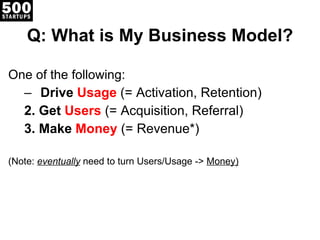
Q: What is My Business Model? One of the following: Drive  Usage   (= Activation, Retention) 2. Get  Users   (= Acquisition, Referral) 3. Make  Money   (= Revenue*) (Note:  eventually  need to turn Users/Usage ->  Money)
Lean Startup Challenges Startups have problems in 3 main areas: Management : Set Priorities, Define Key Metrics,  Make Decisions . Product : Build the “Right” Features.  Measure, Iterate . Marketing : Distribution, Distribution,  Distribution .
Role: Founder/CEO Q: Which Metrics? Why? A: Focus on  Critical Few Actionable  Metrics (if you don’t use the metric to make a decision, it’s not actionable) Hypothesize Customer Lifecycle Target ~3-5 Conversion Events  (tip: Less = More) Test, Measure, Iterate to Improve
Role: Product / Engineering Q: What Features to Build?  Why?  When are you “Done”? A:  Easy-to-Find ,  Fun / Useful ,  Unique   features that   Increase Conversion   (stop iterating when increase decelerates) Wireframes = Conversion Steps Measure, A/B Test, Iterate FAST (daily/weekly) Optimize for Conversion Improvement 80% on existing feature optimization 20% on new feature development
Role: Marketing / Sales Q: What channels?  Which users?  Why? A: High  Volume   (#), Low  Cost   ($), High  Conv   (%) Design & Test Multiple Marketing Channels + Campaigns Select & Focus on Best-Performing Channels & Themes Optimize for conversion to target CTAs, not just site/landing page Match/Drive channel cost to/below revenue potential Low-Hanging Fruit:  Blogs SEO/SEM Landing Pages Automated Emails
M AARRR keting Plan Marketing Plan = Target Customer Acquisition Channels 3 Important Factors = Volume (#), Cost ($), Conversion (%) Measure conversion to target customer actions Test audience segments, campaign themes, Call-To-Action (CTAs)  [Gradually] Match Channel Costs =>  Revenue Potential  Increase Vol. & Conversion, Decrease Cost, Optimize for Revenue Potential Avg Txn Value (ATV), Ann Rev Per User (ARPU), Cust Lifetime Value (CLV) Design channels that (eventually) cost <20-50% of target ATV, ARPU, CLV Consider Costs, Scarce Resource Tradeoffs Actual $ expenses Marketing time & resources Product/Engineering time & resources Cashflow timing of expense vs. revenue, profit
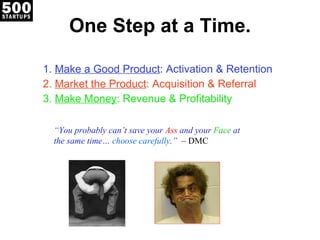
One Step at a Time. Make a Good Product : Activation & Retention Market the Product : Acquisition & Referral Make Money : Revenue & Profitability “ You probably can’t save your  Ass  and your  Face  at the same time…  choose carefully .”  – DMC
Investor Metrics:  “Super Angel”  ->  Lean VC Not  “Spray & Pray”, but rather “ Quantitative, Incremental, Selective Follow-on ” Investing.  (Product, Market, Revenue.)
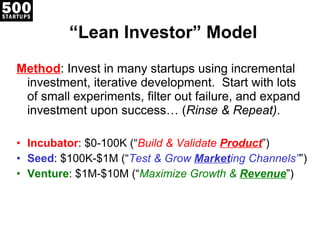
“ Lean Investor” Model Method : Invest in many startups using incremental investment, iterative development.  Start with lots of small experiments, filter out failure, and expand investment upon success… ( Rinse & Repeat) . Incubator : $0-100K (“ Build & Validate  Product ”) Seed : $100K-$1M (“ Test & Grow  Market ing Channels” ”) Venture : $1M-$10M (“ Maximize Growth &  Revenue ”)
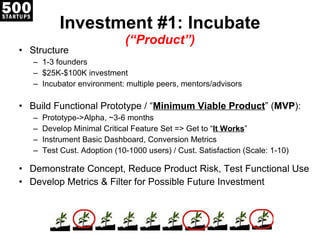
Investment #1: Incubate (“Product”) Structure 1-3 founders $25K-$100K investment Incubator environment: multiple peers, mentors/advisors Build Functional Prototype / “ Minimum Viable Product ” ( MVP ): Prototype->Alpha, ~3-6 months Develop Minimal Critical Feature Set => Get to “ It Works ” Instrument Basic Dashboard, Conversion Metrics Test Cust. Adoption (10-1000 users) / Cust. Satisfaction (Scale: 1-10) Demonstrate Concept, Reduce Product Risk, Test Functional Use Develop Metrics & Filter for Possible Future Investment
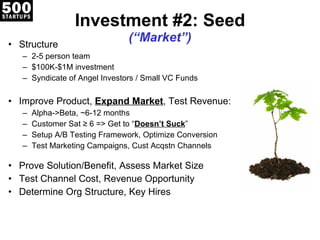
Investment #2: Seed (“Market”) Structure 2-5 person team $100K-$1M investment Syndicate of Angel Investors / Small VC Funds Improve Product,  Expand Market , Test Revenue: Alpha->Beta, ~6-12 months Customer Sat ≥ 6 => Get to “ Doesn’t Suck ” Setup A/B Testing Framework, Optimize Conversion Test Marketing Campaigns, Cust Acqstn Channels  Prove Solution/Benefit, Assess Market Size Test Channel Cost, Revenue Opportunity Determine Org Structure, Key Hires
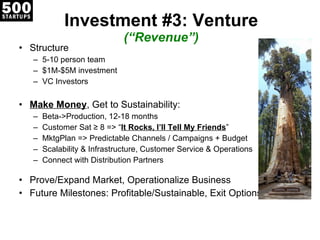
Investment #3: Venture (“Revenue”) Structure 5-10 person team $1M-$5M investment VC Investors Make Money , Get to Sustainability: Beta->Production, 12-18 months Customer Sat ≥ 8 => “ It Rocks, I’ll Tell My Friends ” MktgPlan => Predictable Channels / Campaigns + Budget Scalability & Infrastructure, Customer Service & Operations Connect with Distribution Partners Prove/Expand Market, Operationalize Business Future Milestones: Profitable/Sustainable, Exit Options
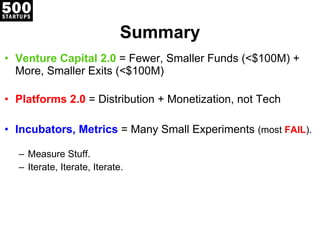
Summary Venture Capital 2.0  = Fewer, Smaller Funds (<$100M) +  More, Smaller Exits (<$100M) Platforms 2.0  = Distribution + Monetization, not Tech Incubators, Metrics  = Many Small Experiments  (most  FAIL ).  Measure Stuff. Iterate, Iterate, Iterate.

Venture Capital 2.0: The Lean VC

  • 1.
    Venture Capital 2.0 : The Lean VC Dave McClure 500 Startups ( @DaveMcClure ) http://500startups.com SlideShare ZipCast, Feb 2011 Re-Inventing Venture Capital Investing through Innovation, Incubation, & Iteration
  • 2.
    Changes. Venture Capital = Fewer, Smaller Funds (<$100M) Decline of Large Funds (> $250m) Birth of “ Super Angel” Funds ($10-100M) Market Changes: Fewer IPOs (>$1B), More/Smaller Acq’stns (<$250M) Platforms = Distribution + Monetization (not Technology) Search (Google) Social (Facebook, Twitter, YouTube) Mobile (Apple, Android) Incubators & Metrics = Many Small Experiments (most FAIL ) Y-Combinator, TechStars, SeedCamp Betaworks, fbFund REV, AngelPad 500 Startups
  • 3.
    Dave McClure: Bio2000-2010: Investor : 100+ Startups (Mint, SlideShare, Twilio, WildFire) Marketing : PayPal, Simply Hired, Mint.com, Founders Fund Community : Startup2Startup , GeeksOnaPlane , StartupVisa Speaker : Startup Metrics, Stanford Facebook class 80’s & 90’s: Entrepreneur : Founder/CEO Aslan Computing (acq.) Developer : Windows App Dev / SQL DB Admin Engineer : Johns Hopkins ‘88, BS Eng / Applied Math
  • 4.
    500 Startups SeedFund Mountain View, CA – Founded 2010 Seed Fund & Startup Accelerator Design , Distribution , Data 90+ Portfolio Companies Twilio Wildfire SendGrid MyGengo Erply Payvment FlowTown Medialets ChinaNetCloud
  • 5.
    500 Hats LLC(Personal Investments: 13 deals, 2004-2008, ~$300K) Results: 1 exit @ $170M (9x), +3-6 future wins 2 addtl exits @ $50M, $70M (advisory roles) Bix (acq YHOO) Jambool (acq GOOG)
  • 6.
    Founders Fund (Incubator/Seed Program: 43 deals, 2008-2010, ~$3M) Results : 8 raised seed rd $500K+ 3 small exits Results : 6 raised Series A $2M+ 2 raised Series B $5-10M+ 1 early exit @ 4x FanBridge Facebook fbFund 22 incubator deals ($850K) FF Angel LLC 21 seed deals ($2M)
  • 7.
    500 Startups LPFund I (90+ investments @ ~$75K avg) Wildfire Crave Tello AwayFind Indinero MyGengo Revnetics Mogotix EcoMom Zencoder GazeHawk Crocodoc SayHired Recurly AppBistro Foodspotting Gantto Medialets Rapportive TransFS SiteJabber GinzaMetrics Estately FlowTown OneForty Twilio Postling Plancast ElaCarte WePay Zappli Format Baydin GroupSpaces Rapportive Apsalar Bunndle Udemy Brainient ReadyForZero Graphicly StoryJumper OtherInbox Viikii Zozi One True Fan Formative Labs Networked Blogs
  • 8.
    Venture Capital 2.0(smaller, faster, better) Venture Capital 1.0 “ Super” Angel (aka Micro-VC)
  • 9.
    Silicon Valley InvestorEcosystem True Ventures First Round Capital Benchmark Accel Angels & Incubators ($0-10M) “ Seed” Funds ($10-50M) VC Funds ($50-250M) VC Funds (>$250M) Y-Combinator TechStars SoftTech (Clavier) FloodGate (Maples) Felicis (Senkut) SV Angel (Conway)
  • 10.
    Venture Capital: StillRelevant? Good for big CAP: Hardware Enterprise SW Clean Tech BioScience Facebook, Zynga, Groupon Not So Great for: Consumer Internet Small Business Consulting Games, Porn ;)
  • 11.
    More & SmallerAcquisitions Mature Internet Platform Co’s: GOOG, MSFT, YHOO, EBAY, AOL, AMZN, AAPL, INTU, ADBE, Fbook Lots of Users, $$$ Outsourcing Innovation Lots of M&A (but small) Great for Angels & Entrepreneurs Not so Great for (big) VCs * Mint acquired by Intuit in Sept 2009 for $170M
  • 12.
    Platforms 2.0 Search,Social, Mobile
  • 13.
    Web 2.0 : Good Times . # Users, Bandwidth = Bigger . Startup Costs = Lower . Transaction $$$ = Better . Building Product => Cheaper, Faster, Better Getting Customers => Easier, More Measurable Product & Marketing Decisions based on Measured User Behavior R.I.P. *BAD* TIMES
  • 14.
    Platform Viability SuccessfulPlatforms have 3 Things: 1) Features 2) Users 3) Money Users . . Money Features Growth Profit Profitable Growth Nirvana
  • 15.
    Distribution Platforms CustomerReach: 100M+ Search : Google (SEO/SEM) Social : Facebook , Twitter , Zynga, LinkedIn Mobile : Apple (iPhone, iPad), Android , Blackberry Media : YouTube /Video, Blogs, Photos Inbox : Gmail , Yahoo, Microsoft
  • 16.
    Web 2.0 BusinessModel: KISS (“Keep It Simple, Stupid”) 1) Re-invent Web 1.0 Businesses Make a Website, a Widget, an App Sell Stuff to People (Transactions, Subscriptions) 2) add Web 2.0 Tech nology Search , Social , Mobile Google , Facebook/Twitter , Apple/Android Email, SMS, Ecommerce / Payments 3) Get Customers , Make Money Distribution, Distribution, Distribution
  • 17.
    Startup Incubators Lots of Hot, Cool, Web 2.0! (+ lots of FAIL .)
  • 18.
    Incubator 2.0: Fast,Cheap, FAIL Incubators = supportive startup ecosystem (+ angels, VCs) Efficient use of investment capital ($0-100K) High fail rate (60-80%) => large initial sample size
  • 19.
    Incubator 2.0: Education, Collaboration, Iteration Success based on: many small startup experiments common platforms, problems & solutions physical proximity, open/collaborative environment fast fail, iteration, metrics & feedback loop Incremental investment; high-risk, but high-reward
  • 20.
    fbFund REV fbFundREV : Facebook “Social” Incubator: invest in startups, apps, websites based on Facebook platform & Facebook Connect. 22 startups @ ~$35K each ($850K total) 3 month program: Technology, Design, Marketing, Business topics Success: ~ 8 startups funded >$500K – Wildfire Interactive raised $4M
  • 21.
    Startup Metrics & The Lean Startup Measure Shit, Iterate .
  • 22.
    “ What Metrics Should I Measure ?” Users, Pages, Clicks, Emails, $$$...? Q: Which of these is best? How do you know? 1,000,000 one-time, unregistered unique visitors 500,000 visitors who view 2+ pages / stay 10+ sec 200,000 visitors who clicked on a link or button 20,000 registered users w/ email address 2,000 passionate fans who refer 5+ users / mo. 1,000 monthly subscribers @ $5/mo the good stuff.
  • 23.
    Read GeoffreyMiller Sex + Evolution + Consumer Mktg = Awesome Sauce
  • 24.
    Other Great Shit. Psychology + Comics
  • 25.
    Discover MeaningWhat Do Users Care About Enough to F**k or Kill ? Kathy Sierra: “ Creating Passionate Users”
  • 26.
    The Lean StartupProgress ≠ Features; Measure Conversion Talk to Customers ; Discover Problems Focus on “ Product/Market Fit” (good solution) Fast, Frequent Iteration (+ Feedback Loop ) Keep it Simple & Actionable
  • 27.
    Discover Customers(Steve Blank, SteveBlank.com)
  • 28.
    Iterate : Learn,Measure, Build. (Eric Ries, StartupLessonsLearned.com) LEARN BUILD MEASURE IDEAS CODE DATA
  • 29.
    Product/Market Fit Before “Launch” (Sean Ellis, Startup-Marketing.com) [email_address] Blog: startup-marketing.com
  • 30.
    Startup Metrics forPirates A cquisition: users come to site from various channels A ctivation: users enjoy 1 st visit: &quot; happy ” experience R etention: users come back , visit site multiple times R eferral: users like product enough to refer others R evenue: users conduct some monetization behavior (note: If you’re in a hurry, Google “Startup Metrics” & watch 5m video) AARRR !
  • 31.
    AARRR! : 5-StepStartup Metrics Model Website.com R evenue $$$ Biz Dev Ads, Lead Gen, Subscriptions, ECommerce A CQUISITION SEO SEM Apps & Widgets Affiliates Email PR Biz Dev Campaigns, Contests Direct, Tel, TV Social Networks Blogs Domains R etention Emails & Alerts System Events & Time-based Features Blogs, RSS, News Feeds
  • 32.
    Q: What isMy Business Model? One of the following: Drive Usage (= Activation, Retention) 2. Get Users (= Acquisition, Referral) 3. Make Money (= Revenue*) (Note: eventually need to turn Users/Usage -> Money)
  • 33.
    Lean Startup ChallengesStartups have problems in 3 main areas: Management : Set Priorities, Define Key Metrics, Make Decisions . Product : Build the “Right” Features. Measure, Iterate . Marketing : Distribution, Distribution, Distribution .
  • 34.
    Role: Founder/CEO Q:Which Metrics? Why? A: Focus on Critical Few Actionable Metrics (if you don’t use the metric to make a decision, it’s not actionable) Hypothesize Customer Lifecycle Target ~3-5 Conversion Events (tip: Less = More) Test, Measure, Iterate to Improve
  • 35.
    Role: Product /Engineering Q: What Features to Build? Why? When are you “Done”? A: Easy-to-Find , Fun / Useful , Unique features that Increase Conversion (stop iterating when increase decelerates) Wireframes = Conversion Steps Measure, A/B Test, Iterate FAST (daily/weekly) Optimize for Conversion Improvement 80% on existing feature optimization 20% on new feature development
  • 36.
    Role: Marketing /Sales Q: What channels? Which users? Why? A: High Volume (#), Low Cost ($), High Conv (%) Design & Test Multiple Marketing Channels + Campaigns Select & Focus on Best-Performing Channels & Themes Optimize for conversion to target CTAs, not just site/landing page Match/Drive channel cost to/below revenue potential Low-Hanging Fruit: Blogs SEO/SEM Landing Pages Automated Emails
  • 37.
    M AARRR ketingPlan Marketing Plan = Target Customer Acquisition Channels 3 Important Factors = Volume (#), Cost ($), Conversion (%) Measure conversion to target customer actions Test audience segments, campaign themes, Call-To-Action (CTAs) [Gradually] Match Channel Costs => Revenue Potential Increase Vol. & Conversion, Decrease Cost, Optimize for Revenue Potential Avg Txn Value (ATV), Ann Rev Per User (ARPU), Cust Lifetime Value (CLV) Design channels that (eventually) cost <20-50% of target ATV, ARPU, CLV Consider Costs, Scarce Resource Tradeoffs Actual $ expenses Marketing time & resources Product/Engineering time & resources Cashflow timing of expense vs. revenue, profit
  • 38.
    One Step ata Time. Make a Good Product : Activation & Retention Market the Product : Acquisition & Referral Make Money : Revenue & Profitability “ You probably can’t save your Ass and your Face at the same time… choose carefully .” – DMC
  • 39.
    Investor Metrics: “Super Angel” -> Lean VC Not “Spray & Pray”, but rather “ Quantitative, Incremental, Selective Follow-on ” Investing. (Product, Market, Revenue.)
  • 40.
    “ Lean Investor”Model Method : Invest in many startups using incremental investment, iterative development. Start with lots of small experiments, filter out failure, and expand investment upon success… ( Rinse & Repeat) . Incubator : $0-100K (“ Build & Validate Product ”) Seed : $100K-$1M (“ Test & Grow Market ing Channels” ”) Venture : $1M-$10M (“ Maximize Growth & Revenue ”)
  • 41.
    Investment #1: Incubate(“Product”) Structure 1-3 founders $25K-$100K investment Incubator environment: multiple peers, mentors/advisors Build Functional Prototype / “ Minimum Viable Product ” ( MVP ): Prototype->Alpha, ~3-6 months Develop Minimal Critical Feature Set => Get to “ It Works ” Instrument Basic Dashboard, Conversion Metrics Test Cust. Adoption (10-1000 users) / Cust. Satisfaction (Scale: 1-10) Demonstrate Concept, Reduce Product Risk, Test Functional Use Develop Metrics & Filter for Possible Future Investment
  • 42.
    Investment #2: Seed(“Market”) Structure 2-5 person team $100K-$1M investment Syndicate of Angel Investors / Small VC Funds Improve Product, Expand Market , Test Revenue: Alpha->Beta, ~6-12 months Customer Sat ≥ 6 => Get to “ Doesn’t Suck ” Setup A/B Testing Framework, Optimize Conversion Test Marketing Campaigns, Cust Acqstn Channels Prove Solution/Benefit, Assess Market Size Test Channel Cost, Revenue Opportunity Determine Org Structure, Key Hires
  • 43.
    Investment #3: Venture(“Revenue”) Structure 5-10 person team $1M-$5M investment VC Investors Make Money , Get to Sustainability: Beta->Production, 12-18 months Customer Sat ≥ 8 => “ It Rocks, I’ll Tell My Friends ” MktgPlan => Predictable Channels / Campaigns + Budget Scalability & Infrastructure, Customer Service & Operations Connect with Distribution Partners Prove/Expand Market, Operationalize Business Future Milestones: Profitable/Sustainable, Exit Options
  • 44.
    Summary Venture Capital2.0 = Fewer, Smaller Funds (<$100M) + More, Smaller Exits (<$100M) Platforms 2.0 = Distribution + Monetization, not Tech Incubators, Metrics = Many Small Experiments (most FAIL ). Measure Stuff. Iterate, Iterate, Iterate.

Editor's Notes

  • #23 I know, too many bullets…
  • #29 BUILT TO LEARN This is the core feedback loop that powers startups. Their goal is not to optimize the time it takes to do any one of these steps. There are many specific practices that can power lean startups, and we’ll cover a few in this presentation. But more important than any specific practice is this core idea: startups should be built to learn.