Sentiment
Analysis
Machine Learning
Approach
Lexicon-Based
Approach
Statistical
Semantic
Supervised
Learning
Unsupervised
Learning
Decision Tree
Classifiers
Linear Tree
Classifiers
Rule-Based
Classifiers
Probabilistic
Classifiers
Bayesian Network
Naïve Bayes
Maximum Entropy
Neural Network
Support Vector
Machines
Sentiment
Analysis
Mitosis Technologies 2
Corpus-Based
Approach
Dictionary-Based
Approach
Sentiment
Analysis
Sentiment analysis is a text-based process that
identifies the positive or negative opinion within a
sentence, paragraph or complete document.
By applying natural language processing (NLP) and text
analysis techniques we analyse unstructured data and
extract significant information from a sentence. It is
transformed into effective business intelligence.
This helps in analysing and measuring human
emotions to convert them into factual data.
The converted data allows us to categorise expressions
as positive, negative or neutral.
Mitosis Technologies 3
4
Sentiment
Analysis
Synonymous and
Interchangeable
Names
Subjective
Analysis
Review
Mining
Opinion
Mining
Appraisal
Extraction
Mitosis Technologies
Sentiment analysis identifies the most significant
expressions and feelings of customers that could have
the greatest impact on the business and its brand.
Sentiment analysis helps a business by listening to its
customers' emotions from survey responses, social
media conversations and more. It can then
customise its offerings to meet customers’
expectations in terms of pricing plans, ease of access,
customer service, etc.
Sentiment analysis helps a business by identifying the
attitudes, emotions and opinions of its customers about
its products, services and brand.
This is achieved by analysing social networking sites and
other digital media forums where people are
commenting on its products and services.
Sentiment Analysis in
Mitosis Technologies 5
Business
Process of
Sentiment Analysis
Sentiment analysis uses rules-based, automatic and
hybrid methods and algorithms.
The rules-based approach helps identify subjectivity,
polarity and the subject of an opinion. It employs
techniques such as:
Stemming, tokenisation, part-of-speech tagging and
parsing
Lexicons (i.e. lists of words and expressions)
The automatic approaches use machine learning
techniques.
Hybrid approaches offer more power by
combining elements of the rules-based and
automatic approaches.
Mitosis Technologies 6
Sentiment Analysis
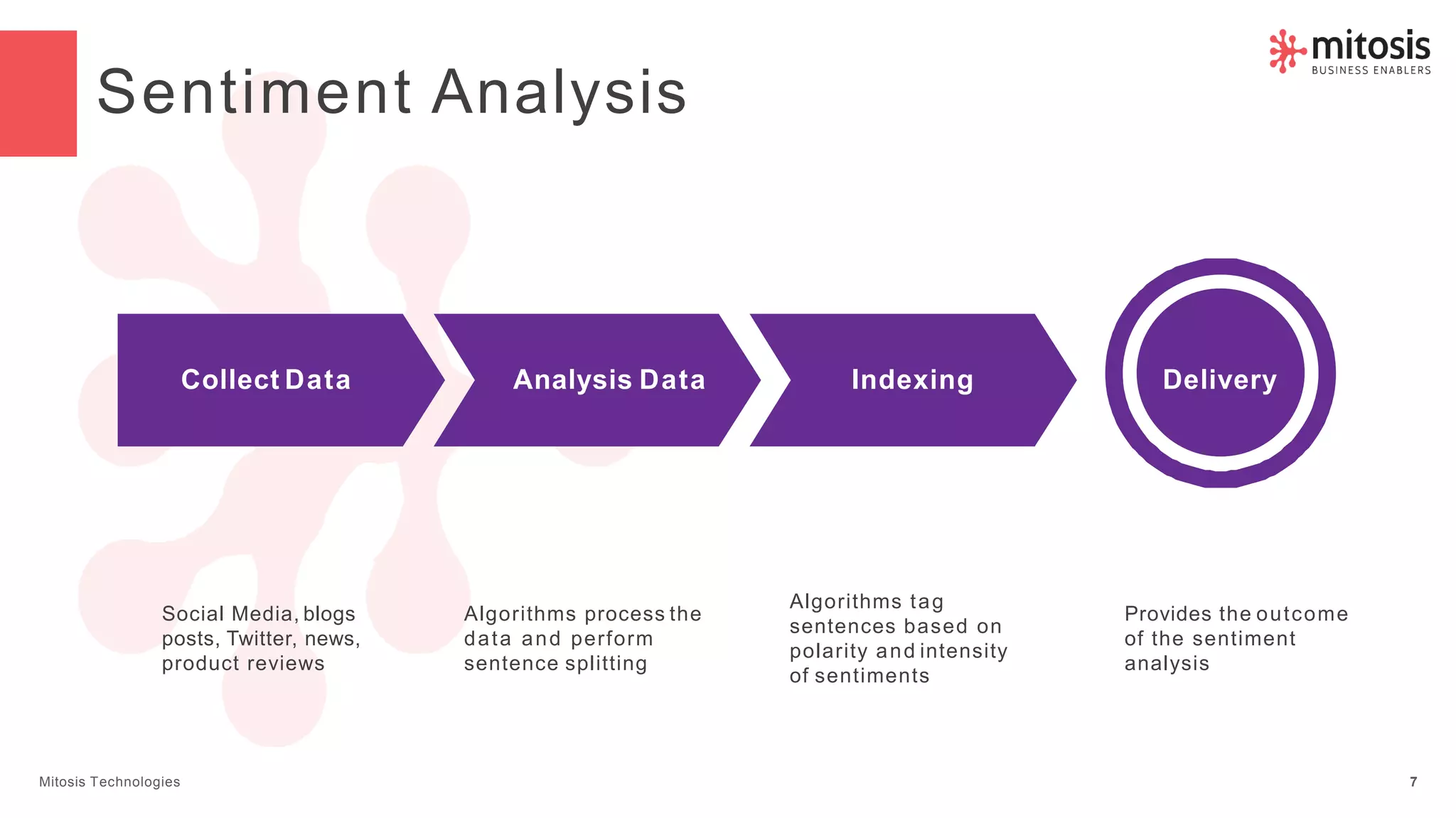
Collect Data
Mitosis Technologies 7
Analysis Data Indexing Delivery
Social Media, blogs
posts, Twitter, news,
product reviews
Algorithms process the
data and perform
sentence splitting
Algorithms tag
sentences based on
polarity and intensity
of sentiments
Provides the outcome
of the sentiment
analysis
Process of
Sentiment Analysis
The first step in the process is to collect customers’ public
posts across the main social media platforms that
reference the business’s products or services.
These are then analysed using a feature extractor with
the results fed into a machine learning (ML) algorithm.
The MLtext classifier transforms the extracted text into a
“bag of words” and “n-grams” with their associated
frequencies.
The n-grams are then classified by a statistical model
that produces customer insight and predictions.
Mitosis Technologies 8
Types of
Algorithms
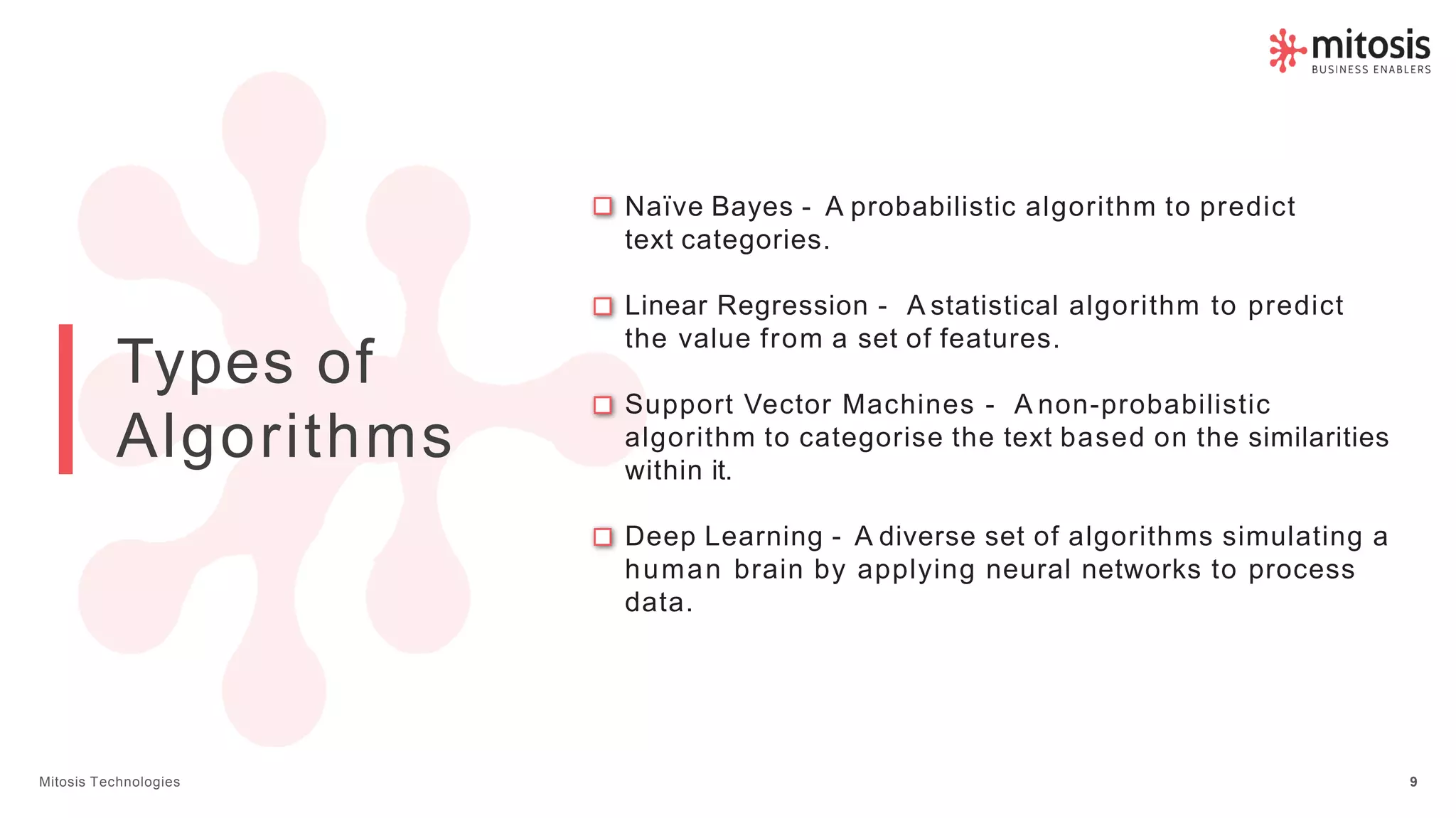
Naïve Bayes - A probabilistic algorithm to predict
text categories.
Linear Regression - A statistical algorithm to predict
the value from a set of features.
Support Vector Machines - A non-probabilistic
algorithm to categorise the text based on the similarities
within it.
Deep Learning - A diverse set of algorithms simulating a
human brain by applying neural networks to process
data.
Mitosis Technologies 9
Text
Classification
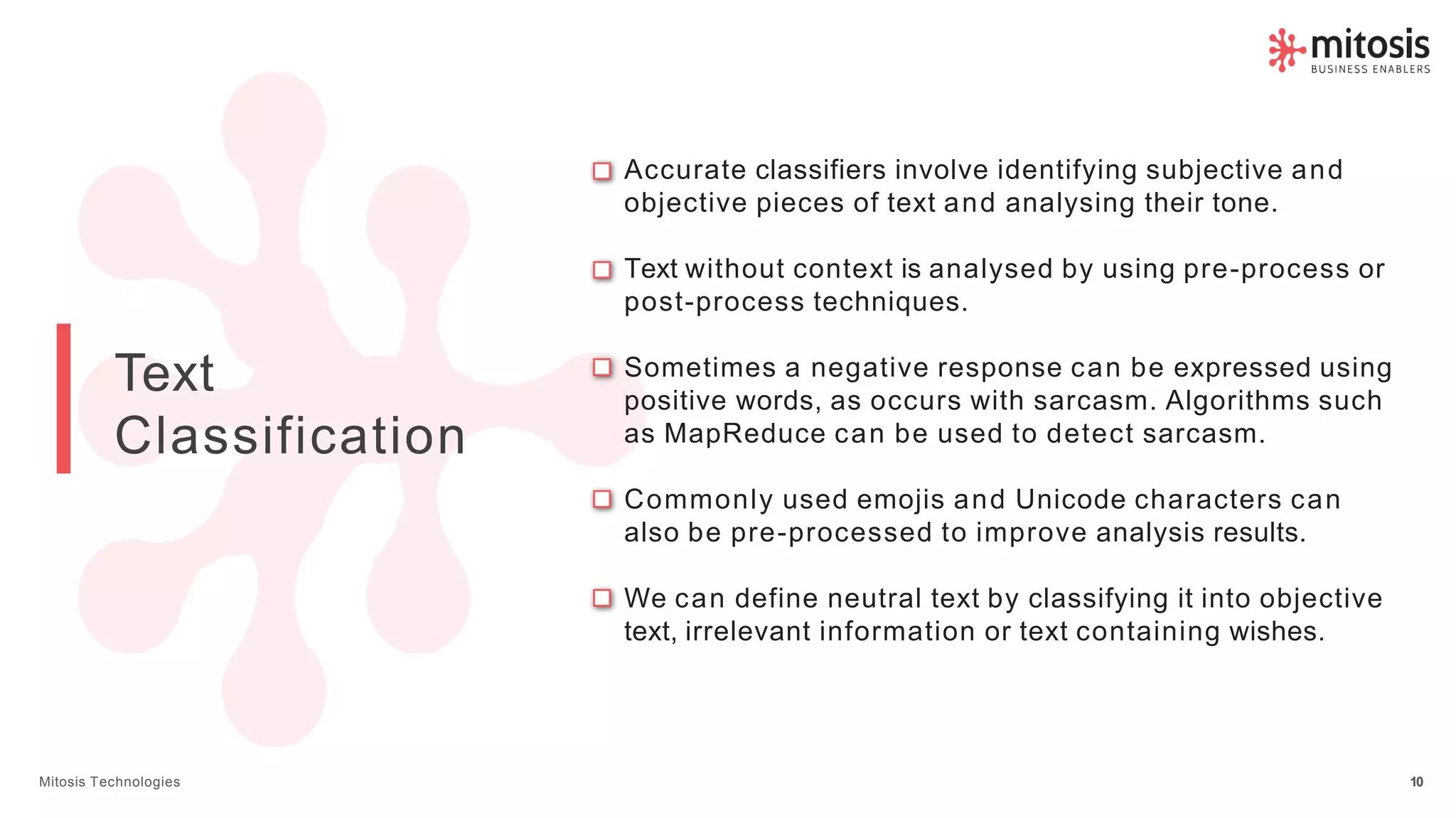
Accurate classifiers involve identifying subjective and
objective pieces of text and analysing their tone.
Text without context is analysed by using pre-process or
post-process techniques.
Sometimes a negative response can be expressed using
positive words, as occurs with sarcasm. Algorithms such
as MapReduce can be used to detect sarcasm.
Commonly used emojis and Unicode characters can
also be pre-processed to improve analysis results.
We can define neutral text by classifying it into objective
text, irrelevant information or text containing wishes.
Mitosis Technologies 10
Language-
Independent Analysis
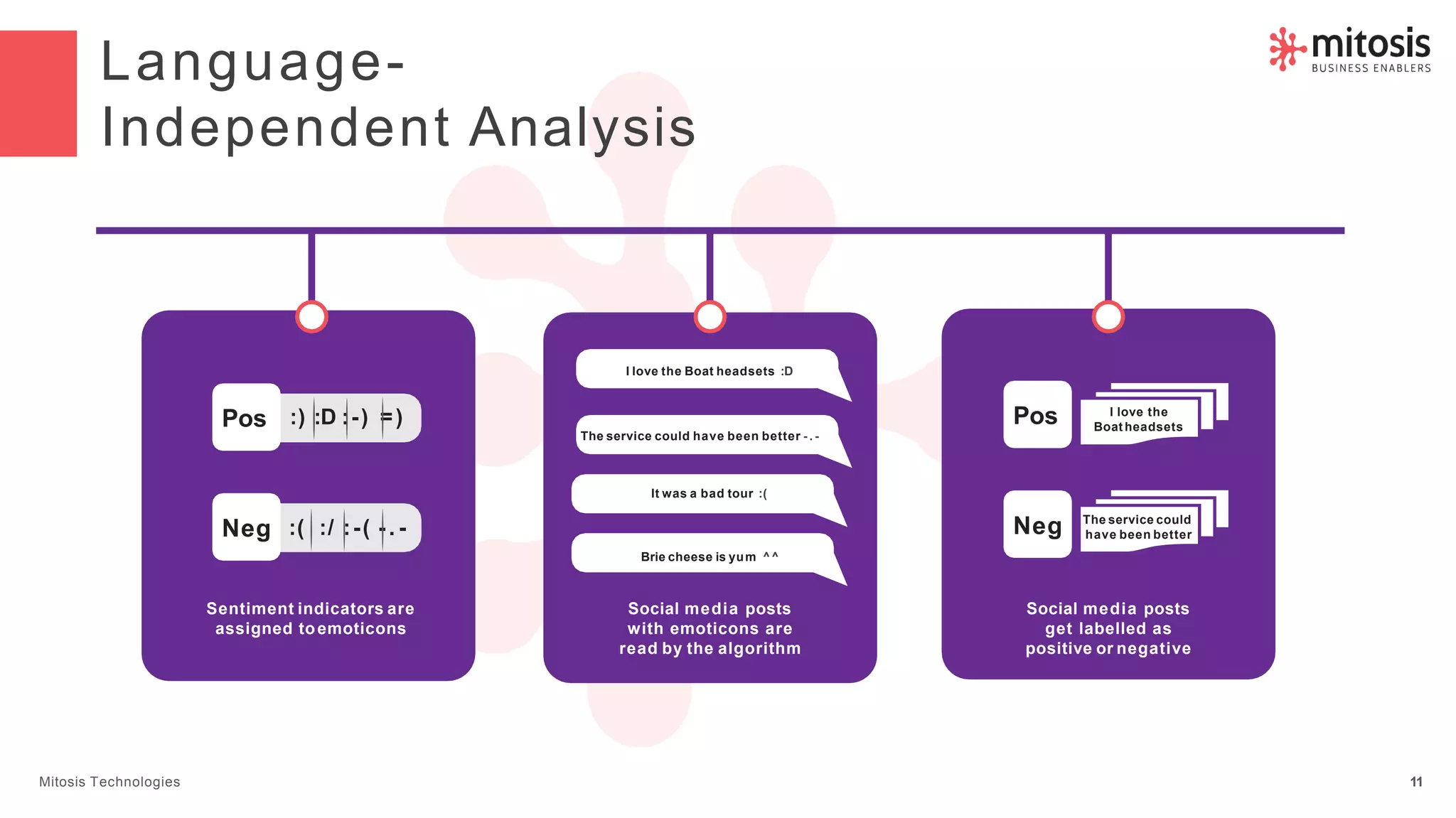
Pos
Sentiment indicators are
assigned toemoticons
Social media posts
with emoticons are
read by the algorithm
Social media posts
get labelled as
positive or negative
Pos
Neg
I love the
Boat headsets
The service could
have been better
:) :D :-) =)
Neg :( :/ :-( - . -
I love the Boat headsets :D
Mitosis Technologies 11
The service could have been better - . -
It was a bad tour :(
Brie cheese is yum ^^
Sentiment Analysis
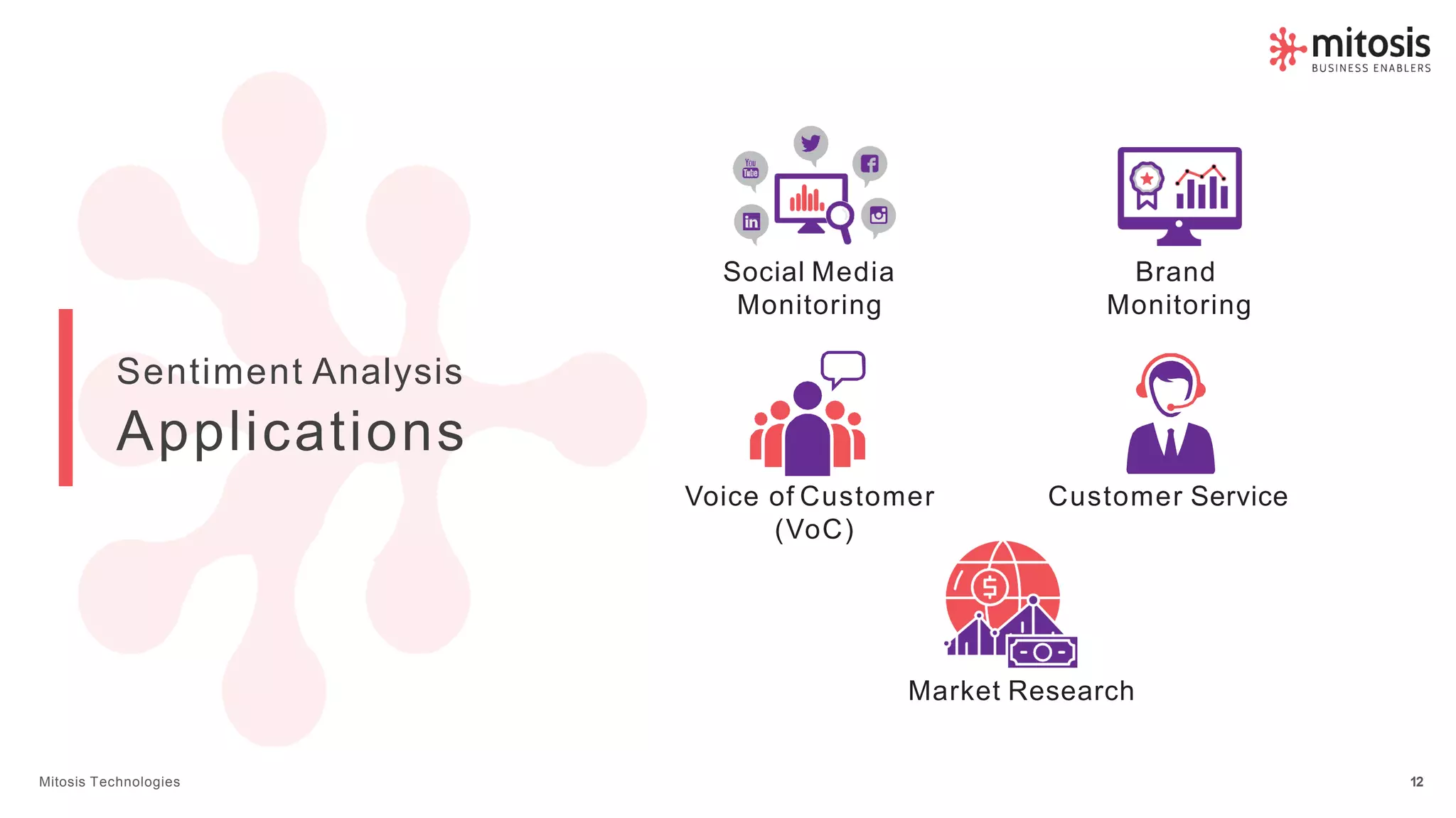
Applications
Social Media
Monitoring
Mitosis Technologies 12
Brand
Monitoring
Voice of Customer
(VoC)
Customer Service
Market Research
Common
APIs Used in
Sentiment Analysis
Scikit-learn
NLTK
SpaCy
TensorFlow
Keras
PyTorch
OpenNLP
CoreNLP
Mitosis Technologies 13
Example Sentiment Analysis
Software Types
Text Processing
It performs word grouping (“lemmatisation”), word
stemming, parts of speech tagging and chunking,
phrase extraction, date extraction, location and
named entity recognition, and more.
Mitosis Technologies 14
Tweet Sentiments
Twitter is a commonly used platform for customers to
express opinions on products. Tweet Sentiments
analyse both new and existing tweets to extract the
emotions one tweet at a time.
MLAnalyser
This software uses machine learning to perform text
classification, article summarisation, stock symbol
extraction, and name, location and language
detection.
Sentiment analysis is used to gain valuable insights from
customers not easily achieved by other means.
It is about enhancing a business and its brand in the eyes
of its current and future customers.
Sentiment analysis reports are directly usable in showing
key areas for improvement.
In conclusion, sentiment analysis enables a business to
gain new insights, understand its customers and
empower its teams effectively for more productive work.
Sentiment Analysis in
Brand
Marketing
Mitosis Technologies 15
What can Sentiment Analysis do for
Brands?
What do customers
think of the
products and brand?
Are customers happy
with the services they
receive?
How do the company’s
policies, external events
or employees impact
customers’ perception of
its brand?
What do customers like
about the brand’s
competitors?
Sentiment Analysis
Mitosis Technologies 16
Increase
Customer Retention
Resolve Customer Experience
Pain Points
Optimise Customer
Service
Measure Social Media RolOptimise Pricing
What can Sentiment Analysis do for
Brands?
Mitosis Technologies 17
To assist you with our services
please reach us at:
hello@mitosistech.com
www.mitosistech.com
IND: +91-7824035173
US:+1-(415) 251-2064

Sentiment Analysis

  • 1.
  • 2.
    Machine Learning Approach Lexicon-Based Approach Statistical Semantic Supervised Learning Unsupervised Learning Decision Tree Classifiers LinearTree Classifiers Rule-Based Classifiers Probabilistic Classifiers Bayesian Network Naïve Bayes Maximum Entropy Neural Network Support Vector Machines Sentiment Analysis Mitosis Technologies 2 Corpus-Based Approach Dictionary-Based Approach
  • 3.
    Sentiment Analysis Sentiment analysis isa text-based process that identifies the positive or negative opinion within a sentence, paragraph or complete document. By applying natural language processing (NLP) and text analysis techniques we analyse unstructured data and extract significant information from a sentence. It is transformed into effective business intelligence. This helps in analysing and measuring human emotions to convert them into factual data. The converted data allows us to categorise expressions as positive, negative or neutral. Mitosis Technologies 3
  • 4.
  • 5.
    Sentiment analysis identifiesthe most significant expressions and feelings of customers that could have the greatest impact on the business and its brand. Sentiment analysis helps a business by listening to its customers' emotions from survey responses, social media conversations and more. It can then customise its offerings to meet customers’ expectations in terms of pricing plans, ease of access, customer service, etc. Sentiment analysis helps a business by identifying the attitudes, emotions and opinions of its customers about its products, services and brand. This is achieved by analysing social networking sites and other digital media forums where people are commenting on its products and services. Sentiment Analysis in Mitosis Technologies 5 Business
  • 6.
    Process of Sentiment Analysis Sentimentanalysis uses rules-based, automatic and hybrid methods and algorithms. The rules-based approach helps identify subjectivity, polarity and the subject of an opinion. It employs techniques such as: Stemming, tokenisation, part-of-speech tagging and parsing Lexicons (i.e. lists of words and expressions) The automatic approaches use machine learning techniques. Hybrid approaches offer more power by combining elements of the rules-based and automatic approaches. Mitosis Technologies 6
  • 7.
    Sentiment Analysis Collect Data MitosisTechnologies 7 Analysis Data Indexing Delivery Social Media, blogs posts, Twitter, news, product reviews Algorithms process the data and perform sentence splitting Algorithms tag sentences based on polarity and intensity of sentiments Provides the outcome of the sentiment analysis
  • 8.
    Process of Sentiment Analysis Thefirst step in the process is to collect customers’ public posts across the main social media platforms that reference the business’s products or services. These are then analysed using a feature extractor with the results fed into a machine learning (ML) algorithm. The MLtext classifier transforms the extracted text into a “bag of words” and “n-grams” with their associated frequencies. The n-grams are then classified by a statistical model that produces customer insight and predictions. Mitosis Technologies 8
  • 9.
    Types of Algorithms Naïve Bayes- A probabilistic algorithm to predict text categories. Linear Regression - A statistical algorithm to predict the value from a set of features. Support Vector Machines - A non-probabilistic algorithm to categorise the text based on the similarities within it. Deep Learning - A diverse set of algorithms simulating a human brain by applying neural networks to process data. Mitosis Technologies 9
  • 10.
    Text Classification Accurate classifiers involveidentifying subjective and objective pieces of text and analysing their tone. Text without context is analysed by using pre-process or post-process techniques. Sometimes a negative response can be expressed using positive words, as occurs with sarcasm. Algorithms such as MapReduce can be used to detect sarcasm. Commonly used emojis and Unicode characters can also be pre-processed to improve analysis results. We can define neutral text by classifying it into objective text, irrelevant information or text containing wishes. Mitosis Technologies 10
  • 11.
    Language- Independent Analysis Pos Sentiment indicatorsare assigned toemoticons Social media posts with emoticons are read by the algorithm Social media posts get labelled as positive or negative Pos Neg I love the Boat headsets The service could have been better :) :D :-) =) Neg :( :/ :-( - . - I love the Boat headsets :D Mitosis Technologies 11 The service could have been better - . - It was a bad tour :( Brie cheese is yum ^^
  • 12.
    Sentiment Analysis Applications Social Media Monitoring MitosisTechnologies 12 Brand Monitoring Voice of Customer (VoC) Customer Service Market Research
  • 13.
    Common APIs Used in SentimentAnalysis Scikit-learn NLTK SpaCy TensorFlow Keras PyTorch OpenNLP CoreNLP Mitosis Technologies 13
  • 14.
    Example Sentiment Analysis SoftwareTypes Text Processing It performs word grouping (“lemmatisation”), word stemming, parts of speech tagging and chunking, phrase extraction, date extraction, location and named entity recognition, and more. Mitosis Technologies 14 Tweet Sentiments Twitter is a commonly used platform for customers to express opinions on products. Tweet Sentiments analyse both new and existing tweets to extract the emotions one tweet at a time. MLAnalyser This software uses machine learning to perform text classification, article summarisation, stock symbol extraction, and name, location and language detection.
  • 15.
    Sentiment analysis isused to gain valuable insights from customers not easily achieved by other means. It is about enhancing a business and its brand in the eyes of its current and future customers. Sentiment analysis reports are directly usable in showing key areas for improvement. In conclusion, sentiment analysis enables a business to gain new insights, understand its customers and empower its teams effectively for more productive work. Sentiment Analysis in Brand Marketing Mitosis Technologies 15
  • 16.
    What can SentimentAnalysis do for Brands? What do customers think of the products and brand? Are customers happy with the services they receive? How do the company’s policies, external events or employees impact customers’ perception of its brand? What do customers like about the brand’s competitors? Sentiment Analysis Mitosis Technologies 16
  • 17.
    Increase Customer Retention Resolve CustomerExperience Pain Points Optimise Customer Service Measure Social Media RolOptimise Pricing What can Sentiment Analysis do for Brands? Mitosis Technologies 17
  • 18.
    To assist youwith our services please reach us at: hello@mitosistech.com www.mitosistech.com IND: +91-7824035173 US:+1-(415) 251-2064