What is a Capability URL
(and why do I care?)
Dan Appelquist (@torgo)

Open Web Advocate, Telefónica Digital
Telefónica Digital
http://blog.digital.telefonica.com - @tefdigital
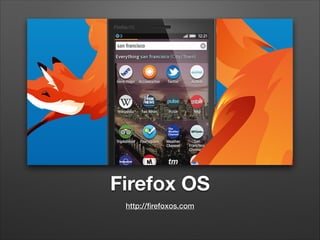
Firefox OS
http://firefoxos.com
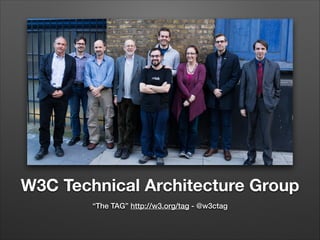
W3C Technical Architecture Group
“The TAG” http://w3.org/tag - @w3ctag
Jeni Tennison
!
Technical Director of the ODI
http://theodi.org
@jenit
Capability URLs
“Cool URIs Don’t Change”
- Tim Berners-Lee
http://www.w3.org/Provider/Style/URI.html
Footnote: What’s the difference
between a URI and a URL?
•

In theory: URLs are a subset of URIs

•

In practice: they are used interchangeably

•

In reality: anyone who uses the term URI probably
spends too much time around Web Standards wonks
Cool URLs Don’t Change
…but…
Not all URLs are cool
Some URLs are hot!
Sorry.
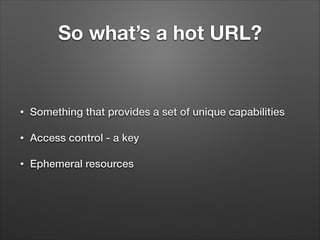
So what’s a hot URL?

•

Something that provides a set of unique capabilities

•

Access control - a key

•

Ephemeral resources
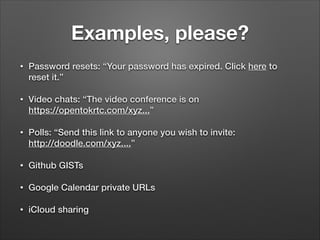
Examples, please?
•

Password resets: “Your password has expired. Click here to
reset it.”

•

Video chats: “The video conference is on 

https://opentokrtc.com/xyz...”

•

Polls: “Send this link to anyone you wish to invite: 

http://doodle.com/xyz....”

•

Github GISTs

•

Google Calendar private URLs

•

iCloud sharing
Reasons to Use

•

No login required

•

Easy to pass on
Reasons to Be Careful

•

No login required

•

Easy to pass on
URLs Aren’t Designed to be Secret

•

It appears in the address bar (usually)

•

It appears in log files - e.g. proxy logs

•

If it’s passed on once it can be passed on again
Also, Web Architecture Says “No”
•

Using multiple URLs for the same resource runs contrary to
documented good practice:
•

•

However, the rationale for this is based on sharing:
•

•

Good practice: Avoiding URI aliases : A URI owner should not
associate arbitrarily different URIs with the same resource.

(Source: Architecture of the World Wide Web, Volume One: http://
www.w3.org/TR/webarch/)

It’s better for everyone linking to, or talking about, the same resource
to use the same URL

Capability URLs are oriented around limited sharing. In these
circumstances, having multiple aliases is not an issue.
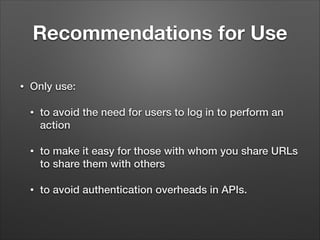
Recommendations for Use
•

Only use:
•

to avoid the need for users to log in to perform an
action

•

to make it easy for those with whom you share URLs
to share them with others

•

to avoid authentication overheads in APIs.
•

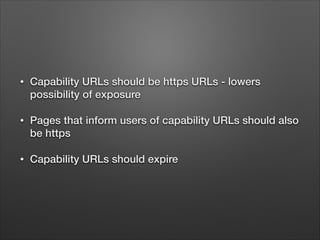
Capability URLs should be https URLs - lowers
possibility of exposure

•

Pages that inform users of capability URLs should also
be https

•

Capability URLs should expire
•

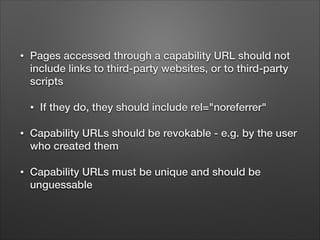
Pages accessed through a capability URL should not
include links to third-party websites, or to third-party
scripts
•

If they do, they should include rel="noreferrer"

•

Capability URLs should be revokable - e.g. by the user
who created them

•

Capability URLs must be unique and should be
unguessable
Be aware of when you are using this pattern.
Employ best practices.
Remember: URLs are the fundamental architectural
building block of the web. Use with care.
Capability URLs
Many care
Such powerful

Very not break Web

Wow.
Thanks!
Keep up with our ongoing work in this space:

http://w3ctag.github.io/capability-urls/
Formal feedback round coming soon, but feel free to
weigh in on GitHub (github.com/w3ctag) or on our
mailing list www-tag@w3.org (also holds true for
anything else the TAG is working on).
Dan Appelquist @torgo

W3C TAG @w3ctag

What is a Capability URL (and why do I care?)

  • 1.
    What is aCapability URL (and why do I care?) Dan Appelquist (@torgo)
 Open Web Advocate, Telefónica Digital
  • 2.
  • 3.
  • 4.
    W3C Technical ArchitectureGroup “The TAG” http://w3.org/tag - @w3ctag
  • 5.
    Jeni Tennison ! Technical Directorof the ODI http://theodi.org @jenit
  • 6.
  • 7.
    “Cool URIs Don’tChange” - Tim Berners-Lee http://www.w3.org/Provider/Style/URI.html
  • 8.
    Footnote: What’s thedifference between a URI and a URL? • In theory: URLs are a subset of URIs • In practice: they are used interchangeably • In reality: anyone who uses the term URI probably spends too much time around Web Standards wonks
  • 9.
  • 10.
  • 11.
    Not all URLsare cool
  • 12.
  • 13.
  • 14.
    So what’s ahot URL? • Something that provides a set of unique capabilities • Access control - a key • Ephemeral resources
  • 15.
    Examples, please? • Password resets:“Your password has expired. Click here to reset it.” • Video chats: “The video conference is on 
 https://opentokrtc.com/xyz...” • Polls: “Send this link to anyone you wish to invite: 
 http://doodle.com/xyz....” • Github GISTs • Google Calendar private URLs • iCloud sharing
  • 16.
    Reasons to Use • Nologin required • Easy to pass on
  • 17.
    Reasons to BeCareful • No login required • Easy to pass on
  • 18.
    URLs Aren’t Designedto be Secret • It appears in the address bar (usually) • It appears in log files - e.g. proxy logs • If it’s passed on once it can be passed on again
  • 19.
    Also, Web ArchitectureSays “No” • Using multiple URLs for the same resource runs contrary to documented good practice: • • However, the rationale for this is based on sharing: • • Good practice: Avoiding URI aliases : A URI owner should not associate arbitrarily different URIs with the same resource.
 (Source: Architecture of the World Wide Web, Volume One: http:// www.w3.org/TR/webarch/) It’s better for everyone linking to, or talking about, the same resource to use the same URL Capability URLs are oriented around limited sharing. In these circumstances, having multiple aliases is not an issue.
  • 20.
    Recommendations for Use • Onlyuse: • to avoid the need for users to log in to perform an action • to make it easy for those with whom you share URLs to share them with others • to avoid authentication overheads in APIs.
  • 21.
    • Capability URLs shouldbe https URLs - lowers possibility of exposure • Pages that inform users of capability URLs should also be https • Capability URLs should expire
  • 22.
    • Pages accessed througha capability URL should not include links to third-party websites, or to third-party scripts • If they do, they should include rel="noreferrer" • Capability URLs should be revokable - e.g. by the user who created them • Capability URLs must be unique and should be unguessable
  • 23.
    Be aware ofwhen you are using this pattern. Employ best practices. Remember: URLs are the fundamental architectural building block of the web. Use with care.
  • 24.
    Capability URLs Many care Suchpowerful Very not break Web Wow.
  • 25.
    Thanks! Keep up withour ongoing work in this space:
 http://w3ctag.github.io/capability-urls/ Formal feedback round coming soon, but feel free to weigh in on GitHub (github.com/w3ctag) or on our mailing list www-tag@w3.org (also holds true for anything else the TAG is working on). Dan Appelquist @torgo
 W3C TAG @w3ctag