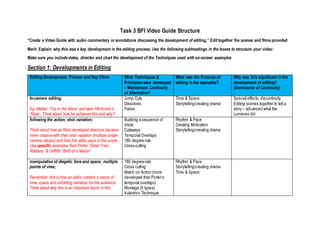
Task 3 BFI Video Guide Structure
“Create a Video Guide with audio commentary or annotations discussing the development of editing.” Edit together the scenes and films provided
Merit: Explain why this was a key development in the editing process. Use the following subheadings in the boxes to structure your video:
Make sure you include dates, director and chart the development of the Techniques used with on-screen examples
Section 1: Developments in Editing
Editing Development, Pioneer and Key Films What Techniques &
Principles were developed
– Mainstream Continuity
or Alternative?
What was the Purpose of
editing in the examples?
Why was this significant in the
development of editing?
(Dominance of Continuity)
In-camera editing;
Eg. Melies’ ‘Trip to the Moon’ and later Hitchcock’s
‘Rope’. Think about how he achieved this and why?
Jump Cuts
Dissolves
Fades
Time & Space
Storytelling/creating drama
Special effects, discontinuity.
Editing scenes together to tell a
story – advanced what the
Lumieres did
following the action; shot variation;
Think about how as films developed directors became
more creative with their shot variation (multiple single
camera setups) and how this adds pace to the scene.
Use specific examples from Porter ‘Great Train
Robbery’ & Griffith ‘’Birth of a Nation’’
Building a sequence of
shots
Cutaways
Temporal Overlaps
180 degree rule
Cross-cutting
Rhythm & Pace
Creating Motivation
Storytelling/creating drama
manipulation of diegetic time and space; multiple
points of view;
Remember this is how an editor creates a sense of
time, space and unfolding narrative for the audience.
Think about why this is an important factor in film
180 degree rule
Cross cutting
Match on Action (more
developed than Porter’s
temporal overlaps)
Montage (5 types)
Kuleshov Technique
Rhythm & Pace
Storytelling/creating drama
Time & Space
making and identify SPECIFIC examples and
techniques employed by directors.
Porter ‘Life of American Fireman’ and Griffiths ‘Birth of
a Nation’ were doing this in order to create drama and
entertainment in their storytelling, but remember that
Eisenstein ‘Strike’ was also doing this to create
Montage & meaning for propaganda and to make
people think.
Analogue: film,
Early editing meant that editors had to be very precise
when cutting the film. Invention of the ‘splicer’ meant
that this sped up the editing time.
Get footage of film being cut using a splicer
Cuts
Transitions
Linear editing – required the editor to physically cut and join the
film to assemble the edit in order the print/develop as a reel
What are Tarantino’s thoughts
about Linear/Analogue editing vs
Non-Linear/Digital editing – which
does he prefer and why?
.
Analogue: video;
Video is an electronic medium for the recording,
copying and broadcasting of moving visual images.
Early video tapes could record up to one hour. WE
have since now moved on to digital which is a cheaper
method of video production.
Get footage of video being edited
Linear editing – required the editor to record/copy the various
sources onto a tape to assemble the edit in order
Digital
Modern method of editing using computers. Allows for
more creativity and special effects. Final Cut, Avid etc.
Non-Linear editing – allows the editor to assemble the edit out
of sequence and re-arrange/re-organise
Section 2: Development of Techniques & Principles – Continuity vs Montage & The New Wave
For your structure, group together the Continuity Techniques and refer to your examples you have found.
Then group the Alternative Techniques together and discuss this separately, the principles and purposes in challenging the dominance of
Continuity/Hollywood – the Soviets and the ‘New Wave Auteurs’
Finally discuss with reference to Modern and Contemporary Periods and explain how Alternative Techniques have been absorbed and Montage and
Discontinuity is used for stylistic purposes
Technique – describe
and give detailed
example
Purpose - why would this
technique be used in Early
Cinema?
Is it a Mainstream or
Alternative Technique?
How was this technique
developed in the Modern
Period – give a detailed
example and discuss how it
was used/purpose.
How has this technique
developed in the
Contemporary Period?
Give a detailed example
and discuss how it is
used/purpose.
Conclude with explanation of
the dominance of Hollywood
Continuity vs Alternative
Principles of editing
Part 1: Continuity editing – Introduce this Principle
Seamless/Invisible
Cuts
Motivated cuts
Parallel editing/cross
cut
180 degree rule
Cutaways
Point ofview shot
Shot reverse shot
Part 2: Alternative Techniques - Introduce this Principle
Montage
Jump Cutting
Techniques that can be used for either Continuity or Alternative (discuss how they are used and purpose), include in both Part 1 and 2.
Transitions eg.
Dissolve, fade, wipe
Melies’ special effects or to
move between scenes
Editing rhythm Griffiths cross cutting or
Eisenstein’s 5 methods -
Metric
Cutting to soundtrack Hollywood Montage/Music
Videos?
Section 3: Video Guide Conclusion
Merit Task: Explain the key developments, techniques and purpose of editing
discussing how one led to another
Evidence - Films Response notes
Explain how Early Cinema editing developed and influenced
the Modern so that Continuity becoming the dominant
Principle of editing
Explain how these Continuity techniques are still used and
their purpose
Explain how Montage, and Discontinuity techniques
developed from Early to Modern to challenge Continuity
and their Purpose
Explain how contemporary editing uses Alternative
techniques and their Purpose with reference to specific
examples
Distinction Task: Critically assess the develop of editing principles and purposes
Evaluate has Montage and Discontinuity lost their Purpose
and Meaning in favour of stylistic use?
What political reasons did Continuity become the dominant
form of editing over Montage?
Why did the New Wave set out to break continuity?

Task 3 bfi video guide structure

  • 1.
    Task 3 BFIVideo Guide Structure “Create a Video Guide with audio commentary or annotations discussing the development of editing.” Edit together the scenes and films provided Merit: Explain why this was a key development in the editing process. Use the following subheadings in the boxes to structure your video: Make sure you include dates, director and chart the development of the Techniques used with on-screen examples Section 1: Developments in Editing Editing Development, Pioneer and Key Films What Techniques & Principles were developed – Mainstream Continuity or Alternative? What was the Purpose of editing in the examples? Why was this significant in the development of editing? (Dominance of Continuity) In-camera editing; Eg. Melies’ ‘Trip to the Moon’ and later Hitchcock’s ‘Rope’. Think about how he achieved this and why? Jump Cuts Dissolves Fades Time & Space Storytelling/creating drama Special effects, discontinuity. Editing scenes together to tell a story – advanced what the Lumieres did following the action; shot variation; Think about how as films developed directors became more creative with their shot variation (multiple single camera setups) and how this adds pace to the scene. Use specific examples from Porter ‘Great Train Robbery’ & Griffith ‘’Birth of a Nation’’ Building a sequence of shots Cutaways Temporal Overlaps 180 degree rule Cross-cutting Rhythm & Pace Creating Motivation Storytelling/creating drama manipulation of diegetic time and space; multiple points of view; Remember this is how an editor creates a sense of time, space and unfolding narrative for the audience. Think about why this is an important factor in film 180 degree rule Cross cutting Match on Action (more developed than Porter’s temporal overlaps) Montage (5 types) Kuleshov Technique Rhythm & Pace Storytelling/creating drama Time & Space
  • 2.
    making and identifySPECIFIC examples and techniques employed by directors. Porter ‘Life of American Fireman’ and Griffiths ‘Birth of a Nation’ were doing this in order to create drama and entertainment in their storytelling, but remember that Eisenstein ‘Strike’ was also doing this to create Montage & meaning for propaganda and to make people think. Analogue: film, Early editing meant that editors had to be very precise when cutting the film. Invention of the ‘splicer’ meant that this sped up the editing time. Get footage of film being cut using a splicer Cuts Transitions Linear editing – required the editor to physically cut and join the film to assemble the edit in order the print/develop as a reel What are Tarantino’s thoughts about Linear/Analogue editing vs Non-Linear/Digital editing – which does he prefer and why? . Analogue: video; Video is an electronic medium for the recording, copying and broadcasting of moving visual images. Early video tapes could record up to one hour. WE have since now moved on to digital which is a cheaper method of video production. Get footage of video being edited Linear editing – required the editor to record/copy the various sources onto a tape to assemble the edit in order Digital Modern method of editing using computers. Allows for more creativity and special effects. Final Cut, Avid etc. Non-Linear editing – allows the editor to assemble the edit out of sequence and re-arrange/re-organise
  • 3.
    Section 2: Developmentof Techniques & Principles – Continuity vs Montage & The New Wave For your structure, group together the Continuity Techniques and refer to your examples you have found. Then group the Alternative Techniques together and discuss this separately, the principles and purposes in challenging the dominance of Continuity/Hollywood – the Soviets and the ‘New Wave Auteurs’ Finally discuss with reference to Modern and Contemporary Periods and explain how Alternative Techniques have been absorbed and Montage and Discontinuity is used for stylistic purposes Technique – describe and give detailed example Purpose - why would this technique be used in Early Cinema? Is it a Mainstream or Alternative Technique? How was this technique developed in the Modern Period – give a detailed example and discuss how it was used/purpose. How has this technique developed in the Contemporary Period? Give a detailed example and discuss how it is used/purpose. Conclude with explanation of the dominance of Hollywood Continuity vs Alternative Principles of editing Part 1: Continuity editing – Introduce this Principle Seamless/Invisible Cuts Motivated cuts Parallel editing/cross cut 180 degree rule
  • 4.
    Cutaways Point ofview shot Shotreverse shot Part 2: Alternative Techniques - Introduce this Principle Montage Jump Cutting Techniques that can be used for either Continuity or Alternative (discuss how they are used and purpose), include in both Part 1 and 2. Transitions eg. Dissolve, fade, wipe Melies’ special effects or to move between scenes Editing rhythm Griffiths cross cutting or Eisenstein’s 5 methods - Metric Cutting to soundtrack Hollywood Montage/Music Videos?
  • 5.
    Section 3: VideoGuide Conclusion Merit Task: Explain the key developments, techniques and purpose of editing discussing how one led to another Evidence - Films Response notes Explain how Early Cinema editing developed and influenced the Modern so that Continuity becoming the dominant Principle of editing Explain how these Continuity techniques are still used and their purpose Explain how Montage, and Discontinuity techniques developed from Early to Modern to challenge Continuity and their Purpose Explain how contemporary editing uses Alternative techniques and their Purpose with reference to specific examples Distinction Task: Critically assess the develop of editing principles and purposes Evaluate has Montage and Discontinuity lost their Purpose and Meaning in favour of stylistic use? What political reasons did Continuity become the dominant form of editing over Montage? Why did the New Wave set out to break continuity?