Towards View-Aware Adaptive Streaming of Holographic Content
Hadi Amipour1, Christian Timmerer1,2, and Mohammad Ghanbari1,3
1Alpen-Adria-Universität Klagenfurt, Klagenfurt, Austria
2Bitmovin, Klagenfurt, Austria
3School of Computer Science and Electronic Engineering, University of Essex, Colchester, UK
This research has been supported in part by the
Christian Doppler Laboratory ATHENA: https://athena.itec.aau.at/
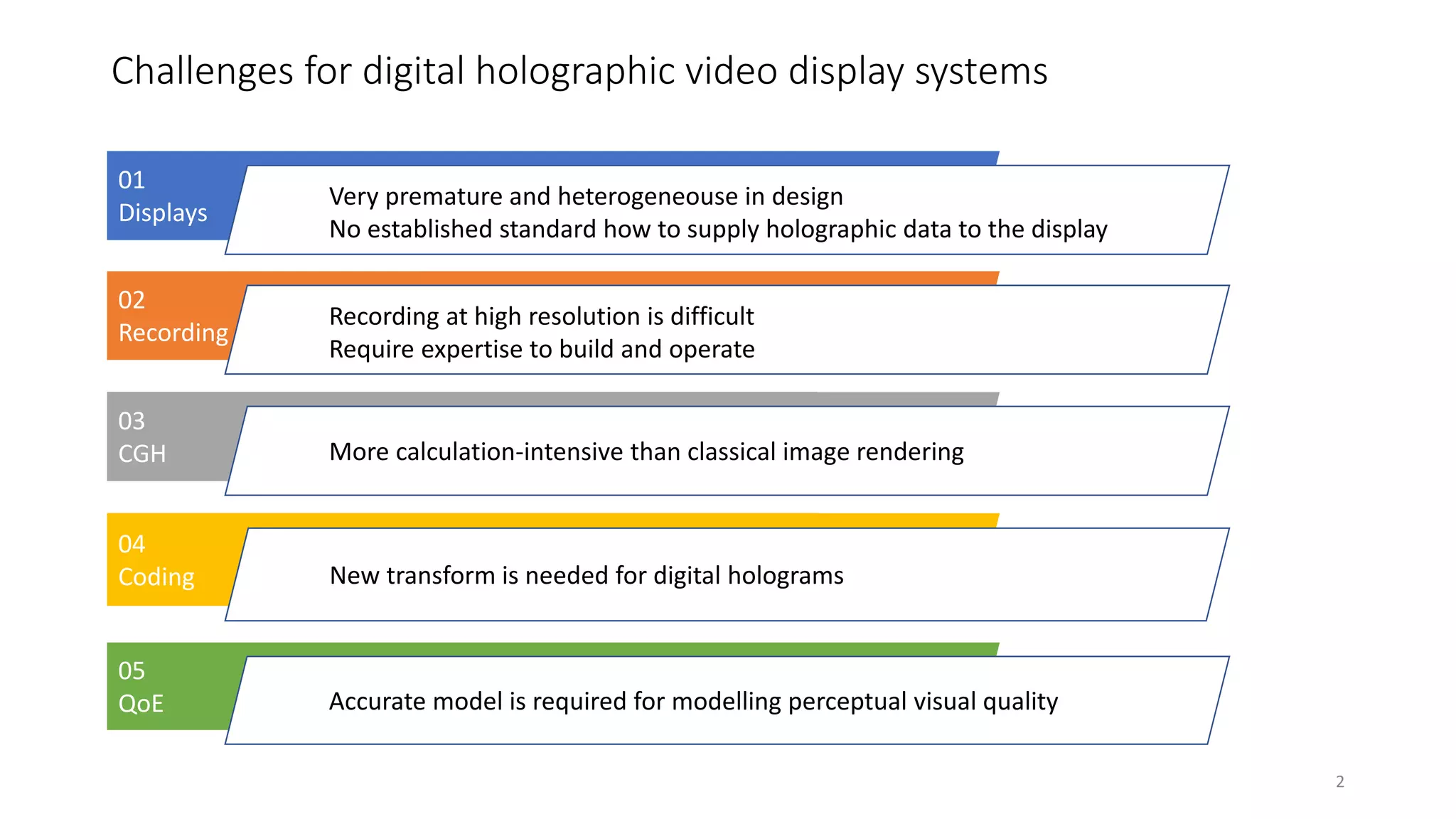
Challenges for digital holographic video display systems
2
01
Displays
Very premature and heterogeneouse in design
No established standard how to supply holographic data to the display
02
Recording
Recording at high resolution is difficult
Require expertise to build and operate
03
CGH More calculation-intensive than classical image rendering
04
Coding New transform is needed for digital holograms
05
QoE Accurate model is required for modelling perceptual visual quality
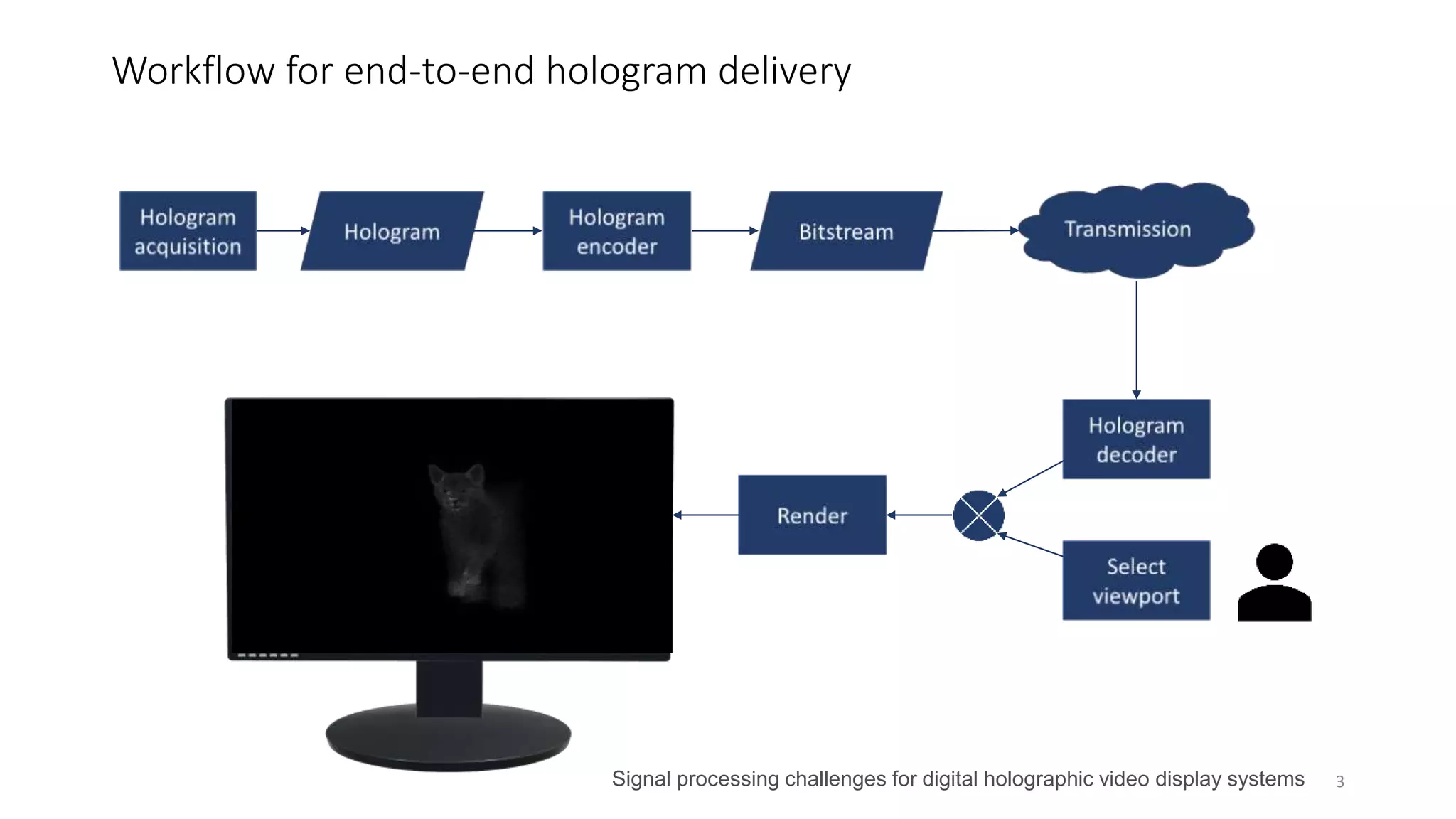
Workflow for end-to-end hologram delivery
3Signal processing challenges for digital holographic video display systems
4
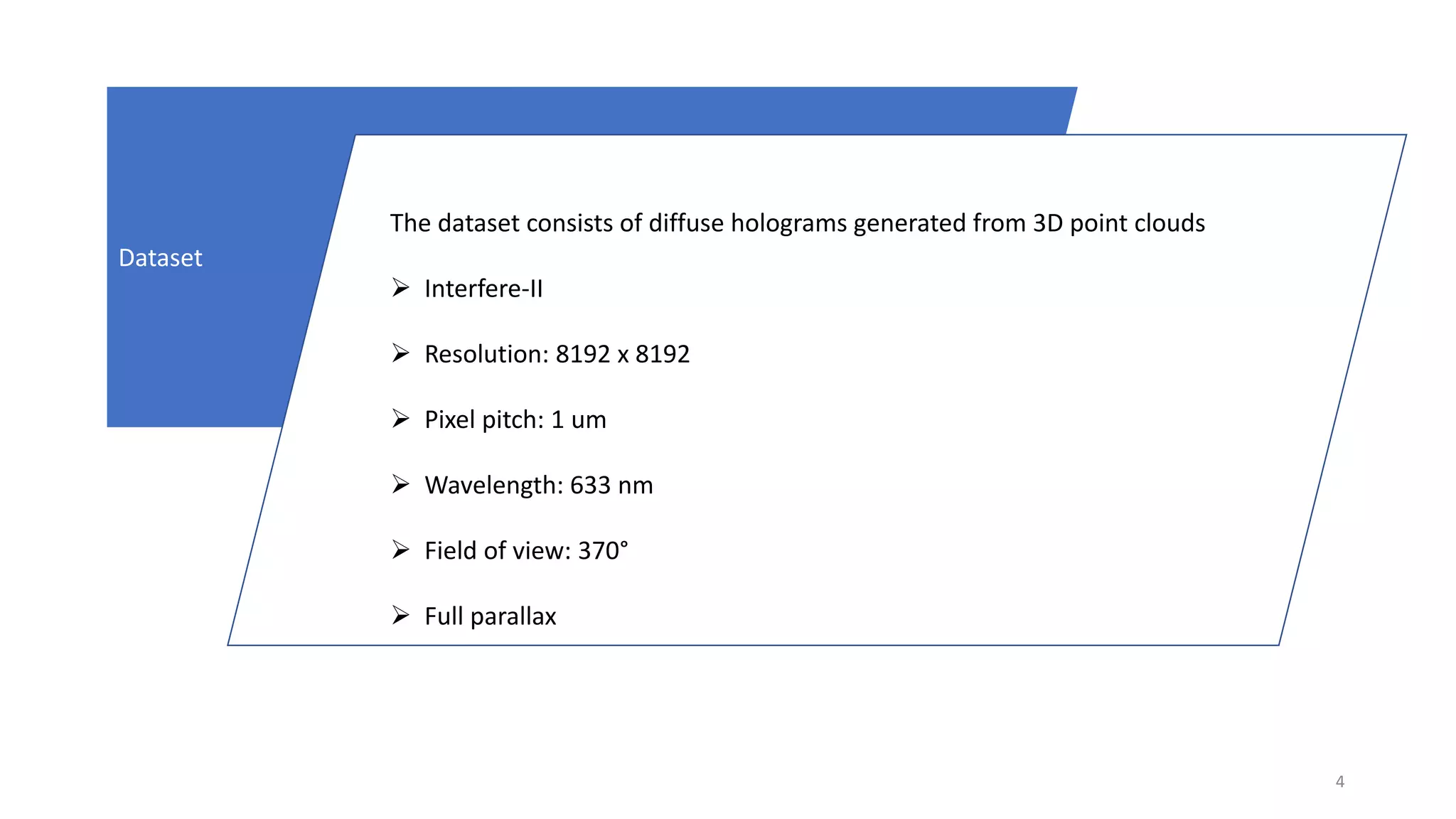
Dataset
The dataset consists of diffuse holograms generated from 3D point clouds
 Interfere-II
 Resolution: 8192 x 8192
 Pixel pitch: 1 um
 Wavelength: 633 nm
 Field of view: 370°
 Full parallax
5
Compression
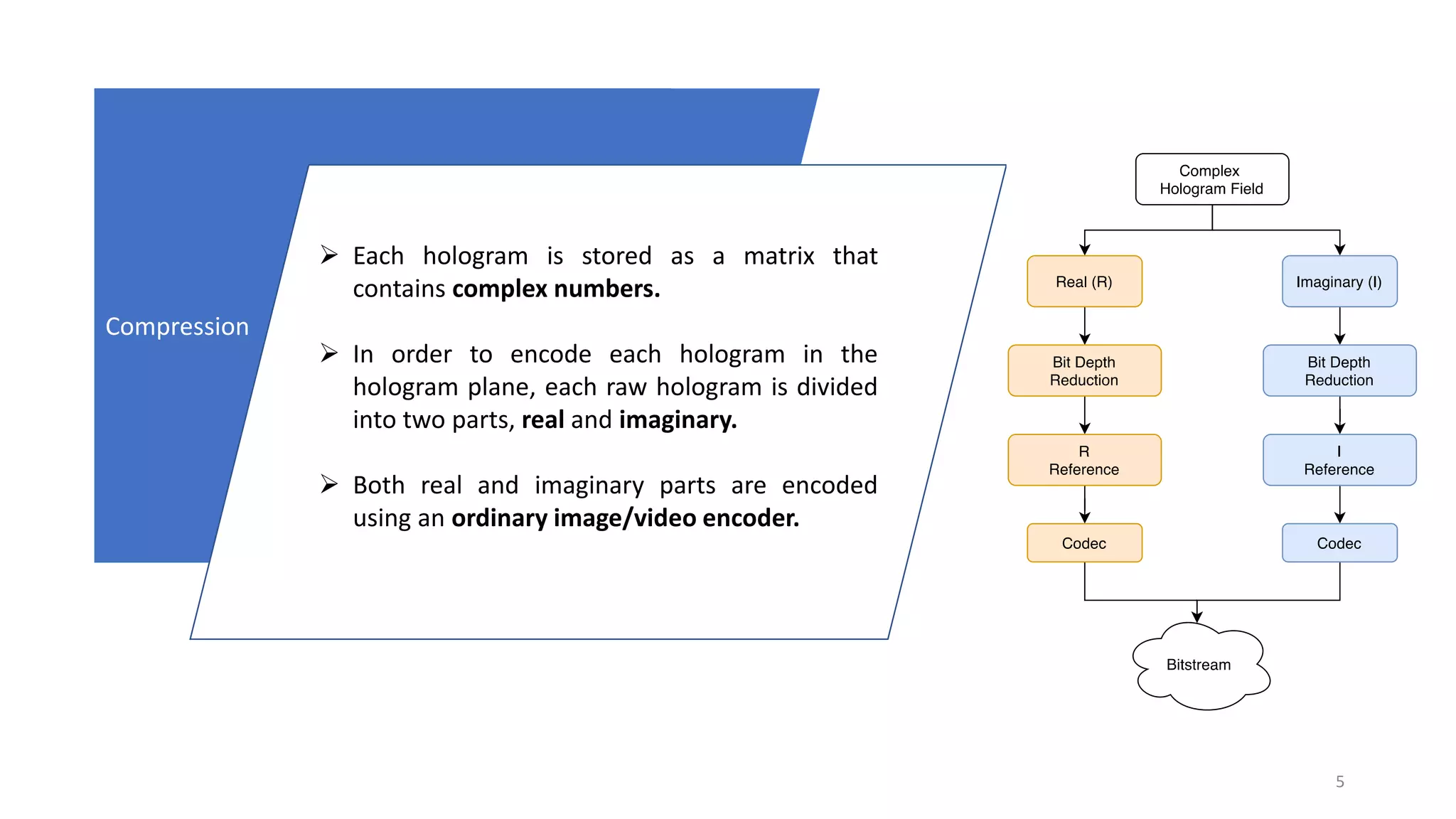
 Each hologram is stored as a matrix that
contains complex numbers.
 In order to encode each hologram in the
hologram plane, each raw hologram is divided
into two parts, real and imaginary.
 Both real and imaginary parts are encoded
using an ordinary image/video encoder.
6
Viewports
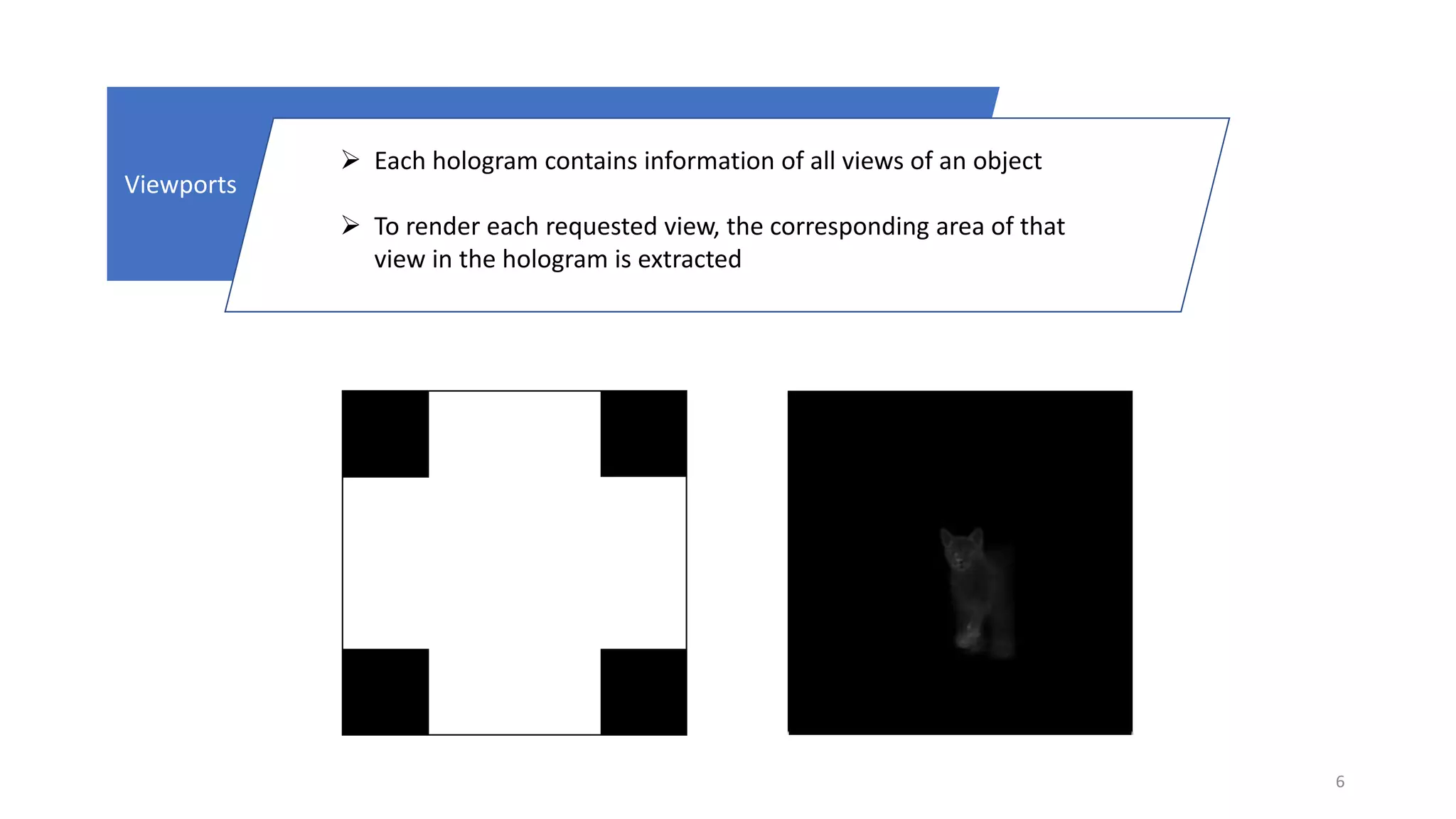
 Each hologram contains information of all views of an object
 To render each requested view, the corresponding area of that
view in the hologram is extracted
Adaptive holography streaming
7
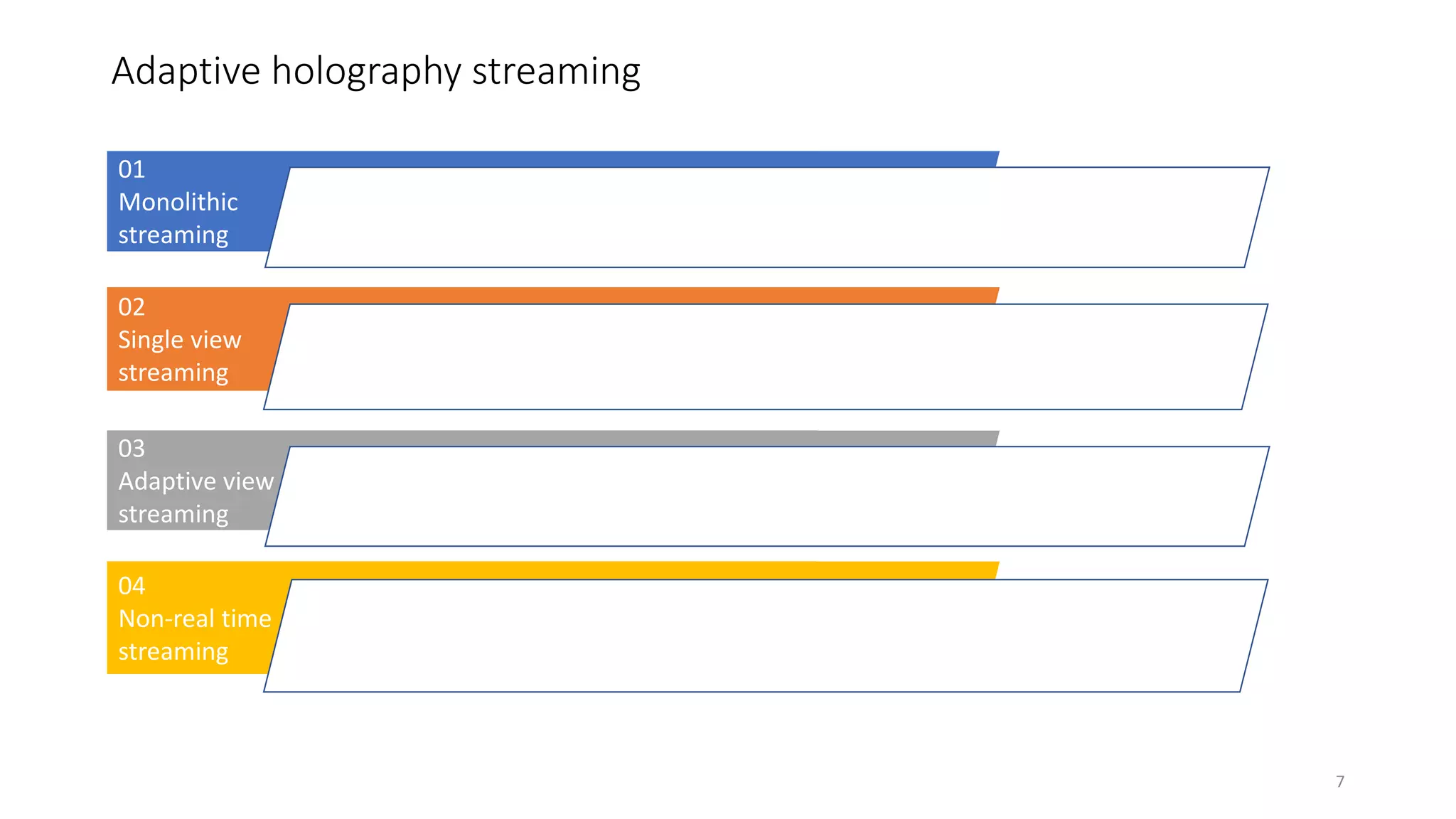
01
Monolithic
streaming
02
Single view
streaming
03
Adaptive view
streaming
04
Non-real time
streaming
8
Monilithic
streaming
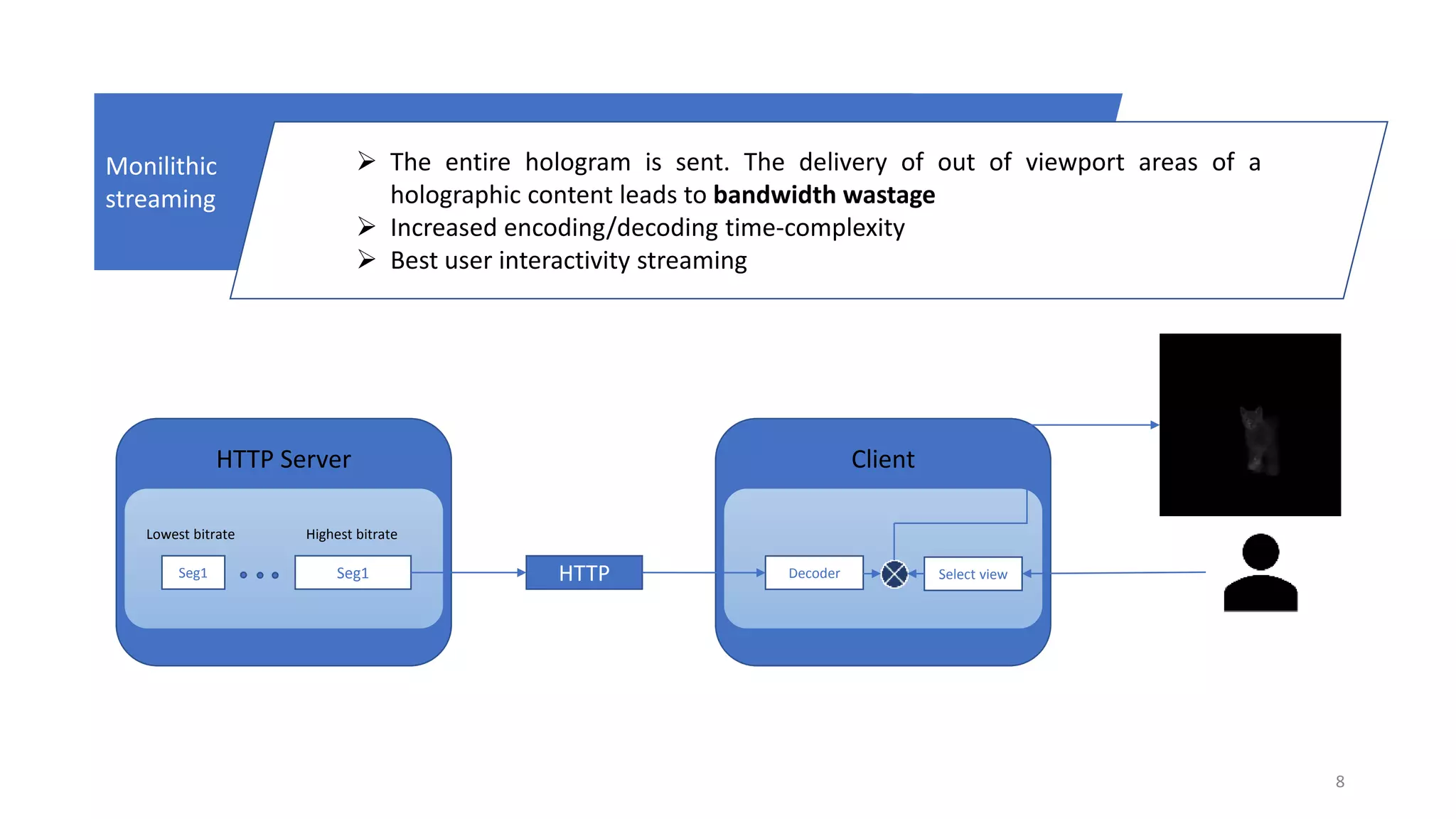
 The entire hologram is sent. The delivery of out of viewport areas of a
holographic content leads to bandwidth wastage
 Increased encoding/decoding time-complexity
 Best user interactivity streaming
HTTPSeg1Seg1
Highest bitrateLowest bitrate
HTTP Server Client
Select viewDecoder
9
Single view
streaming
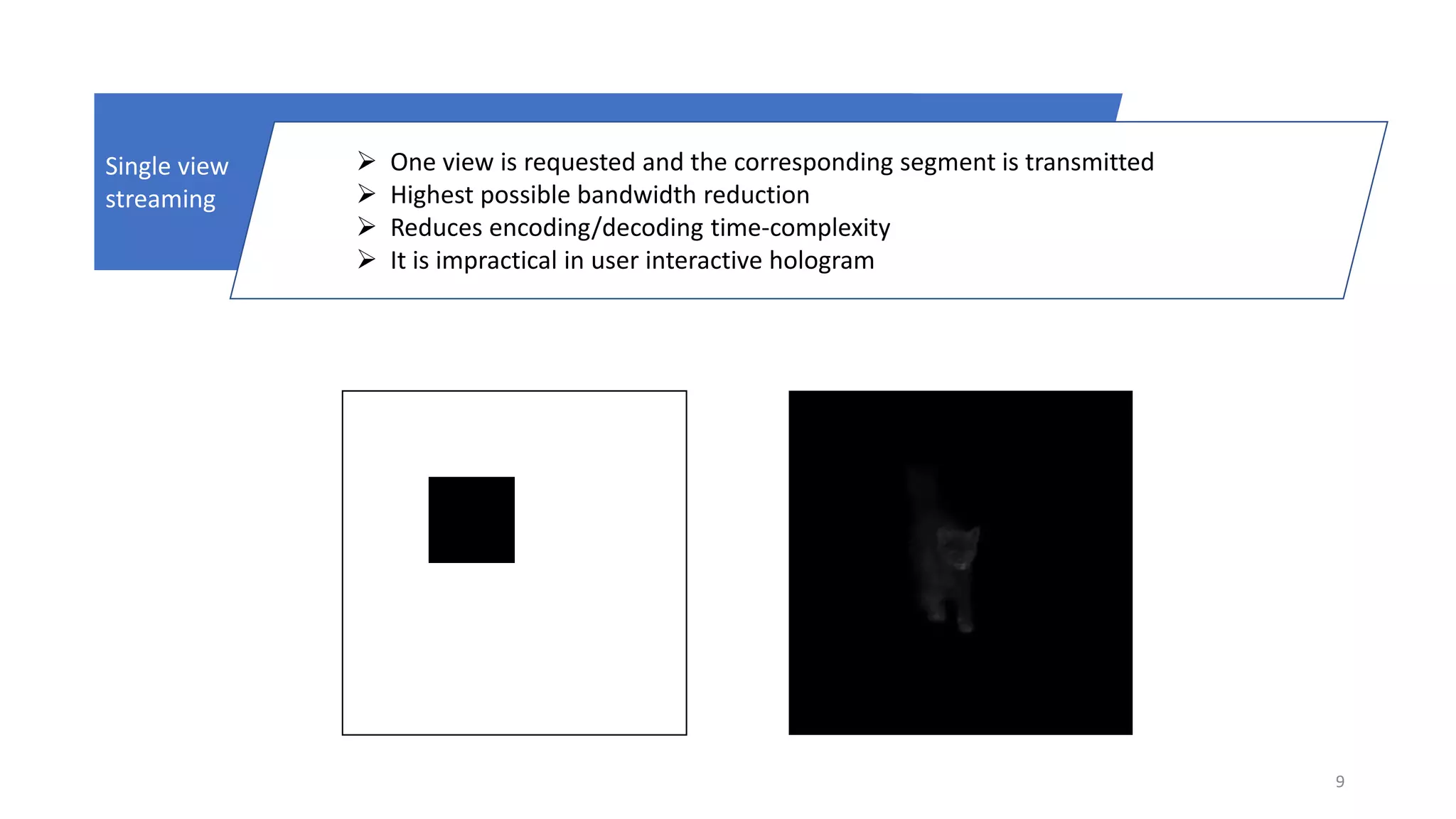
 One view is requested and the corresponding segment is transmitted
 Highest possible bandwidth reduction
 Reduces encoding/decoding time-complexity
 It is impractical in user interactive hologram
10
Single view
streaming
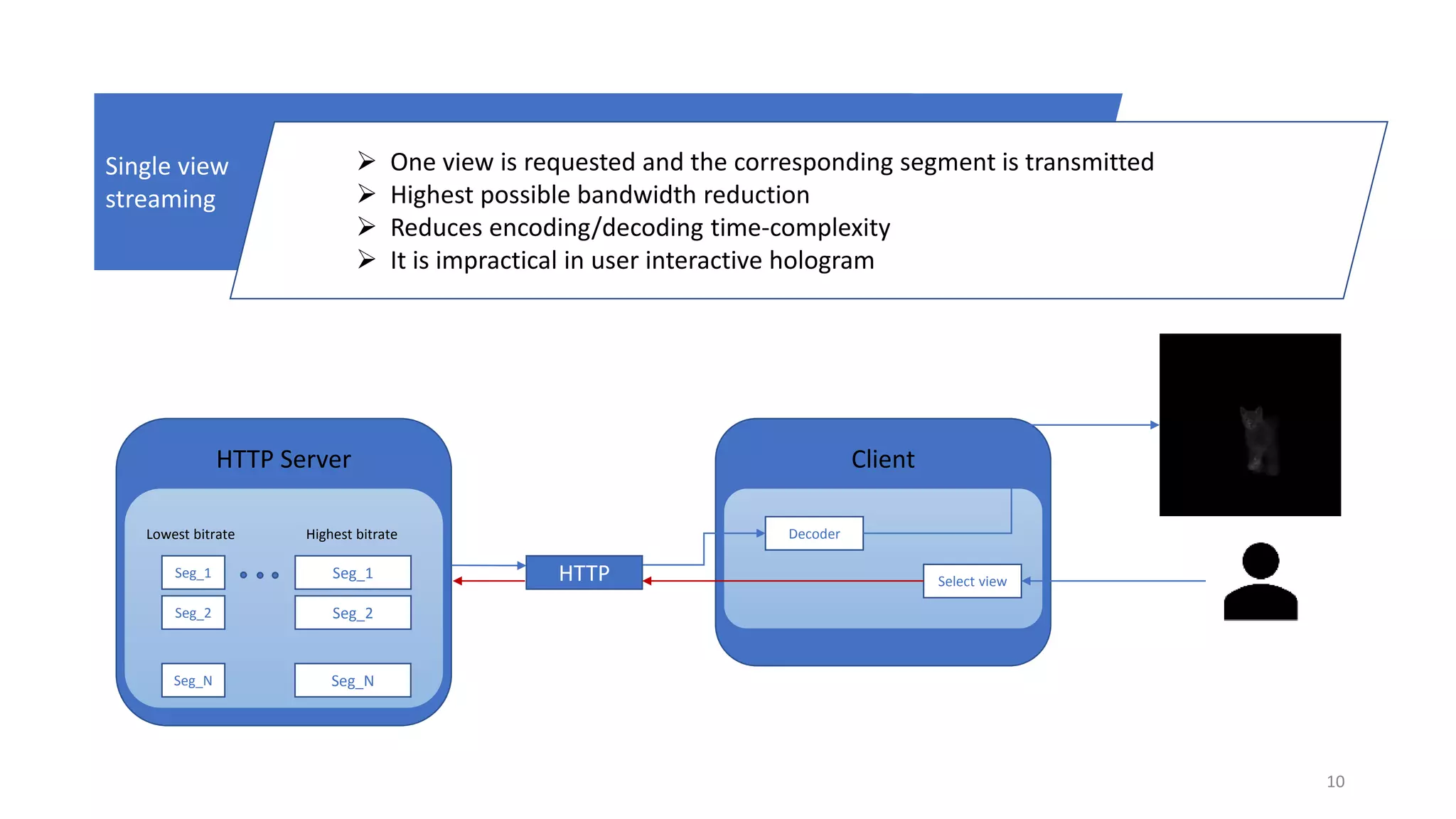
 One view is requested and the corresponding segment is transmitted
 Highest possible bandwidth reduction
 Reduces encoding/decoding time-complexity
 It is impractical in user interactive hologram
HTTPSeg_1Seg_1
Highest bitrateLowest bitrate
HTTP Server Client
Select view
Decoder
Seg_2
Seg_N
Seg_2
Seg_N
11
Adaptive view
streaming
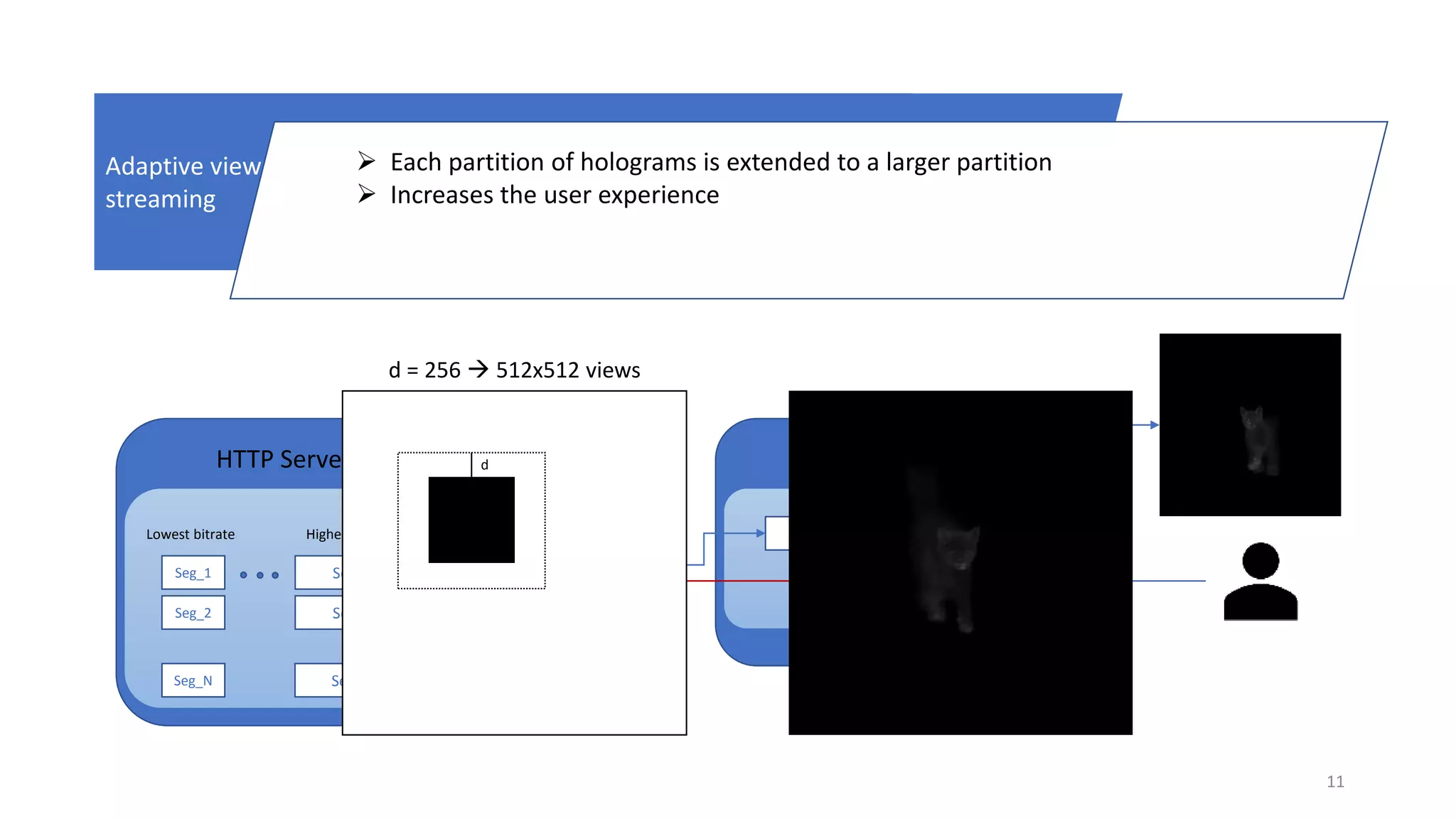
 Each partition of holograms is extended to a larger partition
 Increases the user experience
HTTPSeg_1Seg_1
Highest bitrateLowest bitrate
HTTP Server Client
Select view
Decoder
Seg_2
Seg_N
Seg_2
Seg_N
d
d = 256  512x512 views
12
Adaptive view
streaming
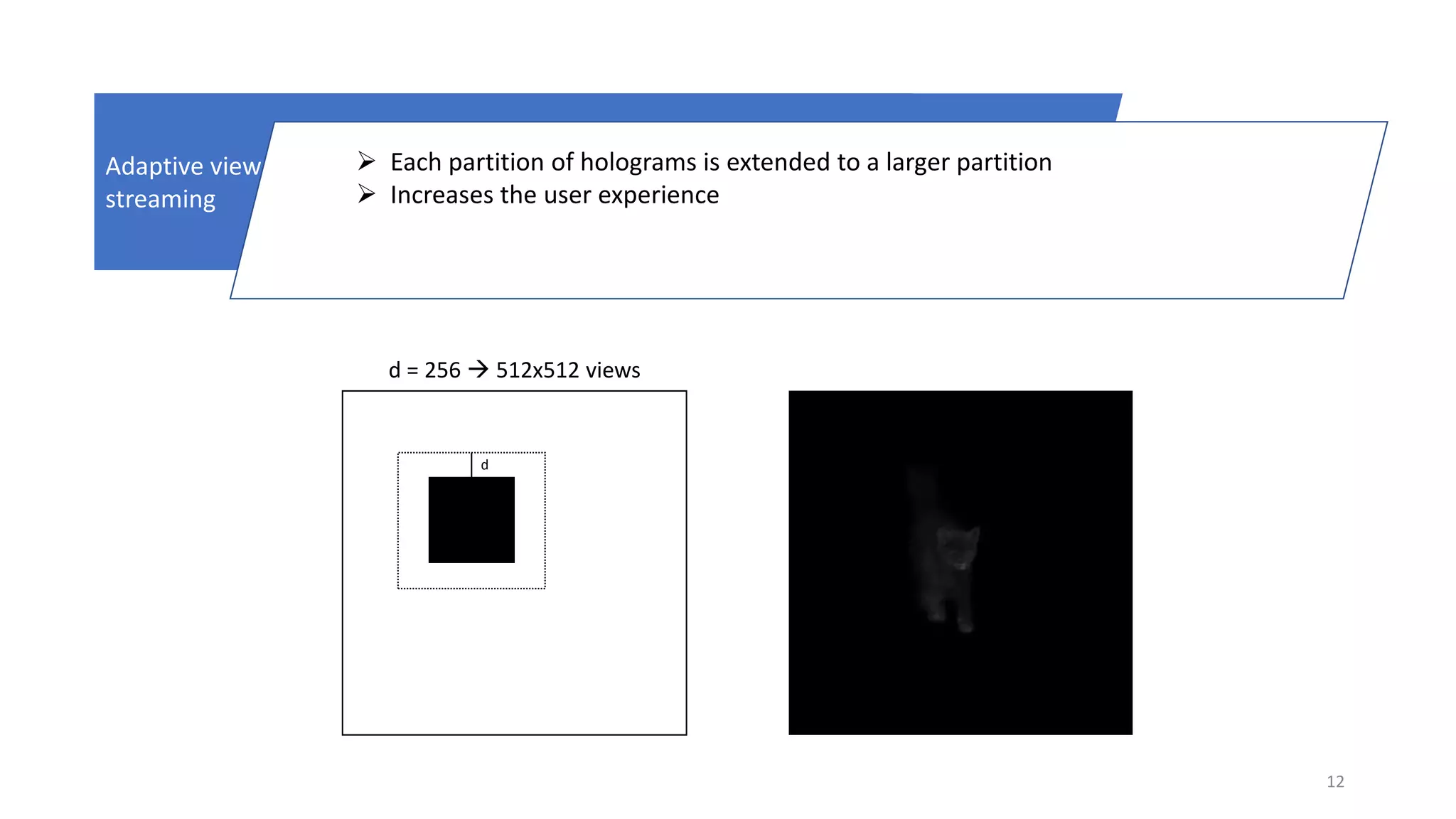
 Each partition of holograms is extended to a larger partition
 Increases the user experience
d
d = 256  512x512 views
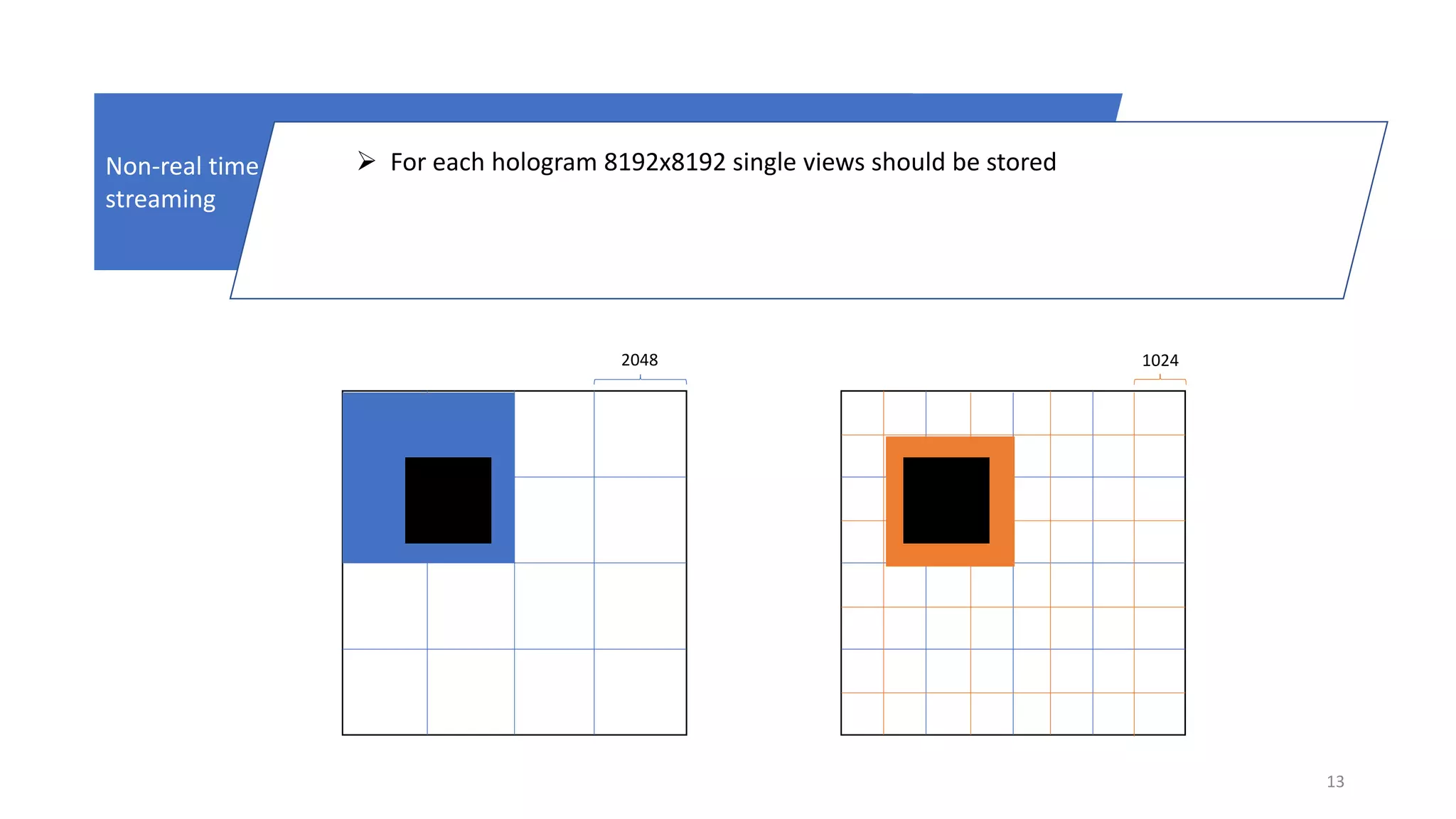
13
Non-real time
streaming
 For each hologram 8192x8192 single views should be stored
2048 1024
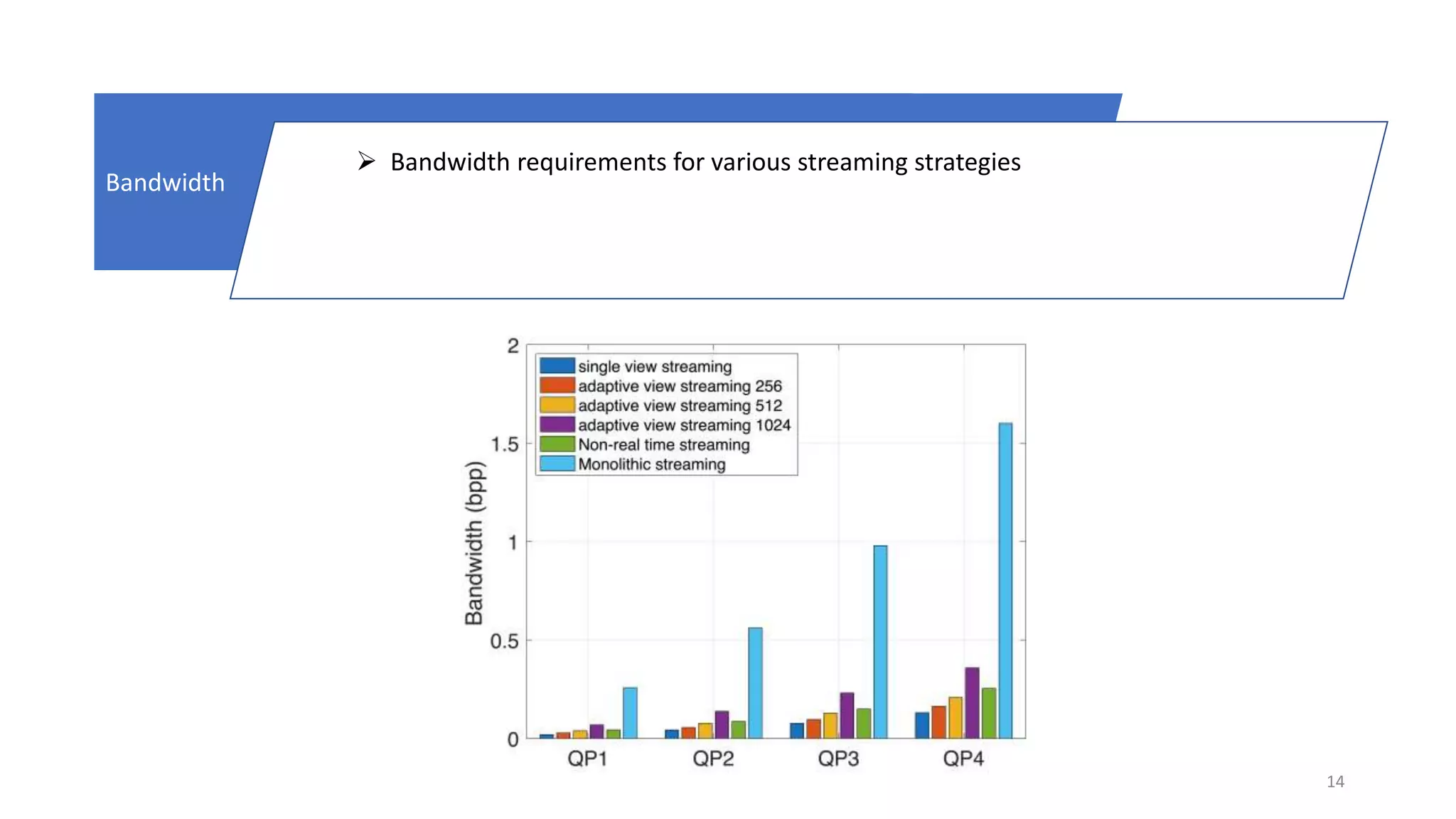
14
Bandwidth
 Bandwidth requirements for various streaming strategies
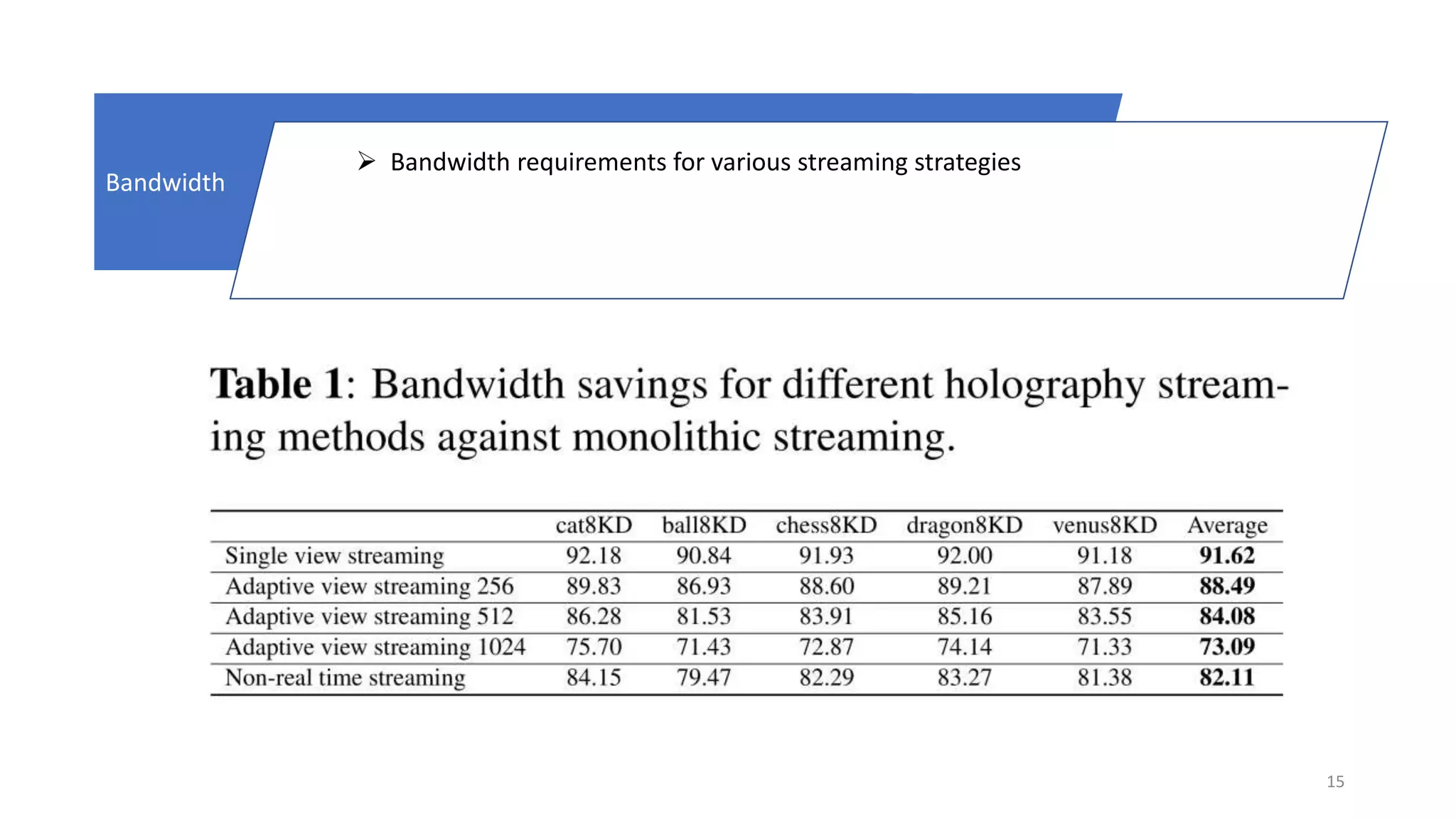
15
Bandwidth
 Bandwidth requirements for various streaming strategies
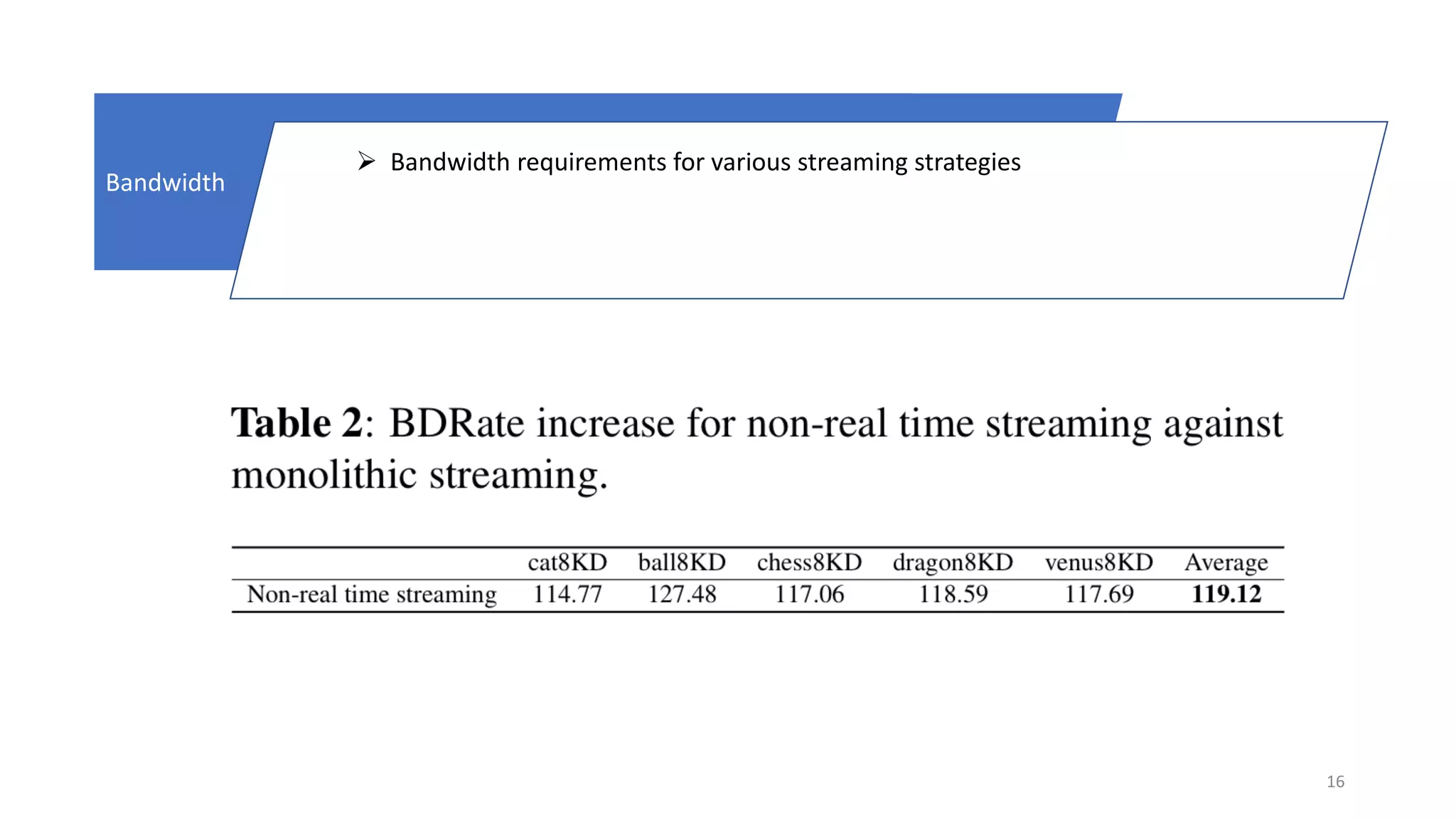
16
Bandwidth
 Bandwidth requirements for various streaming strategies
17
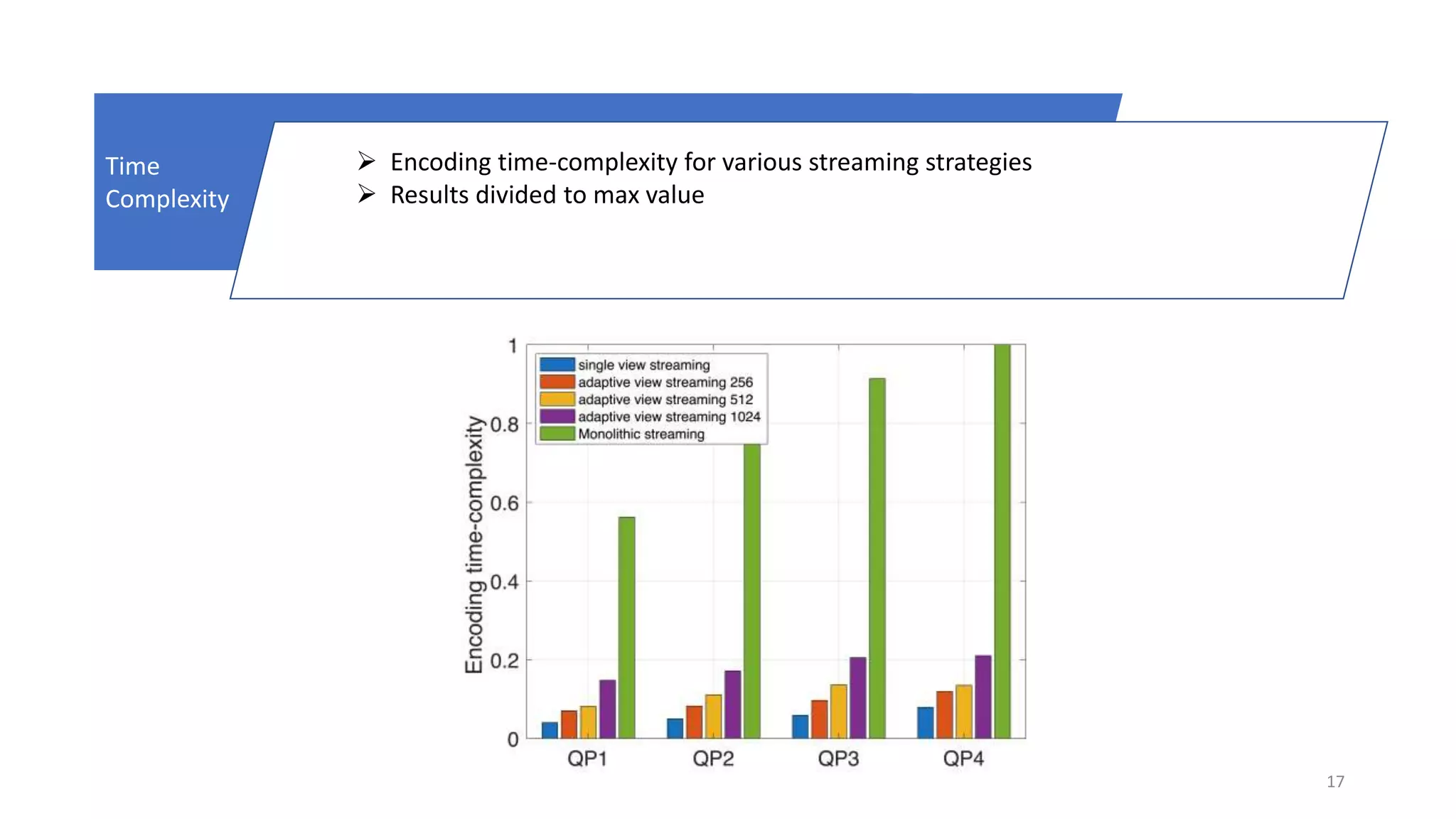
Time
Complexity
 Encoding time-complexity for various streaming strategies
 Results divided to max value
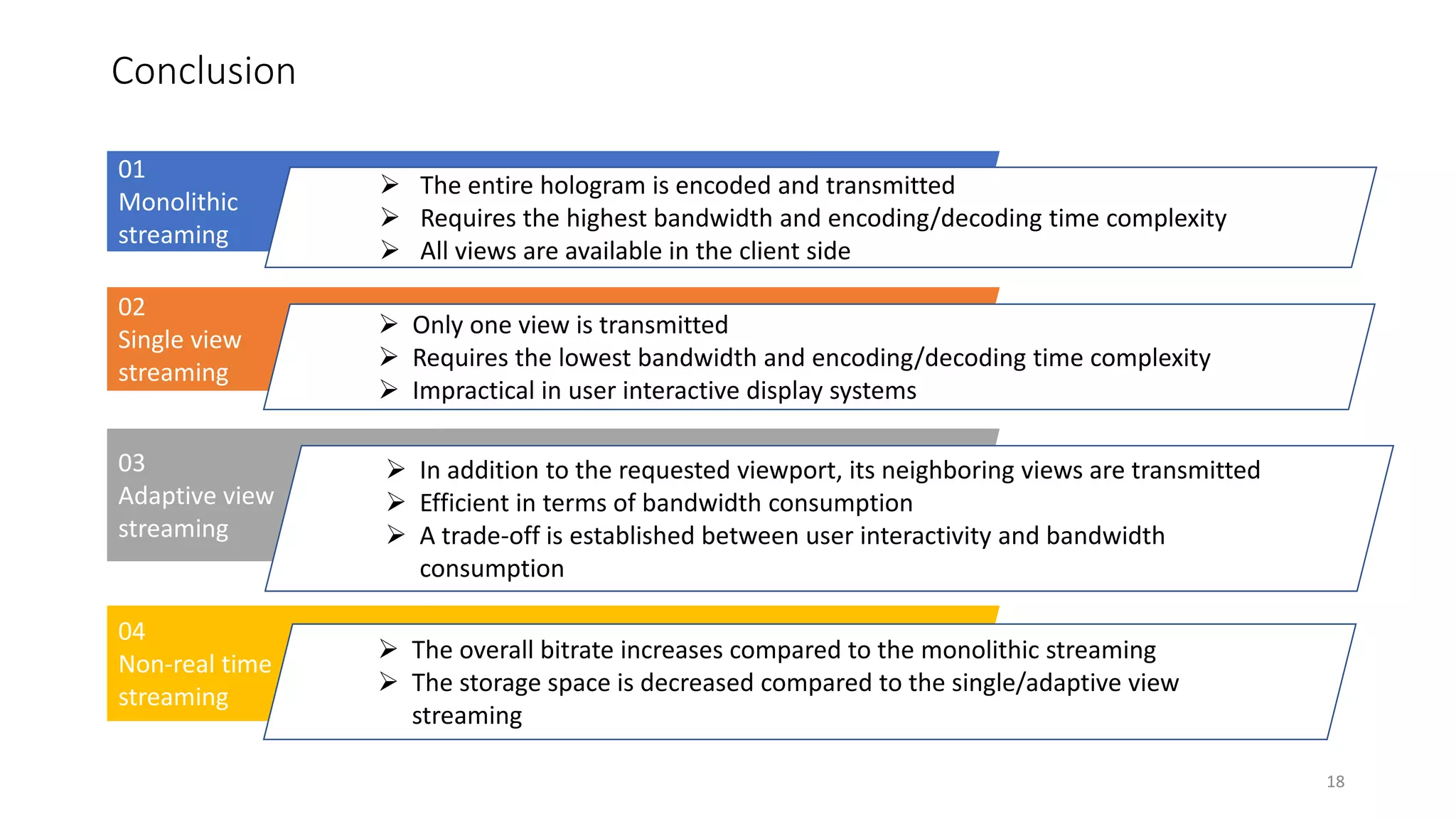
Conclusion
18
01
Monolithic
streaming
 The entire hologram is encoded and transmitted
 Requires the highest bandwidth and encoding/decoding time complexity
 All views are available in the client side
02
Single view
streaming
 Only one view is transmitted
 Requires the lowest bandwidth and encoding/decoding time complexity
 Impractical in user interactive display systems
03
Adaptive view
streaming
 In addition to the requested viewport, its neighboring views are transmitted
 Efficient in terms of bandwidth consumption
 A trade-off is established between user interactivity and bandwidth
consumption
04
Non-real time
streaming
 The overall bitrate increases compared to the monolithic streaming
 The storage space is decreased compared to the single/adaptive view
streaming
19
www.athena.itec.aau.at
Any
Questions?
/HadiAmirpour

Towards View-Aware Adaptive Streaming of Holographic Content

  • 1.
    Towards View-Aware AdaptiveStreaming of Holographic Content Hadi Amipour1, Christian Timmerer1,2, and Mohammad Ghanbari1,3 1Alpen-Adria-Universität Klagenfurt, Klagenfurt, Austria 2Bitmovin, Klagenfurt, Austria 3School of Computer Science and Electronic Engineering, University of Essex, Colchester, UK This research has been supported in part by the Christian Doppler Laboratory ATHENA: https://athena.itec.aau.at/
  • 2.
    Challenges for digitalholographic video display systems 2 01 Displays Very premature and heterogeneouse in design No established standard how to supply holographic data to the display 02 Recording Recording at high resolution is difficult Require expertise to build and operate 03 CGH More calculation-intensive than classical image rendering 04 Coding New transform is needed for digital holograms 05 QoE Accurate model is required for modelling perceptual visual quality
  • 3.
    Workflow for end-to-endhologram delivery 3Signal processing challenges for digital holographic video display systems
  • 4.
    4 Dataset The dataset consistsof diffuse holograms generated from 3D point clouds  Interfere-II  Resolution: 8192 x 8192  Pixel pitch: 1 um  Wavelength: 633 nm  Field of view: 370°  Full parallax
  • 5.
    5 Compression  Each hologramis stored as a matrix that contains complex numbers.  In order to encode each hologram in the hologram plane, each raw hologram is divided into two parts, real and imaginary.  Both real and imaginary parts are encoded using an ordinary image/video encoder.
  • 6.
    6 Viewports  Each hologramcontains information of all views of an object  To render each requested view, the corresponding area of that view in the hologram is extracted
  • 7.
    Adaptive holography streaming 7 01 Monolithic streaming 02 Singleview streaming 03 Adaptive view streaming 04 Non-real time streaming
  • 8.
    8 Monilithic streaming  The entirehologram is sent. The delivery of out of viewport areas of a holographic content leads to bandwidth wastage  Increased encoding/decoding time-complexity  Best user interactivity streaming HTTPSeg1Seg1 Highest bitrateLowest bitrate HTTP Server Client Select viewDecoder
  • 9.
    9 Single view streaming  Oneview is requested and the corresponding segment is transmitted  Highest possible bandwidth reduction  Reduces encoding/decoding time-complexity  It is impractical in user interactive hologram
  • 10.
    10 Single view streaming  Oneview is requested and the corresponding segment is transmitted  Highest possible bandwidth reduction  Reduces encoding/decoding time-complexity  It is impractical in user interactive hologram HTTPSeg_1Seg_1 Highest bitrateLowest bitrate HTTP Server Client Select view Decoder Seg_2 Seg_N Seg_2 Seg_N
  • 11.
    11 Adaptive view streaming  Eachpartition of holograms is extended to a larger partition  Increases the user experience HTTPSeg_1Seg_1 Highest bitrateLowest bitrate HTTP Server Client Select view Decoder Seg_2 Seg_N Seg_2 Seg_N d d = 256  512x512 views
  • 12.
    12 Adaptive view streaming  Eachpartition of holograms is extended to a larger partition  Increases the user experience d d = 256  512x512 views
  • 13.
    13 Non-real time streaming  Foreach hologram 8192x8192 single views should be stored 2048 1024
  • 14.
    14 Bandwidth  Bandwidth requirementsfor various streaming strategies
  • 15.
    15 Bandwidth  Bandwidth requirementsfor various streaming strategies
  • 16.
    16 Bandwidth  Bandwidth requirementsfor various streaming strategies
  • 17.
    17 Time Complexity  Encoding time-complexityfor various streaming strategies  Results divided to max value
  • 18.
    Conclusion 18 01 Monolithic streaming  The entirehologram is encoded and transmitted  Requires the highest bandwidth and encoding/decoding time complexity  All views are available in the client side 02 Single view streaming  Only one view is transmitted  Requires the lowest bandwidth and encoding/decoding time complexity  Impractical in user interactive display systems 03 Adaptive view streaming  In addition to the requested viewport, its neighboring views are transmitted  Efficient in terms of bandwidth consumption  A trade-off is established between user interactivity and bandwidth consumption 04 Non-real time streaming  The overall bitrate increases compared to the monolithic streaming  The storage space is decreased compared to the single/adaptive view streaming
  • 19.