Page 7
Elementary Statistics A Step By Step Approach 7th Edition Bluman TEST
BANK
Full download: http://testbanklive.com/download/elementary-statistics-a-step-
by-step-approach-7th-edition-bluman-test-bank/
Chapter 2 - Frequency Distributions and Graphs
1. Which of the following does not need to be done when constructing a frequency
distribution?
A) select the number of classes desired
B) find the range
C) make the class width an even number
D) use classes that are mutually exclusive
Ans: C Difficulty: Easy Section: 2.1
2. The lower class limit represents the smallest data value that can be included in the class.
Ans: True Difficulty: Moderate Section: 2.1
3. When data are collected in original form, they are called .
Ans: raw data
Difficulty: Easy Section: 2.1
4. The of a specific class is the number of data values contained in it.
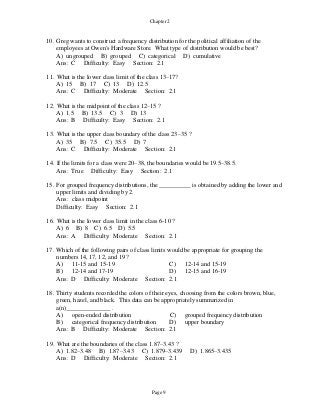
Ans: frequency
Difficulty: Easy Section: 2.1
5. If a frequency distribution had class boundaries of 132.5–147.5, what would be the class
width?
Ans: 15
Difficulty: Moderate Section: 2.1
6. For the class 10 - 18, the upper class limit is
A) 9.5 B) 10 C) 18 D) 18.5
Ans: C Difficulty: Easy Section: 2.1
7. What are the boundaries of the class 12-19?
A) 11.5 and 19.5 B) 8.5 and 22.5 C) 12 and 19 D) 7
Ans: A Difficulty: Easy Section: 2.1
8. In an ungrouped frequency distribution of the average age of high school graduates, what
would be the boundaries for the class of graduates who were reported to be 18 years old?
A) 17–19 years old C) 17.6 – 18.5 years old
B)
Ans:
17.5 – 18.5 years old
B Difficulty: Easy Section: 2.1
D) 17.6 19.5 years old
9. What is the midpoint of the class 7-11 ?
Page 8
A) 9.5 B) 9 C) 5 D) 4
Ans: B Difficulty: Easy Section: 2.1
Page 9
Chapter 2
10. Greg wants to construct a frequency distribution for the political affiliation of the
employees at Owen's Hardware Store. What type of distribution would be best?
A) ungrouped B) grouped C) categorical D) cumulative
Ans: C Difficulty: Easy Section: 2.1
11. What is the lower class limit of the class 13–17?
A) 15 B) 17 C) 13 D) 12.5
Ans: C Difficulty: Moderate Section: 2.1
12. What is the midpoint of the class 12–15 ?
A) 1.5 B) 13.5 C) 3 D) 13
Ans: B Difficulty: Easy Section: 2.1
13. What is the upper class boundary of the class 23–35 ?
A) 35 B) 7.5 C) 35.5 D) 7
Ans: C Difficulty: Moderate Section: 2.1
14. If the limits for a class were 20–38, the boundaries would be 19.5–38.5.
Ans: True Difficulty: Easy Section: 2.1
15. For grouped frequency distributions, the is obtained by adding the lower and
upper limits and dividing by 2.
Ans: class midpoint
Difficulty: Easy Section: 2.1
16. What is the lower class limit in the class 6-10 ?
A) 6 B) 8 C) 6.5 D) 5.5
Ans: A Difficulty: Moderate Section: 2.1
17. Which of the following pairs of class limits would be appropriate for grouping the
numbers 14, 17, 12, and 19 ?
A) 11-15 and 15-19 C) 12-14 and 15-19
B) 12-14 and 17-19 D) 12-15 and 16-19
Ans: D Difficulty: Moderate Section: 2.1
18. Thirty students recorded the colors of their eyes, choosing from the colors brown, blue,
green, hazel, and black. This data can be appropriately summarized in
a(n) .
A) open-ended distribution C) grouped frequency distribution
B) categorical frequency distribution D) upper boundary
Ans: B Difficulty: Moderate Section: 2.1
19. What are the boundaries of the class 1.87–3.43 ?
A) 1.82–3.48 B) 1.87–3.43 C) 1.879–3.439 D) 1.865–3.435
Ans: D Difficulty: Moderate Section: 2.1
Page 10
Chapter 2
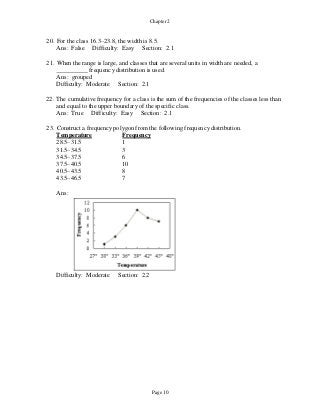
Temperature
28.5–31.5
Frequency
1
31.5–34.5 3
34.5–37.5 6
37.5–40.5 10
40.5–43.5 8
43.5–46.5 7
Ans:
20. For the class 16.3–23.8, the width is 8.5.
Ans: False Difficulty: Easy Section: 2.1
21. When the range is large, and classes that are several units in width are needed, a
frequency distribution is used.
Ans: grouped
Difficulty: Moderate Section: 2.1
22. The cumulative frequency for a class is the sum of the frequencies of the classes less than
and equal to the upper boundary of the specific class.
Ans: True Difficulty: Easy Section: 2.1
23. Construct a frequency polygon from the following frequency distribution.
Difficulty: Moderate Section: 2.2
Page 11
Chapter 2
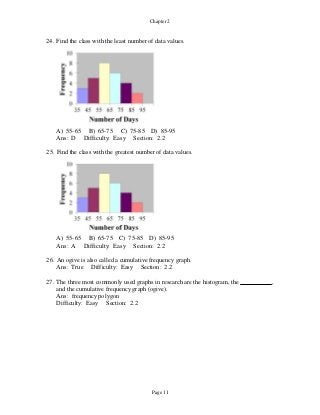
24. Find the class with the least number of data values.
A) 55-65 B) 65-75 C) 75-85 D) 85-95
Ans: D Difficulty: Easy Section: 2.2
25. Find the class with the greatest number of data values.
A) 55-65 B) 65-75 C) 75-85 D) 85-95
Ans: A Difficulty: Easy Section: 2.2
26. An ogive is also called a cumulative frequency graph.
Ans: True Difficulty: Easy Section: 2.2
27. The three most commonly used graphs in research are the histogram, the ,
and the cumulative frequency graph (ogive).
Ans: frequency polygon
Difficulty: Easy Section: 2.2
Page 12
Chapter 2
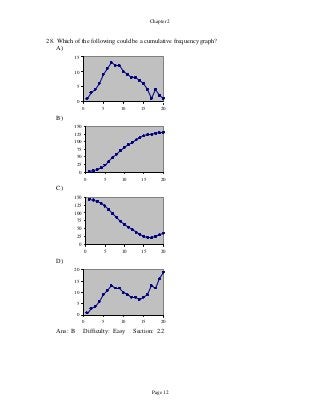
28. Which of the following could be a cumulative frequency graph?
A)
15
10
5
0
0 5 10 15 20
B)
150
125
100
75
50
25
0
C)
150
125
100
75
50
25
0
D)
0 5 10 15 20
0 5 10 15 20
20
15
10
5
0
0 5 10 15 20
Ans: B Difficulty: Easy Section: 2.2
Page 13
Chapter 2
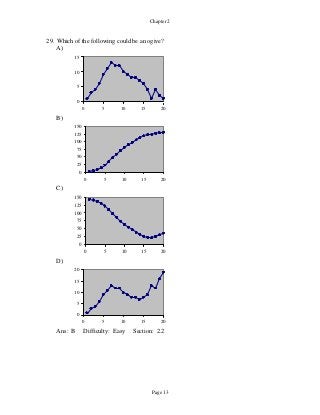
29. Which of the following could be an ogive?
A)
15
10
5
0
0 5 10 15 20
B)
150
125
100
75
50
25
0
C)
150
125
100
75
50
25
0
D)
0 5 10 15 20
0 5 10 15 20
20
15
10
5
0
0 5 10 15 20
Ans: B Difficulty: Easy Section: 2.2
Page 14
Chapter 2
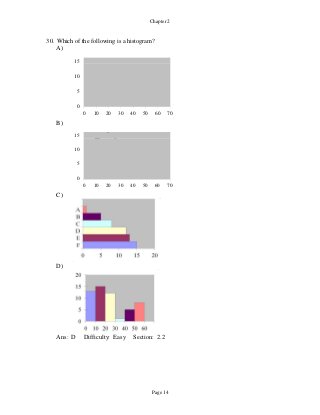
30. Which of the following is a histogram?
A)
15
10
5
0
0 10 20 30 40 50 60 70
B)
15
10
5
0
0 10 20 30 40 50 60 70
C)
D)
Ans: D Difficulty: Easy Section: 2.2
Page 15
Chapter 2
31. The frequency polygon and the histogram are two different ways to represent the same
data set.
Ans: True Difficulty: Easy Section: 2.2
32. For a given data set, the ogive and the frequency polygon will have the same overall
shape.
Ans: False Difficulty: Easy Section: 2.2
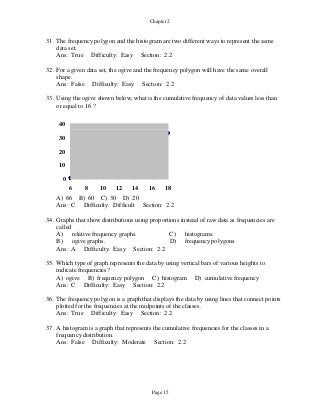
33. Using the ogive shown below, what is the cumulative frequency of data values less than
or equal to 16 ?
40
30
20
10
0
6 8 10 12 14 16 18
A) 66 B) 60 C) 30 D) 20
Ans: C Difficulty: Difficult Section: 2.2
34. Graphs that show distributions using proportions instead of raw data as frequencies are
called
A) relative frequency graphs. C) histograms.
B) ogive graphs. D) frequency polygons.
Ans: A Difficulty: Easy Section: 2.2
35. Which type of graph represents the data by using vertical bars of various heights to
indicate frequencies?
A) ogive B) frequency polygon C) histogram D) cumulative frequency
Ans: C Difficulty: Easy Section: 2.2
36. The frequency polygon is a graph that displays the data by using lines that connect points
plotted for the frequencies at the midpoints of the classes.
Ans: True Difficulty: Easy Section: 2.2
37. A histogram is a graph that represents the cumulative frequencies for the classes in a
frequency distribution.
Ans: False Difficulty: Moderate Section: 2.2
Page 16
Chapter 2
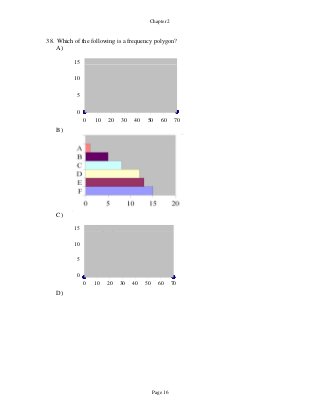
38. Which of the following is a frequency polygon?
A)
15
10
5
0
0 10 20 30 40 50 60 70
B)
C)
15
10
5
0
0 10 20 30 40 50 60 70
D)
Page 17
Chapter 2
Ans: C Difficulty: Moderate Section: 2.2
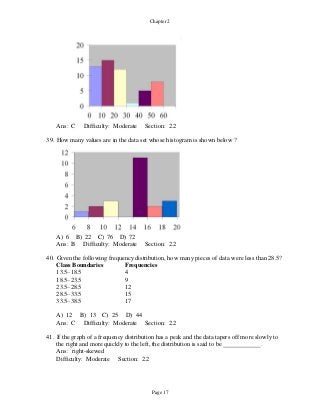
39. How many values are in the data set whose histogram is shown below ?
A) 6 B) 22 C) 76 D) 72
Ans: B Difficulty: Moderate Section: 2.2
40. Given the following frequency distribution, how many pieces of data were less than 28.5?
Class Boundaries
13.5–18.5
Frequencies
4
18.5–23.5 9
23.5–28.5 12
28.5–33.5 15
33.5–38.5 17
A) 12 B) 13 C) 25 D) 44
Ans: C Difficulty: Moderate Section: 2.2
41. If the graph of a frequency distribution has a peak and the data tapers off more slowly to
the right and more quickly to the left, the distribution is said to be .
Ans: right-skewed
Difficulty: Moderate Section: 2.2
Page 18
Chapter 2
NumberofStudents
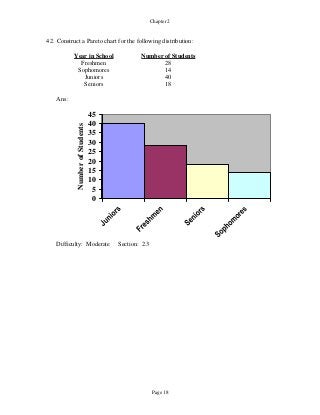
42. Construct a Pareto chart for the following distribution:
Year in School Number of Students
Freshmen 28
Sophomores 14
Juniors 40
Seniors 18
Ans:
45
40
35
30
25
20
15
10
5
0
Difficulty: Moderate Section: 2.3
Page 19
Chapter 2
NumberofStudents
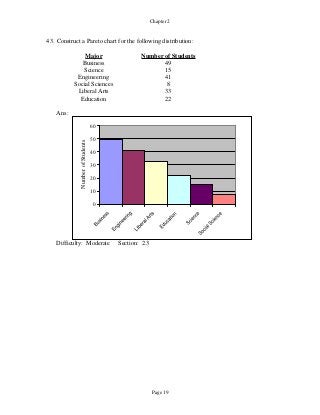
43. Construct a Pareto chart for the following distribution:
Major Number of Students
Business 49
Science 15
Engineering 41
Social Sciences 8
Liberal Arts 33
Education 22
Ans:
60
50
40
30
20
10
0
Difficulty: Moderate Section: 2.3
Page 20
Chapter 2
Year
1996
Contributions
$550
1997 $700
1998 $800
1999 $1050
2000 $1200
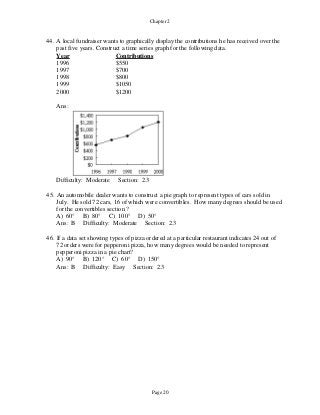
Ans:
44. A local fundraiser wants to graphically display the contributions he has received over the
past five years. Construct a time series graph for the following data.
Difficulty: Moderate Section: 2.3
45. An automobile dealer wants to construct a pie graph to represent types of cars sold in
July. He sold 72 cars, 16 of which were convertibles. How many degrees should be used
for the convertibles section ?
A) 60° B) 80° C) 100° D) 50°
Ans: B Difficulty: Moderate Section: 2.3
46. If a data set showing types of pizza ordered at a particular restaurant indicates 24 out of
72 orders were for pepperoni pizza, how many degrees would be needed to represent
pepperoni pizza in a pie chart?
A) 90° B) 120° C) 60° D) 150°
Ans: B Difficulty: Easy Section: 2.3
Page 21
Chapter 2
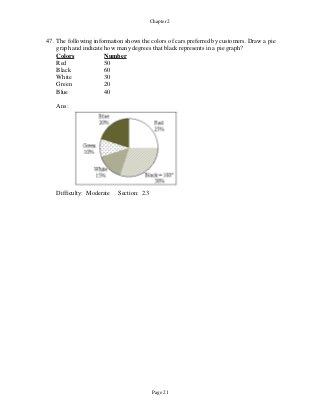
Colors
Red
Number
50
Black 60
White 30
Green 20
Blue 40
Ans:
47. The following information shows the colors of cars preferred by customers. Draw a pie
graph and indicate how many degrees that black represents in a pie graph?
Difficulty: Moderate Section: 2.3
Page 22
Chapter 2
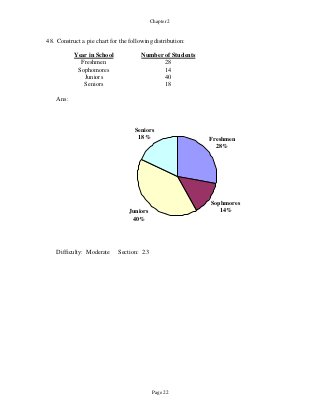
48. Construct a pie chart for the following distribution:
Year in School
Freshmen
Number of Students
28
Sophomores 14
Juniors 40
Seniors 18
Ans:
Seniors
18%
Juniors
40%
Freshmen
28%
Sophmores
14%
Difficulty: Moderate Section: 2.3
Page 23
Chapter 2
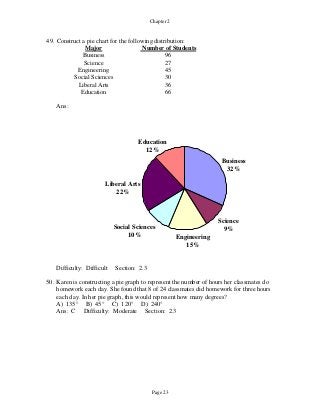
49. Construct a pie chart for the following distribution:
Major
Business
Number of Students
96
Science 27
Engineering 45
Social Sciences 30
Liberal Arts 36
Education 66
Ans:
Education
12%
Business
32%
Liberal Arts
22%
Social Sciences
10% Engineering
15%
Science
9%
Difficulty: Difficult Section: 2.3
50. Karen is constructing a pie graph to represent the number of hours her classmates do
homework each day. She found that 8 of 24 classmates did homework for three hours
each day. In her pie graph, this would represent how many degrees?
A) 135° B) 45° C) 120° D) 240°
Ans: C Difficulty: Moderate Section: 2.3
Page 24
Chapter 2
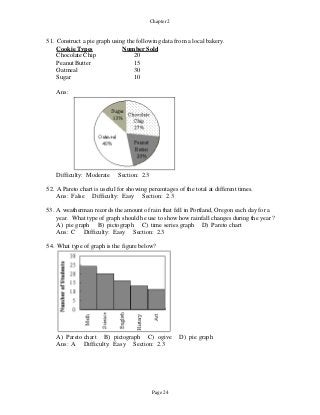
Cookie Types
Chocolate Chip
Number Sold
20
Peanut Butter 15
Oatmeal 30
Sugar 10
Ans:
51. Construct a pie graph using the following data from a local bakery.
Difficulty: Moderate Section: 2.3
52. A Pareto chart is useful for showing percentages of the total at different times.
Ans: False Difficulty: Easy Section: 2.3
53. A weatherman records the amount of rain that fell in Portland, Oregon each day for a
year. What type of graph should he use to show how rainfall changes during the year ?
A) pie graph B) pictograph C) time series graph D) Pareto chart
Ans: C Difficulty: Easy Section: 2.3
54. What type of graph is the figure below?
A) Pareto chart B) pictograph C) ogive D) pie graph
Ans: A Difficulty: Easy Section: 2.3
Page 25
Chapter 2
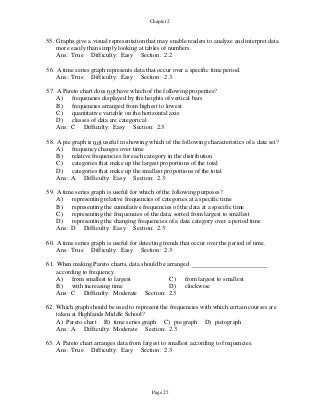
55. Graphs give a visual representation that may enable readers to analyze and interpret data
more easily than simply looking at tables of numbers.
Ans: True Difficulty: Easy Section: 2.2
56. A time series graph represents data that occur over a specific time period.
Ans: True Difficulty: Easy Section: 2.3
57. A Pareto chart does not have which of the following properties?
A) frequencies displayed by the heights of vertical bars
B) frequencies arranged from highest to lowest
C) quantitative variable on the horizontal axis
D) classes of data are categorical
Ans: C Difficulty: Easy Section: 2.3
58. A pie graph is not useful in showing which of the following characteristics of a data set?
A) frequency changes over time
B) relative frequencies for each category in the distribution
C) categories that make up the largest proportions of the total
D) categories that make up the smallest proportions of the total
Ans: A Difficulty: Easy Section: 2.3
59. A time series graph is useful for which of the following purposes?
A) representing relative frequencies of categories at a specific time
B) representing the cumulative frequencies of the data at a specific time
C) representing the frequencies of the data, sorted from largest to smallest
D) representing the changing frequencies of a data category over a period time
Ans: D Difficulty: Easy Section: 2.3
60. A time series graph is useful for detecting trends that occur over the period of time.
Ans: True Difficulty: Easy Section: 2.3
61. When making Pareto charts, data should be arranged
according to frequency.
A) from smallest to largest C) from largest to smallest
B) with increasing time D) clockwise
Ans: C Difficulty: Moderate Section: 2.3
62. Which graph should be used to represent the frequencies with which certain courses are
taken at Highlands Middle School?
A) Pareto chart B) time series graph C) pie graph D) pictograph
Ans: A Difficulty: Moderate Section: 2.3
63. A Pareto chart arranges data from largest to smallest according to frequencies.
Ans: True Difficulty: Easy Section: 2.3
Page 26
Chapter 2
64. When two sets of data collected over specific periods of time are compared on the same
graph using two lines, it is called a compound time series graph.
Ans: True Difficulty: Moderate Section: 2.3
65. A pie graph would best represent the number of inches of rain that has fallen in Ohio
each day for the past 2 months.
Ans: False Difficulty: Moderate Section: 2.3
66. The percentages of white, wheat, and rye bread sold at a supermarket each week is best
shown using a
Ans: pie
graph.
Difficulty: Moderate Section: 2.3
67. A graph would most appropriately represent the number of students that
were enrolled in Statistics for each of the past ten years.
Ans: time series
Difficulty: Moderate Section: 2.3
Page 27
Chapter 2
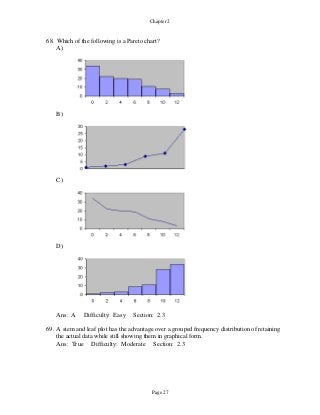
68. Which of the following is a Pareto chart?
A)
B)
C)
D)
Ans: A Difficulty: Easy Section: 2.3
69. A stem and leaf plot has the advantage over a grouped frequency distribution of retaining
the actual data while still showing them in graphical form.
Ans: True Difficulty: Moderate Section: 2.3
Page 28
Chapter 2
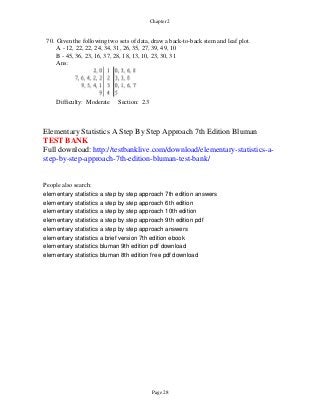
70. Given the following two sets of data, draw a back-to-back stem and leaf plot.
A - 12, 22, 22, 24, 34, 31, 26, 35, 27, 39, 49, 10
B - 45, 36, 23, 16, 37, 28, 18, 13, 10, 23, 30, 31
Ans:
Difficulty: Moderate Section: 2.3
Elementary Statistics A Step By Step Approach 7th Edition Bluman
TEST BANK
Full download: http://testbanklive.com/download/elementary-statistics-a-
step-by-step-approach-7th-edition-bluman-test-bank/
People also search:
elementary statistics a step by step approach 7th edition answers
elementary statistics a step by step approach 6th edition
elementary statistics a step by step approach 10th edition
elementary statistics a step by step approach 9th edition pdf
elementary statistics a step by step approach answers
elementary statistics a brief version 7th edition ebook
elementary statistics bluman 9th edition pdf download
elementary statistics bluman 8th edition free pdf download
Elementary statistics a step by step approach 7th edition bluman test bank

  • 1.
    Page 7 Elementary StatisticsA Step By Step Approach 7th Edition Bluman TEST BANK Full download: http://testbanklive.com/download/elementary-statistics-a-step- by-step-approach-7th-edition-bluman-test-bank/ Chapter 2 - Frequency Distributions and Graphs 1. Which of the following does not need to be done when constructing a frequency distribution? A) select the number of classes desired B) find the range C) make the class width an even number D) use classes that are mutually exclusive Ans: C Difficulty: Easy Section: 2.1 2. The lower class limit represents the smallest data value that can be included in the class. Ans: True Difficulty: Moderate Section: 2.1 3. When data are collected in original form, they are called . Ans: raw data Difficulty: Easy Section: 2.1 4. The of a specific class is the number of data values contained in it. Ans: frequency Difficulty: Easy Section: 2.1 5. If a frequency distribution had class boundaries of 132.5–147.5, what would be the class width? Ans: 15 Difficulty: Moderate Section: 2.1 6. For the class 10 - 18, the upper class limit is A) 9.5 B) 10 C) 18 D) 18.5 Ans: C Difficulty: Easy Section: 2.1 7. What are the boundaries of the class 12-19? A) 11.5 and 19.5 B) 8.5 and 22.5 C) 12 and 19 D) 7 Ans: A Difficulty: Easy Section: 2.1 8. In an ungrouped frequency distribution of the average age of high school graduates, what would be the boundaries for the class of graduates who were reported to be 18 years old? A) 17–19 years old C) 17.6 – 18.5 years old B) Ans: 17.5 – 18.5 years old B Difficulty: Easy Section: 2.1 D) 17.6 19.5 years old 9. What is the midpoint of the class 7-11 ?
  • 2.
    Page 8 A) 9.5B) 9 C) 5 D) 4 Ans: B Difficulty: Easy Section: 2.1
  • 3.
    Page 9 Chapter 2 10.Greg wants to construct a frequency distribution for the political affiliation of the employees at Owen's Hardware Store. What type of distribution would be best? A) ungrouped B) grouped C) categorical D) cumulative Ans: C Difficulty: Easy Section: 2.1 11. What is the lower class limit of the class 13–17? A) 15 B) 17 C) 13 D) 12.5 Ans: C Difficulty: Moderate Section: 2.1 12. What is the midpoint of the class 12–15 ? A) 1.5 B) 13.5 C) 3 D) 13 Ans: B Difficulty: Easy Section: 2.1 13. What is the upper class boundary of the class 23–35 ? A) 35 B) 7.5 C) 35.5 D) 7 Ans: C Difficulty: Moderate Section: 2.1 14. If the limits for a class were 20–38, the boundaries would be 19.5–38.5. Ans: True Difficulty: Easy Section: 2.1 15. For grouped frequency distributions, the is obtained by adding the lower and upper limits and dividing by 2. Ans: class midpoint Difficulty: Easy Section: 2.1 16. What is the lower class limit in the class 6-10 ? A) 6 B) 8 C) 6.5 D) 5.5 Ans: A Difficulty: Moderate Section: 2.1 17. Which of the following pairs of class limits would be appropriate for grouping the numbers 14, 17, 12, and 19 ? A) 11-15 and 15-19 C) 12-14 and 15-19 B) 12-14 and 17-19 D) 12-15 and 16-19 Ans: D Difficulty: Moderate Section: 2.1 18. Thirty students recorded the colors of their eyes, choosing from the colors brown, blue, green, hazel, and black. This data can be appropriately summarized in a(n) . A) open-ended distribution C) grouped frequency distribution B) categorical frequency distribution D) upper boundary Ans: B Difficulty: Moderate Section: 2.1 19. What are the boundaries of the class 1.87–3.43 ? A) 1.82–3.48 B) 1.87–3.43 C) 1.879–3.439 D) 1.865–3.435 Ans: D Difficulty: Moderate Section: 2.1
  • 4.
    Page 10 Chapter 2 Temperature 28.5–31.5 Frequency 1 31.5–34.53 34.5–37.5 6 37.5–40.5 10 40.5–43.5 8 43.5–46.5 7 Ans: 20. For the class 16.3–23.8, the width is 8.5. Ans: False Difficulty: Easy Section: 2.1 21. When the range is large, and classes that are several units in width are needed, a frequency distribution is used. Ans: grouped Difficulty: Moderate Section: 2.1 22. The cumulative frequency for a class is the sum of the frequencies of the classes less than and equal to the upper boundary of the specific class. Ans: True Difficulty: Easy Section: 2.1 23. Construct a frequency polygon from the following frequency distribution. Difficulty: Moderate Section: 2.2
  • 5.
    Page 11 Chapter 2 24.Find the class with the least number of data values. A) 55-65 B) 65-75 C) 75-85 D) 85-95 Ans: D Difficulty: Easy Section: 2.2 25. Find the class with the greatest number of data values. A) 55-65 B) 65-75 C) 75-85 D) 85-95 Ans: A Difficulty: Easy Section: 2.2 26. An ogive is also called a cumulative frequency graph. Ans: True Difficulty: Easy Section: 2.2 27. The three most commonly used graphs in research are the histogram, the , and the cumulative frequency graph (ogive). Ans: frequency polygon Difficulty: Easy Section: 2.2
  • 6.
    Page 12 Chapter 2 28.Which of the following could be a cumulative frequency graph? A) 15 10 5 0 0 5 10 15 20 B) 150 125 100 75 50 25 0 C) 150 125 100 75 50 25 0 D) 0 5 10 15 20 0 5 10 15 20 20 15 10 5 0 0 5 10 15 20 Ans: B Difficulty: Easy Section: 2.2
  • 7.
    Page 13 Chapter 2 29.Which of the following could be an ogive? A) 15 10 5 0 0 5 10 15 20 B) 150 125 100 75 50 25 0 C) 150 125 100 75 50 25 0 D) 0 5 10 15 20 0 5 10 15 20 20 15 10 5 0 0 5 10 15 20 Ans: B Difficulty: Easy Section: 2.2
  • 8.
    Page 14 Chapter 2 30.Which of the following is a histogram? A) 15 10 5 0 0 10 20 30 40 50 60 70 B) 15 10 5 0 0 10 20 30 40 50 60 70 C) D) Ans: D Difficulty: Easy Section: 2.2
  • 9.
    Page 15 Chapter 2 31.The frequency polygon and the histogram are two different ways to represent the same data set. Ans: True Difficulty: Easy Section: 2.2 32. For a given data set, the ogive and the frequency polygon will have the same overall shape. Ans: False Difficulty: Easy Section: 2.2 33. Using the ogive shown below, what is the cumulative frequency of data values less than or equal to 16 ? 40 30 20 10 0 6 8 10 12 14 16 18 A) 66 B) 60 C) 30 D) 20 Ans: C Difficulty: Difficult Section: 2.2 34. Graphs that show distributions using proportions instead of raw data as frequencies are called A) relative frequency graphs. C) histograms. B) ogive graphs. D) frequency polygons. Ans: A Difficulty: Easy Section: 2.2 35. Which type of graph represents the data by using vertical bars of various heights to indicate frequencies? A) ogive B) frequency polygon C) histogram D) cumulative frequency Ans: C Difficulty: Easy Section: 2.2 36. The frequency polygon is a graph that displays the data by using lines that connect points plotted for the frequencies at the midpoints of the classes. Ans: True Difficulty: Easy Section: 2.2 37. A histogram is a graph that represents the cumulative frequencies for the classes in a frequency distribution. Ans: False Difficulty: Moderate Section: 2.2
  • 10.
    Page 16 Chapter 2 38.Which of the following is a frequency polygon? A) 15 10 5 0 0 10 20 30 40 50 60 70 B) C) 15 10 5 0 0 10 20 30 40 50 60 70 D)
  • 11.
    Page 17 Chapter 2 Ans:C Difficulty: Moderate Section: 2.2 39. How many values are in the data set whose histogram is shown below ? A) 6 B) 22 C) 76 D) 72 Ans: B Difficulty: Moderate Section: 2.2 40. Given the following frequency distribution, how many pieces of data were less than 28.5? Class Boundaries 13.5–18.5 Frequencies 4 18.5–23.5 9 23.5–28.5 12 28.5–33.5 15 33.5–38.5 17 A) 12 B) 13 C) 25 D) 44 Ans: C Difficulty: Moderate Section: 2.2 41. If the graph of a frequency distribution has a peak and the data tapers off more slowly to the right and more quickly to the left, the distribution is said to be . Ans: right-skewed Difficulty: Moderate Section: 2.2
  • 12.
    Page 18 Chapter 2 NumberofStudents 42.Construct a Pareto chart for the following distribution: Year in School Number of Students Freshmen 28 Sophomores 14 Juniors 40 Seniors 18 Ans: 45 40 35 30 25 20 15 10 5 0 Difficulty: Moderate Section: 2.3
  • 13.
    Page 19 Chapter 2 NumberofStudents 43.Construct a Pareto chart for the following distribution: Major Number of Students Business 49 Science 15 Engineering 41 Social Sciences 8 Liberal Arts 33 Education 22 Ans: 60 50 40 30 20 10 0 Difficulty: Moderate Section: 2.3
  • 14.
    Page 20 Chapter 2 Year 1996 Contributions $550 1997$700 1998 $800 1999 $1050 2000 $1200 Ans: 44. A local fundraiser wants to graphically display the contributions he has received over the past five years. Construct a time series graph for the following data. Difficulty: Moderate Section: 2.3 45. An automobile dealer wants to construct a pie graph to represent types of cars sold in July. He sold 72 cars, 16 of which were convertibles. How many degrees should be used for the convertibles section ? A) 60° B) 80° C) 100° D) 50° Ans: B Difficulty: Moderate Section: 2.3 46. If a data set showing types of pizza ordered at a particular restaurant indicates 24 out of 72 orders were for pepperoni pizza, how many degrees would be needed to represent pepperoni pizza in a pie chart? A) 90° B) 120° C) 60° D) 150° Ans: B Difficulty: Easy Section: 2.3
  • 15.
    Page 21 Chapter 2 Colors Red Number 50 Black60 White 30 Green 20 Blue 40 Ans: 47. The following information shows the colors of cars preferred by customers. Draw a pie graph and indicate how many degrees that black represents in a pie graph? Difficulty: Moderate Section: 2.3
  • 16.
    Page 22 Chapter 2 48.Construct a pie chart for the following distribution: Year in School Freshmen Number of Students 28 Sophomores 14 Juniors 40 Seniors 18 Ans: Seniors 18% Juniors 40% Freshmen 28% Sophmores 14% Difficulty: Moderate Section: 2.3
  • 17.
    Page 23 Chapter 2 49.Construct a pie chart for the following distribution: Major Business Number of Students 96 Science 27 Engineering 45 Social Sciences 30 Liberal Arts 36 Education 66 Ans: Education 12% Business 32% Liberal Arts 22% Social Sciences 10% Engineering 15% Science 9% Difficulty: Difficult Section: 2.3 50. Karen is constructing a pie graph to represent the number of hours her classmates do homework each day. She found that 8 of 24 classmates did homework for three hours each day. In her pie graph, this would represent how many degrees? A) 135° B) 45° C) 120° D) 240° Ans: C Difficulty: Moderate Section: 2.3
  • 18.
    Page 24 Chapter 2 CookieTypes Chocolate Chip Number Sold 20 Peanut Butter 15 Oatmeal 30 Sugar 10 Ans: 51. Construct a pie graph using the following data from a local bakery. Difficulty: Moderate Section: 2.3 52. A Pareto chart is useful for showing percentages of the total at different times. Ans: False Difficulty: Easy Section: 2.3 53. A weatherman records the amount of rain that fell in Portland, Oregon each day for a year. What type of graph should he use to show how rainfall changes during the year ? A) pie graph B) pictograph C) time series graph D) Pareto chart Ans: C Difficulty: Easy Section: 2.3 54. What type of graph is the figure below? A) Pareto chart B) pictograph C) ogive D) pie graph Ans: A Difficulty: Easy Section: 2.3
  • 19.
    Page 25 Chapter 2 55.Graphs give a visual representation that may enable readers to analyze and interpret data more easily than simply looking at tables of numbers. Ans: True Difficulty: Easy Section: 2.2 56. A time series graph represents data that occur over a specific time period. Ans: True Difficulty: Easy Section: 2.3 57. A Pareto chart does not have which of the following properties? A) frequencies displayed by the heights of vertical bars B) frequencies arranged from highest to lowest C) quantitative variable on the horizontal axis D) classes of data are categorical Ans: C Difficulty: Easy Section: 2.3 58. A pie graph is not useful in showing which of the following characteristics of a data set? A) frequency changes over time B) relative frequencies for each category in the distribution C) categories that make up the largest proportions of the total D) categories that make up the smallest proportions of the total Ans: A Difficulty: Easy Section: 2.3 59. A time series graph is useful for which of the following purposes? A) representing relative frequencies of categories at a specific time B) representing the cumulative frequencies of the data at a specific time C) representing the frequencies of the data, sorted from largest to smallest D) representing the changing frequencies of a data category over a period time Ans: D Difficulty: Easy Section: 2.3 60. A time series graph is useful for detecting trends that occur over the period of time. Ans: True Difficulty: Easy Section: 2.3 61. When making Pareto charts, data should be arranged according to frequency. A) from smallest to largest C) from largest to smallest B) with increasing time D) clockwise Ans: C Difficulty: Moderate Section: 2.3 62. Which graph should be used to represent the frequencies with which certain courses are taken at Highlands Middle School? A) Pareto chart B) time series graph C) pie graph D) pictograph Ans: A Difficulty: Moderate Section: 2.3 63. A Pareto chart arranges data from largest to smallest according to frequencies. Ans: True Difficulty: Easy Section: 2.3
  • 20.
    Page 26 Chapter 2 64.When two sets of data collected over specific periods of time are compared on the same graph using two lines, it is called a compound time series graph. Ans: True Difficulty: Moderate Section: 2.3 65. A pie graph would best represent the number of inches of rain that has fallen in Ohio each day for the past 2 months. Ans: False Difficulty: Moderate Section: 2.3 66. The percentages of white, wheat, and rye bread sold at a supermarket each week is best shown using a Ans: pie graph. Difficulty: Moderate Section: 2.3 67. A graph would most appropriately represent the number of students that were enrolled in Statistics for each of the past ten years. Ans: time series Difficulty: Moderate Section: 2.3
  • 21.
    Page 27 Chapter 2 68.Which of the following is a Pareto chart? A) B) C) D) Ans: A Difficulty: Easy Section: 2.3 69. A stem and leaf plot has the advantage over a grouped frequency distribution of retaining the actual data while still showing them in graphical form. Ans: True Difficulty: Moderate Section: 2.3
  • 22.
    Page 28 Chapter 2 70.Given the following two sets of data, draw a back-to-back stem and leaf plot. A - 12, 22, 22, 24, 34, 31, 26, 35, 27, 39, 49, 10 B - 45, 36, 23, 16, 37, 28, 18, 13, 10, 23, 30, 31 Ans: Difficulty: Moderate Section: 2.3 Elementary Statistics A Step By Step Approach 7th Edition Bluman TEST BANK Full download: http://testbanklive.com/download/elementary-statistics-a- step-by-step-approach-7th-edition-bluman-test-bank/ People also search: elementary statistics a step by step approach 7th edition answers elementary statistics a step by step approach 6th edition elementary statistics a step by step approach 10th edition elementary statistics a step by step approach 9th edition pdf elementary statistics a step by step approach answers elementary statistics a brief version 7th edition ebook elementary statistics bluman 9th edition pdf download elementary statistics bluman 8th edition free pdf download