API Management Best Practices with WSO2
API Manager
Chanaka Fernando
WSO2 Inc
Agenda
● API First Designing Approach
● API Life-cycle management
● Manage services through API versioning
● Securing APIs
● API rate limiting and Throttling
● API Monitoring
● Promote, Advertise and socialize APIs
● Scaling the API Manager
2
API First Designing
Approach
4
API Always Comes First
API First Designing Approach
● API Developer should have accurate API design.
- API acts as a contract between the service providers and consumers,
● Need to create new version instead of editing existing API.
● A high-quality API management solution should provide a mechanism to design
the API by considering both technical and business aspects.
- WSO2 API Manager has the capability of facilitating above both parties.
● API developers can use the API Publisher web interface of WSO2 API Manager
and Technical aspects are important to them.
● Both API consumers and service providers are interested in business aspects.
5
6
● API Design - Over the wizard & with swagger
Creating APIs
API First Designing Approach
● API Developers and publishers should decide the visibility and subscription
availability for the API in a multi-tenant environment.
● The API visibility should be controlled over the business domains.
● WSO2 API Publisher has the capability to include API resource to manage
different endpoints.
● WSO2 API Manager also has an integrated Swagger UI to properly design the
APIs.
7
API First Designing Approach
Best practices while creating APIs
● Proper Naming APIs.
● Proper versioning.
● Proper HTTP methods.
● Create API for dedicated backend services.
● Consider the special behaviours of the APIs.
● Proper error handling.
8
API First Designing Approach
Error handling with Circuit Breaker
9
API Lifecycle Management
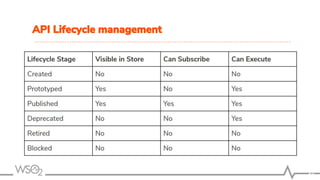
API Lifecycle management
● Each API has its own life cycle state.
● The developers can improve and refine the API before deploying it in production.
● The consumers can take decisions based on the API status.
● In APIM, we can identify the several API status and relevant recommendations
per each life cycle state.
Created state :
- This is the starting stage of the API.
11
12
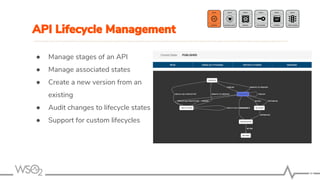
● Manage stages of an API
● Manage associated states
● Create a new version from an
existing
● Audit changes to lifecycle states
● Support for custom lifecycles
API Lifecycle Management
API Lifecycle management
Prototyped state-
This helps API developers to refine the API and make sure it is production ready in a
way that it is beneficial to most of the users.
Published state-
API is deployed as a production ready service. Consumers must have a valid
subscription to the API if they are interested in using the service.
Blocked state-
API developers can change the lifecycle to “Blocked”. This might be useful when there
are security issues or service violations. Once the issue is fixed, API developer can
re-publish the API. Also, it is possible to deprecate the API if needed.
13
API Lifecycle management
Deprecated States
The API can be “Depreciated”, If the developer needs to update
published API with latest modifications.
By deprecating the API, The developer can make allow existing APIs
to the consumer and restrict to subscribing new consumers for it.
Retired state
The final stage of the api and API is unpublished from the gateway and deleted from
the store. But still the developers can’t create a api as a same context
with the retired APIs have.
14
API Lifecycle management
15
Manage services through
API Versioning
Manage services through API versioning
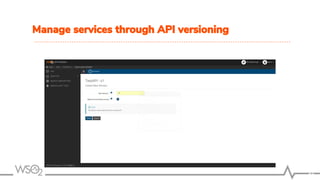
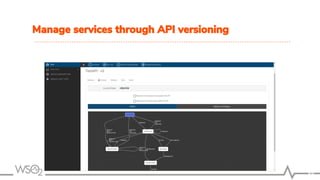
● There may be requirements to have API modifications.
● It is not recommended to modify a published API which already has consumers.
● The best practice is to create a new version of the same API with the
update/change.
● Editing API with active subscribers will violated the business agreement
between API publisher and consumer.
● If the developer wants to update the existing API, He/She should creates a
prototype as a new version and make allow consumers to try out the the
prototype and after being maintaining both older and newer, deprecate the old
version and published the API which is in prototype status.
17
Manage services through API versioning
18
Manage services through API versioning
19
Manage services through API versioning
20
Securing APIs
Securing APIs
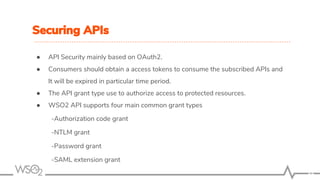
● API Security mainly based on OAuth2.
● Consumers should obtain a access tokens to consume the subscribed APIs and
It will be expired in particular time period.
● The API grant type use to authorize access to protected resources.
● WSO2 API supports four main common grant types
-Authorization code grant
-NTLM grant
-Password grant
-SAML extension grant
22
23
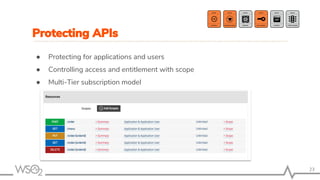
● Protecting for applications and users
● Controlling access and entitlement with scope
● Multi-Tier subscription model
Protecting APIs
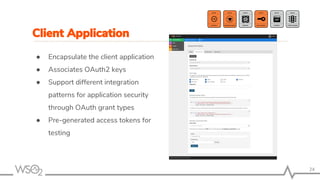
24
● Encapsulate the client application
● Associates OAuth2 keys
● Support different integration
patterns for application security
through OAuth grant types
● Pre-generated access tokens for
testing
Client Application
Securing APIs
● The API developers can define their own custom grant type.
● The key manager handle the access tokens and It is possible to extend the key
manager in WSO2 API Manager using WSO2 Identity server as the key
manager.
● Can be configured a third party key manager.
● Can authenticate via Google or facebook.
25
API Rate limiting and
Throttling
API rate limiting
● The API rate limiting is managing traffic is important feature in real world
deployments.
● The traffic manager is responsible for
- regulating API traffic.
- making access API and applications to consumers at different
service levels.
- securing APIs against security attacks.
- process throttling policies in real time.
27
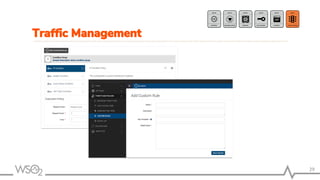
28
● Tier based simple model
○ Application developer selects the tier at app registration
○ Each tier is tied to a policy that describe the quota
○ Tiers can be applied at the application, API or at the API resource level
● Advance rule based models
○ Policies containing IP conditions, message attribute based conditions,
transport header based conditions
○ Complex real time pattern based conditions
Traffic Management
29
Traffic Management
30
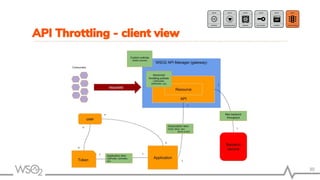
API Throttling - client view
31
API Throttling - execution flow
API Monitoring
33
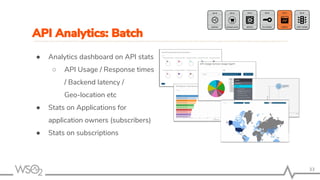
● Analytics dashboard on API stats
○ API Usage / Response times
/ Backend latency /
Geo-location etc
● Stats on Applications for
application owners (subscribers)
● Stats on subscriptions
API Analytics: Batch
34
● Leverages real-time analytics streaming engine
● Used for various alerting use-cases
○ Fraudulent access token usage
○ Keeping API developers alerted on backend performance issues
○ Alerting on SLA violations
○ Alerting on tier crossing for subscriptions
● Detect trends
● Detect API call sequences that needs to be blocked
● Detect non-usage scenarios
API Analytics: Realtime
Promote, Advertise and
socialize API
Promote, Advertise and Socialize API
● The API business owner can advertise, market and sell APIs as a product in
developer communities worldwide.
● Mainly these community features can be found in API Store.
● In API Store, there is a facility to search apis based on different attributes. API
name, API provider, API version, API documentation, and API status are some of
the supported search criteria.
● Rating and commenting.
● Sharing the API via social media.
● Consumers can join to forum to discuss the ideas.
36
Scaling the API Manager
Scalability
● Componentized architecture allows the API Manager to scale to higher limits
without any bottleneck
● Different components can scale at different rate
● Components can be deployed across different security zones based on the
requirements
● 1000 TPS on average with minimum HA deployment (2 node all-in-one)
38
39
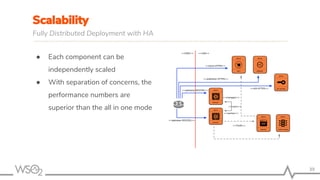
● Each component can be
independently scaled
● With separation of concerns, the
performance numbers are
superior than the all in one mode
Scalability
Fully Distributed Deployment with HA
THANK YOU
wso2.com

Api management best practices with wso2 api manager

  • 1.
    API Management BestPractices with WSO2 API Manager Chanaka Fernando WSO2 Inc
  • 2.
    Agenda ● API FirstDesigning Approach ● API Life-cycle management ● Manage services through API versioning ● Securing APIs ● API rate limiting and Throttling ● API Monitoring ● Promote, Advertise and socialize APIs ● Scaling the API Manager 2
  • 3.
  • 4.
  • 5.
    API First DesigningApproach ● API Developer should have accurate API design. - API acts as a contract between the service providers and consumers, ● Need to create new version instead of editing existing API. ● A high-quality API management solution should provide a mechanism to design the API by considering both technical and business aspects. - WSO2 API Manager has the capability of facilitating above both parties. ● API developers can use the API Publisher web interface of WSO2 API Manager and Technical aspects are important to them. ● Both API consumers and service providers are interested in business aspects. 5
  • 6.
    6 ● API Design- Over the wizard & with swagger Creating APIs
  • 7.
    API First DesigningApproach ● API Developers and publishers should decide the visibility and subscription availability for the API in a multi-tenant environment. ● The API visibility should be controlled over the business domains. ● WSO2 API Publisher has the capability to include API resource to manage different endpoints. ● WSO2 API Manager also has an integrated Swagger UI to properly design the APIs. 7
  • 8.
    API First DesigningApproach Best practices while creating APIs ● Proper Naming APIs. ● Proper versioning. ● Proper HTTP methods. ● Create API for dedicated backend services. ● Consider the special behaviours of the APIs. ● Proper error handling. 8
  • 9.
    API First DesigningApproach Error handling with Circuit Breaker 9
  • 10.
  • 11.
    API Lifecycle management ●Each API has its own life cycle state. ● The developers can improve and refine the API before deploying it in production. ● The consumers can take decisions based on the API status. ● In APIM, we can identify the several API status and relevant recommendations per each life cycle state. Created state : - This is the starting stage of the API. 11
  • 12.
    12 ● Manage stagesof an API ● Manage associated states ● Create a new version from an existing ● Audit changes to lifecycle states ● Support for custom lifecycles API Lifecycle Management
  • 13.
    API Lifecycle management Prototypedstate- This helps API developers to refine the API and make sure it is production ready in a way that it is beneficial to most of the users. Published state- API is deployed as a production ready service. Consumers must have a valid subscription to the API if they are interested in using the service. Blocked state- API developers can change the lifecycle to “Blocked”. This might be useful when there are security issues or service violations. Once the issue is fixed, API developer can re-publish the API. Also, it is possible to deprecate the API if needed. 13
  • 14.
    API Lifecycle management DeprecatedStates The API can be “Depreciated”, If the developer needs to update published API with latest modifications. By deprecating the API, The developer can make allow existing APIs to the consumer and restrict to subscribing new consumers for it. Retired state The final stage of the api and API is unpublished from the gateway and deleted from the store. But still the developers can’t create a api as a same context with the retired APIs have. 14
  • 15.
  • 16.
  • 17.
    Manage services throughAPI versioning ● There may be requirements to have API modifications. ● It is not recommended to modify a published API which already has consumers. ● The best practice is to create a new version of the same API with the update/change. ● Editing API with active subscribers will violated the business agreement between API publisher and consumer. ● If the developer wants to update the existing API, He/She should creates a prototype as a new version and make allow consumers to try out the the prototype and after being maintaining both older and newer, deprecate the old version and published the API which is in prototype status. 17
  • 18.
    Manage services throughAPI versioning 18
  • 19.
    Manage services throughAPI versioning 19
  • 20.
    Manage services throughAPI versioning 20
  • 21.
  • 22.
    Securing APIs ● APISecurity mainly based on OAuth2. ● Consumers should obtain a access tokens to consume the subscribed APIs and It will be expired in particular time period. ● The API grant type use to authorize access to protected resources. ● WSO2 API supports four main common grant types -Authorization code grant -NTLM grant -Password grant -SAML extension grant 22
  • 23.
    23 ● Protecting forapplications and users ● Controlling access and entitlement with scope ● Multi-Tier subscription model Protecting APIs
  • 24.
    24 ● Encapsulate theclient application ● Associates OAuth2 keys ● Support different integration patterns for application security through OAuth grant types ● Pre-generated access tokens for testing Client Application
  • 25.
    Securing APIs ● TheAPI developers can define their own custom grant type. ● The key manager handle the access tokens and It is possible to extend the key manager in WSO2 API Manager using WSO2 Identity server as the key manager. ● Can be configured a third party key manager. ● Can authenticate via Google or facebook. 25
  • 26.
    API Rate limitingand Throttling
  • 27.
    API rate limiting ●The API rate limiting is managing traffic is important feature in real world deployments. ● The traffic manager is responsible for - regulating API traffic. - making access API and applications to consumers at different service levels. - securing APIs against security attacks. - process throttling policies in real time. 27
  • 28.
    28 ● Tier basedsimple model ○ Application developer selects the tier at app registration ○ Each tier is tied to a policy that describe the quota ○ Tiers can be applied at the application, API or at the API resource level ● Advance rule based models ○ Policies containing IP conditions, message attribute based conditions, transport header based conditions ○ Complex real time pattern based conditions Traffic Management
  • 29.
  • 30.
  • 31.
    31 API Throttling -execution flow
  • 32.
  • 33.
    33 ● Analytics dashboardon API stats ○ API Usage / Response times / Backend latency / Geo-location etc ● Stats on Applications for application owners (subscribers) ● Stats on subscriptions API Analytics: Batch
  • 34.
    34 ● Leverages real-timeanalytics streaming engine ● Used for various alerting use-cases ○ Fraudulent access token usage ○ Keeping API developers alerted on backend performance issues ○ Alerting on SLA violations ○ Alerting on tier crossing for subscriptions ● Detect trends ● Detect API call sequences that needs to be blocked ● Detect non-usage scenarios API Analytics: Realtime
  • 35.
  • 36.
    Promote, Advertise andSocialize API ● The API business owner can advertise, market and sell APIs as a product in developer communities worldwide. ● Mainly these community features can be found in API Store. ● In API Store, there is a facility to search apis based on different attributes. API name, API provider, API version, API documentation, and API status are some of the supported search criteria. ● Rating and commenting. ● Sharing the API via social media. ● Consumers can join to forum to discuss the ideas. 36
  • 37.
  • 38.
    Scalability ● Componentized architectureallows the API Manager to scale to higher limits without any bottleneck ● Different components can scale at different rate ● Components can be deployed across different security zones based on the requirements ● 1000 TPS on average with minimum HA deployment (2 node all-in-one) 38
  • 39.
    39 ● Each componentcan be independently scaled ● With separation of concerns, the performance numbers are superior than the all in one mode Scalability Fully Distributed Deployment with HA
  • 40.