Prosecutor 		Response to Domestic ViolenceLearning Unit 5A mini content lecture designed as a supplemental learning resource for CRJ 461 by Bonnie Black.
Represents the interest of the state or peopleResponsibility to ensure justice is servedIs not the victim’s attorney despite beliefs to the contrary2What is the Role of the Prosecutor?
Traditional Treatment of Victims in Criminal Justice SystemWould you wantto cooperate?Insensitive QuestioningVictim’s Fault- BlamingCan’t Find Out What is HappeningProperty kept for Long Time As EvidenceTime Wasted At CourtIndifference to Fears About CooperatingAnxiety About Testifying/QuestioningVictim’s Needs Secondary to Conviction3
Injustices by ProsecutorsConviction FocusedCommon use of plea bargaining to dispose of high volume of casesPolitically motivatedget votesappease the publicLittle victim sensitivityThey are a means to an end result - conviction4
Victim Costs Associated with Participating in Criminal Justice SystemAnxiety - FearLack of InformationDelays/ContinuancesTime From Work/Reduced IncomeTransportation                            ProblemsBabysitting Issues                            and costsIntimidationFrustrationAbuse5
Remedying the Plight Prosecutor Strategies to Address Domestic Violence More Effectively
REMEDY:                                Victim Witness ProgramsGOAL“Minimize witness discontent…in order to retain testimonial value”Witness Management7
Victim Witness ProgramsBegan in 1975		Emergence of Victim Advocates			Located in Police and Prosecutors Office8
Responsibilities of Victim AdvocateExplain the importance of cooperation		Inform of rightsFurnish information		Provide orientation to court processTips on recall and testifying9
Support and assistanceReduces fear of unknown: educated about how the system works and role of the playersReduces anxiety about participationLearns about community resourcesDirect contact in system is available to them to answer questions Benefits to Victim10
Problems with Victim Witness ProgramsNOT victim oriented;  focuses on insult to society not insult to victim.Based on what officials think victim needs NOT on victim wants.Limited to those who report AND suspect is apprehended.Based on needs of prosecutor NOT victim.11
Are victim witness programs simply a self-serving way to get a conviction on the case?What are the disadvantages to the victim?Think About It!12
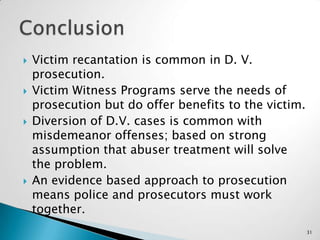
Also called “Victimless” or “Evidence-Based” ProsecutionVictims desire to drop charges or unwillingness to cooperate is not a reason to dismiss the charges.Prosecution is based on evidenceReliance on police officers preserving and gathering evidence at the sceneMost D.V. cases do not go to trialplea bargaineddiversion REMEDY:  No Drop Policies13
Offender agrees to terms and treatmentUsually designed for first offendersJust because a D.V. offender hasn’t been arrested, doesn’t mean there is not a long pattern of abuseIf successful, charges are dismissed.No convictionCommon in lower courts; misdemeanor casesAre different depending on jurisdiction and state.REMEDY:  Diversion14
Example: City of Phoenix Diversion “What is diversion?Diversion is offered to offenders who meet a specific criteria. Those who are eligible will have the option of completing a counseling program designed to prevent the defendant from committing this type of crime in the future. Upon successful completion of the program, the charges will be dismissed. Upon request of the victim, the views of the victim shall be considered in determining diversion eligibility.Who qualifies for diversion?The prosecutor determines at the time of prosecution whether a defendant is eligible to attend diversion. Factors that may influence the decision include:Whether this is the first time charges are brought. Whether a previous case has been dismissed through diversion. Whether the victim is under the age of 15. The severity of the offense. You may learn additional information about diversion by speaking with a victim advocate at 602-261-8192.”Source: City of Phoenix , Frequently Asked Questions; http://phoenix.gov/VICTIMS/faqs.html15
“What happens if the defendant fails to complete diversion?If the defendant fails to complete diversion, the court will find the defendant guilty. The judge will then impose the sentence that was agreed to on the diversion plea agreement.”City of Phoenix Example Cont.Source: City of Phoenix , Frequently Asked Questions; http://phoenix.gov/VICTIMS/faqs.html16
Vertical ProsecutionD. V. cases are handled by the same prosecutorial team or prosecutor from  time of complaint to disposition.Victims don’t get shuffled aroundPromotes cooperationSpecialized Prosecution UnitsCreates level of expertiseCases don’t fall through cracksREMEDY: Team Approaches17
Has been referred to as “victimless prosecution.”Assumes domestic violence victim won’t cooperate so focus is on the evidence in case.Police role in collection and documentation of evidence is key. Based on the assumption victim recantation (change his/her story) will occur.REMEDY: 				     Evidence Based Prosecution18
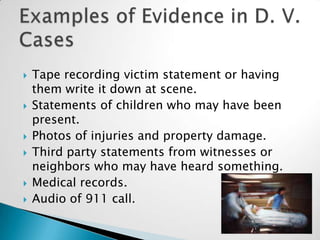
Tape recording victim statement or having them write it down at scene.Statements of children who may have been present.Photos of injuries and property damage.Third party statements from witnesses or neighbors who may have heard something.Medical records.Audio of 911 call.Examples of Evidence in D. V. Cases19
Allows for spontaneous and excited statements to be admitted “even if the party who said them is not present.”
Comes from:
Startling event
Stress from excitement of event
To apply, statement made while event was occurring or close thereafter“Excited Utterance” Use in D.V. CasesWhat is it?Exception to hearsay rule that prohibits statements from a “second party repeating what the first party said.”Quote Source:  “The Criminal Justice Response to Criminal Justice” by Andrew Klein, Thomson Wadsworth, 2004.20
REMEDY: Prosecutor Training on D.V.Recognition that training needed to be collaborative and involve police, prosecutors, judges, probation officers, victim advocates, etc.Important: Emphasis on a system wide approach to D.V. not just an agency approachFunded by Violence Against Women ActFocus on prosecution policies to create consistency in D.V. decisions21
Abuser Treatment: A Requirement of DiversionThink About It!Can abusers change?22
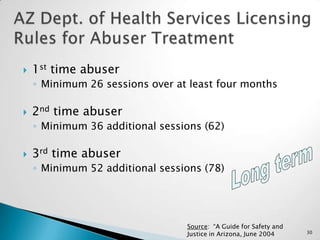
Can It Place The Victim At Risk?Abuser treatment and research is in its infancy.Popular option for  prosecution and courts.Certification and monitoring of programs remains lax.One treatment fits all. Quick fix to long term problem. 23
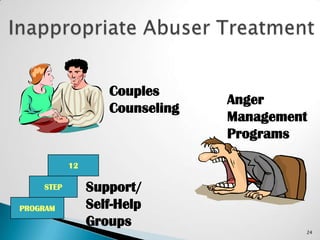
Inappropriate Abuser TreatmentCouplesCounselingAngerManagementPrograms12STEPSupport/Self-HelpGroupsPROGRAM24
Indicators Of Offender ChangeSincerely feels distress and remorse about behavior.Accepts responsibility—”Owns” problem.Wants to change behavior and demonstrates it.Recognizes criminality and consequences.All forms of abuse cease.25
Indicators of Change Cont.Is “involved” in treatment---counselor and victim recognize change.Acknowledges abuse is intentional and used to control partner.Accepts change as lifetime commitment not temporary fix.26

Learning Unit 5: Prosecutor Response to D.V. -CRJ 461

  • 1.
    Prosecutor Response toDomestic ViolenceLearning Unit 5A mini content lecture designed as a supplemental learning resource for CRJ 461 by Bonnie Black.
  • 2.
    Represents the interestof the state or peopleResponsibility to ensure justice is servedIs not the victim’s attorney despite beliefs to the contrary2What is the Role of the Prosecutor?
  • 3.
    Traditional Treatment ofVictims in Criminal Justice SystemWould you wantto cooperate?Insensitive QuestioningVictim’s Fault- BlamingCan’t Find Out What is HappeningProperty kept for Long Time As EvidenceTime Wasted At CourtIndifference to Fears About CooperatingAnxiety About Testifying/QuestioningVictim’s Needs Secondary to Conviction3
  • 4.
    Injustices by ProsecutorsConvictionFocusedCommon use of plea bargaining to dispose of high volume of casesPolitically motivatedget votesappease the publicLittle victim sensitivityThey are a means to an end result - conviction4
  • 5.
    Victim Costs Associatedwith Participating in Criminal Justice SystemAnxiety - FearLack of InformationDelays/ContinuancesTime From Work/Reduced IncomeTransportation ProblemsBabysitting Issues and costsIntimidationFrustrationAbuse5
  • 6.
    Remedying the PlightProsecutor Strategies to Address Domestic Violence More Effectively
  • 7.
    REMEDY: Victim Witness ProgramsGOAL“Minimize witness discontent…in order to retain testimonial value”Witness Management7
  • 8.
    Victim Witness ProgramsBeganin 1975 Emergence of Victim Advocates Located in Police and Prosecutors Office8
  • 9.
    Responsibilities of VictimAdvocateExplain the importance of cooperation Inform of rightsFurnish information Provide orientation to court processTips on recall and testifying9
  • 10.
    Support and assistanceReducesfear of unknown: educated about how the system works and role of the playersReduces anxiety about participationLearns about community resourcesDirect contact in system is available to them to answer questions Benefits to Victim10
  • 11.
    Problems with VictimWitness ProgramsNOT victim oriented; focuses on insult to society not insult to victim.Based on what officials think victim needs NOT on victim wants.Limited to those who report AND suspect is apprehended.Based on needs of prosecutor NOT victim.11
  • 12.
    Are victim witnessprograms simply a self-serving way to get a conviction on the case?What are the disadvantages to the victim?Think About It!12
  • 13.
    Also called “Victimless”or “Evidence-Based” ProsecutionVictims desire to drop charges or unwillingness to cooperate is not a reason to dismiss the charges.Prosecution is based on evidenceReliance on police officers preserving and gathering evidence at the sceneMost D.V. cases do not go to trialplea bargaineddiversion REMEDY: No Drop Policies13
  • 14.
    Offender agrees toterms and treatmentUsually designed for first offendersJust because a D.V. offender hasn’t been arrested, doesn’t mean there is not a long pattern of abuseIf successful, charges are dismissed.No convictionCommon in lower courts; misdemeanor casesAre different depending on jurisdiction and state.REMEDY: Diversion14
  • 15.
    Example: City ofPhoenix Diversion “What is diversion?Diversion is offered to offenders who meet a specific criteria. Those who are eligible will have the option of completing a counseling program designed to prevent the defendant from committing this type of crime in the future. Upon successful completion of the program, the charges will be dismissed. Upon request of the victim, the views of the victim shall be considered in determining diversion eligibility.Who qualifies for diversion?The prosecutor determines at the time of prosecution whether a defendant is eligible to attend diversion. Factors that may influence the decision include:Whether this is the first time charges are brought. Whether a previous case has been dismissed through diversion. Whether the victim is under the age of 15. The severity of the offense. You may learn additional information about diversion by speaking with a victim advocate at 602-261-8192.”Source: City of Phoenix , Frequently Asked Questions; http://phoenix.gov/VICTIMS/faqs.html15
  • 16.
    “What happens ifthe defendant fails to complete diversion?If the defendant fails to complete diversion, the court will find the defendant guilty. The judge will then impose the sentence that was agreed to on the diversion plea agreement.”City of Phoenix Example Cont.Source: City of Phoenix , Frequently Asked Questions; http://phoenix.gov/VICTIMS/faqs.html16
  • 17.
    Vertical ProsecutionD. V.cases are handled by the same prosecutorial team or prosecutor from time of complaint to disposition.Victims don’t get shuffled aroundPromotes cooperationSpecialized Prosecution UnitsCreates level of expertiseCases don’t fall through cracksREMEDY: Team Approaches17
  • 18.
    Has been referredto as “victimless prosecution.”Assumes domestic violence victim won’t cooperate so focus is on the evidence in case.Police role in collection and documentation of evidence is key. Based on the assumption victim recantation (change his/her story) will occur.REMEDY: Evidence Based Prosecution18
  • 19.
    Tape recording victimstatement or having them write it down at scene.Statements of children who may have been present.Photos of injuries and property damage.Third party statements from witnesses or neighbors who may have heard something.Medical records.Audio of 911 call.Examples of Evidence in D. V. Cases19
  • 20.
    Allows for spontaneousand excited statements to be admitted “even if the party who said them is not present.”
  • 21.
  • 22.
  • 23.
  • 24.
    To apply, statementmade while event was occurring or close thereafter“Excited Utterance” Use in D.V. CasesWhat is it?Exception to hearsay rule that prohibits statements from a “second party repeating what the first party said.”Quote Source: “The Criminal Justice Response to Criminal Justice” by Andrew Klein, Thomson Wadsworth, 2004.20
  • 25.
    REMEDY: Prosecutor Trainingon D.V.Recognition that training needed to be collaborative and involve police, prosecutors, judges, probation officers, victim advocates, etc.Important: Emphasis on a system wide approach to D.V. not just an agency approachFunded by Violence Against Women ActFocus on prosecution policies to create consistency in D.V. decisions21
  • 26.
    Abuser Treatment: ARequirement of DiversionThink About It!Can abusers change?22
  • 27.
    Can It PlaceThe Victim At Risk?Abuser treatment and research is in its infancy.Popular option for prosecution and courts.Certification and monitoring of programs remains lax.One treatment fits all. Quick fix to long term problem. 23
  • 28.
  • 29.
    Indicators Of OffenderChangeSincerely feels distress and remorse about behavior.Accepts responsibility—”Owns” problem.Wants to change behavior and demonstrates it.Recognizes criminality and consequences.All forms of abuse cease.25
  • 30.
    Indicators of ChangeCont.Is “involved” in treatment---counselor and victim recognize change.Acknowledges abuse is intentional and used to control partner.Accepts change as lifetime commitment not temporary fix.26