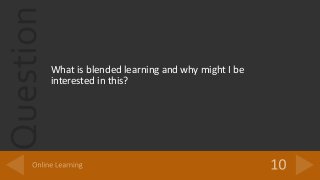
AnswerBlended learning isa mixture of both face-to-face
and online learning
“Current research suggests that the best results come from offering
learners a blended option” Hockly & Clandfield, 2010
AnswerIt depends!
• Whatare you teaching?
• When do your students have time to learn?
• How much work do you want to do?
• How much communication / interactivity do you want to include?
• Synchronous or Asynchronous?
• VLE (Moodle, Edmodo) or PLE (Blog, Twitter, Facebook, etc)?
• Live classes (WizIQ, etc) or text chat?
AnswerIdeally, a combinationof both
Synchronous if it’s easy to set a time to meet and
you want to promote interaction
Asynchronous if it’s difficult for everyone to meet at
the same time and/or you want to allow people to
study at their own pace
AnswerHow much control/ownershipdo you want to have?
How important is assessment to you?
VLE – allows for greater teacher control; learners log
in and are guided to activities; assessment is easy;
once course ends, community usually ends
PLE – enables greater learner freedom; learners set
up different tools themselves; assessment trickier;
learners build a PLN that can continue after course
ends
AnswerMore than yourlearners and enough to enable you
to support them with any technical issues they may
have.
• Familiarise yourself with the tools you are going
to use
• Be prepared to offer learners technical support if
they need it
• Consider taking a course if you think you need it
AnswerUsing a webcamhelps humanise the
learning/teaching
If you don’t/can’t, then make sure you have photos
of yourself and encourage your learners to add
photos of themselves/complete their profiles
If you use a webcam, become ‘camera aware’ – look
at the camera (eye contact) not the screen and think
about what learners can see in background, etc.
AnswerHow familiar areyou with the platform? What kind
of platform is it?
e.g. with a webinar, it’s easier to have a
moderator/facilitator and a presenter. If anything
goes wrong, the facilitator can step in; it makes
questions/answers easier; 2 is always better than 1
AnswerMake sure yourlive class is well planned with a clear
structure that is also logical.
What is the aim/outcome of the class?
How will you know if you have achieved the
aim/outcome?
Do you have enough variety and interaction
planned?
AnswerYour live classneeds to be engaging and motivating
– otherwise, why do learners need to attend it live?
They could watch/listen to a recording.
Ask questions, get the learners to interact and use
the text chat
AnswerTry to buildsome pairwork/groupwork into your
course – learners will like it
Be careful not to make pairwork/groupwork too
important in an asynchronous course
Think about time zones when establishing groups –
learners must be able to meet up with each other
Answer
Creating podcasts forlearners to listen to is worth
considering – they are very portable and learners
can learn anywhere (while commuting, for example)
AnswerMake sure thelearners know how much time they
need to spend learning/studying each week
Set deadlines for assignments but be flexible and
extend these if necessary
AnswerVery important, especiallyat the beginning of a
course. Provide plenty of opportunities for this to
take place to help create a learning community
Meeting and greeting and ‘getting to know you’
activities will help learners feel part of the learning
community
AnswerAsking the learnersto establish their objectives will
help you know what they want to get out of a
course and also give them something to aim for
Revisiting these objectives later on will help the
learners see what they have achieved
AnswerIf you don’tset deadlines, then learners may never
finish something or submit an assignment
If deadlines are not realistic, learners may lose
interest / hope
AnswerAlthough it soundslike an outdated term, it’s still
worth establishing ground rules with learners.
Think about:- respect for others, acknowledgment of
other people’s ideas, humour (difficult to express
online), emoticons (don’t overuse), capital letters
(DON’T SHOUT!), etc.
AnswerText chat isuseful if people have slower or less
reliable Internet connections
Text chat can become a good space for socializing
Text chat in Facebook groups or using Twitter (with a
#hashtag) can be a great way to use this
AnswerWith live classesinvolving learners using voice,
everyone should have a headset or headphones/mic
and not use speakers as it causes feedback
If you experience feedback, mut the mics and
unmute them when someone needs to speak
AnswerLearn from othersby joining online courses/sessions
and take notes of the things that work/don’t work
Do some reading or consider taking a course to help
you
58.
Answer
Nicky Hockly (2012)
Webinars:A Cookbook for Educators
The Round
Nicky Hockly & Lindsay Clandfield (2010)
Teaching Online
Delta Publishing