



Leadership:
Responding to complexity
Dr Dicle Kortantamer
Three facets of
complexity
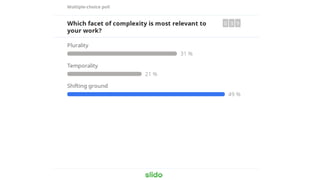
✓ Plurality
✓ Temporality
✓ Shifting ground
A heroic solution?
A problem-based approach:
How can we best respond to this facet of complexity?
Who and what contributes to this response, when & how?
Plurality
• Opportunity & challenge
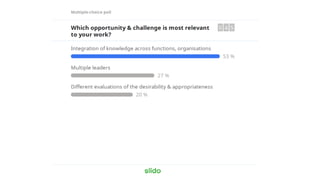
Integration of knowledge across functions,
organisations
Boundary complexities
• How can we best respond?
Bridging activities: Develop a ‘trading zone’
• Who / what contributes?
Brokers, bridging functions, a common
language, norms, procedures
Galison P (2010), Trading With The Enemy. In: Gorman, ME (ed) Trading
Zones and Interactional Expertise. Cambridge: The MIT Press.
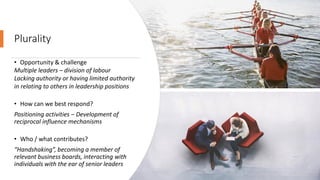
Plurality
• Opportunity & challenge
Multiple leaders – division of labour
Lacking authority or having limited authority
in relating to others in leadership positions
• How can we best respond?
Positioning activities – Development of
reciprocal influence mechanisms
• Who / what contributes?
“Handshaking”, becoming a member of
relevant business boards, interacting with
individuals with the ear of senior leaders
Plurality
• Opportunity & challenge
Different evaluations of the desirability &
appropriateness of the intended change or
how it is delivered
• How can we best respond?
Legitimising activities - probing, parading,
informing
• Who / what contributes?
Leaders or members of the groups that will
receive the change, coalition of leaders
Temporality
• Opportunity & challenge
Pressures associated with publicly visible
deadlines can produce a sense of urgency but
also can lead to short-termism
• How can we best respond?
Temporal activities: Inquire into the
implications of action for long-term flexibility
• Who / what contributes?
The project team, possibly other stakeholders
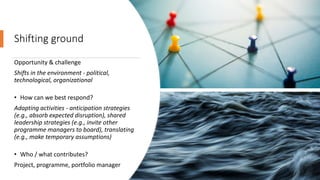
Shifting ground
Opportunity & challenge
Shifts in the environment - political,
technological, organizational
• How can we best respond?
Adapting activities - anticipation strategies
(e.g., absorb expected disruption), shared
leadership strategies (e.g., invite other
programme managers to board), translating
(e.g., make temporary assumptions)
• Who / what contributes?
Project, programme, portfolio manager
Reflexive learning
Not just reflecting on past experience
Collectively question assumptions & taken-for-granted ways of working
Organisational culture that supports this
Engaged scholarship
Scholars and practitioners need to bring together their expertise
during the design and delivery of complex projects
Deeper understanding of ‘what works’ –
Scholars are not immersed in practice. They bring in cutting edge theoretical guidance
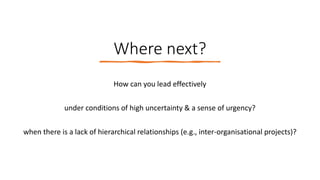
Where next?
How can you lead effectively
under conditions of high uncertainty & a sense of urgency?
when there is a lack of hierarchical relationships (e.g., inter-organisational projects)?
Any comments or questions?
d.s.kortantamer@brighton.ac.uk

Leadership: Responding to complexity webinar

  • 1.
  • 6.
    Three facets of complexity ✓Plurality ✓ Temporality ✓ Shifting ground
  • 7.
    A heroic solution? Aproblem-based approach: How can we best respond to this facet of complexity? Who and what contributes to this response, when & how?
  • 8.
    Plurality • Opportunity &challenge Integration of knowledge across functions, organisations Boundary complexities • How can we best respond? Bridging activities: Develop a ‘trading zone’ • Who / what contributes? Brokers, bridging functions, a common language, norms, procedures Galison P (2010), Trading With The Enemy. In: Gorman, ME (ed) Trading Zones and Interactional Expertise. Cambridge: The MIT Press.
  • 9.
    Plurality • Opportunity &challenge Multiple leaders – division of labour Lacking authority or having limited authority in relating to others in leadership positions • How can we best respond? Positioning activities – Development of reciprocal influence mechanisms • Who / what contributes? “Handshaking”, becoming a member of relevant business boards, interacting with individuals with the ear of senior leaders
  • 10.
    Plurality • Opportunity &challenge Different evaluations of the desirability & appropriateness of the intended change or how it is delivered • How can we best respond? Legitimising activities - probing, parading, informing • Who / what contributes? Leaders or members of the groups that will receive the change, coalition of leaders
  • 12.
    Temporality • Opportunity &challenge Pressures associated with publicly visible deadlines can produce a sense of urgency but also can lead to short-termism • How can we best respond? Temporal activities: Inquire into the implications of action for long-term flexibility • Who / what contributes? The project team, possibly other stakeholders
  • 13.
    Shifting ground Opportunity &challenge Shifts in the environment - political, technological, organizational • How can we best respond? Adapting activities - anticipation strategies (e.g., absorb expected disruption), shared leadership strategies (e.g., invite other programme managers to board), translating (e.g., make temporary assumptions) • Who / what contributes? Project, programme, portfolio manager
  • 15.
    Reflexive learning Not justreflecting on past experience Collectively question assumptions & taken-for-granted ways of working Organisational culture that supports this
  • 16.
    Engaged scholarship Scholars andpractitioners need to bring together their expertise during the design and delivery of complex projects Deeper understanding of ‘what works’ – Scholars are not immersed in practice. They bring in cutting edge theoretical guidance
  • 17.
    Where next? How canyou lead effectively under conditions of high uncertainty & a sense of urgency? when there is a lack of hierarchical relationships (e.g., inter-organisational projects)?
  • 20.
    Any comments orquestions? d.s.kortantamer@brighton.ac.uk