Jim McDonaldChief Strategy Officer, XiotechData Storage for the CloudBalancing Performance, Capacity and Cost
Most data follows a similar patternWrite, read, ignore“Small” amounts of data follow a much more aggressive patternWrite, write,read, write,read, read, write, read,read, read,write, write, write, write,read, writeThe result is that for effective cloud storage you need to have both high capacity and highperformanceAnd it needs to be cheaper than could be done in-houseStorage for the Cloud
Traditional cloud storage was viewed as a data dumping groundAll about $/GB, performance “irrelevant”Cloud storage is now becoming a lot more active:File synchronisationBig dataCalendars…And performance is needed for cloud computingIf it can’t do it faster and cheaper it won’t winWhy are the Requirements Changing?
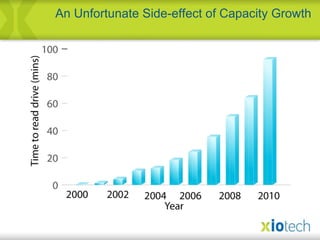
An Unfortunate Side-effect of Capacity Growth
Over the past 10 years, on a performance/GB basis, drives have gone down 50xWhat Does This Mean?
A standard enterprise drive can handle roughly:An Exchange server with 125 users @ 2.4GB/userA 300GB database with 12 transactions per secondA virtual desktop implementation with 3 users @ 100GB/userThe capacity Vs. performance numbers are very imbalanced against performanceFor internal IT this is wasted expenditureFor cloud service providers this is unobtainable revenuePerformance is the Limiting Factor
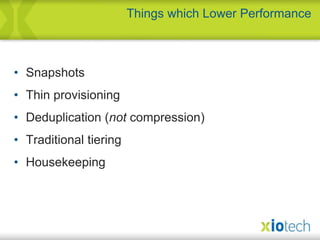
SnapshotsThin provisioningDeduplication (not compression)Traditional tieringHousekeepingThings which Lower Performance
Traditional tiering is a great example of sacrificing performance for capacityBecause tiering focuses on capacityCurrent tiering algorithms are especially bad for heavily-loaded environmentsThink sat nav before traffic informationEnterprise storage:10,000 IOPSTraditional TieringArchive storage:2,000 IOPSPerformanceCurrent tiering solutions are fine if you just want capacity(But if you just want capacity don’t bother with tiering)
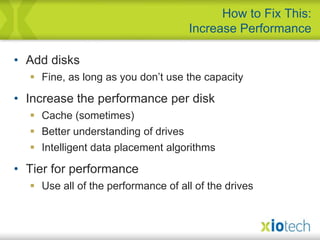
Add disksFine, as long as you don’t use the capacityIncrease the performance per diskCache (sometimes)Better understanding of drivesIntelligent data placement algorithmsTier for performanceUse all of the performance of all of the drivesHow to Fix This:Increase Performance
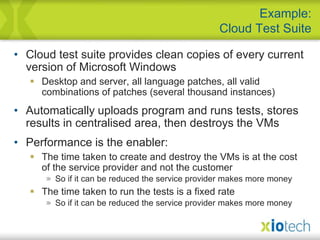
Cloud test suite provides clean copies of every current version of Microsoft WindowsDesktop and server, all language patches, all valid combinations of patches (several thousand instances)Automatically uploads program and runs tests, stores results in centralised area, then destroys the VMsPerformance is the enabler:The time taken to create and destroy the VMs is at the cost of the service provider and not the customerSo if it can be reduced the service provider makes more moneyThe time taken to run the tests is a fixed rateSo if it can be reduced the service provider makes more moneyExample:Cloud Test Suite
Stop thinking like it’s 2000“If I could get all the old data off my enterprise drives I’d be rich”Capacity is not expensive any more, performance isMeasure anything other than archive storage in terms of performance not capacityBe wary of capacity-increasing (and performance-decreasing) “added value” featuresDo you really need more capacity and less performance?Closing Thoughts
Questions?
Thank You

Data storage for the cloud ce11

  • 1.
    Jim McDonaldChief StrategyOfficer, XiotechData Storage for the CloudBalancing Performance, Capacity and Cost
  • 2.
    Most data followsa similar patternWrite, read, ignore“Small” amounts of data follow a much more aggressive patternWrite, write,read, write,read, read, write, read,read, read,write, write, write, write,read, writeThe result is that for effective cloud storage you need to have both high capacity and highperformanceAnd it needs to be cheaper than could be done in-houseStorage for the Cloud
  • 3.
    Traditional cloud storagewas viewed as a data dumping groundAll about $/GB, performance “irrelevant”Cloud storage is now becoming a lot more active:File synchronisationBig dataCalendars…And performance is needed for cloud computingIf it can’t do it faster and cheaper it won’t winWhy are the Requirements Changing?
  • 4.
    An Unfortunate Side-effectof Capacity Growth
  • 5.
    Over the past10 years, on a performance/GB basis, drives have gone down 50xWhat Does This Mean?
  • 6.
    A standard enterprisedrive can handle roughly:An Exchange server with 125 users @ 2.4GB/userA 300GB database with 12 transactions per secondA virtual desktop implementation with 3 users @ 100GB/userThe capacity Vs. performance numbers are very imbalanced against performanceFor internal IT this is wasted expenditureFor cloud service providers this is unobtainable revenuePerformance is the Limiting Factor
  • 7.
    SnapshotsThin provisioningDeduplication (notcompression)Traditional tieringHousekeepingThings which Lower Performance
  • 8.
    Traditional tiering isa great example of sacrificing performance for capacityBecause tiering focuses on capacityCurrent tiering algorithms are especially bad for heavily-loaded environmentsThink sat nav before traffic informationEnterprise storage:10,000 IOPSTraditional TieringArchive storage:2,000 IOPSPerformanceCurrent tiering solutions are fine if you just want capacity(But if you just want capacity don’t bother with tiering)
  • 9.
    Add disksFine, aslong as you don’t use the capacityIncrease the performance per diskCache (sometimes)Better understanding of drivesIntelligent data placement algorithmsTier for performanceUse all of the performance of all of the drivesHow to Fix This:Increase Performance
  • 10.
    Cloud test suiteprovides clean copies of every current version of Microsoft WindowsDesktop and server, all language patches, all valid combinations of patches (several thousand instances)Automatically uploads program and runs tests, stores results in centralised area, then destroys the VMsPerformance is the enabler:The time taken to create and destroy the VMs is at the cost of the service provider and not the customerSo if it can be reduced the service provider makes more moneyThe time taken to run the tests is a fixed rateSo if it can be reduced the service provider makes more moneyExample:Cloud Test Suite
  • 11.
    Stop thinking likeit’s 2000“If I could get all the old data off my enterprise drives I’d be rich”Capacity is not expensive any more, performance isMeasure anything other than archive storage in terms of performance not capacityBe wary of capacity-increasing (and performance-decreasing) “added value” featuresDo you really need more capacity and less performance?Closing Thoughts
  • 12.
  • 13.