The Western Democracies Stumble
Post-War European Problems
• In 1919, after WWI, Britain, France, and the USA – the
three democracies - appeared powerful
• However, postwar Europe faced grave problems
• The most pressing issues were 1) finding jobs for veterans
and 2) rebuilding war-ravaged lands
• Many potential future leaders were killed in the war
Post-War European Problems
• These problems made radical ideas
more popular with citizens
• Britain had to deal with growing
socialism and the “Irish Question”
• Fear of radicals set off a “Red Scare”
in the USA
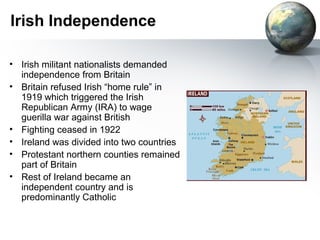
Irish Independence
• Irish militant nationalists demanded
independence from Britain
• Britain refused Irish “home rule” in
1919 which triggered the Irish
Republican Army (IRA) to wage
guerilla war against British
• Fighting ceased in 1922
• Ireland was divided into two countries
• Protestant northern counties remained
part of Britain
• Rest of Ireland became an
independent country and is
predominantly Catholic
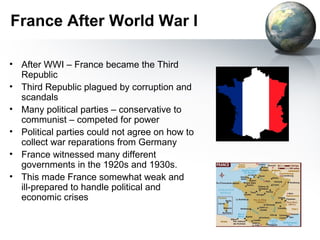
France After World War I
• After WWI – France became the Third
Republic
• Third Republic plagued by corruption and
scandals
• Many political parties – conservative to
communist – competed for power
• Political parties could not agree on how to
collect war reparations from Germany
• France witnessed many different
governments in the 1920s and 1930s.
• This made France somewhat weak and
ill-prepared to handle political and
economic crises
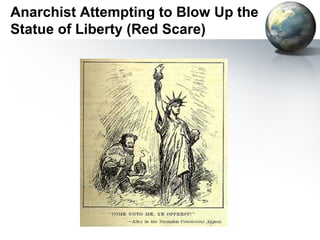
The Red Scare
• The Bolshevik (Communist) Revolution triggered a “Red
Scare” in the USA (1919-1920)
• Some Americans feared a Communist takeover similar to
the Russian Revolution
• Police arrested “suspected” Communist radical
sympathizers and deported them from the USA
• Red Scare sparked demands to limit immigration from
Europe mostly from Southern and Eastern Europe
• Congress passed laws that restricted immigration from
certain areas of Europe
• A shadow of immigration discrimination descended upon
the USA
Red Scare
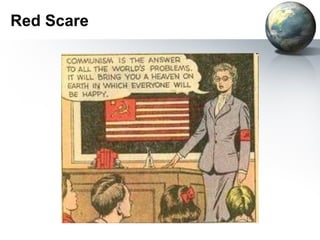
Red Scare
Anarchist Attempting to Blow Up the
Statue of Liberty (Red Scare)
International Issues
• The three democracies also faced international issues
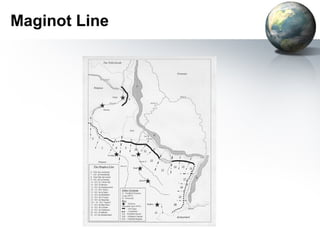
• Concern about a strong Germany led France to build the
Maginot Line and insist on strict enforcement of the
Versailles treaty and war reparations
• Maginot Line was a series of defensive fortifications along
France-Germany border designed to prevent another
German invasion
• France sought alliances with other countries to keep
Germany weak
• Britain disagreed with France’s attitude toward Germany
• Britain feared that IF Germany became too weak, USSR and
France would become too powerful
Maginot Line
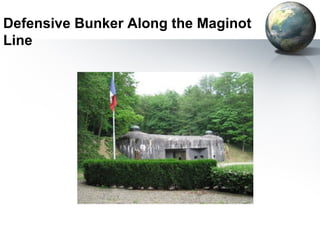
The Maginot Line named after French minister of
defense André Maginot was a line of concrete
fortifications, tank obstacles, machine gun posts and
other defenses which France constructed along its
borders with Germany and with Italy, in the light of
experience from World War I, and in the run-up to World
War II.
Maginot Line
Defensive Bunker Along the Maginot
Line
Locarno Treaties
• Signed in 1925 in Locarno, Switzerland
• Seven European nations
• Settled border disputes between Germany and
France, Belgium, the former Czechoslovakia, and
Poland
• Perhaps Europe had finally learned to live in
peace?
Kellogg-Briand Pact
• Many nations signed the Kellogg-Briand Pact promising to
“renounce war as an instrument of national policy”
• In this optimistic spirit, the great powers pursued
disarmament – the reduction of armed forces and weapons
• Sizes of navies were reduced but not the size of armies
• Unfortunately, neither the Kellogg-Briand Pact nor the WEAK
League of Nations (located in Switzerland) had the power to
stop aggression
• Ambitious dictators in Europe and Japan noted and exploited
this weakness (e.g., Japanese invasion of Manchuria)
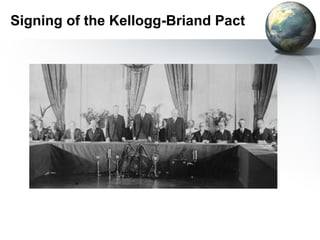
Signing of the Kellogg-Briand Pact
Kellogg-Briand Pact
The Kellogg-Briand Pact, also known as the Pact of
Paris after the city where it was signed on August 27,
1928, was an international treaty "providing for the
renunciation of war as an instrument of national policy." It
failed in its purpose but was significant for later
developments in international law. It was named after the
American secretary of state Frank B. Kellogg and French
foreign minister Aristide Briand, who drafted the pact.
WWI Affected National Economies
• The war affected economies all over the world
• Both Britain and France owned huge war debts to the
USA and relied on reparation payments from Germany to
pay their loans
• Britain was deeply in debt with high unemployment and
low wages, and out of date factories
• In 1926, a general strike lasted nine days and involved
three million workers
WWI Affected National Economies
• Conversely, the French economy recovered fairly quickly,
while the USA emerged as the world’s top economic power
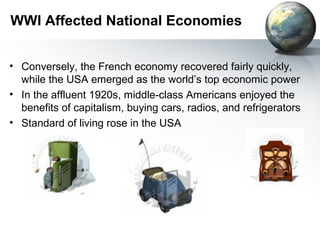
• In the affluent 1920s, middle-class Americans enjoyed the
benefits of capitalism, buying cars, radios, and refrigerators
• Standard of living rose in the USA
Economic Pressures
• Better technologies allowed factories to make more
products faster, leading to overproduction in the United
States
• Factories then cut back, and many workers lost their jobs
• A crisis in finance (management of money matters
including the circulation of money, loans, investments, and
banking) led the Federal Reserve (central U.S. banking
system) to raise interest rates
• This made people even more nervous about the economy
Economic Pressures
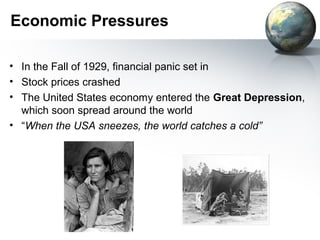
• In the Fall of 1929, financial panic set in
• Stock prices crashed
• The United States economy entered the Great Depression,
which soon spread around the world
• “When the USA sneezes, the world catches a cold”
Great Depression
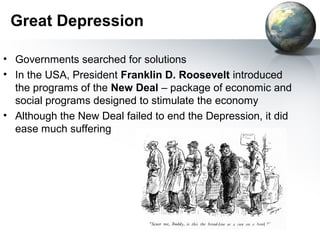
• Governments searched for solutions
• In the USA, President Franklin D. Roosevelt introduced
the programs of the New Deal – package of economic and
social programs designed to stimulate the economy
• Although the New Deal failed to end the Depression, it did
ease much suffering
Great Depression
• Critics of the New Deal argued
that the size of the federal
government increased and the
federal debt increased
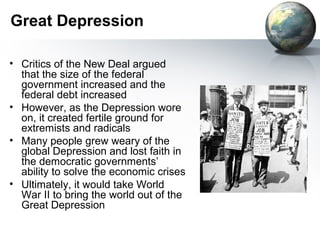
• However, as the Depression wore
on, it created fertile ground for
extremists and radicals
• Many people grew weary of the
global Depression and lost faith in
the democratic governments’
ability to solve the economic crises
• Ultimately, it would take World
War II to bring the world out of the
Great Depression
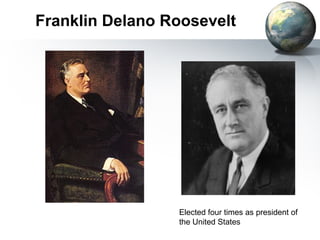
Franklin Delano Roosevelt
Elected four times as president of
the United States
Powerpoint Questions
• 1. What were the three powerful democratic countries that
emerged after World War I?
• 2. What pressing problem faced Great Britain from 1919-
1922? How was this problem solved? Describe.
• 3. Why was France weakened in the 1920s?
• 4. Which country emerged as the world’s top economic
power after WWI?
• 4. Why did the USA experience a “Red Scare”?
• 5. What was the Kellogg-Briand Pact designed to do?
Powerpoint Questions
• 6. What 1929 event aggravated the economic decline in the USA?
• 7. What treaty settled territorial disputes between Germany and other
European countries?
• 8. What agreement among various countries renounced war as an
instrument of national policy?
• 9. In the USA, what was one result of manufacturing goods at a faster
rate?
• 10. What is the name of the U.S. central banking system?
• 11. What program did President Roosevelt introduce to stimulate the
U.S. economy after the Great Depression began?
• 12. Why did people around the world lose faith in their governments?
The End

The Western Democracies Stumble

  • 1.
  • 2.
    Post-War European Problems •In 1919, after WWI, Britain, France, and the USA – the three democracies - appeared powerful • However, postwar Europe faced grave problems • The most pressing issues were 1) finding jobs for veterans and 2) rebuilding war-ravaged lands • Many potential future leaders were killed in the war
  • 3.
    Post-War European Problems •These problems made radical ideas more popular with citizens • Britain had to deal with growing socialism and the “Irish Question” • Fear of radicals set off a “Red Scare” in the USA
  • 4.
    Irish Independence • Irishmilitant nationalists demanded independence from Britain • Britain refused Irish “home rule” in 1919 which triggered the Irish Republican Army (IRA) to wage guerilla war against British • Fighting ceased in 1922 • Ireland was divided into two countries • Protestant northern counties remained part of Britain • Rest of Ireland became an independent country and is predominantly Catholic
  • 5.
    France After WorldWar I • After WWI – France became the Third Republic • Third Republic plagued by corruption and scandals • Many political parties – conservative to communist – competed for power • Political parties could not agree on how to collect war reparations from Germany • France witnessed many different governments in the 1920s and 1930s. • This made France somewhat weak and ill-prepared to handle political and economic crises
  • 6.
    The Red Scare •The Bolshevik (Communist) Revolution triggered a “Red Scare” in the USA (1919-1920) • Some Americans feared a Communist takeover similar to the Russian Revolution • Police arrested “suspected” Communist radical sympathizers and deported them from the USA • Red Scare sparked demands to limit immigration from Europe mostly from Southern and Eastern Europe • Congress passed laws that restricted immigration from certain areas of Europe • A shadow of immigration discrimination descended upon the USA
  • 7.
  • 8.
  • 9.
    Anarchist Attempting toBlow Up the Statue of Liberty (Red Scare)
  • 10.
    International Issues • Thethree democracies also faced international issues • Concern about a strong Germany led France to build the Maginot Line and insist on strict enforcement of the Versailles treaty and war reparations • Maginot Line was a series of defensive fortifications along France-Germany border designed to prevent another German invasion • France sought alliances with other countries to keep Germany weak • Britain disagreed with France’s attitude toward Germany • Britain feared that IF Germany became too weak, USSR and France would become too powerful
  • 11.
    Maginot Line The MaginotLine named after French minister of defense André Maginot was a line of concrete fortifications, tank obstacles, machine gun posts and other defenses which France constructed along its borders with Germany and with Italy, in the light of experience from World War I, and in the run-up to World War II.
  • 12.
  • 13.
    Defensive Bunker Alongthe Maginot Line
  • 14.
    Locarno Treaties • Signedin 1925 in Locarno, Switzerland • Seven European nations • Settled border disputes between Germany and France, Belgium, the former Czechoslovakia, and Poland • Perhaps Europe had finally learned to live in peace?
  • 15.
    Kellogg-Briand Pact • Manynations signed the Kellogg-Briand Pact promising to “renounce war as an instrument of national policy” • In this optimistic spirit, the great powers pursued disarmament – the reduction of armed forces and weapons • Sizes of navies were reduced but not the size of armies • Unfortunately, neither the Kellogg-Briand Pact nor the WEAK League of Nations (located in Switzerland) had the power to stop aggression • Ambitious dictators in Europe and Japan noted and exploited this weakness (e.g., Japanese invasion of Manchuria)
  • 16.
    Signing of theKellogg-Briand Pact
  • 17.
    Kellogg-Briand Pact The Kellogg-BriandPact, also known as the Pact of Paris after the city where it was signed on August 27, 1928, was an international treaty "providing for the renunciation of war as an instrument of national policy." It failed in its purpose but was significant for later developments in international law. It was named after the American secretary of state Frank B. Kellogg and French foreign minister Aristide Briand, who drafted the pact.
  • 18.
    WWI Affected NationalEconomies • The war affected economies all over the world • Both Britain and France owned huge war debts to the USA and relied on reparation payments from Germany to pay their loans • Britain was deeply in debt with high unemployment and low wages, and out of date factories • In 1926, a general strike lasted nine days and involved three million workers
  • 19.
    WWI Affected NationalEconomies • Conversely, the French economy recovered fairly quickly, while the USA emerged as the world’s top economic power • In the affluent 1920s, middle-class Americans enjoyed the benefits of capitalism, buying cars, radios, and refrigerators • Standard of living rose in the USA
  • 20.
    Economic Pressures • Bettertechnologies allowed factories to make more products faster, leading to overproduction in the United States • Factories then cut back, and many workers lost their jobs • A crisis in finance (management of money matters including the circulation of money, loans, investments, and banking) led the Federal Reserve (central U.S. banking system) to raise interest rates • This made people even more nervous about the economy
  • 21.
    Economic Pressures • Inthe Fall of 1929, financial panic set in • Stock prices crashed • The United States economy entered the Great Depression, which soon spread around the world • “When the USA sneezes, the world catches a cold”
  • 22.
    Great Depression • Governmentssearched for solutions • In the USA, President Franklin D. Roosevelt introduced the programs of the New Deal – package of economic and social programs designed to stimulate the economy • Although the New Deal failed to end the Depression, it did ease much suffering
  • 23.
    Great Depression • Criticsof the New Deal argued that the size of the federal government increased and the federal debt increased • However, as the Depression wore on, it created fertile ground for extremists and radicals • Many people grew weary of the global Depression and lost faith in the democratic governments’ ability to solve the economic crises • Ultimately, it would take World War II to bring the world out of the Great Depression
  • 24.
    Franklin Delano Roosevelt Electedfour times as president of the United States
  • 25.
    Powerpoint Questions • 1.What were the three powerful democratic countries that emerged after World War I? • 2. What pressing problem faced Great Britain from 1919- 1922? How was this problem solved? Describe. • 3. Why was France weakened in the 1920s? • 4. Which country emerged as the world’s top economic power after WWI? • 4. Why did the USA experience a “Red Scare”? • 5. What was the Kellogg-Briand Pact designed to do?
  • 26.
    Powerpoint Questions • 6.What 1929 event aggravated the economic decline in the USA? • 7. What treaty settled territorial disputes between Germany and other European countries? • 8. What agreement among various countries renounced war as an instrument of national policy? • 9. In the USA, what was one result of manufacturing goods at a faster rate? • 10. What is the name of the U.S. central banking system? • 11. What program did President Roosevelt introduce to stimulate the U.S. economy after the Great Depression began? • 12. Why did people around the world lose faith in their governments?
  • 27.