Risk Equation
Most risk equations include the
standard approach of probability
and impact. Nowadays, with the
changing threat landscape, a new
approach to the risk equation
should be looked at.
Adesh Rampat (adeshpcs@yahoo.com)
Risk Equation
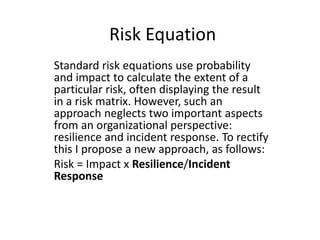
Standard risk equations use probability
and impact to calculate the extent of a
particular risk, often displaying the result
in a risk matrix. However, such an
approach neglects two important aspects
from an organizational perspective:
resilience and incident response. To rectify
this I propose a new approach, as follows:
Risk = Impact x Resilience/Incident
Response
Risk Equation
This equation allows for risk to be easily understood
especially when it comes to the level of incident
response required to address an event. It also
assists in the assessment process as to the critical
areas to focus on in today’s constantly changing
threat landscape.
When an organization is hit by a cyber attack, for
example, the probable questions that are asked
include:
What is the impact?
What systems within the network has the attack
penetrated?
Is our current incident response plan effective?
Risk Equation
Let’s analyze what this equation is about:
Impact: this is the effect on the organization due to the occurrence of a risk.
Resilience: organizational resilience against threats. This must take into
consideration the following:
Ability to deal with the effects of a natural disaster – this will include the
relocation of systems and staff required to have the organization functioning
within a reasonable period of time.
Ability to withstand the effect of technology related threats such as distributed
denial of service attacks (DDOS). Resiliency in this area would range from
employing sufficient bandwidth to ‘cushion’ such an attack to recognizing a threat
through the use of monitoring systems.
Conducting periodic penetration tests (both on the external perimeter and
internal network) to understand where vulnerability exists and implementing the
necessary fixes.
Employing user awareness programs, to combat, for example, against
Ransomware and other social engineering threats.
Risk Equation
Incident response: the time it takes for an organization
to respond to an attack in the event that its systems have
been penetrated or have been hit by a natural disaster. An
organization must have a sound incident management
plan which it can use to be able to recover within the
shortest possible time.
Risk Equation
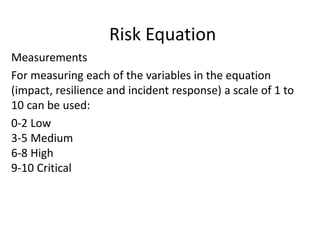
Measurements
For measuring each of the variables in the equation
(impact, resilience and incident response) a scale of 1 to
10 can be used:
0-2 Low
3-5 Medium
6-8 High
9-10 Critical
Risk Equation
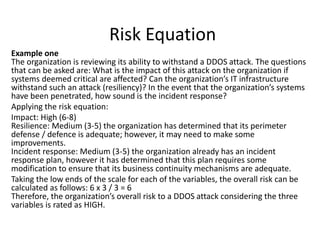
Example one
The organization is reviewing its ability to withstand a DDOS attack. The questions
that can be asked are: What is the impact of this attack on the organization if
systems deemed critical are affected? Can the organization’s IT infrastructure
withstand such an attack (resiliency)? In the event that the organization’s systems
have been penetrated, how sound is the incident response?
Applying the risk equation:
Impact: High (6-8)
Resilience: Medium (3-5) the organization has determined that its perimeter
defense / defence is adequate; however, it may need to make some
improvements.
Incident response: Medium (3-5) the organization already has an incident
response plan, however it has determined that this plan requires some
modification to ensure that its business continuity mechanisms are adequate.
Taking the low ends of the scale for each of the variables, the overall risk can be
calculated as follows: 6 x 3 / 3 = 6
Therefore, the organization’s overall risk to a DDOS attack considering the three
variables is rated as HIGH.
Risk Equation
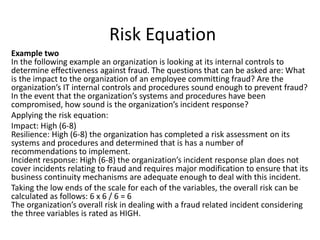
Example two
In the following example an organization is looking at its internal controls to
determine effectiveness against fraud. The questions that can be asked are: What
is the impact to the organization of an employee committing fraud? Are the
organization’s IT internal controls and procedures sound enough to prevent fraud?
In the event that the organization’s systems and procedures have been
compromised, how sound is the organization’s incident response?
Applying the risk equation:
Impact: High (6-8)
Resilience: High (6-8) the organization has completed a risk assessment on its
systems and procedures and determined that is has a number of
recommendations to implement.
Incident response: High (6-8) the organization’s incident response plan does not
cover incidents relating to fraud and requires major modification to ensure that its
business continuity mechanisms are adequate enough to deal with this incident.
Taking the low ends of the scale for each of the variables, the overall risk can be
calculated as follows: 6 x 6 / 6 = 6
The organization’s overall risk in dealing with a fraud related incident considering
the three variables is rated as HIGH.
Risk Equation
With this new approach to calculating risk, organizations
can have a much clearer view as to the risks faced when its
resilience and incident response are being tested.

Risk Equation

  • 1.
    Risk Equation Most riskequations include the standard approach of probability and impact. Nowadays, with the changing threat landscape, a new approach to the risk equation should be looked at. Adesh Rampat (adeshpcs@yahoo.com)
  • 2.
    Risk Equation Standard riskequations use probability and impact to calculate the extent of a particular risk, often displaying the result in a risk matrix. However, such an approach neglects two important aspects from an organizational perspective: resilience and incident response. To rectify this I propose a new approach, as follows: Risk = Impact x Resilience/Incident Response
  • 3.
    Risk Equation This equationallows for risk to be easily understood especially when it comes to the level of incident response required to address an event. It also assists in the assessment process as to the critical areas to focus on in today’s constantly changing threat landscape. When an organization is hit by a cyber attack, for example, the probable questions that are asked include: What is the impact? What systems within the network has the attack penetrated? Is our current incident response plan effective?
  • 4.
    Risk Equation Let’s analyzewhat this equation is about: Impact: this is the effect on the organization due to the occurrence of a risk. Resilience: organizational resilience against threats. This must take into consideration the following: Ability to deal with the effects of a natural disaster – this will include the relocation of systems and staff required to have the organization functioning within a reasonable period of time. Ability to withstand the effect of technology related threats such as distributed denial of service attacks (DDOS). Resiliency in this area would range from employing sufficient bandwidth to ‘cushion’ such an attack to recognizing a threat through the use of monitoring systems. Conducting periodic penetration tests (both on the external perimeter and internal network) to understand where vulnerability exists and implementing the necessary fixes. Employing user awareness programs, to combat, for example, against Ransomware and other social engineering threats.
  • 5.
    Risk Equation Incident response:the time it takes for an organization to respond to an attack in the event that its systems have been penetrated or have been hit by a natural disaster. An organization must have a sound incident management plan which it can use to be able to recover within the shortest possible time.
  • 6.
    Risk Equation Measurements For measuringeach of the variables in the equation (impact, resilience and incident response) a scale of 1 to 10 can be used: 0-2 Low 3-5 Medium 6-8 High 9-10 Critical
  • 7.
    Risk Equation Example one Theorganization is reviewing its ability to withstand a DDOS attack. The questions that can be asked are: What is the impact of this attack on the organization if systems deemed critical are affected? Can the organization’s IT infrastructure withstand such an attack (resiliency)? In the event that the organization’s systems have been penetrated, how sound is the incident response? Applying the risk equation: Impact: High (6-8) Resilience: Medium (3-5) the organization has determined that its perimeter defense / defence is adequate; however, it may need to make some improvements. Incident response: Medium (3-5) the organization already has an incident response plan, however it has determined that this plan requires some modification to ensure that its business continuity mechanisms are adequate. Taking the low ends of the scale for each of the variables, the overall risk can be calculated as follows: 6 x 3 / 3 = 6 Therefore, the organization’s overall risk to a DDOS attack considering the three variables is rated as HIGH.
  • 8.
    Risk Equation Example two Inthe following example an organization is looking at its internal controls to determine effectiveness against fraud. The questions that can be asked are: What is the impact to the organization of an employee committing fraud? Are the organization’s IT internal controls and procedures sound enough to prevent fraud? In the event that the organization’s systems and procedures have been compromised, how sound is the organization’s incident response? Applying the risk equation: Impact: High (6-8) Resilience: High (6-8) the organization has completed a risk assessment on its systems and procedures and determined that is has a number of recommendations to implement. Incident response: High (6-8) the organization’s incident response plan does not cover incidents relating to fraud and requires major modification to ensure that its business continuity mechanisms are adequate enough to deal with this incident. Taking the low ends of the scale for each of the variables, the overall risk can be calculated as follows: 6 x 6 / 6 = 6 The organization’s overall risk in dealing with a fraud related incident considering the three variables is rated as HIGH.
  • 9.
    Risk Equation With thisnew approach to calculating risk, organizations can have a much clearer view as to the risks faced when its resilience and incident response are being tested.