20 January 2015
Peter Berkery
Executive Director
 136 Members
◦ 93 US, with university affiliation
◦ 19 US, with other institutional affiliation
◦ 10 Canadian (Anglophone)
◦ 14 International
 Founded in 1947
 8 staff
 Members must meet eligibility criteria:
◦ Peer review
◦ Commitment to Mission
◦ Sufficient program size
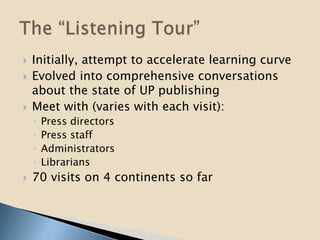
 Initially, attempt to accelerate learning curve
 Evolved into comprehensive conversations
about the state of UP publishing
 Meet with (varies with each visit):
◦ Press directors
◦ Press staff
◦ Administrators
◦ Librarians
 70 visits on 4 continents so far
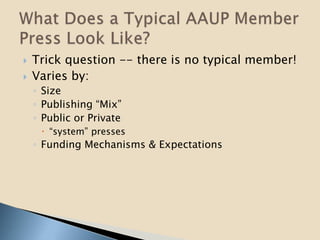
 Trick question -- there is no typical member!
 Varies by:
◦ Size
◦ Publishing “Mix”
◦ Public or Private
 “system” presses
◦ Funding Mechanisms & Expectations
 Academic Monographs
◦ “By scholars, for scholars”
 Crossover Monographs
 Regional
◦ Cultural and natural history
 Literature
◦ Especially in translation
 Poetry
 Textbooks
 Journals
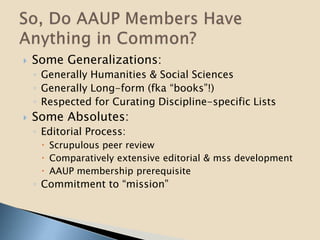
 Some Generalizations:
◦ Generally Humanities & Social Sciences
◦ Generally Long-form (fka “books”!)
◦ Respected for Curating Discipline-specific Lists
 Some Absolutes:
◦ Editorial Process:
 Scrupulous peer review
 Comparatively extensive editorial & mss development
 AAUP membership prerequisite
◦ Commitment to “mission”
 Advocacy/Visibility
 Financial Model Under Stress:
◦ Open Access
◦ Channel Disruption
◦ Shifting Library Budgets
 Scale (or lack thereof):
◦ Technology
◦ Production
◦ Sales & Marketing
 Changes in Promotion & Tenure Process
 Challenges to Peer Review
 AAUP’s New Strategic Plan
 Research Activities
◦ Largely Mellon Funded
◦ Intended to Build Capabilities Around:
 Consortial activity
 Bringing UP scholarship to the Open Web
 Global Focus
Build membership and foster internal and external
collaborations
◦ Celebrate existing collaborations among members
◦ Increase outreach to:
 international publishers and associations
 libraries and their organizations
 scholarly societies
 like-minded publishers
◦ Facilitate scaled collaborations to decrease costs and
increase capabilities
◦ Find points of common interest with like-minded
associations
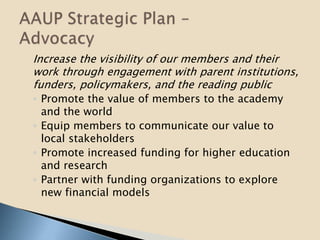
Increase the visibility of our members and their
work through engagement with parent institutions,
funders, policymakers, and the reading public
◦ Promote the value of members to the academy
and the world
◦ Equip members to communicate our value to
local stakeholders
◦ Promote increased funding for higher education
and research
◦ Partner with funding organizations to explore
new financial models
Conduct research that provides data and analyses
to support advocacy and to inform publishing
operations and new business models
◦ Collect, analyze, and disseminate AAUP statistical
surveys
◦ Facilitate selective environmental scans to
identify trends, gaps, and options for new
business opportunities and models
◦ Find and disseminate compelling data points and
at-a-glance facts and statistics to advocate for
presses
Provide professional development leadership
training
◦ Inventory and affirm best practices
◦ Promote cross-member education
◦ Develop programs and services that promote
essential skills and leadership development
 Web-based discoverability engine
◦ nap.edu/academy-scope/
 Increase visibility among associations
representing Higher Education constituencies
 Increase visibility among government agencies
responsible for Humanities funding
 Expand membership categories
 International sub rights solution
 Infrastructure: new website & member
collaboration hub
 Research, research, research
 Recent Mellon Grants – building capabilities:
◦ Pilot expansion of existing distribution business
into publishing services platform (UNC Press)
◦ Electronic portal for art & architectural history
content (Yale U Press)
◦ Peer review pilot project for digital content
(Stanford U Press)
◦ Open access digital monographs (U California Press)
◦ Mixed-media digital publishing platform (WVU)
◦ More grants pending for Spring cycle
 Understanding Monograph Costs
 Digitizing Backlists
 Networks of Collaboration
◦ Exchange information, ideas, best practices globally
◦ Ex: sharing information on peer review practices
 Networks of Advocacy
◦ Raise awareness of increasingly global policy
discussions
◦ Ex: freedom-to-read, anti-piracy, open access
 Networks of Commerce
◦ Increase ability to transact business globally
◦ Ex: global sub-rights database

University Presses: An Overview

  • 1.
    20 January 2015 PeterBerkery Executive Director
  • 2.
     136 Members ◦93 US, with university affiliation ◦ 19 US, with other institutional affiliation ◦ 10 Canadian (Anglophone) ◦ 14 International  Founded in 1947  8 staff  Members must meet eligibility criteria: ◦ Peer review ◦ Commitment to Mission ◦ Sufficient program size
  • 3.
     Initially, attemptto accelerate learning curve  Evolved into comprehensive conversations about the state of UP publishing  Meet with (varies with each visit): ◦ Press directors ◦ Press staff ◦ Administrators ◦ Librarians  70 visits on 4 continents so far
  • 4.
     Trick question-- there is no typical member!  Varies by: ◦ Size ◦ Publishing “Mix” ◦ Public or Private  “system” presses ◦ Funding Mechanisms & Expectations
  • 5.
     Academic Monographs ◦“By scholars, for scholars”  Crossover Monographs  Regional ◦ Cultural and natural history  Literature ◦ Especially in translation  Poetry  Textbooks  Journals
  • 6.
     Some Generalizations: ◦Generally Humanities & Social Sciences ◦ Generally Long-form (fka “books”!) ◦ Respected for Curating Discipline-specific Lists  Some Absolutes: ◦ Editorial Process:  Scrupulous peer review  Comparatively extensive editorial & mss development  AAUP membership prerequisite ◦ Commitment to “mission”
  • 7.
     Advocacy/Visibility  FinancialModel Under Stress: ◦ Open Access ◦ Channel Disruption ◦ Shifting Library Budgets  Scale (or lack thereof): ◦ Technology ◦ Production ◦ Sales & Marketing  Changes in Promotion & Tenure Process  Challenges to Peer Review
  • 8.
     AAUP’s NewStrategic Plan  Research Activities ◦ Largely Mellon Funded ◦ Intended to Build Capabilities Around:  Consortial activity  Bringing UP scholarship to the Open Web  Global Focus
  • 9.
    Build membership andfoster internal and external collaborations ◦ Celebrate existing collaborations among members ◦ Increase outreach to:  international publishers and associations  libraries and their organizations  scholarly societies  like-minded publishers ◦ Facilitate scaled collaborations to decrease costs and increase capabilities ◦ Find points of common interest with like-minded associations
  • 10.
    Increase the visibilityof our members and their work through engagement with parent institutions, funders, policymakers, and the reading public ◦ Promote the value of members to the academy and the world ◦ Equip members to communicate our value to local stakeholders ◦ Promote increased funding for higher education and research ◦ Partner with funding organizations to explore new financial models
  • 11.
    Conduct research thatprovides data and analyses to support advocacy and to inform publishing operations and new business models ◦ Collect, analyze, and disseminate AAUP statistical surveys ◦ Facilitate selective environmental scans to identify trends, gaps, and options for new business opportunities and models ◦ Find and disseminate compelling data points and at-a-glance facts and statistics to advocate for presses
  • 12.
    Provide professional developmentleadership training ◦ Inventory and affirm best practices ◦ Promote cross-member education ◦ Develop programs and services that promote essential skills and leadership development
  • 13.
     Web-based discoverabilityengine ◦ nap.edu/academy-scope/  Increase visibility among associations representing Higher Education constituencies  Increase visibility among government agencies responsible for Humanities funding  Expand membership categories  International sub rights solution  Infrastructure: new website & member collaboration hub  Research, research, research
  • 14.
     Recent MellonGrants – building capabilities: ◦ Pilot expansion of existing distribution business into publishing services platform (UNC Press) ◦ Electronic portal for art & architectural history content (Yale U Press) ◦ Peer review pilot project for digital content (Stanford U Press) ◦ Open access digital monographs (U California Press) ◦ Mixed-media digital publishing platform (WVU) ◦ More grants pending for Spring cycle  Understanding Monograph Costs  Digitizing Backlists
  • 15.
     Networks ofCollaboration ◦ Exchange information, ideas, best practices globally ◦ Ex: sharing information on peer review practices  Networks of Advocacy ◦ Raise awareness of increasingly global policy discussions ◦ Ex: freedom-to-read, anti-piracy, open access  Networks of Commerce ◦ Increase ability to transact business globally ◦ Ex: global sub-rights database